Game Animals of America BULL MOOSE
Reading edition
Monograph Number Five in The Mentor Reading Course
Imagine an animal standing between six and seven feet high at the shoulders, its legs four feet long, its neck and body covered with a heavy thatch of coarse, purplish gray hair, and its huge head crowned with massive antlers spreading from five to six feet in width! That is the moose (Alces americanus). It is the largest animal of the deer family. The only way to appreciate a moose is to see an adult animal alive and full of strength, striding through the forests of Canada or Alaska.
The word moose is a North American Indian name which is said to mean “cropper” or “trimmer,” from the animal’s habits of feeding on the branches of trees. The moose can be recognized by its broad, square-ended, overhanging nose, its high hump on the shoulders, its long, coarse, smoky gray hair, and the antlers of the male, which are enormously flattened and expanded. Moose are found in northern Maine, and some other parts of the Northern States, Canada and Alaska.
It is hard to kill a moose. Most of those killed are shot from ambush. In the autumn months the moose hunter may sometimes make a horn of birch bark and, concealing himself beside a pond at nightfall, may by imitating the call of the cow moose attract a bull within shooting distance.
The moose calf is born in May and is at first a grotesque looking creature with long, loose jointed legs and an abnormally short body. By the time the calf is a year old it has taken on the colors of adult life.
Unlike most members of the Deer Family, the moose does not graze. It eats the bark, twigs and leaves of certain trees, and also moss and lichens. It is strictly a forest animal and is never found on open, treeless plains. Being very fond of still water, it frequents small lakes and ponds.
One of the largest bull moose on record was seven feet high at the shoulders and had a girth of eight feet. The largest pair of antlers recorded have a spread, at the widest point, of 78 inches. The weight of the antlers and the dry skull together is 93 pounds.
The bull moose has under the throat a long strip of skin called a “bell.” In the adult male animal this bell is sometimes a foot in length The female moose has no antlers, and out of every thousand females only one has a bell.
In captivity the moose is docile, and affectionate. They have even been trained to drive in harness. But owing to the peculiar nature of their digestive organs, they cannot live long upon ordinary grass or hay. Green grass is fatal to them.
During the deep snows of winter moose herd together in sheltered spots in the forest. They move about in a small area and by treading down the snow form what is called a “moose yard.”
The Alaskan moose has been described as a new species (Alces gigas). It is said to be a giant in size. Ideas of this animal are greatly exaggerated, although it is true that its antlers are really immense.
BASED ON MATERIAL DRAWN FROM “THE AMERICAN NATURAL HISTORY,” COPYRIGHT 1904, BY WILLIAM T. HORNADAY
ILLUSTRATION FOR THE MENTOR. VOL. 4. No. 13. SERIAL No. 113
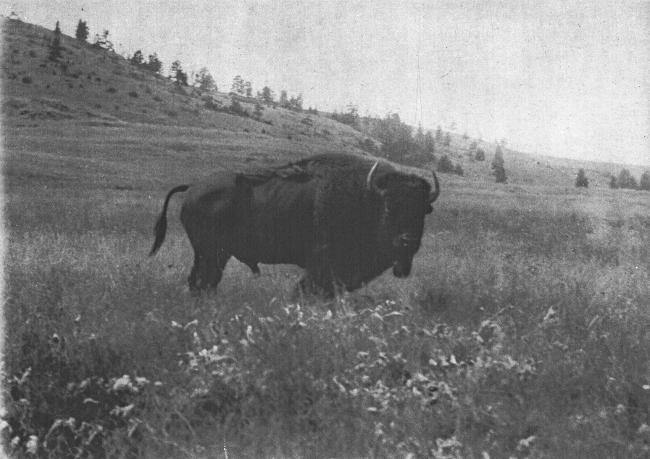
THE BISON LEADER