Editorial
Reading edition
“Seek knowledge wherever it can be found throughout the world.” So spoke Mutsuhito, late Emperor of Japan. It was a favorite maxim of his, and one frequently repeated by his subjects. It might well be a legend of The Mentor, for the wise thought beneath that injunction of the emperor’s is just what inspired The Mentor plan.

The method pursued in The Mentor finds, too, a striking parallel in Japanese life. In seeking knowledge and in the enjoyment of beautiful things, the Japanese set their minds on “one thing at a time.” Their habit of thought and their method of study are such as might be expressed in The Mentor principle, “Learn one thing every day.”
The thoroughness of the Japanese is well known. Their intelligence, enterprise, and up-to-dateness have been illustrated many times in the arts of peace and in the science of war. In this one particular principle of concentration in study, and single mindedness in the enjoyment of beautiful things, the Japanese may well be taken as a model for the rest of mankind.
My friend Takashima showed me lately a beautiful vase. It stood on a pedestal in a room that seemed to me empty. Simple matting covered the floor; simply decorated screens covered the walls; a few pieces of furniture, equally simple, were all that the room contained—beside that vase. “Is it not beautiful?” he said, and then he gave me its history, telling me who, among the early masters of Chinese pottery, had designed and shaped this exquisite work of art. I remarked on the reverence that he showed for a single work of art in devoting a room to it alone. “Enjoy one thing of beauty at a time,” he said. “I could not enjoy this vase in a room filled with miscellaneous things. As well go to a shop. The mind would be in chaos—knowing nothing well and appreciating nothing to the full.”
Such had always been Takashima’s habit. He said it was a habit of his people. “Why,” he asked, “should you have more than one thing of beauty in your room at a time? Enjoy it to the full. Then place something else there, but, before removing it, get out of it all that there is in it of beauty and of knowledge. You cannot do this in the confusion of a room filled with many varied things.” The incident was so strikingly in accord with The Mentor idea that it seemed as if Takashima might the next moment have added the phrase, “Learn one thing every day.”
And so the principle underlying the plan of The Mentor Association is one approved and exercised by a nation of intelligent people. How many other people follow this direct and simple path to knowledge we cannot say, but that it is not only the direct and simple way, but the one satisfying and effective way of acquiring knowledge, is plain. On that principle The Mentor Association is founded, and by following that principle, the members of the Association can add day by day to their store of knowledge, and can fully and intelligently enjoy the beautiful things in art.
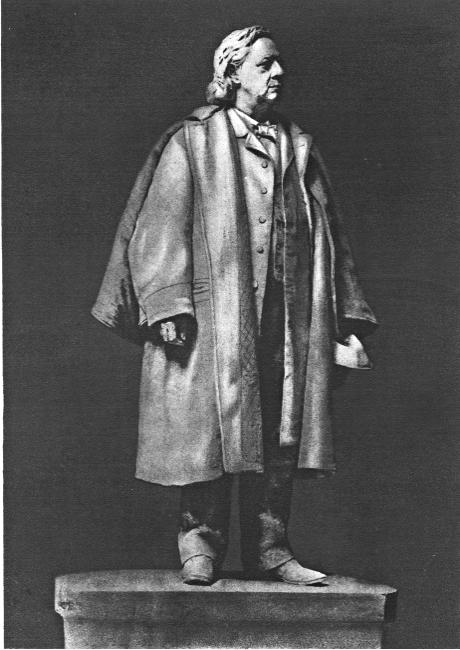
COPYRIGHT 1903 THE MACMILLAN CO
HENRY WARD BEECHER—JOHN QUINCY ADAMS WARD
REPRODUCED FROM “AMERICAN SCULPTURE” BY LORADO TAFT
