THE OPEN LETTER
Reading edition
Why The Mentor? What’s in the name? We might have chosen any one of fifty names beside The Mentor. We had a list of fully 100 names before we made our selection. And the material that we have supplied under the name of “Mentor” would have served its purpose as well under another name. But we chose our name very carefully. There’s a reason for “Mentor.” And yet, although we are now a little over three years old and number nearly 100,000 in membership, no one has asked the reason—at least until a few weeks ago. Then one of our earliest members put the question, “What or who is The Mentor?” The question was slow in coming, but I am glad it is here, because the answer is worth while.

Mentor was a very worthy individual of ancient Greece. You can read about him in Homer’s “Odyssey.” He was the son of Alcimus and the faithful friend of Ulysses (Odysseus). When Ulysses set forth on his long wanderings, he consigned his household and his family, including his son Telemachus to the care of his friend Mentor. So faithful was Mentor in his attention to Telemachus and so serviceable to him in precept and example that his name has now come to be used in the sense of a wise and trustworthy advisor—“a wise and faithful guide and friend” as a modern dictionary phrases it.
The name of Mentor was brought down nearer to our time by the eminent French writer, philosopher, and churchman, Fenelon, archbishop of Cambria. He lived in the time of the Grand Monarch, Louis XIV, and so wise and cultivated was he that the king made him tutor to his grandson, the Duke of Burgundy, eldest son of the dauphin, and eventual heir to the throne. In the course of his tutorship, and for purposes of instruction, Fenelon wrote several remarkable books—prose poems, in their way, but each having a distinct moral purpose either religious or political. In one of these, published in 1699, and entitled “Telemaque,” Fenelon recounts the adventures of the son of Ulysses in search of his father. It is a Utopian novel dealing with conditions of life in an idealistic way, and hovering between dreams and realities. Its object was to educate the young Duke of Burgundy’s mind to the highest purposes of life as they should be regarded by royalty—to keep before his eyes the “great and holy maxim that kings exist for the sake of their subjects, not subjects for the sake of kings.” In this book the character of “Mentor” figures prominently. His aims are educational in a gentle, lofty way, his hope being, as he puts it himself, “to change the tastes and habits of the people.”
It was more due to Fenelon’s employment of the character of “Mentor” than to that of Homer, that the name “Mentor” came into use as a modern word. “Mentor” now stands for a wise instructor and a guide, but, first and foremost, a friend. The underlying principle of “Mentor” is an interest in the welfare and improvement of others, and the dominating purpose of his life is service to others.
So for that reason we selected the name. And when we made the selection we thought that we were the first to use the name in the field of periodical publication. We lived in that illusion but a short time. Scarcely six months had gone by before we learned anew the old lesson that the world is small and that there are many active minds in it. One morning a plain, unpretentious periodical came into our office bearing on its front the title “The Mentor,” and with it came a friendly letter of greeting from its editor. The place of publication was the Charlestown Jail, and the object of the periodical was to reflect in prose and verse the daily life of the occupants of that quiet and secure retreat. The editor extended his greetings to me and asked me if I would exchange with him—not positions, but periodicals. The request was readily granted, and, as a result, we are now thoroughly informed of the affairs of that substantial institution of Charlestown, and we are carrying our message of information twice a month to the members of the exclusive community located there.
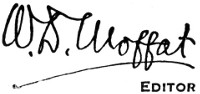
W. D. Moffat Editor
The Mentor Association
ESTABLISHED FOR THE DEVELOPMENT OF A POPULAR INTEREST IN ART, LITERATURE, SCIENCE, HISTORY, NATURE, AND TRAVEL
THE ADVISORY BOARD
JOHN G. HIBBEN, President of Princeton University
HAMILTON W. MABIE, Author and Editor
JOHN C. VAN DYKE, Professor of the History of Art, Rutgers College
ALBERT BUSHNELL HART, Professor of Government, Harvard University
WILLIAM T. HORNADAY, Director New York Zoological Park
DWIGHT L. ELMENDORF, Lecturer and Traveler
THE MENTOR IS PUBLISHED TWICE A MONTH
SUBSCRIPTION, THREE DOLLARS A YEAR. FOREIGN POSTAGE 75 CENTS EXTRA. CANADIAN POSTAGE 50 CENTS EXTRA. SINGLE COPIES FIFTEEN CENTS. PRESIDENT, THOMAS H. BECK; VICE-PRESIDENT, WALTER P. TEN EYCK; SECRETARY, W. D. MOFFAT; TREASURER, ROBERT M. DONALDSON; ASST. TREASURER AND ASST. SECRETARY, J. S. CAMPBELL
COMPLETE YOUR MENTOR LIBRARY
Subscriptions always begin with the current issue. The following numbers of The Mentor Course, already issued, will be sent postpaid at the rate of fifteen cents each.
Serial No.
1. Beautiful Children in Art
2. Makers of American Poetry
3. Washington, the Capital
4. Beautiful Women in Art
5. Romantic Ireland
6. Masters of Music
7. Natural Wonders of America
8. Pictures We Love to Live With
9. The Conquest of the Peaks
10. Scotland, the Land of Song and Scenery
11. Cherubs in Art
12. Statues With a Story
13. Story of America in Pictures: The Discoverers
14. London
15. The Story of Panama
16. American Birds of Beauty
17. Dutch Masterpieces
18. Paris, the Incomparable
19. Flowers of Decoration
20. Makers of American Humor
21. American Sea Painters
22. Story of America in Pictures: The Explorers
23. Sporting Vacations
24. Switzerland: The Land of Scenic Splendors
25. American Novelists
26. American Landscape Painters
27. Venice, the Island City
28. The Wife in Art
29. Great American Inventors
30. Furniture and Its Makers
31. Spain and Gibraltar
32. Historic Spots of America
33. Beautiful Buildings of the World
34. Game Birds of America
35. Story of America in Pictures: The Contest for North America
36. Famous American Sculptors
37. The Conquest of the Poles
38. Napoleon
39. The Mediterranean
40. Angels in Art
41. Famous Composers
42. Egypt, the Land of Mystery
43. Story of America in Pictures: The Revolution
44. Famous English Poets
45. Makers of American Art
46. The Ruins of Rome
47. Makers of Modern Opera
48. Dürer and Holbein
49. Vienna, the Queen City
50. Ancient Athens
51. The Barbizon Painters
52. Abraham Lincoln
Volume 2
53. George Washington
54. Mexico
55. Famous American Women Painters
56. The Conquest of the Air
57. Court Painters of France
58. Holland
59. Our Feathered Friends
60. Glacier National Park
61. Michelangelo
62. American Colonial Furniture
63. American Wild Flowers
64. Gothic Architecture
65. The Story of the Rhine
66. Shakespeare
67. American Mural Painters
68. Celebrated Animal Characters
69. Japan
70. The Story of the French Revolution
71. Rugs and Rug Making
72. Alaska
73. Charles Dickens
74. Grecian Masterpieces
75. Fathers of the Constitution
76. Masters of the Piano
Volume 3
77. American Historic Homes
78. Beauty Spots of India
79. Etchers and Etching
80. Oliver Cromwell
81. China
82. Favorite Trees
83. Yellowstone National Park
84. Famous Women Writers of England
85. Painters of Western Life
86. China and Pottery of Our Forefathers
87. The Story of The American Railroad
88. Butterflies
89. The Philippines
90. Great Galleries of The World: The Louvre
91. William M. Thackeray
92. Grand Canyon of Arizona
93. Architecture in American Country Homes
94. The Story of The Danube
95. Animals in Art
96. The Holy Land
97. John Milton
98. Joan Of Arc
99. Furniture of the Revolutionary Period
100. The Ring of the Nibelung
Volume 4
101. The Golden Age of Greece
102. Chinese Rugs
103. The War of 1812
104. Great Galleries of the World: The National Gallery, London
105. Masters of the Violin
THE MENTOR ASSOCIATION. Inc., 52 East Nineteenth Street, New York, N. Y.
Statement of the ownership, management, circulation, etc., required by the Act of Congress of August 24, 1912, of The Mentor, published semi-monthly at New York. N. Y., for April 1, 1916. State of New York, County of New York. ss. Before me, a Notary Public in and for the State and county aforesaid, personally appeared Thomas H. Beck, who, having been duly sworn according to law, deposes and says that he is the Publisher of The Mentor, and that the following is, to the best of his knowledge and belief, a true statement of the ownership, management, etc., of the aforesaid publication for the date shown in the above caption, required by the Act of August 24, 1912, embodied in section 443, Postal Laws and Regulations, to wit: (1) That the names and addresses of the publisher, editor, managing editor, and business managers are: Publisher, Thomas H. Beck, 52 East 19th Street, New York; Editor, W. D. Moffat, 52 East 19th Street, New York; Managing Editor, W. D. Moffat, 52 East 19th Street, New York; Business Manager, Thomas H. Beck, 52 East 19th Street, New York. (2) That the owners are: American Lithographic Company, 52 East 19th Street, New York; C. Eddy, L. Ettlinger, J. P. Knapp, C. K. Mills, 52 East 19th Street, New York; M. C. Herezog, 28 West 10th Street, New York; William T. Harris, Villa Nova, Pa.; Mrs. M. E. Heppenheimer, 51 East 58th Street, New York: Emilie Schumacher, Executrix for Luise E. Schumacher and Walter L. Schumacher Mount Vernon, N. Y., Samuel Untermyer, 37 Wall Street, New York. (3) That the known bondholders, mortgagees, and other security holders owning or holding 1 per cent or more of total amount of bonds, mortgages, or other securities, are: None. (4) That the two paragraphs next above, giving the names of the owners, stockholders, and security holders, if any, contain not only the list of stockholders and security holders as they appear upon the books of the Company, but also, in cases where the stockholder or security holder appears upon the books of the Company as trustee or in any other fiduciary relation. The name of the person or corporation for whom such trustee is acting, is given; also that the said two paragraphs contain statements embracing affiant’s full knowledge and belief as to the circumstances and conditions under which stockholders and security holders who do not appear upon the books of the Company as trustees, hold stock and securities in a capacity other than that of a bona fide owner; and this affiant has no reason to believe that any other person, association, or corporation has any interest direct or indirect in the said stock, bonds, or other securities than as so stated by him. Thomas H. Beck, Publisher. Sworn to and subscribed before me this twenty-first day of March, 1916. J. S. Campbell, Notary Public, Queens County. Certificate filed in New York County. My commission expires March 30, 1917.
THE MENTOR