Volume 4 — BOOK XI[336]
Alexander Teixeira de Mattos translation
BOOK XI[336]
Madame Récamier—Childhood of Madame Récamier described by M. Benjamin Constant—Letter to Madame Récamier from Lucien Bonaparte—Continuation of M. Benjamin Constant's narrative: Madame de Staël—Madame Récamier's journey to England—Madame de Staël's first journey to Germany—Madame Récamier in Paris—Plans of the generals—Portrait of Bernadotte—Trial of Moreau—Letters from Moreau and Masséna to Madame Récamier—Death of M. Necker—Return of Madame de Staël—Madame Récamier at Coppet—Prince Augustus of Prussia—Madame de Staël's second journey to Germany—The Château de Chaumont—Letter from Madame de Staël to Bonaparte—Madame Récamier and M. Mathieu de Montmorency exiled—Madame Récamier at Châlons—Madame Récamier at Lyons—Madame de Chevreuse—Spanish prisoners—Madame Récamier in Rome—Albano-Canova: his letters—The Albano fisherman—Madame Récamier in Naples—The Duc de Rohan-Chabot—King Murat: his letters—Madame Récamier returns to France—Letter from Madame de Genlis—Letters from Benjamin Constant—Articles by Benjamin Constant on Bonaparte's return from Elba—Madame de Krüdener—The Duke of Wellington—I meet Madame Récamier again—Death of Madame de Staël—The Abbaye-aux-Bois.
We pass to the embassy to Rome, to Italy, the dream of my life. Before continuing my story, I must speak of a woman of whom we shall not lose sight again till the end of these Memoirs. A correspondence is about to open between us from Rome to Paris: it is necessary, therefore, to know to whom I am writing, how and at what period I became acquainted with Madame Récamier.
She met, in the different ranks of society, persons, more or less celebrated, engaged upon the stage of the world: all offered her their worship. Her beauty mingles its ideal existence with the material facts of our history: a placid light illuminating a stormy picture.
Let us resume once more the consideration of times gone by; let us endeavour, by the light of my setting sun, to trace a portrait on the sky where my night, which approaches, will soon spread its shadows.
A letter published in the Mercure after my return to France, in 1800, had attracted the attention of Madame de Staël. I was not yet struck off the list of Emigrants; Atala drew me from my obscurity. Madame Bacciocchi (Élisa Bonaparte), at the request of M. de Fontanes, applied for and obtained my erasure. Madame de Staël had interested herself in this matter: I went to thank her. I cannot remember if it was Christian de Lamoignon or the author of Corinne[337] who introduced me to Madame Récamier, her friend; the latter was then living at her house in the Rue du Mont-Blanc. On emerging from my woods and the obscurity of my life, I was still quite timid; I scarce dared lift my eyes to a woman surrounded by adorers.
One morning, about a month later, I was at Madame de Staël's; she had received me at her toilet; she let Mademoiselle Olive dress her, while she talked, twisting a little green branch between her fingers. Entered suddenly Madame Récamier, dressed in a white gown; she sat down in the middle of a sofa covered in blue silk. Madame de Staël, remaining standing, continued her very animated conversation, and talked eloquently; I hardly answered, my eyes fixed on Madame Récamier. I had never imagined anything like her, and was more than ever discouraged: my admiration changed into ill-humour against my person. Madame Récamier went out, and I did not see her again till twelve years later.
Twelve years! What adverse power thus cuts and fritters away our days, squandering them ironically on all the indifferences called attachments, on all the miseries styled felicities! Then, by a further derision, when it has blighted and spent the most precious part, it brings you back to the starting-point of your career. And how does it bring you back? With your mind possessed with the foreign ideas, the importunate phantoms, the deluded or incomplete feelings of a world which has left you no happiness. Those ideas, those phantoms, those feelings place themselves between you and the bliss which you might still enjoy. You return with your heart sick with regret, afflicted by those errors of youth so painful to the memory in the modesty of years. That is how I returned, after having been to Rome, to Syria, after seeing an empire go by, after becoming the man of noise, after ceasing to be the man of silence. What had Madame Récamier done? What had been her life?
I have not known the greater portion of the existence at once brilliant and retired of which I am about to talk to you: I am obliged, therefore, to betake myself to authorities other than mine; but they shall be unexceptionable. First, Madame Récamier has described to me facts which she has witnessed and communicated to me valuable letters. She has written, on what she has seen, notes of which she has permitted me to consult the text and, too rarely, to quote it. Next, Madame de Staël in her correspondence, Benjamin Constant in his recollections, some printed, the others in manuscript, M. Ballanche in a notice on our common friend, Madame la Duchesse d'Abrantès in her sketches, Madame de Genlis in hers have furnished abundant materials for my narrative: I have only knotted all these fine names together, filling up the gaps with my own statement, when some links of the chain of events were overlooked or broken.
Montaigne says that men go gaping after future things[338]: I have the passion for gaping after past things. All is pleasure, particularly when we turn our eyes to the early years of those we love; we spin out a cherished life; we extend the affection which we feel over days which we never knew and which we revive; we adorn that which was with that which is; we recompose youthfulness.
*
Madame Récamier.
At Lyons, I have seen the Jardin des Plantes laid down on the ruins of the ancient amphitheatre and in the gardens of the old Abbaye de la Déserte, now pulled down; the Rhone and the Saône flow at its feet; far away rises the highest mountain in Europe, the first mile-post of Italy, with its white board above the clouds. Madame Récamier was placed in this abbey; she there passed her childhood behind a grill which opened upon the outer church only at the elevation of the Mass. Then one saw young girls bowing down in the inner chapel of the convent. The saint's-day of the abbess was the principal festival of the community; the prettiest boarder paid the customary compliment: her dress was arranged, her hair plaited, her head veiled and crowned by the hands of her playmates; and all this in silence, for the hour of rising was one of those which were called "grand silence" in the monasteries. It goes without saying that Juliette[339] had the honours of the day. Her father and mother, having settled in Paris, sent to fetch their child. From some rough drafts written by Madame Récamier, I gather this note:
"On the eve of the day on which my aunt was to come to fetch me, I was taken to the room of Madame the Abbess to receive her blessing. The next day, bathed in tears, I went out through the door, which I did not remember seeing opened to admit me, found myself in a carriage with my aunt, and we drove off for Paris.
"I leave with regret a time so calm and so pure to enter upon that of excitement. It often comes back to me as in a vague, sweet dream, with its clouds of incense, its numberless ceremonies, its processions in the gardens, its singing and its flowers."
*
Those hours which have left a pious desert now rest in another religious solitude, without having lost anything of their freshness and their harmony.
Benjamin Constant, the wittiest man after Voltaire, strives to give an idea of Madame Récamier's early youth: he has drawn from the model whose features he aimed at tracing a grace which was not natural to him.
"Among the women of our time," he says, "whom advantages of feature, mind, or character have rendered famous, there is one whom I wish to depict. Her beauty made her admired at first; her soul next made itself known, and her soul appeared even superior to her beauty. The habit of society supplied her mind with the means to display itself, and her mind remained below neither her beauty nor her soul.
"At the age of barely fifteen[340], married to a man[341] who, occupied by an immense amount of business, could not guide her extreme youthfulness, Madame Récamier found herself left almost entirely to herself in a country which was still in a state of chaos.
"Several women of the same period have filled Europe with their diverse fames. The majority have paid tribute to their century, some through indelicate loves, others by guilty condescensions towards the successive tyrannies.
"She whom I am describing emerged radiant and pure from that atmosphere which blighted all that it did not corrupt. Childhood was at first a safeguard for her, thanks to the Author of this beautiful work, who made everything turn to her advantage. Far removed from the world, in a solitude beautified by the arts, she formed for herself a gentle occupation out of all those attractive and poetic studies which remain the charm of another age.
"Often also, surrounded by young companions, she indulged with them in clamorous sports. Slender and light of foot, she outstripped them in the race; she covered with a bandage her eyes which were one day to penetrate every soul. Her glance, to-day so expressive and so profound, which seems to us to reveal mysteries unknown to herself, sparkled then only with a lively and playful gaiety. Her beautiful hair, which cannot become undone without filling us with perturbation, then fell, without danger to any, over her white shoulders. Laughter loud and long often interrupted her childish conversation; but already one could perceive in her that nice and quick observation which seizes upon the ridiculous, that gentle malice which is amused by it without ever wounding, and particularly that exquisite sentiment of eloquence, purity and good taste, a real inborn nobility, the titles to which are stamped upon privileged beings.
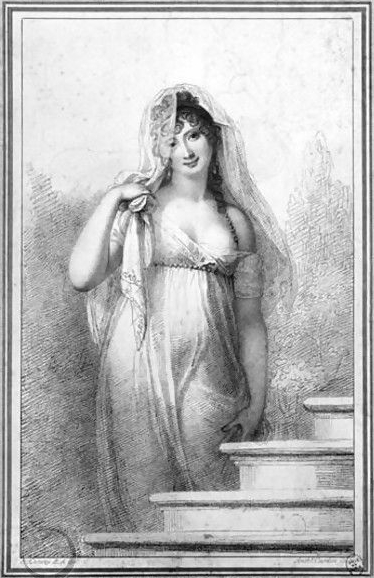
Madame Récamier.
Her girlhood.
"The great world of that time was too uncongenial to her nature that she should not prefer retirement. She was never seen in the houses open to all comers, the only meeting-places possible when every closed company was suspected; where all classes rushed, because there they could talk and say nothing, meet and not be compromised; where ill manners took the place of wit and disorder of gaiety. She was never seen at the Court of the Directory, where the power was at once terrible and familiar, inspiring dread without escaping contempt.
"However, Madame Récamier sometimes issued from her retreat to go to the play or to the public walks and, in those places frequented by all, her rare appearances were real events. Every other object of those vast assemblies was forgotten, and all flung themselves in her way. The man fortunate enough to escort her had to overcome admiration as it were an obstacle; his steps were at every moment delayed by the onlookers crowding around her; she delighted in this success with the gaiety of a child and the shyness of a young girl; but her graceful dignity, which in her home distinguished her from her young friends, abroad restrained the exuberant throng. It was as though she reigned by her mere presence over her companions and the public. Thus passed the first years of Madame Récamier's marriage, between poetical occupations, childish sports at home, and short and brilliant appearances in the world."
Interrupting the narrative of the author of Adolphe[342], I will say that, in this society following upon the Terror, everybody feared to have the air of possessing a home. People met in the public places, especially in the Pavillon de Hanovre[343]: when I saw that pavilion, it was deserted like the hall of a yesterday's feast, or like a stage from which the actors had descended for ever. There were wont to come together young women escaped from prison, whom André Chénier had made to say:
Je ne veux point mourir encore[344].
Madame Récamier had met Danton on his road to execution and, soon after, she saw some of the fair victims snatched from men who had themselves become victims of their own fury.
I come back to my guide Benjamin Constant:
"Madame Récamier's mind had need of another food. The instinct for the beautiful caused her to delight beforehand, without knowing them, in men distinguished by a reputation for talent and genius.
"M. de La Harpe was one of the first to appreciate this woman who was destined one day to group around herself all the celebrities of her age. He had met her in her childhood, he saw her again married, and the conversation of this young person of sixteen years possessed a thousand attractions for a man whom his excessive self-esteem and the habit of intercourse with the most intelligent men in France rendered extremely difficult and hard to please.
"M. de La Harpe divested himself, in the presence of Madame Récamier, of most of the defects which made commerce with him laborious and almost insupportable. He took pleasure in acting as her guide: he admired the swiftness with which her mind made good her want of experience and grasped all that he revealed to her concerning the world and mankind. It was at the time of the famous conversion which so many people have qualified as hypocrisy. I have always regarded that conversion as sincere. The sentiment of religion is an inherent faculty in man; it is absurd to pretend that fraud and falsehood have created that faculty. Nothing is put into the human soul except what nature has put there. The persecutions, the abuses of authority in favour of certain dogmas can delude us personally and revolt us against what we should feel if it were not imposed upon us; but, so soon as the external causes have ceased, we return to our primitive tendency: when there is no more courage in resisting, we no longer applaud ourselves for our resistance. Now, the Revolution having taken this merit from unbelief, the men whom vanity alone had rendered unbelieving were able to become religious in good faith.
"M. de La Harpe was of that number; but he retained his intolerant character and that bitterness of disposition which made him conceive new hatreds without abjuring the old ones. All those thorns of his devotion disappeared, however, when he was with Madame Récamier."
M. de La Harpe.
Here are a few fragments of the letters from M. de La Harpe to Madame Récamier of which Benjamin Constant speaks:
"Saturday, 28 September.
"What, madame, you carry your kindness so far as to wish to honour a poor outlaw like myself with a visit! This time I might say, like the ancient patriarchs, whom I resemble so little otherwise, that 'an angel has come into my house.' I well know that you like to do works of mercy; but, as things go nowadays, all good is difficult, and this like the rest. I must inform you, to my great regret, that to come alone is first of all impossible, for many reasons: among others that, with your youth and your face, the splendour of which will follow you everywhere, you could not travel without a waiting-maid, to whom prudence forbids me to confide the secret of my retreat, which is not mine alone. You would therefore have only one means of carrying out your generous resolution, which would be to take counsel with Madame de Clermont, who would bring you one day to her little sylvan castle, and from there it would be very easy for you to come with her. You are both made to appreciate and love one another.... I am writing many verses at this moment. In writing them, I often reflect that I shall one day be able to read them to the fair and charming Juliet, whose mind is as penetrating as her glance, and her taste as pure as her soul. I would also willingly send you the fragment of Adonis which you like, although it has become a little profane for me; but I would want a promise that it shall not leave your hands....
"Farewell, madame; I indulge with you in ideas which anyone but yourself would think very extraordinary addressed to a person of sixteen years; but I know that your sixteen years are only in your face[345]."
"Saturday[346].
"It is long indeed, madame, since I had the pleasure of talking with you, and, if you be sure, as you must be, that this is one of my privations, you will make me no reproaches....
"You have read in my soul; you have seen there that I wore in it the mourning for the public misfortunes and for my own faults, and I could not but feel that this sad disposition formed too strong a contrast with all the brilliancy that encompasses your age and your charms. I even fear lest it should sometimes have made itself felt in the few moments which I have been permitted to spend with you, and I entreat your indulgence therefore. But now, madame, when Providence seems to show us a better future very near at hand, to whom could I better than to yourself confide the joy which I derive from hopes so sweet and, to my belief, so near? Who will fill a greater place than you in the private pleasures which will be mingled with the public joy? I shall then be more susceptible and less unworthy of the delights of your charming company, and how happy I shall deem myself still to count for something in it! If you deign to attach the same value to the fruit of my labour, you shall always be the first to whom I shall hasten to present it. Then no more contradictions nor obstacles; you shall always find me at your orders, and none, I hope, will be able to blame me for this preference. I shall say, 'Here is she who, at the age of illusions and with all the brilliant advantages that can excuse them, has known all the nobility and delicacy of proceedings of the purest friendship and, in the midst of every homage, has remembered an outlaw!' I shall say, 'Here is she whose youth and grace I have seen grow amid a general corruption which was never able to overtake them, she whose reason at sixteen years has often put mine to shame!' and I am sure that none will be tempted to contradict me."
The sadness of events, of age and of religion, hidden under a melting expression, present in these letters a singular admixture of thought and style. Let us return once more to Benjamin Constant's narrative:
"We come to the time when Madame Récamier saw herself for the first time the object of a strong and regular passion. Till then she had received unanimous worship from all who had met her, but her manner of life nowhere offered centres of union where one could be sure of finding her. She never received at home and she had not yet formed a society where one could penetrate every day to see her and try to please her.
Lucien Bonaparte.
"In the summer of 1799, Madame Récamier came to live at the Château de Clichy, a quarter of a league from Paris. A man since celebrated through different sorts of pretensions, and even more celebrated through the advantages which he has refused than through the successes which he has won, Lucien Bonaparte, obtained an introduction to her.
"He had not, till then, aspired to any save facile conquests and, to obtain these, had studied only the romancing methods which his want of knowledge of the world represented to him as infallible. It is possible that he was enticed at first by the idea of captivating the loveliest woman of his time. Young, the leader of a party in the Council of the Five Hundred, the brother of the first general of the age, he was gratified at uniting the triumphs of a statesman and the successes of a lover in his person.
"He conceived the idea of having recourse to a fiction to declare his love to Madame Récamier; he imagined a letter from Romeo to Juliet, and sent it as a work of his to her who bore the same name."
Here is this letter from Lucien, known to Benjamin Constant; in the midst of the revolutions which have stirred the world of reality, it is racy to see a Bonaparte plunge into the world of fictions:
LETTER FROM ROMEO TO JULIET by the author of the Tribu indienne[347]
"Venice, 29 July.
"Romeo writes to you, Juliet: if you refuse to read me, you will be crueller than our parents whose long strife has at last been appeased; no doubt that horrid strife will not revive. ... A few days since, I knew you only by repute. I had sometimes seen you in the temples and at feasts; I knew you were the most beautiful; a thousand lips repeated your praises, and your charms had struck but not dazzled me.... Why has peace delivered me to your empire? Peace! It reigns in our families, but trouble reigns in my heart....
"Recall to yourself the day when I was first presented to you. We were celebrating at a large banquet the reconciliation of our fathers. I had come from the Senate, where the troubles raised against the Republic had created a lively impression.... You arrived; then all flocked round:
"'How lovely she is!' they cried....
"The throng in the evening filled the gardens of Bedmar. Importunate people, who are everywhere, took possession of me. This time I had neither patience with them nor affability: they kept me from you!... I wished to account for the emotion that was overcoming me. I knew love and wished to master it.... I was carried away, and with you left the festive spot.
"I have seen you since: love has seemed to smile upon me. One day, seated at the water's edge, motionless and pensive, you were stripping a rose of its leaves; alone with you, I spoke.... I heard a sigh... vain illusion! Recovering from my mistake, I saw indifference with its placid brow seated between us two.... The passion which masters me found utterance in my discourse, and yours bore the amiable and cruel impress of childhood and pleasantry.
"Each day I would wish to see you, as though the dart were not fixed deep enough in my heart. The moments at which I see you are very rare, and those young Venetians who surround you and talk insipid gallantry to you are hateful to me. How is it possible to talk to Juliet as to other women!
"I have wanted to write to you; you will know me, you will no longer refuse to believe me; my soul is ill at ease; it thirsts for sentiment. If love has not stirred yours; if Romeo in your eyes is but an ordinary man, oh, I conjure you by the bonds which you have laid upon me, be severe with me from kindness; do not smile to me again, do not speak to me again, thrust me far from you. Tell me to go away and, if I can execute that rigorous order, remember at least that Romeo will ever love you; that none has ever reigned over him as Juliet has; and that he can no longer cease to live for her, at least in remembrance."
*
For a sober-minded man, all this is rather laughable: the Bonapartes used to live on theatres, novels and verses; is the life of Napoleon himself aught else than a poem?
Lucien's passion.
Benjamin Constant continues, while commenting upon this letter:
"The style of this letter is evidently imitated from all the novels that have depicted the passions, from Werther to the Nouvelle Héloïse. Madame Récamier easily discovered, from several circumstances of detail, that she herself was the object of the declaration offered as though simply for her perusal. She was not sufficiently accustomed to the language of love to be warned by experience that everything in the expressions was, perhaps, not sincere; but a true and sure instinct warned her; she replied with simplicity and even gaiety, and showed much more indifference than disquietude or fear. It needed no more for Lucien really to experience the passion which he had at first somewhat exaggerated.
"Lucien's letters grew truer, more eloquent, in proportion as he grew more impassioned; certainly they always show the ambition for ornamentation, the desire to attitudinize; he cannot go to sleep without 'flinging himself into the arms of Morpheus.' In the midst of his despair, he describes himself as surrendered to the great occupations which surround him; he is astonished that a man like him sheds tears; but, in all this alloy of declamation and phrases, there is nevertheless eloquence, sensibility and grief. At last, in a letter full of passion in which he wrote to Madame Récamier, 'I cannot hate you, but I can kill myself,' he suddenly makes a general reflection: 'I am forgetting that love is not snatched, but won,' and then adds, 'After receiving your note, I received many of a diplomatic character; I learnt some news of which public rumour has no doubt informed you. Congratulations surround, deafen me... people talk to me of what is not you! 'Then another exclamation:
"'How weak is nature compared to love!'
"And yet this news which found Lucien unconcerned was an immense piece of news: Bonaparte's disembarkation on his return from Egypt.
"A new destiny had landed with its promises and its threats; the 18 Brumaire was not more than three weeks distant.
"Barely escaped from the dangers of that day, which will always fill so great a place in history, Lucien wrote to Madame Récamier:
"'I have seen your image!... You will have had my last thought!'...
"Madame Récamier contracted a friendship, which became daily more intimate and which still endures, with a woman who was illustrious in a very different way from that in which M. de La Harpe was famous.
"M. Necker, having been struck off the list of Emigrants, charged Madame de Staël, his daughter, to sell a house which he had. Madame Récamier bought it, and this was an occasion for her to see Madame de Staël[348].
"The sight of this celebrated woman at first filled her with excessive timidity. The face of Madame de Staël has been very widely discussed. But a proud glance, a sweet smile, an habitual expression of kindliness, the absence of any minute affectation and of any embarrassing reserve, caressing words, praises somewhat direct but seeming to escape from enthusiasm, an inexhaustible variety of enthusiasm surprise, attract and conciliate almost all who approach her. I know no woman, nor even any man, who is more convinced of her own vast superiority to all the world and who makes this conviction bear less hard upon others.
"Nothing could be more engaging than the conversations of Madame de Staël and Madame Récamier. The quickness of the one in expressing a thousand new thoughts, the quickness of the other in grasping and perceiving them; that masculine and powerful mind which disclosed all, that delicate and subtle mind which understood all; those revelations made by a trained genius to a youthful intelligence worthy to receive them: all this formed a union which it is impossible to describe without having had the happiness to witness it one's self.
"The friendship of Madame Récamier for Madame de Staël was strengthened by a sentiment which they both entertained: filial love. Madame Récamier was fondly attached to her mother, a woman of rare merit, whose health was already giving rise to fears and whose loss her daughter has never since ceased to regret. Madame de Staël had vowed a worship to her father which his death has rendered but the more exalted. Always overpowering in her manner of expressing herself, she becomes still more so, above all, when speaking of him. Her earnest voice, her eyes ready to grow wet with tears, the sincerity of her enthusiasm moved the soul of even those who did not share her opinion of that celebrated man. Ridicule has frequently been cast on the praises which she has awarded him in her writings; but, when you have heard her on that subject, it is not possible to make it an object of mockery, for nothing that is true is ridiculous."
*
Madame de Staël.
The letters of Corinne to her friend Madame Récamier began at the period here recalled by Benjamin Constant: they have a charm which is almost akin to love; I will set forth a few:
"Coppet, 9 September.
"Do you recollect, fair Juliet, a person whom you loaded with marks of interest last winter and who is bold enough to invite you to do twice as much in the winter to come? How do you govern the empire of beauty? One awards it you with pleasure, that empire, because you are eminently good, and it seems natural that so gentle a soul should have a charming face to express it. Of all your admirers you know that I prefer Adrien de Montmorency[349]. I have received letters from him, remarkable for wit and grace, and I believe in the solidity of his affections, notwithstanding the charm of his manners. For the rest, that word 'solidity' suits me, who claim to play but a very secondary part in his heart. But you, who are the heroine of every sentiment, are exposed to the great events out of which tragedies and novels are made. Mine[350] is progressing at the foot of the Alps. I hope you will read it with interest. I like this occupation. . . . . . . . . . . . . . . . . . . .
"Amid all those successes, what you are and what you will remain is an angel of purity and beauty, and you will have the worship of the devout as well as of the worldly.... Have you seen the author of Atala again? Are you still at Clichy? In short, I ask for details of yourself. I love to know what you are doing, to represent to myself the places in which you dwell. Is not all a picture in the memories which one retains of you? I add to this natural enthusiasm for your rare advantages a great inclination for your company. Pray accept kindly all that I offer you, and promise me that we shall meet often in the coming winter."
"Coppet, 30 April.
"Do you know, fair Juliet, that my friends have been flattering me somewhat with the notion that you might come here? Could you not give me that great pleasure? It is some time since happiness spoilt me, and your arrival would be a return of luck and would give me hopes for all that I desire. Adrien and Mathieu say they will come. If you came with them, a month's stay here would serve to show you our splendid nature. My father says that you ought to choose Coppet for your residence and that we should make our excursions from there. My father is very eager in his desire to see you. You know what they said of Homer:
"Par la voix des vieillards tu louais la beauté[351].
"And independently of that beauty you are charming."
During the short Peace of Amiens[352], Madame Récamier took a journey to London with her mother. She had letters of introduction from the old Duc de Guignes, who had been Ambassador to England thirty years before. He had kept up a correspondence with the most brilliant women of the time: the Duchess of Devonshire[353], Lady Melbourne[354], the Marchioness of Salisbury[355], the Margravine of Anspach, with whom he had been in love. His embassy was still celebrated, his memory green among those respectable ladies.
Madame Récamier in London.
Such is the power of novelty in England that, on the morning after her arrival, the newspapers were full of the foreign beauty. Madame Récamier received visits from nearly all the persons to whom she had sent letters. Among these persons, the most remarkable was the Duchess of Devonshire, then between forty-five and fifty years of age. She was still in vogue and beautiful, although she had lost one eye, which she concealed behind a lock of her hair. The first time that Madame Récamier appeared in public, it was in her company. The duchess took her to the Opera in her box, in which were the Prince of Wales, the Duc d'Orléans and his brothers the Duc de Montpensier[356] and the Comte de Beaujolais[357]: the first two were to become kings; one was on the verge of the throne, the other was still separated from it by an abyss[358].
Eyes and opera-glasses were turned on the duchess' box. The Prince of Wales said to Madame Récamier that, if she did not want to be suffocated, she must leave before the end of the performance. Scarcely was she on her feet, before the doors of the boxes opened precipitously; she escaped nothing, and was carried by the tide of the crowd to her carriage.
The next day, Madame Récamier went to Kensington Gardens, accompanied by the Marquess of Douglas, later Duke of Hamilton[359], who has since received Charles X. at Holyrood[360], and by his sister the Duchess of Somerset[361]. The crowd flung itself on the fair foreigner's footsteps. This effect was repeated each time she showed herself in public; the newspapers resounded with her name; her portrait, engraved by Bartolozzi[362], was spread broadcast through England. The author of Antigone, M. Ballanche, adds that ships carried it as far as the isles of Greece: beauty returned to the spots where its image had been invented. We have a sketch of Madame Récamier by David, a full-length portrait by Gérard, a bust by Canova. The portrait is Gérard's master-piece; but it does not please me, because I recognise the model's features in it without recognising the expression.
On the eve of Madame Récamier's departure, the Prince of Wales and the Duchess of Devonshire asked leave to call on her and to bring with them some persons of their society. Music was performed. Together with the Chevalier Marin, the first harper of the time, she played variations on a theme by Mozart. This evening was mentioned in the public press as a concert which the beautiful foreigner had given, on leaving, to the Prince of Wales.
The next day, she set sail for the Hague and took three days to make a crossing of sixteen hours. She has told me that, during those days dashed with storms, she read the Génie du Christianisme straight through; I was "revealed" to her, to use her kind expression: I recognise in this the good-will which the winds and the sea have always had for me.
Near the Hague, she visited the country-house of the Prince of Orange. The Prince, having made her promise to go to see that residence, wrote her several letters in which he speaks of his reverses and of his hope to conquer them: William I. has, in fact, become a monarch[363]; at that time one intrigued to become king as nowadays to become a deputy, and those candidates for the sovereignty used to throng round the feet of Madame Récamier as though she had crowns in her gift.
The following note from Bernadotte, who reigns to-day over Sweden[364], ended Madame Récamier's journey to England: . . . . . . . . . .
"The English papers, while calming my apprehensions for your health, have informed me of the dangers to which you have been exposed. I at first blamed the people of London for their too great assiduity, but, I confess to you, I soon excused them, for I am an interested party when it is necessary to justify persons who become indiscreet in order to admire the charms of your celestial countenance.
"Amid the lustre which surrounds you and which you deserve by such manifold rights, deign sometimes to remember that the being most devoted to you in nature is
"Bernadotte."
Madame de Staël's exil.
Madame de Staël, threatened with exile, attempted to settle down at Maffliers, a country-place eight leagues from Paris. She accepted the proposal made to her by Madame Récamier, on her return from England, to spend a few days with her at Saint-Brice; afterwards she went back to her first refuge. She relates what happened then, in the Dix années d'exil:
"I was at table," she says, "with three of my friends in a room from which one saw the high road and the entrance-door. It was at the end of September[365], at four o'clock: a man in grey, on horseback, stopped and rang; I was sure of my fate; he asked for me; I received him in the garden. As I went towards him, I was struck by the scent of the flowers and the beauty of the sun. The sensations that come to us through the combinations of society are so different from those of nature! The man told me that he was the commandant of the Versailles Gendarmery.... He showed me a letter, signed by Bonaparte, which contained the order to remove me to forty leagues from Paris, with an injunction to make me leave within twenty-four hours, while treating me, however, with all the consideration due to a woman whose name was known.... I replied to the officer of gendarmes that to set out within twenty-four hours might suit conscripts, but not a woman and children. Consequently I proposed that he should accompany me to Paris, where I had need of three days to make the necessary arrangements for my journey. I therefore got into my carriage with my children and this officer, who had been selected as being the most literary of the gendarmes. In fact, he paid me compliments on my writings.
"'You see, monsieur,' I said to him, 'what comes of being an intellectual woman. I beg you, dissuade the members of your family from it, if you have occasion to do so.'
"I tried to rouse myself with pride, but I felt the clutching at my heart.
"I stopped for a few moments at Madame Récamier's. I there found General Junot[366], who, out of devotion for her, promised to go the next day to speak to the First Consul. He did so in fact with the greatest warmth....
"On the eve of the last day given me, Joseph Bonaparte made yet one attempt....
"I was obliged to await the answer in an inn at two leagues from Paris, not daring to return to my own home in town. A day passed without the answer reaching me. Not wishing to attract attention by remaining longer at the inn where I was, I made the circuit of the walls of Paris to go to look for another, also at two leagues from Paris, but on a different road. This wandering life, at four steps from my friends and my home, caused me a grief which I cannot recall without shuddering[367]."
*
Madame de Staël, instead of returning to Coppet, set out on her first journey to Germany. At that time she wrote me the letter on the death of Madame de Beaumont which I quoted when writing of my first journey to Rome.
Madame Récamier gathered round her in Paris all that was most distinguished in the oppressed parties and in the opinions which had not yielded to victory. One saw there the lights of the old Monarchy and the new Empire: the Montmorencys, the Sabrans[368], the Lamoignons, Generals Masséna, Moreau and Bernadotte; one destined for exile, another for the throne. Illustrious foreigners also visited there: the Prince of Orange, the Prince of Bavaria[369], the brother[370] of the Queen of Prussia surrounded her, just as in London the Prince of Wales was proud to carry her shawl. So irresistible was the attraction that Eugène de Beauharnais[371] and the Emperor's very ministers went to these assemblies. Bonaparte could not suffer success, even when it was a woman's. He used to say:
"Since how long has the Council been held at Madame Récamier's?"
General Bernadotte.
I now return to Benjamin Constant:
"For a long time, Bonaparte, who had seized upon the government, had been progressing towards tyranny. The most opposite parties became incensed against him and, while the bulk of the citizens were still allowing themselves to be enervated by the tranquillity which was promised them, the Republicans and the Royalists desired an inversion. M. de Montmorency belonged to the latter by his birth, his connections and his opinions. Madame Récamier cared for politics only through her generous interest in the vanquished of all parties. The independence of her character made her averse to the Court of Napoleon, of which she had refused to form part M. de Montmorency conceived the idea of confiding his hopes to her, painted the restoration of the Bourbons to her in colours calculated to arouse her enthusiasm, and charged her to bring together two men at that time of importance in France, Moreau and Bernadotte, to see if they could unite against Bonaparte. She was intimately acquainted with Bernadotte, who has since become Prince Royal of Sweden. Something chivalrous in his appearance, something noble in his manners, something very subtle in his intelligence, something declamatory in his conversation make him a remarkable man. Courageous in battle, bold in speech, but timid in actions which are not military, irresolute in all his designs, he has one thing which makes him very seductive at first sight, but which, at the same time, places an obstacle to any combination of plans with him, and that is a habit of haranguing, a relic of his revolutionary education which does not leave him. He sometimes has movements of real eloquence; he knows it, he loves this kind of success and, when he has entered upon the development of some general idea connected with what he has heard in the clubs or the rostrum, he loses sight of all that occupies him and is no longer anything but an impassioned orator. That is what he appeared in France during the early years of the reign of Bonaparte, whom he always hated and by whom he was suspected, and that again is what he has shown himself in these later days, amid the disorder of Europe, of which, nevertheless, we owe the liberation to him, because he reassured the foreigners by showing them a Frenchman ready to march against the tyrant of France and knowing how to say only such things as could have an influence for his nation's good.
"Anything that offers a woman the means of exercising power is always agreeable to her. Moreover, in the idea of rousing against the despotism of Bonaparte men important through their dignities and their glory there was something generous and noble which was bound to tempt Madame Récamier. She therefore lent herself to M. de Montmorency's wishes. She often threw Bernadotte and Moreau together at her house. Moreau wavered, Bernadotte spouted. Madame Récamier took Moreau's indecisive speeches for a commencement of resolution and Bernadotte's harangues as a signal for the overthrow of tyranny. The two generals, on their side, were enraptured to see their discontent pampered by so much beauty, wit and grace. There was, in fact, something romantic and poetic in that young and bewitching woman who talked to them of the liberty of their country. Bernadotte never ceased repeating to Madame Récamier that she was made to electrify the world and create fanatics."
*
While noting the delicacy of this portraiture by Benjamin Constant, it must be said that Madame Récamier would never have entered into political interests but for the irritation which she felt at the banishment of Madame de Staël. The future King of Sweden had a list of the generals who still held with the party of independence, but Moreau's name was not on it; it was the only one fit to be opposed to Napoleon's, only Bernadotte did not know what manner of man the Bonaparte was whose power he was attacking.
Madame Moreau[372] gave a ball: all Europe was there, excepting France, which was represented only by the Republican Opposition. In the course of this entertainment, General Bernadotte led Madame Récamier to a little drawing-room where only the sound of the music followed them to remind them where they were. Moreau passed into this drawing-room; Bernadotte said to him, after long explanations:
"You have a popular name; you are the only one of us who can put himself forward with the support of the people; see what you can do, what we can do under your leader-ship."
Moreau repeated what he had often said before, that "he felt the danger with which liberty was threatened, that they must watch Bonaparte, but that he feared civil war."
This conversation was prolonged and became animated; Bernadotte lost his temper, and said to General Moreau:
"You do not dare to take up the cause of liberty; well, then, Bonaparte will make sport of liberty and you. It will perish in spite of our efforts and, as for you, you will be involved in its ruin without having fought."
Prophetic words!
Madame Récamier's mother was intimately acquainted with Madame Hulot, the mother of Madame Moreau, and Madame Récamier had contracted with the latter one of those childish friendships which it is a pleasure to continue in after life.
The trial of General Moreau.
During General Moreau's trial, Madame Récamier spent all her time with Madame Moreau. The latter told her friend that her husband complained that he had not yet seen her among the public which filled the court and the bench. Madame Récamier arranged to be present at the sitting on the day after this conversation. One of the judges, M. Brillat-Savarin[373], undertook to pass her in through a private door which opened on to the amphitheatre of the court. She raised her veil, on entering, and cast a glance over the rows of prisoners in order to find Moreau. He recognised her, rose and bowed. All eyes were turned in her direction; she hastened to descend the steps of the amphitheatre to reach the place intended for her. The prisoners were forty-seven in number; they filled the benches placed opposite the judges of the court. Each prisoner was placed between two gendarmes: the soldiers treated General Moreau with deference and respect.
Messieurs de Polignac and de Rivière attracted attention, but especially Georges Cadoudal. Pichegru, whose name will remain associated with that of Moreau, was missing from his side, or, rather, one seemed to see his shadow there, for it was known that he was also missing from prison[374].
There was no more question of Republicans: it was Royalist loyalty fighting against the new power; nevertheless, this cause of the Legitimacy and of its high-born partisans had, as its leader, a man of the people, Georges Cadoudal. One saw him there, with the thought that that so pious and so fearless head was about to fall on the scaffold, that he, Cadoudal, alone, perhaps, would not be saved, for he would do nothing to be saved. He defended only his friends; as for what concerned him in particular, he told all. Bonaparte was not so generous as people supposed: eleven persons devoted to Georges perished with him[375].
Moreau did not speak. At the end of the sitting, the judge who had brought Madame Récamier came to take her away. She crossed the bar at the opposite side to that by which she had entered, and passed by the bench of the prisoners. Moreau came down, followed by his two gendarmes; he was separated from her only by a hand-rail. He addressed a few words to her, which, in her startled condition, she did not hear; she tried to reply, her voice broke.
To-day, when the times are changed and when Bonaparte's name alone seems to fill them, we do not conceive how small a hold his power as yet had. On the night preceding the sentence, during which the court sat, all Paris was on foot. Floods of people went towards the Palace of Justice. Georges wanted no mercy; he replied to them who wished to ask it for him:
"Do you promise me a finer occasion of death?"
Moreau, condemned to transportation, set out for Cadiz, whence he was to cross to America. Madame Moreau went to join him. Madame Récamier was with her at her departure. She saw her kiss her son in his cradle and saw her turn back again to kiss him a second time; she took her to her carriage, and received her last farewell.
Letter from General Moreau.
General Moreau wrote the following letter from Cadiz to his generous friend:
"Chiclana (near Cadiz), 12 October 1804.
"Madame,
"You will, no doubt, be pleased to hear news of two fugitives in whom you have shown so much interest. After going through all sorts of fatigues, by land and sea, we were hoping to rest at Cadiz, when the yellow fever, which in some way may be compared to the ills we had recently undergone, came to besiege us in that town.
"Although my wife's confinement obliged us to remain there for more than a month during the sickness, we were lucky enough to escape infection; only one of our servants caught it.
"At last we are at Chiclana, a very pretty village at a few leagues from Cadiz, enjoying good health, and my wife quite convalescent, after giving me a very healthy daughter.
"She is persuaded that you take as great an interest in this event as in all that has happened to us, and she asks me to acquaint you with it and to send you her kind remembrances.
"I say nothing of the kind of life which we lead: it is excessively tedious and monotonous, but at least we breathe at liberty, although in the land of the Inquisition.
"I beg you, madame, to receive the assurance of my respectful attachment, and to believe me ever
"Your most humble and most obedient servant,
"V. Moreau."
This letter is dated from Chiclana, a spot which, together with glory, seemed to promise an assured reign to M. le Duc d'Angoulême: and yet he appeared on that coast only with as fatal a result as Moreau, who has been believed devoted to the Bourbons. Moreau, in the depths of his soul, was devoted to liberty; when he had the misfortune to join the Coalition, the question in his eyes was solely that of contending against the despotism of Bonaparte. Louis XVIII. said to M. de Montmorency, who was deploring the death of Moreau as a great loss to the Crown:
"Not so great: Moreau was a Republican."
The general returned to Europe only to find the cannon-ball on which his name was engraved by the finger of God.
Moreau recalls to my mind another illustrious captain, Masséna. The latter was going to the Army of Italy; he asked Madame Récamier for a white ribbon from the trimming of her dress. One day she received this note in Masséna's hand:
"The charming ribbon given him by Madame Récamier was worn by General Masséna in the battles and the blockade of Genoa: it never left the general and constantly promoted his victory."
The old manners peep out through the new manners of which they form the ground-work. The gallantry of the knight of gentle birth appeared again in the plebeian soldier: the memory of the tournaments and crusades lay hidden in the feats of arms with which modern France has crowned her ancient victories. Cisher, the companion of Charlemagne, did not deck himself in the fight with his lady's colours:
"He carried," says the Monk of Saint-Gall[376], "seven, eight, or even nine enemies strung on his lance."
Cisher went before and Masséna came after chivalry.
*
Madame de Staël in Berlin heard of her father's illness; she hurried back, but M. Necker was dead[377] before she reached Switzerland.
At that time happened M. Récamier's ruin[378]; Madame de Staël was soon informed of this unfortunate event. She at once wrote to Madame Récamier, her friend:
Letter from Madame de Staël.
"Geneva, 17 November.[379]
"Ah, my dear Juliet, what pain have I felt at the shocking news that reaches me! How I curse the exile which does not permit me to be with you, to press you to my heart! You have lost all that has to do with the ease and comfort of life; but, if it were possible to be more loved, more interesting than you are, that is what would have happened to you. I am going to write to M. Récamier, whom I pity and respect. But, tell me, would it be a dream to hope to see you here this winter? If you were willing, three months spent here, in a narrow circle where you would be passionately cared for: but in Paris also you inspire that feeling. At any rate, I will come to see you at Lyons, or anywhere outside my 'forty leagues,' to embrace you, to tell you that I have felt more tenderness for you than for any woman I have ever known. I can say nothing to you by way of consolation, unless it be that you will be loved and valued more than ever and that the admirable features of your generosity and benevolence will be known, in spite of yourself, through this misfortune, as they never would have been without it. Certainly, to compare your situation with what it was, you have lost; but if it were possible for me to envy what I love, I would give all that I am to be you. A beauty unmatched in Europe, a stainless reputation, a proud and generous character, what a fortune of happiness that remains in this sad life through which we go so naked! Dear Juliet, let our friendship draw closer; let it consist not only of generous services, which have all come from you, but of a sustained correspondence, a reciprocal desire to confide our thoughts in one another, a life together. Dear Juliet, you shall make me come back to Paris, for you are still an all-powerful person, and we shall see each other every day; and, as you are younger than I, you shall close my eyes, and my children shall be your friends. My daughter cried this morning at my tears and yours. Dear Juliet, we both enjoyed the luxury that surrounded you; your fortune was ours, and I feel myself ruined because you are no longer rich. Believe me, some happiness remains when one has made herself loved thus.
"Benjamin wants to write to you; he is much upset. Mathieu de Montmorency has written me a very touching letter about you. Dear friend, may your heart remain calm amid so many sorrows. Alas, neither the death nor the indifference of your friends threaten you, and those are the eternal wounds. Adieu, dear angel, adieu! Respectfully I kiss your charming face...."
Madame Récamier now became the object of a new interest: she left society without complaining and seemed as much made for solitude as for the world. Her friends remained to her, "and this time," M. Ballanche has said, "fortune withdrew alone."
Madame de Staël drew her friend to Coppet[380]. Prince Augustus of Prussia, captured at the Battle of Eylau[381], passed through Geneva on his way to Italy: he fell in love with Madame Récamier. The intimate and private life that belongs to every man continued its course beneath the general life, the blood of battles and the transformation of empires. The rich man, on waking, beholds his gilded panellings, the poor man his smoky rafters: there is but one sun-ray to give light to both.
Prince Augustus, believing that Madame Récamier might consent to a divorce, proposed to her in marriage. A record of this passion remains in the picture of Corinne, which the Prince obtained from Gérard; he made a present of it to Madame Récamier as an undying reminder of the feeling with which she had inspired him and of the intimate friendship which united Corinne and Juliet.
The summer was spent in merry-making: the world was upset; but it happens that the echo of public catastrophes, mingling with the joys of youth, redoubles their charm; we surrender ourselves the more eagerly to pleasures the nearer we feel to losing them.
Madame de Genlis has made a novel out of this attachment of Prince Augustus. I found her one day in the throes of composition. She was living at the Arsenal, surrounded by dusty books, in a gloomy apartment. She expected nobody; she was dressed in a black gown; her white hair obscured her face; she held a harp between her knees, and her head was sunk upon her breast. Hanging on to the strings of the instrument, she allowed her pale and emaciated hands to wander on either side of the sonorous wire-work, from which she drew feeble sounds, resembling the distant and undefinable voices of death. What was the ancient sybil singing? She was singing Madame Récamier. She had at first hated her, but had later been conquered by beauty and distress. Madame de Genlis had just finished this page on Madame Récamier, giving her the name of Athenais:
Prince Augustus of Prussia.
"The Prince entered the drawing-room, with Madame de Staël showing him the way. Suddenly the door half opened, and Athenais advanced. By the elegance of her figure, by the dazzling brilliancy of her features, the Prince could not fail to recognise her, but he had formed a quite different idea of her: he had represented this woman to himself as famous for her beauty, as proud of her successes, with an assumed bearing and the kind of confidence which that sort of celebrity only too often gives; and he saw a timid young person step forward with embarrassment and blush as she appeared. The sweetest sentiment mingled with his surprise.
"After dinner, they did not go out, because of the excessive heat; they went down into the gallery to make music until the time came to take the air. After a few brilliant chords and harmonious sounds of entrancing sweetness, Athenais sang to her own accompaniment on the harp. The Prince listened to her with rapture and, when she had finished, looked at her with inexpressible commotion, exclaiming:
"'And such talents!'"
Madame de Staël, in her maturity, loved Madame Récamier: Madame de Genlis, in her decrepitude, found back for her the accents of her youth; the author of Mademoiselle de Clermont[382] lays the scene of her novel[383] at Coppet, with the author of Corinne, a rival whom she detested: that was one wonder. Another wonder is to see me writing these details. I am turning over letters which remind me of times in which I lived solitary and unknown. There was happiness without me on the shores of Coppet, which I have not seen since without a certain movement of envy. The things which have escaped me on earth, which have fled from me, which I regret, would kill me, were I not so near my tomb; but, at this short distance from eternal oblivion, truths and dreams are equally vain: at the end of one's life, all is time lost.
Madame de Staël set out a second time for Germany[384]. Here begins again a series of letters to Madame Récamier, perhaps even more charming than the first.
There is nothing in Madame de Staël's printed works which approaches this naturalness, this eloquence, in which imagination lends its expression to the feelings. The virtue of Madame Récamier's friendship must have been great, since it was able to make a woman of genius produce what was hidden and, as yet, unrevealed in her talent. We divine, moreover, in the sad accent of Madame de Staël a secret displeasure, of which the beauty would naturally be the confidant, she who could never receive like wounds.
*
Madame de Staël, having returned to France, came, in the spring of 1810[385], to live at the Château de Chaumont[386], on the banks of the Loire, at forty leagues from Paris, the distance fixed by the radius of her banishment. Madame Récamier joined her at that country-house.
Madame de Staël was at that time supervising the impression of her work on Germany; when it was on the point of publication, she sent it to Bonaparte with this letter:
Madame de Staël to Napoleon.
"Sire,
"I take the liberty of presenting to Your Majesty my work on Germany. If you deign to read it, it seems to me that you will find in it proof of a mind capable of some reflection and ripened by time. Sire, it is twelve years since I saw Your Majesty and since I was exiled. Twelve years of misfortune modify all characters, and destiny teaches resignation to those who suffer. Prepared to put to sea, I beseech Your Majesty to grant me half-an-hour's conversation. I believe that I have things to tell you which may interest you, and it is on that score that I beseech you to grant me the favour of speaking to you before my departure. I will allow myself only one thing in this letter, which is an explanation of the motives which oblige me to leave the Continent, if I do not obtain permission from Your Majesty to live at a country-place near enough to Paris for my children to stay there. Your Majesty's disgrace casts so great a disfavour in Europe upon the persons who are its object, that I cannot take a step without encountering its effects. Some fear to compromise themselves by seeing me, others think themselves Romans when triumphing over that fear. The simplest social relations become services which a proud mind cannot put up with. Among my friends are some who have allied themselves to my lot with admirable generosity; but I have seen the most intimate sentiments shattered against the necessity to live with me in solitude, and I have spent my life during the past eight years between the dread of not obtaining sacrifices and the sorrow of being the object of them. It is perhaps ridiculous thus to enter into details of one's impressions with the sovereign of the world; but that which gave you the world, Sire, is a sovereign genius. And, in respect of observation of the human heart, Your Majesty's comprehension embraces the greatest and the most delicate springs. My sons have no career, my daughter is thirteen years of age; in a few years it will be necessary to settle her: it would be selfish to compel her to live in the insipid residences to which I am condemned. I shall therefore have to part from her, alas! This life is unendurable, and I know no remedy for it on the Continent. What city can I choose in which Your Majesty's disgrace does not place an invincible obstacle to both the settling of my children and my personal repose? Your Majesty is not yourself, perhaps, aware of the fear which most of the authorities of every country entertain of exiles, and in this connection I should have things to tell you which surely exceed what you may have ordered. Your Majesty has been told that I regretted Paris because of the Museum and Talma: this is an agreeable jest upon exile, in other words upon the misfortune which Cicero and Bolingbroke have declared to be the most insupportable of all; but, if I were to love the master-pieces of art which France owes to Your Majesty's conquests, if I were to love those beautiful tragedies, the images of heroism: would it be for you, Sire, to blame me for it? Is not the happiness of each individual compounded of the nature of his faculties? And, if Heaven has given me talents, have I not the imagination which renders the enjoyment of the arts and the mind necessary? So many people ask of Your Majesty real advantages of every kind! Why should I blush to ask of you friendship, poetry, music, pictures, all that ideal existence which I can enjoy without swerving from the submission which I owe to the Monarch of France?"
This unpublished letter was worth preserving[387]. Madame de Staël was not, as has been contended, a blind and implacable enemy. She was listened to no more than I, when I also saw myself obliged to write to Bonaparte to ask him for the life of my cousin Armand. Alexander and Cæsar would have been touched by this letter so lofty in tone, written by so famous a woman; but the confidence of the merit which judges itself the equal of the supreme dominion, that sort of familiarity of the intellect which places itself on the level of the master of Europe to treat with him as from crown to crown appeared to Bonaparte but the arrogance of a disordered self-esteem. He thought himself set at defiance by all that had any independent greatness; to him baseness seemed fidelity, pride revolt: he did not know that true talent recognises no Napoleons save in genius, that it has its right of entry into the palaces as into the temples, because it is immortal.
*
Madame de Staël left Chaumont and returned to Coppet[388]; Madame Récamier again hastened to go to her; M. Mathieu de Montmorency also remained devoted to her. Both were punished for it; they were smitten with the very penalty which they had gone to console: the forty leagues' distance from Paris was inflicted on them[389].
Madame Récamier retired to Châlons-sur-Marne[390] influenced in her selection by its propinquity to Montmirail[391], where Messieurs de La Rochefoucauld-Doudeauville resided.
A thousand details of Bonaparte's oppression have become lost in the general tyranny: the persecuted persons dreaded to see their friends for fear of compromising them; their friends dared not visit them, for fear of drawing down upon them some increase of severity. The unhappy outlaw, becoming as one infected with the plague, lived sequestered from the human race, in quarantine in the despot's hatred. You were well received so long as your independence of opinion was unknown; so soon as it became known, every one drew back; there remained around you none save authorities spying on your connections, your feelings, your correspondence, your proceedings: such were those times of honour and liberty.
Madame de Staël's letters reveal the sufferings of that period, in which talents were at each moment threatened with a dungeon, in which one busied one's self only with the means of escaping, in which one aspired to flight as to a deliverance: when liberty has disappeared there remains a country, but no more mother-land.
Madame de Staël's marriage.
When writing to her friend that she did not wish to see her, from apprehension of the evil which she might bring upon her, Madame de Staël did not say all: she was secretly married to M. de Rocca[392], whence resulted a complication of difficulties by which the imperial police profited. Madame Récamier, from whom Madame de Staël thought it right to conceal her new cares, was astonished, with good reason, at the stubbornness which she displayed in forbidding her the entry of her place at Coppet: though wounded by the resistance of Madame de Staël, for whom she had already sacrificed herself, she persisted in her resolve to join her.
All the letters which ought to have restrained Madame Récamier only served to confirm her in her intention; she started and, at Dijon, received this fatal note:
"I bid you adieu, dear angel of my life, with all the tenderness of my soul. I recommend Auguste[393] to you: let him see you and then let him see me again. You are a celestial creature. If I had lived in your company, I should have been too happy: fate carries me away. Adieu[394]."
Madame de Staël was to meet Juliet again only to die. Her note struck the traveller with a thunder-bolt: to fly suddenly, to depart before pressing in her arms her who was hastening to fling herself into her adversity, was not that a cruel resolution on Madame de Staël's part? It appeared to Madame Récamier that friendship might have been less "carried away by fate."
Madame de Staël went in search of England by way of Germany and Sweden: the power of Napoleon was a second sea separating Albion from Europe, even as the Ocean separates her from the world.
Auguste, Madame de Staël's son, had lost his brother killed by a sword-thrust in a duel[395]; he married and had a son: this son, a few months old, followed him into the tomb. With Auguste de Staël the male posterity of an illustrious woman died out, for it does not revive in the honourable, but unknown name of Rocca.
*
The Duchesse de Chevreuse.
Madame Récamier, left alone and full of regret, first sought a refuge in her native town of Lyons[396]: there she met Madame de Chevreuse[397], another exile. Madame de Chevreuse had been forced by the Emperor and, afterwards, by her own family to enter the new society. You would scarce find an historic name which did not consent to lose its honour rather than a single forest. Once engaged at the Tuileries, Madame de Chevreuse thought she would be able to hold sway in a Court newly-issued from the camps: that Court, it is true, sought to acquaint itself with the airs of olden times, in the hope of covering its recent origin; but the plebeian manner was still too rough to receive lessons from aristocratic impertinence. In a revolution which endures and which has taken its last step, as for instance in Rome, the Patricians, a century after the fall of the Republic, could resign themselves to being no more than the Senate of the Emperors; the past had nought wherewith to reproach the Emperors of the present, since that past was finished; every existence was branded with a like stigma. But in France the nobles who converted themselves into chamberlains were in too great a hurry; the new-born Empire disappeared before them, and they found themselves face to face with the old Monarchy raised to life again.
Madame de Chevreuse, attacked by a disease of the chest, begged and was refused the favour of ending her days in Paris; we do not expire when and where we please: Napoleon, who made so many dead, would never have done with them if he had left them the choice of their tomb.
Madame Récamier succeeded in forgetting her own sorrows only by interesting herself in those of others; through the charitable connivance of a sister of Mercy, she secretly visited the Spanish prisoners in Lyons. One of them, brave and handsome, a Christian like the Cid, was passing away to God: seated on his straw, he played the guitar; his sword had betrayed his hand. So soon as he caught sight of his benefactress, he sang her ballads of his country, having no other means to thank her. His enfeebled voice and the confused sounds of the instrument were lost in the silence of the prison. The soldier's comrades, half wrapped in their torn cloaks, their black locks hanging over their bronzed and emaciated faces, raised eyes, proud of their Castilian blood, moist with gratitude, on the exile who recalled to them a mother, a sister, a sweetheart, and who bore the yoke of the same tyranny.
The Spaniard died. He could say with Zarviska, the young and valorous Polish poet:
"An unknown hand shall close my eyes; the tolling of a foreign bell shall announce my death, and voices which are not those of my country shall pray for me."
Mathieu de Montmorency came to Lyons to visit Madame Récamier. She then knew M. Camille Jordan and M. Ballanche, both worthy to swell the train of friendships attached to her noble life.
*
Madame Récamier was too proud to solicit her recall. Fouché had long and to no purpose urged her to adorn the Court of the Emperor: the details of these palace negociations can be read in the writings of the time. Madame Récamier retired to Italy[398]; M. de Montmorency accompanied her as far as Chambéry. She crossed the rest of the Alps with no other travelling-companion than a little niece of seven, to-day Madame Lenormant[399].
Rome was at that time a French town, the capital of the Department of the Tiber. The Pope was repining a prisoner at Fontainebleau, in the palace of Francis I.
Fouché was on a special mission in Italy and commanded in the city of the Cæsars, even as the chief of the black eunuchs commands in Athens: he merely passed through; M. de Norvins[400] was installed in the quality of Minister of Police: the movement was bearing upon a different point in Europe.
Conquered without having seen its second Alaric, the Eternal City lay silent, plunged in its ruins. Artists dwelt alone on that heap of centuries. Canova received Madame Récamier as though she were a Greek statue which France was returning to the Vatican Museum: the pontiff of the arts, he inaugurated her into the honours of the Capitol in deserted Rome.
Antonio Canova.
Canova had a house at Albano; he offered it to Madame Récamier; she passed the summer there. The balconied window of her bed-room was one of those large painter's casements which frame the landscape. It opened upon the ruins of Pompey's Villa; in the distance, over olive trees, one saw the sun set in the sea. Canova returned at that hour; stirred by that beautiful sight, he loved to sing, with a Venetian accent and a pleasant voice, the barcarolle, O pescator dell'onda; Madame Récamier accompanied him on the piano. The sculptor of Psyche and the Magdalen revelled in this harmony, and sought in Juliet's features the type of the Beatrix which he was dreaming of one day making. Rome had of old seen Raphael and Michael Angelo crown their models in poetic orgies, too freely related by Cellini[401]: how much superior to them was this pure and decent little scene between an exiled woman and that simple and gentle Canova!
More solitary than ever, Rome at that moment wore widow's weeds: she no longer saw pass, blessing her as they did so, the peaceful sovereigns who rejuvenated her old days with all the wonders of the arts. The noise of the world had once again withdrawn from her; St. Peter's was deserted like the Coliseum.
I have read the eloquent letters which the most illustrious woman of our past days wrote to her friend; read the same feelings of tenderness, expressed with the most charming artlessness, in the language of Petrarch[402], by the first sculptor of modern times. I will not be guilty of the sacrilege of trying to translate them:
"Domenico, mattina.
"Dio eterno? siamo vivi, o siamo morti? lo voglio esser vivo, almeno per scriveri; si, lo vuole il mio cuore, anzi mi comanda assolutamente di farlo. Oh! se'l conoscete bene a fondo questo povero cuor mio, quanto, quanto mai ve ne persuadereste! Ma per disgrazia mia pare ch'egli sia alquanto all'oscuro per voi. Pazienza! Ditemi almeno come state di saluto, se di più non volete dire; benchè mi abbiate promesso di scrivere a di scrivermi dolce. Io davvero che avrei voluto vedervi personalmente in questi giorni, ma non vi poteva essere alcuna via di poterlo fare; anzi su di questo vi dirò a voce delle cose curiose. Convenie dunque che mi contenti, a forza, di vidervi in spirito. In questo modo sempre mi siete presente, sempre vi veggo, sempre vi parlo, vi dico tante, tante cose, ma tutte, tutte al vento, tutte! Pazienza anche di questo! gran fatto che la cosa abbia d'andare sempre in questo modo! voglio intanto però che siate certa, certissima che l'anima mia vi ama molto più assai di quello che mai possiate credere ed imaginare."
*
Madame Récamier had succoured the Spanish prisoners in Lyons; another victim of the power which struck her enabled her to exercise her compassionate humour at Albano: a fisherman, accused of holding intelligence with the subjects of the Pope, had been tried and sentenced to death. The inhabitants of Albano entreated the stranger who had taken refuge with them to intercede for the unfortunate man. She was taken to the gaol; she saw the prisoner; struck by the man's despair, she melted into tears. The unhappy man begged her to come to his assistance, to intercede for him, to save him; his prayer was the more harrowing in that it was impossible to snatch him from the punishment. It was already night, and he was to be shot at sunrise.
Nevertheless, Madame Récamier, although persuaded of the uselessness of her application, did not hesitate. She sent for her carriage and stepped into it, without the hope which she left to the condemned man. She drove through the Campagna infested with brigands, reached Rome, and failed to find the Director of Police. She waited two hours at the Palazzo Fiano, counting the minutes of a life of which the last was approaching. When M. de Norvins arrived, she explained to him the object of her journey. He replied that the sentence was pronounced and that he had not the necessary power to suspend it.
The Albano fisherman.
Madame Récamier set out again heart-broken; the prisoner had ceased to live when she approached Albano. The inhabitants were awaiting the Frenchwoman on the road; so soon as they discovered her, they hastened up to her. The priest who had attended the culprit brought her his last vows: he thanked la dama, whom he had not ceased to seek with his eyes while going to the place of execution; he begged her to pray for him: for a Christian has not done with everything and is not beyond fear when he is no more. Madame Récamier was led by the ecclesiastic to the church, where the crowd of handsome Albano peasant-women followed her. The fisherman had been shot at the hour at which the sun rose upon the bark, now unguided, which he had been accustomed to steer over the seas and upon the shores which he had been accustomed to survey.
To become disgusted with conquerors, one must have known all the ills they cause, one must have been a witness to the indifference with which men sacrifice to them the most inoffensive creatures in a corner of the globe in which they have never set foot. Of what consequence to Bonaparte's successes were the days of a poor net-maker in the Papal States? Undoubtedly, he never knew that that paltry fisherman existed; amid the clatter of his struggle with kings, he did not so much as know the name of his plebeian victim.
The world perceives in Napoleon naught save victories; the tears with which the triumphal columns are cemented do not fall from his eyes. And I, I think that, out of those despised sufferings, those calamities of the small and the lowly, are formed, in the councils of Providence, the secret causes which hurl the ruler from his pinnacle. When instances of injustice accumulate in such a way as to bear down the weight of fortune, the scale descends. There is blood which is dumb and blood which cries out: the blood of the battle-field is drunk in silence by the earth; peaceable blood when shed spurts with a moan towards Heaven; God receives it and avenges it. Bonaparte slew the Albano fisherman; a few months later[403], he was banished among the fishermen of Elba, and he died among those of St. Helena.
Did my vague memory, scarce outlined in Madame Récamier's thoughts, appear to her amid the plains of the Tiber and the Anio? I had already passed through those melancholy wastes; I had left a tomb there honoured by Juliet's friends. When M. de Montmorin's daughter[404] died, in 1803, Madame de Staël and M. Necker wrote me letters of regret; you have seen those letters. Thus I received at Rome, almost before I knew Madame Récamier, letters dated from Coppet; it was the first sign of an affinity of destiny. Madame Récamier has also told me that my Letter of 1804 to M. de Fontanes served her as a guide in 1814, and that she often read and re-read the following passage:
"Whosoever has no tie left in life should come to live in Rome. There he will find for company a land which will feed his reflections and occupy his heart, and walks which will always say something to him. The stone which he treads under foot will speak to him; the dust which the wind raises beneath his steps will contain some human greatness. If he is unhappy, if he has mingled the ashes of those whom he loved with so many illustrious ashes, with what charm will he not pass from the sepulchre of the Scipios to the last resting-place of a virtuous friend!... If he is a Christian, ah! how can he then tear himself away from that land which has become his country, from that land which has witnessed the birth of a second empire, holier in its cradle, greater in its might than that which preceded it, from that land where the friends whom we have lost, sleeping with the martyrs in the catacombs, under the eye of the Father of the Faithful, appear as though they ought to be the first to awake in their dust and seem to be nearer to the skies?"
But, in 1814, I was only a vulgar cicerone to Madame Récamier, the common property of all travellers; more fortunate in 1823, I had ceased to be a stranger to her and we were able to talk together of the Roman ruins.
*
In Naples, where Madame Récamier went in the autumn[405], the occupations of solitude ceased. Scarce had she alighted at her inn, when King Joachim's ministers came hastening up. Murat, forgetting the hand which had changed his whip[406] into a sceptre, was ready to join the Coalition. Bonaparte had planted his sword in the middle of Europe, as the Gauls planted their blade in the middle of the mallus[407]; around Napoleon's sword were drawn up in a circle kingdoms which he distributed to his family. Caroline[408] had received that of Naples. Madame Murat was not so elegant an antique cameo as the Princess Borghese; but she had more expression and more wit than her sister. In the firmness of her character one recognised the blood of Napoleon. If the diadem had not been for her an ornament for a woman's head, it would still have been the emblem of a queen's power.
Queen Caroline Murat.
Caroline received Madame Récamier with an alacrity which was the more affectionate that the oppression of tyranny made itself felt as far as Portici. Nevertheless, the city which possesses Virgil's[409] tomb and Tasso's[410] cradle, the city in which Horace[411], Livy[412], Boccaccio[413] and Sannazaro[414] lived, in which Durante[415] and Cimarosa[416] were born, had been beautified by its new master. Order had been restored; the lazzaroni no longer played at ball with human heads to amuse Admiral Nelson[417] and Lady Hamilton[418]. The excavations at Pompeii had been extended; a road wound over the Posilipo[419], into whose flanks I had penetrated, in 1803[420], to go to ask at Liternum[421] for Scipio's retreat. Those new royalties of a military dynasty had brought back life to regions in which before them the moribund languor of an old race of kings had made itself manifest. Robert Guiscard[422], William Iron-arm[423], Roger[424] and Tancred[425] seemed to have returned, minus the chivalry.
Madame Récamier was in Naples in February 1814; where was I then? In my Vallée-aux-Loups, commencing the story of my life. I was concerning myself with the sports of my childhood to the sound of the foreign soldier's footsteps. The woman whose name was to close these Memoirs was strolling on the marine of Baja. Had I not a presentiment of the good which was one day to come to me from that quarter, when I was depicting the Parthenopian seduction in the Martyrs:
"Every morning, so soon as dawn began to appear, I went under a portico.... The sun rose before me... it illumined with its tenderest fires the mountain-chain of Salernum[426], the blue sea studded with the white sails of the fishermen, the islands of Capræ[427], Œnaria[428], Prochyta[429]... the cape of Misenum[430] and Baiæ[431] with all its enchantments.
"Flowers and fruits moist with dew are less sweet and less fresh than the Neapolitan landscape emerging from the shades of night. I was always surprised, on reaching the portico, to find myself beside the sea; for the waves in that spot scarce gave forth a fountain's gentle murmur. In an ecstasy before that picture, I leant against a pillar and, void of thoughts, desires, or plans, remained whole hours breathing a delicious air. The charm was so intense that it seemed to me that that divine air was transforming my own substance, and that, with an unspeakable pleasure, I was rising towards the firmament like a pure spirit....
"To await or go in search of beauty; to see her come towards us in a wherry and smile to us from amid the waves; to float with her on the sea, while strewing its surface with flowers; to follow the enchantress into the recesses of that wood of myrtles and into the fortunate fields where Virgil set Elysium; that was the occupation of our days.... Perhaps there are climates dangerous to virtue through their extreme voluptuousness. And is it not this that an ingenious fable strove to teach, when telling that Parthenope[432] was built upon a syren's tomb? The velvet brilliancy of the country-side, the lukewarm temperature of the air, the rounded outlines of the mountains, the soft inflexions of the streams and valleys form at Naples so many seductions for the senses, which everything tends to rest, nothing to wound....
"To escape the noonday heat, we would retire to that part of the palace built under the sea. Stretched on beds of ivory, we listened to the murmuring of the waves above our heads. If some storm surprised us down in these retreats, the slaves brought us lamps filled with the most precious nard of Araby. Then entered young Neapolitan girls, bearing roses of Pæstum in vases of Nola; while the billows moaned without, they sang, performing tranquil dances before us which reminded me of the manners of Greece: thus were realized for us the fictions of the poets; we seemed in Neptune's cave to be watching the sports of the Nereids[433]."
Madame Récamier met, at Naples, Count von Neipperg[434] and the Duc de Rohan-Chabot[435]: one was destined to climb to the eagle's nest, the other to wear the purple. They said of the latter that he was devoted to red, having worn the coat of a chamberlain, the uniform of a light-horseman of the Guard, and the robe of a cardinal.
The Duc de Rohan.
The Duc de Rohan was very pretty; he warbled plaintive ballads, painted little water-colours and was eminent for his coquettish and studied dress. When he became an abbé, his pious hair, tried by the iron, had all a martyr's elegance. He used to preach at dusk, in sombre oratories, before devout women, taking care, with the aid of two or three artistically-distributed tapers, to light up his pale features in mezzotint, like a picture[436].
We cannot, at first sight, explain to ourselves how men whose names rendered them stupid by sheer force of pride came to accept wages from a parvenu. Looking more closely into this aptness for entering service, we find that it proceeded naturally from their manners: accustomed to the domestic condition, little recked they if the livery was changed, provided the master were lodged at the castle under the same sign-board. Bonaparte's contempt appraised them at their true value; the great soldier, abandoned by his own people, said to a great lady:
"As a matter of fact, there are only yourselves that know how to serve."
Religion and death have passed the sponge over a few weaknesses, very pardonable after all, of the Cardinal de Rohan. A Christian priest, he consummated his sacrifice at Besançon, succouring the unhappy, feeding the poor, clothing the orphan, and wearing out in good works his life, the course of which was naturally shortened by deplorable ill-health.
Reader, if you grow impatient at these quotations, these accounts, reflect, first, that perhaps you have not read my works and, next, that I can no longer hear you; I am sleeping in the ground on which you tread; if you be angry with me, stamp on the ground, you will insult only my bones. Reflect, moreover, that my writings form an essential part of that existence whose leaves I am unfolding. Ah, why had not my pictures of Naples a background of truth! Why was not the daughter of the Rhone[437] the real woman of my imaginary delights? But no; if I was Augustine, Jerome, Eudorus, I was all these alone; my days went before the days of the friend of Corinne in Italy. How happy should I have been could I have spread my whole life under her feet like a carpet of flowers! My life is rough and its unevenness hurts. May my dying hours at least reflect the tenderness and charm with which she has filled them upon her who was beloved by all and of whom none had ever to complain!
*
Murat, King of Naples.
Murat, King of Naples, born 25 March 1767, at the Bastide, near Cahors, was sent to Toulouse for his studies. He took a dislike to letters, enlisted in the Ardennes Chasseurs, deserted, and ran away to Paris. Admitted into Louis XVI.'s Constitutional Guard, he received, after the disbanding of that guard, a cornetcy in the 12th Regiment of Mounted Chasseurs. On the death of Robespierre, he was dismissed as a Terrorist[438]; the same thing happened to Bonaparte, and both soldiers were left without resources. Murat was restored to favour on the 13 Vendémiaire, and became aide-de-camp to Napoleon. He served under him in the early Italian campaigns, took the Valtellina and added it to the Cisalpine Republic[439]; he took part in the Egyptian Expedition and distinguished himself at the Battle of Abukir[440]. Returning to France with his master, he was ordered to turn out the Council of the Five Hundred[441]. Bonaparte gave him his sister Caroline in marriage[442]. Murat commanded the cavalry at the Battle of Marengo[443]. He was Governor of Paris at the time of the death of the Duc d'Enghien and bemoaned in secret a murder which he had not the courage to condemn aloud.
Brother-in-law to Napoleon, and a marshal of the Empire[444], Murat entered Vienna in 1805[445]; he contributed to the victories of Austerlitz[446], Jena[447], Eylau[448], and Friedland[449], became Grand-duke of Berg[450], and invaded Spain in 1808.
Napoleon recalled him and gave him the Crown of Naples. Proclaimed King of the Two Sicilies on the 1st of August 1808, he pleased the Neapolitans through his magnificence, his theatrical dress, his cavalcades and his entertainments.
Summoned in his capacity as a grand vassal of the Empire to the invasion of Russia, he reappeared in all the battles and found himself charged with the command of the retreat from Smolensk to Wilna[451]. After manifesting his discontent, he left the army, following Bonaparte's example, and went to warm himself in the sun of Naples, as did his captain at the fireside of the Tuileries. Those men of triumph could never accustom themselves to reverses. Then began his connexion with Austria. He appeared once more in the camps of Germany in 1813, returned to Naples after the loss of the Battle of Leipzig[452], and resumed his Austro-British negociations. Before entering into a complete alliance, Murat wrote Napoleon a letter which I have heard read by M. de Mosbourg[453]: he told his brother-in-law in this letter that he had found the Peninsula in a very agitated condition, that the Italians were demanding their national independence and that, if this were not restored to them, it was to be feared that they should join the European Coalition and thus increase the dangers of France. He besought Napoleon to make peace, as the only means of preserving so powerful and fine an empire. He added that, if Bonaparte refused to listen to him, he, Murat, abandoned at the further end of Italy, would find himself compelled to leave his kingdom or embrace the interests of Italian liberty. This very reasonable letter was left for several months unanswered; Napoleon was, therefore, not able to reproach Murat justly with having betrayed him.
Murat, obliged to make a quick choice, signed a treaty with the Court of Vienna on the 11th of January 1814; he bound himself to furnish the Allies with a corps of thirty thousand men. As the price of his defection, he was guaranteed his Kingdom of Naples, and his right of conquest over the Papal Marches. Madame Murat revealed this important transaction to Madame Récamier. At the moment when he was about to declare himself openly, Murat, very much excited, met Madame Récamier at Caroline's, and asked her what she thought of the decision which he had to take; he begged her to weigh well the interests of the people whose sovereign he had become. Madame Récamier said to him:
"You are a Frenchman and you must remain faithful to the French."
Murat's face became distorted; he rejoined:
"So I am a traitor? What can I do? It is too late!"
He threw open a window and pointed to an English fleet entering under full sail.
*
Vesuvius was in a state of eruption and throwing out flames. Two hours later, Murat was on horseback at the head of his guards; the crowd surrounded him, shouting, "Long live King Joachim!" He had forgotten all; he seemed drunk with delight. The next day, a great performance at the Teatro di San-Carlo; the King and Queen were received with frantic acclamations unknown to people on this side of the Alps. The Envoy of Francis II. was also applauded; the box of Napoleon's Minister was empty; Murat appeared troubled at this, as though he had seen the ghost of France at the back of that box.
Fall of Murat.
Murat's army, set in motion on the 16th of February 1814, forced Prince Eugene to fall back upon the Adige. Napoleon, who had at first obtained unhoped for successes in Champagne, wrote to his sister Caroline some letters which were captured by the Allies and their contents communicated to the English Parliament by Lord Castlereagh. He said to her:
"Your husband is very brave on the battle-field, but he is weaker than a woman or a monk when he does not see the enemy before him. He has no moral courage. He has been afraid, and he would not risk to lose in one instant what he can hold only through me and with me."
In another letter, addressed to Murat himself, Napoleon said to his brother-in-law:
"I presume that you are not one of those who think that the lion is dead; if that was your calculation, it would be erroneous.... You have done me all the harm you could since your departure from Wilna. The title of King has turned your head; if you wish to keep it, behave yourself."