Front matter (continued 3)
Reading edition
It is also to be noted that a submergence of the land and consequent deluge may be cataclysmic or tranquil, according to local circumstances, and that it may have been locally sudden, while for the whole world it was gradual and of longer duration. Such differences must belong to all great submergences, which may in one place produce great disturbance and very coarse deposits, in another may be quiet and deposit the finest silt. Even the flood of a river or the action of a tide admits of variations of this kind. In narrow channels the great tides of the Bay of Fundy rush as torrents; in wide bays they creep in imperceptibly.
The traditions and Biblical history of the Deluge not only furnish important material for connecting the geological ages with the period of human history, and for enabling us to realise the fact that early man was a witness of some of the later physical and vital vicissitudes that have passed over the earth, but may be correlated with other ancient traditions which seem at first sight to have no immediate relation to it.
As an example, I may refer to the well-known Egyptian fable of Atlantis, which may be a reminiscence of early man in the second continental period, and which we may, perhaps, even connect with the Mexican tradition of civilisation reaching America from the East. [58]
Plato has handed down to us a circumstantial tradition, derived from Egypt, of a great Atlantic continent west of Europe, once thickly peopled, and the seat of an empire that was dominant over the Mediterranean regions. This continent, or island, was called Atlantis, and it had been submerged with all its people in prehistoric times. This tradition may have reference to certain geological facts of the early modern period already referred to. If the Egyptian tradition really extended back to the antediluvian period, we can readily understand their belief in the continent of Atlantis. We have already ascertained the great extension in that period of the land of Western Europe, and there may have been outlying insular tracts in the Atlantic now quite unknown to us. These lands may well have sustained nations of the gigantic Cro-magnon race, 'men of renown,' who, when their westward progress was stayed by the ocean, and they were checked in the north by the increasing cold, may have turned their arms against the dwellers on the Mediterranean coasts, perhaps in the age immediately preceding the Deluge. We know little as yet of the history of those Horshesu, or children of Horus, who are said to have preceded the historic period in Egypt. There must have been Egyptian literature about these people, and should this be recovered we shall probably learn more of Atlantis. In the meantime we may, at least, bring the tradition of that perished continent into harmony with geology and history. I may add that we need not consider the above view as at variance with that of those archæologists who, like the late Sir D. Wilson, [59] suppose the tradition of Atlantis to have been founded on vague intimations of the existence of America, since any such intimations which reached the civilised nations of Southern Europe or Africa would naturally be considered as an indication that some part of the lost Atlantis still continued to exist.
In still another direction does the deluge story connect itself with physical probabilities. If we examine the Atlantic map representing the soundings of the Challenger expedition, we shall find evidence not only of that extension of land in temperate Western Europe which may have originated the story of Atlantis, but other dispositions of land, especially in the extreme north and south, which may have influenced antediluvian climate. We have reason to believe that in the second continental period, that of palæocosmic man, Baffin's Bay may have been greatly narrowed and Behring's Straits entirely closed, while large tracts of land existed around Iceland and west of Norway. There would thus be almost continuous land connection around the north pole, permitting easy extension of man and of hardy animals. There would also be much less access of ice to the North Atlantic.
At the same time in another region there was probably a land connection from Florida to South America by the Bahamas, and the equatorial current may have been more powerfully deflected northward than now. The effect would be to produce around the North Atlantic, and especially on the eastern side, a golden age of genial climate, fitted to early man, but destined as time went on and geographical changes proceeded, preparatory to the great diluvial subsidence, to fade away into the cool and damp climate of the later post-glacial or antediluvian period. This again would lead to migrations, wars, and fierce struggles for existence among the human populations—a time of anarchy and violence preceding the final catastrophe.
Much collateral evidence in substantiation of these probabilities can be collected from the distribution of marine life [60] and the changes of level, even on the American coast. They conjure up before us strange visions of the prehistoric past, and of the vicissitudes of which man himself has been witness, and of which, whether through memory and tradition or the revelation of God, he has continued to retain some written records which, long dim and uncertain, are now beginning to be put into relation with physical facts ascertained by modern scientific observation.
We have already seen how the Deluge story and the fate of the antediluvians have interwoven themselves with the myths and superstitions of the Old World. The six great gods of the Egyptian pantheon represent the creative days, and the 'Sons of Horus' the antediluvians. So we have the ten patriarchs or kings of the old Chaldeans corresponding to those of Genesis, and the heaven-defying Titans of the old mythologies representing the giants before the Flood. Perhaps, however, no illustration of this is more patent or more touching than that well-known one of Ishtar, the Astarte of the Syrians, the Artemis of the Greeks, and who has been identified with the chief female divinity of many other ancient nations, even with that Diana whom 'all Asia and the inhabited world worshippeth.'
The Chaldean deluge tablets for the first time introduce her to us as an antediluvian goddess, and inform us that she is the deified mother of men, the same with the Biblical Isha, or Eve. In the crisis of the Deluge we are told, 'Ishtar spoke like a little child, the great goddess pronounced her discourse. Behold how mankind has returned to clay. I am the mother who brought forth men, and like the fishes they fill the sea. The gods because of the angels of the abyss are weeping with me.' Ishtar is thus the mother of men, herself deified and gone into the heavens, but even there mourning over her hapless children. She may be a star-goddess, or the moon may be her emblem; but for all that she appears in this old legend as a deified human mother, with a mother's heart yearning over the progeny that had sprung from her womb, and had been nourished in her breast. It was this, more than her crescent or starry diadem, that commended her worship to her children. Her representative in Genesis, the first mother, Isha, or Eve, is no goddess, but a woman. Yet is she the emblem of life and the mother of a promised Redeemer of humanity, who is to undo the results of sin and to restore the Paradise of God bruising the head of the great serpent who, in the Chaldean as in the Hebrew story, represents the power of evil. Ishtar has been represented as the bride of the god Tammuz, the Adonis [61] of the Greeks, and whose worship was one of the idolatries that led the women of Israel astray, 'weeping for Tammuz'; [62] but it now appears that, according to the oldest doctrine, she is his mother, [63] and he was a 'keeper of sheep,' dwelling in Eden, or Idinu, and murdered by his brother Adar, who is also a god, and more especially the god of war. In short, the story of Ishtar, Tammuz, and Adar, the parent of so many myths, is merely the familiar one of Cain and Abel. Hence the belief that the murder of Tammuz was connected with the Deluge, and hence the annual lamentation of the women for Tammuz when the spring inundations swelled and reddened the waters of the streams—a rite possibly even antediluvian, and commemorative of the mourning of the first mother for her slain son, to rescue whom it was fabled that she even descended into Hades.
Oppert regards the legend of Tammuz and Ishtar as a solar myth, and supposes that the story of Cain and Abel was based on it. But a family history of crime and sorrow is a much more real and probable thing as a basis for tradition than a solar myth, and naturalists at least will be disposed to invert the theory, and to believe that the simple Bible story was the foundation of all the varied cults and superstitions that clustered round Ishtar and Tammuz, as well as personages like Osiris and Isis, who seem to have been later avatars, or revivals of the same tale.
It would be easy to show that the deluge story has intimate connections with other ancient myths and superstitions, as well as with the results of modern archæology and geology. But were this all, our inquiry, however interesting and curious, would have little practical value. It has two important bearings on the present time. Christianity bases itself, its founder Himself being witness, on the early chapters of Genesis, as history and prophecy, and the treatment which these ancient and inspired records have met with in modern times at the hands of destructive criticism is doing its worst in aid of the anti-Christian tendencies of our time. To remove the doubts that have been cast on these old records is therefore a clear gain to the highest interests of humanity, and if theology and philology are unable to secure this benefit, natural science may well step forward to lend its aid. Another connection with present interests depends on the fact that, while superstitions akin to that which deified the mother of the promised seed, and introduced the world-wide cults of Astarte and Aphrodite, still reign over great masses of men, absolute materialism and desperate struggle for existence among men and nations are growing and extending themselves as never before since the antediluvian times, and are provoking a like signal and direful vengeance. In the midst of all this, Christians look forward to the second coming of Jesus Christ to destroy the powers of evil and to inaugurate a better time; and it was He who said, 'As it came to pass in the days of Noah, even so shall it be in the days of the Son of Man.' Let us remember the old story of the flood of Noah lest those days come on us unawares.
CHAPTER XI
THE PREHISTORIC AND HISTORIC IN THE EAST
The term prehistoric was first used by my friend Sir Daniel Wilson in his Prehistoric Annals of Scotland. It was intended to express 'the whole period disclosed to us by archæological evidence as distinguished from what is known by written records.' As Wilson himself reminds us, the term has no definite chronological significance, since historic records, properly so-called, extend back in different places to very different times. With reference, for example, to the Chaldean and Hebrew peoples, if we take their written records as history, this extends back to the Deluge at least. Written history in Egypt reaches to at least 3000 years B.C., while in Britain it extends no farther than to the landing of Julius Cæsar, and in America to the first voyage of Columbus. In Palestine we possess written records back to the time of Abraham, but these relate mainly to the Hebrew people. Of the populations which preceded the Abrahamic immigration, those 'Canaanites who were already in the land,' we have little history before the Exodus, except the remarkable letters recently unearthed at Tel-el-Amarna, in Egypt. In Egypt we have very early records of the dwellers on the Nile, but of the Arabian and African peoples, whom they called Pun and Kesh, and the Asiatic peoples, whom they knew as Cheta and Hyksos, we have till lately known little more than their names and the representations of them on Egyptian monuments. In both countries there may be unsounded depths of unwritten history before the first Egyptian dynasty, and before the Abrahamic clan crossed the Jordan.
What, then, in Egypt and Palestine may be regarded as prehistoric? I would answer—(1) The geographical and other conditions of these countries immediately before the advent of man. (2) The evidence which they afford of the existence, habits, and history of man in periods altogether antecedent to any written history, except such notes as we have in the Bible and elsewhere as to the so-called antediluvian world. (3) The facts gleaned by archæological evidence as to tribes known to us by no records of their own, but only by occasional notices in the history or monuments of other peoples. In Egypt and Palestine such peoples as the Hyksos, the Anakim, the Amalekites, the Hittites, and Amorites are of this kind, though contemporary with historic peoples.
Prehistoric annals may thus, in these countries, embrace a wide scope, and may introduce us to unexpected facts and questions respecting primitive humanity. I propose in the present chapter to direct attention to some points which may be regarded as definitely ascertained in so far as archæological evidence can give any certainty, though I cannot pretend, in so limited a space, to enter into details as to their evidence.
Before proceeding, I may refer by way of illustration to another instance brought into very prominent relief by the publication of Schuchardt's work on Schliemann's excavations. We all know how shadowy and unreal to our youthful minds were the Homeric stories of the heroic age of Greece, and our faith and certainty were not increased when we read in the works of learned German critics that the Homeric poems were composite productions of an age much later than that to which they were supposed to belong, and that their events were rather myths than history. How completely has all this been changed by the discoveries of Schliemann and his followers! Now we can stand on the very threshold over which Priam and Hector walked. We can see the jewels that may have adorned Helen or Andromache. We can see double-handled cups like that of old Nestor, and can recognise the inlaid work of the shield of Achilles, and can walk in the halls of Agamemnon. Thus the old Homeric heroes become real men, as those of our time, and we can understand their political and commercial relations with other old peoples before quite as shadowy. Recent discoveries in Egypt take us still farther back. We now find that the 'Hanebu,' who invaded Egypt in the days of the Hebrew patriarchs, were prehistoric Greeks, already civilised, and probably possessing letters ages before the date of the Trojan War. So it is with the Bible history, when we see the contemporary pictures of the Egyptian slaves toiling at their bricks, or when we stand in the presence of the mummy of Rameses II. and know that we look on the face of the Pharaoh who enslaved the Hebrews, and from whose presence Moses fled.
Such discoveries give reality to history, and similar discoveries are daily carrying us back to old events, and to nations of whom there was no history whatever, and are making them like our daily friends and companions. A notable case is that of the children of Heth, known to us only incidentally by a few members of the nation who came in contact with the early Hebrews. Suddenly we found that these people were the great and formidable Kheta, or Khatti, who contended on equal terms with the Egyptians and Assyrians for the empire of Western Asia; and when we began to look for their remains, there appeared, one after another, stone monuments, seals, and engraved objects, recording their form and their greatness, till the tables have quite been turned, and there is danger that we may attach too much importance to their agency in times of which we have scarcely any written history. Thus, just as the quarry and the mine reveal to us the fossil remains of animals and plants great in their time, but long since passed away, so do the spade and pick of the excavator constantly turn up for us the bones and the works of a fossil and prehistoric humanity.
Egypt may be said to have no prehistoric period, and our task with it will be limited to showing that its written history scarcely goes back as far as many Egyptologists suppose and confidently affirm, and that beyond this it has as yet afforded nothing. Egypt, in short, old though it seems, is really a new country. When its priests, according to Plato, taunted Solon with the newness of the Greeks and referred to the old western empire of Atlantis, they were probably trading on traditions of antediluvian times, which had no more relation to the actual history of the Egyptian people than to that of the Greeks.
The limestones and sandstones which bound the Nile valley, sometimes rising in precipitous cliffs from the bank of the stream, sometimes receding for many miles beyond the edge of the green alluvial plain, are rocks formed in cretaceous and early tertiary times under the sea, when all Northern Africa and Western Asia were beneath the ocean. When raised from the sea-bed to form land, they were variously bent and fractured, and the Nile valley occupies a rift or fault, which, lying between the hard ridges of the Arabian hills on the east and the more gentle elevations of the Nubian desert on the west, afforded an outlet for the waters of interior Africa and for the great floods which in the rainy season pour down from the mountains of Abyssinia.
This outlet has been available and has been in process of erosion by running water from a period long anterior to the advent of man, and with this early pre-human history belonging to the miocene and pliocene periods of geology we have no need to meddle, except to state that it was closed by a great subsidence, that of the pleistocene or glacial period, when the land of North Africa and Western Asia was depressed several hundred feet, when Africa was separated from Asia, when the Nile valley was an arm of the sea, and when sea-shells were deposited on the rising grounds of Lower Egypt at a height of two hundred feet or more. [64] Such raised beaches are found not only in the Nile valley but on the shores of the Red Sea, and, as we shall see, along the coast of Palestine; but, so far as known, no remains of man have been found in connection with them. This great depression must, however, geologically speaking, have been not much earlier than the advent of man, since in many parts of the world we find human remains in deposits of the next succeeding era.
This next period, that known to geologists as the post-glacial or early modern, was characterised by an entire change of physical conditions. The continents of the northern hemisphere were higher and wider than now. The details of this we have already considered, and have seen that at this time the Mediterranean was divided into two basins, and a broad fringe of low land, now submerged, lay around its eastern end. This was the age of those early palæolithic or palæocosmic men whose remains are found in the caverns and gravels of Europe and Asia. What was the condition of Egypt at this time? The Nile must have been flowing in its valley; but there was probably a waterfall or cataract at Silsilis in Upper Egypt, and rapids lower down, and the alluvial plain was much less extensive than now and forest-clad, while the river seems to have been unable to reach the Mediterranean and to have turned abruptly eastward, discharging into a lake where the Isthmus of Suez now is, and probably running thence into the Red Sea, so that at this time the waters of the Nile approached very near to those of the Jordan, a fact which accounts for that similarity of their modern fauna which has been remarked by so many naturalists. I have myself collected in the deposits of this old lake, near Ismailia, fresh-water shells of kinds now living in the Upper Nile. If at this time men visited the Nile valley, they must have been only a few bold hunters in search of game, and having their permanent homes on the Mediterranean plains now submerged.
If they left any remains we should find these in caverns or rock shelters, or in the old gravels belonging to this period which here and there project through the alluvial plain. At one of these places, Jebel Assart, near Thebes, General Pitt-Rivers has satisfied himself of the occurrence of flint chips which may have been of human workmanship; [65] but after a day's collecting at the spot, I failed to convince myself that the numerous flint flakes in the gravel were other than accidental fragments. If they really are flint knives they are older than the period we are now considering, and must be much older than the first dynasty of the Egyptian historic kings. [66] These gravels were indeed, in early Egyptian times, so consolidated that tombs were excavated in them. Independently of this case, I know of no trustworthy evidence of the residence of the earliest men in Egypt. Yet we know that at this time rude hunting tribes had spread themselves over Western Asia, and over Europe as far as the Atlantic, and were slaying the mammoth, the hairy rhinoceros, the wild horse, and other animals now extinct. They were the so-called 'palæolithic' or historically antediluvian men, belonging, like the animals they hunted, to extinct races, quite dissimilar physically from the historical Egyptians. And yet in a recent review of the late Miss Edwards's charming work, Pharaohs, Fellahs, and Explorers, she was taken to task by an eminent Egyptologist for statements similar to the above. On the evidence of two additional finds of flint implements on the surface, he affirms the existence of man in Egypt at a time when 'the Arabian deserts were covered with verdure and intersected by numerous streams,' that is, geologically speaking, in the early pleistocene or pliocene period, or even in the miocene!
Singularly enough, therefore, Egypt is to the prehistoric annalist not an old country—less old indeed than France and England, in both of which we find evidence of the residence of the palæolithic cave men of the mammoth age. Thus, when we go beyond local history into the prehistoric past, our judgment as to the relative age of countries may be strangely reversed.
It is true that in Egypt, as in most other countries, flint flakes, or other worked flints, are common on the surface and in the superficial soil; but there is no good evidence that they did not belong to historic times. A vivid light has been thrown on this point by Petrie's discovery, in débris attributed to the age of the twelfth dynasty, or approximately that of the Hebrew patriarchs, of a wooden sickle of the ordinary shape, but armed with flint fakes serrated at their edges, [67] though the handle is beautifully curved in such a manner as to give a better and more convenient hold than with those now in use. This primitive implement presents to us the Egyptian farmer of that age reaping his fields of wheat and barley with implements similar to those of the palæocosmic men. No doubt, at the same time, he used a harrow armed with rude flints, and may have used flint flakes for cutting wood or for pointing his arrows. Yet he was a member of a civilised and highly-organised nation, which could execute great works of canalisation and embankment, and could construct tombs and temples that have not since been surpassed. Can we doubt that the common people in Palestine and other neighbouring countries were equally in the flint age, or be surprised that, somewhat later, Joshua used flint knives to circumcise the Israelites? [68] How remarkable are these links of connection between early Eastern civilisation and the stone age! and they relate to mere flakes, such as if found separately might be styled 'palæolithic.'
In accordance with all this, when we examine the tenants of the oldest Egyptian tombs, who are known to us by their sculptured statues and their carved and painted portraits, we find them to be the same with the Egyptians of historic times, and not very dissimilar from the modern Copts, and we also find that their arts and civilisation were not very unlike those of comparatively late date.
There are, however, some points in which the early condition of even historic Egypt was different from the present or from anything recorded in written history.
I have elsewhere endeavoured, with the aid of my friend Dr. Schweinfurth, to restore the appearance of the Nile valley when first visited by man in the post-diluvial period. It was then probably densely wooded with forests similar to those in the modern Soudan, and must have swarmed with animal life in the air, on the land, and in the water, including many formidable and dangerous beasts. On the other hand, to a people derived from the Euphratean plains and accustomed to irrigation, it must have seemed a very garden of the Lord in its fertility and resources.
There is good reason to credit the Egyptian traditions that the first colonists crossed over from Southern Arabia by the Red Sea from that land of Pun to which the Egyptians attributed their theology, and settled in the neighbourhood of Abydos, and that they made their way thence to the northward, at a time when the delta was yet a mere swamp, [69] and when they had slowly to extend their cultivation in Lower Egypt by dikes and canals. If we ask when the first immigrants arrived, we are met by the most extravagantly varied estimates, derived mainly from attempts to deduce a chronology from the dynastic lists of Egyptian kings. That these are very uncertain, and in part duplicated, is now generally understood, but still there is a tendency to ask for a time far exceeding that for which we have any good warrant in authentic history elsewhere. Herodotus estimated the time necessary for the deposition of the mud of the delta at 20,000 years; but if we assume that this deposit has been formed since the land approximately attained to its present level, allowing for some subsidence in the delta in consequence of the weight of sediment, and estimating the average rate of deposition at one fifteenth of an inch per annum, which is as low an amount as can probably be assumed, we shall have numbers ranging from 5,300 to about 7,000 years for the lapse of time since the delta was a bay of the Mediterranean.
It is true that the recent borings in the delta, under the officers of the British Engineers, have shown a great depth in some places without reaching the original bottom of the old bay. Some geologists have accordingly inferred from this a much greater age for the deposit than that above stated, [70] and in this they are in one respect justified; but they have to bear in mind that only the upper part of the material belongs to the modern period. A vast thickness is due to the pleistocene and pliocene ages, when the Nile was cutting out its valley and depositing the excavated material in the sea at its mouth. A careful examination of the borings proves by their composition that this is actually the case. [71] Geologists who have been guided by these facts in their estimates of time have been taunted as affirming that a great diluvial catastrophe occurred while quiet government and civilised life were going on in Egypt. The evidence for this early date of Egyptian colonisation of the Nile valley is, as everyone knows, doubtful, and it might be retorted that archæologists represent the Egyptian government as dating from a period when the Nile valley was an inland district, and when the centres of human population must have been, principally at least, on lands now submerged.
As an example of the fanciful way in which this subject is sometimes treated, I may cite the fabulous antiquity attributed to the great sphinx of Gizeh. We are told that it is the most ancient monument in Egypt, antedating the pyramids, and belonging to the time of the mystic 'Horshesu,' or people of Horus, of Egyptian tradition. In one sense this is true, since the sphinx is merely an undisturbed mass of the eocene limestone of the plateau. But its form must have been given to it after the surrounding limestone was quarried away by the builders of the pyramids, and consequently long after the founding of Memphis by the first Egyptian king Mena. The sphinx is, in short, a block of stone left by the quarrymen, and probably shaped by them as an appropriate monument to the workmen who died while the neighbouring pyramids were being built. A similar monument, of immensely greater antiquity from a geological point of view, exists near Montreal, in a huge boulder of Laurentian gneiss, placed on a pedestal by the workmen employed on the Victoria Bridge, in memory of immigrants who died of ship fever in the years when the bridge was being built.
It follows from all this that the monumental history of Egypt, extending to about 3000 years B.C., gives us the whole story of the country, unless some chance memorial of a population belonging to the post-glacial age should in future be found. There are, however, things in Egypt which illustrate prehistoric times in other countries, and some of these have lately thrown a new and strange light on the early history of Palestine, and especially on the Bible history.
One of the kings of the eighteenth dynasty, whose historical position was probably between the time of Joseph and that of Moses, Amunoph III., is believed to have married an Asiatic wife, and under her influence, he and his successor, Amunoph IV., or Khu en-Aten, seem to have swerved from the old polytheism of Egypt, and introduced a new worship, that of Aten, a god visibly represented by the disk of the sun, and, therefore, in some sense identical with Ra, the chief god of Egypt; but there was something in this new worship offensive to the priests of Ra. Perhaps it was regarded as a Semitic or Asiatic innovation, or led to the introduction of unpopular Semitic priests and officers. Amunoph IV. consequently abandoned the royal residence at Thebes, and established a new capital at a place now called Tel-el-Amarna, almost at the boundary of Upper and Lower Egypt, and from this place he ruled not only Egypt but a vast region in Western Asia, which had been subjected to the Egyptian government in the reign of the third Amunoph. From these subject districts, extending from the frontiers of Egypt to Asia Minor on the north, and to the Euphrates on the east, came great numbers of despatches to the Pharaoh, and these were written not on papyrus or skin, but on tablets of clay hardened by baking, and the writing was not that of Egypt, but the arrow-head script of Chaldea, which seems at this time to have been the current writing throughout Western Asia. [72]
The scribes of the Egyptian king read these documents, answered them as directed by their master, docketed them, and laid them up for reference; and, strange to say, a few years ago, Arabs, digging in the old mounds, brought them to light, and we have before us, translated into English, a great number of letters, written from cities of Palestine and its vicinity about a hundred years before the Exodus, and giving us word-pictures of the politics and conflicts of the Canaanites and Hittites and other peoples, long before Joshua came in contact with them. Among other things in this correspondence, we find remarkable confirmation of the sacred and political influence of Jerusalem, which the Bible presents to us in the widely separated stories of Melchisedec, king of Salem, in the time of Abraham, and of the suzerainty of Adonizedec, king of Jerusalem, in the time of Joshua.
At the time in question, Jerusalem was ruled by a king or chief, subject to Egypt, but, as in the times of Abraham and Joshua, exercising some headship over neighbouring cities. He complains of certain hostile peoples called chabiri, a name supposed by Zimmel [73] to be equivalent to Ibrim or Hebrews, which to some may seem strange, as the Israelites were, according to the generally received chronology, at this time in Egypt. We must bear in mind, however, that according to the Bible the Israelites were not the only 'children of Eber.' The Edomites, Moabites, Ammonites, Ishmaelites, and Midianites were equally entitled to this name; and we know, from the second chapter of Deuteronomy, that these were warlike and intrusive peoples, who had, before the Exodus, dispossessed several native tribes, so that we do not wonder at the fact that a king of Jerusalem might have been suffering from their attacks long before the Exodus. [74] It may be noted incidentally here, that this wide application of the term Hebrew accords with the use of the name Aperiu for Semitic peoples other than Israelites in Egypt.
We have here also a note on an obscure passage in the life of Moses, namely, his apparent want of acquaintance with the name Jehovah until revealed to him at Horeb. [75] Now, as reported in Exodus, Moses in that interview addressed God as 'Adon,' which is supposed to be the Hebrew equivalent of 'Aten,' the meaning being Lord. This is a curious incidental agreement with the prevalence of the Aten worship in Egypt, and shows that this name may have been currently used by the Israelites, whose God Moses himself calls Adon, till commanded to use the name Jehovah.
A second point of contact of Egypt and Palestine is in the painting and sculptures of hostile and conquered nations in Egyptian temples and tombs. These were evidently intended to be portraits, and an admirable series of them has been published by Mr. Petrie under a commission from the British Association for the Advancement of Science. By means of these excellent photographs, now before me, we can see for ourselves the physiognomy and form of head of the Amorite, Philistine, Hittite, and many other peoples previously known to us only by name and a few historical facts; and thus with their correspondence, as preserved in the Tel-el-Amarna tablets, and their pictures as given by Petrie, we have them before us much as we have the speeches and portraits of our contemporaries in the illustrated newspapers, and can venture to express some opinion as to their ethnic affinities and appearance, and can judge more accurately as to the familiar statements of the Bible respecting them. [76] Lastly, Maspero and Tomkins have, with the aid of the names fixed by the survey of Western Palestine, revised the lists given by Thothmes III., in the temple of Karnak, of the places which this Egyptian Alexander had conquered; and they have thus verified the Hebrew geography of the Books of Joshua and Judges.
Another unexpected acquisition is the solution of the mystery which has enshrouded that mysterious people known as Hyksos or shepherd kings, who invaded Egypt about the time of the Hebrew patriarchs, and, after keeping the Egyptians in subjection for centuries, were finally expelled by the predecessors of the Amunoph already referred to. They constitute a great feature in early Egyptian history, but disappear mysteriously, leaving no trace but a few sculptured heads, Turanian in aspect and markedly contrasting with those of the native Egyptians. It now appears that a people of Northern Syria and Mesopotamia, known to the Egyptians at a later time as Mitanni, and who were neighbours of and associated with the Northern Hittites, have the features of the Hyksos. It also seems from a letter in the Tel-el-Amarna tablets that they spoke a non-Semitic or Turanian language akin to that of the Hittites. Thus we have traced the shepherd kings to their origin, and, curiously enough, Cushanrish-athaim, who oppressed the Israelites in the days of Othniel, seems to represent a later inroad of the same people.
Such 'restitutions of decayed intelligence' now meet us on every hand as the results of modern exploration, and are enabling us to bridge over the gaps which have separated the geological ages from the prehistoric and historic human periods in those ancient countries where civilisation seems to have originated.
CHAPTER XII
THE NEANTHROPIC DISPERSION AND ALLIED TOPICS
The remarkable record of the early distribution of the sons of Noah ('Toledoth' of the sons of Noah) in Genesis x. may be regarded, relatively to most of the nations it refers to, as a scrap of prehistoric lore of the most intensely interesting character. From the old 'Phaleg' of Bochart to the recent commentaries of Delitzsch and other German scholars, it has received a host of more or less conjectural explanations; and while all agree in extolling its value and importance as a 'Beginning of History,' nothing can be more various than the views taken of it. Only in the light of the recent discoveries and researches already referred to can we arrive at a clear conception of its import; but with these and some common sense we may hope to be more fortunate than the older interpreters. It is necessary, however, to explain here that, for want of a little scientific precision, many modern archæologists still fail in their interpretations. They tell us that the Toledoth are not properly 'ethnological,' but rather 'ethnographical,' and that we are to regard the document as referring, not to the genealogical affiliations of nations, but to their accidental geographical positions at the time of the record.
Now this is precisely what the writer, with a sure scientific instinct, carefully guards against, and explicitly informs us he did not intend. He tells us that he gives the 'generations of the sons of Noah' and their descendants, and at the ends of the three lists relating to these sons, he is careful to say that he has given them 'in their lands, each according to his language, after their families, in their nations,' or the formula is slightly varied into 'after their families, after their tongues, in their lands, in their nations.' Lastly, in the conclusion of the whole table he reiterates, 'These are the families of the sons of Noah, according to their generations, after their nations.' All these statements, let it be observed, are acknowledged to be parts of one (Elohistic) document. It is clear, therefore, that the writer intends us to understand that the determining elements of his classification are neither physical characters nor accidents of geographical distribution, but descent and original language—two primary and scientific grounds of classification, and which common sense requires us to adhere to in interpreting the document, whose value will depend on the certainty with which the writer could ascertain facts as to these criteria: criteria which are, of course, less open to the observation of later inquirers, who may find difficulty in ascertaining either descent or original language, and in default of these may be obliged to resort to other grounds of classification.
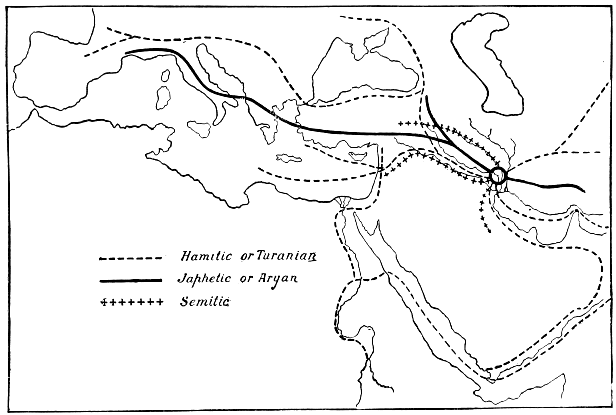
MAP SHOWING LINES OF POSTDILUVIAN MIGRATIONS FROM SHINAR, AS IN GENESIS X.
Among modern archæologists it has been a fruitful source of controversy whether we should classify men according to their skulls or to their tongues; in other words, whether physical characters or linguistic should be dominant in our classifications. Neither ground is absolutely certain. We may find long and short skulls in the same grave-mound, and there are intermediate forms which defy certain arrangement. In like manner history assures us that people of one race have often adopted the language of another. True science warns us that we may err unless we give a fair valuation to every available character. The ethnologist of Genesis considers both physical and linguistic characters, but bases his arrangement mainly on the sure ground of descent along with original language.
It may be said, however, that if taken in the sense obviously intended by the writer, the list will not correspond with the facts. A few data have, however, to be taken into the account in order to give this early writer fair play.
1. The record has nothing to do with antediluvian peoples or with survivors of the Deluge other than the sons of Noah, if there were any such. Therefore, those ethnologists who are sceptical as to the historical Deluge, and who postulate an uninterrupted advance of man through long ages of semi-bestial brutality, have nothing in common with our narrator, and cannot possibly understand his statements.
2. The document does not profess to be a series of ethnological inferences from the present or ancient characters of different nations, but an actual historical statement of the known migrations of men from a common centre in Shinar, the Sumir of the Chaldeans.
3. It relates only to the primary distribution of men from their alleged centre over certain districts of Western Asia, Eastern Europe, and Northern Africa, and does not profess to know anything of their subsequent migrations or history.
4. It is thus not responsible for those later, even if very ancient, changes which displaced one race by another, or obliged one race to move on by the pressure of another, nor for any changes of language or mixtures of races which may have occurred in these movements.
5. It affirms nothing as to the physical characters of the races referred to, except as they may be inferred from heredity, but it implies some resemblance in language between the derivatives of the same stock, and this, be it observed, notwithstanding the added narrative of the confusion of tongues at Babel, [771] which the narrator does not regard as interfering with the fact of languages originally forming a few branches proceeding from a common stock.
6. If we ask what our narrator supposed to be the original or Noachic tongue, we might infer from his three lines of descent, and from the locality of the dispersion and the episode of Nimrod's prehistoric kingdom, that the primitive language of Chaldea would be the original stem; and this we now know from authentic written records to have been an agglutinate language of the type usually known as Turanian, and more closely allied to the Tartar and Chinese tongues than to other kinds of speech. It would follow that what we now call Semitic and Aryan or Japhetic forms of speech must, in the view of our ancient authority, date from the sequelæ of the great 'confusion of tongues.'
These points being premised, we can clear away the fogs which have been gathered around this little luminous spot in the early history of the world, and can trace at least the principal ethnic lines of radiation from it. Though the writer gives us three main branches of affiliation of the children of Noah, he really refers to six principal lines of migration, three of them belonging to that multifarious progeny of Ham, in which he seems to include both the Turanian and Negroid types of our ordinary classifications, as well as some of the brown and yellow races.
One of the lines of affiliation of Ham leads eastward and is not traced; but if the Cushite people, who are said to have gone to the land which in earlier antediluvian times was that of 'gold and bedolach and shoham stone,' that is, along the fertile valley of Susiana, were those primitive people, preceding the Elamites of history, who are said to have spoken an agglutinate language, [78] then we have at least one stage of this migration. A second line leads west to the eastern coast of the Mediterranean, to Egypt and to North Africa. A third passes south-westward through Southern Arabia and across the Red Sea into interior Africa. To the sons of Japhet are ascribed two lines of migration, one through Asia Minor and the northern coasts of the Mediterranean; another north-west, around the Black Sea. The Semites would seem to have been a less wandering people at the first, but subsequently to have encroached on and mingled with the Hamites, and especially on that western line of migration leading to the Mediterranean. All this can be gathered from undisputed national names in the several lines of migration above sketched, without touching on the more obscure and doubtful names or referring to tribes which remained near the original centre. We must, however, inquire a little more particularly into the movements bearing on Palestine and Egypt.
So far as the writer in Genesis is informed, he does not seem to be aware of any sons of Japhet having colonised Palestine or Egypt. It was only in the later reflux of population that the sons of Javan gained a foothold in these regions. They were both colonised primarily by Hamites and subsequently intruded on by Semites.
Here a little prehistoric interlude noted by the writer, or by an author whom he quotes, gives a valuable clue not often attended to. The oldest son of Ham, Cush, begat Nimrod, the mighty hunter and prehistoric conqueror, who organised the first empire in that Euphratean plain which subsequently became the nucleus of the Babylonian and Assyrian power. The site of his kingdom cannot be doubted, for cities well known in historic times, Babel, Erech, Accad, and Calneh, were included in it, as well as probably Nineveh. The first point which I wish to make in this connection is that we cannot suppose this to have been a Semitic empire. Its nucleus must have been composed of Nimrod's tribal connections, who were Hamites and presumably Cushites. He is, indeed, said to have gone into or invaded the land of Ashur, and if by this is meant the Semitic Ashur, he must have been hostile to these people, as indeed the Chaldeans were in later times. The next point to be noted is that the Nimrodic empire must have originated at a time when the Cushites were still strong on the Lower Euphrates, and before that great movement of these people which carried them across Arabia to the Upper Nile, and ultimately caused the name Cush or Kesh to be almost exclusively applied to the Ethiopians of Africa. Now is this history, or mere legend?
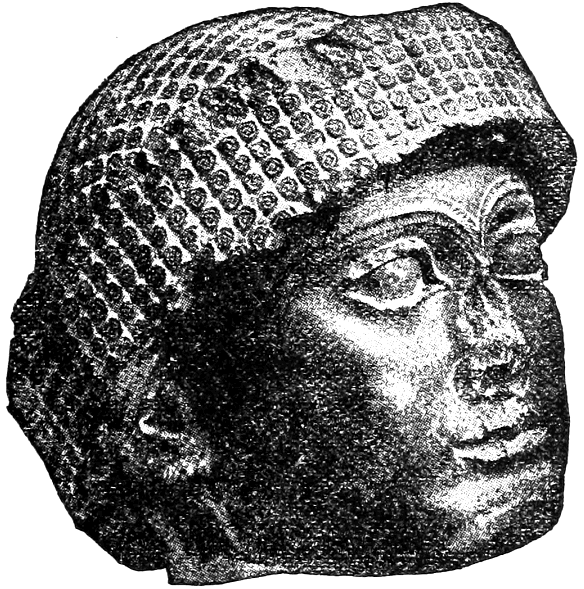
HEAD ILLUSTRATING THE MOST ANCIENT TYPE OF CUSHITE TURANIAN, FROM TEL-LOH (after de Sarzec). The cap is perhaps an imitation of the antediluvian shell-caps, like that of the 'man of Mentorie.'
The answer of archæology is not doubtful. We have in the earliest monuments of Chaldea evidence that there was a pre-Semitic population, to whom, indeed, it is believed that the Semites who invaded the country owed much of their civilisation. A recent writer has said that 'outside of the Bible we know nothing of Nimrod,' but others see a trace of him in the legendary hero of Chaldean tradition, Gisdubar or Gingamos, while others think that, as Na-marod, he may be the original of Merodach, the tutelary god of Babylon. Independently of this, there was certainly an early Chaldean and 'Turanian' empire, which must have had some founder, whatever his name, and which was not Semitic or Aryan, and therefore what an early writer would call Hamitic. Further, our author traces from this region the great Cushite line of migration, which includes such well-known names as Seba, Sabta, Sheba and Dedan, into Arabia on the way to Africa. Here the Egyptian monuments take up the tale, and inform us of a South Arabian and East African people, the people of Pun or Punt, represented as like to themselves and to the Kesh or Ethiopians, and who thus correspond to the Arabian Cushites of Genesis. In accordance with this the Abyssinian of to-day is scarcely distinguishable from the old Punites as represented on the Egyptian monuments. [79]
Thus the primitive Cushite kingdom and one of the great lines of Cushite migration are established by ancient monuments. Let it be further observed that, as represented in Egypt, these primitive Ethiopians were not black, but of a reddish or brownish colour, like the Egyptians themselves, and that their migration explains the resemblance of the customs and religion of early Egypt to those of Babylonia, and the ascription by the Egyptians of the origin of their gods to the land of Pun.
The remaining sons of Ham, Mizraim, Put and Canaan, are not mentioned in connection with the old Nimrodic kingdom, and seem to have moved westward at a very early period. They were already 'in the land,' and apparently constituted a considerable citizen population before the migration of Abraham.
Mizraim represents the twin populations of the delta and Lower Egypt, and the Tel-el-Amarna tablets inform us that long before the time of Moses Mitzor was the ordinary name of Egypt, while we know that its early population was closely allied in features and language to the Cushites.
Canaan [80] heads a central line of migration, and Sidon and Cheth are said to have been his leading sons. The first represents the Phœnician maritime power of Northern Syria, the second that great nation known to the Egyptians as Kheta and to the Assyrians as Khatti, whose territory extended from Carchemish on the Euphrates through the plain of Coele-Syria to Hebron in Southern Palestine, and not improbably into the delta. They were a people whose language was allied to that of Cushite Chaldea, [81] whose features were of a coarser type than those of their more southern confrères, and who, according to the Egyptian annals, were closely allied with the Amorites, Jebusites, and other people identified with Canaan in the Old Testament. The Cheta, at one time known only as the sons of Heth in the Old Testament, may be said in our time to have experienced a sudden resurrection, and now bulk so largely in the minds of archæologists that their importance is in danger of being exaggerated.
A significant note is added: 'Afterwards were the families of the Canaanites scattered abroad.' How could this be? Their line of migration and settlement led directly to the great sea, and was hemmed in by that of the Japhetites on the north and of the Cushites on the south; but they made the sea their highway, and soon there was no coast from end to end of the Mediterranean, and far along the European and African shores of the Atlantic, that was not familiar with the Phœnician Canaanite. But it may be said these Phœnicians were a Semitic people. They certainly spoke a Semitic language allied to the Hebrew, but what right have we to attribute Semitic languages solely to the descendants of the Biblical Shem? Even if these languages originated with them they may have spread to other peoples, as we know they replaced the old Turanian speech of Babylonia, just as the Arabic has extinguished other languages in Egypt itself. In whatever way the Phœnicians acquired a Semitic tongue, in physical character they were not Semitic, but closely allied to the Hittites, the Philistines, and the people of Mitzor, or Egypt. The Egyptian sculptures prove this, and the celebrated Capuan bust of Hannibal reminds us of the features of the old Hyksos kings of Egypt, who were no doubt of Hamite or Turanian stock.
Finally, what relation does the record in Genesis x. bear to the prehistoric peoples of the neanthropic age? These must have been in the main the advanced colonists and straggling adventurers of the leading lines of migration. We find such people recorded in the Pentateuch, and also in the caverns and shelters of Phœnicia, as preceding the Canaanites in Syria; and such nomads and hunters must have streamed out into Europe and Africa in advance of the more settled and slowly advancing agricultural peoples. At first they must have been few, rude, and users of stone implements only, living chiefly by hunting and fishing; but some of them may have taken with them domestic animals and seeds of grains, and so have established here and there civilised communities. In later times, new colonists and commerce introduced among them bronze and iron and more advanced arts. Thus these early neanthropic peoples belonged to one or other of the great lines of migration indicated in our old record; though by virtue of physical changes and dialectic differences induced by isolation and new conditions of life, and which in such circumstances would arise with a rapidity unexampled in later times, as well as the want of historical annals, it has in many cases become difficult or impossible precisely to trace their affinities. Even in Palestine, at the time of the Exodus, peoples of this kind (Horites, Avvites, &c.) [82] were known, whose affinities had been lost; and it is not necessary to suppose that these were remnants of antediluvians, since what we know in modern times of the wanderers on the outskirts of great migrations sufficiently accounts for their existence.
This is, I think, a fair summary of the testimony of the writer of Genesis x., as compared with the general evidence of history and archæology. But we have something further to learn from what may be called the fossil remains of prehistoric peoples as embodied in the Egyptian monuments, which are conversant with all the nations around the eastern end of the Mediterranean.
The Egyptians divided the nations known to them into four groups, of which they have given us several representations in tombs and public buildings. One of these consisted of their own race. The other three were as follows: (1) Southern peoples mostly of dark complexions, ranging from light brown to black. These included the Cushites, Punites, and negroes. (2) Western peoples mostly of fair complexions inhabiting the islands and northern coasts of the Mediterranean, the 'Hanebu' or chiefs of the north or of the isles, with some populations of North Africa, the so-called white Lybians and Maxyans. (3) Northern or north-eastern peoples, or those of Syria and the neighbouring parts of Western Asia, Amorites, Hittites, Edomites, Arabs, &c., usually represented as of yellowish complexion.
The first of these divisions evidently corresponds with the line of Cushite migration of Genesis, extending from Shinar through Southern Arabia, Nubia, and Ethiopia, and of which the negroes are apparently degraded members pushed in advance of the others, while the populations of Pun and Kesh, the southern Arabians and their relatives in Africa, closely resemble, as figured in the monuments, the Egyptians themselves.
The second group of the Egyptian classification represents those so-called Aryan peoples of Europe and its islands, and parts of Northern Africa, of whom the Greeks are a typical race, and who in Genesis are said to have possessed the 'Isles of the Gentiles'; though in the wave of migration from the east they were in many places preceded by non-Aryan races, Pelasgians, Iberians, &c., possibly wandering Hamitic tribes, while they were also invaded by that scattering abroad of the Phœnician Canaanites referred to in Genesis. They are represented in the monuments as people with European features, fair complexions, and sometimes fair hair and blue eyes.
The third group is the most varied of the whole, because its seat in Syria was a meeting-place of many tribes. Its most ancient members, the Phœnicians and allied nations, were, according to the monuments, men resembling the Egyptian and Cushite type, and these, no doubt, were those pre-Semitic and prehistoric nations of Canaan referred to in the remarkable notes regarding the Emim, Zuzim, &c., in the second chapter of Deuteronomy, which may be regarded as a foot-note to the Toledoth of Genesis x. These aborigines were invaded by men of different types. First, we find in the monuments that the Amorites of the Palestine hills were a fair people with somewhat European features, like some of the present populations of the Lebanon. When returning over the Lebanon in 1884 we met a large company of men with camels and donkeys carrying merchandise. They were fair-complexioned and with brown hair, and from their features I might have supposed they were Scottish Highlanders. I was told they were Druses, and they were evidently much like, as are indeed many of the modern fellaheen of the Palestine hills, the Amar as they are pictured in Egypt. These white peoples, though reckoned in the Bible as Hamites, may have had a mixture of Aryan blood. It is to be noted here that the Amorite chiefs, Aner, Eshcol, and Mamre, named as confederate with Abraham, have non-Semitic names.
A later inroad was that of the Hittites, evidently a people having affinity with the Philistines and Egyptians, but whose chiefs and nobles seem to have been of Tartar blood, like the modern Turks. The names of their kings seem also to have been non-Semitic. Later, the great westward migration of Semitic peoples, to which that of Abraham himself belongs, not only introduced the Israelites but many nations of Semitic or mixed blood, the Moabites, Ammonites, Edomites, Ishmaelites, &c., whom we find figuring in the Egyptian monuments as yellow or brownish people with a Jewish style of features, and all of whom, as mentioned above, would be known to the Egyptians and Canaanites as 'Hebrews.' [83]
Thus the monuments confirm the Jewish record, and the confusion which some ethnologists have introduced into the matter arises from their applying in an arbitrary manner the special tests of physical and philological characteristics, and neglecting to distinguish the primary migrations of men from subsequent intrusions.
Another singular point of agreement is that, just as in Egypt we find men civilised from the first, so we find elsewhere. In Egypt writing and literature date from before the time of Abraham. In like manner we have no monumental evidence of any time when the Accadian people of Babylonia were destitute of writing and science, and we now find that there were learned scribes in all the cities of Canaan, and that the Phœnicians and Southern Arabians knew their alphabet ages before Moses, while even the Greeks seem to have known alphabetic writing long before the Mosaic age. [84] These men, in short, were descendants of the survivors of the Noachian Deluge, and therefore civilised from the first; and though we have no certain evidence of letters before the Flood, except the statement of the author of the Babylonian deluge tablets, that Noah hid written archives at Sippara before going into the ark, yet it is quite certain that men who could build Noah's ship are not unworthy ancestors of the Phœnician seamen, who probably launched their barks on the Mediterranean before the death of Noah himself. Thus, whatever value we may attach to the record in Genesis, we cannot refuse to admit that it is thoroughly consistent with itself and with the testimony of the oldest monuments of Asia and Africa, as it is also with the evidence of the geological changes of the pleistocene and early modern epoch.
In like manner the Egyptian inscriptions of the conquests of Thothmes III. give us a pre-Mosaic record of Palestinian geography corresponding with that of the Hebrew conquest, and the pictures of sieges coincide with the excavations of Petrie at Lachish in restoring those Canaanite towns, 'walled up to heaven,' which excited the fear of the Israelites. Neither can we scoff at the illiteracy of men who were carrying on diplomatic correspondence in written despatches before Genesis itself was compiled. Nor can we doubt the military prowess of these people, their chariot forces, their sculptured idols and images, their wealth of gold and silver, their agricultural and artistic skill. All these are amply proved by the monuments of the Egyptians and the Hittites. [85]
Palestine thus presents a prehistoric past parallel with the earlier years of Egypt. It has, however, a still earlier period, for in Palestine, as stated in a previous chapter, we have evidence of the existence of man long before the dispersion of the sons of Noah. To appreciate this evidence, we must go back, as in the case of Egypt, to the pre-human period. All along the coast of Palestine, from Jaffa to the northern limit of old Phœnicia, the geological traveller sees evidence of a recent submergence, in the occurrence of sandstone, gravel, and limestone with shells and other marine remains of species still living in the Mediterranean. These are the relics of that pleistocene submergence already referred to, in which the Nile valley was an arm of the sea and Africa was an island. No evidence has been found of the residence of man in Palestine in this period, when, as the sea washed the very bases of the hills, and the plains were under water, it was certainly not very well suited to his abode. The climate was also probably more severe than at present, and the glaciers of Lebanon must have extended nearly to the sea. This was the time of the so-called glacial period in Western Europe.
This, however, was succeeded by that post-glacial period in which, as already explained, the area of the Mediterranean was much smaller than at present, and the land encroached far upon the bed of the sea. This, the second continental period, is that in which man makes his first undoubted appearance in Europe, and we have evidence of the same kind in Syria, to which I have already directed attention in the description of the caverns of the Lebanon, in Chapter IV.
That the occupancy of these caves is very ancient is proved by the fact that the old Egyptian conquerors, who cut a road for themselves over these precipices before the Exodus, seem to have found them in the same state as at present, while farther south ancient Syrian tombs are excavated in similar bone breccias. But there is better evidence than this. The bones and teeth in these caves belong not to the animals which have inhabited the Lebanon in historic times, but to creatures like the hairy rhinoceros and the bison, now extinct, which could not have lived in this region since the comparatively modern period in which the Mediterranean resumed its dominion over that great plain between Phœnicia and Cyprus. This we know had been submerged long before the first migrations of the Hamites into Phœnicia, even before the entrance of those comparatively rude tribes which seem to have inhabited the country before the Phœnician colonisation. [86] Unfortunately no burials of these early men have yet been found, and perhaps the Lebanon caves were only their summer sojourns on hunting expeditions. They were, however, probably of the same stock with the races (the Cro-magnon and Canstadt) of the so-called mammoth age in Western Europe, who have left similar remains. Thus we can carry man in the Lebanon back to that absolutely prehistoric age which preceded the Noachian Deluge and the dispersion of the Noachidæ. [87]
If in imagination we suppose ourselves to visit the caves of the Nahr-el-Kelb pass, when they were inhabited by these early men, we should find them to be tall muscular people, clothed in skins, armed with flint-tipped javelins and flint hatchets, and cooking the animals caught in the chase in the mouths of their caves. They were probably examples of the ruder and less civilised members of that powerful and energetic antediluvian population which had apparently perfected so many arts, and the remains of whose more advanced communities are now buried in the silt of the sea bottom. If we looked out westward on what is now the Mediterranean, we should see a wide wooded or grassy plain as far as eye could reach, and perhaps might discern vast herds of elephant, rhinoceros, and bison wandering over these plains in their annual migrations. Possibly on the far margin of the land we might see the smoke of antediluvian towns long ago deeply submerged in the sea.
The great diluvial catastrophe which closed this period, and finally introduced the present geographical conditions, we have seen good reason to identify with the historical Deluge, and the old peoples of the age of the mammoth and rhinoceros were antediluvians, and must have perished from the earth before the earliest migration of the Beni Noah.
Putting together the results referred to in the preceding pages, we may restore the prehistoric ages of the Eastern Mediterranean under the following statements:
1. In the period immediately preceding human occupancy, the land of Palestine, Egypt, and Arabia participated in the great pleistocene depression, accompanied by a rigorous climate.
2. The next stage was one of continental elevation, in which the borders of the Mediterranean were dry land, and vast plains in this basin, and even in the Western Atlantic, were open to human migration. In this age palæocosmic men took up their abode all over Western Asia, Europe, and Northern Africa, and probably occupied broad lands since submerged. At this period the region was inhabited by the mammoth, rhinoceros, bison, and other large animals now altogether or locally extinct.
3. The earlier part of this post-glacial or antediluvian period was one of mild climatal conditions, followed by a slight return of the conditions of the previous glacial age.
4. The period was terminated by a great submergence, accompanied with vast destruction of animal and human life; and of comparatively short duration, corresponding to the historical Deluge.
5. From this depression the more limited continents of the modern period were elevated, and man again overspread them from his primitive seats in the Euphratean region, as recorded in the tenth chapter of Genesis.
6. In this early migration the Biblical Hamites, forming one of the groups of men vaguely known as Turanian, first spread themselves over Palestine and Egypt, and founded the early Phœnician, Canaanite, Mizraimite, and Cushite tribes and nations.
7. In early historic times Semitic peoples, Hebrews and others from the east, and Mongoloid peoples from the north, migrated into Palestine and dominated and mixed with the primitive tribes, finally penetrating into Egypt and establishing there the dominion known as that of the Hyksos. The historical Moabites, Ammonites, Ishmaelites, and Hittites were peoples of this character, having a substratum of Hamite blood with aristocracies of Semitic or Tartar origin.
It will be observed that while archæological evidence tends to illustrate and corroborate that wonderful collection of early historical documents contained in the Book of Genesis, and to prove their great antiquity, on the other hand these documents prove to be the most precious sources of information as to the antediluvian age, the great Flood, the earliest dispersion of men, the old Nimrodic empire, the connections of Asiatic and African civilisation, and other matters connected with the origins of the oldest nations, respecting which we have little other written history.
We thus learn that, relatively to Bible history, there is no prehistoric age, since it carries us back beyond the Deluge to the origin of man, so that we might properly restrict this term in its narrower signification to those parts of the world not covered by this primitive history. It is true that a tide of criticism hostile to the integrity of Genesis has been rising for some years; but it seems to beat vainly against a solid rock, and the ebb has now evidently set in. The battle of historical and linguistic criticism may indeed rage for a time over the history and date of the Mosaic law, but in so far as Genesis is concerned it has been practically decided by scientific exploration.
Since writing the preceding pages I have met with a remarkable paper by Mr. Horatio Hale in the Transactions of the Royal Society of Canada. [881] It is one which should commend itself to the study of every Biblical scholar and archæologist; but is contained in a periodical which perhaps meets the eyes of few of them. In this paper he maintains the importance of language as a ground of anthropological classification, and then uses his wide knowledge of the languages of American aborigines, and other rude races, to show that the grammatical complexity and logical perfection of these languages implies a high intellectual capacity in their original framers, and that where such complex and perfect languages are spoken by very rude tribes like the Australian aborigines, they originated with cultivated and intellectual peoples—in the case of the Australian, with the civilised primitive Dravidians of India. He thus shows that languages, like alphabets, have undergone a process of degradation, so that those of modern times are less perfect exponents of thought than those which preceded them, and that primitive man in his earliest state must have been endowed with as high intellectual powers as any of his descendants.
On similar grounds he shows that it is not in the outlying barbarous races that we are to look for truly primitive man, since here we have merely degraded types, and that the primitive centres of man and language must have been in the old historic lands of Western Asia and Northern Africa. On this view the time necessary for the development of the arts of civilisation and of extensive colonisation would not be great. 'In five centuries a single human pair planted in a fertile oasis might have given origin to a people of five hundred thousand souls, numerous enough to have sent out emigrations to the nearest inviting lands.' The same lapse of time would have sufficed to develop agriculture, to domesticate animals, and to make some progress in architectural and other arts of life. He quotes the remarkable passage of Reclus [89] as to the agency of woman in the inventions of early art, and shows that this accords with more modern experience among the less civilised nations. It is obvious that all this tends to bring scientific anthropology into the closest relation with the old Biblical history, though Hale, in deference, perhaps, to modern prejudices, does not refer to this.
In the passage quoted by Hale, Reclus says: 'It is to woman that mankind owes all that has made us men.' Following this hint of the ingenious French writer, we may imagine the first man and woman inhabiting some fertile region, rich in fruits and other natural products, and subsisting at first on the uncultivated bounty of nature. With the birth of their first child, perhaps before, would come the need of shelter either in some dry cavern or booth of poles and leaves or bark, carpeted perhaps with moss or boughs of pine. This would be the first 'home,' with the woman for its housekeeper. We may imagine the man bringing to it the lamb or kid whose dam he had killed, and the woman, with motherly instinct, pitying the little orphan and training it to be a domestic pet, the first of tamed animals. She, too, would store grain, seeds and berries for domestic use, and some of these germinating would produce patches of grain, or shrubs, or fruit trees around the hut. Noticing these and protecting them, she would be the first gardener and orchardist. The woman and her children might add to the cultivated plants or domesticated quadrupeds and birds; and the man would be induced, in the intervals of hunting and fishing, to guard, protect, and fence them.
When the boys grew up, to one of them might be assigned the care of the sheep and goats, to the other the culture of the little farm, while they might aid their father in erecting a better and more artistic habitation, the first attempt at architecture, and in introducing artificial irrigation to render their field more fertile. Is not this little romance of M. Elie Reclus perfectly in harmony with the old familiar story in Genesis, and also with the most recent results of modern science?
CHAPTER XIII
SUMMARY OF RESULTS
It may be well, in conclusion, to sum up the general truths we have arrived at in relation to the place of man in the great and long-continued drama of the earth's geological history.
1. We have found no link of derivation connecting man with the lower animals which preceded him. He appears before us as a new departure in creation, without any direct relation to the instinctive life of the lower animals. The earliest men are no less men than their descendants, and up to the extent of their means, inventors, innovators, and introducers of new modes of life, just as much as they. We have not even been able as yet to trace man back to the harmless golden age. As we find him in the caves and gravels he is already a fallen man, out of harmony with his environment and the foe of his fellow creatures, contriving against them instruments of destruction more fatal than those furnished by nature to the carnivorous wild beasts. Yet we would fain believe in an Edenic age of innocence; and physiological probability, as well as the old story in Genesis, demands that we should suppose a primitive condition in which man, careless and happy, should subsist on the spontaneous bounty of nature in some favoured 'garden of the Lord.'
Scheme of possible Correlation of the Geological and Historical Records as to Early Man, as the Facts appear in the present Stage of Investigation, May 1894.
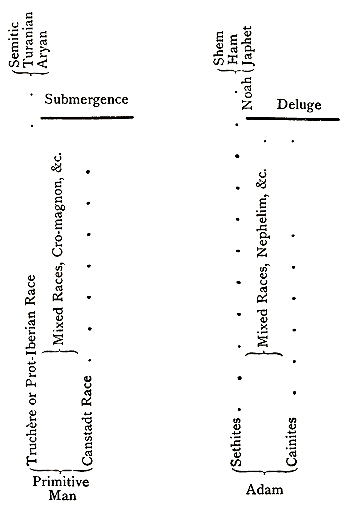
Click here for text version.
2. If we inquire as to the nature of the interval which separates man from the lower animals, we find that it exists with reference both to his rational and physical nature. With respect to the first we may affirm in man the existence of a lower (psychical) intelligence, similar to that of the inferior animals, and of a spiritual nature allying him with higher intelligences, and with God Himself. Rightly considered, this places the doctrine of creation in a very firm position. Those who deny it must adopt one of two alternatives. Either they must refuse to admit the evidence in man of any nature higher than that of brutes—a conclusion which common sense, as well as mental science, must always refuse to admit—or they must attempt to bridge over the 'chasm,' as it has been called, which separates the instinctive nature of the animal from the rational and moral nature of man—an effort confessedly futile.
3. As to the body of man, the case is different, but still perfectly in harmony with the idea of his higher nature. Man, as to his body, is confessedly an animal, of the earth earthy. He is also a member of the province vertebrata, and the class mammalia; but in that class he constitutes not only a distinct species and genus, but even a distinct family, or order. In other words, he is the sole species of his genus, and of his family, or order. He is thus separated, by a great gap, from all the animals nearest to him; and even if we admit the doctrine, as yet unproved, of the derivation of one species from another in the case of the lower animals, we are unable to supply the 'missing links' which would be required to connect man with any group of inferior animals. This physical distinctness has also a special significance, inasmuch as it depends on certain negative peculiarities such as the absence of clothing, of natural weapons of attack and defence, as well as on the positive properties of the erect posture, the hands adapted to various kinds of manipulation, and the special sensory gifts. Thus viewed in relation to his environment, his wants as well as his possessions in regard to structures and powers, would be fatal to any creature not possessed of his intelligence, and we cannot conceive how such privations or such gifts could spontaneously arise in nature.
4. No fact of science is more certainly established than the recency of man in geological time. Not only do we find no trace of his remains in the older geological formations, but we find no remains even of the animals nearest to him; and the conditions of the world in those periods seem to unfit it for the residence of man. If, following the usual geological system, we divide the whole history of the earth into four great periods, extending from the oldest rocks known to us, the eozoic, or archæan, up to the modern, we find remains of man, or his works, only in the latest of the four, and in the later part of this. In point of fact, there is no indisputable proof of the presence of man until we reach the early modern period. This is, no doubt, what was to have been expected on the supposition of the orderly development of the chain of animal life in the long geologic eons; but it is not by any means the only hypothesis that was possible when, for example, the Book of Genesis was written. A more fanciful cosmologist might at that time have given precedence to man, and might have supposed that the other animals were produced later, and for his benefit, or his injury. This is the view of the sacred writer himself with respect to the local group of animals intended to be in immediate association with the first man. Restricted in this way, the statement of a group of animals created with man in his earliest abode is not contradictory to the order in Genesis first, nor scientifically improbable. We have seen that in any case the deductions from geology are in harmony with the earliest revelations made to the human mind on the subject, and in accordance with all the later facts of actual history.
5. The absolute date of the first appearance of man cannot perhaps be fixed within a few years or centuries, either by human chronology or by the science of the earth. It would seem, however, that the Bible history, as well as such hints as we can gather from the history of other nations, limits us to two or three thousand years before the Deluge of Noah, while some estimates of the antiquity of man, based on physical changes or ancient history, or on philology, greatly exceed this limit. If the earliest men were those of the river gravels and caves, men of the 'mammoth age,' or of the 'palæolithic' or palæocosmic period, we can form some definite ideas as to their possible antiquity. They colonised the continents immediately after the elevation of the land from the great subsidence which closed the pleistocene or glacial period, in what has been called the 'continental' period of the post-glacial age, because the new lands then raised out of the sea exceeded in extent those which we have now. We have, as stated in a previous chapter, some measures of the date of this great continental elevation, and know that its distance from our time must fall within about eight thousand years. Many indications, both in Europe and America, lead to the belief that it is physically impossible that man could have colonised the northern hemisphere at an earlier date than this geologically recent continental period.
6. There is but one species of man, though many races and varieties; and these races or varieties seem to have developed themselves at a very early time and have shown a remarkable fixity in their later history. There is reason to believe, however, from various physiological facts, that this is a very general law of varietal forms, which are observed to appear rapidly or suddenly, and then in favourable circumstances to be propagated continuously. It would seem also to apply to the introduction of forms regarded as species, since it is not unusual to find a genus at or near its origin represented by its maximum number of specific forms.
7. The precise locality of the origin of man can be defined on probable grounds as in a temperate region, supplied with the vegetable productions most useful to him in a natural state, and free from destructive animal rivals. We can scarcely suppose that this locality can have been in any of those parts of the world in which man finds the greatest difficulty in subsisting, or becomes most degraded, though this paradoxical view has been held by some archæologists. It must rather have been in some fertile and salubrious region of the northern hemisphere; and probability as well as tradition points to those regions in South-Western Asia which have not only been the earliest historical abodes of man, but are also the centres of the animals and plants most useful to him. It is interesting to note here that Hæckel, on purely physical grounds, decides against Europe, Africa, Australia, and America, and concludes that 'most circumstances indicate Southern Asia.'
8. It is to be observed, however, that the diluvial interlude gives a double origin of man; but the historical accounts of the neocosmic dispersion, as we have already seen, refer us in this case also to the same regions of South-Western Asia. The traditions which ascribe human origin to a 'Mountain of the North' refer to the second dispersion, and coincide with the Ararat of Genesis and the 'Mountain of the North' on which the ship of Hasisadra was supposed by the Chaldeans to have grounded.
9. We are now in a position to correlate the historical Deluge with the great geographical changes which closed the palanthropic age. This, when regarded as an established fact, furnishes the solution of many of the most disputed questions of anthropology. The misuse of the Deluge in the early history of geology, in employing it to account for changes that took place long before the advent of man, certainly should not cause us to neglect its legitimate uses, when these arise in the progress of investigation. It is evident that if this correlation be accepted as probable, it must modify many views now held as to the antiquity of man. In that case, the modern rubble spread over plateaus and in river valleys, far above the reach of the present floods, may be accounted for, not by the ordinary action of the existing streams, but by the abnormal action of currents of water diluvial in their character. Further, since the historical Deluge cannot have been of very long duration, the physical changes separating the deposits containing the remains of palæocosmic men from those of later date would, in like manner, be accounted for, not by slow processes of subsidence, elevation, and erosion, but by causes of a more abrupt and cataclysmic character.
Finally, it has been the tendency of modern geological and archæological discovery to attach more and more value and importance to the ancient records of the human race, and especially to those precious documents which have been preserved to our time in the Book of Genesis.
We have merely glanced cursorily at a few of the salient points of the relation of the primitive history of man in Genesis to modern scientific discovery. Many other details might have been adduced as tending to show similar coincidences of these two distinct lines of evidence. Enough has, however, been said to indicate the remarkable manner in which the history in Genesis has anticipated modern discovery, and to show that this ancient book is in every way trustworthy, and as remote as possible from the myths and legends of ancient heathenism, while it shows the historical origin of beliefs which in more or less corrupted forms lie at the foundations of the oldest religions of the Gentiles, and find their true significance in that of the Hebrews. To the Christian the record in Genesis has a still higher value, as constituting those historical groundworks of the plan of salvation to which our Lord Himself so often referred, and on which He founded so much of His teaching.
INDEX

[A] [B] [C] [D] [E] [F] [G] [H] [I] [J] [K] [L] [M] [N] [O] [P] [Q] [R] [S] [T] [W] [Z]
A Adam, description of, 64 Adon, the name, 180 Akkadian kingdom, foundation of, 108 Alphabets, early, 108 Amunoph III., 177 Amunoph IV., 177 Anakim, the, 65 Animals, remains of, 23, 30, 38, 43, 45, 46, 48, 50, 74, 96, 98 Antediluvians, identification of, 125 Anthropic age, definition of, 17; events of, 39 Anthropology, 16 Archæan age, the, 19 Ark, the, description of, 135 Arrow-headed characters, use of, 108 Artemis, 160 Aten, worship of, 177 Atlantis, fable of, 156 Auriferous gravel, finds in, 34 B Bears, cave, 46 Beni Elohim, 132 Beni ha Adam, 132 Bones, human, gnawed, 47 Boule, on deposits at Schweizersbild, 87 Britain, early inhabitants of, 103 Broca, on skulls, 61 Burials, discoveries of, 56 C Cain, the race of, 131 Canaan, migration of, 193 Canstadt race, the, 51, 80; age of, 70; condition of, 75; interments of, 77; skulls of, 81 Carthaillac on palanthropic age, 70; on the mortuary customs of, 77 Carving, specimens of, 49 Castelnedolo, skeleton at, 29 Cave dwellers, 48; their food, 49 Caverns, various, 42 Celtæ, the, description of, 104 Cenozoic age, the, 20; changes of, 24; events of, 39; relations of, 84 Chaldean version of the Deluge, 137; creation tablets, 107; Genesis quoted, 113 Cheth, children of, 167 Chipped Stone age, the, 69 Chronometers, geological, 89 Civilisation, early postdiluvian, 118 Clichy skull, the, 60 Climate of the pliocene, 25; of the eocene, 27; changes of, 35, 36; of the post-glacial age, 36; of the palanthropic age, 38, 40, 171 Creation, the, order of, in Genesis, 106, 112, 114; Chaldean account of, 112 Cresswell caves, description of, 95 Cro-magnon cave, the, 51 Cro-magnon race, the, 51; skeletons of, 53; skulls of, 61, 81; age of, 70; condition of, 75; appearance of, 76; belief of, 76; interments of, 77 Curse, the, 120 Cushite kingdom, foundation of, 108 Cushite migration, the, 192 D Dawkins on palæolithic and neolithic periods, 93 Days of creation, the, 14, 18 Delta, the, age of, 174 Deluge, the, accounts of, 107; story of, 121; Lenormant on, 123; conclusions as to, 126; prevalence of story of, 127; physical aspects of, 135; Chaldean version of, 136; history of, 137; was it miraculous? 140; was it universal? 147, 151 Diana, 160 Dispersion of man, the, 108 Druses, the, 198 Dupont on cave of Goyet, 46; on primitive man, 73; on plain dwellers, 74; on Frontal caves, 98 E Earth, the stages of its history, 15, 18; age of, 18 Eber, children of, 179 Eden, site of, 114 Edwards, Miss, criticism of, 171 Egypt, history of, 168; first colonists of, 174 Elephant in Europe, the, 38 Elevation of land in post-glacial age, 36 Elohim, use of the name, 112 Embalming, early practice of, 78 Engis skull, the, 60 Eocene age, the, 23; changes of, 24 Eozoic age, the, 19 Euphrates, the, 114 Eve, story of, 160 Evolution of man, the, 22; vagaries of, 118 Exodus, the, Pharaoh of, 179 F Fall of man, the, 116 Fauna of palanthropic age, changes of, 86 Flints, worked, 28 Food of cave dwellers, 49 Furfooz caves, description of, 98 G Generations of Noah, the, 184 Genesis, order of creation in, 106 Geologist, the, method of, 12 Giants, a race of, 63 Gibraltar skull, the, 60 Glacial age, the, 25 Globe, incandescent, picture of, 18 Goyet, cave of, description of, 46 Greenwell on men of Britain, 103 Grenelle, skull of, 60; deposit at, 94 H Hale on importance of language, 206 Hamites, migrations of, 188 Hasisadra, the Chaldean Noah, 118 Hebrew annals, truth of, 106 Heth, 167 Higher criticism, Sayce on, 109 Historian, the, method of, 12 Hittites, the, inroad of, 198 Holmes on worked flints, 31 Homeric heroes, reality of, 166 Horus, sons of, 159 Hyksos, the, 181 I Idinu, or Eden, 114 Ightham, worked flints of, 31 Interments, discoveries of, 56; mode of, 77 Isha, story of, 160 Ivory, ornaments of, 58; engraving on, 74 J Jahveh, 133 Japhet, migrations of, 189, 190 Jebel Assart, flint chips at, 171 Jehovah Elohim, use of the name, 112, 132 Jerusalem, ancient state of, 179 K Karun, a river of Eden, 114, 116 Kerkhat, the, 114 Kheta, or Khatti, 167 Kneeling posture in interments, 77 L Laugerie Basse, cave at, 51; skeleton at, 58 Lebanon caves, human remains in, 43, 45; visit to, 202 Lenormant on the Deluge, 123; on the Ark, 136 Lion, the cave, 46 Lyell, on Falls of Niagara, 124 M Mammals in palanthropic age, species of, 37 Mammoth age, cave of, 50 Mammoth, the, in Europe, 38; extinction of, 74 Man, date of his appearance, 21, 213; his earliest remains still human, 22; antecedents of, 23; his remains overlaid, 35; in Europe, 35; in palanthropic age, 40; how distinguished, 41; his remains at Nahr-el-Kelb, 45; at Goyet, 46; gnawed bones of, 47; a cave dweller, 48; his ornaments, 48, 58; carving of, 49; food of, 49; his physical characters, 51; his remains at Cro-magnon, 51; skeleton of, at Mentone, 58; varieties in skull of, 60; gigantic size of, 62; a feebler race, 63; conditions of, 71; Dupont on primitive, 73; unprogressive character of men of mammoth age, 75; beliefs of, 76; mortuary customs of palanthropic, 77; change of, from palæocosmic to neocosmic, 91; neolithic, 101; of Britain, 103; in Eden, 115; condition of palanthropic, 116; recency of, 213; locality of his origin, 216 Meeting-place of geology and history, 13 Mentone skeleton, the, 58 Mesozoic age, the, 19 Metals, the knowledge of, 118 Miocene age, the, 23; changes of, 24; monkeys of, 27 Mitanni, 181 Mizraim, 193 Monkeys, miocene, 27 Mortillet on the stone age, 69 Moses: his knowledge of Divine name, 180 Mourlon on pleistocene remains, 30 Musical instruments, invention of, 118 N Nahr-el-Kelb, caverns of, 44; people of, 203 Neanderthal skull, the, 60 Neanthropic age, definition of, 17; events of, 39; men of, 95 Nebula, picture of, 18 Necklace, a shell, 48 Neocosmic age, appearance of, men of, 91, 102 Neolithic age, men of, 101 Niagara, Lyell's use of, 124 Nile valley, limestones of, 168, 201; appearance of, 174 Nimrod, kingdom of, 190 Noah, story of, 121 Nuesch on deposits at Schweizersbild, 87 O Old man of Cro-magnon, 53; supposed history of, 65 Ornaments, remains of, 48, 58 P Palæolithic implements, discoveries of, 31 Palæozoic age, the, 19 Palanthropic age, definition of, 17; number of species of mammals in, 37; climate of, 38; land of, 40; caves of, 46; animals of, 50; man of, 51; conditions of, 69; divisions of, 70; tragic end of, 85; changes in fauna of, 80; subsidence of, 88 Palestine, people of, 197; history of, 201 Paviland skull, the, 60 Petrie: his photographic portraits, 180 Pharaoh of the Exodus, the, 179 Phœnicians, the, 193 Pictet on number of species in palanthropic age, 37 Pinches on Chaldean Genesis, 113 Plain dwellers, 51; conditions of, 74 Pleistocene age, definition of, 17; history of, 23; human remains of, 30; events of, 39 Pliocene age, 23; changes of, 24; human remains of, 29; events of, 39 Polished Stone age, the, 69; men of, 101 Post-glacial age, 26; elevation of, 36 Punites, 193 Q Quaternary period, the, 20 Quatrefages on Castelnedolo skeleton, 29; on Truchère skull, 84 R Ra, worship of, 177 Recency of man, 213 Reclus, romance of, 208 Reindeer age, the, 38, 50 Rhinoceros in Europe, the, 38 Rivière on Mentone skeleton, 58, 62 S Sayce on the higher criticism, 109 Scale of earth's history, a, 22 Schliemann, discoveries of, 166 Schweizersbild, deposits at, 87 Semites, migrations, 189 Seth, the race of, 131 Shell ornaments, remains of, 48, 58 Sickle, wooden, 172 Silures, the, 103 Skeleton of Castelnedolo, 29; Mentone, 58; of Laugerie Basse, 58 Skull from Val d'Arno, 29; of Cro-magnon, 53, 82; of Clichy, Grenelle, Gibraltar, Paviland, Neanderthal, Engis, 60; of Canstadt, 81; of Truchère, 83 Species, number of palanthropic, 37 Sphinx, the, history of, 176 Spy, interments at, 56 Stone ages, the, 69 Submergence, records of, 148 Subsidence of palanthropic age, 88; date of, 90 T Tammuz, story of, 161 Taylor on early men of Britain, 103 Teeth, human, condition of, 63 Tel-el-Amarna tablets, 165, 177 Tigris, the, 114 Trenton, flints of, 32 Tristram on cave shelters, 44 V Vezère, rock shelters of, 51 W Whistle, bone, 116 Woman of Cro-magnon, 55 Woolly rhinoceros in Europe, the, 38 Z Zittel on number of species of mammals, 37
Transcriber's Note
All obvious typographical errors were corrected. Minor changes were made to standardize the text to match the most prevalent form used. All original spellings were retained.
The "Nile valley" listing in the Index lists a page 241 which should have been 201.
For those using screen readers, a text version of the chart on page 211 is reproduced below.
{ Semitic { Truchère or Prot-Iberian Race { Turanian { { Aryan Primitive { Man { Mixed Races, Cro-magnon, &c. } { } Submergence { Canstadt Race } { Sethites { Shem { { Ham Adam { Mixed Races, Nephelim, &c. } Noah { Japhet { } { Cainites } Deluge