Chapter I · THE MEDICINE-MEN, THEIR MODES OF TREATING DISEASE, THEIR SUPERSTITIONS, PARAPHERNALIA, ETC. (continued 2)
Reading edition
The opinions entertained in Pliny's time descended to that of the Reformation—
Finger of birth-strangled babe, Ditch-deliver'd by a drab.[166]
"Scrofula, imposthumes of the parotid glands, and throat diseases, they say, may be cured by the contact of the hand of a person who has been carried off by an early death;" but, he goes on to say, any dead hand will do, "provided it is of the same sex as the patient and that the part affected is touched with the back of the left hand."[167] A footnote adds that this superstition still prevails in England in regard to the hand of a man who has been hanged.
The use of dead men's toes, fingers, spinal vertebræ, etc., in magical ceremonies, especially the fabrication of magical lamps and candles, is referred to by Frommann.[168]
Grimm is authority for the statement that in both France and Germany the belief was prevalent that the fingers of an unborn babe were "available for magic."[169]
In England witches were believed to "open graves for the purpose of taking out the joints of the fingers and toes of dead bodies ... in order to prepare a powder for their magical purposes."[170]
"Saint Athanase dit même, que ces parties du corps humain [i.e., hands, feet, toes, fingers, etc.] étoient adorées comme des dieux particuliers."[171]
According to the sacred lore of the Brahmans "the Tirtha sacred to the Gods lies at the root of the little finger, that sacred to the Rishis in the middle of the fingers, that sacred to Men at the tips of the fingers, that sacred to Agni (fire) in the middle of the hand."[172]
In the Island of Ceylon "debauchees and desperate people often play away the ends of their fingers."[173]
Hone shows that "every joint of each finger was appropriated to some saint."[174]
NECKLACES OF HUMAN TEETH.
A number of examples are to be found of the employment of necklaces of human teeth. In my own experience I have never come across any specimens, and my belief is that among the Indians south of the Isthmus such things are to be found almost exclusively. I have found no reference to such ornamentation or "medicine" among the tribes of North America, but there are many to show the very general dissemination of the custom in Africa and in the islands of the South Sea. Gomara says that the Indians of Santa Marta wore at their necks, like dentists, the teeth of the enemies they had killed in battle.[175] Many of the Carib, we are told by a Spanish writer, ostentatiously wear necklaces made of strings of the teeth of the enemies whom they have slain.[176] Padre Fray Alonzo Fernandez says of the Carib: "Traen los dientes con los cabellos de los que mataron por collares, como hazian antiguamente los Scitas."[177] The people of New Granada "traen al cuello dientes de los que matavan."[178] Picart says that the natives of New Granada and Cumana "portent au col les dents des ennemis qu'ils ont massacrez."[179] The Spaniards found in the temple of the Itzaes, on the island of Peten, an idol made of "yesso," which is plaster, and in the head, which was shaped like the sun, were imbedded the teeth of the Castilians whom they had captured and killed.[180]
"They strung together the teeth of such of their enemies as they had slain in battle and wore them on their legs and arms as trophies of successful cruelty."[181]
Stanley says, referring to the natives of the Lower Congo country: "Their necklaces consisted of human, gorilla, and crocodile teeth, in such quantity, in many cases, that little or nothing could be seen of the neck."[182]
"The necklaces of human teeth which they [Urangi and Rubunga, of the Lower Congo] wore."[183] Again, "human teeth were popular ornaments for the neck."[184] When a king dies they [the Wahŭma, of the head of the Nile] cut out his lower jaw and preserve it covered with beads.[185]
Schweinfurth[186] speaks of having seen piles of "lower jawbones from which the teeth had been extracted to serve as ornaments for the neck" by the Monbuttoo of Africa. "A slaughtered foe was devoured from actual bloodthirstiness and hatred by the Niam-Niams of Central Africa.... They make no secret of their savage craving, but ostentatiously string the teeth of their victims round their necks, adorning the stakes erected beside their dwellings for the habitation of the trophies with the skulls of the men they have devoured. Human fat is universally sold."[187]
The four front teeth were extracted by the men and women of the Latooka and other tribes of the White Nile, but no explanation is given of the custom.[188]
In Dahomey, strings of human teeth are worn.[189]
Freycinet saw in Timor, Straits of Malacca, "a score of human jawbones, which we wished to purchase; but all our offers were met by the word 'pamali,' meaning sacred."[190]
In one of the "morais" or temples entered by Kotzebue in 1818, on the Sandwich Islands, there were two great and ugly idols, one representing a man, the other a woman. "The priests made me notice that both statues, which had their mouths wide open, were furnished with a row of human teeth."[191]
The Sandwich Islanders kept the jaw bones of their enemies as trophies.[192] King Tamaahmaah had a "spitbox which was set round with human teeth, and had belonged to several of his predecessors."[193]
Among some of the Australian tribes the women wear about their necks the teeth which have been knocked out of the mouths of the boys at a certain age.[194] This custom of the Australians does not obtain among the North American tribes, by whom the teeth, as they fall out, are carefully hidden or buried under some tree or rock. At least, I have been so informed by several persons, among others by Chato, one of the principal men of the Chiricahua Apache.
Molina speaks of the customs of the Araucanians, who, after torturing their captives to death, made war flutes out of their bones and used the skulls for drinking vessels.[195] The Abipones of Paraguay make the bones of their enemies into musical instruments.[196]
The preceding practice is strictly in line with the "medicinal" and "magical" values attached in Europe to human teeth, human skin, etc. The curious reader may find much on this subject in the works of Frommann, Beckherius, Etmüller, Samuel Augustus Flemming, and others of the seventeenth century, where it will be shown that the ideas of the people of Europe of that period were only in name superior to those of the savages of America, the islands of the South Seas, and of Central Africa. In my work upon "The Scatalogic Rites of all Nations" I have treated this matter more in extenso, but what is here adduced will be sufficient for the present article.
The skin of Ziska, the Bohemian reformer, was made into a "medicine drum" by his followers.
THE SCRATCH STICK.
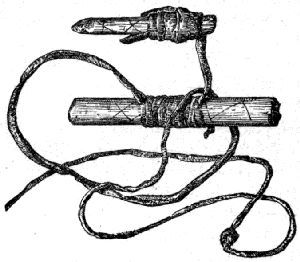
When Gen. Crook's expedition against the Chiricahua Apache reached the heart of the Sierra Madre, Mexico, in 1883, it was my good fortune to find on the ground in Geronimo's rancheria two insignificant looking articles of personal equipment, to which I learned the Apache attached the greatest importance. One of these was a very small piece of hard wood, cedar, or pine, about two and a half to three inches long and half a finger in thickness, and the other a small section of the cane indigenous to the Southwest and of about the same dimensions. The first was the scratch stick and the second the drinking reed.
The rule enjoined among the Apache is that for the first four times one of their young men goes out on the warpath he must refrain from scratching his head with his fingers or letting water touch his lips. How to keep this vow and at the same time avoid unnecessary personal discomfort and suffering is the story told by these petty fragments from the Apache's ritual. He does not scratch his head with his fingers; he makes use of this scratch stick. He will not let water touch his lips, but sucks it into his throat through this tiny tube. A long leather cord attached both stick and reed to the warrior's belt and to each other. This was all the information I was able to obtain of a definite character. Whether these things had to be prepared by the medicine-men or by the young warrior himself; with what ceremonial, if any, they had to be manufactured, and under what circumstances of time and place, I was unable to ascertain to my own satisfaction, and therefore will not extend my remarks or burden the student's patience with incoherent statements from sources not absolutely reliable. That the use of the scratch stick and the drinking reed was once very general in America and elsewhere, and that it was not altogether dissociated from ritualistic or ceremonial ideas, may be gathered from the citations appended.
In her chapter entitled "Preparatory ceremony of the young warrior" Mrs. Emerson says: "He does not touch his ears or head with his hand," explaining in a footnote, "the head was sometimes made a sacrificial offering to the sun."[197] Tanner relates that the young Ojibwa warrior for the "three first times" that he accompanies a war party "must never scratch his head or any other part of his body with his fingers, but if he is compelled to scratch he must use a small stick."[198] Kohl states that the Ojibwa, while on the warpath, "will never sit down in the shade of a tree or scratch their heads; at least, not with their fingers. The warriors, however, are permitted to scratch themselves with a piece of wood or a comb."[199] Mackenzie states regarding the Indians whom he met on the Columbia, in 52° 38′, N. lat., "instead of a comb they [the men] have a small stick hanging by a string from one of the locks [of hair], which they employ to alleviate any itching or irritation in the head."[200]
The Tlinkit of British North America use these scratchers made of basalt or other stone.
"The pipe-stem carrier (i.e., the carrier of the sacred or 'medicine' pipe) of the Crees, of British North America, dares not scratch his own head, without compromising his own dignity, without the intervention of a stick, which he always carries for that purpose."[201]
Bancroft[202] quotes Walker as saying that "a Pima never touches his skin with his nails, but always with a small stick for that purpose, which he renews every fourth day and wears in his hair."
As part of the ceremony of "initiating youth into manhood" among the Creeks, the young neophyte "during the twelve moons ... is also forbidden to pick his ears or scratch his head with his fingers, but must use a small splinter to perform these operations."[203] The Apache-Yuma men carry in their hair "a slender stick or bone about 8 inches long, which serves them as a comb."[204]
The idea that these scratch sticks replace combs is an erroneous one; Indians make combs in a peculiar way of separate pieces of wood, and they are also very fond of brushing their long locks with the coarse brushes, which they make of sacaton or other grass.
"One other regulation, mentioned by Schomburgk, is certainly quaint; the interesting father may not scratch himself with his finger nails, but may use for this purpose a splinter, especially provided, from the mid-rib of a cokerite palm."[205]
When a Greenlander is about to enter into conversation with the spirits "no one must stir, not so much as to scratch his head."[206]
In the New Hebrides most of the natives "wear a thin stick or reed, about 9 inches long, in their hair, with which they occasionally disturb the vermin that abound in their heads."[207]
Alarcon, describing the tribes met on the Rio Colorado, in 1541, says: "They weare certaine pieces of Deeres bones fastened to their armes, wherewith they strike off the sweate."[208]
In German folk-lore there are many references to the practice in which the giants indulged frequently in scratching themselves, sometimes as a signal to each other. Just what significance to attach to these stories I can not presume to say, as Grimm merely relates the fact without comment.[209]
Of the Abyssinians, Bruce says: "Their hair is short and curled like that of a negro's in the west part of Africa, but this is done by art not by nature, each man having a wooden stick with which he lays hold of the lock and twists it round like a screw till it curls in the form he desires."[210] In a footnote, he adds: "I apprehend this is the same instrument used by the ancients, and censured by the prophets, which in our translation is rendered crisping-pins."
Possibly the constant use of the scratch stick in countries without wood suggested that it should be carried in the hair, and hence it would originate the fashion of wearing the hair crimped round it, and after a while it would itself be used as a crimping-pin.
Thus far, the suggestion of a religious or ceremonial idea attaching to the custom of scratching has not been apparent, unless we bear in mind that the warrior setting out on the warpath never neglects to surround himself with all the safeguards which the most potent incantations and "medicine" of every kind can supply. But Herbert Spencer tells us in two places that the Creeks attach the idea of a ceremonial observance to the custom. He says that "the warriors have a ceremony of scratching each other as a sign of friendship;"[211] and again, "scratching is practiced among young warriors as a ceremony or token of friendship. When they have exchanged promises of inviolable attachment, they proceed to scratch each other before they part."[212]
Dr. J. Hampden Porter remarks that this ceremonial scratching may be a "survival" of the blood covenant, and that in earlier times the young warriors, instead of merely scratching each other's arms, may have cut the flesh and exchanged the blood. The idea seems to be a very sensible one.
Father Alegre describes a ceremonial scratching which may have been superseded by the scratch stick, to which the medicine-men of certain tribes subjected the young men before they set out on the warpath. Among the Pima and Opata the medicine-men drew from their quivers the claws of eagles, and with these gashed the young man along the arms from the shoulders to the wrists.[213]
This last paragraph suggests so strongly certain of the practices at the sun dance of the tribes farther to the north that it may be well to compare it with the other allusions in this paper to that dance.
It will be noticed that the use of the scratch-stick, at least among the tribes of America, seems to be confined to the male sex; but the information is supplied by Mr. Henshaw, of the Bureau of Ethnology, that the Indians of Santa Barbara, Cal., made their maidens at the time of attaining womanhood wear pendant from the neck a scratcher of abalone shell, which they had to use for an indefinite period when the scalp became irritable.
Prof. Otis T. Mason, of the National Museum, informs me that there is a superstition in Virginia to the effect that a young woman enciente for the first time must, under no circumstances, scratch her head with her fingers, at least while uncovered; she must either put on gloves or use a small stick.
The Parsi have a festival at which they serve a peculiar cake or bread called "draona," which is marked by scratches from the finger nails of the woman who has baked it.[214]
No stress has been laid upon the appearance in all parts of the world of "back scratchers" or "scratch my backs," made of ivory, bone, or wood, and which were used for toilet purposes to remove irritation from between the shoulder blades or along the spine where the hand itself could not reach. They are to the present day in use among the Chinese and Japanese, were once to be found among the Romans and other nations of Europe, and instances of their occasional employment until a very recent date might be supplied.
THE DRINKING REED.
Exactly what origin to ascribe to the drinking reed is now an impossibility, neither is it probable that the explanations which the medicine-men might choose to make would have the slightest value in dispelling the gloom which surrounds the subject. That the earliest conditions of the Apache tribe found them without many of the comforts which have for generations been necessaries, and obliged to resort to all sorts of expedients in cooking, carrying, or serving their food is the most plausible presumption, but it is submitted merely as a presumption and in no sense as a fact. It can readily be shown that in a not very remote past the Apache and other tribes were compelled to use bladders and reeds for carrying water, or for conveying water, broth, and other liquid food to the lips. The conservative nature of man in all that involves his religion would supply whatever might be needed to make the use of such reeds obligatory in ceremonial observances wherein there might be the slightest suggestion of religious impulse. We can readily imagine that among a people not well provided with forks and spoons, which are known to have been of a much later introduction than knives, there would be a very decided danger of burning the lips with broth, or of taking into the mouth much earthy and vegetable matter or ice from springs and streams at which men or women might wish to drink, so the use of the drinking reed would obviate no small amount of danger and discomfort.
Water was carried in reeds by the Dyaks of Borneo, according to Bock.[215] The manner in which the natives of the New Hebrides and other islands of the South Pacific Ocean carry water in bamboo joints recalls the Zuñi method of preserving the sacred water of the ocean in hollow reeds.[216]
Fig. 432.—The scratch stick and drinking reed.
Mr. F. H. Cushing shows that "so far as language indicates the character of the earliest water vessels which to any extent met the requirements of the Zuñi ancestry, they were tubes of wood or sections of canes."[217] Long after these reeds had disappeared from common use, the priests still persisted in their use for carrying the water for the sacred ceremonies. The mother of the king of Uganda gave to Speke "a beautifully-worked pombé sucking-pipe."[218] For ordinary purposes these people have "drinking gourds." In Ujiji, Cameron saw an old chief sucking pombé, the native beer, through a reed;[219] and, later on in his narrative, we learn that the reed is generally used for the purposes of drinking. "The Malabars reckoned it insolent to touch the vessel with their lips when drinking."[220] They made use of vessels with a spout, which were no more and no less than the small hollow-handled soup ladles of the Zuñi and Tusayan, through which they sipped their hot broth.
In an ancient grave excavated not far from Salem, Massachusetts, in 1873, were found five skeletons, one of which was supposed to be that of the chief Nanephasemet, who was killed in 1605 or 1606. He was the king of Namkeak. On the breast of this skeleton were discovered "several small copper tubes ... from 4 to 8 inches in length, and from one-eighth to one-fourth of an inch in diameter, made of copper rolled up, with the edges lapped."[221]
Alarcon relates that the tribes seen on the Rio Colorado by him in 1541, wore on one arm "certain small pipes of cane." But the object or purpose of wearing these is not indicated.[222]
The natives of the Friendly Islands carried in their ears little cylinders of reed, although we learn that these were "filled with a red solid substance."[223] Among the Narrinyeri of Australia, when young men are to be initiated into the rank of warriors, during the ceremonies "they are allowed to drink water, but only by sucking it up through a reed."[224] Admiral von Wrangel says of the Tchuktchi of Siberia: "They suck their broth through a small tube of reindeer bone," which "each individual carries about with him."[225] Padre Sahagun says that the human victim whom the Aztecs offered up in sacrifice was not allowed to touch water with his lips, but had to "suck it through a reed."[226]
"The Mexicans had a forty-days' fast in memory of one of their sacred persons who was tempted forty days on a mountain. He drinks through a reed. He is called the Morning Star."[227] The Mexicans, according to Fray Diego Duran, placed before the statues of their dead bowls of "vino," with "rosas," tobacco (this seems to be the proper translation of the word "humazos," smokes), and a reed called the "drinker of the sun," through which the spirit could imbibe.[228]
"The suction pipes of steatite," mentioned by Schoolcraft, as found in the mounds, may have been the equivalents of our drinking reeds, and made of steatite to be the more readily preserved in the ritual of which they formed part.
Copper cylinders 1¼ inches long and ⅜ of an inch in diameter were found in the mounds of the Mississippi Valley by Squier and Davis. The conjecture that they had been used "for ornaments" does not seem warranted.[229]
We should not forget that there was a semideification of the reed itself by the Aztec in their assignment of it to a place in their calendar under the name of "acatl."[230]
Mrs. Ellen Russell Emerson speaks of the custom the warriors of the northern tribes had which suggests that she had heard of the drinking reed without exactly understanding what it meant. She says that warriors carry bowls of birch bark "from one side of which the warrior drinks in going to battle—from the other, on his return. These bowls are not carried home, but left on the prairie, or suspended from trees within a day's journey of his village."[231]
Among the Brahmans practices based upon somewhat similar ideas are to be found: every morning, upon rising, "ils prennent trois fois de l'eau dans la main, & en jettent trois fois dans leur bouche, évitant d'y toucher avec la main."[232]
The fundamental reason upon which the use of the drinking reed is based is that the warrior or devotee shall not let water touch his lips. It is strange to find among the regulations with regard to taking water by the warrior caste: "He shall not sip water while walking, standing, lying down, or bending forward."[233]
The Dharma-sûtra, traditionally connected with the Rishi-Vasishtha, of the Seventh Mandala of the Rig-Veda, is a relic of a Vedic school of the highest antiquity. Its seat was in the present northwestern provinces of India, and, like the Dharmasâstra of Gautama, it is the sole surviving record from this source.[234]
There was another service performed by reeds or tubes in the domestic economy of nations around the north pole. As the Apache are derived from an Arctic ancestry it does not seem amiss to allude to it. Lord Lonsdale, in describing the capture of a whale which he witnessed, says that the Eskimo women "first of all gathered up the harpoons and then pulled out all the spears. As each spear was withdrawn a blow-pipe was pushed into the wound and the men blew into it, after which the opening was tied up. When every wound had been treated in this manner the whale resembled a great windbag and floated high in the water."
In the National Museum at Washington, D. C., there are many pipes made of the bones of birds, which were used by the Inuit as drinking tubes when water had to be taken into the mouth from holes cut in the ice. These drinking tubes seem to be directly related to our subject, although they may also have been used as Lonsdale describes the pipes for blowing the dead whale full of air. Another point to be mentioned is that the eagle pipe kept in the mouth of the young warrior undergoing the torture of the sun dance among the Sioux and other tribes on the plains is apparently connected with the "bebedero del Sol" of the peoples to the south.[235]
The use of this drinking reed, shown to have been once so intimately associated with human sacrifice, may have disappeared upon the introduction of labrets, which seem, in certain cases at least, to be associated with the memory of enemies killed in battle, which would be only another form of human sacrifice. This suggestion is advanced with some misgivings, and only as a hypothesis to assist in determining for what purpose labrets and drinking tubes have been employed. The Apache have discontinued the use of the labret, which still is to be found among their congeners along the Lower Yukon, but not among those living along the lower river.[236] According to Dall the custom was probably adopted from the Inuit; he also shows that whenever labrets are worn in a tribe they are worn by both sexes, and that the women assume them at the first appearance of the catamenia.
"This is to be noted, that how many men these Savages [Brazilians] doe kill, so many holes they will have in their visage, beginning first in their nether lippe, then in their cheekes, thirdly, in both their eye-browes, and lastly in their eares."[237]
Cabeza de Vaca speaks of the Indians near Malhado Island, "They likewise have the nether lippe bored, and within the same they carrie a piece of thin Cane about halfe a finger thicke."[238] Herrera relates very nearly the same of the men of "Florida": "Traìan una tetilla oradada, metido por el agujero un pedaço de Caña, i el labio baxero tambien agujereado, con otra caña en èl."[239] But Herrera probably obtained his data from the narrative of Vaca.
In looking into this matter of labrets as connected or suspected as being in some way connected with the drinking reed, we should not expect to find the labret adhering very closely to the primitive form, because the labret, coming to be regarded more and more as an ornament, would allow greater and greater play to the fancy of the wearer or manufacturer, much the same as the crosses now worn by ladies, purely as matter of decoration, have become so thoroughly examples of dexterity in filagree work as to have lost the original form and significance as a declaration of faith. But it is a subject of surprise to find that the earlier writers persistently allude to the labrets in the lips of the Mexican deities, which probably were most tenacious of primitive forms, as being shaped like little reeds—"cañutillos."
Herrera says of Tescatlipoca: "Que era el Dios de la Penitencia, i de los Jubileos ... Tenia Çarcillo de Oro, i Plata en el labio baxo, con un cañutillo cristalino, de un geme de largo."[240] The high priest, he says, was called topilçin, and in sacrificing human victims he wore "debaxo del labio, junto al medio de la barba, una pieça como cañutillo, de una piedra açul."[241]
Father Acosta also speaks of the tube (canon) of crystal worn by Tezcatlipoca in the lower lip: "En la leure d'embas un petit canon de crystal, de la longueur d'un xeme ou demy pied."[242]
Speaking of Quetzalcoatl Clavigero says: "From the under lip hung a crystal tube."[243] From Diego Duran's account of this "bezote" or labret it must have been hollow, as he says it contained a feather: "En el labio bajo tenia un bezote de un veril cristalino y en el estaba metida una pluma verde y otras veces azul."[244]
In the Popul Vuh is to be found a myth which gives an account of the origin of labrets. It relates that two night watchers over the flowers in the garden of Xibalba had in some manner proved derelict in duty, and had their lips split as a punishment.[245]
In Paraguay a tribe called the Chiriguanes, "se percent la levre inférieure & ils y attachent un petit Cilindre d'étain ou d'argent, ou de Resine transparente. Ce prétendu ornement s'appelle Tembeta."[246]