Chapter XI · A BLOW THAT NEARLY KILLED GEORGE
Reading edition
“I don’t blame you for feeling disturbed, George,” comforted the guardian, “but there is still a ray of hope left here.”
“Begging your pardon, there isn’t even a glimmer,” returned George. “I might have known something would be sure to happen.”
“May I see it?” asked Harriet. Miss Elting handed the message to her.
“Read it aloud,” cried Dill. “George doesn’t seem to think any one is interested except himself. What’s the matter with Disbrow? When is he coming?”
“Isn’t coming at all,” answered George weakly. “Please read it.”
“‘George Baker, Meadow-Brook, N. H.’ It is dated at New London,” explained Harriet, then continued to read the message, which was as follows: “‘Unfortunate accident. Pullman step porter set down tilted under foot when I was stepping from train. Landed on back with sprained ankle. Laid up perhaps two weeks. Awfully sorry. See what I can do if come here. Let know any change. (Signed) Disbrow.’”
[099]
“Must have thought he was writing a letter instead of sending a telegram,” jeered Crazy Jane.
The boys glanced at each other and breathed deeply. Words failed them just at that moment.
“Sprained his ankle and is laid up,” reflected Jane. “He asks you to come to see him. Are you going?”
“You must not go on our account,” said Harriet Burrell. “You must not worry him with our troubles. He has plenty of his own at present. We shall get along somehow.”
“Yes, don’t take it so to heart, George,” urged the guardian. “We are fortunate in having you to coach us. I know you will turn us out finished players at the expiration of five weeks from the time we started.”
“Where is Mr. Mabie?” asked Hazel.
“I left him in town, in case there should happen to be anything more from Disbrow. But there won’t be. I know what a sprained ankle is. I had one once, and I don’t want another. What a mess I have made of it!”
“Indeed, you have not,” returned Harriet quickly. “You have done a great deal for us. That you have failed in this one instance is no fault of your own. Circumstances have been too much for you, that is all. We shall never forget what you have done for us. We are the [100] ones who have not measured up to the mark, but you will remember I told you we were going to play in the tournament and going to win. I say it again. We are going to WIN!”
“You will have to play a better game than you have done so far,” George blurted, then, realizing what he had said, made an humble apology for his apparent rudeness.
“You are right,” Harriet laughed merrily. “We shall have to play a much better game, and that is what we are going to do. But we are wasting time. Girls, get ready for practice. Captain, you sit on the boulder yonder from where you can watch us. Don’t be afraid to criticise. We need your severest criticism.”
The girls ran for their racquets, Sam got the tennis balls, George pulled himself together and stumbled over to the boulder, on which he took his seat, but instead of watching the girls, he sunk his head in his hands and relapsed into his former gloomy mood.
“Say,” said Sam, giving the captain a poke in the ribs with a thumb, “look at those girls. We aren’t going to be quitters, are we?”
George hesitated a moment, then raised his head, threw back his shoulders and slid from the rock to his feet.
“You’re right, Sam. For once in your life you are talking sense. Of course we’ll go on. I [101] was so bitterly disappointed about Disbrow that I lost my courage. I’ve found it again. If we fail now, it won’t be because we didn’t try. Prepare for the first set. No fooling now. Harriet and Tommy will play together this time, opposing Jane and Hazel. We shall see what you can do in team work. This will be the regular set provided you can stand it to play that long without a rest. It is time we did some grilling.” George was himself again. Harriet smiled and nodded approvingly.
“Please do not hesitate to say what you think,” she urged. “We are not so sensitive that we cannot stand listening to the truth.”
“Play!”
Nearly every play for the first half of the set was a fault. George groaned within himself, but was careful not to show how hopeless he felt inwardly. He worked with them until the perspiration was trickling down his cheeks, until he was well-nigh exhausted from the nervous strain.
Along in the fourth game, however, matters began to brighten a little. Harriet and Tommy made some very good strokes. Tommy showed herself to be very quick on her feet, though there was no certainty as to where she was going to place a ball when she struck it. It was just as likely to soar off among the bushes and be lost [102] as it was to drop in the court of her opponents. Jane developed no little power in her strokes, but her footwork was poor, yet a keen judge would have discovered good tennis material in each of the girls at the net. George, of course, was not an expert, and these little surface indications of possibilities were lost on him. He saw only faults or scores. Anything less than the latter sent his heart down into his boots, figuratively speaking.
Harriet and Tommy won the set handily, though the last game of the set was worse played than any game since they had been practising. If anything, George was more discouraged than at any previous time. Tommy, however, was delighted with her own playing. The little lisping girl considered that she and Harriet had played a wonderful game, merely because they had defeated Jane and Hazel.
They were given no time in which to discuss the game. Their instructor changed sides, placing Hazel and Harriet together, Jane and Tommy opposed to them. Harriet and Hazel won the set, the former’s fast playing, though full of faults, being responsible for her side getting the game.
“You are showing speed, at any rate,” was George’s compliment. “If I were a better coach, I might be able to push you along faster, [103] but this is the first time I ever tried to teach any one to play tennis. I wish Disbrow were here.”
“Oh, forget Disbrow!” answered Sam. “We are going to win out in this tournament. I believe with Harriet that there isn’t another team on the coast that can defeat this one. They are only amateurs, girls. Probably many of them are beginners, too.”
“Don’t you fool yourself about that,” returned Baker. “Herrington told me they had a lot of likely entries, almost professional players, though, of course, they are not that in fact. One thing I wish to call the attention of the players to, is that Jane and Tommy played too far apart. Tommy took a position down near the net while Jane was back near the serving line. You saw how Harriet and Hazel played, both back some distance from the net. They won the game. Remember, it is easier to run forward and pick up a ball than it is to run backward. Play closer together and you will put up a much better defence and run less risk of the ball passing you. Try it this time, playing closer together.”
[104]
They did, with the result that the game was much closer than the one before, though Harriet Burrell’s side won as usual. Just why her side always won George Baker was at a loss to understand, for it was plain that Harriet played a wretched game, worse, if anything, than did her companions.
“Will you please tell me how you did it?” questioned George after Harriet’s side had won again.
“I did not do it. Tommy and I did it together,” was the naive reply. But Harriet, awkward and unscientific as she was, had used some little trick that got the better of her opponents. They did not appear to realize this, but Harriet did. She knew full well, and that trick was a phase of the game that she proposed to cultivate and work to the limit. She was very sorry that they were not to be coached by Mr. Disbrow, knowing that he could be of great assistance to her in developing this very trick. Disbrow would have understood instantly the value of it.
The play was continued with more or less discouraging results, so far as Baker was concerned, all the afternoon, with only an occasional halt for rest and such instruction as the coach was able to give them. At sundown he threw himself down on the ground, his face red and perspiring, his throat hoarse from yelling at his pupils, his body weary. It was the hardest day’s work that George Baker had ever done, but the nervous strain was the cause of [105] his great fatigue rather than the physical effort.
“Come, fellows, we must be getting to our own wigwam,” he said, starting up suddenly.
“You are going to remain here and have supper,” replied Miss Elting. “You were quite willing to be with us last evening when the skies were bright. Now that they are not bright it is all the more reason why you should stay this time. You are all fagged out and, what is worse, discouraged. We shall have a nice supper this evening, then afterward some songs and games if you wish.”
“No more games for me to-day,” interrupted George, “begging your pardon.”
“I did not mean tennis games. I, too, have seen enough of those for one day. I meant other games that will relax you all. Songs are a good thing. Our players will ‘go stale’ with too much work. It is not a good plan, I have heard, to keep too steadily at it when one is preparing for a contest. Am I not right?”
George nodded. Sam smiled broadly.
“Yes, we must take care of our principals,” declared the latter. “They are very delicate and very precious.” This raised the first laugh of that long, trying afternoon. The boys checked their own laughter suddenly, as if they had caught themselves doing something wrong. [106] Harriet started the Meadow-Brook yell, in which the boys joined with a shout. From that moment on the gloom of the day was less marked, conversation more natural and easy.
When the supper was served on a table that the boys had made for them, they all sat down on rustic seats put together by the same skilful hands.
“Now, isn’t this better than for you boys to go back to camp to mope all the evening while we girls are doing the same here?” demanded the guardian.
“Yes; this has the other backed off the court, over the side lines into the bushes,” declared Sam.
“Otherwise, nothing but slang would quite fit the occasion, eh, Mr. Crocker?” chuckled Miss Elting. “I am not rebuking you. I have never had and never expect to have occasion to do that to a Tramp Boy. How long is Mr. Mabie to remain in town?”
“I told him to stay there until P. E. either telegraphed or wrote.”
“You think there is some prospect of his coming, then, do you?”
“Not one chance in a million,” answered George with emphasis. “Would you, if you had a sprained ankle? I reckon he will make the Pullman Company pay very dearly for this, [107] though. The ankle of a tennis player is worth something, I should say.”
“What do you think of the girls’ playing now?”
“In some ways it is an improvement, but——”
“But! There is just the trouble,” cried Harriet. “When we do our best you say, ‘It is very good, but——’”
“Well, isn’t it?” he demanded a little sourly.
“I have not permitted myself to think of the matter in that way,” replied Harriet.
“Then you have given up hope so far as the tournament is concerned?” questioned the guardian, fixing a steady look on the face of the captain.
“I—I should hardly care to say that,” stammered George, avoiding her eyes.
“But deep down in your heart you do not believe the Meadow-Brook Girls stand the slightest chance of winning even a place in the tennis tournament at Newtown?” persisted the guardian.
“Do you?” returned George.
“I am asking you, Captain Baker.”
“No, I don’t. There, you made me say it again. Now will you tell me what you think?”
“I don’t know that I should put it quite so strongly as you have, but from what we have [108] seen I should say the chances were not particularly brilliant,” she admitted.
“You are tho encouraging!” lisped Tommy. “Anybody who can play thuch a game ath I can to be talked about in that way! It maketh me thad, tho thad and tho tired!”
“One person cannot play for the whole team, you know,” said Dill, with a grin.
“Yeth, I thuppothe that ith tho. However, I will do jutht ath the otherth withh.”
“What do you say to giving it up, girls?”
Miss Elting was not smiling now, though, had they been more observant, they would have seen a suggestion of laughter in her eyes. She knew her girls well, and perhaps was asking the question with a deeper purpose in mind than appeared on the surface.
“I say just what I have said before,” answered Harriet slowly and with emphasis. “I have gone into this not for the sake of giving up, but with the purpose to go through with it. We owe it to the boys who have done so much for us to keep going until the end. That is what I propose to do unless I am forbidden by Miss Elting or by my parents.”
“But you can’t win,” cried George. “You know you can’t.”
“What will you do if I win?”
[109]
“I’ll take off my hat to you, even though I get a sunstroke doing it,” returned George, his face relaxing into a broad smile.
“You shall have the chance, for I am going to play and I am going to win. The team is going to win. That is what I mean when I say I am going to do it. Of course, I do not expect to do it alone. I know we are going to win a place. I feel it. I can’t tell you just why, but I do, so you had better prepare to protect yourself from sunstroke. If there are any trees where the tournament is to be held, by all means engage a place under one.”
“They don’t have trees near tennis courts. Trees throw shadows that sometimes make the players nervous or cause them to misjudge their distances. No, I’ll have to take my medicine and I will.”
“Hark!” Jane held up a hand for silence.
“What is it?” asked Sam, with a half startled look in his eyes.
“I heard some one speak. It may have been out in the road, though.”
“One couldn’t hear as far as that. Besides, I am sure I heard a call,” declared Harriet.
“Some one surely is coming. I hear two voices,” agreed Miss Elting. “Perhaps it is Charlie Mabie returning from the village with good news.”
“It may be Charlie Mabie all right, but there is nothing doing on the good news,” replied George.
[112]
“Hi, there! Hello the camp!” called the familiar voice of Charlie.
“Hello yourself,” answered George.
“Come out and help me, some of you strong-armed boys. I have picked up a fellow who has hurt his foot. Can’t you give a poor suffering chap a hand?”
The boys sprang up, George with them. In the dim light they could faintly make out two figures approaching them. One was Mabie, the other no one recognized. The latter was leaning on Charlie’s arm.
“’Owdy, Georgie, old chap?” called a second voice.
“What-a-at?” gasped Captain Baker. “Who is it?”
“Don’t you know, old chap? Have you forgotten an old friend so soon?”
“It’s P. E.! It’s P. E. himself! Whoop!” Captain Baker uttered a wild yell and rushing forward threw his arms about the neck of the newcomer. “Oh, P. E., P. E., you did come after all; you didn’t go back on your old salt water friend! Girls, he’s here, he’s here, I tell you! Yell, you Tramps! Yell, I tell you!”
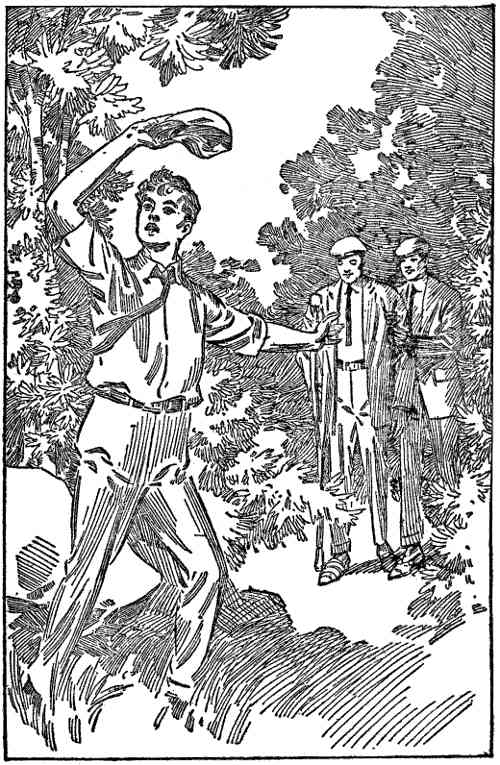
“It’s P. E.!” Shouted George.
[113]