Part 1 — CHAPTER IV.
Reading edition
FŒTAL DEVELOPMENT.
The last Chapter brought us up to the point of conception, or the first commencement of the new being. The next step is to exhibit its various stages of development, and to show how it is nourished and maintained in its proper position. This is requisite in order to understand the origin of many diseases and accidents which occur during gestation, and also to explain the various signs by which it is determined whether a female is pregnant or not.
FŒTAL DEVELOPMENT.
The development of a perfectly formed human being from the egg in which it originates, is one of the most astonishing phenomena that can come under our observation, and is eminently deserving the study of every rational being. The present explanation of it must necessarily be brief, being merely intended to make the main subject more clear.
It has already been remarked that it is uncertain whether the ovum is impregnated before it is brought into the Uterus, or after it arrives there; but be that as it may, nothing has yet been discovered in the Womb till several days after conception. Some physiologists tell us that the rudiment of the new being may be found there about the sixth day; but others again assure us that it cannot be found before the twelfth, at which period our explanation of its development will commence.
At the twelfth day the ovum is about the size of a large pea, it is composed of a vesicle containing a thick fluid, called the germ, which corresponds to the opaque substance seen in the white of a fecundated bird's egg, and of a yellowish substance, in which it floats, called the vitellus, which answers to the yelk. The whole being surrounded by two membranous coverings, the outer one called the chorion, and the inner one the amnion. Between these is a gelatinous substance, and within the amnion is a fluid, called the liquor amnii. The two membranes, the liquor amnii, and the inclosed ovum, are called the ovulum! Immediately after conception the uterus begins to secrete, from its inner walls, another membrane, very delicate, called the decidua. This lines the whole cavity, so that when the ovulum passes out of the tube it is met by this lining which seems to prevent its entrance into the womb. The ovulum, however, presses upon it and so makes a depression, like a nest, in which it lies. This prevents its moving about, or falling to the bottom of the womb.
The weight of the entire ovulum is about one grain. The embryo commences in the germ, and may now be seen about the size of a pin's point. The vitellus removes away from it, but remains connected by a small pedicel or thread-like tube, down which it is gradually absorbed as nutriment. A small white thread, scarcely perceptible, may be seen sometimes as early as this period, being the commencement of the brain and spinal marrow. The mouth is visible also from the twelfth to the twentieth day, and frequently the eyes. These are placed at first on the side of the head, like those of quadrupeds, and move round to the front afterwards.
At twenty-five days, the embryo is about the size of a large ant, which it also resembles in form. It begins to have a little more consistence, and the future bones begin to resemble cartilage, or gristle. A small groove may be seen denoting the neck, which thus indicates the separation of the head from the trunk. The weight is three or four grains.
The first month, it is about the size of a Bee, and is somewhat like a small worm bent together. The arms may be seen like two little warts. They are first formed under the skin, and shoot out like buds, growing straight from the body; afterwards they become folded together, in a curious manner, upon the breast. The head is as large as the rest of the body, and upon it we can now see distinctly the eyes, like two black dots, the mouth, like a line, and also the nose. The lower extremity is lengthened out like a tail. Weight about ten grains.
The second month. Every part has now become much more developed, and the general form is that of a human being. The superior members are much more elongated, and the inferior ones begin to be distinguished, forming in the same manner as the others. The fingers are united together by a membrane, like the web on a Frog's foot. In the ribs, clavicles, and jaw bones, a few points can be seen ossified, the cartilage beginning; to harden into bone. The rudiments of the first teeth are also visible. The weight is about one drachm, and the length one inch.
At about seventy days the eyelids are visible, the nose becomes prominent, the mouth enlarges, and the external ear may be seen. The neck is well defined. The brain is soft and pulpy, and the heart is perfectly developed.
Every organ is originally formed without either blood or blood vessels. The circulation which afterwards takes place in them is merely for their subsequent development. The heart is perfect in all its parts, and even has a slight motion, before the blood is found in it.
Three months. All the essential parts are well defined. The eyelids distinct, but firmly closed. The lips perfect, but drawn tightly together. The heart beats forcibly, and in the larger vessels red blood is seen. The fingers and toes are defined, and the muscles begin to be apparent. The organs of generation are remarkably prominent, but still it is somewhat difficult, at first, to distinguish the sex by these organs, notwithstanding their development, as the principal parts in both are nearly identical in form. It can, however, be ascertained by other circumstances, as the form of the head, dorsal spine, thorax, and abdomen. It now weighs about two ounces and a half, and measures four or five inches in length.
Four months. The development is remarkably increased. The brain and spinal marrow becomes firmer, the muscles distinct, and a little cellular tissue is formed. The abdomen is fully covered in and the intestines are no longer visible. A little of the substance called meconium even collects in the intestines, the same as is found in at birth. It now weighs seven or eight ounces, and measures six or seven inches. The bones are ossified in a great part of their extent, and the rudiments of the second set of teeth are visible, under the first.
The uterus now is so large that it can no longer remain in the lower part of the pelvis, but is compelled to rise up into the abdomen for more room. This change of position is improperly called quickening! Sometimes it takes place very gradually, so that it is scarcely noticed, but more frequently it rises suddenly, disturbing all the internal organs, and causing in them considerable derangement till they accommodate themselves to the change. This occurrence often causes unnecessary alarm, though the sickness, and other unpleasant sensations, are always sufficiently annoying.
This stage corresponds with that in which the young of oviparous animals breaks the shell and escapes. The human being however, undergoes a remarkable change, and remains in the womb for a period longer than that already past, in order to become more perfected.
From four to nine months the development is proportionally much more rapid than during the first four months, owing to the circulation of perfect red blood, which is now found the same as in the adult, and is probably derived from the mother's blood vessels.
Five months. Every part is considerably increased in size, and become more perfect. The lungs enlarge, and are even capable of being, to a certain extent, dilated. The skin becomes much stronger. The situation of the nails can be discerned. The meconium is more abundant, and lower down in the intestines. The length is now eight or ten inches, and the weight fifteen or sixteen ounces.
Six months. The nails are marked. The head becomes downy, from the first development of the hair. A little fat is formed. Length twelve inches, weight from one and a half to two pounds. No indications of intellectual faculties.
Seven months. The whole being has rapidly progressed. The nails are formed, the hair is perfect, in the male the testicles descend to the scrotum, and in the female the ovaries reach the brim of the pelvis. The bones are tolerably firm, and the meconium collects in the large intestines. Length fourteen inches, weight about three pounds. Intellectual functions not yet exercised.
The two remaining months are merely devoted to further increase in size and weight. No new phenomena present themselves.
Nine months. Every function has become active. The skin becomes colored, and perspiration occurs. There are no indications of the intellectual functions, but the animal functions are remarkably active, particularly that of taste, which no doubt leads to the act of sucking, from the natural desire for its gratification. The child can now experience all the ordinary sensations of pain, hunger, heat, and cold, and is capable of preserving an independent existence if brought into the world.
Plate XII. represents a section of the Uterus at about one month of gestation, so as to show all the parts in their proper situation.
PLATE XII.
Section of the Uterus, with the Ovum and appendages, at about one month of gestation.—a. a. a. The substance of the walls of the Womb.—b. b. The Embryo.—c. The different vessels by which it is connected with the Placenta.—d. d. The Placenta.—e. The Vitellus.—f. f. f. The Membrane lining the Uterus, called the Decidua; it is seen to be bent double, or reflected, the Embryo being on the outside of it.—g. g. The Chorion, or Middle Membrane, which is studded over with villosities, or small blood vessels.—h. h. The Amnion, or inner membrane, which contains the fluid called the liquor amnii, in which the Embryo floats.—i. i. The blood vessels which connect the Placenta with the Womb.—j. Is a plug of Mucus, by which the mouth of the Womb is now blocked up.—k. k. The ends of the Fallopian Tubes, which are cut off; these are also blocked up with mucus, the same as the Os Tincæ.—l. The Os Tincæ, or mouth of the Womb.—m. The Vagina.
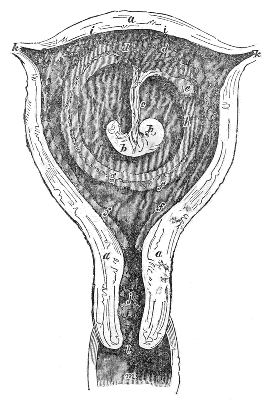
Plate XII.
Section of the Uterus, with the Ovum and appendages, at about one month of gestation.
FŒTAL NUTRITION.
The manner in which the new being derives its nutriment, or the material by which it grows, is, in a great measure, unknown to us, though we certainly obtain some little information about it by a study of the apparatus employed in the process.
For the first fifteen or twenty days the substance called the Vitellus, (e. Plate XII.) which is analagous to the yelk of the ordinary egg, appears to supply most, if not all of the material that is required in the formation of the new being; and indeed this substance does not totally disappear till after the third month, though we cannot suppose it to be the sole source of nutriment then. It is also supposed, by some, that the amniotic liquor, in which the fœtus floats, may afford some nutriment, either by being swallowed, or by being absorbed through the skin. It is certain that this fluid is nutritive, and there is nothing impossible in its absorption, though it is not very likely to occur to a sufficient extent. The idea that it can be swallowed however, is erroneous, because the mouth of the Fœtus is firmly closed while in the Womb; and besides, children have been born alive without mouths, and even without heads, and of course they could not have swallowed anything. It is now generally conceded by physiologists that the material required by the Fœtus, for its nutrition, is obtained from the blood of the mother, through the medium of the Placenta, and the vessels in the Umbilical cord. It is, however, a matter of dispute whether the maternal blood is sent directly, in its ordinary state, into the body of the child, or whether it first undergoes a preparatory process, which most modern authors suppose it does.
From the earliest period of gestation, the middle membrane, called the chorion, (g. g. P. XII.) is covered, on its outer surface, with a number of small protuberances called villosities, which subsequently become true blood vessels. About the fourth month these have increased very much in size and number, and have all become conglomerated into one mass, in form like a mushroom. This is called the Placenta. It is almost entirely formed of blood vessels, which seem to attach themselves at one end, by open mouths, to the open mouths of other blood vessels on the inner walls of the uterus (i. i. Plate XII.) At the other end these vessels are drawn together and lengthened out into a long tube, called the umbilical cord, or navel string, which finally enters the body of the child at the navel and so establishes the connexion between it and the mother.—(c. Plate XII.)
The blood vessels in the placenta, umbilicus, and fœtus, like those in the maternal body, are of two kinds, Arteries and veins. The arteries, which come from the left side of the heart, carry the pure blood, which contains all the materials for forming and nourishing every part of the system. The veins contain the blood in its impure state, and take it to the right side of the heart, from whence it is forced into the lungs to be purified by the act of breathing. The blood is made impure by some of its constituents being absorbed, to form the different parts of the body, and by having thrown into it a quantity of waste and poisonous matter no longer needed.
The course of the blood, therefore, is from the left side of the mother's heart along her arteries till it reaches the arteries of the uterus, from them it passes into those of the placenta, and thence into those of the umbilicus which convey it into the body of the child. When there it circulates in its arteries, supplies the material for its further increase and development, becomes in consequence impure, and passes into its veins, the same as in the maternal body. From these veins it passes into those of the umbilicus and placenta, and, apparently, into those of the mother, by which it is conveyed to the right side of her heart, and by its action to her lungs, to be again purified when she breathes. This explains what was previously stated, that the child uses the mother's heart, lungs, and stomach, while in the womb, and has, therefore, no occasion to use its own.
The diameter of the placenta is about six inches, and its thickness about one inch and a half. The length of the umbilical cord is from eighteen to twenty-four inches, its diameter about half an inch. These dimensions are, however, subject to great variation. Instances are mentioned of the cord being five feet long, and as thick as the child's arm. I have seen one myself four feet long. Sometimes it will be very short, not more than eight or ten inches. It is composed of one artery and two veins, twisted together like the strands of a cable, and of a sheath surrounding them composed of the chorion and amnion. Between the sheath and the vessels is a thick gelatinous fluid called the Gelatine of Wharton.
This explanation, it must be remembered, is in fact merely hypothetical. The direct passage of the blood through the Placenta, from the mother's vessels into those of the cord, is denied by many physiologists, who contend that there is an intermediate set of vessels in the Placenta, in which it first undergoes important changes. They also contend that the impure blood does not pass through into the mother's veins at all, but is purified in the Placenta, and immediately returned. Some have even averred that the Placenta is not required at all, to supply nourishment, but is merely a purifying organ. It is now known, however, that it is not absolutely essential to either process, for children have been born alive, and perfectly formed, which merely floated loosely in the amniotic liquor, having neither Placenta nor cord, nor any other connection with the mother. How they were nourished we cannot tell. These, however, must be regarded merely as curious exceptions, there being little doubt but that fœtal nutrition is ordinarily effected through the Placenta and cord, by means of the mother's blood, somewhat in the manner we have described.
PECULIARITIES OF THE FŒTAL CIRCULATION.
From the circumstance of the fœtus not using its heart and lungs, like the adult, its circulation has several modifications.
The engine by which the blood is forced along its vessels is the heart! This is divided into two distinct parts, each of which has two cavities, the upper one called the auricle, and the lower one the ventricle, which communicate with each other by curious valves. In the adult the whole of the impure blood is poured into the right auricle, that from the lower part of the body by the inferior vena cava, and that from the upper part by the superior vena cava. From the right auricle it passes into the right ventricle, which pumps it into the lungs, by way of the pulmonary artery; here it is purified by the act of respiration, and then brought, when pure, by the pulmonary veins, into the left auricle, and passes from thence into the left ventricle, which pumps it into the great aorta, and from thence into the smaller arteries all over the body. The two sides of the heart, therefore, do not communicate directly with each other, but there is a strong partition between them. In the fœtus the arterial blood from the mother, when it leaves the umbilical artery, enters first the liver, runs through its vessels, gives off the bile found in it, and then joins the vena cava inferior. By this passage it is taken into the right auricle, along with the impure blood of the vena cava. From the right auricle it passes through a hole in the partition directly into the left auricle, instead of taking the indirect route by the lungs as in the adult. From the left auricle it passes into the left ventricle, and is from thence distributed by the arteries all over the body. This opening in the partition is called the foramen ovale!
After birth, when the blood begins to pass through the lungs, this passage closes up. By the eighth day it is generally obliterated, often much sooner, though occasionally it has remained open longer without inconvenience. In some cases the foramen ovale does not close at all. The child then has what is called the blue disease! The whole body is of a uniform leaden, or blue color, and the whole system is generally languid and sluggish. The blue color is caused by the dark blood of the veins mixing with that of the arteries. These children mostly die early, but some live to be five or six years old, and one I saw twelve, but this is rare. No remedy can be had for this affliction, and I have never known it to cure spontaneously. Some children are so very dark for a few days after birth as to cause great alarm. This is owing to the foramen ovale being very open and closing slowly. No apprehension need be experienced in such cases, as it soon subsides.
The impure blood from the upper part of the fœtal body, which is brought down by the superior vena cava, also enters the right auricle, but does not pass from thence through the foramen, like that from the inferior vena cava. By a peculiar arrangement this blood is made to pass down into the right ventricle, and from thence along the pulmonary artery, the same as in the adult state. Only a very small portion, however, passes into the lungs, the great part being taken along a tube called the ductus arteriosus into the great artery called the aorta, where it begins to turn down to the lower part of the body. In consequence of this, the arterial blood going down to the lower part of the body, is mixed with this portion of impure, venous blood, brought by the ductus arteriosus from the superior vena cava; while that going to the head, and upper part of the body remains pure. And this is the reason why the lower part is always so much smaller than the upper part, previous to birth; it receives less pure nourishment. The head and chest appear, at an early period, almost as large as the rest of the body.
This circumstance also explains why, in the great majority of cases, the right arm is preferred to the left, and has more real power. The place where the ductus arteriosus pours the impure blood into the aorta, is almost immediately opposite to where the artery is given off which feeds the left arm. In consequence of which, in most cases, a small portion of this impure blood becomes mixed with the arterial blood, and the left arm is, therefore, in the same situation as the lower limbs, and like them is comparatively imperfectly developed. The right arm is not liable to any such deprivation. In some cases the insertion of the ductus arteriosus is lower down, so that no such mixture occurs. Both arms are then equal, and this accounts for the fact that in some persons there appears to be no difference. In some cases, no doubt, early habit, or imitation, may overcome this natural inferiority, and even give the preference to the left arm; but such instances are rare; the general rule is the contrary, and for the reason stated.
The ductus arteriosus closes up about the same time as the foramen ovale.
The two veins which convey the impure blood back to the mother, to be purified, originate from the iliac artery, in the pelvis. They pass up the sides of the bladder towards the navel, enter the sheath of the cord, and so reach the placenta. These vessels are obliterated about the third or fourth day after birth, and remain afterwards in the form of a fibrous cord.
The real source of all the blood in the body of the child is a mystery; it would certainly appear most likely for the whole of it to be derived from the mother's vessels, but there are many circumstances which make it probable that the child may form some itself, by digesting the fluid it is supposed to absorb. This view is supported by the fact that there is found in its bowels at birth, and even before, a greenish substance like excrement, called Meconium. This has every appearance of being the product of digestion, though some suppose it to be derived from the liver. It occasionally contains hair, and other anomalous substances.
CHAPTER IV.
THE BREAST.
The Breasts, or Mammæ, are not needed in the process of generation, nor are they absolutely necessary even after birth; but as they are naturally associated, in the majority of cases, with infantile nutrition, and are besides liable to many derangements and diseases during pregnancy and child-birth, it is advisable to give some account of them.
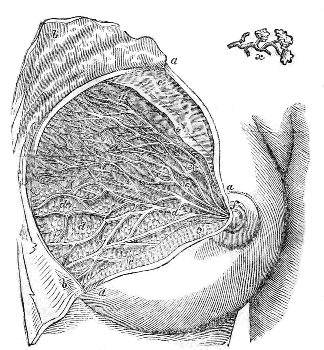
When one of the breasts is dissected it is found to be composed chiefly of a singular body called the Mammary Gland, which resembles somewhat a very firm piece of fat, of a yellowish drab color. In the substance of this Gland are an immense number of little cells, or vessels, in which, by some unexplainable process, the milk is secreted, or made from the blood. From these little vessels there proceeds small tubes which gradually unite into larger ones, and these again into larger ones still, until at last all the milk is poured into a few tubes, or canals, which terminate in the nipple. The outer mouths of these terminal canals are only slightly contracted together, so that the suction of the child's mouth, or even the pressure of the milk, when the breast is full, will force them open and allow the fluid to flow out.
The following plate represents the structure of the Breast, and explains, as far as it can be explained, the manner in which it performs its functions.
PLATE XII.—a.
a. a. The cut edges of the skin.—b. b. The flaps of the skin thrown back.—c. c. c. The fat which covers the breast.—d. d. The cells of the Mammary gland.—e. e. e. The Tubes or canals, which convey the milk from the Gland to the Nipple.—f. The Nipple, cut down the middle, to show the ends of the milk tubes terminating in it; these are usually about fifteen or eighteen in number.—x. Shows a bunch of the little cells, with the tubes proceeding from them, as they appear when injected.
THE FEMALE BREAST.
Plate XII.—a.
This Plate represents the structure of the Breast, and explains the manner in which it performs its functions.
Sometimes there has been seen two and even three nipples on one breast, and in a few cases one of the breasts has had no nipple at all. The two glands are not immediately connected, but have a very intimate sympathy with each other. The size of the breast depends more upon the thickness of the layer of fatty substance, than upon the development of the gland, so that one female, with a very full bosom, may have but little milk, while another, whose breast is but little prominent, may have a superabundance. The graceful swell of the fully developed breast is, however, a matter of positive utility, as well as of beauty, because it better adapts it to the use of the child, and probably also adds to its pleasure, as any one may readily conceive who will observe the delight with which an infant, even when not nursing, will often caress it. Sir Astley Cooper says, "The natural obliquity of the Mamella, or nipple, forwards and outwards, with a slight turn of the nipple upwards, is one of the most beautiful provisions in nature, both for the mother and the child. To the mother, because the child rests upon her arm and lap in the most convenient position for sucking; for if the nipple and breast had projected directly forwards, the child must have been supported before her, in the mother's hands, in a most inconvenient and fatiguing position, instead of it reclining upon her side and arm. But it is wisely provided by nature, that when the child reposes upon its mother's arm it has its mouth directly applied to the nipple, which is turned outwards to receive it, whilst the lower part of the breast forms a cushion, upon which the cheek of the infant tranquilly reposes."
With the exception of the dark areola, or circle, and the little tubercles around the nipple, the breast is of the most delicate structure and color, so that it blushes, or reddens, like the cheek, from any sudden emotion, and goes pale during fainting.
As a general rule no milk is secreted in those who have not become pregnant, nor in those who have passed the turn of life, but occasionally exceptions are observed to this rule.
Bandelocque tells us of a girl only eight years of age, who suckled her little brother more than a month! And Sir Hans Sloane tells us of a lady aged sixty eight, who nursed several of her grandchildren, though she had had no child herself for twenty years! Dr. Francis, of New York, describes the case of a lady who continued to secrete milk regularly for fourteen years after having lost her child, so that she could always nurse an infant; and Dr. Kennedy relates an instance of another who continued to suckle children, uninterruptedly, for forty-seven years, and who had milk perfectly sweet and good even when eighty-one years old! Dr. Clark, of Alabama, informs us that a married lady, who had never been pregnant, was requested to take charge of an infant during the night, and that to quiet it she had put her nipple in its mouth. This was done frequently, and to the great surprise of all it induced a flow of milk. A singular circumstance connected with this was that the lady soon after became pregnant, though previously barren! This will not appear so surprising, however, to those who know the connection between the breasts and the womb, and who have observed the mysterious bond of sympathy by which their functions are united.—(See the articles on Menstruation, and on Sterility, in my "Diseases of Woman," for other instances of this kind.)
The structure of the male breast is precisely the same as that of the female, but it is seldom developed. Instances have been known, however, of the milk being secreted in men, and of children having been nourished by it! Humboldt gives us an instance of this kind, and Professor Hull, of Maryland, exhibited a colored man to his class, in the year 1827, who had a large full bosom, like a female, and who had often officiated as wet nurse in the family of his mistress. The secretion appears to have been established by his putting the children that he had to nurse to the nipple, to quiet them. When the milk was not needed it was found as difficult to dry it up as it is in some females, but it was soon made to flow again, by applying a child to the breast for a few times. This man differed in no other respect from any other man!
In the females of some races of the human kind, the mammæ attain a surprising length, and become very flaccid, so that they hang down to the hips, or lower, and may be thrown over the shoulder for the child to nurse from while carried on the back. Some suppose this to constitute a real variety of the human race, but others suppose it to result merely from habit, which is probably correct.
When the breasts are small sized in young females, their growth may often be promoted, but the means need not be pointed out here.
SECTION II.
SIGNS OF PREGNANCY, AND THE MEANS OF DETECTING IT; ITS DURATION, AND THE PERIOD AT WHICH THE FŒTUS CAN LIVE.
It is always desirable, and frequently of the first importance, to be able to know whether a female is pregnant or not, both to the accoucheur and to the individual, or even to be able to judge whether she is probably or possibly so, or not. Sometimes this can be decided positively, but more frequently it is a matter of great uncertainty. The presumptive and positive signs on which a judgment can be formed are of various kinds, most of which can be readily observed, and easily made use of by any person in possession of the information already given in the preceding section. They will be set forth in the following Chapters, together with such other matter as appertains to this part of the subject, in such a manner as will make them available either for professional or for private use.