Front matter (continued 2)
Reading edition
2.
If Solide Magnitudes, being of the same bignes, or quãtitie, that any Liquor is, and hauyng also the same Waight: be let downe into the same Liquor, they will settle downeward, so, that no parte of them, shall be aboue the Superficies of the Liquor: and yet neuertheles, they will not sinke vtterly downe, or drowne.
3.
If any Solide Magnitude beyng Lighter then a Liquor, be let downe into the same Liquor, it will settle downe, so farre into the same Liquor, that so great a quantitie of that Liquor, as is the parte of the Solid Magnitude, settled downe into the same Liquor: is in Waight, æquall, to the waight of the whole Solid Magnitude.
4.
Any Solide Magnitude, Lighter then a Liquor, forced downe
5.
Any Solid Magnitude, heauyer then a Liquor, beyng let downe into the same Liquor, will sinke downe vtterly: And wilbe in that Liquor, Lighter by so much, as is the waight or heauynes of the Liquor, hauing bygnes or quantitie, æquall to the Solid Magnitude.
6.
I. D.
The Cutting of a Sphære according to any proportion assigned may by this proposition be done Mechanically by tempering Liquor to a certayne waight in respect of the waight of the Sphære therein Swymming.
If any Solide Magnitude, Lighter then a Liquor, be let downe into the same Liquor, the waight of the same Magnitude, will be, to the Waight of the Liquor. (Which is æquall in quantitie to the whole Magnitude,) in that proportion, that the parte, of the Magnitude settled downe, is to the whole Magnitude.
BY these verities, great Errors may be reformed, in Opinion of the Naturall Motion of thinges, Light and Heauy. Which errors, are in Naturall Philosophie (almost) of all mẽ allowed: to much trusting to Authority: and false Suppositions. As, Of any two bodyes, the heauyer, to moue downward faster then the lighter. A common error, noted. This error, is not first by me, Noted: but by one Iohn Baptist de Benedictis. The chief of his propositions, is this: which seemeth a Paradox.
A paradox.
If there be two bodyes of one forme, and of one kynde, æquall in quantitie or vnæquall, they will moue by æquall space, in æquall tyme: So that both theyr mouynges be in ayre, or both in water: or in any one Middle.
Hereupon, in the feate of N. T. Gunnyng, certaine good discourses (otherwise) may receiue great amendement, and furderance. The wonderfull vse of these Propositions. In the entended purpose, also, allowing somwhat to the imperfection of Nature: not aunswerable to the precisenes of demonstration. Moreouer, by the foresaid propositions (wisely vsed.) The Ayre, the water, the Earth, the Fire, may be nerely, knowen, how light or heauy they are (Naturally) in their assigned partes: or in the whole. And then, to thinges Elementall, turning your practise: you may deale for the proportion of the Elementes, in the thinges Compounded. Then, to the proportions of the Humours in Man: their waightes: and the waight of his bones, and flesh. &c. Than, by waight, to haue consideration of the Force of man, any maner of way: in whole or in part. Then, may you, of Ships water drawing, diuersly, in the Sea and in fresh water, haue pleasant consideration: and of waying vp of any thing, sonken in Sea or in fresh water &c. And (to lift vp your head a loft:) by waight, you may, as precisely, as by any instrument els, measure the Diameters of Sonne and Mone. &c. Frende, I pray you, way these thinges, with the iust Balance of Reason. And you will finde Meruailes vpon Meruailes: And esteme one Drop of Truth (yea in Naturall Philosophie) more worth, then whole Libraries of Opinions, vndemonstrated: or not aunswering to Natures Law, and your experience. Leauing these Staticall. In Mathematicall matters, by the Mechaniciens ayde, we will behold, here, the Commodity of waight. The practise Staticall, to know the proportion, betwene the Cube, and the Sphære. Make a Cube, of any one Vniforme: and through like heauy stuffe: of the same Stuffe, make a Sphære or Globe, precisely, of a Diameter æquall to the Radicall side of the Cube. Your stuffe, may be wood, Copper, Tinne, Lead, Siluer. &c. (being, as I sayd, of like nature, condition, and like waight throughout.) And you may, by Say Balance, haue prepared a great number of the smallest waightes: which, by those Balance can be discerned or tryed: and so, haue proceded to make you a perfect Pyle, company & Number of waightes: to the waight of six, eight, or twelue pound waight: most diligently tryed, all. And of euery one, the Content knowen, in your least waight, that is wayable. [They that can not haue these waightes of precisenes: may, by Sand, Vniforme, and well dusted, make them a number of waightes, somewhat nere precisenes: by halfing euer the Sand: they shall, at length, come to a least common waight. Therein, I leaue the farder matter, to their discretion, whom nede shall pinche.] The Venetians consideration of waight, may seme precise enough: by eight descentes progressionall,* * I. D. For, so, haue you .256. partes of a Graine. halfing, from a grayne. Your Cube, Sphære, apt Balance, and conuenient waightes, being ready: fall to worke.❉. First, way your Cube. Note the Number of the waight. Way, after that, your Sphære. Note likewise, the Nũber of the waight. If you now find the waight of your Cube, to be to the waight of the Sphære, as 21. is to 11: Then you see, how the Mechanicien and Experimenter, without Geometrie and Demonstration, are (as nerely in effect) tought the proportion of the Cube to the Sphere: as I haue demonstrated it, in the end of the twelfth boke of Euclide. Often, try with the same Cube and Sphære. Then, chaunge, your Sphære and Cube, to an other matter: or to an other bignes: till you haue made a perfect vniuersall Experience of it. Possible it is, that you shall wynne to nerer termes, in the proportion.
When you haue found this one certaine Drop of Naturall veritie, procede on, to Inferre, and duely to make assay, of matter depending. As, bycause it is well demonstrated, that a Cylinder, whose heith, and Diameter of his base, is æquall to the Diameter of the Sphære, is Sesquialter to the same Sphære (that is, as 3. to 2:) To the number of the waight of the Sphære, adde halfe so much, as it is: and so haue you the number of the waight of that Cylinder. Which is also Comprehended of our former Cube: So, that the base of that Cylinder, is a Circle described in the Square, which is the base of our Cube. But the Cube and the Cylinder, being both of one heith, haue their Bases in the same proportion, in the which, they are, one to an other, in their Massines or Soliditie. But, before, we haue two numbers, expressing their Massines, Solidities, and Quantities, by waight: wherfore, we haue * The proportion of the Square to the Circle inscribed. *the proportion of the Square, to the Circle, inscribed in the same Square. And so are we fallen into the knowledge sensible, and Experimentall of Archimedes great Secret: of him, by great trauaile of minde, sought and found. Wherfore, to any Circle giuen, you can giue a Square æquall: * The Squaring of the Circle, Mechanically. *as I haue taught, in my Annotation, vpon the first proposition of the twelfth boke, And likewise, to any Square giuen, you may giue a Circle æquall: * To any Square geuen, to geue a Circle, equall. *If you describe a Circle, which shall be in that proportion, to your Circle inscribed, as the Square is to the same Circle: This, you may do, by my Annotations, vpon the second proposition of the twelfth boke of Euclide, in my third Probleme there. Your diligence may come to a proportion, of the Square to the Circle inscribed, nerer the truth, then is the proportion of 14. to 11. And consider, that you may begyn at the Circle and Square, and so come to conclude of the Sphære, & the Cube, what Euclides twelfth boke. &c. after this resort to my last proposition, vpon the last of the twelfth. And there, helpe your selfe, to the end. And, here, Note this, by the way. Note Squaring of the Circle without knowledge of the proportion betwene Circumference and Diameter. That we may Square the Circle, without hauing knowledge of the proportion, of the Circumference to the Diameter: as you haue here perceiued. And otherwayes also, I can demonstrate it. So that, many haue cumberd them selues superfluously, by trauailing in that point first, which was not of necessitie, first: and also very intricate. And easily, you may, (and that diuersly) come to the knowledge of the Circumference: the Circles Quantitie, being first knowen. Which thing, I leaue to your consideration: making hast to despatch an other Magistrall Probleme: and to bring it, nerer to your knowledge, and readier dealing with, then the world (before this day,) had it for you, that I can tell of. And that is, A Mechanicall Dubblyng of the Cube: &c. Which may, thus, be done: To Dubble the Cube redily: by Art Mechanicall: depending vppon Demonstration Mathematicall. Make of Copper plates, or Tyn plates, a foursquare vpright Pyramis, or a Cone: perfectly fashioned in the holow, within. Wherin, let great diligence be vsed, to approche (as nere as may be) to the Mathematicall perfection of those figures. At their bases, let them be all open: euery where, els, most close, and iust to. From the vertex, to the Circumference of the base of the Cone: & to the sides of the base of the Pyramis: I. D. The 4. sides of this Pyramis must be 4. Isosceles Triangles alike and æquall. Let 4. straight lines be drawen, in the inside of the Cone and Pyramis: makyng at their fall, on the perimeters of the bases, equall angles on both sides them selues, with the sayd perimeters. These 4. lines (in the Pyramis: and as many, in the Cone) diuide: one, in 12. æquall partes: and an other, in 24. an other, in 60, and an other, in 100. (reckenyng vp from the vertex.) Or vse other numbers of diuision, as experience shall teach you. Then,* I. D. * In all workinges with this Pyramis or Cone, Let their Situations be in all Pointes and Conditions, alike, or all one: while you are about one Worke. Els you will erre. set your Cone or Pyramis, with the vertex downward, perpendicularly, in respect of the Base. (Though it be otherwayes, it hindreth nothyng.) So let thẽ most stedily be stayed. Now, if there be a Cube, which you wold haue Dubbled. Make you a prety Cube of Copper, Siluer, Lead, Tynne, Wood, Stone, or Bone. Or els make a hollow Cube, or Cubik coffen, of Copper, Siluer, Tynne, or Wood &c. These, you may so proportiõ in respect of your Pyramis or Cone, that the Pyramis or Cone, will be hable to conteine the waight of them, in water, 3. or 4. times: at the least: what stuff so euer they be made of. Let not your Solid angle, at the vertex, be to sharpe: but that the water may come with ease, to the very vertex, of your hollow Cone or Pyramis. Put one of your Solid Cubes in a Balance apt: take the waight therof exactly in water. Powre that water, (without losse) into the hollow Pyramis or Cone, quietly. Marke in your lines, what numbers the water Cutteth: Take the waight of the same Cube againe: in the same kinde of water, which you had before: put that* also, I. D. * Consider well whan you must put your waters togyther: and whan, you must empty your first water, out of your Pyramis or Cone. Els you will erre. into the Pyramis or Cone, where you did put the first. Marke now againe, in what number or place of the lines, the water Cutteth them. Two Euclide. Which fourth line, shall be the Rote Cubik, or Radicall side of the Cube, dubble to your Fundamentall Cube: which is the thing we desired. God be thanked for this Inuention, & the fruite ensuing. For this, may I (with ioy) say, ΕΥΡΗΚΑ, ΕΥΡΗΚΑ, ΕΥΡΗΚΑ: thanking the holy and glorious Trinity: hauing greater cause therto, then * Vitruuius. Lib. 9. Cap. 3. *Archimedes had (for finding the fraude vsed in the Kinges Crowne, of Gold): as all men may easily Iudge: by the diuersitie of the frute following of the one, and the other. Where I spake before, of a hollow Cubik Coffen: the like vse, is of it: and without waight. Thus. Fill it with water, precisely full, and poure that water into your Pyramis or Cone. And here note the lines cutting in your Pyramis or Cone. Againe, fill your coffen, like as you did before. Put that Water, also, to the first. Marke the second cutting of your lines. Now, as you proceded before, so must you here procede. * Note. *And if the Cube, which you should Double, be neuer so great: you haue, thus, the proportion (in small) betwene your two litle Cubes: And then, the side, of that great Cube (to be doubled) being the third, will haue the fourth, found, to it proportionall: by the 12. of the sixth of Euclide.
Note, as concerning the Sphæricall Superficies of the Water. Note, that all this while, I forget not my first Proposition Staticall, here rehearsed: that, the Superficies of the water, is Sphæricall. Wherein, vse your discretion: to the first line, adding a small heare breadth, more: and to the second, halfe a heare breadth more, to his length. For, you will easily perceaue, that the difference can be no greater, in any Pyramis or Cone, of you to be handled. Which you shall thus trye. For finding the swelling of the water aboue leuell. “Square the Semidiameter, from the Centre of the earth, to your first Waters Superficies. Square then, halfe the Subtendent of that watry Superficies (which Subtendent must haue the equall partes of his measure, all one, with those of the Semidiameter of the earth to your watry Superficies): Subtracte this square, from the first: Of the residue, take the Rote Square. That Rote, Subtracte from your first Semidiameter of the earth to your watry Superficies: that, which remaineth, is the heith of the water, in the middle, aboue the leuell.” Which, you will finde, to be a thing insensible. And though it were greatly sensible,* * Note. yet, by helpe of my sixt Theoreme vpon the last Proposition of Euclides twelfth booke, noted: you may reduce all, to a true Leuell. But, farther diligence, of you is to be vsed, against accidentall causes of the waters swelling: as by hauing (somwhat) with a moyst Sponge, before, made moyst your hollow Pyramis or Cone, will preuent an accidentall cause of Swelling, &c. Experience will teach you abundantly: with great ease, pleasure, and cõmoditie.
Thus, may you Double the Cube Mechanically, Treble it, and so forth, in any proportion. Note this Abridgement of Dubbling the Cube. &c. Now will I Abridge your paine, cost, and Care herein. Without all preparing of your Fundamentall Cubes: you may (alike) worke this Conclusion. For, that, was rather a kinde of Experimentall demõstration, then the shortest way: “Take water (as much as conueniently will serue your turne: as I warned before of your Fundamentall Cubes bignes) Way it precisely. Put that water, into your Pyramis or Cone. Of the same kinde of water, then take againe, the same waight you had before: put that likewise into the Pyramis or Cone. For, in eche time, your marking of the lines, how the Water doth cut them, shall geue you the proportion betwen the Radicall sides, of any two Cubes, wherof the one is Double to the other: working as before I haue taught you: * Note. *sauing that for you Fundamentall Cube his Radicall side: here, you may take a right line, at pleasure.”
Yet farther proceding with our droppe of Naturall truth: To giue Cubes one to the other in any proportion, Rationall or Irrationall. you may (now) geue Cubes, one to the other, in any proportiõ geuẽ: Rationall or Irrationall: on this maner. Make a hollow Parallelipipedon of Copper or Tinne: with one Base wãting, or open: as in our Cubike Coffen. Frõ the bottome of that Parallelipipedon, raise vp, many perpendiculars, in euery of his fower sides. Now if any proportion be assigned you, in right lines: Cut one of your perpendiculars (or a line equall to it, or lesse then it) likewise: by the 10. of the sixth of Euclide. And those two partes, set in two sundry lines of those perpendiculars (or you may set them both, in one line) making their beginninges, to be, at the base: and so their lengthes to extend vpward. Now, set your hollow Parallelipipedon, vpright, perpendicularly, steadie. Poure in water, handsomly, to the heith of your shorter line. Poure that water, into the hollow Pyramis or Cone. Marke the place of the rising. Settle your hollow Parallelipipedon againe. Poure water into it: vnto the heith of the second line, exactly. Poure that water* * Emptying the first. duely into the hollow Pyramis or Cone: Marke now againe, where the water cutteth the same line which you marked before. For, there, as the first marked line, is to the second: So shall the two Radicall sides be, one to the other, of any two Cubes: which, in their Soliditie, shall haue the same proportion, which was at the first assigned: were it Rationall or Irrationall.
Thus, in sundry waies you may furnishe your selfe with such straunge and profitable matter: which, long hath bene wished for. And though it be Naturally done and Mechanically: yet hath it a good Demonstration Mathematicall. The demonstrations of this Dubbling of the Cube, and of the rest. Which is this: Alwaies, you haue two Like Pyramids: or two Like Cones, in the proportions assigned: and like Pyramids or Cones, are in proportion, one to the other, in the proportion of their Homologall sides (or lines) tripled. Wherefore, if to the first, and second lines, found in your hollow Pyramis or Cone, you ioyne a third and a fourth, in continuall proportion: that fourth line, shall be to the first, as the greater Pyramis or Cone, is to the lesse: by the 33. of the eleuenth of Euclide. If Pyramis to Pyramis, or Cone to Cone, be double, then shall* I. D. * Hereby, helpe your self to become a præcise practiser. And so consider, how, nothing at all, you are hindred (sensibly) by the Conuexitie of the water. Line to Line, be also double, &c. But, as our first line, is to the second, so is the Radicall side of our Fundamentall Cube, to the Radicall side of the Cube to be made, or to be doubled: and therefore, to those twaine also, a third and a fourth line, in continuall proportion, ioyned: will geue the fourth line in that proportion to the first, as our fourth Pyramidall, or Conike line, was to his first: but that was double, or treble, &c. as the Pyramids or Cones were, one to an other (as we haue proued) therfore, this fourth, shalbe also double or treble to the first, as the Pyramids or Cones were one to an other: But our made Cube, is described of the second in proportion, of the fower proportionall lines: therfore* * By the 33. of the eleuenth booke of Euclide. as the fourth line, is to the first, so is that Cube, to the first Cube: and we haue proued the fourth line, to be to the first, as the Pyramis or Cone, is to the Pyramis or Cone: Wherefore the Cube is I. D. * And your diligence in practise, can so (in waight of water) performe it: Therefore, now, you are able to geue good reason of your whole doing. Suppose Pyramis to Pyramis, or Cone to Cone, to be double or treble. &c. Therfore Cube, is to Cube, double, or treble, &c. Which was to be demonstrated. And of the Parallelipipedõ, it is euidẽt, that the water Solide Parallelipipedons, are one to the other, as their heithes are, seing they haue one base. Wherfore the Pyramids or Cones, made of those water Parallelipipedons, are one to the other, as the lines are (one to the other) betwene which, our proportion was assigned. But the Cubes made of lines, after the proportiõ of the Pyramidal or Conik homologall lines, are one to the other, as the Pyramides or Cones are, one to the other (as we before did proue) therfore, the Cubes made, shalbe one to the other, as the lines assigned, are one to the other: Which was to be demonstrated. Note. * Note this Corollary. *This, my Demonstratiõ is more generall, then onely in Square Pyramis or Cone: Consider well. Thus, haue I, both Mathematically and Mechanically, ben very long in wordes: yet (I trust) nothing tedious to them, who, to these thinges, are well affected. And verily I am forced (auoiding prolixitie) to omit sundry such things, easie to be practised: which to the Mathematicien, would be a great Threasure: and to the Mechanicien, no small gaine. * The great Commodities following of these new Inuentions. *Now may you, Betwene two lines giuen, finde two middle proportionals, in Continuall proportion: by the hollow Parallelipipedon, and the hollow Pyramis, or Cone. Now, any Parallelipipedon rectangle being giuen: thre right lines may be found, proportionall in any proportion assigned, of which, shal be produced a Parallelipipedon, æquall to the Parallelipipedon giuen. Hereof, I noted somwhat, vpon the 36. proposition, of the 11. boke of Euclide. Now, all those thinges, which Vitruuius in his Architecture, specified hable to be done, by dubbling of the Cube: Or, by finding of two middle proportionall lines, betwene two lines giuen, may easely be performed. Now, that Probleme, which I noted vnto you, in the end of my Addition, vpon the 34. of the 11. boke of Euclide, is proued possible. Now, may any regular body, be Transformed into an other, &c. Now, any regular body: any Sphere, yea any Mixt Solid: and (that more is) Irregular Solides, may be made (in any proportiõ assigned) like vnto the body, first giuen. Thus, of a Manneken, (as the Dutch Painters terme it) in the same Symmetrie, may a Giant be made: and that, with any gesture, by the Manneken vsed: and contrarywise. Now, may you, of any Mould, or Modell of a Ship, make one, of the same Mould (in any assigned proportion) bigger or lesser. Now, may you, of any * *Gunne, or little peece of ordinaũce, make an other, with the same Symmetrie (in all pointes) as great, and as little, as you will. Marke that: and thinke on it. Infinitely, may you apply this, so long sought for, and now so easily concluded: and withall, so willingly and frankly communicated to such, as faithfully deale with vertuous studies. Such is the Fruite of the Mathematicall Sciences and Artes. Thus, can the Mathematicall minde, deale Speculatiuely in his own Arte: and by good meanes, Mount aboue the cloudes and sterres: And thirdly, he can, by order, Descend, to frame Naturall thinges, to wonderfull vses: and when he list, retire home into his owne Centre: and there, prepare more Meanes, to Ascend or Descend by: and, all, to the glory of God, and our honest delectation in earth.
Although, the Printer, hath looked for this Præface, a day or two, yet could I not bring my pen from the paper, before I had giuen you comfortable warning, and brief instructions, of some of the Commodities, by Statike, hable to be reaped: In the rest, I will therfore, be as brief, as it is possible: and with all, describing them, somwhat accordingly. And that, you shall perceiue, by this, which in order commeth
THis do I call Anthropographie. Which is an Art restored, and of my preferment to your Seruice. I pray you, thinke of it, as of one of the chief pointes, of Humane knowledge. Although it be, but now, first Cõfirmed, with this new name: yet the matter, hath from the beginning, ben in consideration of all perfect Philosophers. Anthropographie, is the description of the Number, Measure, Waight, figure, Situation, and colour of euery diuerse thing, conteyned in the perfect body of MAN: with certain knowledge of the Symmetrie, figure, waight, Characterization, and due locall motion, of any parcell of the sayd body, assigned: and of Nũbers, to the sayd parcell appertainyng. This, is the one part of the Definition, mete for this place: Sufficient to notifie, the particularitie, and excellency of the Arte: and why it is, here, ascribed to the Mathematicals. Yf the description of the heauenly part of the world, had a peculier Art, called Astronomie: If the description of the earthly Globe, hath his peculier arte, called Geographie. If the Matching of both, hath his peculier Arte, called Cosmographie: Which is the Descriptiõ of the whole, and vniuersall frame of the world: Why should not the description of MAN is the Lesse World. him, who is the Lesse world: and, frõ the beginning, called Microcosmus (that is. The Lesse World.) And for whose sake, and seruice, all bodily creatures els, were created: Who, also, participateth with Spirites, and Angels: and is made to the Image and similitude of God: haue his peculier Art? and be called the Arte of Artes: rather, then, either to want a name, or to haue to base and impropre a name? You must of sundry professions, borow or challenge home, peculier partes hereof: and farder procede: as, God, Nature, Reason and Experience shall informe you. The Anatomistes will restore to you, some part: The Physiognomistes, some: The Chyromantistes some. The Metaposcopistes, some: The excellent, Albert Durer, a good part: the Arte of Perspectiue, will somwhat, for the Eye, helpe forward: Pythagoras, Hipocrates, Plato, Galenus, Meletius, & many other (in certaine thinges) will be Contributaries. And farder, the Heauen, the Earth, and all other Creatures, will eche shew, and offer their Harmonious seruice, to fill vp, that, which wanteth hereof: and with your own Experience, concluding: you may Methodically register the whole, for the posteritie: Whereby, good profe will be had, of our Harmonious, and Micro Cosmus. Microcosmicall constitution. * The outward Image, and vew hereof: to the Art of Zographie and Painting, to Sculpture, and Architecture: (for Church, House, Fort, or Ship) is most necessary and profitable: for that, it is the chiefe base and foundation of them. Looke in * Lib. 3. Cap. 1. *Vitruuius, whether I deale sincerely for your behoufe, or no. Looke in Albertus Durerus, De Symmetria humani Corporis. Looke in the 27. and 28. Chapters, of the second booke, De occulta Philosophia. Consider the Arke of Noe. And by that, wade farther. Remember the Delphicall Oracle NOSCE TEIPSVM (Knowe thy selfe) so long agoe pronounced: of so many a Philosopher repeated: and of the Wisest attempted: And then, you will perceaue, how long agoe, you haue bene called to the Schole, where this Arte might be learned. Well. I am nothing affrayde, of the disdayne of some such, as thinke Sciences and Artes, to be but Seuen. Perhaps, those Such, may, with ignorance, and shame enough, come short of them Seuen also: and yet neuerthelesse All Artes, should in one age, or in one land, or of one man, be made knowen to the world. Let vs embrace the giftes of God, and wayes to wisedome, in this time of grace, from aboue, continually bestowed on them, who thankefully will receiue them: Et bonis Omnia Cooperabuntur in bonum.
Trochilike, is that Art Mathematicall, which demonstrateth the properties of all Circular motions, Simple and Compounde. And bycause the frute hereof, vulgarly receiued, is in Wheles, it hath the name of Trochilike: as a man would say, Whele Art. By this art, a Whele may be geuen which shall moue ones about, in any tyme assigned. Two Wheles may be giuen, whose turnynges about in one and the same tyme, (or equall tymes), shall haue, one to the other, any proportion appointed. By Wheles, may a straight line be described: Likewise, a Spirall line in plaine, Conicall Section lines, and other Irregular lines, at pleasure, may be drawen. These, and such like, are principall Conclusions of this Arte: and helpe forward many pleasant and profitable Mechanicall workes: Saw Milles. As Milles, to Saw great and very long Deale bordes, no man being by. Such haue I seene in Germany: and in the Citie of Prage: in the kingdome of Bohemia: Coyning Milles, Hand Milles for Corne grinding: And all maner of Milles, and Whele worke: By Winde, Smoke, Water, Waight, Spring, Man or Beast, moued. Take in your hand, Agricola De re Metallica: and then shall you (in all Mines) perceaue, how great nede is, of Whele worke. By Wheles, straunge workes and incredible, are done: as will, in other Artes hereafter, appeare. A wonderfull example of farther possibilitie, and present commoditie, was sene in my time, in a certaine Instrument: which by the Inuenter and Artificer (before) was solde for xx. Talentes of Golde: and then had (by misfortune) receaued some iniurie and hurt: And one Ianellus of Cremona did mend the same, and presented it vnto the Emperour Charles the fifth. Hieronymus Cardanus, can be my witnesse, that therein, was one Whele, which moued, and that, in such rate, that, in 7000. yeares onely, his owne periode should be finished. A thing almost incredible: But how farre, I keepe me within my boundes: very many men (yet aliue) can tell.
Helicosophie, is nere Sister to Trochilike: and is, An Arte Mathematicall, which demonstrateth the designing of all Spirall lines in Plaine, on Cylinder, Cone, Sphære, Conoid, and Sphæroid, and their properties appertayning. The vse hereof, in Architecture, and diuerse Instrumentes and Engines, is most necessary. For, in many thinges, the Skrue worketh the feate, which, els, could not be performed. By helpe hereof, it is * Atheneus Lib. 5. cap. 8. *recorded, that, where all the power of the Citie of Syracusa, was not hable to moue a certaine Ship (being on ground) mightie Archimedes, setting to, his Skruish Engine, caused Hiero the king, by him self, at ease, to remoue her, as he would. Proclus. Pag. 18. Wherat, the King wondring: Απὸ τάυτης τῆς ἡμήρας, περὶ παντὸς, Αρχιμήδει λέγοντι πιϛευτέομ. From this day, forward (said the King) Credit ought to be giuen to Archimedes, what soeuer he sayth.
Pneumatithmie demonstrateth by close hollow Geometricall Figures, (regular and irregular) the straunge properties (in motion or stay) of the Water, Ayre, Smoke, and Fire, in theyr cõtinuitie, and as they are ioyned to the Elementes next them. This Arte, to the Naturall Philosopher, is very proffitable: to proue, that Vacuum, or Emptines is not in the world. And that, all Nature, abhorreth it so much: that, contrary to ordinary law, the Elementes will moue or stand. As, Water to ascend: rather then betwene him and Ayre, Space or place should be left, more then (naturally) that quãtitie of Ayre requireth, or can fill. Againe, Water to hang, and not descend: rather then by descending, to leaue Emptines at his backe. The like, is of Fire and Ayre: they will descend: when, either, their Cõtinuitie should be dissolued: or their next Element forced from them. And as they will not be extended, to discontinuitie: So, will they not, nor yet of mans force, can be prest or pent, in space, not sufficient and aunswerable to their bodily substance. Great force and violence will they vse, to enioy their naturall right and libertie. To go to the bottom of the Sea without daunger. Hereupon, two or three men together, by keping Ayre vnder a great Cauldron, and forcyng the same downe, orderly, may without harme descend to the Sea bottome: and continue there a tyme &c. Where, Note, how the thicker Element (as the Water) giueth place to the thynner (as, is the ayre:) and receiueth violence of the thinner, in maner. &c. Pumps and all maner of Bellowes, haue their ground of this Art: and many other straunge deuises. As, Hydraulica, Organes goyng by water. &c. Of this Feat, (called commonly Pneumatica,) goodly workes are extant, both in Greke, and Latin. With old and learned Schole men, it is called Scientia de pleno & vacuo.
Menadrie, is an Arte Mathematicall, which demonstrateth, how, aboue Natures vertue and power simple: Vertue and force may be multiplied: and so, to direct, to lift, to pull to, and to put or cast fro, any multiplied or simple, determined Vertue, Waight or Force: naturally, not, so, directible or moueable. Very much is this Art furdred by other Artes: as, in some pointes, by Perspectiue: in some, by Statike: in some, by Trochilike: and in other, by Helicosophie: and Pneumatithmie. By this Art, all Cranes, Gybbettes, & Ingines to lift vp, or to force any thing, any maner way, are ordred: and the certaine cause of their force, is knowne: As, the force which one man hath with the Duche waghen Racke: therwith, to set vp agayne, a mighty waghen laden, being ouerthrowne. The force of the Crossebow Racke, is certainly, here, demonstrated. The reason, why one mã, doth with a leauer, lift that, which Sixe men, with their handes onely, could not, so easily do. By this Arte, in our common Cranes in London, where powre is to Crane vp, the waight of 2000. pound: by two Wheles more (by good order added) Arte concludeth, that there may be Craned vp 200000. pound waight &c. So well knew Archimedes this Arte: that he alone, with his deuises and engynes, (twise or thrise) spoyled and discomfited the whole Army and Hoste of the Romaines, besieging Syracusa, Plutarchus in Marco Marcello. Marcus Marcellus the Consul, being their Generall Capitaine. Synesius in Epistolis. Such huge Stones, so many, with such force, and so farre, did he with his engynes hayle among them, out of the Citie. Polybius. Plinius. Quintilianus. T. Liuius. And by Sea likewise: though their Ships might come to the walls of Syracusa, yet hee vtterly confounded the Romaine Nauye. What with his mighty Stones hurlyng: what with Pikes of* * Athenæus. 18 fote long, made like shaftes: which he forced almost a quarter of a myle. What, with his catchyng hold of their Shyps, and hoysing them vp aboue the water, and suddenly letting them fall into the Sea againe: what with his* * Galenus. Anthemius. Burning Glasses: by which he fired their other Shippes a far-of: what, with his other pollicies, deuises, and engines, he so manfully acquit him selfe: that all the Force, courage, and pollicie of the Romaines (for a great season) Archimedes, Briareus, and Centimanus. Zonaras maketh mention of one Proclus, who so well had perceiued Archimedes Arte of Menadrie, and had so well inuented of his owne, that with his Burning Glasses, Burning Glasses. being placed vpon the walles of Bysance, he multiplied so the heate of the Sunne, and directed the beames of the same against his enemies Nauie with such force, and so sodeinly (like lightening) that he burned and destroyed both man and ship. And Dionspecifieth of Priscus, a Geometricien in Bysance, who inuented and vsed sondry Engins, of Force multiplied: Which was cause, that the Emperour Seuerus pardoned him, his life, after he had wonne Bysance: Bycause he honored the Arte, wytt, and rare industrie of Priscus. But nothing inferior to the inuention of these engines of Force, was the inuention of Gunnes. Gunnes. Which, from an English man, had the occasion and order of first inuenting: though in an other land, and by other men, it was first executed. And they that should see the record, where the occasion and order generall, of Gunning, is first discoursed of, would thinke: that, “small thinges, slight, and cõmon: comming to wise mens consideration, and industrious mens handling, may grow to be of force incredible.”
Hypogeiodie, is an Arte Mathematicall, demonstratyng, how, vnder the Sphæricall Superficies of the earth, at any depth, to any perpendicular line assigned (whose distance from the perpendicular of the entrance: and the Azimuth, likewise, in respect of the said entrance, is knowen) certaine way may be præscribed and gone: And how, any way aboue the Superficies of the earth designed, may vnder earth, at any depth limited, be kept: goyng alwayes, perpendicularly, vnder the way, on earth designed: And, contrarywise, Any way, (straight or croked,) vnder the earth, beyng giuen: vppon the vtface, or Superficies of the earth, to Lyne out the same: So, as, from the Centre of the earth, perpendiculars drawen to the Sphæricall Superficies of the earth, shall precisely fall in the Correspondent pointes of those two wayes. This, with all other Cases and circumstances herein, and appertenances, this Arte demonstrateth. This Arte, is very ample in varietie of Conclusions: and very profitable sundry wayes to the Common Wealth. The occasion of my Inuenting this Arte, was at the request of two Gentlemen, who had a certaine worke (of gaine) vnder ground: and their groundes did ioyne ouer the worke: and by reason of the crokednes, diuers depthes, and heithes of the way vnder ground, they were in doubt, and at controuersie, vnder whose ground, as then, the worke was. The name onely (before this) was of me published, De Itinere Subterraneo: The rest, be at Gods will. For Pioners, Miners, Diggers for Mettalls, Stone, Cole, and for secrete passages vnder ground, betwene place and place (as this land hath diuerse) and for other purposes, any man may easily perceaue, both the great fruite of this Arte, and also in this Arte, the great aide of Geometrie.
Hydragogie, demonstrateth the possible leading of Water, by Natures lawe, and by artificiall helpe, from any head (being a Spring, standing, or running Water) to any other place assigned. Geometrie therefore, is necessary to Hydragogie. Of the sundry wayes to force water to ascend, eyther by Tympane, Kettell mills, Skrue, Ctesibike, or such like: in Vitruuius, Agricola, (and other,) fully, the maner may appeare. And so, thereby, also be most euident, how the Artes, of Pneumatithmie, Helicosophie, Statike, Trochilike, and Menadrie, come to the furniture of this, in Speculation, and to the Commoditie of the Common Wealth, in practise.
Horometrie, is an Arte Mathematicall, which demõstrateth, how, at all times appointed, the precise vsuall denominatiõ of time, may be knowen, for any place assigned. These wordes, are smoth and plaine easie Englishe, but the reach of their meaning, is farther, then you woulde lightly imagine. Some part of this Arte, was called in olde time, Gnomonice: and of late, Horologiographia: and in Englishe, may be termed, Dialling. Auncient is the vse, and more auncient, is the Inuention. The vse, doth well appeare to haue bene (at the least) aboue two thousand and three hundred yeare agoe: in* 4. Reg. 20. King Achaz Diall, then, by the Sunne, shewing the distinction of time. By Sunne, Mone, and Sterres, this Dialling may be performed, and the precise Time of day or night knowen. But the demonstratiue delineation of these Dialls, of all sortes, requireth good skill, both of Astronomie, and Geometrie Elementall, Sphæricall, Phænomenall, and Conikall. Then, to vse the groundes of the Arte, for any regular Superficies, in any place offred: and (in any possible apt position therof) theron, to describe (all maner of wayes) how, vsuall howers, may be (by the Sunnes shadow) truely determined: will be found no sleight Painters worke. So to Paint, and prescribe the Sunnes Motion, to the breadth of a heare. In this Feate (in my youth) I Inuented a way, How in any Horizontall, Murall, or Æquinoctiall Diall, &c. At all howers (the Sunne shining) the Signe and Degree ascendent, may be knowen. Which is a thing very necessary for the Rising of those fixed Sterres: whose Operation in the Ayre, is of great might, euidently. I speake no further, of the vse hereof. Bur forasmuch as, Mans affaires require knowledge of Times & Momentes, when, neither Sunne, Mone, or Sterre, can be sene: Therefore, by Industrie Mechanicall, was inuented, first, how, by Water, running orderly, the Time and howers might be knowen: whereof, the famous Ctesibius, was Inuentor: a man, of Vitruuius, to the Skie (iustly) extolled. Then, after that, by Sand running, were howers measured: Then, by Trochilike with waight: And of late time, by Trochilike with Spring: without waight. All these, A perpetuall Motion. a more excellent, more commodious, and more marueilous way, then all these: of hauing the motion of the Primouant (or first æquinoctiall motion,) by Nature and Arte, Imitated: which you shall (by furder search in waightier studyes) hereafter, vnderstand more of. And so, it is tyme to finish this Annotation, of Tymes distinction, vsed in our common, and priuate affaires: The commoditie wherof, no man would want, that can tell, how to bestow his tyme.
Zographie, is an Arte Mathematicall, which teacheth and demonstrateth, how, the Intersection of all visuall Pyramides, made by any playne assigned, (the Centre, distance, and lightes, beyng determined) may be, by lynes, and due propre colours, represented. A notable Arte, is this: and would require a whole Volume, to declare the property thereof: and the Commodities ensuyng. Great skill of Geometrie, Arithmetike, Perspectiue, and Anthropographie, with many other particular Artes, hath the Zographer, nede of, for his perfection. For, the most excellent Painter, (who is but the propre Mechanicien, & Imitator sensible, of the Zographer) hath atteined to such perfection, that Sense of Man and beast, haue iudged thinges painted, to be things naturall, and not artificiall: aliue, and not dead. This Mechanicall Zographer (commonly called the Painter) is meruailous in his skill: and seemeth to haue a certaine diuine power: As, of frendes absent, to make a frendly, present comfort: yea, and of frendes dead, to giue a continuall, silent presence: not onely with vs, but with our posteritie, for many Ages. And so procedyng, Consider, How, in Winter, he can shew you, the liuely vew of Sommers Ioy, and riches: and in Sommer, exhibite the countenance of Winters dolefull State, and nakednes. Cities, Townes, Fortes, Woodes, Armyes, yea whole Kingdomes (be they neuer so farre, or greate) can he, with ease, bring with him, home (to any mans Iudgement) as Paternes liuely, of the thinges rehearsed. In one little house, can he, enclose (with great pleasure of the beholders,) the portrayture liuely, of all visible Creatures, either on earth, or in the earth, liuing: or in the waters lying, Creping, slyding, or swimming: or of any foule, or fly, in the ayre flying. Nay, in respect of the Starres, the Skie, the Cloudes: yea, in the shew of the very light it selfe (that Diuine Creature) can he match our eyes Iudgement, most nerely. What a thing is this? thinges not yet being, he can represent so, as, at their being, the Picture shall seame (in maner) to haue Created them. To what Artificer, is not Picture, a great pleasure and Commoditie? Which of them all, will refuse the Direction and ayde of Picture? The Architect, the Goldsmith, and the Arras Weauer: of Picture, make great account. Our liuely Herbals, our portraitures of birdes, beastes, and fishes: and our curious Anatomies, which way, are they most perfectly made, or with most pleasure, of vs beholden? Is it not, by Picture onely? And if Picture, by the Industry of the Painter, be thus commodious and meruailous: what shall be thought of Zographie, the Scholemaster of Picture, and chief gouernor? Though I mencion not Sculpture, in my Table of Artes Mathematicall: yet may all men perceiue, How, that Picture and Sculpture, are Sisters germaine: and both, right profitable, in a Commõ wealth. and of Sculpture, aswell as of Picture, excellent Artificers haue written great bokes in commendation. Witnesse I take, of Georgio Vasari, Pittore Aretino: of Pomponius Gauricus: and other. To these two Artes, (with other,) is a certaine od Arte, called Althalmasat, much beholdyng: more, then the common Sculptor, Entayler, Keruer, Cutter, Grauer, Founder, Paynter (&c) know their Arte, to be commodious.
An objection. Architecture, to many may seme not worthy, or not mete, to be reckned among the Artes Mathematicall. To whom, I thinke good, to giue some account of my so doyng. Not worthy, (will they say,) bycause it is but for building, of a house, Pallace, Church, Forte, or such like, grosse workes. And you, also, defined the Artes Mathematicall, to be such, as dealed with no Materiall or corruptible thing: and also did demonstratiuely procede in their faculty, by Number or Magnitude. First, The Answer. you see, that I count, here, Architecture, among those Artes Mathematicall, which are Deriued from the Principals: and you know, that such, may deale with Naturall thinges, and sensible matter. Of which, “some draw nerer, to the Simple and absolute Mathematicall Speculation, then other do. And though, the Architect procureth, enformeth, & directeth, the Mechanicien, to handworke, & the building actuall, of house, Castell, or Pallace, and is chief Iudge of the same: yet, with him selfe (as chief Master and Architect,) remaineth the Demonstratiue reason and cause, of the Mechaniciens worke: in Lyne, plaine, and Solid: by Geometricall, Arithmeticall, Opticall, Musicall, Astronomicall, Cosmographicall” (& to be brief) by all the former Deriued Artes Mathematicall, and other Naturall Artes, hable to be confirmed and stablished. If this be so: then, may you thinke, that Architecture, hath good and due allowance, in this honest Company of Artes Mathematicall Deriuatiue. I will, herein, craue Iudgement of two most perfect Architectes: the one, being Vitruuius, the Romaine: who did write ten bookes thereof, to the Emperour Augustus (in whose daies our Heauenly Archemaster, was borne): and the other, Leo Baptista Albertus, a Florentine: who also published ten bookes therof. Architectura (sayth Vitruuius) est Scientia pluribus disciplinis & varijs eruditionibus ornata: cuius Iudicio probantur omnia, quæ ab cæteris Artificibus perficiuntur opera. That is. Architecture, is a Science garnished with many doctrines & diuerse instructions: by whose Iudgement, all workes, by other workmen finished, are Iudged. It followeth. Ea nascitur ex Fabrica, & Ratiocinatione. &c. Ratiocinatio autem est, quæ, res fabricatas, Solertia ac ratione proportionis, demonstrare atque explicare potest. Architecture, groweth of Framing, and Reasoning. &c. Reasoning, is that, which of thinges framed, with forecast, and proportion: can make demonstration, and manifest declaration. Againe. Cùm, in omnibus enim rebus, tùm maximè etiam in Architectura, hæc duo insunt: quod significatur, & quod significat. Significatur proposita res, de qua dicitur: hanc autem Significat Demonstratio, rationibus doctrinarum explicata. Forasmuch as, in all thinges: therefore chiefly in Architecture, these two thinges are: the thing signified: and that which signifieth. The thing propounded, whereof we speake, is the thing Signified. But Demonstration, expressed with the reasons of diuerse doctrines, doth signifie the same thing. After that. Vt literatus sit, peritus Graphidos, eruditus Geometriæ, & Optices non ignarus: instructus Arithmetica: historias complures nouerit, Philosophos diligenter audiuerit: Musicam sciuerit: Medicinæ non sit ignarus, responsa Iurisperitorũ nouerit: Astrologiam, Cælique rationes cognitas habeat. An Architect (sayth he) ought to vnderstand Languages, to be skilfull of Painting, well instructed in Geometrie, not ignorant of Perspectiue, furnished with Arithmetike, haue knowledge of many histories, and diligently haue heard Philosophers, haue skill of Musike, not ignorant of Physike, know the aunsweres of Lawyers, and haue Astronomie, and the courses Cælestiall, in good knowledge. He geueth reason, orderly, wherefore all these Artes, Doctrines, and Instructions, are requisite in an excellent Architect. And (for breuitie) omitting the Latin text, thus he hath. Secondly, it is behofefull for an Architect to haue the knowledge of Painting: that he may the more easilie fashion out, in patternes painted, the forme of what worke he liketh. And Geometrie, geueth to Architecture many helpes: and first teacheth the Vse of the Rule, and the Cumpasse: wherby (chiefly and easilie) the descriptions of Buildinges, are despatched in Groundplats: and the directions of Squires, Leuells, and Lines. Likewise, by Perspectiue, the Lightes of the heauen, are well led, in the buildinges: from certaine quarters of the world. By Arithmetike, the charges of Buildinges are summed together: the measures are expressed, and the hard questions of Symmetries, are by Geometricall Meanes and Methods discoursed on. &c. Besides this, of the Nature of thinges (which in Greke is called φυσιολογία) Philosophie doth make declaration. Which, it is necessary, for an Architect, with diligence to haue learned: because it hath many and diuers naturall questions: as specially, in Aqueductes. For in their courses, leadinges about, in the leuell ground, and in the mountinges, the naturall Spirites or breathes are ingendred diuers wayes: The hindrances, which they cause, no man can helpe, but he, which out of Philosophie, hath learned the originall causes of thinges. Likewise, who soeuer shall read Ctesibius, or Archimedes bookes, (and of others, who haue written such Rules) can not thinke, as they do: vnlesse he shall haue receaued of Philosophers, instructions in these thinges. And Musike he must nedes know: that he may haue vnderstanding, both of Regular and Mathematicall Musike: that he may temper well his Balistes, Catapultes, and Scorpions. &c. Moreouer, the Brasen Vessels, which in Theatres, are placed by Mathematicall order, in ambries, vnder the steppes: and the diuersities of the soundes (which ye Grecians call ηχεῖα) are ordred according to Musicall Symphonies & Harmonies: being distributed in ye Circuites, by Diatessaron, Diapente, and Diapason. That the conuenient voyce, of the players sound, whẽ it came to these preparations, made in order, there being increased: with yt increasing, might come more cleare & pleasant, to ye eares of the lokers on. &c. And of Astronomie, is knowẽ ye East, West, South, and North. The fashion of the heauen, the Æquinox, the Solsticie, and the course of the sterres. Which thinges, vnleast one know: he can not perceiue, any thyng at all, the reason of Horologies. Seyng therfore this ample Science, is garnished, beautified and stored, with so many and sundry skils and knowledges: I thinke, that none can iustly account them selues Architectes, of the suddeyne. But they onely, who from their childes yeares, ascendyng by these degrees of knowledges, beyng fostered vp with the atteynyng of many Languages and Artes, haue wonne to the high Tabernacle of Architecture. &c. And to whom Nature hath giuen such quicke Circumspection, sharpnes of witt, and Memorie, that they may be very absolutely skillfull in Geometrie, Astronomie, Musike, and the rest of the Artes Mathematicall: Such, surmount and passe the callyng, and state, of Architectes: A Mathematicien. and are become Mathematiciens. &c. And they are found, seldome. As, in tymes past, was Aristarchus Samius: Philolaus, and Archytas, Tarentynes: Apollonius Pergęus: Eratosthenes Cyreneus: Archimedes, and Scopas, Syracusians. Who also, left to theyr posteritie, many Engines and Gnomonicall workes: by numbers and naturall meanes, inuented and declared.
Thus much, and the same wordes (in sense) in one onely Chapter of this Incõparable Architect Vitruuius, shall you finde. And if you should, but take his boke in your hand, and slightly loke thorough it, you would say straight way: Vitruuius. This is Geometrie, Arithmetike, Astronomie, Musike, Anthropographie, Hydragogie, Horometrie. &c. and (to cõclude) the Storehouse of all workmãship. Now, let vs listen to our other Iudge, our Florentine, Leo Baptista: and narrowly consider, how he doth determine of Architecture. Sed anteque vltra progrediar. &c. But before I procede any further (sayth he) I thinke, that I ought to expresse, what man I would haue to bee allowed an Architect. For, I will not bryng in place a Carpenter: as though you might Compare him to the Chief Masters of other Artes. For the hand of the Carpenter, is the Architectes Instrument. VVho is an Architect. But I will appoint the Architect to be “that man, who hath the skill, (by a certaine and meruailous meanes and way,) both in minde and Imagination to determine and also in worke to finish: what workes so euer, by motion of waight, and cuppling and framyng together of bodyes, may most aptly be Commodious for the worthiest Vses of Man.” And that he may be able to performe these thinges, he hath nede of atteynyng and knowledge of the best, and most worthy thynges. &c. The whole Feate of Architecture in buildyng, consisteth in Lineamentes, and in Framyng. And the whole power and skill of Lineamentes, tendeth to this: that the right and absolute way may be had, of Coaptyng and ioyning Lines and angles: by which, the face of the buildyng or frame, may be comprehended and concluded. And it is the property of Lineamentes, to prescribe vnto buildynges, and euery part of them, an apt place, & certaine nũber: a worthy maner, and a semely order: that, so, ye whole forme and figure of the buildyng, may rest in the very Lineamentes. &c. And we may prescribe in mynde and imagination the whole formes,* * The Immaterialitie of perfect Architecture. all material stuffe beyng secluded. Which point we shall atteyne, by Notyng and forepointyng the angles, and lines, by a sure and certaine direction and connexion. Seyng then, these thinges, are thus: What, Lineament is. Lineamente, shalbe the certaine and constant prescribyng, conceiued in mynde: made in lines and angles: and finished with a learned minde and wyt. “We thanke you Master Baptist, that you haue so aptly brought your Arte, and phrase therof, to haue some Mathematicall perfection: Note. by certaine order, nũber, forme, figure, and Symmetrie mentall:” all naturall & sensible stuffe set a part. Now, then, it is euident, (Gentle reader) how aptely and worthely, I haue preferred Architecture, to be bred and fostered vp in the Dominion of the pereles Princesse, Mathematica: and to be a naturall Subiect of hers. And the name of Architecture, is of the principalitie, which this Science hath, aboue all other Artes. And Plato affirmeth, the Architect to be Master ouer all, that make any worke. Wherupon, he is neither Smith, nor Builder: nor, separately, any Artificer: but the Architect, is hable to teach, Demonstrate, distribute, describe, and Iudge all workes wrought. And he, onely, searcheth out the causes and reasons of all Artificiall thynges. Thus excellent, is Architecture: though few (in our dayes) atteyne thereto: yet may not the Arte, be otherwise thought on, then in very dede it is worthy. Nor we may not, of auncient Artes, make new and imperfect Definitions in our dayes: for scarsitie of Artificers: No more, than we may pynche in, the Definitions of Wisedome, or Honestie, or of Frendeshyp or of Iustice. No more will I consent, to Diminish any whit, of the perfection and dignitie, (by iust cause) allowed to absolute Architecture. Vnder the Direction of this Arte, are thre principall, necessary Mechanicall Artes. Namely, Howsing, Fortification, and Naupegie. Howsing, I vnderstand, both for Diuine Seruice, and Mans common vsage: publike, and priuate. Of Fortification and Naupegie, straunge matter might be told you: But perchaunce, some will be tyred, with this Bederoll, all ready rehearsed: and other some, will nycely nip my grosse and homely discoursing with you: made in post hast: for feare you should wante this true and frendly warnyng, and tast giuyng, of the Power Mathematicall. Lyfe is short, and vncertaine: Tymes are perilouse: &c. And still the Printer awayting, for my pen staying: All these thinges, with farder matter of Ingratefulnes, giue me occasion to passe away, to the other Artes remainyng, with all spede possible.
THe Arte of Nauigation, demonstrateth how, by the shortest good way, by the aptest Directiõ, & in the shortest time, a sufficient Ship, betwene any two places (in passage Nauigable,) assigned: may be cõducted: and in all stormes, & naturall disturbances chauncyng, how, to vse the best possible meanes, whereby to recouer the place first assigned. What nede, the Master Pilote, hath of other Artes, here before recited, it is easie to know: as, of Hydrographie, Astronomie, Astrologie, and Horometrie. Presupposing continually, the common Base, and foundacion of all: namely Arithmetike and Geometrie. So that, he be hable to vnderstand, and Iudge his own necessary Instrumentes, and furniture Necessary: Whether they be perfectly made or no: and also can, (if nede be) make them, hym selfe. As Quadrantes, The Astronomers Ryng, The Astronomers staffe, The Astrolabe vniuersall. An Hydrographicall Globe. Charts Hydrographicall, true, (not with parallell Meridians). The Common Sea Compas: The Compas of variacion: The Proportionall, and Paradoxall Compasses Anno. 1559. (of me Inuented, for our two Moscouy Master Pilotes, at the request of the Company) Clockes with spryng: houre, halfe houre, and three houre Sandglasses: & sundry other Instrumẽtes: And also, be hable, on Globe, or Playne to describe the Paradoxall Compasse: and duely to vse the same, to all maner of purposes, whereto it was inuented. And also, be hable to Calculate the Planetes places for all tymes.
Moreouer, with Sonne Mone or Sterre (or without) be hable to define the Longitude & Latitude of the place, which he is in: So that, the Longitude & Latitude of the place, from which he sayled, be giuen: or by him, be knowne. whereto, appertayneth expert meanes, to be certified euer, of the Ships way. &c. And by foreseing the Rising, Settyng, Nonestedyng, or Midnightyng of certaine tempestuous fixed Sterres: or their Coniunctions, and Anglynges with the Planetes, &c. he ought to haue expert coniecture of Stormes, Tempestes, and Spoutes: and such lyke Meteorologicall effectes, daungerous on Sea. For (as Plato sayth,) Mutationes, ue temporum presentire, non minus rei militari, quàm Agriculturæ, Nauigationique conuenit. To foresee the alterations and opportunities of tymes, is conuenient, no lesse to the Art of Warre, then to Husbandry and Nauigation. And besides such cunnyng meanes, more euident tokens in Sonne and Mone, ought of hym to be knowen: such as (the Philosophicall Poëte) Virgilius teacheth, in hys Georgikes. Where he sayth,C
Sol quoque & exoriens & quum se condet in vndas, Signa dabit, Solem certissima signa sequuntur. &c. Georgic. 1. ———— Nam sæpe videmus, Ipsius in vultu varios errare colores. Cæruleus, pluuiam denunciat, igneus Euros. Sin maculæ incipient rutilo immiscerier igni, Omnia tum pariter vento, nimbisque videbis Feruere: non illa quisquam me nocte per altum Ire, neque a terra moueat conuellere funem. &c. Sol tibi signa dabit. Solem quis dicere falsum Audeat? ———— &c.
And so of Mone, Sterres, Water, Ayre, Fire, Wood, Stones, Birdes, and Beastes, and of many thynges els, a certaine Sympathicall forewarnyng may be had: sometymes to great pleasure and proffit, both on Sea and Land. Sufficiently, for my present purpose, it doth appeare, by the premisses, how Mathematicall, the Arte of Nauigation, is: and how it nedeth and also vseth other Mathematicall Artes: And now, if I would go about to speake of the manifold Commodities, commyng to this Land, and others, by Shypps and Nauigation, you might thinke, that I catch at occasions, to vse many wordes, where no nede is.
Yet, this one thyng may I, (iustly) say. In Nauigation, none ought to haue greater care, to be skillfull, then our English Pylotes. And perchaunce, Some, would more attempt: And other Some, more willingly would be aydyng, it they wist certainely, What Priuiledge, God had endued this Iland with, by reason of Situation, most commodious for Nauigation, to Places most Famous & Riche. And though, * Anno. 1567 S. H. G. (of* Late) a young Gentleman, a Courragious Capitaine, was in a great readynes, with good hope, and great causes of persuasion, to haue ventured, for a Discouerye, (either Westerly, by Cape de Paramantia: or Esterly, aboue Noua Zemla, and the Cyremisses) and was, at the very nere tyme of Attemptyng, called and employed otherwise (both then, and since,) in great good seruice to his Countrey, as the Irish Rebels haue *tasted: * Anno. 1569 Yet, I say, (though the same Gentleman, doo not hereafter, deale therewith) Some one, or other, should listen to the Matter: and by good aduise, and discrete Circumspection, by little, and little, wynne to the sufficient knowledge of that Trade and Voyage: Which, now, I would be sory, (through Carelesnesse, want of Skill, and Courrage,) should remayne Vnknowne and vnheard of. Seyng, also, we are herein, halfe Challenged, by the learned, by halfe request, published. Therof, verely, might grow Commoditye, to this Land chiefly, and to the rest of the Christen Common wealth, farre passing all riches and worldly Threasure.
Thaumaturgike, is that Art Mathematicall, which giueth certaine order to make straunge workes, of the sense to be perceiued, and of men greatly to be wondred at. By sundry meanes, this Wonder-worke is wrought. Some, by Pneumatithmie. As the workes of Ctesibius and Hero, Timæus speaketh. Some, by Stringes strayned, or Springs, therwith Imitating liuely Motions. Some, by other meanes, as the Images of Mercurie: and the brasen hed, made by Albertus Magnus, which dyd seme to speake. Boethius was excellent in these feates. To whom, Cassiodorus writyng, sayth. Your purpose is to know profound thynges: and to shew meruayles. By the disposition of your Arte, Metals do low: Diomedes of brasse, doth blow a Trumpet loude: a brasen Serpent hisseth: byrdes made, sing swetely. Small thynges we rehearse of you, who can Imitate the heauen. &c. Of the straunge Selfmouyng, which, at Saint Denys, by Paris, * Anno. 1551 *I saw, ones or twise (Orontius beyng then with me, in Company) it were to straunge to tell. But some haue written it. And yet, (I hope) it is there, of other to be sene. And by Perspectiue also straunge thinges, are done. As partly (before) I gaue you to vnderstand in Perspectiue. As, to see in the Ayre, a loft, the lyuely Image of an other man, either walkyng to and fro: or standyng still. Likewise, to come into an house, and there to see the liuely shew of Gold, Siluer or precious stones: and commyng to take them in your hand, to finde nought but Ayre. Hereby, haue some men (in all other matters counted wise) fouly ouershot thẽ selues: misdeaming of the meanes. Therfore sayd Claudius Cælestinus. De his quæ Mundo mirabiliter eueniunt. cap. 8. Hodie magnæ literaturæ viros & magna reputationis videmus, opera quedam quasi miranda, supra Naturã putare: de quibus in Perspectiua doctus causam faciliter reddidisset. That is. Now a dayes, we see some men, yea of great learnyng and reputation, to Iudge certain workes as meruaylous, aboue the power of Nature: Of which workes, one that were skillfull in Perspectiue might easely haue giuen the Cause. Of Archimedes Sphære, Cicero witnesseth. Tusc. 1. Which is very straunge to thinke on. For when Archimedes (sayth he) did fasten in a Sphære, the mouynges of the Sonne, Mone, and of the fiue other Planets, he did, as the God, which (in Timæus of Plato) did make the world. That, one turnyng, should rule motions most vnlike in slownes, and swiftnes. But a greater cause of meruayling we haue by Claudianus report hereof. Who affirmeth this Archimedes worke, to haue ben of Glasse. And discourseth of it more at large: which I omit. The Doue of wood, which the Mathematicien Archytas did make to flye, is by Agellius spoken of. Of Dædalus straunge Images, Plato reporteth. Homere of Vulcans Selfmouers, (by secret wheles) leaueth in writyng. Aristotle, in hys Politikes, of both, maketh mention. Meruaylous was the workemanshyp, of late dayes, performed by good skill of Trochilike. &c. For in Noremberge, A flye of Iern, beyng let out of the Artificers hand, did (as it were) fly about by the gestes, at the table, and at length, as though it were weary, retourne to his masters hand agayne. Moreouer, an Artificiall Egle, was ordred, to fly out of the same Towne, a mighty way, and that a loft in the Ayre, toward the Emperour comming thether: and followed hym, beyng come to the gate of the towne.* * Thus, you see, what, Arte Mathematicall can performe, when Skill, will, Industry, and Hability, are duely applyed to profe.
A Digression. And for these, and such like marueilous Actes and Feates, Naturally, Mathematically, and Mechanically, wrought and contriued: Apologeticall. ought any honest Student, and Modest Christian Philosopher, be counted, & called a Coniurer? Shall the folly of Idiotes, and the Mallice of the Scornfull, so much preuaile, that He, who seeketh no worldly gaine or glory at their handes: But onely, of God, the threasor of heauenly wisedome, & knowledge of pure veritie: Shall he (I say) in the meane * A prouerb. Fayre fisht, and caught a Frog. a Frog? Nay, a Deuill? For, so, doth the Common peuish Pratler Imagine and Iangle: And, so, doth the Malicious skorner, secretly wishe, & brauely and boldly face down, behinde my backe. Ah, what a miserable thing, is this kinde of Men? How great is the blindnes & boldnes, of the Multitude, in thinges aboue their Capacitie? What a Land: what a People: what Maners: what Times are these? Are they become Deuils, them selues: and, by false witnesse bearing against their Neighbour, would they also, become Murderers? Doth God, so long geue them respite, to reclaime them selues in, from this horrible slaundering of the giltlesse: contrary to their owne Consciences: and yet will they not cease? Doth the Innocent, forbeare the calling of them, Iuridically to aunswere him, according to the rigour of the Lawes: and will they despise his Charitable pacience? As they, against him, by name, do forge, fable, rage, and raise slaunder, by Worde & Print: Will they prouoke him, by worde and Print, likewise, to Note their Names to the World: with their particular deuises, fables, beastly Imaginations, and vnchristen-like slaunders? Well: Well. O (you such) my vnkinde Countrey men. O vnnaturall Countrey men. O vnthankfull Countrey men. O Brainsicke, Rashe, Spitefull, and Disdainfull Countrey men. Why oppresse you me, thus violently, with your slaundering of me: Contrary to Veritie: and contrary to your owne Consciences? And I, to this hower, neither by worde, deede, or thought, haue bene, any way, hurtfull, damageable, or iniurious to you, or yours? Haue I, so long, so dearly, so farre, so carefully, so painfully, so daungerously sought & trauailed for the learning of Wisedome, & atteyning of Vertue: And in the end (in your iudgemẽt) am I become, worse, then when I begã? Worse, thẽ a Mad man? A dangerous Member in the Common Wealth: and no Member of the Church of Christ? Call you this, to be Learned? Call you this, to be a Philosopher? and a louer of Wisedome? To forsake the straight heauenly way: and to wallow in the broad way of Socrates, his Apologie will testifie: Apuleius his Apologies, will declare the Brutishnesse of the Multitude. Ioannes Picus, Earle of Mirandula, his Apologie will teach you, of the Raging slaunder of the Malicious Ignorant against him. Ioannes Trithemius, his Apologie will specifie, how he had occasion to make publike Protestation: as well by reason of the Rude Simple: as also, in respect of such, as were counted to be of the wisest sort of men. “Many could I recite: But I deferre the precise and determined handling of this matter: being loth to detect the Folly & Mallice of my Natiue Countrey men.* * Who, so hardly, can disgest or like any extraordinary course of Philosophicall Studies: not falling within the Cumpasse of their Capacitie: or where they are not made priuie of the true and secrete cause, of such wonderfull Philosophicall Feates.” These men, are of fower sortes, chiefly. The first, I may name, Vaine pratling busie bodies: The second, Fond Frendes: The third, Imperfectly zelous: and the fourth, Malicious Ignorant. To eche of these (briefly, and in charitie) I will say a word or two, and so returne to my Præface. 1. Vaine pratling busie bodies, vse your idle assemblies, and conferences, otherwise, then in talke of matter, either aboue your Capacities, for hardnesse: or contrary to your Consciences, in Veritie. 2. Fonde Frendes, leaue of, so to commend your vnacquainted frend, vpon blinde affection: As, because he knoweth more, then the common Student: that, therfore, he must needes be skilfull, and a doer, in such matter and maner, as you terme Coniuring. Weening, thereby, you aduaunce his fame: and that you make other men, great marueilers of your hap, to haue such a learned frend. Cease to ascribe Impietie, where you pretend Amitie. For, if your tounges were true, then were that your frend, Vntrue, both to God, and his Soueraigne. Such Frendes and Fondlinges, I shake of, and renounce you: Shake you of, your Folly. 3. Imperfectly zelous, to you, do I say: that (perhaps) well, do you Meane: But farre you misse the Marke: If a Lambe you will kill, to feede the flocke with his bloud. Sheepe, with Lambes bloud, haue no naturall sustenaunce: No more, is Christes flocke, with horrible slaunders, duely ædified. Nor your faire pretense, by such rashe ragged Rhetorike, any whit, well graced. But such, as so vse me, will finde a fowle Cracke in their Credite. Speake that you know: And know, as you ought: Know not, by Heare say, when life lieth in daunger. Search to the quicke, & let Charitie be your guide. 4. Malicious Ignorant, what shall I say to thee? Prohibe linguam tuam a malo. A detractione parcite linguæ. Cause thy toung to refraine frõ euill. Refraine your toung from slaunder. Though your tounges be sharpned, Serpent like, & Adders poyson lye in your lippes: Psal. 140. yet take heede, and thinke, betimes, with your selfe, Vir linguosus non stabilietur in terra. Virum violentum venabitur malum, donec præcipitetur. For, sure I am, Quia faciet Dominus Iudicium afflicti: & vindictam pauperum.
Thus, I require you, my assured frendes, and Countrey men (you Mathematiciens, Mechaniciens, and Philosophers, Charitable and discrete) to deale in my Basilius Magnus, layeth Moses and Daniel, before the eyes of those, which count all such Studies Philosophicall (as mine hath bene) to be vngodly, or vnprofitable. Waye well S. Stephen his witnesse of Moses. Act. 7. C. Eruditus est Moses omni Sapientia Ægyptiorũ: & erat potens in verbis & operibus suis. Moses was instructed in all maner of wisedome of the Ægyptians: and he was of power both in his wordes, and workes. You see this Philosophicall Power & Wisedome, which Moses had, to be nothing misliked of the Holy Ghost. Yet Plinius hath recorded, Moses to be a wicked Magicien. And that (of force) must be, either for this Philosophicall wisedome, learned, before his calling to the leading of the Children of Israel: or for those his wonders, wrought before King Pharao, after he had the conducting of the Israelites. As concerning the first, you perceaue, how S. Stephen, at his Martyrdome (being full of the Holy Ghost) in his Recapitulation of the olde Testament, hath made mention of Moses Philosophie: with good liking of it: And Basilius Magnus also, auoucheth it, to haue bene to Moses profitable (and therefore, I say, to the Church of God, necessary). But as cõcerning Moses wonders, done before King Pharao: God, him selfe, sayd: Vide vt omnia ostenta, quæ posui in manu tua, facias coram Pharaone. See that thou do all those wonders before Pharao, which I haue put in thy hand. Thus, you euidently perceaue, how rashly, Plinius hath slaundered Moses, Lib. 30. Cap. 1. of vayne fraudulent Magike, saying: Est & alia Magices Factio, a Mose, Iamne, & Iotape, Iudæis pendens: sed multis millibus annorum post Zoroastrem. &c. 1. Let all such, therefore, who, in Iudgement and Skill of Philosophie, are farre Inferior to Plinie, “take good heede, least they ouershoote them selues rashly,” in Iudging of Philosophers straunge Actes: and the Meanes, how they are done. 2. But, much more, ought they to beware of forging, deuising, and imagining monstrous feates, and wonderfull workes, when and where, no such were done: no, not any sparke or likelihode, of such, as they, without all shame, do report. 3. And (to conclude) most of all, let them be ashamed of Man, and afraide of the dreadfull and Iuste Iudge: both Folishly or Maliciously to deuise: and then, deuilishly to father their new fond Monsters on me: Innocent, in hand and hart: for trespacing either against the lawe of God, or Man, in any my Studies or Exercises, Philosophicall, or Mathematicall: As in due time, I hope, will be more manifest.
NOw end I, with Archemastrie. Which name, is not so new, as this Arte is rare. For an other Arte, vnder this, a degree (for skill and power) hath bene indued with this English name before. And yet, this, may serue for our purpose, sufficiently, at this present. This Arte, teacheth to bryng to actuall experience sensible, all worthy conclusions by all the Artes Mathematicall purposed, & by true Naturall Philosophie concluded: & both addeth to them a farder scope, in the termes of the same Artes, & also by hys propre Method, and in peculier termes, procedeth, with helpe of the foresayd Artes, to the performance of complet Experiẽces, which of no particular Art, are hable (Formally) to be challenged. If you remember, how we considered Architecture, in respect of all common handworkes: some light may you haue, therby, to vnderstand the Souerainty and propertie of this Science. Science I may call it, rather, then an Arte: for the excellency and Mastershyp it hath, ouer so many, and so mighty Artes and Experiences, and searcheth forth the causes of Conclusions, by Experiences: and also putteth the Conclusions them selues, in Experience, it is named of some, Scientia Experimentalis. The Experimentall Science. Nicolaus Cusanus termeth it so, in hys Experimentes Statikall, And an other Philosopher, R. B. of this land Natiue (the floure of whose worthy fame, can neuer dye nor wither) did write therof largely, at the request of Clement the sixt. The Arte carrieth with it, a wonderfull Credit: By reason, it certefieth, sensibly, fully, and completely to the vtmost power of Nature, and Arte. This Arte, certifieth by Experience complete and absolute: and other Artes, with their Argumentes, and Demonstrations, persuade: and in wordes, proue very well their Conclusions.* But wordes, and Argumentes, are no sensible certifying: nor the full and finall frute of Sciences practisable. And though some Artes, haue in them, Experiences, yet they are not complete, and brought to the vttermost, they may be stretched vnto, and applyed sensibly. As for example: the Naturall Philosopher disputeth and maketh goodly shew of reason: And the Astronomer, and the Opticall Mechanicien, put some thynges in Experience: but neither, all, that they may: nor yet sufficiently, and to the vtmost, those, which they do, There, then, the Archemaster steppeth in, and leadeth forth on, the Experiences, by order of his doctrine Experimentall, to the chief and finall power of Naturall and Mathematicall Artes. Of two or three men, in whom, this Description of Archemastry was Experimentally, verified, I haue read and hard: and good record, is of their such perfection. So that, this Art, is no fantasticall Imagination: as some Sophister, might, Cum suis Insolubilibus, make a florish: and dassell your Imagination: and dash your honest desire and Courage, from beleuing these thinges, so vnheard of, so meruaylous, & of such Importance. Well: as you will. I haue forewarned you. I haue done the part of a frende: I haue discharged my Duety toward God: for my small Talent, at hys most mercyfull handes receiued. To this Science, doth the Science Alnirangiat, great Seruice. Muse nothyng of this name. I chaunge not the name, so vsed, and in Print published by other: beyng a name, propre to the Science. Vnder this, commeth Ars Sintrillia, by Artephius, briefly written. But the chief Science, of the Archemaster, (in this world) as yet knowen, is an other (as it were) OPTICAL Science: wherof, the name shall be told (God willyng) when I shall haue some, (more iust) occasion, therof, to Discourse.
Here, I must end, thus abruptly (Gentle frende, and vnfayned louer of honest and necessary verities.) For, they, who haue (for your sake, and vertues cause) requested me, (an old forworne Mathematicien) to take pen in hand: (through the confidence they reposed in my long experience: and tryed sincerity) for the declaryng and reportyng somewhat, of the frute and commodity, by the Artes Mathematicall, to be atteyned vnto: euen they, Sore agaynst their willes, are forced, for sundry causes, to satisfie the workemans request, in endyng forthwith: He, so feareth this, so new an attempt, & so costly: And in matter so slenderly (hetherto) among the common Sorte of Studentes, considered or estemed.
And where I was willed, somewhat to alledge, why, in our vulgare Speche, this part of the Principall Science of Geometrie, called Euclides Geometricall Elementes, is published, to your handlyng: being vnlatined people, and not Vniuersitie Scholers: Verily, I thinke it nedelesse.
1. For, the Honour, and Estimation of the Vniuersities, and Graduates, is, hereby, nothing diminished. Seing, from, and by their Nurse Children, you receaue all this Benefite: how great soeuer it be.
2. Neither are their Studies, hereby, any whit hindred. No more, then the Italian Vniuersities, as Academia Bononiensis, Ferrariensis, Florentina, Mediolanensis, Patauina, Papiensis, Perusina, Pisana, Romana, Senensis, or any one of them, finde them selues, any deale, disgraced, or their Studies any thing hindred, by Frater Lucas de Burgo, or by Nicolaus Tartalea, who in vulgar Italian language, haue published, not onely Euclides Geometrie, but of Archimedes somewhat: and in Arithmetike and Practicall Geometrie, very large volumes, all in their vulgar speche. Nor in Germany haue the famous Vniuersities, any thing bene discontent with Albertus Durerus, his Geometricall Institutions in Dutch: or with Gulielmus Xylander, his learned translation of the first sixe bookes of Euclide, out of the Greke into the high Dutch. Nor with Gualterus H. Riffius, his Geometricall Volume: very diligently translated into the high Dutch tounge, and published. Nor yet the Vniuersities of Spaine, or Portugall, thinke their reputation to be decayed: or suppose any their Studies to be hindred by the Excellent P. Nonnius, his Mathematicall workes, in vulgare speche by him put forth. Haue you not, likewise, in the French tounge, the whole Mathematicall Quadriuie? and yet neither Paris, Orleance, or any of the other Vniuersities of Fraunce, at any time, with the Translaters, or Publishers offended: or any mans Studie thereby hindred?
3. And surely, the Common and Vulgar Scholer (much more, the Gramarian) before his comming to the Vniuersitie, shall (or may) be, now (according to Plato his Counsell) sufficiently instructed in Arithmetike and Geometrie, for the better and easier learning of all maner of Philosophie, Academicall, or Peripateticall. And by that meanes, goe more cherefully, more skilfully, and spedily forwarde, in his Studies, there to be learned. And, so, in lesse time, profite more, then (otherwise) he should, or could do.
4. Also many good and pregnant Englishe wittes, of young Gentlemen, and of other, who neuer intend to meddle with the profound search and Studie of Philosophie (in the Vniuersities to be learned) may neuerthelesse, now, with more ease and libertie, haue good occasion, vertuously to occupie the sharpnesse of their wittes: where, els (perchance) otherwise, they would in fond exercises, spend (or rather leese) their time: neither seruing God: nor furdering the Weale, common or priuate.
5. And great Comfort, with good hope, may the Vniuersities haue, by reason of this Englishe Geometrie, and Mathematicall Præface, that they (hereafter) shall be the more regarded, esteemed, and resorted vnto. For, when it shall be knowen and reported, that of the Mathematicall Sciences onely, such great Commodities are ensuing (as I haue specified): and that in dede, some of you vnlatined Studentes, can be good witnesse, of such rare fruite by you enioyed (thereby): as either, before this, was not heard of: or els, not so fully credited: “Well, may all men coniecture, that farre greater ayde, and better furniture, to winne to the Perfection of all Philosophie, Vniuersities. may in the Vniuersities be had: being the Storehouses & Threasory of all Sciences, and all Artes, necessary for the best, and most noble State of Common Wealthes.”
6. Besides this, how many a Common Artificer, is there, in these Realmes of England and Ireland, that dealeth with Numbers, Rule, & Cumpasse: Who, with their owne Skill and experience, already had, will be hable (by these good helpes and informations) to finde out, and deuise, new workes, straunge Engines, and Instrumentes: for sundry purposes in the Common Wealth? or for priuate pleasure? and for the better maintayning of their owne estate? I will not (therefore) Apologie, for a vertuous acte doing: and for cõmending, or setting forth, Profitable Artes to English men, in the English toung. “But, vnto God our Creator, let vs all be thankefull: for that, As he, of his Goodnes, by his Powre, and in his wisedome, hath Created all thynges, in Number, Waight, and Measure: So, to vs, of hys great Mercy, he hath reuealed Meanes, whereby, to atteyne the sufficient and necessary knowledge of the foresayd hys three principall Instrumentes: Which Meanes, I haue abundantly proued vnto you, to be the Sciences and Artes Mathematicall.”
And though I haue ben pinched with straightnes of tyme: that, no way, I could so pen downe the matter (in my Mynde) as I determined: hopyng of conuenient laysure: Yet. if vertuous zeale, and honest Intent prouoke and bryng you to the readyng and examinyng of this Compendious treatise, I do not doute, but, as the veritie therof (accordyng to our purpose) will be euident vnto you: So the pith and force therof, will persuade you: and the wonderfull frute therof, highly pleasure you. And that you may the easier perceiue, and better remember, the principall pointes, whereof my Preface treateth, The Ground platt of this Præface in a Table. I will giue you the Groundplatt of my whole discourse, in a Table annexed: from the first to the last, somewhat Methodically contriued.
If Hast, hath caused my poore pen, any where, to stumble: You will, (I am sure) in part of recompence, (for my earnest and sincere good will to pleasure you), Consider the rockish huge mountaines, and the perilous vnbeaten wayes, which (both night and day, for the while) it hath toyled and labored through, to bryng you this good Newes, and Comfortable profe, of Vertues frute.
So, I Commit you vnto Gods Mercyfull direction, for the rest: hartely besechyng hym, to prosper your Studyes, and honest Intentes: to his Glory, & the Commodity of our Countrey. Amen.
Written at my poore House At Mortlake.
Anno. 1570. February. 9.
J. DEE
Here haue you (according to my promisse) the Groundplat of
my MATHEMATICALL Præface: annexed to Euclide (now first)
published in our Englishe tounge. An. 1570. Febr. 3.
Simple, Which dealeth with Numbers onely: and demonstrateth all their properties and appertenances: where, an Vnit, is Indiuisible. In thinges Supernaturall, æternall, & Diuine: By Application, Ascending.
Arithmetike. Mixt, Which with aide of Geometrie principall, demonstrateth some Arithmeticall Conclusion, or Purpose. The vse whereof, is either, The like Vses and Applications are, (though in a degree lower) in the Artes Mathematicall Deriuatiue.
Principall, which are two, onely, In thinges Mathematicall: without farther Application.
Sciences, and Artes Mathematicall, are, either Simple, Which dealeth with Magnitudes, onely: and demonstrateth all their properties, passions, and appertenances: whose Point, is Indiuisible.
Geometrie. In thinges Naturall: both Substãtiall, & Accidentall, Visible, & Inuisible. &c. By Application: Descending.
Mixt, Which with aide of Arithmetike principall, demonstrateth some Geometricall purpose, as EVCLIDES ELEMENTES.
Arithmetike, vulgar: which considereth Arithmetike of most vsuall whole numbers: And of Fractions to them appertaining. Arithmetike of Proportions. Arithmetike Circular. Arithmetike of Radicall Nũbers: Simple, Compound, Mixt: And of their Fractions. Arithmetike of Cossike Nũbers: with their Fractions: And the great Arte of Algiebar.
The names of the Principalls: as, At hand All Lengthes.— All Plaines: As, Land, Borde, Glasse, &c. All Solids: As, Timber, Stone, Vessels, &c. Mecometrie. Embadometrie. Stereometrie.
Deriuatiue frõ the Principalls: of which, some haue Geometrie, vulgar: which teacheth Measuring How farre, from the Measurer, any thing is: of him sene, on Land or Water: called Apomecometrie. Geodesie: more cunningly to Measure and Suruey Landes, Woods, Waters. &c.
With distãce from the thing Measured, as, How high or deepe, from the leuell of the Measurers standing, any thing is: Seene of hym, on Land or Water: called Hypsometrie. Of which are growen the Feates & Artes of Geographie. Chorographie. Hydrographie.
How broad, a thing is, which is in the Measurers view: so it be situated on Land or Water: called Platometrie. Stratarithmetrie.
Perspectiue, Which demonstrateth the maners and properties of all Radiations: Directe, Broken, and Reflected.
Astronomie, Which demonstrateth the Distances, Magnitudes, and all Naturall motions, Apparences, and Passions, proper to the Planets and fixed Starres: for any time, past, present, and to come: in respecte of a certaine Horizon, or without respecte of any Horizon.
Musike, Which demonstrateth by reason, and teacheth by sense, perfectly to iudge and order the diuersitie of Soundes, hie or low.
Cosmographie, Which, wholy and perfectly maketh description of the Heauenlym and also Elementall part of the World: and of these partes, maketh homologall application, and mutuall collation necessary.
Astrologie, Which reasonably demonstrateth the operations and effectes of the naturall beames of light, and secrete Influence of the Planets, and fixed Starres, in euery Element and Elementall body: at all times, in any Horizon assigned.
Statike, Which demonstrateth the causes of heauines and lightnes of all thinges: and of the motions and properties to heauines and lightnes belonging.
Anthropographie, Which describeth the Nũber, Measure, Waight, Figure, Situation, and colour of euery diuers thing contained in the perfecte body of MAN: and geueth certaine knowledge of the Figure, Symmetrie, Waight, Characterization, & due Locall motion of any percell of the said body assigned: and of numbers to the said percell appertaining.
Propre names as, Trochilike, Which demonstrateth the properties of all Circular motions: Simple and Compound.
Helicosophie, Which demonstrateth the designing of all Spirall lines: in Plaine, on Cylinder, Cone, Sphære, Conoïd, and Sphæroid: and their properties.
Pneumatithmie, Which demonstrateth by close hollow Geometricall figures (Regular and Irregular) the straunge properties (in motion or stay) of the Water, Ayre, Smoke, and Fire, in their Continuitie, and as they are ioyned to the Elementes next them.
Menadrie, Which demonstrateth, how, aboue Natures Vertue, and power simple: Vertue and force, may be multiplied: and so to directe, to lift, to pull to, and to put or cast fro, any multiplied, or simple determined Vertue, Waight, or Force: naturally, not, so, directible, or moueable.
Hypogeiodie, Which demonstrateth, how, vnder the Sphæricall Superficies of the Earth, at any depth, to any perpendicular line assigned (whose distance from the perpendicular of the entrance: and the Azimuth likewise, in respecte of the sayd entrance, is knowen) certaine way, may be prescribed and gone, &c.
Hydragogie, Which demonstrateth the possible leading of water by Natures law, and by artificiall helpe, from any head (being Spring, standing, or running water) to any other place assigned.
Horometrie, Which demonstrateth, how, at all times appointed, the precise, vsuall denomination of time, may be knowen, for any place assigned.
Zographie, Which demonstrateth and teacheth, how, the Intersection of all visuall Pyramids, made by any plaine assigned (the Center, distance, and lightes being determined) may be, by lines, and proper colours represented.
Architecture, Which is a Science garnished with many doctrines, and diuers Instructions: by whose iudgement, all workes by other workmen finished, are iudged.
Nauigation, Which demonstrateth, how, by the Shortest good way, by the aptest direction, and in the shortest time: a sufficient Shippe, betwene any two places (in passage nauigable) assigned, may be conducted: and in all stormes and naturall disturbances chauncing, how to vse the best possible meanes, to recouer the place first assigned.
Thaumaturgike, Which geueth certaine order to make straunge workes, of the sense to be perceiued: and of men greatly to be wondred at.
Archemastrie, Which teacheth to bring to actuall experience sensible, all worthy conclusions, by all the Artes Mathematicall purposed: and by true Naturall philosophie, concluded: And both addeth to them a farder Scope, in the termes of the same Artes: and also, by his proper Method, and in peculiar termes, procedeth, with helpe of the forsayd Artes, to the performance of complete Experiences: which, of no particular Arte, are hable (Formally) to be challenged.
Title Page Text
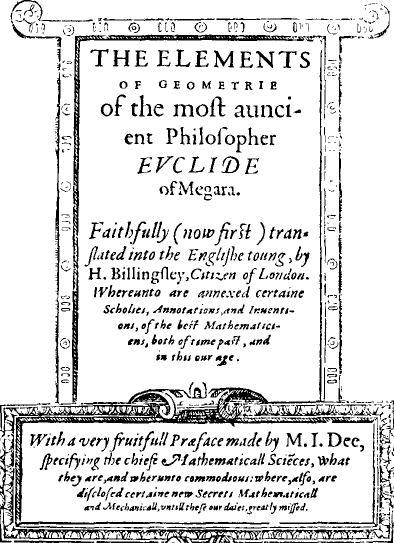
THE ELEMENTS OF GEOMETRIE of the most auncient Philosopher EVCLIDE of Megara.
Faithfully (now first) translated into the Englishe toung, by H. Billingsley, Citizen of London. Whereunto are annexed certaine Scholies, Annotations, and Inuentions, of the best Mathematiciens, both of time past, and in this our age.
With a very fruitfull Præface made by M. I. Dee, specifying the chiefe Mathematicall Sciẽces, what they are, and wherunto commodious: where, also, are disclosed certaine new Secrets Mathematicall and Mechanicall, vntill these our daies, greatly missed.
Imprinted at London by Iohn Daye.
Transcriber’s Footnotes
A. Mathematical Notation. John Dee used the “root” sign √ in combination with some less familiar symbols:
“First power”, here used to express an unknown. Shown in this e-text as X (capitalized).

Root sign combined with “second power” symbol = square root. Shown in this e-text as 2√.

Root sign combined with “third power” symbol = cube root. Shown in this e-text as 3√.

Doubled “second power” symbol = 4th power; with root sign = fourth root. Shown in this e-text as 4√.

B. Diagrams: The symbol drawn as P (Pounds) is shown here as P. See above for X symbol.
HOTE +C | | + | | + | | +E | MOIST A TEMPERATE B DRYE +------+------+------+------+------+------+------+------+ |D | + | | + | | + | | + COLD
_____________________ | | | | {P}. 2. | Hote. 4. | | | | | {P}. 1. | Hote. 3. | |_________|___________|
_____________________ | | | _ | {P}. 2. | Hote. 4. | ⅓ _ The forme_ | | | _ 3⅔ resulting. | {P}. 1. | Hote. 3. | _ ⅔ |_________|___________|
C. “Vergilius teaches in his Georgikes.” The quoted lines, with breaks at each “&c.”, are 438-439; 451-457; 463-464.
Euclid citations
The following Propositions were identified by number.
6.12: (How) to find a fourth (line) proportional to three given straight lines.
11.34: In equal parallelepipedal solids the bases are reciprocally proportional to the heights; and those parallelepipedal solids in which the bases are reciprocally proportional to the heights are equal.
11.36: If three straight lines are proportional, then the parallelepipedal solid formed out of the three equals the parallelepipedal solid on the mean which is equilateral, but equiangular with the aforesaid solid.
12.1: Similar polygons inscribed in circles are to one another as the squares on their diameters.
12.2: Circles are to one another as the squares on their diameters.
12.18 (“last”): Spheres are to one another in triplicate ratio of their respective diameters.
Notes on the text
The Greek letter η (eta) was consistently printed as if it were the ou-ligature ȣ.
The Latin -que was written as an abbreviation resembling -q´;. It is shown here as que.
Less common words include “fatch” (probably used as a variant of “fetch”) and the mathematical terms “sexagene” and “sexagesme”.