"The Mate of the Lily" (continued 3)
Reading edition
We must of course continue our search for him, and we all hoped that, unless he had escaped on board some passing vessel, which was not at all likely, he would not be far off.
It was arranged that Blyth should keep the first watch, Uncle Jack the second, and I the third.
I never slept more soundly in my life, as I was very tired with our long tramp, for it seemed but a moment after I lay down before I was aroused by my uncle giving me a pull by the leg I crept out from under the boat, and shouldering my musket began to pace up and down close to the boat to keep myself awake, while my uncle took my place.
The stars were shining brightly, and a light wind rustled the leaves of the neighbouring trees, while the water lapped gently on the beach. No other sounds reached my ears. I still felt so drowsy that I was sure, should I sit down, that I should go to sleep. Occasionally I extended my walk to the borders of the forest.
I had made several turns, and calculated that I had been half an hour or so on watch, when it appeared to me that the night was growing darker, and looking up I saw that the stars overhead were obscured, while the murmuring sound in the trees had increased in loudness; though sheltered as we were by the forest we did not feel the wind, which was blowing off shore. The clouds continued gathering until the whole sky was obscured. I fully expected before long that there would be a downpour of rain, but as we were on a weather shore I did not think it necessary to call my companions. I continued my walk, occasionally approaching the forest and then returning to the boat.
I looked out anxiously for the approach of day, but even had the sky been clear, the trees would have prevented me from seeing the first streaks of dawn, and as it was the sun itself would probably not be visible.
At last I knew by the light that the day had broke. I had gone back to the forest, and intended to arouse my companions at the end of the next turn, when I fancied that I could distinguish the sound of human voices amid the soughing of the wind in the branches overhead. Stooping down to the ground I listened attentively—I was sure I was not mistaken.
The voices might be those of the natives, who finding we had retreated had pursued us. Hurrying back to the boat as quickly as I could, I roused up Uncle Jack, telling him what I had heard.
“Very likely you are right, Harry,” he answered, “though we might drive back the savages, we could not do so without bloodshed, and our safest plan will be to get our boat off and hold a parley with them from her. If they show hostility, we can keep them at bay until we get to a safe distance.”
Without a moment’s delay we called up our companions. We quickly turned the boat on her keel and ran her down into the water. We two held her, while the rest carried our goods on board.
Just as we were jumping in we saw a number of savages, armed with spears and bows, emerging from the forest, and they, catching sight of us, rushed forward, others following, until a formidable band was collected on the beach.
“Shove off, lads!” cried the first mate, seizing an oar, and the rest of us imitating his example, aided by the wind, we speedily drove the boat away from the shore.
The savages, seeing us about to escape them, bent their bows and let fly a shower of arrows, which came whistling about our ears, some falling in the boat and others on either side.
The first mate steered, Blyth sat by his side with a musket in his hand ready to fire, while our Papuan guide crouched down in the stern-sheets.
“Shall I fire?” asked Blyth, “I can knock over one of those fellows; the chief, I suspect, who seems to be leading them on.”
“No, hold fast, I would not injure the poor wretches if it can be avoided,” answered the first mate. “We shall be out of their reach in another minute. We can then settle how to treat with them.”
A few strokes took us beyond the range of their missiles. He was right, for their bows were comparatively small, intended rather to shoot birds than for war, while their javelins could not be thrown to any great distance.
He now directed Ned to tell Kalong to address them, and to say that we had come with friendly intentions to trade, and to recover some countrymen who had been wrecked on their coast.
The chief, on hearing this, invited us on shore, observing that we could talk more easily there, and that he would hear what we had to say.
The Malay and our native guide talked together.
“Kalong says we had better not trust them,” observed Ned; “if we land they may shoot us for the sake of getting our goods. They don’t know how far our firearms can reach. Better give them a volley to show them.”
This Uncle Jack was unwilling to do, though we might have shot down half a dozen of them at least, had we fired as Ned proposed.
While this palaver was going forward I took a glance seaward, when what was my astonishment to see the “Iris” and “Lily” standing along the coast, under close reefed topsails, as if coming to look for us. I could judge by the way they heeled over that a pretty strong breeze was blowing in the offing.
If we were to get on board there was no time to lose; indeed, it seemed very doubtful whether we could reach either of the vessels. They were too far off to see us, and it was doubtful whether they could hear our muskets. Uncle Jack directed Blyth and me to fire at the same time, but neither the ship nor the brig altered their course. They had good reason for not wishing to approach the land, as the wind, rapidly increasing, was shifting to the north-west, and they might at any moment find themselves on a lee shore. They had also got so far from the harbour they had left that it was evident that they could not manage to get back.
“They’ll not desert us, lads, depend upon that,” said Uncle Jack, as we saw them standing away from the coast; “we can neither overtake them nor land while those fellows on shore show so unfriendly a disposition. We must try and get back to the village where we procured our guides, though I don’t know what sort of reception we shall meet with when their friends hear that we have lost one of them. It will be a long pull and a heavy one, for we shall have a head sea as soon as we get clear of this bay.”
“Why not then make for yonder island to the eastward?” I observed. “These savages, who don’t appear to have any canoes, cannot follow us there, and we shall be able to remain in safety until our friends come to take us off.”
“We may have to follow your suggestion, Harry, but we must first try to get back to the river to land our guide according to our promise. He has proved faithful, and we will supply him with goods with which he may be able to ransom his companion.”
This was said as we were pulling out of the bay, but no sooner did we get beyond the point than we met so heavy a sea that it was impossible to pull the whale boat against it, and we were in danger of being swamped. Our only alternative was, as I proposed, to run for the island. Even now we had to pull hard to avoid the following seas which threatened to poop us. We saw the savages on shore dancing, shouting, and gesticulating when they discovered that we had escaped them. On finding, however, that we were steering for the island they rushed along the beach in the same direction, which made us fear that they might possess the means of crossing over to it, and that after all we should have to fight for our lives. We had not much apprehension, however, as to the result. Uncle Jack intended to pull round to the lee side of the island, and then, should they persist in attacking us, we could shoot them down from the boat while we kept out of range of their arrows.
As we pulled along we watched the two vessels which were getting further and further from the coast, although the ship had only her fore and mizen topsail set, and the brig was under equally snug canvas.
Aided by the wind the boat went faster than the savages could run, and they were out of sight when we reached the passage between the island and the main land. We could see no canoes on the shore, and this made us hope that we might at all events avoid an attack until the gale was over, and we could resume our search for my father.
We did not doubt for a moment that the “Lily” would come to look for us, and by hoisting a signal on the outer end of the island we hoped to attract her attention. Passing through the channel, which was about a mile wide, we rounded the eastern point of the island where the water was perfectly smooth, when discovering a small bay with a sandy beach we at once pulled in. As we saw no huts or plantations we calculated that the island was uninhabited. We therefore landed without hesitation, and hauled up our boat. From a rocky elevation on the northern side of the bay we could command a view of the main land along the whole length of the strait.
Uncle Jack sent Blyth and me to watch should any natives appear, but sharp as were our eyes we could discover neither canoes nor human beings moving about.
The savages therefore supposing we had escaped had, we concluded, returned to their village. As there was some probability that we should have to remain several days on the island, Uncle Jack proposed that we should build a hut, which would be a pleasanter sleeping-place than under the boat. We at once therefore set to work.
The Papuan showed himself an adept at the use of the axe, and understanding clearly what we wanted was of great assistance. A bamboo thicket and some large palm leaves afforded us materials, so that in a short time we had a well built hut erected capable of containing all the party, the upper floor affording us a sleeping-place, while the lower would shelter us during the day should it come on to rain. We naturally felt much anxiety about the vessels, though we trusted that they would avoid any of the dangers which lay to the westward.
Night passed without any adventure. The gale raged with unabated fury, though we felt it but little in our sheltered cove. We had brought a good store of provisions and a breaker of water in the boat, but that, from the frequent applications to it, was almost exhausted. It was necessary to search for a fresh supply. Uncle Jack was unwilling to leave the beach in case the natives might find the means of crossing. Blyth and I therefore undertook to go in search of water. We hoped, although we might not discover a stream—which from the size of the island was unlikely—we might find a spring, or ground by digging into which fresh water might be reached. As soon, therefore, as we had breakfasted we set off. As we had pulled along it the previous day we calculated that the island was between three and four miles long and about two miles broad.
Besides our guns we each carried a long bamboo stick, one end pointed and the other formed like a gouge to serve as a spade, with which we might dig for water, should we fail to find a stream.
So thick was the jungle immediately at the back of the cove that we had to proceed along the shore some distance before we could make our way inland. In several places we found it lined with the pandanus or screw palm, which looks as if it had branches at both ends, the lower being the roots which had lifted the trunk into the air. In other places there were cocoa-nut trees with nuts hanging from them, so we knew that even were we to be kept there many weeks we should have an ample supply of vegetable diet.
“We shall find other food too,” said Blyth, pointing to some trees which grew in a hollow at the foot of a hill. “Those are sago trees; if hard pressed we might manufacture sufficient sago from them to last us for months, or even years. They require moisture, and I have little doubt that by digging we shall find water not far from their roots. But we will search further, perhaps we may discover a spring which will give us a more ample supply, so that there is no fear of our starving. What a number of birds there are! Many of them, too are birds of paradise. I cannot tell you their names, but they seem to be the same as are found in the Aru islands away to the southward. We shall have no difficulty in shooting them, or some of those magnificent pigeons when we want them, but it would be a pity to expend our ammunition unnecessarily. We can kill a few as we return to serve us for dinner.”
The whole of the island indeed appeared to be a perfect garden, and yet, as far as we could discover, not a single inhabitant did it contain. We made our way on, not without great difficulty, sometimes having to cut a passage for ourselves through the underwood until we reached the southern end, or rather western shore, where we could see the ocean still covered over with raging foam-topped seas, which made us fear that for many days to come our friends could not return, and until the brig did come back I was sure that Uncle Jack would consider it his duty to remain on the island, whence he could communicate with her.
As we were more likely to find a spring inland than on the coast we continued our course up the centre of the island. “We shall have to dig, I suspect, after all, in the sago grove,” said Blyth, as we at last began our return. “However, we may as well carry some game with us; I intend to shoot the first fine pigeon I see. You can try your luck, although I would advise you not to fire unless you feel sure of your aim.”
In a short time Blyth, who was a good shot, killed three or four pigeons, and I had shot a parrot and a bird of paradise, but I felt ashamed at having deprived so beautiful a creature of life, yet thousands were flying about unseen by human eye, which they are formed to delight. We went on a little further, when I again fired and brought down another parrot. Just as I pulled the trigger I caught sight between the trees of a face watching us. At the first glance I thought it must be some huge baboon, but still it looked human though covered thickly with hair. I was a little in advance of Blyth. Supposing that if not a baboon it was a savage, I was hurriedly reloading, ready to defend myself, when a man stepping forward exclaimed—
“Who are you mates, and where do you come from?”
For a moment my astonishment at the sudden apparition prevented me from answering. The man, however, advanced without fear. His dress, though in tatters, was that of a seaman, fastened together by all sorts of contrivance, while a roughly-formed palm-leaf hat covered his head.
“I heard your shots some time ago, and have been long hunting for you, for I was sure no natives could have fired as you have done.”
Without answering his inquiries, I with intense eagerness put the same questions, “Who are you? And where do you come from?”
“I am an Englishman, who was cast away out there, and who was kept a prisoner for many a long year by a set of savages up the country, until about six months ago, when the captain and I got free from them and crossed over here, where we have been ever since, hoping that some craft would appear and take us off.”
“What ship did you belong to? Who is your captain?” I asked, with intense eagerness.
“The ‘Amphion,’ Captain Musgrave was my captain,” he answered.
“He is not, then, living?”
“Yes, he is alive, but he is in a bad way, I fear. He kept up his spirits until yesterday, when we saw two English vessels run past us to the southward. Then it seemed to him, and to me too, for that matter, that all hope was gone, and that we might have to remain here for years more for what we could tell, since all the time we have been here we have never seen a vessel.”
At that moment Blyth came up, and in a voice choking with agitation I told him what I had heard.
“Lead us at once to your captain,” he said, turning to the seaman; “we came here expressly to look for him, and are expecting the vessels back as soon as the weather will allow them to return to the coast. If your father is ill, Harry, there will be a risk in agitating him by presenting yourself suddenly to him. Let our friend here first tell him that he has found some Englishmen on the island, and then I will go in and tell him that his son and brother-in-law have come to look for him. Where is he living?” he asked of the sailor.
“In a poor enough place, sir, close on the sea shore. It is a cave, inside a rock. We thought it safer than a hut, where the natives, if they had come to the island, would be more likely to find us.”
I begged the seaman to hurry on. “What! Are you the captain’s son?” he asked, as I ran by his side. “Often and often he has talked about you. If anything will set him on his legs the sight of you will.”
We soon reached the beach, when scrambling for some distance among the rocks the seaman pointed to the entrance of a cave at the side of a hill which sloped up from the water.
As agreed on the seaman went first, followed by Blyth. I stood outside eagerly waiting to be summoned. It seemed so long that I was afraid my father had been overcome with the news.
At length Blyth appeared, and beckoned me in, and the next instant I was kneeling by my father’s side, as he lay stretched on a bed of leaves and matting, which Dick Meade, his faithful follower, had arranged for him.
“What! Are you Harry, really my son Harry?” he exclaimed, throwing his arms around my neck; “I was sure that you and my good brother Jack Radburn would come to look for me if you thought I was alive, and not until yesterday, when God in his mercy had sent you to this island, did I lose hope. Ungrateful I was, after having been preserved from so many dangers; but your appearance has brought me back to life.”
“What the captain wants is some good food,” I heard Dick observe to Blyth; “if you’ll let me cook one of those pigeons it will do him all the good in the world.”
As Blyth carried a flint and steel they soon had a fire lighted in a sheltered spot, just outside the cave. While I sat by my father I was thankful to see that he appeared stronger as we conversed.
Blyth soon again came in and volunteered to carry the joyful intelligence to Uncle Jack. During his absence the pigeon was cooked and eaten. Dick brought in a shell full of water from a spring, which he said bubbled out of the hill side close at hand.
Soon I heard Uncle Jack’s voice. I need not describe the meeting between him and my father. He had left Blyth with directions to bring the boat round should the sea have gone down sufficiently to enable her without risk to reach a little cove which we found not far from the cave, where she might be hauled up if necessary. Uncle Jack, with his usual forethought, had brought tea and sugar and biscuit, luxuries to which my poor father had long been a stranger. They appeared to benefit him much. In a few hours he was able to sit up and converse freely with us. Before nightfall we had the satisfaction of seeing the boat, and Dick ran down to pilot her into the cove. Some of the party spent the night in the cave, which was of considerable size, and others under the boat.
The first thing all hands did in the morning was to cut down the tallest trees we could find to form a flag-staff, which we placed on the highest part of the hill overlooking the ocean. We then fastened together the two flags we had in the boat with a number of our handkerchiefs, which, combined, formed a flag of a size which could be seen at a considerable distance; eagerly we watched day after day for the appearance of sail.
I had never seen Uncle Jack so anxious, he could not help reflecting that during the gale some accident might have happened to the “Iris,” and that his dear Grace might be among the sufferers.
“Cheer up, brother Jack,” said my father, when he saw him thus cast down; “I have learned more than ever to put confidence in God’s loving mercy during my exile. Had I not been able to trust Him, I should have sank long ago. I have known Haiselden and Bingley all their lives, and they are not the men to desert their friends.”
Still another and another day passed. At length, one morning, I was awakened by a shout from Dick Meade, and running out of the cave, I saw the rising sun shining on the white canvas of a brig in the offing. That she was the “Lily” I had no doubt, but where was the “Iris”? What would be Uncle Jack’s feelings at not seeing her?
Dick was hoisting up the flag which he had just bent on. The breeze was from the south-east, which would enable the brig to approach the island without risk. She was standing on farther to the northward, and I began to fear that she was not the “Lily” after all. I was expressing my doubts to Dick, when I found Uncle Jack standing by me with a telescope to his eye.
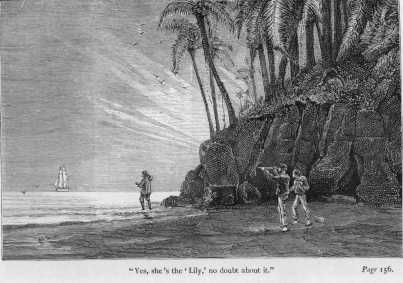
“Yes she’s the ‘Lily,’ no doubt about it; she’ll see our signal before long, as she will be looking out for us.”
In another minute the whole of our party were on foot. I ran in to tell my father, who insisted on coming out to have a look at the object for which his eyes had so often ached in vain.
In the meantime our men had lighted a fire, believing that a long pull would be before them. Fortunate it was that they did so. My father was not in a fit state to go off without breakfast. The meal was scarcely over when the brig tacked, and the “Lily’s” flag was run up at the mast-head.
Not a moment was lost in launching the boat. My father was assisted down to the beach. We waited a few minutes, when the “Lily” hove to. Our last act was to lower the signal flag, and we then, getting on board, with hearty strokes pulled away for the brig.
“We have found him, we have found him!” I could not help calling out as we approached her side.
My father was helped on board, and warmly welcomed by our kind-hearted captain. Uncle Jack’s first inquiry was for the “Iris.”
“She’s all safe at the Aru islands, where I promised to rejoin her as soon as I had recovered you,” answered Captain Haiselden; “and as she has received some damage in the gale, she is likely to be detained there several days.”
The only person who looked unhappy was our Papuan guide; but he was reassured when the captain promised to land him at his own village, towards which we stood, as soon as the whale boat was dropped astern.
In a couple of hours we were off the mouth of the river, when we once more pulled off, with the same party which had before landed in the whale boat.
As we approached, a shout of joy arose from our companions. The cause was soon explained. One of the first persons we saw standing on the platform in front of the hut was the lost guide who had, we afterwards found, made his escape, while his captors were pursuing us.
The natives were delighted with the things we brought them, and we could have laden our boat up to the gunwale with the articles they offered in return.
Wishing our friends good-bye, and promising that we would as soon as possible pay them another visit, we pulled back to the brig.
In three days we reached the Aru islands, seldom visited by English vessels, and brought up before the chief town Dobbo, which is, however, only a collection of huts such as those described in Papua and Borneo, though of a more substantial character. The population of the islands are mostly Papuans, though people from various other parts of the Eastern seas have settled there. The islands are generally level, and thickly wooded, the forests containing amongst other birds two or three of the most beautiful species of birds of paradise.
The “Iris” was almost ready to sail, so that we remained there but a couple of days, when, threading our way among the coral reefs, we once more got into the open sea.
I should have been happy to give a further description of our voyage and our visit to Timor, where we anchored to obtain fresh provisions. We then shaped our course along the south coast of Java, and then, crossing the Indian Ocean, rounded the Cape of Good Hope; after which we had a remarkably fine passage home, and, strange to say, did not once lose sight of the “Iris.”
Whether Uncle Jack had anything to do with this I can only guess. I know that he told me to keep a bright look-out for her whenever he was below, and report to him any change in her position. The “Iris” led the way up the Thames. Immediately she dropped her anchor, before going into dock, Uncle Jack and my father went on board and arranged a plan with Grace for breaking the news of his return to my mother; she and Mrs Bingley at once went on shore promising to act with due discretion. I have every reason to believe they carried out their duty well, for when I arrived at home a few hours after my father, I found my mother looking the picture of happiness, and almost as calm and composed as usual.
I have not entered into the trading particulars of the voyages of the two vessels, but both were considered highly satisfactory. It was the first of several I made on board the brig to the same region, the mate of the “Lily” being now her captain.
In the next voyage my Aunt Grace, now Uncle Jack’s wife, accompanied him. He has since retired from the sea. I served with him as his second, and then his first mate for some years, until I got the command of a ship. I must acknowledge that I greatly owe my success to having followed the good example set me by my excellent uncle once The Mate of the “Lily.”
The End.
| Chapter 1 | | Chapter 2 | | Chapter 3 | | Chapter 4 | | Chapter 5 | | Chapter 6 | | Chapter 7 |