Front matter (continued 2)
Reading edition
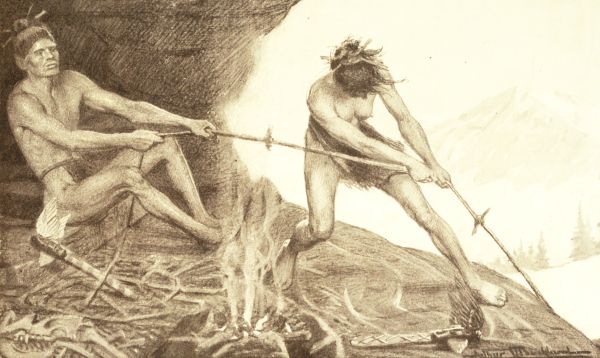
SALVING THE GHOST-BEAR'S SKIN
The salving of that bear's-meat was a four-days' poem. By the fifth evening the youngsters were victualled for the rest of the winter, and Dêh-Yān had not one thumb-nail's breadth of cutting-edge upon the last of her chert-flakes. She was also dead beat.
The whole of the sixth day and the following night the girl slept the deep, dreamless sleep of a healthy organism wearied out, watched by Pŭl-Yūn, who had seen to it that she had gorged herself to repletion before lying down, and who had himself rubbed her swollen joints vigorously with fat, and who watched over her whilst she slept beneath the vast hairy spoil of her twice-dead lover.
"Saw-Kimo," jeered the young brave during the long chilly night-watches, "this is the third time thou hast bid for my woman. She was not for thee, nor thy Little Moons. She is mine! mine!—I tell thee!—Was there ever such a woman?—never!—I have seen two bears die in my time on the other side of the ranges, but they were Brown Bears, and young bears at that, yet they died within a ring of as many braves as they (or thou) had claws upon their feet. It took the whole strength of a war-party to bring either of them to bay and keep them there. We brought two braves who did not go home with us. One we buried to each bear. And, look thou at thy business, O Saw-Kimo (if that be thy name) and whimper for shame, thou who died at one stroke, and that from the hand of a squaw—of a girl! a stroke in the eye of thee; in the brain of thee. Such a stroke! And thou a Cave Grizzly! Was there ever such a woman?"
So Pŭl-Yūn; for the glory of the feat had got upon his imagination. The more he sang of it, the less he understood it. You must remember that his knowledge of how the thing had been done was all by hearsay. The bolt had been discharged from behind him, and owing to the darkness of the cave, he had not watched it home; Dêh-Yān's description of the wound, and of the chert assegai-head still enfixed in the eye-socket, was unsatisfying. He must see for himself, some day, soon—yes, at once—the great stripped skull which lay a hundred feet beneath him. And whilst he pondered a certain familiar sound reached his ears from the foot of the cliff; it was the cracking of a bone. Some furry scavenger of the forest had been drawn to the carcass and would not be long without competitors. The man must risk something. He cast loose his bandages and splints, crawled to the sill and hurled stone after stone upon the marauder. Nor did his leg suffer. The bone had knit.
The scraping, greasing and suppling of that immense hide was a laborious business, but a labour of love for Dêh-Yān, whose heart was both big and high within her. There was no tribal record, no legend even, of any woman having killed a bear in single fight. Yet she held her tongue, and silently grew in moral stature.
Pŭl-Yūn might sing about his wife's prowess, but he was not to be convinced of the superiority, or even of the use, of her new weapon. He was a spearman. As a spearman, an expert with the assegai, he had won the deputy-chieftainship, the war-chieftainship, of his tribe. What was possible with the spear he could do; but this fiddling with a strung-drill was too novel, too womanish, too uncertain as yet. He would have none of it.
The girl, already convinced and sanguine, wisely desisted from argument. By help of the cord the massive skull was hauled up from below to tell its tale to deaf ears, to be admired, turned over, its death-wound marvelled at and its lesson ignored. The man set himself to dig out the enormous white fangs. He also detached those twenty black curving claws, arranged, studied and pored over them, watched by Dêh-Yān. She knew by intuition what was passing in his mind and waited. This was the critical, the dangerous point of their married life.
Who was to wear those teeth? those claws?
He put the question from him (she had not raised it), it would wait; the trophies were not ready for wearing as yet, they must be drilled before they could be strung. Dêh-Yān saw that her husband needed something but was too sulky to ask, and by a real intuition fetched him the lengths of elder which he required for this new drilling and left him to his work, setting herself to study the properties of her new weapon. There was nothing to take her afield, stacks of frozen bear-meat blocked the cave, she could experiment at her leisure, and had conquered some of the initial difficulties before her man, glumly busy up above, knew anything about them.
Thus, the girl found that assegai-heads were too heavy, and assegai-shafts too stout for successful shooting; terrible at point-blank range, at anything over twenty strides they wobbled and swerved and fell short, and Dêh-Yān, the practical, argued, and argued rightly, that unless her shafts flew farther and straighter and bit deeper than a thrown assegai, she had better keep to the orthodox weapon. She needed chert, or flint, to make for her arrows smaller and lighter heads: but neither chert nor flint was to be found in that valley, nor was it possible for her to adventure the week's journey down-stream to the chalk cliff which was the only source known to her of the tribe's cutting-tools. But, womanlike, she remembered her needles, and in default of chert fell to experimenting with bone tips attached to lighter shafts by rosin and sinew, the hafting method of the Little Moons. She succeeded from the first attempt, settling after many trials to a shaft as long as her own arm: made herself ten upon this pattern and practised sedulously. Skill came apace, far more quickly to this tense-sinewed one-idead savage woman than it would come to a modern, and at the end of three days' constant archery she found herself able to put all ten arrows into a small circle marked out upon a snow-bank at full assegai-range. Beyond this range her missiles disappointed her, they still wobbled. As a practical spear-thrower she knew what was lacking—there was no spin upon them. How could this be remedied?—This question lay down with her at night and arose with her in the morning. She besought her totem for wisdom, but got never a sign. A sacrifice was needed; she vowed to the Moon the first-fruits of her bow, and greatly daring, adventured out into the wintry forest armed with her new weapon and nought else. What would the God send (the moon is a man to the savage), fur or feather? A little hazel-grouse trotted out into the glade; the shot was a difficult one, impossible with spear or throwing-stick, owing to overhanging boughs, but the girl prayed as she drew and brought it off. Her heart filled with gratitude, her totem was still watching over her for good. This should be a whole-burnt offering; a few feathers alone would she retain as her own share of the spoils, the first that ever fell to her bow (the Ghost-Bear always excepted).
Whilst walking caveward, these curving flight-feathers in hand, something in their curvature, their shapes, aroused her superstition. "Moon-feather," she whispered, and attached one of them to one of her shafts. The feather was narrow, stiff and strongly curved, it refused to lie along the shaft, but must needs curl somewhat around it when bound thereto by small sinews at either end. Dêh-Yān's first shot with it at her snow-bank target flooded her bosom with adoring gratitude, for here was the thing she had sought and prayed for, the shaft spun as it flew! Again and again she essayed shots at increasing ranges and still the wonder persisted, at fifty, yes, and at sixty paces the shaft flew straight, swerving neither to left nor right. All her shafts were presently feathered, and, since the principle eluded her, and some behaved better than others, she must practise daily, watch, consider and think, and within a while came to a practical conclusion, to closely imitate the feathering of those which span the best.
FOOTNOTES:
CHAPTER V
THE TESTING OF THE NEW THING
And now there was gloom in the household. Pŭl-Yūn was gaining strength daily and as irritable as your convalescent is permitted to be. His leg was not yet sound enough or supple enough to attempt the descent of the face, for the knee-joint creaked from its six weeks of disuse; on the other hand, it could not get enough of play within the limits of the cave. His nerves excited him, his temper was less even than when he was helpless, and, worst of all, his conscience would not let him be. Thus came Aidôs down to men.
Dêh-Yān put up with her man's petulant outbreaks and slaved for him harder than ever. A diet of dark bear-meat—solid bear-meat daily and twice a day, although admirably suited to keep up the bodily warmth, is hard upon the liver unless regulated by abundant exercise, which in the case of her husband was out of the question. She cast about for something lighter, but game was getting scarce in the immediate neighbourhood of the cave, and indeed in the glen itself; she had hunted it too closely and too long. It was the depth of winter in the mountains, migratory life had long since left for the lower levels, resident life was scanty. Dêh-Yān betook herself to trapping. A bird of some kind her man should have.
Pŭl-Yūn, peering moodily from his cave-platform, watched her bending over a trap far below and a long way off. The cackle of a chough came up clearly through the cold air, a danger-signal, and it struck him as singular that the bird should be calling so far from the woman, for as a rule they ignored her movements unless she were within, say, a hundred paces, yet he put the matter from him, no dream had given him prescience of impending danger.
The girl, busied at her work, crouched beside her gin, her deer-skin quiver upon her shoulder, her bow laid beside her hand. The man was annoyed at the sight, he distrusted this new-fangled plaything of hers; why could she not carry spears as he would have done, as he was going to do in a week or so? Everything she did, or failed to do, had power to annoy the poor fellow now. That she bore with him so quietly was an offence in itself. Had she answered him back, had she met him half-way in the quarrel which he had been provoking for a week past, he would have taken such an attitude in good part. That is to say he would have found it natural and treated it naturally, beaten her, to wit, as every savage man has ever done since the male subjugated the female.
But Dêh-Yān's gentle, unselfish reserve, and perpetual activities on his behalf, gave him never an opening.
So he watched her moodily, jealously—come, the secret is out at last, we have a name for the complaint.
This is of the primitive passions. It is one which we share with, or inherit from the brutes. A cat, a lap-dog, a parrot, will sicken of jealousy. Children, savages, uneducated people, our semi-educated fellow-citizens (our new masters), are subject to severe and protracted fits of this torturing disease. We have known a working-man, middle-aged, of failing health, and with a sickly wife and young family to support, throw up a foreman's post of twenty-eight shillings the week and begin life again upon seventeen as a common labourer, from sheer jealousy of one of the gang under him whom he could not induce his firm to discharge without a reason.
Women are more liable to the malady than men because they have, upon the whole, less distractions for their minds. A man can escape from the proximity of his enemy (once possibly his friend), he can steep his mind in business, in politics, in literature, in sport. A woman has her rival ever at her elbow, in her kitchen, in the nursery, in the school-room or next door.
In the case of poor Pŭl-Yūn the position was reversed. It was he, who with hardening muscles and strengthening passion, was debarred from healthy and adequate physical exercise, and was fain to eat his heart in bitterness of spirit, with an accusing conscience ever at his elbow, a house-mate for which he had no name, for the Thing, like many other Things, rheumatism, gravity, panic-terror, malaria, etc., although maleficent, had not yet been separated, personified and named.
Picture him overlooking with the beady, deep-set, far-sighted eyes of the savage, like an eagle from his eyrie, the doings of his jealously-loved squaw a half-mile away and three hundred feet below.
There, she had set that gin, and half arose, her chert-knife in one hand, her bow in the other. Sudden as the pounce of a lynx (and nothing in nature save the stroke of a snake can be swifter), a man leaped upon her from the scrub. Pŭl-Yūn caught his breath, for the enemy had her by the kaross and must have borne her down had not his foot caught in a trailing bough of pumilus. As it was, it was the nearest thing in the world, for as he stumbled, still fast to her, the skewer at her throat snapped, he reeled back with the kaross, the woman was free. He was at her again, but she doubled under his tossed-up arm, striking back and up as she did so and getting him in the arm-pit, as her husband thought. By some means she was at liberty, off and away; not along the glade, but winding swift and puzzlingly amid the tangling scrub of which she knew every game-track by heart. This was the saving of her, as Pŭl-Yūn saw and breathed again, for two other hunters now upsprang from beside the path which they had anticipated her flying feet would follow. These seemed for a moment somewhat out of it, for their quarry had doubled back and secured a lead, but they were hardened braves in the pink of condition, winter-hunters who seemed to know the valley, and once clear of that patch of scrub what would happen?
There is but one thing that can happen when an unarmed woman is set upon by three armed men—unless, indeed, she be helped. But how was Dêh-Yān to be helped?—and by whom?—By himself only! He smote his stiff knee and yelped a short and very bitter laugh. Yes, the girl must come to him for help at the last.
Meanwhile she was playing the game, running her ring about the thicket, as a vixen does when roused. There was just the off-chance that she might throw her pursuers out, and get back to her earth unviewed. But, with three men (and such men), it was the poorest of chances, and she was incurring the most outrageous risks. She had boasted somewhat to him of her speed, and he had believed that she was fleet for a woman, but what woman, or what man, for the matter of that, could stand up before three?—She was heading down-glen when he lost sight of the chase, and every step would have to be retraced, and the double made in face of a runner-up pressing her for all he was worth, and flankers running wide to cut her off when she turned.
He threw himself upon the cave-floor and gnawed his knuckles in impotent chagrin.
She should not have turned. She should have headed straight for him at once. They would have stood out the siege together, and died together, for that was what it would have come to, as he saw too clearly.
As for his wife making a successful stand anywhere, or under any circumstances, and fighting it out with that new Thing of hers, the idea never occurred to him once during the long hours of his lonely vigil.
The shadows of the winter's day lengthened. The imprisoned man had given up hope. His wife did not come, would never come to him again. The husband's heart grew heavy with the sorrow which settles down upon the watcher whose anxieties are over at last, whom the worst has befallen.
For himself he did not particularly care. He had no fear that she would give him away under torture. Dêh-Yān would be staunch to the last, of that he was assured, doing her justice now that she was gone. He had stores enough for another four months, and long before that would be as sound a man again as ever he was. But this cave would be a hateful place without his squaw. Nor could he face the thought of returning to his tribe without her, empty-handed, with nothing to show for his winter-hunting. This was a humiliation not to be borne, the sneering enquiries of his cousin and rival, the wonder of his fellow-braves, the eyes of the women. No wife and no scalps?
Whether besieged or no, Pŭl-Yūn would stay back and avenge her. What was she worth in Little Moon lives? He held up all his ten fingers and solemnly gloomed upon them. Ten should die for her—if he lived—not less. So the night wore.
Then a stick cracked below in the darkness, and her signal, the shrill whistle of the marmot, rang out. His heart leaped, he gripped his axe and a stone for a down-throw; she would be hard-pressed to a surety, but why did the fool-creature make such a noise?—'Twas madness!
He hirpled to the lip of the rock-platform and craned over, peering down into the impenetrable dusk below, ready for action, listening, eye, ear and nostril at stretch for news of the whereabouts of his foes. But the only sounds were the scrape of his squaw's moccasins and her hardly-taken breaths. How heavily she climbed!—Was she wounded? She did not reply to his low-spoken questions. She was coming nearer, nearer; his eyes, accustomed to seeing in the worst of lights, could make out her bare unbandaged head and shoulders, her arms too, there seemed little the matter with what of her he could see. Her kaross was gone, he had seen it go, she was still encumbered with that silly bag of arrows, and the big bow-drill hampered her climbing. Drawing her breath in gasps, she reached the sill of the cave, crawled in and sate mutely panting, her eyes shining glassily in her head. She seemed unharmed; she was unharmed; it was wonderful—amazing! Now, what had happened? Why could not the creature speak? "What of the chase, Dêh-Yān?"
Still mute and with an open mouth drawn up from the teeth with the muscular contraction of extreme toil, she unrolled and laid out before him in the dusk—One—Two—Three bloody scalps each with the top-knot of a brave,—raw, fresh-stripped.
Pŭl-Yūn caught his breath in with a harsh cry: "Wah!—What?—How?—Where?" but the woman squatting over her spoils did not answer. She had reached her farthest. She swayed, she leaned, she collapsed, she tumbled forward almost into his arms.
The man drew the bear-skin over her as she lay shuddering, whimpering. He marvelled to hear her long-drawn sobbing in the darkness. This was new indeed; never had he known her to weep. Presently she relaxed and slept. He watched her slumber, gnawing a tortured lip, incredulous and convinced, exulting and humiliated, adoring and furiously jealous by fits. What would come out of this? 'Twas glorious! But 'twas absurdly disconcerting! Wonderful, no doubt, past whooping, but not to be put up with!
At midnight she awoke with a start, sighed once, rubbed her eyes, put back her hair, pulled herself together and was a new creature. Ashamed of her weakness, she silently got to her feet, made up the fire and cooked food for both.
Pŭl-Yūn watched her, would give her time, when she had eaten forth it came.
She had led her pursuers over a long and difficult line, hoping to throw them out, but Gow-Loo, though less fleet than she, was not to be shaken off; in fact he had pressed her hard and fired thrice as the leading greyhound fires at his hare, whilst the others, running to point, had headed-off her attempts at doubling. The men were in training, knew the country, and thought to wear her down by sprinting in succession. Again, and yet again, had her turn of speed been the saving of her.
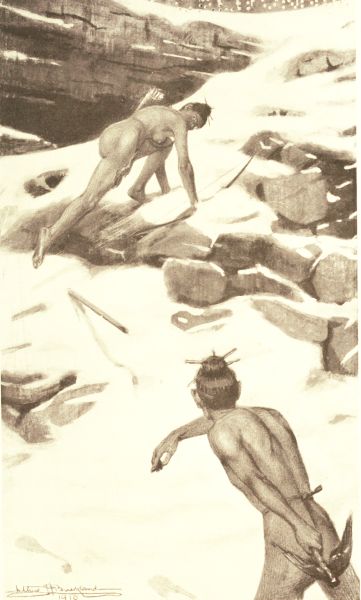
HE THREW SHORT WITH A GASP
But she was getting a long way down the glen and the daylight held. It would see her out unless she changed her tactics. In a little while she would be out of her country and (for aught that she knew) in theirs, then the game would be up.
So, tightening her throat, she had made up her mind, and doubled right-handedly close across the line of Low-Mah, whom she believed she had hurt, taking the risk of his assegai at short range. Her judgment justified itself when the hunter threw short with a gasp and she slipped past him and made her point, a salient rock-face that she knew, steep, narrow, where she could neither be overlooked nor outflanked. There, at more than a very tall spruce-tree's height from the last stones of the scree below her, she had chosen her ledge and stood at bay, regulating her breath and schooling her swimming head for the final tussle.
"I think those rocks were not wholly new ground to thee," suggested the listener.
"I had been up there before—three years back, when I was a girl. Our old men call them 'The Two Fangs,' but the tribe has re-named them; they are 'The Hungry Boys' since—since something happened there which is not good to speak about," she shot a glance over her shoulder to make sure that The Dead were not listening. "Three of our unproved lads, two half-growns and a child, whilst berrying, were driven up that cleft by a wolf. They were not found in time. The two boys must have eaten the little one. Then—who knows?—perhaps they fought with knives. They were found up there, dead,—with the bones."
"Ugh! not a clean place after dark. Surely your children went wide of it in all lights. How then—?"
"The boys I played with dared me.... Not one of them would do it.... There was a gnawed finger-bone still in a crevice.... So, I knew my footholds to-day."
Pŭl-Yūn laid his hand upon his mouth and perused this wife of his in the flicker of the brands. There was nothing in this by-incident to excite surprise, a piteous tragedy: the coarse woof of savage life is occasionally shot by such a crimson warp. His mental vision was busy with this woman's adventure, picturing the tall, splintered aiguille, springing sheer from its scree, cleft by its one narrow cheminée leading to its one broad platform-ledge so far aloft there. Yes, he had realised the mise-en-scène, and could follow the woman's weary voice carrying on her story, and could accompany her point by point.
The pursuers had seen that she was at the top of a blind couloir from which was no escape upward. Saw too that the overhang protected her from anything sent down from above. Saw too that the rock was absolutely sound, and that she had nothing to throw (a point in their favour).
Then, since daylight was waning, they determined to put the thing through. Their camp, dogs ("good wolves"), karosses and sleeping-robes were hours away. There was neither fuel nor water upon that scree beneath the cliff. After all, strong runner as she was, this was only a girl—unarmed, and probably spent.
Up came the leading couple, boldly and close together, and only when fully committed to the business, recognised the trap.
The girl, who had by this time recovered her wind, held her fire until the leading climber's top-knot showed twenty feet below her ledge. She knew him for Gow-Loo, he turned his head, saw her leaning above him, handling the absurd bent stick which she had carried throughout the run, and, getting his breath, made her a mock offer of marriage, the same bitter little jeer that he had cast after her thrice during the chase. As he made it, he laid his head back upon his shoulder the better to leer at his helpless victim, now safely under his hand, and—even as he bared his dog-tooth, a little short light assegai was sticking deeply beneath his ear. The stricken man plucked hard at the shaft with one hand, but the bone head was barbed and he could not draw it. He uttered no cry, possibly from shame, more probably from inability to articulate, and his fellow-climber, Pongu, just below him in the cheminée, getting no reply from him, and craning out to learn why his leader had stopped, knew not what had happened before a second shaft was driven hard and deep between collar-bone and shoulder-blade into his own lung, which brought him, too, to a stand with his mouth and nose full of blood.
Each man knew that he was hard hit, but knew not of the other's hurt; each felt the immediate need of getting down, but neither could speak, nor warn the man below him to vacate the footholds. To give ground to a young squaw was despicable; both held on grimly, doggedly and too long.
Low-Mah, the lowest, came up the cleft haltingly, crippled by that stab in the arm-pit that we know of, and which he had known for hours past to his bitter cost. The point of the Master-Girl's knife, whilst making a quite inconsiderable puncture, had touched one of the nerves of the brachial plexus, his right arm felt heavy and numb and was giving him exquisite agony, which he was bearing as mutely as a wolf. He knew by trial that he could not throw, but thought he could climb. His honour was engaged. To be known henceforth as the warrior who was lamed by a squaw?—Not he!
He saw that the leaders had stopped, and without visible cause, although Pongu, two spears'-lengths above him, was coughing fast and hard. He could not see their wounds, nor the weapons which had caused them, but the patter of falling blood from the severed artery in Gow-Loo's throat warned him of something amiss. Then an assegai clipped past his own ear very close. Phew! what was this? Whence had this she-lynx weapons?—Was this an old haunt of hers? and had she led them up this cleft to spear them with javelins stored for the occasion? His position, almost exactly beneath his leaders, had its advantages; their bodies screened him; he offered the smallest of marks—but (a fear suddenly gripped him, bred by the silence and immobility of those leaders) what if one of them should fall? He hailed them by name, but elicited no reply. "I must get from under them while I may," thought he, and attempted a traverse, a ticklish piece of work for a man so hampered. If he could but escape from this cheminée, this death-trap, and win around the buttress to the left, he would, as he reckoned, be under cover. He made the move, and not a moment too soon. Why, oh why, had not one or the other of his mates fought his way up within swing of a tomahawk?—(there is no throwing to be done while scaling a vertical fissure). Tomahawk, indeed? Gow-Loo, being by this time in exceeding evil case, and growing blind and weak, dropped his hatchet, and a moment later, with never a cry of warning, let go altogether; his knees buckled, his body bent, and down he came upon Pongu and took him to the bottom with him. There they lay, their life's business accomplished, the matter disposed of so far as they were concerned.
Then Low-Mah, for almost the first time in his life, knew fear. Yet it no more unnerved him than the proximity of the leading hound relaxes the sinews of a failing fox. Desperately, yet cautiously, he wrought to put that salient overhang of cliff between him and the Master-Girl; it was but a matter of a spear's length; if he gained it he were safe. He had paused in his climb, as who would not?—when the bodies of his friends rushed down past him; quickly he withdrew his eyes from them where they lay, to look too long upon such a sight does a climber no good, and in another step he had won shelter and comparative safety—when—how say it?—his left arm, the one upon which he chiefly depended, was pinned down to its shoulder by a small, but astonishingly hard-thrown assegai! Oh, the pang of it!—and the ignominy of being twice maimed and held-up by a squaw! He gnashed his teeth hearing the clear triumphant laugh of the Master-Girl above him, and then in a wink that laugh had changed to a thrilling, brief scream, and something light came bounding down the fissure, the bent stick the girl had held in hand when she crossed him. He must glance up, knowing his wound, but not yet understanding his luck, nor perceiving that his enemy was already disarmed, and saw that enemy in a very close place, for she, whilst laughing, had been overcome by one of those revulsions which lie in wait for the overstrung. Her desperate exertions, her desperate risk, followed by such unimaginable success, had shaken her; she had leaned too far over watching the effect of her shaft, and had almost followed it.
"And, O husband" (let the Master-Girl tell the adventure in her own words), "then, for the second time, I so nearly gave up! The first time was when Gow-Loo made his last sprint for me. My heart seemed bursting, my legs shook as I raced. He got within throw ... I felt all up my back what was coming. 'This is the end,' I thought,—but his hatchet struck my quiver. Then I took fresh heart, I remembered thee. 'My man shall not starve like a sick badger in his earth. Little Moon, help my man,' I prayed! and new strength came to my legs, and Gow-Loo dropped back blown. It was after that that I doubled and all came right. But now, for the second time, I thought all was over. I had overbalanced, I stumbled, I let fall my bow and my last arrow, and came down twice my height, scrambling and clutching hard. When I stopped and my eyes cleared I was in a bad place and could find no footholds for ever so long. But, again I thought of thee, and again I cried to my Totem, and lo! at once my right foot was on something, and I was safe."
"Safe?" echoed Pŭl-Yūn hoarsely, catching his breath, "with all thy weapons at the foot of the cliff, and that half-crippled wolf between thee and them?—was there no scraping past him?"
"It was not to be done. He was well-placed astride the outer angle of the buttress with both feet firm; but the only holds for getting down that cheminée lay close under his hand, and he knew it. I worked down to within my length of him, but it would not do. I had to return to my ledge and wait."
"And he?"
"He made mouths at me and said all the worst that he knew. No, I will not tell thee what he said. This is his scalp, is not that enough?"
"Nay, but I will hear. What said he?"
"First he fixed his eyes upon mine and would have charmed me down, and when that would not serve, he must show me point by point what must be the end; this hold, and that hold, and then the one next to him; and that, as I must needs come down feet foremost, he would set his hand or his teeth in me, for he was too badly hurt to get down himself. And it was all—Come down to me, my Little Love, and thou and I will go gently to the bottom together, and thou shalt sleep long (Oh long!) and soundly (very soundly) in my arms!"
"Eh, but he said that?" blurted the husband. "Which didst say was his scalp?"
"What matter?—nay, thou must not spoil it! It was almost the last thing he did say. Oh, but we were thirsty, he and I! I sucked the rock!—and cold—we were cold; I could see him shaking. Is he cold now, dost thou think? I hope he is very, very cold!"
"And then?" asked the husband, recovering himself, and prosaically detached from the possible sensations of a dead enemy, but Dêh-Yān paused.
Yes, what then?—for there seemed no way out of this stale-mate. The man might cling on there until the woman above him perished of the night's wind-frost, of exhaustion, or thirst, or made some despairing attempt and met her death so.
But, what of the other, the brute denizens of the glen? The rapid movement of a chase hath a stimulating influence upon whatever is within sight or hearing. Have we not seen the apparition of a pack of hounds in full cry set a whole countryside in motion?—horses at grass, calves, colts, sows, pigs of all sizes, breaking bounds, yea, the heavy-footed Wessex labourer, school-children, the curate upon his rounds, and the village postman upon his, swept out of their several orbits and drawn into the tail of the passing comet?
Yes, these four racing figures had been seen, and noted, and followed as far as appetite prompted or means of progression allowed. A lean, lone wolf with a festering fore-pad struck the trail and limped on at a steady, questing, three-legged trot, in hopes that the end of the matter might provide something toothsome. The rapid movements of parties of men had been known to have such an effect even at that time (as since).
But the chief watchers and followers had been the fowls of the air.
Every mountain peak had then, and many have still, a planetary system of birds of prey. In clear weather these swing in circles at unimaginable heights, scrutinising in turn every radiating glen, and remarking all that moves therein.
Yes, man and beast, each fly-tormented mule, new-yeaned ibex kid and German botanist climbing economically without a guide, is marked, scrutinised, summed up and kept under day-long observation, and his probabilities of life assessed upon certain grim actuarial tables known only to the tribes who seek their meat from God. You had not thought it? You scarce credit it. "Have never seen them." But they have seen you, and in the Hautes Pyrénées, or the Atlas, your every step has been marked from your rising up to your lying down.
Without counting the buzzards, which are chiefly concerned with mice, there are at least three kinds of watchers of the world below.
First, and most in evidence, is the griffon, a lordly creature to the eye, with vast, square-cut wings and a small woolly head sunk into a snow-white ruff; a vulture he, with a vulture's appetite for carrion—and for nothing else. His interest in a man begins when that man is in the act of falling, and becomes urgent only in the case of the fall proving fatal.
The eagle is smaller, but more powerful; he, too, is a carrion feeder, but will carry off grouse, marmot and red-deer calf. In hard weather Scottish eagles will pack and destroy a full-grown hind, whilst the larger race of Tibet is credited with killing wolf in fair fight. But the fear of man is on him—he learned it long ago, and there is no record of this bird attacking even a small boy. Sooth to say, he is both cowardly and stupid, though all-glorious to see.
Last and most formidable, because incalculable, is the great bearded vulture, or lammergeier (the gypaëte of the Gavarnie izard-hunters), a sly ruffian who makes up in brains what he lacks in weapons. This sort is as fond of carrion as the others, and has ways of his own for providing it.
The Master-Girl and her pursuers had not run three bow-shots before the eye of a watcher was upon them. By the time they had gone a mile the whole planetary system of the nearest peak was disturbed; and before the girl had taken sanctuary a ring of big birds was circling half a mile above her. This might mean business.
Her climbing was watched by the griffons without excitement; their turn might come later, but had not come yet; it was the bearded vulture which dropped out of the blue in bold spirals and marked the four humans disappear into that cheminée. Then, if a bird of prey ever swears he swore, for a man climbing between the strait walls of a cleft is of no use to him.
When two bodies fell there was commotion, the griffons shut their wings and plunged two thousand feet in a few seconds, but clapped on the brakes and bore up again with the wind rattling in their great drab quills, for the bodies had not rebounded upon the scree, but lay close under the rock—where something else might fall. Patience, brothers!
Moreover, there were two living figures yet upon that rock, and these the griffons held in fear. They climbed the sky again and waited on, wheeling narrowly and near.
Not so the bearded vulture, playing a lone hand and pursuing the traditional tactics of his race, he skimmed the summit of that aiguille and took stock of its capabilities. Two humans were still within the cleft. The upper was well sheltered from above, and on both sides. He turned short to keep her in his eye (a wicked crimson eye it was). At that moment she faltered, slipped and was almost gone. Instantly he dipped and edged in, but she recovered herself; out he went again. Whilst turning he once more caught sight of the lower figure; he had lost it for a while. It had shifted, had emerged from the cleft, and was clinging to an exposed, projecting buttress, overhung from above, safe from a downright stroke, but from a side-flick, eh?
The human moved slowly, it went short upon one of its fore-legs; it seemed, and was, very lame, very tired and unsure of its footing.
Meanwhile the two humans in question knew nothing of the scrutiny of which they were the subjects, being otherwise and fully engaged. Besides, griffons may guide a hunter to a kill, but signify naught else. The presence of the real danger had clean escaped them, for the bearded vulture is less given to soaring than to gliding along a cliff-face close in, ready for the emergencies of anything that moves thereon.
The light had begun to go; it was abominably cold, a flurry of small snow found its way into the cleft, and ran in little round dry pellets upon the naked back of the Master-Girl crouching for warmth like a hare in her form, and hugging herself against the strong shudders which ran through her. To have fought her battle and to have so nearly won, and to lose life and all from such a childish blunder!—If she had but the smallest of weapons, a skinning-knife, a bodkin, she would take her chance; but the bodkin had gone when the kaross went, and her knife had been wrenched from her hand when she struck. There was not one little wee loose stone within reach; she had tried them all, even to breaking her nails.
And that wretch Low-Mah, down there, not six bows'-lengths away, lamed as he was, would be girding at her all the time, breaking off at whiles to work desperately at that crippling arrow. It was certainly loosening. One barb held; but such was the fellow's courage that he would tear it out yet, and then?
Until it drew he could not get back into the cleft, for his pinned-up hand was upon that side. When he rested from his bouts of self-torture he indemnified himself by assailing her with insults and taunts, governing his voice lest she should guess how far he was gone. She did guess, and with chattering teeth gave him fully as good as she took. It was very pitiful, inexpressibly vulgar, this nose-to-nose pitched battle of primeval Billingsgate. Lo, did ye think that passionate hate first found expression in our time?
He played upon her shaken nerves. Could she not see those child-eating boys, sitting at her either elbow, their reddened teeth a-work, click! click! To which sally Dêh-Yān, stroking her own hair and pointing down to his, rejoined that his scalp should hang from her belt ere night with the top-knots of the other two. "And, ah me! I have no knife, Lo-Mah; shall I find it under thine arm?—or am I to borrow thine for our little business?" With other like endearments. Pity them both.
In the middle of one of her ripostes the girl choked, for the last barb had given, his arm was free. Nodding to her mutely, for he was well-nigh sick with agony, the man brought his hand down; he stripped the feathers, biting the gut whipping, and took the barbs in his teeth; he had but to draw the nock through his forearm and would be not only free but weaponed.
He drew inch by inch, it came, he had it in his hand. "Now, my Heart, I begin. Wait for me, my dove, my love! I am coming for thee!"
He shook the new snow from his ears, shifted his hold, lifted a foot, still grimly nodding his unspoken threat, and—next moment was reeling out into empty air, whilst a huge bird which had dealt the buffet, staggered past and plunged, then opening wide wings regained its balance and swept short zigzags down—down in pursuit of its falling booty.
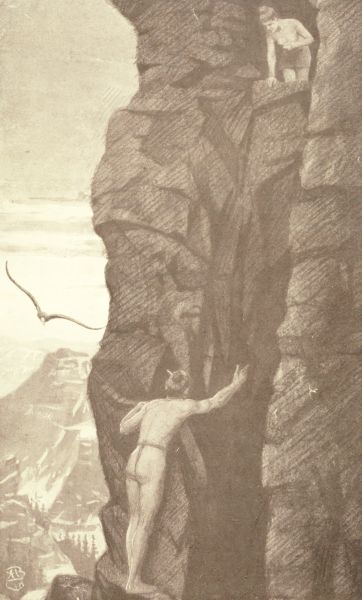
STALE MATE
But the Master-Girl beat her little fists upon the stone and wept. "I would have killed him yet," she wailed in that bitterness of spirit which overcomes the bravest when the ideal perfection of some all-but achieved success has been marred at the ultimate moment.
It is always so in life. Napoleon instead of yielding his sword to the conquering Briton, rattles off from his last battle-field in a well-horsed calèche. Nor did every French ship strike her colours at Trafalgar. Nor did the allies enter Sevastopol on the night of the Alma, as they might have done so easily; nor did Kitchener catch the gallant and adroit De Wet.
Her chaplet lacked the full foliage that is accorded to the victor in fiction only.
Bear not too hardly upon her, ye, who are proudly and perfectly straightforward in all speech and action, if I confess upon her behalf that in after life the Master-Girl made not quite so much of the bearded vulture's intervention as you might have done.
She had achieved an unheard-of and almost incredible feat, and knew it—but (now came that deadly reaction!)—the Shape-Strength was ebbing from her. Would her luck hold?
She had no fear of her feathered ally. Him, she, craning far over, had watched take seizin of his kill, and then, as the light went suddenly, spread vast wings and racquet-tail and sail forth across the darkening scree and blacker forest-spires to some roosting cranny of his own.
Her knees gave way beneath her, her wrists jerked as she let herself down from ledge to jut and from jut to cranny of that cheminée of death; her eyes were set in her head and her jaws cramped with a tongue-drying ague of fear of falling. In a word she was as nearly forespent as a girl of sixteen may be, and has a right to be, who has run as she had run, fought as she had fought, and fasted as she had fasted, and was still fasting.
At last (after what agonies of apprehension and endurance) the tension upon her fingers might be relaxed, for one foot was upon the first loose stone of the scree. Its fellow found something soft and chilly beneath it. At the touch of a dead enemy the Master-Girl's eyes were enlightened as if with food.
The rites of victory must be observed. She fell to, panting thickly as she cut and tugged, not for the horror of her task but from sheer exhaustion, and whilst arising to her feet to utter the three whoops which the occasion demanded,[4] found her legs bending, and dropped asleep upon the stones between her silent foes. So have men fallen asleep upon the rack when the screws were eased.
But the Porter-Soul which seldom sleeps would allow her no long respite. Much remained to do, and was she not still in peril? Before long she suddenly threw the gathering snow off her and glanced around keenly. The night-wind blowing up the crevice was tainted with—what? Four green, shining eyes were watching her. She sniffed, "Fox!" and contemptuously threw a stone and, ere its rattle had ceased, felt her scalp crawl, for over the spruce spires travelled the drear, anti-human menace of the wolf.
Her Totem was obscured and for once seemed far, but there was another resource near at hand and familiar, if only—only—it were propitious! those malignant Boy-Ghosts whose jibbering squeaks and rustlings had added untold horrors to the last hour of her darkling vigil upon the ledge. These, for some cause, had spared her, might she not entreat their continued good-will? She had known and played with all three before her promotion to the tribal governess-ship: there was nothing between herself and the elder two; the eaten child did not count. Doubtless they would be hungry—(Oh, how her own vitals pinched!) Quick, then, an offering! Savagely, desperately she hacked the hands from Low-Mah, and (it had been impossible before her sleep) bestowed them upon a ledge some five bows'-lengths up that dark ascent.
"Pen-noo!—Lab-go-nee!—here is meat! See I bring you food!—I bring it in peril of my life! Ye, who kept yourselves from the grey wolf, keep me this night!"
She was down again and tore herself from the place. Partake she would not, though nature cried out for food. A brave of her race would have had no qualms, but—a squaw?—No!
Feebly, and with her spirit riding her reluctant flesh as a ruthless rider urges a failing horse, did Dêh-Yān set her face upon that ghost-guarded journey up the valley, nor did wolf, lynx or worse molest her.
Her foes were the tormenting thoughts which, vulture-like, wheel closely around a spirit encumbered by a weakened body.
Was it worth it? Her man had grown cold and silent and strange to her. Twice the agony of wounded affection superadded to crushing bodily fatigue brought her to a stand beneath dark boughs at some rougher gradient. Then with shut eyes and chin driven hard against a labouring bosom she fought it out. The nurse-spirit triumphed.—"If I lie down and sleep here—I shall not awake again, and he—will die, or at best be a lame man for his life." Then, lifting her face again, she would draw a deep breath and set her jaw to endure the anguish of walking, and so, by a series of shortening spurts, reeling and rocking, she reached the foot of the face. But it was a dog-weary girl, without one spark of the pride of victory alight within her, who crawled in over the cave-sill.
FOOTNOTES:
CHAPTER VI
RENUNCIATIONS
After the recital the woman flagged again, and presently could hardly keep her eyes open. At a sign from her man she lay down and was dead asleep almost before she had drawn up her knees in the posture assumed by the sleeping savage all the world over, the antenatal position in which the pre-dynastic Egyptians buried their dead.
But Pŭl-Yūn could not sleep. He had passed through every phase of mental agony; had spent a long day at the torture-stake of suspense and anticipation, and had been released from it to find himself confronted by a crisis in his domestic relations.
He understood only too well what had happened. Since the world and wiving began was there ever such a woman?—Was there ever such a predicament for the husband of a woman? Use and wont and the immemorial practice of his own, and all other tribes, had fixed the relative positions of the sexes. This man believed as firmly as did the Apostle Paul that the Man was made first, and was the Head of the Woman, who was provided for him, for his comfort and use by his Goddess, the Sun, and over whom he, the man, was bound to exercise the rights of mastery and lordship to the very fullest extent. Whilst young and comely the wife was a valuable possession, but, when stringy and past work and child-bearing, it had until recently been a question in times of scarcity whether she might not be eaten. That the Sun-Disc Men had recently decided against the older use is a point in favour of the Sun-Disc Men which we, their descendants, may score to their credit. The Fuegians, at the time of Charles Darwin's visit, still occasionally dined upon their grandmothers.[5] As to conceding to one of the subject sex equal rights, the thing was extra-revolutionary, it was indeed inconceivable, it was outside the region of discussion.
But, what was this that had happened?—Here, in this chance-begun housekeeping, the whole matter had been turned topsy-turvy; the moccasins were on contrary feet; the hatchet was in the wrong hand. He had come out to capture a wife, and a wife had captured him. He had broken his leg and she had mended it. Twice he had been attacked by a bear and twice she (not he), had beaten it off, killing it—actually killing the monster,—at the second encounter (think of it!—whoever heard the like?) On that occasion he, the man, had borne himself stoutly, and as a brave; he had faced his foe axe in hand, without hope, and had made no moan, and would have taken his mauling, and his death, without a whimper. Thus had he preserved his self-respect, had participated in the fight, and had in some roundabout fashion come to persuade himself that the skin was his, and that the necklace of claws and teeth which was now around his neck had a right to be there. (It did not sit comfortably as yet, but, comfort and assurance would have come in time, never fear. Did not the Prince Regent assert so frequently that as "Major Brown" he had fought at Mont St Jean, that at length, as George the Fourth his gracious Majesty related the story with embellishments at the Waterloo banquet and appealed to Wellington himself for substantiation?—"'Twas I gave the order—'Up Guards and at 'em!'—You heard me, Arthur?")
Such, alack, is poor human nature in these latter days, nor was it more veracious in The Days of Ignorance.
Yes, Pŭl-Yūn had begun to believe that he had killed that bear.
But, who killed the three braves whose raw scalps lay upon the cave floor? Those three scalps were another guess matter, a different story altogether. There was no straight, or even plausible manner of accounting for them. He saw no way of persuading himself now, or in the future, that he had had any hand in the taking of them.
In a word, they were his wife's, every single hair of them—not his, alas, not his!
In a word, this poor ignorant savage man was all to seek in the lore of Modern Officialism,—the Whole Art of Assumption was hid from him; by which I mean the mental and spiritual capacity to appropriate to one's own peculiar credit not only the results of another man's courage, luck or capacity, but the actual performance itself. This is the recognised modern practice. The pupil paints or plans, the Master signs the drawings and takes the commission. The devil devils, the Leader wins the case. The C.I.V. storms Bavianskloof, the alderman of his ward receives the war-medal. The Stunt-Sahib, squattering through bottomless mud, organises the new annexation, his chief (down at the base under a punkah) gets the thanks of the Governor-General.
This is how we do it to-day. They did it otherwise in days when The All-Seeing Sun was believed to shine with approval upon the Sayer-of-the-thing-that-is, but to hide Her face from the liar, and the sneak, and the tribesman who stole the axe or the honour of another.
So, poor foolish Pŭl-Yūn gnawed his knuckles for long dark hours, wishing that his wife and he were dead, and, but for a soul of goodness in things evil—a red savage, for one—might e'en have brought his wish to the birth by braining the woman as she slept and subsequently pitching himself off the crag. He dreed his weird for the lee-lang watches of the coldest and blackest night that ever he had known, colder and blacker than those which he had worn through after the breaking of his leg, and before the Master-Girl had found and taken possession of him. He would say in the after years, and did plainly believe, that during that night-watch there were strange visitants to the cave, that two birds flew in out of the darkness and sate with him; the one upon his right hand was a ptarmigan of the scree, winter-white and soft, clucking sweet things, gentle things, about the sleeping girl. The one upon his left hand a raven of the cliff, blacker than the midnight or the shadows of the cave, croaking evil things, showing the poor, hardly-bestead savage all the shame and the ignominy and the laughing scorn of the home-coming to his tribe.
But the longest and blackest of nights wears at last, and the dawn-streak shot aloft and the cold grey peaks took fire and glowed like rosy brands amid the ash of a hearth: then, whilst the dawn brightened and the upper ranges were dyed a colour that had no name to the watcher, nor has gained one yet, for it is not the heart of a rose, nor saffron, nor salmon, nor hath it an earthly counterpart—it was whilst the heavens above him were declaring the Glory of God and the firmament showing His handiwork, that the last struggle took place, the tender clucking mastered the dull croaking! The raven stalked forth to the cave-sill and took wing a-down the gulf of air but, thrice the little snow-white ptarmigan tossed himself aloft into the keen clear morning, and thrice he came circling down again to the cave-sill with stiffly-bent wing and inflated throat singing his song of praise to the Lord who made and warmed him, and then he too was gone and the watcher was alone.
Then Pŭl-Yūn, under the stirring of a new impulse, did a very strange and wonderful thing. Taking the trophy from his own neck he laid it across the throat of the sleeping woman. Her eyes opened, her hand went up, she felt, saw and understood. She arose to her knees, a new and beautiful light was in her eyes, a great and pathetic awe had fallen upon her.
"No—thou shalt not do it!—No!—How shall my husband go home to his people bare-necked whilst his wife walks behind him wearing—these?"
"I—will!" groaned the man.
"You shall not,—you dare not,—you cannot!"
"Be silent!—I say I will!" he groaned more harshly.
Catching up scalps and necklace she cast everything at his feet and bent grovelling before him.
"What are these to me?—I want but thee! But to a brave they are more than father, mother, wife, or life itself." She did not speak in scorn, but from what she had seen and known, yet it hurt.
"Stop,—cease, be still!" he cried abruptly and very fiercely, for how shall a man fight himself if his wife takes sides with his lower nature against the higher? The woman did not understand; she thought him enraged, she knew not why; but, the jealousy which had poisoned their life for weeks past was cause enow. Plainly he must be humoured.
"That is right!—Be master!—What am I?—Thy slave and a Little Moon girl, no more. Thou hast never beaten me yet, beat me now!—take the things! Let us be as we were.... Yes," with a dead-lift of self-renunciation, "I will break my bow!" She reached for the weapon where it lay,—what it meant for her only an inventor, and a successful inventor, can tell. To allay the unreasoning jealousy, the rooted conservatism of her husband, this red girl would have put out of her life the New Thing that she had thought out, brought to the birth, perfected and tested at the risk of her very heart's blood.
As her hand closed upon the wood, a larger and stronger hand closed over both. Her lover silently drew her to himself.
FOOTNOTES:
CHAPTER VII
SHORT, SOMEWHAT DRY, BUT IMPORTANT
We must compress into three or four pages the labours and results of four busy months, during which by frequent experiment, and incessant practice these two young creatures worked at, and worked out the mechanics of their discovery.
It was an opportunity of almost incalculable infrequency. Consider, I beseech you. Your savage, a man of a hunting tribe, lives normally from hand to mouth. Is game abundant and his hunting successful he gorges to repletion and sleeps long and heavily. Is food scarce he hunts the harder, sleeps lightly, eats sparingly, and has in prosperity no incentive, and in adversity no leisure for protracted and systematic experiment, even if he should find the impulse within himself, and be upheld by the applause and co-operation of his tribe.
It is doubtful if the combination of rare and delicate qualities which go to the making of an inventor present themselves once in a thousand generations of savage men, and how much rarer still must be that general recognition from his fellows without which a savage can effect nothing permanent. Even the privacy, which is hardly less essential than sympathy for a tentative effort, is wanting, for a savage lives in public, and the initial failures of the inventor not seldom in our own times expose him to the pitiless raillery of his contemporaries, a blighting, sterilising ridicule to which the child-nature of primitive man was certainly not less sensitive than are the natures of monkeys, dogs and children.
The steadfast mind that can ignore and outstay the gibes of neighbours is not too common to-day, and was probably very rare indeed in that remote and ancient world of which my tale tells.
That an armourer should work behind locked doors, and that it is folly to show unfinished work to a bairn are excellent adages. But, savages are all bairns; indeed, among primitive peoples the environment is so unfavourable for invention that one might almost say that a savage never invents anything, and even in the case of his stumbling upon a promising novelty, its unfamiliarity condemns it in the eyes of his comrades, if not in his own.
Only in the excessively rare event of a reforming chief can any advance be registered. And how seldom does such a prodigy arise! The stars in their courses fight against such an avatar!—We, the English of the twentieth century, are, take us all round, as open to reason and as receptive to the New Idea as any folk upon this earth, or any that ever trod it; what is more, we are accustomed to reforms, we await them with expectancy if not with equanimity, we know full well that certain of our venerable institutions stand in need of tinkering, but we never dream that the impulse shall come from above. A codifying, or land-transfer-simplifying Lord Chancellor, or a reforming or unifying Archbishop is incredible. The processes by which such men climb to their posts disable their minds from criticising a system which has justified itself in their persons. Nor is it likely that a sachem will be impatient of a state of affairs which has landed him at the summit of his ambitions. A Peter the Great comes but once in an æon.
Here, however, in this snow-bound glen, were just that assemblage of conditions which stimulate and protect the inventor whilst perfecting his invention. The store of frozen bear-meat secured leisure. There had been sufficient initial success to encourage continued experiment. The companionship of two united hearts provided the needful sympathy; nor was the touch of emulation wanting. The august mountains kept the ring, their snowy silence excluding the hee-haws of jealous ignorance.
Heavens, how these children worked!—Size, material, method of use, the best position, trajectories,—everything was an open question; everything had to be mastered by trial, by competition, by comparison. Observe, there was absolutely no past, no tribal lore to handicap or guide. How they chattered! As to arrows, now,—should they head them with bone or with stone?—How fledged?—How straightened?—Of what length?—This brought on the bow, its size, its weight, its parent tree; wych-elm, ash, or cornel?
Pŭl-Yūn leaned to something small and short, handy for wood-work; but after being consistently out-shot by longer weapons of the Master-Girl's choosing, propelled by a longer bow, gave way after some sulking.
He was by way of learning. And so was she, for never again during those four months did she shoot her best in his presence, or to his knowledge. Thenceforward she would essay her longest flights in private, and found that the extreme range which contented her man was far from being the limit of her own bow. But this knowledge she kept to herself.
Pŭl-Yūn was as yet a poor walker, but his infirmity in no wise hindered his archery, rather did it help, in that it tied him to the butts. His industry, his zeal to excel were tremendous, and there was reason that he should toil terribly to perfect himself in this novel art before presenting himself again to his tribe. He had by now determined, at Dêh-Yān's earnest intercession, and as the reasoned result of a couple of months' watching of his shafts, to discard his spears. It was a momentous decision; who shall say what it meant to the war-chief of a small tribe hard-pressed by stronger and better armed neighbours?
Conceive then, this human pair, mere youngsters according to our reckoning, cut off from the world, applying every faculty which they possessed to the study of their art. Doubt not that when once they had come to an agreement as to details, progress was consistent and rapid; and as week by week their smaller and yet smaller marks were stricken at lengthened ranges, their exultation rose and hardened to solid confidence.
So wore the days and the months of winter.
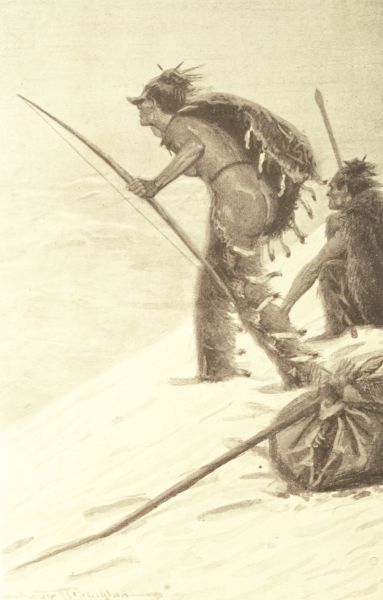
PURSUED
CHAPTER VIII
THE FLITTING, AND THE FORERUNNER
"Dêh-Yān, we must be going!"
"And thy leg?"
"Ah, yes,—but, stronger or weaker, we must go, or there will be no legs of mine, or of thine, to go upon!"
"Dreams again?—that hare?"
The man nodded sagely and swept the white waste below the cave with apprehensive eyes. There was nothing to be seen. A delaying spring had hardly made itself evident at their height. The lammergeiers in a cleft high overhead, were feeding a single clamorous youngster, a fat, downy chick, but the lammergeier lays its egg in the last days of the old year. The ravens were hard at work upon their nest, the wool was in (winter coat of stone-buck), the first green egg would be laid within the week, for March was wearing according to our modern calendar.
The stream had begun to trickle, the water-ousels were at work, but the larch was still untasselled, and not a flower had yet broken the snow-crust, not even the fringed purple soldanella, or the small pale crocuses at the edges of the drifts. The passes would still be piled deep with soft new falls.
The crossing would be a desperate business as Pŭl-Yūn knew very well. Such a feat had never been essayed so early within human memory; all crossings (and such were rare events) had ever been made in the late autumn when the snows were hard. Yet he was in a fever to be gone, and the woman knew why.
"Thy Little Moons will make an early start of it—some of them at least will be up here presently looking for their lost braves."
"I buried them deeply—many stones did I roll down over them," said the girl gravely, thinking her own thoughts.
"But, their dogs (Good Wolves) will find them, never doubt," remarked Pŭl-Yūn. "It was bad luck thy not killing their dogs the same night. Nay, I do not blame thee. Thou hadst run far and fast, and fought bravely, wonderfully; it makes my heart laugh to think of one woman fighting three braves and bringing away their scalps. Yes, I own thou wast tired out. All the same it was against us, and is against us still, that those three dogs were left to gnaw through their leashes and get away down to the tribe masterless. They will be brought up again and laid on and followed, and if they do not own to the trails of their dead masters, they will own to ours, which is as bad for us. No, we cannot fight the whole of thy tribe, we must be moving, and at once."
This was final. Dêh-Yān, who had put in three whole days at arrow-making, arose with the last and finest specimen of her art in her hands. It was fledged with the white and black quills of ptarmigan, and pointed with a keen splinter of bone. Holding the venomous looking thing between her hands by point and nock, she straightened a weary back and lifted it towards the Young Moon. "O Totem of my people, and of me, and of my New Thing, grant that this one at the least of all my arrows may serve me at my need!"
They began their packing, a serious affair; their outfit must be cut down to the least, last ounce. It must consist of just food, raw meat, their weapons, the bear-skin to sleep in, and the trophies; no more.
Double-moccasinned they set forth, clothed with deer-skin leggings to the body, dividing the loads between them, an event significant and of the first importance in human history.
"We must march light," said Pŭl-Yūn, and paused. Dêh-Yān frowned, set her mouth, and tossed from the cave-sill the hoard of rock-crystals, amethyst and cairngorm, as dear to a girl of the Magdalanian age as her diamonds to a bride of our own.
"This I will not leave," continued the man, nodding approval of the accomplished sacrifice of vanities. The thing reserved was the shoulder-blade of the dead bear upon which he, no mean draughtsman, had etched the story of the fight; yet, watching the resolution of his wife to disencumber herself, he presently cast down his achievement, and turned his back to it where it lay.—Yet, as we know, it was not lost: did not the drip from the roof glaze it over and preserve it? Did not the wet floor upon which it lay enclasp and seal it down? Did not a sheet of incrustation fall from the roof and cover it, and finally, in the fulness of time, did not the Professor come fumbling along and find it? And is it not to-day the especial glory and pride of a certain case in a certain University Museum?
Pŭl-Yūn was minded to work up as high as his leg would carry him, and then, after a heavy meal, to make a night of it, coiled up with his wife in that thick, warm, capacious bear-skin in a hole in a drift. "Walk whilst the light lasts and you can see your marks," was his rede. "Who knows what the weather upon the pass may be to-morrow?" It might well be that a "firn" from the south would be blowing on the col, and then they must just lie snug and sleep it out, yes, to the last strip of their meat, if needs were, for to face it would be—death!
Up they trudged, and up, and still up, bowed double beneath their burdens, occasionally stopping to straighten weary backs, always choosing the outcrops of bare rock where such trended upward, but for an hour on end sinking mid-thigh-deep at every toilsome step in soft, new snow. The last of the trees was far below them, even the trailing pine and juniper had given out. They were working up into their first cloud; below the ragged coldness of its moving edge Dêh-Yān turned and took her last look upon the country of her childhood and her folk. There was no regret in her heart; nor any love for any human creature whom she was leaving. Her father she had never known, he had perished young. (Most savages die young—hard is the life and heavy the mortality; the hunter-tribes barely keep up their stocks despite early marriage). Her mother, whom she could just remember, was also dead. Her child-life had been made bitter to her by blows and grinding service rendered to gruff masters and shrewish mistresses. The small girl-child had struggled up; other children died, she survived, being one of the indestructibles, sharpened, hardened, toughened exceedingly by her environment. Such an upbringing, whatsoever else it may do, does not cultivate the affections. How jealous she had been of the boys! How she had despised the girls, her inferiors in speed and daring! When promoted to the post of Governess, how she had bullied her small charges!
No, she gazed with unshaken bosom and clear eye upon the valleys of her home. The last peep! And there, miles and miles away, and, oh, so far beneath, was a something strung out across a snow-field, a something which would have escaped the best eye in a regiment of modern Alpini—a something which moved slowly, and was withal so faint and so far, that a strand of cobweb seen across a pane at the breadth of a wide room would be cable-broad compared with it. "Wah, we started none too soon," was Pŭl-Yūn's comment, and, leg-weary as he found himself, he kept at it, butting away upward into cloud and falling snow so long as he was sure of his line, then, confident that the advance-party of the Little Moons, supposing that they had got upon the spoor, and meant sticking to it, would not have daylight to make it good, he bored into the leeside of a big drift, throwing out the loose snow behind him like a dog, and invited Dêh-Yān to accept it as a camp.
Dêh-Yān disliked the idea of camping in the presence of pursuit, but she saw that her man had marched as far as he was able. Moreover, he was now in his element; a brave who had been a member of four war-parties had a right to his opinion as to what other braves would or would not do. "They will follow on to the edge of the cloud," said he. "Above that the new fall will cover our sign, not wholly, but enough to make them call off the dogs when the sun sets. And we—we will be up and off before She rises to-morrow. And I say, Dêh-Yān, I do not like those Good Wolves of thy people."
"Nor I—And if they follow on?"
"They won't. They are wholly out of their country, and I am nearing mine, and have travelled this road before, which none of them have, as I think—at least none that returned."
"That is so," assented Dêh-Yān. "When I was quite little, two of our young men tried this pass. They never came back. Tell me," she went on, snuggling down into the bear-skin, and feeling the blood begin to move again in her toes. "What brought thee over this awful road?"
"I was out for a wife."
"But were there no girls in the tribes south of you that thou took this high white path?"
"Oh, yes, there are girls everywhere, but the tribes to the south of the Sun-Men, the Hawks and the White Wolf people, are so much stronger than we that we have had to give up going to them for wives. It was our braves who never came back from those journeys."
"Oho! those tribes would not be braver, I think? then, how?"
"They have an all-year-round camp close to the best quarry of weapon-stone. They have many slaves at work doing nothing else but axe-making, and so are better armed than we. Also they stockade their camps. There is no getting in or getting out of their villages. I think our bows will surprise them." He added, "And now, if thou hast eaten all thou canst, go to sleep. I shall watch, or rather lie awake and listen."
Pŭl-Yūn had out-marched his pursuers, but he had over-marched himself. The pride of manhood kept him going, the same pride forbade him to acknowledge his terrible weariness, but his wife was not deceived.
"I will watch first," she had said, and had insisted upon taking a last look round their hiding-place before turning in. Upon her return she found, as she had anticipated, that her man was sunk in the deepest sleep that nature knows. The Master-Girl nodded, built herself a line of marks, slight, but sufficient, and glided off into the snow-lit night silent as an owl.
At midnight Pŭl-Yūn turned himself and woke with a sense of something lost. He was alone. For some moments his locality, and his very individuality escaped him, so deeply had he plunged, then both returned.
"Dêh-Yān, come in here, it is my watch," he whispered, but there was no reply. The man peered forth into the darkness, and got to his feet armed. His wife was gone. He listened. The night was thick and still, what wind was blowing came up the pass from the glen which they had left. It was bitter cold. Suddenly, from down the pass came one small sound, slight and keen as the squeak of a bat, but it was not the squeak of a bat, and Pŭl-Yūn felt the hairs creep upon his neck, for it was the shrieking yelp of a wolf. Now a wolf is an animal which hunts and lives in a society of its own, a society which has common needs and cooperates in its enterprises. Hence wolves have a multiplicity of cries with which to express their wants and intentions, and many of these were known to Pŭl-Yūn from childhood. But a wolf, though a villain, is no coward, and rarely, most rarely expresses pain. As a rule, when trapped he dies mute. What meant that single piercing yelp? To the ear and trained imagination of the woodlander it signified a spasm of surprise, despair, disappointment and grief. It was a call to the pack, "To me, my comrades! Haro! I am betrayed!"
That his wife's hand was in it Pŭl-Yūn never doubted, but how deep was her hand in it? and could she withdraw that hand? To have left him asleep and gone off upon a lone hunting at midnight was—it was—like her! But, it was hard upon him, very hard.
He took his weapons, axe and knife, for of what service are arrows in a midnight?—and moved in the direction of the cry. Within a few strides he stumbled upon the first of her marks, then upon a second, later upon a third. This, then, was no unpremeditated escapade; no, like everything else which she did, this foray towards the camp of the pursuing enemy was a thought-out business.
The snow creaked, something was coming. A quick light breathing, a swift foot, Dêh-Yān was upon him, had caught him silently by the arm, had turned him and was urging him to his top speed. He raced beside her obediently in blind faith, she smelt of wolf and of blood. There was a cry of wolves behind them as they ran, but Dêh-Yān was laughing. The cry, mingled with the shouts of hunters, rose to a crash.
"That is the last of it—they have come upon my kill, and are baying upon the blood. They can carry the line no farther."
She was right, the fierce, wild clamour rose and fell and rose again, but was stationary.
"But, we must be upon the trail. There is no room here for thee and for me." The Master-Girl was speaking with quick decision; her husband listened, guessing wildly—they had picked up the marks, had found the snow-camp, she was refolding the bear-skin; he gathered his own affairs and followed her.
"Whither?—thou hast never been this way before, and even I am unsure of our road in this thickness and mirk."
"Anywhere is good—it is sheer death to loiter. We must risk everything upon speed and the chance of a farther snowfall. Run thy best now, I will tell thee more to-morrow."
Hours later in the first grey of a wintry dawn they had halted and dug themselves a second cave. This time they both snuggled within it, and sat panting and weak, listening for sounds of pursuit, and hearing only the ghost-like cackle of the mountain choughs at play amid cloud and falling snow overhead. They had got to their farthest; if followed up and found now they must die. Rest and sleep and food were imperative claims which would take no denials. Snow was falling, they had still a chance. They ate and slept and were not interrupted.
They awoke in an unknown world, small flakes fell steadily and straight, no wind breathed, there was no sun or sign of sun, it was one whiteness of diffused light in which the sense of direction was defeated.
They sate close as snow-bound hares and munched bear-meat, Dêh-Yān telling her story between the mouthfuls.
"After I mounted guard it came to me that my people—I mean the Little Moons—would never have come up so high so early in the season for game. It is no winter-hunting that we saw below us at the edge of the cloud, it is a war-party, and they mean scalps. Also, it seemed to me, even at that distance, I could make out Good Wolf with them."
"Good eyes thou must have!—but, go on."
"Now it came to me that with Good Wolf they could not very well lose our trail, and being on the war-path, all braves too, and marching light, we should not be able to outmarch them, burdened as we are, and—and—"
"And—and—" mimicked the husband, "my wife did not wish to leave her skin behind, eh?"
"We find it useful, thou and I; warm too," murmured the wife, drawing the deep-piled pelt around her lover, and burying her own nose in the soft fur. "But it was not for this skin only, but for two others for which I was taking thought—"
"They are not so furry, those two," chuckled Pŭl-Yūn, pinching her.
"It seemed to me," resumed the Master-Girl sedately, "that if it were a war-party of braves, with Good Wolf, too, our chance was bad, unless—"
"Unless someone somehow foiled our line?" whispered the man ponderingly. "But how?"
"That was the question. I went down to their camp and made friends with the first Good Wolf that came up to me. There were others, but they were curled up each with his master, this one was the only watch they had set. I listened, I saw. Then I was for coming away, for ten braves and as many Good Wolf are bad company for one girl. But the getting away again was not easy. Gow-Loo's Good Wolf (I knew him, and he me) was suspicious. He walked around my knees so closely I could hardly move my feet. I could not speak to him for fear of rousing the camp. At last, when he had licked my hands, I got him to let me out and to follow. When I had led him a good way, and he was upon my hatchet-hand, and a little in front of me, I killed him. I had not meant him to have spoken, but the light was bad and he was very quick. It cost me two strokes. The rest thou knows."
Pŭl-Yūn did know that his wife had run a frightful risk, and that once again her foresight and cool courage had brought her through. What he did not know was that she owed her life to the fact that her dead enemy's wolf, or wolf-dog, was still ignorant of the art of barking, and had met the night-comer to his masters' camp in the silent fashion of his wild parents. But, the wonder of it! His inmost heart told him that this adventure would have been beyond him: he would not have risked the certainty of being pulled down by wolves, good or bad, and taken from them by their masters to dree a crueller ending at the stake.
Meanwhile snow fell steadily for a day and a night. The fugitives sate close and contrived to keep themselves warm, but their stock of food, howsoever well husbanded, was running out. Their position was already critical, presently it might be desperate, but they were spared the pangs of indecision or of divided counsels. Both recognised that their very lives depended upon doing nothing. To exhaust their bodily heat by struggling in deep new drift would be madness. And whither?—Their last mark was lost, they knew not north from south whilst the snow continued falling. No, they must sit it out, even if they starved where they sat.
By the evening of the third day the last of the meat was gone. They were huddling in silence, having discussed the question of eating their leggings and moccasins on the morrow, and agreed to refrain.
"For," said Pŭl-Yūn, "we could never get away from this snow-camp without our leg-gear, so we may as well starve clothed and with a hope in our hearts, as starve two days later half-naked with none." And to this the Master-Girl had agreed.
But the situation was far from cheerful and did not conduce to much conversation.
"Hark!—what is that?"
"Hush, on thy life, hush!—we are well hidden."
During their headlong flight from their first halt, and in the course of the various doublings and subterfuges by which the fugitives had hoped to break the continuity of their trail and baffle their pursuers, these youngsters had most effectually lost their bearings. This, their second, and which threatened to prove itself their final camp, was excavated in the side of one among many round-topped drifts which studded a level plain, or what seemed such, for its limits were hidden, it was probably the frozen surface of some small lake, or such another expanse as the Andermatt valley, a green and pleasant place in the summer months, upon which several lateral glens converged, a haunt of the mountain bison and the tall, wide-antlered stag, but in winter a dreary waste avoided by man and beast.
Yet, something was approaching, for the snow, frozen crisply by the evening's chill, crunched beneath heavy feet. There was the deep, rhythmical panting of a huge body labouring hugely. What on earth might this be? Four thoroughly frightened human eyes peered forth from the spy-hole left at the mouth of the snow-cave, and beheld—What think ye? A great, bald, black block of a head, maned at the temples and nape and hung with a pair of shield-shaped hairy ears, was butting through the drifts. A coil of bristly trunk was stowed away between a pair of prodigious tusks which showed yellow amid the whiter snows around them. They were as stout as young beeches and curled upon themselves in such wise that their points were useless to the monster who bore them. This had probably been his down-fall; some younger rival with shorter weapons, shorter and lighter, but with points which could be brought to bear, had ousted this patriarch from the herd. Here was a rogue mammoth upon his travels, setting the height and width of a mountain range between himself and the scene of his disgrace, a Napoleon on his way to St Helena, diswived, discrowned, a tragedy of brute existence. The great heart was hot within him, he was boiling to avenge his wrongs upon the first creature that he might meet, and meantime was working off his fury in tempestuous exertions. What was a fifty or sixty-mile march to the enormous sinews of limbs seasoned by migrations and combats of a hundred and fifty years? His breath smoked around him as he forged his way along, now pawing the snow under him, now wallowing over it, using his huge belly as a raft.
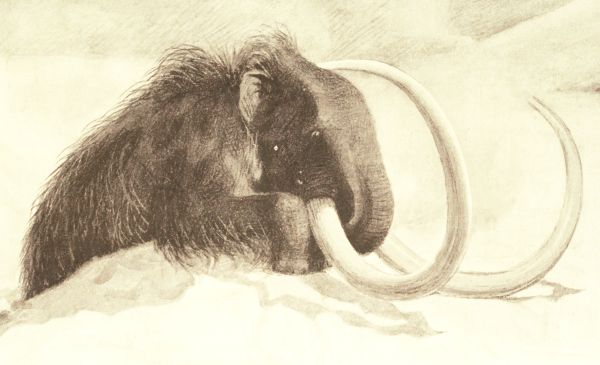
THE FORERUNNER
Evidently he had fought his fight to a finish, had bellowed, butted and thrust at some more adroit or better-armed youngster (some youth of seventy or eighty summers, maybe), who had worn him down and worsted him, and now, with such holes and rents in his shaggy sides as would have been death to any smaller beast, and were gruesome to see, he had relinquished the partners and pastures of his lusty prime, and was a wanderer upon the face of the earth until death—death which would from henceforth ambush his path and his lying down, for no keenly-interested wives would henceforth watch over his safety. No, with yearly waning powers he must stave off doom as he might, but come it would at length, a grisly onslaught of a horde of lions, a staked pitfall, a snow-hidden morass.
Dêh-Yān shuddered at the sight of his small, red, wicked eye.
"If he gets our wind?" she whispered, in the ghost of a pixie's whisper, and was well pinched for the indiscretion. The giant did not get their wind, he had something else to think of. When he paused for breath close to their cave, they could see the great wall of hairy side twitching with the smart of the raw gashes with which it was scored, the records of that desperate and final conflict, for it is the law of the elephant herd that a dethroned master-bull shall never retry the issue: once down he is an outcast for the rest of his life, and a terror to the twentieth-century jungle, as his collateral ancestor, the rogue mammoth, was to the bleak tundras and mountain forests which were his home in the age of ice.
It was their first sight of a mammoth, the great beasts were already a dwindling race in the times we tell of, the days of the Magdalanian men.
Presently the silent watchers beheld the great panting hero get his breath and resume his travels. Ploughing, heaving, wading through the snow, he faded from sight and silence returned.
"This may be just the luckiest thing in the world for us," said Pŭl-Yūn, "or on the other hand, the unluckiest."
"Um, yes," assented the Master-Girl, thoughtfully, peering forth upon the trail which the passing monster had left. "If he is marching by himself we can take the same line, there is no losing that spoor. He knows the way, be sure of that, and where he can go we can follow—but, he leaves a blood-sign behind him, see!—If a party of tigers, or of grizzlies, strike that trail they will follow it up on the chance of finding the bull in some drift. Or, those Little Moon braves might happen upon it, eh?"
"In any case we must lie close for to-night, no more dark marches for me! and if the morning shows that the bull is travelling unattended, we will use his trail."
"I begin to think we shall do it after all," smiled Dêh-Yān, a little grimly, perhaps, for though she had kept a stiff mouth all day, the prospect was not encouraging, and she, at least, had no local knowledge to fall back upon even if the weather should take up and let them through.
Fortune smiled upon the youngsters. Morning-light showed them the mammoth-track skinned over with a film of new snow unprinted by the spoor of beast or man. The fall had ceased, the drifts ploughed through and pressed down by the bulk and weight of their forerunner, gave easy passage; something in the contours of the ground seemed familiar to Pŭl-Yūn, who silently took the lead, striding ahead with confidence, and presently, suddenly, the change came, the slope eased off, and the glory of the prospect before her rushed to the eyes of the girl who had been toiling up the last ascent bent beneath her load. She had never been so high before, nor overlooked such an extent of country. It caught her breath.
"Oh, what wide place is this!—And all the hunting-grounds of our people?"
"Not the twentieth part of it!" growled Pŭl-Yūn with a frown. "Have I not told thee how narrow our ground is, and that it grows narrower?"
The Master-Girl sucked in her lips and re-shouldered her pack. "Let us be getting down to them," she said shortly; then, half to herself, "Narrow or broad there shall be room enough for one Little Moon woman—and her bow! But, O Pŭl-Yūn, when thou hast found thy folk, do not quite forget poor Dêh-Yān."
The man fell back a stride and went beside his wife for a while in silence, albeit the going was so good that speech had been easy whilst in Indian file. It came home to him how bitter is the lot of the newly-caught slave-wife among the older women of the tribe, to whom her ignorance, youth and foreignness are subjects for ill-natured merriment and opportunities for spite.
"There shall be no breaking-in for my wife," he said. "Listen!—To-morrow night thou shalt sit upon that bear-skin in my chief's presence. I have said it!"
And all this fuss about crossing one of the lower cols!
Wait, my friend. These young people had neither guides nor porters, nor maps, compass, nor rope, nor ice-axes nor well-nailed, water-tight boots; appointments which make a fairly simple thing of what were otherwise a perilous feat. Moreover this was very early in the season, a time of year when every week makes a difference. The writer of this veracious history of the Old Time has himself seen the farm folk in a Pyrenean glen leave their hay to run shouting at the first tourist of the season who had news of their friends on the other side of the pass. And that was in May.
Nor were the Alps of that Old Time just as we see them to-day. I grant you they had come down in the world since their first glorious Himalayan youth; they no longer towered thirty, thirty-five thousand feet above the sub-tropical terai interspersed with its chain of salt lakes which we now know as the Mediterranean. The worst of the Great Ice Age was over, that grievous time when half the waters of the oceans were piled in a solid cap around the northern pole, a cap which extended southward in such sort that in Britain everything north of the Thames, and upon the mainland all that is now Germany and Austria, was sealed down beneath a solid sheet which was not melted for twenty thousand years on end. During this time, and for long after the worst of it was over, the Alps and the Tirol were in process of being ground down to something approaching what we see to-day. Their soaring peaks had arrested the cloud-systems of central Europe, and turned France into an arid steppe, the grazing-ground of countless herds of wild horse and gazelle, the clouds had deposited themselves in snow, the hoarded snows had ground down the sides of the giants, pared away their summits and crawled out half across Lombardy in glaciers, which, when they finally receded, left trails of rubbish thirty miles long, spoils filched from the heights behind them.
The worst of this was over. The Rhone glacier had dwindled somewhat, but still blocked the Wallis. For many generations the shores of the Mediterranean had been peopled in winter by tribes which had each its summer hunting quarters in this or that glen of the hinterland; tribes which had but little knowledge of, and no intercourse with, the people upon the other side of the chain in the glens which feed the headwaters of the Po.
How should they have had?—I am telling a tale of the long ago; much water has run under the bridges since, both those of Avignon and those of Padua, and every gallon of it brought down something from the southern Alps, hence, as nothing rolls uphill, century by century the passes have been growing lower than they were when our two youngsters essayed their adventure.
CHAPTER IX
THE HOME-COMING
It was evening, the men of the Sun-Disc Clan had returned from their hunting and fishing. The women and children were squatted about the fires. A clear, peculiar outcry broke from the girl in the tree-top, the watch-woman; just such a cry comes from the sentinel bird of a flock of feeding wild-fowl. The whole community was upon its feet in a moment, peering under arched hands.
Afar off against the yellow side of a dry gully of the foot-hills which arose between the last of the chestnut forest and the first of the spruce were to be descried a couple of moving specks.
They, whoever they might be, were miles away: made visible for a moment by the chance of their crossing a bare rock-face which had caught the last of the sunlight, thrown up distinctly against this ruddy yellow background and defined by the magical clearness of an open sunset following a day of rain.
The braves handled their assegais awaiting the word of the old chief, a ring-man who had taken his first scalp forty years before and wore the necklace of five bears'-claws which testified to participation in a later and yet sterner fight. He gave no order and kept his eyes upon the moving specks.
These had dipped into a hollow. "They have seen our smokes," said he. "If they are friends they will come right on, if they are unfriends they will not show again and the young men must deal with them to-night."
"Who but unfriends would come from that side?" asked a very tall young brave. There was a touch of covert insolence in the tone although the question was natural enough.
The speaker was a person of some consideration, for when he spoke others held their peace and listened (watching still, be sure).—He was one Honk-Ah, a great-nephew of the old chief, a man of notable activity and more ambition; one who aspired to the deputy-chieftainship; an aspiration which had been kept in check for two years past by the presence of his cousin Pŭl-Yūn, a brave equally active and more popular, less subject to fits of disfiguring passion; a man marked out for leadership as well by his birth—being grandson to the chief-regnant—as by his qualities.