Chapter VI · Gardens for Big Boys and Girls
Reading edition
“OH, Billy,” cried Mary Frances, as her brother laid down the paper, “that doesn’t sound a bit babyish to me! If I could just have a garden like that——”
“That’s an all-right garden,” interrupted Billy, “but, Mary Frances, it isn’t much compared with my plan for your wonderful play house garden, as you’ll soon see when I give you the—
Garden Lists for Big Boys and Girls
The following-named flowers, which are pictured in the Mary Frances Garden Cut-Outs, are described in the outlines that follow the lists.
Do not attempt to plant all the flowers named, but read the lists, and study the descriptions carefully. Then select the plants you prefer for your garden, and make your own list ready for ordering.
You will notice that certain names are repeated in several instances. This is only to show the period of bloom, whether early Spring, Summer, or Autumn, or throughout the season.
NOTE ON THE GARDEN CUT-OUTS
Dear Girl or Boy:
No doubt you will wish, just as Mary Frances did, to be able to cut flowers every few days from your garden for your mother to use as a “centerpiece” on the dining table, or for your father’s desk, or for your grandmother’s dresser, or to give to some dear friend.
Now, anyone can have a few plants which will bloom at some time or other, but the garden you and Mary Frances have in mind is one which will have flowers blooming from March, through April, May, June, July, August, September, October, and on into November, until killed by frost.
Flowers nearly nine months of the year! Yes, that is quite possible in almost every part of our country—if you study carefully the outlines given on pages 51-62, inclusive.
The first outline gives a list of plants which bloom in the Early Spring. (See Garden Cut-Out No. 1.)
The second names the plants which bloom in the Early Summer. (See Garden Cut-Out No. 2.)
The third, the plants which bloom in Mid-Summer. (See Garden Cut-Out No. 3.)
The fourth, those blooming in Late Summer or Early Autumn. (See Garden Cut-Out No. 4.)
For instructions for making the Garden Cut-Outs, see Chapter LXII, page 373.
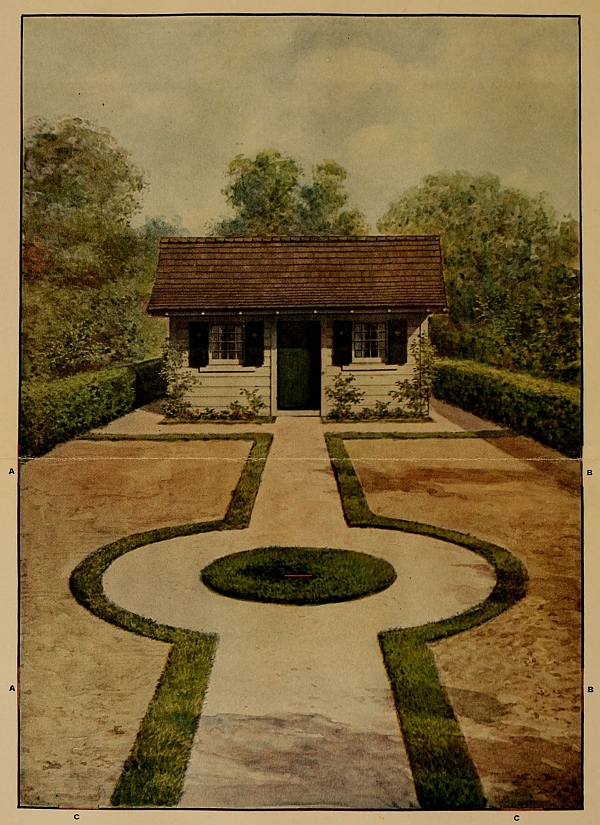
PICTURE OF MARY FRANCES PLAY HOUSE BEFORE THE CHILDREN PLANTED THE GARDENS For Directions for Garden Cut-Outs, see Chapter LXII
Thirty-seven Hardy Perennials
Aster (Wild)
Alkanet (Anchusa)
Baby’s Breath
Bellflower
Bergamot
Blanket Flower
Bleeding Heart
Campanula
Candytuft
Centaurea
Chrysanthemum
Columbine
Coreopsis
English Daisy
Forget-me-not
Foxglove
Hollyhock
Larkspur
Lupine
Marguerite
Monkshood
Pæony
Pinks— Moss Hardy
Poppy— Iceland Oriental
Phlox (Hardy)
Pyrethrum
Poker Plant
Rock Cress
Roses
Sneezewort
Speedwell
Sweet Alyssum (yellow)
Sweet-William
Thoroughwort
Violet and Viola
Wall Flower
Windflower
Twenty Annuals
Ageratum
Cockscomb
Cornflower
Cosmos
Cigar Plant
Everlasting
Four-o’Clock
Garden Geranium
Lemon Verbena
Nasturtium
Petunia
Princess Feather
Periwinkle
Phlox
Scarlet Sage
Snapdragon
Sweet Alyssum (white)
Verbena
Wild Cucumber Vine
Zinnia
Eight Bulbous Plants
Daffodil
Hyacinth
Iris
Lily of the Valley
Madonna Lily
Snowdrop
Tulip
Yellow Day Lily
A Letter About the Garden Cut-Outs
Dear Boy or Girl:
No doubt you will wish, just as Mary Frances did, to be able to cut flowers every few days from your garden, for your mother to use as a “center piece” on the dining table, or for your father’s desk, or for your grandmother’s dresser, or as a gift for a friend.
Now, anyone can have a few plants which will bloom at some time or other, but the garden you and Mary Frances have in mind is one which will have flowers in bloom from March, through April, May, June, July, August, September, October, and into November until ruined by frost.
Flowers over eight months of the year! Yes, that is possible in nearly every part of our country—if you study carefully the outlines following this page.
The first outline gives a list of plants which bloom in the Early Spring.
The second names the plants which bloom in Early Summer.
The third, the plants which bloom in Mid-Summer.
The fourth, those blooming in Autumn.
These lists are nearly like the ones given Billy by his teacher, which he and Mary Frances used in planting a garden in front of the Play House. As you read these lists, turn to the pictures of the Mary Frances Garden Cut-Outs, and try to recognize the flower named.
All that Mary Frances wished, she and Billy made “come true,” and every day through the flowering season she gathered flowers from, her garden—but that is part of the story, so now begin to read
A Few Hints on Growing the Flowers Shown in the Garden Cut-Outs
In using the following lists, if the garden space is small, select only the names marked with a star.
The height of each plant is given because it is always desirable to plant low-growing flowers in the foreground; and tall ones in the background.
The following-named Perennials (the roots of which live from year to year) may be grown from seeds, but cannot be depended upon to bloom the first year.
Instead of beginners starting seeds of Perennials, it is well to buy the young plants from a reliable dealer to start the permanent garden, and to experiment with seeds after acquaintance with those plants already established.
Do not buy many plants of any kind, as a few, well cared for, will increase in number the next year.
Annuals (the roots of which die in the Fall) will bloom the same season as planted. Start seeds early, either in a box in a sunny window, or in a warm sunny corner out of doors early in May.
The first step in garden-making is the planning of the garden.
(See Chapter LXII on “The Mary Frances Garden Cut-Outs.”)
The second step is selection of the seed, and the ordering of the same from one of the best seed firms.
Never try inferior or untested seeds. It is no economy.
In regard to “color scheme,” see Chapter LX.
For artistic effect, it is usually best to plant the same kind of flowers close together to obtain “masses” of bloom.