THE MARTIAN (continued 2)
Reading edition
And they both loved good music—Mozart, Bach, Beethoven—and were almost priggish in their contempt for anything of a lighter kind; especially with a lightness English or French! It was only the musical lightness of Germany they could endure at all! But whether in Paris or London, enter Barty Josselin, idle school-boy, or dandy dissipated guardsman, and fashionable man about town, or bohemian art student; and Bach, lebewohl! good‑bye, Beethoven! bonsoir le bon Mozart! all was changed: and welcome, instead, the last comic song from the Château des Fleurs, or Evans's in Covent Garden; the latest patriotic or sentimental ditty by Loïsa Puget, or Frédéric Bérat, or Eliza Cook, or Mr. Henry Russell.
And then, what would Barty like for breakfast, dinner, supper after the play, and which of all those burgundies would do Barty good without giving him a headache next morning? and where was Barty to have his smoke?—in the library, of course. "Light the fire in the library, Mary; and Mr. Bob [that was me] can smoke there, too, instead of going outside," etc., etc., etc. It is small wonder that he grew a bit selfish at times.
Though I was a little joyous now and then, it is quite without a shadow of bitterness or envy that I write all this. I have lived for fifty years under the charm of that genial, unconscious, irresistible tyranny; and, unlike my dear parents, I have lived to read and know Barty Josselin, nor merely to see and hear and love him for himself alone.
Indeed, it was quite impossible to know Barty at all intimately and not do whatever he wanted you to do. Whatever he wanted, he wanted so intensely, and at once; and he had such a droll and engaging way of expressing that hurry and intensity, and especially of expressing his gratitude and delight when what he wanted was what he got—that you could not for the life of you hold your own! Tout vient à qui ne sait pas attendre!
Besides which, every now and then, if things didn't go quite as he wished, he would fly into comic rages, and become quite violent and intractable for at least five minutes, and for quite five minutes more he would silently sulk. And then, just as suddenly, he would forget all about it, and become once more the genial, affectionate, and caressing creature he always was.
But this is going ahead too fast! revenons. At the examinations this year Barty was almost brilliant, and I was hopeless as usual; my only consolation being that after the holidays we should at last be in the same class together, en quatrième, and all through this hopelessness of mine!
Laferté was told by his father that he might invite two of his school‑fellows to their country‑house for the vacation, so he asked Josselin and Bussy‑Rabutin. But Bussy couldn't go—and, to my delight, I went instead.
That ride all through the sweet August night, the three of us on the impériale of the five‑horsed diligence, just behind the conductor and the driver—and freedom, and a full moon, or nearly so—and a tremendous saucisson de Lyon (à l'ail, bound in silver paper)—and petits pains—and six bottles of bière de Mars—and cigarettes ad libitum, which of course we made ourselves!
The Lafertés lived in the Department of La Sarthe, in a delightful country‑house, with a large garden sloping down to a transparent stream, which had willows and alders and poplars all along its both banks, and a beautiful country beyond.
Outside the grounds (where there were the old brick walls, all overgrown with peaches and pears and apricots, of some forgotten mediæval convent) was a large farm; and close by, a water‑mill that never stopped.
A road, with thick hedge‑rows on either side, led to a small and very pretty town called La Tremblaye, three miles off. And hard by the garden gates began the big forest of that name: one heard the stags calling, and the owls hooting, and the fox giving tongue as it hunted the hares at night. There might have been wolves and wild‑boars. I like to think so very much.
M. Laferté was a man of about fifty—entre les deux âges; a retired maître de forges, or iron‑master, or else the son of one: I forget which. He had a charming wife and two pretty little daughters, Jeanne et Marie, aged fourteen and twelve.
He seldom moved from his country home, which was called "Le Gué des Aulnes," except to go shooting in the forest; for he was a great sportsman and cared for little else. He was of gigantic stature—six foot six or seven, and looked taller still, as he had a very small head and high shoulders. He was not an Adonis, and could only see out of one eye—the other (the left one, fortunately) was fixed as if it were made of glass—perhaps it was—and this gave him a stern and rather forbidding expression of face.
He had just been elected Mayor of La Tremblaye, beating the Comte de la Tremblaye by many votes. The Comte was a royalist and not popular. The republican M. Laferté (who was immensely charitable and very just) was very popular indeed, in spite of a morose and gloomy manner. He could even be violent at times, and then he was terrible to see and hear. Of course his wife and daughters were gentleness itself, and so was his son, and everybody who came into contact with him. Si vis pacem, para bellum, as Père Brossard used to impress upon us.
It was the strangest country household I have ever seen, in France or anywhere else. They were evidently very well off, yet they preferred to eat their mid‑day meal in the kitchen, which was immense; and so was the mid-day meal—and of a succulency!...
An old wolf‑hound always lay by the huge log fire; often with two or three fidgety cats fighting for the soft places on him and making him growl; five or six other dogs, non‑sporting, were always about at meal‑time.
The servants—three or four peasant women who waited on us—talked all the time; and were tutoyées by the family. Farm‑laborers came in and discussed agricultural matters, manures, etc., quite informally, squeezing their bonnets de coton in their hands. The postman sat by the fire and drank a glass of cider and smoked his pipe up the chimney while the letters were read—most of them out loud—and were commented upon by everybody in the most friendly spirit. All this made the meal last a long time.
M. Laferté always wore his blouse—except in the evening, and then he wore a brown woollen vareuse, or jersey; unless there were guests, when he wore his Sunday morning best. He nearly always spoke like a peasant, although he was really a decently educated man—or should have been.
His old mother, who was of good family and eighty years of age, lived in a quite humble cottage in a small street in La Tremblaye, with two little peasant girls to wait on her; and the La Tremblayes, with whom M. Laferté was not on speaking terms, were always coming into the village to see her and bring her fruit and flowers and game. She was a most accomplished old lady, and an excellent musician, and had known Monsieur de Lafayette.
We breakfasted with her when we alighted from the diligence at six in the morning; and she took such a fancy to Barty that her own grandson was almost forgotten. He sang to her, and she sang to him, and showed him autograph letters of Lafayette, and a lock of her hair when she was seventeen, and old‑fashioned miniatures of her father and mother, Monsieur and Madame de something I've quite forgotten.
M. Laferté kept a pack of bassets (a kind of bow‑legged beagle), and went shooting with them every day in the forest, wet or dry; sometimes we three boys with him. He lent us guns—an old single‑barrelled flint‑lock cavalry musket or carbine fell to my share; and I knew happiness such as I had never known yet.
Barty was evidently not meant for a sportsman. On a very warm August morning, as he and I squatted "à l'affût" at the end of a long straight ditch outside a thicket which the bassets were hunting, we saw a hare running full tilt at us along the ditch, and we both fired together. The hare shrieked, and turned a big somersault and fell on its back and kicked convulsively—its legs still galloping—and its face and neck were covered with blood; and, to my astonishment, Barty became quite hysterical with grief at what we had done. It's the only time I ever saw him cry.
"Caïn! Caïn! qu'as‑tu fait de ton frère?" he shrieked again and again, in a high voice, like a small child's—like the hare's.
I calmed him down and promised I wouldn't tell, and he recovered himself and bagged the game—but he never came out shooting with us again! So I inherited his gun, which was double‑barrelled.
Barty's accomplishments soon became the principal recreation of the Laferté ladies; and even M. Laferté himself would start for the forest an hour or two later or come back an hour sooner to make Barty go through his bag of tricks. He would have an arm‑chair brought out on the lawn after breakfast and light his short black pipe and settle the programme himself.
First, "le saut périlleux"—the somersault backwards—over and over again, at intervals of two or three minutes, so as to give himself time for thought and chuckles, while he smoked his pipe in silent stodgy jubilation.
Then, two or three songs—they would be stopped, if M. Laferté didn't like them, after the first verse, and another one started instead; and if it pleased him, it was encored two or three times.
Then, pen and ink and paper were brought, and a small table and a kitchen chair, and Barty had to draw caricatures, of which M. Laferté chose the subject.
"Maintenant, fais‑moi le profil de mon vieil ami M. Bonzig, que j' n' connais pas, que j' n'ai jamais vu, mais q' j'aime beaucoup." (Now do me the side face of my old friend M. Bonzig, whom I don't know, but am very fond of.)
And so on for twenty minutes.
Then Barty had to be blindfolded and twisted round and round, and point out the north—when he felt up to it.
Then a pause for reflection.
Then: "Dis‑moi qué'q' chose en anglais."
"How do you do very well hey diddle‑diddle Chichester church in Chichester church‑yard!" says Barty.
"Qué'q' çà veut dire?"
"Il s'agit d'une église et d'un cimetière!" says Barty—rather sadly, with a wink at me.
"C'est pas gai! Qué vilaine langue, hein? J' suis joliment content que j' sais pas I'anglais, moi!" (It's not lively! What a beastly language, eh? I'm precious glad I don't know English.)
Then: "Démontre‑moi un problème de géométrie."
Barty would then do a simple problem out of Legendre (the French Euclid), and M. Laferté would look on with deep interest and admiration, but evidently no comprehension whatever. Then he would take the pen himself, and draw a shapeless figure, with A's and B's and C's and D's stuck all over it in impossible places, and quite at hazard, and say:
"Démontre‑moi que A + B est plus grand que C + D." It was mere idiotic nonsense, and he didn't know better!
But Barty would manage to demonstrate it all the same, and M. Laferté would sigh deeply, and exclaim, "C'est joliment beau, la géométrie!"
Then: "Danse!"
And Barty danced "la Paladine," and did Scotch reels and Irish jigs and break‑downs of his own invention, amidst roars of laughter from all the family.
Finally the gentlemen of the party went down to the river for a swim—and old Laferté would sit on the bank and smoke his brûle‑gueule, and throw carefully selected stones for Barty to dive after—and feel he'd scored off Barty when the proper stone wasn't found, and roar in his triumph. After which he would go and pick the finest peach he could find, and peel it with his pocket‑knife very neatly, and when Barty was dressed, present it to him with a kindly look in both eyes at once.
"Mange‑moi ça—ça t' fera du bien!"
Then, suddenly: "Pourquoi q' tu n'aimes pas la chasse? t'as pas peur, j'espère!" (Why don't you like shooting? you're not afraid, I hope!)
LE PÈRE POLYPHÈME
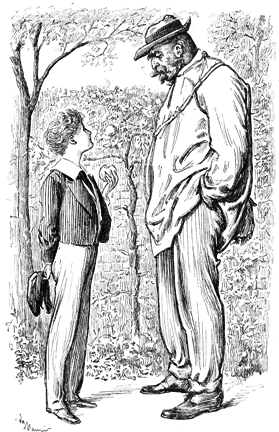
"'Sais pas,'" said Josselin; "don't like killing things, I suppose.'"
So Barty became quite indispensable to the happiness and comfort of Père Polyphème, as he called him, as well as of his amiable family.
On the 1st of September there was a grand breakfast in honor of the partridges (not in the kitchen this time), and many guests were invited; and Barty had to sing and talk and play the fool all through breakfast; and got very tipsy, and had to be put to bed for the rest of the day. It was no fault of his, and Madame Lafertó declared that "ces messieurs" ought to be ashamed of themselves, and watched over Barty like a mother. He has often declared he was never quite the same after that debauch—and couldn't feel the north for a month.
The house was soon full of guests, and Barty and I slept in M. Laferté's bedroom—his wife in a room adjoining.
Every morning old Polyphemus would wake us up by roaring out:
"Hé! ma femme!"
"Voilà, voilà, mon ami!" from the next room.
"Viens vite panser mon cautère!"
And in came Madame L. in her dressing‑gown, and dressed a blister he wore on his big arm.
Then: "Café!"
And coffee came, and he drank it in bed.
Then: "Pipe!"
And his pipe was brought and filled, and he lit it.
Then: "Josselin!"
"Oui, M'sieur Laferté."
"Tire moi une gamme."
"Dorémifasollasido—Dosilasolfamirédo!" sang Josselin, up and down, in beautiful tune, with his fresh bird‑like soprano.
"Ah! q' ça fait du bien!" says M. L.; then a pause, and puffs of smoke and grunts and sighs of satisfaction.
"Josselin?"
"Oui, M'sieur Laferté!"
"'La brune Thérèse!'"
And Josselin would sing about the dark‑haired Thérèsa—three verses.
"Tu as changé la fin du second couplet—tu as dit 'des comtesses' au lieu de dire 'des duchesses'—recommence!" (You changed the end of the second verse—you said "countesses" instead of "duchesses"—begin again.)
And Barty would re‑sing it, as desired, and bring in the duchesses.
"Maintenant, 'Colin, disait Lisette!'"
And Barty would sing that charming little song, most charmingly:
"'Colin,' disait Lisette, 'Je voudrais passer l'eau! Mais je suis trop pauvrette Pour payer le bateau!' 'Entrez, entrez, ma belle! Entrez, entrez toujours! Et vogue la nacelle Qui porte mes amours!"
And old L. would smoke and listen with an air of heavenly beatitude almost pathetic.
"Elle était bien gentille, Lisette—n'est‑ce pas, petiot?—recommence!" (She was very nice, Lisette; wasn't she, sonny?—being again!)
"Now both get up and wash and go to breakfast. Come here, Josselin—you see this little silver dagger" (producing it from under his pillow). "It's rather pointy, but not at all dangerous. My mother gave it me when I was just your age—to cut books with; it's for you. Allons, file! [cut along] no thanks!—but look here—are you coming with us à la chasse to‑day?"
"Non, M. Laferté!"
"Pourquoi?—t'as pas peur, j'espère!"
"Sais pas. J' n'aime pas les choses mortes—ça saigne—et ça n' sent pas bon—ça m'fait mal au cœur." (Don't know. I'm not fond of dead things. They bleed—and they don't smell nice—it makes me sick.)
And two or three times a day would Barty receive some costly token of this queer old giant's affection, till he got quite unhappy about it. He feared he was despoiling the House of Laferté of all its treasures in silver and gold; but he soothed his troubled conscience later on by giving them all away to favorite boys and masters at Brossard's—especially M. Bonzig, who had taken charge of his white mouse (and her family, now quite grown up—children and grandchildren and all) when Mlle. Marceline went for her fortnight's holiday. Indeed, he had made a beautiful cage for them out of wood and wire, with little pasteboard mangers (which they nibbled away).
Well, the men of the party and young Laferté and I would go off with the dogs and keepers into the forest—and Barty would pick filberts and fruit with Jeanne and Marie, and eat them with bread‑and‑butter and jam and cernaux (unripe walnuts mixed with salt and water and verjuice—quite the nicest thing in the world). Then he would find his way into the heart of the forest, which he loved—and where he had scraped up a warm friendship with some charcoal‑burners, whose huts were near an old yellow‑watered pond, very brackish and stagnant and deep, and full of leeches and water‑spiders. It was in the densest part of the forest, where the trees were so tall and leafy that the sun never fell on it, even at noon. The charcoal‑burners told him that in '93 a young de la Tremblaye was taken there at sunset to be hanged on a giant oak‑tree—but he talked so agreeably and was so pleasant all round that they relented, and sent for bread and wine and cider and made a night of it, and didn't hang him till dawn next day; after which they tied a stone to his ankles and dropped him into the pond, which was called "the pond of the respite" ever since; and his young wife, Claire Élisabeth, drowned herself there the week after, and their bones lie at the bottom to this very day.
And, ghastly to relate, the ringleader in this horrible tragedy was a beautiful young woman, a daughter of the people, it seems—one Séraphine Doucet, whom the young viscount had betrayed before marriage—le droit du seigneur!—and but for whom he would have been let off after that festive night. Ten or fifteen years later, smitten with incurable remorse, she hanged herself on the very branch of the very tree where they had strung up her noble lover; and still walks round the pond at night, wringing her hands and wailing. It's a sad story—let us hope it isn't true.
Barty Josselin evidently had this pond in his mind when he wrote in "Âmes en peine":
Sous la berge hantée L'eau morne croupit— Sous la sombre futaie Le renard glapit, Et le cerf‑dix‑cors brame, et les daims viennent boire à l'Étang du Répit. "Lâchez‑moi, Loupgaroux!"
Que sinistre est la mare Quand tombe la nuit; La chouette s'effare— Le blaireau s'enfuit! L'on y sent que les morts se réveillent—qu'une ombre sans nom vous poursuit. "Lâchez‑moi, Loup‑garoux!"
Forêt! forêt! what a magic there is in that little French dissyllable! Morne forêt! Is it the lost "s," and the heavy "^" that makes up for it, which lend such a mysterious and gloomy fascination?
Forest! that sounds rather tame—almost cheerful! If we want a forest dream we have to go so far back for it, and dream of Robin Hood and his merrie men! and even then Epping forces itself into our dream—and even Chingford, where there was never a were‑wolf within the memory of man. Give us at least the virgin forest, in some far Guyana or Brazil—or even the forest primeval—
"... where the murmuring pines and the hemlocks, Bearded with moss and in garments green, indistinct in the twilight, Stand like druids of eld, with voices sad and prophetic, Stand like harpers hoar"—
that we may dream of scalp‑hunting Mingoes, and grizzly‑bears, and moose, and buffalo, and the beloved Bas‑de‑cuir with that magic rifle of his, that so seldom missed its mark and never got out of repair.
"Prom'nons nous dans les bois Pendant que le loup n'y est pas...."
That's the first song I ever heard. Céline used to sing it, my nurse—who was very lovely, though she had a cast in her eye and wore a black cap, and cotton in her ears, and was pitted with the smallpox. It was in Burgundy, which was rich in forests, with plenty of wolves in them, and wild‑boars too—and that was only a hundred years ago, when that I was a little tiny boy. It's just an old nursery rhyme to lull children to sleep with, or set them dancing—pas aut' chose—but there's a deal of Old France in it!
There I go again—digressing as usual and quoting poetry and trying to be literary and all that! C'est plus fort que moi....
One beautiful evening after dinner we went, the whole lot of us, fishing for crayfish in the meadows beyond the home farm.
As we set about waiting for the crayfish to assemble round the bits of dead frog that served for bait and were tied to the wire scales (which were left in the water), a procession of cows came past us from the farm. One of them had a wound in her flank—a large tumor.
"It's the bull who did that," said Marie. "Il est très méchant!"
Presently the bull appeared, following the herd in sulky dignity. We all got up and crossed the stream on a narrow plank—all but Josselin, who remained sitting on a camp‑stool.
"Josselin! Josselin! venez donc! il est très mauvais, le taureau!"
Barty didn't move.
The bull came by; and suddenly, seeing him, walked straight to within a yard of him—and stared at him for five minutes at least, lashing its tail. Barty didn't stir. Our hearts were in our mouths!
Then the big brindled brute turned quietly round with a friendly snort and went after the cows—and Barty got up and made it a courtly farewell salute, saying, "Bon voyage—au plaisir!"
After which he joined the rest of us across the stream, and came in for a good scolding and much passionate admiration from the ladies, and huggings and tears of relief from Madame Laferté.
"I knew well he wouldn't be afraid!" said M. Laferté; "they are all like that, those English—le sang‑froid du diable! nom d'un Vellington! It is we who were afraid—we are not so brave as the little Josselin! plucky little Josselin! But why did you not come with us? Temerity is not valor, Josselin!"
"Because I wanted to show off [faire le fanfaron]!" said Barty, with extreme simplicity.
"Ah, diable! Anyhow, it was brave of you to sit still when he came and looked at you in the white of the eyes! it was just the right thing to do; ces Anglais! je n'en reviens pas! à quatorze ans! hein, ma femme?"
"Pardi!" said Barty, "I was in such a blue funk [j'avais une venette si bleue] that I couldn't have moved a finger to save my life!"
At this, old Polyphemus went into a Homeric peal of laughter.
"Ces Anglais! what originals—they tell you the real truth at any cost [ils vous disent la vraie vérité, coûte que coûte]!" and his affection for Barty seemed to increase, if possible, from that evening.
Now this was Barty all over—all through life. He always gave himself away with a liberality quite uncalled for—so he ought to have some allowances made for that reckless and impulsive indiscretion which caused him to be so popular in general society, but got him into so many awkward scrapes in after‑life, and made him such
FANFARONNADE
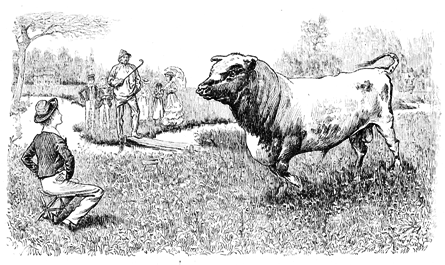
mean enemies, and gave his friends so much anxiety and distress.
(And here I think it right to apologize for so much translating of such a well‑known language as French; I feel quite like another Ollendorf—who must have been a German, by‑the‑way—but M. Laferté's grammar and accent would sometimes have puzzled Ollendorf himself!)
Towards the close of September, M. Laferté took it into his head to make a tour of provincial visits en famille. He had never done such a thing before, and I really believe it was all to show off Barty to his friends and relations.
It was the happiest time I ever had, and shines out by itself in that already so unforgettably delightful vacation.
We went in a large charabancs drawn by two stout horses, starting at six in the morning, and driving right through the Forest of la Tremblaye; and just ahead of us, to show us the way, M. Laferté driving himself in an old cabriolet, with Josselin (from whom he refused to be parted) by his side, singing or talking, according to order, or cracking jokes; we could hear the big laugh of Polyphemus!
We travelled very leisurely; I forget whether we ever changed horses or not—but we got over a good deal of ground. We put up at the country houses of friends and relations of the Lafertés; and visited old historical castles and mediæval ruins—Châteaudun and others—and fished in beautiful pellucid tributaries of the Loire—shot over "des chiens anglais"—danced half the night with charming people—wandered in lovely parks and woods, and beautiful old formal gardens with fishponds, terraces, statues, marble fountains; charmilles, pelouses, quinconces; and all the flowers and all the fruits of France! And the sun shone every day and all day long—and in one's dreams all night.
And the peasants in that happy country of the Loire spoke the most beautiful French, and had the most beautiful manners in the world. They're famous for it.
It all seems like a fairy tale.
If being made much of, and petted and patted and admired and wondered at, make up the sum of human bliss, Barty came in for as full a share of felicity during that festive week as should last an ordinary mortal for a twelvemonth. Figaro quà, Figaro là, from morning till night in three departments of France!
But he didn't seem to care very much about it all; he would have been far happier singing and tumbling and romancing away to his charbonniers by the pond in the Forest of la Tremblaye. He declared he was never quite himself unless he could feel the north for at least an hour or two every day, and all night long in his sleep—and that he should never feel the north again—that it was gone forever; that he had drunk it all away at that fatal breakfast—and it made him lonely to wake up in the middle of the night and not know which way he lay! "dépaysé," as he called it—"désorienté—perdu!"
And laughing, he would add, "Ayez pitié d'un pauvre orphelin!"
Then back to Le Gué des Aulnes. And one evening, after a good supper at Grandmaman Laferté's, the diligence de Paris came jingling and rumbling through the main street of La Tremblaye, flashing right and left its two big lamps, red and blue. And we three boys, after the most grateful and affectionate farewells, packed ourselves into the coupé, which had been retained for us, and rumbled back to Paris through the night.
There was quite a crowd to see us off. Not only Lafertés, but others—all sorts and conditions of men, women, and children—and among them three or four of Barty's charcoal‑burning friends; one of whom, an old man with magnificent black eyes and an immense beard, that would have been white if he hadn't been a charcoal‑burner, kissed Barty on both cheeks, and gave him a huge bag full of some kind of forest berry that is good to eat; also a young cuckoo (which Barty restored to liberty an hour later); also a dormouse and a large green lizard; also, in a little pasteboard box, a gigantic pale green caterpillar four inches long and thicker than your thumb, with a row of shiny blue stars in relief all along each side of its back—the most beautiful thing of the kind you ever saw.
"Pioche bien ta géométrie, mon bon petit Josselin! c'est la plus belle science au monde, crois‑moi!" said M. Laferté to Barty, and gave him the hug of a grizzly‑bear; and to me he gave a terrific hand‑squeeze, and a beautiful double‑barrelled gun by Lefaucheux, for which I felt too supremely grateful to find suitable thanks. I have it now, but I have long given up killing things with it.
I had grown immensely fond of this colossal old "bourru bienfaisant," as he was called in La Tremblaye, and believe that all his moroseness and brutality were put on, to hide one of the warmest, simplest, and tenderest hearts in the world.
Before dawn Barty woke up with such a start that he woke me:
"Enfin! ça y est! quelle chance!" he exclaimed.
"Quoi, quoi, quoi?" said I, quacking like a duck.
"Le nord—c'est revenu—it's just ahead of us—a little to the left!"
We were nearing Paris.
And thus ended the proudest and happiest time I ever had in my life. Indeed I almost had an adventure on my own account—une bonne fortune, as it was called at Brossard's by boys hardly older than myself. I did not brag of it, however, when I got back to school.
It was at "Les Laiteries," or "Les Poteries," or "Les Crucheries," or some such place, the charming abode of Monsieur et Madame Pélisson—only their name wasn't Pélisson, or anything like it. At dinner I sat next to a Miss ———, who was very tall and wore blond side ringlets. I think she must have been the English governess.
We talked very much together, in English; and after dinner we walked in the garden together by starlight arm in arm, and she was so kind and genial to me in English that I felt quite chivalrous and romantic, and ready to do doughty deeds for her sake.
Then, at M. Pélisson's request, all the company assembled in a group for evening prayer, under a spreading chestnut‑tree on the lawn: the prayer sounded very much like the morning or evening prayer at Brossard's, except that the Almighty was addressed as "toi" instead of "vous"; it began:
"Notre Père qui es aux cieux—toi dont le regard scrutateur pénètre jusque dans les replis les plus profonds de nos cœurs"—and ended, "Ainsi soit‑il!"
The night was very dark, and I stood close to Miss ———, who stood as it seemed with her hands somewhere behind her back. I was so grateful to her for having talked to me so nicely, and so fond of her for being English, that the impulse seized me to steal my hand into hers—and her hand met mine with a gentle squeeze which I returned; but soon the pressure of her hand increased, and by the time M. le Curé had got to "au nom du Père" the pressure of her hand had become an agony—a thing to make one shriek!
"Ainsi soit‑il!" said M. le Curé, and the little group broke up, and Miss ——— walked quietly indoors with her arm around Madame Pélisson's waist, and without even wishing me good‑night—and my hand was being squeezed worse than ever.
"Ah ha! Lequel de nous deux est volé, petit coquin?" hissed an angry male voice in my ear—(which of us two is sold, you little rascal?).
And I found my hand in that of Monsieur Pélisson, whose name was something else—and I couldn't make it out, nor why he was so angry. It has dawned upon me since that each of us took the other's hand by mistake for that of the English governess!
All this is beastly and cynical and French, and I apologize for it—but it's true.
October!
It was a black Monday for me when school began again after that ideal vacation. The skies they were ashen and sober, and the leaves they were crisped and sere. But anyhow I was still en quatrième, and Barty was in it too—and we sat next to each other in "L'étude des grands."
There was only one étude now; only half the boys came back, and the pavillon des petits was shut up, study, class‑rooms, dormitories, and all—except that two masters slept there still.
Eight or ten small boys were put in a small
MÉROVÉE RINGS THE BELL
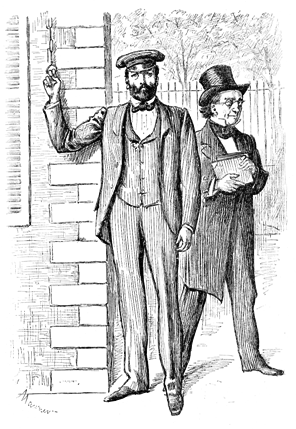
school-room in the same house as ours, and had a small dormitory to themselves, with M. Bonzig to superintend them.
I made up my mind that I would no longer be a cancre and a crétin, but work hard and do my little best, so that I might keep up with Barty and pass into the troisième with him, and then into Rhétorique (seconde), and then into Philosophie (première)—that we might do our humanities and take our degree together—our "Bachot," which is short for Baccalauréat‑ès‑lettres. Most especially did I love Monsieur Durosier's class of French Literature—for which Mérovée always rang the bell himself.
My mother and sister were still at Ste.‑Adresse, Hâvre, with my father; so I spent my first Sunday that term at the Archibald Rohans', in the Rue du Bac.
I had often seen them at Brossard's, when they came to see Barty, but had never been at their house before.
They were very charming people.
Lord Archibald was dressing when we got there that Sunday morning, and we sat with him while he shaved—in an immense dressing‑room where there were half a dozen towel‑horses with about thirty pairs of newly ironed trousers on them instead of towels, and quite thirty pairs of shiny boots on trees were ranged along the wall. James, an impeccable English valet, waited on "his lordship," and never spoke unless spoken to.
"Hullo, Barty! Who's your friend?"
"Bob Maurice, Uncle Archie."
And Uncle Archie shook hands with me most cordially.
"And how's the north pole this morning?"
"Nicely, thanks, Uncle Archie."
Lord Archibald was a very tall and handsome man, about fifty—very droll and full of anecdote; he had stories to tell about everything in the room.
For instance, how Major Welsh of the 10th Hussars had given him that pair of Wellingtons, which fitted him better than any boots Hoby ever made him to measure; they were too tight for poor Welsh, who was a head shorter than himself.
How Kerlewis made him that frock‑coat fifteen years ago, and it wasn't threadbare yet, and fitted him as well as ever—for he hadn't changed his weight for thirty years, etc.
How that pair of braces had been made by "my lady" out of a pair of garters she wore on the day they were married.
And then he told us how to keep trousers from bagging at the knees, and how cloth coats should be ironed, and how often—and how to fold an umbrella.
It suddenly occurs to me that perhaps these little anecdotes may not be so amusing to the general reader as they were to me when he told them, so I won't tell any more. Indeed, I have often noticed that things look sometimes rather dull in print that were so surprisingly witty when said in spontaneous talk a great many years ago!
Then we went to breakfast with my lady and Daphne, their charming little daughter—Barty's sister, as he called her—"m'amour"—and who spoke both French and English equally well.
But we didn't breakfast at once, ravenous as we boys were, for Lady Archibald took a sudden dislike to Lord A.'s cravat, which, it seems, he had never worn before. It was in brown satin, and Lady A. declared that Loulou (so she called him) never looked "en beauté" with a brown cravat; and there was quite a little quarrel between husband and wife on the subject—so that he had to go back to his dressing‑room and put on a blue one.
At breakfast he talked about French soldiers of the line, and their marching kit (as it would be called now), quite earnestly, and, as it seemed to me, very sensibly—though he went through little mimicries that made his wife scream with laughter, and me too; and in the middle of breakfast Barty sang "Le Chant du Départ" as well as he could for laughing:
"La victoire en chantant nous ouvre la carrière! La liberté‑é gui‑i‑de nos pas" ...
while Lord A. went through an expressive pantomime of an overladen foot‑soldier up and down the room, in time to the music. The only person who didn't laugh was James—which I thought ungenial.
Then Lady A. had her innings, and sang "Rule Britannia, Britannia rule de vaves"—and declared it was far more ridiculous really than the "Chant du Départ," and she made it seem so, for she went through a pantomime too. She was a most delightful person, and spoke English quite well when she chose; and seemed as fond of Barty as if he were her own and only son—and so did Lord Archibald. She would say:
"Quel dommage qu'on ne peut pas avoir des crompettes [crumpets]! Barty les aime tant! n'est‑ce pas, mon chou, tu aimes bien les crompettes? voici venir du buttered toast—c'est toujours ça!"
And, "Mon Dieu, comme il a bonne mine, ce cher Barty—n'est‑ce pas, mon amour, que tu as bonne mine? regarde‑toi dans la glace."
And, "Si nous allions à l'Hippodrôme cette après‑midi voir la belle écuyère Madame Richard? Barty adore les jolies femmes, comme son oncle! n'est‑ce pas, méchant petit Barty, que tu adores les jolies femmes? et tu n'as jamais vu Madame Richard? Tu m'en diras des nouvelles! et vous, mon ami [this to me], est‑ce que vous adorez aussi les jolies femmes?"
"Ô oui," says Daphne, "allons voir M'ame Richard; it'll be such fun! oh, bully!"
So after breakfast we went for a walk, and to a café on the Quai d'Orsay, and then to the HippodrÔme, and saw the beautiful écuyère in graceful feats of la haute école, and lost our hearts—especially Lord Archibald, though him she knew; for she kissed her hand to him, and he his to her.
Then we dined at the Palais Royal, and afterwards went to the Café des Aveugles, an underground coffee‑house near the Café de la Rotonde, and where blind men made instrumental music; and we had a capital evening.
I have met in my time more intellectual people, perhaps, than the Archibald Rohans—but never people more amiable, or with kinder, simpler manners, or who made one feel more quickly and thoroughly at home—and the more I got to know them, the more I grew to like them; and their fondness for each other and Daphne, and for Barty too, was quite touching; as was his for them. So the winter sped happily till February, when a sad thing happened.
I had spent Sunday with my mother and sister, who now lived on the ground‑floor of 108 Champs Élysées.
I slept there that Sunday night, and walked back to school next morning. To my surprise, as I got to a large field through which a diagonal footpath led to Père Jaurion's loge, I saw five or six boys sitting on the terrace parapet with their legs dangling outside. They should have been in class, by rights. They watched me cross the field, but made no sign.
"What on earth can be the matter?" thought I.
The cordon was pulled, and I came on a group of boys all stiff and silent.
"Qu'est‑ce que vous avez donc, tous?" I asked.
"Le Père Brossard est mort!" said De Villars.
Poor M. Brossard had died of apoplexy on the previous afternoon. He had run to catch the Passy omnibus directly after lunch, and had fallen down in a fit and died immediately.
"Il est tombé du haut mal"—as they expressed it.
His son Mérovée and his daughter Madame Germain were distracted. The whole of that day was spent by the boys in a strange, unnatural state of désœuvrement and suppressed excitement for which no outlet was possible. The meals, especially, were all but unbearable. One was ashamed of having an appetite, and yet one had—almost keener than usual, if I may judge by myself—and for some undiscovered reason the food was better than on other Mondays!
Next morning we all went up in sorrowful procession to kiss our poor dear head‑master's cold forehead as he lay dead in his bed, with sprigs of boxwood on his pillow, and above his head a jar of holy water with which we sprinkled him. He looked very serene and majestic, but it was a harrowing ceremony. Mérovée stood by with swollen eyes and deathly pale—incarnate grief.
On Wednesday afternoon M. Brossard was buried in the Cimetière de Passy, a tremendous crowd following the hearse; the boys and masters just behind Mérovée and M. Germain, the chief male mourners. The women walked in another separate procession behind.
Béranger and Alphonse Karr were present among the notabilities, and speeches were made over his open grave, for he was a very distinguished man.
And, tragical to relate, that evening in the study Barty and I fell out, and it led to a stand‑up fight next day.
There was no preparation that evening; he and I sat side by side reading out of a book by Châteaubriand—either Atala, or René or Les Natchez, I forget which. I have never seen either since.
The study was hushed; M. Dumollard was de service as maître d'études, although there was no attempt to do anything but sadly read improving books.
If I remember aright, René, a very sentimental young Frenchman, who had loved the wrong person not wisely, but too well (a very wrong person indeed, in his case), emigrated to North America, and there he met a beautiful Indian maiden, one Atala, of the Natchez tribe, who had rosy heels and was charming, and whose entire skin was probably a warm dark red, although this is not insisted upon. She also had a brother, whose name was Outogamiz.
Well, René loved Atala, Atala loved René, and they were married; and Outogamiz went through some ceremony besides, which made him blood brother and bosom friend to René—a bond which involved certain obligatory rites and duties and self‑sacrifices.
Atala died and was buried. René died and was buried also; and every day, as in duty bound, poor Outogamiz went and pricked a vein and bled over Rene's tomb, till he died himself of exhaustion before he was many weeks older. I quote entirely from memory.
This simple story was told in very touching and beautiful language, by no means telegraphese, and Barty and I were deeply affected by it.
"I say, Bob!" Barty whispered to me, with a break in his voice, "some day I'll marry your sister, and we'll all go off to America together, and she'll die, and I'll die, and you shall bleed yourself to death on my tomb!"
"No," said I, after a moment's thought. "No—look here! I'll marry your sister, and I'll die, and you shall bleed over my tomb!"
Then, after a pause:
"I haven't got a sister, as you know quite well—and if I had she wouldn't be for you!" says Barty.
"Why not?"
"Because you're not good‑looking enough!" says Barty.
At this, just for fun, I gave him a nudge in the wind with my elbow—and he gave me a "twisted pinch" on the arm—and I kicked him on the ankle, but so much harder than I intended that it hurt him, and he gave me a tremendous box on the ear, and we set to fighting like a couple of wild‑cats, without even getting up, to the scandal of the whole study and the indignant disgust of M. Dumollard, who separated us, and read us a pretty lecture:
"Voilà bien les Anglais!—rien n'est sacré pour eux, pas même la mort! rien que les chiens et les chevaux." (Nothing, not even death, is sacred to Englishmen—nothing but dogs and horses.)
When we went up to bed the head‑boy of the school—a first‑rate boy called d'Orthez, and Berquin (another first‑rate boy), who had each a bedroom to himself, came into the dormitory and took up the quarrel, and discussed what should be done. Both of us were English—ergo, both of us ought to box away the insult with our fists; so "they set a combat us between, to fecht it in the dawing"—that is, just after breakfast, in the school‑room.
I went to bed very unhappy, and so, I think, did Barty.
Next morning at six, just after the morning prayer, M. Mérovée came into the school‑room and made us a most straightforward, manly, and affecting speech; in which he told us he meant to keep on the school, and thanked us, boys and masters, for our sympathy.
We were all moved to our very depths—and sat at our work solemn and sorrowful all through that lamp‑lit hour and a half; we hardly dared to cough, and never looked up from our desks.
Then 7.30—ding‑dang‑dong and breakfast. Thursday—bread‑and‑butter morning!
I felt hungry and greedy and very sad, and disinclined to fight. Barty and I had sat turned away from each other, and made no attempt at reconciliation.
We all went to the réfectoire: it was raining fast. I made my ball of salt and butter, and put it in a hole in my hunk of bread, and ran back to the study, where I locked these treasures in my desk.
The study soon filled with boys: no masters ever came there during that half‑hour; they generally smoked and read their newspapers in the gymnastic ground, or else in their own rooms when it was wet outside.
D'Orthez and Berquin moved one or two desks and forms out of the way so as make a ring—l'arène, as they called it—with comfortable seats all round. Small boys stood on forms and window‑sills eating their bread‑and‑butter with a tremendous relish.
"Dites donc, vous autres," says Bonneville, the wit of the school, who was in very high spirits; "it's like the Roman Empire during the decadence—'panem et circenses!'"
"What's that, circenses? what does it mean?" says Rapaud, with his mouth full.
"Why, butter, you idiot! Didn't you know that?" says Bonneville.
Barty and I stood opposite each other; at his sides as seconds were d'Orthez and Berquin; at mine, Jolivet trois (the only Jolivet now left in the school) and big du Tertre‑Jouan (the young marquis who wasn't Bonneville).
We began to spar at each other in as knowing and English a way as we knew how—keeping a very respectful distance indeed, and trying to bear ourselves as scientifically as we could, with a keen expression of the eye.
When I looked into Barty's face I felt that nothing on earth would ever make me hit such a face as that—whatever he might do to mine. My blood wasn't up; besides, I was a coarse‑grained, thick‑set, bullet‑headed little chap with no nerves to speak of, and didn't mind punishment the least bit. No more did Barty, for that matter, though he was the most highly wrought creature that ever lived.
At length they all got impatient, and d'Orthez said:
"Allez donc, godems—ce n'est pas un quadrille! Nous n'sommes pas à La Salle Valentino!"
And Barty was pushed from behind so roughly that he came at me, all his science to the winds and slogging like a French boy; and I, quite without meaning to, in the hurry, hit out just as he fell over me, and we both rolled together over Jolivet's foot—Barty on top (he was taller, though not heavier, than I); and I saw the blood flow from his nose down his lip and chin, and some of it fell on my blouse.
Says Barty to me, in English, as we lay struggling on the dusty floor:
"Look here, it's no good. I can't fight to‑day; poor Mérovée, you know. Let's make it up!"
"All right!" says I. So up we got and shook hands, Barty saying, with mock dignity:
"Messieurs, le sang a coulé; l'honneur britannique est sauf;" and the combat was over.
"Cristi! J'ai joliment faim!" says Barty, mopping his nose with his handkerchief. "I left my crust on the bench outside the réfectoire. I wish one of you fellows would get it for me."
"Rapaud finished your crust [ta miche] while you were fighting," says Jolivet. "I saw him."
Says Rapaud: "Ah, Dame, it was getting prettily wet, your crust, and I was prettily hungry too; and I thought you didn't want it, naturally."
I then produced my crust and cut it in two, butter and all, and gave Barty half, and we sat very happily side by side, and breakfasted together in peace and amity. I never felt happier or hungrier.
"Cristi, comme ils se sont bien battus," says little Vaissière to little Cormenu. "As‑tu vu? Josselin a saigné tout plein sur la blouse à Maurice." (How well they fought! Josselin bled all over Maurice's blouse!)
Then says Josselin, in French, turning to me with that delightful jolly smile that always reminded one of the sun breaking through a mist:
"I would sooner bleed on your blouse than on your tomb." (J'aime mieux saigner sur ta blouse que sur ta tombe.)
So ended the only quarrel we ever had.
Part Third
"Que ne puis‑je aller où s'en vont les roses, Et n'attendre pas Ces regrets navrants que la fin des choses Nous garde ici‑bas!"—Anon.
Barty worked very hard, and so did I—for me! Horace—Homer—Æschylus—Plato—etc., etc., etc., etc., etc., and all there was to learn in that French school-boy's encyclopædia—"Le Manuel du Baccalauréat"; a very thick book in very small print. And I came to the conclusion that it is good to work hard: it makes one enjoy food and play and sleep so keenly—and Thursday afternoons.
The school was all the pleasanter for having fewer boys; we got more intimate with each other, and with the masters too. During the winter M. Bonzig told us capital stories—Modeste Mignon, by Balzac—Le Chevalier de Maison‑rouge, by A. Dumas père—etc., etc.
In the summer the Passy swimming‑bath was more delightful than ever. Both winter and summer we passionately fenced with a pupil (un prévôt) of the famous M. Bonnet, and did gymnastics with M. Louis, the gymnastic master of the Collège Charlemagne—the finest man I ever saw—a gigantic dwarf six feet high, all made up of lumps of sinew and muscles, like....
Also, we were taught equitation at the riding‑school in the Rue Duphot.
On Saturday nights Barty would draw a lovely female profile, with a beautiful big black eye, in pen and ink, and carefully shade it; especially the hair, which was always as the raven's wing! And on Sunday morning he and I used to walk together to 108 Champs Élysées and enter the rez‑de‑chaussée (where my mother and sister lived) by the window, before my mother was up. Then Barty took out his lovely female pen‑and‑ink profile to gaze at, and rolled himself a cigarette and lit it, and lay back on the sofa, and made my sister play her lightest music—"La pluie de Perles," by Osborne—and "Indiana," a beautiful valse by Marcailhou—and thus combine three or four perfect blisses in one happy quart d'heure.
Then my mother would appear, and we would have breakfast—after which Barty and I would depart by the window as we had come, and go and do our bit of Boulevard and Palais Royal. Then to the Rue du Bac for another breakfast with the Rohans; and then, "au petit bonheur"; that is, trusting to Providence for whatever turned up. The programme didn't vary very much: either I dined with him at the Rohans', or he with me at 108. Then, back to Brossard's at ten—tired and happy.
One Sunday I remember well we stayed in school, for old Josselin the fisherman came to see us there—Barty's grandfather, now a widower; and M. Mérovée asked him to lunch with us, and go to the baths in the afternoon.
Imagine old Bonzig's delight in this "vieux loup de mer," as he called him! That was a happy day for the old fisherman also; I shall never forget his surprise at M. Dumollard's telescope—and how clever he was on the subject.
He came to the baths, and admired and criticised the good swimming of the boys—especially Barty's, which was really remarkable. I don't believe he could swim a stroke himself.
Then we went and dined together at Lord Archibald's, in the Rue du Bac—"Mon Colonel," as the old fisherman always called him. He was a very humorous and intelligent person, this fisher, though nearer eighty than seventy; very big, and of a singularly picturesque appearance—for he had not endimanché himself in the least; and very clean. A splendid old man; oddly enough, somewhat Semitic of aspect—as though he had just come from a miraculous draught of fishes in the Sea of Galilee, out of a cartoon by Raphael!
I recollect admiring how easily and pleasantly everything went during dinner, and all through the perfection of this ancient sea‑toiler's breeding in all essentials.
Of course the poor all over the world are less nice in their habits than the rich, and less correct in their grammar and accent, and narrower in their views of life; but in every other respect there seemed little to choose between Josselins and Rohans and Lonlay‑Savignacs; and indeed, according to Lord Archibald, the best manners were to be found at these two opposite poles—or even wider still. He would have it that Royalty and chimney‑sweeps were the best‑bred people all over the world—because there was no possible mistake about their social status.
I felt a little indignant—after all, Lady Archibald was built out of chocolate, for all her Lonlay and her Savignac! just as I was built out of Beaune and Chambertin.
I'm afraid I shall be looked upon as a snob and a traitor to my class if I say that I have at last come to be of the same opinion myself. That is, if absolute simplicity, and the absence of all possible temptation to try and seem an inch higher up than we really are—But there! this is a very delicate question, about which I don't care a straw; and there are such exceptions, and so many, to confirm any such rule!
Anyhow, I saw how Barty couldn't help having the manners we all so loved him for. After dinner Lady Archibald showed old Josselin some of Barty's lovely female profiles—a sight that affected him strangely. He would have it that they were all exact portraits of his beloved Antoinette, Barty's mother.
They were certainly singularly like each other, these little chefs‑d'œuvre of Barty's, and singularly handsome—an ideal type of his own; and the old grandfather was allowed his choice, and touchingly grateful at being presented with such treasures.
The scene made a great impression on me.
So spent itself that year—a happy year that had no history—except for one little incident that I will tell because it concerns Barty, and illustrates him.
One beautiful Sunday morning the yellow omnibus was waiting for some of us as we dawdled about in the school‑room, titivating; the masters nowhere, as usual on a Sunday morning; and some of the boys began to sing in chorus a not very edifying chanson, which they did not "Bowdlerize," about a holy Capuchin friar; it began (if I remember rightly):
"C'était un Capucin, oui bien, un père Capucin, Qui confessait trois filles— Itou, itou, itou, là là là! Qui confessait trois filles Au fond de son jardin— Oui bien— Au fond de son jardin! Il dit à la plus jeune—
Itou, itou, itou, là là là! Il dit à la plus jeune ... 'Vous reviendrez demain!'" Etc, etc., etc.
I have quite forgotten the rest.
Now this little song, which begins so innocently, like a sweet old idyl of mediæval France—"un écho du temps passé"—seems to have been a somewhat Rabelaisian ditty; by no means proper singing for a Sunday morning in a boys' school. But boys will be boys, even in France; and the famous "esprit Gaulois" was somewhat precocious in the forties, I suppose. Perhaps it is now, if it still exists (which I doubt—the dirt remains, but all the fun seems to have evaporated).
Suddenly M. Dumollard bursts into the room in his violent sneaky way, pale with rage, and says:
"Je vais gifler tous ceux qui ont chanté" (I'll box the ears of every boy who sang).
So he puts all in a row and begins:
"Rubinel, sur votre parole d'honneur, avez‑vous chanté?"
"Non, m'sieur!"
"Caillard, avez‑vous chanté?"
"Non, m'sieur!"
"Lipmann, avez‑vous chanté?"
"Non, m'sieur!"
"Maurice, avez‑vous chanté?"
"Non, m'sieur" (which, for a wonder, was true, for I happened not to know either the words or the tune).
"Josselin, avez‑vous chanté?"
"Oui, m'sieur!"
And down went Barty his full length on the floor, from a tremendous open‑handed box on the ear. Dumollard was a very Herculean person—though by no means gigantic.
Barty got up and made Dumollard a polite little bow, and walked out of the room.
"Vous êtes tous consignés!" says M. Dumollard—and the omnibus went away empty, and we spent all that Sunday morning as best we might.
In the afternoon we went out walking in the Bois. Dumollard had recovered his serenity and came with us; for he was de service that day.
Says Lipmann to him:
"Josselin drapes himself in his English dignity—he sulks like Achilles and walks by himself."
"Josselin is at least a man," says Dumollard. "He tells the truth, and doesn't know fear—and I'm sorry he's English!"
And later, at the Mare d'Auteuil, he put out his hand to Barty and said:
"Let's make it up, Josselin—au moins vous avez du cœur, vous. Promettez‑moi que vous ne chanterez plus cette sale histoire de Capucin!"
Josselin took the usher's hand, and smiled his open, toothy smile, and said:
"Pas le dimanche matin toujours—quand c'est vous qui serez de service, M. Dumollard!" (Anyhow not Sunday morning when you're on duty, Mr. D.)
And Mr. D. left off running down the English in public after that—except to say that they couldn't be simple and natural if they tried; and that they affected a ridiculous accent when they spoke French—not Josselin and Maurice, but all the others he had ever met. As if plain French, which had been good enough for William the Conqueror, wasn't good enough for the subjects of her Britannic Majesty to‑day!
The only event of any importance in Barty's life that year was his first communion, which he took with several others of about his own age. An event that did not seem to make much impression on him—nothing seemed to make much impression on Barty Josselin when he was very young. He was just a lively, irresponsible, irrepressible human animal—always in perfect health and exuberant spirits, with an immense appetite for food and fun and frolic; like a squirrel, a collie pup, or a kitten.
Père Bonamy, the priest who confirmed him, was fonder of the boy than of any one, boy or girl, that he had ever prepared for communion, and could hardly speak of him with decent gravity, on account of his extraordinary confessions—all of which were concocted in the depths of Barty's imagination for the sole purpose of making the kind old curé laugh; and the kind old curé was just as fond of laughing as was Barty of playing the fool, in and out of season. I wonder if he always thought himself bound to respect the secrets of the confessional in Barty's case!
And Barty would sing to him—even in the confessional:
"Stabat mater dolorosa Juxta crucem lachrymose Dum pendebat fllius" ...
in a voice so sweet and innocent and pathetic that it would almost bring the tears to the good old curé's eyelash.
"Ah! ma chère Mamzelle Marceline!" he would say—"au moins s'ils étaient tous comme ce petit Josselin! çà irait comme sur des roulettes! Il est innocent comme un jeune veau, ce mioche anglais! Il a le bon Dieu dans le cœur!"
"Et une boussole dans l'estomac!" said Mlle. Marceline.
I don't think he was quite so innocent as all that, perhaps—but no young beast of the field was ever more harmless.
That year the examinations were good all round; even I did not disgrace myself, and Barty was brilliant. But there were no delightful holidays for me to record. Barty went to Yorkshire, and I remained in Paris with my mother.
There is only one thing more worth mentioning that year.
My father had inherited from his father a system of shorthand, which he called Blaze—I don't know why! His father had learnt it of a Dutch Jew.
It is, I think, the best kind of cipher ever invented (I have taken interest in these things and studied them). It is very difficult to learn, but I learnt it as a child—and it was of immense use to me at lectures we used to attend at the Sorbonne and Collège de France.
Barty was very anxious to know it, and after some trouble I obtained my father's permission to impart this calligraphic crypt to Barty, on condition he should swear on his honor never to reveal it: and this he did.
With his extraordinary quickness and the perseverance he always had when he wished a thing very much, he made himself a complete master of this occult science before he left school, two or three years later: it took me seven years—beginning when I was four! It does equally well for French or English, and it played an important part in Barty's career. My sister knew it, but imperfectly; my mother not at all—for all she tried so hard and was so persevering; it must be learnt young. As far as I am aware, no one else knows it in England or France—or even the world—although it is such a useful invention; quite a marvel of simple ingenuity when one has mastered the symbols, which certainly take a long time and a deal of hard work.
Barty and I got to talk it on our fingers as rapidly as ordinary speech and with the slightest possible gestures: this was his improvement.
Barty came back from his holidays full of Whitby, and its sailors and whalers, and fishermen and cobles and cliffs—all of which had evidently had an immense attraction for him. He was always fond of that class; possibly also some vague atavistic sympathy for the toilers of the sea lay dormant in his blood like an inherited memory.
And he brought back many tokens of these good people's regard—two formidable clasp‑knives (for each of which he had to pay the giver one farthing in current coin of the realm); spirit‑flasks, leather bottles, jet ornaments; woollen jerseys and comforters knitted for him by their wives and daughters; fossil ammonites and coprolites; a couple of young sea‑gulls to add to his menagerie; and many old English marine ditties, which he had to sing to M. Bonzig with his now cracked voice, and then translate into French. Indeed, Bonzig and Barty became inseparable companions during the Thursday promenade, on the strength of their common interest in ships and the sea; and Barty never wearied of describing the place he loved, nor Bonzig of listening and commenting.
"Ah! mon cher! ce que je donnerais, moi, pour voir le retour d'un baleinier à Ouittebé! Quelle 'marine' ça ferait! hein? avec la grande falaise, et la bonne petite église en haut, près de la Vieille Abbaye—et les toits rouges qui fument, et les trois jetées en pierre, et le vieux pont‑levis—et toute cette grouille de mariniers avec leurs femmes et leurs enfants—et ces braves filles qui attendent le retour du bien‑aimé! nom d'un nom! dire que vous avez vu tout ça, vous—qui n'avez pas encore seize ans ... quelle chance!... dites—qu'est‑ce que ça veut bien dire, ce
'Ouïle mé sekile rô!'
Chantez‑moi ça encore une fois!"
And Barty, whose voice was breaking, would raucously sing him the good old ditty for the sixth time:
"Weel may the keel row, the keel row, the keel row, Weel may the keel row That brings my laddie home!"
which he would find rather difficult to render literally into colloquial seafaring French!
He translated it thus:
"Vogue la carène, Vogue la carène Qui me ramène Mon bien aimé!"
"Ah! vous verrez," says Bonzig—"vous verrez, aux prochaines vacances de Pâques—je ferai un si joli tableau de tout ça! avec la brume du soir qui tombe, vous savez—et le soleil qui disparait—et la marée qui monte et la lune qui se lève à l'horizon! et les mouettes et les goëlands—et les bruyères lointaines—et le vieux manoir seigneurial de votre grand‑père ... c'est bien ça, n'est‑ce pas?"
"Oui, oui, M'sieur Bonzig—vous y êtes, en plein!"
And the good usher in his excitement would light himself a cigarette of caporal, and inhale the smoke as if it were a sea‑breeze, and exhale it like a regular sou'‑wester! and sing:
"Ouïle—mé—sekile rô, Tat brinn my laddé ôme!"
Barty also brought back with him the complete poetical works of Byron and Thomas Moore, the gift of his noble grandfather, who adored these two bards to the exclusion of all other bards that ever wrote in English. And during that year we both got to know them, possibly as well as Lord Whitby himself. Especially "Don Juan," in which we grew to be as word‑perfect as in Polyeucte, Le Misanthrope, Athalie, Philoctète, Le Lutrin, the first six books of the Æneid and the Iliad, the Ars Poetica, and the Art Poétique (Boileau).
Every line of these has gone out of my head—long ago, alas! But I could still stand a pretty severe examination in the now all‑but‑forgotten English epic—from Dan to Beersheba—I mean from "I want a hero" to "The phantom of her frolic grace, Fitz‑Fulke!"
Barty, however, remembered everything—what he ought to, and what he ought not! He had the most astounding memory: wax to receive and marble to retain; also a wonderful facility for writing verse, mostly comic, both in English and French. Greek and Latin verse were not taught us at Brossard's, for good French reasons, into which I will not enter now.
We also grew very fond of Lamartine and Victor Hugo, quite openly—and of De Musset under the rose.
"C'était dans la nuit brune Sur le clocher jauni, La lune, Comme un point sur son i!"
(not for the young person).
"WEEL MAY THE KEEL ROW"
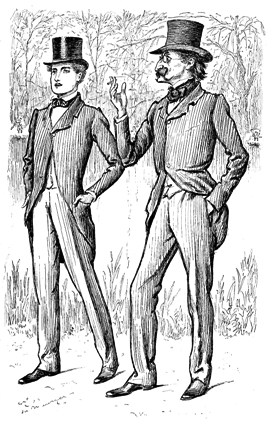
I have a vague but pleasant impression of that year. Its weathers, its changing seasons, its severe frosts, with Sunday skatings on the dangerous canals, St.‑Ouen and De l'Ourcq; its genial spring, all convolvulus and gobéas, and early almond blossom and later horse‑chestnut spikes, and more lime and syringa than ever; its warm soft summer and the ever‑delightful school of natation by the Isle of Swans.
This particular temptation led us into trouble. We would rise before dawn, Barty and Jolivet and I, and let ourselves over the wall and run the two miles, and get a heavenly swim and a promise of silence for a franc apiece; and run back again and jump into bed a few minutes before the five‑o'clock bell rang the réveillé.
But we did this once too often—for M. Dumollard had been looking at Venus with his telescope (I think it was Venus) one morning before sunrise, and spied us out en flagrant délit; perhaps with that very telescope. Anyhow, he pounced on us when we came back. And our punishment would have been extremely harsh but for Barty, who turned it all into a joke.
After breakfast M. Mérovée pronounced a very severe sentence on us under the acacia. I forget what it was—but his manner was very short and dignified, and he walked away very stiffly towards the door of the étude. Barty ran after him without noise, and just touching his shoulders with the tips of his fingers, cleared him at a bound from behind, as one clears a post.
M. Mérovée, in a real rage this time, forgot his dignity, and pursued him all over the school—through open windows and back again—into his own garden (Tusculum)—over trellis railings—all along the top of a wall—and finally, quite blown out, sat down on the edge of the tank: the whole school was in fits by this time, even M. Dumollard—and at last Mérovée began to laugh too. So the thing had to be forgiven—but only that once!
Once also, that year, but in the winter, a great compliment was paid to la perfide Albion in the persons of MM. Josselin et Maurice, which I cannot help recording with a little complacency.
On a Thursday walk in the Bois de Boulogne a boy called out "À bas Dumollard!" in a falsetto squeak. Dumollard, who was on duty that walk, was furious, of course—but he couldn't identify the boy by the sound of his voice. He made his complaint to M. Mérovée—and next morning, after prayers, Mérovée came into the school‑room, and told us he should go the round of the boys there and then, and ask each boy separately to own up if it were he who had uttered the seditious cry.
"And mind you!" he said—"you are all and each of you on your 'word of honor'—l'étude entière!"
So round he went, from boy to boy, deliberately fixing each boy with his eye, and severely asking—"Est‑ce toi?" "Est‑ce toi?" "Est‑ce toi?" etc., and waiting very deliberately indeed for the answer, and even asking for it again if it were not given in a firm and audible voice. And the answer was always, "Non, m'sieur, ce n'est pas moi!"
But when he came to each of us (Josselin and me) he just mumbled his "Est‑ce toi?" in a quite perfunctory voice, and didn't even wait for the answer!
When he got to the last boy of all, who said "Non, m'sieur," like all the rest, he left the room, saying, tragically (and, as I thought, rather theatrically for him):
"Je m'en vais le cœur navré—il y a un lâche parmi vous!" (My heart is harrowed—there's a coward among you.)
There was an awkward silence for a few moments.
Presently Rapaud got up and went out. We all knew that Rapaud was the delinquent—he had bragged about it so—overnight in the dormitory. He went straight to M. Mérovée and confessed, stating that he did not like to be put on his word of honor before the whole school. I forget whether he was punished or not, or how. He had to make his apologies to M. Dumollard, of course.
To put the whole school on its word of honor was thought a very severe measure, coming as it did from the head master in person. "La parole d'honneur" was held to be very sacred between boy and boy, and even between boy and head master. The boy who broke it was always "mis à la quarantaine" (sent to Coventry) by the rest of the school.
"I wonder why he let off Josselin and Maurice so easily?" said Jolivet, at breakfast.
"Parce qu'il aime les Anglais, ma foi!" said M. Dumollard—"affaire de goût!"
"Ma foi, il n'a pas tort!" said M. Bonzig.
Dumollard looked askance at Bonzig (between whom and himself not much love was lost) and walked off, jauntily twirling his mustache, and whistling a few bars of a very ungainly melody, to which the words ran:
"Non! jamais en France, Jamais Anglais ne règnera!"
As if we wanted to, good heavens!
(By‑the‑way, I suddenly remember that both Berquin and d'Orthez were let off as easily as Josselin and I. But they were eighteen or nineteen, and "en Philosophie," the highest class in the school—and very first‑rate boys indeed. It's only fair that I should add this.)
By‑the‑way, also, M. Dumollard took it into his head to persecute me because once I refused to fetch and carry for him and be his "moricaud," or black slave (as du Tertre‑Jouan called it): a mean and petty persecution which lasted two years, and somewhat embitters my memory of those happy days. It was always "Maurice au piquet pour une heure!"... "Maurice à la retenue!"... "Maurice privé de bain!"... "Maurice consigné dimanche prochain!" ... for the slightest possible offence. But I forgive him freely.
First, because he is probably dead, and "de mortibus nil desperandum!" as Rapaud once said—and for saying which he received a "twisted pinch" from Mérovée Brossard himself.
Secondly, because he made chemistry, cosmography, and physics so pleasant—and even reconciled me at last to the differential and integral calculus (but never Barty!).
He could be rather snobbish at times, which was not a common French fault in the forties—we didn't even know what to call it.
For instance, he was fond of bragging to us boys about the golden splendors of his Sunday dissipation, and his grand acquaintances, even in class. He would even interrupt himself in the middle of an equation at the blackboard to do so.
"You mustn't imagine to yourselves, messieurs, that because I teach you boys science at the Pension Brossard, and take you out walking on Thursday afternoons, and all that, that I do not associate avec des gens du monde! Last night, for example, I was dining at the Café de Paris with a very intimate friend of mine—he's a marquis—and when the bill was brought, what do you think it came to? you give it up?" (vous donnez votre langue aux chats?). "Well, it came to fifty‑seven francs, fifty centimes! We tossed up who should pay—et, ma foi, le sort a favorisé M. le Marquis!"
To this there was nothing to say; so none of us said anything, except du Tertre‑Jouan, our marquis (No. 2), who said, in his sulky, insolent, peasantlike manner:
"Et comment q'ça s'appelle, vot' marquis?" (What does it call itself, your marquis?)
Upon which M. Dumollard turns very red ("pique un soleil"), and says:
"Monsieur le Marquis Paul—François—Victor du Tertre‑Jouan de Haultcastel de St.‑Paterne, vous êtes un paltoquet et un rustre!..."
And goes back to his equations.
Du Tertre‑Jouan was nearly six feet high, and afraid of nobody—a kind of clodhopping young rustic Hercules, and had proved his mettle quite recently—when a brutal usher, whom I will call Monsieur Boulot (though his real name was Patachou), a Méridional with a horrible divergent squint, made poor Rapaud go down on his knees in the classe de géographie ancienne, and slapped him violently on the face twice running—a way he had with Rapaud.
It happened like this. It was a kind of penitential class for dunces during play‑time. M. Boulot drew in chalk an outline of ancient Greece on the blackboard, and under it he wrote—
"Timeo Danaos, et dona ferentes!"
"Rapaud, translate me that line of Virgil!" says Boulot.
"J'estime les Danois et leurs dents de fer!" says poor Rapaud (I esteem the Danish and their iron teeth). And we all laughed. For which he underwent the brutal slapping.
The window was ajar, and outside I saw du Tertre‑Jouan, Jolivet, and Berquin, listening and peeping through. Suddenly the window bursts wide open, and
A TERTRE-JOUAN TO THE RESCUE!
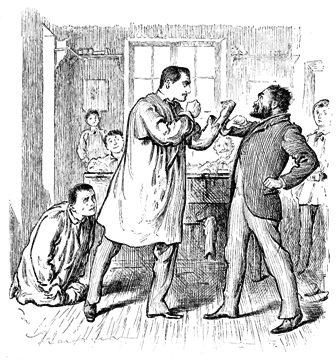
du Tertre‑Jouan vaults the sill, gets between Boulot and his victim, and says:
"Le troisième coup fait feu, vous savez! touchez‑y encore, à ce moutard, et j'vous assomme sur place!" (Touch him again, that kid, and I'll break your head where you stand!).
There was an awful row, of course—and du Tertre‑Jouan had to make a public apology to M. Boulot, who disappeared from the school the very same day; and Tertre‑Jouan would have been canonized by us all, but that he was so deplorably dull and narrow‑minded, and suspected of being a royalist in disguise. He was an orphan and very rich, and didn't fash himself about examinations. He left school that year without taking any degree—and I don't know what became of him.
This year also Barty conceived a tender passion for Mlle. Marceline.
It was after the mumps, which we both had together in a double‑bedded infirmerie next to the lingerie—a place where it was a pleasure to be ill; for she was in and out all day, and told us all that was going on, and gave us nice drinks and tisanes of her own making—and laughed at all Barty's jokes, and some of mine! and wore the most coquettish caps ever seen.
Besides, she was an uncommonly good‑looking woman—a tall blonde with beautiful teeth, and wonderfully genial, good‑humored, and lively—an ideal nurse, but a terrible postponer of cures! Lord Archibald quite fell in love with her.
"C'est moi qui voudrais bien avoir les oreillons ici!" he said to her. "Je retarderais ma convalescence autant que possible!"
"Comme il sait bien le français, votre oncle—et comme
MADEMOISELLE MARCELINE
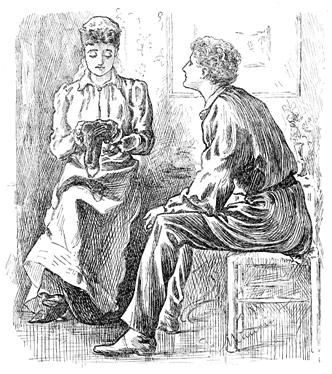
il est poli!" said Marceline to the convalescent Barty, who was in no hurry to get well either!
When we did get well again, Barty would spend much of his play‑time fetching and carrying for Mlle. Marceline—even getting Dumollard's socks for her to darn—and talking to her by the hour as he sat by her pleasant window, out of which one could see the Arch of Triumph, which so triumphantly dominated Paris and its suburbs, and does so still—no Eiffel Tower can kill that arch!
I, being less precocious, did not begin my passion for Mlle. Marceline till next year, just as Bonneville and Jolivet trois were getting over theirs. Nous avons tous passé par là!
What a fresh and kind and jolly woman she was, to be sure! I wonder none of the masters married her. Perhaps they did! Let us hope it wasn't M. Dumollard!
It is such a pleasure to recall every incident of this epoch of my life and Barty's that I should like to go through our joint lives day by day, hour by hour, microscopically—to describe every book we read, every game we played, every pensum (i.e., imposition) we performed; every lark we were punished for—every meal we ate. But space forbids this self‑indulgence, and other considerations make it unadvisable—so I will resist the temptation.
La pension Brossard! How often have we both talked of it, Barty and I, as middle‑aged men; in the billiard‑room of the Marathoneum, let us say, sitting together on a comfortable couch, with tea and cigarettes—and always in French whispers! we could only talk of Brossard's in French.
"Te rappelles‑tu l'habit neuf de Berquin, et son chapeau haute‑forme?"
"'IF HE ONLY KNEW!'"
"Te souviens‑tu de la vieille chatte angora du père Jaurion?" etc., etc., etc.
Idiotic reminiscences! as charming to revive as any old song with words of little meaning that meant so much when one was four—five—six years old! before one knew even how to spell them!
"Paille à Dine—paille à Chine— Paille à Suzette et Martine— Bon lit à la Dumaine!"
Céline, my nurse, used to sing this—and I never knew what it meant; nor do I now! But it was charming indeed.
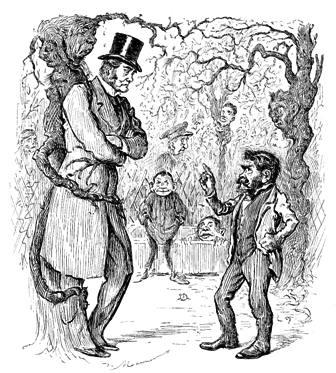
Even now I dream that I go back to school, to get coached by Dumollard in a little more algebra. I wander about the playground; but all the boys are new, and don't even know my name; and silent, sad, and ugly, every one! Again Dumollard persecutes me. And in the middle of it I reflect that, after all, he is a person of no importance whatever, and that I am a member of the British Parliament—a baronet—a millionaire—and one of her Majesty's Privy Councillors! and that M. Dumollard must be singularly "out of it," even for a Frenchman, not to be aware of this.
"If he only knew!" says I to myself, says I—in my dream.
Besides, can't the man see with his own eyes that I'm grown up, and big enough to tuck him under my left arm, and spank him just as if he were a little naughty boy—confound the brute!
Then, suddenly:
"Maurice, au piquet pour une heure!"
"Moi, m'sieur?"
"Oui, vous!"
"Pourquoi, m'sieur!"
"Parce que ça me plaît!"
And I wake—and could almost weep to find how old I am!
And Barty Josselin is no more—oh! my God!... and his dear wife survived him just twenty‑four hours!
Behold us both "en Philosophie!"
And Barty the head boy of the school, though not the oldest—and the brilliant show‑boy of the class.
Just before Easter (1851) he and I and Rapaud and Laferté and Jolivet trois (who was nineteen) and Palaiseau and Bussy‑Rabutin went up for our "bachot" at the Sorbonne.
We sat in a kind of big musty school‑room with about thirty other boys from other schools and colleges. There we sat side by side from ten till twelve at long desks, and had a long piece of Latin dictated to us, with the punctuation in French: "un point—point et virgule—deux points—point d'exclamation—guillemets—ouvrez la parenthèse," etc., etc.—monotonous details that enervate one at such a moment!
Then we set to work with our dictionaries and wrote out a translation according to our lights—a pion walking about and watching us narrowly for cribs, in case we should happen to have one for this particular extract, which was most unlikely.
Barty's nose bled, I remember—and this made him nervous.
Then we went and lunched at the Café de l'Odéon, on the best omelet we had ever tasted.
"Te rappelles‑tu cette omelette?" said poor Barty to me only last Christmas as ever was!
Then we went back with our hearts in our mouths to find if we had qualified ourselves by our "version écrite" for the oral examination that comes after, and which is so easy to pass—the examiners having lunched themselves into good‑nature.
There we stood panting, some fifty boys and masters, in a small, whitewashed room like a prison. An official comes in and puts the list of candidates in a frame on the wall, and we crane our necks over each other's shoulders.
And, lo! Barty is plucked—collé! and I have passed, and actually Rapaud—and no one else from Brossard's!
An old man—a parent or grandparent probably of some unsuccessful candidate—bursts into tears and exclaims,
"Oh! qué malheur—qué malheur!"
A shabby, tall, pallid youth, in the uniform of the Collège Ste.‑Barbe, rushes down the stone stair's shrieking,
"Ça pue l'injustice, ici!"
One hears him all over the place: terrible heartburns and tragic disappointments in the beginning of life resulted from failure in this first step—a failure which disqualified one for all the little government appointments so dear to the heart of the frugal French parent. "Mille francs par an! c'est le Pactole!"
Barty took his defeat pretty easily—he put it all down to his nose bleeding—and seemed so pleased at my success, and my dear mother's delight in it, that he was soon quite consoled; he was always like that.
To M. Mérovée, Barty's failure was as great a disappointment as it was a painful surprise.
"Try again Josselin! Don't leave here till you have passed. If you are content to fail in this, at the very
"'MAURICE AU PIQUET!'"
outset of your career, you will never succeed in anything through life! Stay with us as my guest till you can go up again, and again if necessary. Do, my dear child—it will make me so happy! I shall feel it as a proof that you reciprocate in some degree the warm friendship I have always borne you—in common with everybody in the school! Je t'en prie, mon garçon!"
Then he went to the Rohans and tried to persuade them. But Lord Archibald didn't care much about Bachots, nor his wife either. They were going back to live in England, besides; and Barty was going into the Guards.
I left school also—with a mixture of hope and elation, and yet the most poignant regret.
I can hardly find words to express the gratitude and affection I felt for Mérovée Brossard when I bade him farewell.
Except his father before him, he was the best and finest Frenchman I ever knew. There is nothing invidious in my saying this, and in this way. I merely speak of the Brossards, father and son, as Frenchmen in this connection, because their admirable qualities of heart and mind were so essentially French; they would have done equal honor to any country in the world.
I corresponded with him regularly for a few years, and so did Barty; and then our letters grew fewer and farther between, and finally left off altogether—as nearly always happens in such cases, I think. And I never saw him again; for when he broke up the school he went to his own province in the southeast, and lived there till twenty years ago, when he died—unmarried, I believe.
Then there was Monsieur Bonzig, and Mlle. Marceline, and others—and three or four boys with whom both Barty and I were on terms of warm and intimate friendship. None of these boys that I know of have risen to any world‑wide fame; and, oddly enough, none of them have ever given sign of life to Barty Josselin, who is just as famous in France for his French literary work as on this side of the Channel for all he has done in English. He towers just as much there as here; and this double eminence now dominates the entire globe, and we are beginning at last to realize everywhere that this bright luminary in our firmament is no planet, like Mars or Jupiter, but, like Sirius, a sun.
Yet never a line from an old comrade in that school where he lived for four years and was so strangely popular—and which he so filled with his extraordinary personality!
So much for Barty Josselin's school life and mine. I fear I may have dwelt on them at too great a length. No period of time has ever been for me so bright and happy as those seven years I spent at the Institution F. Brossard—especially the four years I spent there with Barty Josselin. The older I get, the more I love to recall the trivial little incidents that made for us both the sum of existence in those happy days.
La chasse aux souvenirs d'enfance! what better sport can there be, or more bloodless, at my time of life?
And all the lonely pathetic pains and pleasures of it, now that he is gone!
The winter twilight has just set in—"betwixt dog and wolf." I wander alone (but for Barty's old mastiff, who follows me willy‑nilly) in the woods and lanes that surround Marsfield on the Thames, the picturesque abode of the Josselins.
Darker and darker it grows. I no longer make out the familiar trees and hedges, and forget how cold it is and how dreary.
"Je marcherai les yeux fixés sur mes pensées, Sans rien voir au dehors, sans entendre aucun bruit— Seul, inconnu, le dos courbé, les mains croisées: Triste—et le jour pour moi sera comme la nuit."
(This is Victor Hugo, not Barty Josselin.)
It's really far away I am—across the sea; across the years, O Posthumus! in a sunny play‑ground that has been built over long ago, or overgrown with lawns and flower‑beds and costly shrubs.
Up rises some vague little rudiment of a hint of a ghost of a sunny, funny old French remembrance long forgotten—a brand‑new old remembrance—a kind of will‑o'‑the‑wisp. Chut! my soul stalks it on tiptoe, while these earthly legs bear this poor old body of clay, by mere reflex action, straight home to the beautiful Elisabethan house on the hill; through the great warm hall, up the broad oak stairs, into the big cheerful music‑room like a studio—ruddy and bright with the huge log‑fire opposite the large window. All is on an ample scale at Marsfield, people and things! and I! sixteen stone, good Lord!
How often that window has been my beacon on dark nights! I used to watch for it from the train—a landmark in a land of milk and honey—the kindliest light that ever led me yet on earth.
I sit me down in my own particular chimney‑corner, in my own cane‑bottomed chair by the fender, and stare at the blaze with my friend the mastiff. An old war‑battered tomcat Barty was fond of jumps up and makes friends too. There goes my funny little French remembrance, trying to fly up the chimney like a burnt love‑letter....
Barty's eldest daughter (Roberta), a stately, tall Hebe in black, brings me a very sizable cup of tea, just as I like it. A well‑grown little son of hers, a very Ganymede, beau comme le jour, brings me a cigarette, and insists on lighting it for me himself. I like that too.
Another daughter of Barty's, "la rossignolle," as we call her—though there is no such word that I know of—goes to the piano and sings little French songs of forty, fifty years ago—songs that she has learnt from her dear papa.
Heavens! what a voice! and how like his, but for the difference of sex and her long and careful training (which he never had); and the accent, how perfect!
Then suddenly:
"À Saint‑Blaize, à la Zuecca ... Vous étiez, vous étiez bien aise! À Saint‑Blaize, à la Zuecca ... Nous étions, nous étions bien là! Mais de vous en souvenir Prendrez‑vous la peine? Mais de vous en souvenir, Et d'y revenir? À Saint‑Blaize, à la Zuecca ... Vivre et mourir là!"
So sings Mrs. Trevor (Mary Josselin that was) in the richest, sweetest voice I know. And behold! at last I have caught my little French remembrance, just as the lamps are being lit—and I transfix it with my pen and write it down....
And then with a sigh I scratch it all out again, sunny and funny as it is. For it's all about a comical adventure I had with Palaiseau, the sniffer at the fête de St.‑Cloud—all about a tame magpie, a gendarme, a blanchisseuse, and a volume of de Musset's poems, and doesn't concern Barty in the least; for it so happened that Barty wasn't there!
Thus, in the summer of 1851, Barty Josselin and I bade adieu forever to our happy school life—and for a few years to our beloved Paris—and for many years to our close intimacy of every hour in the day.
I remember spending two or three afternoons with him at the great exhibition in Hyde Park just before he went on a visit to his grandfather, Lord Whitby, in Yorkshire—and happy afternoons they were! and we made the most of them. We saw all there was to be seen there, I think; and found ourselves always drifting back to the "Amazon" and the "Greek Slave," for both of which Barty's admiration was boundless.
And so was mine. They made the female fashions for 1851 quite deplorable by contrast—especially the shoes, and the way of dressing the hair; we almost came to the conclusion that female beauty when unadorned is adorned the most. It awes and chastens one so! and wakes up the knight‑errant inside! even the smartest French boots can't do this! not the pinkest silken hose in all Paris! not all the frills and underfrills and wonderfrills that M. Paul Bourget can so eloquently describe!
My father had taken a house for us in Brunswick Square, next to the Foundling Hospital. He was about to start an English branch of the Vougeot‑Conti firm in the City. I will not trouble the reader with any details about this enterprise, which presented many difficulties at first, and indeed rather crippled our means.
My mother was anxious that I should go to one of the universities, Oxford or Cambridge; but this my father could not afford. She had a great dislike to business—
"'QUAND ON PERD, PAR TRISTE OCCURRENCE, SON ESPÉRANCE, ET SA GAÎTÉ, LE REMÈDE AU MÉLANCOLIQUE C'EST LA MUSIQUE ET LA BEAUTÉ'"
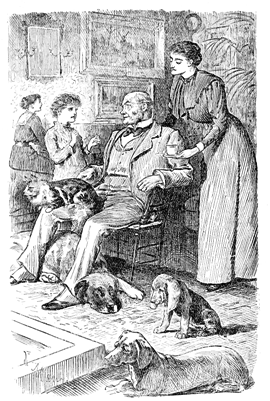
and so had I; from different motives, I fancy. I had the wish to become a man of science—a passion that had been fired by M. Dumollard, whose special chemistry class at the Pension Brossard, with its attractive experiments, had been of the deepest interest to me. I have not described it because Barty did not come in.
Fortunately for my desire, my good father had great sympathy with me in this; so I was entered as a student at the Laboratory of Chemistry at University College, close by—in October, 1851—and studied there for two years, instead of going at once into my father's business in Barge Yard, Bucklersbury, which would have pleased him even more.
At about the same time Barty was presented with a commission in the Second Battalion of the Grenadier Guards, and joined immediately.
Nothing could have been more widely apart than the lives we led, or the society we severally frequented.
I lived at home with my people; he in rooms on a second floor in St. James's Street; he had a semi‑grand piano, and luxurious furniture, and bookcases already well filled, and nicely colored lithograph engravings on the walls—beautiful female faces—the gift of Lady Archibald, who had superintended Barty's installation with kindly maternal interest, but little appreciation of high art. There were also foils, boxing‑gloves, dumbbells, and Indian clubs; and many weapons, ancient and modern, belonging more especially to his own martial profession. They were most enviable quarters. But he often came to see us in Brunswick Square, and dined with us once or twice a week, and was made much of—even by my father, who thoroughly disapproved of everything about him except his own genial and agreeable self, which hadn't altered in the least.
My father was much away—in Paris and Dijon—and Barty made rain and fine weather in our dull abode, to use a French expression—il y faisait la pluie et le beau temps. That is, it rained there when he was away, and he brought the fine weather with him; and we spoke French all round.
The greatest pleasure I could have was to breakfast with Barty in St. James's Street on Sunday mornings, when he was not serving his Queen and country—either alone with him or with two or three of his friends—mostly young carpet warriors like himself; and very charming young fellows they were. I have always been fond of warriors, young or old, and of whatever rank, and wish to goodness I had been a warrior myself. I feel sure I should have made a fairly good one!
Then we would spend an hour or two in athletic exercises and smoke many pipes. And after this, in the summer, we would walk in Kensington Gardens and see the Rank and Fashion. In those days the Rank and Fashion were not above showing themselves in the Kensington Gardens of a Sunday afternoon, crossing the Serpentine Bridge again and again between Prince's Gate and Bayswater.
Then for dinner we went to some pleasant foreign pot‑house in or near Leicester Square, where they spoke French—and ate and drank it!—and then back again to his rooms. Sometimes we would be alone, which I liked best: we would read and smoke and be happy; or he would sketch, or pick out accompaniments on his guitar; often not exchanging a word, but with a delightful sense of close companionship which silence almost intensified.
Sometimes we were in very jolly company: more warriors; young Robson, the actor who became so famous; a big negro pugilist, called Snowdrop; two medical students from St. George's Hospital, who boxed well and were capital fellows; and an academy art student, who died a Royal Academician, and who did not approve of Barty's mural decorations and laughed at the colored lithographs; and many others of all sorts. There used to be much turf talk, and sometimes a little card‑playing and mild gambling—but Barty's tastes did not lie that way.
His idea of a pleasant evening was putting on the gloves with Snowdrop, or any one else who chose—or fencing—or else making music; or being funny in any way one could; and for this he had quite a special gift: he had sudden droll inspirations that made one absolutely hysterical—mere things of suggestive look or sound or gesture, reminding one of Robson himself, but quite original; absolute senseless rot and drivel, but still it made one laugh till one's sides ached. And he never failed of success in achieving this.