THE MARÉCHALE (continued 2)
Reading edition
It was twelve days before the trial came on. The Maréchale was in delicate health, and frequently became sick. The hunger-striking and forcible feeding of these latter days would soon have killed her. She tried to eat, but had little appetite, and what little she had was destroyed by the garlic in the food. Mice disturbed her nights and in the early morning the odours which came from the passages were insupportable. The only way in which she could get any relief was by putting her face between the iron bars of the window and breathing the air which came up from the lake. She was always thankful that her face was thin and just went through the cold bars.
One morning at five or six o'clock she was awakened by happy voices singing dear familiar choruses outside the prison walls. She was very ill, but she dragged herself from her hard bed to the window, waved her hand, and cried "Amen!" Then she attached her handkerchief to a bar, and let it flutter like a flag. The signal was received with shouts of "Amen, Maréchale—be of good cheer—hold on—hallelujah!"
As the time passed, she was thrown in upon herself, and went through a great soul-struggle. She had lately been the victim of a stinging article, grossly ignorant and cruelly unjust, which had appeared in a religious paper, written, rumour said, by the wife of a Swiss pastor. It had accused her of unwomanliness, immodesty, and vanity. She made the painful discovery that she could not yet say, "None of these things move me." The poisoned arrows had gone deep, forcing tears from her eyes and attacking her peace of mind. Chancing to notice a little slate hanging on the wall of her cell, she took it down and began to write on it all the accusations which her enemies might bring against her, asking herself as she did so, "Could you write your name and say you accept that, and that?" Her conscience compelled her to answer "No, there are some things which I could not endure." She was appalled as she thought of more and greater trials which God might ask her to undergo. He might deprive her of health. He might send her to Japan. He might take away her reputation and make it impossible for her to defend herself. Could she bear such things? No, she could not yet sign her name under the terrible words she wrote. With sorrow she put the slate back in its place, and for two days it hung against the wall with its list of cruel things which she could not accept. But during those days she pondered and prayed. She rebuked her doubts and fears. How could she ever distrust her Lord, who had led her with such infinite tenderness? How imagine that He would ever lay upon her more than He would give her power to bear? She soon crept up close to His arms, and realised that nothing was really unbearable except doubt. Taking her slate down, she read over again all that she might be called upon to suffer, and signed "Catherine Booth." Then the Angels of God filled the prison cell; the peace and joy of heaven flooded her soul; and from that hour her communion with her Lord was so sweet that she kissed the walls of her dungeon before she was led forth to her trial.
On that day (September 19) she wrote her exquisite prison song, "Best beloved of my soul," and sent it to her father. It was sung, while she was still in prison, at a great meeting for prayer, in Exeter Hall, at which Mrs. Butler spoke. It was first written in French, the language in which she now habitually thought, and translated by herself into English. The latter is well-known, and many readers will be glad to have the French.
O Toi que mon âme adore,
Je ne suis pas seule ici,
Car je T'y retrouve encore,
Et je suis au ciel ainsi,
Ma vie est à Ton service,
Je T'appartiens sans retour;
Corps et âme en sacrifice,
Je Te suivrai nuit et jour.
Combattons dans la souffrance,
Et les yeux baignés de pleurs;
Bien près est la délivrance,
Voici l'Homme de douleurs!
Sa voix chasse ma tristesse,
Mon chagrin s'est dissipé;
Je chante avec allégresse,
Mon cachot est transformé!
Au milieu de la tempête
Rien ne peut troubler ma paix;
Son amour que rien n'arrête
Peut me garder à jamais.
Le combat est dur, terrible,
L'enfer rugit contre nous;
Mais l'Armée est invincible:
Avec Dieu nous vaincrons tout.
During the twelve days of her imprisonment the Maréchale received many letters of sympathy and good cheer from Swiss friends, whose words proved to her how deep and real had been the work of the Armée du Salut in the country. One of the most interesting was signed by seventy-two mothers, who bore glad testimony to the conversion of their sons and daughters, and two more were signed by a number of wives praising God for the conversion of their husbands.
More intimate letters came to Catherine from home, all breathing warm love, tender solicitude, and ardent hope that good would come out of evil. "I quite see with you," wrote her mother, "as to God's hand being in all this, and it appears that when communities or nations get sodden in sin and darkness, there is no way of arousing them but by such a flashing of the truth in their midst as will provoke persecution. God wants the attention of the people, and this is the best way to secure it, no doubt.... Perhaps you are right about pleading your own cause, only you should have some one at your elbow who knows the law. You will not be up on points of law, I fear, otherwise I have no doubt that God will give you what you should say. I feel it a great thing to have a child in prison for Jesus' sake; there could be only one greater, namely to be there myself; but one would hardly have thought it possible in this age. How true that the devil hates real saints as much as ever he did, and that the spirit of persecution only needs the real presence of the Spirit of God to call it forth.... That the Lord comfort and keep you and reveal Himself to you more and more and make you a mother of nations, prays your loving and sympathising mother.
"Catherine Booth."
The next letter admirably reveals both the father's and the General's heart. With the deepest concern for his beloved daughter there is combined a lively sense of the fact that his enemies are overreaching themselves and doing him and his cause the greatest possible service. He wrote: "My darling, no one can tell the anxieties we have all gone through concerning you during this week.... We were awakened by telegraph messenger with a wire from Geneva to say 'Blücher detained till trial. Patrick with her—cared for.' The last sentence fills us with relief. We interpret it to mean Patrick is with you as your secretary or maid, and you have all your wants supplied and no hardships.... Enclosed is this morning's Times. All the papers have notices of it, so that it is flying all over the world. If you do not suffer in your health, I don't care. It will all work for good. But your health is of more importance to me in my estimation than all Switzerland. If you can only get assurance of this! I am all uncertain whether this will reach you. There will be a storm directly and no mistake if these Swiss go on at this rate. We all send you all our heart's love and heaps of prayers and sympathy. God bless and keep you! Remember me to Lieut. Patrick.
"Your affectionate father,
"William Booth."
Mrs. Bramwell Booth, who as Miss Florence Soper had been one of the Maréchale's first comrades in Paris, wrote her: "I feel as if you had mounted away to a land where I can call you 'Katie' no more. But I will say, and I do say in my heart of innermost hearts, my Saint Catherine, counted worthy to suffer.... If only I could beseech you to remember that your health is everything. This is the dawning of a glorious morning in your work—the forerunner of a glorious victory. Will you send some word through Patrick of the whole truth—just let me know—-just your Flo—if it is as bad as a prison cell, and is it doing your body the least bit of harm? ... I wish you could know, in your solitude, how we all love you—I wish the breezes over the lake could bring you some whispers of what we have said of you. The glorious God is our God for ever and ever, and His chariots of fire are with you—His invisible army is around you. Your own Flo. 20. 9. '83."
Her sister Emma, who was now at the head of the Training School at the Congress Hall, wrote: "What can be said at such times compared with what is felt? I will not attempt to write. I am praying. All hearts here hold you up ceaselessly—your example is before us! In the night and the day I am with you—in your sorrow I find your joy in what is to come out of all. 'They know not what they do,' and out of their very efforts to hinder and stop God's work shall it spread beyond restraint. The loss is great, my precious sister, but the reward will be infinitely greater, and in both you will have been allowed to share. It would have been easier to be with you, but I'll fight harder than ever in my corner here. Filled with deepest sympathy and yearning desire for His kingdom to come in Switzerland! Devotedly, Emma. PS. It is your back I most tremble for—your poor back! I wonder if you have pillows. Bless your dear little Pattie [Miss Patrick]. Oh, each moment I am with you! JESUS is—He does love and choose and will honour you!"
Among those who wrote to the prisoner was George Railton,[1] whom she regarded almost as an elder brother. He had lived with the family during her childhood, and when she was a girl of twelve and onwards she used to get up at six in the morning—slipping downstairs on her bare feet in order not to awaken mother—to have a Bible lesson with him. She always regarded the talks in those morning hours as among the great formative influences in her life. Railton, who became the General's first commissioner, watched her career with profound and affectionate interest. He wrote on September 25: "Dear Maréchale Prisoner, I have just come from that tremendous prayer meeting [in Exeter Hall, held as a protest against her imprisonment], one of the biggest and best this world has ever seen.... The way the volleys burst out at the right time and went ringing all round the Hall sounded splendid. And the sight of thousands standing up to give themselves to God, hundreds and hundreds for foreign service, and all for service somewhere, was magnificent.... My impression is that as they [the Swiss] have outraged law all along they may very likely do it when it comes to sentence.... God only knows what is coming next, but anyhow we shall win."
[1] Since these pages were written, this remarkable man has died—as he wished—with his armour on, and been "promoted to glory."
Towards the end of her imprisonment Catherine wrote: "God will open the door for us through this storm. My will is God's. All I want is to accomplish His desire for the world. Do not worry at all. Jesus is here. There is such wonderful victory ahead that all my cry is, Lord, make us equal to it!—ready in every way! Ever fighting, in jail as well as on the field, following on to know Him. I have been looking at that wonderful sight—Calvary. I must ever live in sight of it."
The trial took place at Boudry on Saturday the 25th and Monday the 27th September. It excited the greatest interest in Switzerland and far beyond it. The Journal de Genève said: "This prosecution at Boudry has an immense political significance in the highest sense of that word, and the decision, whatever it may be, will take its place in the history of Republican rights." Even the most sanguine scarcely hoped for the acquittal of the accused. But the unexpected happened, and the triumph of righteousness was a woman's triumph.
The Public Prosecutor spent much time in proving that Salvationists were mountebanks and fanatics. A young Englishwoman had flung an insult in the face of the Grand Council, accusing them of violating the constitution. Her contempt for the law was the more surprising as the English never rebel against the law, however unjust it may be (!). If the Armée du Salut was not suppressed they would have to enlarge their asylums. Christ, who was, perhaps, the most religious man who ever lived, favoured private rather than public prayer. Silent communion with God was better than getting up and shouting "I am saved!" While the accused placed herself above the law, the Queen of England was obliged to submit to Acts of Parliament. Having not only ignored, but deliberately violated the decree, the Salutistes must bear the consequences, and no doubt they would be happy to receive the crown of martyrdom!
On the second day of the trial, after a speech in the defence by M. Monnier, the Maréchale rose to plead her own cause. Though she had passed twelve days in prison, and sat many hours in the suffocating atmosphere of a crowded court-house, she overcame her exhaustion, her spirit subduing the frail body. She had been accustomed to face great crowds since she was sixteen, and she was never more completely master of herself or her audience than she was in that critical hour. Her voice was never clearer, nor her manner more commanding. Her brother Herbert, who was in the court, said he was amazed at her power. As she pleaded the cause of religious liberty, her hearers felt that she had not come to be judged but for judgment upon them all. Some extracts will serve to indicate the quality of her speech.
"What is the need of the Armée du Salut? Allow me to read a passage from one of your own journals: 'Cantonal Governments will see with alarm the flood of demoralisation rising menacingly higher and higher; and instead of seeking to destroy the causes of this deluge, they only take away the remaining dams.' It is needless to enlarge on the necessity for an Armée du Salut in the face of these facts.
"The Prosecutor has said, in speaking of the work, that it moved the entire population, and that there must be a cause for this. He has reason to say so. I agree with him; there must be a cause, far deeper than any that has been mentioned here to-day. It is at this cause that we strike—which exists in the heart of man.
"As to our aim, we are trying to bring these people who outrage your laws, who fight against God, to the feet of Him who alone can change them, to the only hope that exists for them, the Saviour of the world. We work, we live, we suffer to do this. This is our one hope and object—to bring the world to the great Deliverer, Jesus Christ.
"Ah! The question of all questions, the question which every intelligent man ought to face, is—What are we to do with the masses? If they are not reached by the power of the Gospel, a day will come when they will turn round against you, occasioning terrible trouble and disorder, and awful will be the consequences. Then, gentlemen, you will have reason to regret your action in this matter. If these disturbers are capable of manifesting such hatred, such rage against citizens who pray to God, they will also be capable of manifesting the same rebellious spirit against any other opinions, or any other law, which may not please them.
"We have not made the people like this. Bear in mind that we have not created this terrible state of barbarism, which was let loose around that hall, and which has made my heart bleed many times in witnessing. Who is responsible for this? We cannot be, for we have only been in your town a few months.
"Although we have suffered terribly through misrepresentations that have been wilfully circulated about us, we are not discouraged! We know that truth and justice will soon triumph. I love Switzerland all the more for what we have endured (Applause). A little while and Switzerland will love us. We shall win thousands to righteousness, peace and heaven.
"The Prosecutor referred to the Queen saying that even she was subject to the decrees of Parliament, but that I placed myself above her in refusing to become subject to the decrees of the Grand Council. There is no parallel between Her Majesty and myself. No act has been passed to forbid her praying in a wood, or I think Her Majesty would have something to say on that subject (Sensation).
"One word in conclusion. You may punish us; you may imprison us; you may prosecute us as long as you are permitted; but what you cannot do is to stop this work—to suppress it. Beware what you do for your country's sake, for Jesus Christ's sake. Take care that in banishing us you do not banish the light, that you do not banish Jesus Christ, and in that great day when you are called to give an account you be found guilty of fighting against God."
Such pleading was irresistible. The jury had not the courage to enforce the law. To their honour, they let themselves be swayed by considerations of equity. They found that while the accused had violated the decree she had not acted with "culpable intention." In consequence of this verdict she was acquitted. The sentence was received by her friends in the court with a burst of fervent "Amens." And the Maréchale deserved the thanks of every Swiss patriot. By her bold and successful claim of right she had made history. At a time when the old Republic was forgetful of its noblest traditions, untrue to itself, she restored its ideal. She vindicated for every man and woman freedom to worship God according to their conscience. She brought back to the hills and valleys of Switzerland the crown rights of the Redeemer.
No one appreciates or speaks more enthusiastically to-day than the Maréchale of the devotion and bravery of her comrades, Colonel Clibborn first and foremost, and spiritual children at this time.
CHAPTER VI
THE SOUL OF FRANCE
It is not easy to reach the ideal and spiritual elements of character which are masked by the light laughter or the polite scorn of the typical Frenchman, who believes, or pretends to believe, that religion is only for priests and women. At the opening of a new hall in the Rue Oberkamff, a big fellow shook his fist in the Maréchale's face and said, "An Englishman may accept religion—a German—or a heathen, but a Frenchman—never!" "O God, if You exist, save my soul, if I have one!" was the prayer of another man, who had attended the meetings for some time, and who indicated with a strange pathos the bewildered state of mind into which many of the educated, as well as the ignorant, had sunk. "Let there be no mistake," said a French writer, Louise de Croisilles; "it is by no means unnatural that the Army should have taken root in India, or even under Africa's burning sun, but that it should be accepted in Paris, the centre of free-thought and unbelief, that is a thing incredible."
Nevertheless the Frenchman suffers from "the malady of the ideal," even as other men. His heart is restless until it rests in God, and it is sheer faithlessness to say that he cannot be won by the grace of God. If he is sceptical, it is because he has no conception of the fascinating loveliness of Christianity; if he is a scoffer, it is because he has never come in contact with human lives which suggest to him the infinite goodness of God.
After the Maréchale's great legal victory, which was really a triumph of the Gospel over its enemies, she returned to Paris and quietly resumed her tasks. She was in nowise changed, though public opinion regarding her was undoubtedly changed. She had become a person of note. Editors of newspapers and magazines sent reporters to her meetings at the Quai de Valmy, or at the new headquarters in the Rue Auber, and found piquant accounts of her sayings and doings to be excellent copy. Visitors to the city came to hear her. Artists begged for the honour of painting her portrait for the Salon, an honour which she steadily refused. The son of Garibaldi invited her to visit Italy, where, he said, she would be welcomed and not treated as she had been in Switzerland. None of these things, however, moved her. As she had promised God in her prison that she would never be depressed by the calumnies of men, so now she prayed that she might never be elated by their praises. With a stronger faith and a more ardent hope, she plunged again into absorbing work. One sees that she worked with her imagination; that she obeyed her intuitions; that she proved the originality and inventiveness of love; and her efforts were so rewarded that 1884 was her annus mirabilis, at the end of which she wrote: "Can you imagine the bewilderment that comes over me when I sit down to convey some idea of the wonderful way in which God has led and helped us during the year? ... It is not too much to say that during the past twelve months we have passed from the position of a small and almost unknown mission to that of a great spiritual power, recognised and felt throughout France and Switzerland."
A series of fresh inspirations contributed to this result. The first of these was the visitation of the cafés of Paris. One winter night the Maréchale and two young comrades, Blanche Young and Kate Patrick, went out with shawls on their heads, and made their way to one of the boulevard cafés. The leader passed the door, and passed it again. She turned to her lieutenants and said, "You have never known your Maréchale till now; you see what a coward she is!"
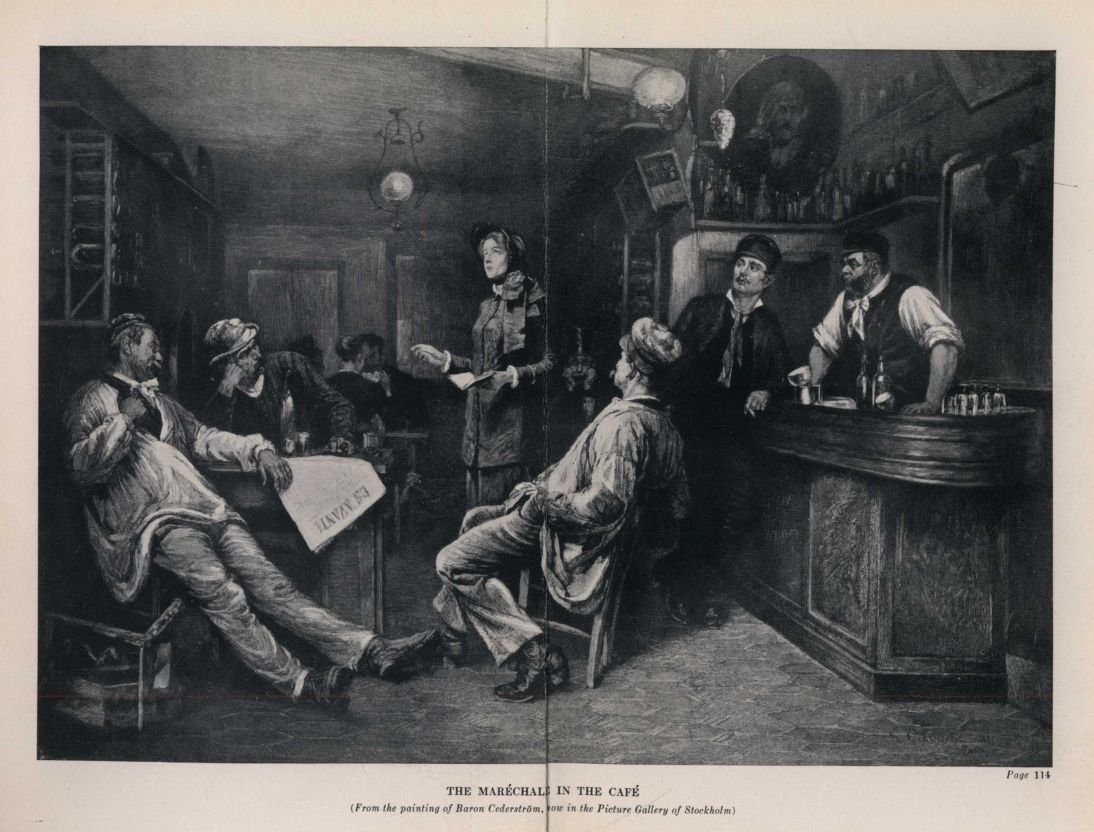
THE MARÉCHALE IN THE CAFÉ (From the painting of Baron Cederström, now in the Picture Gallery of Stockholm)
"No, no, no!" they both protested.
At last she put her hand on the door, pushed it open, and went in. A man in a white apron was selling drink. Going up to him, she said, "May I sing something?"
He stared open-mouthed.
Trembling from head to foot, she repeated, "I should like to sing something."
"Very well!"
She began:
"Le ciel est ma belle patrie,
Les anges y font leur séjour;
Le soldat qui lutte et qui prie
Y sera bientôt à son tour."
While she sang, Blanche chimed in with her guitar and her second voice. As they proceeded, the smoking, drinking, and card-playing ceased, and every face was turned towards them. They sang on:
"En marche, en marche,
Soldats, vers la patrie!
En marche, en marche,
Soldats, vers la patrie!"
When they had finished the hymn, the Maréchale thanked her audience, adding that they could hear her again at Rue Auber Hall; and that she knew a Friend, of whom she wished to tell them. As she and her comrades turned to walk out, the man in the white apron bowed, as if they had done him a service.
"May I come another time?" said the Maréchale.
"Certainly, Mademoiselle!"
They visited sixteen cafés that night, and when she got home she felt she had never been happier in her life, never nearer to Jesus. She had tried in her own way to obey His command, "Let your light shine before men." Since then, thousands and thousands of cafés have been visited, and much good has thus been done. Let one case stand for many.
There used to be a well-known resort in Paris called the Café de l'Enfer, the windows and walls of which were painted with lurid scenes representing hell. There rouged and powdered singing girls entertained people of the dare-devil type, who sat drinking and smoking at little tables. From an open coffin a grim skeleton stared at everybody, and prizes were given for the most audacious witticisms about death. The more outrageous the blasphemies were, the louder were the roars of applause with which they were received.
But the Maréchale and her young lieutenants, "armed in complete steel"—the panoply of God—were not afraid of the gates of hell. Having obtained permission to sing, they mounted the estrade, and rendered some of their most attractive part-songs. The café orchestra at once took up the airs as if it had been paid to do so. The songs of Paradise were well received even in those regions, and then the Maréchale, stepping forward, made a little speech:
"You are very clever here. You play very well. But it is a rôle that you play. Your laughter is not real; I can tell you the source of true laughter and true joy. This is not life, it is death; I can tell you what real life is. This is not peace, it is an effort to drown care and forget trouble; I can tell you the secret of peace. Let me give you my address, where you can hear us sing again."
It required as much moral courage to deliver that speech as to face all the jurists of Helvetia.
When the Maréchale was leaving, she passed a lovely girl, in whose ear she whispered, "What are you doing here? you ought to be in bed."
"Who will give me a supper or a bed?" the girl plaintively asked.
"I will!" exclaimed the Maréchale; "come with me, quick!"
She hailed a cab, put the girl in, and drove away. The poor child, eighteen years of age, had a sad tale to tell. She had noble blood in her veins, and her mother and she had both been cruelly wronged. The Maréchale led her to Christ and ultimately secured for her a position in one of the best colleges of America, where she was universally respected. Not long after she was installed there, she sent the Maréchale 500 francs, with the pathetic message, "Save another, as you saved me."
The Maréchale's methods naturally gave offence to those who had not the courage to adopt them. Late one night she and some comrades were standing at the door of a theatre while it was emptying. One of her young officers cried in clear, penetrating tones, "Prepare to meet thy God!" The words seemed to send an electric shock through the gay crowd. Thereupon a gentleman came forward to the Maréchale and said:
"Mademoiselle, you are evidently young girls of good family, and I am scandalised to see you here at this hour. I, too, occupy myself with preaching, but I am shocked at your behaviour."
"Really?" she replied, "and I am scandalised that you are scandalised. You profess to believe the Gospel. How are you to get these indifferent tens of thousands to hear of the Saviour? They won't come to listen to you. What more natural and more in accord with the principles of Jesus, than to go to them and compel them to hear?"
Ten minutes after, the gentleman returned and slid a five-franc piece into her hand, saying:
"It is you who are right!"
It was impossible for young girls to be in the boulevards towards midnight without being sometimes molested. But the leader would instruct her soldiers thus: "If they say the vilest things in the world to you, remember that is only the outside. Think of their souls which cost so dear to Christ. Say one or two sentences that will remain with them, and pass on."
More than once she proved this method of dealing to be very effective. In a corner of one of the boulevards a "gentleman" approached her and asked for a rendezvous. She looked at him in silence, which he took for consent.
"Where?" he asked, taking out his pencil and note-book.
"Devant le Trône de Dieu!" (Before the Throne of God!)
The man took to his heels, and ran.
That went all over France. One day the same sword will pierce the conscience of every roué in the universe.
The Maréchale's second original idea was to begin a series of Conférences (Meetings) in the fashionable Lecture Hall of the Boulevard des Capucines. Her increasing popularity only deepened her sense of duty to the city of her adoption, and suggested to her the possibility of bringing Christ to the Boulevards as well as to the Villette. She could not live in gay Paris without profoundly pitying the thoughtless, infidel Rich, for whom it is proverbially so hard to enter the kingdom of heaven. Her idea of attacking the central stronghold of the world's fashion and pleasure was a daring one for a woman, especially for a woman of the Maréchale's youthful years. About this time she read the Life of Napoleon, and found in his astonishing career many lessons for an evangelist. She was especially struck by his faith in his star, and his contempt for "ce bête de mot, impossible." She knew that she had something better to trust than a star, and stronger reason for holding that all things are possible.
Her new plan of campaign was great alike in its conception and its execution. From the very first the Conférences for men were astonishingly successful, and they were renewed year after year. The audiences were very different from a Keswick or Northfield congregation, in which the preaching is mostly to the converted. Perhaps the best parallel to the Maréchale's Conférences is to be found in Professor Drummond's Sunday evening meetings for students (men only) in the Oddfellows Hall, Edinburgh, which, by a strange coincidence, began in the same year. Having enjoyed the friendship of both these evangelists, and listened to them many scores of times, I have often been forcibly struck by their likeness to each other, and for power to rivet the attention and inspire the confidence of cultivated men of the world I have met nobody to compare with them.
When the Maréchale came to hold her first Conférence, the proprietor of the hall entered her ante-room and advised her to deliver a sort of ethical lecture, rather than speak of salvation, as it was the worldly fashionable public who would assemble, and he was afraid they would not be pleased if they heard too much of religion. But they listened with rapt attention while she spoke on the text "Without God and without hope in the world." Of the second Conférence Galignani's Messenger said, "The subject, 'The Greatest Sin,' was treated with a force of religious arguments which made a visible impression on many persons in the audience. The attention was deep and respectful. The Hall was crowded, and the doors were vainly besieged by a numerous crowd, the greater part of whom remained outside the open windows to hear the address." Another leading journal said, "She has profoundly astonished the citizen sceptic, who has been out of the habit of being astonished for a long time."
Her brother Ballington was present at a later meeting, and described the impression made on himself as one who did not know French. "I had to cover my face more than once while our Maréchale spoke. Her words, though in a foreign language, yet seemed understandable. The Spirit does not confine Himself to words alone. He speaks through the countenance, and eyes, and hands—He fills the Temples of His children. Three things struck me in that meeting: first, the rapt attention and interest of the audience, and there seemed few who were not impressed at the close; second, the manner in which the people remained in the after-meeting on to the end; third, the utter amazement, and yet perfect solemnity of the congregation, when some sinner came up through the aisles to seek peace, even rising as though to make sure that what they saw was a fact." Then he adds—and one notes the beautiful transition—"I was also present and took part in meetings at Paris in which the very poorest were attending by hundreds, and at which I saw men of the vilest caste and life getting saved." No small part of the Maréchale's charm lay in her flexibility and adaptability—her Pauline habit of becoming all things to all men—to the rich and to the poor, to the wise and to the unwise—that she might win some.
At a later time the Maréchale delivered somewhat similar addresses in other cities of France such as Nîmes, Marseilles, Havre, Rouen, Lyons—and she was everywhere astonished to find that the French, who seem the most thoughtless, are yet among the most thoughtful people in the world. The result of such Conférences as these cannot be tabulated. For one thing, they made the Maréchale more than ever a mother-confessor and spiritual director. The thoughts of many hearts were revealed to her at private interviews of which no record was kept, and in letters, one of which may be given as containing the secret of the Maréchale's power—her possession of Christ's Spirit—a second as showing the abyss of doubt from which many of her hearers had to be rescued, and some others as indicating the wonderful success which often attended her efforts.
The first runs as follows: "I am glad you accept my request to visit my home. You will consider the intention in asking you to come under my roof, like One before you, who had the noblest Heart which ever beat for mankind. It is because this Great Heart has possessed yours to the degree of rendering you like Himself, that you have profoundly moved me and made me better. Certainly I will speak with you on these vital subjects, but I need more and more the moral and spiritual atmosphere of the meetings: this opens the heart and at the same time deadens the opposition of the mind. Oh, if the latter could hold its peace! ... I have lived much in solitude, and naturally these problems have been always with me. I may say that the Infinite has tortured me for twenty years: lately I have arrived at the conclusion that one can know nothing. So I shall be glad to speak with you and at length."
A second correspondent wrote: "Your marvellous faith, your simple and powerful eloquence so deeply moved me that I cannot but thank you. I thank you as an artist, as a sincere admirer of beautiful work, of great characters; I thank you as a man blasé, sceptical, benumbed and deadened. As a child I adored Jesus, and now, after having thought much and suffered infinite pains which you cannot understand, I have said adieu to faith and also adieu to hope! I have become one of those you call sceptics. Ah! do not say 'terrible' sceptic, but unfortunate, pitiable, unhappy sceptic. You are, Madame, a great, beautiful, generous heart, and if ever earnest good wishes have been worth anything, I have cherished them for you, your work, and those who fight by your side. You will believe me, an unbeliever, who envies you, admires you, and ideally loves you."
A third of her hearers wrote succinctly: "Two of your meetings have sufficed to destroy infidel convictions of twenty years' standing."
A fourth, after testifying to his respect and confidence, said: "What your soul yearns for is conversion. You would like me to add, I am converted. I cannot say that I am. But you have made an incredible impression on me, and you have made me love the Christ I never loved." He evidently could not rest there, and soon he sent a second letter, describing with thankfulness how one night, in prayer and agonising mental controversy, he had received a manifestation of the Holy Spirit, which had finally slain his doubt and made him a believer in God.
The twofold purpose of the Conférences was to conquer the feelings and tastes, the etiquette and conventionality, of people of the world, and to awaken faith in unbelievers. One day a very bad man thrust some bank-notes into the Maréchale's hand, saying while he did so:
"I believe in nothing."
"You believe in nothing, and yet you give me these bank-notes!"
He replied, "I believe in you, and I wish you had a hall in every town and hamlet and village in my country."
"Pull out your watch," she said. "I believe in your watch, I believe that it keeps time, but I do not believe in its maker! ... I am naturally just as great a lover of ease and comfort as you are. The motive power—la force motrice—of my life, the spring upon which everything turns, is the love of Christ. You believe in me; believe in Him who has made me what I am."
The Maréchale's third new departure was perhaps the most important of all—the founding of an École Militaire, or school for cadets, somewhat similar to the Military School at Clapton, over which her sister Emma at that time presided. When Catherine first went to France, a very noted Protestant pastor said to her, "You will never get three Frenchwomen to live together in peace." But at the Training Home, Avenue Lumière 3, in the Villette, where the Maréchale lived all the year round with her officers, there were as many as forty or fifty young women—among whom, at one time, a Princess's daughters were side by side with scullery maids—and the harmony, the love, the spirit of "never mind me," which prevailed was one of the miracles of the work in France.
To the training of company after company of young cadets—French, Swiss, English, Belgian, German, Italian and Russian—the Maréchale gave a great deal of her time and strength, her pattern being ever our Lord's own training of the Twelve. All obeyed her joyfully and without question. She realised intuitively that the highest thing in training is not discipline, but something which discipline follows as light follows the sun. That something is the spirit, the atmosphere, which men and women are brought into and which transforms them. In the École Militaire it was the selflessness of people who did not care what became of them. Where that spirit takes possession of any one, there is no need to say to him, "You shall do this or that." The law of the spirit of life makes him obedient without constraint.
The spirit of the Maréchale's leadership is somewhat expressed in Garibaldi's call to arms often quoted by her. His followers understood his motives, realised his disinterestedness, saw that rewards and honours were nothing to the man who was seeking the Liberty of Italy. Therefore they loved him so much that they would have died for him. There was no marked difference between the Staff and the Field, and yet there was discipline, obedience, devotion such as the world has scarcely ever seen equalled.
That was the spirit which the Maréchale sought to impart to the École Militaire. Everything else—how to study the Bible, how to conduct meetings, how to use the voice, how to deal with souls—was subordinated by her to the one thing needful—the spirit of sacrifice. "We are sometimes told," she once wrote, "that our uniforms, our young women speaking in public, our tambourines and our processions bring contempt upon religion. It is a mistake. That which is the laughing-stock of the world and of hell is a religion without sacrifice. People will never believe in Christians who, while professing to be disciples of Him who had not where to lay His head, live in luxury, seek first the comfort of their family, the health and position of their children, and let their souls perish for lack of that Gospel which they profess to believe. There is the secret of the unbelief of France; that is what makes the young who are in search of the truth cry 'Comedy!' On the other hand, those faces which radiate the light from on high, those young people who rise up to give themselves to God instead of the world, those men and women who declare, with a sincerity which leaves no room for doubt, that they consecrate their life to God for the saving of souls, are more eloquent than the most beautiful discourses."
The faces of officers and cadets who surrounded the Maréchale on her platform undoubtedly constituted a large element of her power. Renée Gange, the Socialist, wrote a fine appreciation of her and her comrades, in which she confesses that what she finds "remarkable among these young girls, pretty as well as plain, is the complete absence of the ordinary feminine expression.... In looking with searching, scrutinising eye at the faces enveloped in this ugly bonnet, we have not deciphered the least vestige of this expression, neither timidity, nor awkwardness, nor restlessness, nor the consciousness that people are thinking of them. Nothing. These faces are the free faces of free creatures."
One day a French Baron, who had received a great blessing at the Maréchale's Conférences, said to her in the great hall at the Rue Auber, "What you lack here is pictures; for instance, the saints. Those beautiful faces, with their sweet celestial expressions, diffuse a sentiment of reverence and quietness, and they would form such a beautiful background to you. You should have the Virgin, and Saint Francis, and many others. That is what you lack in all your halls: could we not do something?"
"Baron," said the Maréchale, "will you come here next Sunday evening?"
"Yes, certainly. Are you going to speak?" He never lost a chance of hearing her.
"Yes; be sure you do not miss it."
Next Sunday evening she marshalled her little group of officers. She filed them in, men on one side, women on the other. She stood in the midst of them and spoke. At the end of the meeting the Baron came forward.
"Maréchale," he said, "you have no need of pictures. Those figures! those faces! they are your pictures."
Her friend Frank Crossley was greatly struck by this incident. He wrote: "I was specially interested in the remark upon inspired faces. I once heard Rendel Harris say of the biblical critics, that they might tear the volume into shreds, but never could rub off the light of God from the faces of His people."
One of the cadets of the École Militaire was Constance Monod, daughter of the great Protestant preacher whose hymn, "Oh, the bitter shame and sorrow," is known everywhere. Having received salvation and rich spiritual blessings from attending the Maréchale's meetings, she became one of her most devoted officers and warmest friends. She was one day put up to speak to a very rough audience of lewd, low men, and one of the roughest and lewdest of them said, with tears in his eyes:
"Oh, what extraordinary purity in that face!"
That was the expression which gave so many of the cadets their power in the cafés and in the slums. It was what they were, far more than what they said, that did the work.
Among the new cadets there was always a great heart-searching. Were they sure of their vocation? Had they a due sense of the seriousness, the sacredness, the responsibility, the opportunity of the call to work and fight for God? If they were not right there, everything was wrong. But if they had really left the world, and come to learn to know GOD, He revealed Himself to them, and it was marvellous how rapidly they grew in that heart-knowledge which is always so much deeper than head-knowledge.
Whenever troubles and difficulties arose, the Maréchale's method was not to evade them, but to grip things at the bottom. An invitation to "come and have a cup of tea" would lead to earnest talk and prayer, by which she nipped many an evil in the bud. These "personals," as such interviews were called, were remembered ever afterwards with gratitude.
The conquest of self, the triumph of the spirit of love, was illustrated in small matters as well as in great. One day a Frenchman, François, refused to clean the boots of another cadet, who was a German.
"I clean a German's boots? Never! never!" The Maréchale quietly said:
"The boots will be cleaned."
"Never by me!"
"By you."
"Well, not now, let them wait!"
The whole day passed, and the boots were not cleaned. The Maréchale knew what François suffered inwardly, and got him alone in the evening.
"Jesus died for the Germans," she said.
His lips remained tightly pressed. He suffered, and she suffered with him. After a moment's silence he burst into a torrent.
"We have endured too much! Think of the siege of Paris. That beast of a Bismarck! Oh! our country has suffered. Clean a German's boots? Never!"
He raved. The Maréchale was quiet and listened for a time. Then she said:
"All that may be true; but you are going to have a greater victory over the Germans than ever the Germans won over you. The triumph which they had over France was a flea-bite in comparison."
She got his ear, and talked to him of the highest things. The victory which Jesus won on Calvary over Pilate and the Priests and Judas, this must be François' victory.
"Go back to your trade unless you can win this victory. This makes an apostle of François, and nothing else. These boots are only a detail, but they have brought to light something in you that is hindering the great victory."
And so they talked. She would not force him. Next morning she gave a lecture, at the end of which he came into her room and sat down. There was a moment's silence, and then he collapsed, falling all of a heap and sobbing like a child.
"Maréchale," he said, "I will clean the boots!"
Such training inside the École made the cadets ready for any conflict outside, and the triumph of the spirit of love was in some instances a preparation for death. The first of the Maréchale's cadets to win the martyr's crown was Louis Jeanmonod.
He was a Swiss youth, finely built, nearly six foot, and twenty-one years of age; a true soldier, devoted, courageous, tender-hearted. His months of training were almost over, and in the last three weeks he developed wonderfully. He visited the cafés with great success, singing and speaking, holding his auditors in breathless silence. He had great power in convicting people, and often his opponents would become his friends and ask him to continue to speak to them.
On a January night in 1885 he was guarding the door of the Hall at the Quai de Valmey, when one of the roughs ran at him head foremost and butted him violently in the stomach. Louis managed to shut the door, and next day went on bravely with his work, even selling the En Avant in the evening, till the pain became very severe. The doctor found that a quantity of blood had already settled in his lungs, and soon after pronounced his case beyond all human skill.
Louis was for a time delirious, but he had never in his past life played the fool, and he uttered no word that his mother would not have wished to hear. He always seemed to be starting on a campaign. Were the caps, the bags, and everything else ready? Oh! what glorious times were coming!
When the delirium passed, and his mind became calm, his pallid face shone with a strange light. As soon as the Maréchale came to his bedside, he saluted and said—
"Amen, Maréchale, amen!"
What were his thoughts of the ruffian who had dealt the deadly blow? He had only a single thought—"One day he will be saved." Detectives came to receive the dying man's description of the assailant. A message from them to this effect was conveyed to Louis, who answered it in a single word:
"Jamais!" (Never!)
But he described the guilty man to the Maréchale, that she might know him and pray for him.
Seeking her hand when the end drew near, he said—
"Oh, I love so much to hold your fingers."
"Jesus will take your hands, Louis, and guide you into the port."
"I will—let myself—be guided—by Him."
The Maréchale prayed, and with the spirit of Saint Stephen in his breast and the words "It is too beautiful!" on his lips, he went to be with Christ. Belleville and the Villette were stirred to the depths by a martyr's funeral, and at the grave Théodore Monod spoke words which moved the hearts of all.
The young Maréchale who gathered round her men and women of this stamp—a willing people in the day of the Lord's power, ready for everything, faithful unto death—evidently possessed high qualities of leadership, and ere long the spirit of the École Militaire was to be found in every station of the Army throughout France and Switzerland. Speaking at one of the General's great meetings in Scotland, Professor Henry Drummond said that after travelling all over the South of Europe, visiting many cathedrals and hearing famous orators, he had landed at Marseilles, and felt more of the presence and power of Christ in the Salvation Army meeting-place of that town than he had experienced in all his wanderings. The General repeated this to the Maréchale, and she found that the meeting which had so profoundly impressed the Professor had been conducted by a young officer, Mlle. Dormois, who had recently left the Training School in Paris.
That the authorities at home praised God for the Maréchale's work scarcely needs saying. Her father's appreciation found expression in every letter. Here are brief extracts from three of them.
"My dear girl, my very precious girl, I know you are after my own heart. I place boundless confidence in your judgment and resolutions. Do not be afraid of anything or any one."
"You are a true heroine, a Joan of Arc, indeed."
"You must have a fearful strain upon you. Still a great part of your business is to keep yourself quiet and free from wearing care. To be cool and steady under fire is the quality of the very best soldiers. I fear I have not excelled in this direction, and it is a very difficult property in our family, seeing how full of sympathy and feeling our hearts and lives are, but God can do much for us."
Every letter from her eldest brother Bramwell, who was the Chief of Staff, was a "Well done!" from over the sea. Writing in 1885—the year of his and Stead's heroic crusade against vice—he said: "I get more and more dissatisfied with things human every day. The world is all gone mad. If it was only bad, and not mad, we could mend it, but being both I get less and less hope instead of more! We will now attend to quality more. If we could get better people surely we should go faster. I solemnly believe you are ahead of us on the Continent in this direction."
In the following year he wrote: "Do not think you will ever be less dear to me than you have been. You cannot be. I love and admire you, and if you were my general to-morrow I should follow you to the last gasp and stick while there was one limb of me left."
CHAPTER VII
WOMAN'S VOCATION
"There can be neither Jew nor Greek; there can be neither bond nor free; there can be no male and female: for ye are all one in Christ Jesus." After the lapse of many centuries this great apostolic saying is beginning to yield up its meaning and its blessing. The Mother of the Army was one of the first to assert woman's liberty, and her daughters entered into a sacred heritage. Having become a public speaker at fourteen, and seen the work of faith rewarded with countless signs following, the Maréchale could never harbour any secret fear that her ministry might be grieving the Spirit of God. It was impossible, however, that she should work for years without encountering many who had strong prejudices. Our Lord's disciples "marvelled that He spake with a woman," and there are still disciples who marvel when a woman speaks for Him.
In the summer of her third year in France, the Maréchale attacked the old city of Nîmes, in the largely Protestant Gard—the first of a series of campaigns which were the means of bringing a blessing to a number of the provinces of France. On her arrival she found that M. Peyron, an eminent judge, who had greatly benefited from hearing her before, had arranged a preliminary meeting of the orthodox of Nîmes—pastors and their wives and other Protestant workers—to the number of about 120. He was anxious that they should be won before her campaign began, but he had no idea that he had prepared for her one of the battles royal of her life.
The meeting being thrown open, the doctrine of holiness—God's power to keep His children from sinning—first came up, and was violently attacked by several pastors who confounded it with perfectionism. Their remarks were loudly applauded, and one lady screamed above the rest—
"Let him that is without sin get up and testify."
Greatly daring, the Maréchale whispered to a comrade who sat beside her, "Rise, Bisson," which he did, and in a few simple words testified, not indeed to his own perfection, but to God's power to sanctify and keep as well as justify.
After a momentary lull, the storm became fiercer than ever, and the ministry of women was now the cause of war. The Maréchale alluded to her mother's manifesto on the subject.
"We have read it," said a lady, "and we do not agree with it. Women are meant for the home. They are commanded to be silent in the churches."
"Besides," cried another, "you are not old enough."
The Maréchale quoted the words, "Let no man despise thy youth."
"But that," retorted a pastor's wife, "was said to a man."
Thereupon the babel of voices became deafening.
"Pretty and prepossessing girls," a matron was heard to say, "should not show themselves in public."
"If you do speak," said a pastor, skilled in distinctions, "you should speak to women only, and not before men."
All through the storm the central figure was quiet and self-possessed. But she was thinking hard. The idea of a distinction in sex had never come before her as a speaker; it was new and strange to her. When she at length spoke again, she put the result of her thinking into a simple, memorable, unanswerable dictum:
"But there is no sex in soul."
Perhaps somebody had said the same thing before, but it was none the less original on her part. Then she expanded the truth:
"The needs of a man's soul are the same as a woman's, and vice versa. You do not get up and say there are so many men and so many women in a meeting. They all need salvation, pardon, purity, peace; all the gifts and graces of the Spirit are for men and women alike. Of course," she continued, "if any woman is so light and frivolous that she makes such a distinction, that certainly proves that she has no vocation to be an evangelist, and I should send her home by the next train."
She felt that the atmosphere of the room was horrible. Religious controversies, like religious wars, create a more frightful spirit than any other quarrels. Instead of prolonging the discussion, the Maréchale sank on her knees and began to pray. She had won by prayer many victories which were remembered after long years. When she was a child of fourteen, she attended a meeting of her mother's at Ryde in the Isle of Wight. She sat far back beside the door, listening till the address was ended, and then she heard her mother ask if some brother or sister would pray. As nobody responded, and the silence became too oppressive to bear, Katie rose and poured out her heart to God in tones of passionate earnestness, seeking for a victory ere the meeting ended. When she got home, she was folded in her mother's arms and covered with kisses; and forty years after, when she was herself conducting a mission at Ryde, a saintly lady of ninety-two told her that no prayer lived in her memory like that child's prayer.
It was such a prayer—long, intense, passionate—that the Maréchale prayed among the orthodox of Nîmes. That night the eldest daughter of M. Peyron, a beautiful, worldly girl, was won for Christ. At seven o'clock on the following morning two pastors, MM. Challand and Babut, along with M. Peyron, awoke the Maréchale. They had come to say, for themselves and others, how they deplored the scene of the preceding night, and to beg forgiveness.
On Sunday morning the campaign proper was begun in the Alcasar, which was packed, and the wives of several pastors were among those who came in tears to the penitent form. Albin Peyron, junior, who is to-day the leader of the Army in Switzerland, began the new life at a "Night with Jesus" which was held after that meeting. In his youth he was the founder of La Petite Armée, which did much good work among the children of Nîmes and other towns of Southern France.
While the Maréchale was always at home in crowds, she loved quiet interviews with individuals if possible still more. In many of these talks the subject was the victory of faith. During one of her tournées, she was conducting meetings in a theatre at Cannes. On a lovely September evening she was walking towards the sea, lost in admiration of the sunset. Fatigued with her Sunday morning's work, she was seeking a little repose. She observed a priest slowly proceeding towards the hill on which stood a little Catholic church. His appearance struck her; he looked at once so distinguished and so sad. An inner voice said to her, "Speak to that priest." "I cannot," she said, "he would think me mad." But the voice said the same words a second time, and then she instantly obeyed. Hurrying towards the priest, she said—
"Good-evening, mon père. I presume you are going to the church on the hill. May I accompany you, for I would speak with you on spiritual subjects?"
Uncovering his head, and bowing with great respect, he answered, "Certainly, madame."
They walked on for a little in silence. Then she said—
"What must I do to be saved, my father?"
"Keep the ten commandments," he answered at once.
"But the rich young man who came to Jesus could say with his hand on his heart that he had kept them all, and yet had no assurance of salvation. He was in great trouble. He said, 'What must I do to be saved?'"
"Oh, then you must take the holy Eucharist very often."
"But those who take it, my father, are they saved from sinning? Are they not the victims of the power of evil, the same as others?"
"Oh! yes, madame, but then there is the Confessional."
"But does not the same thing apply to the Confessional, my father? You must know that there are tens of thousands in France who confess, but fall again the next day. They have not found rest. Is not Christ ready to save us if we are ready to be saved?"
"Alas! madame, we shall sin always, always, to the very end of our lives."
"But, my father, were not St. Augustine, St. Francis of Assisi, St. Catherine of Siena, Fénelon and many others, delivered from the slavery of sin and self? They attained to something definite—to holiness."
He turned with vehemence and said, raising his voice—
"Ah! madame, but those were extraordinary lives. Those people were saints."
"No, my father, they were men and women like you and me. What God did for St. Augustine or St. Catherine of Siena, can He not do it for me if I am ready to fulfil the conditions which He lays down? What does religion do, what is it worth, if it cannot deliver us from sin?"
He did not answer. He was silently thinking.
She went on, "Is Christ a Saviour, yes or no?"
"Oh, yes, yes, yes, He is!"
"Has He saved you, my father?"
They stood still for a moment, and he turned his face away, with a look of poignant sadness. Then followed a confession—one of the deepest, most heartfelt cries she had ever listened to—ending with the words, "Alas, alas! all the days of my life I sin, and I expect to sin to my latest breath."
The Maréchale was profoundly moved, and felt that she stood upon holy ground. At last she spoke—
"Then Calvary is the greatest fiasco the world has ever seen."
Stretching out his hand, he said, "Oh, madame, do not say that; it is blasphemy."
"But, my father, we are in the presence of facts, not fancies. You have left what men prize most. You have lived up to your light. And what do I find? Torment instead of rest, conflict instead of assurance, bondage instead of deliverance. Surely, my father, Jesus did not come to increase our burdens, but to relieve them. You remember His word, 'Come unto me and I will give you rest.' He said, 'My yoke is easy and my burden is light.' Are these theories to be preached in pulpits, or are they realities?"
By this time they stood on the summit of the hill, and she said—
"You are going to preach to-night, mon père?"
"Yes."
"Would you like that we should go down the hill together and resume our conversation?"
"It would be a great pleasure, madame."
He preached one of the best sermons she had ever heard, partly inspired, she could not help thinking, by their intimate talk. As the congregation moved out, she stepped into a Confessional box to wait for him. She saw him turning this way and that with a look of disappointment, and, stepping out, said to him—
"I am here, mon père."
They began to descend the hill together. "My father," she said, "I greatly enjoyed your sermon. But how can you show others the way of deliverance if you have not found it yourself? How can you unbind if you are not unbound? How can you heal if you are not healed? How, my father? Do you not see that all this is only from the head, not from the life, the heart?"
"It is true! But I try, oh, my God, I try!"
"But it does not come in that way—by our struggles."
"Then how?" he exclaimed in a tone of despair.
"Does He not say, 'Abide in me, and ask what you will, and it shall be done unto you'? Does not St. Paul testify, 'I can do all things through Christ which strengthened me.' How many have given praise to Him who is 'able to save to the uttermost' and 'able to present us faultless'! Put Him to the proof. If any one has the right to salvation, surely you have."
They paused under a tree in the stillness of evening, and, while he stood with bowed head, she knelt beside him and prayed.
CHAPTER VIII
THE RENUNCIATION OF HOME
Early in 1887 the Maréchale became the wife of Mr. Arthur Sydney Clibborn, an Irish gentleman of Quaker extraction, lineally descended from Barclay of Ury, the hero of one of Whittier's finest poems. Brought up in Bessbrook, which was called the model town from the fact that there was no public-house, police barracks or pawnshop in it, he renounced excellent business prospects in answer to a call which first came to him through a simple, earnest Quaker minister, "Sydney, will thee not come with us?" The visit of some representatives of Salvationism to Bessbrook turned the current of his thoughts in a new direction, making him exclaim, "Here is primitive Quakerism, primitive Wesleyanism, primitive Christianity!" As he had spent some years at school in Switzerland, and become proficient in French and German, he was sent by General Booth to assist the Maréchale in France, and acted as her chief of staff until their marriage.
He was a man of great courage, and received a medal from the French President for saving life from drowning. As a servant of God he would, one cannot but think, have made a splendid Huguenot or Covenanter. His heroic ideal was the persecuted Quaker whose blood he had in his veins. In the Salvation Army's early days of conflict he was the bravest of the brave. He was stoned and covered with mud in the streets of Geneva. He was pursued by a Parisian mob that howled "Down with Jesus Christ!" His life was attempted many times, and he was condemned to death by the Nihilists under the seal of the Paris headquarters; but he never went out of his way to avoid death or use carnal weapons.
Mr. Booth-Clibborn has been specially used of God in removing the difficulties of those troubled with intellectual doubt and in opening the eyes of a large number who were in spiritual darkness.
The Maréchale was now obliged to leave the Training Home, where her vie apostolique among her beloved officers and cadets, whose every conflict and danger she shared, had often seemed to her like life in an earthly paradise. But whatever new duties and cares came to her in her little home in the Rue d'Allemagne, she never allowed them to interfere with her vocation. In the course of fourteen years God gave her five sons and five daughters, among whom life was infinitely sweet to her, yet all her public activities were maintained, while her passion for souls burned with a clear and steady flame.
Loyalty to Christ now assumed a new aspect, and the conditions of discipleship an added stringency. A great sentence in the Gospel—"Verily I say unto you, there is no man that hath left house, or brethren, or sisters, or father, or mother, or wife, or children, or lands, for my sake, and the Gospel's, but he shall receive an hundredfold now in this time, houses and brethren and sisters and mothers and children and lands, with persecutions, and in the world to come eternal life"—burned itself into the Maréchale's soul, and she never doubted that she received her centuple just because she paid the price.
When she went to any of the towns of France to undertake a difficult campaign, it was impossible for her to do her duty unless she fixed her whole mind and heart upon the work. Having to deal with the mass of sin concentrated in a large mixed audience such as she had to face in these towns, and knowing, as she used to say, that every person had a skeleton in the cupboard, she felt that she must become, as it were, the scapegoat to bear the sins of these people. There was a sense in which she had to be like Christ in this respect, and so co-operate and suffer with Him (Col. i. 24). She must go and set herself apart to lift up hands to God in favour of the city. She must say to every preoccupation, every earthly tie, "Stand thou there while I go yonder to pray." She must live for that town and that people for six weeks, or two or three months. She might do a certain kind of work without giving her life, but it would not be of the apostolic kind. To get the hundredfold of which Christ spoke she must leave father and mother, home and child. In some very real way she must sacrifice and suffer. She had felt this from her childhood, and she now saw it more clearly than ever; there was always a price to pay. The secret of success in such cases was the consciousness of a vocation and a passionate love too, and the personal dealing with the Christ of Calvary.
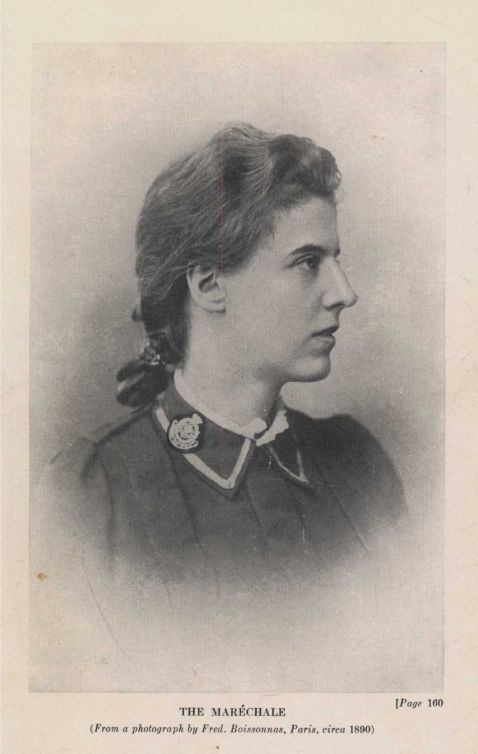
THE MARÉCHALE (From a photograph by Fred. Boissonnas, Paris, circa 1880)
How hard it became for the Maréchale to accept this cross may be indicated by a touching scene depicted by her secretary, Miss Gugelman, who is now one of the bravest soldiers of salvation in India.
"'Seek ye first the Kingdom of God.' How clearly this was illustrated when, at a late hour one evening, just at the close of her month's meetings in Paris, the Maréchale bent over her little ones' cots to bid them good-bye before starting on her three-months' tour through France and Switzerland. Evangeline, the eldest, had kept awake, for she knew that her mamma was going away. The little arms were flung round the warrior-mother's neck, when, raising her sweet tear-stained face, little Evangeline stammered, 'Maman, stay with me, or take me with you on your tournées.' Our leader's all too human tears filled her eyes; she kissed the little pleader, and then wrapped her up in a blanket, and brought her into the study to see us off. It was painfully clear to us who were watching her, that the leaving of her little ones for the war's sake was a heavy cross to the Maréchale. Thank God, she shirks it not. Suppressing her feelings, she went out into the cold and damp, and started her long all-night journey."
That was in February 1894, and later in the same year she had two of the finest campaigns of her life—at Havre and Rouen. The turbulent beginning at Havre was graphically described by her friend the Princess Malzoff, who accompanied the Maréchale in order to have a taste of the vie apostolique. "There was a great tumult in the 'Lyre Havraise.' The Maréchale had come to publish the word of love and salvation. An immense crowd forced itself into the hall, and who would have dared believe that they had all come simply to present the world with the most scandalous, the most vulgar and odious spectacle that one can imagine? When the Maréchale rose with great dignity and calm ... she could not make herself heard. Every word was interrupted; one could see that it was a prepared stroke. One might imagine oneself to be in an asylum. But she did not let herself be discouraged; she persevered; she walked straight into the midst of the infuriated crowd. She did not tame these wild beasts, but she came out victorious all the same. Tall, beautiful, calm, sustained by her divine conviction and with the strength of a great heart, she came back again and again—our admirable Maréchale! ... In the midst of this infernal and ridiculous tumult a few élite souls felt a noble enthusiasm for this young woman who battled alone against a hostile and wicked crowd. They came to grasp her hand, to express their admiration for her and their shame for those who had broken the simplest laws of hospitality, politeness and civilisation. Blessed be our Maréchale; in her the whole Armée du Salut was personified that night in its strength, its faith, its persevering love."
Tributes to "the Maréchale under fire" were extorted from all the reporters. After two or three meetings the atmosphere was changing and the tide of battle turning, when tidings came from Paris, that Augustine, the Maréchale's little son of two summers, was alarmingly ill. Then came an indescribable mental conflict, which ended in her deciding to remain at least another night and hope for better news in the morning. She called her officers for prayer, and that night spoke with a power and tenderness which held the vast audience as with a spell; after which she had Havre for six weeks in the hollow of her hand.
Next morning she received a reassuring wire from home, and, sitting alone on the beach, she wrote a hymn that gives perfect expression to the thought of the Greater Love—a hymn that has endeared itself in France as much to Catholics as to Protestants. It begins:
Qui quitte famille et terre
Pour mon Nom, pour suivre mes pas;
Qui quitte enfants, père ou mère,
Reçoit le centuple ici-bas.
When this hymn was sung in the "Lyre Havraise" a night or two afterwards by one of the Maréchale's young comrades, Mme. Jeanmonod, who had a beautiful soprano voice, it was received with a burst of sympathetic applause, and had to be sung over and over again, till the audience knew it.
Then there was a great harvest of souls to reap. A letter written at the time gives an idea of the intensity of spirit with which the leader threw herself into the work.
"Meeting superb! Nothing of its kind since the days of Geneva and Nîmes, and even better in a sense than that, as the infidels rush to hear me. Perfect order and people pleading to get in. In these first audiences it has been too risky and excitable to allow any to speak but me. They applaud everything, that is, when I have finished speaking, and I never felt more free and regardless of man's opinion. I am stronger with the rough element alone in my weakness, so much stronger as I throw myself on them. Yes, I am filled with the life and power of God for this town. This hour may never come again. My soul is on the full stretch.... Do you know what the 'Centuple' is for me? That my children shall become apostles! Oh, I claim that of God, and do you know there is an assurance in my heart."
In addition to the nightly crowds at the Casino, the Maréchale held afternoon meetings for women only, at which she spoke on such subjects as "The Role of Woman," "The Mother of Jesus," "The White Robe." Nothing impressed Havre more than the midnight suppers she gave to the filles perdues of the town, not a few of whom were constrained to abandon the life of sin. And so generous were the rich citizens in their offerings that at the close of the campaign the Maréchale was at length able to realise one of her cherished ideas—the foundation of a Rescue Home in Paris.
After Havre, the Maréchale had a short breathing-space at home, and then Rouen had to be faced. Again the shadow of the Cross fell upon little hearts and lives. Victoire, who was nearly five, pleaded with upstretched arms, "Don't go, mother! stay with us!" (Ne pars pas, Maman! Reste avec nous!) Evangeline, who had just turned six, had learned the lesson of separation, and, throwing her arms around her mother, said, "Maman, if you do go to Rouen, will some souls be saved that would not be saved if you did not go?"
"Yes; most likely so."
"Then go, Maman!"
And Maman went.
While the good Catholic of Rouen was shocked, the man in the street was amused, at the idea of worshipping God in the Théâtre Français instead of the stately cathedral, and between them they contrived to make the thing impossible. What, they asked, could be more grotesque than preaching and singing hymns on the stage? At the opening meeting the Maréchale herself obtained a fairly good hearing, but a hostile element was present which every now and then convulsed the audience with laughter by some comical exclamation; and when one of her comrades attempted to close the meeting with prayer, the rout was complete. Prayer in a theatre was the limit, and next day the Maréchale was informed by the Mayor that he must pacify the public by terminating these proceedings.
The great Casino, at the corner of the square in which Joan of Arc was burned, was then secured, and the Maréchale began to deliver a series of addresses on "The Holy Mother of Jesus," "Nineteenth Century Miracles," "Confession," "Restitution," "The Saints," "The Pater Noster," "My Credo," "The Altar." The crowds that filled the hall to overflowing were amazed to find that these subjects were all dealt with quite unecclesiastically, and with such an exclusive application to the individual heart and life that sacerdotalism became, as it were, non-existent, while the sinner and the Saviour were made manifest and left face to face. The people who came with minds alert left with hearts melted and consciences aroused. Soon there were great numbers of souls seeking spiritual help, and the Maréchale announced that she would meet the convicted and anxious in one of the rooms of the Casino. No fewer than four hundred sought private interviews in that place, which thus became a confessional of the simple, primitive order. Not by priestly absolution, but through personal contact with the one High Priest and Mediator, was sin remitted and salvation won.
So many Catholics were converted that the head of one of the seminaries thought it necessary to preach against the Armée du Salut. An influential abbé, on the other hand, said: "I cannot, of course, agree with the Salvationists, but I am absolutely convinced of their sincerity, and I am certain they are far nearer salvation than the majority of Catholics." The curé of the largest paroisse attended one day in his soutane, gave an offering for the mission, and bought the publications at the door. When the Maréchale was about to speak to women alone on the Holy Mother, two priests expressed their desire to be present, and she had them concealed behind a curtain. At the end they were deeply moved, and assured her they had not heard a single word with which they were not in heartiest agreement. Such was the deep spiritual impression made upon the town that a newspaper was published containing nothing but accounts of her meetings and the work going on in the Casino.
During all her years in France the Maréchale never posed as a Protestant and never attacked Catholicism. Creeds, ceremonies, penances, pilgrimages—these things were to her neither here nor there. She always went for the real, and she found in Christ not only true divinity but perfect humanity. Her sermon on the Virgin melted thousands of Catholic hearts, and her fundamental doctrine of sacrifice never failed to evoke a response from the Latin races. She was an eager student—so far as the "apostolic life" permitted—of the writings of Catherine of Siena, Thomas à Kempis, Madame Guyon and Fénelon, claiming kinship with all who loved the Lord Jesus Christ in sincerity and truth.
Thus she had great power over Catholics as well as Protestants and infidels. One of her most devoted officers, M. le Roux, had, after a brilliant career as a Catholic student, completed his preparation for the priesthood and received the tonsure, when he came under her influence and found his life completely changed. And the following letter received from a lady-professor in Rouen indicates the kind of impression which was made on many Catholic minds.
"Dear Maréchale, I wish to do what I have not yet dared to do when face to face with you—that is, to express the pleasure which I have found in your charming Conférences. They have moved and troubled me to such an extent, have thrown such light in my heart and mind, that I ask myself what is going on within me. Your addresses, so simple and yet so high, so suited to your hearers, so consecutive, have influenced me more than all the beautiful sermons of the monks. You have made me understand that God asks something else from us than outward practices and empty ceremonial, and I feel that you have renewed a faith in me that had nearly disappeared. You have made me taste, thanks to your deep convictions and the warmth of your speech, one of the purest joys I have ever known.... Be blessed a thousand times, Maréchale, for having revealed my religion to be under a new light, for having shaken this apathy which rendered me incapable of every generous impulse, for having made me more sensitive to the sufferings of others. Be blessed in your children, who one day I hope will reward you nobly for all your sacrifices. Be blessed in humanity, the great family which you have elected to live for and which is the object of your care."
Does such a revival as this leave solid and lasting results? Let one case out of many be presented as evidence that it does. M. Matter was a distinguished engineer and an officer in the French army. Extracts from two of his letters tell what the Rouen campaign did for him.
"Beloved Maréchale, Three years ago tonight a poor man entered the Casino through what appeared mere chance. He was burdened with sorrow, keenly conscious of his sins, but never dreaming of asking the Armée du Salut—which did not even excite his curiosity—to help him, hardly believing any more in the possibility of salvation for him. God inspired you; the Holy Spirit made your words penetrate even underneath the breastplate of sin which covered my poor heart. Two days after I was born to a new life. From that moment God has strengthened, protected and directed me. I seek to love Him with all my heart, and I treasure a deep and loving gratitude to you."
And six years later: "I have made a pilgrimage at night in the deserted streets to the Casino where God found me and where you were His ambassador."
This gentleman is now well known all over France for his work among criminals and drunkards, and his services have been recognised by the French government. He gets into personal touch with hundreds of convicts in order to speak to them of the love of God, and down in the Ardèche he has a Home for four hundred little waifs, mostly the children of criminals, whom he calls the Maréchale's grandchildren, he himself being her spiritual son.
The last time she visited him in Paris, they were engaged in eager and intimate talk, when he said, "Do you see that ivory pipe? I have engraved on it the day of my conversion at Rouen; but since that time I have never had any inclination to smoke it. And do you see that pile of letters? These are from my boys in prison. Let me read one of them to you." Then he read the words of a convict who spoke of prison walls lighted up with the glory of Christ's presence. And he added, "Do you remember you said to me when I was in despair over my past life, 'These hands, which have done so much evil, will bring blessing and salvation where I can never go.' Your words have literally come true."
CHAPTER IX
THE FRIENDSHIP OF CHRIST
One night a little card was placed on the table d'hôte of the Hôtel Meurice, in the Rue de Rivoli, intimating to the guests that the Maréchale would speak at an informal meeting in the salon after dinner. Among those who came to see and hear her was a little Russian lady with deep and thoughtful hazel eyes. She was the celebrated Princess Nancy (properly Anastasia) Malzoff of the Russian court. One of the Czarinas died in her arms. She was a friend of King Edward VII, and her brilliant wit made her a welcome figure in every court of Europe. She spoke eight languages.
She was now well advanced in life, and thought she had known everybody worth knowing and seen everything worth seeing in the world. But that evening was the beginning of a new life of peace and joy such as she had never dreamed of. From the moment the Maréchale opened her lips, she was fascinated, first by the speaker, and then still more by the message. Next morning she came in her carriage to the Villette. The Maréchale was scarcely well enough to receive her, but she would not take a "No." When she entered the Maréchale's room, she threw herself by the bedside and exclaimed, "Oh! tell me, how did you get to know Him?"
This was the commencement of a seven years' friendship, and during all that time she was never out of reach without writing the Maréchale every second day.
The Princess was a member of the orthodox Greek Church. Her mother had married her off at sixteen, and she had eleven children by the time she was twenty-eight. When she found that her husband had become unfaithful, she dismissed him with an emphatic "C'est fini!" and for more than a quarter of a century she had never seen him.
The Maréchale listened with deep sympathy to the story of her life, and then said, "You must forgive him, if you would be forgiven."
"Never, never!"
"Yes, if you want Christ, forgive him. Never mind what he has done, you must forgive him."
The Princess could not. A struggle went on in her mind for six weeks. She began to come to the meetings at the Rue Auber, but she had no peace. The Maréchale opened the question again.
"Come now, I want you to write and invite him to meet you at your hotel, to dine with him, and to forgive him."
A terrible inner controversy ensued, and the Princess became ill over it. One can scarcely imagine what it all meant to her, and yet thousands have to go through the same.
Calling one day, the Maréchale found her in a cloud of cigarette smoke.
"Princess, how dare you smoke like this?"
"Well, I am surrounded by a thousand devils, blue, black and yellow. You have been neglecting me."
A ceaseless conflict was raging in her breast, and ere they parted that day she wrote a letter and said she would send it.
The Maréchale called again, and found that the letter had not been sent. Then the crisis came.
"Princess, you are lost. If you do not forgive, your heavenly Father will not forgive you."
"I cannot, I cannot."
She was in agony of soul.
"Princess," said the Maréchale, "are you perfect? From the little I know of you I should think you have a very bad temper."
"It is true, it is true."
"Your sins have not been his, but they are sins before God, and have caused suffering to others. If you want God to forgive your bad temper, you must forgive him."
The Maréchale prayed, and bade her look to the Cross and see how Christ forgave. Then she told her again what to do.
"Darling, you are to invite him to your apartments; you are to have a sweet little dinner for him and flowers on the table, and when he comes you are to kiss him."
"But I cannot!"
"Yes, you will; and remember it is no forgiveness unless you kiss him. Forgiveness means kissing. Forgive him, and I know peace will come."
"Very well, I will, I will!"
The Maréchale chanced to be leaving Paris for a time, and said—
"You will send me a wire when you have done it."
The Princess invited her husband. He made a long night journey. She kissed him and forgave him. Next day the Maréchale received a wire which made her dance for joy. It ran: "Tout s'est passé comme vous l'avez dit, et la paix du Christ m'inonde: Malzoff" (All is done as you said, and the peace of Christ floods my soul.)
Her husband died after a few months, and her thankfulness for what she had done was profound.
The last years of her own life were beautiful. In a letter which she wrote to General Booth in regard to her friend's health she said: "I owe a great deal to the Maréchale. She has given me a treasure greater than all the treasures of this world—she has given me a living Christ; she has put Him not near me, but in me, in my soul, and the gratitude I feel for that blessing is great." An article from her pen on the Army's work in Paris contains these words: "The Salle Auber is to me now a holy place. I feel the presence of Christ there—Christ who has personally become a living Saviour to me since the Maréchale brought me to Him and committed me to His Divine arms."
Hundreds of letters, the last of which was written in St. Petersburg on the day before her death, reveal an intensely ardent nature, and prove that the heart which truly loves never grows old. We translate a few extracts.
"I will use all my moral forces to prove to you that our mutual affection has advanced me in the path of holiness which you opened to me the very first moments I heard you speak. God had pity upon me and sent you on my via dolorosa to open to me a new horizon, a new heaven. He carried my heart to you with an intensity of which I did not think myself capable."
"I have found in you two beings equally precious to me—the first is a friend I love like a dearly beloved daughter; the second the Maréchale of my Salvation, whose work, vocation and power I admire—that moral power which you only in the whole world exercise over me. If I had known you earlier, you would have made a saint of me."
"Not any affection in the world, not even my children's, can replace yours for me. What does it matter though everybody loves me if you do not?"
"I know that it is because I have not yet renounced my 'self,' my 'moi,' that your absence makes me suffer, but I cannot help it—it is beyond my power. I know also that the day my 'self' will be chased away—which is doubtful—I shall love no one, for to love one must be a self, one must have one's own heart."
"I doubt if there are any others who bear you such a deep, complete, living, warm and luminous affection. Not that you do not deserve it, but all natures are not alike, and you know the fault of mine. I cannot love by halves."
"'Love wisely,' some one advises. That word 'wise' hurts me. I do not want to be wise in my love for you. I prefer to love madly, and that is what I do, and you feel it, don't you? Wisdom to the devil when it is a question of the heart."
"I cannot believe that He must detach us from everything to attach us to Himself—that would make me very sad. On the contrary I feel that it is only human love, disinterested love, but deep and living, which can make us understand Divine love. It is only through human experience that we can appreciate His great, His mighty, His eternal love for us. All the life of Jesus is filled with that palpable love for His creatures, and that is why He is so near to us. Let me therefore love you without detachment, and the more I love you the more I will love Him."
One of her letters is peculiarly interesting: "I will see the Emperor in these days, and I will seek strength to speak to him. You see, my darling, speaking is not enough, one must in such a case pour out one's soul and feel that a superior force guides one and speaks for one."
It turned out as she hoped. One night she was at the Palace in St. Petersburg. After dinner the Czar came and seated himself beside her. Soon they were deep in intimate conversation. She began telling him what her new-found friend in Paris had done for her. She talked wisely as he listened attentively. At length he said—
"But, Nancy, you have always been good, always right."
"No," she answered; "till now I have never known the Christ. She has made Him real to me, brought Him near to me, and He has become what He never was before—my personal Friend."
CHAPTER X
THE BURNING QUESTION
It was the often expressed wish of Mrs. Josephine Butler that the Maréchale might be able to join her crusade against the infamous White Slave Traffic. In one of her earliest letters to her friend she said: "Dearest Catherine, the wicked party, as you know, have triumphed in the elections in Switzerland, and the Geneva government has passed that evil Law which our friends were trying to stop.... How nice it would be if you and I could stand up together in Geneva, and denounce their wickedness and proclaim the Saviour. I should love to do so." At a later time she wrote of her young friend, "Oh, I sometimes think if she were in the work of our Federation, what a harvest she might bring us in, or rather bring in for God!"
The Maréchale regarded the wish of that saintly and chivalrous woman as involving a kind of sacred trust. Her own heart was early and deeply troubled by the darker aspects of our modern civilisation. When she and her two brave comrades, Florence Soper and Adelaide Cox, took their first flat in Paris, they were shocked to learn that they had as their nearest neighbours—above and beneath, to the right and to the left—families unconsecrated by any marriage tie; and in the course of their ordinary work they found themselves hourly confronted by all the devils of vice. The lurid facts, of which most Christians, happily for their own peace of mind, know little or nothing, were burned into the souls of these noble women, each of whom dedicated herself to a battle à outrance against this most appalling form of evil. And have they not faithfully kept their vow? Are there any living Englishwomen who have done so much to protect our innocent children and raise our fallen sisters as these three, who first toiled and suffered and prayed together thirty years ago in the Villette of Paris?
In redeeming her pledge, the Maréchale not only gave midnight suppers to the filles déchues of the great cities in which she conducted her campaigns, not only founded Rescue Homes in Paris, Nîmes, Lyons and Brussels, but endeavoured to make the problem of purity a national question, to be dealt with in a statesmanlike manner by every patriotic citizen.
She frequently addressed great meetings of the men of Paris and other cities on this subject, making irresistible appeals to the heart and conscience. It was astonishing how she carried the most critical audiences along with her, though now and then an indignant hearer would leap to his feet and dash out of the hall or theatre in which her meeting was held.