Front matter
Reading edition
BY
JOHN CARL PARISH
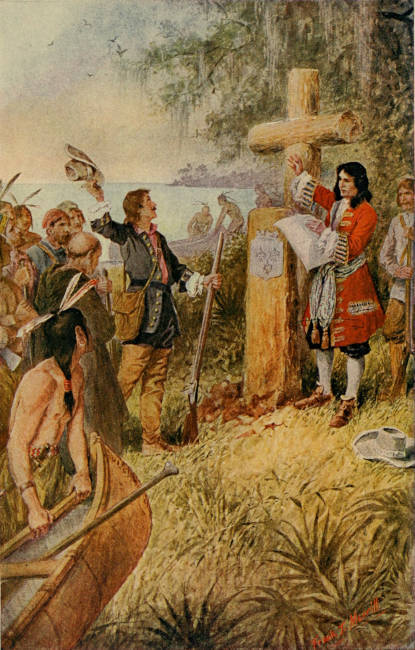
La Salle took possession in the name of the King of France.
True Tales of the Great Valley
EDITED BY BENJAMIN F. SHAMBAUGH
The Man with the Iron Hand
BY
JOHN CARL PARISH
BOSTON AND NEW YORK
HOUGHTON MIFFLIN COMPANY
The Riverside Press Cambridge
1913
COPYRIGHT, 1913, BY HOUGHTON MIFFLIN COMPANY
ALL RIGHTS RESERVED
Published October 1913
Let us picture in imagination the history of the Great Valley of the Mississippi as a splendid drama enacted upon a giant stage which reaches from the Alleghanies to the Rockies and from the Great Lakes to the Gulf of Mexico and through which the Father of Waters sweeps majestically. Let us people this stage with real men and women—picturesque red men and no less interesting white men, Indians, Spaniards, Frenchmen, Englishmen, explorers, warriors, priests, voyageurs, coureurs de bois; fur traders, and settlers. Let the scenes be set about the lakes, along the rivers, among the hills, on the plains, and in the forests. Then, viewing this pageant of the past, let us write the true tales of the Great Valley as we write romance—with life, action, and color—that the history of our Great Valley may live.
Benjamin F. Shambaugh
AUTHOR’S PREFACE
The purpose of this book is to present in readable narrative form, yet with strict accuracy, some of the events which attended the coming of the French explorers into the Mississippi Valley, and to deal with these events as much as possible from the standpoint of the Indians whose country the white men entered. In other words, an effort has been made to place the reader in the position and environment of the native inhabitants in order that he may witness the coming of the whites through the eyes and minds of the Indians instead of viewing from the outside the exploration, by men of his own kind, of an unknown land peopled by a strange and vaguely understood race.
For the sake of preserving the standpoint of the Great Valley, the story of explorations is centered about Henry de Tonty—the “Man with the Iron Hand”—who, unlike his leader La Salle, remained in the valley of the Mississippi and in close relations with its inhabitants for a quarter of a century.
This book is not in any sense fiction. It has been written directly from the original sources and from the best information available upon the life of the Indian at the time of the arrival of the whites. The sources consist mainly of the letters and relations of Father Marquette and other Jesuits, of Joliet and La Salle and Tonty, and the writings of the various friars, priests, and soldiers who accompanied them. A few fragments are accessible in manuscript form only; but the most important material has been compiled, edited, and published by Pierre Margry, John Gilmary Shea, B. F. French, Reuben Gold Thwaites, and others.
Where conversations are given they have been taken from the reports of those who held them or heard them. Usually they have been translated literally from the French records. Sometimes the direct discourse has been turned into indirect, or abridged, and in a few cases the indirect has been turned into the direct form.
The writings of the early explorers and priests abound in descriptive details of a climatic, physical, or personal nature; and this information, wherever illuminative, has been drawn upon to reproduce as vividly and as truly as possible the conditions surrounding the events described.
There is one secondary writer who will always deserve the gratitude of the student of subjects connected with the French and Indians in Canada and the Mississippi Valley, and acknowledgments are here made to Francis Parkman, not as a source of information—although his conclusions, drawn from an exhaustive study of original documents, are invaluable—but as a pioneer and unrivaled master in the field and a source of unfailing inspiration.
There are many persons who have aided the work in various ways, and their assistance has been duly appreciated; but space will permit the mention of only two of them. The helpful criticism and suggestions of my wife throughout the entire preparation of the volume have materially benefited the text; and the constant advice and encouragement of the editor of the series, Dr. Benjamin F. Shambaugh, and his careful editorial revision of the manuscript have added much to the value of the book.
John Carl Parish.
Denver, Colorado
CONTENTS
I THE CAPTIVE
II THE COMING OF THE STRANGERS
III DOWN THE GREAT RIVER
IV THE CAPTIVE RELEASED
V THE BLACK GOWN
VI “THE IROQUOIS ARE COMING”
VII THE SECRET COUNCIL
VIII THE FORT CALLED CRÈVECŒUR
IX THE WHITE INVASION
X THE MYSTERIOUS HAND
XI “WE ARE ALL SAVAGES”
XII THE DEATH OF CHASSAGOAC
XIII THE IROQUOIS COME
XIV THE SCATTERING OF THE TRIBES
XV A SIOUX WAR PARTY
XVI THE LAND OF THE SIOUX
XVII A BUFFALO HUNT
XVIII THE MIAMIS REPENT
XIX A CHIEF COME TO LIFE
XX STRANGE RITES
XXI THE LOWER MISSISSIPPI
XXII THE GATHERING OF THE TRIBES
XXIII FORT ST. LOUIS
XXIV THE LOST CHIEF
XXV NEWS FROM LA SALLE
XXVI AN ILL-STARRED VOYAGE
XXVII HUNTING THE MISSISSIPPI
XXVIII FROM THE GULF TO THE ILLINOIS
XXIX WHEN HE LEFT THEM
XXX WHITE AND RED SAVAGES
XXXI TONTY’S HEROIC VENTURE
XXXII THE PITIFUL REMNANT
The frontispiece is from a painting by Frank T. Merrill
The Man with the Iron Hand