Front matter (continued 7)
Reading edition
She lowered her chin and drooped her somber eyelids, and said with curling lips:
"It was. He took out his watch, and told me: 'I can hear you for three minutes longer! Has the Prince Imperial—with the disinterested assistance of those about him, altered that possibility into a certainty?' I explained to him then that nothing further had come of the rencontre,—though measures had been taken to preserve Monseigneur's interest from dying for lack of excitement, bouquets of violets being sent to him at regular intervals, with a slip of paper attached to the stems, upon which had been written in an unformed, girlish hand—'From one who prays for the Hope of France!'
"And then?..."
"Then M. de Bismarck spoke, keeping his thumb all the time on the watch-dial: 'So! The girl plays the part of an ingenue for the present! Will she keep these airs of candor and innocence when she has got her claws on that poor stripling? And do you suggest that the Prussian Secret Service should supply her with funds for the carrying out of her design, whatever it may be? Are we to lay our heads together, like the Brethren in the libretto of Mehul's opera "Joseph," and sing in chorus: This is the heir. Come, let us kill him!'"
"Even Beelzebub," said Straz, "can quote from Scripture when it suits him. I suppose you were annoyed, and showed it—which was an error of judgment on your part!"
"I rose up," said she, and suited the action to the word, "with indignation, assuring M. de Bismarck that his suspicions were unjust. That the young girl mentioned was of ancient family and irreproachable morals, convent-bred and highly educated. And that I, myself, being her nearest living relative of her own sex, was able to vouch for the fact. I added that the interest displayed in her by Monseigneur the Prince—who until that moment had never been known to look at a woman—led me to conceive that by aid of a few deft hints, a little discreet encouragement—another distant glimpse—a meeting accidentally brought about in some retired spot favorable to the revival of first impressions, an influence might be brought to bear upon the Imperial boy which might develop his mind and mold his character. Somehow in my agitation the name of Juliette de Bayard escaped me. 'De Bayard,' exclaimed M. de Bismarck. 'So! You are her mother!' Great Heaven!—the intolerable tone in which he uttered the words! Only the most abandoned of her sex could have supported the insulting irony of the look accompanying them. Choking, I took my leave.... He accompanied me to the staircase, with a false appearance of courtesy. As I turned to descend, he hurled the last insult of all! Nicolas, do not ask me to repeat the sentences!—and yet, I must have them written in another memory.... He twitted me with my nationality before his secretary and servants. He likened me to a mythological character with an unpronounceable name.... He said only a modern mother would be infamous enough to devote her only daughter to Venus Something-Or-Other.... Next to my husband, I detest that man!"
Straz had been pulling at his moist red underlip as she raved out her story in a frenzy of rage and resentment, intensified by the necessity of speaking in a lowered tone. Now he dragged the feature out as though it had been made of india-rubber, let it snap back, and said, shrugging his bull's shoulders and getting up:
"You are a woman and he is—Bismarck! He does not for the moment want the wares you desire to sell him. It is unlike him—the diplomat who could encourage M. Benedetti to lay before him the Emperor's projet de traité in writing—and lock it away for use at a future opportunity—not to be willing to secure an advantage—placed before him with clearness and skill—in the newly awakened fancy of a schoolboy who, if he lives, will be an Emperor—for a charming and innocent young girl!" He pronounced these words as though they were smeared with something sweet and luscious, licking his lips gently, and rolling his dead black eyes in sensual enjoyment. "As regards your husband, he has certainly not replied to the letter of your solicitors, but why do you hate the unlucky man?"
"Do you ask?" Adelaide demanded, with glittering eyes and heaving bosom. "Did he not refuse to divorce me? Should I not have legally borne the title of Baroness von Valverden if his sentimental prejudices had not blocked the way?"
Straz pulled his waved beard, and said, delicately separating a strand of it from the rest, and keeping it between his thick white fingers:
"Sentimental, why sentimental? Do you not even give him credit for sufficient spirit to resent being made ridiculous? The desire to be revenged—you will not even allow him that?"
She bit her scarlet underlip and answered, breathing quickly:
"He was too good, too high-minded—too chivalrous—oh! 'tis ridiculous, I admit!" for Straz commenced to titter silently, screwing up the corners of his eyes and shaking his shoulders, as he sat with his thick, short arms folded on his chest. "An idea to make you hug yourself as you are doing. But true, nevertheless! He would have said—at this distance of time I can still hear him preaching: 'I will avenge the injury to my honor when I am confronted with my enemy. I will not revenge myself upon the woman who deserted me for him!'"
The words came, not in her own voice. Straz left off sniggering. He said to himself, considering her through narrowed lids:
"Those were De Bayard's actual words. I wonder, since she has neither seen nor heard from him since she left him, how it is she knew that they were spoken? Some obliging mutual friend may have repeated them. Or she read them in some letter of his, written to Count Valverden. That is quite possible. But the question is, whether she would detest him so bitterly if her passion for him were absolutely extinguished. She is even jealous when one speaks of their daughter, whom he worships.... I will play her on this string—it may be useful, who knows?"
Aloud he said:
"Detest your husband, dear friend, if it affords you entertainment. Probably he deserves it, though women I have met who knew him vowed him un crème d'homme, worthy of the name he bears." He smiled in his beard, hearing her foot tap upon the shining parquet, and went on. "Men have praised his gallantry and his disinterestedness——"
"'Disinterestedness!'" she mocked. "Truly—to the point of fanaticism he is disinterested. Have we not to thank that characteristic for the ruin of our plans?"
Said Straz:
"A little more subtlety upon the part of your solicitors, and you might have found M. le Colonel less obstinately inclined to discourage the idea of a reconciliation. To have entrusted a portrait to the hands of the lawyers would have been an excellent move. Once convinced that the thirteen or fourteen years that have elapsed since you—parted—have increased rather than diminished the beauty that once he worshiped—and I fancy De Bayard would have accepted your terms!"
He sniggered, and waited as the violet shadows about her brilliant eyes deepened, and she breathed more quickly. Then he went on:
"They were generous—I allude to the conditions. Ninety men out of a hundred would have accepted them. For what has De Bayard to condone that others have not winked at? You were a mere girl, weary of separation from a husband who doubtless consoled himself after his own fashion, for his detention in the Crimea. Bored to desperation—condemned to spend your days in the care of a child, and in listening to the imbecile grumblings of a sick old devotee,—point out to me the woman, young, beautiful, brilliant, and ambitious—who would not—in your place—have done precisely as you did?"
She threw her head a little backward, bringing into prominence the superb modeling of her columnar throat and the heavy lines of the lower jaw. Her wine-colored eyes considered him between their narrowed lids. She savored his words, silently, with palpitating nostrils, and rippling movements of the muscles of her tightly closed lips. And the qualities of treachery and cruelty, mingling in her strange character with sensuality, and pride, and recklessness, were written upon her beauty as plainly as they are stamped upon the individuality of a tigress, or a poisonous snake.
"You speak of weariness ... of boredom..." She spoke between her teeth, accentuating the vowels and prolonging the sibilants: "Nicolas, it was hellish—that ménage at Auteuil!..." She clenched the white hand that rested on the chair-arm and continued, looking with burning eyes through Straz into the past.
"That woman—my husband's mother, with her parade of devotion for the absent. With her ceaseless repetition of 'my son,' 'my son's child,' and 'my son's wife!' ... Grand Dieu!—how she enraged me! How she made me hate—hate—hate them!—yes! all three.... Perhaps myself also, most bitterly of all!"
"We have a curious proverb in my country," commented Straz, with his snigger: "'I draw water from a well that has no bottom when I tell my gossip of the faults of my mother-in-law!'"
She said, with undisguised scorn:
"I am not a collector of curios from your country!"
"Ah, but wait! Hear the rest of it!" said Straz, dexterously embroidering on the original: "'But when my mother-in-law wishes to acquaint my husband with my good qualities, she will write them with the plume from a gnat's head, on the paper that wrapped a butterfly's egg, when she has bought her ink at the shop where they sell none!'"
Adelaide continued, ignoring the labored witticism:
"In the letter of farewell that I wrote to De Bayard I said 'Your mother will console you, I have no doubt!' ... How often I have imagined I could hear her talking to him.... He would weep on her knees, like a schoolboy. She would lead him to look at the child, asleep in its cot by the side of her bed, and tell him, 'Do not fear! She will not be like her mother! She will grow up candid and discreet and virtuous!' Everything that Adelaide was not, you understand.... Ha, ha, ha! Absurd old creature! Were she not dead, I should detest her still!"
Straz mentally commented: "The daughter has inherited the hatred, unless I am mistaken." Aloud he said:
"The prophecy, if made, has not been fulfilled, my Adelaide.... Mademoiselle, if inferior to her mother in splendor and beauty, certainly has been dowered with her elegance and charm." He bunched the fingers of his right hand, kissed them, and launched the kiss, conjecturally, in the direction of Paris. "A pocket edition of Psyche before that little affair with Cupid! A rare jewel! A chic type, give you my word!"
The daintily shod foot had beaten time, as Straz enlarged upon the theme of Juliette's perfections, to what might have been the tune of a tarantella: now it ceased. She laughed in the Roumanian's face, and cried, still laughing:
"A child! ... A schoolgirl—who has seen no more of the world than the pearl in the oyster! All this is too funny—give you my word!"
Said Straz, lolling his head against the chair-back and licking his red lips cattishly:
"Ah, but when the pearl-diver opened the oyster, he said: 'Here is a gem worth a Kingdom, or an Empire, when it shall be polished and properly set!'"
"'Or an Empire!'"
She echoed the three words, throwing her head back in imitation of Straz's attitude, and looking at him with languid provocation. Then she yawned, showing her perfect teeth and the tip of a rosy tongue, and remarked with an air of boredom:
"My friend, whether your pearl be worth an Empire or a cabbage-plot, your chance of proving its value is forever forfeited, thanks to the obstinacy of M. de Bayard."
Said Straz:
"Our plan would have been easier to carry out,—had M. de Bayard been more—complaisant."
She rose up, her beautiful face livid and gray under its artificial roses. Her eyebrows writhed like little live snakes, her eyes burned like wind-blown torches. She spoke, looking past her confederate in the chair, and with a voice he barely recognized:
"His mother must have prayed her Saints for this," she said, "that I should always fail in the moment when triumph seemed most sure. Max Valverden would have married me—it is absolutely certain!—had not Fate sent him back on leave from the Staff in Austria but a couple of hours too soon. Weak, sentimental Max! always threatening extreme measures. Who would have believed him capable of carrying out that menace so often reiterated! But this I know. Had he confronted me with what his letter termed 'the unmistakable proofs of my appalling treachery,' I would have convinced him even against the testimony of his own ears and eyes. But De Bayard—but my husband!——"
She had forgotten Straz; she saw nothing but her own frustrated ambitions, the dead body of the man whose suicide had robbed her of a title, and the living husband whose stern rejection of her overtures had left her forever outside the social pale....
"Do I not know the man he is! With another it would have been so easy. He would have granted an interview,—I would have been suppliant and humble—I would have told my tale in such a voice! ... You were away.... I was young and inexperienced.... I foolishly yielded to the persuasions of another.... Once I had let Valverden kiss me I felt myself smirched for ever. I fled with him because I dared not meet your eyes!"
Straz sniggered. She went on, not hearing him....
"He would have taken me to his heart again. Once reinstated there I would have regained the entrée to Society. For a woman who has lived within the pale—even if she finds it better fun outside—it is hideous to be déclassée. A few triumphs,—a little intriguing—and I should have been received at Court.... For the Emperor is above all a man of the world; and the Empress loves to surround herself with beautiful and witty women. With gifts, talents, charm like mine, I should have carried all before me!—I should have reigned—I should have drunk the wine of Success from a goblet of diamond."
"Without doubt," agreed Straz, "had M. le Colonel consented to receive you. Yet I contend, his refusal is a hopeful sign, if it means that he is afraid."
She winced as though he had thrust a knife in her side, and cried out:
"Afraid! You do not know him.... No!—I tell you, that it is to him as though I had never existed.... Did we meet, he would look me in the face—pass me by without the twitch of a muscle—without the flicker of a glance.... But you have shown me how I may reach his heart—and one day I shall thrust my hand into his breast and tear it out and trample on it.... It is she—my daughter—who will accomplish this!..."
Said Straz, pushing back his chair, getting up and blowing his nose loudly:
"Then the sooner we exchange these avenues of dusty lime-trees, choked with crowds of bellowing Teutons, for the boulevards of Paris, the better. We shall, of course, be forced to return by a détour via Brussels—the Rhine Valley railways being reserved for the transport of troops. Passports can be had on application to the usual authorities. The only insuperable obstacle to our departure is—the bill!"
Madame came back to consciousness of sordid things as the Roumanian ostentatiously turned out his trouser-pockets.
"You are at an impasse for lack of funds?" she asked him.
"Upon my life, my soul!" Straz smilingly assured her, "I am at present without a radish! A sum of two thalers negotiable currency constitutes my stock of cash. Although, as I have told you, I carry secreted on my person an order for"—he tapped his bosom—"ten thousand francs payable from the Secret Funds of the Imperial Government. This I tried to cash before I left Paris——" He measured off an infinitesimal quantity of finger-nail and displayed it to her. "Do you think I got a franc from anyone? No!—you know better! The Emperor's methods are understood too well. And thus it is that the disinclination of M. de Bismarck to finance our plan for the union of two young and ingenuous lovers has hit me in the midriff. A thousand curses on his niggardliness!"
As though prompted by some recollection of Adelaide's previous display of tragic passion, he scowled portentously, spat at the fireplace, then began to strut about, vaporing and waving his ringed, hairy-backed hands.
"Penniless.... What damnable absurdity! The Emissary of a Potentate! The Bearer of the Bowstring—with Life or Death in my hand. For lack of cash I travel second-class to that accursed South German Principality—I stoop to put up at a third-rate inn. My Mission performed, I yield to the promptings of my ardent nature. In the company of her who reigns sultana of my soul,—who for my sake has shared the discomforts of that abominable caravanserai—I return to the barbarous capital of the Hohenzollerns—I risk my person in the streets of Berlin. Had my brain been cooler—had your image glowed less seductively before my mental vision"—he rolled his black eyes amorously and laid a thick ringed hand upon his breast—"it may be that I should not have accompanied you,—that I might have hurried back express to Paris—presented myself to my Imperial master—and reaped the golden prize!"
"Say rather," responded Madame, in a tone not untinged with acrimony, "that as the result of your unsuccessful endeavor to enlist the interest of M. de Bismarck in that charming plan to unite two ingenuous young people—you are placed in a position that is not without unpleasant possibilities. My beaux yeux are less to blame than your ambition 'to kill,' as the English say, 'two birds with one stone!' You——"
"Say 'we,' not 'you,' my divine Adelaide," corrected Straz, with tender insistence, "for if not in actuality husband and wife, we are thus inscribed upon the bureau-register. 'One in sorrow, one in joy,' to quote a poet of my nation. I wish you were acquainted with the verses of Stepan Mieciwycz. They would afford you exquisite delight."
"Possibly," said Madame, with an ominous hardening of the facial muscles, and a whiteness about the lips. "What does not afford me delight is that these brigands downstairs have threatened to seize our luggage if their claim is not satisfied within an hour."
"Sapristi!" commented the Roumanian. "A beautiful imbroglio! And—as I have no luggage—beyond a traveling valise," he added with a gentle snigger, "your trunks, bonnet-boxes, imperials, traveling-bags, and so forth—must become the prey of the management. It grieves me to the soul that you should suffer this denudation at the hands of these coarse Germans. But what I cannot prevent, I can but deplore!"
"And if," she said in a vibrating voice of anger, "these coarse Germans should lay hands upon your person, for the purpose of ascertaining for themselves the state of your purse! ... What then?"
"What then?" Straz's cynical composure broke up. "Istenem!—Istenem! Nothing could be more dangerous! My letter of instructions from M. de Gramont, annotated in the Emperor's own hand! The official letter, of introduction from the Minister to Prince Antony—the copies of those three telegrams His Highness sent from Sigmaringen—the order on the Privy Purse—all concealed in a silk belt I am in the habit of wearing—these Prussians will find the papers should they search me to the skin. Then I, with my wife——" He italicized the sentences.
"One in sorrow as in joy, I think you said!" interpolated Madame, bitterly.
"We should be arrested—dragged before official interrogators!—imprisoned!—Oh! do not imagine I am laying on the colors too thickly. Is it incredible that M. de Bismarck might welcome an opportunity—pending the result of this war—to turn the key on us?"
"Why on us?" demanded Adelaide. "Do I wear a silken belt containing incriminating letters? Orders on the Secret Funds ... copies of Hohenzollern telegrams?"
Straz looked at her, and his black stare hardened suspiciously. The swift Oriental blood that pigmented his eyes and skin, and fed the luxuriant growth of hair upon him, leaped in the dark to the conclusion that he had been betrayed. He said, smiling, and speaking with a lisp, a trick of his that boded ill, had she but known it:
"Not to my knowledge.... I have never searched while you were sleeping,—or spiced the draught that made the sleep profound."
"My thanks," she said, keeping her countenance magnificently, "for the glass of mulled Burgundy I gave you when you returned from the Schloss. You were suffering from chill—you shivered and burned alternately.... Like a woman, I did what I could—and you are ungrateful, like all other men."
"My soul," simpered Straz, "I adore you madly. But like every other man, I am a son of Adam, and you are a daughter of Madame Eve. And a little snake hisses in my ear whenever I am not looking at you: 'She would be truer to her sex if she were false!'"
"Nicolas! This is too much! No, no, I beg of you to let me leave you!"
Adelaide had put her hand to her heart, given him a look in which passionate tenderness seemed to strive with wounded pride, quitted her chair, and hurried, the Roumanian hot upon her heels, to the door communicating with the boudoir. Detained by his feverish grasp upon her hand, prisoned by the muscular arm about her waist, she could only reiterate her desire for freedom. Straz asseverated:
"Yes! when you have forgiven me! Pardon, beloved Adelaide! Life of my life, you know we Slavs are naturally suspicious—it is always in our blood!"
He thrust his face to hers, amorously ogling. The slight thickening of the consonants, due to catarrh, made his passionate speech sound grotesquely ridiculous. The approach of his mouth, the contact of his breath, reminded the fastidious Adelaide that such colds could be transferred. So she smiled dazzlingly upon him, and gently freed herself from his enfolding tentacles, leaning her softly-tinted cheek downwards to the shoulder her own overtopped.
"You are pardoned, my beloved one! But think with me how this bill may be settled! What if you really should be in danger in this place!"
He shrugged hopelessly, and ejaculated:
"Sapristi! I can conceive it possible.... But—hampered by the lack of money, what are we to do?"
She said with a start, as if suddenly enlightened:
"Dearest, I have some jewels.... Think nothing of the sacrifice! ... Will it not be made for him who is more to me than all?..."
"Angel! ... Now I know, indeed, that Adelaide is true to me! Pardon thy slave, who dared to deem otherwise!"
Straz devoured her hand with kisses, became more enterprising as she grew, or seemed to grow, more yielding. But she put him from her, suffering her bright glance to linger on him amorously, saying in tones of liquid sweetness, with a bewitching accent of rebuke:
"Be good now! I am tired, and must positively dine in my room to-night. My maid will bring you in a few moments a case containing—what I mentioned just now. Late as it is, shops are still open ... there is a firm of jewelers—Müller and Stettig in the Charlotten-Strasse, who will buy such things for ready money.... It should bring sufficient to supply us with funds for a long time.... Poor Valverden paid eighteen thousand thalers for it!" She added as Straz licked his lips appreciatively: "It is a star of emeralds and brilliants you have often seen me wear."
"Thou art my star! O incomparable Adelaide!"
She pushed him from her, yet oozing with impassioned admiration. She gently shut the boudoir-door—and noiselessly shot the bolt. Then her face changed, and all her disgust for Straz, his cheap compliments—his slovenliness—his arrogance and self-satisfaction, his impecuniousness and his cold in the head, was written on her face and expressed by every movement of her body. She ran across the boudoir, abandoning her air of languor, burst into the bedroom beyond, and aroused a dozing maid.
"Wake up, Mariette! Find me—it is in the red morocco jewel-case in the brown leather imperial—the diamond star with emerald points!"
While the woman rummaged, the mistress swiftly reviewed the situation. The cold, clear brain that dwelt behind that velvet mask of sensuous beauty had formulated a plan for getting rid of the Slav.
He would be an enemy dangerous as a rattlesnake, she told herself. But—trap your rattlesnake, and he cannot bite. On the other hand, his subtle capacity for intrigue—his swift Oriental cunning—even his masculine strength,—made of him a useful ally, even when he had no more secrets for a clever woman to ferret out and sell.
For the brief telegram in cipher, dispatched by Madame to a studiously unsuspicious address in Berlin before nightfall of the day of the arrival in Sigmaringen—with the later-sent copies of Gramont's letters—the formal introduction which had secured the Agent from the Tuileries an audience of Prince Antony, and the four pages of secret instructions margined with the Emperor's annotations, had brought in a handsome sum of money, thanks to the potency of mulled Burgundy heavily dosed with laudanum. Adelaide had known a moment of deadly terror when the Slav's black eyes had looked at her with that sinister stare of suspicion, and his conjectures had leaped in the dark, so very near the actual verity. She felt no desire to encounter that look again.
So she pondered, fingering the bulky roll of Prussian banknotes paid her by Privy Councillor Bucher a few days previously,—how she might best get rid of Straz without another scene. His Oriental cunning, his childish vanity, his petulance and sensuality, his colossal greed of money and money's worth, blinded her to the ruthlessness and ferocity of his tigerish nature, and provoked her to brave a risk far greater than she guessed.
She would get rid of him—play the game he had devised, without him; and win, in spite of cold water thrown by M. de Bismarck. The trap he had planned to catch the son of the Emperor should yet be set successfully. Was not the intended bait of living maiden's flesh her own?
She felt no pity for the innocence of the girl, or for the inexperience of the stripling. She was curious to know how—under given circumstances—they would comport themselves; she was eager to bring to terms the Minister who had contemptuously rejected her proposal—she thirsted above all for revenge upon the husband she had wronged.
Straz stood in the way, therefore Straz must be swept aside. His mission to Prince Antony performed, the Napoleon would have no more use for the instrument. Perhaps that order on the Privy Purse would never be paid?
She arrived at this conclusion as the maid brought the red morocco jewel-case. She unlocked it with a key she wore in a bracelet, and drew out a shagreen-covered box containing the vaunted ornament. It had not been given her by her dead lover; the story of the thousands spent on it was no more reliable than the doubleted emeralds, and the thin central star of diamonds set flush with the gold setting of the toy.
But it looked well; and Straz was no good judge of jewels, and she had not paid Müller and Stettig the moderate sum demanded as its price. The merchants had been rude enough to dun her, and when Straz should appear and tender the article for sale to them, the manager would summon a policeman, and the Roumanian would be detained. He would refer to herself, but long before a representative of the firm could appear to interrogate her, she would have paid the hotel-bill and departed, leaving the price of the trinket in the hands of the management. Flaws in the plan, no doubt, but on the whole it was workable. She rose, took the star from the case stamped with the too-revealing names of Müller and Stettig, glanced in the mirror, left the bedroom and swept through the boudoir.
"Nicolas!" she whispered, unbolting the door noiselessly, and opening it a little way.
"My Peri, I am here!" snuffled the impassioned Roumanian.
She opened the door a little further, and thrust out a white palm cradling the glittering gewgaw. He pounced on it, leaving a kiss instead.
"Remember, Müller and Stettig, 85 Charlotten Strasse. Fly!"
"Sultana, I depart upon the wings of Love, to return like the bee to the rose, laden with golden pollen."
"Your wings, unlucky bee, will be clipped by a policeman," Madame said inwardly, as the drawing-room door shut and the Slav's footsteps crossed the little ante-room. There was a murmur of voices, that of Straz raised as if in surprise or interrogation. Probably the gilt-buttoned functionary had been lying in wait for him with the hotel-bill. She listened a moment, heard no more, and went back, saying to her attendant:
"Pack everything. We leave at once for Brussels."
The maid said, with peculiar demureness:
"And Monsieur, Madame?"
Her mistress told her:
"Monsieur has gone to call upon his bankers."
The maid responded with even greater demureness:
"Madame should know that in her absence Monsieur endeavored——"
Madame said hastily:
"Pay no heed. These are customs common in Roumania!"
The woman continued, bridling with all the scorn Lesbia's waiting-maid feels for the penniless gallant:
"Monsieur endeavored to borrow of me ten thalers...."
Madame shrugged and bade her:
"Go on with your packing! Monsieur does not accompany us!"
And without the exchange of another word the mistress and maid understood each other perfectly. The impecunious Straz was to be jettisoned for the lightening of the ship.
Meanwhile, Fate willed the Slav should encounter on the threshold of the ante-room the emissary of Messrs. Müller and Stettig, who had called for the third time to demand payment of the bill. This being offered for his inspection as the responsible male of the party, threw unexpected light on the intentions of Adelaide.
"Sixteen hundred thalers," he murmured. "Reasonable, too—most reasonable! I have seen Madame wearing the ornament, and admired it very much. Yes, if you desire it, I will speak to the lady. It is doubtless mere forgetfulness that has deferred the settlement of your claim. Wait here!"
He unwound a knitted silk scarf that was folded round his bull-neck. He turned down the collar of his Astrakhan-lined coat, and went back with noiseless steps. The door of the boudoir was ajar. He satisfied himself that Adelaide was in the bedroom beyond it. He stepped in, glanced about him, formulating his plan, then locked the boudoir-door, put the key in his pocket, crossed the room, and knocked upon the door of the bedroom, swiftly stepping aside, so that the door—which opened outward,—should conceal him from those within.
"Who is it knocks? Open and see!" he heard Madame command her maid within the bedroom. The maid appeared, crossed the boudoir, found the door fast, and returned to tell her mistress. But then she found the door of the bedroom she had quitted was bolted on the other side. There was no sound within, but a kind of rustling, and once or twice a footstep on the carpet. So, with the patience of her caste, the maid sat down upon a sofa until it should please her lady to undo the bedroom-door.
Her lady was incommoded by the grip of Straz's thick hairy hands upon her windpipe. He freed one in a moment—and then Adelaide was being blinded by the folds of a silken scarf.... Long, wide, and elastic, it served the Roumanian's purpose admirably. Perhaps it had been useful in that particular way before. And as he rolled and twisted it, he whispered sniggeringly in the little pearl-white ear that jutted from between the crimson swathings, almost as though it had been purposely left free:
"So, my Sultana!—so,—you would betray me!..."
Enveloped, she stammered through the silken meshes some barely intelligible sentences. The folds tightened chokingly—and the words died in a gasp.
"Mercy!... Forgive!..."
"Surely, my proud Sultana," said the thickish voice with the catarrhal snuffle in it. "What will men not pardon to beauty such as yours!"
She moaned and strove to tear away the smooth bands that were suffocating her. He whipped a velvet ribbon from the toilet-table, brought down her hands, and bound them behind her back. That little shell-shaped ear was purplish by this time. At the point of losing consciousness, she felt him softly groping for the treasure hidden in her bosom—she heard the crackling of the roll of notes withdrawn.
"Do not...!" she tried to say, but no sound came from her but a groaning; and through the roaring of her blood she heard him answer back:
"Do not rob you! would you plead, my peerless Adelaide? Far from it. I merely take from you what is my own! For—there was the taste of opium in my mouth when I awakened in Love's embraces. And conviction, stronger than proof, convinces me that I have been sold. Else why this store of honey in the breast of the Queen of the garden, while the black bee was sent roaming to gather store elsewhere? Eh, eh! I think I could manage to guess at the reason why I was to have been detained by those jewelers on suspicion of theft! My Sultana would have vanished, leaving no address behind her.... Istenem! but the emerald star would have served your purpose well!"
There was a silence. Rings of fire, stars of emerald whirled before Adelaide's blinded vision.
"Do not be afraid, my Queen, I am not going to murder you!" chuckled the thick voice in the little swollen blackening ear. "Only to spoil your beauty a little—nothing more terrible. Your eyes will be less clear, your skin less dazzlingly unblemished, after this experience. You will never again look in your mirror without remembering me!"
Rocking and swaying, ready to fall, she was only kept upright by the arm of Straz about her body. She felt him free that arm, shifting her weight against his great chest, and as she lay blind and helpless there, his snigger vibrated through her horribly. Then—the smooth, slippery folds of the silk scarf tightened murderously, stopping all breath, shutting out consciousness. Whelmed in an abyss of Nothingness, she felt and knew no more....
"Madame is a little unwell," said Straz, who regained the ante-chamber by the way of a dressing-room communicating with Madame's bedroom. "She will call on Messrs. Müller and Stettig to-morrow, and settle their account. Meanwhile"—for the representative of the firm was beginning to expostulate—"she returns the emerald-pointed star with her regrets." He added smilingly as the relieved employé gratefully pocketed the trinket: "Ladies are not business-like in these little matters of money. But Heaven, who inspired in man the desire to see them well-dressed, has conferred on him the privilege of paying their bills."
He accompanied the jeweler's foreman down to the vestibule, chatting agreeably. He carried no valise, so was allowed to pass out with the man. Keeping one thick, hairy-backed hand thrust down into a pocket of his Astrakhan-furbished shooting-jacket, close-clutched upon the solid roll of Prussian banknotes, reft from that smooth and perfumed hiding-place.
XXXI
"The Crown Prince," wrote P. C. Breagh, "and the Red Prince—as people nickname Friedrich Karl of Prussia, in virtue of his partiality for the crimson uniform of his regiment, the Ziethen Hussars,—have departed amidst scenes of overwhelming enthusiasm, to take over the respective commands of the Third and Second Army Corps. On July 31st, at half-past-five noon, the very day on which I pen these lines, the aged Sovereign drove in an open landau drawn by two superb black Hungarian horses to join his Ministers and his Chief of the Great Staff at the station, where waited the special train destined to convey the venerable Commander-in-Chief of the Field Armies of Germany to the immediate Seat of War."
There was a jolt, the pencil bucked furiously, and the writer's skull came smartly into contact with the uncushioned seat-back of the gray-painted, semi-partitioned railway transport-car, in which, with some forty blue-uniformed infantrymen of the Prussian Guard, P. C. Breagh was being hurried toward the Rhine frontier, in a din so comprehensive that you could only make your neighbor hear by putting your mouth to his ear and bawling, and in an atmosphere so thick with dust and smells, of varied degrees of intensity and picturesqueness, that you drew it into your lungs in gulps and exhaled it with sensible effort.
The partly-glazed windows did not let down, bars began where the glass left off, and therefore the N.C.O.'s of the eighth of a company appropriated to themselves the corner-seats. Sandwiched between two large and heated warriors, with his unstrapped knapsack on his knee, and his elbows jammed immovably against his lower ribs, P. C. Breagh abandoned the impulse to rub his bump, and continued to write, using the old straw hat which crowned the knapsack as a support for a notebook.
"The Queen," he went on, "who was evidently laboring under the influence of emotion, accompanied His Majesty. A thunderstorm coruscated and detonated overhead as the Royal salute of guns crashed out, and King Wilhelm's subjects greeted him with round upon round of enthusiastic 'Hoch's.' The object of their acclamations kept continually smoothing his heavy white mustache with the right, ungloved hand, between the salutes with which he acknowledged the plaudits of his people—a characteristic gesture of the veteran monarch when..."
The pencil faltered. "Under the influence of emotion" could not be used again, because it had already done duty for the Queen, whose eyes, poor lady! had been red with crying. P. C. Breagh knocked off to sharpen his pencil and read over what he had set down. "Coruscated and detonated" pleased him, though to have said that the thunderstorm had growled and blazed would have been a good deal nearer the mark. And "characteristic gesture" was loftier language than "familiar trick" or "habit." Mr. Knewbit would have snorted at it, it was true, but this was not one of Mr. Knewbit's stipulated-for letters, "describing in a style readable by plain, ordinary, everyday people, what you've seen and heard, and felt, and smelled."
Still, one could not hope to please everybody—and this was a descriptive article—not a chatty news-letter. When complete, it would be forwarded to the Editor of a Leading Daily, with the brief intimation that more like it might be had—at a price. That it would draw commissions, P. C. Breagh believed implicitly. There was a stately stodginess about the style that could not fail to impress. So he continued as "Die Wacht am Rhein" broke out once more; and the deep bass notes emitted by his burly right-hand neighbor tickled his ribs and made him goosefleshy.
"The aged monarch seemed weary, it appeared to me."
"Ach, ach! but the old man looks tired!" people in the front had holloaed to one another. All the week-end one had seen the King bowling up, and down, and round-about Berlin in his little one-horse carriage, with a single, mounted orderly-officer in attendance; giving out colors, addressing the regiments, conversing in short, soldierly sentences with the field-officers in command.
"Baron von Moltke, Chief of the Great General Staff," went on the pencil, "the War-Minister General von Roon, and the Federal Chancellor and Minister-President General Count von Bismarck-Schönhausen, with the personnel of the Great Headquarters Staff and the mobilized Foreign Office, received His Majesty at the railway-station, tastefully adorned with black-and-white bunting, carpeted with red, and garlanded with roses, said to be the favorite floral emblem of the septuagenarian potentate...."
It could not be denied by P. C. Breagh,—the painfully hammered-out paragraphs smacked of the sample supplied by Mr. Knewbit for avoidance. "Sham technicality and sentimental slumgullion," he seemed to hear that rigorous critic saying, so loudly and in such a pouncing manner, that P. C. Breagh hurriedly scratched out the sentence about the floral emblems, though "septuagenarian potentate" must be reserved for use later, as offering a refreshing change from "aged King" and "veteran" or "venerable monarch." "Hoary-headed Ruler" would come in usefully by-and-by....
Bump—bump—jolt, ker-link-ker-lank ker-lunk! ...
The two powerful engines, pulling a train-load of fully two-thirds of a regiment at fullest war-strength, were slowing up at a station: ... A roar of voices kept continually at crescendo hailed the arrival. Another roar, mixed with fragments of patriotic song, replied. The platform presented a sea of heads of both sexes, backed by an imposing array of shelves, decorated with foliage, dangling lamps and national bunting; surmounted by a bust of the King between busts of Moltke and Bismarck, and literally groaning under piles of sausages, loaves, cheeses, oleaginous packages of sandwiches and pastry—rows of gilt and silver-foiled wine-bottles, and then more rows....
Barrels of genuine Berlin beer, adorned with the Hohenzollern colors, stood hospitably ready to replenish glasses and mugs. Filled with the amber nectar, trays of these, suspended from the shoulders of stalwart youths, wearing Red Cross arm-badges, and white-muslin-draped maidens adorned with crimson sashes, waited to quench the thirst of Prussia's soldier sons. And taking in the condition of things at a glance, said one of the two N.C.O.'s in charge of the party:
"Himmeldonnerwetter! ... Lads, there seems no help for it. We have got to tuck in again!"
And simultaneously with the bass response: "At your service, Herr Sergeant!" and almost before the slow-going locomotives stopped, panting Samaritans hurled themselves upon the carriages, and arms ending in hands proffering packages of comestibles and tobacco, bottles of beer or frothing glasses, or packets of cigars, were thrust in between the window-bars, until every man's jaws were busy, and every man's hands were laden.... Until even the modestly retiring P. C. Breagh had been compelled to accept a mighty hunk of iced plum-cake and a giant package of liver-sandwiches, and forced to empty a foaming beaker of brown Bavarian.
"Why not, why not, when they have plenty for everyone?" hiccoughed a stalwart private, who had emptied many mugs: "Won't every fellow of the regiment find his double-pint waiting him, when the next train comes up?"
There was plenty for everyone. Not only the troop-train that would follow this, containing the odd thousand rank-and-file and the rest of the regimental officers, would find the "cool blonde" and the "dark brunette," the savory snack and the soothing weed, as ready for the alleviation of possible requirements as they had been at every halting-place—the City of Hanover severely excepted—since the huge send-off at Berlin on the afternoon of the previous day.
Every class contributed to the refreshment of the soldiers. Wealthy brewers sent drayloads of barrels, rich aristocrats gave wines from their cellars. The bakers bestowed bread, the pork-butchers contributed hams and sausages, the tobacconists cigars and pipe-tobacco. While the cook baked cakes with her perquisites of lard and dripping: and the servant-maid took from her scant savings for the purchase of a gross of match-boxes, to distribute at the station when the military trains came in.
Poor was the wight who could be liberal in nothing. And thus thought the little old woman when she cooked her dozen ginger-snaps.
She was a tiny little monkey-faced old peasant, in a frilled white mutch, jaded red shawl, blue apron and brown-striped drugget petticoat; and she stood quite alone in a clear space left upon the platform of a little country station, as the eager philanthropists about her crowded to lavish hospitality on the inmates of the incoming train. As the pastry and the cakes, the coffee, beer, and spirits flowed in at the windows and down the throats of the wearers of the blue, white-faced Guard uniforms, this little old woman made no effort to offer her ginger-snaps, which were ranged in three rows of four on a dingy white cloth in a little broken basket, and were palpably melting under the rays of an ardent July sun.
Her timidity and her feebleness had kept her back, but when the Colonel in command issued the order to entrain, and the officers who had clanked in pairs up and down the platform, good-humoredly answering the questions of old ladies, and gallantly returning the admiring glances of young ones, accepting a leaf-full of fruit here, or a glass of Rhine wine or a cigarette there,—began to take their places,—she mustered courage to hold up her basket to a dandy young subaltern and murmur: "Please to take!"
Next moment—the dandy could not have meant it,—but as he pushed away the extended basket, and swung round upon his heel, his silver sword-knot caught in the frayed cloth or broken wicker-work, and down went the basket, and the snaps were spilt upon the ground....
"Thou dear God!" the little old woman cried in anguish. "Ach—ach! the good, the delicious ginger-snaps! ... Who now will eat them? Ach!—Ach!"
And up to her poor eyes went her blue apron. It was a terrible tragedy to her. Some people pitied her. Others were heartless enough to laugh after the fashion of the blond, red-lipped officer—and to laugh once more at the summary fashion of his setting-down.
For a terrible, rasping voice said, speaking behind the dandy subaltern, and full four inches above the level of his ear:
"Under-Lieutenant Fahle will remedy the damage done by his carelessness before he resumes his place in the train!"
Thus the train waited while the offender, blood-red with rage and confusion, picked up the sticky brown cakes with his snowily gloved fingers, and replaced them in the broken basket, amidst the little old woman's humble apologies, and entreaties that the gracious gentleman would not trouble himself. When the Colonel, owner of the rasping voice above referred to, in conjunction with a bushy scarlet beard and bristling mustaches, a stately height of six feet four inches, a regulation waist, and three rows of decorations, performed an act of bravery for which he deserved another medal still. For, selecting the snap that looked cleanest, this dauntless warrior gravely took it between his thumb and finger, bit a piece out, and declared it excellent. Then, amidst the rapturous plaudits of the onlookers, he solemnly saluted the twittering old lady, and swung himself loftily back into his carriage, thundering out once more the order:
"Entrain!"
Conceive the banging of doors, the bumping and clanking, the cheers and the tears da capo, and the curtseys the little old woman dropped, one after another, almost faster than one could count. Suppose the train moving slowly on, and a tricksy spirit inspiring a wag among the rank-and-file aboard, to shout to her:
"Hey there, Mother Ginger-snaps! give us one before we go!"
Twenty voices took up the cry, and blue cloth-covered arms were thrust out between the carriage window-bars. Hands waggled, soliciting the sugary boon. And the little old woman, torn between the desire to give and the impossibility of giving,—danced like a hen on a hot griddle, until a giant porter, compassionating her plight, snatched her up like a large doll, and ran with her beside the moving carriages, holding her out at arm's length, as she upheld her basket, until all the ginger-snaps were gone.
Instinctively as P. C. Breagh had felt that the cumbrous grandiloquence of his descriptive article would be snorted at by Mr. Knewbit, so he knew that the little incident of the ginger-snaps would afford his patron delight. Therefore he tucked it away in a safe pigeon-hole of his memory, with a description of the rough, gay-painted, crowded wooden box he sat in, odoriferous with its conglomeration of smells, based on the combined stenches of tallow and perspiring humanity, laced with the sharp sour of malt, and mercifully tempered with the fumes of strong tobacco.
Piff! The hot, cinder-flavored draughts that raced in over the glazed half-windows were powerless to freshen or dilute the atmosphere. Yet among the varied types of men who, their heavy knapsacks disposed in iron racks above them, sat packed as close as sardines on the narrow benches, were not a few, who, judging by the mute evidence of their well-groomed skins and carefully kept finger-nails, their finer hair and more clearly modeled features, belonged to Germany's upper class.
Shriek! The train plunged into a cutting ending in a tunnel of sheer blackness. Bursting, with another shriek, into the light of day, she raced for a while neck-and-neck with a cavalry-train. They were Red Dragoon Guards and White Cuirassiers of the Great Headquarters Staff, and they exchanged cheers and sharp, staccato shouts of "Hurrah, Preussen!" with the infantry of the Guard, as the latter were hurried by.
Nothing was left to Chance. All was deadly, methodical accuracy. The keen, clear brain under Moltke's wig controlled the speed of every train upon the six Rhine and Moselle railways over which the Army of United Germany was rolling to inundate France.
Trains, trains, trains!
Trains of trucks, laden with gabions woven of split beech-saplings, with oaken lascines and bales of empty earth-bags. Commissariat trains of wagons packed with sheep and cattle, and the ubiquitous pig of the Fatherland. Coffee-and-sugar trains, trains of pea-sausage and the rock-hard brown biscuit wherewith "Our Moltke" fed his soldier men. Trains of spare arms, clothing, trenching-tools and cooking-utensils; trains of cartridges, gunpowder, blasting-powder, solid shot, shrapnel, and the big projectiles destined for the siege-guns; with trains upon trains close-packed with the men who were to use these things,—took precedence or gave it, because the withered finger beckoned or waved....
"Our Moltke," so mild and affable and courteous, truly, when the Genius that possessed thee spread his steely wings and soared, thou wert a very terrible old man, or so it seems to me.
The descriptive article laid by, you found P. C. Breagh, in the interests of Mr. Knewbit, studying his fellow-travelers. The weak-eyed, spectacled young soldier on his left-hand, whose fingers were burned and yellow-stained, as though their owner had dabbled in chemical experiments, and who had remained mute as a fish throughout the journey, only opening his mouth to eat or drink, or reply to a remark addressed to him by a non-commissioned officer, was reading the "Iliad" of Homer in the original, from a little parchment-bound, Amsterdam-printed Elzevir edition, that he seemed to cherish as the apple of one of his short-sighted eyes.... A handsome young bugler in the next compartment had a well-thumbed copy of "The Pickwick Papers." The huge tanned Guardsman on his right, whose broad breast displayed the medals of 1866 and of the Schleswig-Holstein campaign, and whose powerful bass notes had reverberated through the diaphragm of his neighbor when he sang, was chatting with a younger comrade who sat opposite. Holding the well-greased unburnished needle-gun between their solid thighs—to hang the silver-spiked Guard's helmet on the muzzle seemed a popular way of disposing of the headpiece—they exchanged experiences in a genial roar, subdued to a growl at confidential passages.
"Grete came to the Barracks to bid me God-speed.... There were a few tears—dried when I promised to bring her a wedding-gift from Paris. Thou seest, she is going to turn over a new leaf, and get married to a waiter at a Sommer-garten—a club-footed man who is not called upon to serve—being on the Exempt List."
They guffawed at the picture of the happy bridegroom. Said the senior, wiping his overflowing eyes with a hand as brown and broad as an undersized flitch of bacon:
"I looked up 'Mina in the Landsberger-Strasse. She could not meet me, as her old woman had a betrothal-party for one of her daughters. A young student from a Conservatoire, in a tail-coat three sizes too small for him, and a pair of linen cuffs as big as starched table-napkins, was the victim served up. I saw him as 'Mina carried in the spiced wine and rum-punch, and a longer pair of lantern-jaws I never saw. But when they sat down to table, and I took another peep through the door-crack, I promise you those jaws of his were grinding away like steam!"
"Nu, but the punch?" asked the other Guardsman.
"Sapperlot!—do you suppose I went without my whack of it?—and 'Mina's eyes as red as preserved cherries with crying about my going to the War? I had had a mug of the good stuff, and a bottle of something or other!—gilt paper on the neck of it—nothing at all but fizzle inside. Then I settled down to a jug of cool beer and the breast of a turkey, while 'Mina was waiting on the parlor-folks. Heard her step coming along the passage—thought I'd play the fool with her a bit—so I turned the kitchen-gas low and hid behind the door. In she comes!—I'd got my arms round her and kissed her—a regular juicy smack or two, before—by the yell she gave!—I knew it wasn't 'Mina at all...."
"Potzblitz! who was it, then?"
"Who but the old woman? But for the thumping size of the waist I'd squeezed, and the taste of violet-powder in my mouth, I might have thought I'd got hold of one of the young Fräuleins. 'Help, murder, thieves!' cried she. 'How dare you insult a respectable mother of a family! Give your name, you rogue, or I'll have in the police!'—'Don't do that,' says I. 'I'm only 'Mina's brother—dropped in to take leave before going to the War!'—'A fine brother!' says she. 'Do brothers hug their sisters in that bearish way? Be off with you quick march! and think yourself lucky to escape so easily!'..." He wound up: "But if she had reported me to the Herr Oberst Leutnant, nothing much would have come of it. He'd have said: 'Was sol Ich!—but we're off to the War!'"
A sentence or so more, and the conversation resolved itself into strong tobacco-smoke. Twilight was fading into dusk. Dortmund—Elberfeld—Düsseldorf had paid tribute of beers, cheers, and tears to the defenders of German Unity, the most inveterate songsters and conversationalists were getting sleepy, and it would be midnight before the troop-train, traveling, like the others that followed it, at a speed strictly calculated to permit of the somewhat slower transit of six supplementary trains bearing the King and his Great Headquarter Staff—could reach Cologne.
The lamps, adding the flavor of hot kerosene to the conglomeration of odors—had been lighted at Düsseldorf. The tobacco-reek had grown so dense that below their band of yellow light was a sharply defined band of opaque blue fog, in which medium colors were neutralized to monochrome, and outlines of sleeping, or chatting, or card-playing, or reading soldiers blurred into vagueness, wavered, and were blotted out for P. C. Breagh in a sudden doze.
He wakened at a late hour, to the iron measure clanked and ground and beaten out by couplings and brakes, wheels and axles. Snores of all kinds—from the shrill clarionet-note of the spectacled student of Homer to the deep 'cello-bass of the Guardsman who had hugged 'Mina's mistress in mistake for his sweetheart—resounded on all sides; the tobacco-fog had somewhat thinned.
Finding it possible to move, because his burly neighbor was soundly sleeping, pillowed upon the body of the man upon his right hand, P. C. Breagh yawned—recovered his knapsack, which had slipped from his knees to a floor which in point of cleanliness left much to be desired, removed from it with a fragment of newspaper the worst impurities it had contracted by contact, threw the newspaper out of the nearest window and, in the performance of this act, caught a not unfriendly eye.
Its owner, a huge young man, who, occupying a place on the end of the same seat, had been hitherto screened by the body of the huger private who had kissed not wisely, said, and in English of the Oxford brand:
"You find our men lacking in good manners? Yet there is much spitting on the part of English soldiers, when they are standing at ease, or off duty. I have myself observed this."
"Then you know England?" P. C. Breagh interrogated, and the private, who was very tall, very blond, very broad-shouldered, straight-featured, blue-eyed, and small-waisted, answered:
"Pretty well. I have a relative who married a lady who is your countrywoman. I have been the guest of her family at their London house. You speak our language, for I have heard you. And with a North Prussian accent, by the way."
P. C. Breagh returned:
"I spent three years at Schwärz-Brettingen. With the sole result that I can make myself understood by Germans who don't speak English. And that I owe to my landlady."
Said the Guardsman, yawning and smiling:
"My father sent me to Oxford. Three terms have yielded this result,—that I can converse with Englishmen who know German. Thanks to a charming young lady, a niece of the relative I spoke of just now, who was so good as to read the poems of Tennyson with me. 'The Princess,' 'In Memoriam,' and 'Maud,' were her chief favorites—I preferred his epics founded on the Arthurian legend. Though my charming English cousin was often vexed with me for saying that our Wagner's verse-drama of the Nibelungen-Ring possessed far truer inspiration, and that 'Die Walküre' and 'Tristan' would have been finer than anything Tennyson has ever written,—had they existed simply as poems, and never been wedded to music at all. At that the young English lady was angry; she said things to me in her indignation which were terrible; but she forgave me, because I was compelled to leave the University and return to Germany to put in my term of service as a private, before I present myself as a candidate for an officer's silver sword-knot in the usual course of things. You are, perhaps, acquainted with our German methods of qualifying for a Commission? Bismarck has two sons serving as troopers with the 1st Dragoon Guards; whereas a private of Ours is a nephew of Moltke's, and two or three others are cadets of princely families—representatives of what your countrymen would call the 'aristocracy of Germany.' Perhaps one or two of them will find that silver sword-knot they are looking for—across the frontier, somewhere between the Rhine and the Moselle!..."
"When do you think there will be fighting?"
Inexpressibly P. C. Breagh yearned to know when and where the dance was expected to begin. But his eagerness seemed to freeze the loquacious Guardsman, whose blue eyes narrowed, whose smile stiffened, whose smooth voice instantly diverted the current of the talk to other things:
"Were you at the Gala Performance at the Opera, the night before last? Delphine Zucca could hardly sing; her husband, young Baron von Bladen, of the Jastrow Hussars, has been appointed first galloper on the Staff of General Manteuffel, Chief of the First Corps, First Army. So the Zucca is naturally inconsolable, as they've only been married a month. But Elise Hahn-Tieck, as the Genius of United Germany, in a corslet of gilt chain-mail, and a helmet crested with oak-boughs, with a green Rhine meandering over her white muslin robe, was tremendous when she came down to the center of the stage to sing 'Die Wacht am Rhein,'—-carrying our East Prussian Flag and the banner of the Hohenzollern, and followed by other operatic actresses in character as the Auxiliary States. Sapperlot! When she drew her sword, she was tremendous! And when she fell upon her knees, the big chandelier in the auditorium jumped. She sang the part of Gretchen last season, and looked not much over thirty. Make-up, because, you know, she has a grandson who is a junior-lieutenant in the Duke of Coburg's Regiment of White Cuirassiers, and must be sixty if she's a day. Prime donne are like wines, no good till they've arrived at a ripe old age. Though I could introduce you to a little girl of eighteen or so, just now doing a song-and-dance at the Schützen-Strasse Tingel-Tangel, who has a voice that pleases me better than the warblings of any of the highly paid Opera House nightingales. And what a figure! round and tempting and seductive. And such arms, and—Sapperlot!—what a pair of legs!"
Thus prattled the twenty-year-old sprig of German aristocracy, to the other youngster, his senior in years if his junior in knowledge of the world. He went on in his Oxford English:
"Not that I'm inclined to ruin myself for women, though I must say a good many pretty ones have been uncommonly kind to me. That sort of thing runs in my family, though! and I ought to be obliged to my Cousin Max for dying a bachelor. Killed himself in '66 about a mistress who was playing the double game. A regular French adventuress, diabolically handsome, who eloped with him when he was attaché of our Prussian Embassy at Paris in '57, and has a husband living, they say. Colossal impudence—actually passes herself off as my cousin's widow, in society of a certain sort. So, out of the desire to deal Madame Venus a slap in the face, I got a comrade who knew her, to introduce me at a festive supper-party.... Said he: 'Countess von Schön-Valverden, permit me to present my most intimate friend,' and reels off my name. Would you believe it, the woman never turned a hair. It was I who got flustered when she stared me in the face. Colossal coolness—I can hear her now, lisping: 'The Herr Count is doubtless a relative of my poor, dear Maximilian! Even had he not borne the name, I should have been struck by his resemblance to my beloved lost one.' And then I got out, not half as cleverly as I had planned it: 'And even had you borne the name that is your own, Madame, I should have been shot through the heart by the beauty that has already proved fatal to one member of my family!'" He added, "I laid an emphasis on those four words, 'shot through the heart,' because my unlucky cousin actually met his death after that fashion.... Will you have a cigar of mine? They are better than the weeds our patriotic friends have bestowed on us."
P. C. Breagh accepted a smooth light-hued Havana from the offered case, asking with interest, due to the lurid flare of tragedy in the background of the other's lively chatter: "And the lady of the Venusberg—how did she take your reference to her past?"
The Guardsman, cigar in mouth, stopped in the act of striking a fusee-match to answer: "She took it—as a woman of Madame de Bayard's stamp might be expected to. With a sangfroid that one could only admire somewhat less than her superb skin and hair, her shape of a goddess and her marvelous eyes—almost the color of Brazilian tourmaline." He sent out a spiral of fragrant brownish-blue smoke and added: "Had I actually stood four years ago in the shoes which I have legally inherited, I'll be hanged if I'd have shot myself and left her to my rival. For the other was at Schönfeld—actually in the house, you must know!—when Cousin Max came home on leave. Hence the tragedy at three o'clock in the morning. Such a depressing hour to commit suicide. Now, had it been after supper..."
He shrugged, and sent out another spiral of cigar-smoke, and, perceiving that his whilom listener heard no longer, ceased to talk.
The while P. C. Breagh plunged into a brown-study by the chance utterance of a stranger's name, and unblushingly abandoning the effort to remain true to his gigantic type-ideal, hung fondly over the mentally evoked image of an Infanta in miniature.
Where was Juliette de Bayard now? Had the outbreak of war hastened or delayed her marriage with the happy master of swordsmanship? And—worshiping her father as Monica had said she did—how had she borne the parting from him?
She would be very calm.... P. C. Breagh pictured the little face drawn and pinched with misery; saw the sapphire eyes dimmed with tears unshed, imagined the slender throat convulsed with sobs that were kept resolutely back, heard the silver-flute voice saying:
"My father has honored me with his confidence as long as I can remember, sir!" and, "See you—I will be trusted absolutely, or I will not be trusted at all!"
Strange that his elfin queen—his carved ivory Princess—should bear the same name as the woman the Guardsman had gossiped of—the beautiful, evil creature with the eyes like Brazilian tourmalines. And, what particular color in Brazilian tourmalines might have been intended? Some were purple, others pink, and yet others reddish-brown. The woman who had dropped her parasol on the staircase at the Chancellor's had had eyes of tawny wine-color. With the remembrance, came back the perfume shaken from her rustling silks and laces, and the languid echo of her caressing voice.
Drowsiness came next, and then oblivion, in heavy slumber. And, as the unconscious form of P. C. Breagh lapsed this way and that, and his chin burrowed deeper into his bosom, the Sergeant who occupied the corner-seat facing the sleeper,—shading his eyes from the lamplight with a broad brown hand that wore a thick silver wedding ring upon the little finger, lowered the hand, and, leaning forward, stared in the young man's unconscious face, with small, suspicious, unwinking eyes. Now the eyes looked round so sharply, that every waking man in the compartment, save the blue-eyed patron of the Tingel-Tangel girl, found it necessary to assume the appearance of slumber, and the Sergeant's voice said hoarsely:
"Private von Valverden!"
"At your service, Herr Sergeant."
"Private von Valverden, is this one, then, an Englishman?"
"Undoubtedly, Herr Sergeant!"
"Gut!" said the Sergeant. "But what is his calling? Is he of the newspaper-offices that he sits and scribbles so?"
"That question I cannot answer, Herr Sergeant, but if he be on the staff of any paper, he cannot accompany us without a Legitimation, and a letter from someone in authority."
The Sergeant sucked in his bearded lips, and rolled his sharp little eyes more suspiciously than ever. Valverden went on:
"Doubtless he has them—I saw him show a paper to the Halt Commandant at Berlin, and the Herr Colonel himself spoke to him and told him he might travel as far as Bingen by this train. And I happen to know that four London newspaper correspondents have been accredited by the King upon the instance of Count Bismarck; one being appointed to accompany the Crown Prince, another being permitted to accompany the Second Army, while two are attached to the Great Headquarter Staff."
The Sergeant said, glancing at the unconscious slumberer:
"Gut, gut! but is this fellow one of them?"
"If he be not, Herr Sergeant, he will get no farther than Bingen, for doubtless the Commandant there will be on the lookout for persons whose credentials are not of the best."
The Sergeant shook his head vigorously, wrinkling up his full-bearded countenance suspiciously:
"And suppose the Commandant is not on the lookout, Private von Valverden? See you, I have had my suspicions since yesterday, and I tell you..."
XXXII
Every waking ear in the neighborhood, and there were now a good many, pricked with curiosity as the Sergeant half-rose, and, inclining his inflamed countenance and bearded lips toward the ear of his selected confidant, continued in a hoarse rumbling undertone:
"Two of those verdammte English newspaper-scribblers that have got on the blind side of Their Excellencies and His Majesty the Commander-in-Chief were at the station at Berlin picking up information the very day we entrained. Well do I know that paunchy little one with the big beard, who has, they say, as many Orders as a Field-Marshal, and who will venture to thrust himself upon Our Moltke in his study, and accost His Excellency Count Bismarck upon the very doorsteps of the Reichstag itself. They got off three trains ahead of us, paying for men and horses and trucks, to Cologne; and if this fellow were not a knave, would he not have gone with them? Ach, ja! It would have been so! But they did not even know him, though he pretended to touch his cap to them.... I tell you he turned as red as beetroot when they passed him without a glance. Nu, nu! he is an unlicensed meddler, if not a French spy, speaking English. Do they not teach it at their Lycées? And he has got on the blind side of the Commandant at Berlin and the Herr Colonel. But I, Sergeant Schmidt, have my weather-eye open, and it sticks in my gizzard that our so-glorious Moltke, let alone His Majesty, should with so much civility these quill-driving vagabonds encourage; when they say the French Emperor has given orders that, should the like of them about the heels of his Army Corps be caught sniffing, they are to be shot."
"Possibly the Napoleon has more deficiencies to be ashamed of than we have, Herr Sergeant!"
Taking a deep breath, the Sergeant blew himself out to the utmost of his capacity and bellowed:
"Himmeldonnerwetter! are you going to insinuate in my presence that the Prussian Army has anything at all to be ashamed of? Now you've waked this rascal with your racket, maybe you'll sit on his head while I go through his pockets. Here, Braun and Kleiss, catch hold of his arms and legs!"
Waking in the chiaroscuro of the smoke-filled, lamplit troop-carriage to find himself in the brawny grip of the aforesaid Braun and Kleiss, P. C. Breagh fought for freedom, yelling as one possessed, and lashing out with all his might. In the heat of the scrimmage that followed, as a muscular arm in a coarse blue sleeve came round his neck from behind and choked him into silence, somebody said in his ear:
"Keep still ... not hurt you! Only going ... search!"
And before he had rallied his wits sufficiently to realize that the warning was in English, a pair of extra-sized hands had deftly emptied the pockets of the old brown Norfolk jacket, relieved him of the cherished binoculars, a brand-new revolver, and a purse and letter-case that had been hidden in his bosom next the skin. Then, a soiled newspaper having been spread upon the carriage-bench and the pieces of conviction arranged upon it, Sergeant Schmidt, surrounded by an audience of admiring inferiors, commenced to interrogate their owner:
"What is this?" He held up the well-used briar-root. "A pipe, and yet it might be used to conceal dispatches or tracings. A pistol also. On the principle of the French mitraille, with many barrels. Prisoner, answer! Where did you get this?"
Returned P. C. Breagh, scarlet and breathing shortly:
"I bought it in Berlin from a pawnbroker in the Landsberger-strasse. By what right..."
Someone behind hacked him on the ankle, driving home the axiom that silence was wisdom, and he subsided, boiling within, as the Colt, a nearly brand-new six-barreled weapon, seen and purchased, together with its box of three hundred cartridges, for seven of P. C. Breagh's cherished sovereigns, was laid by, while the Sergeant, breathing stertorously, examined the contents of the purse. He snorted, letting the bright coins run through his greedy fingers like yellow water:
"Nine pieces of gold. French coins, too, or call me a sheepshead!"
"At your service, Herr Sergeant," put in the smooth, well-bred voice of Valverden, following on the ominous murmur that had greeted the Sergeant's announcement; "the money is as English as this revolver is American. Prove the first for yourself. When has the French Emperor figured in a woman's hair and corsage?"
A guffaw went up. P. C. Breagh, recognizing the voice which had spoken from behind him, realized that here was a friend in need. But an attempt at speech on his part was frustrated by an ominous tightening of the muscular arm that had previously half-strangled him. The Sergeant, his fiery pot-zeal rather damped by frequent set-backs, snapped-to the purse and said, keeping it tucked in one capacious palm, as he shook out the contents of the letter-case:
"So! He is cunning, like many another of his kidney. Yet it may be here is proof sufficient to show him a rogue! Who here reads French?"
"I do, Herr Sergeant." Once again the well-bred voice of Valverden. The Sergeant grunted surlily:
"There is another here ... Private Kunz!"
The spectacled soldier who read Homer in the original, and who had been violently displaced when the muscular Braun and the athletic Kleiss had obeyed the order to pinion the suspected one, shot bolt upright in his distant corner, saluted and said in a meek voice:
"At your service, Herr Sergeant!"
"Private Kunz, canst thou read French?"
"Zu befehl, Herr Sergeant!" The spectacled private added as the Sergeant passed him over the contents of the letter-case: "But these letters are not in French. Two are in English, and one is in German."
The Sergeant scowled and thundered:
"Thou art an ass!"
"At your service, Herr Sergeant," mildly agreed the spectacled soldier, "but Private Count von Schön-Valverden, who understands the French and English languages, will corroborate my statement if you will kindly refer to him."
"'Kindly refer.' ... 'Corroborate my statement.' ..." The Sergeant, purple in the gills, and with bolting eyes, loosened his collar-hook before he launched into profanity: "Potzblitz! Never did I meet with language to equal thine. What wert thou as a civilian before thou didst enter the Army?"
"Graduate of the University of Würzburg, Herr Sergeant," faltered the spectacled Guardsman, "and Privat-docent in Chemistry and Philosophy. Occupying the post of assistant to Herr Weber, Dispensing Chemist, of Strahlsund, near Stettin."
"Sehrgut, Private Kunz," said the Sergeant, conscious of the grins lurking behind the respectful faces about him. "Tell us plainly, and without lying or skipping, what are these papers the fellow has got on him? Put him back on the seat, Braun and Kleiss, and sit on either side, each taking a wing. Now, Kunz, do thou begin!"
And the little sheaf that had been transferred from the horny clutches of the Sergeant, to the yellow-stained sensitive-looking fingers of the chemist's assistant, was subjected to the scrutiny of the weak eyes behind his large round spectacles, as sleepy-looking Westphalian villages of cottages with tall tiled roofs, grouped about squat, low-spired churches; and leagues of rye and barley, almost ready for the sickle, streamed by the half-glazed windows, all black in shadow and white in the clear, pure radiance of August's crescent moon.
Item, a worn letter in English handwriting of the legal kind, dated in the January previous, and directed to P. C. Breagh, Esq., Care of Frau Busch, Jaeger-strasse, Schwärz-Brettingen. Item, a passport issued some ten days previously, to the same person on application at the London Foreign Office, on disbursement of the sum of Two Shillings, and authorizing him, on payment of the proper dues and at his own risk, to proceed via Ostend to Berlin. Item, another passport, procured as a last resource—granting the said P. C. Breagh permission on the part of the Berlin Foreign Office, and as a strictly non-combatant British subject, to transfer himself, via Belgium and Luxembourg, to French territory. Lastly, a half-sheet of tough Chancellory note-paper, covered with the large, closely-set, vigorous handwriting of the man who was meant when newspaper-editors and politicians, diplomats and monarchs, guttersnipes and generals, talked of Prussia. What would happen when that came under the spectacles of the ex-chemist's assistant? P. C. Breagh thirsted to know.
What happened was, that the Sergeant, rendered impatient by delay on the part of the spectacled one, grabbed at the documents and dropped them on the unclean floor. The half-sheet of Chancellory note was picked up by Valverden. He gave it one glance and said, smoothly and with an indefinable change in the tone of the voice that P. C. Breagh had thought so friendly:
"I would put this paper back with the rest and return them to their owner, Herr Sergeant, and prosecute no further inquiries, if I were you."
"Nu? ... Was? I cannot read the crabbed stuff that is written and printed on the other papers," grunted the Sergeant. "But this seems wholesome German.... What says it, then? Tell us, you, since that gimpel in glasses can make nothing of it, for all his brag."
Valverden obeyed and read:
"The bearer of this is an Englishman, named Patrick Carolan Breagh, speaking German with a slight accent. Height five feet nine inches, age 23. Hair reddish and curling, complexion fresh, much freckled. Short, straight nose, gray eyes with dots of yellow, chin square, slightly cleft. Further his desire to proceed with our troops, if possible. I can personally vouch for his honesty and good faith.
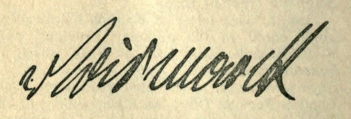
"BERLIN, "July, 1870."
XXXIII
P. C. Breagh never heard the order given, but next moment his aching wrists were released from the huge, hard grip of Privates Braun and Kleiss, and the muscular legs that had affectionately twined about his own, were withdrawn. Subsequently, singly, and in silence, the Sergeant handed back the watch, pipe, tobacco-pouch, purse, and note-case. Last of all, Valverden, making a long arm, returned the half-sheet of Chancellory note, bearing the signature that had worked the miracle, without words, and looking coldly in its owner's face.
"Thanks tremendously! ... I've no doubt I'm to blame for not producing my credentials earlier," said Carolan. "But I'd no notion of the rather serious turn things were going to take. However, all's well that ends——"
His smile froze upon his lips, and died out of his eyes as he encountered the stare the other turned upon him, answering haughtily:
"I regret that you have suffered some rough handling from my comrades, under the wrong impression that you were an agent of the French Secret Service. Admitting that our own side act advisedly in employing persons like you, I must say that to me, personally, a spy is—a spy!"
"But, hang it! you don't suppose——" Carolan choked out after a moment of angry bewilderment. And with the Sergeant's piggish little eyes curiously fixed on him, Valverden answered curtly:
"I suppose nothing. Excuse me from further conversation."
The revolver with its cartridges had not been returned with the other articles. Its owner asked the Sergeant for it, getting in reply only a glare. Thenceforward the long night's journey for one traveler was performed in unbroken silence. P. C. Breagh had been dispatched to Coventry by one and all.
Men who conversed spoke in barely-audible whispers, their covert glances, like the frigid indifference of Valverden's regard, and the extra six inches of seat-space accorded to the holder of the States Chancellor's written guarantee, testified to the aroma of suspicion that personage's document exhaled.
So at breathless, baking midnight the troop-train clanked into Cologne, no longer throbbing with the beat of drums, roaring with iron-shod wheels, swarming with men in brass-spiked helmets, choked with continuously shouting patriots, as it had been a few hours earlier when the Headquarter Staff trains had passed through,—and in the close, gray dawn of a thundery day, jolted into Bingen.
Here miles of rolling-stock and numberless engines blocked up the metal roads. Shuttered windows and barricaded doors testified that house-owners had temporarily abandoned their property. Strings of barges, laden with Commissariat stores and live-stock, were being towed up the Rhine by the gaily painted, white-awninged, paddle-wheel steamers familiar to the British tourist, while others were conveying voluntarily exiled residents and fugitive visitors down the classic stream out of harm's way.
Conveyance by railway—of a kind—was to be had upon terms prohibitory to all but the opulent. And disheveled ladies, pale or red with panic, besieged the station-master and his master, the Halt Commandant—with prayers, commands and entreaties, for places, but for places on some Northward-going train....
Something was in the air besides the short, staccato bugle-calls, the scream of signal-whistles and the ceaseless beating of the Prussian side-drums. P. C. Breagh knew it, even as a tall, lean, red-faced Inspector caught his eye and beckoned him imperiously to quit his cage, asking:
"You have a Legitimation to proceed with the troops to Kreuznach? No? Then be good enough to stand aside until I have an opportunity of ascertaining why you were originally permitted. Here is the Commandant."
Standing on the whitewashed platform, hot, dusty, unbrushed and unwashed, burdened with his unstrapped knapsack, a stout walking-stick, a leather-covered, screw topped sling water-bottle, some crumpled newspapers and a package of solid sandwiches—thrust upon him at one of the previous stopping-places, P. C. Breagh was conscious of cutting a sorry figure. Conscious, too, of Valverden's supercilious eye-glass, glittering a few yards off, as he stretched his long legs on the platform and talked eagerly with some comrades of his own standing, straight-backed, long-legged youngsters, with arrogant manners, clear eyes, budding mustaches, newly fledged whiskers, broad shoulders and regulation waists.
No new pupil at a young ladies' boarding school, smarting under the double stigma of plainness and poverty, no cheaply arrayed debutante at a suburban subscription-ball, ever blushed more hotly or winced more painfully under the scrutiny of prettier and richer girls, than did P. C. Breagh under the glances of these young men.
Not the memory of the Army Service examinations he had failed in galled him, or that missed shot for the I.C.S., or the University career foregone. It was the word "spy" that rankled in his memory and took the starch out of his self-conceit.
Before the discovery of the Minister's written guarantee, Valverden had gossiped with him as an equal—the other Guardsmen had been friendly in their rougher way. The fateful half-sheet of Chancellory note had changed everything. "As though one had blossomed out in plague or smallpox," P. C. Breagh had said to himself bitterly. "And I feel like a kind of Ali Baba or somebody, whose talisman would only work upside down!"
Even his parting salute had met with grudging acknowledgment. The Sergeant had grunted. Braun and Kleiss had spat, and looked the other way. Valverden's finger had barely brushed the narrow peak of his forage-cap. Only Kunz, the spectacled ex-chemist's assistant, had civilly bidden the parting guest good-day.
He was horribly sore at the treatment received from Valverden. Susceptible of hero-worship, warm and sincere in feeling, he had taken a liking to the brilliant youngster, three years his junior, his superior in social status and in cynical knowledge of the world. Was it disgraceful to belong to the Prussian Diplomatic Secret Intelligence Department, that ramifying spider-web of invisible wires, reaching to the uttermost Kingdoms of the civilized globe, and emanating from the Chancellory in the Friedrichstrasse, Berlin?
The Army had its secret agents, an army of them, by Jingo! Had not scraps of conversation reached the ears of P. C. Breagh no later than the previous day, relative to a certain dandy Colonel of Prussian Field Artillery, who for the past two years had filled the well-paid post of lace and ribbon Department Manager at the Paris Bon Marche.
Then why on earth.... But at this juncture the Halt Inspector returned with the Commandant, a white-whiskered, potty officer, in blue infantry uniform with distinctive white shoulder-straps, beside whom stalked a tall, middle-aged Colonel of Uhlans, whose pale eyes, unshaded by the tufted schlapka, glittered through steel-rimmed glasses, whose teeth were clenched on a familiar meerschaum—and whose gaunt, broad-shouldered figure looked better in the dark blue cavalry uniform with its yellow plastron and white cross-belt, than in Herr von Rosius's Berlin-made private clothes.
For it was undoubtedly Miss Ling's quiet-mannered first-floor lodger, who had resigned his post of teacher at the Berners Street Institute of Languages when the wire had come from Headquarters, bidding him come back and be a cog-wheel in Moltke's big war-machine. What Mr. Knewbit would have called "the blank expression" appeared behind his spectacles when they showed him his young fellow-lodger from Coram Street. But he paused when the Commandant halted and began to ask questions—which Carolan answered in the German so frequently tested on Herr von Rosius.
"How came you to travel from Berlin in a train set apart for the use of the Guard Infantry? Show me your Legitimations-Kart and military ticket, if you have one!—You have neither? ... Then how did you, against the regulations, obtain permission of the authorities to enter a militär-zug? It is inconceivable that you should have managed to conceal yourself without connivance of some kind!"
Things were getting close to the Chancellory half-sheet, but it would never be displayed with the consent of P. C. Breagh. He had wild ideas of feigning idiocy, of appealing to Von Rosius, but the first resource savored of the theater too strongly for adoption, and the second—one glance at the hard, ignoring eyes behind the steel-rimmed glasses disposed of that for good.
At his wits' end, a loud, genial voice hailed him in the English language, flavored with the County Dublin brogue.
"By the powers! and there's the face I'm looking for. Longer by a yard than it was when you capped me at Berlin. Faith! and I stared at you with all my eyes, wondering where in the world I'd last beheld ye? Till Chris Brotherton quizzed me and I bet him five shillings the place was Fleet Street. Now, on your honor, was it? Speak, or forever after hold your tongue!"
"Not quite Fleet Street, sir, but hardly a stone's throw from it!" A great wave of unreasonable hope lifted the sinking heart of P. C. Breagh.
The big, warm voice and the kind, bright glance that had wrought the miracle, belonged to a stout little bearded gentleman of fifty, topped with a hard gray Derby, and attired in a pepper-and-salt cutaway coat, brown holland vest and neat white hunting-stock, gray Bedford cords and shiny black spurred Blucher boots. Had you met him cantering on some plump and well-fed cob along a green lane in the Mother Country, you would have taken him—but for the revolver-pouch that depended from a neat black leather belt, and the wallet that, with its companioning field-glass, was slung across his shoulders—for a hard-riding country surgeon or solicitor, of the good old English kind. But P. C. Breagh knew better, and his drab world changed to rose-color, as the big voice rolled from the capacious chest:
"Hardly a minute's ... Hold on! For the life of you, don't refresh my memory! What would it be to find one's mental legs getting shaky at the start of a new campaign! Not a stone's throw from Fleet Street, did you say? ... By the Beadle of Old Trinity! if you don't mean the Maze at Hampton Court or the Nevski Prospect at Petersburg, or the garden of the Dilkusha at Lucknow, you're talking of Printing House Square! Am I right now?"
"You've hit the nail, sir! You were walking arm-in-arm with Mr. Sala—and I'd been introduced to him before, luckily! and he remembered my name and presented me to you!"
"And I'm five shillings the richer by the meeting. For if Chris Brotherton dares to say the Thunderbolt office and Fleet Street are anything but synonymous, he's a bolder man than I take him to be. But I'm interrupting a conversation...." He broke off, saluting the official. "Pray accept my apologies, Herr Commandant, I'll wait while you finish with my young friend."
The Commandant stiffly returned the genial salute before he wheeled and walked off with the Inspector and Von Rosius, who, while the king of British War Correspondents chatted with his glowing vassal, had exchanged a few sentences with these personages apart. Then said the kindly little gentleman, with a humorous twirl of the eye at the three:
"I claimed your acquaintance because I saw you nearing the jaws of a German guardroom. Though I fancy you'd a friend at Court in that Uhlan Colonel there! ... I heard him tell the Commandant that he'd no earthly idea how you got here, but you were simply an English schoolboy who was crazy to see a war. And the Commandant said something about turning tail at the first whistle of a Bombensplitter—that's a shell-splinter. Though I'm pretty certain by the cut of your jib you'd do nothing of the kind!"
He added, as a familiar shout of "Entrain!" and a bugle-call brought the platform leg-stretchers scampering to their places and the long train of gray-painted wagons, officers' horse-boxes and baggage trucks, clanked into motion again:
"Your friends of the Guard have gone without you. Kreuznach will be their detraining-point—that's all I can tell you. For the reason—and it's an uncommonly sound one!—that the newly mobilized men of the infantry battalions want a march to limber their joints and stretch their new boots a bit. Begad! my own brogues would be the better of a day or two on the trees. But rheumatism and corns are the price one pays for experience—and the privilege of talking like a daddy to harum-scarum gossoons like yourself. You've no business to be here, boyo! but since you are—use your eyes and brains to observe with—never be ashamed of running away when you can get out of danger by doing it! and for your mother's sake, if she's living—don't be dragged into fighting on a side. Forget that you have a revolver, if that bulge under your jacket means that you carry one,—and keep your temper cool and your opinions strictly neutral, if a fellow with a drop of Irish blood in him can! Twit me with Bull Run, now, and you'll get the historic answer: 'Do as I advise you to do, not what I do!'"
He pulled out the battered gold hunting-watch at the end of its short, strong leather guard, and glanced at it, saying with a sigh of relief:
"Seven o'clock. Breakfast ought to be ready at the Victoria—barrack of a hostelry, packed with cocky Prussian officers. Suppose you come back there with me and have a bite and sup?"
Dazzling prospect! to a young man given to hero-worship, which the historian of "Cromwell" had positively asserted to be good for youthful bodies and souls. P. C. Breagh would have given a great deal if Valverden could have heard the invitation.... However, it was more likely than not that he had beheld the object of his scorn in familiar conversation with the most famous of British War Correspondents, as the gray-painted troop-train carried him away.
XXXIV
That was an enchanted walk for P. C. Breagh, back to the big, bare, barrack-like Victoria. It was the Doctor's generous amends for an unintentional slight. Two days previously, at the Potsdam Railway Station, Berlin, when a companion had said to him: "Who's the enthusiastic young admirer who kowtowed to you? English, I should say, and you cut him unmercifully,"—he had answered, out of the whirl of great affairs:
"I've no notion; but I'll make amends if ever he crosses my path again. It's not my way to hurt a boy."
"Bet you five bob he hails from Fleet Street," the friend had cried; and the Doctor had answered:
"If so, he has a claim on me I'm not going to deny."
Dust underfoot made the tread fall as on velvet. Dust in the air parched the throat and got in the eyes. And the incessant rolling of the Prussian side-drums, lanced through with signal whistles and sharp bugle-calls, made the hot baked atmosphere quiver, and the play of early sunshine on myriads of brass helmet-spikes made the eyes water and blink, as the battalions of blue infantry that had marched into Bingen on the previous day mustered from their billets, were entrained and conjured away; and other battalions that had marched fifteen miles since cock-crow tramped in with the thick white dust turned to mud upon them by the heavy Rhineland dews that had soaked their boots and damped their uniforms, halted but to breakfast—and were off, almost on the heels of the first.
Division after Division of Cavalry—Uhlans in light or dark blue piped with red, and shiny black Lancer schapkas, Cuirassiers in white uniforms, with steel breast and back plates, and steel helmets simple in design as those of Cromwell's Ironsides; light blue Dragoons, Hussars with tufted shakos of miniver, and braided jackets of red, black, green, brown and pale blue, with their flying batteries of Horse Artillery, their proviant columns and ammunition-trains, had been rushed to the frontier with astounding speed. Now the blue deluge of marching men with needle-guns came rolling after. With thunder of heavy siege-trains, with patches of green upon the monotonous blue, that stood for picked battalions of sharpshooters; sons of gamekeepers and forest-rangers; bred from childhood to woodcraft and hunter's lore; experts in the use of the rifle, scouts and trackers of daring and skill.
On the seventeenth of July the Warlock had said to his King, "Give me to the third of August and we are safe." This was the third of August. And the air was thick with something besides dust.
Conscious of this, they talked, the neophyte and the adept discussing things that had happened during the pregnant interval. How Forbes of the Daily News, who tramped it up to Saarbrück by the Nahe Valley Road from Kreuznach, had seen the first blood flow, when a couple of infantrymen of the garrison were brought in in a chipped condition, having been sniped at by red-breeched French marksmen across the frontier-line.
With a single battalion of the Hohenzollerns, the 7th Regiment of Rhineland Uhlans had hitherto constituted Saarbrück's garrison. And the French being reported in force at Forbach, some fifteen or sixteen thousand men being said to be strung out along the frontier, a detachment of Uhlans with spare troop-horses had ridden into Neunkirchen on the morning of the twenty-fourth of July, and borrowed from the collieries a dozen stout miners, armed with picks, and supplied with blasting cartridges, fuses, and so on. These grimy stalwarts they tied on troop-horses; crossed the frontier, and blew up the viaduct on the railway-line branching from the Forbach-Metz railway near Cocheren and connecting Metz with Saarguemines, Bitche, Hagenau and Strasbourg.
Thenceafter, nothing of note happened until the twenty-eighth of July, when the Emperor Napoleon III. entered Metz with his Staff and the heir to the Throne Imperial, and formally took command of the seven corps d'armée known as the "Army of the Rhine." Upon the same day, a party of the Hohenzollerns, commanded by an N.C.O., reconnoitering on the right front, flushed a French vidette, in a wood covering a knoll of rising ground, over the top of which went the imaginary frontier-line.
Being shot at, the Hohenzollerns retired to garrison. But about regimental soup-time, twelve or thereabouts, a battery of six French field-pieces came over the slope of the Spicherenberg heights, getting into position on a plateau half-way down.
And while the Prussian drummers beat to arms; while the Hohenzollerns hastily posted their four companies, one on each of the town's three bridges, and sent one forward on the heels of a squadron of Uhlans, up the Forbach Road, which runs through Saarbrück, rising as it trends to the west;—while the rest of the Uhlans stood to their horses in the Markt-platz, and the civilian population stopped to look on, or scuttled for cover, six shells were fired, three of them hitting a little beerhouse on the hill-brow, just off the Forbach Road—and the Imperial cannonade was over, the artillerists retired, and nothing more had happened,—though the videttes and patrols, Gallic and Teuton, had cracked away at each other from high noon till batlight.
Discussing these things, the adept and the neophyte came to the Victoria, every window of which was crowded with Prussian officers, eating, drinking and smoking, or shouting for breakfast, coffee, beer, wine and tobacco in every key of the human register.