Chapter VI · THE COLOURATION OF ORGANISMS (continued 2)
Reading edition
“False” Mimicry among Mammals
The Cacomistle of Mexico (Bassaris astuta), one of the raccoon family, has a grey body and long black-and-white ringed tail, just like the ring-tailed Lemur of Madagascar (Lemur catta); [243] both are arboreal and about the same size, and this lemur’s colouration is exceptional in its family.
The banded Duiker-buck of West Africa (Cephalophus doriae), has the same very unusual colouration as the thylacine or marsupial wolf of Tasmania, light brown, with bold black bands across the hinder part of the back, and the animals are about the same size.
The dormouse of Europe closely resembles a small American Opossum (Didelphys murina), and a larger opossum (D. crassicaudata) is very like the Siberian Mink (Mustela sibirica).
The Flying Squirrel of North America (Sciuropterus volucella) is closely copied by the Flying Phalanger (Petaurus breviceps) of Australia.
It will be readily seen that in no one of these cases can the likeness be of utility to either the “model” or the “copy.”
False Batesian Mimicry among Birds
There are many instances of this phenomenon among birds. The New Zealand Cuckoo (Urodynamis tritensis) shows a far closer resemblance to the American Sparrow-hawk (Accipiter cooperi) than to any New Zealand hawk, and in fact closely mimics this quite alien bird.
The stormy petrel, a purely oceanic bird, closely resembles in size, colour, and style of flight the Indian Swift (Cypselus affinis), a purely [244] inland creature; both are sooty black, with a conspicuous white patch on the lower back.
The Pied Babbling Thrush (Crateropus bicolor) of Africa is singularly like the Pied Myna (Græulipica melanoptera) of Java, both being of about the same size, with white body and black wings and tail quills. This, we may add, is a very unusual colouration among small birds.
The black-headed Oriole (Oriolus melanocephalus) of India is very similar in appearance to the common Troupial (Icterus vulgaris) of Brazil; indeed, the troupials, a purely American group, are so like the old world orioles in colour that they usurp their name in America.
The little insectivorous Iora (Ægithina tiphia) of India strongly resembles in size and colour a Siskin (Chrysomitris colambiana) from South America, the males in both being black above and yellow below, while in the females the black is replaced by olive-green.
Another Indian babbler (Cephalopyrus flammiceps), yellowish-green, with orange forehead, is closely copied by, or copies, the well-known Brazilian Saffron-finch (Sycalis flaveola).
In Fergusson Island, near New Guinea, there is a ground pigeon (Otidiphaps insularis) which is black with chestnut wings, like several of the powerful ground cuckoos of the genus Centropus, but no species of these cuckoos so coloured appears to inhabit the island.
[245]
In Africa there is a tit (Parus leucopterus) which has the same very unusual colouration as an East-Indian bulbul (Micropus melanoleucus), both being black with a white patch on the wing-coverts. These two birds are about the same size. As showing the purely coincidental character of such resemblances, we may mention that this same rare pattern occurs again in our Black Guillemot (Uria grylle) and in the Muscovy Duck (Cairina moschata).
We have already quoted Gadow (p. 198) on “false mimicry” among snakes. He also gives, on p. 110 of Through Southern Mexico, an example of this phenomenon among amphibia. It is, he writes, “impossible to distinguish certain green tree-frogs of the African genus Rappia from a Hyla, unless we cut them open. If they lived side by side, which they do not, this close resemblance would be extolled as an example of mimicry.”
We should be very greatly surprised if abundant examples of “false mimicry” are not found among insects. We trust that this remark will stimulate some entomologist to pay attention to the subject.
It is the essence of Müllerian mimicry that both model and copy are immune from attack from enemies. Unfortunately for the theory, similar resemblances occur among birds of prey, [246] where neither party can benefit from the association. This gives rise to what we may perhaps call false Müllerian mimicry. Thus the goshawk and peregrine falcon resemble each other in being brown above and streaked below in immature plumage, and having barred underparts and a grey upper plumage when adult.
Theory of Mimicry Criticised
Having stated the more important objections to the theory of protective mimicry, it now remains for us to deal specifically with each head of evidence offered in its favour.
1. With regard to the assertion that the model and its copy are often not nearly related, we have shown that among mammals and birds instances of resemblance between widely-separated groups occur under such circumstances that neither party can derive any benefit therefrom.
2. As regards the assertion that species which are mimicked are either well-defended or unpalatable, this certainly does not hold good with regard to some at any rate of the coincidental resemblances among birds which we have pointed out; even if these pairs of similar species lived in the same country it would require considerable ingenuity to say why one should mimic the other.
3. As regards the argument that the inedible species of Ithomiinæ, etc., display only fifteen colours, while the less numerous edible Papilios [247] display more than double this number of colours, we may draw attention to the fact that those birds which are most immune from attack are precisely those which display the smallest range as regards colour, e.g., hawks, owls, crows, gulls, storks, and cranes. As we have already submitted, no question of Müllerian association comes in here.
On the other hand, the eminently edible families of game-birds and ducks display great variety of colour, in the males at all events.
4. As regards the statement that although in many cases the mimetic resemblances extend to the minutest detail, they are not accompanied by any structural changes except such as assist in the production of a superficial likeness, we may refer to the case we have already cited of the New Zealand cuckoo, which, though it so closely copies an American hawk, is typically cuculine in structure. Here, of course, there can be no question of advantage to the “mimicking” cuckoo in the resemblances.
5. In answer to the argument that mimetic resemblance extends to form, attitude, and movement, as well as colour, and that deep-seated organs are affected only when the superficial resemblance is thereby intensified, we may draw attention to such cases as the following:—
(a) The harmless Indian Snake (Lycodon aulicus) is closely similar to the well-known Krait (Bungarus cœruleus), [248] also Indian; but the resemblance extends to a structural detail which can hardly have mimetic value—namely, the harmless snake has long, fang-like front teeth, though these are unconnected with poison-glands. Animals which come into contact with the krait and its mimic are hardly likely to inspect their teeth.
(b) A considerable number of birds of the shrike group—known as Cuckoo-Shrikes (Campophaga)—closely resemble cuckoos in plumage; but even if they derive any benefit from mimicking birds which are credited with being mimics already, they cannot profit by the fact that the shafts of the rump-feathers in both groups are stiffened; this being a peculiarity which would not be perceptible until the bird was in the grasp of an aggressor.
(c) As a third case of coincidence we may refer to the tubercle in the nostril of the Brain-fever-bird (Hierococcyx varius), as a minute detail of hawk-like appearance, though not present in the particular species imitated.
6. The argument that mimetic resemblances are produced in the most diverse ways, but the result is uniform, loses much of its force when we consider the various methods by which short-tailed birds appear to have long caudal appendages.
In the peacock it is the upper tail coverts which are elongated; in the Stanley Crane [249] (Tetrapteryx paradisea) it is the innermost or tertiary quills of wing; in one of the egrets some of the feathers of the upper back grow to a great length and form a train; in the Bird of Paradise (Paradisea apoda) the long flank plumes are commonly mistaken for the tail.
In these cases there can be no question of mimicry.
7. We have shown that the idea that imitator and imitated are always found in the same area is absolutely fallacious. In birds, for example, the most striking resemblances appear to occur between species that dwell far apart.
8. We can cite, as parallel to the case of a mimicking species of which the male copies one model and the female another, the strange similarity between the barred brown plumage of the female blackcock and that of the female eider-duck. The males of these species, although both black and white, differ greatly in appearance; but the male blackcock is admittedly very like the male of another species of sea-duck—the scoter.
9. Against the supposed ancestral non-mimetic forms existing on islands we can pit the “mimetic” orioles in small islands and their non-mimetic cousins on the mainland. In Australia an oriole of what appears to be an ancestral style lives beside, but declines to mimic, a friar bird of a very pronounced type.
[250]
10. The case of certain diurnal moths mimicking butterflies appears to be explicable without the aid of the theory of protective mimicry. When two species adopt the same method of obtaining food, it not infrequently happens that a professional likeness springs up between them. Of this the swifts and swallows afford a striking illustration.
11. As a set-off to the cases where the alleged mimicry is confined to certain seasons of the year, we may cite the case of the pheasant-tailed Jaçana (Hydrophasianus chirurgus), which in its winter plumage might easily be mistaken, when on the wing, for the paddy bird or Pond Heron (Ardeola grayii), both being of like size and having a brown back, long green legs, and white wings. Moreover, they are to be found in the same localities in India. At the breeding season, however, they are absolutely different in plumage.
Yet another argument commonly adduced in favour of the theory of protective mimicry is that local variations of the imitated species are sometimes followed by the imitator; thus the butterfly Danais chrysippus shows a white patch on the hind wings in Africa, and this is followed by its mimic.
But the same thing occurs, quite irrationally, so to speak, among birds. The peregrine falcon and hobby of Europe are only winter migrants [251] to India, where they are replaced as residents by the Shaheen (Falco peregrinator) and Indian Hobby (F. severus). Both these differ from the migratory forms by being blacker above and chestnut below, instead of cream colour. Thus the resemblance occurs in each race. A similar distinction, as noted by Blyth, exists between the Common Swallow (Hirundo rustica) and the Swallow (H. tytleri) of Eastern Asia, the latter having the whole ventral surface rufous instead of only the throat. Yet no one will suggest that swallows mimic falcons, or that there is mimicry between the peregrine and hobby. It is obvious that such parallel changes occur independently of mimicry.
The Water-rail (Rallus aquaticus) and Baillon’s Crake (Porzana bailloni) of Europe are distinguished from their allies of Eastern Asia by having the sides of the head plain grey, whereas the Eastern Asiatic forms (R. indicus and P. pusilla) have a brown streak along each side of the face. Here, again, we have an instance of birds of the same family varying together with geographical distribution.
“Recognition” Colours
One of the prettiest conceits of the Wallaceian school of zoologists is the theory of recognition markings.
“If,” writes Wallace, on page 217 of Darwinism, [252] “we consider the habits and life-histories of those animals which are more or less gregarious, comprising a large proportion of the herbivora, some carnivora, and a considerable number of all orders of birds, we shall see that a means of ready recognition of its own kind, at a distance or during rapid motion, in the dusk of twilight or in partial cover, must be of the greatest advantage and often lead to the preservation of life. Animals of this kind will not usually receive a stranger in their midst. While they keep together they are generally safe from attack, but a solitary straggler becomes an easy prey to the enemy; it is therefore of the highest importance that, in such a case, the wanderer should have every facility for discovering its companions with certainty at any distance within the range of vision.
“Some means of easy recognition must be of vital importance to the young and inexperienced of each flock, and it also enables the sexes to recognise their kind and thus avoid the evils of infertile crosses; and I am inclined to believe that its necessity has had a more widespread influence in determining the diversities of animal colouration than any other cause whatever. To it may probably be imputed the singular fact that whereas bilateral symmetry of colouration is very frequently lost among domesticated animals, it almost universally prevails in a state of nature; [253] for if the two sides of an animal were unlike, and the diversity of colouration among domestic animals occurred in a wild state, easy recognition would be impossible among numerous closely allied forms.”
As examples of recognition colouration, Wallace cites, among others, the white upturned tail of the rabbit—a “signal flag of danger,” the conspicuous white patch displayed by many antelopes, the white marks on the wing- and tail-feathers of the British species of butcher-birds, the stone-chat, the whin-chat, and the wheat-ear.
Wallace therefore asserts, firstly, that recognition marks not only help herbivorous animals to keep together, but act as a danger signal; the member of a flock which first catches sight of the enemy takes to its heels, displaying its white flag, which is the signal of danger to the other members of the flock. Secondly, that recognition marks prevent the evils of infertile crosses. Thirdly, that the necessity of being able to recognise one another has rigidly preserved bilateral symmetry among animals in a state of nature.
As regards assertion number one, we would point out that where a flock of herbivora is being stalked by a beast of prey, the member of the flock nearest to the enemy—that is to say, the hindmost member—will probably be the first to observe him. As that creature will be more unfavourably situated for escape than the rest of [254] the herd, it will not be to their advantage to follow the line it has taken. Moreover, being at the rear of the flock, it is not in a good position to take the lead, and its pursuer is likely to see the danger signal before its friends do. It would thus seem that “danger signals,” while possibly sometimes of service to their possessors, are on the whole ornaments which might profitably be dispensed with. Natural selection can scarcely be charged with the production of a character of such doubtful utility to the organism.
Moreover, flourishing species of many gregarious animals do not possess any “signal flag of danger,” while, on the other hand, a great many solitary species display markings that render them very conspicuous when in motion. Take the case of the famous Indian Paddy Bird (Ardeola grayii). This, when at rest, is coloured so as to be very difficult to distinguish from its surroundings, but flight transforms it, for it then displays its milk-white pinions, which would make a perfect danger signal, if only it were not peculiarly solitary in its habits. Its gregarious brethren, the Cattle Egrets (Bubulcus coromandus), on the other hand, display no danger signal.
Interbreeding of Allied Species
That these recognition marks prevent the intercrossing of allied species and the production of infertile hybrids appears to be pure fiction. As we have already shown, hybrids between allied species are by no means always infertile. [255] Moreover, species which differ only in colour seem usually to interbreed in those parts where they meet.
“This interbreeding,” writes Finn, on page 14 of Ornithological and Other Oddities, “occurs where the carrion crow (Corvus corone) meets the hooded crow (Corvus cornix), where the European and Himalayan goldfinches (Carduelis carduelis and C. caniceps) encounter each other, and where the blue rollers of India and Burma (Coracias indicus and C. affinis) come into contact, to say nothing of other cases.”
Of these other cases, the Indian bulbuls of the genus Molpastes form a very remarkable one. In all places where two of the so-called species meet they appear to interbreed, and so freely do they interbreed that at the points where the allied species run into one another it is not possible to refer the bulbuls to either species. Thus William Jesse writes of the Madras Red-vented Bulbul (Molpastes hæmorrhous) (page 487 of The Ibis for July 1902): “This bird, although I have given it the above designation, is not the true M. hæmorrhous. I have examined numbers of skins and taken nests and eggs time after time, and have come to the conclusion that our type is very constant, and at the same time differs from all the red-vented bulbuls hitherto described. The dimensions tally with those given by Oates for M. hæmorrhous, while the black of the crown [256] terminates rather abruptly on the hind neck, and is not extended along the back, as is the case with M. intermedius and M. bengalensis. On the other hand, as in the two last species, the ear coverts are chocolate. Furthermore, I may add—although I attach little importance to this—that the eggs of the Lucknow bird which I have seen are, without exception, far smaller than my eggs of genuine M. intermedius from the Punjab. My own opinion is that the Lucknow race is the result of a hybridisation between the other three species.”
Further, in Bannu, Mr D. Donald saw M. intermedius and M. leucogenys paired at the same nest. That gentleman could not possibly be mistaken on the point, as the latter species has white cheeks and yellow under tail-coverts, while the cheeks of the former species are dark-coloured and the patch of feathers under the tail is red. Similarly, Whitehead and Magrath, writing of the birds of the Kurram Valley (Ibis, January 1909), record that the former shot no fewer than twelve bulbuls, which undoubtedly appear to be hybrids between these two species. As these hybrids differ considerably inter se, there seems no room for doubt that they breed with one another and with the parent species.
Symmetry in Nature
Wallace’s third statement, that if the two sides of animals in a state of nature were alike, easy recognition would be impossible among numerous [257] closely allied forms, reminds us forcibly of the sad case of the boy whose tailor was his mother. Humanum est errare: she made her son one pair of trousers that fastened up behind, so that the poor boy when wearing them never knew whether he was going to or coming home from school! If animals are able to recognise their mates, their bilateral symmetry does not seem necessary to enable them to distinguish their fellows from allied species.
It is, indeed, true that asymmetrically marked animals are very rarely seen in the wild state, while they are the rule rather than the exception among domesticated species. But this appears to be due, not to the necessity of recognition markings in nature, but to the fact that those animals that display a tendency to massed pigment perish in the struggle for existence, since this massing of pigment appears to be correlated with weakness of constitution. In other words, this massing of pigment is an unfavourable variation, which under natural conditions dooms its possessor. In the easier circumstances of domestication, animals which are irregularly pigmented are able to survive, so that, among them, the almost universal tendency to the massing of pigment can be followed without let or hindrance.
It is unnecessary to say more upon this subject. The few facts we have set forth suffice to destroy this particular excrescence on the Darwinian theory.
[258]
The Colouring of Flowers and Fruits
Extremely interesting though the subject be, we are unable to consider at length the generally accepted theory that the colour markings and perfumes of wild flowers are the result of the unconscious selection exercised by insects.
While not denying that many flowers profit by their colouring, that these colours may sometimes serve to attract the insects, by means of which cross-fertilisation is effected, we are not prepared to go to the length of admitting that all the colours, etc., displayed by flowers and floral structures are due to the unconscious selection exercised by insects. It is one thing to admit that the colour of its flowers is of direct utility to a plant; it is quite another to assert that the colour in question owes its origin and development to natural selection. Our attitude towards the generally accepted explanation of the colours of flowers is similar to that which we adopt towards the theory of protective mimicry among animals. In certain cases we are prepared to admit that the mimicking organism derives benefit from the likeness; but this, we assert, is no proof that natural selection has originated the likeness.
Cross- versus Self-fertilisation
The theory that flowers have developed their colours in order to attract insects to them, and thus secure cross-fertilisation, is based on the [259] assumption that cross-fertilisation is advantageous to plants. It is questionable whether this assumption is justified. True it is that numbers of experiments have been performed, which show that, in many cases, flowers which are artificially self-fertilised yield comparatively few seeds. But experiments of this kind do not prove very much.
To place on the stigma pollen from the anthers of the same flower, in case of a plant which for many generations has been cross-fertilised, is to subject the plant in question to a novel experience—an experience which may be compared to transplanting it to another soil. The immediate effect may appear to be unfavourable, although, if the experiment be persisted in, the ultimate results may prove beneficial to the plant.
That this is the case with some flowers that are artificially fertilised is asserted by the Rev. G. Henslow. This observer states, that had Darwin pursued his investigations further, he would probably have modified his views regarding the benefits of self-fertilisation. Darwin’s statement that “Nature abhors perpetual self-fertilisation” seems to be as far from the truth as that which declares “Nature abhors a vacuum.”
From the mere fact that cross-fertilised flowers yield a greater quantity of seed than they do when self-fertilised, it does not necessarily follow [260] that cross-fertilisation is advantageous. The amount of seed produced is probably not always a criterion as to the advantages of the crossing to the plant. Some flowers yield most seed when fertilised by the pollen from flowers belonging to a different species!
It is significant that some plants produce cleistogamous flowers, that is to say, flowers which invariably fertilise themselves. Such flowers never open; so that the visits of insects are precluded.
According to Bentham, the Pansy (Viola tricolor) is the only British species of Viola in which the showy flowers produce seeds. The other species are all propagated by their cleistogamous flowers. The genus Viola is an advanced species: it would therefore seem that the production of cleistogamous flowers is an advance on the production of entomophilous flowers. Cleistogamous blossoms are obviously more economical.
Insects and Flowers
In the case of the malvas, epilobias and geraniums, where we see, side by side, races of which the individuals produce insect-fertilised flowers and those that are characterised by self-fertilised flowers, the latter are quite as thriving as the former.
The common groundsel, which, according to Lord Avebury, is “rarely visited by insects,” flourishes like the green bay tree, as many [261] gardeners know to their cost. The same may be said of the pimpernels. In this connection it is important to bear in mind that the anemophilous, or wind-fertilised, angiosperms, as, for example, the grasses, are believed to be descendants of insect-fertilised or entomophilous forms.
A weighty objection to the theory that the colours of flowers have been developed because they attract insects has been urged by Mr E. Kay Robinson, namely, that among wild flowers the most highly coloured ones are the least attractive to insects.
“Show me,” writes he, on page 222 of The Country-Side for March 20, 1909, “the insect-collector who will seek for specimens among the brilliant scarlet poppies. Of what use is the dog rose, with its large discs of pinky-white, to him? On the other hand, does he not find that by far the most attractive flowers are the almost invisible spurge laurel blossoms in February and March, the fuzzy sallow catkins in March and April, the bramble blossom in midsummer, and the ivy’s small green flowers in autumn? Of these only the bramble has any pretensions to colour, and if you try, as I have tried, the experiment of picking off every petal from sprays of bramble blossoms you will find that its attraction to moths does not appear diminished.
[262]
“The fact that insects do visit many conspicuously coloured flowers does not show that the colour attracts them, when the fact is borne in mind that they neglect others which are equally coloured, while the flowers which they particularly haunt are inconspicuous. Conspicuous flowers which have abundance of nectar attract insects, of course, but so do inconspicuous flowers which have nectar. If they have no nectar, neither the conspicuous nor the inconspicuous flowers attract insects other than pollen or petal eaters, whose visits are not good for the plant. This shows that the nectar attracts the insects and that the colour of the flowers makes no difference.”
In autumn many leaves assume bright and beautiful tints. These are not believed to be in any way useful to the plant. The autumnal hues and shades are regarded, and rightly regarded, as the garb of death and decay. Such colours are the result of the oxidation of the chlorophyll or green colouring matter of the leaves. Why should not the colours of the petals of the flowers, which wither and fade long before the green leaves do, be due to a similar cause? The bright colours of fruits are supposed to have been effected by natural selection in order to attract fruit-eating animals. Surely a hungry animal does not require that its food be brightly coloured in order to find it! We [263] must remember that during the greater part of the year most animals have no occupation save that of finding their food. Inconspicuously coloured fruits, like those of the ivy, are frequently eaten by birds. The bright colours of some ripening fruits are undoubtedly the colours of decay. Many fungi and seaweeds have bright colours. It is never hinted that these are of any direct utility to their possessor.
Every flower, every plant, every organism must be of some colour.
Honey
Many flowering plants produce honey. This is said by some botanists to have been directly caused by natural selection, because the honey attracts insects. Possibly those who take up this attitude are putting the cart before the horse. It is probable that honey, like oxygen, is an ordinary product of the metabolism of the plant, and that the visits of bees and other insects to such plants are the result rather than the cause of the honey being there. Boisier found that some plants, for example, Potentilla tormentilla and Geum urbanum, gave honey in Norway, but very little near Paris.
He further discovered that by supplying certain plants copiously with water he could induce them to produce more than their normal output of honey.
As is their habit, Neo-Darwinians have pushed their pet theory to absurd lengths in its [264] application to flowers. They assert that the visits of insects are responsible for not merely the general colour of every flower, but also the various lines, spots, and other markings of flowers. The lines that frequently occur on the petals are supposed to guide the insects to the honey! This particular refinement of Neo-Darwinism, to quote Kay Robinson, “needs little discussion. Insects have very poor sight. You can see this when a bee or a butterfly flies bang against a whitewashed wall; when a wasp pounces upon a black spot on a sunlit floor, mistaking it for a fly; or when a settled dragon-fly will allow you to poke it in the face with the end of a walking-stick, although it will be off like a flash if you raise your arm. There is, therefore, large reason to doubt whether insects can even see the fine lines in the throats of flowers which are supposed to guide them to the nectar. It is rather absurd, too, to suppose that such lines can be needed, since insects come in swarms to inconspicuous and apparently scentless flowers or to ‘sugared’ tree-trunks in the dark. Where there is nectar, insects which have come to the feast from a distance need no pencilled lines to guide them over the last quarter of an inch of their journey.”
Scents of Flowers
Neo-Darwinians further assert that the scents of flowers have been developed by natural selection because they serve to attract insect visitors [265] to the flowers. In support of this contention it is urged that the most highly scented flowers are not usually the most conspicuous ones, since it is not necessary for a flower to be both highly coloured and strongly scented. Again, those flowers which open at night are usually very highly scented.
Plausible though this view seems, there are weighty objections to it. These are so admirably summarised by Kay Robinson in the issue of The Country-Side for March 27, 1909, that we feel we cannot do better than reproduce his words:—
“It is true that many flowers which are strongly scented are visited by insects, but these flowers have abundance of nectar, and the insects come in spite of the scent, and not on account of it. They visit unscented flowers, provided that they have nectar, equally freely; and they do not visit flowers which have scent without nectar.
“Moreover, fruits are more generally scented even than flowers; but what explanation have those, who attribute the scents of flowers to the tastes of insects, for the scents of fruits? Insects which visit fruits are only robbers. Therefore, if we say that plants have scents for the purpose of attracting insects, we accuse all plants which have scented fruits of attempted suicide.
“There are hosts of plants, again, with scented leaves. Here also the insects are only robbers, [266] and it is quite clear that the scent is not useful in attracting insects. If, therefore, you adopt the insect theory to explain the scents of flowers, you must invent entirely new theories to explain the scents of fruits and leaves.”
It is thus evident that the ordinarily accepted explanation of the colours, scents, and markings of flowers is far from satisfactory.
Kay Robinson’s Theory
Mr E. Kay Robinson has put forth in recent issues of The Country-Side (March 20, 27, and April 3, 1909) quite a new explanation of the phenomena, and one which deserves careful consideration. He maintains that “the real, primary, and original meaning of the colours, markings, nectar and scents of flowers is not to attract insects, but to deter grazing and browsing animals.”
“I say,” he writes, “that grazing and browsing animals avoid eating conspicuous flowers. I have watched a flock of five hundred sheep pass across a yard-wide strip of close-nibbled turf on the Norfolk coast, grazing as they passed, and the number of open daisy blossoms after they had passed seemed the same as before they came. Every one of five hundred sheep had eaten something from that yard of grass, and not one had eaten any of the hundred and thirty odd daisies.
“Every summer the farm horses are turned into the same old pasture, and as the summer wanes the field always presents the same appearance—the [267] green grass close-grazed, the tall buttercups left standing high.
“Once, leaning over a gate with friends, I pointed out that a flock of sheep grazing in a sainfoin field were nibbling the greenstuff close, but were not eating the flowery stalks, when one sheep near us accidentally pulled up a whole sainfoin plant by the roots and proceeded to munch it upwards. Inch by inch the stem passed into its jaws, and I began to be afraid that it was going to establish an ‘exception’ to my rule. But, just when the bright cluster of pink sainfoin blossom was within two inches of its teeth, it gave an extra nip, and the flower head fell to the ground, and the sheep resumed its search for greenstuff.
“I do not say that this would always happen—I should be sorry for any theory which depended upon the intelligence of a sheep—but it was a very striking object-lesson to my two companions; and any one who looks around during this summer with an inquiring mind will find plenty of evidence that grazing, browsing, and nibbling animals avoid flowers, and stick to greenstuff when they can get it.
“I do not say that all animals avoid the same flowers. Horses, for instance, may dislike large flowers like roses and conspicuous yellow flowers like buttercups, but they will bite off flat clusters of minute white or pale yellow flowers, such as [268] yarrow or wild parsnip. These distinctions made by certain kinds of beasts will probably in the future be found to afford valuable evidence as to the regions of origin of our flowers and animals. Such plants as the yarrow and the wild parsnip, for instance, probably did not originate in the home of the wild horse, because they are not protected against it.
“As a general rule, however, there is abundance of evidence that plants with conspicuous flowers gain a large advantage in the struggle for existence, because grazing and browsing animals avoid them; while there is no real evidence at all that conspicuous flowers attract insects.”
Kay Robinson extends this explanation to the shape, the scent, and the nectar of flowers. He admits that many flowers are adapted to the visits of insects, but this is, he asserts, but a secondary result. The “real, primary meaning” of the shapes of flowers of curious configuration is, he insists, “a deterrent to grazing or browsing animals.”
According to him plants, like the snap-dragon, which have “blossoms in the semblance of a mouth,” are avoided by grazing animals, because they mistake such flowers for mouths, and have no wish to be bitten! Orchids, he asserts, “are strongly deterrent to grazing and browsing animals, which are looking for greenstuff, and regard these gaudy, spidery, winged blossoms as [269] live creatures.” “If this is not the truth,” he asks, “will any adherent of the theory that we owe the shapes of flowers to insects explain why some of our common British orchids are so like bees, spiders, etc.? Some which have no particular resemblance to any insect still exhibit weird shapes, suggestive to the human mind of living things, such as lizards, etc. The reason why they look like bees, spiders, lizards, and various unclassed creatures is quite simple. Grazing animals are looking for greenstuff, and do not wish to eat living creatures which may bite or sting or taste nasty. Thus the orchids have acquired the power of looking like creatures.
“Every one,” he continues, “who is familiar with the blossom of the wild carrot—a flat head of minute, dull-white blossoms—must have noticed how very often the centre blossom in each head is purplish or reddish-black. This makes it very conspicuous in the middle of the flat white flower head. Now what conceivable use can this barren little blackish blossom—scarcely bigger than a pin’s head—be to the wild carrot plant if we regard the flat head of white flowers as an attraction to the sight of insects? If, on the other hand, we rightly regard the flat head of white blossoms as an advertisement to grazing animals that it is not wholesome greenstuff, but innutritious blossoms liable to be infested with ants and other stinging insects, we [270] see at once the great use of this small blackish flower in the middle. It looks like an insect, and possibly in the home of the wild carrot there is some minute blackish insect with a peculiarly villainous smell or taste—or perhaps a potent sting—which grazing animals carefully avoid whenever they can see it. Thus the wild carrot flourishes; though here in Britain—where the wild carrot has established itself now—we may fail at first to see the exact meaning of the trick. I think, however, that, when we understand it, it fits admirably into the theory that the shapes and colours of flowers are primarily useful as deterrents to grazing and browsing animals and not as attractions to insects.
“Thus we see,” he concludes, “that the queer shapes of these orchids, which are a great stumbling-block in the way of those who preach that we owe the shapes of flowers to the tastes of insects, become a strong confirmation of my theory that we owe the shapes of flowers to grazing and browsing animals.”
Of the nectar of flowers, Kay Robinson writes: “Since this is eagerly sought for by hosts of insects, whose visits are in most cases useful to the flowers, it seems only natural to suppose that we see cause and effect in this connection.
“Here, however, I will outline my theory of the origin of nectar and of flowers in general.
[271]
“I think there is no doubt whatever that all the parts of a flower are modified leaves. The original type of flowering plant—I think we may safely assume—had a single stem and produced its seed at the summit, as the crown of its year’s endeavour. The flower, before it became what we would recognise as a flower, was a cluster of protecting leaves round the seed-making parts of the plant. To the production of the seed the whole energies of the plant were devoted, and into the cluster of leaves at the top of the stem all the essences of the plant were concentrated. If during the coming spring you handle and examine the leaves at the end of the strong shoots of thorns or fruit bushes, you will find that the surface of the young leaves is quite sticky. If you observe browsing animals also, you will discover that—contrary to expectation—they do not like strong-growing, juicy shoots, evidently preferring mature leaves lower down the branch. This shows, I think, that plants have the power of protecting their new shoots by crowding into them the volatile oils and essences which they produce as a protection against animals. Now nectar appears always to be distasteful to grazing and browsing animals; and they also dislike scented flowers. I think, therefore, that it is reasonable to suppose that the nectar and scents which now distinguish so many flowers were first produced as an exudation of concentrated sap [272] upon the surfaces of the protecting leaves round the seed-making parts of the original flowers. As these leaves became more efficiently protective by assuming colours, shapes, and markings which warned animals of their character, so their apparatus for producing scent and honey became specialised; and at this point the insect appeared upon the scene as a factor in the life’s success of the plant.”
Such, then, is Kay Robinson’s bold and original theory. In some respects it seems far-fetched. The natural inclination is to ask, “Is it possible that cattle can be so stupid, so blind, as to really believe that a snap-dragon is the mouth of an animal, or that an orchid is a spider?”
At present we know so little of animal psychology that we are not yet in a position to give an answer to this question. Horses, we know, are apt to be frightened by the most harmless things, such as a piece of brown paper lying on the road. Mr Robinson’s theory should give a stimulus to the study of the mind of animals—a study which, if properly undertaken, will probably throw a flood of light upon some of the problems of evolution. Mr Robinson’s theory equally with the ordinarily-accepted hypothesis, utterly fails to explain the first origins of colours, scents, etc. When once a flower has acquired a certain amount of colour, it is easy to understand how that flower may attract insects or repel [273] grazing animals. But how can the origin of the colour or other characteristic be explained?
We asked Mr Kay Robinson how he would account for the great success in the struggle for existence of some species of grasses on which herbivorous animals feed so largely. He replied, in the issue of The Country-Side, dated April 3, 1909:—
“The grass has a manner of growth which defies the grazing animal. Its long, thin leaves are constantly pushing upwards from the ground, and, if they are grazed down one day, they will have pushed up again the next. Moreover, when the outside blade of grass has exhausted its power of growing, there is another blade inside it with many inches still to grow, and another inside that which has scarcely begun to grow, and yet another further in which has not yet seen daylight; and so on. In a state of nature grazing animals are nowhere so numerous on any given patch of ground from day to day as to keep down the grass. If they were, carnivorous animals would stay there to eat the grazing animals, and grow fat and multiply. Thus the grazing herds are scattered and wandering, followed wherever they go by the beasts of prey; and in their absence the grass pushes ahead, so that when the grazing animals return its clump is larger and its roots are stronger, and it is better able to survive attack than before.
[274]
“The method of the clovers and trefoils is quite different. When circumstances are favourable and enemies few, they will form large-leaved luxuriant clumps, with fine heads of blossom; but where grazing animals abound they have the power of adapting themselves to altered circumstances. They creep so closely along the ground that the teeth of the grazing animal cannot pick them up between the surrounding grass, and they produce leaves so small and short-stalked that to eat them would be like nibbling the pile off velvet. Any clover or trefoil thus growing in self-defence is accepted as the ‘shamrock’ of Ireland; and it is certainly a fine emblem for a race which regards itself as surviving in spite of incessant oppression.
“These are the reasons, however, why the grasses and clovers or trefoils continue to enrich old pastures when most of the other plants disappear, with the exception of daisies and buttercups, and the acid sorrels.”
We should be glad to hear how Mr Robinson accounts for the conspicuous flowers in the species of “prickly pear” (Euphorbia), which is so abundant in India, and which is not browsed upon by animals.
We regret that we are not able to devote more space to this most interesting theory. We can only add that, even if it fail to become widely accepted, it is of great value as showing that it [275] is possible to offer a plausible explanation of a large number of phenomena, which nine out of ten botanists explain in a very different way.
So satisfied are the majority of naturalists with the “insect theory,” that they seem of late years to have paid but little attention to the subject of floral colouration. This affords a striking instance of the pernicious influence which Neo-Darwinism is exercising on the minds of men to-day. It tends to stifle research instead of stimulating it.
Accepted Theories Unsatisfactory
We have now dealt with the theory of protective colouration, the theory of warning colouration, the theory of mimicry, and the theory of recognition markings. We have shown that although many organisms undoubtedly derive profit from the fact that they are difficult to see in their natural surroundings or from their resemblance to other organisms, the hypothesis that this inconspicuousness or the mimicry of these animals has been caused by the natural selection of small variations is untenable.
Warning colours, we have shown, although a disadvantage to their possessors, are sometimes seen in nature because they are accompanied by unpalatability. The theory of recognition markings must, we fear, be laid to rest in the burial ground of exploded hypotheses.
The extreme popularity of the existing theories regarding animal colouration and their very [276] general acceptance are to be attributed, firstly, to their simplicity; secondly, to the fact that they have thrown light on many phenomena which previously had seemed inexplicable; thirdly, that if we assume, as the great majority of biologists do, that evolution has been effected by the accumulation of numerous variations, small in degree and indefinite in direction, we seemed forced either to accept Neo-Darwinism or admit that the whole subject of animal colouration baffles us, in other words, to reject what appears like cosmos and substitute for it chaos.
With a few exceptions, books that deal with the colours of organisms, while emphasising the evidence in favour of the generally-accepted theories, seem almost entirely to ignore the host of facts that do not appear to fit in with them.
This is largely due to the almost unavoidable bias of the human mind when obsessed by a pet theory. There are none so blind as those who will not see. It is also, in part, the consequence of the prevalent neglect of the scientific method of comparison which leads men to theorise on insufficient evidence. This, of course, is a natural result of specialisation in biology. Naturalists are in the habit of confining their study to the habits of the animals of one particular country and then making far-reaching generalisations therefrom.
As an example of the kind of theorising to [277] which this method leads, we may cite the often-quoted theory which ascribes the green colouring of some arboreal fruit-eating pigeons to adaptation to an existence among tropical foliage, and ignores the fact that in America tree-haunting pigeons are never of this colour, and that it is not by any means universal even among the old-world pigeons.
White Down of Nestlings
Similarly, a theory has been advanced (W. P. Pycraft, Knowledge, 1904, p. 275) that the white down of some nestling birds, is an adaptation to resisting the heat of the sun in open nests. This is at once negatived by the fact that young owls, usually hatched in shaded places, are also generally white, while young cormorants, living in open nests, are black; yet the allied darters, with the same breeding haunts in some cases, have white young. Lest it should be thought that black has some especial value in a nestling living exposed, we may mention that young petrels, which are born in holes, have black or dark down.
As we have already pointed out, naturalists in too readily accepting the theory that variation is minute in degree and indefinite in direction, have raised quite unnecessary difficulties, even for the selection hypothesis. We have cited certain facts, which seem to show that variations, as a rule, are not indefinite in direction; of these the most striking is furnished by [278] birds in which the tail feathers are greatly elongated. Were variations indeterminate, we might reasonably expect to find that the elongation occurred in one particular feather or pair of feathers in one species, in another pair in a second species, in a third pair in a third species, and so on. But this is not the case; no bird has one single long feather in its tail, and when two are elongated, as is so commonly the case, these are almost invariably the middle or the outside pair; e.g., in the European bee-eater and pheasant it is the former, in the swallow and blackcock, the latter.
Exceptions are so rare that they may almost be said to prove the rule; e.g., although most terns have the outer-tail feathers elongated, in some of the Noddy Terns (Anous, Gygis) the third pair, in others the fourth pair, of tail feathers are the longest. This must mean one of two things, either that the variation, as regards length in tail feathers, other than middle or outer, does not ordinarily occur, or that it occurs, but is, in some way, inimical to the welfare of the species. The latter hypothesis does not seem probable, as the Noddies are particularly abundant birds where they occur, that is to say, in the tropical seas; therefore, we can only conclude that that particular variation has not occurred in birds as a whole.
We have adduced abundant evidence to show [279] that mutations or discontinuous variations occur in nature; and as these afford much more favourable material on which natural selection can act, it is reasonable to suppose that they have played a considerable part in evolution.
When discussing the phenomena of inheritance, we attempted to show that, not improbably, these discontinuous variations are due to some re-arrangement in the constituent parts of the unit characters, or biological molecules, as we have called them.
Cranes
In this connection we may mention the apparently singular phenomenon of different species in the same natural group, exhibiting either a definite excess or deficiency of plumage on the head. Among cranes, most species are more or less bald; but the Demoiselle (Anthropoides virgo) has a fully-feathered head with long side-plumes, while the head of the Stanley Crane (A. paradisea) appears to be swollen, so abundantly is it feathered. The crowned cranes, although bare-cheeked, have double crests, the two parts of which have been respectively compared to a pen-wiper and a bunch of toothpicks!
Among the guinea-fowls, several species are crested, while others, as, for example, the domestic one, are bare-headed. Now, on the theory of evolution, by accumulation of minute variations, phenomena such as these are difficult [280] of explanation; but, on the assumption that a slight rearrangement of the biological atoms in the molecule may produce very diverse results, as we see in the case of chemical molecules, and of seasonally dimorphic butterflies, there is no particular ground for surprise at such a phenomenon.
In this connection we may cite the significant fact, so well known to canary breeders, that two crested birds when mated tend to produce a bald-headed one.
If the colour of any part of an organism be due to the internal arrangement of the constituent parts of the biological molecule from which it is derived, we should expect any rearrangement of the component parts to produce quite a different colour. In other words, we should expect occasionally to see colour-mutations. These are precisely what we do see. Similarly, if the scheme of colouring of an organism be due to a certain grouping of biological molecules, we should expect the same scheme of colouring to occur in organisms which are not nearly related. This, too, we observe in nature.
Many of the phenomena of mimicry, and all the cases which we have cited as pseudo-mimicry, seem to us to be referable to this.
Magpie Colouring
Take, for example, the magpie colouration in birds—that is to say, a scheme of colouring in which the body is white, and head, wings, and [281] tail black. This occurs in the following birds belonging to the most diverse groups:—
The Magpie.
The Magpie Tanager (Cissopis leveriana).
The Magpie Robin (Copsychus saularis), cock only; in the hen the black is replaced by brownish grey.
The Pied Honeyeater (Entomophila picata).
The Chaplain Crow (white-bodied form of the hoodie crow).
The New Ireland Swallow Shrike (Artamus insignis).
The Magpie Goose (Anseranas melanoleucus).
Combinations of this kind, in which the black is replaced by brown or grey, are excessively rare.
On the other hand, we see in several birds the combination in which the white is replaced by yellow:—
The Common Troupial (Icterus vulgaris).
The Black-headed Oriole (Oriolus melano cephalus).
The Black-and-yellow Grosbeak, male only.
What we may call imperfect magpie colouration, i.e. where the head becomes white, occurs in several species of birds. The head of a black species sometimes becomes white as a mutation; in the domestic Muscovy duck, for example, an individual is sometimes produced having a white head, although the black of the remainder of the plumage remains unchanged.
[282]
As examples of this scheme of colouration we may cite—
Black-and-white Fruit Pigeons (Myristicivoræ).
Several Gannets (Sula capensis, S. serrator, etc.)
Swallow-tailed Kite (Elanoides furcatus).
Several Storks (Euxenura maguari, Anastomus oscitans, Pseudotantalus cinereus).
Moreover, a common variety of the barn-door fowl has also a white body and black primaries and tail, showing that this scheme of colour may arise as a mutation.
A further elimination of black in the tail and body leads us to white birds with more or less black wings:—
White Storks (Ciconia alba, C. boyciana, and Euxenura maguari).
The White Crane (Grus leucogeranus).
The Snow Geese (Chen nivalis, C. rossi).
The Common Gannet (Sula bassana).
The White Buzzard (Leucopternis).
The Scavenger Vultures (Neophron).
A recurring combination in mammals is black, with a white marking on the breast.
Most of the bears, even young brown bears, show a tendency to this. It is also found in the Tasmanian devil, and in varieties of our domestic cats, rats, and dogs; also in the domestic duck.
The white-spotted pelage, not uncommon in deer, especially fawns, is curiously repeated in [283] the Australian carnivorous marsupials, known as Native Cats (Dasyurus).
In domestic animals we frequently find the following localisation of white—white socks, collar, breast, and muzzle. The arrangement occurs in cats, dogs, rabbits, guinea-pigs and mice, also in the horse and pig, but without the collar. The arrangement is not seen in goats, cattle, or sheep, nor in wild animals of any kind. This would lead to the conclusion that the combination is correlated with some character unfavourable to survival under natural conditions.
Many variations which frequently occur among both wild and domestic animals do not persist in nature.
Albinos
As instances of such variations we may mention pure albino forms, that is to say those in which pigment does not occur in the eyes.
It is easy to see why this variation is not allowed to persist in nature. Its possessors are handicapped by bad eyesight, and so have no chance of surviving in the struggle for existence. It is thus that natural selection acts. On the other hand, white species with pigmented eyes are fairly numerous. These enjoy normal eyesight, but labour under the disadvantage of being easily seen by their foes. Hence we find that white species generally either occur in a snowy habitat, or are powerful and both able and ready to [284] defend themselves. In this connection it is interesting to notice that in New Zealand all birds, whether introduced or indigenous, are particularly liable to albinism. Owing to the fewness of their enemies these albinistic forms are able to persist.
A variation, or rather a mutation, that frequently occurs among domesticated birds, but which is seen in very few wild species, is that which takes the form of white primary feathers on the wing. This variation must often occur in nature, but it rarely establishes itself, apparently because white feathers do not resist wear so well as coloured ones do.
Biological Molecules and Colour
Black-and-yellow colouration occurs in several widely separated species of birds. The arrangement of the two colours follows to some extent the same rules as the black-and-white combination.
Several birds have a yellow body with black head, wings, and tail, such as—
The Black-headed Oriole (Oriolus melanocephalus).
The Black-and-Yellow Grosbeaks (Pycnorhamphus icteroides, P. affinis) (cock).
The Common Troupial (Icterus vulgaris).
In others the black on the head is nearly or quite suppressed, that on the tail remaining to a greater or less extent; such are—
The Golden Orioles (Oriolus galbula, O. kundoo, etc.).
Several species of Icterus.
Several fly-catchers of the genus Piezorhynchus (males only).
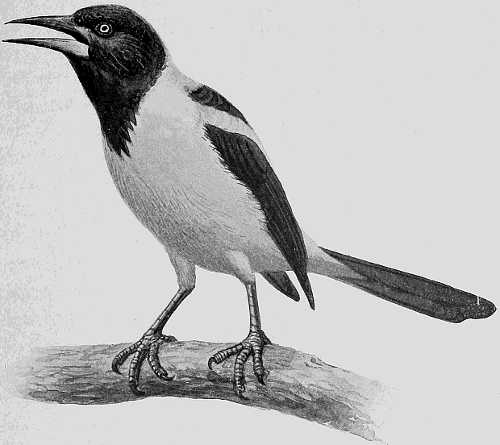
BRAZILIAN TROUPIAL
This species (Icterus vulgaris) is that most frequently seen in captivity; the pattern of colour is found in several other allied forms.
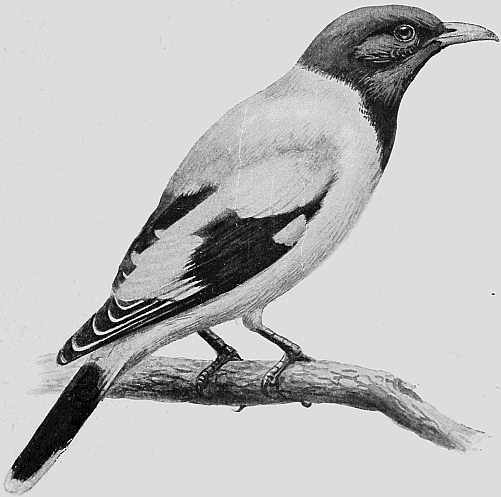
INDIAN BLACK-HEADED ORIOLE
Several other orioles besides this (O. melanocephalus) have the black head.
[285]
We have said sufficient to show that certain combinations of colours recur in nature in species which are neither nearly related to one another nor subjected to similar environment. For such phenomena it is difficult, if not impossible, to account on the theory that natural selection, acting on minute variations, is responsible for all the varied colouring of the animal kingdom. The facts, however, are in accordance with the supposition that the organism is the result of the growth and development of a number of units or biological molecules which exist in the fertilised egg.
If there be any truth in the supposition, the colouration of every animal must be due to the development of one or more of these molecules. Colouration may be expression of the arrangement of all the molecules in the fertilised egg, or it may be due to the development of a number of molecules whose function is to determine the colouring of an organism, or it may be the result of the development of one such molecule, which perhaps splits up in such a way that a portion attaches itself to each of the other molecules.
But it is idle to speculate on this point. As we have already insisted, the tendency to build [286] up elaborate theories on very slender foundations is a too frequent failing of zoologists. We desire merely to emphasise the fact that the phenomena of animal colouration almost force us to the conclusion that the colouring of each organism is the result of the development of a number of units.
It may be objected that, if this be the case, the number of the units which contribute to the colour of any organism must be exceedingly large, since we see in nature an almost limitless number of different schemes of colouring. If the colour of each animal be the result of the development of a few units, it might be thought, firstly, that the diversity of schemes of colouration which we observe in nature could not possibly occur; and secondly, that, under such circumstances, the colour pattern of a bird or beast should be of the nature of a mosaic, each colour being sharply defined and separated from every other colour, instead of the colours shading one into the other, as is so frequently the case.
Such objections would be based on a misconception as to the nature of the units which combine to produce the colouration of an organism. These units show themselves as centres of development of colour, as points from which the colour or colouring they represent spreads, until it meets and mingles with other patches of colour which are being developed from other centres. The colour produced at one centre may spread [287] more rapidly than that which forms at another; this, of course, will result in a preponderance in the organism of the colour which is produced at the former centre.
Further, we must bear in mind that the development of each colour-producing unit is largely affected by conditions external to it, as we shall see when dealing with Sexual Dimorphism.
More than one naturalist, who has paid careful attention to the subject of animal colouration, has perceived that through the apparently endless diversity of the colouring of organisms something like order runs.
Mr Tylor Quoted
Over thirty years ago Mr Alfred Tylor called attention to this important fact. That observer, whose views met with the approval of Wallace, was of opinion that colour follows structure, and that in a many-hued animal it changes at points where the function changes.
“If,” writes Mr Tylor, “we take highly decorated species—that is, animals marked by alternate dark or light bands or spots, such as the zebra, some deer, or the carnivora, we find, first, that the region of the spinal column is marked by a dark stripe; secondly, that the regions of the appendages, or limbs, are differently marked; thirdly, that the flanks are striped or spotted, along or between the regions of the lines of the ribs; fourthly, that the shoulder and hip regions are marked by curved lines; fifthly, [288] that the pattern changes, and the direction of the lines, or spots, at the head, neck, and every joint of the limbs; and, lastly, that the tips of the ears, nose, tail, and feet, and the eyes are emphasised in colour.”
More recently Mr J. Lewis Bonhote has devoted much attention to this important subject. The results of his researches are summarised on page 185 of vol. xxix. of the Proceedings of the Linnæan Society, and on page 258 of the Proceedings of the Fourth International Ornithological Congress, 1905. Mr Bonhote states that the presence or absence of colour tends almost invariably to make its appearance, first of all, on certain definite tracts, common to mammals and birds alike, which he calls pœcilomeres.
Pœcilomeres
“Pœcilomeres,” he writes, “are situated on the following parts, viz., chin, malar stripe, maxillary stripe, a spot above and slightly in front of the eye, a spot below or slightly behind the eye, the ear, crown of the head, occiput, fore-end of sternum, vent, rump, thighs, wrist, shoulders (above and below).
“Now, there is hardly any species of bird on which one or more of these pœcilomeres is not ‘picked out’ (to use a painter’s expression) in some colour different from that of the surrounding parts, and, in fact, most of the so-called recognition or protective markings will be found on these patches.
[289]
“On the other hand, among many species the differentiation of colour on the pœcilomeres is not so conspicuous as to attract the eye or to serve in any way for protection or mimicry, yet we still find them marked by differences of colour so slight that, unless especially looked for, they would never be noticed.
“Or, again, some species occasionally, but not invariably, show a few white feathers on certain parts of their body, and, when such is the case, it will be found that these white feathers appear on the pœcilomeres. . . . There is hardly a species in which examples of these pœcilomeres may not be found. . . . The Kingfisher (Alcedo ispida) shows the various head pœcilomeres very clearly, and as examples of inconspicuous differences on these tracts, the rump of the hen sparrow (Passer domesticus) and hen chaffinch (Fringilla cœlebs), the malar stripe and dark ear-patch of the hen Yellow Bunting (Emberiza citrinella), and the dark ante-orbital patch of the Barn Owl (Strix flammea) are familiar examples. And, lastly, as an instance of the class where a few white feathers frequently, but not invariably, appear, the young of the cuckoo (Cuculus canorus) forms a good example.
“These spots may, however, appear in a transitory manner, as, for instance, where a change of plumage (not necessarily moult) is occurring.”
As an instance of this, Bonhote cites the case [290] of a young male Shoveler (Spatula clypeata), “in which the metallic colour on the head first showed itself on the post-orbital and auricular pœcilomeres, gradually meeting and joining up across the head with the crown and occipital pœcilomeres, and then finally spreading forwards. And it may be well to note that the joining up of the auricular and post-orbital pœcilomeres formed a metallic patch similar in size and position to that found in the male Teal (Querquedula crecca), and, further, in the last stage, when the whole head, except the portion round the beak, was metallic, the markings are similar to those found permanently in the hen Scaup (Fuligula marila).
“Now, these resemblances taking place in the normal pure-bred wild shoveler, the question of reversion does not come in, and no one would suppose these resemblances due to anything more than transitional variation, and it is the object of this portion of the paper to show that variation in colour follows along definite lines.”
Biological Molecules
Mr Bonhote continues: “As a further illustration of how widely spread these lines are throughout the mammalian and avian kingdoms, we may note the assumption of the brown head in the case of the Black-headed Gull (Larus ridibundus), which invariably follows each year on lines similar to those related in the case of the shoveler, and . . . the method by which, on the approach of winter, the stoat assumes his [291] white dress, is (although the change is from brown to white) again conducted along precisely similar lines.” Mr Bonhote argues with great force that, as the process occurs in two animals so widely separated, the fundamental cause must be a deep-seated one. There can be no doubt that these pœcilomeres of Bonhote are connected with our biological molecules. Each of these pœcilomeres is the result of the development of one of these unit characters; each is to be regarded as the centre of activity, the sphere of influence of a biological molecule, or the portion of one, which controls the colouring of a definite region of the organism. In the case of creatures which display the same colour throughout, these molecules all give rise to the same kind of colouring; in the case of animals which display a variety of colours and markings the various molecules give origin to various colours. But we must bear in mind that the final colour to which each colour-producing molecule gives rise depends to some extent on circumstances other than the constitution of the molecule. Thus it is that the young in most organisms differ in colour and marking from the adults. On this also depends the phenomena of seasonal and sexual dimorphism. The same colour-producing molecule may give rise to one colour under one set of conditions and to a totally different colour under another set of conditions.
[292]
It is a significant fact that under abnormal conditions the feathers of birds tend to disappear precisely on those spots where the pœcilomeres of Bonhote occur.
Thus in a sickly cage bird the feathers frequently show a tendency to fall off on the following spots: crown of head, lores, jaws, head generally, rump, vent and thighs.
Many wild birds—as, for example, the cranes—display patches of naked skin on the head, and these are usually situated on pœcilomeres. Similarly, natural excessive developments of plumage tend to occur on the pœcilomeres, or, rather, the spots characterised by pœcilomeres—for example, the train of the peacock. Loral plumage, it is true, is seldom long, but is often of a peculiar nature.
Colour mutations tend to occur on the pœcilomeres. Thus it is that these pœcilomeres often form the distinctive characters and markings of allied species. This is precisely what we should expect if the pœcilomeres correspond to biological molecules and mutations are the result of the rearrangement of the constituent parts of these molecules.
Still more significant is the fact that the colour-markings in hybrids tend to follow pœcilomeres.
Bonhote has performed a large number of experiments in hybridising ducks. Some of his hybrids were produced from three pure ancestors, [293] as, for example, the pintail, the spotbill, and the mallard; others from two ancestors. Some of these hybrids were crossed with other hybrids, and others with the parent forms, hence Bonhote secured a number of hybrids, each of which had a distinctive appearance; but all the variations appearing among the hybrids were found to start on one or more of the pœcilomeres.
Certain of the hybrids showed a resemblance to one or other of the parent species, others were unlike either parent, and resembled either no known species or species other than their parents.
When a hybrid shows a resemblance to a species other than that to which either parent belongs, it is said to exhibit the phenomenon of atavism or reversion,—the individual is supposed to have been “thrown back” to an ancestral form.
The true explanation of the phenomenon would seem to be that, as the result of the crossing, biological molecules in the fertilised egg have been formed which, on development, give rise to combinations of colour like those seen in other species.
Thus the phenomena of “mimicry” and “reversion” are, we believe, due to the fact that in the fertilised egg of both the pattern and its copy a similar arrangement of biological molecules obtains. If we regard the sexual act as resembling in many respects a chemical synthesis, the phenomenon need not surprise us.
[294]
To sum up, the observed facts of animal colouration seem to indicate that there are in each organism some twelve or thirteen centres of colouring, which we suggest may correspond with portions of the fertilised egg. From each of these centres the colour develops and spreads, so that every part of the organism is eventually coloured. These centres of colouring are not altogether independent of one another. Sometimes they all give rise to the same hue, in which case we have a uniformly-coloured organism, such as the raven. More often from some one colour develops, and from others another colour; if these two colours happen to be black and white, the result is a pied organism, which displays a definite pattern due to the correlation of the various colour-producing biological molecules.
Thus it occasionally happens that two widely different organisms exhibit very similar markings, and therefore resemble one another. When this resemblance is believed to be of advantage to one or other of the similarly-coloured species, naturalists call it mimicry, and assert that the likeness is due to the action of natural selection; but where neither organism can profit by the resemblance, zoologists make no attempt to explain it. What we suggest is that the colouration of an animal depends upon the structure, or, at any rate, the nature, of the parts of the egg which produce these centres of colour. But this [295] is not by any means the only cause that determines the colouration of the organism. If it were, young creatures in their first plumage would invariably resemble the parents, the two sexes would always be alike, and there would be no such phenomenon as seasonal dimorphism.
As a matter of fact, the portions of the egg (we call them, for the sake of clearness, colour-producing biological molecules) which give rise to the pœcilomeres exhibit themselves merely in the shape of tendencies; the ultimate form the colouring will take depends to a large extent upon other and extraneous circumstances, such as the secretion of hormones.
Thus it is that organisms seem to display an almost endless diversity of colouration. But beneath all this diversity we see something like order. It occasionally happens (why, we do not know) that one, or more, of the biological molecules which make up the nucleus of the fertilised ovum becomes altered in the sexual act, with the result that a discontinuous variation or mutation appears in the resulting organism. The mutation may be a favourable one, or one which does not affect in any way the chances of an organism in the struggle for existence, or an unfavourable one. In the last of the three cases the organism will perish early and not leave behind any offspring exhibiting its peculiarity.
It is thus that natural selection acts. Natural [296] selection weeds out relentlessly all organisms which display unfavourable variations. It is thus obvious that many species may, and we believe do, exist which possess characters of no direct utility to them, or even slightly harmful ones. For this reason Wallace and his followers fail in their attempts to prove that every patch of colour in every organism is of direct utility. Natural selection has to take an animal as it finds it—the good with the bad. If an organism as a whole is not wanting—that is to say, if it is able to hold its own against other organisms, and is fitted to fill any place in nature—that organism will probably survive, although it may be defective in many respects. As its name implies, natural selection is a mere selecting agency. It has to choose from what is presented to it. It is not, as many seem to think, a manufacturer or inducer of variations. Natural selection can no more make an animal vary in any given direction than the human breeder can. Its power is limited to the destroying of all variations which do not pass the test prescribed by it.
[297]