HOW “KID” MADE GOOD A STORY OF THE CANADIAN LUMBER WOODS
Reading edition
“What are you doing here, Kid?”
This was the greeting that came to a lad of fifteen who, late one afternoon in the month of October, about thirty years ago, walked into one of the lumber camps which were then located along the French River in Northern Ontario. He was a light-haired boy with blue eyes showing a natural honesty beneath them, and with a bearing that would command the admiration of any real man.
The greeting came somewhat forcibly to the boy, particularly when it was given by Scott, the foreman of the camp, who was known throughout the district as a man who demanded the best from his men, though he treated them well in return, and the lad to whom he spoke was surely in touch with new experiences. To a boy who scarcely knew what hard work really meant, who through force of circumstances was forced to come up against work which was ordinarily tackled by physical giants, this meant new as well as trying experiences. It was a well-known fact that anyone who looked for employment in a lumber camp must become one of the crew and must abide by the well-defined though unwritten rule of those days of passing through the rather rough, but usually good-natured treatment, such as all green, first-year hands, were subjected to. This policy was followed in the belief, as prevails in a good many other institutions and industries, that the sooner a green hand got his bumps the quicker he would become a full-fledged hand. Charlie, the young man our story is concerned with, had found his way to what was known as Camp No. 2. Here Scott, the foreman, had seen many years’ experience in the lumber camps and in driving logs on the most difficult water. Furthermore, Scott had gotten his early training under one of the hardest bosses that ever wore shoe leather—a man firm as steel and cold as an iceberg. Naturally he had absorbed a good deal of these qualities, but with all this he had a kindly spot in his heart, under a rough exterior, for the green hand who seemed to have in him the right sort of stuff, particularly if the new man were willing.
Probably Charlie would have chosen some other vocation had his circumstances been otherwise, but at that time and in that part of the country nothing else seemed open to him. Only a few weeks before, through the death of his father, the family’s resources had been swept away, and when the mother and the smaller children had been left without support it seemed to the oldest son that it was his duty to get into something at once which would provide for them.
Charlie looked Scott in the eyes after his first query and replied that he was looking for a job. The answer to this was not assuring.
“Kids are no good in the forest,” said the foreman. “And the best men have to hustle to hold their jobs in Camp No. 2. But you look tired, kid. I’ll feed you and give you a bunk for the night.”
For the moment Charlie was left alone and had a chance to look about him. Naturally he was interested in the approach of the crew, who, although they had just completed a hard day’s work, seemed to be full of life and good spirits and pushed one another about, as it seemed to him, rather roughly. One man who had been near when the foreman spoke to the lad had heard Scott greet him as “Kid,” and apparently, as was customary in lumber camps, a nickname like this was bound to stick. As the crew came to the Camp House two shrill blasts given by the cook on his long tin horn gave a warning to get ready for supper, and this man spoke up rather roughly:
“Get that turkey off your back, Kid, and roll up your sleeves for hash.”
Five minutes later one short blast on the horn announced supper ready, and a stream of rough, though good-natured, men bolted out of the sleeping-camp and hurried to the door of the cook-camp. Every member of the crew carried his appetite with him. They took their seats in an orderly way, for the cook was always king in the cook-camp, and they well knew that anyone who acted in a disorderly way would be ejected, even if the services of the carving-knife were required. Scott, the foreman, had told the cook to put on an extra plate, so Kid was seated, and did justice to the wholesome meal, which, his first in the camp, was somewhat of a revelation since it supplied food in plenty, cooked to a finish and placed steaming hot on the table. After his long tramp during the day, with only a snack since breakfast, the meal was very welcome.
Supper over, Kid went back to the sleeping-camp with the crew, and here the strains of violins, mouth-organs and concertinas were soon blending with voices which seemed like the roar of lions. Each of the crew seemed to have his own tune and sung whatever was nearest in his heart. Suddenly a voice rose above the noise and din, calling:
“Sourdough, don’t hog the whole camp. Give the Kid a chance.”
Charlie was bewildered. Nothing of this nature had ever been presented to him before. He thought that he had seen rough-and-tumble play in his games at school, but the antics of the fun-loving lumbermen surpassed anything he knew. The black coffee, the pea soup, the pork and beans, and the bread “like mother makes,” seemed to have added new fuel to the relentless energy in these forest giants. In addition to singing, they played jokes on one another and wrestled and danced. Old boots were flying through the air and suddenly one of these, which landed directly on Kid’s nose, caused the blood to flow freely.
One of the crew, a swarthy giant who, with matted hair and whiskers, bore a good deal of resemblance to a grizzly bear and who, by the way, probably by reason of dissimilitude, had been christened “Babe,” jumped up in the seat which ran around the edge of the lower bunks. Clenching his fist, he followed the direction from which the boot had been flung, and a warning was given that if further pranks were tried on the Kid he would smash the face of the joker so that his best girl would never recognize him again. All this was quite typical. There were many rough men in Camp No. 2 ready to act as protector to a lad like Kid. They liked the cleanness and manliness of his face, which also showed a stamping of determination indicating that he was brave enough to try to take care of himself when he had to.
After a moment Babe’s eye rested on one of the crew who was in the habit of meting out rough treatment to green hands, and who had been familiarly christened “Jumbo.” At times Babe was quite ready to do his share of the hazing process also, but he realized that beside him was a lonely lad who had wandered into the camp without knowing what experiences he would meet, and under these conditions he was glad to become the boy’s champion and ready to fight to the death, if needs be, for him. Jumbo, in his turn, did not particularly welcome being called to account before the crew by Babe or any other member of the camp, and in a moment he edged his way over to the side of the lad, and in a provoking tone remarked:
“Did you run away from your home, Kid, or did your dad kick you out?”
Babe, who had boys of his own, was a good judge of boy character, and looking down in Charlie’s face he realized that there was something more in the situation than lay on the surface. Jumbo’s insulting remark had cut like a dagger, and the boy’s face bore a look of pain which at first could not be understood. Babe noted this, and acting on his instinct for protection, dropped his fist like a sledge-hammer in Jumbo’s face and sent him rolling back among the crew.
In an instant the music and singing ceased. It was the lull before the storm. Jumbo gathered himself up and was getting ready to renew the attack when, like a flash, the door opened and in it stood a splendid specimen of manhood. It was Scott, the foreman, who instinctively seemed to have the faculty of arriving in scenes of this kind at the psychological moment. With one leap he was by Kid’s side, and seeing the blood on the lad’s face, he demanded the name of the man who had dealt the blow. Jumbo was no coward, and furthermore he had not intended to injure the lad quite so badly. He faced Scott readily, admitting that he had flung the boot, but protesting strongly against any intention of injury. Scott settled the matter characteristically and definitely by informing the crew that if any of them had not had enough to quiet their nerves for the night he was quite ready to accommodate them outside the camp, adding that men who threw boots about should be taught a lesson. His challenge was not accepted.
In a few moments the lights were ordered out, the crew threw themselves into the bunks and in a few seconds were dead to the world, and would remain so until their call would come at four the next morning.
Something in the lad’s face and in the manliness with which he accepted the situation strongly appealed to the foreman, and linking his arm in Kid’s he led him out of the door and over to his own sleeping quarters. A little later the boy told the foreman why he was looking for work.
“Well, Kid,” came the reply, roughly if kindly, “this is no charity camp, but I know the heart of the boss. We’ll give you a fair chance to earn what you can for the support of your mother and the kids. I’ll put you to work to-morrow, and you can roll in with me in my bunk to-night.”
Scott threw off his outer clothing quickly and was in his bunk in a moment. Kid undressed a little more slowly, and when the foreman looked up in a moment he saw why the lad was waiting. He was kneeling beside his bunk. As he looked at the boy saying his prayers he was forced to acknowledge that in some ways the other was braver than he, since he was not afraid to do his duty as he had been taught. In that moment Kid had won the foreman’s heart.
Long before daylight Scott was up to waken the crew. Kid was sleeping soundly, and since the foreman knew of the long tramp he had had the day before he let him sleep till the breakfast call. After breakfast, in firm but kindly tones, he told Kid he was going to put him on trial, that if he were of the right stuff he would make good.
“Put me at any work you think I can do, sir,” the boy said in return. “Any money I get from your company I want to earn honestly. I couldn’t accept charity from you or your boss while I have hands to work.”
In the woods Kid was glad to be put in the hands of Babe, who was one of the sub-foremen. At first he was naturally very awkward, but proved himself to be a willing hand, and although his hands were soon blistered, every muscle in his body ached, and he felt at times that his back would surely break, he applied himself faithfully and without a grumble. Naturally, as the days went by these conditions were remedied, and in a short time Babe was satisfied that the boy was going to make good. When, at the end of the first month, Scott inquired as to how he liked the work, his answer was: “Fine, sir. This is man’s work, and that is what I wanted to do.” At the time experienced men were receiving twenty-five dollars per month. It is not to be wondered at, therefore, that when Scott gave Kid a time-cheque for twenty dollars for his first month’s work he was delighted. He was glad to think that he was now doing a man’s work and receiving a man’s pay. Of course, the cheque went home to his mother with a letter full of good cheer.
It wasn’t long until Kid, the youngest member of the crew, became a favorite in the camp. He was gifted with a beautiful voice, which was heard when he was at leisure in the forest solitude and at night when he sat in the camp and sang songs of home and mother. At times, too, he was brave enough to sing songs he had learned in church and Sunday school, and these were sung in such a way that, when they brought back early memories to the hardened members of the crew, tears came to the eyes of some of these swarthy men who, too, thought of their mothers and of Sunday-school days. By this time, too, the story of why Kid had been forced to work in the lumber camp had become well known. For a time Jumbo, who had been so drastically treated on the boy’s account on that eventful first night, held aloof; but when he heard the story and realized how the lad must have been stung by his thoughtless remark that night, he walked up to him, offering his hand and saying heartily:
“Kid, if you’re ever in trouble and want a friend, call on your Uncle Jumbo.”
In December, the following month, Kid’s time-cheque mounted to twenty-five dollars, and when he was being paid Scott informed him that he had earned every cent of it by working with a willing, cheerful spirit and by doing his level best, and that in this way he had been valuable even outside his regular work as an inspiration to the older members of the camp. This cheque reached his mother just before Christmas, in time to purchase a good many needed things and also to provide for a real Christmas, with a Christmas-tree and all the other accompaniments, for the little ones. In his turn Kid was delighted at Christmas to get a parcel of warm socks and mittens and a letter full of thanksgiving, in which the mother expressed her gratefulness to the men in Camp No. 2 for receiving her boy so kindly, and making special mention of the firm’s thoughtfulness.
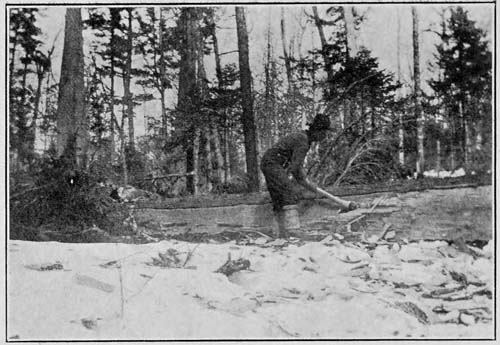
A SCENE FAMILIAR IN THE LUMBER WOODS THIRTY YEARS AGO.
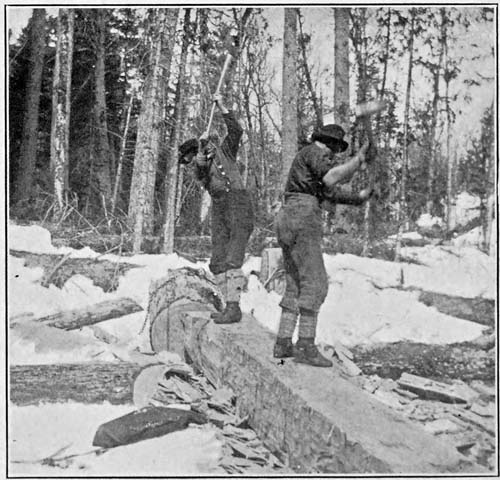
DRESSING A PINE MONARCH FOR SHIPMENT OVERSEAS.
As spring approached even greater efforts were put forth in Camp No. 2. Scott, the man who never tired in doing his best for his employer, was like a mighty, silent force, appearing everywhere, apparently looking after everything grimly and resolutely. He had made up his mind to see all the logs at the river bank before spring set in, and the fairness of his treatment made every man resolve that he would do his part. Every night in camp stories were told of the number of logs cut and placed upon skids that day, and of the record loads hauled by one span of horses to the river. Each night the scaler handed in a report of the work accomplished that day to Scott, who, after going over these, lay down and slept the sleep which comes with the consciousness of a day’s work well done.
Learning that there was a shortage of teamsters. Kid, who knew a little about horses, offered himself for this work, and accordingly was assigned to team supplies for the camp along the tote road from the railroad, about sixty miles away. In sending him out Scott cautioned him of the danger from the wolves, particularly at night, and told him that if he were caught out on the road after nightfall he was to stop and build a fire at the first howl. Failing time for this he was to unhitch his team, climb on their backs, and make the camp the best way he could. He was instructed, however, to provide against being out after night by leaving the Halfway house, thirty miles from camp, at daybreak.
Naturally, Kid planned to follow these instructions carefully, and on his first trip left the Halfway house even before daylight, but unfortunately, because of a heavy fall of snow during the day, was not able to keep to the anticipated schedule. When about six miles from camp darkness set in and he found himself alone in the forest.
Suddenly the howl of a wolf was heard. Following instructions he stopped the team and tried to gather birchbark and bits of wood to build his fire. It was cold, forty below, and doubtless the lad was cold and numb from the cold and frost when the wolves surrounded him. Probably, also, the team became frightened at the wolves, had upset the sleigh and got away. Since there was no witness to the tragedy no one knew definitely. At the time of the lad’s probable arrival Scott ran outside the camp with a lantern and peered down the tote road. As time went by he became alarmed at the failure of the lad to arrive and suddenly, when he heard the dashing of hoofs and saw the team running madly as if chased, he understood that something unusual had happened. With two men and a fresh team he started back over the tote road, and in a little time found their fears realized. Coming to the upturned sleigh, they saw shadowy forms sneaking away into the forest, and a little further on, underneath a tree beside the road, which the boy had evidently tried to climb, were torn boots and some bits of tattered clothing. Probably the lad had climbed the tree, but in his numb condition was unable to hang on and had fallen, becoming a prey to those ferocious brutes. While the lumber-jacks were in some respects hard men and had seen accidents and somewhat similar things before, their regard for the boy who had proved himself a real man made tears flow from their eyes, which froze into icicles as they trickled down their bearded faces. There before them, written on the snow around their feet, was the sad tale of how the heroic lad had met his end in the forest, doing his duty. Scott appreciated what this side of the tragedy would mean to the lad’s mother, fully realizing that she would appreciate how the lad had lived up to his duty, and would understand that God’s angels had been there to claim the spirit of her boy and take it up to a better home than earth affords.
When Scott and his men returned to camp with the story naturally a gloom was cast over the crew. Next day, when the boss of the camp came in, he noted on the way the signs of the tragedy, and on making inquiries was told the sorrowful story. When told of the good qualities of the lad he was deeply touched, and leaving the camp the following day, he resolved to go himself to break the news to the Kid’s mother, carrying with him a collection of over a hundred dollars which had been made up by the members of the crew as a remembrance, to which he himself added a substantial amount. He drove directly to the lad’s home, and on his arrival introduced himself and handed over the purse intended for the mother. Then came a hard task for him. He talked for some time, but had difficulty in getting further with his story than the fact that the money was a gift from the crew of Camp No. 2. Beads of perspiration gathered on his brow. His face was strained, and the matter troubled him so much that he had almost made up his mind to leave without telling his story when the mother, noting the look of pain on his face, pleaded to know all about Charlie. The boss tried to speak, but could not utter the word which he felt would blast her hopes. Then, as she knelt before him and pleaded with him to tell her the truth, saying that she would be brave, and no further information came, she left the room a moment, later appearing with hat and shawl, and said, “Now, please take me to Charlie.” Finally, and almost in a whisper, the boss said: “No, you cannot go to Charlie. His soul is in heaven.”
After an agonized cry, the mother bravely got hold of herself and said: “Charlie’s soul in heaven. Thank God. I can go to him there. I shall be brave and bear the cross, for I know that Charlie will be company there for his father. They were such chums here on earth.”
While Charlie’s face was absent from the camp, his influence was still present. Scott, for instance, knelt and said his prayers every night before he climbed into his bunk, just as Kid had done that first night in camp, and as he prayed for himself Scott tried to remember the mother and kiddies who had suffered from the loss of their son and brother. Many of the men in the camp, too, had been influenced in a similar way, and Camp No. 2 was a different place than it had been six months previously.
When the winter’s work was completed and the men and teams were leaving their quarters, many a man turned to cast a last look at the camp where various joys had been known, where gloom had been shared by all and where trial and difficulty had been overcome. The procession of men, who through their experiences together that winter had become a sort of family, a brotherhood, wended their way along the tote road. Looking at them none could deny that these lumber-jacks were a noble breed of men. The sons and grandsons of pioneers, men of the north, conquerors of the forest, bound together by a chain of chivalrous deeds, of hardships and difficulties, they were doing their part in the building up of the future of a nation.
Scott was in the sleigh with the leading team. When they came opposite the spot where Kid had fought his last battle against the cruel forest conditions, a halt was ordered. The crew gathered around the spot and Jumbo, surprisingly, spoke first, saying: “So here’s where the Kid fought his last fight. I hope he saw that I wanted to be his friend. I’d have liked to take a whack at these brutes myself, or to have taken his place. I guess he would have been worth more in the world than I’ll be.”
The procession passed on its way sorrowfully. Possibly never again would the spot be visited by one who knew the story, but in the years following the men who had been in Camp No. 2 that winter told at their firesides tales of a lad who had fought his battle and won, of the cheerful-faced boy who was man enough to face the world and the hard things in it to support his mother, of the young man who tackled a man’s work and did it without a murmur, and who, above all these other things, loved God and was not afraid to acknowledge Him in his home and in the difficult conditions of the lumber camp.
SOME OF CANADA’S BIG MEN, GOOD MEN ARE HERE IN EMBRYO. YOUR DUTY, BOYS, IS TO GET READY NOW FOR THE BIG OPPORTUNITIES TO COME.