THE ALLEGASH AND EAST BRANCH (continued 3)
Reading edition
Having crossed a second rocky ridge like the first, when I was beginning to ascend the third, the Indian, whom I had left on the shore some fifty rods behind, beckoned to me to come to him, but I made sign that I would first ascend the highest rock before me, whence I expected to see the lake. My companion accompanied me to the top. This was formed just like the others. Being struck with the perfect parallelism of these singular rock hills, however much one might be in advance of another, I took out my compass and found that they lay northwest and southeast, the rock being on its edge, and sharp edges they were. This one, to speak from memory, was perhaps a third of a mile in length, but quite narrow, rising gradually from the northwest to the height of about eighty feet, but steep on the southeast end. The southwest side was as steep as an ordinary roof, or as we could safely climb; the northeast was an abrupt precipice from which you could jump clean to the bottom, near which the river flowed; while the level top of the ridge, on which you walked along, was only from one to three or four feet in width. For a rude illustration, take the half of a pear cut in two lengthwise, lay it on its flat side, the stem to the northwest, and then halve it vertically in the direction of its length, keeping the southwest half. Such was the general form.
There was a remarkable series of these great rock-waves revealed by the burning; breakers, as it were. No wonder that the river that found its way through them was rapid and obstructed by falls. No doubt the absence of soil on these rocks, or its dryness where there was any, caused this to be a very thorough burning. We could see the lake over the woods, two or three miles ahead, and that the river made an abrupt turn southward around the northwest end of the cliff on which we stood, or a little above us, so that we had cut off a bend, and that there was an important fall in it a short distance below us. I could see the canoe a hundred rods behind, but now on the opposite shore, and supposed that the Indian had concluded to take out and carry round some bad rapids on that side, and that that might be what he had beckoned to me for; but after waiting a while I could still see nothing of him, and I observed to my companion that I wondered where he was, though I began to suspect that he had gone inland to look for the lake from some hilltop on that side, as we had done. This proved to be the case; for after I had started to return to the canoe, I heard a faint halloo, and descried him on the top of a distant rocky hill on that side. But as, after a long time had elapsed, I still saw his canoe in the same place, and he had not returned to it, and appeared in no hurry to do so, and, moreover, as I remembered that he had previously beckoned to me, I thought that there might be something more to delay him than I knew, and began to return northwest, along the ridge, toward the angle in the river. My companion, who had just been separated from us, and had even contemplated the necessity of camping alone, wishing to husband his steps, and yet to keep with us, inquired where I was going; to which I answered that I was going far enough back to communicate with the Indian, and that then I thought we had better go along the shore together, and keep him in sight.
When we reached the shore, the Indian appeared from out the woods on the opposite side, but on account of the roar of the water it was difficult to communicate with him. He kept along the shore westward to his canoe, while we stopped at the angle where the stream turned southward around the precipice. I again said to my companion that we would keep along the shore and keep the Indian in sight. We started to do so, being close together, the Indian behind us having launched his canoe again, but just then I saw the latter, who had crossed to our side, forty or fifty rods behind, beckoning to me, and I called to my companion, who had just disappeared behind large rocks at the point of the precipice, three or four rods before me, on his way down the stream, that I was going to help the Indian a moment. I did so,—helped get the canoe over a fall, lying with my breast over a rock, and holding one end while he received it below,—and within ten or fifteen minutes at most I was back again at the point where the river turned southward, in order to catch up with my companion, while Polis glided down the river alone, parallel with me. But to my surprise, when I rounded the precipice, though the shore was bare of trees, without rocks, for a quarter of a mile at least, my companion was not to be seen. It was as if he had sunk into the earth. This was the more unaccountable to me, because I knew that his feet were, since our swamp walk, very sore, and that he wished to keep with the party; and besides this was very bad walking, climbing over or about the rocks. I hastened along, hallooing and searching for him, thinking he might be concealed behind a rock, yet doubting if he had not taken the other side of the precipice, but the Indian had got along still faster in his canoe, till he was arrested by the falls, about a quarter of a mile below. He then landed, and said that we could go no farther that night. The sun was setting, and on account of falls and rapids we should be obliged to leave this river and carry a good way into another farther east. The first thing then was to find my companion, for I was now very much alarmed about him, and I sent the Indian along the shore down-stream, which began to be covered with unburnt wood again just below the falls, while I searched backward about the precipice which we had passed. The Indian showed some unwillingness to exert himself, complaining that he was very tired, in consequence of his day’s work, that it had strained him very much getting down so many rapids alone; but he went off calling somewhat like an owl. I remembered that my companion was near-sighted, and I feared that he had either fallen from the precipice, or fainted and sunk down amid the rocks beneath it. I shouted and searched above and below this precipice in the twilight till I could not see, expecting nothing less than to find his body beneath it. For half an hour I anticipated and believed only the worst. I thought what I should do the next day if I did not find him, what I could do in such a wilderness, and how his relatives would feel, if I should return without him. I felt that if he were really lost away from the river there, it would be a desperate undertaking to find him; and where were they who could help you? What would it be to raise the country, where there were only two or three camps, twenty or thirty miles apart, and no road, and perhaps nobody at home? Yet we must try the harder, the less the prospect of success.
I rushed down from this precipice to the canoe in order to fire the Indian’s gun, but found that my companion had the caps. I was still thinking of getting it off when the Indian returned. He had not found him, but he said that he had seen his tracks once or twice along the shore. This encouraged me very much. He objected to firing the gun, saying that if my companion heard it, which was not likely, on account of the roar of the stream, it would tempt him to come toward us, and he might break his neck in the dark. For the same reason we refrained from lighting a fire on the highest rock. I proposed that we should both keep down the stream to the lake, or that I should go at any rate, but the Indian said: “No use, can’t do anything in the dark; come morning, then we find ’em. No harm,—he make ’em camp. No bad animals here, no gristly bears, such as in California, where he’s been,—warm night,—he well off as you and I.” I considered that if he was well he could do without us. He had just lived eight years in California, and had plenty of experience with wild beasts and wilder men, was peculiarly accustomed to make journeys of great length; but if he were sick or dead, he was near where we were. The darkness in the woods was by this so thick that it alone decided the question. We must camp where we were. I knew that he had his knapsack, with blankets and matches, and, if well, would fare no worse than we, except that he would have no supper nor society.
This side of the river being so encumbered with rocks, we crossed to the eastern or smoother shore, and proceeded to camp there, within two or three rods of the falls. We pitched no tent, but lay on the sand, putting a few handfuls of grass and twigs under us, there being no evergreen at hand. For fuel we had some of the charred stumps. Our various bags of provisions had got quite wet in the rapids, and I arranged them about the fire to dry. The fall close by was the principal one on this stream, and it shook the earth under us. It was a cool, because dewy, night; the more so, probably, owing to the nearness of the falls. The Indian complained a good deal, and thought afterward that he got a cold there which occasioned a more serious illness. We were not much troubled by mosquitoes at any rate. I lay awake a good deal from anxiety, but, unaccountably to myself, was at length comparatively at ease respecting him. At first I had apprehended the worst, but now I had little doubt but that I should find him in the morning. From time to time I fancied that I heard his voice calling through the roar of the falls from the opposite side of the river; but it is doubtful if we could have heard him across the stream there. Sometimes I doubted whether the Indian had really seen his tracks, since he manifested an unwillingness to make much of a search, and then my anxiety returned.
It was the most wild and desolate region we had camped in, where, if anywhere, one might expect to meet with befitting inhabitants, but I heard only the squeak of a nighthawk flitting over. The moon in her first quarter, in the fore part of the night, setting over the bare rocky hills garnished with tall, charred, and hollow stumps or shells of trees, served to reveal the desolation.
Thursday, July 30.
I aroused the Indian early this morning to go in search of our companion, expecting to find him within a mile or two, farther down the stream. The Indian wanted his breakfast first, but I reminded him that my companion had had neither breakfast nor supper. We were obliged first to carry our canoe and baggage over into another stream, the main East Branch, about three fourths of a mile distant, for Webster Stream was no farther navigable. We went twice over this carry, and the dewy bushes wet us through like water up to the middle; I hallooed in a high key from time to time, though I had little expectation that I could be heard over the roar of the rapids, and, moreover, we were necessarily on the opposite side of the stream to him. In going over this portage the last time, the Indian, who was before me with the canoe on his head, stumbled and fell heavily once, and lay for a moment silent, as if in pain. I hastily stepped forward to help him, asking if he was much hurt, but after a moment’s pause, without replying, he sprang up and went forward. He was all the way subject to taciturn fits, but they were harmless ones.
We had launched our canoe and gone but little way down the East Branch, when I heard an answering shout from my companion, and soon after saw him standing on a point where there was a clearing a quarter of a mile below, and the smoke of his fire was rising near by. Before I saw him I naturally shouted again and again, but the Indian curtly remarked, “He hears you,” as if once was enough. It was just below the mouth of Webster Stream. When we arrived, he was smoking his pipe, and said that he had passed a pretty comfortable night, though it was rather cold, on account of the dew.
It appeared that when we stood together the previous evening, and I was shouting to the Indian across the river, he, being near-sighted, had not seen the Indian nor his canoe, and when I went back to the Indian’s assistance, did not see which way I went, and supposed that we were below and not above him, and so, making haste to catch up, he ran away from us. Having reached this clearing, a mile or more below our camp, the night overtook him, and he made a fire in a little hollow, and lay down by it in his blanket, still thinking that we were ahead of him. He thought it likely that he had heard the Indian call once the evening before, but mistook it for an owl. He had seen one botanical rarity before it was dark,—pure white Epilobium angustifolium amidst the fields of pink ones, in the burnt lands. He had already stuck up the remnant of a lumberer’s shirt, found on the point, on a pole by the waterside, for a signal, and attached a note to it, to inform us that he had gone on to the lake, and that if he did not find us there, he would be back in a couple of hours. If he had not found us soon, he had some thoughts of going back in search of the solitary hunter whom we had met at Telos Lake, ten miles behind, and, if successful, hire him to take him to Bangor. But if this hunter had moved as fast as we, he would have been twenty miles off by this time, and who could guess in what direction? It would have been like looking for a needle in a haymow, to search for him in these woods. He had been considering how long he could live on berries alone.
We substituted for his note a card containing our names and destination, and the date of our visit, which Polis neatly inclosed in a piece of birch bark to keep it dry. This has probably been read by some hunter or explorer ere this.
We all had good appetites for the breakfast which we made haste to cook here, and then, having partially dried our clothes, we glided swiftly down the winding stream toward Second Lake.
As the shores became flatter with frequent gravel and sand-bars, and the stream more winding in the lower land near the lake, elms and ash trees made their appearance; also the wild yellow lily (Lilium Canadense), some of whose bulbs I collected for a soup. On some ridges the burnt land extended as far as the lake. This was a very beautiful lake, two or three miles long, with high mountains on the southwest side, the (as our Indian said) Nerlumskeechticook, i. e., Deadwater Mountain. It appears to be the same called Carbuncle Mountain on the map. According to Polis, it extends in separate elevations all along this and the next lake, which is much larger. The lake, too, I think, is called by the same name, or perhaps with the addition of gamoc or mooc. The morning was a bright one, and perfectly still and serene, the lake as smooth as glass, we making the only ripple as we paddled into it. The dark mountains about it were seen through a glaucous mist, and the brilliant white stems of canoe birches mingled with the other woods around it. The wood thrush sang on the distant shore, and the laugh of some loons, sporting in a concealed western bay, as if inspired by the morning, came distinct over the lake to us, and, what was more remarkable, the echo which ran round the lake was much louder than the original note; probably because, the loon being in a regularly curving bay under the mountain, we were exactly in the focus of many echoes, the sound being reflected like light from a concave mirror. The beauty of the scene may have been enhanced to our eyes by the fact that we had just come together again after a night of some anxiety. This reminded me of the Ambejijis Lake on the West Branch, which I crossed in my first coming to Maine. Having paddled down three quarters of the lake, we came to a standstill, while my companion let down for fish. A white (or whitish) gull sat on a rock which rose above the surface in mid-lake not far off, quite in harmony with the scene; and as we rested there in the warm sun, we heard one loud crushing or crackling sound from the forest, forty or fifty rods distant, as of a stick broken by the foot of some large animal. Even this was an interesting incident there. In the midst of our dreams of giant lake trout, even then supposed to be nibbling, our fishermen drew up a diminutive red perch, and we took up our paddles again in haste.
It was not apparent where the outlet of this lake was, and while the Indian thought it was in one direction, I thought it was in another. He said, “I bet you four-pence it is there,” but he still held on in my direction, which proved to be the right one. As we were approaching the outlet, it being still early in the forenoon, he suddenly exclaimed, “Moose! moose!” and told us to be still. He put a cap on his gun, and, standing up in the stern, rapidly pushed the canoe straight toward the shore and the moose. It was a cow moose, about thirty rods off, standing in the water by the side of the outlet, partly behind some fallen timber and bushes, and at that distance she did not look very large. She was flapping her large ears, and from time to time poking off the flies with her nose from some part of her body. She did not appear much alarmed by our neighborhood, only occasionally turned her head and looked straight at us, and then gave her attention to the flies again. As we approached nearer she got out of the water, stood higher, and regarded us more suspiciously. Polis pushed the canoe steadily forward in the shallow water, and I for a moment forgot the moose in attending to some pretty rose-colored Polygonums just rising above the surface, but the canoe soon grounded in the mud eight or ten rods distant from the moose, and the Indian seized his gun and prepared to fire. After standing still a moment, she turned slowly, as usual, so as to expose her side, and he improved this moment to fire, over our heads. She thereupon moved off eight or ten rods at a moderate pace, across a shallow bay, to an old standing-place of hers, behind some fallen red maples, on the opposite shore, and there she stood still again a dozen or fourteen rods from us, while the Indian hastily loaded and fired twice at her, without her moving. My companion, who passed him his caps and bullets, said that Polis was as excited as a boy of fifteen, that his hand trembled, and he once put his ramrod back upside down. This was remarkable for so experienced a hunter. Perhaps he was anxious to make a good shot before us. The white hunter had told me that the Indians were not good shots, because they were excited, though he said that we had got a good hunter with us.
The Indian now pushed quickly and quietly back, and a long distance round, in order to get into the outlet,—for he had fired over the neck of a peninsula between it and the lake,—till we approached the place where the moose had stood, when he exclaimed, “She is a goner!” and was surprised that we did not see her as soon as he did. There, to be sure, she lay perfectly dead, with her tongue hanging out, just where she had stood to receive the last shots, looking unexpectedly large and horse-like, and we saw where the bullets had scarred the trees.
Using a tape, I found that the moose measured just six feet from the shoulder to the tip of the hoof, and was eight feet long as she lay. Some portions of the body, for a foot in diameter, were almost covered with flies, apparently the common fly of our woods, with a dark spot on the wing, and not the very large ones which occasionally pursued us in midstream, though both are called moose-flies.
Polis, preparing to skin the moose, asked me to help him find a stone on which to sharpen his large knife. It being all a flat alluvial ground where the moose had fallen, covered with red maples, etc., this was no easy matter; we searched far and wide, a long time, till at length I found a flat kind of slate-stone, and soon after he returned with a similar one, on which he soon made his knife very sharp.
While he was skinning the moose, I proceeded to ascertain what kind of fishes were to be found in the sluggish and muddy outlet. The greatest difficulty was to find a pole. It was almost impossible to find a slender, straight pole ten or twelve feet long in those woods. You might search half an hour in vain. They are commonly spruce, arbor-vitæ, fir, etc., short, stout, and branchy, and do not make good fish-poles, even after you have patiently cut off all their tough and scraggy branches. The fishes were red perch and chivin.
The Indian, having cut off a large piece of sirloin, the upper lip, and the tongue, wrapped them in the hide, and placed them in the bottom of the canoe, observing that there was “one man,” meaning the weight of one. Our load had previously been reduced some thirty pounds, but a hundred pounds were now added,—a serious addition, which made our quarters still more narrow, and considerably increased the danger on the lakes and rapids, as well as the labor of the carries. The skin was ours according to custom, since the Indian was in our employ, but we did not think of claiming it. He being a skillful dresser of moose-hides would make it worth seven or eight dollars to him, as I was told. He said that he sometimes earned fifty or sixty dollars in a day at them; he had killed ten moose in one day, though the skinning and all took two days. This was the way he had got his property. There were the tracks of a calf thereabouts, which he said would come “by, by,” and he could get it if we cared to wait, but I cast cold water on the project.
We continued along the outlet toward Grand Lake, through a swampy region, by a long, winding, and narrow dead water, very much choked up by wood, where we were obliged to land sometimes in order to get the canoe over a log. It was hard to find any channel, and we did not know but we should be lost in the swamp. It abounded in ducks, as usual. At length we reached Grand Lake, which the Indian called Matungamook.
At the head of this we saw, coming in from the southwest, with a sweep apparently from a gorge in the mountains, Trout Stream, or Uncardnerheese, which name, the Indian said, had something to do with mountains.
We stopped to dine on an interesting high rocky island, soon after entering Matungamook Lake, securing our canoe to the cliffy shore. It is always pleasant to step from a boat on to a large rock or cliff. Here was a good opportunity to dry our dewy blankets on the open sunny rock. Indians had recently camped here, and accidentally burned over the western end of the island, and Polis picked up a gun-case of blue broadcloth, and said that he knew the Indian it belonged to, and would carry it to him. His tribe is not so large but he may know all its effects. We proceeded to make a fire and cook our dinner amid some pines, where our predecessors had done the same, while the Indian busied himself about his moose-hide on the shore, for he said that he thought it a good plan for one to do all the cooking, i. e., I suppose, if that one were not himself. A peculiar evergreen overhung our fire, which at first glance looked like a pitch pine (P. rigida), with leaves little more than an inch long, spruce-like, but we found it to be the Pinus Banksiana,—“Banks’s, or the Labrador Pine,” also called scrub pine, gray pine, etc., a new tree to us. These must have been good specimens, for several were thirty or thirty-five feet high. Richardson found it forty feet high and upward, and states that the porcupine feeds on its bark. Here also grew the red pine (Pinus resinosa).
I saw where the Indians had made canoes in a little secluded hollow in the woods, on the top of the rock, where they were out of the wind, and large piles of whittlings remained. This must have been a favorite resort for their ancestors, and, indeed, we found here the point of an arrowhead, such as they have not used for two centuries and now know not how to make. The Indian, picking up a stone, remarked to me, “That very strange lock (rock).” It was a piece of hornstone, which I told him his tribe had probably brought here centuries before to make arrowheads of. He also picked up a yellowish curved bone by the side of our fireplace and asked me to guess what it was. It was one of the upper incisors of a beaver, on which some party had feasted within a year or two. I found also most of the teeth, and the skull, etc. We here dined on fried moose-meat.
One who was my companion in my two previous excursions to these woods, tells me that when hunting up the Caucomgomoc, about two years ago, he found himself dining one day on moose-meat, mud turtle, trout, and beaver, and he thought that there were few places in the world where these dishes could easily be brought together on one table.
After the almost incessant rapids and falls of the Madunkchunk (Height-of-Land, or Webster Stream), we had just passed through the dead water of Second Lake, and were now in the much larger dead water of Grand Lake, and I thought the Indian was entitled to take an extra nap here. Ktaadn, near which we were to pass the next day, is said to mean “Highest Land.” So much geography is there in their names. The Indian navigator naturally distinguishes by a name those parts of a stream where he has encountered quick water and forks, and again, the lakes and smooth water where he can rest his weary arms, since those are the most interesting and more arable parts to him. The very sight of the Nerlumskeechticook, or Deadwater Mountains, a day’s journey off over the forest, as we first saw them, must awaken in him pleasing memories. And not less interesting is it to the white traveler, when he is crossing a placid lake in these out-of-the-way woods, perhaps thinking that he is in some sense one of the earlier discoverers of it, to be reminded that it was thus well known and suitably named by Indian hunters perhaps a thousand years ago.
Ascending the precipitous rock which formed this long narrow island, I was surprised to find that its summit was a narrow ridge, with a precipice on one side, and that its axis of elevation extended from northwest to southeast exactly like that of the great rocky ridge at the commencement of the Burnt Ground, ten miles northwesterly. The same arrangement prevailed here, and we could plainly see that the mountain ridges on the west of the lake trended the same way. Splendid large harebells nodded over the edge and in the clefts of the cliff, and the blueberries (Vaccinium Canadense) were for the first time really abundant in the thin soil on its top. There was no lack of them henceforward on the East Branch. There was a fine view hence over the sparkling lake, which looked pure and deep, and had two or three, in all, rocky islands in it. Our blankets being dry, we set out again, the Indian as usual having left his gazette on a tree. This time it was we three in a canoe, my companion smoking. We paddled southward down this handsome lake, which appeared to extend nearly as far east as south, keeping near the western shore, just outside a small island, under the dark Nerlumskeechticook Mountain. For I had observed on my map that this was the course. It was three or four miles across it. It struck me that the outline of this mountain on the southwest of the lake, and of another beyond it, was not only like that of the huge rock waves of Webster Stream, but in the main like Kineo, on Moosehead Lake, having a similar but less abrupt precipice at the southeast end; in short, that all the prominent hills and ridges hereabouts were larger or smaller Kineos, and that possibly there was such a relation between Kineo and the rocks of Webster Stream.
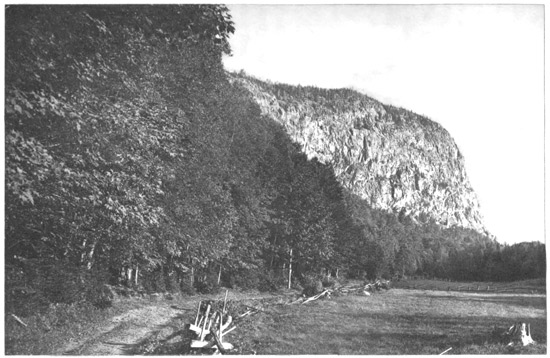
Mount Kineo Cliff
The Indian did not know exactly where the outlet was, whether at the extreme southwest angle or more easterly, and had asked to see my plan at the last stopping-place, but I had forgotten to show it to him. As usual, he went feeling his way by a middle course between two probable points, from which he could diverge either way at last without losing much distance. In approaching the south shore, as the clouds looked gusty and the waves ran pretty high, we so steered as to get partly under the lee of an island, though at a great distance from it.
I could not distinguish the outlet till we were almost in it, and heard the water falling over the dam there.
Here was a considerable fall, and a very substantial dam, but no sign of a cabin or camp. The hunter whom we met at Telos Lake had told us that there were plenty of trout here, but at this hour they did not rise to the bait, only cousin trout, from the very midst of the rushing waters. There are not so many fishes in these rivers as in the Concord.
While we loitered here, Polis took occasion to cut with his big knife some of the hair from his moose-hide, and so lightened and prepared it for drying. I noticed at several old Indian camps in the woods the pile of hair which they had cut from their hides.
Having carried over the dam, he darted down the rapids, leaving us to walk for a mile or more, where for the most part there was no path, but very thick and difficult traveling near the stream. At length he would call to let us know where he was waiting for us with his canoe, when, on account of the windings of the stream, we did not know where the shore was, but he did not call often enough, forgetting that we were not Indians. He seemed to be very saving of his breath,—yet he would be surprised if we went by, or did not strike the right spot. This was not because he was unaccommodating, but a proof of superior manners. Indians like to get along with the least possible communication and ado. He was really paying us a great compliment all the while, thinking that we preferred a hint to a kick.
At length, climbing over the willows and fallen trees, when this was easier than to go round or under them, we overtook the canoe, and glided down the stream in smooth but swift water for several miles. I here observed again, as at Webster Stream, and on a still larger scale the next day, that the river was a smooth and regularly inclined plane down which we coasted. As we thus glided along we started the first black ducks which we had distinguished.
We decided to camp early to-night, that we might have ample time before dark; so we stopped at the first favorable shore, where there was a narrow gravelly beach on the western side, some five miles below the outlet of the lake. It was an interesting spot, where the river began to make a great bend to the east, and the last of the peculiar moose-faced Nerlumskeechticook Mountains not far southwest of Grand Lake rose dark in the northwest a short distance behind, displaying its gray precipitous southeast side, but we could not see this without coming out upon the shore.
Two steps from the water on either side, and you come to the abrupt bushy and rooty if not turfy edge of the bank, four or five feet high, where the interminable forest begins, as if the stream had but just cut its way through it.
It is surprising on stepping ashore anywhere into this unbroken wilderness to see so often, at least within a few rods of the river, the marks of the axe, made by lumberers who have either camped here or driven logs past in previous springs. You will see perchance where, going on the same errand that you do, they have cut large chips from a tall white pine stump for their fire. While we were pitching the camp and getting supper, the Indian cut the rest of the hair from his moose-hide, and proceeded to extend it vertically on a temporary frame between two small trees, half a dozen feet from the opposite side of the fire, lashing and stretching it with arbor-vitæ bark which was always at hand, and in this case was stripped from one of the trees it was tied to. Asking for a new kind of tea, he made us some, pretty good, of the checkerberry (Gaultheria procumbens), which covered the ground, dropping a little bunch of it tied up with cedar bark into the kettle; but it was not quite equal to the Chiogenes. We called this therefore Checkerberry-Tea Camp.
I was struck with the abundance of the Linnæa borealis, checkerberry, and Chiogenes hispidula, almost everywhere in the Maine woods. The wintergreen (Chimaphila umbellata) was still in bloom here, and clintonia berries were abundant and ripe. This handsome plant is one of the most common in that forest. We here first noticed the moose-wood in fruit on the banks. The prevailing trees were spruce (commonly black), arbor-vitæ, canoe birch (black ash and elms beginning to appear), yellow birch, red maple, and a little hemlock skulking in the forest. The Indian said that the white maple punk was the best for tinder, that yellow birch punk was pretty good, but hard. After supper he put on the moose tongue and lips to boil, cutting out the septum. He showed me how to write on the under side of birch bark, with a black spruce twig, which is hard and tough, and can be brought to a point.
The Indian wandered off into the woods a short distance just before night, and, coming back, said, “Me found great treasure,—fifty, sixty dollars’ worth.” “What’s that?” we asked. “Steel traps, under a log, thirty or forty, I didn’t count ’em. I guess Indian work,—worth three dollars apiece.” It was a singular coincidence that he should have chanced to walk to and look under that particular log, in that trackless forest.
I saw chivin and chub in the stream when washing my hands, but my companion tried in vain to catch them. I also heard the sound of bullfrogs from a swamp on the opposite side, thinking at first that they were moose; a duck paddled swiftly by; and sitting in that dusky wilderness, under that dark mountain, by the bright river which was full of reflected light, still I heard the wood thrush sing, as if no higher civilization could be attained. By this time the night was upon us.
You commonly make your camp just at sundown, and are collecting wood, getting your supper, or pitching your tent while the shades of night are gathering around and adding to the already dense gloom of the forest. You have no time to explore or look around you before it is dark. You may penetrate half a dozen rods farther into that twilight wilderness, after some dry bark to kindle your fire with, and wonder what mysteries lie hidden still deeper in it, say at the end of a long day’s walk; or you may run down to the shore for a dipper of water, and get a clearer view for a short distance up or down the stream, and while you stand there, see a fish leap, or duck alight in the river, or hear a wood thrush or robin sing in the woods. That is as if you had been to town or civilized parts. But there is no sauntering off to see the country, and ten or fifteen rods seems a great way from your companions, and you come back with the air of a much-traveled man, as from a long journey, with adventures to relate, though you may have heard the crackling of the fire all the while,—and at a hundred rods you might be lost past recovery, and have to camp out. It is all mossy and moosey. In some of those dense fir and spruce woods there is hardly room for the smoke to go up. The trees are a standing night, and every fir and spruce which you fell is a plume plucked from night’s raven wing. Then at night the general stillness is more impressive than any sound, but occasionally you hear the note of an owl farther or nearer in the woods, and if near a lake, the semihuman cry of the loons at their unearthly revels.
To-night the Indian lay between the fire and his stretched moose-hide, to avoid the mosquitoes. Indeed, he also made a small smoky fire of damp leaves at his head and his feet, and then as usual rolled up his head in his blanket. We with our veils and our wash were tolerably comfortable, but it would be difficult to pursue any sedentary occupation in the woods at this season; you cannot see to read much by the light of a fire through a veil in the evening, nor handle pencil and paper well with gloves or anointed fingers.
Friday, July 31.
The Indian said, “You and I kill moose last night, therefore use ’em best wood. Always use hard wood to cook moose-meat.” His “best wood” was rock maple. He cast the moose’s lip into the fire, to burn the hair off, and then rolled it up with the meat to carry along. Observing that we were sitting down to breakfast without any pork, he said, with a very grave look, “Me want some fat,” so he was told that he might have as much as he would fry.
We had smooth but swift water for a considerable distance, where we glided rapidly along, scaring up ducks and kingfishers. But, as usual, our smooth progress ere long came to an end, and we were obliged to carry canoe and all about half a mile down the right bank, around some rapids or falls. It required sharp eyes sometimes to tell which side was the carry, before you went over the falls, but Polis never failed to land us rightly. The raspberries were particularly abundant and large here, and all hands went to eating them, the Indian remarking on their size.
Often on bare rocky carries the trail was so indistinct that I repeatedly lost it, but when I walked behind him I observed that he could keep it almost like a hound, and rarely hesitated, or, if he paused a moment on a bare rock, his eye immediately detected some sign which would have escaped me. Frequently we found no path at all at these places, and were to him unaccountably delayed. He would only say it was “ver strange.”
We had heard of a Grand Fall on this stream, and thought that each fall we came to must be it, but after christening several in succession with this name, we gave up the search. There were more Grand or Petty Falls than I can remember.
I cannot tell how many times we had to walk on account of falls or rapids. We were expecting all the while that the river would take a final leap and get to smooth water, but there was no improvement this forenoon. However, the carries were an agreeable variety. So surely as we stepped out of the canoe and stretched our legs we found ourselves in a blueberry and raspberry garden, each side of our rocky trail around the falls being lined with one or both. There was not a carry on the main East Branch where we did not find an abundance of both these berries, for these were the rockiest places, and partially cleared, such as these plants prefer, and there had been none to gather the finest before us.
In our three journeys over the carries,—for we were obliged to go over the ground three times whenever the canoe was taken out,—we did full justice to the berries, and they were just what we wanted to correct the effect of our hard bread and pork diet. Another name for making a portage would have been going a-berrying. We also found a few amelanchier, or service, berries, though most were abortive, but they held on rather more generally than they do in Concord. The Indian called them pemoymenuk, and said that they bore much fruit in some places. He sometimes also ate the northern wild red cherries, saying that they were good medicine, but they were scarcely edible. We bathed and dined at the foot of one of these carries. It was the Indian who commonly reminded us that it was dinner-time, sometimes even by turning the prow to the shore. He once made an indirect, but lengthy apology, by saying that we might think it strange, but that one who worked hard all day was very particular to have his dinner in good season. At the most considerable fall on this stream, when I was walking over the carry, close behind the Indian, he observed a track on the rock, which was but slightly covered with soil, and, stooping, muttered “caribou.” When we returned, he observed a much larger track near the same place, where some animal’s foot had sunk into a small hollow in the rock, partly filled with grass and earth, and he exclaimed with surprise, “What that?” “Well, what is it?” I asked. Stooping and laying his hand in it, he answered with a mysterious air, and in a half whisper, “Devil [that is, Indian Devil, or cougar]—ledges about here—very bad animal—pull ’em rocks all to pieces.” “How long since it was made?” I asked. “To-day or yesterday,” said he. But when I asked him afterward if he was sure it was the devil’s track, he said he did not know. I had been told that the scream of a cougar was heard about Ktaadn recently, and we were not far from that mountain.
We spent at least half the time in walking to-day, and the walking was as bad as usual, for the Indian, being alone, commonly ran down far below the foot of the carries before he waited for us. The carry-paths themselves were more than usually indistinct, often the route being revealed only by the countless small holes in the fallen timber made by the tacks in the drivers’ boots, or where there was a slight trail we did not find it. It was a tangled and perplexing thicket, through which we stumbled and threaded our way, and when we had finished a mile of it, our starting-point seemed far away. We were glad that we had not got to walk to Bangor along the banks of this river, which would be a journey of more than a hundred miles. Think of the denseness of the forest, the fallen trees and rocks, the windings of the river, the streams emptying in, and the frequent swamps to be crossed. It made you shudder. Yet the Indian from time to time pointed out to us where he had thus crept along day after day when he was a boy of ten, and in a starving condition. He had been hunting far north of this with two grown Indians. The winter came on unexpectedly early, and the ice compelled them to leave their canoe at Grand Lake, and walk down the bank. They shouldered their furs and started for Oldtown. The snow was not deep enough for snowshoes, or to cover the inequalities of the ground. Polis was soon too weak to carry any burden; but he managed to catch one otter. This was the most they all had to eat on this journey, and he remembered how good the yellow lily roots were, made into a soup with the otter oil. He shared this food equally with the other two, but being so small he suffered much more than they. He waded through the Mattawamkeag at its mouth, when it was freezing cold and came up to his chin, and he, being very weak and emaciated, expected to be swept away. The first house which they reached was at Lincoln, and thereabouts they met a white teamster with supplies, who, seeing their condition, gave them as much of his load as they could eat. For six months after getting home, he was very low, and did not expect to live, and was perhaps always the worse for it.
We could not find much more than half of this day’s journey on our maps (the “Map of the Public Lands of Maine and Massachusetts,” and “Colton’s Railroad and Township Map of Maine,” which copies the former). By the maps there was not more than fifteen miles between camps at the outside, and yet we had been busily progressing all day, and much of the time very rapidly.
For seven or eight miles below that succession of “Grand” falls, the aspect of the banks as well as the character of the stream was changed. After passing a tributary from the northeast, perhaps Bowlin Stream, we had good swift smooth water, with a regular slope, such as I have described. Low, grassy banks and muddy shores began. Many elms, as well as maples, and more ash trees, overhung the stream, and supplanted the spruce.
My lily roots having been lost when the canoe was taken out at a carry, I landed late in the afternoon, at a low and grassy place amid maples, to gather more. It was slow work, grubbing them up amid the sand, and the mosquitoes were all the while feasting on me. Mosquitoes, black flies, etc., pursued us in mid-channel, and we were glad sometimes to get into violent rapids, for then we escaped them.
A red-headed woodpecker flew across the river, and the Indian remarked that it was good to eat. As we glided swiftly down the inclined plane of the river, a great cat owl launched itself away from a stump on the bank, and flew heavily across the stream, and the Indian, as usual, imitated its note. Soon the same bird flew back in front of us, and we afterwards passed it perched on a tree. Soon afterward a white-headed eagle sailed down the stream before us. We drove him several miles, while we were looking for a good place to camp, for we expected to be overtaken by a shower,—and still we could distinguish him by his white tail, sailing away from time to time from some tree by the shore still farther down the stream. Some shecorways being surprised by us, a part of them dived, and we passed directly over them, and could trace their course here and there by a bubble on the surface, but we did not see them come up. Polis detected once or twice what he called a “tow” road, an indistinct path leading into the forest. In the meanwhile we passed the mouth of the Seboois on our left. This did not look so large as our stream, which was indeed the main one. It was some time before we found a camping-place, for the shore was either too grassy and muddy, where mosquitoes abounded, or too steep a hillside. The Indian said that there were but few mosquitoes on a steep hillside. We examined a good place, where somebody had camped a long time; but it seemed pitiful to occupy an old site, where there was so much room to choose, so we continued on. We at length found a place to our minds, on the west bank, about a mile below the mouth of the Seboois, where, in a very dense spruce wood above a gravelly shore, there seemed to be but few insects. The trees were so thick that we were obliged to clear a space to build our fire and lie down in, and the young spruce trees that were left were like the wall of an apartment rising around us. We were obliged to pull ourselves up a steep bank to get there. But the place which you have selected for your camp, though never so rough and grim, begins at once to have its attractions, and becomes a very centre of civilization to you: “Home is home, be it never so homely.”
It turned out that the mosquitoes were more numerous here than we had found them before, and the Indian complained a good deal, though he lay, as the night before, between three fires and his stretched hide. As I sat on a stump by the fire, with a veil and gloves on, trying to read, he observed, “I make you candle,” and in a minute he took a piece of birch bark about two inches wide and rolled it hard, like an allumette fifteen inches long, lit it, and fixed it by the other end horizontally in a split stick three feet high, stuck it in the ground, turning the blazing end to the wind, and telling me to snuff it from time to time. It answered the purpose of a candle pretty well.
I noticed, as I had done before, that there was a lull among the mosquitoes about midnight, and that they began again in the morning. Nature is thus merciful. But apparently they need rest as well as we. Few, if any, creatures are equally active all night. As soon as it was light I saw, through my veil, that the inside of the tent about our heads was quite blackened with myriads, each one of their wings when flying, as has been calculated, vibrating some three thousand times in a minute, and their combined hum was almost as bad to endure as their stings. I had an uncomfortable night on this account though I am not sure that one succeeded in his attempt to sting me. We did not suffer so much from insects on this excursion as the statements of some who have explored these woods in midsummer led us to anticipate. Yet I have no doubt that at some seasons and in some places they are a much more serious pest. The Jesuit Hierome Lalemant, of Quebec, reporting the death of Father Reni Menard, who was abandoned, lost his way, and died in the woods, among the Ontarios near Lake Superior, in 1661, dwells chiefly on his probable sufferings from the attacks of mosquitoes when too weak to defend himself, adding that there was a frightful number of them in those parts, “and so insupportable,” says he, “that the three Frenchmen who have made that voyage affirm that there was no other means of defending one’s self but to run always without stopping, and it was even necessary for two of them to be employed in driving off these creatures while the third wanted to drink, otherwise he could not have done it.” I have no doubt that this was said in good faith.
August 1.
I caught two or three large red chivin (Leuciscus pulchellus) early this morning, within twenty feet of the camp, which, added to the moose-tongue, that had been left in the kettle boiling overnight, and to our other stores, made a sumptuous breakfast. The Indian made us some hemlock tea instead of coffee, and we were not obliged to go as far as China for it; indeed, not quite so far as for the fish. This was tolerable, though he said it was not strong enough. It was interesting to see so simple a dish as a kettle of water with a handful of green hemlock sprigs in it, boiling over the huge fire in the open air, the leaves fast losing their lively green color, and know that it was for our breakfast.
We were glad to embark once more, and leave some of the mosquitoes behind. We had passed the Wassataquoik without perceiving it. This, according to the Indian, is the name of the main East Branch itself, and not properly applied to this small tributary alone, as on the maps.
We found that we had camped about a mile above Hunt’s, which is on the east bank, and is the last house for those who ascend Ktaadn on this side.
We had expected to ascend it from this point, but my companion was obliged to give up this on account of sore feet. The Indian, however, suggested that perhaps he might get a pair of moccasins at this place, and that he could walk very easily in them without hurting his feet, wearing several pairs of stockings, and he said beside that they were so porous that when you had taken in water it all drained out again in a little while. We stopped to get some sugar, but found that the family had moved away, and the house was unoccupied, except temporarily by some men who were getting the hay. They told me that the road to Ktaadn left the river eight miles above; also that perhaps we could get some sugar at Fisk’s, fourteen miles below. I do not remember that we saw the mountain at all from the river. I noticed a seine here stretched on the bank, which probably had been used to catch salmon. Just below this, on the west bank, we saw a moose-hide stretched, and with it a bearskin, which was comparatively very small. I was the more interested in this sight, because it was near here that a townsman of ours, then quite a lad, and alone, killed a large bear some years ago. The Indian said that they belonged to Joe Aitteon, my last guide, but how he told I do not know. He was probably hunting near, and had left them for the day. Finding that we were going directly to Oldtown, he regretted that he had not taken more of the moose-meat to his family, saying that in a short time, by drying it, he could have made it so light as to have brought away the greater part, leaving the bones. We once or twice inquired after the lip, which is a famous tidbit, but he said, “That go Oldtown for my old woman; don’t get it every day.”
Maples grew more and more numerous. It was lowering, and rained a little during the forenoon, and, as we expected a wetting, we stopped early and dined on the east side of a small expansion of the river, just above what are probably called Whetstone Falls, about a dozen miles below Hunt’s. There were pretty fresh moose-tracks by the waterside. There were singular long ridges hereabouts, called “horsebacks,” covered with ferns. My companion, having lost his pipe, asked the Indian if he could not make him one. “Oh, yer,” said he, and in a minute rolled up one of birch bark, telling him to wet the bowl from time to time. Here also he left his gazette on a tree.
We carried round the falls just below, on the west side. The rocks were on their edges, and very sharp. The distance was about three fourths of a mile. When we had carried over one load, the Indian returned by the shore, and I by the path, and though I made no particular haste, I was nevertheless surprised to find him at the other end as soon as I. It was remarkable how easily he got along over the worst ground. He said to me, “I take canoe and you take the rest, suppose you can keep along with me?” I thought that he meant that while he ran down the rapids I should keep along the shore, and be ready to assist him from time to time, as I had done before; but as the walking would be very bad, I answered, “I suppose you will go too fast for me, but I will try.” But I was to go by the path, he said. This I thought would not help the matter, I should have so far to go to get to the riverside when he wanted me. But neither was this what he meant. He was proposing a race over the carry, and asked me if I thought I could keep along with him by the same path, adding that I must be pretty smart to do it. As his load, the canoe, would be much the heaviest and bulkiest, though the simplest, I thought that I ought to be able to do it, and said that I would try. So I proceeded to gather up the gun, axe, paddle, kettle, frying-pan, plates, dippers, carpets, etc., etc., and while I was thus engaged he threw me his cowhide boots. “What, are these in the bargain?” I asked. “Oh, yer,” said he; but before I could make a bundle of my load I saw him disappearing over a hill with the canoe on his head; so, hastily scraping the various articles together, I started on the run, and immediately went by him in the bushes, but I had no sooner left him out of sight in a rocky hollow than the greasy plates, dippers, etc., took to themselves wings, and while I was employed in gathering them up again, he went by me; but hastily pressing the sooty kettle to my side, I started once more, and soon passing him again, I saw him no more on the carry. I do not mention this as anything of a feat, for it was but poor running on my part, and he was obliged to move with great caution for fear of breaking his canoe as well as his neck. When he made his appearance, puffing and panting like myself, in answer to my inquiries where he had been, he said, “Rocks (locks) cut ’em feet,” and, laughing, added, “Oh, me love to play sometimes.” He said that he and his companions, when they came to carries several miles long, used to try who would get over first; each, perhaps, with a canoe on his head. I bore the sign of the kettle on my brown linen sack for the rest of the voyage.
We made a second carry on the west side, around some falls about a mile below this. On the mainland were Norway pines, indicating a new geological formation, and it was such a dry and sandy soil as we had not noticed before.
As we approached the mouth of the East Branch, we passed two or three huts, the first sign of civilization after Hunt’s, though we saw no road as yet; we heard a cow-bell, and even saw an infant held up to a small square window to see us pass, but apparently the infant and the mother that held it were the only inhabitants then at home for several miles. This took the wind out of our sails, reminding us that we were travelers surely, while it was a native of the soil, and had the advantage of us. Conversation flagged. I would only hear the Indian, perhaps, ask my companion, “You load my pipe?” He said that he smoked alder bark, for medicine. On entering the West Branch at Nicketow it appeared much larger than the East. Polis remarked that the former was all gone and lost now, that it was all smooth water hence to Oldtown, and he threw away his pole which was cut on the Umbazookskus. Thinking of the rapids, he said once or twice that you wouldn’t catch him to go East Branch again; but he did not by any means mean all that he said.
Things are quite changed since I was here eleven years ago. Where there were but one or two houses, I now found quite a village, with sawmills and a store (the latter was locked, but its contents were so much the more safely stored), and there was a stage-road to Mattawamkeag, and the rumor of a stage. Indeed, a steamer had ascended thus far once, when the water was very high. But we were not able to get any sugar, only a better shingle to lean our backs against.
We camped about two miles below Nicketow, on the south side of the West Branch, covering with fresh twigs the withered bed of a former traveler, and feeling that we were now in a settled country, especially when in the evening we heard an ox sneeze in its wild pasture across the river. Wherever you land along the frequented part of the river, you have not far to go to find these sites of temporary inns, the withered bed of flattened twigs, the charred sticks, and perhaps the tent-poles. And not long since, similar beds were spread along the Connecticut, the Hudson, and the Delaware, and longer still ago, by the Thames and Seine, and they now help to make the soil where private and public gardens, mansions and palaces are. We could not get fir twigs for our bed here, and the spruce was harsh in comparison, having more twig in proportion to its leaf, but we improved it somewhat with hemlock. The Indian remarked as before, “Must have hard wood to cook moose-meat,” as if that were a maxim, and proceeded to get it. My companion cooked some in California fashion, winding a long string of the meat round a stick and slowly turning it in his hand before the fire. It was very good. But the Indian, not approving of the mode, or because he was not allowed to cook it his own way, would not taste it. After the regular supper we attempted to make a lily soup of the bulbs which I had brought along, for I wished to learn all I could before I got out of the woods. Following the Indian’s directions, for he began to be sick, I washed the bulbs carefully, minced some moose-meat and some pork, salted and boiled all together, but we had not patience to try the experiment fairly, for he said it must be boiled till the roots were completely softened so as to thicken the soup like flour; but though we left it on all night, we found it dried to the kettle in the morning, and not yet boiled to a flour. Perhaps the roots were not ripe enough, for they commonly gather them in the fall. As it was, it was palatable enough, but it reminded me of the Irishman’s limestone broth. The other ingredients were enough alone. The Indian’s name for these bulbs was Sheepnoc. I stirred the soup by accident with a striped maple or moose-wood stick, which I had peeled, and he remarked that its bark was an emetic.
He prepared to camp as usual between his moose-hide and the fire; but it beginning to rain suddenly, he took refuge under the tent with us, and gave us a song before falling asleep. It rained hard in the night, and spoiled another box of matches for us, which the Indian had left out, for he was very careless; but, as usual, we had so much the better night for the rain, since it kept the mosquitoes down.
Sunday, August 2.
Was a cloudy and unpromising morning. One of us observed to the Indian, “You did not stretch your moose-hide last night, did you, Mr. Polis?” Whereat he replied, in a tone of surprise, though perhaps not of ill humor: “What you ask me that question for? Suppose I stretch ’em, you see ’em. May be your way talking, may be all right, no Indian way.” I had observed that he did not wish to answer the same question more than once, and was often silent when it was put again for the sake of certainty, as if he were moody. Not that he was incommunicative, for he frequently commenced a long-winded narrative of his own accord,—repeated at length the tradition of some old battle, or some passage in the recent history of his tribe in which he had acted a prominent part, from time to time drawing a long breath, and resuming the thread of his tale, with the true story-teller’s leisureliness, perhaps after shooting a rapid,—prefacing with “We-e-ll, by-by,” etc., as he paddled along. Especially after the day’s work was over, and he had put himself in posture for the night, he would be unexpectedly sociable, exhibit even the bonhommie of a Frenchman, and we would fall asleep before he got through his periods.
Nicketow is called eleven miles from Mattawamkeag by the river. Our camp was, therefore, about nine miles from the latter place.
The Indian was quite sick this morning with the colic. I thought that he was the worse for the moose-meat he had eaten.
We reached the Mattawamkeag at half past eight in the morning, in the midst of a drizzling rain, and, after buying some sugar, set out again.
The Indian growing much worse, we stopped in the north part of Lincoln to get some brandy for him; but failing in this, an apothecary recommended Brandreth’s pills, which he refused to take, because he was not acquainted with them. He said to me, “Me doctor,—first study my case, find out what ail ’em,—then I know what to take.” We dropped down a little farther, and stopped at mid-forenoon on an island and made him a dipper of tea. Here, too, we dined and did some washing and botanizing, while he lay on the bank. In the afternoon we went on a little farther, though the Indian was no better. “Burntibus,” as he called it, was a long, smooth, lake-like reach below the Five Islands. He said that he owned a hundred acres somewhere up this way. As a thunder-shower appeared to be coming up, we stopped opposite a barn on the west bank, in Chester, about a mile above Lincoln. Here at last we were obliged to spend the rest of the day and night, on account of our patient, whose sickness did not abate. He lay groaning under his canoe on the bank, looking very woebegone, yet it was only a common case of colic. You would not have thought, if you had seen him lying about thus, that he was the proprietor of so many acres in that neighborhood, was worth six thousand dollars, and had been to Washington. It seemed to me that, like the Irish, he made a greater ado about his sickness than a Yankee does, and was more alarmed about himself. We talked somewhat of leaving him with his people in Lincoln,—for that is one of their homes,—and taking the stage the next day, but he objected on account of the expense saying, “Suppose me well in morning, you and I go Oldtown by noon.”
As we were taking our tea at twilight, while he lay groaning still under his canoe, having at length found out “what ail him,” he asked me to get him a dipper of water. Taking the dipper in one hand he seized his powder-horn with the other, and, pouring into it a charge or two of powder, stirred it up with his finger, and drank it off. This was all he took to-day after breakfast beside his tea.
To save the trouble of pitching our tent, when we had secured our stores from wandering dogs, we camped in the solitary half-open barn near the bank, with the permission of the owner, lying on new-mown hay four feet deep. The fragrance of the hay, in which many ferns, etc., were mingled, was agreeable, though it was quite alive with grasshoppers which you could hear crawling through it. This served to graduate our approach to houses and feather beds. In the night some large bird, probably an owl, flitted through over our heads, and very early in the morning we were awakened by the twittering of swallows which had their nests there.
Monday, August 3.
We started early before breakfast, the Indian being considerably better, and soon glided by Lincoln, and after another long and handsome lake-like reach, we stopped to breakfast on the west shore, two or three miles below this town.
We frequently passed Indian islands with their small houses on them. The Governor, Aitteon, lives in one of them, in Lincoln.
The Penobscot Indians seem to be more social, even, than the whites. Ever and anon in the deepest wilderness of Maine, you come to the log hut of a Yankee or Canada settler, but a Penobscot never takes up his residence in such a solitude. They are not even scattered about on their islands in the Penobscot, which are all within the settlements, but gathered together on two or three,—though not always on the best soil,—evidently for the sake of society. I saw one or two houses not now used by them, because, as our Indian Polis said, they were too solitary.
The small river emptying in at Lincoln is the Matanancook, which also, we noticed, was the name of a steamer moored there. So we paddled and floated along, looking into the mouths of rivers. When passing the Mohawk Rips, or, as the Indian called them, “Mohog lips,” four or five miles below Lincoln, he told us at length the story of a fight between his tribe and the Mohawks there, anciently,—how the latter were overcome by stratagem, the Penobscots using concealed knives,—but they could not for a long time kill the Mohawk chief, who was a very large and strong man, though he was attacked by several canoes at once, when swimming alone in the river.
From time to time we met Indians in their canoes, going up river. Our man did not commonly approach them, but exchanged a few words with them at a distance in his tongue. These were the first Indians we had met since leaving the Umbazookskus.
At Piscataquis Falls, just above the river of that name, we walked over the wooden railroad on the eastern shore, about one and a half miles long, while the Indian glided down the rapids. The steamer from Oldtown stops here, and passengers take a new boat above. Piscataquis, whose mouth we here passed, means “branch.” It is obstructed by falls at its mouth, but can be navigated with batteaux or canoes above through a settled country, even to the neighborhood of Moosehead Lake, and we had thought at first of going that way. We were not obliged to get out of the canoe after this on account of falls or rapids, nor, indeed, was it quite necessary here. We took less notice of the scenery to-day, because we were in quite a settled country. The river became broad and sluggish, and we saw a blue heron winging its way slowly down the stream before us.
We passed the Passadumkeag River on our left and saw the blue Olamon mountains at a distance in the southeast. Hereabouts our Indian told us at length the story of their contention with the priest respecting schools. He thought a great deal of education and had recommended it to his tribe. His argument in its favor was, that if you had been to college and learnt to calculate, you could “keep ’em property,—no other way.” He said that his boy was the best scholar in the school at Oldtown, to which he went with whites. He himself is a Protestant, and goes to church regularly at Oldtown. According to his account, a good many of his tribe are Protestants, and many of the Catholics also are in favor of schools. Some years ago they had a schoolmaster, a Protestant, whom they liked very well. The priest came and said that they must send him away, and finally he had such influence, telling them that they would go to the bad place at last if they retained him, that they sent him away. The school party, though numerous, were about giving up. Bishop Fenwick came from Boston and used his influence against them. But our Indian told his side that they must not give up, must hold on, they were the strongest. If they gave up, then they would have no party. But they answered that it was “no use, priest too strong, we’d better give up.” At length he persuaded them to make a stand.
The priest was going for a sign to cut down the liberty-pole. So Polis and his party had a secret meeting about it; he got ready fifteen or twenty stout young men, “stript ’em naked, and painted ’em like old times,” and told them that when the priest and his party went to cut down the liberty-pole, they were to rush up, take hold of it, and prevent them, and he assured them that there would be no war, only a noise,—“no war where priest is.” He kept his men concealed in a house near by, and when the priest’s party were about to cut down the liberty-pole, the fall of which would have been a death-blow to the school party, he gave a signal, and his young men rushed out and seized the pole. There was a great uproar, and they were about coming to blows, but the priest interfered, saying, “No war, no war,” and so the pole stands, and the school goes on still.
We thought that it showed a good deal of tact in him, to seize this occasion and take his stand on it; proving how well he understood those with whom he had to deal.
The Olamon River comes in from the east in Greenbush a few miles below the Passadumkeag. When we asked the meaning of this name, the Indian said there was an island opposite its mouth which was called Olarmon; that in old times, when visitors were coming to Oldtown, they used to stop there to dress and fix up or paint themselves. “What is that which ladies used?” he asked. Rouge? Red Vermilion? “Yer,” he said, “that is larmon, a kind of clay or red paint, which they used to get here.”
We decided that we, too, would stop at this island, and fix up our inner man, at least, by dining.
It was a large island, with an abundance of hemp nettle, but I did not notice any kind of red paint there. The Olamon River, at its mouth at least, is a dead stream. There was another large island in that neighborhood, which the Indian called “Soogle” (i. e., Sugar) Island.
About a dozen miles before reaching Oldtown he inquired, “How you like ’em your pilot?” But we postponed an answer till we had got quite back again.
The Sunkhaze, another short dead stream, comes in from the east two miles above Oldtown. There is said to be some of the best deer ground in Maine on this stream. Asking the meaning of this name, the Indian said, “Suppose you are going down Penobscot, just like we, and you see a canoe come out of bank and go along before you, but you no see ’em stream. That is Sunkhaze.”
He had previously complimented me on my paddling, saying that I paddled “just like anybody,” giving me an Indian name which meant “great paddler.” When off this stream he said to me, who sat in the bows, “Me teach you paddle.” So, turning toward the shore, he got out, came forward, and placed my hands as he wished. He placed one of them quite outside the boat, and the other parallel with the first, grasping the paddle near the end, not over the flat extremity, and told me to slide it back and forth on the side of the canoe. This, I found, was a great improvement which I had not thought of, saving me the labor of lifting the paddle each time, and I wondered that he had not suggested it before. It is true, before our baggage was reduced we had been obliged to sit with our legs drawn up, and our knees above the side of the canoe, which would have prevented our paddling thus, or perhaps he was afraid of wearing out his canoe, by constant friction on the side.
I told him that I had been accustomed to sit in the stern, and, lifting my paddle at each stroke, give it a twist in order to steer the boat, only getting a pry on the side each time, and I still paddled partly as if in the stern. He then wanted to see me paddle in the stern. So, changing paddles, for he had the longer and better one, and turning end for end, he sitting flat on the bottom and I on the crossbar, he began to paddle very hard, trying to turn the canoe, looking over his shoulder and laughing; but finding it in vain, he relaxed his efforts, though we still sped along a mile or two very swiftly. He said that he had no fault to find with my paddling in the stern, but I complained that he did not paddle according to his own directions in the bows.
Opposite the Sunkhaze is the main boom of the Penobscot, where the logs from far up the river are collected and assorted.
As we drew near to Oldtown I asked Polis if he was not glad to get home again; but there was no relenting to his wildness, and he said, “It makes no difference to me where I am.” Such is the Indian’s pretense always.
We approached the Indian Island through the narrow strait called “Cook.” He said, “I ’xpect we take in some water there, river so high,—never see it so high at this season. Very rough water there, but short; swamp steamboat once. Don’t you paddle till I tell you, then you paddle right along.” It was a very short rapid. When we were in the midst of it he shouted “paddle,” and we shot through without taking in a drop.
Soon after the Indian houses came in sight, but I could not at first tell my companion which of two or three large white ones was our guide’s. He said it was the one with blinds.
We landed opposite his door at about four in the afternoon, having come some forty miles this day. From the Piscataquis we had come remarkably and unaccountably quick, probably as fast as the stage or the boat, though the last dozen miles was dead water.
Polis wanted to sell us his canoe, said it would last seven or eight years, or with care, perhaps ten; but we were not ready to buy it.
We stopped for an hour at his house, where my companion shaved with his razor, which he pronounced in very good condition. Mrs. P. wore a hat and had a silver brooch on her breast, but she was not introduced to us. The house was roomy and neat. A large new map of Oldtown and the Indian Island hung on the wall, and a clock opposite to it. Wishing to know when the cars left Oldtown, Polis’s son brought one of the last Bangor papers, which I saw was directed to “Joseph Polis,” from the office.
This was the last that I saw of Joe Polis. We took the last train, and reached Bangor that night.