THE MAGIC RING AND OTHER STORIES (continued 2)
Reading edition
THE GOLDEN CRAB
Once upon a time there was a fisherman who had a wife and three children. Every morning he used to go out fishing, and whatever fish he caught he sold to the King. One day, among the other fishes, he caught a golden crab. When he came home he put all the fishes together into a great dish, but he kept the Crab separate because it shone so beautifully, and placed it upon a high shelf in the cupboard. Now while the old woman, his wife, was cleaning the fish, and had tucked up her gown so that her feet were visible, she suddenly heard a voice, which said:
'Let down, let down thy petticoat
That lets thy feet be seen.'
She turned round in surprise, and then she saw the little creature, the Golden Crab.
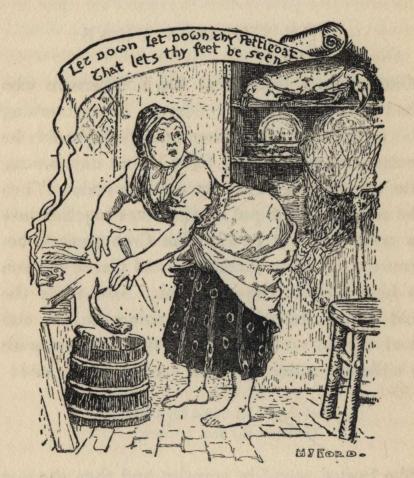
"Let down thy petticoat that lets thy feet be seen"
'What! You can speak, can you, you ridiculous crab?' she said, for she was not quite pleased at the Crab's remarks. Then she took him up and placed him on a dish.
When her husband came home and they sat down to dinner, they presently heard the Crab's little voice saying, 'Give me some too.' They were all very much surprised, but they gave him something to eat. When the old man came to take away the plate which had contained the Crab's dinner, he found it full of gold, and as the same thing happened every day he soon became very fond of the Crab.
One day the Crab said to the fisherman's wife, 'Go to the King and tell him I wish to marry his younger daughter.'
The old woman went accordingly, and laid the matter before the King, who laughed a little at the notion of his daughter marrying a crab, but did not decline the proposal altogether, because he was a prudent monarch, and knew that the Crab was likely to be a prince in disguise. He said, therefore, to the fisherman's wife, 'Go, old woman, and tell the Crab I will give him my daughter if by to-morrow morning he can build a wall in front of my castle much higher than my tower, upon which all the flowers of the world must grow and bloom.'
The fisherman's wife went home and gave this message.
Then the Crab gave her a golden rod, and said, 'Go and strike with this rod three times upon the ground on the place which the King showed you, and to-morrow morning the wall will be there.'
The old woman did so and went away again.
The next morning, when the King awoke, what do you think he saw? The wall stood there before his eyes, exactly as he had bespoken it!
Then the old woman went back to the King and said to him, 'Your Majesty's orders have been fulfilled.'
'That is all very well,' said the King, 'but I cannot give away my daughter until there stands in front of my palace a garden in which there are three fountains, of which the first must play gold, the second diamonds, and the third brilliants.'
So the old woman had to strike again three times upon the ground with the rod, and the next morning the garden was there. The King now gave his consent, and the wedding was fixed for the very next day.
Then the Crab said to the old fisherman, 'Now take this rod; go and knock with it on a certain mountain; then a black man will come out and ask you what you wish for. Answer him thus: "Your master, the King, has sent me to tell you that you must send him his golden garment that is like the sun." Make him give you, besides, the queenly robes of gold and precious stones which are like the flowery meadows and bring them both to me. And bring me also the golden cushion.'
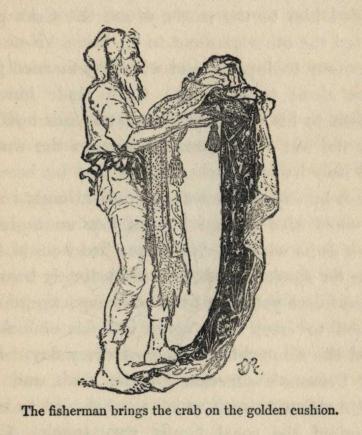
The fisherman brings the crab on the golden cushion.
The old man went and did his errand. When he had brought the precious robes, the Crab put on the golden garment and then crept upon the golden cushion, and in this way the fisherman carried him to the castle, where the Crab presented the other garment to his bride. Now the ceremony took place, and when the married pair were alone together the Crab made himself known to his young wife, and told her how he was the son of the greatest king in the world, and how he was enchanted, so that he became a crab by day and was a man only at night; and he could also change himself into an eagle as often as he wished. No sooner had he said this than he shook himself, and immediately became a handsome youth, but the next morning he was forced to creep back again into his crab-shell. And the same thing happened every day. But the Princess's affection for the Crab, and the polite attention with which she behaved to him, surprised the royal family very much. They suspected some secret, but though they spied and spied, they could not discover it. Thus a year passed away, and the Princess had a son, whom she called Benjamin. But her mother still thought the whole matter very strange. At last she said to the King that he ought to ask his daughter whether she would not like to have another husband instead of the Crab. But when the daughter was questioned she only answered:
'I am married to the Crab, and him only will I have.'
Then the King said to her, 'I will appoint a tournament in your honour, and I will invite all the princes in the world to it, and if any one of them pleases you, you shall marry him.'
In the evening the Princess told this to the Crab, who said to her, 'Take this rod, go to the garden gate and knock with it, then a black man will come out and say to you, "Why have you called me, and what do you require of me?" Answer him thus: "Your master the King has sent me hither to tell you to send him his golden armour and his steed and the silver apple." And bring them to me.'
The Princess did so, and brought him what he desired.
The following evening the Prince dressed himself for the tournament. Before he went he said to his wife, 'Now mind you do not say when you see me that I am the Crab. For if you do this evil will come of it. Place yourself at the window with your sisters; I will ride by and throw you the silver apple. Take it in your hand, but if they ask you who I am, say that you do not know.' So saying, he kissed her, repeated his warning once more, and went away.
The Princess went with her sisters to the window and looked on at the tournament. Presently her husband rode by and threw the apple up to her. She caught it in her hand and went with it to her room, and by-and-by her husband came back to her. But her father was much surprised that she did not seem to care about any of the princes; he therefore appointed a second tournament.
The Crab then gave his wife the same directions as before, only this time the apple which she received from the black man was of gold. But before the Prince went to the tournament he said to his wife, 'Now I know you will betray me to-day.'
But she swore to him that she would not tell who he was. He then repeated his warning and went away.
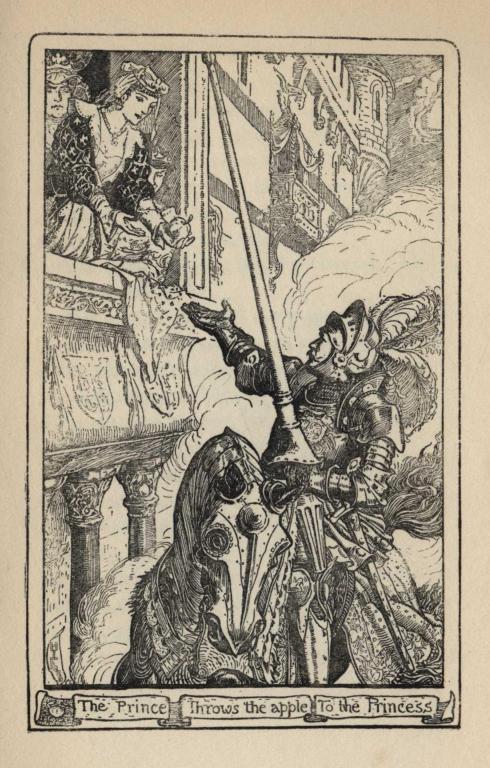
The Prince throws the apple to the Princess
In the evening, while the Princess, with her mother and sisters, was standing at the window, the Prince suddenly galloped past on his steed and threw her the golden apple.
Then her mother flew into a passion, gave her a box on the ear, and cried out, 'Does not even that prince please you, you fool?'
The Princess in her fright exclaimed, 'That is the Crab himself!'
Her mother was still more angry because she had not been told sooner, ran into her daughter's room where the crab-shell was still lying, took it up and threw it into the fire. Then the poor Princess cried bitterly, but it was of no use; her husband did not come back.
Now we must leave the Princess and turn to the other persons in the story. One day an old man went to a stream to dip in a crust of bread which he was going to eat, when a dog came out of the water, snatched the bread from his hand, and ran away. The old man ran after him, but the dog reached a door, pushed it open, and ran in, the old man following him. He did not overtake the dog, but found himself above a staircase, which he descended. Then he saw before him a stately palace, and, entering, he found in a large hall a table set for twelve persons. He hid himself in the hall behind a great picture, that he might see what would happen. At noon he heard a great noise, so that he trembled with fear. When he took courage to look out from behind the picture, he saw twelve eagles flying in. At this sight his fear became still greater. The eagles flew to the basin of a fountain that was there and bathed themselves, when suddenly they were changed into twelve handsome youths. Now they seated themselves at the table, and one of them took up a goblet filled with wine, and said, 'A health to my father!' And another said, 'A health to my mother!' and so the healths went round. Then one of them said:
'A health to my dearest lady,
Long may she live and well!
But a curse on the cruel mother
That burnt my golden shell!'
And so saying he wept bitterly. Then the youths rose from the table, went back to the great stone fountain, turned themselves into eagles again, and flew away.
Then the old man went away too, returned to the light of day, and went home. Soon after he heard that the Princess was ill, and that the only thing that did her good was having stories told to her. He therefore went to the royal castle, obtained an audience of the Princess, and told her about the strange things he had seen in the underground palace. No sooner had he finished than the Princess asked him whether he could find the way to that palace.
'Yes,' he answered, 'certainly.'
And now she desired him to guide her thither at once. The old man did so, and when they came to the palace he hid her behind the great picture and advised her to keep quite still, and he placed himself behind the picture also. Presently the eagles came flying in, and changed themselves into young men, and in a moment the Princess recognised her husband amongst them all, and tried to come out of her hiding-place; but the old man held her back. The youths seated themselves at the table; and now the Prince said again, while he took up the cup of wine:
'A health to my dearest lady,
Long may she live and well!
But a curse on the cruel mother
That burnt my golden shell!'
Then the Princess could restrain herself no longer, but ran forward and threw her arms round her husband. And immediately he knew her again, and said:
'Do you remember how I told you that day that you would betray me? Now you see that I spoke the truth. But all that bad time is past. Now listen to me: I must still remain enchanted for three months. Will you stay here with me till that time is over?'
So the Princess stayed with him, and said to the old man, 'Go back to the castle and tell my parents that I am staying here.'
Her parents were very much vexed when the old man came back and told them this, but as soon as the three months of the Prince's enchantment were over, he ceased to be an eagle and became once more a man, and they returned home together. And then they lived happily, and we who hear the story are happier still.
THE IRON STOVE
Once upon a time when wishes came true there was a King's son who was enchanted by an old witch, so that he was obliged to sit in a large iron stove in a wood. There he lived for many years, and no one could free him. At last a King's daughter came into the wood; she had lost her way, and could not find her father's kingdom again. She had been wandering round and round for nine days, and came at last to the iron case. A voice came from within and asked her, 'Where do you come from, and where do you want to go?' She answered, 'I have lost my way to my father's kingdom, and I shall never get home again.' Then the voice from the iron stove said, 'I will help you to find your home again, and that in a very short time, if you will promise to do what I ask you. I am a greater prince than you are a princess, and I will marry you.' Then she grew frightened, and thought, 'What can a young lassie do with an iron stove?' But as she wanted very much to go home to her father, she promised to do what he wished. He said, 'You must come again, and bring a knife with you to scrape a hole in the iron.'
Then he gave her someone for a guide, who walked near her and said nothing, but he brought her in two hours to her house. There was great joy in the castle when the Princess came back, and the old King fell on her neck and kissed her. But she was very much troubled, and said, 'Dear father, listen to what has befallen me! I should never have come home again out of the great wild wood if I had not come to an iron stove, to whom I have had to promise that I will go back to free him and marry him!' The old King was so frightened that he nearly fainted, for she was his only daughter. So they consulted together, and determined that the miller's daughter, who was very beautiful, should take her place. They took her there, gave her a knife, and said she must scrape at the iron stove. She scraped for twenty-four hours, but did not make the least impression. When the day broke, a voice called from the iron stove, 'It seems to me that it is day outside.' Then she answered, 'It seems so to me; I think I hear my father's mill rattling.'
'So you are a miller's daughter! Then go away at once, and tell the King's daughter to come.'
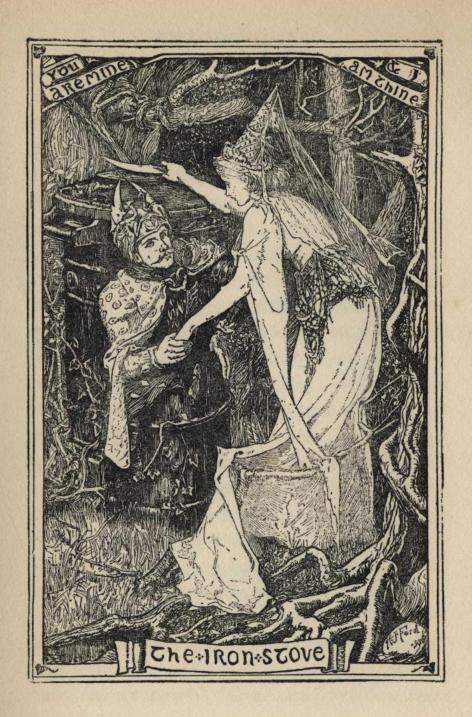
The iron stove
Then she went away, and told the old King that the thing inside the iron stove would not have her, but wanted the Princess. The old King was frightened, and his daughter wept. But they had a swineherd's daughter who was even more beautiful than the miller's daughter, and they gave her a piece of gold to go to the iron stove instead of the Princess. Then she was taken out, and had to scrape for four-and-twenty hours, but she could make no impression. As soon as the day broke the voice from the stove called out 'It seems to be daylight outside.' Then she answered, 'It seems so to me too; I think I hear my father blowing his horn.' 'So you are a swineherd's daughter! Go away at once, and let the King's daughter come. And say to her that what I foretell shall come to pass, and if she does not come everything in the kingdom shall fall into ruin, and not one stone shall be left upon another.' When the Princess heard this she began to cry, but it was no good; she had to keep her word. She took leave of her father, put a knife in her belt, and went to the iron stove in the wood. As soon as she reached it she began to scrape, and the iron gave way and before two hours had passed she had made a little hole. Then she peeped in and saw such a beautiful youth all shining with gold and precious stones that she fell in love with him on the spot. So she scraped away harder than ever, and made the hole so large that he could get out. Then he said, 'You are mine, and I am thine; you are my bride and have set me free!' He wanted to take her with him to his kingdom, but she begged him just to let her go once more to her father; and the Prince let her go, but told her not to say more than three words to her father, then to come back again. So she went home, but alas! she said more than three words; and immediately the iron stove vanished and went away over a mountain of glass and sharp swords. But the Prince was free, and was no longer shut up in it. Then she said good-bye to her father, and took a little money with her, and went again into the great wood to look for the iron stove; but she could not find it. She sought it for nine days, and then her hunger became so great that she did not know how she could live any longer. And when it was evening she climbed a little tree and wished that the night would not come, because she was afraid of the wild beasts. When midnight came she saw afar off a little light, and thought, 'Ah! if only I could reach that!' Then she got down from the tree and went towards the light. She came to a little old house with a great deal of grass growing round, and stood in front of a little heap of wood. She thought, 'Alas! what am I coming to?' and peeped through the window; but she saw nothing inside except big and little toads, and a table beautifully spread with roast meats and wine, and all the dishes and drinking-cups were of silver. Then she took heart and knocked. Then a fat toad called out:
'Little green toad with leg like crook,
Open wide the door, and look
Who it was the latch that shook.'
And a little toad came forward and let her in. When she entered they all bid her welcome, and made her sit down. They asked her how she came there and what she wanted. Then she told everything that had happened to her, and how, because she had exceeded her permission only to speak three words, the stove had disappeared with the Prince; and how she had searched a very long time, and must wander over mountain and valley till she found him.
Then the old toad said:
'Little green toad whose leg doth twist,
Go to the corner of which you wist,
And bring to me the large old kist.'
And the little toad went and brought out a great chest. Then they gave her food and drink, and led her to a beautifully made bed of silk and samite, on which she lay down and slept soundly. When the day dawned she arose, and the old toad gave her three things out of the huge chest to take with her. She would have need of them, for she had to cross a high glass mountain, three cutting swords, and a great lake. When she had passed these she would find her lover again. So she was given three large needles, a plough-wheel, and three nuts, which she was to take great care of. She set out with these things, and when she came to the glass mountain which was so slippery she stuck the three needles behind her feet and then in front, and so got over it, and when she was on the other side put them carefully away.
Then she reached the three cutting swords, and got on her plough-wheel and rolled over them. At last she came to a great lake, and, when she had crossed that, arrived at a beautiful castle. She went in and gave herself out as a servant, a poor maid who would gladly be engaged. But she knew that the Prince whom she had freed from the iron stove in the great wood was in the castle. So she was taken on as kitchen-maid for very small wages. Now the Prince was about to marry another princess, for he thought she was dead long ago.
In the evening, when she had washed up and was ready, she felt in her pocket and found the three nuts which the old toad had given her. She cracked one and was going to eat the kernel, when behold! there was a beautiful royal dress inside it! When the bride heard of this, she came and begged for the dress, and wanted to buy it, saying it was not a dress for a serving-maid. Then she said she would not sell it unless she was granted one favour--namely, to sleep by the Prince's door. The bride granted her this, because the dress was so beautiful and she had so few like it. When it was evening she said to her bridegroom, 'That stupid maid wants to sleep by your door.'
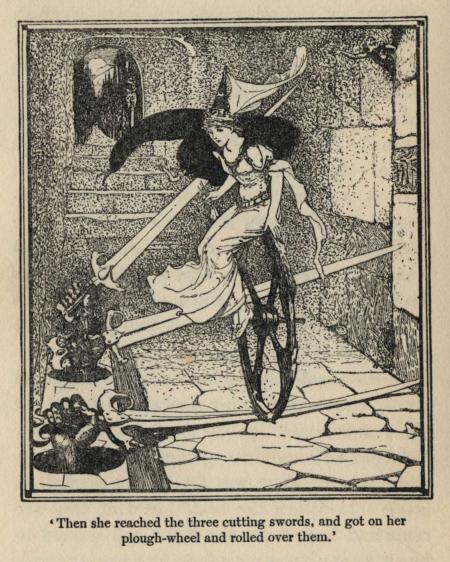
'Then she reached the three cutting swords, and got on her plough-wheel and rolled over them.'
'If you are contented, I am,' he said. But she gave him a glass of wine in which she had poured a sleeping-draught. Then they both went into his room, but he slept so soundly that she could not wake him. The maid wept all night long, and said, 'I freed you in the wild wood out of the iron stove; I have sought you, and have crossed a glassy mountain, three sharp swords, and a great lake before I found you, and will you not hear me now?' The servants outside heard how she cried the whole night, and they told their master in the morning.
When she had washed up the next evening she bit the second nut, and there was a still more beautiful dress inside. When the bride saw it she wanted to buy it also. But the maid did not want money, and asked that she should sleep again by the Prince's door. The bride, however, gave him a sleeping-draught, and he slept so soundly that he heard nothing. But the kitchen-maid wept the whole night long, and said, 'I have freed you in a wood and from an iron stove; I sought you and have crossed a glassy mountain, three sharp swords, and a great lake to find you, and now you will not hear me!' The servants outside heard how she cried the whole night, and in the morning they told their master. And when she had washed up on the third night she bit the third nut, and there was a still more beautiful dress inside that was made of pure gold. When the bride saw it she wanted to have it, but the maid would only give it her on condition that she should sleep for the third time by the Prince's door. But the Prince took care not to drink the sleeping-draught. When she began to weep and to say, 'Dearest sweetheart, I freed you in the horrible wild wood, and from an iron stove,' he jumped up and said, 'You are right. You are mine, and I am thine.' Though it was still night, he got into a carriage with her and they took the false bride's clothes away, so that she could not follow them. When they came to the great lake they rowed across, and when they reached the three sharp swords they sat on the plough-wheel, and on the glassy mountain they stuck the three needles in. So they arrived at last at the little old house, but when they stepped inside it turned into a large castle. The toads were all freed, and were beautiful King's children, running about for joy. There they were married, and they remained in the castle, which was much larger than that of the Princess's father. But because the old man did not like being left alone, they went and fetched him. So they had two kingdoms and lived in great wealth.
A mouse has run,
My story's done.
THE DRAGON AND HIS GRANDMOTHER
There was once a great war, and the King had a great many soldiers, but he gave them so little pay that they could not live upon it. Then three of them took counsel together and determined to desert.
One of them said to the others, 'If we are caught, we shall be hanged on the gallows; how shall we set about it?' The other said, 'Do you see that large cornfield there? If we were to hide ourselves in that, no one could find us. The army cannot come into it, and to-morrow it is to march on.'
They crept into the corn, but the army did not march on, but remained encamped close around them. They sat for two days and two nights in the corn, and grew so hungry that they nearly died; but if they were to venture out, it was certain death.
They said at last, 'What use was it our deserting? We must perish here miserably.'
Whilst they were speaking a fiery dragon came flying through the air. It hovered near them, and asked why they were hidden there. They answered, 'We are three soldiers, and have deserted because our pay was so small. Now if we remain here we shall die of hunger, and if we move out we shall be strung up on the gallows.' 'If you will serve me for seven years,' said the Dragon, 'I will lead you through the midst of the army so that no one shall catch you.' 'We have no choice, and must take your offer,' said they. Then the dragon seized them in his claws, took them through the air over the army, and set them down on the earth a long way from it.
He gave them a little whip, saying, 'Whip and slash with this, and as much money as you want will jump up before you. You can then live as great lords, keep horses, and drive about in carriages. But after seven years you are mine.' Then he put a book before them, which he made all three of them sign. 'I will then give you a riddle,' he said; 'if you guess it, you shall be free and out of my power.' The Dragon then flew away, and they journeyed on with their little whip. They had as much money as they wanted, wore grand clothes, and made their way into the world. Wherever they went they lived in merrymaking and splendour, drove about with horses and carriages, ate and drank, but did nothing wrong.
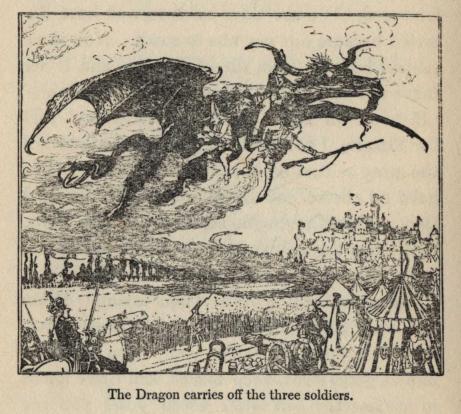
The Dragon carries off the three soldiers.
The time passed quickly away, and when the seven years were nearly ended two of them grew terribly anxious and frightened, but the third made light of it, saying, 'Don't be afraid, brothers, I wasn't born yesterday; I will guess the riddle.'
They went into a field, sat down, and the two pulled long faces. An old woman passed by, and asked them why they were so sad. 'Alas! what have you to do with it? You cannot help us.' 'Who knows?' she answered. 'Only confide your trouble in me.'
Then they told her that they had become the servants of the Dragon for seven long years, and how he had given them money as plentifully as blackberries; but as they had signed their names they were his, unless when the seven years had passed they could guess a riddle. The old woman said, 'If you would help yourselves, one of you must go into the wood, and there he will come upon a tumble-down building of rocks which looks like a little house. He must go in, and there he will find help.'
The two melancholy ones thought, 'That won't save us!' and they remained where they were. But the third and merry one jumped up and went into the wood till he found the rock hut. In the hut sat a very old woman, who was the Dragon's grandmother. She asked him how he came, and what was his business there. He told her all that had happened, and because she was pleased with him she took compassion on him, and said she would help him.
She lifted up a large stone which lay over the cellar, saying, 'Hide yourself there; you can hear all that is spoken in this room. Only sit still and don't stir. When the dragon comes, I will ask him what the riddle is, for he tells me everything; then listen carefully what he answers.'
At midnight the Dragon flew in, and asked for his supper. His grandmother laid the table, and brought out food and drink till he was satisfied, and they ate and drank together. Then in the course of the conversation she asked him what he had done in the day, and how many souls he had conquered.
'I haven't had much luck to-day,' he said, 'but I have a tight hold on three soldiers.'
'Indeed! three soldiers!' said she. 'Who cannot escape you?'
'They are mine,' answered the Dragon scornfully, 'for I shall only give them one riddle which they will never be able to guess.'
'What sort of a riddle is it?' she asked.
'I will tell you this. In the North Sea lies a dead sea-cat--that shall be their roast meat; and the rib of a whale--that shall be their silver spoon; and the hollow foot of a dead horse--that shall be their wineglass.'
When the Dragon had gone to bed, his old grandmother pulled up the stone and let out the soldier.
'Did you pay attention to everything?'
'Yes,' he replied, 'I know enough, and can help myself splendidly.'
Then he went by another way through the window secretly, and in all haste back to his comrades. He told them how the Dragon had been outwitted by his grandmother, and how he had heard from his own lips the answer to the riddle.
Then they were all delighted and in high spirits, took out their whip, and cracked so much money that it came jumping up from the ground. When the seven years had quite gone, the Fiend came with his book, and, pointing at the signatures, said, 'I will take you underground with me; you shall have a meal there. If you can tell me what you will get for your roast meat, you shall be free, and shall also keep the whip.'
Then said the first soldier, 'In the North Sea lies a dead sea-cat; that shall be the roast meat.'
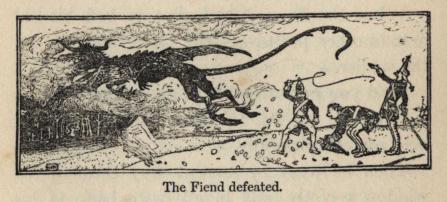
The Fiend defeated.
The Dragon was much annoyed, and hummed and hawed a good deal, and asked the second, 'But what shall be your spoon?'
'The rib of a whale shall be our silver spoon.'
The Dragon made a face, and growled again three times, 'Hum, hum, hum,' and said to the third, 'Do you know what your wineglass shall be?'
'An old horse's hoof shall be our wineglass.'
Then the Dragon flew away with a loud shriek, and had no more power over them. But the three soldiers took the little whip, whipped as much money as they wanted, and lived happily to their lives' end.
THE DONKEY CABBAGE
There was once a young Hunter who went boldly into the forest. He had a merry and light heart, and as he went whistling along there came an ugly old woman, who said to him, 'Good-day, dear hunter! You are very merry and contented, but I suffer hunger and thirst, so give me a trifle.' The Hunter was sorry for the poor old woman, and he felt in his pocket and gave her all he could spare. He was going on then, but the old woman stopped him and said, 'Listen, dear hunter, to what I say. Because of your kind heart I will make you a present. Go on your way, and in a short time you will come to a tree on which sit nine birds who have a cloak in their claws and are quarrelling over it. Then take aim with your gun and shoot in the middle of them; they will let the cloak fall, but one of the birds will be hit and will drop down dead. Take the cloak with you; it is a wishing-cloak, and when you throw it on your shoulders you have only to wish yourself at a certain place, and in the twinkling of an eye you are there. Take the heart out of the dead bird and swallow it whole, and early every morning when you get up you will find a gold piece under your pillow.'
The Hunter thanked the wise woman, and thought to himself, 'These are splendid things she has promised me, if only they come to pass!' So he walked on about a hundred yards, and then he heard above him in the branches such a screaming and chirping that he looked up, and there he saw a heap of birds tearing a cloth with their beaks and feet, shrieking, tugging, and fighting, as if each wanted it for himself. 'Well,' said the Hunter, 'this is wonderful! It is just as the old woman said'; and he took his gun on his shoulder, pulled the trigger, and shot into the midst of them, so that their feathers flew about. Then the flock took flight with much screaming, but one fell dead, and the cloak fluttered down. Then the Hunter did as the old woman had told him: he cut open the bird, found its heart, swallowed it, and took the cloak home with him. The next morning when he awoke he remembered the promise, and wanted to see if it had come true. But when he lifted up his pillow, there sparkled the gold piece, and the next morning he found another, and so on every time he got up. He collected a heap of gold, but at last he thought to himself, 'What good is all my gold to me if I stay at home? I will travel and look a bit about me in the world.' So he took leave of his parents, slung his hunting knapsack and his gun round him, and journeyed into the world.
It happened that one day he went through a thick wood, and when he came to the end of it there lay in the plain before him a large castle. At one of the windows in it stood an old woman with a most beautiful maiden by her side, looking out. But the old woman was a witch, and she said to the girl, 'There comes one out of the wood who has a wonderful treasure in his body which we must manage to possess ourselves of, darling daughter; we have more right to it than he. He has a bird's heart in him, and so every morning there lies a gold piece under his pillow.'
She told her how they could get hold of it, and how she was to coax it from him, and at last threatened her angrily, saying, 'And if you do not obey me, you shall repent it!'
When the Hunter came nearer he saw the maiden, and said to himself, 'I have travelled so far now that I will rest, and turn into this beautiful castle; money I have in plenty.' But the real reason was that he had caught sight of the lovely face.
He went into the house, and was kindly received and hospitably entertained. It was not long before he was so much in love with the witch-maiden that he thought of nothing else, and only looked in her eyes, and whatever she wanted, that he gladly did. Then the old witch said, 'Now we must have the bird-heart; he will not feel when it is gone.' She prepared a drink, and when it was ready she poured it in a goblet and gave it to the maiden, who had to hand it to the Hunter.
'Drink to me now, my dearest,' she said. Then he took the goblet, and when he had swallowed the drink the bird-heart came out of his mouth. The maiden had to get hold of it secretly and then swallow it herself, for the old witch wanted to have it. Thenceforward he found no more gold under his pillow, and it lay under the maiden's; but he was so much in love and so much bewitched that he thought of nothing except spending all his time with the maiden.
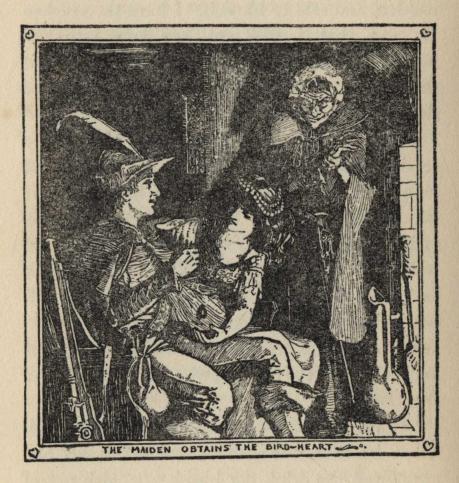
THE MAIDEN OBTAINS THE BIRD-HEART
Then the old witch said, 'We have the bird-heart, but we must also get the wishing-cloak from him.'
The maiden answered, 'We will leave him that; he has already lost his wealth!'
The old witch grew angry, and said, 'Such a cloak is a wonderful thing, it is seldom to be had in the world, and have it I must and will.' She beat the maiden, and said that if she did not obey it would go ill with her.
So she did her mother's bidding, and, standing one day by the window, she looked away into the far distance as if she were very sad.
'Why are you standing there looking so sad?' asked the Hunter.
'Alas, my love,' she replied, 'over there lies the granite mountain where the costly precious stones grow. I have a great longing to go there, so that when I think of it I am very sad. For who can fetch them? Only the birds who fly; a man, never.'
'If you have no other trouble,' said the Hunter, 'that one I can easily remove from your heart.'
So he wrapped her round in his cloak and wished themselves to the granite mountain, and in an instant there they were, sitting on it! The precious stones sparkled so brightly on all sides that it was a pleasure to see them, and they collected the most beautiful and costly together. But now the old witch had through her witchcraft caused the Hunter's eyes to become heavy.
He said to the maiden, 'We will sit down for a little while and rest; I am so tired that I can hardly stand on my feet.'
So they sat down, and he laid his head on her lap and fell asleep. As soon as he was sound asleep she unfastened the cloak from his shoulders, threw it on her own, left the granite and stones, and wished herself home again.
But when the Hunter had finished his sleep and awoke, he found that his love had betrayed him and left him alone on the wild mountain. 'Oh,' said he, 'why is faithlessness so great in the world?' and he sat down in sorrow and trouble, not knowing what to do.
But the mountain belonged to fierce and huge giants, who lived on it and traded there, and he had not sat long before he saw three of them striding towards him. So he lay down as if he had fallen into a deep sleep.
The giants came up, and the first pushed him with his foot, and said, 'What sort of an earthworm is that?'
The second said, 'Crush him dead.'
But the third said contemptuously, 'It is not worth the trouble! Let him live; he cannot remain here, and if he goes higher up the mountain the clouds will take him and carry him off.'
Talking thus they went away. But the Hunter had listened to their talk, and as soon as they had gone he rose and climbed to the summit. When he had sat there a little while a cloud swept by, and, seizing him, carried him away. It travelled for a time in the sky. and then it sank down and hovered over a large vegetable garden surrounded by walls, so that he came safely to the ground amidst cabbage and vegetables. The Hunter then looked about him, saying, 'If only I had something to eat! I am so hungry, and it will go badly with me in the future, for I see here not an apple or pear or fruit of any kind--nothing but vegetables everywhere.' At last he thought, 'At a pinch I can eat a salad; it does not taste particularly nice, but it will refresh me.' So he looked about for a good head and ate it, but no sooner had he swallowed a couple of mouthfuls than he felt very strange, and found himself wonderfully changed. Four legs began to grow on him, a thick head, and two long ears, and he saw with horror that he had changed into a donkey. But as he was still very hungry and this juicy salad tasted very good to his present nature, he went on eating with a still greater appetite. At last he got hold of another kind of cabbage, but scarcely had swallowed it when he felt another change, and he once more regained his human form.
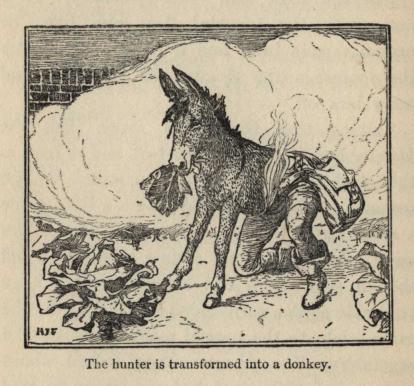
The hunter is transformed into a donkey.
The Hunter now lay down and slept off his weariness. When he awoke the next morning he broke off a head of the bad and a head of the good cabbage, thinking, 'This will help me to regain my own, and to punish faithlessness.' Then he put the heads in his pockets, climbed the wall, and started off to seek the castle of his love. When he had wandered about for a couple of days he found it quite easily. He then browned his face quickly, so that his own mother would not have known him, and went into the castle, where he begged for a lodging.
'I am so tired,' he said, 'I can go no farther.'
The witch asked, 'Countryman, who are you, and what is your business?'
He answered, 'I am a messenger of the King, and have been sent to seek the finest salad that grows under the sun. I have been so lucky as to find it, and am bringing it with me; but the heat of the sun is so great that the tender cabbage threatens to grow soft, and I do not know if I shall be able to bring it any farther.'
When the old witch heard of the fine salad she wanted to eat it, and said, 'Dear countryman, just let me taste the wonderful salad.'
'Why not?' he answered; 'I have brought two heads with me, and will give you one.'
So saying, he opened his sack and gave her the bad one. The witch suspected no evil, and her mouth watered to taste the new dish, so that she went into the kitchen to prepare it herself. When it was ready she could not wait till it was served at the table, but she immediately took a couple of leaves and put them in her mouth. No sooner, however, had she swallowed them than she lost human form, and ran into the courtyard in the shape of a donkey.
Now the servant came into the kitchen, and when she saw the salad standing there ready cooked she was about to carry it up, but on the way, according to her old habit, she tasted it and ate a couple of leaves. Immediately the charm worked, and she became a donkey, and ran out to join the old witch, and the dish with the salad in it fell to the ground. In the meantime, the messenger was sitting with the lovely maiden, and as no one came with the salad, and she wanted very much to taste it, she said, 'I don't know where the salad is.'
Then thought the Hunter, 'The cabbage must have already begun to work.' And he said, 'I will go to the kitchen and fetch it myself.'
When he came there he saw the two donkeys running about in the courtyard, but the salad was lying on the ground.
'That's all right,' said he; 'two have had their share!' And lifting the remaining leaves up, he laid them on the dish and brought them to the maiden.
'I am bringing you the delicious food my own self,' he said, 'so that you need not wait any longer.'
Then she ate, and as the others had done, she at once lost her human form, and ran as a donkey into the yard.
When the Hunter had washed his face, so that the changed ones might know him, he went into the yard saying, 'Now you shall receive a reward for your faithlessness.'
He tied them all three with a rope, and drove them away till he came to a mill. He knocked at the window, and the miller put his head out and asked what he wanted.
'I have three tiresome animals,' he answered, 'which I don't want to keep any longer. If you will take them, give them food and stabling, and do as I tell you with them, I will pay you as much as you want.'
The miller replied, 'Why not? What shall I do with them?'
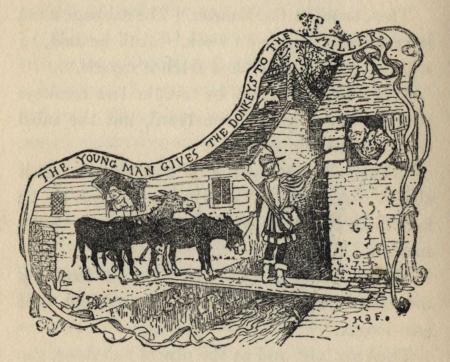
THE YOUNG MAN GIVES THE DONKEYS TO THE MILLER
Then the Hunter said that to the old donkey which was the witch, three beatings and one meal; to the younger one, which was the servant, one beating and three meals; and to the youngest one, which was the maiden, no beating and three meals; for he could not find it in his heart to let the maiden be beaten.
Then he went back into the castle, and he found there all that he wanted. After a couple of days the miller came and said that he must tell him that the old donkey which was to have three beatings and only one meal had died. 'The two others,' he added, 'are certainly not dead, and get their three meals every day, but they are so sad that they cannot last much longer.'
Then the Hunter took pity on them, laid aside his anger, and told the miller to drive them back again. And when they came he gave them some of the good cabbage to eat, so that they became human again. Then the beautiful maiden fell on her knees before him saying, 'Oh, my dearest, forgive me the ill I have done you! My mother compelled me to do it; it was against my will, for I love you dearly. Your wishing-cloak is hanging in a cupboard, and as for the bird-heart I will make a drink and give it back to you.'
But he changed his mind, and said, 'Keep it; it makes no difference, for I will take you to be my own dear true wife.'
And the wedding was celebrated, and they lived happy together till death.
LUCKY LUCK
Once upon a time there was a King who had an only son. When the lad was about eighteen years old his father had to go to fight in a war against a neighbouring country, and the king led his troops in person. He bade his son act as Regent in his absence, but ordered him on no account to marry till his return.
Time went by. The Prince ruled the country and never even thought of marrying. But when he reached his twenty-fifth birthday he began to think that it might be rather nice to have a wife, and he thought so much that at last he got quite eager about it. He remembered, however, what his father had said, and waited some time longer, till at last it was ten years since the King went out to war. Then the Prince called his courtiers about him and set off with a great retinue to seek a bride. He hardly knew which way to go, so he wandered about for twenty days, when, suddenly, he found himself in his father's camp.
The King was delighted to see his son, and had a great many questions to ask and answer; but when he heard that instead of quietly waiting for him at home the Prince was starting off to seek a wife he was very angry, and said: 'You may go where you please, but I will not leave any of my people with you.'
Only one faithful servant stayed with the Prince and refused to part from him. They journeyed over hill and dale till they came to a place called Goldtown. The King of Goldtown had a lovely daughter, and the Prince, who soon heard about her beauty, could not rest till he saw her.
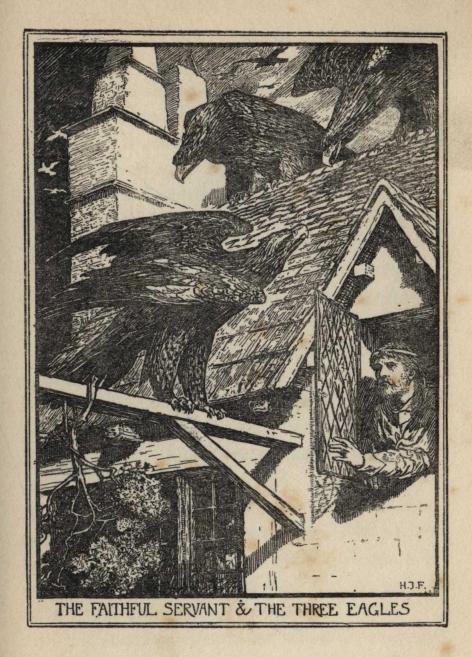
THE FAITHFUL SERVANT & THE THREE EAGLES
He was very kindly received, for he was extremely good-looking and had charming manners, so he lost no time in asking for her hand and her parents gave her to him with joy. The wedding took place at once, and the feasting and rejoicings went on for a whole month. At the end of the month they set off for home, but as the journey was a long one they spent the first evening at an inn. Everyone in the house slept, and only the faithful servant kept watch. About midnight he heard three crows, who had flown to the roof, talking together.
'That's a handsome couple which arrived here to-night. It seems quite a pity they should lose their lives so soon.'
'Truly,' said the second crow; 'for to-morrow, when midday strikes, the bridge over the Gold Stream will break just as they are driving over it. But, listen! whoever overhears and tells what we have said will be turned to stone up to his knees.'
The crows had hardly done speaking when away they flew. And close upon them followed three pigeons.
'Even if the Prince and Princess get safe over the bridge they will perish,' said they; 'for the King is going to send a carriage to meet them which looks as new as paint. But when they are seated in it a raging wind will rise and whirl the carriage away into the clouds. Then it will fall suddenly to earth, and they will be killed. But anyone who hears and betrays what we have said will be turned to stone up to his waist.'
With that the pigeons flew off and three eagles took their places, and this is what they said:
'If the young couple does manage to escape the dangers of the bridge and the carriage, the King means to send them each a splendid gold-embroidered robe. When they put these on they will be burnt up at once. But whoever hears and repeats this will turn to stone from head to foot.'
Early next morning the travellers got up and breakfasted. They began to tell each other their dreams. At last the servant said:
'Gracious Prince, I dreamt that if your Royal Highness would grant all I asked we should get home safe and sound; but if you did not we should certainly be lost. My dreams never deceive me, so I entreat you to follow my advice during the rest of the journey.'
'Don't make such a fuss about a dream,' said the Prince; 'dreams are but clouds. Still, to prevent your being anxious I will promise to do as you wish.'
With that they set out on their journey.
At midday they reached the Gold Stream. When they got to the bridge the servant said: 'Let us leave the carriage here, my Prince, and walk a little way. The town is not far off and we can easily get another carriage there, for the wheels of this one are bad and will not hold out much longer.'
The Prince looked well at the carriage. He did not think it looked so unsafe as his servant said; but he had given his word and he held to it.
They got down and loaded the horses with the luggage. The Prince and his bride walked over the bridge, but the servant said he would ride the horses through the stream so as to water and bathe them.
They reached the other side without harm, and bought a new carriage in the town, which was quite near, and set off once more on their travels; but they had not gone far when they met a messenger from the King, who said to the Prince: 'His Majesty has sent your Royal Highness this beautiful carriage, so that you may make a fitting entry into your own country and amongst your own people.'
The Prince was so delighted that he could not speak. But the servant said: 'My lord, let me examine this carriage first and then you can get in if I find it is all right; otherwise we had better stay in our own.'
The Prince made no objections, and after looking the carriage well over the servant said: 'It is as bad as it is smart'; and with that he knocked it all to pieces, and they went on in the one that they had bought.
At last they reached the frontier; there another messenger was waiting for them, who said that the King had sent two splendid robes for the Prince and his bride, and begged that they would wear them for their state entry. But the servant implored the Prince to have nothing to do with them, and never gave him any peace till he had obtained leave to destroy the robes.
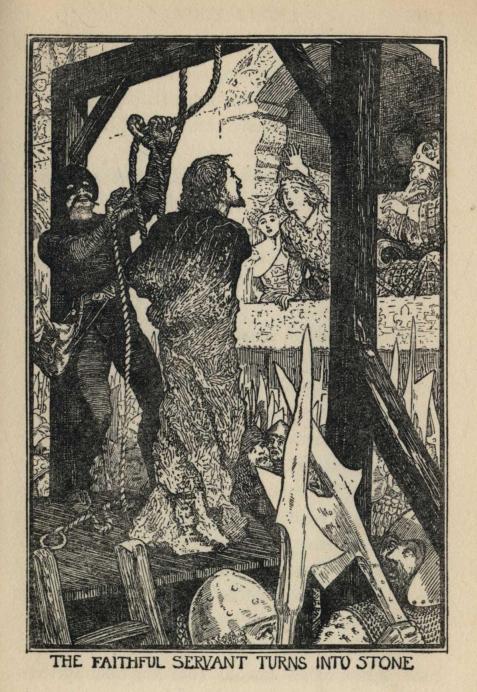
THE FAITHFUL SERVANT TURNS INTO STONE
The old King was furious when he found that all his arts had failed; that his son still lived and that he would have to give up the crown to him now he was married, for that was the law of the land. He longed to know how the Prince had escaped, and said: 'My dear son, I do indeed rejoice to have you safely back, but I cannot imagine why the beautiful carriage and the splendid robes I sent did not please you; why you had them destroyed.'
'Indeed, sire,' said the Prince, 'I was myself much annoyed at their destruction; but my servant had begged to direct everything on the journey and I had promised him that he should do so. He declared that we could not possibly get home safely unless I did as he told me.'
The old King fell into a tremendous rage. He called his Council together and condemned the servant to death.
The gallows was put up in the square in front of the palace. The servant was led out and his sentence read to him.
The rope was being placed round his neck, when he begged to be allowed a few last words. 'On our journey home,' he said, 'we spent the first night at an inn. I did not sleep, but kept watch all night.' And then he went on to tell what the crows had said, and as he spoke he turned to stone up to his knees. The Prince called to him to say no more as he had proved his innocence. But the servant paid no heed to him, and by the time his story was done he had turned to stone from head to foot.
Oh! how grieved the Prince was to lose his faithful servant! And what pained him most was the thought that he was lost through his very faithfulness, and he determined to travel all over the world and never rest till he found some means of restoring him to life.
Now there lived at Court an old woman who had been the Prince's nurse. To her he confided all his plans, and left his wife, the Princess, in her care. 'You have a long way before you, my son,' said the old woman; 'you must never return till you have met with Lucky Luck. If he cannot help you no one on earth can.'
So the Prince set off to try to find Lucky Luck. He walked and walked till he got beyond his own country, and he wandered through a wood for three days, but did not meet a living being in it. At the end of the third day he came to a river near which stood a large mill. Here he spent the night. When he was leaving next morning the miller asked him: 'My gracious lord, where are you going all alone?'
And the Prince told him.
'Then I beg your Highness to ask Lucky Luck this question: Why is it that though I have an excellent mill, with all its machinery complete, and get plenty of grain to grind, I am so poor that I hardly know how to live from one day to another?'
The Prince promised to inquire, and went on his way. He wandered about for three days more, and at the end of the third day saw a little town. It was quite late when he reached it, but he could discover no light anywhere, and walked almost right through it without finding a house where he could turn in. But far away at the end of the town he saw a light in a window. He went straight to it and in the house were three girls playing a game together. The Prince asked for a night's lodging and they took him in, gave him some supper and got a room ready for him, where he slept.
Next morning when he was leaving they asked where he was going and he told them his story. 'Gracious Prince,' said the maidens, 'do ask Lucky Luck how it happens that here we are over thirty years old and no lover has come to woo us, though we are good, pretty, and very industrious.'
The Prince promised to inquire, and went on his way.
Then he came to a great forest and wandered about in it from morning to night and from night to morning before he got near the other end. Here he found a pretty stream which was different from other streams as, instead of flowing, it stood still and began to talk: 'Sir Prince, tell me what brings you into these wilds. I must have been flowing here a hundred years and more and no one has ever yet come by.'
'I will tell you,' answered the Prince, 'if you will divide yourself so that I may walk through.'
The stream parted at once, and the Prince walked through without wetting his feet; and directly he got to the other side he told his story as he had promised.
'Oh, do ask Lucky Luck,' cried the brook, 'why, though I am such a clear, bright, rapid stream, I never have a fish or any other living creature in my waters.'
The Prince said he would do so, and continued his journey.
When he got quite clear of the forest he walked on through a lovely valley till he reached a little house thatched with rushes, and he went in to rest, for he was very tired.
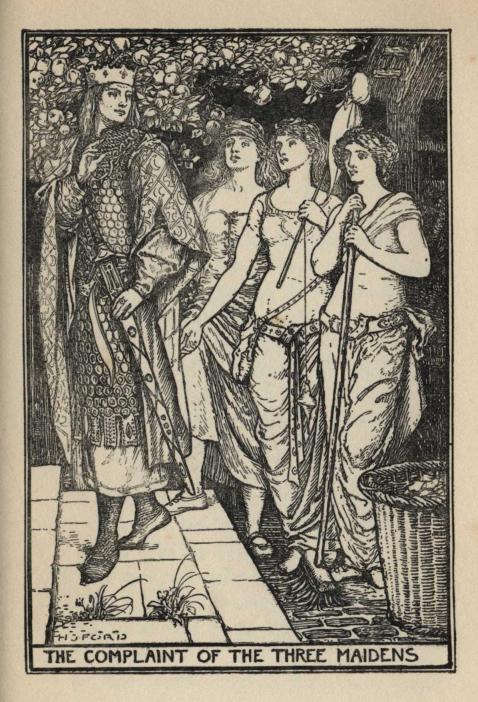
THE COMPLAINT OF THE THREE MAIDENS
Everything in the house was beautifully clean and tidy, and a cheerful honest-looking old woman was sitting by the fire.
'Good morning, mother,' said the Prince.
'May Luck be with you, my son. What brings you into these parts?'
'I am looking for Lucky Luck,' replied the Prince.
'Then you have come to the right place, my son, for I am his mother. He is not at home just now, he is out digging in the vineyard. Do you go too. Here are two spades. When you find him begin to dig, but don't speak a word to him. It is now eleven o'clock. When he sits down to eat his dinner sit beside him and eat with him. After dinner he will question you, and then tell him all your troubles freely. He will answer whatever you may ask.'
With that she showed him the way, and the Prince went and did just as she had told him. After dinner they lay down to rest.
All of a sudden Lucky Luck began to speak and said: 'Tell me, what sort of a man are you? for since you came here you have not spoken a word.'
'I am not dumb,' replied the young man, 'but I am that unhappy prince whose faithful servant has been turned to stone, and I want to know how to help him.'
'And you do well, for he deserves everything. Go back, and when you get home your wife will just have had a little boy. Take three drops of blood from the child's little finger, rub them on your servant's wrists with a blade of grass and he will return to life.'
'I have another thing to ask,' said the Prince, when he had thanked him. 'In the forest near here is a fine stream, but not a fish or other living creature in it. Why is this?'
'Because no one has ever been drowned in the stream. But take care, in crossing, to get as near the other side as you can before you say so, or you may be the first victim yourself.'
'Another question, please, before I go. On my way here I lodged one night in the house of three maidens. All were well-mannered, hard-working, and pretty, and yet none has had a wooer. Why was this?'
'Because they always throw out their sweepings in the face of the sun.'
'And why is it that a miller, who has a large mill with all the best machinery and gets plenty of corn to grind is so poor that he can hardly live from day to day?'
'Because the miller keeps everything for himself, and does not give to those who need it.'
The Prince wrote down the answers to his questions, took a friendly leave of Lucky Luck, and set off for home.
When he reached the stream it asked if he brought it any good news. 'When I get across I will tell you,' said he. So the stream parted; he walked through and on to the highest part of the bank. He stopped and shouted out:
'Listen, oh stream! Lucky Luck says you will never have any living creature in your waters until someone is drowned in you.'
The words were hardly out of his mouth when the stream swelled and overflowed till it reached the rock up which he had climbed, and dashed so far up it that the spray flew over him. But he clung on tight, and after failing to reach him three times the stream returned to its proper course. Then the Prince climbed down, dried himself in the sun, and set out on his march home.
He spent the night once more at the mill and gave the miller his answer, and by-and-by he told the three sisters not to throw out all their sweepings in the face of the sun.
The Prince had hardly arrived at home when some thieves tried to ford the stream with a fine horse they had stolen. When they were half-way across, the stream rose so suddenly that it swept them all away. From that time it became the best fishing stream in the countryside.
The miller, too, began to give alms and became a very good man, and in time grew so rich that he hardly knew how much he had.
And the three sisters, now that they no longer insulted the sun, had each a wooer within a week.
When the Prince got home he found that his wife had just got a fine little boy. He did not lose a moment in pricking the baby's finger till the blood ran, and he brushed it on the wrists of the stone figure, which shuddered all over and split with a loud noise in seven parts and there was the faithful servant alive and well.
When the old King saw this he foamed with rage, stared wildly about, flung himself on the ground and died.
The servant stayed on with his royal master and served him faithfully all the rest of his life; and, if neither of them is dead, he is serving him still.
TO YOUR GOOD HEALTH!
Long, long ago there lived a King who was such a mighty monarch that whenever he sneezed everyone in the whole country had to say 'To your good health!' Everyone said it except the shepherd with the staring eyes, and he would not say it.
The King heard of this and was very angry, and sent for the shepherd to appear before him.
The shepherd came and stood before the throne, where the King sat looking very grand and powerful. But however grand or powerful he might be the shepherd did not feel a bit afraid of him.
'Say at once: "To my good health!"' cried the King.
'To my good health!' replied the shepherd.
'To mine--to mine, you rascal, you vagabond!' stormed the King.
'To mine, to mine, your Majesty,' was the answer.
'But to mine--to my own,' roared the King, and beat on his breast in a rage.
'Well, yes; to mine, of course, to my own,' cried the shepherd, and gently tapped his breast.
The King was beside himself with fury and did not know what to do, when the Lord Chamberlain interfered:
'Say at once--say this very moment: "To your health, your Majesty"; for if you don't say it you'll lose your life,' whispered he.
'No, I won't say it till I get the Princess for my wife,' was the shepherd's answer. Now the Princess was sitting on a little throne beside the King, her father, and she looked as sweet and lovely as a little golden dove. When she heard what the shepherd said she could not help laughing, for there is no denying the fact that this young shepherd with the staring eyes pleased her very much; indeed he pleased her better than any king's son she had yet seen.
But the King was not as pleasant as his daughter, and he gave orders to throw the shepherd into the white bear's pit.
The guards led him away and thrust him into the pit with the white bear, who had had nothing to eat for two days and was very hungry. The door of the pit was hardly closed when the bear rushed at the shepherd; but when it saw his eyes it was so frightened that it was ready to eat itself. It shrank away into a corner and gazed at him from there, and, in spite of being so famished, did not dare to touch him, but sucked its own paws from sheer hunger. The shepherd felt that if he once removed his eyes off the beast he was a dead man, and in order to keep himself awake he made songs and sang them, and so the night went by.
Next morning the Lord Chamberlain came to see the shepherd's bones, and was amazed to find him alive and well. He led him to the King, who fell into a furious passion, and said: 'Well, you have learned what it is to be very near death, and now will you say: "To my good health"?'
But the shepherd answered: 'I am not afraid of ten deaths! I will only say it if I may have the Princess for my wife.'
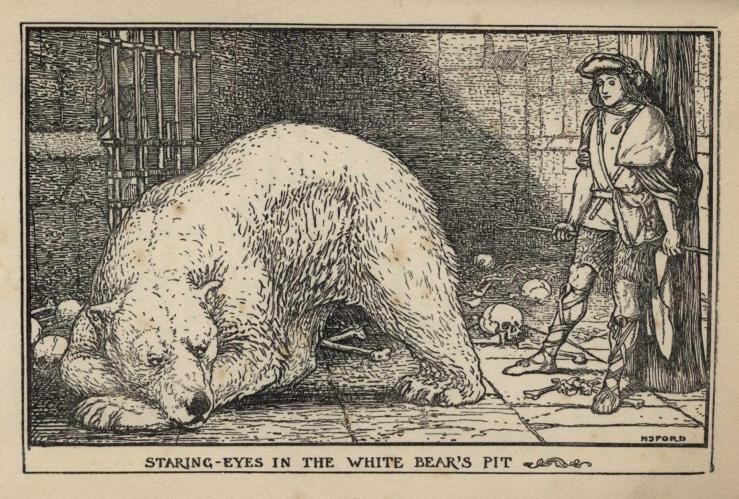
STARING-EYES IN THE WHITE BEAR'S PIT
'Then go to your death,' cried the King; and ordered him to be thrown into the den with the wild boars. The wild boars had not been fed for a week, and when the shepherd was thrust into their den they rushed at him to tear him to pieces. But the shepherd took a little flute out of the sleeve of his jacket and began to play a merry tune, on which the wild boars first of all shrank shyly away, and then got up on their hind legs and danced gaily. The shepherd would have given anything to be able to laugh, they looked so funny; but he dared not stop playing, for he knew well enough that the moment he stopped they would fall upon him and tear him to pieces. His eyes were of no use to him here, for he could not have stared ten wild boars in the face at once; so he kept on playing and the wild boars danced very slowly, as if in a minuet, then by degrees he played faster and faster till they could hardly twist and turn quickly enough and ended by all falling over each other in a heap, quite exhausted and out of breath.
Then the shepherd ventured to laugh at last; and he laughed so long and so loud that when the Lord Chamberlain came early in the morning, expecting to find only his bones, the tears were still running down his cheeks from laughter.
As soon as the King was dressed the shepherd was again brought before him; but he was more angry than ever to think the wild boars had not torn the man to bits, and he said: 'Well, you have learned what it feels to be near ten deaths, now say: "To my good health!"
But the shepherd broke in with, 'I do not fear a hundred deaths, and I will only say it if I may have the Princess for my wife.'
'Then go to a hundred deaths!' roared the King, and ordered the shepherd to be thrown down the deep vault of scythes.
The guards dragged him away to a dark dungeon, in the middle of which was a deep well with sharp scythes all round it. At the bottom of the well was a little light by which one could see if anyone was thrown in whether he had fallen to the bottom.
When the shepherd was dragged to the dungeon he begged the guards to leave him alone a little while that he might look down in the pit of scythes; perhaps he might after all make up his mind to say 'To your good health' to the King. So the guards left him alone and he stuck up his long stick near the well, hung his cloak round the stick and put his hat on the top. He also hung his knapsack up inside the cloak so that it might seem to have somebody within it. When this was done he called out to the guards and said that he had considered the matter, but after all he could not make up his mind to say what the King wished. The guards came in, threw the hat and cloak, knapsack and stick all down the well together, watched to see how they put out the light at the bottom and came away, thinking that now there really was an end of the shepherd. But he had hidden in a dark corner and was laughing to himself all the time.
Quite early next morning came the Lord Chamberlain, carrying a lamp, and he nearly fell backwards with surprise when he saw the shepherd alive and well. He brought him to the King, whose fury was greater than ever, but who cried:
'Well, now you have been near a hundred deaths; will you say: "To your good health"?'
But the shepherd only gave the same answer:
'I won't say it till the Princess is my wife.'
'Perhaps after all you may do it for less,' said the King, who saw that there was no chance of making away with the shepherd; and he ordered the state coach to be got ready, then he made the shepherd get in with him and sit beside him, and ordered the coachman to drive to the silver wood. When they reached it he said: 'Do you see this silver wood? Well, if you will say, "To your good health," I will give it to you.'
The shepherd turned hot and cold by turns, but he still persisted:
'I will not say it till the Princess is my wife.'
The King was much vexed; he drove further on till they came to a splendid castle, all of gold, and then he said:
'Do you see this golden castle? Well, I will give you that too, the silver wood and the golden castle, if only you will say that one thing to me: "To your good health."'
The shepherd gaped and wondered and was quite dazzled, but he still said:
'No; I will not say it till I have the Princess for my wife.'
This time the King was overwhelmed with grief, and gave orders to drive on to the diamond pond, and there he tried once more.
'Do you see this diamond pond? I will give you that too, the silver wood and the golden castle and the diamond pond. You shall have them all--all--if you will but say: "To your good health!"'
The shepherd had to shut his staring eyes tight not to be dazzled with the brilliant pond, but still he said:
'No, no; I will not say it till I have the Princess for my wife.'
Then the King saw that all his efforts were useless, and that he might as well give in, so he said:
'Well, well, it's all the same to me--I will give you my daughter to wife; but, then, you really and truly must say to me: "To your good health."'
'Of course I'll say it; why should I not say it? It stands to reason that I shall say it then.'
At this the King was more delighted than anyone could have believed. He made it known all through the country that there were to be great rejoicings, as the Princess was going to be married. And everyone rejoiced to think that the Princess, who had refused so many royal suitors, should have ended by falling in love with the staring-eyed shepherd.
There was such a wedding as had never been seen. Everyone ate and drank and danced. Even the sick were feasted, and quite tiny new-born children had presents given them.
But the greatest merry-making was in the King's palace; there the best bands played and the best food was cooked; a crowd of people sat down to table, and all was fun and merrymaking.
And when the groomsman, according to custom, brought in the great boar's head on a big dish and placed it before the King so that he might carve it and give everyone a share, the savoury smell was so strong that the King began to sneeze with all his might.
'To your very good health!' cried the shepherd before anyone else, and the King was so delighted that he did not regret having given him his daughter.
In time, when the old King died, the shepherd succeeded him. He made a very good king and never expected his people to wish him well against their wills; but, all the same, everyone did wish him well, for they all loved him.
W. BRENDON AND SON, LIMITED, PLYMOUTH
End paper