Front matter (continued 4)
Reading edition
Continuing down the street, we found the empty old warehouses and rotting wharves among which Aldrich spent so many hours of his boyhood, and we took a picture of one old crumbling dock, which we felt sure must have been very like the one upon which the boys of the Rivermouth Centipedes fired a broadside from “Bailey’s Battery.” The old abandoned guns, twelve in all, were cleaned out, loaded, provided with fuses, and set off mysteriously at midnight, much to the astonishment of the Rivermouthians, who thought the town was being bombarded or that the end of the world had come. The old wharf possessed a singular fascination for me because I still recall how vividly the incident impressed me in my boyhood and how fervently I envied Tom Bailey his unusual opportunities. Nor did it mar my enjoyment in the least to learn that the wharf I was looking at was not the right place, the real one, where the guns were stored, having been removed some time ago. It was near the Point of Graves, the spot where the boys went in bathing and where Binny Wallace’s body was washed ashore after the ill-fated cruise of the Dolphin. The real Binny, by the way, was not drowned at all. The author, here, deviated from the facts to make his story more dramatic.
Point of Graves takes its name from the old burying-ground, occupying a triangular space near the river’s edge. It has quaint old tombstones dating back as far as 1682, with curious epitaphs, skulls, and cherubs carved upon them. Here is the place where Tom Bailey, disappointed in love and determined to become “a blighted being,” used to lie in the long grass, speculating on “the advantages and disadvantages of being a cherub”—the disadvantages being that the cherub, having only a head and wings, could not sit down when he was tired and could not possess trousers pockets!
A stroll through this part of the town, which in olden times was the center of its trade and commerce, is like walking through some of the old English villages. Every house, nearly, has its history, and I fancy the streets have not greatly changed their appearance since the days of Aldrich’s boyhood.
On the corner of Fleet and State Streets we came to an old house, which has an interesting connection with our story. A part of it was occupied as a candy store for nearly sixty years. On the Fourth of July, after Tom had treated the boys to root-beer, a single glass of which “insured an uninterrupted pain for twenty-four hours,” they came here for ice-cream. It is said that one of the ringleaders subsequently celebrated every third of July, until his death, by eating ice-cream in the same room. The story was based upon an incident that really happened in 1847, in which, of course, Aldrich could have had no part, as he was not then living in Portsmouth. I am inclined to doubt whether the real event was half so delightful as the tale which Aldrich tells, of the twelve sixpenny ice-creams, “strawberry and verneller mixed,” and how poor Tom was left to pay for the whole crowd, who slipped out of the window while he was in another room ordering more cream!
No doubt we might have coupled many other places in Portsmouth with “The Story of a Bad Boy”—for it is a very real story, though not to be taken literally in every detail. It is interesting to think of the town, also, as the scene of “Prudence Palfrey.” The old Bell Tavern, where Mr. Dillingham boarded, ceased to exist as a public house in 1852 and was destroyed by fire fifteen years later. It is pleasant also to follow Aldrich in a walk through the streets, with a copy of “An Old Town by the Sea” for a guide, and note all the fine old houses he so charmingly describes.
But we must not devote our entire time to Aldrich, for an older poet has a slight claim to our attention. The opening scene of Longfellow’s “Lady Wentworth,” in the “Tales of a Wayside Inn,” is laid in State Street.
“One hundred years ago and something more, In Queen Street, Portsmouth, at her tavern door,”—
is the way the poem opens. Queen Street was the old name for State Street, and the tavern was the old Earl of Halifax before Master Stavers carried the sign over to the new house in Court Street. It has long since disappeared. It was before this house that the barefooted and ragged little beauty, Martha Hilton, was rebuked by Dame Stavers for appearing on the street half-dressed and looking so shabby, to which she quickly replied:—
“No matter how I look: I yet shall ride In my own chariot, ma’am.”
The house to which she did drive in her own chariot, many a time in later days, as the wife of Governor Wentworth, is one of the most pleasantly situated of all the houses in Portsmouth. It is at Little Harbor, on one of the many peninsulas that jut out into the Piscataqua, below the town, and commands a fine view of the beautiful river and its many islands. The house is a large wooden building containing forty-five rooms, though originally it had fifty-two. Architecturally it is unattractive, external beauty of design having been sacrificed to utility.
“Within, unwonted splendors met the eye, Panels and floors of oak, and tapestry; Carved chimney pieces, where on brazen dogs Reveled and roared the Christmas fires of logs.”
The historic building, with its great Chamber where the Governor and his Council met for their deliberations, still remains in almost its original state.
One could spend many days in Portsmouth investigating its connection with the history of the country, from the early explorations in 1603 of Martin Pring and the visit in 1614 of Captain John Smith, down through the settlements of David Thomson and Captain John Mason, the Indian wars and massacres, the incidents of the Revolution, and the rise and fall of the town’s commerce, and find plenty of old landmarks to give zest to the pursuit. But our search, at present, is for literary landmarks. We, therefore, take passage on the little steamer that plies to and from the Isles of Shoals for a pilgrimage to the Island Garden of Celia Thaxter.
IV THE ISLES OF SHOALS
It is a pleasant sail down the Piscataqua, past the old “slumberous” wharves, where “the sunshine seems to lie a foot deep in the planks”; past the long bridges; the numerous clusters of islands; the white sails of the yacht club, hovering like gulls about the huge battleships, moored to the docks of the navy yard; the ruins of Fort Constitution, formerly Fort William and Mary, famed in history, but more interesting to us as the place where Prudence Palfrey came near surrendering her heart to the infamous Dillingham; the ancient town of Newcastle with its old-fashioned dwellings mingling with pretty new summer cottages, the whole dominated by the white walls of a huge hotel; Kittery Point, birthplace of Sir William Pepperell, the famous Governor and Indian fighter: and at last, the broad Atlantic, stretching to the eastward with nothing to obstruct the view save a few tiny specks, dimly visible in the distance. These are the Isles of Shoals, looking so small that they seem to be only rocks jutting a few feet above the sea, upon which it would be impossible to land.
As we approach Appledore, the islands still seem to be only a cluster of barren rocks, with a few scattered buildings. The charm which they undoubtedly exert upon those who come year after year does not immediately manifest itself to the stranger. He must spend a night there, breathing the pure sea air, watching in the early evening the glistening lights on the far-off shore, and finally falling asleep to dream that he is in mid-ocean, on one of the steadiest of steamers, enjoying the luxury of absolute rest, for which there is no better prescription than an ocean voyage. In the morning, he must walk around the island—it can be done in an hour or two—threading the narrow paths through the huckleberry bushes and picking his way over the high rocks that present their front to the full force of the waves, on the side of Appledore that faces the sea. Here he will see artists spreading their easels and canvases for a day’s work and less busy people settling down in various shady nooks, to read, to chat, to knit, to dream.
To get the real spirit of the islands it is advisable to find one of these quiet nooks and read Celia Thaxter’s “Among the Isles of Shoals,” a book of sketches for which the author needlessly apologizes, but of which Mrs. Annie Fields says, “She portrays, in a prose which for beauty and wealth of diction has few rivals, the unfolding of sky and sea and solitude and untrammeled freedom, such as have been almost unknown to civilized humanity in any age of the world.” Celia Thaxter is herself the Spirit of the Isles of Shoals, and if we are to know and love them, we must take her as our guide. She will be found an efficient one and there is no other.
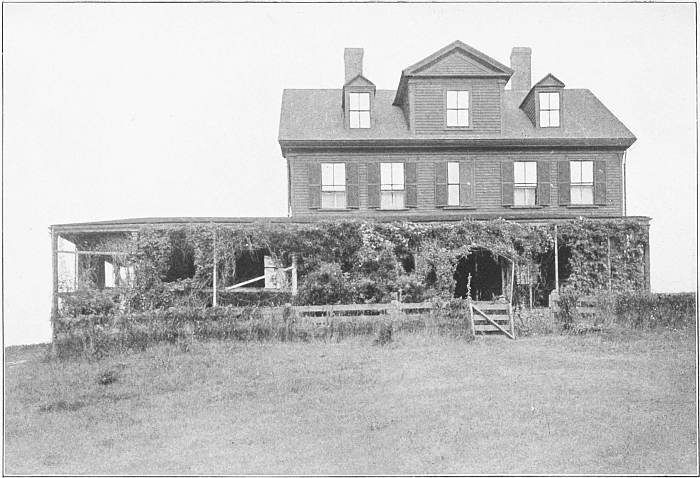
CELIA THAXTER’S COTTAGE
With this purpose in mind, we began our tour of the islands, book in hand, stopping first at the cottage of Mrs. Thaxter. One room is maintained somewhat as she left it, with every square foot of wall space covered by her pictures. But the flower-garden is sadly neglected. Only the vines that still clamber over the porch, and a few hollyhocks that stubbornly refuse to die, remain to suggest the dooryard where the garden flowers used to “fairly run mad with color.” The salt air and some peculiar richness of the soil seem to impart unusual brilliancy to the blossoms and strength to the roots of all kinds of flowers, whether wild or cultivated. Celia Thaxter was one of those people for whom flowers will grow. They responded with blushing enthusiasm to the constant manifestations of her love and tender care. Flowers have a great deal of humanity about them after all. They refuse to display their real luxuriance for cold, careless, or indifferent people, just as babies and dogs know how to distinguish between those who love them and those who love only themselves.
“More dear to me than words can tell Was every cup and spray and leaf; Too perfect for a life so brief Seemed every star and bud and bell.”
Celia Thaxter loved her flowers with a devotion born of the hours of solitude when they were her sole companions. “The little spot of earth on which they grow is like a mass of jewels. Who shall describe the pansies, richly streaked with burning gold; the dark velvet coreopsis and the nasturtiums; the larkspurs, blue and brilliant as lapis-lazuli; the ‘ardent marigolds’ that flame like mimic suns? The sweet peas are of a deep, bright rose-color, and their odor is like rich wine, too sweet almost to be borne, except when the pure fragrance of mignonette is added,—such mignonette as never grows on shore. Why should the poppies blaze in such imperial scarlet? What quality is hidden in this thin soil, which so transfigures all the familiar flowers with fresh beauty?”
Unfortunately, the mysterious quality hidden in the soil, assisted by the warm sunshine and the salt air, with all their powers could not maintain the island garden after the loving hands of its owner were withdrawn, and the little inclosure is now a mass of weeds.
Celia Laighton was brought to the Isles of Shoals as a child of five, and lived with her parents in a little cottage on White Island where her father was the keeper of the lighthouse. She grew to womanhood in the companionship of the rocks, the spray of the ocean, the seaweeds, the shells and the miniature wild life she discovered among them, the tiny wild flowers which her sharp young eyes could find in the most secret crannies, and the marigolds, “rich in color as barbaric gold,” which she early learned to cultivate in “a scrap of garden literally not more than a yard square.” She shouted a friendly greeting to the noisy gulls and kittiwakes that fluttered overhead, chased the sandpipers along the gravelly beach, made friends and neighbors of the crabs, the sea-spiders and land-spiders, the sea-urchins, the grasshoppers and crickets, and set in motion armies of sandhoppers, that jumped away like tiny kangaroos when she lifted the stranded seaweed. And then the birds came to see her. The swallows gathered fearlessly upon the window-sills and built their nests in the eaves, seeming to know that the loving eyes watching their movements could mean no evil. Now and then a bobolink, an oriole, or a scarlet tanager would be seen. The song sparrows came in flocks to be fed every morning. With them, at times, came robins and blackbirds, and occasionally yellowbirds and kingbirds. Sometimes, in hazy weather, they would fly against the glass of the lighthouse with fatal results. “Many a May morning,” says Mrs. Thaxter, “have I wandered about the rock at the foot of the tower mourning over a little apron brimful of sparrows, swallows, thrushes, robins, fire-winged blackbirds, many-colored yellowbirds, nuthatches, catbirds, even the purple finch and scarlet tanager and golden oriole, and many more beside—enough to break the heart of a small child to think of.”
It is no wonder that such a sympathetic soul could even summon the birds to keep her company—as she frequently did with the loons. “I learned to imitate their different cries; they are wonderful! At one time the loon language was so familiar that I could almost always summon a considerable flock by going down to the water and assuming the neighborly and conversational tone which they generally use: after calling a few minutes, first a far-off voice responded, then other voices answered him, and when this was kept up a while, half a dozen birds would come sailing in. It was the most delightful little party imaginable; so comical were they that it was impossible not to laugh aloud.”
To her love of birds and flowers, Mrs. Thaxter added a love of the sea itself, finding delight equally in the sparkle of the calm waves of summer or the wild beating of the surf in winter. She developed a marvelous ear for the music of the sea—something akin to that which enables John Burroughs to name a bird correctly from its notes, even when the songster is trying to imitate the call of another bird as the little impostors sometimes do. She says: “Who shall describe that wonderful voice of the sea among the rocks, to me the most suggestive of all the sounds in nature? Each island, every isolated rock, has its own peculiar note, and ears made delicate by listening, in great and frequent peril, can distinguish the bearings of each in a dense fog.”
Equally well did she know humanity. The daily life of the fishermen, the kind and quantity of the fish they caught, the adventures they experienced, the stories they told, the hardships they endured, the little domestic tragedies that now and then took place in their humble cottages, the sufferings from illness or accident, were all matters of everyday knowledge to her and enlisted her profound sympathy.
Everything in nature appealed to her—the sea and sky, the sunrise and the sunset, the winds and storms, the birds and flowers, the butterflies and insects, the sea-shells and kelp, the fishes and all the lower forms of life—all were objects of careful observation in which she took delight; and to these must be added a deep interest in humanity, particularly of the kind which she met in fishermen’s cottages, where her good common sense and knowledge of simple remedies enabled her to render, again and again, a service in time of need when no other assistance could be obtained.
Such was the unique character whose spirit dominates the islands even to-day,—a lover of nature worthy to stand with Gilbert White, Thoreau, or Burroughs, a poet, an artist, a friendly neighbor, and a womanly woman.
It was a part of our good fortune to have the actual guidance in our tour of the islands of the only surviving brother of Mrs. Thaxter, Mr. Oscar Laighton. In his little motor boat he took us to the tiny island known as Londoners, where for many winters he was the sole inhabitant. Although advancing years have now made it inexpedient for him to live in solitude, the little cottage still remains ready for occupancy at any moment. We stepped inside expecting to see, in so desolate a spot, only such rude furnishings as might be found in some mountain cabin or hunter’s lodge. To our astonishment we found it a veritable little bower, a model of neatness and order, and every room, including the kitchen, filled with well-chosen pictures and books, as though some dainty fairy, of literary tastes, had planned it for her permanent abode. Among the highly prized ornaments were many pieces of china, painted by Mrs. Thaxter. To our minds, the most valuable article in the house—valuable because of the lesson it teaches—is a typewritten card, hanging conspicuously over the kitchen stove, with this cordial greeting to the uninvited guest:—
“Welcome to any one entering this house in shipwreck or trouble. You will find matches in the box on the mantel. The key to the wood-house is in this box. Start a fire in the stove and make yourself comfortable. There are some cans of food on shelf in the pantry. Blankets will be found in the chamber on lower floor. There is a dory ready to launch in the boat-house.”
Three times have shipwrecked men entered the house and taken advantage of this kindly welcome.
Our next visit was to White Island, where, after much difficulty in getting ashore, we climbed to the top of the lighthouse. This is a very different structure from the old wooden building of Celia Thaxter’s childhood and only a small part of the original dwelling remains. But the landing is very much as she describes it. “Two long and very solid timbers about three feet apart are laid from the boat-house to low-water mark, and between those timbers the boat’s bow must be accurately steered.... Safely lodged in the slip, as it is called, she is drawn up into the boat-house by a capstan, and fastened securely.” Our boat was not drawn up, and we had to walk up the steep, slippery planks—with what success I shall not attempt to describe. Here, at night, the little Celia used to sit, with a lantern at her feet, waiting in the darkness, without fear, for the arrival of her father’s boat, knowing that the “little star was watched for, and that the safety of the boat depended in a great measure upon it.”
Haley’s Island, or “Smutty Nose,” as it was long ago dubbed by the sailors because of its long projecting point of black rocks, lies between Appledore and Star Island. Of the two houses now remaining, one is the original cottage of Samuel Haley, an energetic and useful citizen, who once owned the island. Nearby fourteen rude and neglected graves tell a pathetic tale. The Spanish ship Sagunto was wrecked on Smutty Nose, during a severe snowstorm on a January night. The shipwrecked sailors saw the light in Haley’s cottage and crept toward it, benumbed with cold and overcome with the horror and fatigue of their experience. Two reached the stone wall in front of the house, but were too weak to climb over, and their bodies were discovered the next morning, frozen to the stones. Twelve other bodies were found scattered about the island. How gladly the old man would have given these poor sailors the warmth and comfort of his home could he have known the tragedy that was happening while he slept soundly only a few yards away!
Star Island, once the site of the village of Gosport, was in early days the most important of the group. Before the Revolution a settlement of from three to six hundred people carried on the fisheries of the island, catching yearly three or four thousand quintals of fish. All this business is now a thing of the past. The great shoals of mackerel and herring, from which the islands took their name, have disappeared—driven away or killed by the steam trawlers. The old families departed long since, and new ones have never come to take their places, save a few lobster fishermen, who with difficulty eke out a bare living. A quaint little church of stone is perched upon the highest rocks of Star Island, but I fear the attendance is small, even in the summer time.
We found our way back to Appledore, content to spend the remaining days of our visit on this the largest and most inviting of the group.
“A common island, you will say; But stay a moment; only climb Up to the highest rock of the isle, Stand there alone for a little while, And with gentle approaches it grows sublime, Dilating slowly as you win A sense from the silence to take it in.”
Lowell was right. The greatest charm of the islands is felt when you stand on “the highest rock of the isle,” looking out upon the ever sparkling sea that stretches
“Eastward as far as the eye can see— Still Eastward, eastward, endlessly”;
and feeling the restful quietude of the spot. I fancy Celia Thaxter stood upon this rock when she sang—
“O Earth! thy summer song of joy may soar Ringing to heaven in triumph. I but crave The sad, caressing murmur of the wave That breaks in tender music on the shore.”
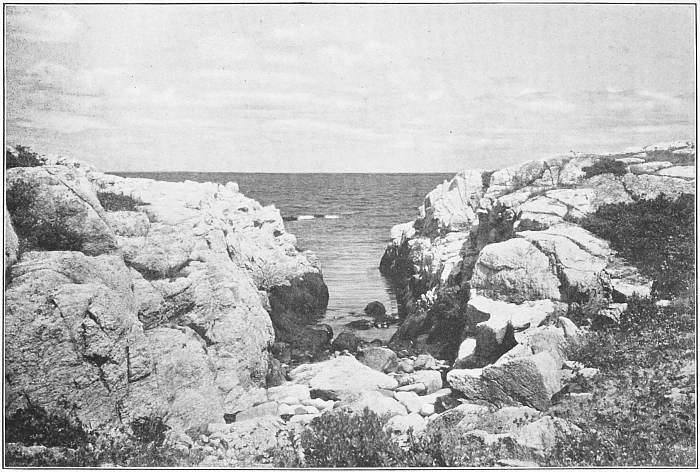
APPLEDORE
VIII A DAY WITH JOHN BURROUGHS
VIII A DAY WITH JOHN BURROUGHS
“Oh, everybody here calls him Uncle John,” was the quick reply to one of my queries of the man who drove me to the country house of John Burroughs, near Roxbury, New York. He had been saying many pleasant things about the distinguished naturalist, dwelling particularly upon his kind heart and genial nature. I noticed that he never referred to him as “Dr.” Burroughs, nor “Mr.” Burroughs, nor even as “Burroughs,” but always as “John” or “good old John,” or most often, “Uncle John.” So I asked by what name the people called him, and the answer seemed to me the most sincere compliment that could have been paid.
When a man has received many honorary degrees which the great universities have felt proud to confer, it is an indication that those most competent to judge have appreciated his intellectual attainments or public services, or both. When the people of his native village bestow upon him the title of “Uncle,” it is an indication that the achievement of fame has not eclipsed the lovable qualities in his character nor dimmed the affectionate regard of the neighbors who have learned to know him as a man. There is a certain friendliness implied in the title of “Uncle,” while it also suggests respect. If you live in a small town you call everybody by his first name. But one of your number becomes famous. To call him “John” seems too familiar. It implies that you do not properly appreciate his attainments. To call him “Mister” or “Doctor” seems to make a stranger of him, and you would not for the world admit that he is not still your friend. “Uncle” is often a happy compromise, particularly if he still retains the neighborly qualities of his less distinguished years.
I do not know that the people of Roxbury ever followed this line of reasoning, but it does seem quite appropriate that they should call their most distinguished fellow citizen “Uncle John.” He was born on a farm near this little village in the Catskills on the 3d of April, 1837, in the very time of the return of the birds. Perhaps this is why he is so fond of them and particularly of Robin Redbreast, that fine old-fashioned democrat, who is one of his prime favorites. He spent his boyhood here, and now, in the fullness of his years, quietly returns each summer to the old familiar haunts, living the same simple life as of yore, except that the pen is now his tool instead of the farming implements.
The little red schoolhouse, where Burroughs and Jay Gould went to school together, may still be seen in the valley, standing in the open country with one of those rounded hilltops in the background which form the characteristic feature of the Catskills. Near by is the Gould birthplace, now a comfortable-looking farmhouse, glistening with a fresh coat of white paint. “Take away the porch and the back extension, and the top story and the paint,” said my driver, “and you will have the original ‘birthplace.’” He said that when he first began the livery business in Roxbury many people came to see the birthplace of Jay Gould, but no one mentioned Burroughs. Now it is just the other way, and the number of visitors increases yearly, all anxious to see the home of the famous philosopher. Yet these two men, one of whom seems to have belonged to the generations of the past while the other is a part of the ever-living present, were boys together in the same schoolhouse more than sixty years ago.
As my conveyance drew up to the door, Mr. Burroughs came out with a hearty welcome. He was alone, for during the summer, when he retires to this place for work, he prefers to do his own housekeeping in his own way. “I am a good cook,” said he, “but a poor housekeeper.” I did not agree with the latter part of the statement, for as I looked around I thought he had about all he needed and everything was clean. Moreover, things were where he could get at them, and from a man’s point of view what better housekeeping could anybody want?
The house which he now occupies is a plain-looking farmhouse, built in 1869 by Mr. Burroughs’s elder brother. Its most distinctive feature is the rustic porch, a recent addition, which serves the purposes of living-room, library, and bedroom. Mr. Burroughs is a believer in fresh air and during the summer likes to sleep out of doors. He has a rustic table, covered with favorite books. When he is not at work, he likes to sit on the porch and enjoy what he calls “the peace of the hills.” Across the road there is a field, broad and long and crossed by numerous stone walls. In the distance are the hills of his well-loved Catskills, their smoothly undulating lines giving a sense of repose. At the right of the house I noticed a small patch of green corn, in front of which were some rambling cucumber vines. In the rear and at the left were a few old apple trees, and farther back, capping the summit of a ridge, a fine grove of trees, standing in orderly array, like an army ready for action. Mr. Burroughs has named the place, in characteristic fashion, “Woodchuck Lodge,” “because,” he said, “I can sit here and count the woodchucks, sometimes eight or ten at a time.”
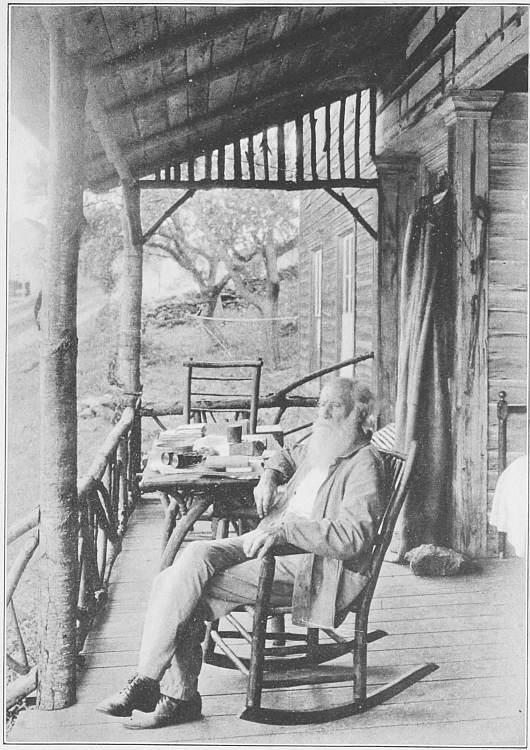
JOHN BURROUGHS AT WOODCHUCK LODGE
Not wishing to interfere with his plans, I expressed the hope that I was not interrupting him, when he quickly replied, “O, my work for to-day is all done. I rise at six and usually do all my writing before noon.” “You are like Sir Walter Scott, then,” said I, “who always began early and, as he said, ‘broke the neck of the day’s work’ before the family came down to breakfast and was ‘his own man before noon.’” “Ah, he was a wonderful man,” replied Mr. Burroughs. Then, after a pause and with a little sigh—“I wish I could invest these hills with romance as he did the hills of Scotland.” “But you have invested them with romance,” I said, “although of a different kind.” “Yes,” he replied, with brightening eyes, “with the romance of humanity and of nature, the only kind to which they are entitled.”
I could not help thinking how wonderfully like Wordsworth this seemed. The romance of humanity and nature! Is it not this, which, since Wordsworth’s time, has given a new charm to the hills and valleys of Westmoreland and Cumberland, causing every visitor to seek the dwelling-places of the poet? And are not those who spend their summers in the Catskills finding a new delight in those beautiful mountains because of the spell which John Burroughs has thrown upon them?
Wordsworth wrote the history of his own mind and called it “The Prelude,” intending it to be but the introduction to a greater poem to be entitled “The Recluse,” which should be a broad presentation of his views on Man, Nature, and Society. “The Excursion” was to be the second part, but the third was never written. He conceived that this great work would be like a Gothic church, the main body of which would be represented by “The Recluse,” while “The Prelude” would be but the ante-chapel. All his other poems, when properly arranged, would then be “likened to the little cells, oratories, and sepulchral recesses, ordinarily included in those edifices.”
Burroughs is far too modest to compare his writings to a cathedral, but he has nevertheless, like Wordsworth, written himself into nearly all of them. Following the English poet’s simile in a modified form, we may think of the product of his pen, not as a cathedral, but as a mansion of many rooms, each furnished with beautiful simplicity and charming taste to represent some different phase of the author’s mind, and each equipped, so to speak, with a mirror, possessing all the magic but without the unpleasant duty of the one in Hawthorne’s tale, so arranged as to reflect the very soul of its builder with perfect fidelity.
So sincere is Burroughs that you feel certain he is constantly revealing his true self. Therefore, when he praises Wordsworth as the English poet who has touched him more closely than any other, you begin to realize the bond of sympathy. When he says that Wordsworth’s poetry has the character of “a message, special and personal to a comparatively small circle of readers,” you know that he is one of the few who have taken the message to heart.
Wordsworth’s love of Nature was of the same kind as the American poet’s. “Nature,” says Burroughs, “is not to be praised or patronized. You cannot go to her and describe her; she must speak through your heart. The woods and fields must melt into your mind, dissolved by your love for them. Did they not melt into Wordsworth’s mind? They colored all his thoughts; the solitude of those green, rocky Westmoreland fells broods over every page. He does not tell us how beautiful he finds Nature, and how much he enjoys her; he makes us share his enjoyment.” Substitute Burroughs for Wordsworth, and Catskill for Westmoreland, and you have in this passage a fine statement of the reason why John Burroughs is winning the gratitude of more and more people every year.
Wordsworth thought of Nature as an all-pervading Presence, something mysterious and sublime, a supreme Being,—
“The anchor of my purest thoughts, the nurse, The guide, the guardian of my heart, and soul Of all my moral being.”
Burroughs does not rise to such ethereal heights, but recognizes that the passion for Nature is “a form of, or closely related to, our religious instincts.” He lives closer to Nature than Wordsworth ever did. His knowledge of her secrets is far deeper and more intimate. He is a naturalist and scientist, as well as a man of poetic temperament. He has a trained eye that sees what others would miss. “There is a great deal of byplay going on in the life of Nature about us,” he says, “a great deal of variation and outcropping of individual traits, that we entirely miss unless we have our eyes and ears open.”
Probably no other man has a keener ear for the music of the birds. He possesses that “special gift of grace,” to use his own expression, that enables one to hear the bird-songs. Not only can he distinguish the various species by their songs, but he instantly recognizes a new note. He once detected a robin, singing with great spirit and accuracy the song of the brown thrasher, and on another occasion followed a thrush for a long time because he recognized three or four notes of a popular air which the bird had probably learned from some whistling shepherd boy. He loves to put words into the mouths of the birds to fit their songs and to fancy conversations between husband and wife upon their nest. The sensitiveness of his ear for bird-music is wonderfully illustrated in his story of a new song which he heard on Slide Mountain in the Catskills. “The moment I heard it, I said, ‘There is a new bird, a new thrush,’ for the quality of all the thrush songs is the same. A moment more and I knew it was Bicknell’s thrush. The song is in a minor key, finer, more attenuated, and more under the breath than that of any other thrush. It seemed as if the bird was blowing into a delicate, slender, golden tube, so fine and yet so flute-like and resonant the song appeared. At times it was like a musical whisper of great sweetness and power.” I do not believe that Wordsworth or any other poet, however passionate his love of Nature, ever heard such a bird-song or could describe its qualities with so keen a discernment.
Mr. Burroughs made me think of Wordsworth again when, as we sat looking over toward the Catskills, he explained his residence at Woodchuck Lodge by referring to his enjoyment of the open country and the peace and quiet of the scene. For, says Wordsworth,—
“What want we? Have we not perpetual streams, Warm woods, and sunny hills, and fresh green fields And mountains not less green, and flocks and herds And thickets full of songsters, and the voice Of lordly birds, an unexpected sound Heard now and then from morn to latest eve, Admonishing the man who walks below Of solitude and silence in the sky?”
After an hour of pleasant conversation my host arose, saying he would build his fire and we would have our dinner. In due course we sat down to a repast that would have gladdened the heart of General Grant himself. The old veteran, as many will remember, after his return from a tour of triumph around the world, in which he had been banqueted by kings and emperors, dukes, millionaires, and public societies, once slipped into a farmer’s kitchen for a dinner of corned beef and cabbage, declaring that he was glad to get something good to eat. Our meal did not consist of corned beef and cabbage, but of corn cakes, made of fresh green corn plucked not a couple of yards from the kitchen door and baked on a griddle by one of the foremost literary men of America. There were other good things, plenty of them, but those delicious cakes with maple syrup of the genuine kind exactly “touched the spot,” as old-fashioned folks used to say. Mine host must have noticed the unusual demands upon his crop of corn and marveled to see the rapid disappearance of the cakes, but he did not seem displeased. On the contrary, as he brought in, time after time, a fresh pile of the steaming flapjacks, his face beamed with the smile that betokens genuine hospitality. Our conversation at table was mostly on politics, in which Mr. Burroughs takes keen interest and upon which he is a man of decided convictions; but this is a subject which he must be allowed to elucidate in his own way.
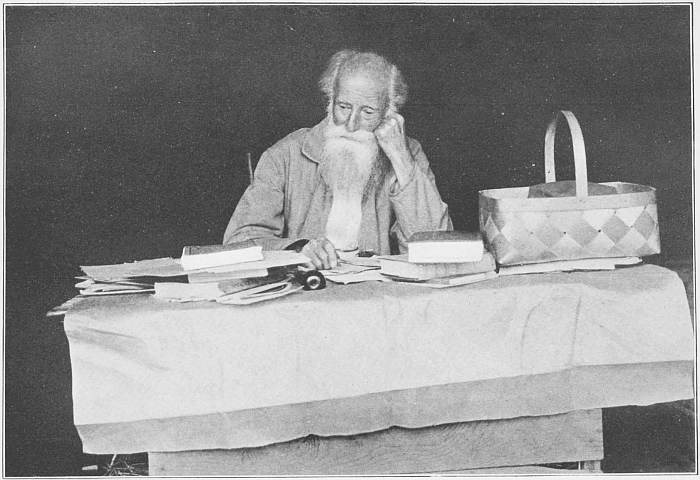
JOHN BURROUGHS AT WORK
After dinner, Mr. Burroughs laughingly remarked that his study was the barn, and we walked up the road to visit it. “I cannot bear to be cramped by the four walls of a room,” said he, “so I have moved out to the barn. I enjoy it greatly. The birds and the small animals come to see me every day and often sit and talk with me. The woodchucks and chipmunks, the blue jays and the hawks, all look in at me while I am at work. A red squirrel often squats on the stone wall and scolds me, and the other day an old gray rabbit came. He sat there twisting his nose like this” (here Mr. Burroughs twisted his own nose in comical fashion), “and seemed to be saying saying—
‘By the pricking of my thumbs Something wicked this way comes.’”
Arrived at the barn, Mr. Burroughs seated himself at his “desk.” With twinkling eyes he explained that it was an old hen-coop. The inside was stuffed with hay to keep his feet warm, and if the weather happens to be chilly, he wears a blanket over his shoulders. A market-basket contains his manuscript and a few books complete the equipment. The desk is just inside the wide-open doors of the barn, and he sits with his face to the light. “There is a broad outlook from a barn door,” said he, smilingly.
Beyond the low stone wall, where his animal friends seat themselves for the daily conversations, is an apple orchard, and in the distance are the rounded summits of the Catskills—a view as peaceful and refreshing as the one from the house. Here Mr. Burroughs is never lonely. One day a junco, or slate-colored snowbird, came on a tour of inspection. She decided to build her nest in the hay. She scorned all the materials so close at hand and brought everything from outside. Her instinct had taught her to find certain materials for a nest, and she could not suddenly learn to make use of the convenient hay. Mr. Burroughs, in speaking of this, told me of a phœbe who built her nest over the window of his house. She brought moss to conceal it, but as the moss did not match the color of the house, she succeeded only in making her nest more conspicuous. Since the evolution of the species, phœbes have built their nests on the sides of cliffs, using moss of the color of the rocks to conceal them. The little bird who, like the junco, followed her instincts, failed to note the difference between the house and the rocks.
In conversation of this kind, Mr. Burroughs turned the hours into minutes, and I was surprised to look up and see the team approaching which was to carry me away. After a reluctant farewell, we drove over the brow of a hill and stopped for a few moments before the farmhouse which was the birthplace of John Burroughs. A comical incident took place. It was raining hard when we arrived and we drove into the barn, directly across the road from the house. An old dog and a young one were here, keeping themselves dry from the shower. I set up my camera in the barn, to take a picture of the house. As I did so, I noticed the old dog walk deliberately out in the rain and perch himself upon the doorstep, where he turned around once or twice as if trying to strike the right attitude. This point determined, he stood perfectly still until I had taken the picture, and when I started to put away the camera, came trotting back to the barn. I do not know what instinct, if any, prompted the dog to wish his picture to be taken, but he was no more foolish than many people,—men, women, and children,—who have insisted upon getting into my pictures, though they knew there was no possibility of their ever seeing them.
Mr. Burrough’s permanent home is at West Park, on the Hudson River, a few miles south of Kingston. Here he has a farm mostly devoted to the cultivation of grapes. He occupies a comfortable stone house, pleasantly situated and nearly surrounded by trees of various kinds. Back of the house and near the river is the study or den, a little rustic building on the slope of the hill, where Mr. Burroughs can write undisturbed by the business of the farm. The walls are partly lined with bookshelves, well crowded with favorite volumes. Near by is a small rustic summer house from which a delightful view of the river may be seen for miles to the north and to the south. This is why the place is called “Riverby”—simply “by-the-river.” It has been the author’s home for many years.
Even the study, however, did not satisfy Mr. Burroughs’s longing for quiet, and so he built another retreat about a mile and a half west of the village which he calls “Slabsides.” It is reached by walking up a hill and passing through a bit of hemlock woods which I found quite charming. Slabsides is a rustic house like many camps in the Adirondacks. It is roughly built, but sufficiently comfortable, and has a pleasant little porch, at the entrance to which a climbing vine gives a picturesque effect which is greatly enhanced by a stone chimney, now almost completely clothed with foliage. It is in an out-of-the-way hollow of the woods where nobody would be likely to come except for the express purpose of visiting Mr. Burroughs. For several summers this was his favorite retreat. He would walk over from his home at Riverby and stay perhaps two or three weeks at a time, doing his own cooking and housekeeping. Of late years, however, Slabsides has been less frequently used, Woodchuck Lodge having received the preference.
All of these abodes, whether you see them within or without, reveal the secret of John Burroughs’s strength. They coincide with his personal appearance, his dress, his conversation, his manner. It is the strength of absolute simplicity. Everything is sincere. Nothing is superfluous. There is no such thing as “putting on airs.” Fame and popularity have not spoiled him. He is genuine. You feel it when you see his workshops. You know it when you meet the man.
Mr. Charles Wagner, the apostle of “the simple life,” has said, “All the strength of the world and all true joy, everything that consoles, that feeds hope, or throws a ray of light along our dark paths, everything that makes us see across our poor lives a splendid goal and a boundless future, comes to us from people of simplicity, those who have made another object of their desires than the passing satisfaction and vanity, and have understood that the art of living is to know how to give one’s life.”
John Burroughs is one of these “people of simplicity,” and his contribution to our happiness lies in his rare power of bringing to his reader something of his own enjoyment of Nature—an enjoyment which he has been able to obtain only through the living of a simple life. He is the complete embodiment of Emerson’s “forest seer”:—
“Many haps fall in the field Seldom seen by wishful eyes; But all her shows did Nature yield, To please and win this pilgrim wise. He saw the partridge drum in the woods; He heard the woodcock’s evening hymn; He found the tawny thrushes’ broods; And the shy hawk did wait for him; What others did at distance hear, And guessed within the thicket’s gloom, Was shown to this philosopher And at his bidding seemed to come.”
IX GLIMPSES OF THE YELLOWSTONE
IX GLIMPSES OF THE YELLOWSTONE
The Yellowstone National Park is Nature’s jewel casket, in which she has kept her choicest gems for countless generations. Securely sheltered by ranges of rugged mountains they have long been safe from human depredations. The red man doubtless knew of them, but superstition came to the aid of Nature and held him awe-struck at a safe distance. The first white man who came within sight of these wonders a century ago could find no one to believe his tales, and for a generation or two the region of hot springs and boiling geysers which he described was sneeringly termed “Colter’s Hell.” Only within the last half-century have the generality of mankind been permitted to view these precious jewels, and even then jealous Nature, it would seem, did not consent to reveal her treasures until fully assured that they would have the protection of no less powerful a guardianship than that of the National Government.
On the 18th of September, 1870, a party of explorers, headed by General Henry D. Washburn, then Surveyor-General of Montana, emerged from the forest into an open plain and suddenly found themselves not one hundred yards away from a huge column of boiling water, from which great rolling clouds of snow-white vapor rose high into the air against the blue sky. It was “Old Faithful” in action. Then and there they resolved that this whole region of wonders should be made into a public park for the benefit of all the people, and renouncing any thought of securing the lands for personal gain, these broad-minded men used their influence to have the National Congress assume the permanent guardianship of the place. And now that protection is fully assured these jewels of Nature may be seen by you and me.
Those who have traveled much will tell you that Nature is prodigal of her riches, and, indeed, this would seem to be true to one who has spent a summer among the snow-clad peaks of the Alps, or dreamed away the days amid the blue lakes of northern Italy, or wandered about in the green forests of the Adirondacks, where every towering spruce, every fragrant balsam, every dainty wild flower and every mossy log is a thing of beauty. But these are Nature’s full-dress garments, just as the broad-spreading wheatfields of the Dakotas are her work-a-day clothes. Her “jewels” are safely locked up in places more difficult of access, where they may be seen by only a favored few; and one of these safe-deposit boxes, so to speak, is the Yellowstone National Park.
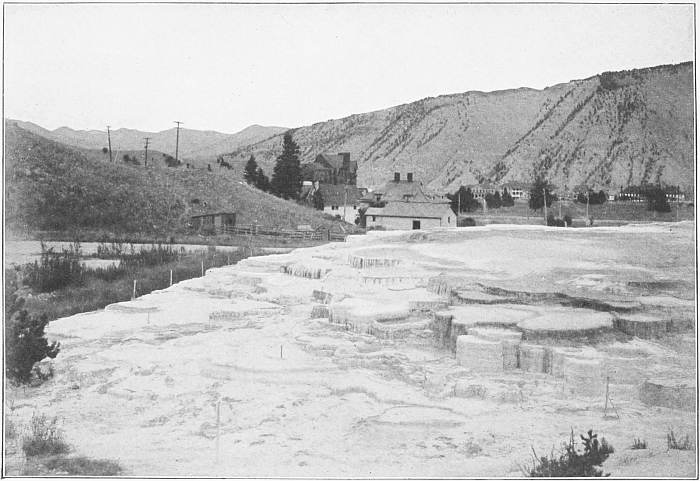
HYMEN TERRACE
The first collection of these natural gems is at Mammoth Hot Springs, and here my camera, as if by instinct, led me quickly to the daintiest in form and most delicate in colorings of them all, a beautiful formation known as Hymen Terrace. A series of steps, covering a circular area of perhaps one hundred feet in diameter, has been formed by the overflow of a hot spring. The terraces consist of a series of semicircular and irregular curves or scallops, like a combination of hundreds of richly carved pulpits, wrought in a soft, white substance resembling coral. Little pools of glistening water reflect the sunlight from the tops of the steps, while a gently flowing stream spreads imperceptibly over about one half the surface, sprinkling it with millions of diamonds as the altar of Hymen ought to be. The pools are greens and blues of many shades, varying with the depth of the water. The sides of the steps are pure white in the places where the water has ceased to flow, but beneath the thin stream they range in color from a rich cream to a deep brown, with all the intermediate shades harmoniously blended. From the highest pools, and especially from the largest one at the very summit of the mound, rise filmy veils of steam, softening the exquisite tints into a rich harmony of color against the azure of the sky.
The Terrace of Hymen is the most exquisite of the formations, but there are others much larger and more magnificent. Minerva Terrace gave me a foreground for a charming picture. Beyond its richly colored steps and sparkling pools were the splendid summits of the Gallatin Range towering more than ten thousand feet above the level of the sea and seeming, in the clear mountain air, to be much nearer than they really are. Hovering above their peaks were piles upon piles of foamy clouds, through which could be seen a background of the bluest of skies, while down below were the gray stone buildings with their bright red roofs that form the headquarters of the army guarding the park.
Jupiter Terrace, the most imposing of all these formations, extends a quarter of a mile along the edge of a brilliantly colored mound, rising about three hundred feet above the plain upon which Fort Yellowstone is built. Pulpit Terrace, on its eastern slope, reproduces upon a larger scale the rich carvings and exquisite tints of Hymen, though without the symmetry of structure. The springs at its summit are among the most strikingly beautiful of these unique formations which I like to call the “jewels” of Nature. Two large pools of steaming water lie side by side, apparently identical in structure, and separated only by a narrow ridge of lime. The one on the left is a clear turquoise blue, while its neighbor is distinctly Nile green. Surrounding these springs are several smaller pools, one a rich orange color, another light brown, and a third brown of a much darker hue. The edges of all are tinted in yellow, brown, and gold of varied shades. The pools are apparently all a part of the same spring or group of springs, and subject to the same conditions of light; yet I noticed at least five distinct colors in as many pools. The water itself is colorless and the different hues must be imparted by the colorings of the lime deposits, influenced by the varying depth and temperature of the water.
What is known as “the formation” of the Mammoth Hot Springs covers perhaps fifty or sixty acres on the slope of Terrace Mountain. It is a heavy deposit of lime or travertine, essentially the same as the stalagmites and stalactites which one sees in certain caverns. When dry it is white and soft like chalk. The colorings of the terraces are of vegetable origin, caused by a thin, velvety growth, botanically classed as algæ, which flourishes only in warm water. The heat of rocks far beneath the surface warms the water of the springs, which, passing through a bed of limestone, brings to the surface a deposit of pure calcium carbonate. Wherever the flow of water remains warm the algæ appear and tint the growing formation with as many shades of brown as there are varying temperatures of the water. When the water is diverted, as is likely to happen from one season to the next, the algæ die and the surfaces become a chalky white.
Leaving the Hot Springs, the road passes through the Golden Gate, where, on one side, a perpendicular wall of rock rises to a height of two hundred feet or more, and on the other are the wooded slopes and rocky summit of Bunsen Peak—a beautiful cañon, where the view suggests the greater glories of Swiss mountain scenery, but for that very reason is not to be mentioned here among the rare gems of the park. Nor shall I include the “Hoodoos,” which, though distinctly unusual, are far from beautiful. An area of many acres is covered with huge fragments of massive rocks, piled in disorderly confusion, as though some Cyclops, in a fit of ugly temper, had torn away the whole side of a mountain and scattered the pieces. Through these rocks project the whitened trunks of thousands of dead trees,—a sort of ghostly nightmare through which we were glad to pass as quickly as possible.
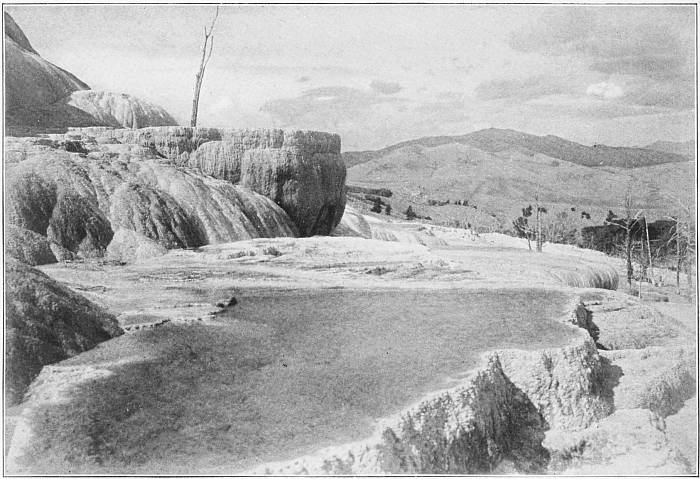
PULPIT TERRACE
We stopped for lunch at the Norris Geyser Basin, and here saw some miniature geysers, as a kind of preparation for the greater ones beyond. The “Constant,” true to its name, throws up a pretty little white fountain so often that it seems to prepare for a new eruption almost before the previous one has subsided. The “Minute Man” is always on duty and pops up his little spray of hot water, fifteen feet high, every minute or two. The “Monarch,” near by, is much larger, but not at all pretty. It throws up a stream of black, muddy water seventy-five to one hundred feet high about every forty minutes.
Some of these geysers are steady old fellows who have found their appointed task in life and have settled down to perform it with commendable regularity. The Norris Basin, however, seems to be the favorite playground of the youngsters,—a frisky lot of geysers of no fixed habits and a playful disposition to burst out in unexpected places. Such is the New Crater, which asserted itself with a great commotion in 1891, bursting forth with the violence of an earthquake. Another erratic young fellow is the “Fountain Geyser,” in the Lower Basin. In July, 1899, he was seized with a fit of the “sulks” and for three months refused to play at all. In October he decided to resume operations and behaved quite well for ten years, when he suddenly took a notion to abandon his crater for the apartments of his neighbor next door. Apparently the furnishings of his new abode did not suit him, for he began at once to throw them out with great violence, hurling huge masses of rock with volcanic force to a height of two hundred feet. Amid terrific rumblings and the hissing of escaping steam, this angry outburst continued for several days, and did not wholly cease for nearly two months. Since then the “Fountain” has settled down to the ordinary daily occupation of a self-respecting geyser. When I saw him he was as calm and serene as a summer’s day, and to all appearances had never been guilty of mischief, nor even exhibited a ruffled temper in all his life. Indeed, had I not known his history (inconceivable in one of the gentler sex), I should have personified this geyser in the feminine gender, because of his exquisite beauty. A great jewel seemed to be set into the surface of the earth. Its smooth upper face, about thirty feet in diameter, was level with the ground upon which we stood. Its color, at first glance, seemed to be a rich turquoise blue, but as we looked into the clear, transparent depths there seemed to be a hundred other shades of blue, all blending harmoniously. In the farthest corner, beneath a shelf or mound of geyserite, appeared the opening of a fathomless cave. All around its edges, and continuing in wavy lines of delicate tracery around the bottom of the bowl, were marvelous patterns of exquisite lacework, every angle seeming to catch and throw back its own particular ray of bluish light. There was not a ripple to disturb the surface, not a bubble to foretell the violent eruption which a few hours would bring forth, and only a thin film of vapor to suggest faintly the extraordinary character of this beautiful pool.
Only a few hundred feet away is another curious phenomenon in this region of surprises. It is a cauldron of boiling mud, measuring forty or fifty feet in diameter, known as the “Mammoth Paint Pots,” where a mass of clay is kept in a state of continuous commotion. Millions of bubbles rise to the surface and explode, sputtering like a thick mess of porridge kept at the boiling point. The color is a creamy white where the ebullition is greatest, but thick masses thrown up around the edges and allowed to cool have assumed a delicate shade of pink. A smaller but more beautiful formation of the same kind is seen near the Thumb Station on the Yellowstone Lake.
As we proceeded, Nature’s jewels seemed to increase in number and magnificence. Turquoise Spring, a sheet of water one hundred feet wide, has all the beauty of the Fountain Geyser in the latter’s quiet state, with an added reputation for tranquillity, for it is not a geyser at all. Near by is Prismatic Lake, about four hundred feet long and two hundred and fifty feet wide. Its center is a very deep blue, changing to green of varying shades, and finally, in the shallowest parts, to yellow, orange, and brown. It is a great spring from the center of which the water flows in delicate, wavy ringlets. The mineral deposits have formed countless scallops, like miniature terraces, a few inches high, sculpturing a wonderful pattern in hues of reds, purples, and browns, delicately imposed upon a background of gray. A thin veil of rising steam was carried away by the wind just enough to reveal the wonderful colorings to our eyes, while the sun added to the bewildering beauty of the spectacle by changing the vapor into a million prisms reflecting all the colors of the rainbow.
In this connection I must not fail to mention the Morning-Glory Spring, where the action of a geyser has carved out a deep bowl, twenty feet in diameter. It would seem as though Nature had sunk a gigantic morning-glory into the earth, leaving its rim flush with the surface and yet retaining, clearly visible beneath the smooth surface of the transparent water, all the delicate shades of the original flower.
The Sapphire Spring, not far away, is another of the little gems of the region. It is a small, pulsating spring, and the jewel itself is not less remarkable than its extraordinary setting, resembling coral. The constant flow of the waters from a center to all directions has caused the formation of a series of irregular concentric circles, broken into little knobs or mounds, from which the vicinity takes its name of the “Biscuit Basin.”
As we approached the Upper Geyser Region, the number and variety of these highly colored pools, hot springs, geysers, and strange formations increased steadily, until at last we stood in the presence of “Old Faithful,” the crown jewel of the collection, the Koh-i-noor of Nature’s casket.
A strong breeze from the north was blowing as I stood before the geyser for the first time, and for that reason, I decided to place my camera directly to the west. A small cloud of steam was rising, which seemed gradually to increase in volume. Then, as I watched, a small spray of water would shoot up occasionally above the rim of the crater. Then a puff of steam and another spray, breaking into globules as the wind carried it away. Then silence. Suddenly a large, full stream shot up a distance of twenty or thirty feet and fell back again, and the crater remained quiet for at least five minutes. Is that all? I thought. Does its boasted regularity only mean that while it plays once in sixty-five minutes, yet the height of some of the eruptions may be only trifling? I began to feel doubtful, not to say disappointed. The column of steam seemed smaller, and I wondered if I should have to wait another hour for a real eruption, when suddenly the lazily drifting cloud became a giant, like the genie in the Arabian Nights. Up into the air shot a huge column of water, followed instantly by another still higher, then another, until in a moment or two there towered above the earth a gigantic column of boiling water one hundred and fifty feet high. Straight as a flagstaff it seemed on the left, while to the right rolled the waving folds of a huge white banner, obscuring the blue of the sky in one great mass of snowy vapor. For several minutes the puffs of steam rolled up, and the fountain continued to play. Then, little by little, its form grew less, its force weakened, and at last there was only the little lazy pillar of vapor outlined against the distant hills.
Again and again during the day I watched it with an ever-increasing sense of fascination, which reached its climax in the evening, when the eruption was lighted by the powerful search-light on the hotel. As the great clouds of steam rolled up, the strong light seemed to impart a vast variety of colors, ranging from rich cream to yellow, orange, brown, and purple, blended harmoniously but ever changing like the rich silk robes of some Oriental potentate,—a spectacle of bewildering beauty, defying the power of pen to describe or brush to paint.
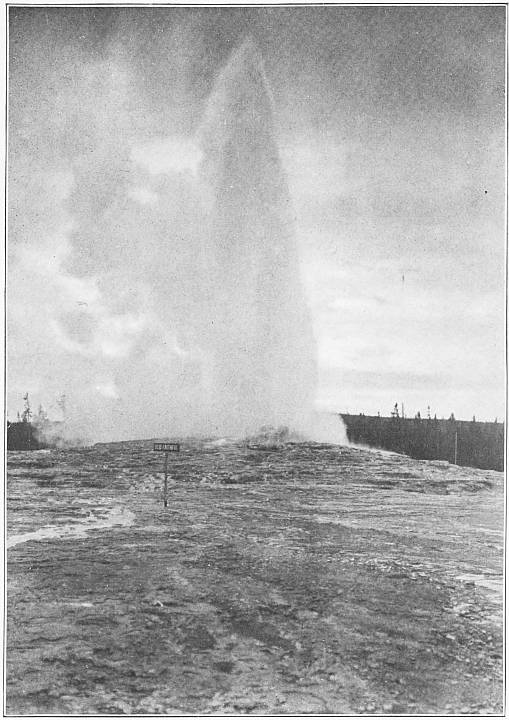
OLD FAITHFUL
There are other geysers greater than “Old Faithful.” “The Giant” plays to a height of two hundred and fifty feet, and the “Grand” and “Beehive” nearly as high; the “Grotto” has a more fantastic crater; the “Castle” has the largest cone, and with its beautifully colored “Castle Well” is more unique; and the “Riverside,” which plays a stream diagonally across the Firehole River, makes a more striking scenic display. But all of these play at irregular intervals and with far less frequency, varying from a few hours to ten or twelve days between eruptions. On the other hand, the regularity with which “Old Faithful” sends his straight, magnificent column to the skies is fascinating beyond description. Every sixty-five or seventy minutes, never varying more than five minutes, day and night, in all seasons and every kind of weather, “Old Faithful” has steadily performed his task since first discovered in 1870 until the present time, and no man can tell for how many centuries before.
“O! Fountain of the Wilderness! Eternal Mystery! Whence came thy wondrous power? For ages,—long before the eye of Man Found access to thy charm, thou’st played Thy stream of marvelous beauty. In midnight dark no less than glorious day, In wintry storms as well as summer’s calm, Oblivious to the praise of men, Each hour to Heaven thou hast raised Thine offering pure, of dazzling white. Thy Maker’s eye alone has seen The tribute of thy faithfulness, And thou hast been content to play thy part In Nature’s solitude.”
Not alone as the guardian of Nature’s jewels is the Yellowstone National Park remarkable. Even if the wonderful geysers, hot springs, and many-colored pools were taken away,—locked up in a strong box and hidden from sight as jewels often are,—the more familiar phases of natural scenery, such as mountains, rivers, lakes, and waterfalls would make it one of the wonder-places of America. On the eastern boundary is the great Absaroka Range, with peaks rising over 10,000 feet. In the northwest corner is the Gallatin Range, dominated by the Electric Peak, 11,155 feet high, covered with snow, and so charged with electricity as to make the surveyor’s transit almost useless. The Yellowstone and Gardiner Rivers, which join at the northern boundary, are separated within the park by a range of mountains of which the highest is Mount Washburne (10,350 feet), named for the leader of the expedition of 1870. Farther south, and midway between the Upper Geyser Basin and the Yellowstone Lake, is the Continental Divide. The road passes between two small lakes, one of which discharges its waters into the Atlantic Ocean by way of the Yellowstone, the Missouri, and the Gulf of Mexico, while the other flows into the Pacific through Snake River and the Columbia. From a point a few miles to the east Lake Shoshone may be seen far below, and seeming to tower directly above it, but really fifty miles away, just beyond the southern boundary of the park, are the three sentinels of the Teton Range, the highest 13,741 feet above the sea. The entire park is in the heart of the Rocky Mountains, its lowest level being over 6000 feet elevation.
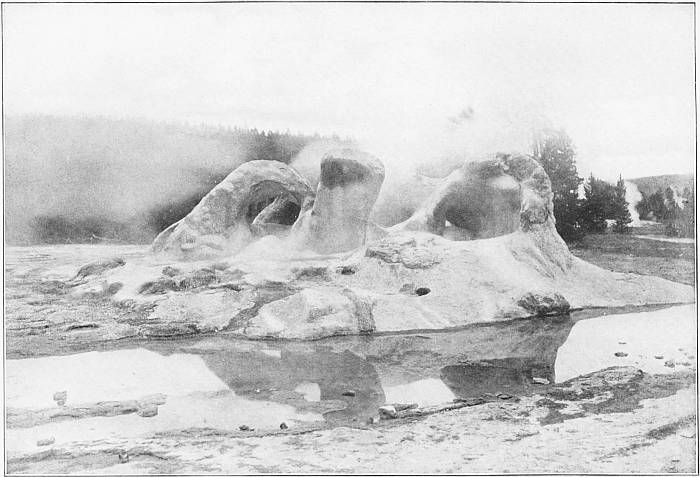
THE GROTTO GEYSER
The park is full of lakes and streams varying in size from the hundreds of little pools and brooks, hidden away among the rocks, to the great Yellowstone Lake, twenty miles in width, and the picturesque river of the same name. Here and there are beautiful cascades which one would go miles to see anywhere else, but the surfeited travelers give them only a careless glance as the stages pass without stopping. The Kepler Cascades tumble over the rocks in a series of falls of more than a hundred feet, making a charming veil of white lace, against a dark background of rocks and pines. The Gibbon Falls, eighty feet high, are nearly as attractive, while the little Rustic Falls, of sixty feet, in Golden Gate Cañon, are really quite delightful. These, and many others, are passed in comparative indifference, for the traveler has already seen many wonderful sights and knows that greater ones are yet in store. His anticipations are realized with good measure running over, when at last he catches his first glimpse of the great Cañon of the Yellowstone.
With us this glimpse came at the Upper Falls, where the Yellowstone River suddenly drops one hundred and twelve feet, suggesting the American Fall at Niagara, though the volume of water is not so great. It is more beautiful, however, because of the wildness of the scenery. Lower down, the river takes another drop, falling to the very bottom of the cañon. Here the cataract is more than twice the height of Niagara, and though lacking the width of the stream that makes the latter so impressive, is in every respect far more beautiful.
One must stand near the edge of the rocks at Inspiration Point to grasp the full majesty of the scene. We are now three miles below the Great Falls. The Upper Fall, which at close range is a great, beautiful white sheet of water, rolling with imperial force over a rocky precipice, seems only a trifling detail in the vast picture—a mere touch of dazzling white where all else is in color. At the bottom is the blue of the river, broken here and there into foamy white waves. Pines and mosses contribute touches of green. The rocky cliffs are yellow and gold, deepening into orange. In the distance a great rock of crimson stands like a fortress, with arched doorway, through which is seen a vista of green fields. But this is an optical illusion, as a strong glass will reveal. The doorway is only a pointed fir, which the distance has softened into the shadow of a pointed arch. Mediæval castles rear their buttressed fronts on inaccessible slopes. Cathedral spires, as majestic as those of Cologne, and numerous as the minarets of Milan, stand out in bold relief. Away down below is an eagle’s nest, into which we can look and see the birds, yet it is perched upon a pinnacle so high that if one were to stand at the level of the river and look up, it would tower above him higher than the tallest building in the world.
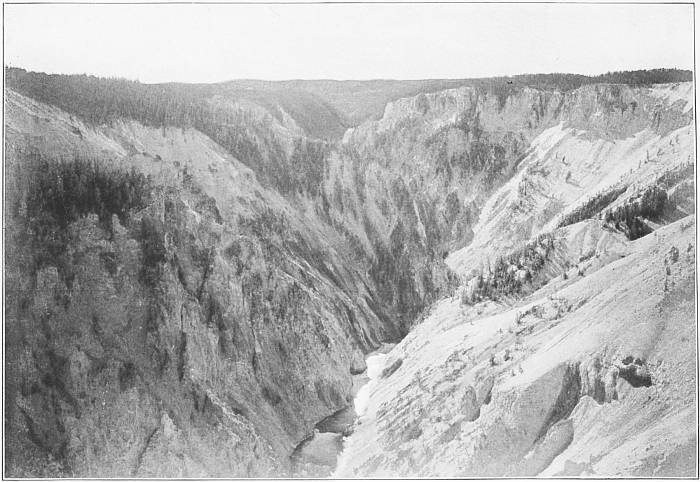
THE CAÑON OF THE YELLOWSTONE RIVER
Not a sign of the handiwork of man appears in any direction. The gorgeous spectacle, reveling in all the hues of the rainbow, is just as Nature made it—let the geologist say, if he can, how many thousands of years ago. And above all this splendid panorama, unequaled save by the glory of the sunset sky, is that same rich blue which Nature employs to add the final touch of loveliness to all her greatest works, and yet reserves enough to beautify the more familiar scenes at home.
X THE GRAND CAÑON OF ARIZONA
X THE GRAND CAÑON OF ARIZONA
I arrived at the cañon on a cold night in January, 1903, alone. There were few guests at the hotel, which was a capacious log cabin, with long, single-storied frame structures projecting in various directions, to serve the purposes of sleeping-rooms and kitchens. It had a primitive look, far more in keeping with the solitude of its surroundings than the present comfortable hotel. An old guide (I hoped he might be John Hance) sat by the fire talking with a group of loungers, and I sauntered near enough to hear the conversation, expecting to listen to some good tale of the cañon. But the talk was commonplace. Presently an Indian came in accompanied by a young squaw. He was said to be a hundred years old—a fact no doubt easily proved by the layers of dirt on his face and hands, if one could count them like the rings on a tree. He proved to be only a lazy old beggar and quite unromantic. The hotel management did not provide Indian dances and other forms of amusement then as now and I was obliged to spend a dull evening. I read the guidebooks and reached the conclusion that the cañon was not worth visiting if one did not go “down the trail” to the bottom of it. So I inquired at the desk when the party would start in the morning, and was dismayed to be told that there would be none unless somebody wanted to go. I was told to put my name on the “list” and no doubt others would see it and we might “get up” a party. I therefore boldly signed my name at the top of a white sheet of paper, feeling much like a decoy, and awaited results. Again and again during the lonesome evening I sauntered over to the desk, but not one of the few guests had shown the slightest interest. At ten o’clock my autograph still headed an invisible list, as lonely as the man for whom it stood, and I went to bed, vowing to myself that if I could get only one companion, besides the guide, I would go down the trail.
It was still dark when I heard the strident voice of a Japanese porter calling through the corridor, “Brek-foos! Brek-foos”! and I rose quickly. The dawn was just breaking as I stepped out into the chill air and walked to the edge of the great chasm. Before me rolled a sea of vapor. It was as though a massive curtain of clouds had been let down from the sky to protect the cañon in the night. The spectacle was not to be exhibited until the proper hour arrived. The great white ocean stretched away to the north as far as the eye could reach, filling every nook and corner of the vast depression. In the east the rosy tints of the morning brightened the sky. Suddenly a ray of light illumined what appeared to be a rock, far out in the filmy ocean, and the black mass blazed with the ruddy hue. The tip of another great butte suddenly projected itself and caught another ray of light. One by one the rugged domes of the great rock temples of Brahma and Buddha and Zoroaster and Isis, as they are called, peeped into view as the mists gradually disappeared, catching the morning sunbeams at a thousand different angles, and throwing back a kaleidoscope of purples, blues, reds, and yellows, until at last the whole superb cañon was revealed in a burst of color, over which the amethyst reigned supreme.
How long I should have stood enraptured before this scene of superlative grandeur, so marvelously unfolded to the sight, I do not know, had not the more prosaic call of “Brek-foos!” long since forgotten, again resounded to bring me back to human levels. I returned to the hotel and entered the breakfast-room, with an appetite well sharpened by the crisp wintry air, first taking a furtive glance at the “list,” where my name still presided in solitary dignity. It was still early and I was seated at the head of a long table, where there were as yet only two or three other guests. I felt sure that the day would be a busy one, particularly if I should find that one companion with whom I was determined to attempt the trail. It would be well to lay in a good supply of fuel, and accordingly I asked the waiter to get me a good beefsteak and a cup of coffee. He suggested griddle cakes in addition, as appropriate for a cold morning, and I assented. Then suddenly remembering that country hotels have a way of serving microscopic portions in what a distinguished author has described as “bird bathtubs,” I called over my shoulder to bring me some ham and eggs also. “George” disappeared with a grin. When he returned, holding aloft a huge and well-loaded tray, that darky’s face was a vision of delight. His eyes sparkled and his thick lips had expanded into an upturned crescent, wherein two rows of gleaming ivory stood in military array, every one determined to be seen. He laid before me a porter-house steak, large enough for my entire family, an immense elliptical piece of ham sliced from rim to rim off the thigh of a huge porker, three fried eggs, a small mountain of buckwheat cakes, and a pot of coffee, remarking, as he made room for the generous repast, “Ah reckon you-all’s powerful hungry dis mawnin’, boss!”
By this time the table was well filled. There is no formality at such places and we were soon chatting together like old acquaintances. I resolved to open up the subject of the trail and asked my neighbor at the right whether he intended to make the trip. He said “No,” rather indifferently, I thought, and I expressed my surprise. I had read the guidebooks to good purpose and was soon expatiating on the wonders of the trail, declaring that I could not understand why people should come from all parts of the world to see the cañon and miss the finest sight of all, the view from below. (Somebody said that in the guidebook.) They were all listening now. Some one asked if it was not dangerous. “Not in the least,” I replied; “no lives have ever been lost and there has never been an accident” (the guidebook said that, too)—“and, besides,” I continued, knowingly, “it’s lots of fun.” Just here a maiden lady of uncertain age, cadaverous cheeks, and a high, squeaky voice, piped out,—“I believe I’ll go.” I remembered my vow about the one companion and suddenly felt a strange, sickly feeling of irresolution. But it was only for a moment. A little girl of twelve was tugging at her father’s coat-tails—“Papa, can’t I go?” Papa conferred with Mamma, who agreed that Bessie might go if Papa went too. I was making progress. A masculine voice from the other end of the table then broke in with a few more questions, and its owner, a man from Minnesota, whom we afterward called the “Major,” was the next recruit. I had suddenly gained an unwonted influence. The guests were evidently inspired with a feeling of respect for a man who would order such a regal breakfast! After the meal was over, a lady approached and prefacing her request with the flattering remark that I “looked respectable,” said that her daughter, a young lady of twenty, was anxious to go down the trail; she would consent if I would agree to see that no harm befell her. I thought I might as well be a chaperon as a cicerone, since I had had no experience as either, and promptly assured the mother of my willingness to accept the charge. It was a vain promise. The young lady was the first to mount her mule and fell into line behind the guide; before I could secure my animal others had taken their places and I found myself three mules astern, with no possibility of passing to the front or of exchanging a word with my “charge.” I fancied a slight gleam of mischievous triumph in her eyes as she looked back, seeming to say, “I can take care of myself, quite well, thank you, Mr. Chaperon!” After a slight delay, I secured my mule and taking the bridle firmly in hand said, “Get up, Sam.” The animal deliberately turned his head and looked back at me with a sardonic smile in his mulish eye that said clearly—“You imagine that you are guiding me, don’t you? Just wait and see!”
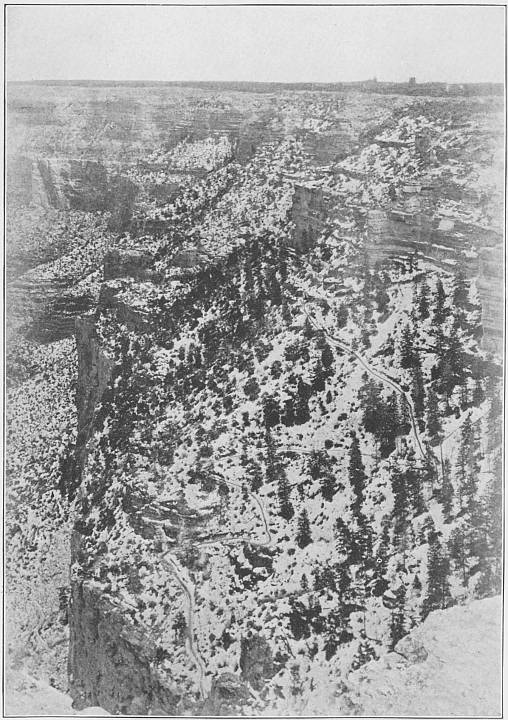
THE TRAIL, GRAND CAÑON
There were seven of us, including the guide, as we started down the long and crooked path. The guide rode a white horse, but the rest of the party were mounted, like myself, on big, sturdy mules—none of your little, lazy burros, as most people imagine. At first the trail seemed to descend at a frightful angle, and the path seemed—oh, so narrow! I could put out my left hand against a perpendicular wall of rock and look down on the right into what seemed to be the bottomless pit. I noticed that the trail was covered with snow and ice. Suppose any of the mules should slip? Had we not embarked upon a foolhardy undertaking? And if there should be an accident, all the blame would justly fall upon my head. How silly of me to be so anxious to go! And how reckless to urge all these other poor innocents into such a trap!
Fortunately such notions lasted only a few minutes. The mules were sharp-shod and did not slip. They went down every day, nearly, and knew their business. They were born in the cañon. They would have been terribly frightened in Broadway, but here they were at home and followed the familiar path with a firm tread. I threw the bridle over the pommel of the saddle and gave Sam my implicit trust. He knew a great deal more about the job than I did. From that moment I had no further thought of danger.
I came to have a high respect for that mule. Most people respect a mule only because of the possibility that his hind legs may suddenly fly out at a tangent and hit something. I respected Sam because I knew his legs would do nothing of the kind. He needed all of them under him and he knew it. He never swerved a hair’s breadth nearer the outer edge of the path than was absolutely necessary. The trail descends in a series of zigzag lines and sharp angles like the teeth of a saw. Sam would march straight down to one of these angles; then, with the precipice yawning thousands of feet below, he would slowly squirm around until his head was pointed down the next segment and then with great deliberation resume his journey. The guide thought him too deliberate and once came back to give me a small willow switch. I was riding on a narrow shelf of rock, less than a yard wide, where I could look down into a chasm thousands of feet deep. “That mule is too slow,” he said; “you must whip him up.” I took the switch and thanked him. But I wouldn’t have used it then for a million dollars!
It was a glorious ride. The trail itself was the only sign of human handiwork. Everything else in sight was as Nature made it—a wild, untouched ruggedness near at hand and a softer, gentler aspect in the distance, where the exposed strata of all the geologic ages caught the sunshine at millions of angles, each reflecting its own particular hue and all blending together in a rich harmony of color; where the bright blue sky and the fleecy clouds came down to join their earthly brethren in a revelry of rainbow tints, and the sun overhead, despite the snow about the rim, was smiling his happiest summer benison upon the deep valley.
We came, presently, to a place called Jacob’s Ladder, where the path ceased to be an inclined plane and became a series of huge steps, each about as high as an ordinary table. Here we all dismounted, for the mules could not safely descend with such burdens. It was comical to watch them. My Sam would stand on each step for several minutes, gazing about as though enjoying the scenery. Then, as if struck by a sudden notion, he would drop his fore legs to the next step, and with hind legs still at the higher elevation, pause in further contemplation. At length it would occur to this deliberate animal that his hind legs, after all, really belonged on the same level with the other two, and he would suddenly drop them down and again become rapt in thought. This performance was repeated on every step for the entire descent of more than one hundred feet.
After traveling about three hours, during which we had descended three thousand feet below the rim, we came to Indian Garden, where an Indian family once found a fertile spot on which they could practice farming in their own crude way. Here we came to some tents belonging to a camping-party, and I found the solution of a problem that had puzzled me earlier in the day. Standing on the rim and looking across the cañon I had seen what appeared to be a newspaper lying on the grass. I knew it must be three or four miles from where I stood, and that a newspaper would be invisible at that distance, yet I could not imagine how any natural object could appear white and rectangular so far away. Presently I saw some tiny objects moving slowly like a string of black ants, and realized that these must be some early trail party. We met them at Indian Garden. They proved to be prospectors and the “newspaper” was in reality the group of tents.
We had now left the steep zigzag path, and riding straight forward over a great plateau, we came to the brink of some granite cliffs, where we could at last see the Colorado River, thundering through the gorge thirteen hundred feet below. And what a river it is! From the rim we could only catch an occasional glimpse, looking like a narrow silver ribbon, threading in and out among a multitude of strangely fashioned domes and turrets. Here we saw something of its true character, though still too far away to feel its real power—a boiling, turbulent, angry, and useless stream dashing wildly through a barren valley of rock and sand, its waters capable of generating millions of horse-power, but too inaccessible to be harnessed, and its surface violently resisting the slightest attempt at navigation; a veritable anarchist of a river! For more than a thousand miles it rushes through a deep cañon toward the sea, falling forty-two hundred feet between its source and mouth and for five hundred miles of its course tumbling in a series of five hundred and twenty cataracts and rapids—an average of slightly more than one to every mile.
Think of the courage of brave Major Powell and his men, who descended this terrible river for the first time, and you have a subject for contemplation as sublime as the cañon itself. In the spring of 1869, when John W. Powell started on his famous expedition, the Grand Cañon was totally unknown. Hunters and prospectors had seen enough to bring back wonderful stories. Parties had ventured into the gorge in boats and had never been heard of again. The Indians warned him that the cañon was sacred to the gods, who would consider any attempt to enter it an act of disobedience to their wishes and contempt for their authority, and vengeance would surely follow. The incessant roar of the waters told of many cataracts and it was currently reported that the river was lost underground for several hundred miles. Undaunted by these fearful tales, Major Powell, who had seen service in the Civil War, leaving an arm on the battlefield of Shiloh, determined, nevertheless, to descend the river. He had long been a student of botany, zoölogy, and mineralogy and had devoted two years to a study of the geology of the region.
With nine other men as his companions, he started from Green River City, Wyoming, on the 24th of May, with one light boat of pine and three heavy ones built of oak. Nothing could be more modest than his report to the Government, yet it is an account of thrilling adventures and hair-breadth escapes, day by day, almost too marvelous for belief. Yet there is not the slightest doubt of its authenticity in every detail. At times the swift current carried them along with the speed of an express train, the waves breaking and rolling over the boats, which, but for the water-tight compartments, must have been swamped at the outset.
When a threatening roar gave warning of another cataract they would pull for the shore and prepare to make a portage. The boats were unloaded and the stores of provisions, instruments, etc., carried down to some convenient point below the falls. Then the boats were let down, one by one. The bow line would be taken below and made fast. Then with five or six men holding back on the stern line with all their strength, the boat would be allowed to go down as far as they could hold it, when the line would be cast off, the boat would leap over the falls, and be caught by the lower rope. Again and again, day after day throughout the entire summer, this hard work was continued. In the early evenings and mornings Major Powell, with a companion or two, would climb to the top of the high cliffs, towering to a height of perhaps two thousand or three thousand feet above the river, to make his observations, frequently getting into dangerous positions where a man with two arms would have difficulty in clinging to the rocks, and where any one but a man of iron nerve would have met instant death.
Day by day they faced what seemed certain destruction, dashing through rapids, spinning about in whirlpools, capsizing in the breakers, and clinging to the upturned boats until rescued or thrown up on some rocky islet, breaking their oars, losing or spoiling their rations until they were nearly gone, and toiling incessantly every waking hour. One of the boats was completely wrecked before they had crossed the Arizona line, and one man, who barely escaped death in this accident, left the party on July 5, declaring that he had seen danger enough. The remaining eight, whether from loyalty to their chief or because it seemed impossible to climb to the top of the chasm, continued to brave the perils of the river until August 27, when they had reached a point well below the mouth of the Bright Angel River. Here the danger seemed more appalling than at any previous time. Lateral streams had washed great boulders into the river, forming a dam over which the water fell eighteen or twenty feet; then appeared a rapid for two or three hundred yards on one side, the walls of the cañon projecting sharply into the river on the other; then a second fall so great that its height could not be determined, and beyond this more rapids, filled with huge rocks for one or two hundred yards, and at the bottom a great rock jutting halfway across the river, having a sloping side up which the tumbling waters dashed in huge breakers. After spending the afternoon clambering among the rocks to survey the river and coolly calculating his chances, the dauntless Powell announced his intention to proceed. But there were three men whose courage was not equal to this latest demand, and they firmly declined the risk.
On the morning of the 28th, after a breakfast that seemed like a funeral, the three deserters—one can scarcely find the heart to blame them—climbed a crag to see their former comrades depart. One boat is left behind. The other two push out into the stream and in less than a minute have safely run the dangerous rapids, which seemed bad enough from above, but were in reality less difficult than many others previously experienced. A succession of rapids and falls are safely run, but after dinner they find themselves in another bad place. The river is tumbling down over the rocks in whirlpools and great waves and the angry waters are lashed into white foam. There is no possibility of a portage and both boats must go over the falls. Away they go, dashing and plunging, striking the rocks and rolling over and over until they reach the calmer waters below, when as if by miracle it is found that every man in the party is uninjured and both the boats are safe. By noon of the next day they have emerged from the Grand Cañon into a valley where low mountains can be seen in the distance. The river flows in silent majesty, the sky is bright overhead, the birds pour forth the music of a joyous welcome, the toil and pain are over, the gloomy shadows have disappeared, and their joy is exquisite as they realize that the first passage of the long and terrible river has been safely accomplished and all are alive and well.
But what of the three who left them? If only they could have known that safety and joy were little more than a day ahead! They successfully climbed the steep cañon walls, only to encounter a band of Indians who were looking for cattle thieves or other plunderers. They could give no other account of their presence except to say they had come down the river. This, to the Indian mind, was so obviously an impossibility that the truth seemed an audacious lie and the three unfortunate men were murdered.
We were obliged to content ourselves with a view of the river from this height, though I had expected to descend to the river’s edge and felt correspondingly disappointed. We had started too late for so long a trip and now it was time to turn back. Looking back at the solid and apparently perpendicular rock, nearly a mile high, it seemed impossible that any one could ascend to the top. It is only when one looks out from the bottom of this vast chasm at the huge walls on every side that he begins to realize its awfulness. We are mere specks in the bottom of a gigantic mould wherein some great mountain range might have been cast. There are great mountains all about us and yet we are not on a mountain but in a vast hole. The surface of the earth is above us. A great gash has been cut into it, two hundred miles long, twelve to fifteen miles wide, and a mile deep, and we are in the depths of that frightful abyss with—to all appearance—no possible means of escape. Perpendicular cliffs of enormous height, which not even a mountain sheep could climb, hem us in on every side. The shadows are growing deep and it seems that the day must be nearly done. Yet we remount our mules and slowly retrace our steps over the steep ascent. It seems as though the strain would break the backs of the animals. As we approached the summit of the path some one remarked, “I should think these mules would be so tired they would be ready to drop.” “Wait and see,” said the guide. A few minutes later we reached the top and dismounted, feeling pretty stiff from the exertion. The mules were unsaddled and turned loose. Away they scampered like a lot of schoolboys at recess, kicking their heels high in the air and racing madly across the field. “I guess they’re not as tired as we are,” said the Major, as he painfully tried to straighten up. Just then the little girl of twelve came up to me. “There is one thing,” she said, “that has been puzzling me all day. How in the world did you find out so quickly that your mule’s name was Sam?” “Name ain’t Sam,” interrupted the guide, bluntly. “Name’s Teddy—Teddy Roosevelt.”
Some years ago I had occasion to attend a stereopticon lecture on the Grand Cañon. The speaker was enthusiastic and his pictures excellent. But he fired off all his ammunition of adjectives with the first slide. For an hour and a half we sat listening to an endless repetition of “grand,” “magnificent,” “sublime,” “awe-inspiring,” etc. As we walked home a young lad in our party, who was evidently studying rhetoric in school, was heard to inquire, “Mother, wouldn’t you call that an example of tautology?” I fear I should merit the same criticism if I were to undertake a description of the cañon. Yet we may profitably stand, for a few moments, on Hopi Point, a promontory that projects far out from the rim, and try to measure it with our eyes.
That great wall on the opposite side is just thirteen miles away. The strip of white at its upper edge, which in my photograph measures less than a quarter of an inch, is a stratum of limestone five hundred feet thick. Here and there we catch glimpses of the river. It is five miles away, and forty-six hundred feet—nearly a perpendicular mile—below the level upon which we are standing. We look to the east and then to the west, but we see only a small part of the chasm. It melts away in the distance like a ship at sea. From end to end it is two hundred and seventeen miles. It is not one cañon, but thousands. Every river that runs into the Colorado has cut out its own cañon, and each of these has its countless tributaries. It has been estimated that if all the cañons were placed end to end in a straight line they would stretch twenty thousand miles.
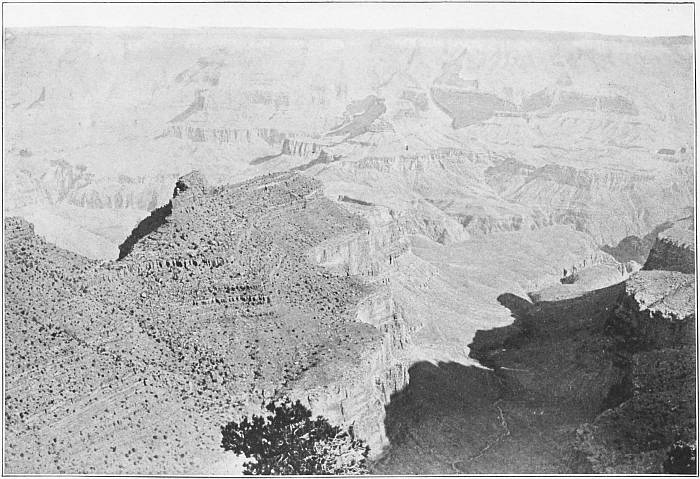
THE GRAND CAÑON OF ARIZONA
If this mighty gash in the earth’s surface were only a great valley with gently sloping sides and a level floor, it would still be impressive and inspiring, though not so picturesque. But its floor is filled with a multitude of temples and castles and amphitheaters of stupendous size, all sculptured into strange shapes by the erosion of the waters. Any one of these, if it could be transported to the level plains of the Middle West or set up on the Atlantic Coast, would be an object of wonder which hundreds of thousands would visit. Away off in the distance is the Temple of Shiva, towering seventy-six hundred and fifty feet above the sea and fifty-two hundred and fourteen feet (nearly a mile) above the river. Take it to the White Mountains and set it down in the Crawford Notch. From its summit you would look down upon the old Tip-Top house of Mount Washington, eight hundred feet below. Much nearer, and a little to the right, is the “Pyramid of Cheops,” a much smaller butte but rising fifty-three hundred and fifty feet above the sea-level. If the “Great Pyramid of Cheops” in Egypt were to be placed by its side it would scarcely be visible from where we stand, for it would be lost in the mass of rocky formations. Mr. G. Wharton James, who has spent many years of his life in the study of the cañon, says that he gazed upon it from a certain point every year for twenty years and often daily for weeks at a time. He continues, “Such is the marvelousness of distance that never until two days ago did I discover that a giant detached mountain fully eight thousand feet high and with a base ten miles square ... stood in the direct line of my sight, and as it were, immediately before me.” He discovered it only because of a peculiarity of the light. It had always appeared as a part of the great north wall, though separated from it by a cañon fully eight miles wide.