Bertram Mitford (continued 5)
Reading edition
For the veldt was alive with warriors, swarming down from the ridge, charging forward in silence, swift in deadly fixity of purpose. They had already passed the cattle herds, and were making straight for himself.
“Order them back, Sonkwana! Order them back!” cried Dawes again, this time drawing his revolver and pointing it straight at the head of the hostage.
But the latter saw his chance, or thought he did. Ducking his head suddenly, he made a rapid plunge to the side, intending, so near were his tribesmen, to fling himself into their ranks. The trader in his flurry and dismay would be certain to miss his aim, he reckoned.
He reckoned without his host, however. Instead of the ball whistling through empty air where his head had been but a moment before, Dawes’s eye, keen as a razor, quick as lightning, had marked the move. By a sort of backward throw of the hand he covered the fleeing form of the foolhardy Sonkwana, and pressed the trigger. The chief’s councillor toppled heavily forward on his face, and lay with outstretched arms. He was stone dead.
What followed was appalling. The report of the pistol was completely drowned in the wild roar of rage that went up. The first life had been taken, and that life a valuable one.
“Stand back!” cried Dawes, his eyes flashing fire.
He might as well have tried to make his voice heard amid the thunder of an Atlantic gale beating among the rocks of the Lizard, or have tried to force back the power of its gigantic surges. His double gun levelled low, he poured the contents of the smooth barrel, loaded heavily with loepers—a large variety of buck shot—into the dense crowd. The result was terrible.
It was all he had time to do, though. The wild, shrill yells of pain were drowned in the thunderous din, as the resistless volume of the charge poured over him. He had a vague recollection of once again raking the closely packed assailants with his other barrel ere he was swept from his feet, and hurled half-stunned to the earth, and of a fierce, grim feeling of satisfaction that he had sold his life pretty dearly. Then the gleaming blades of spears flashed before, his eyes, and he knew his last hour had come.
Still their points did not pierce him. Half-stunned, half-dazed, he became aware that some one was standing over him, averting the threatened blows. Collecting his scattered senses, he stared and stared again at this unexpected preserver. He recognised Vunawayo.
He was seized and held fast, and amid many a brutal kick and blow, his hands and feet were securely bound, and he was flung into the waggon like a log of wood. Then with wild yells and shouting, the Igazipuza forced round the oxen, and compelling the terrified servants to obey their behests, and lead and drive the spans, they started upon their triumphant return amid an indescribable scene of tumultuous rejoicing.
At the first onset Sintoba had drawn the assegai which he carried concealed about his person, and had leaped to the assistance of his master. Had tried to, that is, for he, too, had been overwhelmed and borne down by the impetuous fury of the rush. The same fate had overtaken those in charge of the hindmost waggon, except one of the young leaders whom the savages had slaughtered in the first fierce caprice of their blood-lust, and whose corpse, ripped up and otherwise hideously hacked, lay by the wayside as they returned. The other servants, as we have said, they compelled to engineer the waggons.
Battered, bruised, his bones nearly broken, his joints racked well-nigh to dislocation point by the terrific jolting, poor Dawes lay where they had thrown him, grinding his teeth in his impotent rage and pain. Better to have been killed outright, he thought. He was only spared for some lingering torture—the hideous stake of impalement, most likely. Many had fallen at his hand in that brief moment—their spirits would be satisfied by no less a sacrifice.
The savages, running beside the waggons, jeered at his sufferings.
“Does it hurt—does it hurt, Jandosi?” they cried, as an extra big jolt would nearly brain the unfortunate man. “Ah! ah! there are some things that hurt far more—far more!”
Thus in wild and riotous shouting the whole crowd arrived once more at the gate of the Igazipuza kraal—and here the terrible confusion of the tumult beggars description—the shrill nasal singing of the women who turned out to meet them, the yelping clamour of dogs, the howling of those whose relatives were slain, and the sonorous rhythm of the war-song, all mingled together in the most ear-splitting, brain-stunning din.
Sintoba and his fellows, having outspanned in compliance with the peremptory orders of their captors, were seized and unceremoniously bound. Then poor Dawes was hauled out of the waggon and brutally dragged through the kraal, amid kicks and cuffs, to where the chief was sitting. Then he was flung roughly and anyhow upon the ground.
For some moments did Ingonyama contemplate the helpless form of his captive in silence, and in his massive countenance was a gleam of ruthless, vengeful ferocity. He had sat in fear, here on this very spot, the last time this white man occupied it with him—in fear of his life, be, Ingonyama, the chief of the redoubted Igazipuza. Now the tables were turned. This miserable captive, bruised, helpless, lying there half-stunned, should taste what it meant to tread on the paw of the lion.
“Well, Jandosi?” he began sneeringly. “You are a bird whose song is over loud; yet now surely are your wings cut.”
If John Dawes’s bodily attitude was abject, it was only through force of circumstances. His mental one was very far from having attained that state. With a painful effort he succeeded, amid the jeering laughter of the spectators, in raising himself to an upright sitting posture.
“You are right, Ingonyama,” he replied. “My song is over loud—for you. It is even how being sung at Undini, in ears in which it is bad for you that it shall be poured. Did I not tell you my ‘tongue’ was a long one and spoke far? Even now it speaks.”
“Hi! And did I not tell you that we have a Tooth here which can bite it short? You and your ‘tongue’ shall be bitten on The Tooth, Jandosi!”
“Ehé! E-hé!” roared the listeners. “To The Tooth, to The Tooth with him!”
It was the hour of sunset, and the sweet golden glow fell upon a wild sea of ferocious figures, of hideous mouthing faces and gleaming spear-blades. The whole population had mustered within the kraal, and were crowding up, striving to obtain a view of the chief and his councillors and the white prisoner; and again and again from the savage roaring throats went up the fiendish shout.
“To The Tooth! to The Tooth!”
“Even now I do not fear you, Ingonyama,” went on the trader, intrepidly. “For my death will surely be avenged—ay, as surely as yonder sun will rise to-morrow. It may be that the might of the king will rise up and stamp flat this tribe of abatagati (those who practise arts of wizardry); it may be that my own countrymen will. But it shall surely be done, ye who call yourselves Igazipuza, and my death shall be avenged.”
Again the wild, roaring clamour drowned his words. The intrepidity of the man exasperated them while compelling their admiration. Of the latter, however, Ingonyama felt none. He only remembered his own humiliation at this man’s hands, here on this very spot. His features working, his eyes rolling in fury, he said slowly—
“Let him be bitten on the point of The Tooth.”
“Ha! on the point of The Tooth! on the point of The Tooth!” roared the ferocious crowd in deafening chorus. And a multitude of eager hands were stretched forward to seize the unfortunate man, and drag him away to his hideous death of torture.
Chapter Twenty One.
The King’s “Hunting-Dogs.”
To attempt to describe the fearful despair, the agony of self-reproach, which took possession of poor Gerard’s heart as he awoke to find himself once more in the power of the savages is impossible. The very stars in their courses seemed to be fighting against him. Had he not gone through enough in all conscience? And now all his past perils and experiences were thrown away. He and his comrade were no better off than before his attempted escape, probably indeed worse. Again, it was while he slept that the enemy had stolen upon him—while he slept. He had sacrificed his companion for the sake of a few hours’ sleep! Well, he himself deserved all he might meet with; but Dawes—he had sold him—had fallen asleep at his post like a cowardly and untrustworthy sentinel. The poor fellow was in agonies of self-torment at the thought.
But for the perturbed and flurried state of mind, into which these reflections had thrown him, he would have perceived that the Zulus were every bit as astonished at his appearance as he was at theirs. As it was, he only saw the same dark resolute countenances and ringed heads, the same great broad-bladed assegais. These men, however, carried great white shields with black facings.
“Who are you, Umlúngu, and where do you come from?” said one of them after a moment of silence.
Gerard looked at the speaker, and collecting his ideas, replied, with all the dignity at his command, that he was carrying a message to the king.
A smothered ejaculation burst from the group, and they exchanged glances.
“Does a white man, carrying a message to the king, travel through the country in that state?” said the first who had spoken.
Gerard followed his glance, and appreciated the meaning with which the words were uttered, as he remembered the travel-worn and rather disreputable appearance which he must present. His rifle, too, was beginning to rust, for in the fatigue and exhaustion which had come upon him before falling asleep, he had neglected to do more than just wipe it. The broken hunting-knife was still spliced to the muzzle.
“I lost my horse, and an alligator attacked me in the river,” he replied. “I speared him with this, struck him through the eye, and I believe I killed him.”
“Hau!” broke from the listeners, staring at the broken knife-blade. “That was well done, Umlúngu. But—where do you come from?”
“Who is your chief?” said Gerard, fencing the question after their own fashion.
“He is not here,” was the characteristic reply. “But he is close at hand.”
“Take me to him.”
And Gerard rose, as decisive apparently in purpose as he was in speech.
“Come!” said the spokesman, laconically.
Then, with Gerard in their midst, the group moved off. For upwards of half an hour they filed through the bush at a rapid pace, in process whereof Gerard’s attempts at further enlightenment were met by an intimation, terse but not discourteous, that under present circumstances silence was preferable to speech. But he noticed one thing, overlooked at first in his despair and confusion. These warriors, whoever they might be, did not show the red-painted disc on forehead and breast which distinguished the dreaded Igazipuza.
The way had grown wilder and wilder, and instead of the straggling and more or less scattered bush, the party was now proceeding beneath tall forest trees, from whose gnarled and massive boughs dangled monkey ropes and trailers. The shade was almost a gloom, into which the last rays of the now setting sun shot redly. And now a strange, eerie, fluttering sort of life seemed to spring up within the gloom of those forest shades, and Gerard could not repress an exclamation of astonishment as he looked. For the place was alive with armed warriors, starting up like ghosts, silently, noiselessly, out of nowhere. There seemed to be no end to their number, and he could mark the surprise on each dark face, could hear the low ejaculation and the quivering rattle of assegai hafts as they became aware of his presence.
“Who—what are these?” he asked.
“You wanted to see the chief, Umlúngu,” was the reply. “Have patience. You shall see him.”
Gerard’s first thought was that the talked of Anglo-Zulu war had actually broken out, and this was a force proceeding against his countrymen, and his heart sank. For if that were so, what chance was there for Dawes, in the power of one of Cetywayo’s savage vassals? The king was not likely to risk offending one of his most influential chiefs by demanding the release of a member of the race which was making war upon his nation and dynasty. His meditations on this head were promptly cut short, for his escort had emerged upon a small open glade overhung by a high rock, whose summit was plumed by a dark line of straight-stemmed euphorbia, and beneath this sat a group of men, in whose aspect there was something which instinctively told him they were men of the highest authority.
His escort made a sign for him to halt, while a couple of them went forward to confer with these. Then he was told to advance.
“The chief—that is he!” said one of them.
The man indicated, a large finely built Zulu, was seated in the centre of the group. As his gaze fell upon him Gerard stared; then he started with astonishment—this time openly and undisguisedly—then stared again.
“Sobuza!” he cried. And to the unbounded amazement of his escort, and indeed of all beholders, he dropped his rifle and stepped forward to the chief with outstretched hand.
The latter, indeed, was hardly less astonished than himself, but, with the self-control of his race and rank, showed it but little. A slight smile came over his face, and there was a twinkle in his eye as he shook Gerard by the hand with a hearty grip.
“Au! Jeriji. I remember you,” he said kindly.
There was that in the act, in the tone, which went straight to Gerard’s heart. Here, in this unknown wilderness, after his perilous escapes, he felt that he had found a friend. In the hands of this savage chieftain, surrounded by his armed host, he felt perfectly safe. Whatever the errand of destruction upon which this formidable force was engaged, in the presence of the man he had succoured twice in the hour of danger and difficulty he felt no distrust, no misgiving.
The astonishment of the onlookers at this strange and unexpected recognition knew no bounds. They bent eagerly forward, with many a smothered “whou!” of amazement. But the frank, open, impulsive way in which Gerard had greeted their chief had made the best of impressions, for the Zulu in those days was not without his share of real chivalrous feeling, and the complete absence of any lingering distrust on the part of their prisoner—or guest—appealed powerfully to them. His rifle lay on the ground exactly where he had placed it. Not one of them would pick it up, lest the act might be construed into one of distrust, of disarming him, so to say.
“Sit here, Jeriji,” said the chief, motioning him to a place at his side. “Did you come into the Zulu country all alone to kill alligators, or to pay me a visit?” he went on, with a comical smile, as Gerard promptly acted upon the invitation.
“Neither the one nor the other, Sobuza. But, first tell me, are you and your men out against—my countrymen?”
“Not so,” said the chief. “We are not at war with the English.”
“I am glad of that. Now listen. You asked me why I came into your country. I did not come into it; I was brought into it.”
“Brought into it?” repeated the chief in some astonishment. “By whom?”
“By Ingonyama’s people. Those, who call themselves Igazipuza.”
“Hau! Igazipuza!”
The astonishment, emphatic and unfeigned, with which his statement was echoed, not by the chief only, but by the whole group, might well strike Gerard.
“You know him—you know them?” he said.
A humorous flash flitted across each dark face, the corners of every mouth turned down grimly. Sobuza proceeded to take snuff.
“Tell us about it,” he said. “Begin at the very beginning, Jeriji, for this is no light matter.”
Then Gerard began his tale—from the very outset of their enforced visit to the fastness of that redoubtable clan, throughout the period during which their condition had become one of open and undisguised captivity, down to his own headlong dash for liberty and succour, their untiring and persistent pursuit of him, and his perilous hiding-place on the river-bank. His feat in slaying the alligator caused great sensation; and Sobuza having ordered the rifle, on which was still spliced the broken knife, to be brought, he and his assembled chiefs examined this cleverly devised weapon with the greatest interest. Gerard went up a hundred per cent, in their estimation.
Now our friend’s knowledge of the Zulu tongue comprised a prodigious number of words, but his grammar was of the shakiest description. However, the vital importance of his narrative soon rendered him oblivious to any mere self-consciousness, and in his hearers he found a most eager and patient audience. Once or twice only did they interrupt him when his meaning was unintelligible, and then only to help him through. But, when he had finished, they questioned him on every conceivable detail, cross-examined him so deftly, that they had promptly got out of him his own plans, his own errand, without his being in the least aware of it. More than one there present knew “Jandosi,” from trading trips which he had made among them.
“How many fighting men has Ingonyama, Jeriji?” said Sobuza again.
Gerard replied that he thought there must be at least five hundred. Besides the large kraal there were two smaller ones under the rocks at the further end of the hollow. There was only one approach to the place, and they used to boast that by massing at this point they could hold their own against any odds. He had already sketched on the ground an elaborate map of the place.
“Good!” said Sobuza, grimly. “Life is full of deceptions, and that is one of them, as they shall find out. Listen, Jeriji. You may spare yourself the trouble of carrying Jandosi’s ‘word’ to the king. You asked against whom we were out. Well, we are the king’s hunting-dogs, and the Igazipuza are the game.”
Gerard stared as though he could hardly believe his ears. He had thought the whole population of the northern country, including these among whom he had fallen, was in league with that evil and bloodthirsty clan, if not actively in membership with it. But the armed warriors around him had actually been sent forth to suppress it. Then he remembered how different was their bearing and demeanour to that of his late enemies. There was no boisterous swash-bucklering savagery about these. They were king’s troops, the flower of the Zulu nation, they and their chiefs, even as the Igazipuza were the scum.
“It is as I say,” went on Sobuza, smiling at his air of incredulity. “The Great Great One has long borne with this rebellious dog of his, and these were his words to us, to me Sobuza the son of Panhla, second in command of the Udhloko, and to Gcopo, the third induna of the Ngobamakosi,” designating the chief at his side, whose magnificent physique had struck Gerard the moment he arrived—
“‘There sits among the mountains in the north, a dog who dares call himself by my name (Note 1)—who dares to insult the majesty of my state by his miserable imitation of the same; who gathers around him all the evil-doers of the nation, and levies tribute from my subjects, and kills and plunders men of nations between whom and myself there is peace, so that I am in danger of becoming embroiled by their ill-doings. Moreover these claim the power of immunity from harm by sundry abominable practices abhorrent in the eyes of the People of the Heavens, (Note 2.), and make it their boast that they drink the blood of men. To such lengths have these abatagati carried their enormities, that not only is there no longer peace or security for any who dwell near the northern border on either side thereof, but there is a danger that men may be led to think this dog greater than his master.
“‘Further, this dog who calls himself lion, plots that one day he may roar where the Lion of the Zulu roars alone. Now shall he feel the Lion’s paw, for the time has come when such disturbances and such abominations shall cease out of the land.
“‘Now, Sobuza, and you Gcopo, pick from the Udhloko and the Ngobamakosi one thousand of your best warriors, half from each—for I hear these abatagati, who call themselves blood-drinkers, are numerous and hold a strong place—and go up against them. If they dare to resist eat them up—every man who bears a weapon—otherwise, slay only the dog who calls himself Ingonyama, also Vunawayo, and all who hold rank or standing among this pestilent clan. The remainder, with their women and cattle, drive before you hither. Burn their kraal that no stick or straw be left, and return here by the sixth day from this. Depart.’
“Such were the words of the king to us, Jeriji. Whau! We leaped up shouting the bonga (Note 3), and that same evening we left Undini, as you see us. By this time to-morrow there will be nothing left of the Igazipuza kraal but its smoke, and the vultures of the northern heights will be gorged. It is good that you have fallen in with us, Jeriji, you who are familiar with the place. We will strike them at dawn to-morrow, and Jandosi shall be brought out alive. See—the sun is nearly down. Then we will march.”
“I am very hungry, Sobuza,” said Gerard.
The chief started. Zulus on a war expedition seldom eat more than once a day, and that in the morning. Then he laughed, and gave orders accordingly.
“It is war rations,” he said, as some dried meat and mealies stamped to a kind of flaky paste were produced.
The first was rather “high,” but Gerard was, as he had said, very hungry, and fell to, untroubled by overmuch fastidiousness. While thus engaged he heard a voice say in a jaunty, bantering tone—
“Saku bona, ’mlúngu! Surely we have met before.”
The group of chiefs had temporarily left him, to supervise the few simple preparations for their march. Looking up he saw a young Zulu, unringed, who stood there, laughing all over his face. The features were familiar, but Gerard, who had seen so many natives of late, could not quite locate them.
“Have you any more guns to sell, Umlúngu?” said the young fellow, roguishly.
And then Gerard knew him in a moment.
“Nkumbi-ka-zulu,” he said, holding out his hand to show that he bore no ill-will from their previous very decided misunderstanding. “Why, how is it that you are here?”
“Há!” said the other, with a laugh, “I am in the Ngobamakosi regiment. I am going to help ‘eat up’ the Igazipuza.”
“Well, Nkumbi, you wanted that double gun badly. Listen to me now. Jandosi is in the midst of those Igazipuza, and when we attack them they may rush upon him and kill him. If you are the first to reach his side that double gun shall be yours. I promise it.”
“What if the gun is broken in the battle?”
“Then you shall have as good a one. Only collect some of your companions, and manage to get near Jandosi when we attack, and that gun shall be yours.”
“You are a straight man, Umlúngu, and I believe your word. I will try and win the gun.” And then a short and sharp mandate from his superiors interrupting him, the young warrior turned away abruptly to fall into his place in the ranks.
Note 1. “The Lion” was one of the titles of the Zulu kings.
Note 2. “Izulu” means “the Heavens.”
Note 3. A royal acclamation demanded by Zulu etiquette on such occasions, and which generally consists in a string of extravagant titles.
Chapter Twenty Two.
The Two Emissaries.
The long sound sleep he had had stood Gerard in good stead as he fell into the march of the impi—whose work was indeed cut out for it, for it would take all the hours of darkness before them, and rapid marching at that, to get into position by earliest dawn, that being the time appointed for falling upon the Igazipuza kraal. But these picked men of the king’s troops seemed thoroughly up to their work. Hour after hour they marched, with no sign of flagging, ever the same swift elastic stride, and lucky indeed was it for Gerard that he was in excellent condition or he might have found serious difficulty in keeping pace with them.
There was another thing, too, that stood him in good stead—the foresight of Dawes to wit, which had provided against the very emergency in which he had been placed. More than half of his rifle and revolver cartridges had been done up in several rolls of the most completely watertight wrapping, waxed at the seams. He might have to swim more than one river, Dawes had reasoned. It was as well to be prepared for every contingency. So here he stood, provided with a supply of dry cartridges; and as by this time he was an adept at that sort of thing, he had employed the few minutes of daylight before setting out on the march in taking his weapon to pieces and carefully drying and greasing the mechanism.
Hour followed hour, and still the impi kept on its way. Now and again a brief halt of a few minutes would be called, in order to take a rest and a pinch or two of snuff, then on again; now through jungly tracts of grass and forest-belts, now over spurs of rugged and desolate mountain ranges, now splashing through quaking reedy morasses, where the deep boom of the bull-frog rose above the more treble croak of his smaller kin, and the will-of-the-wisps glinted in many a sickly blue corpse-candle. On, unflagging, strode those iron warriors, grim, silent angels of Death, speeding through the night.
“We are not far from the place now,” said Gerard at length, touching Sobuza’s arm. “Just beyond that spar the slope leading up to the entrance to the hollow begins.”
It was the last hour of the night, that dark and chilly hour which precedes the dawn. They had entered that forest-belt which had been of such service to Gerard in first throwing off his enemies, and now Sobuza had convened his subordinate chiefs around him to hold a council of war. This was not a lengthy process, for the plans had been already laid. These were simplicity itself. The impi, in compact formation, was to advance swiftly to the ridge overlooking the hollow, then to charge down upon the kraal, throwing out “horns,” so as to surround the latter. The inhabitants, thus utterly taken by surprise, would probably offer no resistance; but any who did were to be slain without mercy. Everything depended upon the successful carrying out of the surprise part of the arrangement, otherwise a severe and bloody battle might be reckoned on; for the Igazipuza were not made of the stuff which would submit to be “eaten up” without a struggle. Moreover, in their own stronghold they would prove a terribly formidable enemy, and the king’s troops were only twice their number, odds which the advantage of the ground would go far to neutralise.
“Whau!” muttered Sobuza, taking a final pinch of snuff and rising to his feet. “I fear we are not going to have things all our own way. Ingonyama is no fool, still less is Vunawayo. They may believe you were eaten by the alligator, Jeriji, or they may doubt it; but if they think there is the least chance of you having escaped, they will be upon their guard. Now, if you had been taken and brought back, our work would have been easy. Only,” he added, with a humorous twinkle in his eyes, “it might not have been so easy for you. We might have arrived too late.”
The words struck a chill into Gerard’s heart. What if they had arrived too late—too late as far as his friend was concerned. He hoped and prayed not, and then an outlet to his impatience came in the mandate that was issued for the advance.
And now, as the grey light of dawn broke over the earth, Gerard was able for the first time to obtain a view of the barbarous but splendidly disciplined host in whose midst he was to fight to-day. Debouching from the forest-belt in the most perfect order came this pick of the king’s troops, marching in four companies. Two of these consisted of amakehla or ringed men, and the great war-shields borne by these were white, or nearly so; for this was the draft out of the Udhloko regiment, a part of the royal corps, warriors of long training and experience, mostly middle-aged. The other two consisted of young men, unringed, carrying shields of all sorts of colours, black-and-white, red-and-white, black or red, but none entirely white. These were the Ngobamakosi warriors, fiery young fellows, burning to be led against some enemy, no matter who, in order that they might prove their valour and thus win distinction. The leader of these, Gcopo, walked with Sobuza during the march, and the towering stature of the two chiefs was conspicuous even in that muster of splendidly built men.
Beyond their shields and weapons, there was little or no attempt at martial display or personal adornment; for this being an expedition against their own countrymen, though on a large scale, came more within the category of a police undertaking than an impi sent forth to war, and thus ceremonies and paraphernalia which would have figured in the latter event were dispensed with. But bound round his head, every man wore a narrow strip of hide; the Udhloko, white; the Ngobamakosi, red. This was to distinguish them from the Igazipuza, and that they should not fall upon each other by mistake in the thick of the battle. Thus viewed against the open hillside, marching in splendid order, a forest of bristling spears and tufted shields, a thousand eager and disciplined warriors burning for action, the impi was an imposing sight indeed, and Gerard felt his heart thrill at the consciousness of going into battle for the first time with such men as these.
Suddenly a gasp of wonderment went like a wave through the ranks. All came to a standstill, and every eye was turned upon the same point. There, bounding down the hillside, making straight for the impi, came two men, Zulus. Who were they? Runaways? Refugees? Some of the trader’s people who had escaped? Such were among the conjectures that rose to the minds of the astonished spectators. But, as they drew nearer another and deeper gasp of wonder heaved through the impi, for on forehead and chest of the approaching warriors was now discernible the red mark of the Igazipuza.
On they came, bounding like bucks, heading straight for the impi, and it was seen that they were young men and unringed, and fully armed with shield and assegai. The king’s troops watched them in grim silence.
“We are Igazipuza, the cubs of the Lion. Who are you?” began the spokesman, as the two pulled up within twelve paces of the foremost rank of the Udhloko. An ominous and threatening growl greeted these words, and spears quivered.
“Whelps of the dog, say rather,” exclaimed a deep voice. “Drop your weapons and advance.”
They laughed, those two. Standing before one thousand men, who had come forth expressly to slaughter them and theirs—they laughed.
“We cubs of the Lion shed not our claws,” replied the one who had spoken, a tall, straight young fellow who, panting slightly after his run, stood with his head thrown back contemplating the king’s troops as though he were the king himself. “Our claws may be cut, though they tear badly first. But we do not shed them.”
Again that ejaculation of anger went up, this time mingled with contempt. A rapid movement had been executed. The two young men were surrounded—stood now in the very centre of the impi. Still utterly fearless, they looked around and laughed defiantly.
“As the child makes a plaything of the sleeping serpent, so now are you walking over your graves, you two children,” said Sobuza, contemptuously. “Who are you?”
“Greeting, induna of the king’s impi,” returned the speaker, after a steady stare at the chief. “We are sent by our father, the Lion of the Igazipuza, to warn you to return. There is múti (medicine, or philtre) spread on the mountain-side leading to his kraal, which is death to twenty times the number you have here.”
“Have done with such childishness,” returned Sobuza, sternly. “Is your father, the Lion of the Igazipuza, as you name him”—with a sneer—“prepared to come down here and proceed to Undini to lay his neck beneath the paw of the Lion of the Zulu whose wrath he has incurred?”
The two emissaries fairly laughed.
“Not he,” was the reply. “This is the word of Ingonyama: ‘There is a white man named Jandosi here. When the king’s hunting-dogs first behold the home of the Igazipuza, they shall view many things. They shall see the white man, Jandosi, writhing upon the point of The Tooth—he and all his following. The English will then make war in their anger upon the people of Zulu, and will set up a white king. They shall find their game, but the game of the king’s hunting-dogs will be not jackals, but lions. Now—let them come!’”
The utter audacity of this speech seemed to take away everybody’s breath. They stared at the foolhardy speaker as men who dream. He, before they had recovered, catching sight of Gerard among the group of chiefs, broke into a loud laugh.
“Ha! The other white man! The alligators have spat him up again whole. Well, Umlúngu. New friends are better than old ones. You and your new friends shall see your ‘brother’ being bitten by The Tooth.”
“Seize them!” said Sobuza.
There was a rush and a struggle. Lithe, quick as they were, the two emissaries were overpowered; the blows which would have let the life out of one or more were beaten down by the solid fence of the Udhloko shields. As they lay on the ground, powerless, disarmed—those holding them gazing eagerly, hungrily, at the chief, awaiting the word to bury the broad spears in their prostrate bodies—Gerard recognised, in him who had spoken, the man who had so barbarously slaughtered the unfortunate Swazi, Kazimbi.
“Ho, Umlúngu,” called out the fearless young barbarian. “With the first advance of the king’s impi, your ‘brother’ shall be bitten on The Tooth. Ha, ha!”
The words, the fiendish laugh, sent Gerard nearly off his head. Beckoning Sobuza aside, he besought the chief to delay his advance, to try and make terms with Ingonyama. But Sobuza shook his head. The thing was impossible, he explained. The king’s orders were absolute. Little or nothing was left to his own discretion, who was merely the king’s “dog,” and entrusted with carrying them out. Poor Gerard, with the horrible picture he had discovered that day upon the rock of death now vividly before his eyes, besought and implored. In vain. He even appealed to the recollection of the aid he had been able to render the chief—a thing that at any other time he would have died rather than have done. Still in vain. Sobuza was firm. The king’s orders were imperative and had to be carried out, though one man or a thousand perished. What Jeriji asked was impossible. They had delayed enough already. Then he turned to those who were holding down the emissaries.
“These dogs of Ingonyama’s! Could he not even send me a kehla, instead of talking to me, Sobuza, an induna of the king, through the mouths of two common dog-whelps like these. Let your spears devour them both!”
Eagerly the signal was watched for, eagerly it was obeyed. Down struck the spear-points, bright and flashing, up they rose again, ruddy and gore-dimmed, then down again. The quivering bodies of the foolhardy emissaries lay pierced with a dozen great gashes.
Covered with blood, one of them half rose. It was that of the spokesman.
“Hamba gahle (‘Farewell;’ literally, ‘Go in peace.’), Sobuza, induna of the king,” he gasped, ironically. “Hamba gahle, Umlúngu! The Tooth bites! The Tooth bites!” And, with a devilish chuckle, ferocious, untamable, fearless to the last, the young warrior, choked with the torrents of his own blood, sank back and died.
“Au!” growled the chief impatiently, with an angry scowl. “We have lost more than enough time over this carrion. Yet if all these dogs, who call themselves ‘blood-drinkers,’ care as little for their lives as you two, by the head-ring of the Great Great One we shall have a merry fight before we ‘eat up’ Ingonyama’s house.” Then aloud “Forward, children of the king!”
Chapter Twenty Three.
The Work of “Suppression.”
The chiefs and Gerard were unanimous in the opinion that it would be too much luck to expect to find the Igazipuza unprepared, and the appearance of Ingonyama’s emissaries had set at rest all doubt upon that head; and what with the desperate fearlessness of the outlaw clan—fighting, so to say, with its neck in the halter—and the advantage of fighting on its own ground, the battle that day, as Sobuza had said, was likely to prove a right merry one.
All further necessity for concealment being now at an end, the impi advanced swiftly and in silence, moving at a brisk ran, and now the gleam of battle was in every eye, as gripping their formidable broad-bladed assegais, the warriors pressed forward, in their own expressive idiom beginning to “see red.” Bounding the spar pointed out by Gerard, they surged up the last slope.
Here they formed up into line of battle. Each flank consisted of a company of the Ngobamakosi, and these were to constitute the “horns” when the surrounding had to be done. That on the right had Gcopo for leader, that on the left, another sub-chief, named Matela, while the centre, which was composed of the Udhloko, was led by Sobuza, who, as commander of the expedition, directed the movements generally. Beside him, Gerard had resolved for the present to remain, in order, if called upon, to give assistance by his knowledge of the place.
But for the incident of the two emissaries the king’s impi might have supposed it was going to take the doomed Igazipuza completely by surprise, according to the original plan, for as it advanced swiftly up the slope not an enemy showed himself, not a sign of life was there. Had the Igazipuza elected to choose their own fighting-ground, and retired to some spot strategically more favourable for resisting the invaders? Or was there some secret way out of the hollow, known only to a few, and kept for an emergency such as this? It almost began to look like it. Sobuza and his captains, however, were not the men to trust to appearances or to leave anything to chance, and well indeed for them that such was the case.
They had reached the critical point. A hundred yards further and they would stand upon the ridge overlooking the hollow. Suddenly the stillness was broken—broken in a startling manner. There was a crash of firearms, and from the slope there arose a mass of warriors springing up as though out of the very earth. Covered by their great war-shields, the broad spear gripped in the right hand, they charged like lightning upon the right flank of the king’s force, and the roar of their ferocious blood-shout went up as the roar of a legion of tigers.
Prepared as they were, the surprise, the terrible impetuosity of the charge, momentarily staggered the untried and youthful warriors of the Ngobamakosi. It almost seemed as though they must give way. But Gcopo, their leader, was the right man in the right place.
“Strike, children of the king! Death to the abatagati!” he thundered, waving his great shield as he sprang to meet the onrushing horde, “Usútu! ’Sú-tu!”
“Igazi—pu—za!” roared the latter, answering the king’s war-cry with their own wild slogan. And then as the rival forces met in jarring shock there fell a silence, save for the flutter and crash of shields, the scuffle of feet, the gasp of deep-drawn breaths, the shiver of spears, and the thud of falling bodies. It was all done in a moment.
By hurling his whole force upon that of the daring foe, Sobuza could have crushed it in a very few minutes. But that astute leader knew better. He saw at a glance that the attacking Igazipuza, though better men, hardly equalled in numbers the company of the Ngobamakosi with which they were engaged. So he passed a peremptory word to the remainder of his force to hold itself in reserve, and his strategy was justified, for almost immediately another band of the enemy arose with equally startling suddenness, and fell furiously upon his left flank.
In obedience to a mysterious signal, the king’s impi divided. Half the Udhloko hurled themselves to the support of the wing first attacked, while the remainder sprang forward in the wake of their chief.
“Ho! hunting-dogs of the king, here is your game! Usú-tu!” roared Sobuza, whirling his battle-axe aloft as he leaped to meet these new assailants. The latter were led by a chief of gigantic stature and hideous aspect, beneath whose wildly fantastic adornments of flowing cowhair and long trailing crane’s feathers, Gerard, keeping at the side of Sobuza, had no difficulty in recognising Vunawayo.
“Hah!” growled the latter, as the ringed leader came at him. “Now we have men to deal with!”
Gerard, recognising his old enemy, had covered him with his revolver, and drew the trigger. But with incredible quickness Vunawayo bounded aside, and the ball found its billet in the body of a warrior behind him. Before he could fire again, Sobuza had met the leader of the Igazipuza in full shock.
Then it was as a battle of the giants to behold these two. Their shields clashed together, and remained held at arm’s length, pressing against each other as the heads and interlocked horns of two fighting bulls, each striving to beat down the other’s guard, to draw the other’s stroke by a deft and clever feint; and a false stroke would mean the death of whichever should make it. The warriors on either side had rallied around their respective chiefs and champions, to neither of whom could they render any aid by reason of the desperate fierceness wherewith they were themselves pressing each other. Gerard, carried away by the indescribable savagery and excitement of the combat, began himself to “see red,” was hardly, in fact, conscious of his acts. A sharp sting in the ear, as of a red-hot iron, brought him to himself. Grinding his teeth in fury he emptied his rifle point-blank into the body of a warrior whose assegai stroke had so narrowly missed him, then he was knocked down by the violent contact of a great shield. The bearer of it had raised his spear to strike when he himself was felled by a blow of a battle-axe, and at the same time Gerard was seized by friendly hands and set upon his feet again. Half dazed he continued to load and fire. He saw men stagger beneath their death wound and sink to the earth, now foul and slippery with gore. He saw others almost hacked to pieces as they stood, and then fall to their knees, still thrusting and stabbing as long as there was life in them; but ever the deafening roar of the opposing war-cries, the tossing of weapons and shields, the blows and the gasping, and the spouting blood. It could not last—it could not last.
Even the desperate valour of the Igazipuza, together with the fact that they were on higher ground, for they had charged down upon the king’s impi, could not avail for long against the superior numbers of the latter. Vunawayo, finding his efforts against Sobuza unavailing, and noting that more and more of the latter’s warriors were free to come to their chief’s assistance, sprang suddenly back, and waving his shield, gave out in thunder tones the order to retreat.
But if the king’s troops imagined that victory was theirs they were destined to be undeceived. All this while the Igazipuza had been pressed farther and farther back until they had nearly reached the top of the ridge, and now as they poured over this in their retreat, through the point where the slopes narrowed to a kind of gateway, the pursuers thundering on their rear were met by a small but fresh force which had been placed there to cover the retreat of the bulk.
“By the head-ring of the Great Great One, but these are abatagati indeed!” growled Sobuza at this fresh evidence of the desperate pertinacity of the enemy. “At them, my children! Hew them down!”
And shouting the king’s war-cry he leaped upon the opposing Igazipuza.
If the fighting had been fierce before, it was doubly so now. This band of heroes in their way, savage, bloodthirsty freebooters as they were, had been placed there in this latter-day Thermopylae, to die—to die in order that the rest might renew the combat under more favourable conditions, and what more formidable foe can there be than a cornered combatant? They went down at last before the Udhloko spears, but the struggle was a fearful one, the result almost man for man. When the victors, panting, bleeding, maddened with bloodshed and fury, stood on the ridge looking down into the hollow upon the Igazipuza kraal, those who had originally withstood them, and of whom they were in pursuit, had disappeared. This would mean hunting them down—hunting down a cornered and desperate foe who had not hesitated to assume the offensive and attack a force twice as strong as itself, and who still mustered in sufficient numbers to be of formidable menace; hunting down such as these, at bay among the bush and rocks of their own stronghold. A redoubtable undertaking indeed.
There lay the great kraal, apparently deserted, for it and its surroundings showed no sign of life. Eagerly Gerard’s glance sought the waggons, and then his heart turned sick. They were still there, but around them also was no sign of life. What had happened? But the next glance was destined to sicken him yet more.
“Look—look!” he gasped, gripping Sobuza by the arm. “That is The Tooth. Oh, good God!”
The last ejaculation escaped him in his grief. There rose the great pyramid, clear and distinct in the light of early dawn. Something was moving on its apex, and against the cliff-face several dark objects were plainly discernible. To the sharp eyes of the Zulus, and, indeed, to Gerard himself, the nature of them was unmistakable. They were human forms, and they were hanging from the brow of the cliff.
Sobuza, to whom Gerard had imparted this novel and hideous form of torture practised by the savage freebooters, gave a grunt of interest and surprise as he beheld with his own eyes the actual process; for to hang a man up by his dislocated arms wrenched round in the sockets was unique and a novelty to him—barbarian as he was.
“We are too late—we are too late!” groaned Gerard.
“Not so, Jeriji,” said the chief, sending another look at the grisly cliff and the dangling bodies. “There are three of them. But not one of them is a white man.”
The rush of hope that rose in Gerard’s heart was dashed.
“We cannot see the stake from here,” he said—“the thing they call the ‘point of The Tooth.’ Oh, Heavens, if we are too late! Let us get forward! Quick! We may be in time—we may be in time!”
But the Zulu chief, though concerned because of the agony of mind of his young friend, was not there out of any considerations of sentiment. He was there to carry out the orders of the king in all their drastic severity, and was not going to risk failure and court ruin because one unknown white man was in danger of a barbarous death at the hands of the rebel clan. He had got to pursue the fighting force of the latter, and leave it no time to master in any position favourable to itself.
“It can’t be done, Jeriji,” he replied. “Afterwards, when we have eaten up all these dogs, then we will turn our attention to The Tooth.”
“It will be too late then—too late!” said Gerard, angrily. “Listen, Sobuza!” he almost shouted, as an idea struck him. “Give me a few men, and I will go myself. Don’t you see! That peak commands all the hollow. I know, for I have been on it. And there are people on it now who can signal to the others. Now—is it not in your interest that it should be cleared?”
“Hau!” cried the chief, on whom this idea came with a new light. Then he turned, and after a rapid conference with his colleagues, agreed to the plan, and as by this time the impi—less those who had fallen—had mustered on the ridge, the word was given to advance.
And what a different appearance did they now present. Covered with dust and sweat, many of them gashed with wounds and dripping with blood, shields hacked and weapons splintered, still panting with the exertion and excitement of the battle, there was none of that spick-and-span parade-ground appearance which had characterised them during their march upon them now. But instead there was a grim light in their eyes, a fell meaning in the low murmurs that issued now and then from their lips, as the growls of a wounded lion. Here a man might be seen passing his fingers along the blade of a broad assegai, foul and clotted with blood; there another, balancing his heavy short-handled kerrie and explaining how he had just failed to beat down his adversary’s guard; another again, with a gash which had cut through his head-ring and sliced away a portion of the head beneath. Others again, had lost a finger, an ear, and Sobuza himself was wounded in three places, though not seriously. But on every countenance there was a grim and vengeful rigidity, which showed that when the “suppression” of the Igazipuza should come to be proceeded with, the king’s orders would be carried out in no half-hearted manner.
Leaving a detachment on the ridge to hold the enemy in check in case he should double back and endeavour to break through, Sobuza ordered the advance. The Igazipuza had fled towards the further end of the hollow, where the rocky jungly nature of the ground would be favourable to them making their last stand, and Gerard, who had thoroughly explored the place, was able to estimate pretty accurately the spot where this was likely to be.
“Shall we burn it, my father?” said one of the sub-chiefs, as they passed the great silent kraal. “It would make a merry blaze.”
“And a most troublesome smoke,” returned Sobuza. “Burn it not. When we have done with these jackals we will warm ourselves by the flames of their straw. For the present let it be.”
“We are near The Tooth now, Sobuza,” said Gerard. “Send the men with me that we may clear it.”
But here a fresh difficulty arose. None seemed eager to accompany him. Although the discipline of a Zulu regiment on a war expedition is of iron rigidity, there were mutterings of discontent at the bare idea. The warriors had not come there to take up the quarrel of an unknown white trader, but to exterminate the rebellions subjects of the king. Having tasted its delights, they were burning once more for the mad shock of battle, and with such a foe. They were not keen on falling out of this for the sake of dislodging three or four spies from an elevated position, nor were they eager to place themselves under the command of a white man. The chief himself was but lukewarm in the matter, and it seemed in danger of being abandoned.
“If no one will go with me I will go alone!” cried Gerard, in despair. Then, as his glance fell upon a face in the ranks, he was inspired with new hope. “Come now, Nkumbi-ka-zulu,” he went on. “Are you not ready to win the double gun? It is waiting for you. Are there none of your friends who will go with you? We shall be back with the impi long before the fight is at an end.”
The young warrior stepped forth. It was the dream of his life to possess that double gun which he had so vainly tried to jockey out of its owner. Now, by a strange turn of events, he might only hope to possess it by saving the life of that owner.
“I am ready,” he said, turning deferentially towards Sobuza for permission.
Another and another stepped forward, friends and kinsmen of his.
“Nine of you. With yourself there will be ten. You must do the best you can, Jeriji, for I can spare no more,” said Sobuza impatiently. And the pursuit was resumed.
Lying back from the hollow in a lateral spur, shut in by ironstone cliffs, was a small kraal, and this place had been chosen by the Igazipuza for their last stand. Hither all their women and cattle had been sent, and here they were resolved to die—to die fighting hard. And no better place could they have chosen than this grim cul de sac. It would be impossible to surround them. Only when they had been driven back step by step—forced against the very face of the iron cliff itself, would the last man be exterminated.
Over this weird death-trap there towered a great cloud of dust, and the rocks re-echoed the lowing and trampling of the cattle and the shouts of their drivers, the shrill voices of women, and the squalling of children. And still the messengers of retribution marched on, a fell purpose in each grim countenance; eyeballs rolling with a lurid fury, weapons gripped, step elastic and eager. The dawn had broken lowering and murky, and there was no sun. The wind sang mournfully through the hollow; moaning among the cliffs, as with the wail of spirit voices over the drama of carnage and massacre which was here to be played out. As in the first instance, the Igazipuza had selected a place where their assailants would be obliged to approach them from below.
Sobuza having satisfied himself that all the fighting force of the rebel clan was before him, sent back two swift runners to order forward the detachment he had left on the outer ridge, with the exception of a few who were to remain to cut off any stray fugitives who might break through. The contingency that anything like a number might do so seemed hardly worth reckoning on. Then he ordered the immediate attack.
As the king’s troops came sweeping up the slope, in perfect line of battle, regular and unbroken, there floated to their ears, rising in dull menace on the fitful puffs of the morning, the weird rhythmical chorus of a war-song.
“Cubs of the Lion we, Whose roar sounds Death; Vultures who sit on high, Whose swoop means Death; Serpents who creep below, Whose fangs deal Death— We drink of the blood of men, We laugh at Death! “Wizards of thunder we Whose voice rolls Death; Wizards of lightning we Who flash forth Death! Ho! ‘hunting-dogs of the king,’ Come, taste our Death! We drink of the blood of men— We drink your Death!”
The great ironstone cliffs echoed back the weird words of the savage strophe with almost the effect of articulate repetition, and when, in its final paean of defiance, the chorus swelled to a clamourous, threatening roar, the disgust and hatred and repulsion which ran through the minds of the king’s soldiers knew no bounds. For to the average Zulu nothing is more repellent than any suggestion of dark dealing, and the gruesome import of the song of the Igazipuza, who had already earned a reputation for wizardry in its foulest form, inspired in the minds of these a fell determination to rid the earth of the whole evil brood.
“Usútu!”
“Igazi—Pu—Za!”
The war-shout of the royal house and the defiant slogan of the rebel clan, mingled in booming echoes from the overhanging cliffs, as the dark crescent line swept unswervingly on; the line of white shields, and the flanking companies of parti-coloured ones, the bristling groups of bright spears. In their wild and fantastic array, the red disk, the hideous stamp of their dreaded order, freshly painted on forehead and chest, the strength of ten men in the hopeless desperation of each, the doomed clansmen stood awaiting the shock. It came.
Then again was the silence of voices, but the tramp of striving feet as the conflicting crowd surged backwards and forwards—with the hiss and heave of a dark billow split up on a half-submerged rock—the crash of shields and weapons, the stagger of falling bodies, and the gasp of the slain beneath the savage slashing blows of the infuriated slayers. The Igazipuza are fighting like a race of giants. At this rate barely half the king’s force will return to Ulundi. All three of its leaders are wounded; Sobuza is streaming with blood, but still his gigantic form towers in the thick of the fray, still his battle-axe shears aloft in wavy circles of light, still his white shield shivers that of an opponent like the shock of a charging elephant.
Suddenly a sharp shrill warning cry rings forth. Even above the din of the strife there rises a doll, rambling sound which shakes the ground. Nearer, nearer it draws. Thunder? No. Even the combatants pause. A dense cloud of dust is rolling down the kloof, and through it can be seen a forest of bristling horns, a sea of rolling eyes. Even the combatants take up the warning shout, “Xwaya—xwaya! ’Zinkomo!”
(“Look out—look out! The cattle!”)
Like a whirlwind the frantic herd sweeps down the narrow gorge. Bellowing, leaping, throwing up their horns, the maddened beasts plunge onward, hundreds and hundreds of them, shaking the earth with the thunder of their hoofs, smothering and blinding all with the cyclone of their dust, heading for the outlet. There is no staying the headlong course of the stampeded beasts. The whole impi will be crashed to pulp by the horned terror. In dismay the combatants spring helter-skelter up the rocks, and it goes roaring and thundering by, crushing many as it does so.
Whether the move was a spontaneous one, and that the animals, frantic with the shouting and the reek of blood, and all penned up moreover in such small compass, had stampeded of their own accord, or whether it was a last desperate resource on the part of the Igazipuza to crush and destroy the king’s impi, could not at the time be determined. Both parties, for the moment dazed, now rushed at each other with renewed access of fury—but it could not last. The numbers of the Igazipuza had dwindled frightfully; all cohesion among them was at an end. They were now broken up into groups, still fighting desperately.
“Yield, wizards!” roared Sobuza. “To fight on is death.”
“Ha, ha! We laugh at death, leader of the king’s hunting-dogs!” came the jeering reply.
“Taste it, then!” thundered the chief, springing at the largest of these groups, and, whirling a heavy knobkerrie aloft, for his battle-axe was broken, he smashed in the skull of the speaker like an eggshell. With a roar and a rush the king’s impi surged forward, overwhelming the now scattered groups by sheer weight of numbers. The battle was at an end.
In ghastly staring heaps, their splintered weapons still gripped in their dying throes, still half covered by their hacked shields, the corpses of the Igazipuza warriors lay, gashed and streaming with blood. Grimly, sullenly, to the death had they fought, and now there were none left to fight. The king’s troops, too, had suffered severely. Gcopo, the leader of the Ngobamakosi, had been killed, and Matéla, the sub-chief, was badly wounded with assegai thrusts, and many a staunch fighting man of that regiment and of the Udhloko had fallen.
“On, on!” cried Sobuza, waving his arm. “The king’s work is not yet done. Where is Ingonyama? Where is Vunawayo?”
A shout of dismay, of baffled fury, answered him. Rolling their eyes over the groups of slain, the warriors sought the now familiar features of the fighting leader. In vain. Vunawayo was not among them. Had he succeeded in breaking through the lines during the confusion caused by the rush of the cattle? It began to look like it.
Again, roaring out the king’s war-cry, the whole force charged eagerly forward. There stood the small kraal. In a moment it was entirely surrounded.
“Come forth! come forth!” thundered Sobuza, his voice almost drowned by the dismal clamour of shrieks and terrified howling kept up by the women and children hiding away in their huts in terror of their lives. “Come forth, ere the torch is put in! To linger is death!”
Screaming, grovelling in abject fear, the miserable herd crept forth.
“Spare us, father! Crush us not, Foot of the Elephant! Bend us not, Paw of the Lion!” they howled, rolling on the ground before the chief, beside themselves with fear as they looked upon the blood-stained weapons and threatening scowls of the king’s warriors. The old hags, especially, kept up their dismal, quavering screech. The younger women were for the most part less scared or stonily resigned. All, however, expected immediate massacre.
“Peace, witches—night cats!” thundered Sobuza. “Say, while ye may. Where is Ingonyama?”
Whether in the bewilderment of her terror, or out of sheer force of habit, the foremost of the women, a hideous wrinkled hag, to whom the question seemed in particular addressed, replied—
“We know not, father; we know not—”
“Ha! Ye know not!” said Sobuza, making a sign.
Immediately a warrior stepped forward, and without a word, drove his great assegai through the hag’s body.
“I give you all one more chance,” roared the chief again, cutting short the howl of terror which went up. “Where is Ingonyama?”
“On The Tooth, father. On The Tooth!” eagerly yelled a whole chorus of voices.
“If this is a lie, then shall every one of you be even as she,” said the chief, sternly, pointing with his foot at the corpse of the one who had been ill-advised enough to protest ignorance.
“It is no lie, father!” they cried lustily. “He is there. It is no lie.”
“Ill will it be for yourselves if it is,” said Sobuza, darkly. “And now, witches, this nest of yours shall burn.”
Half a dozen warriors sprang eagerly forward, and in as many moments flames were bursting from the straw huts. Disappointed in their hopes of thus smoking out any fighting men who might have crept in there for shelter, the warriors amused themselves by spearing the dogs as they rushed forth, shouting with laughter as a whole cloud of assegais whizzed past some one more fortunate or more fleet than the rest, without transfixing him. But no further violence was offered to the women and children. The king’s sentence had gone forth only against such as should offer resistance, and did not include these.
Chapter Twenty Four.
The Last of the Freebooters.
Meanwhile Gerard, with a perfect agony of dread and apprehension at his heart, was speeding with his young Zulu allies in the direction of “The Tooth.” Though they could hardly hope to gain it unobserved, yet by way of neglecting no precaution, they crept along as much as possible under cover of the bush. Fortunately, the approaches were well-known to Gerard, who was thus able to guide his party straight to the point by which alone it was accessible.
“See, there!” exclaimed Nkumbi-ka-zulu, suddenly, touching his arm. “Au! the wizards!”
They had got the face of the great rock pyramid almost in section. Looking up, Gerard beheld with a shudder the hanging bodies, which he had first seen from a distance. They were very near now, quite near enough to make out the features of the tortured victims, who, however, appeared to be dead, for they hung motionless against the cliff. Shuddering again, Gerard recognised in the drawn, ghastly countenances those of the three Swazis.
There were still only the three, yet from this he augured no good thing. That horrible stake on the apex of the mount—he could not see that. Did it, too, hold its tortured writhing victim? What had they done with John Dawes, with Sintoba, Fulani, and the other natives? And then he began to hope that for some purpose they might yet have been spared. If so, it might not be too late.
“Now, Nkumbi,” he whispered eagerly. “Up we go! This is the side. I will be first at the top; do you keep close behind me. There cannot be many up there. The place will not hold more than a few, and besides, all their fighting force will be busy with Sobuza.”
As they drew near the summit of the gruesome rock of death, a strange, unwonted stillness reigned. Could it be that the place was deserted? Had the savages already accomplished their horrible work and gone away? Gerard’s heart beat like a hammer as he climbed the last bit of steep rocky path, and he could hardly see. His brain seemed to swim.
Suddenly a strange, rumbling, scuffling sound met his ears, the sound as of a struggle. Mingling with it were quick, deep-toned ejaculations. A wave of a great relief surged round his heart, for he recognised one of the voices. He was not, then, too late.
In a moment he gained the summit, and this was what he saw.
In the centre of the depressed hollow, arrayed in all the grotesque and hideous paraphernalia of a witch-doctor, the great lion’s skin draping him from head to foot, stood Ingonyana, surrounded by half a dozen warriors. Beside him rose the grim, pointed stake, empty now, and ready to receive another victim. And the victim was there. Struggling in the grasp of four athletic savages, struggling with all the might of a powerful and sinewy frame, bound as he was, straining every nerve and muscle, was a white man. They had passed a reim round his neck, and were trying to draw his head down almost to his knees, in a word, to truss him like a fowl, preparatory to impaling him upon that hideous stake. And in this man, Gerard recognised at a glance John Dawes.
So intent were all upon the execution of their barbarous task, that the approach of the party took place absolutely unheeded. To fling himself upon the warriors who were straggling with his friend was to Gerard the work of a fraction of an instant. To empty his revolver into the head of one, and the body of another was that of the same iota of time. Then as the remaining two with a yell of surprise started back to seize the weapons, which they had dropped while engaged in their straggle with the prisoner, they were speared by the Zulus who had followed close behind Gerard.
“Usútu! Death to the abatagati!” thundered Nkumbi-ka-zulu, hurling a casting assegai full at the chief.
Ingonyama, however, caught it deftly on his shield, and charged forward upon the thrower, followed by his six remaining warriors. Bending the air with their ferocious blood-shout, the Igazipuza, having recovered from their momentary surprise, strove now to bear back the assailants, to press them over the cliff’s brow. But the blood of the young Ngobamakosi warriors was up. Not an inch did they give way, and numerically the odds were in their favour. Hand to hand—slashing, parrying, thrusting—they fought.
So swift was the attack—so hard pressed by the ferocious and desperate freebooters was Gerard and his allies, that the former had not even so much as a moment of time wherein to release Dawes. He could only stand before him to protect him with his life. Then suddenly seizing his opportunity, he slipped his rifle between the shoulders of two of the striving Ngobamakosi, and hardly taking aim pressed the trigger. Ingonyama leaped in the air, and fell heavily forward, the blood pouring from a small round hole in his forehead.
“Au! Between the eyes has his life been let out!” cried Nkumbi-ka-zulu, unconsciously echoing the words of the dead chief himself, uttered so prophetically over the lion’s skin which he still wore.
And, remembering the words, despair was in the hearts of the bystanders; but despair to the intrepid, almost fanatical Igazipuza meant only a fresh access of desperation. So far from the fall of their chief inspiring them with dismay, it only nerved them to resistance more stubborn, more ferocious than ever.
Three out of the six were already slain, one almost disabled from wounds. Three likewise of the Ngobamakosi were down—so far man for man. The remaining three, pressed back inch by inch, were already at the cliff’s brow. As for asking quarter that was the last thing in the world they would ever have dreamed of. Gerard now found the opportunity to cut the reims which bound his friend, and thrust his revolver into the hand of the latter.
Hardly had he done so when a terrific uproar arose beneath—the royal shout of Usútu. On it came, surging upward, and immediately there sprang upon the apex of The Tooth some five or six warriors. The red circle showed them to be enemies, the panting chests and hacked shields and the quick eager way in which they turned to glance back as soon as they had gained the summit, showed them to be fugitives. A gasp of surprise escaped the two white men as they caught sight of the foremost. It was Vunawayo.
“Ha! Umlúngu!” cried the latter, as he sighted Gerard, “I told you we should meet again on the point of The Tooth! And we have.”
There was something so terrific, so appalling in the very aspect of the gigantic savage, as covered with blood, his evil features working in a most fiendish and malignant grin, he darted like lightning upon Gerard, that even the latter might have been excused if he had felt momentarily unnerved. Unluckily, too, his foot slipped, so that his rifle bullet, instead of meeting his assailant full in the chest, only hummed past the latter’s ear. He was at the mercy of his formidable foe. Parrying with his shield the blow aimed at him by Gerard’s dabbed rifle, Vunawayo made a furious stab. But Gerard, avoiding it, gripped his assailant by the legs and threw him. The agile and powerful Zulu, however, was half up in a moment, and the straggle became a hand-to-hand one. No assistance either could Dawes or the Ngobamakosi give, all their efforts being fully taxed to hold their own against this new accession of strength to the side of their enemies.
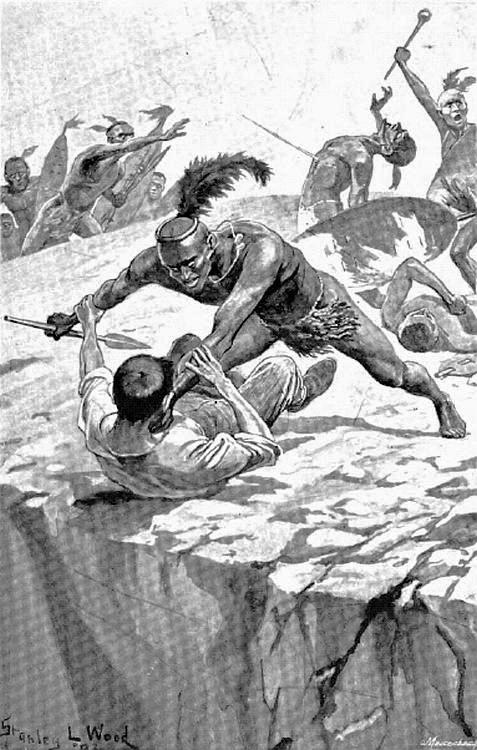
“Au, ’mlúngu! I told you our meeting would be a long one,” growled Vunawayo, between his set teeth, as they rolled nearer and nearer to the brow of the cliff. Gerard the while felt every muscle in his powerful young frame cracking, strained as it was to prevent the savage from freeing the hand which held the assegai. Moments seemed years—nearer and nearer to the fatal brink the combatants rolled. Then the fierce and desperate savage, suddenly jerking free his left wrist, seized his adversary by the throat.
Then Gerard felt that his end had come. His eyes seemed squeezed out of his head. The whole world was spinning round with him. A tug—a final effort—his opponent had got him to the edge of the height. He was going—both were going—
The air rang with the deep-throated “Usútu!” as Sobuza and his followers came swarming over the edge of the summit. Gerard was conscious of a spout of warm blood over his face, for the moment blinding him; of the relaxing grip of his adversary; of a plunge and scuffle as the body of the latter crashed over the brink—of the grasp of powerful hands dragging him back to life and safety. Then, half choked, his brain swimming, he rose to his feet, and took in what had happened—what was happening—the last act in the suppression of the redoubtable freebooting clan.
It all took place in a moment. The summit was alive with warriors, with tossing shields and bristling weapons, all pressing forward upon one man.
He was standing fronting them like a stag at bay—standing on a projecting pinnacle of rock, balancing himself right over the abyss. He was a man of large, fine stature, and his eyes flashed with the elation of a heroic courage, as covered by his great shield, and a broad assegai flourished aloft in his right hand, he defied his slayers to approach.
“Ho, hunting-dogs of the king, here is your quarry! Come and seize it,” he shouted, in deep, mocking tones. “What, afraid? The king’s impi afraid of one man! What a sight for the spirit of Tyaka! Ha! I am the last of the Igazipuza, and the whole of the king’s impi fears me—fears me!” he repeated, in a kind of long-drawn chant—a very death-song, in fact.
Now the summit sloped down to the pinnacle of rock whereon the man stood. To attack him hand-to-hand was certain death, for his object was plain—to seize and drag into the abyss with him whoever should approach, and thus to die true to the traditions of his order, an enemy’s life in his hand. Assegais thrown at him from above he only laughed at, parrying them easily with his shield. Sobuza and his warriors were beside themselves with helpless rage. The jeering laughter and contemptuous defiance of the man goaded them to madness. But how to get at him? The chief was too proud to admit himself beaten by asking the aid of the firearms of his white allies, whereas they, in sheer admiration of the man’s desperate intrepidity, forebore to use them. Even John Dawes, notwithstanding his recent rough treatment and narrow escape from the most barbarous of deaths, could hardly bring himself to fire upon this sole survivor of the race which had so abominably ill-used him.
But the difficulty solved itself unexpectedly. The savage, seeing Gerard pushing his way to the front—seeing, too, the rifle in his hand, mistook his intentions. If they were not going to purchase the pleasure of taking his life at the price of losing one of their own, they should not have it for nothing.
“Ho, cowards!” he roared with flashing eyes. “Ho, cowardly dogs who fear one man. Go, tell your king I spit at his head-ring! Igazi—pu—za!” And as the last long-drawn note of the ferocious war-shout of his tribe escaped his lips, he turned and sprang out into empty air, and a dull, heavy thud and the clink of metal upon stones rising upward to the ears of those above, told that the last of the Igazipuza warriors had died even as those who had gone before him had died—fierce, stubborn, formidable to the end, but unyielding.
A gasp of relief, admiration, awe, went up from the spectators of this powerfully tragic scene. Then they turned to leave the mount of death.
“Whau! these are abatagati indeed!” quoth Sobuza. “But they are right valiant fighters.”
“And this, my father, what shall we do with it?” said one of the warriors, designating the body of Ingonyama, which lay just as it had fallen, covered with the great lion’s skin. “Shall we not place it on ‘the point of the Tooth,’ that even the very birds may behold the fate of the enemies of the Great Great One?”
“The king’s orders did not say that,” replied Sobuza, who was not free from motives of class-feeling. “Ingonyama was a chief, and a brave man, and now he is dead. Let him lie in peace, for was he not a chief?”
“What of this?” said Dawes, touching the lion’s skin.
“We want it not,” answered Sobuza. “It, too, looks like tagati. See! The life was let out of it and its wearer by the same hole.”
“That’s a fact,” said Dawes. “But, if you’re so particular, we are not. We are going to have this—eh, Ridgeley?” And he plucked the lion’s skin from the body of the dead chief.
The Zulus stared, then shrugged their shoulders. A white man might do all kinds of things which were not lawful for themselves, wherefore they did not think so very much of the act.
As they descended from the dreadful hill of slaughter, Dawes narrated all that had befallen him since Gerard had left—his jeopardy in the kraal, and how he had held Ingonyama at the point of his revolver, and that within a few yards of his dancing warriors; then his bold attempt at trekking away, the shooting of the councillor, Sonkwana, the fight, and his own recapture. Nothing on earth had saved him from the frightful fate to which he had been adjudged, but the fact of the lateness of the hour—that and the arrival of the king’s impi at dawn. It was too dark to put him to death that evening, and so he had spent the night a close prisoner, with so many hours of silence and darkness before him wherein to look forward to the terrible torture which awaited him the next day.
Before dawn, however, had come tidings that the king’s impi was marching upon the place, and he was dragged forth into the midst of the whole horde of exasperated barbarians, clamouring like wolves for his blood. But it had been decided to send emissaries to the king’s induna, and meanwhile he was taken to the summit of The Tooth.
“It’s a mercy you turned up when you did, Ridgeley,” he concluded. “Five minutes later, and I’d have been kicking on that stake. Faugh!”
Then Gerard, in turn, related his own experiences. Dawes listened attentively—gravely.
“It was a lucky day for both of us when you dragged that same Sobuza out of the water, over the Umgeni Falls, and a lucky day for me when Cetywayo took it into his head that it was time to suppress the Igazipuza,” he said seriously. “And it was a lucky day, too, for me the day I ran against you knocking around Maritzburg, down on your luck; for I don’t stick at telling you, Ridgeley, that there’s not a chap in forty would have carried through that blockade-running business with the pluck and dash and, above all, cool soundness of judgment you showed. And but for that, where should I have been?”
Gerard reddened.
“Have you quite done making a speech, Dawes?” he said, laughing confusedly. “Because, if so, let’s talk about other things. What has become of Sintoba, and the rest of them?”
Dawes’s countenance fell.
“Hang me if I know,” he said. “From the time they strapped me up I saw no more of the people. The Swazis were hung over here, poor devils, as you saw; but I didn’t see that. It was done just before they lugged me up. I’m afraid though these brutes have made mincemeat of them.”
“What are we going to do, now?” said Gerard. “I suppose we can trek home again.”
“Do? Why, just this. We’ll go to the king’s kraal and claim compensation for the loss of our time and liberty and all the funk we’ve been put in. And we’ll get it, too.”
“Hadn’t we better let well alone?” suggested Gerard. “We have got our stock back. Would it not be best to inspan quietly, and trek right away out of the country?”
“Perhaps it would be best in this instance,” allowed Dawes, after a moment’s pause; “though I had not intended to do things by halves. By the way, I did show an error of judgment the last time I decided to trek. I ought to have waited quietly until the upshot of your undertaking came off. Yes, I made a mistake that time. It was a direct challenge to them, so to speak. But I say, Ridgeley, what a yarn we’ll have to spin to old Bob Kingsland, when next we see him. Why, he’ll vote us a brace of the biggest liars in Natal.”
Gerard laughed. Then, at the thoughts suggested by the mention of Mr Kingsland, he subsided into silence. Not long, however, was he suffered to enjoy his own thoughts, for as they reached the foot of the pyramid a considerable hubbub greeted them.
The remainder of the king’s impi had come up. In the midst of this, hustled, pushed, occasionally kicked, and threatened at every step by a multitude of spears, were three unfortunate natives.
“Kill them!” “Cut them to pieces!” “They are Igazipuza!” “We saw them in the fight!” “They have washed off their red wizard’s mark!” were some of the tumultuous shouts which went up from the crowd.
“Amakafula? Hau! Only listen to that! No. They are Igazipuza, cowardly dogs, not like the rest, who were brave!” roared the savages, who, having tasted what should have been enough blood, clamoured for more. The lives of the wretched men seemed not worth a moment’s purchase. An exclamation escaped both Dawes and Gerard simultaneously. They elbowed their way right into the excited crowd.
“They speak truth, amadoda!” cried Dawes. “They are not Igazipuza. They are my servants.”
The Zulus stared, then fell back. The delight wherewith the Natal natives hailed their master, who had come to their aid in what they imagined a most critical time, beggars description.
“How did you escape, Sintoba, and where have you been hiding?” said Dawes, wonderingly.
Then Sintoba proceeded to explain how he and Fulani and the boy had been put into a hut together, but, unlike their master, had been left unbound, and fairly well treated in general. But something they had overheard led them to attempt their escape, and in the confusion which had followed daring the mastering of the warriors to resist the invasion of the king’s troops, and the despatching of the women and cattle to a place of safety, they had succeeded in slipping away and hiding among the rocks on the opposite side of the hollow to that whereon the battle had taken place. Here they had been discovered by the victorious impi, and being taken for Igazipuza, would have been massacred on the spot but for the intervention of the sub-chief, Matela, who suggested that they should be led before Sobuza, who, with his advance guard, was then in pursuit of Vunawayo and a few surviving fugitives.
“Whau, Jandosi! Your Amakafula have had a narrow escape from the spears of our people,” said Sobuza, quizzically. “Almost as narrow a one as you yourself had from the bite of The Tooth of the Igazipuza. And now let us stand beneath the rock of death and see if these wizards have been able to take to themselves wings and fly down unhurt.”
All misgivings on that score, however, was soon set at rest. At the foot of the cliff, shattered, shivered into a horrible mangled mass, lay the body of Vunawayo—a great gash over the heart, showing where it had received the stab which had, as by a hair’s breadth, saved Gerard from being dragged over by the fierce and desperate savage. At this ghastly evidence of the terrible fate from which he had so narrowly escaped, Gerard shuddered.
“Há! Jeriji!” said Sobuza, with a grim smile. “My broad umkonto (the short-handled stabbing spear) has done its work well, as well as your fists did among those Amakafula dogs near the Umgeni. That was a great day; but this has been a greater one.”
“It has indeed, Sobuza,” answered Gerard. “And so yours was the stroke that saved my life? Well, we are very much more than quits now, at any rate.”
Close beside the shattered remains of Vunawayo, lay those of the warrior who had leaped of his own accord from the summit, choosing rather to die by his own act than that his enemies should have the satisfaction of boasting that they had slain him.
“The wizards have died hard, and we have had a right merry fight,” said Sobuza, turning away. “With more men we could have crushed them quicker, but then we should not have had so grand a fight. I think, Jeriji, that the Great Great One knew this when he sent but a thousand men, for in such blood-letting do we keep our spears sharp in these peaceable times.”
As they rejoined the impi, it became evident that an altercation of some kind was going forward; the parties thereto being a young unringed man and an Udhloko warrior.
“It is mine, I say!” vociferated the former, who was being backed up by more and more of his friends. “It is mine! I won it!”
“You won it!” was the contemptuous reply of the kehla. “Ha! umfane (‘Boy,’ i.e. an unringed man). I have it. I took it. Come now, you, and take it!”
“I will,” shouted the other in answer to this direct challenge. And supported by a gathering number of his friends he rushed upon the ringed man. The latter, however, seemed equally well supported. Spears waved threateningly as the parties confronted each other. It seemed as if civil strife was going to follow upon the extermination of the legitimate enemy.
“Peace!” cried Sobuza, sternly. “What it this, that the king’s hunting-dogs snarl against each other?”
“This, father,” appealed the young warrior. “That gun is mine. I won it fairly. Jeriji promised it. He said, ‘If you get near Jandosi when we attack, if you are the first to reach his side, that double gun shall be yours. I promise it.’ That was the ‘word’ of Jeriji. And was I not the first to reach his side, I and my kinsmen? Whau! There is Jeriji. Ask him, my father. Ask him if such was not his word?”
“Nkumbi-ka-zulu speaks every word of the truth, induna of the king,” said Gerard. “I did promise him the gun on those terms, and he has won it fairly.”
Thus called upon to adjudicate, Sobuza heard what the other side had to say, and the fact that the warrior in whose possession it now was had only picked up the gun instead of having taken it from an enemy in battle went far towards simplifying matters. It had been thrown away early in the conflict by Vunawayo, who, not understanding firearms, had been so violently kicked at the first discharge that he had elected, and wisely, to fight with such weapons as he did understand. So the chief decreed that Nkumbi-ka-zulu had fairly earned the weapon, and it was handed over to him forthwith, to the huge delight of the young warrior and his friends, and as Gerard promised to make some sort of present to the man who had been dispossessed, the dispute was settled to the satisfaction of all parties.
“Pooh! Don’t mention it!” declared Dawes, in reply to Gerard’s apologetic explanation of how he had come to pledge away what was not his property. “You could not more completely have hit upon the right thing to do. If you had been as near that beastly stake as I was, Ridgeley, you’d think you had got off dirt cheap at the price of a gun, I can tell you. Besides, are we not in the swim together and jointly? That young scamp, Nkumbi! Well, he has earned it fairly this time, more so than by jockeying us over it as he tried to do before. Eh, Nkumbi?” And Dawes translated his last remark for the benefit of the young warrior, who, with his confederates, received it with shouts of laughter and great good humour.
The open plain in front of the kraal was one great sea of stirring life as the impi came up. Thither were gathered all the cattle of the Igazipuza, upwards of a thousand of them, and numbers of sheep and goats. Among these squatted or moved dispirited groups of women, sad-faced and resigned; even the children seemed to have lost their lightheartedness, and cowered, round-eyed with awe and apprehension. All had been collected and assembled there by a portion of the king’s force told off for the purpose, and were to be taken as captives and spoils to the king’s kraal; and these were started off thither there and then.
But before this was done an earnest conference had been held between the two white men and the Zulu leaders. After all that had taken place, said John Dawes, he and his comrade were extremely anxious to trek away home. It would be highly inconvenient to travel all round by Ulundi, though on another occasion they hoped to pay a special visit to the king. Meanwhile they had now recovered their cattle and trek-oxen, and they would like to leave the Zulu country for the present. But in consideration of the valuable aid rendered, at any rate, by Gerard, to the king’s troops, and further as some compensation for the detention and peril they had undergone, at the hands of those who were, after all, the king’s subjects, he proposed that Sobuza should award them a share in the cattle seized from the Igazipuza.
The chief took snuff and began to deliberate. He was not sure whether he could do this upon his own responsibility, he said. Recovering their own property was one thing, claiming an award out of the “eaten-up” cattle seemed very much another. How many did Jandosi think would meet his requirements?
Dawes replied that seventy-five head about represented a moderate compensation. Sobuza, however, did not receive the proposal with enthusiasm. Finally it was agreed that sixty head should be allowed, on the express stipulation that no further claim should be made upon the king or the Zulu nation either by the two white men or any of their native followers. As for driving them, he, Sobuza, could not assist them. He was responsible to the king for every man in the impi, and could not upon his own responsibility send any of the king’s subjects out of the Zulu country. The difficulty, however, might be met by pressing into the service two or three of the Igazipuza boys who were young enough to have escaped the massacre of the fighting men and old enough to understand cattle-driving. So, having obtained their share of the spoil, Dawes and Gerard bade a cordial farewell to Sobuza and the Zulu impi, and inspanned, and once more the crack, crack of the whips and the shouts of the drivers, Sintoba and Fulani, resounded cheerily as they started for home.
But the errand of the king’s troops was not quite completed. The hollow had been effectively scoured in search of fugitives hiding away, but none such had been found. Save the few who had broken through, only in order to make their last stand upon the summit of the Tooth, none had thought of escape. All had fallen where they had stood, fighting desperately to the last.
“Now will we put in the fire to this nest of wizards!” cried Sobuza aloud.
Hardly had he given the signal, than smoke was seen rising from the huts, gathering in dense volumes, and, lo, from four different points simultaneously, bright flames broke forth, and as the whole huge kraal, now one vast sheet of leaping, devouring fire, gave forth in uninterrupted salvo its heavy crackling roar, there went up from the ranks of the king’s warriors, mustering in crescent formation to watch the completion of their errand of retribution, the thunder of a fierce war-song of victory and exultation.
“As lightning we smote them, Where, where are they now? The sons of the lightning, The wizards of thunder? Where, too, is their dwelling, Their cattle, their cornfields? “The bolt fell upon them, The thunder-cloud smote them; The might of ‘The Heavens’ In fury it burned them— It smote and it burned them— Its ruin destroyed them! “The wizards are scattered In blood and in ashes; The roar of the Lion In thunder pursued them; The praise of the Lion His children re-echo; The praise of the Lion, The Lion of Zulu, The Lord of the Nations!”
The flames sunk low, sunk into red heaps of ashes pierced with bright and glowing caverns. A dense cloud of smoke overhung the hollow; and now the king’s impi, marching in companies, was moving up towards the ridge. The two waggons, with their full spans of oxen creaking up the rocky way, had already gained the entrance to the hollow, and their owners, riding on horseback, for both the steeds had been recovered too, paused for a moment on the ridge to look back. Their peril and captivity was at an end. They were being brought out in something like a triumphal procession. Far on in front, the dust was rising from the great herd of cattle and the crowd of captives. Behind, below, lay the gruesome and blood-stained hollow. The thunder of the war-song echoed from the slopes, and the rhythmic movement of the lines of shields of marching warriors was a fitting accessary to the lurid background of the picture, the amphitheatre of cliffs, “The Tooth,” the pyramid of Death in the centre, its dismal burdens still dangling against its face, and below, the great smouldering circle of blackening ashes, while the dense smoke cloud mounting to the heavens in the grey and murky noontide, as from the crater of a volcano, proclaimed to all, far and near, that the king’s justice had been executed, and that the power of the dreaded, indomitable, bloodthirsty Igazipuza had now become a thing of the past.
Chapter Twenty Five.
The Last of all our Friends.
Maritzburg again. Gerard, strolling through the busy streets, keenly enjoying the bustle and stir of civilised life after his wild experiences in savage lands, now no longer to him a sealed book, can hardly realise that it is the same place, that he is the same being. Could it be through those very streets that he hurried so eagerly in search of what might bring him a bare subsistence; returned so despondently from each successive failure? Now he felt himself the equal in experience and resource of pretty nearly every man he met. He felt his feet, so to say, and felt them firmly. He felt now that wherever he was put down he could make his way.