INTRODUCTION
Kumārajīva translation
Historical
By whom was this classic given? Devout Buddhists in the Far East say it contains the very words of Śakyamuni, the Buddha, his final teaching spoken towards the end of his days on the Vulture Peak in Nepal. Equally devout Buddhists in Ceylon, Burma, and Siam declare that it was entirely unknown in the ancient Canon, that it contradicts the essential teaching of the Buddha, and that it is the invention of a much later age. Thus we see Buddhism separated into its two great divisions, and it is over the works, of which The Lotus is the most representative type, that the division of Hinayana and Mahayana arises. These two terms were invented by the Mahayanists, who form the “Northern” School of Buddhism, that is the Far Eastern School now found in China, Japan, Korea, Mongolia, Tibet. The Hinayanists are the “Southern”, or Orthodox, School of Ceylon, Burma, Siam. Hinayana means Small wain, or vehicle; Mahayana, Large wain, or vehicle. By the Northern Buddhist, Hinayana is charged with conveying only the few to Nirvana, that is, those seeking salvation by the arduous way of works. Mahayana, on the other hand, professes to open the way for the many, indeed finally for all. Consequently Mahayanism is another term for Universalism, or Catholicism.
In Mahayana, salvation is attained not by laborious effort, but simply by faith in the Buddhas and Bodhisattvas. The great Bodhisattvas in particular are objects of faith and invocation. They are not historical beings but idealizations. Accredited with a vow not to enter into the final bliss of Buddhahood until all creatures are saved, they instantly respond to all who call upon them. Their salvation is not to a Nirvana of individual extinction or annihilation, but to heavens of joy-and blessedness. Such happiness is infinite, to which all will finally attain. Those who claim it now by faith and invocation will escape the perils and pains of reincarnation. Those who delay their belief will continue to suffer until they cry for salvation, as they ultimately will cry.
Here lies the contrast, the difference, between the one School and the other—a difference at least as fundamental as between Roman and Reformed Christianity. But Roman and Reformed virtually make appeal to the same Book, or collection of books, the Bible. Not so is it with Hinayana and Mahayana, for they appeal to two differing sets of textual authorities. Hinayanists claim, with a measure of justice, that their texts are the only ancient and valid canons, and that these alone contain the real teaching of their Founder. Mahayanists, it is true, claim all those texts equally with their rivals, but declare that they were only the Buddha’s preparatory teaching, suited to the immature degree of his disciples’ immediate development. They insist that their Mahayana texts were his developed doctrine, given towards the end of his ministry, when his disciples were mature enough to understand his spiritual interpretation of the universe and of universal truth. They say that his attitude, during the period of Hinayana texts, was similar to the attitude of the schoolmaster, who leads on his pupils according to their ability through the preparatory stages, but when they are sufficiently grounded reveals to them the higher learning. Consequently they claim that the Buddha only in the later stages of his life and before his departure, made the full revelation. This perfect revelation, they assert, is only to be found in the Mahayana texts; it is a revelation of the “All-Truth” which his disciples had been trained by easy stages finally to apprehend in its fullness.
The detached mind will not easily be beguiled into acceptance of the Mahayanist’s special pleading. Mahayanists have not a shred of real evidence to show that the Buddha ever delivered any of the addresses attributed by them to him. All the weight of evidence is indeed against them. Whatever evidence there is rather supports the Hinayanists’ claim to Apostolic Succession. Though these may not possess documentary evidence of the Buddha’s actual sermons, at least the Sutras of Southern Buddhism may be considered as in the direct line of his teaching. As to the Mahayana Sutras, the unprejudiced cannot doubt that they are the invention of a later period, and that Mahayanism is a shoot grafted on to the original stock of the Buddhist Bodhi-tree. Whence, where and when this scion was grafted is still unknown. There are able scholars who assert that there is no need to look abroad for Mahayana ideas, because their embryo can be discovered in the orthodox scriptures. But there seems more justification for supposing the new scion to be of external origin, grafted on to Buddhism, perhaps in Northern India, perhaps still farther north in Central Asia. Whatever its origin this scion, grafted into the old tree, produced fruit of a different quality, more attractive to the eye and the taste; it was this off-shoot that struck in the north and east of Asia. The original stock grew older, died in its native soil, and was only saved by a branch which had been transplanted away from its native hills with their wintry snows to the southern sun, where it survives.
We may say, then, that The Lotus never had any direct connexion with Śakyamuni. It was the brilliant concept of a later age. The author, whose name and place of origin are unknown, was one of the world’s greatest Apocalyptists. He was gifted with a rare imagination, and with remarkable dramatic powers which appeal to an imaginative and florid race. He was endowed with talents of detail and repetition that, while tedious and often puerile to our sated taste, were of prime value in capturing the attention of his readers and in impressing his story on a leisurely people. His brilliant drama of spiritual things has outshone his name, while unconsciously he has been one of the chief instruments in dividing Buddhism. The inspiration that was to weld a fracture already yawning split it permanently in two. The two segments remain apart. The Southern Buddhists of Burma, Ceylon, Siam guard the treasure of the earthly Buddha’s law, as they now guard the coffin supposed to contain his earthly remains so recently recovered. The Northern or Far Eastern Buddhists guard the treasure of an Eternal Buddha, of whom the earthly Buddha was but a temporal manifestation. Thus does Mahayana, or the universal chariot of salvation, compare itself with the Southern Hinayana, or the small chariot of laborious “works”, which saves the few. In reality Mahayanism is, as the Southern Buddhists believe, a betrayal of Śakyamuni Buddha, in the interests of doctrines he never taught and which are a reversal of his principles, as recorded by his disciples.
As to the author, not only is his name unknown, but even the region of his origin is equally obscure. Presumably the writer composed the work in Sanskrit and in Northern India; it may, however, have been composed farther north in Central Asia. Though its date or period is not discovered, it seems to have been both a product, and perhaps a producer, of the reaction against the formalism which had fallen upon ascetic Buddhism.
Was it the offspring of ideas which had already hailed the dawn of spiritual liberation across Western Asia? That is a question to which as yet there is no sufficient answer. Whatever the answer may be we now know that Buddhism, at the beginning of the Christian era, was a potent religious force across Central Asia, that its missionaries had already reached Western China and that, during the first century of our era, the religion, in a form clearly not of the Mahayana order, was welcomed at the Imperial Chinese Court. The Scythian ruler of Northern India, Kanishka, gave it his ardent support during that century, as the ruler Aśoka had done centuries earlier. That the Buddhism of Kanishka’s period differed from the original cult is probable, but we do not yet know in what respect.
It must not be assumed that the new doctrines of salvation, which found their expression in the tractate “The Uprising (Awakening) of Faith” and in “The Lotus Sutra”, were necessarily created by these works. It is more likely that those doctrines only found their ultimate expression in these works. Nor can we assume that they were known before Christian influence was felt in the lands of the new Buddhism. Though by no means convinced, or concerned, that Christian influence had anything to do with the creation of the new cult, yet I cannot ignore the fact that the first assured appearance in China of The Lotus was towards the end of the third century A.D. The Christian Church in India, whose foundation is attributed to the Apostle Thomas, may or may not have existed. That is perhaps a matter of minor importance to our subject in comparison with an influence of recognized potency, namely, the interchange of ideas which spread east and west along the remarkable trading corridor that stretched from Northern China to the Mediterranean. Graeco-Bactrian art is an instance of such propagation. Whether this uprising of the human spirit was a natural protest against priestcraft and ritual, is a question more easily put than answered. Here I can only call attention to the undoubted interchange of such ideas as existing before and after the Christian era.
We are on surer ground when we seek to trace the story of the translation of The Lotus into Chinese. The first partial version, of which no copy exists, was made by an unknown author in or about A.D. 255–6. Another lost version in twenty-eight chapters was made in A.D. 265, by the monk Dharmaraksha. He, or another of the same name, apparently made another version in A.D. 286 which still exists. A fourth version, now lost, was made by a translator of unknown origin in A.D. 335. The fifth version, which holds the field, is that from which the present excerpts are made. Its literary quality shows that it could only have been composed by very scholarly Chinese. But the actual translator to the Chinese pundits was Kumarajiva and he completed the work in A.D. 406. Kumarajiva is said to have come to China, or as some say was captured and brought there, from Kharashar in Turkestan. Others describe him as of “Takchas’ila” (Taxila) in the neighbourhood of Chitral. From A.D. 397 to 415 he lived in the Ch‘in capital of Ch‘ang-an in modern Shensi. At that time China was in a state of partition. Yao Hsing, the Ch‘in ruler, supported and encouraged Kumarajiva, providing him with a large staff of Chinese writers for his very numerous translations and works.
A sixth version, still existing, was made in A.D. 601 by Jñanagupta and Dharmagupta, two monks reputed to be of Indian origin, and it agrees with the Sanskrit version in having twenty-seven chapters. The verses in Chapter XXV of Kumarajiva’s version were not made by him but by a Jñanagupta of the Northern Chou dynasty A.D. 557–89; whether it was the same monk is not clear.
The three existing versions then are the Dharmaraksha version of A.D. 286, that of Kumarajiva which agrees with the Tibetan version, and that of Jñanagupta. Little is known of the sources whence these versions were made. Jñanagupta says that he has seen two originals, one on palm-leaves, the other on a silk-like fabric, which differed considerably from each other. Dharmaraksha’s version he says was from that on palm-leaves, Kumarajiva’s from the fabric. The palm-leaf version seems to have been in Sanskrit; the fabric version was in Kharashar characters, the writing used in Kuche (Kwei-tz), the supposed native place of Kumarajiva. The Kharashar text used by him is said to have been older than that on the palm-leaves.
We possess, then, a version by Kumarajiva which is accepted in the Far East. The Chinese date for its translation, A.D. 406, may be accepted, for its extraordinary popularity over a thousand years ago is attested by the large number of portions brought from the Tun Huang monastery by Sir Aurel Stein and now in the British Museum. These copies, made between A.D. 533 and 972, as also an earlier commentary of A.D. 508, lay hidden in a walled-up chamber probably from the eleventh century until the present century. The discovery and the bringing of these copies to the light of the world is one of the romances of our generation. Sir Aurel, on his second intrepid journey of discovery from Kashmir to Kansu, followed the route taken by the famous Chinese monk Hsüan (or Yüan) Tsang, who in the seventh century made a pilgrimage from China to India. After crossing the dread Taklamakan desert, he reached Tun Huang in Kansu. In the cave-temple of The Thousand Buddhas the abbot in charge, while making repairs, had broken into a closed-up room, whose existence was till then unknown, where he found hidden a great collection of written scrolls. Sir Aurel, after much difficulty, secured a selection of the scrolls, and amongst them were the numerous portions of The Lotus Sutra already mentioned.
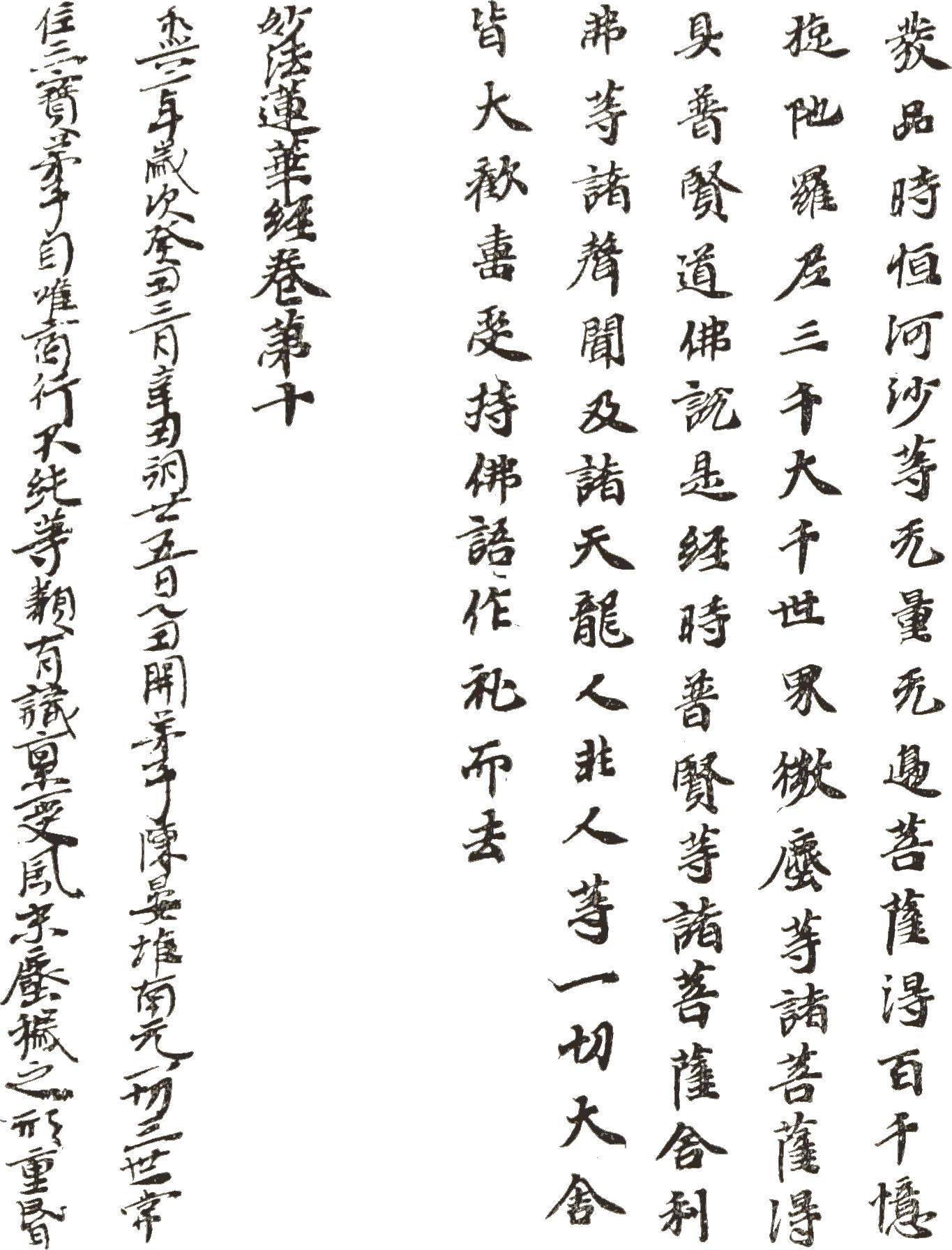
1. End of a roll of Chapter X of the Lotus Sutra in the Stein Collection at the British Museum
It was written on paper on May 4th, A.D. 533, six centuries before paper was made in Europe, The roll was found, with many others, by Sir Aurel M. Stein, in the Cave of the Thousand Buddhas at Tun-huang. The photograph shows the last five lines of the text, the name of the Sutra, chapter, date, and name and description of the writer
Transcribers Note—The right-side text of illustration:
發品時恒河沙等无量无邊菩薩得百千憶旋陀羅尼三千大千世界微塵等諸菩薩得具普賢道佛說是經時普賢等諸菩薩舍利弗等諸聲聞及諸天龍人非人等一切大?皆大歡喜受持佛語作𥘍而去 妙法蓮華經卷第十
From the Sanskrit versions previously brought to the west during the nineteenth century two translations were made, one into French, the other into English. The French version, made from a manuscript provided by Mr. Brian Hodgson, was completed by Eugène Burnouf in 1852 under the title Le Lotus de la bonne loi. The English version was made by H. Kern of Leiden in 1909; it was published, under the title Saddharma Pundarika, as vol. xxi of the Sacred Books of the East. Both these translations were made for scholars.
As yet no translation of the Chinese version has been published, yet it is the Chinese version which is most in use in the Far East. There indeed The Lotus Sutra has its home; to many of the sects of “Northern Buddhism” it is a fundamental work, and by all it is highly valued. To “Southern Buddhists” it is, as already stated, heterodox and contrary to the teaching of their founder Śakyamuni. The complete text has now been translated into English by Mr. Kato and myself and it is hoped will yet be available to the Western student of Buddhism. It will be of value to those who wish to read in its entirety one of the oldest and most popular works giving the fully developed Mahayana doctrine. Nor will it be less useful to many who desire a work replete with Buddhist terminology which, translated phrase by phrase, can easily be compared with the Chinese text.
The Kumarajiva version, on which the present synopsis is based, is especially remarkable for the skill shown by the Chinese scholars in rendering his oral translations into their own written language. His version is probably more a paraphrase than a literal translation, but in the absence of the original text it is difficult to speak with assurance. However that may be, the Chinese scholars produced under him a work of great literary merit. The form of construction is strict and difficult, and the skill shown in the prose is as great as in the poetic part. A more gifted pen may yet reproduce the measure in English where my efforts have failed. Such failure has at least emphasized my opinion that Kumarajiva’s Chinese version is one of the world’s literary masterpieces.
Form and Content
In Kumarajiva’s version, as in Dharmaraksha’s previous translation, there are twenty-eight chapters. In the Sanskrit version and in Jñanagupta’s Chinese translation there are twenty-seven. The difference is brought about in Chapter XI of the Sanskrit, which is given in two parts by the two first-named translators, making Chapters XI and XII.
From the first to the twenty-first chapters of Kumarajiva’s version almost everything is said first in prose then in verse. The same remark applies to the corresponding chapters in the Sanskrit. The remaining chapters in both are without the verse repetition, with the noticeable exception of the twenty-fifth chapter on Avalokiteśvara, i.e. Kwan-yin or Kwannon which, both in the Chinese and the Sanskrit versions, has prose and verse.
Each section, prose and verse, would, if separated, make a fairly complete whole. Whether the verse section, the gathas, preceded the prose is a question that Sanskrit scholars have not yet decided. Linguistic differences suggest that the drama was first composed in verse, and that the prose section was introduced later. The question can only be decided by those competent to judge. At present we must accept the version as it stands, The verse part in general follows the tenor of the prose discourse, but the differences are many. All the prose sections in Chinese are done into short sentences of similar length, which can be read rhythmically. All the verse parts differ in form from the Sanskrit, being in lines of sometimes four, sometimes five monosyllabic words to the line. In the translation here offered no attempt has been made to recast the order of the prose sentences or the verse lines; for with rare exceptions it has proved possible to translate them phrase by phrase, or line by line, thus providing the reader with a translation conveying the structure of the original in its presentation of ideas. No language not monosyllabic could possibly portray the form.
The following quotation from Chapter II may be taken as an example of the verse rhythm, if read as a four-beat measure:
“List well to the Law Obtained by the Buddhas, Which by infinite tact They expound to the living, Whose inmost thoughts, The ways they tread, Their desires diverse, Their former karmas, The Buddha knows well. Hence with reason and parable, Terms and expedients, He leads all to rejoice, Telling them sutras, Or poems, or stories, Or marvels, or reasonings.
To some I preach Nirvana, An expedient to lead them To enter Buddha-wisdom, But to these I’d not yet said ‘You all shall become buddhas’, For the time had not arrived.”
From the first chapter we find The Lotus Sutra to be unique in the world of religious literature. A magnificent apocalyptic, it presents a spiritual drama of the highest order, with the universe as its stage, eternity as its period, and Buddhas, gods, men, devils, as the dramatis personae. From the most distant worlds and from past aeons, the eternal Buddhas throng the stage to hear the mighty Buddha proclaim his ancient and eternal Truth. Bodhisattvas flock to his feet; gods from the heavens, men from all quarters of the earth, the tortured from the deepest hells, the demons themselves crowd to hear the tones of the Glorious One.
Though the divine Speaker is the Buddha, even the earthly Śakyamuni Buddha, no longer is he the human Buddha, but the Eternal One. On earth he had assumed the human form with all its limitations. Now he reveals himself, sub specie aeternitatis, as the Eternal, Omniscient, Omnipotent, Omnipresent Buddha, creator-destroyer, recreator of all worlds, every world a Lotus rising from the waters to flower, shed its fragrance and die, only that fresh flowers may eternally spring.
The scene opens with the Buddha seated on Mount Gridhrakuta, or the Vulture Peak, in Nepal. Here the mount on which he had taught is spiritualized. Around him are gathered his 12,000 purified disciples, thousands more who had not yet completed their course, 80,000 bodhisattvas, 60,000 devas or gods, Brahma and his following of 12,000, dragon-kings with their hundreds of thousands, and demon kings with hundreds of thousands of followers. There, to all these orders of living beings, the Buddha displays the meaning of the Infinite, while from heaven there rain down countless showers of superb flowers filling the air with their fragrance, and all the universe is shaken.
From the centre of his forehead the Buddha sends forth a ray of light which lights up 18,000 worlds to the east, upwards to their highest heavens, downwards to their lowest hells. In like manner he shines upon and reveals the worlds in the other quarters, with all their living beings. In every world is revealed a Buddha teaching vast congregations of disciples.
Thus does the Buddha reveal his infinite worlds in infinite time. It is a colossal conception, expressed with an art that appeals to all who can enter into the spirit of the drama and allow the mind to imagine so tremendous a scene.
In the second act, Chapter II, the Buddha is presented coming forth from a trance-like meditation to explain why he had heretofore confined his teaching to the narrower way of works, while now he makes the greater revelation of faith. As a wise master he had been compelled to follow the tactical method of expediency, because his disciples could not receive the higher wisdom, the more brilliant light, except by previous preparation. Only a Buddha, an Enlightened One, can fathom the meaning of All Existence, and his disciples, in their lower stage of wisdom, would never have been able to believe it possible that they also were called to Buddhahood, to the fullest enlightenment of the Buddha himself. Hence he had to lead them on by measured steps. Even now his All-truth is so vast that he fears to express it lest “all the worlds of gods, men, and demons be startled and perplexed and the doubting amongst his disciples fall into the great pit”. So portentous is the air, and so filled with doubt and foreboding are the hearts of his hearers, that multitudes withdraw, unable to bear the announcement which is to shatter all their past hardly-acquired merits. Here we trace an indication of the breach between the Hinayanists who withdraw and the Mahayanists who remain. At last only the host of faithful bodhisattvas remain, and to them he declares that none but they have power to apprehend his mystery. He proceeds to tell them that though he has seemed to preach other vehicles or modes of salvation, essentially there is but One Vehicle. The other yana have been but temporary expedients. There is but the One Vehicle, that in which the Buddha himself abides, and with which he will save all creatures, bringing them to the true Nirvana, which is not extinction of existence but extinction of all ills and all ignorance. All who pay homage to the Buddha, if with but a simple flower, are thereby admitted to the fellowship of countless Buddhas. Not one will fail to become Buddha, for all Buddhas have vowed to save all beings to perfect enlightenment, that is to perfect Buddhahood.
In the third chapter comes the joyous response of Śariputra, full of ecstasy at the assurance that he is now “really a son of Buddha, born from the mouth of Buddha”, freed from all his errors and doubts and already possessed of the real Nirvana, the extinction of all ills, filled with a sublime peace. The Buddha responds telling him that in his later development he will be called Flower-Light Buddha, that he will reign over a world called Undefiled, and that wherever the feet of his disciples tread jewel-flowers will spring. Soon follows the Parable of the Burning House which is given in this volume. Śariputra, wishing to share his joy with his 1,200 brethren, asks what is to be their lot.
The answer is withheld for a time, or perhaps expressed in the form of parables; for instance, in Chapter IV occurs the Parable of the Prodigal Son, or the Seeking Father, the Buddha being the Father who seeks his wandering son and at last finds him and endows him with all his wealth. Again, in Chapter V, is the Parable of the Trees and Herbs, on which the Buddha, like a great cloud, pours his rain without discrimination or stint; fertilizing each according to its need and receptivity. After this interlude he proceeds to predict in Chapter VI the future of his disciples; for instance, he foretells that Maha-Kaśyapa will be the Buddha Radiance, his Buddha-world being known as Radiant Virtue and his Buddha-period named Great Magnificence; that Subhuti will be the Buddha Name-Form in a Realm of Jewels, in a Buddha-period Jewel-kalpa; another’s Buddha-name will be Golden-Light, and another’s Fragrance of Sandalwood. Then comes a further artistic interlude in the Parable of the Magic City on the weary way to the Land of Jewels, which forms the title and one of the subjects of Chapter VII. This parable follows on the marvellous story of a Buddha who, in his human existence, had sixteen sons, all of whom became Buddhas and preached in their generation the wonderful Lotus doctrine. In Chapter VIII the Buddha returns to the prediction of the future of his disciples, when five hundred of them learn their fate, as do others. The prediction is continued in Chapter IX when it is extended to other multitudes. There are parallels with the Revelation of St. John in that each receives a new name and dwells in a realm with a new name.
Chapter X is called The Preacher and contains an address to the Lord of Healing, or King of Medicine, in which the exceeding value of the Lotus Sutra is declared. So valuable indeed is it that if any one hear a single verse, or a single word of it, and by a single thought delight in it, their perfect enlightenment is assured. Any one who recites one verse only of the Sutra, or offers incense to it, or merely bows before it, foretells thereby his early escape from the realm of men and his translation to buddhahood. On the other hand, though all other blasphemy, even of the Buddha, may be considered light, he who blasphemes the Sutra with a single word, or abuses one reciting it, is guilty of what the Christian would term the sin against the Holy Ghost. On the contrary, he who recites the Sutra is thereby clad in the Buddha’s mantle and adorns himself with the Buddha’s adornment; such a one is worthy of the highest reverence and of the richest gifts; for the Lotus is the secret and mystic doctrine of the Buddha.
It is in Chapter XI that the drama reaches the supreme moment of its presentation. A great stupa or shrine, superbly decorated, appears in the sky, whose light and fragrance and music fill the whole earth. Gods and spirits rain flowers and perfumes upon it. From its midst comes a great voice: World-honoured Śakyamuni! Thou art able to preach to the great assembly the Wonderful Law-flower Sutra of universal and mighty Wisdom, which none but bodhisattvas can learn, and which the Buddhas keep under their own guardianship. What thou proclaimest is the Truth.
The vast multitude of disciples pray eagerly that the Occupant of this heavenly shrine may be revealed to them. They are told that he who is within is The Ancient Buddha, or as we might perhaps say, The Ancient of Days, whose name means Many Precious things, or Abundant Treasures. Infinite ages ago he had vowed that whenever in any world the Lotus was first proclaimed, there would he be in the midst. Only, if he were to reveal himself, it must be in the presence of the countless host of Buddhas who were the offspring of the Buddha he came to hear. Thereupon Śakyamuni sends forth from between his eyebrows the sacred ray of light, which illuminates all his Buddha-worlds first to the east, then to the south, west, and north, the zenith and nadir. In each direction all the Buddhas and bodhisattvas are revealed preaching to their countless hosts of disciples with ravishing voices, under jewelled canopies. The ray of light is recognized at once as the summons to attend upon the shrine of the Ancient Buddha, and hear that marvel of marvels the preaching of The Lotus. With all their vast trains they come joyfully from east and west, from north and south, from zenith and nadir, each taking up his station in the sky, seated on his lion-throne under his allotted jewel-tree. A gorgeous picture of a Celestial Durbar is thus displayed. Filled is the sky with a countless celestial host, when Śakyamuni Buddha approaches the shrine and with a sound as of thunder withdraws its bolt. The doors swing open to reveal on a lion throne the undissipated body of the Ancient Buddha, living and seated in deepest meditation. Lifting up his voice he announces that he has come, according to his age-long vow, to hear The Lotus proclaimed by Śakyamuni. To this end he beckons him to enter the shrine and share his lion-throne. Such is the Revelation of the Ancient Buddha, not as dead but as living.
Beholding all this marvel while still on the earth, the disciples of Śakyamuni now implore that they too no longer be tied to earth, but be received up to join the celestial host. Thereupon Śakyamuni, by his transcendent power, raises the whole company of his disciples into the sky and with a great voice cries: “Who is able to proclaim the Wonderful Law-Flower Sutra in this Saha-world? Now indeed is the time. The Tathagata (Buddha) must himself speedily enter Nirvana, but wills to bequeath this wonderful Sutra so that it may ever live in the world.” Therefore he calls on all present to take the great Mahayana vow.
With Chapter XII begins the difference between those versions with twenty-seven chapters and those with twenty-eight.
In the Sanskrit version our Chapter XII is the latter half of Chapter XI. Though generally considered to be part of the original text, it bears the impress of an interpolation, for the next chapter, (our Chapter XIII) follows naturally on the call just made to take the Mahayana vow. It is said that Kumarajiva omitted this part from his Chinese version, or, if he included it, that for a time it was omitted from the copies made. The hermit referred to in the opening incident of our Chapter XII is named, in the verse section, Asita. Now it is recorded that after the birth of Gautama a certain saint Asita took the infant into his arms, as Simeon did the child Jesus in the Gospel, and foretold his destiny. The chapter is styled Devadatta. This was the name of the cousin and rival of Śakyamuni Buddha, whom he is accused of trying to kill, for which it is reported he was swallowed up in hell. Nevertheless there was a sect which worshipped him as a Buddha up to A.D. 400, but his story is unreliable. By some he is said to be a reincarnation of Asita, which naturally is beyond proof. Here the Buddha is made to announce that it was Devadatta who had taught him The Lotus Sutra. The devout consider this chapter to prove that even a wicked creature like Devadatta, though doomed to hell for trying to kill the Buddha, may still be converted and become Buddha.
The chapter opens by Śakyamuni recounting that, in a former incarnation when he was a king, he devoted himself to a tireless search for the Supreme Wisdom. During long kalpas he gave alms of every kind with the utmost self-sacrifice. At last he, the king, offered to become the menial follower of any one who would reveal to him the Truth. Then it was that the hermit Devadatta called him to be his disciple, promising to teach him The Lotus Truth. He responded with joy and became his servant, for love of the wonderful truth revealed by the hermit. Śakyamuni now foretells the glorious future of Devadatta.
Soon, one of the attendants on the Ancient Buddha from a lower region, evidently a-weary, invites his master to dismiss the durbar and return home. On this Śakyamuni intervenes, requesting the attendant to await the arrival of Manjuśri who will tell of the marvellous effect of The Lotus Sutra during his preaching of it. Manjuśri arrives on a thousand-petal lotus flower and, after paying his homage to the two Buddhas, tells the story of his adventures in the Dragon Palace of the sea, where, in the deep, he has converted infinite numbers. At his call myriads of bodhisattvas arise from the ocean and are assembled on the mountain side seated on jewelled lotuses, after which they ascend into the sky to join the great multitude. Later a greater marvel occurs, for the daughter of the Dragon-king attains to The Lotus wisdom and thereby is instantly changed into a young man. It amazes the assembly for “the body of a woman is filthy and not a vessel of the Law”, whereas here, by immediate conversion, a female can enter into all the privileges of the man, even to that of becoming a king, a Brahma, a Buddha. The moral is easy to draw, that The Lotus doctrine knows no distinction of male or female, but that even a woman may enter into the fullness of Anuttara-samyak-sambodhi, or Perfect Enlightenment.
In Chapter XIII the Lord of Healing bids Śakyamuni Buddha, who is going to his Nirvana, not to have any anxiety, for he and his twenty thousand Bodhisattvas now take a vow to make The Lotus Sutra their charge. During the evil age to come they will faithfully preach it to all creatures, unsparing of body or life. Other countless followers of the Buddha take a like vow. Then the Buddha’s aunt, his foster-mother, leading her six thousand nuns, stands before him, looking sadly on his face. Realizing that they think they have been overlooked, he asks them why they have not understood? Has he not promised perfect enlightenment to all his disciples, and does not this include them? Then he promises that they also will in turn become Buddhas. His foster-mother will become a Buddha called Loveliness, and all her disciples will become perfectly enlightened. His wife, the mother of his son Rahula, he foretells will become a Buddha entitled The Perfect One of the Myriad Rays. All the women thereupon vow to preach The Lotus Sutra in all lands. Following this, the countless number of spiritual bodhisattvas, as with a lion’s roar, vow to preach the Sutra in all worlds in every direction.
The following Chapter XIV, called “A Serene Life”, is an instruction how the vow is to be kept. Rules of life for the disciple are laid down in considerable detail. His virtues are patience, gentleness, a mind unperturbed, seeing all things in their reality, or, as we might say fluid, or spiritual. There must be no intimacy with kings and rulers as such, nor with heretics, nor with authors of worldly literature or poetry, nor with players, boxers and jugglers, nor with butchers, hunters or fishermen, nor with women; he may preach to them, but have no intimacy with them of any kind. To all and in all circumstances he must show charity. Let him fear not staves nor swords, for he will be divinely protected on every hand. Then follows the parable of the king, who rewards his faithful soldiers with all his possessions, save only the lustrous jewel he wears on his brow. At last even this he cannot keep for himself but bestows it also. Thus is it with the Buddha and his priceless jewel The Lotus.
“Springing up out of the Earth” is the title of the next, the fifteenth chapter. The host of Bodhisattvas from other realms offer to Śakyamuni to remain in his realm and preach the Sutra. No need, is his reply, and from the earth spring vast, countless numbers of bodhisattvas, each of them leading forth disciples many as the sands of Ganges, who all make obeisance to the two Buddhas, the Ancient One and Śakyamuni, and walk in procession round them. Fifty kalpas, or myriads of years pass while thus they march, though it seems but as half a day. Whence came they? ask the disciples. Then the Buddha calls forth Maitreya, who is the Buddha-to-come, and to him announces that these are the disciples he has taught through vast ages, who now dwell in a vast realm below the earth in the Space-region of the world. But, how is it possible that Śakyamuni in so short a lifetime can have taught such a vast multitude? ask the disciples astonished. Through Maitreya they express their doubt while depicting in detail the brief life and period of Śakyamuni.
This leads in Chapter XVI to the climax of the drama, where he reveals that his life is hemmed in by no bounds of time and space, for he is eternal. The chapter is called The Revelation of the Buddha as Eternal. “Since I veritably was Buddha, infinite, boundless, hundreds, thousands, myriads, kotis, nayutas of kalpas have passed.” With much illustration, as will be found in this volume, he tries to explain the incalculable meaning of eternity and claims that he has always been Buddha. He describes his eternal being, his omniscience and his omnipresence. He tells them he must leave them for their own good, because even a Buddha may only appear at rare intervals, for familiarity breeds contempt, even for a Buddha. All this he shows in the Parable of the Good Physician, whose sons drink poison and refuse his remedies till he temporarily departs and leaves them.
In the next Chapter XVII, he tells Maitreya that, during the time that he has been proclaiming the Eternity of his Life, beings countless as the sands of Ganges have been saved, and numberless others attained enhanced powers. Flowers, incense, jewels rain down from heaven upon the two Buddhas in the heavenly shrine, while all the Bodhisattvas sing countless praises with heavenly voices. Vast and eternal are the rewards promised to the true believer, all expressed with a wealth of detail impossible to repeat here.
In Chapter XVIII, called The Merits of Joyful Accordance, the Buddha recounts still further the reward that will follow the merit of believing in The Lotus Sutra. Other merits of untold value are discussed, but the merit of faith in The Lotus surpasses all these myriad-fold. On earth the believer will be free from every ailment, for instance, “his teeth will never be dirty, black or yellow, nor in gaps, nor fall out, nor be irregular, nor crooked, his lips will not be pendulous, nor twisted and shrunk, nor coarse and rough, nor have sores and pustules, nor be cracked and broken, nor awry and out of shape, neither thick nor big, neither sallow nor black, having nothing loathsome; his nose will not be flat, nor crooked and distorted,” and so on in further detail. Hereafter he will be born among gods or men, possessing elephants, horses and carriages, jewelled palanquins and litters, and every other luxury.
Further rewards are promised in Chapter XIX—rewards for merits of eye, of ear, of nose, of tongue, of body and of mind, all which are separately described. With his ear he will hear the sounds of his entire universe, from its highest heaven to its lowest hell, the sounds of elephants, horses, oxen, carriages, wailing, lamentation, conches, drums, gongs, bells, laughter, speech, men, women, boys, girls, the lawful, the unlawful, pain, pleasure, and so on, the sounds of its Bodhisattvas and Buddhas being included. In like manner are the other organs presented in unstinted detail.
This is followed by Chapter XX on the Bodhisattva “Never despise”. Wherever he met a person, good or bad, he always addressed him with reverence, as one whose final destiny was buddhahood. Ignorant of everything else, and always repeating “You are to become buddhas”, he stirred people to anger. They beat him severely, while he still saluted them and told them they were destined to buddhahood. As he drew near the end of his normal term of life, he acquired control over the six organs referred to in the last chapter and became possessed of the rewards attached thereto. So influential did he become that all those who had despised and beaten him, chief among whom were his fellow-monks and nuns, became his disciples. After his translation he entered the company of myriads of Buddhas in Light. Then the Buddha, after telling this story, says, I myself was that Buddha “Never Despise.” The persecuting monks are, of course, those of the Hinayana, the persecuted those of the Mahayana.
In Chapter XXI the “Divine Power of the Buddha is revealed”. The method of the revelation of power is startling and far from attractive to the Western mind, but it indicates the value of lingual enlightenment. All living beings in all the universes now assemble together before the Celestial Shrine, and flowers, incense, garlands, canopies, jewels, and every precious thing fill the sky like gathering clouds, being transformed into a mighty jewel-canopy above the Buddhas. Śakyamuni again addresses the gathered host in praise of this Sutra, which he declares contains all the law of the Buddha, all his sovereign powers, all the mystery of his treasury.
“The Final Commission” is the title of Chapter XXII. Śakyamuni by supernatural power places his hand on the heads of the countless Bodhisattvas present, entrusting to them The Lotus law of Perfect Enlightenment. The Tathagata is described as the Great Lord of Giving and they in like manner must give this Sutra to all. Thereupon Śakyamuni dismisses all the Buddhas from all the other Buddha-realms: “Buddhas! Peace be unto you. Let the stupa of the Buddha, Abundant Treasures, be restored as before.” On this all depart rejoicing greatly that they have heard the preaching of Śakyamuni.
It seems probable that the author here ended his drama, though it is noteworthy that this chapter is not done into verse and that, with the exception of Chapter XXV, no further verse portion is found. Nothing is said about the entry of Śakyamuni into his Nirvana, but that may be an artistic and intentional omission. Six more chapters follow, by which presumably some later writer or writers thought to improve the work. They serve no such purpose, and Buddhism would lose nothing by their omission That they formed part of the work as it reached China need not be doubted, but the dismissal of the Celestial Assembly seems the natural conclusion for a work revealing such dramatic skill and power.
It may be added that this Chapter XXII is not, in the Sanskrit version, found here, but as the final chapter, and also in Jñanagupta’s Chinese translation. In Dharmaraksha’s version, Chapter XXV on Avalokiteśvara, or Kuan-yin, precedes it. This may be an indication of the position already gained in the third century A.D. by Kuan-yin, the Regarder of Cries. The remaining chapters are, however, clearly hors d’œuvre, and spoil the drama. Whether it was for this reason that Kumarajiva placed the Final Commission here, or whether such was its position in the text he used, can at present only be matter of conjecture. In the Sanskrit version our Chapters XXIII to XXVIII are interpolated, or so it would appear, the present chapter being put last. That Chapters XXIII to XXVIII have been considered as additions seems also evident from the different order in which they appear. Kern points out that the Sanskrit and Jñanagupta’s versions take as their order our Chapters XXVI, XXIII, XXIV, XXV, XXVII, XXVIII, and XXII; while Dharmaraksha’s order is our Chapters XXV, XXII, XXIII, XXIV, XXVI, XXVII, and XXVIII.
Assuming then, what is doubtful, that our Chapter XXII is the final chapter of the original apocalypse, and that the remaining six are by later writers, though as early as the third century A.D., we find in Chapter XXIII “The Story of the Bodhisattva King of Healing”. It may be noted that sickness and religious healing are closely associated in Buddhism. The King of the Constellation-flower asks Śakyamuni-Buddha why the King of Healing wanders through, and suffers in this universe, healing countless diseases. The Buddha in reply tells him that, in ages gone by, there was a Buddha called Brilliance of the Sun and Moon, who finally preached The Lotus Truth to one of his numberless Bodhisattvas called Beautiful. Beautiful thereupon entered into the samadhi known as the Revelation of all forms, or things. In thank-offering he resolved to offer up his body to Buddha Brilliance. Before doing so for full twelve hundred years, he partook of all the fragrant flowers, oils, resins, and incense, and also anointed himself with sweet unguents. Finally, he bathed in perfumed oil, wrapped himself in a celestial garment and, by his transcendent will, burnt his body as a sweet-smelling offering to the Buddha who had revealed to him The Lotus. Its brightness illumined worlds numerous as the sands of millions of Ganges rivers. It is in this chapter that we first meet with dharanis, or magic spells. When the Buddha Brilliance enters Nirvana, it is to his disciple Beautiful that he commits The Lotus Law, bidding him distribute his relics and erect over them thousands of stupas. After burning the Buddha’s body, the disciple collected 84,000 relics and over each built an immense and beautiful stupa. Still not satisfied, he burnt off his arms in homage, but after a vast interval, during which he was honoured of gods, men, and demons, his arms were restored to him. Therefore, if any one “is able to burn a finger of his hand, or even a toe of his foot, in homage to a Buddha’s stupa, he will surpass him who pays homage with domains, cities, wives, children” and so on. It was this disciple Beautiful who became the King of Healing, and such is said to be the power of this his sutra, that “if a man be sick, on hearing it his sickness will instantly disappear, and he will neither grow old nor die”.
The next Chapter XXIV tells the story of the Bodhisattva Wonder-Sound, in the realm of the Buddha, King Wisdom of the Pure-flower Constellation. He had attained to a great number of samadhis, or trance-like concentrations, the names of which are given. Seeing the ray of light from Śakyamuni Buddha’s brow, he seeks permission to visit this world. The Buddha-king warns him that this is a world of great ruggedness, “full of earth, stones, hills, and filth, the body of the Buddha is short and small, and all his Bodhisattvas are small of stature”. Then Wonder-Sound enters into a samadhi, and first projects 84,000 jewel lotus-flowers, with stalks of gold, on to Mount Gridhrakuta, a sign which Śakyamuni recognizes as portending a visit from Wonder-Sound with his 84,000 disciples. Manjuśri asks the reason, whereupon the Ancient Buddha, Infinite Treasures, (who departed in Chapter XXII) is reintroduced calling on Wonder-Sound to reveal himself. Then is told the story of his previous existences, how he had lived as a god or a demon, a king or a citizen, a monk or a woman. He is able to transform himself at will in order to save the living through The Lotus doctrine.
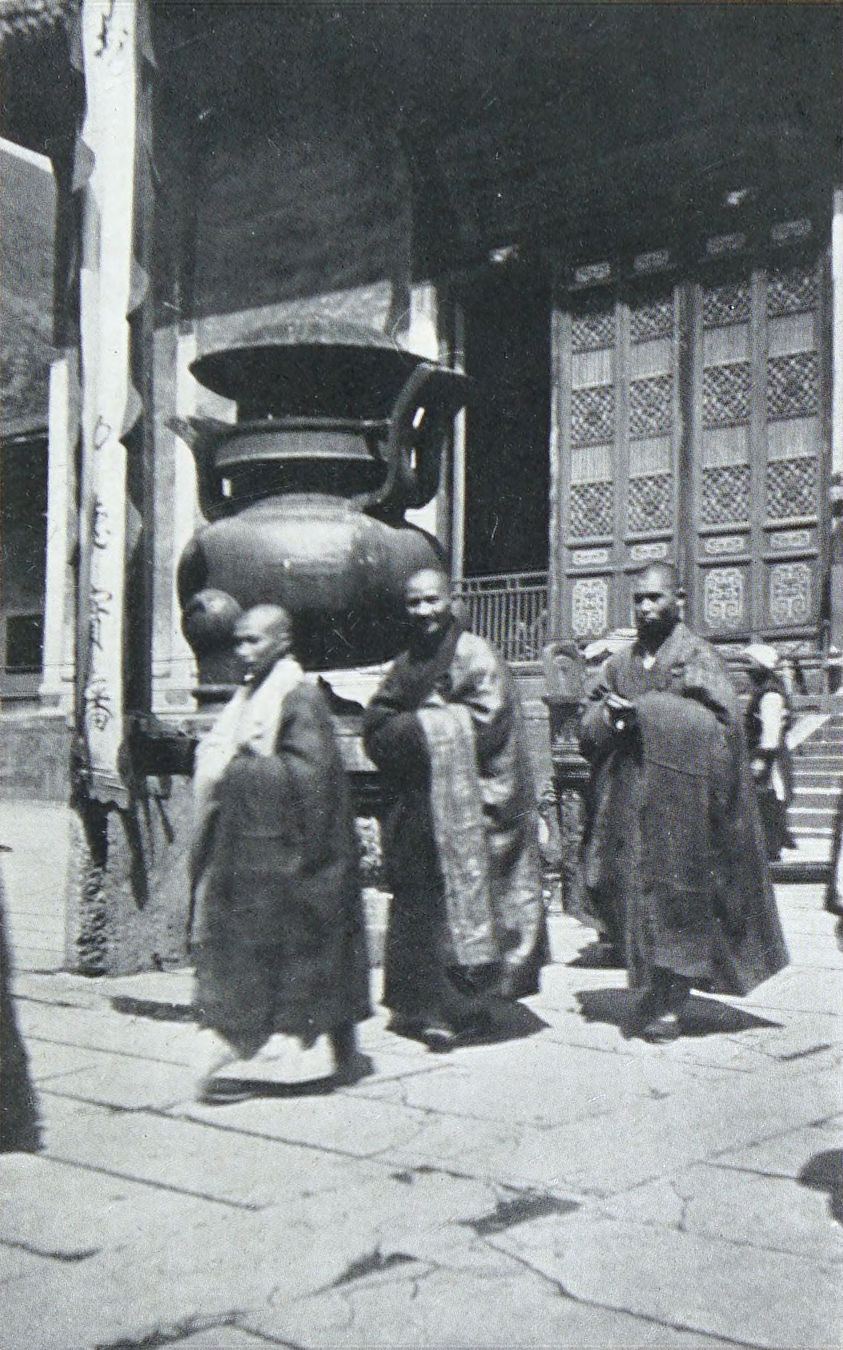
2. Monks returning from worship, Hangchow
The importance of Chapter XXV lies chiefly in its being the oldest reference we have to the Bodhisattva Avalokiteśvara, translated into Chinese as Kwan-yin, into Japanese as Kwannon, and commonly known among Occidentals as The Goddess of Mercy. Being asked by the Bodhisattva, Infinite Thought, why this Bodhisattva is known as Kwan-si-yin, “Regarder of the Cries of the World”, the Buddha replies, it is because whoever in pain and distress call upon Kwan-yin their cries will instantly be heard and answered. If they fall into fire it will not burn them, nor floods drown, nor gales destroy. The cry of one will save all the company. The menacing sword will be snapped, and the wicked demon be unable to see the suppliant; the prisoner, guilty or innocent, will be released; the jewel-trader in peril on the road will be protected; the sufferer from carnal passion, anger, infatuation or other moral difficulties will be freed from them; women desiring sons will bear them, happy, virtuous, and wise; or, if daughters, then good in looks and character, beloved by all. Whoever worships myriads of other Bodhisattvas has vast merit, but whoever only worships Kwan-yin equals the other in merit. Kwan-yin appears in infinite forms according to the need of those to be saved, and those forms are described without reserve.
Dharanis, or Spells, are the subject of Chapter XXVI. They are described as spells for the protection of preachers of The Lotus. The first are put into the mouth of the King of Healing, and the Buddha extols them. Some are spoken of as spells used by Buddhas numerous as the sands of sixty-two kotis of Ganges. Other spells are offered, even the demons bringing their contribution to protect the Preacher of The Lotus.
The story of King Resplendent is the burden of Chapter XXVII. He dwelt in the realm of the Buddha Thunder Voice. His wife named Pure Virtue had two sons, Pure Treasury and Pure Eyed. He himself at first was a heretic, though his wife and sons were devout Buddhists. The sons were earnestly desirous of going to hear The Lotus preached, but the mother urged them first to obtain their father’s permission. To convince him of their powers and fitness for the undertaking, they performed supernatural deeds, springing high into the sky, walking, sitting, lying there; the lower part of their bodies emitting fire, the upper water, or vice versa; vanishing, appearing, walking on water and so on. Convinced at last, the father decides to accompany them to hear the Buddha Thunder Voice, whereupon all the 84,000 ladies of the King’s court hail The Lotus truth. King Resplendent at once makes over his domain to his younger brother, while he, his queen, his two sons and all their retinue forsake home and follow the Way of the Buddha. The two sons who have done this Buddha-deed of converting their father are richly rewarded, one becomes the King of Healing, the other the Lord of Healing.
The final Chapter XXVIII is devoted to Encouragement of the Bodhisattva Universal Virtue. He had come from the eastern quarter with all his vast train of countless gods, dragons, yakshas, and all the beings of his realm, to hear The Lotus preached. On his arrival he vows to guard all who believe this Sutra, so that wherever any such a one walks or stands, reading or reciting this Sutra, he will at once mount his royal six-tusked elephant and with a host of great Bodhisattvas go to that place and, revealing himself, will protect him and comfort his mind; moreover, if any one forgets a single word or verse he will put it again into his memory. He will also give him dharanis, or magic spells, to ward off all foes, and to these spells he now gives utterance. All such disciples of The Lotus will ever do the works of Universal Virtue and their heads will be caressed by the Tathagatas. If any recite or copy the Sutra they will avoid every evil destiny and go straight to Maitreya’s heaven. To him the Buddha replies in similar terms, adding that any one who recites or copies this Sutra, is in reality attending on the Buddha; moreover is as if hearing him speak it with his lips, and as if covered with his robe. Such a one will later sit on a lion throne amid a great assembly of gods and men. By the power of this Sutra such disciples will no longer be attached to clothes, bed-covers, drink, food, or other transient things. If any one contemn them he will be blind for generation on generation, if he tells their faults, true or false, he will be smitten with leprosy; if he ridicules them, his teeth for generations will be sparse and missing, his lips vile, his nose flat, his hands and feet contorted, his eyes asquint, his body stinking and filthy with evil scabs and bloody pus, he will be dropsical and short of breath and have every evil disease. But those that bless and reverence him who reads or recites the Sutra will receive abundant rewards here and now.
Doctrine
Reverence for the Bible in the West has its counterpart among Far Eastern Buddhists in the reverence shown to the Sutras, especially to The Lotus. There is, perhaps, less restraint there in the expression of devotion. Such reverence is a natural consequence of the belief that The Lotus is the Ultimate Truth preached by every Buddha, once only in every Buddha-world, past, present, and to come. To the Mahayanist it is therefore the Eternal Gospel of Buddhism in all worlds and through all time. The Sutra is declared to be the last will and testament of Śakyamuni before his departure; it is his final bequest to this world. All his previous teaching is postulated as interim doctrine, that is, during the time of the disciples’ ignorance and while their minds were still bound by earth-ties and myopic vision. This final revelation is said to have been reserved by him until the eve of his Nirvana. In it he at last makes known the All-Truth, which confers Perfect Enlightenment and Final Nirvana, or Liberation. This supreme liberation cannot be attained by self-discipline and works; it can only be attained by faith and invocation. Salvation by Faith is then the fundamental doctrine of the Mahayana School. According to The Lotus teaching no sacrifice is required, no expiation, no atonement, no remorse, no repentance in the sense of contrition, nothing but faith in the infinite mercy and infinite power of the Infinite Buddha who lives and reigns for ever.
It is manifest, then, that the spiritual message of the book is revolutionary in its character. Not only are these doctrines of salvation given, but there is presented the panorama of unlimited universes, all of them ever-changing manifestations of the All-Buddha, of whom Śakyamuni is but one expression in one of infinite worlds; the assurance that the Eternal Buddha is both transcendent and immanent; the teaching that every world, every universe, is a flower of the Eternal Lotus; the call to faith as a greater force than disciplinary or ascetic works; the proclamation of the Eternal Buddha, and of his Salvation for all, even to the devils in hell; the assurance of the ultimate enlightenment of all; the universality of buddhahood for all, because all are potential buddhas, or enlightened ones—such is the inspiration of this masterpiece of literature.
The author is clearly conscious that he is boldly putting into the Buddha’s lips doctrines to which he never gave utterance, and which are not found in the orthodox scriptures. So eager is he to explain, or explain away, this fundamental discrepancy, that he devotes several chapters and parables to elucidation of and excuse for the Buddha’s complete reversal of his earlier teaching. At times he openly fears that the Buddha will be accused of having deceived his disciples and even lied to them. Unbiased minds, as well as the biased minds of the orthodox, cannot fail to recognize that the orthodox doctrines and those of The Lotus are diametrically opposed. There is, therefore, good reason why the author, who so skillfully foists the new doctrine on to Śakyamuni, should endeavour to defend his position by pretending that all the Buddha’s life had been spent in teaching an interim doctrine, using the methods of a tactician or a casuist. The author is indeed in serious difficulty. He wishes to father on to Śakyamuni, the founder of Buddhism, doctrines he would have repudiated, and to use Śakyamuni’s name and authority to change entirely the character of his religion. If this view be correct, then the pious fraud has been remarkably successful, for it is this form of Buddhism that has tamed savage tribes such as the Mongols and Tibetans, inspired people like the Chinese and Japanese to a higher spiritual and artistic development, established a cult with many resemblances to Christianity, and is now reacting, chiefly through theosophical publications, on certain lines of thought in the West. Orthodox Buddhism has had no such influence. It is the heterodox school that has prevailed.
Needless to say, the above explanation is not acceptable to the devout Mahayanist. Like the Fundamentalist in the West he refuses to have his faith shaken in the letter of the Law. The Lotus, in his estimate, was spoken by Śakyamuni on earth during his last years, all his previous teaching having been preparatory. Many disciples, who are represented as unable to receive his ultimate Truth, left him as is shown in Chapter II, where they turn away from the higher revelation.
Bound to the letter of his scripture, the devout Mahayanist refuses to see in this dramatic work a brilliant apocalypse, in which the earthly Buddha and his disciples are used as figures to portray a new religion of Salvation for all. That in reality is the term which indicates the character of the new and revolutionary doctrine. It accounts also for the division between Mahayanist and Hinayanist, the broad and the narrow schools, the believer in universal salvation by faith and the believer in the salvation of the few by works. It is self-evident that these two terms are not the creation of the orthodox, for they would never dub themselves Hinayanists, men of the “small cart”. That term is a Mahayanist creation, and the influence of The Lotus Sutra in fixing the contrasted terms is undoubted.
The author of The Lotus drama puts into the mouth of Śakyamuni the statement:
“In the Buddha-lands of the Universe There is only the One-Vehicle Law, (Mahayana) Neither a second, nor a third.”
The other ways, or wains, he says are only “provisional terms”, meant
“To lead all living beings Toward the true Buddha-wisdom”;
because a Buddha
“Never by a small vehicle (Hinayana) Really saves the living;”
for, being in the Great Vehicle (Mahayana) himself, he says:
“If by a small vehicle I converted but one human being, I should thereby fall into selfishness, A thing that cannot be.”
Having vowed to lead all beings into perfect buddhahood along with himself, he must do so by the highest means, by the fullest enlightenment, by buddhahood; it was only as a temporary expedient that he had led his disciples by partial truths on the way to the All-Truth. This idea is especially brought out in the parables of The Burning House, Chapter III, and the Magic City, Chapter VII.
Leaving then “this pious fraud”, as the Orthodox believe, to implicate itself by its own excuses, let us turn to certain other doctrines of the book, which differentiate it from the orthodox school.
I. Buddhism, whose awakening is placed under the shelter of the bo or bodhi-tree (ficus religiosa), the Buddhist tree of knowledge, bases its existence on gnosis. Mental awakening, or awareness, intelligence, mind, knowledge, wisdom, are all implicit within the term. To what extent the Gnostics were indebted to Buddhism is not yet clearly elucidated. Mind to both was the supreme factor. But though mind was fundamental to his doctrine, Śakyamuni, according to the Orthodox school, recognized no Mind behind mind. Like Socrates he treated, and was justified in treating, the theistic conceptions of his day as of inferior value. He did not deny the existence of the gods, but placed them beneath the position attained by a Buddha, that is a truly enlightened man. This Mindless system is entirely changed in Mahayanism, in which the Eternal Buddha, who may be described as the Eternal Mind and Eternal Soul, becomes the very foundation of the new structure.
In The Lotus, when the Ancient Buddha appears, who resembles “The Ancient of Days”, it is evident that He is a Person and the devout see in him the Mind behind the All. The Lotus itself, in its complete aspect, is considered as but a metaphor for the Universe, each flower a world; it is used also for the nidus of a soul, as from the spiritual Lotus-flower springs a soul or a life. That the Mahayanists believe in the Mind behind The Lotus, or the All, is clear from the emphasis they lay on the Eternal Buddha. He is in and through all things, which in a sense is the Buddhist form of Pantheism, although, in fact, transcendence rather than immanence is the doctrine of our Sutra. It is manifest, for instance, that the Ancient Buddha is transcendent; when he appears all beings are shown to be his rather than in him; all must assemble to hear Śakyamuni, his earthly counterpart, proclaim The Lotus, with its gospel of universal salvation. It may be argued that the Ancient Buddha here revealed was only one form of the Eternal Buddha, but, even so, the accepted interpretation is that he is the Eternal Buddha. At any rate Nirvana, as extinction of existence, is demonstrated by Mahayanists to be a false doctrine of the Hinayana School.
Chapter XVI is considered to be the supreme declaration of the Buddha, in its Revelation of the eternity of his life. It is Śakyamuni, the earthly form of Buddha, who speaks. After telling of his earthly enlightenment, he goes on to say that though his hearers, who have been his disciples during his brief earthly career, may think such enlightenment a comparatively recent event, yet in reality since he veritably became Buddha, infinite, boundless, hundreds, thousands, myriads, kotis, nayutas, of kalpas, or aeons, had passed. In other words, he who on earth was Śakyamuni had already been Buddha, the Enlightened One, through infinite ages. The doctrine bears resemblance to the doctrine of Eternal Sonship in certain forms of Christian theology. This idea of the infinite is shown in meticulous terms, which to the Western mind may seem puerile. The word “infinite” might cover all our needs. But the story-teller knew his hearers. A single word would pass meaninglessly over their minds. To an unlettered audience his method of detailed illustration had greater value.
The Buddha, then, is conceived of in terms of Omniscience and Eternity. His omnipotence also is shown, by his power to call all creatures to his assembly and to shake all creation. While transcendent, he is also in a sense omnipresent, in that he can send his searchlight ray into every world, and can appear anywhere at will. Little stress is laid in this Sutra on his creative and destroying power. This may be taken as assumed, for every Buddha-world springs as a flower, flourishes and perishes, only to be resurrected in some other form. In this sense the Eternal Buddha is creator, destroyer, and eternal re-creator of worlds.
Perhaps the most interesting reference to the character of the Tathagata, or Buddha, in his power of spiritual omnipresence, is seen in the beautiful saying in Chapter X, “The Dwelling of the Tathagata is the great compassionate heart within all living beings; the Robe of the Tathagata is the gentle and forbearing heart; the Throne of the Tathagata is the spirituality of all existence”. Again: “Though I am in another domain, yet will I reveal myself from time to time to the preacher of The Lotus. If he forgets any detail of this Sutra I will return and tell him, so that he may perfectly possess it.”
II. Not only is there an Eternal Mind behind the All, but Mahayanism goes further. It places this Eternal Mind, or Eternal Buddha, in the relationship of Father. The Lotus in Chapter II says that the Buddha is “the Father of all worlds, who forever brings to an end all fear, despondency, distress, ignorance, and enveloping gloom, and brings to perfection boundless knowledge, strength, and courage. He is born in the world to save all living creatures from the fires of birth, age, disease, death, grief, suffering, infatuation, darkness, and the three poisons, and teach them to obtain perfect enlightenment”.
III. The Eternal Buddha limits his omnipotence by the freewill of his offspring. He may not, for instance, use force to save them. In the parable of the Burning House, in Chapter III, though the lord of the house is strong in body and limb he may not carry out his children. They must come out of their own will. This is shown again in Chapter IV, in the parable of the Prodigal Son, who leaves his father, and runs away. For long he wanders and the father seeks him in vain. After a vain search, the father settles in a certain city, builds a palatial home, amasses great wealth, and is surrounded by innumerable servants and every luxury; but still he is sore at heart, mourning his lost son. The son meanwhile wanders from town to village and village to town, all his money gone, clad in rags, and hiring out his services for a wretched meal. At last, one day, his travels lead him to his father’s mansion and grounds, where he sees his unrecognized father surrounded with honour and glory. Fearing lest he be seized as a slave he turns hastily away, but not before his father has seen and known him. Then comes the account of the son’s arrest, his terror, his liberation, his being persuaded to undertake work, the most menial work, his gradual rise to be major-domo, and the climax when he is declared as son and heir.
One feature clearly evident in this parable is that the freewill of the son is recognized, persuasion being the only method the father might use.
IV. In the above parable the relationship of sonship is clearly shown. To summarize the long and detailed reply of the disciples, the rich lord is the Buddha and we are all the Buddha’s sons. The Buddha has always declared us as his sons. We, too, have wandered away and gone through all the miseries of life, being attached to lower things, but now the Buddha-wisdom is revealed to us, and we know that we are Buddha-sons. No longer must we hanker after the smaller vehicles, the hinayana, for now we are in the Great Vehicle, the mahayana; no longer are we, so to speak, struggling children of earth, but sons of the Omniscient. The Great Treasure of the King of Truth unsought has come to us, and we have obtained all the inheritance of Buddha-sons.
V. Again, the love of the Buddha to all creatures is equal and universal. This finds expression in various places, as, for instance, in the Parable of the Trees and Grasses in Chapter V. On these the Buddha-rain falls impartially, as does his saving truth on all creatures. His truth and his salvation are equally for all beings universally.
VI. Karma and Anatman are fundamental doctrines of original Buddhism. To the Buddha there was no such entity as the atman, which may be expressed as the eternal, individual soul. Personality during life was recognized. It was, however, only a bundle of sensations; at death when these sensations ceased for lack of organs, the bundle or person ceased to exist as such. But there remained karma, or the deeds done, which may in a sense be described as character without a rigid personality; this remainder entered into a new bundle linked, even consciously, with the past.
“The Karma—all that total of a soul Which in the things it did, the thought it had, The self it wove—with woof of viewless time.”
The Light of Asia.
Therefore, it might be said that the sinner suffered, while the saint rose to the condition of nirvana, or extinction, though whether annihilation of existence or merely cessation of reincarnation was meant is disputed. In Mahayanism, however, the atman or immortal soul is restored, and is no longer karma or character without continued personality, merely the progressive resultant of all previous deeds in infinite past existences. While cause and effect remain in the ethical realm, factors of saving power and even of something resembling works of supererogation are introduced. These are not opposed to the law of causation but fulfil it vicariously, or by a process of substitution. Moral good and evil remain essential to life, but they can be attained without struggle and effort by the process of faith. Faith can thus change the entire aspect and force of karma. Instantaneous conversion of the whole nature is assured by faith and invocation, through the medium of a new relationship. Old infrangible determinist bonds snap like tow under the liberating influence of a new personal relationship with a personal, all-loving Buddha-Father. The likeness to the doctrines of the Fatherhood of God and Salvation by faith of the Four Gospels and the Johannine Epistles is even more remarkable than is the Buddhist ritual to the Roman rite, that “invention of the devil to embarrass Mother Church”. The fundamental truth in the Mahayanist texts, as in Christian dogma, has been of course decked out with trappings ill suited to its original simplicity.
VII. The Bodhisattvas, throughout The Lotus, are shown as Enlighteners and Saviours. That is their office and, in consequence, every true disciple becomes a bodhisattva, a being of enlightenment. A distinction is made between Great Bodhisattvas in the spirit world, and ordinary bodhisattvas in this and other similar worlds. The past transmigrations of certain of the more prominent Bodhisattva-disciples, as well as their future, are told; but, in the main body of the narrative, we are spared the more extravagant and even repulsive stories of self-sacrifice by Buddhas and Bodhisattvas. Something of it occurs in the apocryphal chapters about the imaginary Bodhisattvas, such as the Lord of Healing and Kwan-yin. The fact of their mention in Kumarajiva’s Chinese version is evidence of the existence of their cult early in our era. The Bodhisattvas are qualified to enter the bliss of the Buddhas, but delay for themselves this privilege by the vow they make to save every living being in the Buddha-realm in which they dwell. The one who is most famous in the Far East is Amitabha, of Eternal Light and Eternal Life, possibly a conception derived from Western Asia; his name does not appear in The Lotus. Maitreya, a name suggestive of a Mithraic origin, is foretold in The Lotus as the next earthly Buddha. It may be mentioned here that every earthly Buddha-period is of limited duration. It is said to last through three stages, that of the true law, that of semblance of the true law (or formalism, the form without the power), and that of final decadence and disappearance, after which a new Buddha with a new Buddha-period appears. Maitreya, or in Chinese Mi-le Fo, is the Bodhisattva who is to appear as the Buddha of the new period, and he is constantly invoked now as the Coming Buddha, the Messiah who will restore all things.
VIII. Salvation by Faith or Invocation. According to the teaching of The Lotus, while the earthly Buddha did, until near his end, teach the law of salvation by works, it was only because his disciples were earth-bound and their spiritual eyes were not yet opened, nor as yet could be opened. The author knows well that he is introducing a revolution in Buddhism. He sees clearly that the new doctrine of salvation by Faith as the ultimate, indeed the only way, or vehicle, is a very different method from that which in India was accepted as the doctrine of Śakyamuni. The clearest evidence that can be offered of this fact, indubitable to all but the interested, lies in the repudiation of the new doctrine by the Orthodox school, as a contradiction of the essential teaching of the Founder. The “Northern” School may dub it Hinayana, if they wish; it prefers to stand by the documents, and to be fundamentalist with its Master, Śakyamuni, than universalist dependent on pious fiction. The author himself realizes that he is confronted with serious difficulty in defending his apocalyptic Buddha from the charge of deception and lying, terms he himself uses. He labours hard with statement and parable to show that the Buddha had not been guilty of falsehood, but had given his disciples such glimpses of truth as they were temporarily able to realize, until they could bear the full light. Consequently, he declares salvation by works to have been but a tactical and temporary teaching, in preparation for the revelation of the doctrine of universal salvation by faith, especially by faith in The Lotus Sutra. The Mahayanist admits all the Hinayana texts and honours them, though they are to him but an interim ethic; in addition he has his own vast treasury of sutras and other works. It is the teaching of these, of which this Sutra is to most the chief, that revelation is made of the All-truth which brings liberation, liberation not by works of the law, but by faith. Salvation by faith is then the foundation doctrine of the Mahayana School. This doctrine easily degenerated into Salvation by invocation through the teaching of the Sutra itself. Such teaching is seen in Chapter X. It produced a degeneration which reduced Buddhist prayer, or rather invocation, to machine-like repetition. It is often literally machine-made, as witness the prayer-wheels or rotatory prayer-drums, large and small, stationary or portable, of the Lamaistic sect. Indeed, invocation flags float in every breeze in the fields of China in protection of the crops. The rosary—is it parent or child of the Western rosary?—is carried by monks and nuns and by the devout, and Namo Amitabha is repeated millions of times daily. The Buddhist rosary is perhaps as useful a mode of emptying the mind and reaching the “void” as any other, if we may judge by results. Here is a quotation from Chapter X of The Lotus on the value of invocation and especially of the repetition of the Sutra:
“The Buddha addressed the Lord of Healing saying: ... if there be any who hears but a single verse, or a single word of the Wonderful Law-flower Sutra, and by a single thought delights in it, I also predict for him complete and perfect enlightenment. And let there be any who receive and keep, read and recite, or expound and copy even a single verse in the Lotus Sutra, or devoutly look upon the Sutra with reverence as if it were the Buddha, or make offerings to it in various ways with flowers, perfumes, garlands, sandal-powder, perfumed unguents, incense for burning, silk-canopies, banners, flags, garments, music, or even revere it with folded hands; know, Lord of Healing, (this is evidence that) such people have already (in past transmigrations) paid homage to ten myriad kotis of Buddhas and under those Buddhas performed their vows. (Hence they are born among men and) these are the people who will certainly be first to become Buddhas in future worlds. These are the people to be honoured even now, for they have recognized the infinite value of The Lotus Sutra. If such people should be able even by stealth to preach to one person but one word of the Sutra, they reveal thereby that they are Tathagata messengers sent by the Tathagata to perform Tathagata deeds. Any one who sins other grievous sins, even blasphemy against the Buddha, is only a light sinner compared with him who with a single ill word defames the devotee of this Sutra (for that is the sin so to speak against the Holy Ghost). The preacher of the Lotus should be honoured above all men and gifts showered upon him, for the Lotus is the Treasury of the mystic secret of all Buddhas, guarded by all Buddhas and seldom divulged. Wherever it is preached, there a stupa of precious materials should be erected, which should be served with all kinds of flowers &c., &c., music and hymns.”
The supreme value of The Lotus is shown in Chapter XIV, in the parable of the King who, to reward his brave soldiers, shares with them everything he possesses, only reserving to himself the superb jewel on his brow. At last, seeing the splendid deeds of his soldiers, he decides to give them also even this supreme gift. So is it with the Tathagata; seeing his followers fight so bravely against the hosts of Mara, he at length gives them the greatest reward of all—the entry into Salvation by faith and sonship in the priceless Jewel of his forehead, The Lotus Sutra, the Sutra which can only be preached once in a Buddha realm. The obtaining of this jewel will bring infinite enlightenment, ultimate wisdom, the full and complete Way of the Buddha.
IX. It has already been shown that a permanent personal soul has taken the place of the Buddha’s anatman, or no-soul. The bundle of sensations is no longer a temporary organism dissolved at death, but an entity personal and lasting. To the school which postulates Nirvana as the final extinction of existence, the Mahayanist opposes the doctrine of eternal life. Transmigration and the hells remain, for, as seen in Chapters I and VII, the projection of the Buddha-ray reveals the hells of every world with their suffering creatures; nowhere are the appalling sufferings in hell portrayed more realistically than in Mahayanist temples. A universalist doctrine logically requires that the hells of every world shall come to an end in the ultimate salvation of all its creatures, especially when they hear and respond to the proclamation of The Lotus gospel. The hells and transmigrations through all grades of existence, whether gods, devils, men, or creatures of every species, are still necessary in every world, though all may escape on responding to the good news of The Lotus. Their escape is not to extinction, but to the glories of other Buddha-realms, which in this Sutra are shown to be infinite in variety, number, and splendour. While all will attain to perfect enlightenment and happiness it is given to some to progress to even higher offices. During infinite time in infinite worlds there are infinite Buddhas and Buddha-realms. The most exalted positions therefore are open to those who have the spiritual capacity for them. Take, for instance, the prediction in Chapter VI of the future of the disciple Maha-Kaśyapa. It is foretold that he will pay homage (as disciple) to three hundred myriad kotis of universally-honoured Buddhas, serving, revering, honouring, extolling them, and widely proclaiming the infinite Truth of those Buddhas. Presumably he is a disciple of each Buddha separately one after another, thus continuing through incalculable aeons. In his final transmigration it is prophesied that he also will become a Buddha in human form, whose name will be Radiance Tathagata, worshipful, all-wise, of perfectly enlightened conduct, well-departed, understander of the world, peerless leader, controller, teacher of gods and men, Buddha, world-honoured one, whose domain is named Radiant Virtue, and whose Buddha-kalpa, or epoch, is named Magnificence. His lifetime as Buddha will be for twelve kalpas. His law in its correctness will abide (after him) for twenty kalpas and the Semblance of his law, before it begins its final decay, will also abide for twenty kalpas. The period given to Maha-Kaśyapa, as happy disciple of incalculable numbers of Buddhas and himself as a Buddha, is certainly beyond human conception, but whether he then goes into the retirement of some final Nirvana, endlessly radiant and happy, is not foretold. This, however, seems to be the meaning of the author’s Buddha (Śakyamuni) when he speaks of his own immediate Nirvana, which evidently does not mean non-existence, but a state of super-existence, such as that of the Ancient Buddha of Chapter XI. At any rate, it may be said that the Buddha-domain of Kaśyapa, as of the other disciples, while described in all the glories of an oriental paradise, is never depicted in terms of sensuality.
We may say, then, that the soul continues its personal life, if not endlessly, yet in duration beyond the calculation of mundane arithmetic, that the hells and suffering are impermanent; that bliss is ultimately universal in every Buddha-realm; that infinite possibilities in infinite realms and infinite time are open to all; and that for the highest, that is, those who attain to ultimate perfect enlightenment, there is a supreme Nirvana, ineffable, beyond human definition or conception.
X. The clerical order has due encouragement in the Sutra. Monks and nuns of all types, good, bad, and indifferent, receive mention. The type commanding praise is the devoted preacher of The Lotus doctrine, and him the Buddhas and Bodhisattvas will always defend, support, and inspire. In Chapter XIV the character of such a one is depicted and in Chapter XX special attention is drawn to a certain long-suffering monk called “Never-despise”, because he saw in every creature a prospective buddha and revered it accordingly, to the annoyance of his fellow monks, at whose hands he suffered much ill-treatment, until at length he himself became Buddha.
In conclusion, it is just to say that, although The Lotus Sutra is undoubtedly a fundamental classic in Mahayanism, as well as the most popular, the number of its readers is small in relation to the population. This is especially the case in China, where it is known to relatively few; at least 95 per cent, of Chinese adults are quite unable to read it, as is probably also the fact among the monks themselves. The same remark would probably apply to Tibet and Mongolia. In Japan both people and monks are better educated, and therefore must be classed in a different category. In consequence, the number of monks and people in China possessed of any working acquaintance with the Sutra is very small. Moreover, simple though the language is, much of it is still beyond the apprehension of the ordinary reader, partly because of the numerous Sanskrit terms, partly because of the special meaning read into ordinary Chinese terms, and partly because the book needs an interpreter with insight. Apocalyptic literature is necessarily mystical, even paradoxical and occult. The literalist will either be repelled or attracted by the mystery. His vision is held by minor detail. He is devoid of capacity for seeing with the eyes of the apocalyptic author, the religious dramatist. For this reason the devotee of The Lotus Sutra in the East, like the literalist interpreter of The Bible in the West, rarely gets within sight of the stage and the play. The individual actor and his individual movements, even his individual words rivet the attention, and the drama is lost in its detail.
Here, then, is one of the great religious dramas of the world. The composer knows that he is offering a new Buddhism in place of the religion of the Founder. He conceives that Founder as declaring a new Gospel, but places him on the stage of the Vulture Peak, where in India he had often addressed his disciples. There he discloses, by means of the all-revealing Buddha-ray, the concept of infinite worlds in infinite space and time, with vast numbers of Buddhas teaching their infinite numbers of disciples. Yet these Buddhas later are revealed as the offspring of the one eternal Buddha. The scene changes and, awakening from a trance, the Buddha of, or in, this world announces his intention to reveal a truth that will shake the universe and also turn from him many of his disciples. Then, hesitatingly and with reluctance, he makes the great revelation that Buddhahood, like to his own, is of immediate attainment and within the ready reach of all. We see a host of disciples, the Hinayanists, shocked by this volte-face, withdraw from the august assembly, because the Buddha has shattered all the doctrine he has taught them in the past, and is no longer to be trusted. Then we see the Buddha explaining, even excusing himself, to the faithful who remain. After this he predicts the future of his disciples, and prepares them for the great truths they are to retell, in the parables of the Burning House, the Seeking Father, or Prodigal Son, the Rain, the Magic City, and others. The supreme scene opens with the appearance of the great jewelled shrine in the sky, from which comes the voice of the Buddha of old. The stage is then filled by the arrival of Buddhas, with their train, from every part of the universe. And, at last, the Buddha of old is revealed to the assembled host in dramatic fashion, by the ascent into the sky of Śakyamuni Buddha. The great drama proceeds in the raising of the whole assembly of his disciples from the mountain peak into the air, to join the celestial durbar. Still others arrive from other universes, and the sky is thronged with a glorious company from all worlds and in all stages of existence. Marvels appear, miracles are performed, Bodhisattvas as the sands of innumerable Ganges come to make manifest the incalculable number of Śakyamuni’s disciples. The climax of the drama is reached when Śakyamuni makes the declaration that in reality he, too, is the Eternal Buddha. After a certain interlude, he dismisses the assembly who are seen withdrawing from the celestial stage, and finally the shrine of the Ancient of Days disappears from the sky.
The doctrine taught, whatever its origin, is as revolutionary to Buddhism as was the doctrine of Our Lord to Judaism. In the Gospels we have a human figure treading the human stage of action, commanding the affection of the common people, disturbing the vested interests of ceremonialists and legists, ending in a cruel death, and a further revelation to certain disciples. In the Hinayana texts we have a human teacher who, having diagnosed the cause of the disease of transmigration, teaches his disciples an ethical remedy by mental control and discipline. In Mahayana, especially as portrayed in The Lotus Sutra, we have a dramatic presentation, reminding us of the Revelation of St. John at Patmos, with his vision of “One like unto the Son of Man” who was yet “Alpha and Omega”, “the first and the last”, together with the angels and the heavenly host, the sealed book, the vials, and so on. In this great Sutra we have a dramatic presentation of a glorified earthly Buddha, who is yet a Buddha from of old, an eternal Buddha, together with an incalculable host of Buddhas and of all intelligent beings in the universe, assembled at a vast meeting in the sky, when the revelation of the last and ultimate Lotus doctrine is made. The whole is the creation of a brilliant dramatist whose name is unknown, but who has left behind if not the greatest, then one of the greatest religious dramas in the world.
THE LOTUS SUTRA
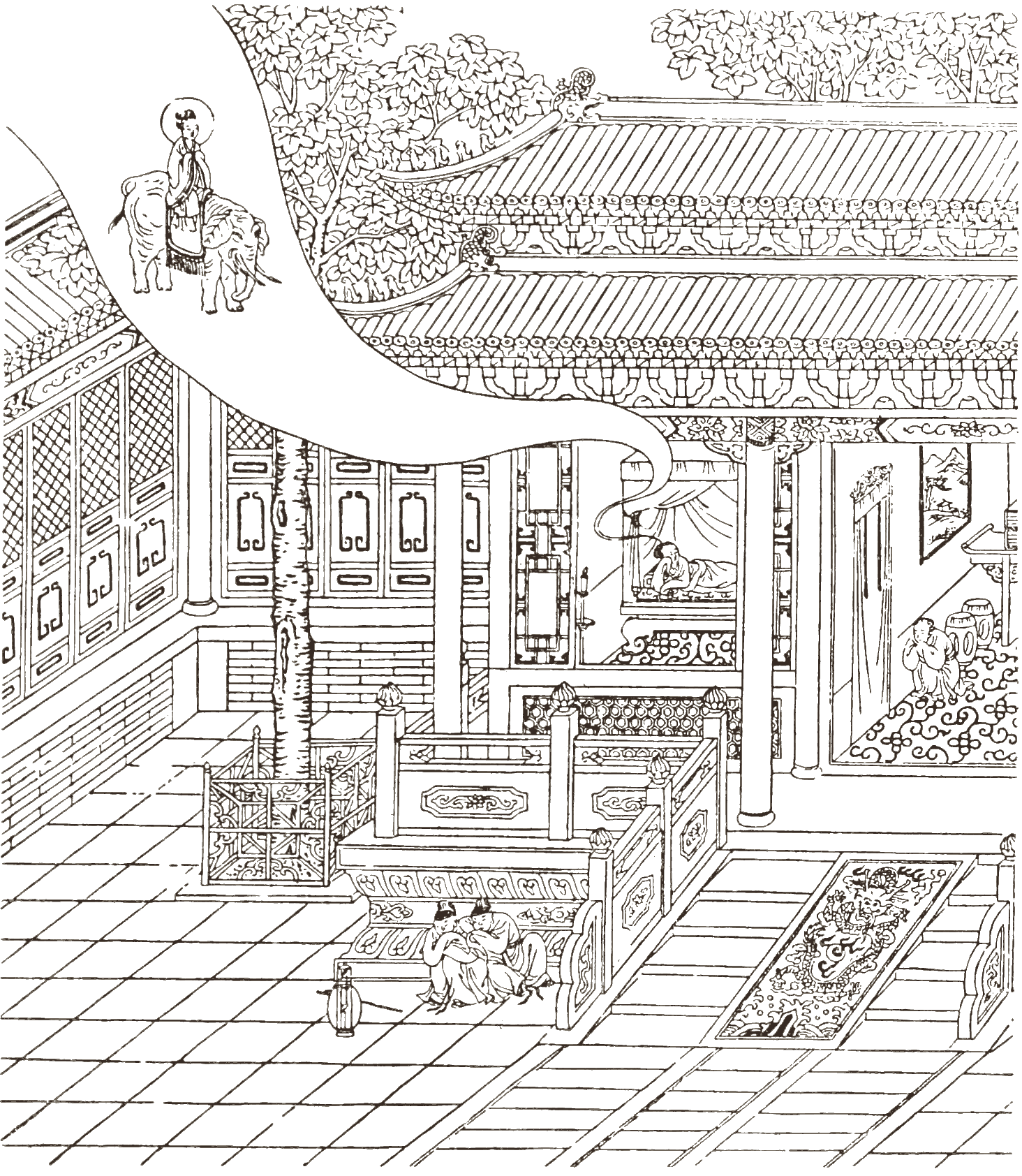
3. Maya’s conception of her son, the Buddha, who arrives for reincarnation on a white elephant