NATALIE SUMNER LINCOLN (continued 4)
Reading edition
He and Doctor Ward had talked far into the early hours of the morning, without coming to any decision except that it would be best to ask a stay of proceedings on the plea that new and vital evidence in Nancy's behalf could be procured. Warren hesitated even to do that. He realized all too clearly that he was between the horns of a dilemma. If it chanced that Doctor Boyd's motive for killing Captain Lloyd was to secure that despatch and thus protect Nancy, it would but establish her guilt as a rebel spy. No one would be likely to believe Boyd had committed such a murder unless he knew, and feared the despatch would incriminate her if allowed to fall into Union hands.
Since seven o'clock Warren had been scouring the city in search of a clue as to Doctor Boyd's whereabouts, but without success. He had seen several of the doctor's patients, who could only tell him that Doctor Boyd had been unexpectedly called out of town, and before going had notified them to send for Doctor Ward if they needed medical attendance during his absence. Warren met with no better success when he made inquiries at Boyd's house. After repeated ringing of the front bell, and knocking on the basement door, the old housekeeper finally answered the door. On learning Warren's errand, she said that the doctor told her he was likely to return at any time; she had no idea where he had gone, he had told her to keep all mail for him.
Warren glanced impatiently at his watch. Miss Metoaca was to be the first witness for the defence, and he had promised to escort her to the trial. Realizing that he had little time to spare before the court convened, he called a hack, jumped into the vehicle, and was driven to the Newtons'. Miss Metoaca was ready and waiting for him, and on their way to Fourteenth Street Warren asked her if she could tell him where Doctor Boyd had gone. Her reply was discouraging. She had not seen or heard of him for weeks.
"I would give anything in the world if he were here," added Miss Metoaca, with emphasis. "He is devoted to Nancy."
Warren silently echoed her wish as he piloted her into the room reserved for the witnesses.
The judge advocate's first witness that morning was an elderly man who apparently did not relish his unexpected prominence before the public. He sat biting his nails and glancing uneasily at Nancy. When being sworn he was ill at ease, and his behavior created a most unfavorable impression on spectators and court alike.
"Your full name?" demanded the judge advocate.
"Oscar Brown."
"Occupation?"
"Druggist."
"Where is your drug store?"
"On F Street next the Ebbitt."
"You know the accused?"
"I don't exactly know Miss Newton," he grinned deprecatingly, "but I have put up prescriptions for her on numerous occasions."
"When did you last see the accused?"
"On the afternoon of the sixth of March, when she came into my store."
"Did she buy any drugs?"
"Yes, sir; a bottle of chloroform."
A gasp escaped Mrs. Warren which was clearly audible in the silent room. Warren had not told his wife of Doctor Ward's startling discovery, and Brown's testimony was a distinct shock to Nancy's tender-hearted and loyal friend.
"Did the accused state why she required chloroform?"
"She did, sir. Otherwise I would not have sold it to her. She said her cat had been run over and she wished to put it out of its misery. Miss Newton is so well known, and her character then was respectable——"
"I object," challenged Warren instantly.
"Objection sustained. Witness, do not indulge in reflections. Confine yourself to answering the judge advocate's questions as briefly as possible," ordered Colonel Andrews sternly.
"Yes, sir"—much abashed.
"Had the accused a bundle in her hand when she entered your store?"
"No, sir. I put the bottle of chloroform in an empty candy box for her as she said it was awkward carrying a round bottle, and she feared she would drop it."
"Indeed!" The judge advocate's satisfaction was apparent. "State the exact time the accused was in your store."
"About a quarter to four, as far as I can remember. I did not enter the sale in my books at the time because Miss Newton said she was in a hurry."
"Have you any questions to ask the witness, Mr. Senator?" asked the judge advocate. For answer Warren handed him a folded paper which he read aloud: "Was that the first time you sold chloroform to Miss Newton?"
"I can't say. It might have been. I do a large business," was the evasive reply.
"Answer yes or no," thundered Colonel Andrews.
Cowed by the president's manner, Brown answered sullenly, "No."
"How many times have you sold her chloroform?" read Warren's next question.
"At least three times."
"Since the new year?"
"Before and since; yes, sir."
"Did she state for what purpose she needed the drug?"
"Doctor John Boyd sent her to buy it for him when he was in a great hurry. Doctor Boyd had a class of young ladies who were learning first-aid to the injured, and Miss Newton acted as his assistant at the clinics."
At the man's words Warren started as if stung. A horrible possibility had occurred to him. Suppose Nancy had visited the doctor's office as well as the drug store that afternoon! She was probably familiar with every article in the doctor's office. Could she have known about the curari? He passed his hand across his damp forehead; then turned to the witness: "I have no further questions to ask you," and Brown beat a hasty retreat.
The judge advocate completed his last entry in his book, laid down his pen, and rose.
"The prosecution rests its case," he announced quietly.
After a brief consultation with Nancy and Dwight, Warren summoned Miss Metoaca to the stand. The spinster's eyes filled with tears when she first saw Nancy. She was devoted to her niece, and the signs of suffering in Nancy's face cut her to the heart. She had to clear her throat twice to get rid of a suspicious lump before she could be duly sworn. Though a witness for the defence, the judge advocate asked the first question, as is the custom in all courts-martial.
"Are you related to the accused?" he asked, when Miss Metoaca was finally settled in her chair.
"She is my niece, my brother's only child."
At that moment an orderly entered the room and handed a note to Warren. He quickly broke the seal and a muttered exclamation escaped him as he read its contents. He crushed the note in his hand, gave a few low-toned directions to his colleague, and left the room.
Warren had prepared his questions, and Mr. Dwight handed them one by one to the judge advocate.
"Do you own a cat?"
"I do, or rather, I did. She had to be chloroformed, much to Misery's delight."
"Misery?" Dwight was confused; he was not familiar with Misery, never having made his acquaintance. "Who is Misery?"
"My niece's dog. He hated that cat."
The judge advocate frowned as he consulted the defence's next question. "State to the court the exact day, and why, you chloroformed her."
"Let me see—it was the afternoon of Mrs. Arnold's ball, the sixth. The cat was run over just before my niece went out, and I asked her to buy some chloroform, thinking I might have to use it."
"Was the bottle full when the accused handed it to you?"
"To the best of my recollection it was."
"Did the accused appear excited or nervous when she returned with the chloroform?"
"No, sir."
"At what hour did she return?"
"About twenty minutes past six."
"I have no further questions to ask this witness," said Dwight. "Do you wish to cross-examine her, Mr. Judge Advocate?"
"Miss Newton," began the judge advocate, "have you taken the 'oath'?"
"I was under the impression you had just administered it to me," exclaimed Miss Metoaca, mildly.
"I mean the oath of allegiance," reddening.
"No, sir."
"Nor the accused?"
"Neither of us, sir. We are law-abiding citizens."
"Are your sympathies with the Union or with the Confederacy?"
"They are divided," tranquilly. "I have relatives and friends in both armies."
"Are you a rebel sympathizer? Answer yes or no."
"I am, sir; like many other Washington women."
"And is the accused also a rebel sympathizer?"
"I cannot answer for my niece's feelings."
"Where was the accused on the night of December 27th, 1864?"
"She spent Christmas with friends in Baltimore, and did not return to Washington until the day after New Year."
"Kindly give the names of these friends."
"Mr. and Mrs. William Murray, 24 Saratoga Street, Baltimore, Md."
The judge advocate made a note of the names and address.
"That is all, Miss Newton; you may retire."
As Miss Metoaca passed Nancy she bent over and whispered tenderly: "Don't worry, my darling; you will be acquitted." Then she was gone.
Mr. Davis rose. "May I ask the indulgence of the court," he said nervously, "that a recess be taken until to-morrow morning? Our senior counsel, Senator Warren, has been called away."
"Has he been called out of town?" asked the president.
"Oh, no, Colonel."
"Did he say when he would be back?"
"He told me that he would return as soon as he could."
"Have you further testimony to offer?"
"No, sir."
"I object to postponement." The judge advocate rose. "It is unnecessary taking up the valuable time of this commission, the members of which have been detached from their respective posts and regiments to serve on it. The Secretary of War has directed that the hearing be terminated at the earliest possible date. If Senator Warren wished a recess he should have so stated before leaving the room. As it is, the accused is still represented by able counsel. If she does not wish to make a statement in her own defence, I will submit the case to the court."
"One moment," interposed Dwight firmly. "You forget, Mr. Judge Advocate, that your case is incomplete. The court has ruled that hearsay evidence will not be accepted. Belden, the scout, has not yet testified before this court as to——"
"I forget nothing," interrupted the judge advocate, heatedly. "The first charge can wait. The second charge of wilful murder has been proved against the accused."
"I deny it," retorted Dwight. "Without a motive you cannot prove a murder. The second charge hinges on the first; until that is proven the second cannot be——"
"I appeal to the court," broke in the judge advocate passionately. "I contend this is simply a clever ruse to gain time. Can you doubt it, you who have seen the rope tightened about the prisoner's throat"—involuntarily Nancy's hand crept up to her neck and plucked nervously at her collar—"by the testimony of reputable witnesses?
"Captain Lloyd, a gallant soldier, was foully murdered in the performance of his duty. You, his brother officers, have been told how the murderess crept down stairs, crept into his bedroom, stole the pocketbook containing the incriminating paper; then, fearing that he might still be able to prove her guilt, she leaned over the sleeping man—and silenced him forever. I tell you," he struck the table with no uncertain hand, "this has been proved. Let the counsel for the defence deny it if they can."
"We deny nothing." With set, stern face Warren, who had entered unnoticed some moments before, pushed his way through the crowded room. He passed Nancy, without look or word, and stopped midway between her chair and the seated officers. "We admit the truth of the judge advocate's statement."
A thunderbolt could not have created a greater sensation. The officers, as well as the spectators, sat dumb, bereft of speech. Nancy, grown deadly white, gazed at Warren with agonized, helpless eyes as his powerful, relentless voice rang out:
"The judge advocate has described to you how she stole step by step into that room with murder in her heart, the guilt of former days lending courage to a desperate act. With stealthy tread she crept up to the bed, her hand fumbled for a moment in the folds of her dress, then drew out a syringe. Deftly, and with practiced hand, she thrust the hypodermic needle into the brawny arm which, once so valiant in the fight, lay helpless on the pillow.
"Calmly she watched the poison flow into Lloyd's veins; then stepped back and dropped the syringe between the head-board and the mattress of the other empty bed. As her hands closed over Lloyd's coat the hall door was pushed open—admitting only a friendly dog.
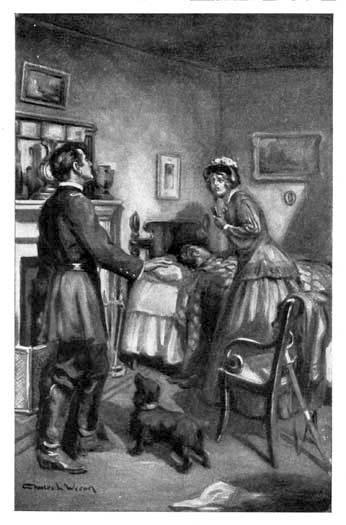
"Quickly she resumed her search, but another interruption stopped her. The sitting-room door opened. She started violently and stood with fast-beating heart. A hesitating step crossed the threshold. Gradually her breath came back and her guilty heart beat more slowly. A blind man could not harm her. She removed the pocket-book just as Goddard tripped over the dog. The sound of his fall aroused the stupefied figure on the bed. Faintly he whispered a name—a familiar name—the name of——"
"Another interruption stopped her.... A hesitating step crossed the threshold."
A shriek rang out—the cry of a soul in torture! The spell-bound officers sprang to their feet. Spectators climbed on their chairs for a better view.
"Sit down! Sit down!" roared the judge advocate.
A figure tottered out into the aisle.
"Air! Air! I must have air!" The judge advocate stepped aside. "For God's sake, let me go!"
"That is just what we cannot do. Guard, here is your prisoner," and Warren caught Mrs. Bennett as she fell.
CHAPTER XXVI
BY A HAIR'S BREADTH
Again and again Colonel Andrews demanded order in the court-room, but the spectators were utterly demoralized and refused to be quiet. It was only after Mrs. Bennett had been carried unconscious into another room that the confusion somewhat abated. Nancy, trembling in every limb, in the reaction which followed her terror and shock, collapsed in her chair, incapable of speech. Mrs. Arnold, whose complexion had turned pasty from her emotions, clung frantically to Mrs. Warren and begged tearfully to be taken home.
Colonel Andrews, purple in the face with his exertions, bellowed in a voice at last heard above the racket: "This unseemly behavior must cease! Major Lane, call the guard and clear the room!"
Silence quickly followed the order, and Warren turned and addressed the excited court:
"I ask your indulgence for precipitating such a scene. I returned to this room intending to ask a stay of proceedings so that I could have time to gather evidence against Mrs. Bennett; but, on hearing the judge advocate's argument against postponement, I saw my opportunity to force a confession from the guilty woman by giving details of Captain Lloyd's murder which would induce her to think there had been an eye-witness to her crime.
"Sitting there, confident that another was practically convicted for Captain Lloyd's murder, the shock of my unexpected words affected her as I hoped they would, and she betrayed herself."
"Is that the only evidence you can offer to prove Mrs. Bennett's guilt?" demanded the judge advocate, harshly.
"My next witness is Miss Mary Phelps, a nurse of the United States Sanitary Commission," was Warren's noncommittal reply.
After the usual preliminaries Miss Phelps told how she found the hypodermic syringe and why she gave it to Doctor Ward. She was then excused, and her place taken by Doctor Ward, who in a few concise words described how he discovered that the syringe was not his, and that it contained a solution which, on examination, proved to be a form of curari. He produced the syringe and gave it to the judge advocate.
As he left the court-room Doctor John Boyd's name was called, and the famous surgeon limped into the room and to the witness chair, followed by a low ripple of excited comment from the spectators which was quickly quelled by Colonel Andrews' peremptory demand for silence. When Doctor Boyd had satisfactorily answered the judge advocate's first question after being sworn, Warren began his direct examination.
"Doctor, are you acquainted with the poison known as curari or curarine?"
"I am. Some of the drug was given to me when I was last in South America. It is almost impossible to procure it in this country now."
"How many people knew that you owned this drug?"
Doctor Boyd reflected a moment before answering. "I am sure only two people beside myself—my former assistant and Mrs. Bennett."
Colonel Andrews had no need to call for silence; one could hear a pin fall in that quiet room as court and spectators bent forward, the better to hear Doctor Boyd's low voice.
"How did Mrs. Bennett learn that you had some curari?"
"She came in to my consulting room one day last November. I had just been making some physiological tests, and the bottle containing the curari was on my table. After I had given her the prescription she had come for she asked me what the bottle contained.
"Curari is a curious poison, and one that is not much known, at least at this date. I explained that the South American Indians used it on their arrow points in the chase, animals killed by it being quite wholesome. I also told her that curari may, except in very large doses, be swallowed with impunity, but if introduced into a puncture of the skin, so as to mix with the blood, the effect is instantly fatal, and leaves no trace of poison behind it. She asked me how to obtain a solution of the drug, and I explained in detail; then, seeing she was ready to go, I rose and put the bottle of curari back on its shelf in the small medicine cabinet that hangs near my table."
"Is the cabinet kept locked?"
"No. My old housekeeper, Martha Crane, has charge of my private office and would not think of disturbing any of my belongings."
"Did you know Captain Lloyd?" read the judge advocate, pasting Warren's last question in his book.
"I first met Captain Lloyd on New York Avenue one morning in January, but I saw him again that same night." The surgeon paused.
"Give a full account of that last occasion," directed Warren.
"I was attending a supper party at Senator Warren's," began Boyd. "We were having a pleasant evening when the bell rang and the servant told the senator that a gentleman wished to speak to Major Goddard. Senator Warren immediately asked Captain Lloyd to step into the parlor, but he declined, saying he preferred to wait in the hall for his friend.
"Suddenly I was startled by a half-stifled moan, and turned to see where the sound came from. Mrs. Bennett was crouching on the sofa behind me; her face livid, her eyes starting from her head. I followed her glance and saw Captain Lloyd standing directly under the hall light."
"Did Captain Lloyd see Mrs. Bennett?"
"No; we were sitting in the darkest part of the room, besides which he was too occupied in staring at Major Goddard and Miss Newton to notice anyone else."
"What happened next?"
"Major Goddard joined his friend almost at once and they went away together. Then, before I could catch her, Mrs. Bennett fell fainting on the floor. If ever I saw naked fear it was in her livid countenance when she gazed at Captain Lloyd.
"Naturally I was curious to know what connection there was between Mrs. Bennett, a society butterfly, and Captain Lloyd of the Secret Service, particularly as I was informed that she was a Union spy, but my professional duties claimed all my attention. And I forgot about the scene until it was recalled to my mind by Mrs. Bennett herself."
"In what way?"
"I was talking with her at the President's levee on March 2nd, and spoke of Major Goddard. She asked me if Captain Lloyd had returned to town with him, and I replied in the negative."
"Was that the last time you saw Mrs. Bennett?"
"No. I saw her on the afternoon of the 6th of March going in to Mrs. Lane's. My housekeeper, Martha," he added, before the judge advocate could speak, "told me, when I entered my office a few seconds later, that Mrs. Bennett had just left, having waited for me in the front office for some time."
"Is the communicating door between the office and your consulting room kept locked when you are absent?"
"No, never."
"Then a patient could enter your consulting room without disturbing your housekeeper?"
"Yes."
"Did you see Mrs. Bennett waiting on Mrs. Lane's doorstep?"
"No, she was just turning the front doorknob and entering when I passed the house."
"Did she see you?"
"No, I think not. Her back was turned to me."
"Is your usual office hour at that time in the afternoon?"
"No."
"Then Mrs. Bennett knew that you were likely to be out at that hour?"
"Yes; she told my housekeeper that she had a bad attack of neuralgia, and had called on the chance of finding me in."
"Where have you been during the past month, Doctor?"
"I left Washington that very afternoon on my way to Richmond."
"Just a moment," interposed Warren, and handed another slip to the judge advocate, who read the question aloud. "Did Mrs. Bennett know you expected to leave town?"
"She did. I told Mrs. Arnold in her presence that I expected to go away at any moment, and did not know exactly when I would return."
"Continue your statement," directed Warren.
"I went to Richmond to see my brother. On my arrival there I found him in one of the hospitals, dying." Boyd's keen eyes grew misty. "I stayed with him to the end. I found my services needed in that unhappy city, so remained; but just before the evacuation I went over to Petersburg to assist in the field hospitals. I only returned to Washington this morning."
"When did you first hear of the charges against Miss Newton?"
"When I reached my house this morning I found Doctor Ward there making inquiries of Martha as to my whereabouts. We went into the office, and Ward told me of Miss Newton's arrest and trial, finally mentioning his suspicions that curari had been used. I sprang out of my chair, walked over and pulled open the door of the cabinet. The bottle of curari was empty. I also found on further search that one of my hypodermic syringes and needles, which I keep in the top drawer of my table, were missing."
"Did any one have access to your offices during your absence from the city?"
"No. I locked both the doors and bolted the windows of those rooms before I left that afternoon, and took the keys with me, knowing that I might be away from home for some time."
"What did you do on discovering the curari was gone?"
"Doctor Ward and I agreed that Senator Warren should be sent for. On his arrival we consulted together and decided that Mrs. Bennett must have killed Captain Lloyd."
"That is all, Doctor," announced Warren. "Mr. Judge Advocate, take the witness."
"Do you know any motive for Mrs. Bennett's crime?" inquired the judge advocate.
"Fear, deadly fear."
"Do you know what inspired that fear?"
"No, sir; I do not."
"You are excused." And the doctor, bowing to the court and to Nancy, withdrew.
"May it please the court to recall Major Goddard," said Warren.
"Major Goddard is under close arrest and cannot leave his quarters," replied the President.
"But there are no longer grounds for such arrest," retorted Warren, warmly. "He cannot now be accused of being an accessory after the fact. By President Lincoln's permission I was allowed to see the major this morning, and I say to you in all earnestness that his testimony is needed to clear up this mystery. I have here an order from the Secretary of War," extending a long envelope which had been delivered to him a moment before, "releasing Major Goddard from arrest."
Convinced by Warren's earnest appeal, the presiding officer despatched an orderly for Goddard.
Nancy's color had returned, and her eyes sparkled with relief and renewed courage as she talked in a low tone with Warren and Dwight during the short wait that followed. Goddard soon made his appearance, for his conversation with Warren had prepared him for such a summons. His whole bearing had changed. He entered the room erect and smiling, and despite his blindness moved with quick, decisive step as the orderly guided him to the witness chair.
"State to the court Captain Lloyd's full name," ordered Warren.
"George Lloyd Irving." His announcement caused low voiced comment, and Colonel Andrews pounded for order.
"Why did Captain Lloyd drop his family name?"
"Because he desired to lose his identity after a certain tragedy in his family."
"Give a full account of that tragedy."
"After graduating from West Point I was ordered West, and I did not see Captain Lloyd until seven years later. I found him greatly changed from the kindly, happy boy I had known in former days. After we had been together for a month we drifted into our old friendly ways, and one night Lloyd confided his troubles to me and why he had dropped his surname.
"Three years before that date, when on a visit in the West, he had met a very pretty, charming girl, became infatuated with her, and after a brief courtship they were married. Shortly after the honeymoon they both realized they had made a fearful mistake. She had married Lloyd for the social position his name could give her. She found that Lloyd hated society and would go nowhere. He was also comparatively poor and could not supply her with the luxuries her shallow nature craved. So they endured a parrot and monkey life of it. After the birth of their baby there was continuous friction, for Lloyd declared that to cut down expenses to meet additional bills they would have to live in a farm house which he owned near a village in New Jersey.
"They moved there and things went from bad to worse. Mrs. Irving hated the village people. Their church socials and the sewing circles seemed to mock her; for she craved balls and brilliant receptions. She never troubled to return the calls of the friendly farmers' wives, and finally she was shunned. Lloyd, who went to and from his work every day, was wrapped up in the baby, a sickly little girl, and paid but little attention to his wife's tempers.
"One day, driven to desperation by the monotony of her existence, for which she chiefly had herself to blame, Mrs. Irving decided to leave Lloyd. He had been sent to Philadelphia to investigate a criminal case, and was expected back the next afternoon. Mrs. Irving dismissed her servant, and at noon the next day, after writing a note to Lloyd, she shut up the house and trudged into town, reaching the station in time to catch the train to the city."
Goddard stopped his long narrative, and cleared his throat nervously. Nancy had never taken her eyes from him, and, as if he felt their appeal, he turned and spoke as if addressing her alone.
"Unfortunately, Lloyd was detained in Philadelphia by illness. When he reached his home he found his house closed, his wife gone, and his delicate baby dead from starvation and exposure in the bitter weather. His farm was on a little-frequented road; his nearest neighbor six miles away. No one had noticed the closed house; no one had approached near enough to hear the baby's cries.
"From that moment Lloyd was a changed man. He waited until after his child was buried; then started in pursuit of her unnatural mother. I do not suppose," added Goddard hastily, "that it ever occurred to Mrs. Bennett that Lloyd might be prevented from returning home that afternoon. She had no particular affection for the child, and decided that having a baby with her would be a drag. She also undoubtedly reasoned that Lloyd would not trouble to find her, but if she took the child away he would instantly institute a search for her.
"Lloyd spent months trying to trace his wife. Finally word reached him that she had sailed on an ill-fated ship which was wrecked, and his wife was reported among those drowned. Convinced that she was dead, he let the matter drop. But, knowing Lloyd as I did, I am convinced that, had he suspected his wife really was alive, he would have killed her, for he worshipped that baby. Many a night I have been wakened by his calling: 'Baby-tot! baby-tot!' in heart-rending tones in his sleep, as I told Senator Warren this morning."
"Why did you not relate this narrative when you testified yesterday?" asked the judge advocate, after Warren signified that he could cross-examine Goddard.
"Because I never connected Lloyd's unhappy married life with the cause of his murder. I thought his wife was dead."
"Did you ever see Captain Lloyd—Captain Irving's wife?"
"No, sir. You can prove my statements by going to the village where the child is buried. I don't doubt you can find some farmers who can identify Mrs. Irving."
"Then you have no direct proof to adduce that Mrs. Irving and Mrs. Bennett are one and the same person?"
"I have no such proof," admitted Goddard, "but any one of average intelligence——" His hot-tempered speech was interrupted by a request that the judge advocate see Mrs. Bennett, who had regained consciousness.
Interest was keyed to the highest pitch, and the judge advocate's return to the room was hailed by a low murmur of suppressed excitement. He laid down a paper and announced gravely: "Mrs. Bennett has confessed."
For the moment there was absolute stillness; then spontaneous applause broke out from Nancy's friends, which was instantly checked by Colonel Andrews.
"In her signed confession Mrs. Bennett states that she is Mrs. Irving," continued the judge advocate. "She bribed a poor woman who was sailing on that ill-fated ship to assume her name, thinking it would mislead her husband should he try to find her. When she heard the woman was drowned Mrs. Irving considered that she was safe. She altered her appearance by dyeing her hair and by other artificial means. Her pleasing address and good education assisted her, together with a forged reference, in securing a position as companion to a rich invalid. Some months after that she heard of the death of her child, and she considered one of the links binding her to the past had been broken. Two years went by; then she met Colonel Bennett at Saratoga, and three months later they were married.
"Mrs. Irving states that she spent December and the first part of January in the North, and only returned to Washington the day before Senator Warren's supper party. On her arrival she had an interview with Secretary Stanton and agreed to find out and report which women in society were sending aid and comfort to the enemy. When she saw and recognized Lloyd she was panic-stricken; not only had she knowingly committed bigamy, a criminal offence, but exposure meant social ruin. And while only indirectly responsible for her child's death, she knew Lloyd, and realized that he would stop at nothing to revenge what he considered the child's murder.
"From that night she planned to get rid of Lloyd. It was easy for her to keep out of his way, for he was in Winchester most of the time. Then she remembered the curari—the poison that left no trace!
"Accompanied by Mrs. Arnold, she visited Major Goddard, and then found out where their rooms were located and how to reach them. Fate played into her hands, for on that sixth of March she met Aunt Dinah, whom she knew, having lived at Mrs. Lane's with her husband when he was first ordered to duty in Washington. Aunt Dinah, who was returning from executing an errand at Brown's drug store, told her that Captain Lloyd had returned and was lying down in his room. Mrs. Lane had said he was not to be disturbed, as he was asleep. Aunt Dinah announced she was dead tired herself from answering the front door in addition to her other work. Mrs. Irving promptly suggested that she leave the front door on the latch, and she watched the old colored woman follow out her suggestion. At last the way was clear. Mrs. Irving knew the house; knew the hours kept by the boarders; if she was seen in the house she had a plausible excuse to explain her presence there. So she secured the poison and committed the murder as already described.
"Mrs. Irving declares that she stole the pocketbook thinking it might contain some papers which referred to her. She burned the case and its contents without examining them, such was her haste to get rid of what might prove incriminating evidence against her. She only took the pocketbook, because she dared not linger long enough to search Lloyd's other belongings, as she could not lock the hall door, and she was in deadly terror for fear some one would walk in on her.
"That is all in the confession which refers to this trial," ended the judge advocate, as he laid down the paper.
"I respectfully submit to the court," began Warren, rising, "that my client has been absolutely vindicated, and demand that she be released from imprisonment."
"The accused has been proven not guilty of the charge of wilful murder," said Andrews, slowly. "But, Mr. Senator, she has not been cleared of the first charge. We must first hear Private Belden's testimony."
The judge advocate rose. "I have here," he announced, taking up an envelope, "a telegram which was handed to me as I entered the room just now. I have not had a moment in which to read it." As he spoke he tore open the envelope. Quickly he scanned the lines, then read them aloud:
"Cavalry Headquarters, April 12, 1865.
Captain George Foster, —th Infantry, War Department, Washington.
"I have to report that Private Belden was killed during the battle of Sailors' Creek, April 6th, 1865.
"H. K. Young, Chief of Scouts".
CHAPTER XXVII
WITH MALICE TOWARD NONE
The judge advocate handed the telegram to the presiding officer as Warren stepped forward.
"I respectfully submit to the court," he said, quietly, "that the first charge against my client is quashed. You have ruled not to admit hearsay evidence. Symonds' testimony in regard to the securing of that despatch from Major Pegram is hearsay. Furthermore, he declares on direct examination that my client's handwriting is not the same as that of the despatch. My client has already been vindicated of the second charge; the first is non-proven. Again I demand my client's honorable acquittal at your hands."
The judge advocate rose to sum up his case, but his argument was interrupted by the entrance of an orderly who handed him a note which he read in haste; and he changed the words almost on his lips.
"May it please the court," he said. "I have received word that new and most important testimony has been discovered relating to the first charge against the accused——"
"You are too late, Mr. Judge Advocate," exclaimed Warren, hotly. "I have already presented my argument to the court. The case is closed!"
"Not so." The judge advocate picked up a book from the table and read aloud: "'The court may, in the interest of truth and justice, call or recall witnesses, or permit their recall at any stage of the proceedings; it may permit material testimony to be introduced by either party quite out of its regular order and place, or permit a case once closed by either or both sides to be reopened for the introduction of testimony previously omitted, if convinced that such testimony is so material that its omission would leave the investigation incomplete.'"
The judge advocate closed the book with a snap and laid it back on the table. "I respectfully contend that Colonel Baker's testimony is necessary before this case is closed. Here is the colonel's note, Mr. President," and he passed the paper to Colonel Andrews, who, after perusing it, handed the paper to the other members.
"The court rules that it is both permissible and necessary to hear further testimony," announced the colonel. "Call Colonel Baker to the stand."
Vexed and angry, Warren resumed his seat. Was victory to be snatched from him at the crucial moment. He dared not glance at Nancy, and sick at heart he listened to the judge advocate's slightly hoarse voice administering the oath to the new witness.
"Do you know the accused?" asked the judge advocate after Baker had given his full name and rank in the service.
"I do. I placed her under arrest as a rebel spy."
"What evidence have you to prove that fact?"
"This." Baker put his hand in his pocket and drew out a small red leather cardcase which was caked with mud. Nancy's eyes distended with fear, and she whitened perceptibly. "I have searched Miss Newton's house a number of times, but without success. To-day I decided to make one more effort, and so ransacked the place thoroughly. When in the stable I noticed that a red-brown field spaniel was doing a lot of snooping around in the rose garden, and I watched him for about ten minutes. Finally he located his bone and dug it up, and with it a tin box which contained this leather case."
Nancy almost cried out. Misery had betrayed her—her pet companion, her little dumb, loyal friend, whose companionship she had longed for for many days. She could hardly see Baker's movements through the stinging tears that surged into her eyes.
Baker took from the case a much-worn paper, and without further comment handed it to the judge advocate, who cleared his voice and read its contents aloud:
"Special Order No. 17 WAR DEPARTMENT, Richmond, Va., June 25th, 1862. (Extract)

"2 . . . The Bearer, Miss Nancy Newton, of Washington, District of Columbia, having volunteered her services, is hereby appointed as Special Agent of Confederate States Government, subject to the approval of this Department. Commanders of Posts, Officers of Guards and Patrols will render all assistance in their power.
"Quartermasters will furnish all necessary transportation.
"By Command of the President.
"Description
"Age—21
Stature—5 ft. 7½ in.
Forehead—Broad
Eyes—Hazel
Nose—Rather short and straight
Mouth—Medium size
Chin—Round, with deep dimple
Hair—Red-golden
Complexion—Fair
Face—Oval
"James A. Seddon, Sec'y of War."
Silently the presiding officer accepted the paper, inspected it, then passed it over to the members of the court.
"Have you any questions to ask the witness, Mr. Senator?" asked the judge advocate.
"Who was present when you found that paper, Colonel Baker?"
"The provost marshal and two of his men," answered Baker; then added: "The leather case is stamped with the prisoner's initials."
"That is all. I have no further questions to ask," said Warren, and Baker departed.
"Do you desire to present argument, Mr. Senator?" asked the judge advocate.
Warren glanced at Nancy's averted face.
"The case rests on its merits," he said slowly. "The evidence is before the court; but I must plead that in reviewing it the court will remember the youth of the prisoner and her sex."
"Stop!" Nancy was on her feet in an instant, her slender form drawn to her full height. "It is my right to make a statement in my own behalf. I desire no such plea entered. My sex prevented my taking arms in the field for the cause I love; so I strove to aid the Confederacy in the only way I could, by woman's wit. Like the Cause," her voice trembled, "I have failed.
"Gentlemen, I am a spy; that most despicable of characters. You are soldiers. You fight in the open and die, honored; I fight in the dark and die—dishonored. You fought for love of the Stars and Stripes; I for love of the Stars and Bars."
A brief pause followed as Nancy's clear, unfaltering voice ceased; then Colonel Andrews rose.
"The court is closed," he announced solemnly. "The findings will be sent to the proper authorities."
Nancy swayed slightly, recovered herself, bowed to the court, then turned blindly and followed the corporal of the guard out of the room. Silently the crowd dispersed; the shadow of coming tragedy stilling all desire for light chatter.
Nancy rose and paced the small prison room restlessly. Anything to get away from her own thoughts. For forty-eight hours she had heard nothing from the outside world. She had not closed her eyes the night before, and Friday found her weary and unstrung by her long vigil.
She wondered dully when the sentence would be carried out. She hoped soon. She pushed her hair back from her forehead nervously. Her thoughts turned to her aunt and then to Goddard. Surely she would be permitted to see them; they would not let her face the end alone.
She had never thanked Senator Warren for all his kindness; all that he had tried to do for her, and all that he had accomplished. At least she was not branded as a murderess. And yet Goddard had thought her capable of such an act!
Nancy's eyes burned with hot, scalding tears that fell one by one; bravely her white lips hushed their moan. She must not lose her self-control. Resolutely she turned and straightened her few belongings. She was so absorbed in trying to forget painful thoughts that she did not hear the sentry open the door, nor a hesitating footstep that crossed the threshold.
"Nancy," said a pleading voice. The girl wheeled around, the carmine mounting her bloodless cheeks. Without a word she stepped forward and was clasped in Goddard's strong embrace. "Do not cry so, my darling," and he stroked her hair with loving hand.
"I must—I must—it is the first time I have given way," gasped Nancy between her sobs. "Oh, Bob, you don't know how I have wanted you; to feel your strong arms about me; to know"—her voice sank—"to know you love me in spite of all——"
"Love you!" the man's voice was rough with the intensity of his emotions. "I love you so it frightens me. God! Why am I so helpless? You are more precious to me than all the world, and I can do nothing."
"Do you call it nothing to offer to die in her place?" asked a quiet voice behind the lovers, and Lincoln, who had walked into the room unheard, closed the door.
Nancy's eyes shone like stars. "Did Bob do that?"—forgetting greeting in her excitement.
"Yes," replied Lincoln, seating himself on the edge of the bed and placing his tall hat beside him.
"You will let me, Mr. President," pleaded Goddard vehemently. "I am blind—helpless—my life will be no loss—I have served my country—while she——" Nancy clung to him in sudden terror. "I give you my word Nancy will henceforth be loyal to our Government."
"Seems to me you are promising a good deal," said Lincoln, dryly.
"You will let me?"—eagerly.
"Die in her stead? No."
"And you are right," declared Nancy, as Goddard stooped over her to hide his bitter disappointment. "I will not accept such a sacrifice."
"'Greater love hath no man,'" quoted Lincoln softly. "You have warm friends, Nancy. Doctor Boyd was with me at noon. He told me that your father on his death-bed made you swear that you would do your utmost to assist the Confederacy. Is that so?"
"Yes." Nancy raised her head bravely and met unflinchingly the gaze of the saddest eyes she had ever seen in human head. "But it was not only that, Mr. President. Like all loyal Virginians, I loved and believed in the Cause."
"As I believe in my Cause, Nancy. Suppose we leave Cause and effect to our Maker; He knows and will not judge our errors harshly, for God is love. The fighting is practically over. Dear child, are you willing to trust to me to heal the war-hurt, and to accept the protection of the flag again, the flag your forefathers died for?"
"Yes," said Nancy, brokenly. It hurt most cruelly to renounce her Cause; and Lincoln, ever quick to detect suffering, spoke to Goddard in an undertone as Nancy walked to the window to regain some hold on her composure.
"Ah, Nancy," he said, as she returned; "I was not surprised to hear Symonds did not recognize your writing. He did not know you were ambidextrous." An exclamation escaped Nancy. "You forget you once showed Tad that you have that gift—so your right hand did not know what your left one wrote." Lincoln laughed gently; then rose. "I left my wife in the carriage and I must not keep her waiting too long, as we are going to Ford's Theater to see 'Our American Cousin.'
"Major Goddard, I expect you to report to me to-morrow that your wife," he glanced mischievously at Nancy, "has taken the 'iron-clad oath of allegiance'—to us both." Lincoln stepped to the door and beckoned to Superintendent Wood, who was waiting in the corridor, to enter. "Superintendent, this prisoner is to go free. Here is her pardon, signed, sealed and delivered," handing it to the officer. "Good-bye, Nancy;" as he looked at the weeping girl his face was a benediction. "God be with you until we meet again!"
Five hours later the Martyr President had joined the Great Majority. Abraham Lincoln! Man of the people! Sorrowing nations paid tribute at his bier.