Front matter
Reading edition
Author of “According to Ng Loy,” “Blind Trails,” etc.
It was an August evening in the valley of the Bunch Grass, and in a year so dry that the poplars and cottonwoods along the Lost Horse River had already turned yellow, and the leaves of the willows were a crackling carpet to the tread of thirsty stock.
No rain had come to the valley since the last Chinook winds had swept the winter snows, and the river was merely a shallow watercourse of evil-smelling fluid. The rolling hills, which extended back to the encircling mountains, were as brown as burlap, and the range cattle were dusty of hide, thin of flank and red-eyed from the heat.
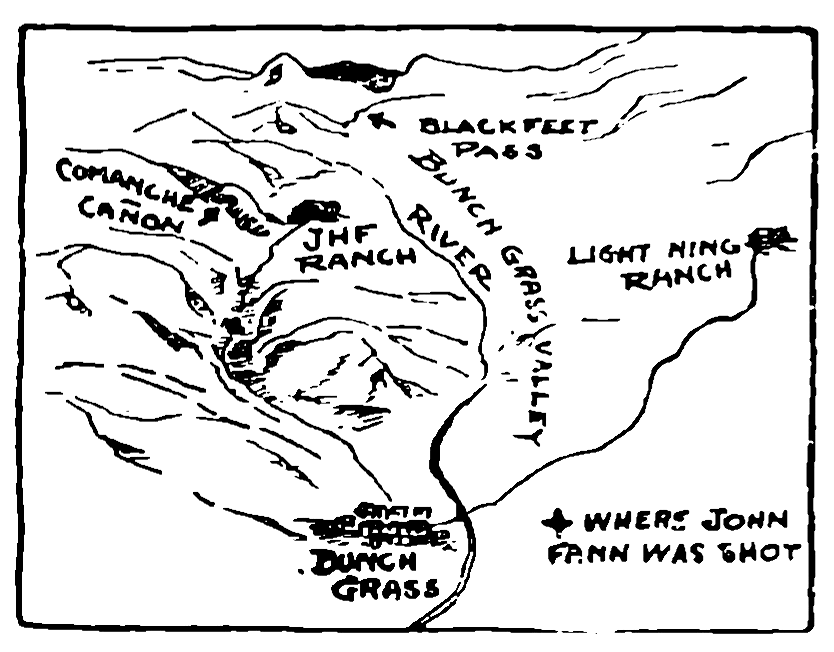
At the north end of this valley, its boundaries extending to the encircling cliffs, through which came the road out of Blackfeet Pass, was the JHF ranch, owned by John H. Fann, known throughout the valley as “John the Baptist.” This was not because of any religious proclivities, but because of his enormous size, his great white beard, which swept almost to his waist, and his massive head of white hair, hanging to his shoulders.
Just now John Fann sat on the broad steps of the JHF ranch house, a rambling, unpainted structure, his elbows on his knees and his hands concealed under his great beard. He might well have posed for Rodin’s “The Thinker,” although there was a trifle more of sorrow than of thought in his half-closed eyes.
Behind him, leaning against one of the porch posts, stood “Ma” Fann, a thin, sad-faced little woman, with large, brown eyes, and a wisp of colorless hair, drawn tightly back and knotted in what was commonly known as a “pug.” She was looking off across the seemingly endless hills, which had lost their drab hues of day and were painted in ivory and lavender in the glow of the setting sun.
But Ma Fann’s eyes and expression did not register that she was viewing the beauties of the painted hills. She had seen them many times in the last fifteen years. Perhaps she had marveled at the Master Artist’s handiwork at some remote time, but that time was long forgotten.
Just out in front of the steps was Bob Kern, squatted on the heels of his boots, as he drew meaningless patterns in the dust with a piece of willow-branch. He was a thin-waisted cowboy, with a face as thin and bony as the face of a half-starved Indian. His nose had been broken and grew at a peculiar angle, and one eye was not exactly set in a straight focus, but his thin-lipped mouth was full of good teeth.
Bob Kern lifted his thin face and squinted narrowly at John Fann. He looked down at the dust-patterns and cleared his throat softly.
“’T’s all right, John—’f yuh look at it thataway. It ain’t noways my point of view. Rustlin’ ’s rustlin’, and it don’t make no difference whether it’s me ’r you or the King of Siam—it’s still rustlin’.”
“Yes, it’s still rustlin’,” said John Fann softly. “Men will always steal, I suppose. Sometimes I wonder why, Bob.”
“Why?” Bob Kern squinted closely, and then looked up at Ma Fann, “Will yuh go inside the house, Ma? I’ve gotta swear a few notes.”
Ma Fann smiled wistfully.
“Swearing doesn’t help, Bob.”
“Mebbe not you, Ma—but it does me. It makes me so —— mad, I tell yuh. Here they’ve been stealin’ JHF cattle for a year, until—” Bob Kern spread his hands wearily—“Honest, Ma, we ain’t got enough left t’ wad a shot-gun.”
“Is it as bad as that, Bob?”
“Wel-l-ll,” drawled Bob, “mebbe it ain’t quite that bad, Ma, but it sure is gittin’ serious. Another year at this rate and there won’t be a JHF cow on the Bunch Grass range.”
A rider was coming down one of the angling trails toward the main gate, riding slowly. He dismounted and opened the gate, which creaked dismally. Somewhere a cow bawled softly. The gate creaked shut and the man started toward the corral, leading his horse. The man was short and fat, with the waddling walk of a duck.
“‘Splinter’s’ likely hungry, Ma,” observed John Fann.
“He mostly always is,” said Ma Fann, “I’ll put the biscuits in the oven.”
She turned and went slowly into the house. Bob yawned and sat down on the lower step, where he humped over and rolled a cigaret. In a few minutes, “Splinter” Martin waddled up from the corral. He sat down heavily beside Bob and helped himself to Bob’s tobacco.
“I run across ‘Chet’ Gunning t’day,” said Splinter hoarsely. Splinter always talked as if suffering from a severe cold.
“Thasso?” Bob showed little interest.
“Over by Singin’ Angel Flats,” explained Splinter. “Me and him had a little talk.”
“Yuh would,” nodded Bob. “Chet ain’t none secretive.”
“I reckon he’s right, at that,” grunted Splinter. “’F I was the sheriff I’d ’a’ found it out long before this.”
“Oh, yuh would, would yuh?” exploded Bob. “I s’pose you knowed it all the time, didn’t yuh? Now, that’s fine of yuh, Splint.”
“F’r gosh sake, what ails you?” croaked Splinter. “You don’t need t’ ride me, cowboy. Right’s right and don’t wrong nobody.”
“Don’t quarrel,” advised John Fann softly. “That does not mend matters, boys. Splinter, you better wash up for supper.”
Splinter got up slowly and started for the rear of the house.
“And don’t forget that you’ve got two ears and a back to yore neck,” added Bob.
Splinter stopped.
“Zasso? Huh!”
He waddled back, grasped Bob by the ears and looked him over closely.
“Well, well! I sure admire yuh, Robert Emmett Kern. I admires any man who makes a discovery and immediate and soon passes out his information to his friends. You ranks with some of our great discoverers, cowboy; but I’d say you was jist a little more rank, at times.”
“Supper is ready, boys,” said Ma Fann from the doorway. “Have you washed, Splinter?”
“No, ma’am—” quickly—“but I’ve had a lesson in it. Be right with yuh, even if I dislocate m’ shoulders.”
Splinter went to the rear of the kitchen, placed the battered wash-basin on a bench and poured some water from a five-gallon kerosene can, which had been fitted with a bail. Noisily he washed his face and dried it on a coarse towel.
He could hear Ma Fann singing softly as she placed the supper on the table. It was an old church hymn, sung off-key, as if the singer’s mind was far from in tune. Splinter listened, his eyes half-closed, the rough towel held tightly in his two hands. He heard John Fann and Bob Kern clump into the dining-room, the closing of the oven door, as Ma Fann removed the biscuits. He picked up the wash-basin and slowly poured out the soapy water.
“Gawd A’mighty made them two,” he said softly, meaning John and Ma Fann. “He made ’em t’ look kinda like me and the rest of the folks, but He must ’a’ took special pains, I reckon, ’cause they’ve got somethin’—that—we—ain’t—got.”
He hung the battered wash-basin on the wall, picked up his hat and went in through the kitchen door. Ma Fann was standing at the stove, looking down at a pan of brown-topped biscuits, holding a plate in her hand. Splinter stepped in beside her and she looked up at him. Quickly she glanced toward the door which led into the dining-room, and then her hand darted inside her waist and she handed Splinter a small kodak picture.
It showed two little children, little chubby things, sitting on the ground, looking up like two little robins at the approach of the mother bird. Splinter’s face broke into a smile and he glanced at Ma Fann. Tears were running down her cheeks, but her lips were drawn in a hard line.
Splinter cleared his throat softly, gave her back the little picture and patted her clumsily on the shoulder as he went into the dining-room.
“He must ’a’ washed his ears,” stated Bob loudly. “Look at the danged pelican. Whatcha doing—cryin’, Splinter? You’ve got tears in yore beautiful eyes, angel child.”
“Soap!” grunted Splinter, easing himself into a chair. “I’m gittin’ so danged clean that I wash m’ eyeballs. Got a good notion t’ build a bath-tub, so we could take a good washin’ every month or so.”
“My gosh, yuh don’t need to go to extremes!” exclaimed Bob. “Just because yuh washed yore neck and ears once, don’t go and get a lot of dudish notions.”
There was little more said during supper. Splinter, who usually carried the bulk of the conversation, was silent and thoughtful.
He and Bob Kern had been working for the JHF outfit for nearly three years, and they knew the inside life of most of the Bunch Grass range folk. There had been another cowboy working there when they came; a wild-riding, hard-drinking, handsome young man, whose name was Barr Wyeth. He was a good cow-hand, but he did not seem to fit in at the JHF.
And then there had been Nell Fann, the daughter, a dark-haired, dark-eyed, strong-willed girl of nineteen. And she had fallen in love with Bob Kern. But Bob Kern did not have the broken nose and the one unreliable eye at that time. That was a memento of a broken cinch and an outlaw horse.
John and Ma Fann had smiled upon the engagement. They both swore by Bob Kern, and John Fann had made his plans to turn the management of the ranch over to Bob Kern. But when Bob had recovered from his accident—he was not the same Bob Kern, outwardly. And who can say that any maid of nineteen will believe that beauty is only skin deep?
Barr Wyeth was undeniably handsome. Range rumor linked his name with Nell Fann, and John Fann had foolishly taken her to task for it. And John Fann lost. A recital of Barr Wyeth’s failings only seemed to enhance his few virtues to her, and inside of a week they had eloped.
Never by word nor deed had either John or Ma Fann showed that they were broken-hearted over the match, but Nell had never come home—never had seen her father and mother, except at a distance, possibly. But fortune smiled upon Barr Wyeth. With the last few dollars he owned he won a small stake at poker. Then he recklessly plunged into roulette until his winnings went well into thousands. At midnight that night the gambling house of Buck Kelly at Bunch Grass, known as the Buck Horn, closed its games and announced that the house was broke.
Barr Wyeth had cleaned them out. With his winning he had bought the Lightning ranch and brand and set himself up as a stock-man. The Lightning ranch-house was located twelve miles from the JHF, and seven miles from the town of Bunch Grass.
Barr Wyeth drank considerable and gambled at every opportunity, but fortune only smiled upon him once. He hired two wild-riding cowpunchers, Mark Ells and “Windy” Hart, whose monthly earnings went to swell the exchequer of the several drink emporiums in Bunch Grass, or to those who engineered the destinies of green-covered tables.
Many times had Barr Wyeth and John Fann met, but never did they speak nor recognize each other in any way. Barr sneered at the mention of John the Baptist, but the name of Barr Wyeth apparently meant nothing to John Fann.
Then the JHF cattle began to disappear; began to dribble away. Bob and Splinter had noticed it first and had told John Fann about it. He was unconvinced, but after a few months he began to realize that unless something was done the JHF brand would only remain on the iron itself.
Bob Kern had found the first clue—the track of a horse wearing a bar-shoe. This horse had been used in the roping of a calf. There was the remains of a small branding fire. There was nothing to show that it was a JHF calf, but honest cattlemen are not in the habit of roping and branding calves far out in the open range.
Bob had given his information to Splinter, and inside of a week they had discovered the owner of that horse. It was Bob who had discovered the horse and he had sworn Splinter to secrecy.
Then Splinter had found a yearling heifer wearing a blotted brand on the right hip, while on the other hip was the jagged streak of the Lightning brand, which had been burned on with a running-iron. The other brand had been blotted entirely, but the blot was on the exact spot of the JHF registry.
Again Bob swore Splinter to secrecy. There was still no absolute evidence. A week later, Splinter found the evidence of another range branding, and near the fire he found a hand-made bone hondo, on which had been burned the initials B.W. A small piece of frayed rope attached to the hondo showed that the weakened rope had broken and the hondo been lost.
And with this evidence, Bob Kern had gone to John and Ma Fann. Splinter had asked him to do it while he—Splinter—was not there. It had been hard for Bob to do this. Down deep in his heart he still loved Nell Wyeth, and little less was his love for John the Baptist and Ma Fann, who was “Ma” to every cowpuncher the length and breadth of the valley.
Neither of the old folks had expressed an opinion. He had simply stated his evidence and they knew that he would not lie. Their daughter’s husband was robbing them—had been robbing them for nearly a year.
“That is the evidence,” said Bob. “Shall I report it to the sheriff?”
“No,” said John Fann. “This shall be our secret, Bob.”
And that was why Bob Kern had said—“Rustlin’ is rustlin’, and it don’t make no difference whether it’s me, or you, or the King of Siam—it’s still rustlin’.”
After supper was over Bob and Splinter went to the bunk-house.
“You told ’em, didn’t yuh?” queried Splinter, as he removed his boots.
“Yeah.” Bob nodded slowly. “I told ’em, Splinter.”
“Did John get sore?”
“Like he always does. It must ’a’ hurt ’em both like ——, Splinter. They didn’t say nothin’. Ma just kinda took hold of a post with both hands, but John didn’t do nothin’ but look off across the hills. I don’t reckon they was thinkin’ much about Barr Wyeth.”
Splinter shook his head.
“No-o-o, I don’t reckon they was, Bob. Ma showed me a picture of Nell’s twins.”
“I seen it. ‘Pastry’ Pell swiped it at the Lightnin’ and brought it to her.”
Pastry Pell was sort of a lazy cowboy who worked extra at the different ranches, and had a habit of mixing in every one’s business.
“Goin’ t’ tell the sheriff, Bob?”
“Not if John has his way about it. He don’t want anybody t’ know, but—aw——Splinter, suppose we was in his place?”
“A rustler’s a rustler, Bob,” reminded Splinter.
“Jist what I got through tellin’ him. But he won’t do anythin’. I reckon the Lightnin’ can rustle every JHF cow on the Bunch Grass hills and John the Baptist won’t say a word, on Nell’s account.”
“That’s right,” agreed Splinter, and then dolefully, “I—I wonder if I talked too much t’day. Dawg-gone it, I met Chet Gunning and me and him talked quite a little.
“He asked me how things was comin’ along, and I told him we’d likely last six months longer. Kind of a fool remark t’ make, and he asks me what I meant; so I told him that somebody was liftin’ JHF cows.
“He wanted t’ know how long this had been goin’ on and I told him. He got kinda mad and wanted t’ know why John the Baptist hadn’t told him. Then—” Splinter threw down his cigaret and ground out the lighted end with the heel of his boot—“Then I told him about the yearlin’ with the vented brand and the Lightnin’ put on with a runnin’-iron.”
“Uh-huh,” said Bob slowly, thoughtfully. “You told him about all there was t’ know, didn’t yuh, Splinter?”
“Well, I never stopped t’ think how John would take it. I might ’a’ knowed I s’pose. Yuh don’t reckon Chet will start anythin’ on what I told him, do yuh, Bob?”
“There’s an election in November,” said Bob meaningly, and then, “What did Chet say?”
“He said it wasn’t givin’ a sheriff a square deal to keep things quiet thataway. I told him he better talk it over with John, bein’ as it’s John’s cows. We had quite an argument, and he said he’d come out and talk with John.”
Bob yawned wearily and leaned back on his bunk. He was sorry that Splinter had talked with Chet Gunning. Chet had never been friendly to Barr Wyeth, and Bob knew that right now Barr Wyeth was working against Gunning in the coming campaign.
Gunning was a man of about forty years of age, tall, dark, hawk-faced and with a drooping, black mustache. He was known as a good shot, fast on the draw and tireless in the saddle. Gunning was not a good “mixer,” and many expressed surprize that he had been elected.
He was a single man and “batched” alone in a little shack at the outskirts of Bunch Grass. Even his deputy, the genial, roly-poly Andy Allard, had to confess that he had never become well acquainted with the sheriff. But Gunning was efficient, ambitious and had made a good officer.
And Bob Kern knew that Gunning would make trouble for Barr Wyeth. Not that Wyeth did not have it coming to him, but Bob hated to be mixed up in it, because it might look like he was working against the man who had married his sweetheart.
It was the following morning, just after breakfast, when Chet Gunning rode up to the porch of the JHF ranch-house and dismounted. John Fann had watched his coming from within the house, but now he came out on the porch and greeted the sheriff.
Splinter was down at the corral, but Bob had stayed at the breakfast-table talking to Ma Fann. Bob heard John’s greeting to the sheriff; so he picked up his hat and went to the front door. Gunning was leaning against the side of the porch, talking to John Fann about the interminable drouth when Bob came out.
“Howdy, Chet,” greeted Bob, “how’s crime?”
“Well—” the sheriff brushed some tobacco flakes off his shirt-front and half-smiled—“it appears to be doin’ real well, Kern—if what I hear has any truth in it.”
John Fann glanced quickly at Bob, as if wondering who had told the sheriff, but Bob was calmly rolling a cigaret.
“Accordin’ to what I hear, there ain’t no mystery about it,” remarked the sheriff slowly, “but I thought I’d have a little talk with John Fann before I went ahead on the case.”
“I never was good at riddles, sheriff,” said John Fann, “so you had better speak plainly.”
“Riddles?” The sheriff lifted his eyebrows, “I reckon you know what I mean, John. Seems to me that the Lightnin’ has struck in the same place more than once.”
“You’re doing the talking,” reminded John coldly.
“I sure am,” replied the sheriff, just a trifle nettled. “I reckon it’s time for me to do a little talkin’, don’tcha think?”
“Perhaps I might answer that, if I knew what you mean, sheriff.”
“Aw, ——!” exploded Gunning. “You’ve had a lot of cattle stolen and you’ve got enough evidence to send a certain party to the penitentiary, haven’t yuh?”
“Have I?” John Fann seemed mildly surprized.
“Have yuh?” Gunning’s eyes snapped. “Well, haven’t yuh?”
“Did you come out here to find out if I have, or to tell me that I have?”
“Well, ——!” Chet Gunning seemed at a loss to know what to say. “Now, look here, John Fann. I reckon you’re tryin’ to shield Barr Wyeth, but I’m —— if the law don’t take it up in spite of you. Mebbe you don’t care if the Lightnin’ steals yuh blind, but crime is crime, and I’m goin’ to stop it; sabe?”
“Since when did the law hire you to ride herd on the JHF stock?” queried Bob Kern easily, as he came down the steps and stopped near the sheriff.
“About the same time that it gave you the right to horn in on a conversation that don’t concern yuh,” retorted the sheriff sarcastically.
Bob grinned widely.
“Then I reckon we’re both talkin’ foolish, Gunning. Suppose you go back and run yore office, while we runs the JHF, and mebbe we’ll all do well.”
“Thasso?”
Gunning squinted critically at Bob. He knew that Bob would fight with fists or guns, and that he was fairly adept with either. Gunning was not looking for a fight; so he ignored Bob and turned to John Fann.
“I reckon I’ll just go ahead on what evidence I’ve got, John.”
“What evidence have you got?” queried John.
The sheriff hitched up his belt and looked around. Splinter was coming up from the corral and the sheriff greeted him warmly.
“Hello, Martin. I was just checkin’ up on some of the things you told me yesterday about the rustlin’ of the JHF stock. I reckon you had the right idea.”
Splinter flushed slightly and looked at Bob, who was looking straight at him. Splinter spat thoughtfully and knitted his brows.
“The things I told yuh, sheriff?” Splinter’s brow smoothed and he grinned widely. “I reckon yore dreamin’, ain’t yuh? Yesterday? Why, I ain’t seen yuh for a week.”
Gunning stared at him for a moment and then walked over to his horse. He looked coldly at John Fann and Bob Kern and seemed about to speak, but mounted his horse and rode stiffly down through the big gate and headed down the road toward Bunch Grass.
Every city, every town and every community has its one certain eccentric character, and Pastry Pell was the one which fate had dealt to Bunch Grass. He was thin, almost to the point of emaciation, pasty of face, colorless of eye and with protruding teeth, as yellow as dirty ivory.
His garb was as drab as his physique and personality; yet he was a good cow-hand—when he would work, which was not often. He preferred to meander about the range, eating here, sleeping there; tolerated, but never welcome. He was unable to read or write, yet he had an uncanny nose for news or scandal—preferably, scandal. He owned his own horse, saddle and bridle, and carried his six-shooter shoved inside the waistband of his trousers, where, on account of his lack of avoirdupois, it hung precariously, threatening at any time to become an inhabitant of the aforementioned trousers.
But a gun was of little use to Pastry, if you were willing to take Pastry’s own words for it. He had hired out to the Double-Triangle at round-up time, and the foreman had asked him about his outfit.
“I’ve got a bronc and a saddle and a bridle and a six-gun—the —— thing.”
“What’s the matter with the gun? Ain’t it no good?” queried the boss.
“Yeah, it’s a good gun,” admitted Pastry. “It’s a —— good gun, but what the —— good is it? I never see nothin’ to shoot.”
And it was Pastry Pell that Sheriff Chet Gunning met, as he dismounted in front of his office in Bunch Grass. Pastry made it a point to visit the office at irregular times, because he might hear something to tell others about.
Sheriff Gunning knew Pastry very well. Also, Sheriff Gunning was in a bad frame of mind, following his interview with the three men at the JHF ranch. He knew there was nothing he could do, as long as John Fann refused to admit theft. Splinter’s denial of their previous conversation made the sheriff boil.
“Huh! You ain’t eatin’ right, sheriff,” was Pastry’s opening comment.
“What’s that?”
The sheriff turned from tying his horse and stared at Pastry.
“Stummick’s disorderly, that’s what she is,” declared Pastry with conviction. “You ought to quit eatin’ meat f’r a while and stick to vegi-tables.”
“Now, what in —— are you talkin’ about?” demanded the sheriff.
“Jowls kinda yaller,” explained Pastry. “Eyes blood-shot. Yore either sufferin’ from bad circ-lation, torpid liver, or—” Pastry considered the sheriff closely—“somebody done somethin’ to git under yore skin.”
“Mm-m-yah!” snorted the sheriff and went into the office.
After a moment, which Pastry consumed in masticating a huge chew of tobacco, he followed the sheriff inside.
The sheriff had seated himself at his desk and begun sorting some legal papers, but now he looked up, a scowl on his face. But Pastry ignored the scowl and sat down against the wall, while the sheriff considered him for a space of time.
“Know who rides a horse that wears a bar-shoe?” asked the sheriff.
“Bar-shoe?” Pastry expectorated toward the door and nodded quickly. “Barr Wyeth.”
“Hm-m-m!”
The sheriff squinted closely at Pastry for a moment and went back to examining his papers.
“Why?” queried Pastry. The question had excited his natural curiosity. “What about a bar-shoe?”
The sheriff considered his answer well before he said—
“There’s a lot of JHF stock missin’.”
“Yeah?”
Pastry got slowly to his feet and leaned against the wall.
“And what about the bar-shoe?”
The sheriff leaned back in his chair and considered the ceiling for several moments.
“There’s a yearlin’ somewhere in the hills, wearin’ a vented brand on the right hip, and on the other hip is a Lightnin’ mark, run on with an iron rod.”
“Well, f’r gosh sake!” exploded Pastry. “Does John the Baptist know it?”
“Yeah, he knows it.”
“Huh!”
Pastry’s thin face seemed to twist with eagerness. This surely was a choice morsel; something worth the telling, and it would surely be told with elaborations and variations.
“Hot, ain’t it?” grunted Pastry, moving toward the door. “I ain’t never seen it so hot, ’cept in Death Valley, and I ain’t never been there. Hope we have a rain.”
“Be a long dry spell, if we don’t,” remarked the sheriff, but his sarcastic reply did not quite reach Pastry Pell, who was already hurrying to the hitch-rack in front of the Buck Horn saloon.
For a long time the sheriff stared down at the mass of papers in front of him, a calculating look on his face. He knew that John Fann would not prosecute Barr Wyeth, on account of Barr’s wife, and he wondered what Barr Wyeth would do when he found himself branded publicly as a cattle-rustler.
Pastry lost no time in going to the Lightning ranch; in fact, his horse was a-lather when he swung off at the ranch-house and clumped loudly up the rickety steps. Mrs. Wyeth met him at the door, and even in his excitement, Pastry could see that she had been crying.
She stepped aside to let him in. In the next room a baby was crying fretfully. The room was poorly furnished, but clean as wax. The walls were hung with cheap crayon enlargements of the Wyeth ancestors, but there were no likenesses of any of the Fann family. An old upright organ stood in one corner, with oil lamps surmounting the brackets on each side.
“Where’s Barr?” asked Pastry hoarsely.
“He—he’s asleep,” faltered Mrs. Wyeth, half-indicating a closed door with a jerk of her head.
Pastry knew that Barr Wyeth had spent most of the night at a roulette table in the Buck Horn and had consumed quantities of liquor.
“What did you want of him?” queried Mrs. Wyeth anxiously.
Pastry fidgeted. He wanted to talk to Barr Wyeth, but not in the humor that he would probably find him now; so he decided against waking him up to receive the news.
“I jist wanted t’ tell him t’ look out for the sheriff,” said Pastry nervously.
Mrs. Wyeth’s face went white. She knew that Barr had come home drunk—what had he done that he should look out for the sheriff?
“What is it, Pastry?” she breathed the question. “What has he done?”
Neither of them saw Barr Wyeth’s door open several inches.
“I got this from the sheriff,” said Pastry slowly, “and I dunno what he’s goin’ t’ do, but it kinda looks like Barr has been stealin’ cows from the JHF.”
“From the JHF?”
Mrs. Wyeth shut her eyes tightly, as if trying to blot out the thought.
“Yes, ma’am. Seems that there’s a horse that wears a bar-shoe mixed up in it, and yore husband rides a horse that’s shod thataway. And then there’s a yearlin’ that’s had the JHF blotted and a lightnin’ has been burned on with a runnin’-iron.”
Mrs. Wyeth clutched the top of the table with both hands and stared at Pastry.
“Are you—sure—of—this?” she panted.
“That’s what the sheriff said,” nodded Pastry. “I asks him if John the Baptist knows about it and he said that he did.”
The door behind them creaked warningly and Barr Wyeth came toward them. His eyes were blood-shot and his tousled hair hung down low over his forehead. He had only removed his boots, and his clothes were wrinkled and disarranged. Several days’ growth of beard made Barr Wyeth anything but the handsome young man he had been a year before.
“Barr, you—” began Mrs. Wyeth, but he stopped her with an impatient motion of his hand and walked up close to Pastry.
“What’s this stuff you’ve been tellin’ her?” Barr’s voice was half-angry, half-inquiring.
“Just what the sheriff told me,” explained Pastry nervously. “He said——”
“That I was a rustler?” interrupted Barr.
“Yeah, and he said——”
“Drop that!” snapped Barr, grasping Pastry by the shoulder. “Did Chet Gunning tell you to come out here and tell this to my wife?”
“——, no! He never told me to tell it to anybody.”
“But you found this out from him, didn’t yuh?”
“Yeah, he—don’t pinch me thataway! How’s a feller goin’ to talk with you pinchin’ off his arm? He said that there was a yearlin’ with a vented brand and that the Lightnin’ had been run on with——”
Barr had drawn slightly away, after he had released Pastry’s arm, and now he smashed the luckless Pastry full in the mouth with his clenched fist.
Pastry reeled backward, reaching blindly for support, while into him went Barr, smashing with both fists, driving Pastry out through the open door and knocking him backward off the porch, where he landed on his shoulders in a scraggly rosebush.
Barr halted at the edge of the porch, panting, cursing, while Mrs. Wyeth clung to his sleeve and begged him to stop. Barr shoved the hair out of his eyes and stared at her. He was berserk with rage and shoved her roughly aside as he went back into the house.
Pastry got wonderingly to his feet, dazed, bleeding. He had lost all sense of direction and his first two steps brought him in violent contact with the porch, after which he sat down real hard and held his face in his hands.
Mark Ells and Windy Hart had seen the fight on the porch from down by the corral, and now they hurried up to the porch. Ells was a stoop-shouldered, hard-faced young man with sagging lips and a flat nose. Windy Hart was a big man, narrow between the eyes, almost chinless and with a generous-sized nose, heavily veined in red.
They walked up and considered the fallen Pastry, who managed to get to his feet. He sopped some of the gore off his face with the sleeve of his shirt and groaned whiningly. Mrs. Wyeth was still standing on the porch, one hand braced against a post.
“What’s a matter, Pastry?” asked Windy curiously.
Pastry spat painfully and shook his head.
“Can’tcha talk?” queried Mark.
“Yeth,” Pastry lisped from the loss of teeth.
“Tell us what was the matter, won’t-cha?”
“No, thir,” Pastry shook his head. “I ain’t goin’ t’ thay nothin’. I—I—” Pastry glanced toward the open door of the ranch-house—“I thed too much ath it wath.”
As Pastry turned toward his horse, Barr Wyeth came out of the house. He was dressed now, even to his belt and holster, and under one arm he was carrying a carbine in a scabbard.
He did not speak to his wife, but as he started past her she grasped him by the arm.
“Where are you going, Barr?”
He jerked away from her and started down the steps.
“Barr, where are you going?” she asked again.
He stopped and looked back at her:
“Well, if you want to know so —— bad; I’m goin’ down to see the sheriff and then I’m goin’ out to the JHF.”
“What for, Barr?”
“What for?” Barr laughed hoarsely. “That’s a —— of a question.”
He turned and looked at Pastry, who had mounted—
“Get off that horse, you coyote pup!”
Pastry lost no time in dismounting.
“Now, you stay here until I’m gone; sabe?” ordered Barr. “I ain’t goin’ to have yuh packin’ a talk to Chet Gunning nor to John the Baptist.”
“What’s gone wrong, Barr?” asked Windy.
“They’re brandin’ us a bunch of thieves—or rather, they’re brandin’ me a thief, and I’m goin’ to vent that brand —— quick!”
“Huh!” blurted Windy softly.
Barr whirled and hurried down to the corral, where he began saddling. Windy and Mark exchanged glances. Pastry was standing beside his horse, nursing a very sore face, and Mrs. Wyeth still braced herself against the post, white-faced, sick at heart over it all.
From back in the house came the wailing of a child. A grasshopper crackled its way past the house and a vagrant breeze stirred the dusty foliage. Barr Wyeth mounted and rode straight out toward the main highway, never looking back, and they watched him fade out in a cloud of dust.
“Well, I gueth I can go now,” Pastry’s voice broke the stillness, and he got painfully aboard his horse.
They watched him ride away, going slowly, feeling tenderly of his battered face.
Mrs. Wyeth turned her eyes and looked at the two men.
“Isn’t there anything we can do?”
“No, ma’am, I don’t reckon so,” replied Windy.
She turned wearily and went back into the house. For a moment the two men looked at each other, and then they went straight to the corral, saddled their horses and rode into the hills.
Buck Kelly, owner of the Buck Horn saloon and gambling-house, was not a flashy type of gambler; rather he was a quiet dresser, quiet in his conversation and drank little.
But he was a hard man to beat. He played shrewdly, without visible emotion, and it was impossible to tell whether he was a hard loser or not. He had come in from “Nowhere” and bought out the Southern saloon, which he had renamed the Buck Horn.
Physically, Buck Kelly was only average. The lines of his square-cut face were deeply graven, his lips thin, and his black hair slightly tinged with gray. He loaned small amounts of money to the cowboys, which insured their pay-day patronage, and was not averse to giving them a liberal liquor credit.
But Buck Kelly, early in the game, showed that the Buck Horn was not a brawling-hall. With his two hands he had whipped a pair of belligerent cowboys. One of them had tried to draw a gun, but Kelly took it away from him in a way that showed the crowd that Kelly knew a few good tricks.
Then, just to show the crowd that he was not unfamiliar with the weapon in his hand, he called their attention to a mineral-water lithograph on the wall, which depicted a very lovely fairy-like female person, with a flaming jewel for a head-dress. It was at least twenty feet away, but without apparent aim, he obliterated the aforementioned jewel.
This served to establish Buck Kelly as a bad man to seek trouble with, and gave him a standing with the hard-riding sons of the Bunch Grass hills.
Barr Wyeth had left the Lightning with a very definite purpose in mind. He was going to Bunch Grass and make Chet Gunning eat dirt. He was not entirely free of the potations of the night before, and when he came in sight of the drab, unpainted little town of Bunch Grass, after seven miles of dusty road, he was less bloodthirsty than when he started.
He was still firm in his purpose, but his throat was very dry and his nerves were badly in need of a stimulant. He had seen much red, but now it had blended with morose reflections until it was almost indigo. Therefore he headed for the hitch-rack in front of the Buck Horn and lost no time in imbibing liquid cheer.
And not far behind him came Pastry Pell. He had managed to keep Barr Wyeth in sight—or rather he had kept within what would have been sight if Pastry had been able to see things in a normal way, which he was not.
Pastry circled the town and entered the sheriff’s office by the rear door. He found the sheriff standing in the front door, calmly surveying the street. He had seen Barr Wyeth ride into town, and he had noted that Barr rode with a rifle in a boot under his right saddle-fender. Now he turned and squinted at Pastry Pell, who had halted near the center of the room.
“For ——’s sake, what happened to you?” grunted the astonished sheriff. Pastry’s face was not at all nice to look upon, as it had swelled considerably.
“Thed too much,” lisped Pastry painfully.
“Oh!” The sheriff did not need any explanation.
“And he cometh down here to thoot you—Wyeth,” explained Pastry thickly. “Thed he wath.”
“Thasso?”
The sheriff glanced back up the street and walked up to Pastry.
“Pell, you’re a —— of a lookin’ thing. Did Barr Wyeth do this to you?”
“Yeth,” simply.
“I suppose you went out there and told a lot of —— lies, like you usually do, didn’t yuh? Some day you’ll get enough sense to keep your mouth shut.”
“That day ith today,” declared Pastry solemnly. “If I knowed that the earth wath comin’ to an end, I’d keep my mouth thut.”
There was no doubt but what Pastry was thoroughly in earnest, and the sheriff smiled grimly.
“So Barr Wyeth has come down here to shoot me, eh?”
“Yeth,” nodded Pastry quickly. “And ath thoon ath that ith over he thed he wath goin’ after John the Baptith.”
“Uh-huh,” nodded the sheriff absently. “He might, at that.”
“You goin’ to arretht him?” asked Pastry.
“Arrest him? What for? Because he came down here to shoot me? Or because he beat you up?”
“No thir, but becauth he ith a rustler.”
“I ain’t got no evidence that he’s a rustler, Pastry.”
“No evidenth?”
Pastry swallowed hard and felt tenderly of his swollen eyes.
“Not a —— bit!” exclaimed the sheriff.
“Then,” said Pastry slowly, “you ain’t got a lot more thense than I have. I think you better thwear off today too—like I did. You thed too much to me and when I thed what you thed——”
“I reckon you’re right,” interrupted the sheriff, “but I’ll be lucky to get off with only a busted face.”
“If you think thith ith luck,” Pastry patted a swollen lip, which protruded like the bill of a duck, “you muth have a —— of an idea of mithfortune.”
After the sheriff had ridden away from the JHF ranch, Bob Kern and Splinter saddled their horses and rode away toward Comanche Cañon. John Fann and his wife sat down on the porch and deliberated over the situation.
“It’s going to mean trouble, Ma.” John Fann shook his head sadly. “Not trouble for us, but for——”
“Barr Wyeth is hot-headed, John. Even if you would not prosecute him, there is still—disgrace.”
“And disgrace means a killing in this country, Ma.”
“I wonder if Barr needed the money so badly that he stole to get it? He drinks and gambles.”
John Fann got slowly to his feet and picked up his hat. “I’m going to the Lightning ranch, Ma.”
“To see Barr Wyeth? John, he hates you so badly?” Ma Fann did not want to see him go.
“Yes, he hates me,” agreed John softly. “I think he has taught Nell to hate me, too. I suppose it is my reward for trying to interfere in their marriage.”
“But what can you do—what good can you do in talking to Barr Wyeth, John?”
“I don’t know, Ma. Sometimes I wonder why he is so bitter toward us. Why have we never seen Nell?”
Ma Fann turned away. She too had heard some of the things that Barr Wyeth had said against them; things for which there was no reason. It was true that neither of them was in favor of her marriage to Barr Wyeth, but they had calmly bowed to the inevitable.
“I don’t know what time I’ll be back, Ma,” stated John. “I’ll cut across the hills, and maybe I’ll go to town on my way back.”
It was only about seven miles across the hills to the Lightning ranch, and John Fann rode into the ranch-house yard about fifteen minutes after Pastry Pell had ridden away, following Barr Wyeth to Bunch Grass.
Nell Wyeth was standing in the doorway, staring off across the hills as he rode up. It was the first time he had ever come to her home—the first time she had ever been face to face with him since her marriage. For a long time they looked at each other, and then—
“Where is your husband?”
John’s voice was husky.
“What do you want of him?”
Her voice was barely audible, and she walked slowly out toward him. He looked down at her from his horse, but said nothing.
“What do you want of him?” she repeated anxiously now, and her voice was husky.
“I want to talk with him, Nellie,” softly. She shook her head quickly.
“Don’t try to talk with him. You know how he feels toward you—how he has always felt toward you, after the things you have said about us—and he’s ten times worse now.”
“After the things I have said about you,” repeated John Fann slowly. “What things, Nellie?”
Mrs. Wyeth shook her head.
“Too many things to remember.”
“Too many to remember,” repeated John slowly. “I don’t think I understand. What could I say against you?”
“That’s just it. Just because you did not want me to marry Barr, you have said these things, I suppose. I have managed to make Barr ignore everything, but now—” She turned and looked down the dusty road toward town—“Now, he has gone to Bunch Grass, and I think he is going to make serious trouble.”
“I think I understand,” said John patiently. “More talk.”
“More lies, you mean!”
“I hope so, Nellie.”
“And they started at the JHF ranch, too!” indignantly.
“Yes, I think they did.”
“And Bob Kern had a hand in it,” declared the woman heatedly. “He has been a dog-in-the-manger ever since I married Barr Wyeth. Oh, I’ve heard the things he has said.”
John Fann stared down at her and a sad smile creased his eyes.
“If Bob Kern has mentioned your name, it has been in his prayers, Nellie.”
“Is that so? Well, it wasn’t in his prayers when he said that he would drive Barr Wyeth out of the Bunch Grass range and make me sorry that I ever turned him down because he had a crooked face.”
“No, that don’t sound like a prayer—nor like Bob Kern. I will try to find Barr Wyeth in town.”
And without saying good-by, John Fann turned his horse around and rode toward town on his big, gray horse, while the woman leaned against the side of the porch and stared after him, her eyes filled with sorrow. She wanted to call after him, but she bit her lips and stifled the impulse.
Perhaps, she thought, Bob Kern might be right after all. The Lightning outfit was just about at the end of its rope. Drink and the green cloth had taken its toll of the outfit, and Bob had told her a few days before that he would probably lose the ranch. [see Transcriber’s note at end of text]
Then the suspicion suddenly struck her. Was Bob stealing cattle to try to recoup his losses? If he was, his enmity toward the JHF would naturally cause him to take their stock in preference to any other. Pastry Pell had said that there was a yearling which had been misbranded with the Lightning mark.
She went slowly into the living-room and sank down in a chair. The wife of a cattle-thief! If anything happened to Barr, what would become of her? And Bob Kern had said—but what had Bob Kern to do about it? There were the babies—the twins. And Bob had sworn that he was going to “get” the sheriff and John the Baptist. He was going to kill them.
She sprang out of her chair and ran to the bedroom. The twins were peacefully sleeping—two tiny little bundles of humanity. For a moment she debated, looking at them nervously, then she closed the door, ran swiftly out of the house and down to the barn, where she began saddling her own horse. She was going to try to overtake her father and warn him.
Barr Wyeth did not drink wisely but he drank well—and alone, which was not at all like Barr Wyeth. Buck Kelly noticed this and tried to draw Barr into conversation, but without much success.
“You ain’t drinkin’ on a bet, are you?” queried Buck.
“On a bet?” growled Barr. “Whatcha mean?”
“You’ve had seven glasses of liquor in ten minutes, Barr.”
“What if I have?” Barr grew instantly belligerent, but Buck moved away and grew interested in a poker game.
“What business is it of his?” demanded Barr of the drink dispenser. “Tell me that, will yuh? How —— old does a feller have to be to know what he wants? Huh?”
Barr surveyed the place, eyes half-closed.
“I just want to tell everybody that I’m of age and that I do as I —— please. There’s too many people around here that are tryin’ to run my business, and I’m tellin’ yuh all here and now that I’m tired of it; sabe?”
“Nobody tryin’ to run you, Barr,” assured Buck. “Go right ahead and get your skin filled with hooch. There’s a bunk in the back room, when yuh get so yuh can’t stand up to drink.”
“Is—that—so?”
Barr spaced his words carefully and his right hand dropped close to the butt of his holstered gun. One of the men shoved back from the poker table and left his cards where they had fallen in that deal. He was taking no chances.
Buck Kelly did not move. He knew that Barr was dangerous. Came the sound of a step at the door and Barr’s eyes flashed sideways to see Chet Gunning, the sheriff, watching him closely.
“Don’t move, Barr.”
The sheriff’s voice was coldly conversational. “Ain’t nobody goin’ to hurt yuh—if yuh don’t move.”
He walked up slowly, took Barr’s gun from the holster and handed it over to the bartender.
“Fangs all pulled nice and pretty,” observed the sheriff. “Now yuh can move, Barr.”
Barr turned and looked at the sheriff, who had stepped back. Barr’s lips showed like a white scar, and the muscles of his jaws stuck out like knotted ropes, but he knew that he was helpless now and might as well make the best of it.
“I’ll thank Pell when I see him,” said Barr thickly. “Let’s have a drink.”
But no one came up to the bar. The bartender handed out the bottle, and Barr poured out a drink. He looked back over his shoulder, but no one was paying any attention to him.
“Nobody wants to drink with a cow-thief,” said Barr bitterly, leaning across the bar and looking at his reflection in the mirror.
He lifted his glass and laughed harshly.
“Here’s how, you —— thief!”
He started to take his drink, but the glass halted at his lips. John the Baptist was coming in the door. Quick as a flash, Barr dropped his glass, grasped the heavy bottle, whirled around and flung it straight at the old man’s head.
Came the thud of the impact, the crash of breaking glass, as the bottle hit the floor, and John the Baptist went down in a heap, almost blocking the doorway.
And before any one could stop him, Barr Wyeth sprang over him and went out of the door, tore his horse away from the hitch-rack and headed for home in a cloud of dust.
Buck Kelly was the first man to reach John Fann’s side and he swore with relief when he saw that the bottle had struck the old man a glancing blow on the forehead, tearing and bruising the skin, instead of making a solid impact, which most surely would have crushed his skull.
“An inch further to the left and no law on earth would save Barr Wyeth,” said one of the men, as they helped John Fann into a chair and bathed his forehead.
“That sure is some caress to git from a son-in-law,” observed a grizzled cow-man seriously, proffering a none too clean handkerchief to use as a bandage.
Pastry Pell came in and became an interested spectator, and the men looked curiously at his battered countenance.
“My gosh, you must ’a’ been fightin’!” exclaimed one of the men.
Pastry shook his head.
“No, thir—not me.”
“That’s Barr Wyeth’s trade-mark,” said the sheriff.
“Why did he call himself a cow-thief?” queried the grizzled cow-man. “I don’t sabe that, Chet.”
“Booze talk,” said Kelly quickly. “Too much booze.”
John Fann was recovering now. His eyes opened and he looked up at the ring of faces around him.
“Feel better, John?” asked the sheriff.
John nodded and got to his feet. He was a trifle unsteady as he felt of his bandaged head, but he smiled and nodded.
“Yes, I think I am all right again.”
“You had a —— close call,” observed Kelly.
“And Barr Wyeth never stopped to see whether it was just a close call or a cinch,” added the sheriff. “Right now he thinks he killed you, John.”
“Probably be dithappointed when he finds out that he didn’t,” observed Pastry lispingly.
“You talk too —— much!” snapped the sheriff, and Pastry nodded quickly in agreement, which brought a laugh from the crowd.
“Kelly, can I have a little talk with you?” asked John.
“Sure yuh can, John. Come back to my room.”
The old man walked unsteadily, as if still dazed from the blow, but followed Kelly to his room at the rear of the saloon. Kelly motioned him to a chair and sat down on the edge of the cot.
“I want to talk with you about Barr Wyeth, Kelly,” said John Fann wearily.
His hand trembled as he smoothed his white beard, which was now streaked with blood.
“All right, John.” Kelly nodded and bit the end off a fresh cigar. “Go ahead.”
“Do you think that Barr would steal?”
“Well, that’s a hard question, John. I heard him call himself a thief today—a cow-thief, I think.”
“He was drunk today,” said John slowly, as if trying to excuse the statement. “Drunk and mad, I guess. My cows are being stolen, Kelly; and the guilt points at Barr Wyeth.”
“Enough evidence for an arrest, John?”
“The law requires too little evidence, Kelly. It is easy to secure an arrest; not difficult to get a conviction. Acquittal does not mean exoneration. No, the law is not fair. All men may be equal before the court, but the process of law, the juggling of lawyers—no, I do not care to talk of evidence, Kelly.”
“And they are your cows, John.”
“Yes, my cows.”
“Why would Barr Wyeth steal your cows?”
“Kelly—” John the Baptist leaned forward and looked the gambler straight in the eyes—“Barr Wyeth must be badly in debt. Cards and drink will eat up any business, and the Lightning never was a rich ranch. I think that Barr stole to try and pay his debts.”
Kelly laughed and considered the tip of his cigar.
“Then why don’t he pay ’em, John?”
The old man shook his head sadly. He knew that Barr must owe Buck Kelly a lot of money, and Buck should be in a position to know if Barr was making any attempt to pay off his debts.
“Kelly, will you take a mortgage on my ranch?” John Fann did not look at Kelly as he spoke.
“Your ranch—the JHF?”
John nodded—
“Yes, my ranch.”
“Why—I dunno.”
Kelly stretched and chewed rapidly on his cigar.
“How big a mortgage, John?”
“Five thousand dollars.”
Kelly stopped chewing his cigar and stared at the old man.
“Yuh ain’t aimin’ to pay Barr Wyeth’s debts, are yuh?”
“Five thousand isn’t much on the JHF, Kelly.” John Fann ignored Kelly’s question.
“No, that’s a fact—nor much toward Barr Wyeth’s debts.” John stared at Kelly curiously.
“You don’t mean that Barr owes more than that.”
“Barr Wyeth won the price of the Lightning ranch from me,” said Kelly slowly. “He should have quit gambling.”
John Fann humped a little lower in his chair and his great gnarled hands seemed to fairly dig into his overall-clad knees. His eyes were nearly closed, and Kelly thought for a moment that the old man was suffering from the blow on his temple, but he lifted his head and looked at Kelly.
“I’ve heard you say that you would like to own a ranch, Kelly; what will you give me for the JHF?”
Kelly laughed.
“Buy your ranch, John? Why, the JHF is the best ranch in Bunch Grass valley, man. Do you mean that you would sell out to pay the debts of Barr Wyeth? Give up your hard-earned money to—say, John the Baptist, you’re crazy! What would you do? Do you think that Barr would ever pay you back—that he would take you and your wife in and keep yuh? ——, you make me tired!”
“No,” John shook his head. “I do not expect much from Barr Wyeth. Neither does he expect much from me; so we might both be surprized, Kelly. Me and Ma are getting old—don’t need much.
“It has been a hard year for the cattle. The JHF has suffered with the rest—maybe more—and what’s left on this range are pretty blamed thin. We haven’t shipped any beef this year, Kelly; and you know what that means. I’ve managed to keep Bob and Splinter.”
“Still, the JHF is a good ranch, John.”
“Yes, a—good—ranch.”
“And you want to sell it to pay Barr Wyeth’s debts?”
“Perhaps,” the old man smiled wearily, “I need money for myself, Kelly.”
Kelly snorted audibly and humped over, examining his finger-nails, as he considered the proposition. Then:
“John, I haven’t a lot of money. My business is almost as uncertain as the weather, but I’ve got about eight thousand dollars. Suppose I take a mortgage for that amount. The JHF is worth a lot more than that, but if you ever obligate yourself for more than that amount, somebody is going to take away your home.”
“Thank you, Kelly. I—I guess it will be enough.”
“Too —— much!” growled Kelly. “I’ll have the papers made out, John. You come tomorrow morning and I’ll have the money for you.”
John Fann got to his feet and turned to the door.
“Kelly, I am trusting you to keep this quiet.”
“Well—” Kelly laughed shortly—“I’m just as ashamed of it as you are, John. I think I know Barr Wyeth better than you do.”
“And yet,” John Fann paused with the door half-open, “it was written long ago, ‘Let him who is without sin cast the first stone.’”
He closed the door softly. Pastry Pell was at the wash-stand, washing his swollen face, and he nodded to John Fann, but the old man was too deep in thought even to see him. Pastry grinned at himself in the cracked mirror and felt tenderly of his puffed lips.
And the sheriff was right when he said that Barr Wyeth thought he had killed John Fann. He had spurred out of Bunch Grass, dazed, fighting mad and half-drunk, but above all his whirling emotions came the soul-shrinking fact that he was a murderer.
Without warning, without giving the old man a chance in the world, he had killed him. There was no alibi, no defense in the world would save him. He tried to think calmly, and the thought smote him, that he had gone to town with murder in his heart. He had announced his intentions of killing Chet Gunning and John the Baptist.
Some one was coming down the road toward him, riding in a cloud of dust. Through dazed eyes he saw that it was his wife, and he mechanically drew his horse to a stop. She was close to him now, her face tear-stained, her eyes wide and inquiring. The dust from their horses’ feet eddied up around them, blurring their faces.
“I killed your father.”
Barr Wyeth’s voice sounded like the voice of a ventriloquist’s dummy, thin and unreal.
“You killed him,” said the woman in a flat voice, as if admitting the truth. “You said you would, you know.”
“That was a long time ago,” said Barr wearily, slowly. “I remember that I said it—a—long—time—ago.”
They stared at each other through the dust. The woman brushed a hand across her face, across her eyes, as if to wipe away the things that were before her. Then she turned her horse slowly around and started back toward the ranch. Barr Wyeth looked after her for a moment and then followed in her wake.
He was sober now and no longer dazed. No jury in the valley would ever acquit him, the evidence was all against him. He remembered that Windy, Mark and Pastry Pell were present when he had said he was going to “get” the sheriff and John the Baptist.
He felt sure that Pastry had told the sheriff and that the sheriff had disarmed him for that reason. It was a case of premeditated murder; murder in the first degree, punishable by hanging. He wondered if it would be worth while for him to go into the hills and take a chance on getting away. The whole valley would be against him.
Suddenly he wondered if he had really killed John Fann. His soul clutched at the thought, but he shook his head. The bottle had been nearly full of liquor; a heavy glass bottle, and he had thrown it with every ounce of his strength. No, it must have crushed the old man’s skull like an egg-shell, he thought.
It was a long way home for Barr Wyeth. Ahead of him rode his wife, looking into a blurred future for herself and the twin babies. Barr did not try to ride with her. He had hated John the Baptist, and just now, for the first time, he fully realized that John the Baptist was his wife’s father.
“Why did I hate him so?” wondered Barr. “The things he said about me—that was the reason. Yes, that was it. I killed him for the things he had said about me. He didn’t want me to marry Nell, but I fooled him. He said things about me and I killed him for saying those things.”
Two riders were coming down the slope of a hill ahead of him, and now they came down onto the road. It was Mark Ells and Windy Hart, heading toward Bunch Grass. Both of them spoke to Mrs. Wyeth as they passed her, but she did not look up.
Both of them drew rein, as if to speak to Barr Wyeth, but he did not stop nor speak to them. He did not want to talk to any one. It seemed so useless to talk to any one now. They watched him ride away toward the ranch and looked curiously at each other.
“Can yuh beat that, Windy?” queried Mark Ells.
“Nope—yuh can’t even tie it,” declared Windy. “Barr was a whoopin’ wolf when he left, but somethin’ has sure shrunk his howl a heap. Might be worth findin’ out.”
Mark grinned widely and they rode on toward town.
Buck Kelly did a lot of high-powered thinking after John Fann went out. He swore softly to himself over the whole deal, but mostly at John Fann for being such a fool. Then he lit a fresh cigar, picked up his hat and went in search of the sheriff.
He found him in his office, and lost no time in telling him what John Fann proposed to do. The sheriff listened in evident disapproval.
“I ain’t got a lot of use for John the Baptist, but I’m danged if I like to see him throwin’ money away on Barr Wyeth,” declared the sheriff. “I don’t think there’s any doubt but what Barr has been stealin’ cows from the JHF.”
“And the —— old fool is goin’ to hock his ranch to pay Barr’s debts,” growled Kelly. “As far as the investment is concerned, I can’t lose.”
“You’ve got a mortgage on the Lightning, haven’t yuh?” asked the sheriff.
“No, but I’ve got enough of Wyeth’s notes to cover the whole works.”
“And if Barr does get that money from John the Baptist, and does pay his bills, he’ll be payin’ it to you.”
“Sure,” nodded Kelly. “It’ll be a case of shiftin’ the debt to an old man and an old lady.”
“And Barr Wyeth will never pay it back, Kelly. You’ve got to refuse to give it to him.”
Kelly laughed and shook his head.
“If he don’t get it from me, he’ll get it from somebody else, Chet.”
The sheriff stared down at his toes, a frown between his eyes, but he suddenly looked up and leaned close to Kelly.
“Buck, this ain’t a square deal to let the old man do a thing like this, don’tcha know it? Will you back me up in a —— fool proposition?”
“What is it?” smiled Kelly.
“You’re payin’ him that money tomorrow morning. If he’s alone—” The sheriff hesitated—“Kelly, we’ve got to take a chance on him being alone and going home with the money. If he does, I’ll hold him up as he comes up through the cañon, and I’ll take that money.
“I’ll give it back to you, Kelly. There’ll be —— raised, but we’ll set pat; sabe? I’ll wear a mask and do it all up proper. We’ll let the old man think he’s a big loser, but he won’t be. Do yuh stand behind me in this?”
Kelly laughed and nodded.
“Chet, I’m with yuh. But for gosh sake, do it right. If you get caught it’ll look bad.”
“Who’ll catch me? Andy Allard is laid up with a sore tooth. It’s a cinch, if the old man is alone. I don’t think he’ll go to the Lightnin’ from here—not after Barr hittin’ him the way he did.”
“It’s a —— of a note when the sheriff turns highwayman to keep another man from payin’ his debts,” grinned Kelly.
“Accordin’ to law, Kelly,” nodded the sheriff, “but I’m goin’ outside the law, and I’m bettin’ she works.”
“—— help us, if it don’t, Chet—Bunch Grass jurors won’t.”
Mrs. Wyeth rode straight to the ranch-house, where she dismounted and went inside. Barr followed her into the bedroom, where he found her on her knees beside the bed, her face buried in a pillow. The babies were awake and they stared up at him with wondering eyes.
The twins had never meant much to him before. He wanted to say something to his wife, to try to console her, but what could he say to her now, he wondered? Then he backed out of the room and took the horses down to the corral.
For a while he considered taking his swiftest horse and escaping into the hills, but decided against it. Then he went back to the ranch-house and sat down on the porch to wait for the sheriff.
The sun was setting behind the Medicine Men peaks, and the road to Bunch Grass was fading out in the mist of evening. Barr’s eyes were watching the road; watching for the coming of the sheriff and his posse. Darkness comes swiftly after sunset, but still Barr Wyeth waited.
His wife came out of the doorway and sat down on the porch, but she did not speak. He looked at her, but her face was only a white blur in the dim light. He knew that she was waiting, too. Then, out of the dim distance came the dark bulk of riders and turned in at the gate.
“They’re comin’,” said Barr Wyeth softly.
But the riders moved on to the corral, where they began to unsaddle; blurred misshapen figures.
“It’s Mark and Windy,” said Barr in a flat voice.
To Barr, it seemed hours that they consumed in unsaddling. Then they went into the bunk-house, and in a few moments later there came the yellow glow of their oil lamp. Then the door shut, cutting off the light.
“Good God, why don’t they come up here?” breathed Barr wonderingly, and it was more a prayer than an imprecation.
“What is the use?” asked Mrs. Wyeth.
Then the bunk-house door opened and one of the men came slowly up to the porch. It was Windy. He stopped and appeared to be looking at the house, as if wondering why there were no lights. Then he discovered them on the porch and came up closer.
“I was jist wonderin’ if you’d gone away,” he said apologetically.
“No, I didn’t go away,” said Barr thickly.
“I didn’t see no lights,” explained Windy, and then hesitated for a moment before he said, “I—me and Mark was jist wonderin’ if you’d do us a favor, Barr.”
“A favor? What do you mean, Windy?”
“Well,” Windy laughed shortly, “last night Mark got sore and tore up our deck of cards, and I was wonderin’ if you’ve got an old deck you’d loan us.”
“A—a deck of cards?” parroted Barr. “Why, I—I——”
“I’ll find one,” said Mrs. Wyeth.
She went into the house and came out in a moment with the cards, which she handed to Windy.
“What’s new in town?” Barr asked nervously.
“Deader’n a nail.”
“Wh-what?”
“Bunch Grass allus is dead,” said Windy. “Thank yuh for the cards.”
He turned and started back, but Barr stopped him.
“Windy, did you see John Fann?”
“Yeah, I seen him.” Windy hesitated for a moment. “The bartender said he was chargin’ you up with a quart of hooch and a new bottle.”
“But—but John Fann—” faltered Barr weakly.
“I dunno whether he’s sore or not, Barr. It’s a good thing yuh didn’t hit him square. I’ll git yuh a new deck of cards next time I go to town. Good night.”
They watched him go back to the bunk-house and the door closed behind him.
“Barr,” said Mrs. Wyeth softly, and her voice broke to a sob, “Barr, you ought to get down on your knees and thank God.”
“I suppose so,” said Barr weakly, “but I’d likely make a mess of prayer, like I have everythin’ else.”
It was the following morning at breakfast that Bob Kern and Splinter Martin saw John Fann’s bandaged head. They had ridden in late and had not bothered Ma Fann for supper. Neither of them mentioned it, as they knew that John Fann would tell them, if he cared to have them know. But John Fann evidently did not care to tell them, and their curiosity naturally increased.
Ma Fann looked as if she had passed a sleepless night, but tried to be cheerful during the meal.
“We circled Comanche Cañon yesterday,” volunteered Bob, “and we made a pretty close count. There ain’t over two hundred head of cows on that end of the range.”
John Fann nodded thoughtfully.
“Betcha there ain’t over eight hundred JHF’s on the whole blamed range,” observed Splinter, as he balanced a piece of ham on his knife-blade, “and we had a tally of thirteen hundred and sixty-eight this Spring.”
John Fann stared at the table, as he slowly stirred his coffee.
“Bob,” he said thoughtfully, “how long would it take you and Splinter to throw all the stock onto the home ranch?”
“Eh?”
Bob dropped his fork and it clattered to the floor. He picked it up and squinted sharply at John.
“Round ’em all up and throw ’em in here?”
“Yes, Bob.”
“Why—” Bob stared at Splinter and shook his head wonderingly—“Why, I reckon we could do it in a week.”
“A week?” repeated John Fann slowly. “Well, I guess you can go ahead, Bob. Throw all you can in the horse pasture; there’s plenty of water there.”
He got up from the table, picked up his hat and went out of the room. They heard him clump down the front steps and go toward the stable. Ma Fann was standing at the stove, her back toward the boys, and Bob went over to her. He put his hand on her shoulder and turned her around.
“Ma, what does it mean?” he asked.
She shook her head and her eyes filled up with tears.
“Aw, gosh A’mighty,” muttered Bob. “F’r gosh sake, Ma, don’t cry! Here—” he drew a chair from beside the table and gently forced her to sit down. “Now, tell us about it.”
She wiped her tears away with her apron and shook her bowed head.
“He is going to sell all the stock. There was a man in Pine City who made him a flat offer a short time ago, but the price was so low that John wouldn’t take it. Now, he is going to sell out. He has given a mortgage on the ranch—on—the—old—JHF.”
“Aw ——!” blurted Splinter. “A mortgage on—say, this is the best darned ranch——”
“I didn’t know he needed the money so bad,” said Bob mournfully. “Me and Splinter have been takin’ forty a month a-piece, and we didn’t need it, Ma. Why didn’t he say he was pinched thataway?”
Ma Fann wiped away her tears and got to her feet.
“Well, we couldn’t winter all that stock, anyway. If it should be a hard winter, with the range in bad shape, we would have to buy hay.”
Splinter walked to a window and watched John Fann ride down the road toward Bunch Grass while Bob leaned against the wall and rolled a cigaret so thoughtlessly that he wasted half a package of tobacco.
“Then, I reckon, me and Splinter will have to rustle new jobs, Ma,” he observed sadly.
Ma Fann sighed and turned back to her pans.
“Mebbe,” said Splinter hopefully, “mebbe somethin’ will turn up.”
“Yeah, tha’s right,” nodded Bob. “Don’tcha worry, Ma. C’m on, Splint; we’ve gotta job ahead of us.”
They took their hats and went softly out of the house. Ma Fann looked after them tearfully. It would be like losing her own sons, and her heart echoed Splinter’s hope that something might turn up. She knew why John Fann was selling out his stock, putting a mortgage on the ranch, but she would not tell Bob and Splinter.
The two cowboys saddled up and rode into the hills. Their hearts were not in the work, and there was little conversation. They traveled slowly along the ridges, working back into the breaks. There were few cattle in sight. Then Bob Kern drew rein on a ridge and considered the outlook.
“Splinter, let’s swing back and clean up the range between Bunch Grass and the ranch. We’ll clean out this bunch when we herd in from Antelope Creek, and I don’t feel like tacklin’ Antelope today. Whatcha say?”
“Suits me,” agreed Splinter. “It ain’t noways a job that I relish, Bob. Dang it all, I wish I knowed some way to help John the Baptist. Who do yuh reckon hit him? Or was it an accident, do yuh suppose?”
“It wasn’t no accident,” declared Bob. “They’d ’a’ told about it, if it had been.”
“I’d like to meet the son-of-a-gun that hit him, Bob.”
“You’d have —— little to do but to clean up the mess, if I found out first,” said Bob savagely. “If the JHF was owned by anybody else, I’d ’a’ helped bust up that —— Lightnin’ outfit long ago. They’ll keep on liftin’ cows until I forget who I’m workin’ for.”
“Well, gosh all Friday, you ain’t the only one what is workin’ for the JHF,” reminded Splinter. “Any time yuh feel like startin’ somethin’, lemme know. Any old time you forget who yo’re workin’ for—I’m forgettin’, too.”
They turned and rode slowly back down the slopes, where the dry grass and brush crackled like tissue under their horses’ hoofs. Beyond them stretched the rolling hills, yellowed and browned and traversed by cattle trails. Farther beyond was the dark line of the Lost Horse River, which angled the length of the valley, and beyond that was the Medicine Men range, harsh and black in the sunlight.
Slowly they drifted around the heads of the cañons, coming nearer and nearer to the road which led from the JHF to Bunch Grass; a road that twisted its way through a narrow cañon, after leaving the flat country and opened out again before reaching the JHF ranch-house.
Suddenly Bob Kern reined his horse and leaned forward, listening.
“Thought I heard a shot,” he remarked.
“Well,” Splinter smiled indulgently, “is it anythin’ strange that we might hear a shot?”
Bob’s dusty face broke into a grin.
“No, that’s a fact. I reckon I’m kinda jumpy, and I never stopped t’ think.”
They moved along, skirting the edge of the cañon above the road, going slowly. Finally they came out on the rim, where they could see the road far below them. There were two horses standing close together—two saddled horses.
Just beyond them appeared to be a dark mass beside the road, which might be a man.
“What do yuh reckon is goin’ on down there?” queried Bob.
“Say, that looks like John Fann’s big gray bronc, don’t it? Ain’t that a man——”
Splinter stopped. One of the dark objects was a man. He appeared to get up from his knees and went quickly over to the horses. He mounted and rode swiftly toward town.
“There’s another man there!” grunted Bob. “There beside the road—that dark spot.”
“And that’s John Fann’s horse, or I’m a liar!” exclaimed Splinter. “Yuh don’t suppose that anythin’——”
But Bob had whirled his horse and was riding madly down the cañon rim, looking for a place to descend into the cañon. Splinter spurred after him. A short distance beyond, Bob whirled his horse over the edge and went angling and sliding down the steep hill, his horse fairly sitting down to keep from somersaulting, while close behind him came Splinter, ignoring the laws of gravity in his hurry to reach the road.
And they found John Fann lying beside the road, with a bullet in his head; his hair and beard gory with blood, but still alive.
“Good ——!” exclaimed Bob after a hasty examination. “He was shot from behind!”
The bullet had struck him back of his left ear and ranged upward.
“But he ain’t dead?” queried Splinter anxiously.
“No, but he ain’t a long ways from it. Poor Ma. This will about kill her, Splinter.”
“Who was the man who just left here?” demanded Splinter. “He’s the snake we’re after, Bob! Didja see what he looked like? What kind of a bronc was he ridin’?”
Bob shook his head.
“I dunno, Splint. Dark colored horse, but I ain’t got no idea who the rider was. Yuh can’t tell nothin’—lookin’ down on him thataway.”
“But he’s headin’ toward town, Bob. One of us has got to stay here with John, while the other goes after a doctor and to try and find out who shot him.”
“I’ll go, Splinter; and —— help that man, if I find him! You stay here.”
And before Splinter could protest, Bob vaulted into his saddle and was racing off down the road toward Bunch Grass. The other rider had had at least ten minutes start of Bob, and Bob was not sure but what this man had seen them on the cañon rim. There were innumerable places where this man could swing off the road and let him go past, but Bob did not hesitate. He wanted the doctor first of all.
It was over three miles to Bunch Grass, but Bob did not slacken speed. Behind him streamed a cloud of yellow dust, like the smoke screen of a destroyer going into action. And Bob rode with a six-shooter clutched in his right hand, praying that he might catch sight of the man who had ridden away from John Fann.
But he did not see him, and straight down the main street rode Bob, jerking his jaded horse to a slithering stop in front of the Buck Horn. He swung down and strode quickly inside.
Buck Kelly was at the bar, talking to a couple of cow-boys from the 76 outfit, while several more punchers were playing a game of pool and arguing loudly. Bob strode to the bar and up to Kelly.
“Buck,” said Bob hoarsely, “John Fann was shot a while ago—shot from behind, while he was on the cañon road between here and the JHF.”
“Shot!” gasped Kelly, and his face paled slightly.
“Old John the Baptist?” queried one of the cowboys.
Came the clatter of dropped cues and the pool-playing cowboys gathered around.
“He wasn’t dead when I left,” said Bob. “Splinter’s with him. Shot in the head, boys. We saw the man who done the job, but we don’t know who he was. He headed for town.”
“For ——’s sake!” blurted Kelly. “Who do yuh suppose done it, Bob?”
Kelly was shaking in his shoes. He knew that the sheriff had gone out there to hold up John Fann, and he wondered if John Fann had put up such a battle that the sheriff had been forced to shoot him.
“You told the sheriff?” asked a cowboy.
Bob shook his head.
“Ain’t had time. Does anybody know if Doc. Knowles is in town?”
“I see him go into Pelliser’s store about five minutes ago,” volunteered a cowboy. “I’ll find him.”
He whirled and ran out of the door, and almost collided with the sheriff, who was coming in. He shoved the sheriff aside and ran across the street.
Bob grasped the sheriff by the arm and told him as quickly as he could of what had happened. Kelly was looking straight at the sheriff and their eyes met. The sheriff seemed to have grown old, tired; not at all himself.
“Old John Fann,” he repeated. “Shot in the head. All right, I’ll get a horse and be right with yuh, Bob.”
He turned and went out of the door. The cowboy was coming back to the saloon, bringing Doctor Knowles, a grayhaired physician who had spent most of his life in the Bunch Grass hills.
“What’s this?” he demanded anxiously. “John the Baptist shot? Somebody help me hitch up my buggy-team. We’ll take him home. Best place for him. Team’s in my barn and the buggy’s in the yard. Be with you in a moment.”
Two of the cowboys went out with him. Kelly turned to the bartender—
“I’m going along, Sam,” he said, and went out the rear door, where he kept a horse in a little stable.
The bartender shoved a bottle of liquor across the bar to Bob.
“Better take this along with yuh, Bob.”
Bob nodded and shoved it inside his shirt as he went outside. The cowboys were getting their horses, and in a few minutes the sheriff came from his stable, leading a tall, roan horse, which belonged to Andy Allard, his deputy, who was laid up with an ulcerated tooth.
“My horse went lame,” explained the sheriff wearily. “Lucky thing that Andy’s horse was in the barn.”
It was about fifteen minutes after Bob’s entry into Bunch Grass that he rode back at the head of eight riders and Doctor Knowles in a buggy. The riders swung into a swift gallop, but Doctor Knowles kept close behind them, his seasoned team of broncos traveling like a runaway.
Buck Kelly and the sheriff rode stirrup to stirrup, but did not talk to each other. In fact, the sheriff seemed to try to avoid Kelly’s glances.
John Fann was still alive, but unconscious. The doctor made a swift examination and ordered the boys to put John Fann into the buggy.
“Can’t tell a thing,” he replied to their questions. “Bullet is still in there. Maybe it cracked his skull.”
“Do you think he’ll live to tell who shot him?” queried the sheriff.
“Chances are he never seen the man.”
“Better see what he’s got in his pockets,” said Kelly softly. “I handed him eight thousand dollars in currency just before he left town. I took a mortgage on the JHF.”
The sheriff stepped over and searched through John’s pockets, but there was no sign of the eight thousand.
“Who knew that he had the money?” demanded Bob.
“Judge Freeman, myself and John Fann,” said Kelly slowly. He was trying not to incriminate the sheriff.
“The judge is a cripple, and you couldn’t ’a’ been there,” said Bob. “John Fann never shot himself and stole the eight thousand.”
Kelly looked at the sheriff, but the sheriff avoided his eyes. They loaded John Fann into the buggy and Doctor Knowles picked up the lines.
“Do the best you can for him, Doc,” said the sheriff. “I’m going to try and find the man who shot him.”
“You goin’ back to town?” queried Kelly, and the sheriff nodded.
“I’ll go back with you, Chet. There ain’t nothin’ I can do at the ranch. Lemme know as soon as yuh can what chances old John has got.”
The buggy, with its cowboy escort, started on, and Buck Kelly rode slowly back toward town with the sheriff.
“Now, yuh can talk to me, Chet,” said Kelly meaningly.
The sheriff turned in his saddle and faced Kelly.
“Buck, do you think I done that?”
“I’m listenin’, Chet.”
“Good ——! I wouldn’t harm John the Baptist, Kelly. I went out there to pull off that hold-up, but I went up the cañon further, where I waited. I hadn’t been there more than fifteen minutes, when I heard a horse comin’, but it was comin’ from the JHF.
“Then I seen Barr Wyeth ride past, goin’ toward town. He didn’t see me, but I figured that everythin’ was off now. He’d meet old John and old John would give him the money.
“I didn’t want to run into them; so I stayed there a while. I don’t know how long it was, but it must ’a’ been half an hour. Then I heard a shot. I got on my horse and went down the road in a hurry.
“I found John’s horse comin’ up the road; so I caught it and took it back with me. Then I finds John flat on his back in the road. I packed him into the shade and examined him. The money was gone. I was wonderin’ what to do about it, when I happens to look up at the rim of the cañon and I sees two riders, stopped on the edge.
“I know they’ve seen me, and I think it’s Bob Kern and Splinter Martin. Then—” the sheriff shook his head—“I reckon I got panicky, Kelly. I got my horse and busted out for town. I left the road and circled to come in the back way. I seen Bob Kern streakin’ along the road. My bronc looked like he’d swum the river; that’s why I’m ridin’ Andy’s horse.”
“Yuh sure it was Barr Wyeth?” asked Kelly.
“Y’betcha. Passed within twenty feet of me, Kelly.”
“If that’s told, there’s goin’ to be a first-class lynchin’, Chet.”
“And I’d have a —— of a time tryin’ to tell my part of it, Kelly. Why, even a jury wouldn’t believe my story. All the evidence I’ve got is the fact that Barr Wyeth rode past me. That don’t make him a murderer—not in the eyes of a jury.”
“Well——” hopefully—“I hope John the Baptist lives. To —— with the eight thousand dollars. If he dies I’ll tear up the —— mortgage.”
They rode into town and stabled their horses. Several more cowboys were in the Buck Horn, including Pastry Pell, Windy Hart and Mark Ells. They crowded around and shot a volley of questions at Kelly, but he was able to give them little satisfaction.
“I tell yuh she’s gittin’ to be a tough country,” declared Pastry Pell. “I’m figgerin’ to pull out and see if I can’t find a calm and serene locality. Who do yuh reckon shot the old man, Kelly?”
Kelly shook his head.
“I think it was a robbery.”
“Killed old John the Baptist to rob him?” queried Pastry Pell. “Why, that ain’t——”
“He had eight thousand dollars with him,” said Kelly.
“For gosh sake!” exploded a cowboy. “Eight thousand!”
Pastry Pell’s mouth remained open so long that one of the cowboys reminded him of the fact.
“And it was gone?” queried Pastry.
“Didja think they’d divide up with him?” snapped Kelly.
“Sheriff got any idea who done it?” questioned Windy.
“Yuh might ask him,” replied Kelly.
“Is John the Baptist goin’ to die?” asked Pastry.
“Now, ain’t that a —— of a question?” complained Kelly, addressing the cowboys. “Is it any wonder that he got his face smashed?”
“Aw, I never got it smashed for askin’ questions,” declared Pastry. “I got it for answerin’ questions that wasn’t asked.”
Bob Kern rode ahead and broke the news to Ma Fann. He expected her to faint or scream, but she was made of the fiber that bends much before it breaks. Swiftly she prepared a bed, while Bob heated water on the kitchen stove.
The cowboys carried the old man into the house and put him on the bed, while Doctor Knowles laid out his shining instruments and prepared to remove the bullet.
“Get Mrs. Fann away, can’t you?” asked the doctor of Bob Kern. “This ain’t going to be pretty to watch.”
Bob went out into the kitchen and gently led Ma Fann out to the back porch.
“Set down, Ma,” he urged. “There ain’t a thing yuh can do in there, and I want to talk with yuh.”
She sat down beside him and he put his hand on her shoulder.
“Ma, I want to tell yuh that somebody—the feller that shot John—stole eight thousand dollars out of his pocket.”
She nodded slowly.
“I was afraid of that, Bob. I knew he was going to get it today.”
“Why didn’t he ask me or Splinter to go with him? My gosh, I’d ’a’ hired an army, Ma.”
Ma Fann did not reply. Bob was rolling a cigaret and as he started to wet the edge of the paper with his tongue, his eyes seemed to focus on a spot a few feet away. He spilled the tobacco from the paper as he shoved away from the steps and peered down at the ground.
“Who was here today, Ma?” he asked.
“What do you mean, Bob?”
He came back and looked down at her.
“Ma, was Barr Wyeth here this mornin’?”
She nodded slowly.
“Yes. Just after you left, Pastry Pell came past here and stopped to talk a minute. He had been in a fight, I think. He only stopped a minute. Then, about nine o’clock, Barr came. I was out here and he rode around. He asked for John and I told him that he was in Bunch Grass.”
“Did he act mad?”
“No, I don’t think so, Bob.”
“Nine o’clock, eh?”
Bob glanced at his watch and put it back in his pocket.
“Bob, you don’t think——”
Ma Fann stopped with the question unasked, but Bob knew what she meant.
“Who hit John yesterday, Ma?”
She looked at him, her eyes filled with tears.
“It was Barr Wyeth, wasn’t it?”
She nodded, but did not look at him.
“I thought so,” he said softly.
“But that don’t mean ——”
Ma Fann hesitated, trying to convince herself that Barr was innocent.
“And John Fann was shot and robbed between nine and nine-thirty—two miles from here.”
Splinter clumped out through the kitchen and came out on the porch.
“Doc got the bullet,” he announced. “It’s a .44.”
“And nine out of every ten six-guns in this valley are forty-fours,” said Bob sadly.
“What does doc say about John?”
“He dunno. Says there must ’a’ been some shock, but he don’t think it’ll be serious.”
Ma Fann got up and went into the house.
“She ain’t no quitter,” said Splinter. “By golly, she’s got more nerve than I have.”
“Barr Wyeth was here this mornin’, lookin’ for John,” said Bob meaningly. “He pulled off down the road after that.”
“Yeah?”
Splinter shoved his hands into his overall pockets and rocked on his heels.
“Well, Mister Wyeth, we’ll be right on yore trail. Let’s go and have it over with.”
“Zasso?” Bob’s tone was sarcastic. “I suppose all we’ve got to do is to ride over there, ask Barr Wyeth for the money—and get it, eh? Then we accuses him of shootin’ John Fann and he’ll admit it. My gosh, that’s a simple way to settle things, Splinter.”
“Barr Wyeth started out to kill Chet Gunning and John yesterday,” stated Splinter. “I heard the boys talkin’ about it. Barr hit John with the bar-bottle at the Buck Horn and then beat it for home. That’s where John got the busted scalp.”
“I know,” nodded Bob, and went into the house.
The cowboys were getting ready to leave and Bob went to Doctor Knowles, who was sitting beside the bed.
“How long are yuh goin’ to stay, Doc?”
“Until John regains consciousness,” replied the doctor. “Anyway, I shall be here several hours.”
“Just so Ma ain’t left alone,” explained Bob. “Me and Splinter are goin’ to town.”
“I’ll stay until you get back,” assured the doctor.
Bob went out the back way, spoke to Splinter and they went out to their horses. The other cowboys were already going down the road and Bob did not try to catch up with them.
“Look for the bar-shoe, Splinter,” said Bob. “So dang much travel has likely wiped out the signs, but we’ll try and find where he turned off the road.”
Here and there, for the first mile, they were able to find an occasional imprint of a bar-shoe, but beyond that the dust became deeper and all trace was lost. They spent some time in examining the spot where John Fann had lain, but so much trampling had erased every clue that might have been there.
From there on they searched closely, but there was no sign of a bar-shoe to be seen.
“If Wyeth was in Bunch Grass this mornin’, somebody must ’a’ seen him,” declared Bob. “Accordin’ to Kelly, nobody knew about the money, except Kelly, Judge Freeman and John himself. Barr didn’t know it. He never shot old John to get the money, but he must ’a’ found it afterwards. I reckon he can use it to good advantage.”
They rode on into Bunch Grass. The cowboys had preceded them, and a crowd was gathered around the Buck Horn, listening to the latest news from the JHF. The sheriff was there, but was saying little. He was frankly worried over the whole thing, and was not sure that Kelly had believed his story.
Numerous questions were shot at Bob and Splinter, but they were unable to improve upon the stories that had already been told. Windy and Mark were there, listening much but saying nothing. As usual, Pastry Pell had made himself the center of interest although he knew nothing, except from hearsay.
“It ain’t for me t’ accuse anybody,” said Pastry, “but she ’pears as a open book t’ me.”
“It sure would have to,” laughed Splinter, “and with letters a foot-high, if you was able to read ’em with your eyes. You look like you’d tried to bull-dog an engine.”
“He talked too much, like he’s doin’ now,” said Windy meaningly.
Pastry licked his lips and tried to think of a suitable answer, but decided to keep still.
“John the Baptist was shot with a forty-four,” said Bob, “but that’s no clue at all. How many of us shoot a forty-four?”
A check of the crowd showed that all except Pastry Pell and Splinter used that caliber gun; their guns were forty-five Colts.
“Eight forty-fours and two forty-fives,” said Bob. “That’s about the average all the way across this range.”
The talk became desultory and Bob caught a signal from the sheriff. In an off-hand way they drifted together and went across the street to the office.
“What’s your idea, Kern?” queried the sheriff.
Bob hesitated. He knew that the sheriff would immediately arrest Barr Wyeth if he told him that Wyeth had been at the JHF that morning. In Bob’s mind there was no doubt that Barr Wyeth had shot and robbed John Fann, but still he held back the information.
“I ain’t got no idea, Chet,” Bob shook his head. “I seen the man ride away, but I’ll be danged if I could tell whether he was a big man or a little man, or whether he rode a black, brown, bay or a gray horse. They was kinda in the shadows, and you know how things look on a bird’s-eye view thataway.”
The sheriff sighed with satisfaction. At least, Bob did not suspect him.
“What about Barr Wyeth?” asked the sheriff.
“What about him?” asked Bob innocently.
“Aw ——!” The sheriff appeared peeved. “What are yuh tryin’ to do—protect him?”
“Are you tryin’ to arrest him?”
“No-o-o, not unless he’s guilty. Yuh see, he came to town yesterday to kill me and John the Baptist, but I took his gun away. He hit old John with a bottle and darn near busted his head. Under them circumstances, yuh’ve got to admit that it looks bad for Barr Wyeth, don’tcha?”
“Too bad,” agreed Bob.
“Whatcha mean, Kern?” quickly.
“Nothin’. I don’t reckon there’s anythin’ for yuh to do but to arrest Barr and try him for it. Yo’re sure he done the job, ain’tcha?”
“Nope—not sure enough. I thought I had enough evidence to shove him over for rustlin’, but you and Splinter and John the Baptist craw-fished out of the deal.”
“Thasso?” grinned Bob. “Well, I reckon we’ll drift back to the ranch and kinda relieve the doctor. ’F yuh hear of any good evidence, lemme hear it, will yuh, Chet?”
“I will, like ——!” retorted the sheriff.
Barr Wyeth was going from the corral to the house when Windy and Mark rode in that afternoon and motioned for him to stop.