Chapter XXII · (continued 2)
Reading edition
Three distinct species of the echidna are recognised by zoologists. The one peculiar to the cooler climate of Tasmania is remarkable for its more slender spines, the much greater abundance of the long bristle-like hairs, and the thickness of the seal-brown under-fur, as compared with the typical Australian form. In North-west New Guinea the largest and most aberrant form is met with. Normally it has only three toes in place of five to each foot, the spines are very long and thick, the body is deeper and more compressed, and the animal stands comparatively high upon its feet.
The writer, during his residence in Tasmania, had several examples of the local species as domestic pets. For the first few days they were very shy and untractable, burrowing into the earth and seeking to escape, or presenting an impenetrable cheval de frise of sharp-pointed spines to the hands that sought to caress them. After a short interval, however, the creatures became entirely reconciled to human society and the small amount of restraint to which they were subjected. They would follow their owner about the garden, or, flattening their bodies and spreading out their limbs to the greatest extent, lie basking in the sun close to where he might be seated. They also apparently appreciated being carried, slung across their owner's arm after the manner of a lap-dog. Living in the near vicinity of unreclaimed bush-land, it was found possible to keep these echidnas well supplied with their customary food; they were, in fact, permitted to forage on their own account. Liberated amidst their normal surroundings, they would walk leisurely from one ant-hill to another, tearing down the side of it with their powerful front claws, and appropriating its living contents with the greatest relish. It was observed, however, in this connection that the echidna paid attention entirely to the succulent white larvæ and pupal phases of the insects with which the inner chambers of the ant-hills are customarily crowded, and that adult ants, as they abounded in the tracts near at hand or elsewhere, were altogether neglected. In addition to this natural food these animals were supplied daily with a saucer of either well-softened bread or porridge and milk, for which they evinced a decided appreciation, assimilating this food dexterously, though somewhat slowly, with the aid of their long protrusile tongues. Allowed to wander about the house, they displayed a most inquisitive turn of mind, peering into every crevice, and climbing upon every accessible article of furniture.
The echidna usually produces only one egg at a time; it is relatively small, not larger than a sparrow's egg, but equally and obtusely rounded at both extremities, and with a white leathery shell like that of a reptile. For some time previous to hatching, this egg is carried in a skin-fold or rudimentary pouch in the parent's abdomen, much similar to that possessed by many of the marsupials. The young one is also retained in this pouch for some weeks after escaping from the egg. When finally leaving the pouch, it is between three and four inches in length, and the spines are in an altogether rudimentary condition.
Examples of the Australian echidna have on several occasions been "in residence" at the Zoo; while the Hon. Walter Rothschild has been fortunate in keeping living specimens of both this and the very rare three-toed New Guinea variety in his admirably appointed menagerie at Tring.
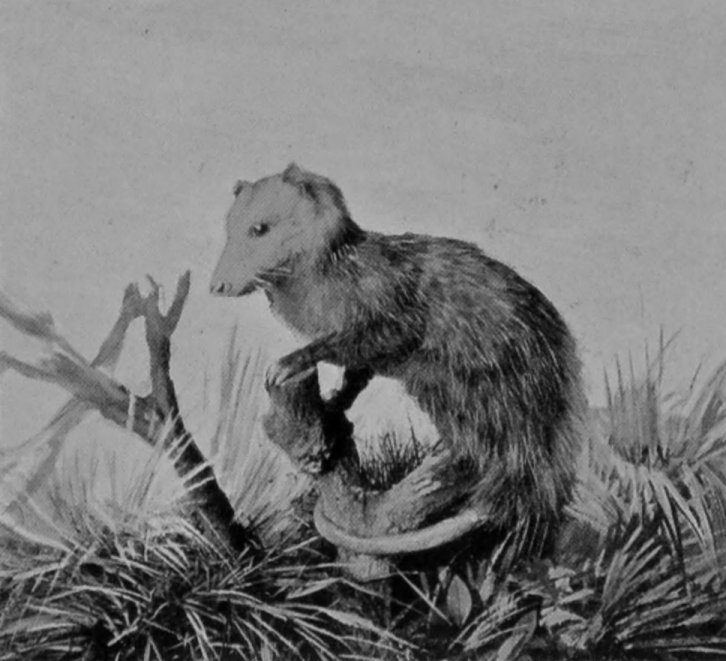
Photo by W. Saville-Kent, F.Z.S.] [Milford-on-Sea.
COMMON OR VIRGINIAN OPOSSUM.
The only marsupial animal found north of Mexico.
The Platypus.
The egg-laying mammal known as the Duck-billed Platypus differs very essentially from the echidna both in aspect and habits. It is adapted especially for an amphibious life, and for feeding on molluscs, worms, and insects, which it abstracts from the muddy bed or banks of the rivers that it frequents. The somewhat depressed ovate body is covered with short dense fur much resembling in colour and texture that of an otter. The tail is short and flattened like that of a beaver, but in place of being naked and scaly, as in that animal, is covered, on the upper surface more particularly, with long, coarse, bristle-like hairs that intercross one another in all directions. Neither is this tail used, as with the beaver, as a mason's trowel, it being simply subservient as a steer-oar. The feet are all four distinctly webbed, the membranes of the front feet in particular projecting to some distance beyond the extremities of the claws, and so communicating to these members a singular resemblance to the feet of a duck. The head of the platypus tapers off from the body without any conspicuous neck, and terminates in a most remarkable duck-like beak, having at its base a supplementary membranous ferrule-like structure which would seem to serve the purpose of limiting the distance into which the beak of the animal is thrust into the mud during the quest for its accustomed food, and at the same time protecting the creature's eyes. The mouth of the adult platypus contains no teeth, simply a few horny plates; but, singularly to relate, rudimentary teeth exist temporarily in the young animals. These provisional teeth, moreover, correspond in a marked manner with those of some ancient types of mammals which occur as fossils in the tertiary deposits of North America. The platypus, with relation to the obliteration of its teeth in the adult state, is regarded as a very exceptionally modified form and not as the immediate prototype of the ordinary mammals.
The platypus is found in Tasmania and in the south and eastern districts of Australia only, being altogether unknown in the west and north. Being especially shy and retiring, and to a large extent nocturnal in its habits, it is not frequently seen even in districts where it may be rather abundant. The animal excavates burrows of so great a length as from thirty to fifty feet in the river-banks that it frequents, and at the extreme end of these burrows it constructs a loose nest of weeds and root-fibres, which it uses as its retreat, and also for the production of its eggs and young. There are invariably two entrances to these burrows, the one being under water, and the other usually opening into a tangle of brushwood at some little distance from the water's edge. As many as from one to four eggs and young may be produced at a time, but two is the more general number. From the first it would appear that the eggs and young are deposited and nursed in the nest, not being retained or carried about in a pouch, as observed of the echidna.
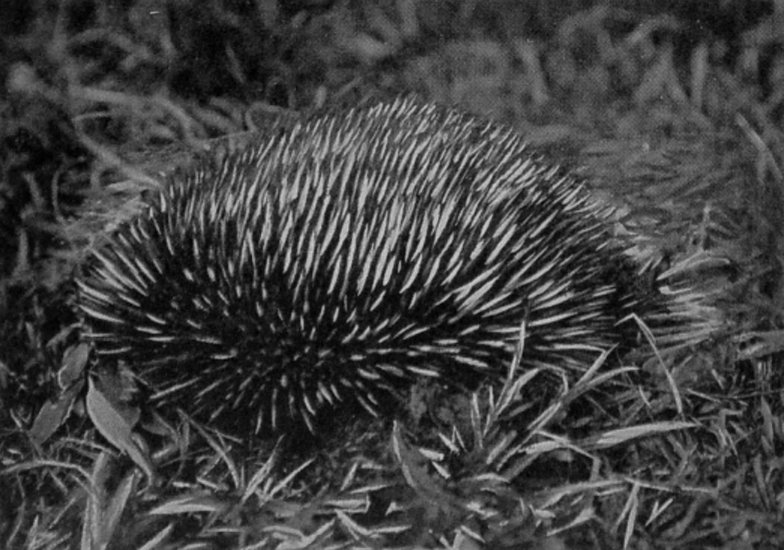
Photo by D. Le Souef] [Melbourne.
ECHIDNA, OR ANT-EATING PORCUPINE.
The female echidna can carry two eggs in her pouch, which in due course are hatched by the heat of her body.
The late Dr. George Bennett, of Sydney, New South Wales, has probably placed on record the most detailed account of the ways and life-habits of these remarkable animals, though it did not fall to him to solve the much-vexed question as to whether or not they were oviparous. This discovery, as applied also to the like phenomenon in the case of the echidna, was the outcome within quite recent years of the researches of Mr. Caldwell. After much indefatigable exploration, in which he was ably assisted by the natives, Dr. Bennett obtained from the extremity of an exceptionally long burrow a mother and pair of half-grown young. The young ones survived several weeks, and proved most droll and interesting pets. In playful habits they much resembled puppies, chasing and rolling one another over, and pretending to bite with their toothless bills. They were also much addicted to climbing every scalable article of furniture, including even a tall book-case, which they would negotiate by "swarming" up behind it as a sweep climbs a chimney, with their backs to the wall and their feet against the back of the book-case. The sleeping and waking hours that both these and other examples kept were observed to be very irregular; for while usually most lively and disposed to ramble after it grew dusk, they would at other times come out of their own accord in the daytime, or perhaps one would ramble about while the other slept. When going to sleep, they would roll themselves up in a perfect ball, the head, tail, and limbs being closely folded over the abdomen.
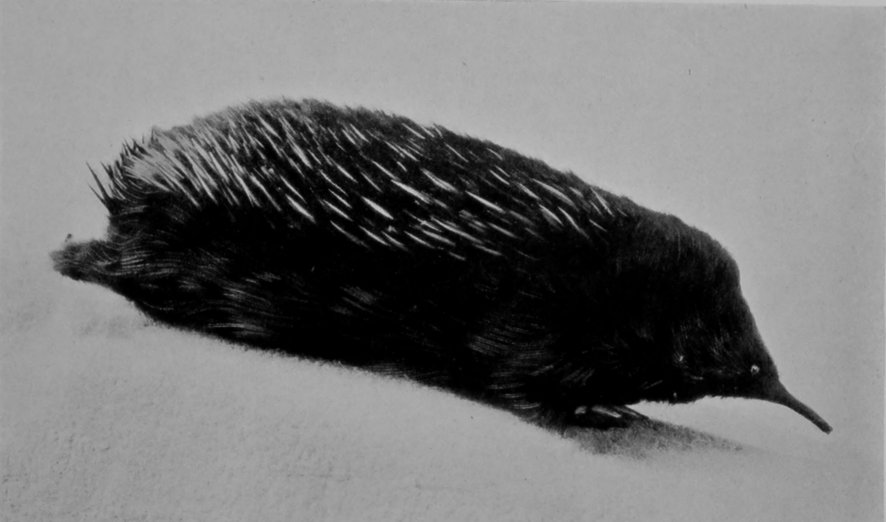
Photo by W. Saville-Kent, F.Z.S.] [Milford-on-Sea.
TASMANIAN ECHIDNA, OR PORCUPINE ANT-EATER.
This is the largest variety of the five-toed species; it grows to a length of 20 inches, and has the fur so long as almost to conceal the spines.
The food question appears to have presented almost insurmountable difficulties so far against the permanent acclimatisation of these interesting animals in any of our European zoological gardens. At the Melbourne Zoo some considerable success was obtained by fencing off a small pond abounding with insects and well-established water-plants for their reception, and in this instance they had also the advantage of being brought speedily and within a few hours of their capture to their new home. For their long voyage to Europe the provision of an adequate quantity of living insects or other aquatic organisms is a by no means easy task. They have, however, been known to thrive on broken-up river-mussels for the space of two or three weeks, and would probably have done so for a longer period. This material might easily be stored for their use on board ship.
An incident concerning the natural predilections of the platypus that fell within the writer's observation in Tasmania might also be utilised in their experimental transportation. At the trout- and salmon-rearing establishment on the river Plenty—of which the writer was at the time superintendent—the platypuses proved to be most destructive to the spawn both deposited in the hatching-boxes and upon the natural spawning-beds, or "redds," and they had in consequence to be systematically destroyed. This being the case, it is probable that they would be found to thrive well on a diet consisting to a large extent of the preserved roes or spawn of any easily procurable fish—such as the Murray perch and cod—and of which adequate supplies might with facility be stored aboard ship. The admixture in all cases of a certain amount of sand or mud with their provided pabulum would appear to be essential for digestive purposes, such material being always found in considerable quantities in their stomachs when dissected.
A distinguishing feature which the male platypus shares in common with the echidna is the peculiar spur developed on its hind foot. It is in this case, however, much larger and sharper, and has been accredited with aggressive functions and poisonous properties. There can be little doubt, however, that they are normally used by the animal only as clasping or retaining instruments during intercourse with the female at the breeding-season. At the same time, undoubted cases of persons receiving severe wounds from these animals' spurs have been placed on record. One such that fell within the writer's cognisance happened on the Murray River, on the Victorian and New South Wales boundary. A young fisher-lad, on taking up his nets, found a half-drowned platypus entangled in them, and, whilst disengaging it, it convulsively gripped his hand between the two spurs, the points penetrating deeply into the flesh on either side. The result was a festering wound that refused to heal for many months, and for such time entirely deprived the lad of his use of that hand.
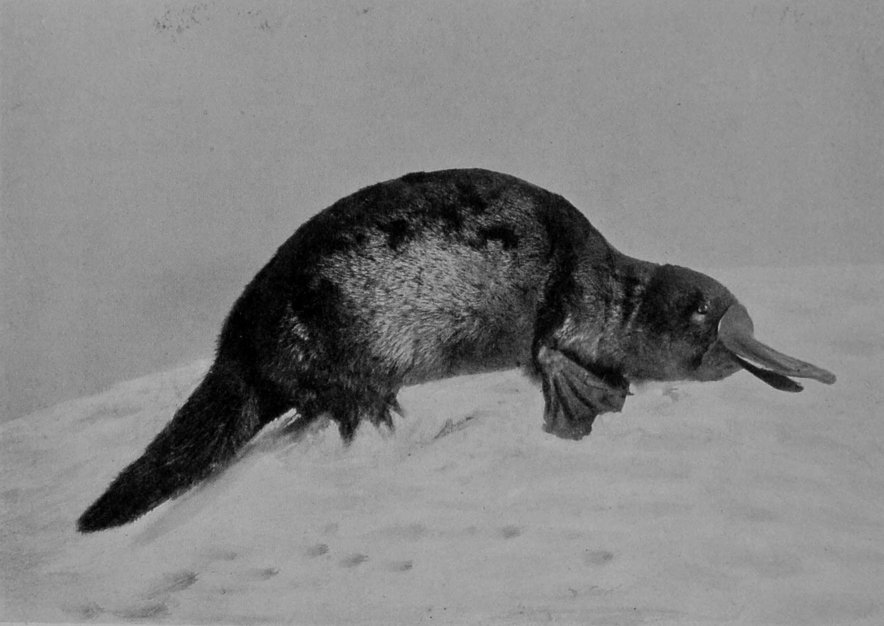
Photo by W. Saville-Kent, F.Z.S.] [Milford-on-Sea.
DUCK-BILLED PLATYPUS.
This curious egg-laying mammal, the only representative of its family, is mainly nocturnal in habits.
The fur of the platypus, dressed so as to remove the outer and longer series of hairs, nearly resembles that of the fur-seal in both colour and texture, and as a rare local product is highly prized for the manufacture of carriage-rugs and other articles.
With the egg-laying Echidna and Platypus we terminate the Mammalian Series, and they pave the way to the typical egg-laying animals which follow.
End of Vol. I.
Note
[1]
Since this was in type, Sir Harry Johnston has reported the existence in the Congo forest, on the borders of Uganda, of a large unknown type of ruminant, the Akapi of the natives.