ART AND CRITICISM IN AMERICA
Reading edition
(from the New York Press)
Tribune: “Edith Wharton’s Summer (Appleton) is a masterpiece of accurate, graceful and fascinating composition ... a climax of graphic power is reached which has seldom been approximated in contemporary fiction. But then—the pity of it all! the pity of it all! Was it worth while to use such gifts, to employ such rare and exquisite an artistry, in the exploitation of so sordid and so seamy a side of life?... If now and then, and here and there, man must be so fallen and so lost, let us rather ‘Walk backward with averted gaze and hide the shame.’”
Times: “Mr. Lewis’s (The innocents, by Sinclair Lewis. Harper) native endowment is essentially Dickensian, because his mental affinity is stronger for what is sweet and clean and bright, upward looking and forward pressing, in human nature, than it is for the rotten, the dour and the hopeless. He sees and duly uses these poisoned and poisonous elements of human life, but in his estimate of the forces that inspire, etc., etc.”
(To get the full value of the reviews of Mr. Lewis’s work one must read his countless stories and novels. But it would be well, perhaps, to mention that he is a rising young manufacturer of literary all-day suckers, who turns out a novel in about the time it took Flaubert to write a paragraph of Madame Bovary)—I. S.
Roosevelt’s “The Foes of Our Own Household”
This is an invaluable book. It is a compilation of all the outworn thought of the last two generations.—jh.
WE WANT!
We want monthly eight pages more for French, eight pages more for painting and sculpture (when extant), sixteen pages more if we are to print both the Hueffer prose series and the new novel promised by James Joyce, at the same time. We see no reason why we should not publish music (not criticism of music) if any happens to be written. Even our most rabid detesters can not expect us to double our format unless we can, at about the same time, double our list of subscribers. It is, placid reader, up to you.
Mason & Hamlin
THE STRADIVARIUS OF PIANOS
Mason & Hamlin Co.
313 FIFTH AVENUE NEW YORK
THE IRISH HOME-RULE CONVENTION
by George W. Russell (“A. E.”) and Sir Horace Plunkett with an American opinion by John Quinn
“The best, the sanest, the most unbiased and at the same time the most eloquent discussion of the Irish Home-Rule question”.—John Quinn.
Seventy-five cents
THE MACMILLAN COMPANY, Publishers New York
THE GREENWICH VILLAGE THEATRE 4th Street & 7th Avenue
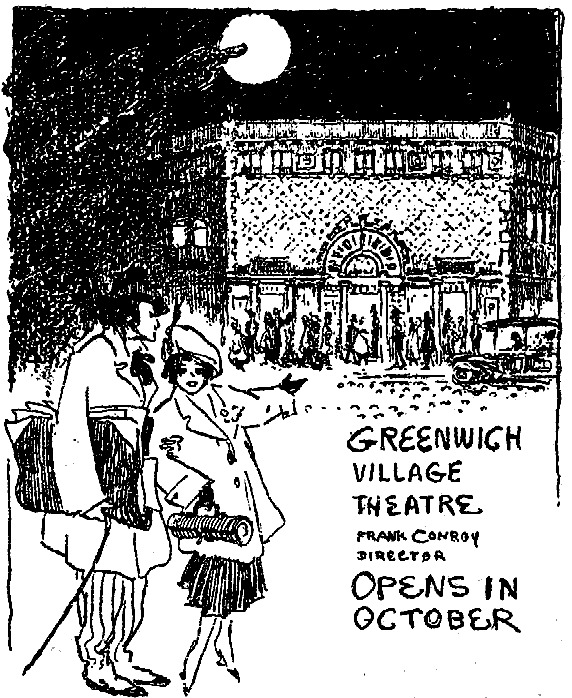
THE OPENING BILL:
A Fantasy in two scenes, Behind the Watteau Picture, by Robert E. Rogers, with Incidental music by W. Franke Harlinge.
Efficiency by Robert H. Davis and Perley Poore Sheehan.
The Festival of Bacchus by Arthur Schnitzler, translated by Charles Henry Meltzer.
Subscription Books Now Open
Temporary Office: 133 Washington Place
By THOMAS H. DICKINSON THE INSURGENT THEATRE
All about the artistic and practical sides of the “little” theatres, open-air presentations, performances for children, “modern” movements and, in general, a full discussion and orientation of departures from tradition of the American stage. The various organizations and their personnel are catalogued and their contributions evaluated. Lists of plays performed are included.
If you write, act, read or criticise, you need this book.
$1.25 net
B. W. HUEBSCH, Publisher, 225 Fifth ave., New York
Mr. KNOPF announces
LUSTRA
by Ezra Pound
This, the first book of poems by Mr. Pound to appear in this country since 1912, opens with a number of pieces on modern subjects. These are followed by the now famous Cathay “translation” from the Fenollosa Chinese manuscripts. Then come some earlier poems, and the book closes with the long and new Three Cantos.
The volume contains much that is not included in any English editions of Mr. Pound’s books.
$1.50 net at all bookshops
Alfred A. Knopf, Publisher New York
Modern Gallery
500 Fifth Avenue
DAUMIER CEZANNE LAUTREC VAN GOGH PICASSO BRANCUSI PICABIA DERAIN BURTY VLAMINCK RIVERA BRAQUE
Mexican Pre-Conquest Art African Negro Sculpture
EUGENE HUTCHINSON
PHOTOGRAPHS
Fine Arts Building Chicago, Illinois
To the Memory of “The Seven Arts”
FALL ANNOUNCEMENT OF NEW BOOKS OF THE OPEN COURT PUBLISHING CO.
Bool’s Collected Logical Works. Volume two: Laws of Thought. $3.00.
“Here is an exact reproduction in the 1854 original, with the addition of an index. The same is established of fundamental laws as in the earlier Mathematical Analysis of Logic but with more general methods and a wider range of application.”—The St. Louis Mirror.
The Contingency of the Laws of Nature. By Emile Boutroux. Translated by Fred Rothwell. Cloth, $1.50.
“M. Boutroux has restored to man his thoughts and feelings that reality and effective influence over the course of things which common sense attributed to them.”—Baltimore News.
Geometrical Lectures of Isaac Barrow. With an introduction by J. M. Child. Cloth, $1.25.
“The importance of this work to students of mathematical theory goes without saying. The introduction is carefully and ably reasoned.”—The Springfield Republican.
Diderot’s Early Philosophical Works. Translated and Edited by Margaret Jourdain. Pp. 246. Cloth, $1.00.
“No man with an interest in literature and life would care to be without a reading of a fine specimen of Eighteenth Century thought.”—The Philadelphia Inquirer.
Professionalism and Originality. By F. A. Hayward. Cloth, $1.75.
“In view of the privileged and almost irresponsible positions occupied by the professions and of the obscurity involving the questions of professional superintendence and criticism this book is of great and possibly permanent interest.”—The Pittsburg Post.
A Modern Job. An essay on the Problems of Evil. By Etienne Giran. $.75.
“The volume is worthy of careful reading for it presents various tendencies found in our world to-day and also shows that it is dangerous to build one’s theology and religion in any one-sided fashion.”—International Journal of Ethics.
Three Men of Judea. By Henry S. Stix. Pp. 112. Cloth, $1.00.
This book is not written for scholars but for those simple minded and honest folk who have never read their Bible nor thought much on the subject of religious history, accepting their religion like their politics, as a sort of parental heritage.
THE OPEN COURT PUBLISHING COMPANY 122 South Michigan Avenue Chicago, Illinois
Interesting New Books for Discriminating Readers
Does This Amazing Novel Forecast the Way to Peace?
THE COMING
By J. C. Snaith
A soldier, wounded, war weary, who has learned in the trenches to forget the meaning of hate; a village vicar, voicing the venom of those who do not fight; and John Smith, simple, determined, working for the brotherhood of man—around these three characters the author of “The Sailor” has written an amazing novel of the spiritual and ethical side of the War.
Cloth, $1.50 net
The Wind in the Corn
By Edith Franklin Wyatt
Song poems of Democracy and the great Trails that sound a note of hope and honest labor.
$1.50 net
Great Companions
By Edith Franklin Wyatt
A delightful discussion of the personalities of a dozen great writers.
$1.50 net
Out of Their Own Mouths
With an introduction by William Roscoe Thayer
An accurate translation of official German letters and documents which prove conclusively how and why the Prussians began the war.
$1.00 net
The Latin at War
By Will Irwin
An intimate account of the author’s experiences in France and Italy during the great war.
$1.75 net
Summer
By Edith Wharton
A vivid story of life in a small hill town.
$1.50 net
Susan Lenox: Her Fall and Rise
By David Graham Phillips
“America has to its credit one more great novel, perhaps the greatest since ‘The Scarlet Letter’.”—Minneapolis Journal
Two vols, boxed, $2.50 net
The Red Badge of Courage
By Stephen Crane
New edition with an Introduction by Arthur Guy Empey “This is not a story of war: It is War.”
$1.00 net
The Quest of Ledgar Dunstan
By Alfred Tresidder Sheppard
An acute study of a drifter, who seeks, and in the end, finds, himself.
$1.50 net
At All Booksellers · These Are Appleton Books D. Appleton and Company, Publishers, New York
COLONY ART SHOP
Artists’ Materials
Oil and Water Colors Brushes and Canvas Smocks to Order
Interior and Exterior Decorating Paper Hanging Polishing and Refinishing of Wood Work
ADOLPH KLAFF
143 Sixth Ave., NEW YORK CITY, Chelsea 1285
OLD CHELSEA
51 West 16th Street New York City
Rooms, Suites, Floors furnished or unfurnished. Intelligent service for busy men and women.
Table d’hote dining-room
noted for fine home cooking.
“A bit of Old Chelsea in little old New York”
Just think!
Translations from the best of the Europeans
Original stories, poems, etc., by the younger Americans
Drawings, etchings, and other reproductions—all in the same magazine
THE PAGAN
Unique Monthly
15 cents a copy, $1.50 a year
The Pagan Publishing Company 174 Centre Street New York City
THE ARTISTS’ GUILD
A NATIONAL ORGANIZATION INCORPORATED ON A “NOT FOR PROFIT BASIS”.
Paintings, Sculpture AND Handwrought Objects
As security for the purchase and to ensure merit, all works are approved by a jury.
Exquisite and Rare Gifts
The Artists’ and Craft Workers’ own organization
GALLERIES, EXHIBITION AND SALESROOMS FINE ARTS BUILDING · CHICAGO, ILLINOIS
“Hello Huck!”
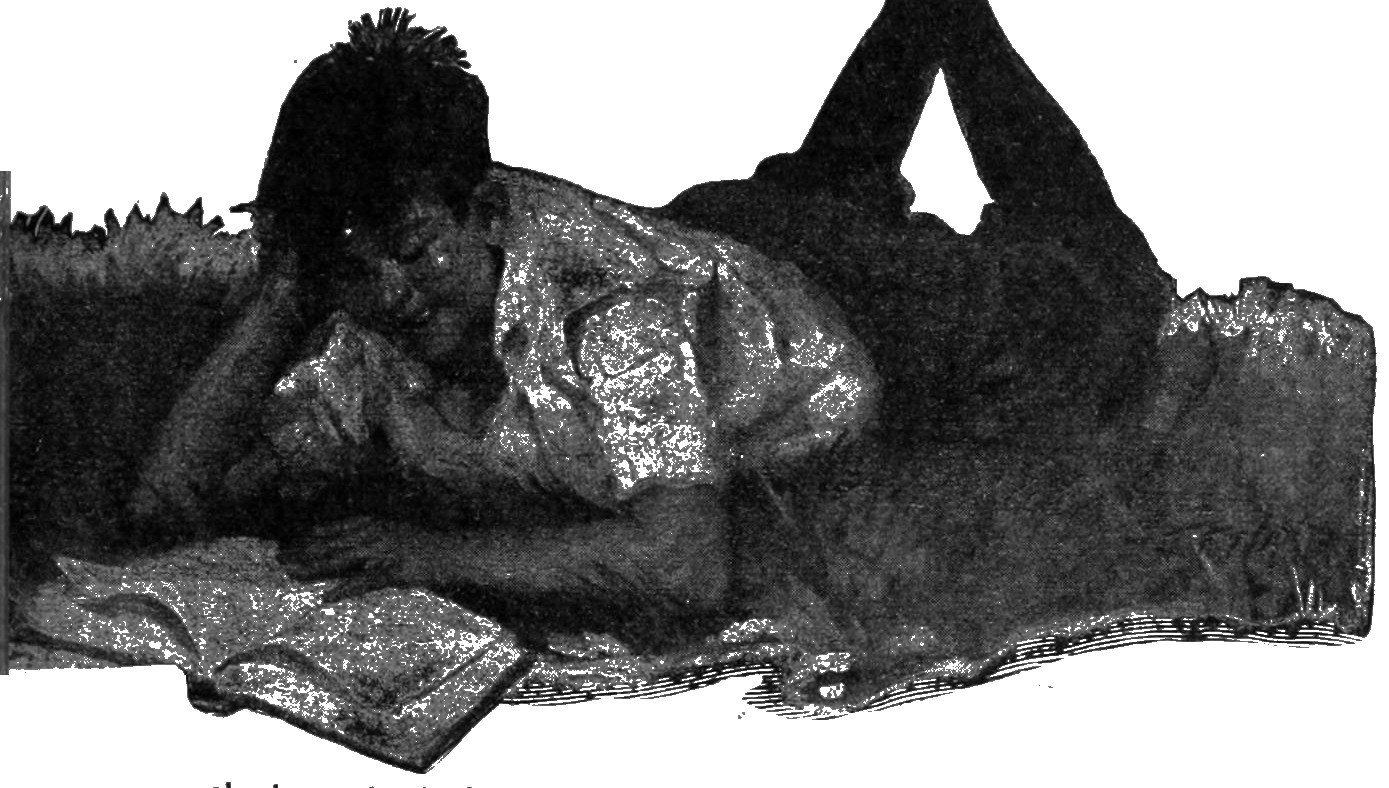

Recall that golden day when you first read “Huck Finn”? How your mother said, “For goodness’ sake, stop laughing aloud over that book. You sound so silly.” But you couldn’t stop laughing.
Today when you read “Huckleberry Finn” you will not laugh so much. You will chuckle often, but you will also want to weep. The deep humanity of it—the pathos, that you never saw, as a boy, will appeal to you now. You were too busy laughing to notice the limpid purity of the master’s style.
MARK TWAIN
When Mark Twain first wrote “Huckleberry Finn” this land was swept with a gale of laughter. When he wrote “The Innocents Abroad” even Europe laughed at it itself.
But one day there appeared a new book from his pen, so spiritual, so true, so lofty that those who did not know him well were amazed. “Joan of Arc” was the work of a poet—a historian—a seer. Mark Twain was all of these. His was not the light laughter of a moment’s fun, but the whimsical humor that made the tragedy of life more bearable.
A Real American
Mark Twain was a steamboat pilot. He was a searcher for gold in the far West. He was a printer. He worked bitterly hard. All this without a glimmer of the great destiny that lay before him. Then, with the opening of the great wide West, his genius bloomed.
His fame spread through the nation. It flew to the ends of the earth, until his work was translated into strange tongues. From then on, the path of fame lay straight to the high places. At the height of his fame he lost all his money. He was heavily in debt, but though 60 years old, he started afresh and paid every cent. It was the last heroic touch that drew him close to the hearts of his countrymen.
The world has asked is there an American literature? Mark Twain is the answer. He is the heart, the spirit of America. From his poor and struggling boyhood to his glorious, splendid old age, he remained as simple, as democratic as the plainest of our forefathers.
He was, of all Americans, the most American. Free in soul, and dreaming of high things—brave in the face of trouble—and always ready to laugh. That was Mark Twain.
The Price Goes Up
25 VOLUMES Novels—Stories—Humor—Essays—Travel—History
This is Mark Twain’s own set. This is the set he wanted in the home of each of those who love him. Because he asked it, Harpers have worked to make a perfect set at a reduced price.
Before the war we had a contract price for paper, so we could sell this set of Mark Twain at half price.
Send the Coupon Without Money
L. R. S. HARPER & BROTHERS
Franklin Sq., N. Y.
Send me, all charges prepaid, a set of Mark Twain’s works in 25 volumes, illustrated, bound in handsome green cloth, stamped in gold, gold tops and untrimmed edges. If not satisfactory, I will return them at your expense. Otherwise I will send you $1.00 within 5 days and $2.00 a month for 12 months, thus getting the benefit of your half-price sale.
Little Review
Name .............................
Address ..........................
The last of the edition is in sight. The price of paper has gone up. There can be no more Mark Twain at the present price. There never again will be any more Mark Twain at the present price. Get the 25 volumes now, while you can. Every American has got to have a set of Mark Twain in his home. Get yours now and save money.
Your children want Mark Twain. You want him. Send this coupon today—now—while you are looking at it.
HARPER & BROTHERS, New York
A SELECTION OF BOOKS from THE LITTLE REVIEW BOOKSHOP
Poetry and Drama
Prufrock and other Observations, by T. S. Eliot.
Noh: A Study of the Classical Stage of Japan, by Ernest Fenollosa and Ezra Pound. $2.75.
The Love Poems of Verhæren, translated by Flint, Symons, and others. $1.50.
A Night at an Inn, by Lord Dunsany. 50 cents.
Psychology
Psychology of the Unconscious by Dr. C. G. Jung. $4.00.
The Psychoanalytic Method, by Dr. Oskar Pfister. $4.00.
Wit and Its Relation to the Unconscious, by Dr. Sigmund Freud. $2.50.
The Neurotic Constitution, by Dr. Alfred Adler. $3.00.
Fiction
A Portrait of the Artist as a Young Man, by James Joyce. $1.50.
Pelle the Conqueror, by Martin Anderson Nexø. 4 volumes. $6.00.
Mendel, by Gilbert Cannan. $1.50.
Dubliners, by James Joyce. $1.50.
Miscellaneous
Le Feu, by Henri Barbusse.
Chamber Music, by James Joyce.
The Works of Anatole France. Each $1.25.
Oscar Wilde: His life and Confessions, by Frank Harris. 2 volumes. $10.00.
All mail orders must be accompanied by an average of ten cents per book for postage.
THE LITTLE REVIEW
THE MAGAZINE THAT IS READ BY THOSE WHO WRITE THE OTHERS
Some features of the coming issues:
November: Hanrahan’s Oath: A Play, by Lady Gregory Poems from the Chinese of Li Po, by Maxwell Bodenheim Imaginary Letters, VI., by Ezra Pound Reproductions of Modern Sculpture and Drawings
December: A Letter from Remy de Gourmont A Soldier of Humour, by Wyndham Lewis T. S. Eliot: A Criticism, by May Sinclair
January: Women and Men, by Ford Madox Hueffer
James Joyce will begin a new novel either in the February or March number.
Editorials in The Little Review will respect no vested interests, no publishers’ interests, no aged magazines and reviews, nor staffs of the same.
THE LITTLE REVIEW BOOKSHOP
It is often impossible even in the large cities to get books on special subjects. We can deliver to you any book on any subject.
Copies of The Egoist on sale.
In this issue is a subscription blank. Give it to some one who wishes to subscribe.
24 West Sixteenth Street, New York City
Advertisements were collected at the end of the text.
The table of contents on the title page was adjusted in order to reflect correctly the headings in this issue of The Little Review.
The original spelling was mostly preserved. A few obvious typographical errors were silently corrected. All other changes are shown here (before/after):
... I have come too late. She is dead. ... ... DR T.: I have come too late. She is dead. ...