The Reader Critic
Reading edition
Oddities?
A. R. S.:
I have found The Little Review excessively burdened with what you describe as “stuff in which the creative element is present”. Indeed my impression is that it is devoted more to invention than to interpretation, and therein misses its calling as an agency of “Art”. And as to quality, it is not my understanding that “Art” is necessarily, or usually, insipid or bizarre, as represented in your publication. These are times for men to be attending to more serious things than aesthetic oddities.
[The above letter was written to us by one of the front citizens of a large city, on his club stationary,—a men’s club where old Betties gossip and criticize women’s clothes. Yet he would say to men like Wyndham Lewis, and other of our contributors now in the trenches, that these are times for men to be attending to more serious things than aesthetic oddities.
How smoothly he has set down the attitude of the great average mind toward Art. No, I cannot say average. Average implies variation. It is the perfect contempt of the elderly gentleman art patron for the creative and the original. From long years of supporting museums of art, the city beautiful plan, opera organizations, etc., he acquires the attitude of the affluent married man toward his wife: whatever is supported by him must necessarily be a thoroughly understood subject, and even if inferior, must be the interpreter of his life.—jh.]
Radicalism and Conservatism
M. L. K.:
I am renewing my subscription to The Little Review, though I don’t know just why. I don’t understand you very well any more. I don’t know whether I approve. You used to be very different. Sometimes you were great. Your own article “Life Itself” and Ben Hecht’s “Dregs” I shall always remember. You used to show such fine sympathy for all kinds of social suffering. I cannot see how a magazine devoted only to what you call Art can have a very vital share in the solving of our present great problems. This is such a splendid opportunity for your radicalism....
[Conservatism: to preserve the best. As a term of abuse, to preserve good and bad indiscriminately.
Radicalism: to get to the root of the matter. Usually to eradicate good and bad indiscriminately.
Besides they are terms filthy from contact with politics.—F. E.]
Too British
V. H., Maine:
I like the July number a lot. It’s consistently good all through. The only thing I was disappointed in was the “Imaginary Letters”. It’s so damned British! It’s very clever, there’s no question—but to me at least it lacks beauty. The T. S. Eliot poems are in something the same vein but much more mature, and awfully well written. I like the Ezra Pound very much—in fact everything else.
[I can’t see why Lewis’s Letter is any more essentially British than Nietzsche’s “Flies in the Market Place”. And since it is very good writing why hasn’t it beauty?—M. C. A.]
Reproach
... I am sorry about one thing,—you don’t seem to be able to get rid of the propaganda. All the things Pound sends you are in a way propaganda. If not, what are they trying to do; just shock people? Eliot’s poem about the Church is all right. That sort of thing ought to be said and he has said it so well that it will get over. But I think his “Lune de Miel” is disgusting, in one line simply impossible. I am terribly interested, but I do wish they would be a little more delicate.
[I am with you on the propaganda. Extermination seems simple and direct and lasting and the only solution to me. Shocking people I believe is a fever of extreme youth which cools very soon,—as soon as caught almost. If one could only shock them to the foundations there might be some interest, but they are never shocked beyond where they are always trembling anyway. Eliot is quite outside that kind of interest.
We are known, in magazine lingo, as a class magazine. At first I was puzzled as to what that meant. But when a distinguished foreigner, a man who might have competed with the Jodindranath of Ezra Pound’s article, said that that article was a “matter for police suppression” I thought that he was probably the only person qualified to understand it. There is that class. And then there is the other class,—the one expressed by the gentleman who laughingly said: “There is a number of such backgrounds that should be so exploited”.—jh.]
War Art
B. C., Kansas:
The Little Review is the only magazine I have laid eyes on in months that hasn’t had a word in it about this blasted war. How do you do it?
[Perhaps it’s because none of us considers this war a legitimate or an interesting subject for Art, not being the focal point of any fundamental emotion for any of the peoples engaged in it. Revolutions and civil wars are different ... but that is a long story. There never has been a real revolution yet: peoples have revoluted but they have never seemed to hold on to what they have fought for. By the time the revolution gets to be history they are back behind where they started, staggering under the same kind of burdens. They are really hunch-backs, but they think that which bends their backs can be unloaded. And civil wars, whatever their pretext, seem always to be the fight of the self-righteous uncultivated against the cultivated and the suave.
I am not writing this as a “scholar of history.” I am just wandering on when I don’t very much want to. At least I do feel strongly that nine tenths of the stuff written is a rotten impertinence to be discouraged. Some reviewers call these efforts “deeply touching and of poignant appeal”. Consider the morbid deadliness of the U-Boat and then this poem:—
You are a U-Boat you, You’re number 23, U-Boat you’re after me U-Boat this is not war, U-Boat you make me sore.
There are three stanzas supporting this chorus which are a matter of abnormal crime. And this is the effort of a woman educated in one of the best colleges in the country.—jh.]
To “jh”
Israel Solon, New York:
I see in your last issue: “After reading your article ‘Push-Face’ in your June number I have torn the magazine to pieces and burned it in the fire. You may discontinue my subscription”.
We would destroy you instead of falling upon his face for the one red moment you tendered him. What is one to say to this?
Life would be hard to bear were it not that of this all life is made, by this all life destroyed.
Louise Gebhard Cann, Seattle:
... Mr. Pound’s swashbuckling always sets me to crying, with my eye on the needy American public. “Encore! Encore!” But I am not tempted to reread him, except for the purpose of looking up in the dictionary the novel words he uses. However, since reading his Dialogue in the June Little Review, I have reversed my opinion; for I shall read that excellent chat between the student and Rabelais twice as many times as I read any one of John Davidson’s “Tête-à-têtes”.
I intended to interject quite parenthetically before that no one who conscientiously reads the author of “Jodindranath Mawhwor’s Occupation” can fail to develop a vocabulary; and since the art of writing is the art of words,—that, given language, inevitably formal literature arises,—Mr. Pound is a high-pressure manufacturer of literature-matrix.
The May number was certainly an achievement,—the sort of thing we’re hungry for; but we missed “jh”.
Your “Push-Face” is precisely to the point. Its weakest part is your satire on clothes and appearance. To seize upon the merely external, to ridicule a woman because of her age, is the easiest and therefore the most journalistic form of humor. I am certain that in time we shall come into a form of wit so potent that it will deal with character as you deal with double-chins and tunics. You yourself attain this penetrating force of satire when you throw up against the Red-Cross activity the activity of the police in pushing back the little children from the slums beyond the Square.
[You seem to me to be a bit confused in your criticism of my “Push-Face” article. “Its weakest part is your satire on clothes and appearance”—and later you are certain that we shall come into a form of wit so potent that it will deal with character as I dealt with double-chins and tunics (appearance and clothes). But I feel certain that we shall never come into a time when the reader will be penetrating enough to recognize psychology from a mere dealing with “externals”.
The part you criticise was an attempt to strike through externals to suggest a psychology of anatomy,—a psychology founded on a theory that the definitive lines of the body take their intention from something more fundamental than will power. I have not read Dr. Adler’s theory of the “fictitious goal”. But I have learned from my study of the human body, in drawing from it, and from that eternal observation of it which becomes a tireless and almost unconscious preoccupation of the painter,—I have learned that it is possible for even the slightly intelligent to stamp his body with all the movement, bearing, and spirit of some cherished ideal or some protective colouring of himself which he wishes to present to the world. In great stress or in crises where the entire will power is overthrown or engaged elsewhere the body, like the mind, assumes its true lines and presence. On the stage this is a very simple way of unmasking a character,—you will say, an obvious way. Then why may not the fictitious role be obvious to the painter,—not a matter of “mere externals” but a legitimate thing to seize upon as a subject for satire or what you choose? This class of people—those of the fictitious role—are really the richest material for Art. It is only in cases where there is creative power back of the fictitious role that the thing itself becomes an art: in poets, musicians, painters, etc., when the fictitious becomes a thing created, where with mind and body they have created a wholly new, unshakable, well-designed character from themselves.
Byron, the unwanted, spiritless, club-footed child who created from this material a brilliant symbol of romantic manly beauty, “flashing a flaming heart across Europe”.
But all this is too interesting and immense to deal with in a paragraph. Sometime perhaps I will go into it at length.—jh.]
The stag’s voice has bent her heart toward sorrow, Sending the evening winds which she does not see, We cannot see the tip of the branch. The last leaf falls without witness. There is an awe in the shadow, And even the moon is quiet, With the love-grass under the caves. —From “Noh”, by Ernest Fenollosa and Ezra Pound.
Garments created by Bertha Holley give the wearer the distinction in color and line of an artist’s portrait. Their beauty is essential, therefore permanent, and raises one forever above the confusion and extravagance of changing fashion. Moreover, each garment forms part of an accumulative, interchangeable wardrobe which may be acquired at once or gradually, as a booklover acquires books, and when complete enables the possessor to meet every occasion with variety and charm.
BERTHA HOLLEY
Twenty-one East Forty-ninth Street New York City Telephone: Plaza 1495
Mason & Hamlin
THE STRADIVARIUS OF PIANOS
Mason & Hamlin Co.
313 FIFTH AVENUE NEW YORK
THE ARTISTS’ GUILD
A NATIONAL ORGANIZATION INCORPORATED ON A “NOT FOR PROFIT BASIS”.
Paintings, Sculpture AND Handwrought Objects
As security for the purchase and to ensure merit, all works are approved by a jury.
Exquisite and Rare Gifts
The Artists’ and Craft Workers’ own organization
GALLERIES, EXHIBITION AND SALESROOMS FINE ARTS BUILDING CHICAGO, ILLINOIS
THE LITTLE REVIEW
MARGARET C. ANDERSON, Editor EZRA POUND, London Editor
For September:
INFERIOR RELIGIONS, by WYNDHAM LEWIS L’HOMME MOYEN SENSUEL, by EZRA POUND EELDROP AND APPLEPLEX, II., by T. S. ELIOT IMAGINARY LETTERS, IV.: “The Nonsense about Art for the Many”, by EZRA POUND
MR. JAMES JOYCE will contribute to The Little Review as soon as circumstances permit. Editorials in The Little Review will respect no vested interests, no publishers’ interests, no aged magazines and reviews, nor staffs of the same.
Yearly Subscription, U. S. A., $1.50; Canada, $1.65; Great Britain and other Countries, 7/-
THE LITTLE REVIEW
24 West 16th Street, New York City Foreign Office: 5 Holland Place Chambers, Kensington W.8., London.
Enclosed find $1.50 for one year’s subscription, beginning ......................
Name ................................ Address .............................. ..............................
COLONY ART SHOP
Artists’ Materials
Oil and Water Colors Brushes and Canvas Smocks to Order
Interior and Exterior Decorating Paper Hanging Polishing and Refinishing of Wood Work
ADOLPH KLAFF
143 Sixth Ave., NEW YORK CITY Chelsea 1285
EUGENE HUTCHINSON
PHOTOGRAPHS
FINE ARTS BUILDING, CHICAGO, ILL.
SPECIAL OFFER
JAMES JOYCE’S A Portrait of the Artist as a Young Man and a year’s subscription to The Little Review for $2.50.
We are glad to announce that through the courtesy of Mr. Huebsch we are able to make the following unusual offer, open to any one who sends in a subscription (or a renewal) to The Little Review.
Mr. Joyce’s Portrait of the Artist as a Young Man, the most important and beautiful piece of novel writing to be found in English today, retails for $1.50. The subscription price of The Little Review is $1.50. We will cut the latter to $1.00, for this special offer, and you may have the book and the subscription for $2.50. Or you may have Mr. Joyce’s Dubliners instead.
ORDER FORM
“A PORTRAIT OF THE ARTIST AS A YOUNG MAN”
Please send me .... cop .... of
A PORTRAIT OF THE ARTIST AS A YOUNG MAN by James Joyce, published by Mr. B. W. Huebsch, for which I enclose....
Name ............................... Address ............................ ............................
Orders, accompanied by remittance should be sent to
THE LITTLE REVIEW 24 West 16th Street, New York City
THE EGOIST
An Individualist Review
Present Features
LINGUAL PSYCHOLOGY: THE SCIENCE OF SIGNS: a series of subtle and illuminating articles working out a new conception of the function of philosophic inquiry—by Miss Dora Marsden (started in July number).
Literary criticism, reviews and other prose articles. Paris chronicle and a series of articles on modern French prose writers, by Madame Ciolkowska.
DIALOGUES OF FONTENELLE, translated by Mr. Ezra Pound (started in May number).
TARR, a brilliant modern novel by Mr. Wyndham Lewis, leader of the English “Vorticist” group (started in April number).
Poems by young English and American poets, mostly belonging to the Imagist group.
PUBLISHED MONTHLY
Price Fifteen Cents a Number
Yearly Subscription, One Dollar Sixty Cents
OAKLEY HOUSE, BLOOMSBURY ST., LONDON, W. C.
CHALLENGING THE GOVERNMENT
Twelve to fifteen radical publications have been declared unmailable.
THE MASSES is the only one which has challenged the censorship in the courts and put the Government on the defensive.
Each month we have something vitally important to say on the war.
We are going to say it and continue to say it.
We are going to fight any attempt to prevent us from saying it.
THE MASSES has proved in the last few issues that it stands the foremost critic of militarism.
In these critical times THE MASSES is necessary for a true comprehension of the war problems.
Buy THE MASSES on the newsstands until we are readmitted to the mails.
15¢ the Copy.
The Masses Publishing Company 34 Union Square, East · New York City
To The Advertiser
We have given very little attention to solving the advertising problem for The Little Review.
We have always been too engrossed in the adventure of making a magazine of literature.
This has been a lack of foresight on our part.
We are told every day by advertising men that a certain class of advertiser is always looking for our kind of public.
A magazine whose interest is in its contents rather than in policy, circulation, competition, or popularity, is a peculiarly good medium for the class of advertiser who has standards beyond precedent standards.
He is assured of an interested, loyal, discriminating audience. The advertiser needs us. We need the advertiser. He will help us to enlarge our format and to carry out an extraordinary program.
Now is the time to advertise with us.
We are a growing concern.
Write for rates.
The Little Review 24 West Sixteenth Street, New York City.
“Hello Huck!”
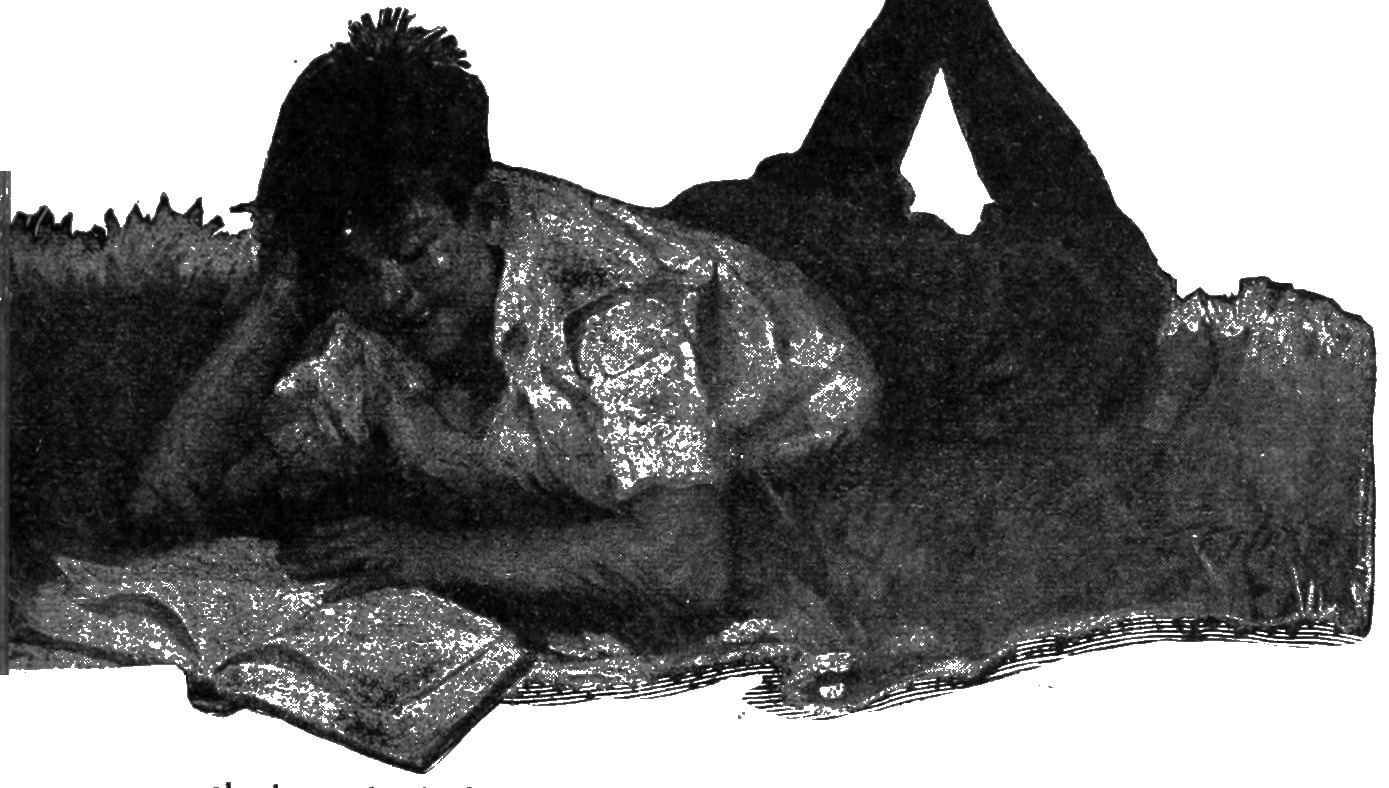

Recall that golden day when you first read “Huck Finn”? How your mother said, “For goodness’ sake, stop laughing aloud over that book. You sound so silly.” But you couldn’t stop laughing.
Today when you read “Huckleberry Finn” you will not laugh so much. You will chuckle often, but you will also want to weep. The deep humanity of it—the pathos, that you never saw, as a boy, will appeal to you now. You were too busy laughing to notice the limpid purity of the master’s style.
MARK TWAIN
When Mark Twain first wrote “Huckleberry Finn” this land was swept with a gale of laughter. When he wrote “The Innocents Abroad” even Europe laughed at it itself.
But one day there appeared a new book from his pen, so spiritual, so true, so lofty that those who did not know him well were amazed. “Joan of Arc” was the work of a poet—a historian—a seer. Mark Twain was all of these. His was not the light laughter of a moment’s fun, but the whimsical humor that made the tragedy of life more bearable.
A Real American
Mark Twain was a steamboat pilot. He was a searcher for gold in the far West. He was a printer. He worked bitterly hard. All this without a glimmer of the great destiny that lay before him. Then, with the opening of the great wide West, his genius bloomed.
His fame spread through the nation. It flew to the ends of the earth, until his work was translated into strange tongues. From then on, the path of fame lay straight to the high places. At the height of his fame he lost all his money. He was heavily in debt, but though 60 years old, he started afresh and paid every cent. It was the last heroic touch that drew him close to the hearts of his countrymen.
The world has asked is there an American literature? Mark Twain is the answer. He is the heart, the spirit of America. From his poor and struggling boyhood to his glorious, splendid old age, he remained as simple, as democratic as the plainest of our forefathers.
He was, of all Americans, the most American. Free in soul, and dreaming of high things—brave in the face of trouble—and always ready to laugh. That was Mark Twain.
The Price Goes Up
25 VOLUMES Novels—Stories—Humor—Essays—Travel—History
This is Mark Twain’s own set. This is the set he wanted in the home of each of those who love him. Because he asked it, Harpers have worked to make a perfect set at a reduced price.
Before the war we had a contract price for paper, so we could sell this set of Mark Twain at half price.
Send the Coupon Without Money
HARPER & BROTHERS
Franklin Sq., N. Y.
Send me, all charges prepaid, a set of Mark Twain’s works in 25 volumes, illustrated, bound in handsome green cloth stamped in gold, gold tops and untrimmed edges. If not satisfactory, I will return them at your expense. Otherwise I will send you $1.00 within 5 days and $2.00 a month for 12 months, thus getting the benefit of your half-price sale.
Little Review
Name ........................
Address .....................
The last of the edition is in sight. The price of paper has gone up. There can be no more Mark Twain at the present price. There never again will be any more Mark Twain at the present price. Get the 25 volumes now, while you can. Every American has got to have a set of Mark Twain in his home. Get yours now and save money.
Your children want Mark Twain. You want him. Send this coupon today—now—while you are looking at it.
HARPER & BROTHERS, New York
A SELECTION OF BOOKS from THE LITTLE REVIEW BOOKSHOP
Poetry and Drama.
Prufrock and other Observations, by T. S. Eliot.
Noh: A Study of the Classical Stage of Japan, by Ernest Fenollosa and Ezra Pound. $2.75.
The Love Poems of Verharen, translated by Flint, Symons, and others. $1.50.
A Night at an Inn, by Lord Dunsany. 50 cents.
Psychology
Psychology of the Unconscious, by Dr. C. G. Jung. $4.00.
The Psychoanalytic Method, by Dr. Oskar Pfister. $4.00.
Wit and Its Relation to the Unconscious, by Dr. Sigmund Freud. $2.50.
The Neurotic Constitution, by Dr. Alfred Adler. $3.00.
Fiction
A Portrait of the Artist as a Young Man, by James Joyce. $1.50.
Pelle the Conqueror, by Martin Anderson Nexo. 4 volumes. $6.00.
Mendel, by Gilbert Cannan. $1.50.
Dubliners, by James Joyce. $1.50.
Miscellaneous
Le Feu, by Henri Barbusse.
Chamber Music, by James Joyce.
The Works of Anatole France. Each $1.25.
Oscar Wilde: His life and Confessions, by Frank Harris. 2 volumes. $10.00.
All mail orders must be accompanied by an average of ten cents per book for postage.
Advertisements were collected at the end of the text.
The table of contents on the title page was adjusted in order to reflect correctly the headings in this issue of The Little Review.
The original spelling was mostly preserved. A few obvious typographical errors were silently corrected. All other changes are shown here (before/after):
... And when she meets our gaze her eyes are laughter lit ... ... And when she meets our gaze her eyes are laughter lit, ...
... Her speech a wicked tale that we may vie with her ... ... Her speech a wicked tale that we may vie with her, ...