"Later: Edmee, A Tale of the French Revolution" (continued 2)
Reading edition
“Madame Germain smiled.
”‘You will always be as dear to me as my own child, whatever name you are called by,’ she said. ‘But as I was saying, Edmée, you are growing a big girl; there are many things young ladies of your station need to learn that cannot be taught in a village like Valmont. And your dear mother has never wished to be separated from you, so she would not send you away to a convent to be educated, as so many young girls are sent. That is why she now feels there is truth in what her brother, my lord the Marquis, is always saying—that she must go to live in Paris for awhile, taking you with her. There you can have lessons of every kind, in all the accomplishments right for you to know. And my lady too—she has lived here so many years, seldom seeing any friends of her own rank—perhaps for her, too, it may be well—this change. It is only natural, sadly as we shall all miss her.’
“Edmée’s face had grown more and more melancholy as Madame Germain went on speaking, till at last she dropped it in her hands, and, leaning her head on her friend’s knees, burst into a fit of sobbing. She did not cry loudly or wildly, but Madame Germain, laying her hand on her shoulders, felt how the child shook all through, and was startled at the effect of her words.
”‘My child, my precious little lady,’ she said, ‘do not take it so to heart. Be brave, my Edmée. Think how it will trouble your dear mamma if she sees you so unhappy. For it is for your sake my lady is doing this—for your good—that you may grow up all that she and the good Count hoped you would.’
“Edmée raised her tear-stained face.
”‘I don’t mean to be naughty,’ she said, ‘but I don’t want to go to Paris. I want to stay here, among my own people. In Paris no one will love us; it will all be full of strangers, who care for us no more than we care for them. Here in my own Valmont I know every face. I never walk down the village street without every one smiling at me. Oh! mamma Germain, I shall feel starved and cold among strangers, and I shall choke to be in a town among houses and walls—no longer my dear gardens and park, and trees and fields, and all the lovely country.’
”‘But that is selfish, Edmée, my child,’ said her kind friend. ‘If your dear mother can make up her mind to do it—for to her it is perhaps even more painful than to you—for your sake, you at least should be grateful to her, and do your best to show her you are so. In after years, if you never saw anything of the world but your little Valmont, you might regret your ignorance—might even reproach your friends for having shut you up in this corner. And you will come back again. It is not for always you are going away.’
”‘No, indeed, that is my only comfort,’ said Edmée. ‘I will try to learn all my lessons as fast and well as ever I can, so that little mother will soon see there is no need to stay longer in Paris, and we will come back, never again to leave our dear Valmont. Will not that be a good plan, mother Germain?’
”‘Excellent!’ said the good woman, delighted to see that the child had taken up this idea; ‘that will certainly be much better than crying.’
”‘Though,’ continued Edmée, ‘I shall not like Paris—I have a sort of fear of it. I think there must be many cruel people there. That Victorine—do you remember her, mamma Germain?—she told me things I hardly understood, about the way people live there—how the rich despise the poor, and the poor hate the rich. And sometimes she would shake her head and say, “Ah, one would live to see many things changed—she herself might be a great lady yet; but if she were a great lady she could know how to enjoy herself—she would not choose for her friends common peasants.” That she said to vex me, you know.’
”‘Ah yes, she was not a nice girl,’ said Madame Germain.
”‘And she is still with my aunt, the Marquise,’ went on Edmée. ‘I do not want to see her again. I hope mamma will take Nanette. I should not like Victorine to have anything to do for me.’ She remained silent for a moment, then looking up suddenly, ‘Mother Germain,’ she said, ‘does Pierre, my poor Pierrot, does he know about our going away?’
“Madame Germain nodded her head. For herself she could bear her share of the sorrow, but her heart failed her when she thought of how her boy would feel it, and for the first time the tears came into her eyes.
”‘Ah, he does,’ said Edmée. ‘He has not been to the Château for two days, and I wondered why.’
”‘He dared not go, till we knew that you knew it,’ said Pierre’s mother. ‘We felt sure your quick eyes would see there was something the matter.’
”‘I think I have known it was coming,’ said the little girl with a sigh. ‘I have felt sad sometimes of late without knowing why, and never has my uncle been here without my seeing that his words troubled my mother, even though she did not tell me why. Mother Germain, I cannot do any embroidery to-day; just let me sit still here beside you for awhile, and then I will go home. Pierre will be in soon, will he not?’
“And, tired with the excitement and the crying, Edmée again laid her head on her old friend’s knee, and Madame Germain went on quietly knitting, and did not at first notice that the little girl had fallen asleep, till, hearing a step approaching, she looked up and saw Pierre entering the cottage. She was going to speak, but the boy held up his hand.
”‘She is asleep, mother,’ he whispered as he came near, ‘and she has been crying. Does she know? Has my lady told her?’
”‘I have told her, the poor lamb!’ said Madame Germain. ‘Her mother wished it so. Yes, she has been crying bitterly. She seems to think it will break her little heart to leave Valmont and go away to Paris.’
“Pierre looked very sorrowfully at the innocent face, which seemed scarcely older than the fair baby-face of the portrait at the Château.
”‘Mother,’ he said gently, ‘I think I would give my life for our little lady.’
”‘I believe you would, my boy,’ said his mother.
”‘I cannot bear their going away,’ he continued. ‘It is not only that we shall miss them so sorely, but I have a sort of fear for them—our lady and this tender little creature; who would protect them and take care of them in any danger as we—their own people of Valmont—would?’
”‘But what danger could come to them?’ said Madame Germain. ‘You must not be fanciful, my boy. They will be in the Marquis’s grand house in Paris, surrounded by his servants. And though I have no love for him, still I have no doubt he will take good care of his sister and her child. Indeed, the Countess has told me that that is one of the arguments he uses with her—he says it is not safe for two ladies alone as they are in the country in these unsettled times. For it appears there is a great deal of discontent and bad feeling about; that was a terrible business your father was telling me of the other day—a château burnt to the ground in the dead of night, and several of the inmates burnt to death, and no one can say who did it.’
”‘But then it is no mystery as to why it was done,’ said Pierre. ‘The lord of that country is noted for his cruelty. Father said he would not wish you ever to hear the horrors that he has committed among his people; what wonder that at last some one should try to avenge them? And, mother, the Marquis is both feared and hated. I hear strange things and see strange looks when he comes over here. I cannot think that he is a good protector for our ladies. They are far safer here at Valmont, where every one loves them.’
”‘It might be so were they going to Sarinet,’ said Madame Germain, who was of a cheerful and hopeful disposition; ‘but in Paris! In Paris, where are the king and queen, and all the great lords and ladies, and the king’s regiments of guards!—ah no, it is not there that there could ever be any revolt.’
”‘But dark days have been known there before now, mother, and dreadful things have been done in Paris,’ persisted Pierre, who had read all the books of history he could get hold of, and had thought over what he had read. ‘I could tell you—’
”‘Hush!’ said Madame Germain, speaking still, as they had been doing all the time, in a whisper; ‘the child is waking.’
“And as she spoke Edmée opened her blue eyes and looked about her in surprise. As she saw where she was she gradually remembered all, and how it was that she had fallen asleep there, and a look of distress crept over her face as she held out her hands to her friend Pierre.
”‘I did not know I had fallen asleep,’ she said. ‘My eyes were sore with crying. Oh, Pierrot, are you not sorry for your poor little Edmée?’
“Pierre did not speak, but his lip quivered, and he turned away his face. He was too big now to cry, he thought, but it was very difficult to keep back the tears.
”‘Come now, my children,’ said Madame Germain; ‘you must not look so sad, or my lady will think I have very badly fulfilled her commission. You must cheer Edmée, Pierre; talk to her of the happy time when she will come home again to her own people—two, three years soon pass! Ah, when you are my age you will see how true that is, and not wish the time over.’
“Edmée drew the kind face down to hers and kissed it.
”‘I will promise you to try to be cheerful with mamma,’ she said. ‘It is only here I will allow myself to cry. Now I must go home; Pierrot will come with me to the little gate.’
“But all the way home to the Château through the village the children scarcely spoke, though usually their tongues ran fast enough. Their hearts were too full; and when they got to the little gate through which a footpath led directly to the side door by which Edmée usually entered, she did not urge Pierre to come in to see her mother.
”‘Come to-morrow,’ she said; ‘by that time I shall be a little more accustomed to it. To-night it will be all I can do not to cry when mamma speaks to me, and to see you looking so sorry makes me still more unhappy, my poor Pierrot!’
“So they said good-night at the gate. I would not undertake to say that on his way home Pierre’s resolution not to cry now that he was so big a boy held good. There was no one to see him except the little birds and a rabbit or two that scudded across the path through the park—and it was his first real trouble.
“His tears would have been still more bitter, poor boy, had he known how few ‘to-morrows’ he and Edmée would have to spend together; for when the little girl entered the Château she was met by unexpected news, and Nanette, who had been on the point of going to fetch her, told her to go at once to her mother’s room, as the Countess wished to speak to her.
“Feeling still bewildered by all she had heard, Edmée obeyed half-tremblingly. A glance at her mother told her there was further trouble in store for her. The Countess was in tears, and her room, usually so neat and orderly, was all in confusion: cupboards and drawers open, and great travelling cases, which Edmée did not remember ever to have seen before, standing about, and the Countess’s maid, Franchise, an old woman who had been in the Valmont family since the time of the last Count’s mother, was fussing about with trembling hands, her red eyes telling their own tale.
”‘Oh, Edmée, my darling, I am glad you have come back!’ exclaimed her mother, but without giving her time to say more the little girl flew into her arms.
”‘She has told me, mamma—mother Germain has told me. But why are you crying? You were not so unhappy when I went out this morning—and poor Françoise too!’
”‘It is only, my darling,’ said the Countess, taking her little daughter upon her knee, ‘it is only that the summons has come rather sooner than I expected. A courier has arrived from Sarinet with letters from your uncle, desiring us to arrange for going there almost at once. He requires me to be there a few days before going on with him and the Marquise to Paris, for there is much to arrange. So, Edmée, my sweet, we must say good-bye to our dear home.’
“It was hard, very hard, for Edmée to keep her resolution of doing nothing to add to her mother’s distress. But she bravely drove back her tears, and throwing her arms round the Countess’s neck, kissed her tenderly.
”‘Don’t cry, dear little mother,’ she said; ‘Madame Germain has been speaking to me, and I am going to be very good. I am going to learn my lessons in Paris so well, so very well, that you will be quite surprised how clever I shall become, and then we shall all the sooner be able to return to our dear Valmont. When are we to start, dear mamma? You see, I am going to be very good. You need not be afraid to tell me all, and she sat up, valiantly blinking away the tears that would, keep coming.’
“The Countess was greatly relieved.
”‘My good Marie,’ she said—‘Marie’ was Madame Germain’s first name—‘it is very kind of her to have spoken so wisely to my little girl, and it will make all easier for me. Yes, dear, it will be soon, very soon—the day after to-morrow we have to leave for Sarinet.’
”‘The day after to-morrow!’ exclaimed Edmée. ‘Ah, yes, that is very soon.’
“But no other words of complaint or distress escaped her.
“And two days later saw the Countess and her daughter in the great big travelling carriage, which had made but few journeys since the good Count’s death, on their way to the Château de Sarinet. They were accompanied by Nanette and her uncle Ludovic, who had long been a sort of steward in the house, and could not make up his mind to see his lady go to Paris without him. Poor old Françoise would gladly have gone too, but at her age it was out of the question, so she remained, with many tears, at Valmont, where she kept all in the most perfect order, so that, as she used to say, ‘if my lady comes back at any moment, there will be nothing to do but light the fire.’ And on the box, between the rather fat coachman and Ludovic, Pierre Germain managed to squeeze himself in. He had begged hard to accompany them all the way to Sarinet, but the Countess had judged it better not. Her regard for the boy and his parents was very sincere, and it would have pained her for him to have been treated at her brother’s house like a common servant-boy, as, indeed, no servant-boy was ever treated at Valmont. So Pierre bade his dear ladies farewell at Machard, a little village where they stopped for the first night, whence he returned by himself to his home, for twenty or thirty miles on foot were nothing to the sturdy boy.
“It was a sad farewell—sadder my mother has often told me, than the actual circumstances really warranted, and many times, on looking back to it, she has thought that some foreboding of the terrible events to come must have been on their spirits.
”‘Good-bye, my faithful little friend,’ were the Countess’s last words to poor Pierre, as he reverently kissed her hand; ‘you are the true son of your good father and mother—I can wish no better thing for you, my boy, than that you may grow up to resemble them.’
”‘My lady,’ said Pierre, the tears coursing down his face, ‘I can never, never thank you for all your goodness to me, but my life—everything I possess—is yours and my little lady’s. I would give my life for you if it would do you good.’
“And the future showed that his words said no more than the truth. As for Edmée, she was sobbing too much to say farewell to her childhood’s friend at all. But the last view he had of her face was drowned in tears—the dear little face that had so seldom been aught but radiant and sunny.
“She brightened up a little when they started again. It was the first time in her remembrance that she had been so far from home, and novelty has always great charm for a child. Travelling was not in those days as it is now, when the public conveyances go to Paris at least twice a week, and one does not require to be a great lord to be able to visit distant places. And Edmée felt as if she had got quite to the other side of the world when, on the evening of the second day, the heavy travelling carriage turned in the gates of Sarinet and drew up before the great door, where her uncle, the Marquise, a small delicate-looking lady, with a peevish expression, and a boy, whom, though he had grown taller, she knew again in an instant to be her cousin Edmond, were all waiting to receive them with proper ceremony.
“Edmée turned as quickly as she could, with politeness, from the smiles of her uncle, which she somehow always fancied to be half-mocking, and the careless greeting of her aunt, to the boy cousin, of whom she had often thought with pity. She wondered if he had become better-tempered and less selfish. But the first glance was not reassuring. Except that he had grown taller he was very much the same as the cross, haughty little boy of two or three years ago.
”‘What do you look at me so for, my cousin?’ he said; ‘I have grown tall, have I not? You are taller too, though of course much smaller than I. But you are very pretty. I find you even prettier than before, only your hair is arranged in a very old-fashioned way. However, I am delighted you have come to live with us. I shall now have some one to amuse me, and for you too—you will find Paris, and even Sarinet much livelier than Valmont.’
“Edmée had grown redder and redder during this speech, but Edmond did not seem to observe it.
”‘And how is that stable-boy you used to be so fond of?’ continued Edmond. The children were a little apart from the elders of the group by this time, so, fortunately perhaps for future harmony, no one overheard when the girl flashed round upon her cousin.
”‘Edmond de Sarinet,’ she said with a dignity that was comical and yet touching, ‘I warn you now, once for all, that I will only be your friend—I will only play with you and be kind to you—on condition of your never daring to say one word against my dear home or my dear friends. And this, sir, it is just as well you should understand from the beginning,’ and then, overcome by all she had gone through in the last few days, she flew to her mother, and hiding her face in her arms burst into tears.
”‘What a little savage!’ said the Marquise in a low voice to her husband. But the boy Edmond looked sorry.”
Chapter Seven.
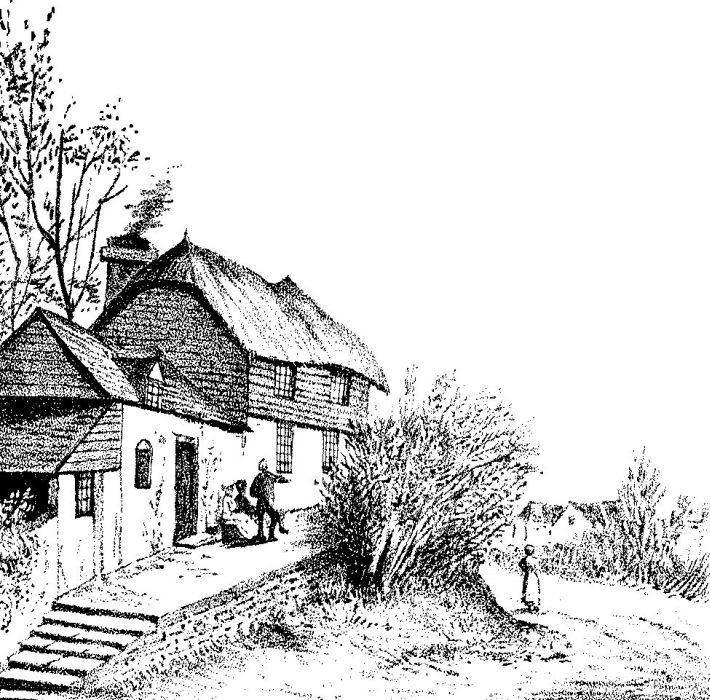
“On a fine summer evening about two years after the sad day that had seen the departure of Edmée and her mother from their beloved home, Madame Germain, with her husband and son, was sitting on the bench in front of their cottage—the cottage which is at present, at the time I am writing, inhabited by Mathurine Le Blanc and her sons, standing, as I think I have already said, some short way out of the village—enjoying a little rest after the labour of the day. Not that they were altogether idle. The mother was of course knitting, the father smoking his pipe, if that can be considered an occupation, and the son was holding an open letter in his hand, from which he had just been reading aloud.
”‘Yes,’ he said, ‘in a few days from now we may certainly expect her. She was to leave the next week, my lady says, and that is a fortnight ago.’
”‘Old Ludovic was to bring her a part of the way, was he not?’ said Germain, taking his pipe out of his mouth; ‘I wish he had been coming all the way. I should have liked a talk about many things with the good old man.’
”‘Ah yes,’ agreed his wife, ‘and so should I. But think of the long journey, Germain, and he is getting very old.’
”‘Besides, he would never have agreed to leave my lady and her daughter for so long,’ said Pierre. ‘Think—now that Nanette has left them, old Ludovic is the only one of their own people about them! Oh, how I wish my lady would make up her mind to come home!’
”‘Perhaps she cannot—she hints as much,’ said Madame Germain. ‘You know the Marquis is the dear child’s guardian bylaw, and he is an obstinate man once he takes a thing in his head. But we shall hear more from Nanette—more, perhaps, than the Countess likes to write; letters are risky things, to my way of thinking.’
”‘And these are ticklish times,’ said father Germain. He was a man of few words, and therefore what he did say carried the more weight.
”‘Yes, father, you are right,’ said Pierre, and unconsciously he dropped his voice and spoke in a lower key. ‘Our good curé was telling me some strange things to-day. The bad feeling is spreading fast. There was a château fired last week not very far from Sarinet. To be sure it was put out and no lives lost; but there was a good deal of destruction done, and it shows that it is coming nearer.’
”‘But here at Valmont,’ said his mother, always slow to believe ill, ‘I could never be afraid. Think how steady and industrious a set our people are—how loyal and faithful they have always shown themselves; and with good reason, for have they not ever been treated most generously and kindly by our masters?’
”‘Ah yes,’ said Germain, ‘but it is not always the majority that carries the day. Here, as everywhere, there are some idle and discontented and turbulent spirits—enough to give trouble if they united with others. And I am assured that in no case is it the country people themselves that start the thing. Poor creatures! they are mostly too ground-down and wretched to start anything. But they are ready to follow, though not to lead, and the fire of revolt once lighted by the secret emissaries sent for the purpose from Paris, soon spreads. Alas, I see not what is before us all—here even in our quiet, happy Valmont!’
“Pierre, who had listened eagerly to his father’s words, was on the point of replying when he suddenly started. They had been talking so earnestly that they had not heard footsteps coming up the few yards of lane which led from the village main street, till the new-comer was close to them, and Pierre, recovering from his first surprise, touched his mother on the shoulder.
”‘Some one is here, mother,’ he said, as Madame Germain looked up from her knitting. ‘Can it be—yes, I think it must be—Nanette?’
”‘Yes, indeed,’ said the young woman, holding out her hand with a smile. ‘I am not surely so changed as you, Monsieur Pierre. Had I seen you anywhere else I would not have known you, so tall as you have grown. And you, Monsieur and Madame, of course you are not changed at all; you do not look a day older.’
”‘Life passes quietly here, my good Nanette,’ said the forester. ‘We do not wear ourselves out with wishing to be everything that we are not, as some do.’
”‘Ah no—you are wise,’ said the girl. ‘And I—I cannot tell you how happy I am to be at home again. Even,’ she added with a slight blush, ‘even if I were not going to be married’—for it was to fulfil an engagement made before she had gone to Paris that Nanette had returned—‘it is so good to feel safe in one’s own country.’
”‘Safe,’ repeated Madame Germain; ‘but surely you were not afraid in Paris?’
”‘I don’t know,’ said Nanette evasively, and yet with a half glance round as if she feared her words might be overheard; ‘I don’t like Paris. It is not a place for good, simple people. All these new ideas!—ah, don’t let us talk of all that. I have so much to tell you of our dear ladies; Paris or no Paris, it has been a terrible grief to me to leave them,’ and her pretty bright eyes filled with tears.
”‘We were just talking of them when you came up,’ said Madame Germain, ‘and wondering when we should see you. Sit down, my child; in our surprise at seeing you we are forgetting politeness, and you must be tired with your long journey.’
”‘When did you arrive?’
”‘Only last night,’ said Nanette. ‘But I am not tired now. Yesterday was very pleasant; father drove the light cart over to Machard to meet me. The two days before in the diligence—ah, that was tiring. My great-uncle Ludovic came the first day’s journey with me, by my lady’s wish; you see what care she takes of me—of every one about her.’
”‘As ever—our dear lady!’ said Madame Germain.
”‘Ah, if there were more like her!’ said Nanette. ‘Things and feelings would not be what they are coming to, if there had been more like her. The Marquise now—for all she looks so tiny and delicate—ah! she has a hard and cruel heart—or no heart at all. She is a fit wife for her husband. And how they are hated! Worse than ever, I believe.’
”‘By those about them in Paris, do you mean?’ said the father Germain. ‘At Sarinet he is now almost a stranger. All these years, I think, he has never been back again.’
”‘And do you not know why?’ said Nanette. ‘’Tis said he dare not—and yet at worst he is a brave man. Perhaps after all he has some conscience left, and shrinks from seeing the utter wretchedness he has caused. We passed through many villages on our way, but in none did I see more hideous misery than at Sarinet. My lord is always short of money now—he spends so much in every way—and they do say that he and the Marquise too lose great sums at play. And when the money runs dry it is always the same thing. “Get it out of those lazy hounds of mine at Sarinet,” writes my lord to his bailiff, and then the screw is put on again, ever tighter and tighter. Ah, it is horrible!’ and Nanette shuddered.
“Germain looked up at her in surprise. She had changed. It was not like the simple, light-hearted girl of three years ago to speak so forcibly, or to feel things so deeply.
”‘How have you heard so much, my girl?’ he said.
”‘In Paris one learns much,’ said Nanette. ‘Much ill I might have learnt had my lady not taken care of me almost as if I had been her own sister. But the servants all talk, and chatter, and complain, and threaten—and my lady, she too told me a great deal. She has almost no one to talk to there—no one who sees things as she does. And she told me to tell you—her good friends she always calls you—all I could. She wants you to understand how she is placed. There is nothing she longs for so much as to return to Valmont, and from month to month she is hoping to see her way to doing so. But the Marquis opposes it, and you know he is Mademoiselle’s guardian by law, and my lady does not like to anger him; his temper, too, grows worse and worse, though he is gentler to her than to any one else. But you can fancy it is not a home such as our dear ladies can be happy in. And at times I can see that the Countess is really afraid. There is talk of dark and wild things. There have been meetings of the people where dreadful threats have been uttered against the king and queen, the clergy and the nobles—against every one in high position, and sometimes the police and the soldiers even, could scarce disperse them. Many think the people once roused will not be quieted again. And of all the great rich nobles who have oppressed the poor and made themselves hated, none, or few at least, are more hated than the Marquis.’
”‘And our dear Countess is his sister!’ exclaimed Madame Germain, over whose cheerful face had crept a cloud of foreboding.
”‘I wonder you could bear to leave them,’ said Pierre, almost indignantly; but Nanette did not resent his tone. She turned to him, her eyes full of tears.
”‘I did my utmost to stay,’ she replied, ‘but my lady would not hear of it. Albert had waited so long, she said; it was not right to put him off still, though for my part I could have found it in my heart to put him off altogether. I saw that the idea worried her. Then, too, I think she was glad for me to come home to talk to you—to explain things a little. She dare not write very much—letters are never very safe. And she is so lonely—in the midst of all that racket—she and Mademoiselle Edmée.’
”‘Have they no friends they care for?’ asked Pierre.
”‘Few—very few. And already of those some have left the country. Yes, indeed,’ said Nanette, ‘it is not yet much known, but several of the wiser and far-seeing among the nobility have gone to Switzerland—some to Holland, and to England, on pretence of travelling, but it is known they do not intend to return till they see how things turn out.’
”‘It seems almost cowardly,’ said Pierre.
”‘Yes,’ said Nanette, ‘so my lady said. But I do not know that it is so. What can the few do in such a state of things? And they have their children to think of.’
”‘It is true. But our lady need not go so far. In no foreign country could she be so safe as here in her own Valmont.’
”‘It seems so at present,’ said the girl with a sigh. ‘But all the talk I have heard frightens and confuses me. Once the fire is lighted, who can say? Still I wish with all my heart, and so does my old uncle Ludovic, that the ladies were here, and not in Paris. And you may be sure the Countess will seize the first chance of returning. I was to tell you this—and to say that she will count on you, father Germain, and on Pierre, to help them if occasion arises.’
”‘She will not be disappointed,’ said Germain, and Pierre eagerly agreed with him.
”‘But all the same,’ continued his father, ‘I confess I do not see the great difficulty about their getting away; the Marquis would never force his sister to stay?’
”‘No,’ said Nanette, ‘but there are difficulties. I think my lord has power over Mademoiselle Edmée’s money, and if the Countess broke off with him she might not know what he did with it. It is something like that, but my lady never fully explained to me. I only hope—’ But then Nanette hesitated.
”‘What, my girl?’ said Madame Germain.
”‘Perhaps it is wrong of me to think so, but I have sometimes wondered if my dear little lady’s money is safe. The Marquis is always short of money now, and for my part I think some of these fine gentlemen have strange notions of honesty.’
”‘Not among themselves,’ said Germain. ‘They may rob the poor, but they would think it dishonour to rob each other. However, I can understand how you mean, Nanette,’ and he too gave a deep sigh. Ruin to their young mistress would not be prosperity for Valmont.
”‘And who is taking your place now, my good Nanette,’ asked mother Germain. ‘Is that girl whom Edmée disliked so—that Victorine, still with the Marquise?’
”‘Yes,’ said Nanette. ‘I cannot bear her. She is clever and cunning, and no one can please the Marquise as she does. She flatters her lady to her face, but behind her back she speaks worse than any of the servants. She is as false as she can be, and would be the first to turn on her masters—she wanted to attend to Mademoiselle when she heard I was leaving, but our ladies do not like her. They live so simply—never going to parties or anything of that kind, for which indeed, Mademoiselle is too young, and my lady too sad she says—that they need but little attendance. And there is a poor girl there—a Sarinet girl—whom my ladies have taken a fancy to. Marguerite Ribou is her name. She is a pretty, gentle girl, about my own age. I taught her what I could; perhaps with such kind mistresses she may get on,’ said Nanette, with a slightly patronising tone.
”‘A Sarinet girl! I wonder to hear they have any one from Sarinet in the household,’ said mother Germain.
”‘This girl is an orphan. Her only brother died some years ago. I think there was some ugly story about his death, though she never speaks of it,’ said Nanette. ‘I fancy he was cruelly treated, and that even the Marquis was somewhat ashamed, and the girl was offered a place at the château to save appearances.’
”‘I wonder she took it,’ said mother Germain.
”‘She was starving probably,’ said Nanette. ‘Hunger is a hard master. But I doubt if her feelings to the family are much better than those of Victorine, only Marguerite says nothing.’
“Suddenly Pierre broke in.
”‘Marguerite Ribou—I remember her!’ he exclaimed. ‘Mother, you have not forgotten my telling you of what I saw at Sarinet?—a young man all fainting and bleeding, and they were driving him—the brutes! And his sister was called Marguerite. Yes, indeed! how could she go to serve them?’
”‘It must have been, as I say—she had no choice,’ answered Nanette. ‘And now I think she will stay out of affection for our ladies, who have been kind to her from the first. But for them, in that bad Paris, what would have become of her, heaven only knows. I must be going, my good friends. I promised mother not to be long—my first day at home! But I shall see you often, for I shall not be more quickly tired of talking of our ladies than you will be of hearing. The Countess has such trust in you; she even told me to say to you—’ But here again poor Nanette stopped, and the tears filled her eyes. ‘There is no hurry,’ she said; ‘I will tell you another time.’
”‘Nay, my dear,’ said Mother Germain, ‘I would like to hear it now, while her words are fresh in your mind.’
”‘It was the day I left. She was very sad; I think she was sorry for me to go, and perhaps there were other causes. “Tell my dear Germains,” she said, “that if anything happens to me—one knows not what it might be in these times that are threatening us—there is no one—I have no friends I trust as I do them, no one to whom I could better confide my child. Even little Pierre”—my lady does not know how tall you are now, Monsieur Pierre,’ said Nanette, with a smile—‘“Pierre, I believe, would give his life for Edmée,” she said.’
”‘And she said true,’ said Pierre, his face glowing.
”‘Thank you, Mademoiselle Nanette, for telling me her very words.’
“Then at last the girl left them, after reminding them all, Pierre included, that she counted upon them as guests at her wedding the following week.
”‘She is a good girl,’ said Madame Germain, when Nanette had gone; ‘but that she always was. She comes of a good stock. Old Ludovic is as faithful a servant as any one could possibly desire. Nanette has improved wonderfully. I used not to think her so intelligent and quick of perception.’
”‘It is the society of the Countess that has improved and educated her,’ said father Germain, between the puffs of smoke from his pipe, which he was again enjoying—with, however, a grave, almost uneasy, expression on his face.
“He said nothing, however, till that evening, when alone with his wife, for he was a man who well considered not only his words, but the best time at which to utter them.
”‘I like not the look of things—over there,’ he said, with a jerk of his thumb in the direction where Paris was supposed to lie. ‘I think the girl Nanette is right in her fears. I wish my lady were back among us.’
”‘So indeed do I,’ said Madame Germain.
”‘There is no use saying much about it before the boy,’ resumed her husband. ‘He thinks enough of it already. Much more and he would be setting off to Paris to rescue them before one clearly sees the danger.’
”‘But we would not stop him,’ said his wife.
”‘Not if it were to render them real service. I would go myself. Thou knowest that, wife! But we must wait awhile till we see. No use getting ourselves into trouble without doing them any good.’
”‘True,’ said Pierre’s mother, for she had the greatest respect for her husband’s opinion.
”‘At the same time do not mistake me,’ he said. ‘I am more than ready to do any service the Countess could desire. It may be that what she says is the fact—that she has no friends she can so depend on as upon us. We are plain and simple folk, but we are faithful, and we are grateful, and the time may come for us to show it.’
”‘God grant we may see how to act wisely should it be so,’ said his wife fervently. ‘And God spare my lady and her child for a peaceful life in their own home.’
”‘Amen,’ said the forester, no less devoutly than his good wife.
“Nanette’s wedding-day arrived, and the ceremony was celebrated with the usual gaieties. According to a special message from Edmée, Pierre, who was a better scribe than either his father or mother, wrote a full account of it to the Countess in Paris. He was very important over this letter, which took him quite a week to complete to his satisfaction, and then he took it to Nanette, now young Madame Delmar, for her approval, which was heartily bestowed.
”‘Ah, how pleased Mademoiselle will be to get it,’ she said. ‘I can fancy her reading it aloud to her dear mother, and possibly, if he has been “very good,” as Mademoiselle calls it, Monsieur Edmond will be allowed to hear it.’
“Pierre’s face darkened.
”‘That fellow!’ he exclaimed, and he made a movement as if he would tear the paper. ‘I won’t have him mocking at my letter, Nanette.’
“The young woman looked at him with surprise.
”‘No fear,’ she said. ‘You don’t think our young lady would allow him or any one to mock at anything to do with her dear Valmont. Besides poor Monsieur Edmond is not likely to do so. He is much the best of them, and he is so ill; they say he cannot live long. I think it is partly pity for him that keeps our ladies there. I was telling your good mother about him the other day, but you were not there, I remember.’
“Pierre looked a little ashamed of his ebullition.
”‘I am sorry,’ he said. ‘I did not know. I thought of him as when I saw him five years ago.’
”‘Ah, yes,’ said Nanette; ‘but since then he is much changed. And he worships the very ground our young lady stands on. No wonder! what would he have been but for her and her mother? For neither his father nor mother can bear the sight of him.’
”‘Poor fellow,’ said Pierre. ‘Then he cannot be much of a protector to our ladies in case of need.’
”‘No indeed,’ said Madame Delmar. And from that moment Pierre only thought of his childish enemy with profound pity.”
Chapter Eight.
“As a rule, news, even of great importance, travelled very slowly in those days. But not long after the return of Nanette there came to Valmont, as to even far remoter corners of France, with a rush like that of a mighty wind, tidings of the first tremendous outburst of the great storm—the assault and taking of the prison of the Bastille by the infuriated mob. My mother well remembers that day in Paris. The terror which spread through all classes—the strange stories which were afloat about the wretched prisoners released from the dungeons, where some of them had been confined till they had forgotten not only the crime—imaginary in many cases—for which they had been punished, but even their own names and histories! The destruction of the terrible Bastille can never be regretted, but it was accompanied by dreadful deeds. The murder of the governor and other officers who were but doing their duty; for the people, maddened by hunger as well as by their many wrongs, did not stop to consider which were the guilty and which the innocent. I have said to my mother that from this point I wish she would take this narrative into her own hands. It seems to me that as an eye-witness—for in this year 1789, she was an intelligent girl of nearly thirteen—she could describe with much more force and vividness many of the scenes which followed. But she begs me to continue as I have begun. The story concerns my father quite as much as herself, she says, and she wishes it to be written as much from his recollections, which he has often related to me, as from her own. So I must do my best, sadly imperfect though I feel it to be.
“The taking of the Bastille was the signal for outrages through many parts of the country. Châteaux were burnt, convents sacked and destroyed, many even among the superior farmer class, who had had nothing to do with the government or the oppression of the poor, whose only crime was that through their industry and economy they had grown richer than their neighbours, suffered as well as their betters. In Paris itself many of the most conspicuous among the nobility were dragged by the mob from their houses and put to death in a horrible way, by being hanged on the street lamps. These I have always thought much more to be pitied than those later sufferers who perished by the famous guillotine; for this first manner of death united insult to barbarity.
“How it came to pass that my great-uncle, the Marquis de Sarinet, was not among those on whom this first fury was wreaked, my mother has often felt at a loss to explain. It may have been that he had never mixed himself up much with affairs of state—for he was selfish even in this, disliking everything which gave him trouble—and that thus his name was not one of the best known. But his punishment had already begun, for the following winter saw the complete destruction by fire, after it had been robbed of everything of value, of the beautiful old Château of Sarinet.
“News of this was not long in reaching Valmont.
“All through these months many a faithful heart there had ached with anxiety for their Countess and her child. But the disordered state of things was having everywhere a bad effect. Quiet and peaceable folk began to be frightened. Many dared not express any interest in or sympathy with those whose turn it was now to be unjustly and cruelly treated. And among the loose characters who now and then passed through or loitered about our quiet Valmont, there were not wanting some on the look-out for mischief-making.
”‘You speak of your lady as different from others,’ they would say. ‘Let her show herself among you. If she cared for you she would be here, not amusing herself and wasting money on nonsense like all the fine ladies in Paris. It is that which has brought ruin on the country.’
“And some listened to and believed these cunning words, so that already, had the Countess just then returned to Valmont, it is to be doubted if she would have been received with the old affection. There was some reason, too, for discontent. Collet, the Countess’s bailiff, was the most discreet of men, devoted to the family’s interest, but at the same time ready to carry out all his lady’s endeavours to do good to her people. But it began to be noticed that he was more rigorous than formerly in exacting all the payments due, also that less money was forthcoming for charitable purposes, that the new year’s gifts year by year were curtailed, and that Collet looked anxious and careworn.
”‘It is his bad conscience,’ said some. ‘He is going the way of all like him, enriching himself at our expense.’
”‘And the Countess is no doubt learning to throw about her money too. Trust fine ladies for that, however sweet-spoken they may be; and after all she is a Sarinet by birth,’ said others.
“But I need not say that in the Germains’ cottage, and indeed in most of those in the village, nothing of this kind was believed, and once or twice, when words or hints to this effect were uttered before Pierre, his father had to check the hot indignation with which the lad would have met them, reminding him that by a dignified silence he was both showing more respect for their lady, and perhaps better serving her cause. He could speak with authority, for both he and the old curé were in poor Collet’s confidence, and knew, what he thought it would be dishonourable to tell, that he strongly suspected that the Marquis, having exhausted his own resources, was now helping himself to the money of his sister and his niece. And more than once both were of a mind to say out what they were almost, sure of. ‘If it goes much further we shall feel it our duty to do so,’ said the curé to the bailiff. ‘And even now I have almost made up my mind to write to the Countess, for I am certain she has no idea of what is being done, to some extent, in her name.’
“But just as the good man was meditating a letter to Paris, one was received from there which altered the state of things, and for a long time brought some sunshine and hopefulness back to the hearts of the faithful friends of Edmée and her mother.
“The Countess and her daughter were returning to Valmont.
”‘All then will be well,’ said Madame Germain, wiping her eyes from which were running tears of joy. ‘Things are evidently quieting down; otherwise our ladies would not think of undertaking the journey. Those poor, foolish people, no doubt, seeing how ready the king is to agree to everything reasonable, will be satisfied at last, and all will be well.’
“Nor was she the only one to hope, from time to time, during these early years of the Revolution, that the black cloud might after all disperse. For, thanks to the efforts of some unselfish and wise men, more than once a cordial understanding between the king, the government, and the people was almost arrived at, though always, alas! to be again broken through by treachery or mistakes or passionate outburst on one side or the other.
“This was in the summer of 1790, about a year after the taking of the Bastille. All through the autumn days that followed, the Germain family and others waited eagerly for further news from Paris. At last came again a few hurried words to Madame Germain from the Countess, referring to other letters sent by the post which had never been received at Valmont. She had found it impossible, she said, to carry out her plan of returning home that last summer. The Marquis had opposed it; he was so sure that things were calming down, and he objected to any member of his family leaving Paris. ‘So again,’ wrote the poor lady, ‘Edmée and I must take patience. But surely next summer, the fourth since our absence, will see us in our own dear home.’
“Next summer! Preceded by a severe winter, which saw sufferings such as Valmont had never known before—for the demands on Collet for money became more and more peremptory, and though the curé and Germain had written to the Countess a full account of the state of things, no notice had been taken of it, and they began to fear she had never received their letter—‘next summer’ brought no better state of things. The king and his family were now, to all intents and purposes, prisoners in the hands of their people; the few wiser and cooler-headed men in the government were overruled; great numbers of the better classes had left their unhappy country; of those whom obstinacy, in some cases poverty, caused to remain, till too late to get away, the fate became daily more uncertain. And among these there was every reason to fear were Edmée de Valmont and her mother!
”‘If they had left the country, I feel sure they would have found some means of letting us know,’ said Madame Germain, shaking her head, for the long anxiety and uncertainty had lessened her hopefulness. And just as her husband and son, after discussing for perhaps the hundredth time this sad state of things, had arrived at the conclusion that something must be done, some step they must and would take, there came again suddenly, and in an unexpected way, news of the two so dear to them.
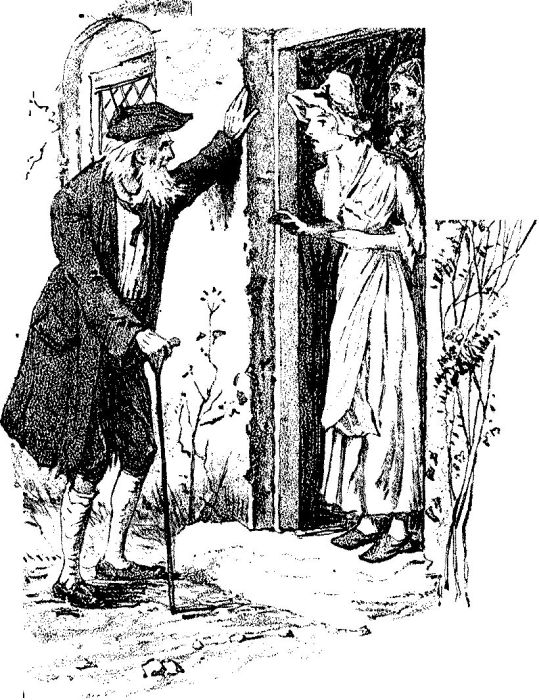
“It came in the shape of a very feeble and very old man, who, looking more dead than alive, dragged himself one evening, late in the month of September, in the year I have now reached in my narrative, that of 1792, to the door of the forester’s cottage, and there, half-fainting on the threshold, asked in a broken voice for Germain or his wife. They did not know him in the least—how could they, in this wretched, dust-and-mud-covered old beggar, whose white beard hung neglectedly, whose feet were almost shoeless, whose poor old hands trembled with nervous weakness, have recognised the carefully-attired, respectable, nay stately Ludovic, who had driven away on the box of the travelling chariot, so proud to follow his ladies to the end of the world, had they bidden him? His devotion had cost him dear, poor old man, and as he feebly murmured—
”‘Don’t you know me—your old friend Ludovic?’ mother Germain burst into tears—tears of pity for him, of terror for those he had come from.
“They at once did their best for him. It would have been cruel to question him till he had regained a little strength, and indeed useless. Now that he had reached the end of his journey, his forces seemed altogether to collapse, and for some hours they feared he would die without having told them anything. But food and wine carefully administered, and a refreshing sleep into which he fell, did wonders for him, for notwithstanding his age, he had been till lately a vigorous and healthy man; and by the evening he woke up greatly revived, and eager to explain everything, and by degrees his kind hosts heard all, which perhaps it is well to give as far as possible in his own words—for the events he related have often been told me both by my mother who had seen them herself, and by my father who heard them at the moment from Ludovic’s own lips.
”‘I never thought I should reach here alive,’ began the old man. ‘The last few days have been terribly hard. From some distance on the other side of Machard I have come on foot. But few conveyances are on the road—no longer a chance of meeting with those of some of the great lords whose attendants, had they known who I was, would have given me a lift—no, the days of such travelling are over indeed; and in the few public coaches I met I could not have had a place, for I had not a sou! She gave me all she had—our dear lady—but it was very little, and there was no time to sell the jewels she had with her. Since four or five days I have scarcely tasted any food, though once or twice kind souls took pity on me. The first part of the journey was easy enough. I travelled in the public conveyances, to save time; but though easy, I soon saw it was a risk. While I was decently dressed they looked at me more than once with suspicion—above all that my clothes, though they were shabby enough compared with those you used to know me in, in happier days, had the look of my position, and nobleman’s servants are now often objects of suspicion. So I decided to make the rest of the way as best I could, getting a lift in a cart as long as my money lasted, and when my clothes became so shabby I dare say it was a safeguard. At all events here I am! God be thanked, if I could but think my dear ladies were also in safety!’
”‘But where are they?—what of them?’ burst out Pierre, who had listened with compassion indeed, but not without a certain impatience, to the poor old man’s somewhat rambling account of his own adventures.
”‘Softly, my boy,’ said his mother in a low voice. ‘Do not hurry him, let him tell all in his own way, otherwise he may grow confused.’
“But Pierre’s words had done no harm.
”‘Of course,’ said Ludovic, ‘that is where I should have begun, instead of wasting time over my own affairs, stupid old man that I am. But you must forgive me, my good friends. Old age is garrulous, and finds it difficult to keep to the point. Where was I?’ and he looked round feebly.
”‘You were saying,’ said Pierre, trying to restrain his impatience, ‘how thankful you would be, were you assured that the Countess and her daughter were in safety like yourself; and I interrupted you entreating you to tell us where you believe them to be.’
”‘Where?’ said Ludovic; ‘in Paris. At least, I fear it is unlikely that they will again have attempted to leave.’
”‘Attempted to leave it! Did they do so? and did they not succeed?’ exclaimed the Germains together.
”‘Alas, no!’ replied Ludovic, shaking his white head. ‘That is how I come to be here alone. I will tell you all. You have heard, no doubt, the principal events of this sad time. My lady has been longing to return to Valmont almost ever since she left it, but the Marquis has always opposed it. Two years ago she at last gained his consent, and was on the point of starting, when some one put it into his head that it was undignified, and would have a bad effect for any member of his family to leave his house, and as my lady could get no money except from him, and as she was also unwilling to anger him, she again gave in. He is the most obstinate man—even now he will not believe that there is any danger for him or his. And my lady at last came to see that if she is to get away, it must be without his assistance. All these weary months she has been waiting for an opportunity. At last, about three weeks ago, all seemed favourable. The Marquis was away for a day or two, with some of his friends, who, like him, have refused to take warning, and all arrangements had been made for my ladies and myself to start quietly. We were to travel in a small plain carriage, not likely to attract attention, which a friend of the Marquis’s, less obstinate than he, and really concerned for the Countess and her daughter, had hired, with a driver he could trust. This gentleman,—how I do not know—had procured the necessary papers, which described the Countess as my daughter, returning to the country for her health. I was described as a shopkeeper of Tours. Well, we started—oh the joy of Mademoiselle Edmée! The only drawback was the poor boy Edmond, whom my lady dared not bring away, in face of his father’s commands that he was to stay. She had already fought hard to get leave for him to accompany them when they should leave—and who was heart-broken. At the last moment my lady got out of the carriage again to clasp him in her arms, and whisper some words of comfort; it caused a little delay; sometimes I have thought those three minutes might have saved us. It was not to be. I can hardly bear to tell you of our terrible disappointment. We had scarcely got the length of the street when we met the Marquis returning, in a furious temper at having found it impossible to get as far as the country house, a few miles out of Paris, where he was to meet his friends. He was furious, and, perhaps for the first time, alarmed; for, my friends, do you know what had happened the night before?—it was that of the 2nd of September!’ and Ludovic looked up hesitatingly. Germain bowed his head.
”‘I know,’ he said, ‘and so does Pierre. But we would not tell my poor wife. However, perhaps it is foolish,’ and turning to Madame Germain, he rapidly related to her how on that dreadful night bands of wretches, armed with pikes and hatchets, had burst open the doors of the prisons of Paris, and there slaughtered the unfortunate beings—all of the upper classes, and many innocent of any wrong—who had been seized and shut up as ‘suspected’ of disloyalty to the new Government. For which bloody deed the wretches who had committed it were liberally rewarded by the authorities!
”‘Yes,’ continued Ludovic, ‘for the first time the Marquis believed that the mob—the hounds and dogs he had despised—was a terrible enemy to have aroused, for the worst and lowest come to the front at such times. Perhaps he meant it for the best; but it was, I fear, an awful mistake. He turned the horses’ heads, and insisted on his sister returning to his hotel. It was utterly impossible, he maintained, for her to attempt the journey thus alone and unprotected, save by an old fool, as he amiably called me. But what did I care? And there we were again—half-an-hour after our hopeful departure—powerless and heart-broken with disappointment. What the Countess heard of the horrors I have told you I do not know—I dared not ask, for if she had not heard all, I would have been the last to tell her. But that evening, late, she sent for me privately, and gave me her instructions. She was as pale as death—she has changed terribly, and what wonder! Many a time I have thought our dear lady was not long for this world, and she thinks so, I believe, herself. “My good Ludovic,” she said, “this has been a terrible disappointment. But for the moment I can attempt nothing else. It may be here, as my brother says, that in spite of all our precautions, in the present terribly excited state of the town, had we got as far as the barriers it would but have been to be stopped, and perhaps seized and imprisoned. He insists that it is better to wait a few days. But he has promised me at once to arrange for our all flying to Valmont—poor man, at Sarinet there is no longer a roof to shelter him and his!—and so, my good Ludovic, I must try to take courage and hope, though my mind misgives me sorely. For that my poor brother has hitherto escaped seems to me scarcely short of a miracle, and I cannot feel confidence in his still doing so. Therefore, my faithful friend, I want you to set off at once for Valmont. It is for yourself; less risk than staying here, not that you think of that, I know, and it is the best service you can at present render me and my child. Alone you will have, I am assured, little difficulty in making your way. Here is all the money I have been able to collect; to give you any of my jewels would but expose you to suspicion; take it and go. And arrived at Valmont, seek at once my dear Germains. If by the end of this month they or you have no news of me—then I fear, it will not mean good news—then, I must trust to them to consider if in any way they can help me, or still more my child. Should my brother be taken, I have a plan in my head, for concealing ourselves here in Paris, till we can venture to try to escape. And Germain is a shrewd and clever man. I fancy there would be no risk for him in coming to Paris, and if he knows we are in danger, I believe nothing would keep him from attempting it. With his help and strong arm, we might manage a safe disguise. Should we succeed, as my brother hopes, in all leaving Paris together, I shall find means of letting you know at Valmont. Should we fail I shall still hope to conceal myself and Edmée, though at present I cannot make any detailed plan. One thing I may tell you”—and here my lady lowered her voice—“the only person I trust here is Marguerite Ribou. And now, my good Ludovic, the sooner you leave the better. The Marquis has no idea at present of my attempting anything. It will be time enough for me to tell him you are gone when you are beyond recall.” And then,’ continued Ludovic, ‘she held out her hand; I kissed it, in weeping you may be sure, and I obeyed her. That night I spent in a little tavern near the barriers, and I got out the next morning without difficulty. And here—here at last, after all my troubles, I am! I have told you, I think, my lady’s exact words. It is now—is it not?—near the end of September?’
”‘The twentieth,’ replied Pierre.
”‘And you have no news?’
”‘Not a word,’ said Germain.
”‘Then,’ said old Ludovic, ‘it is for you to decide what can be done. A few days still—a few days perhaps we can wait. It will give me time to recover my old wits a little, if it brings no news from our poor ladies.’”
Chapter Nine.
“Long after poor old Ludovic was in bed and asleep that night, the Germains sat up talking over all he had told them.
”‘To-morrow will be the twenty-first of September,’ said old Germain thoughtfully; ‘that makes nine days more to wait—’
”‘But should we wait, father,’ exclaimed Pierre. ‘I feel so certain no news will come, and every day, every hour, it is so much time lost—can we not set off at once? Father, mother, let me go! I am so young and strong—fatigue is nothing to me, and father is not so strong as he was,’ which was true, for rheumatism, that sad enemy of those whose duties force them to be out in all weather, had already more than once, for weeks at a time, crippled the forester’s active limbs.
“The father and mother looked at each other. True, they had said they would not grudge their boy in the service they had all their lives been devoted to, and the risk they did not think so great for him as it perhaps really was. But when it came to the point of his setting off on the long journey—so uncertain how to proceed, so young and inexperienced as he was?
”‘No, my son,’ said Germain. ‘It is right that I should go myself. I am an ignorant man—less taught than you—but I have the training of age, and have learnt to keep cool and quiet when your fiery young tongue would be getting you into trouble. No, stay you here and take care of your mother, and I will go where it is my duty to go. To-morrow we will talk over about when I should start. I should like to hear what Nanette Delmar thinks about it,’ and with these words he rose from his chair, but stiffly and with difficulty; his wife and Pierre both noticed it more than heretofore. He was not the man he had been.
”‘Sitting so long cramps one—and the fire is out too,’ he said.
“But his wife looked concerned.
”‘These damp days in the woods are bringing the rheumatism out again, I fear,’ she said sadly; ‘but I must not murmur; I have had almost too happy a life, even compared with my dear lady. No, I would grudge nothing for her.’
“Pierre kissed her—more affectionately even than usual, as he bade her good-night. Then he went up to his own little room, his mother thought, to go to bed and sleep as usual.
“But early the next morning—very early, while the autumn haze was still over the woods, and the hoarfrost on the fields, there came a soft tap to young Madame Delmar’s door. Nanette was up already, for her husband was working just now at some distance, and she had to get his soup ready betimes, and so, as he had half hoped, Pierre Germain found her alone.
“He quickly explained his errand. He had come to charge her with the duty of telling his parents that he had gone.
”‘They must not think me disobedient,’ he said. ‘I feel that I am right, and they too will come to see it. My father is not what he was; if he set off on the journey alone he might fall ill on the way and we never know it; or if I went with him I might be obliged to nurse him in some strange place, feeling miserable at nothing being done. No, Nanette, father is best at home. I am young and strong, and I have so often thought over this, and all that I might have to do, that it seems to me as if I had got it by heart. But you, Nanette, who have seen them so much more lately than we, who have been in Paris and know all about where they live and everything, I want you to talk to me, and tell me all you can, so that I shall feel less confused when I get there.’
”‘Willingly,’ said Nanette. And then after putting the rest of the soup they had had on to the fire again to heat for Pierre, and fetching some bread and a couple of eggs to beat up into an omelette—he must have a good breakfast before starting, she said—she sat down and told him all she could think of. She described the house, the rooms occupied by Edmée and her mother, the one or two among the servants she thought better off than the others, though the only one she seemed to have any real confidence in was Marguerite Ribou.
”‘And even she,’ said Pierre, ‘she has more reason to wish for revenge than any of them—are you sure we can trust her?’
”‘She has no ill-will, nothing but good feelings to our ladies,’ said Nanette, thoughtfully. ‘But beyond that—as to the Sarinet family, certainly I am sure she is bitter past words. And that Victorine may have influenced her! Of her I need not tell you to beware.’
”‘Then if all is still as usual with them when I get there,’ said Pierre, ‘how should I proceed? It would not be wise to say I came from Valmont to see the Countess.’
”‘No,’ said Nanette, ‘for if the Marquis were still there he might hear of it, and he would suspect his sister was again making some plan without telling him, which he would only oppose—he is so obstinate. No, I think you had better ask for Marguerite, and judge for yourself. But Pierre, I have faint hopes,’ and Nanette’s face grew very grave, ‘very small hope that you will find things as they were in the Rue de Lille. Had they still been so I feel sure the Countess would have written—and, indeed, I do not think she would have remained there all this time without making some other effort to get away.’
”‘She may have written,’ said Pierre; ‘letters miscarry so in these days.’
”‘If she dared write I am sure she will have done so,’ said Nanette, ‘unless,’ and the young woman shuddered. ‘No, do not let us think the worst; only it is sometimes impossible not to remember all I heard there. But again, if the Countess is in disguise somewhere, you see she would not dare to write for fear her letter might be traced, and would betray who she was.’
”‘Should I know Mademoiselle Edmée, again if I saw her, do you think?’ asked Pierre.
”‘Oh yes, I think so; she has grown tall, of course, but still she has the same face. Indeed, she is still very like the dear little picture. My lady never has it out of her sight. It hangs in her room in Paris just as it did here.’
”‘Many a time my mother and I have wished they had left it at the Château,’ said Pierre with a smile; ‘it would have been some consolation.’
”‘Ah, yes; that I understand,’ said Nanette.
“But then Pierre started up.
”‘I must be off,’ he said. ‘I mean to get over a good piece of ground before the day is old.’
”‘But you are not going on foot? You have some money with you, surely?’ said Madame Delmar anxiously.
”‘Oh yes,’ said Pierre; ‘I have enough to pay my journey. I mean to get on as fast as I can till I am near Paris. Then, perhaps, it will be as well to go on foot. No one will pay any attention to a young fellow like me, and I daresay it is as well for me not to have much money with me. It might be stolen. The Countess is sure to have money; there is no fear on that score!’
“Nanette hesitated.
”‘I don’t know,’ she said; ‘there is no telling to what straits even she may be brought. See here, Pierre,’ she added, going to a cupboard from which she took out a locked box; ‘in here are some of my savings. Take what you can; it is my own money, and even if it were not, Albert would be the last to grudge it in such a case,’ and she forced into the boy’s hands a little packet containing a few gold coins. ‘See here, a moment; I will stitch it into the lining of your coat, where no one would suspect it.’
“Pierre did not resist.
”‘It is for them,’ he said simply, ‘and for them I thank you. At worst, Nanette, my father and mother would repay you. Tell them you gave it to me; it will make them less anxious about me. Try to see them soon—before noon, will you not? And tell them you agree with me that if anything is to be done it is best at once, and that it was best for my father to stay at home.’
”‘Yes,’ said Nanette, ‘I will say all. I think you are right, Pierre. Farewell, and God bless you, my friend!’
“She stood at the door, watching him along the road as far as she could see, and then with a sigh re-entered her cottage.
”‘I wish he were safe back again, and our dear ladies with him,’ she said to herself. ‘Though even their absence would seem nothing now, were one sure they were in safety. I wish they were safe in some other country, however far away, and even if we could not see them for years. It is too dreadful to think of what may happen to them—of what may have already happened. My sweet lady and the dear tender little Edmée! Ah! I must not think of it, or I shall unfit myself for everything. Albert must not tell me any more of the dreadful things he hears. Not till they are safe at least.’
“I cannot tell very much of Pierre Germain’s journey to Paris. He himself used to say he did not, in after years, recall it very clearly; later events and anxieties made it grow vague and cloudy. But nothing of very great importance occurred. As he had himself said, he was not a figure in any way conspicuous, or likely to draw much attention. A fine, sturdy young fellow of seventeen or eighteen, his little bundle slung over his shoulder, making his way along the country roads, whistling as he went, or now and then mounted on the top of the public coach ready for a little conversation, or to give a helping hand with the horses if he were wanted—he had not the appearance of a dangerous person. Nor would any one have suspected the intense anxiety he learned so well to hide, the burning eagerness to get to the end of his journey which possessed him. All the information he could pick up, without seeming too much interested in doing so, he tried to acquire. And the nearer he approached the capital the greater seemed the half-suppressed excitement, the stranger became the looks and tones of many of the people he came across; while all through his journey he met the sight of burnt and ruined châteaux, of convents deserted by their inmates and pillaged by the neighbouring townspeople or villagers, of farms where no longer the cheerful sounds of labour were to be heard—and everywhere misery and reckless disorder.
“He had no difficulty in entering the great city.
“In those days it was much easier to get into Paris than, once there, to get out again. The bundle which he carried was carelessly glanced at by the official at the barriers, who asked him mockingly if he had come to make his fortune in Paris, taking him for a country lad attracted, like hundreds of others, by the accounts of the lawlessness and licence of the ‘rule of the mob,’ and Pierre laughed back a mocking reply. He did not yet, not till he had made his way through what seemed to him innumerable streets, dare to ask for the Rue de Lille, so fearful was he of attracting attention by seeming to have any errand about which he might be questioned. But at last, feeling hungry and tired, he ventured into a milk shop, where a meek, rather frightened-looking woman, with a little child in her arms, was standing behind the counter.
”‘Madame,’ he was beginning, but the woman quickly interrupted him: ‘Citizeness, you mean, boy,’ she said. ‘Whence do you come to use a word we never hear now?’ and on his hastily begging her pardon, ‘it is not for me; it matters nothing to me. It is for yourself, citizen,’ she added. ‘You must watch your words, and indeed by your looks it were better for you to go back whence you came.’
“Pierre felt startled. ‘By my looks, citizeness,’ he said. ‘I look what I am—a country lad come to see Paris for the first time.’
”‘Better never have seen it, then,’ said the woman, earnestly. ‘Go back to your home, if you have one, my boy, for you look honest and innocent,’ but she spoke in a low voice, and glanced round her as if afraid of being overheard.
“There was something in her face, in her very timidity, which inspired Pierre with confidence.
”‘I cannot go back,’ he said, speaking also in a low voice. ‘I have come for a purpose, but I am a complete stranger. Perhaps you can help me. Will you tell me the way to the Rue de Lille?’
“The woman looked at him with regret.
”‘It is not far from here,’ she said; ‘but it is a long street. What house do you want there?’
”‘The house—the hotel of the Marquis de Sarinet,’ he replied, but low as he spoke the woman held up her hand with a warning gesture.
”‘Hush, hush!’ she said, ‘we know no such names. The citizen Sarinet,’ she continued, reflectively; ‘no, I do not remember ever to have heard of such an one. But there are few houses now inhabited by their former owners in the Rue de Lille. You must ask there, but take care how you ask.’
”‘Once there, I can find the house, I am sure,’ said Pierre; ‘it has been so well described to me. If you will direct me to the street, that is enough. But first, can you give me a cup of milk? I have had nothing to eat or drink to-day.’
”‘You shall have some coffee and some bread,’ said the woman. ‘I always have it ready early in the morning, as I used to in quieter times. But my customers are less regular than then. Those who spend their nights drinking in the taverns, are not ready betimes. Keep out of such places, my boy, and take my advice—get back to your mother in the country as soon as you can.’
”‘I wish nothing better,’ said Pierre; ‘but first I must do what I have come for.’
“And then the good woman gave him his breakfast, for which he paid her well. ‘Poor thing, it was not easy for those who stayed quietly at home to get on now-a-days,’ she said. Her husband had done no work for long. Where he got what he brought home, though only to waste it, she did not like to ask.
”‘It is all the same cry now,’ she said, waxing bolder in her confidences, and glad to have some one to talk to.
”‘They won’t work. What is the great republic for if they are to go on working, they say? And so they drink and quarrel, and many are half the time starving. One day they feast like princes, and the next they have nothing. Everything is for all, and all are equal, they say; but for my part, I think it is rather take who can, and those who can’t go without—no, no, we are a long way off the fine things they promise us yet.’
“And she was so taken up with her own troubles that Pierre could not get from her any information as to how things had been going of late; whether many aristocrats had been seized, or whether many had fled. He only stopped her long list of grievances by saying he must go, and begging her to direct him. She did so, and then reverting to his own risk, she again begged him to be careful.
”‘Return if you can, and tell me how you get on. But do not talk more than you can help; above all, do not be persuaded to enter the taverns and take wine.’
”‘I never take wine,’ said Pierre.
”‘The more risk then if you did. It would go to your head, and you might tell what is better untold. Good morning, little citizen,’ she called out after him in a louder and rougher tone than was natural to her, but which Pierre understood to be for the benefit of a group of dissipated-looking men in blouses, who came sauntering along, their hands in their pockets, just at the moment.
“He had no difficulty in finding his way to the Rue de Lille, nor, once there, in picking out, thanks to the exact landmarks Nanette had given him, the great wooden doors, or gates rather, enclosing the courtyard of the Hotel de Sarinet. Put even outside, in the street where he stood, he seemed to distinguish a deserted air about the place. At that early hour in the morning it would only have been natural for the doors to have been open, to have seen some sweeping or cleaning going on inside, and have heard the cheerful sounds of grooms brushing down their horses and rolling out the heavy carriages to be aired. But, on the contrary, there was no sound; all was appallingly silent, and the street itself seemed like a place of the dead. There was no one of whom he could have made inquiry, had he wished. So after an instant’s hesitation Pierre lifted the heavy knocker attached to the little door leading into the porter’s lodge, at the side of the great one, and let it fall with a loud rap. Then he waited; but there was no response, and again he knocked, again and yet again, waxing bolder with increasing anxiety, but always in vain. And after what seemed to him a great length of time—in reality a quarter of an hour or so—spent in that dreary waiting, he had at last to make up his mind to the fact, there was no one there—the house was entirely deserted! His first feeling was one of the bitterest disappointment; he could have sat down on the rough bit of pavement before the doors and burst into tears! He had felt so sure of finding them. His nature, hopeful like his mother’s, did not prepare him for obstacles, and all through his journey he had been picturing to himself his arrival just in the nick of time to relieve the Countess’s anxiety, and arrange for safely escorting her and her daughter through every danger to Valmont! But with a few minutes’ reflections came other feelings besides disappointment. Where were they? A shudder ran through Pierre as he thought where but too probably they were; probably enough in one or other of the prisons, crowded with many as gentle, as high-bred and delicate as they; possibly—for even children of Edmée’s age had not been spared—possibly no longer alive; those innocent heads might already have fallen under the cruel guillotine! And the boy felt sick with fear and horror. But still it was also possible that they had escaped. The Countess had foreseen the danger, and spoken of plans for safety. She might, it was even very likely that it was so, have carried them out, and be at this, moment in hiding and disguise somewhere, near perhaps, in this great city of Paris!
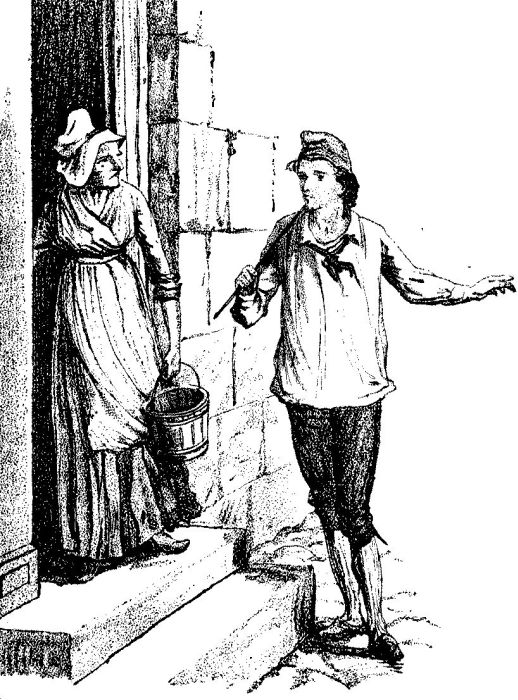
“Pierre’s hope revived, but he looked up and down the deserted street in bewilderment. What could he do? whom could he ask? whither could he go? Just then a door on the opposite side opened cautiously, and a very dirty old woman poked out her head, looked this way and that, and then emerged with a bucketful of rubbish—cabbage stalks, egg-shells, and the like—which she emptied at the side of the gutter. She had not seen Pierre, who was somewhat in shadow, but he saw her, and darted forward.
”‘Good morning, Mad—Citizeness,’ he said quickly. ‘Can you by chance tell me whose house that is opposite,’ and he pointed to the door where he had been knocking. ‘I was sent there, but it was a fool’s errand, I think. No one will open.’
”‘No wonder!’ said the hag, glancing at him suspiciously, but taking him for some countrified lad new to Paris, as indeed he was. ‘No wonder!—there’s no one there. Ah no, indeed, my lord the marquis will never come lashing his horses out of his courtyard again,’ and she gave a shrill laugh, ‘nor will my fine lady the sour-faced Marquise come driving by in her chariot. We’ve got it to ourself now! The grand hotels are to be had for low rents in this street,’ and she turned to go in again. But Pierre, in his eagerness, caught her by the skirt, dirty as it was.
”‘But where are the others then?’ he said. ‘There were other ladies there—not proud, or sour-faced either. You must have seen them if you lived here.’
”‘They’re all gone, I tell you! Seen them? Yes, I daresay I did when I came every day for the rubbish those wasteful servants threw about. But it’s our turn now—my son’s and mine; we’ve got a fine hotel all to ourselves, you see! Yes, they’re all gone—here and there too. Madame Guillotine will tell you; she’s the only Madame now!’
”‘Are they all dead?’ said Pierre, in a voice he would hardly have known for his own, and which struck even the half-crazed old hag with a sort of pity.
”‘How should I know?’ she said. ‘And what does it matter? You’re no aristocrat—why should you care? Stay! I heard tell—what was it then? They let the little lady go—that was it, I think. A nice little lady too, if she hadn’t been one of the cursed breed. Many’s the silver piece she’s given me as she passed. What was she to you that you should look so, boy? Foster-sister, may be?’
“Pierre nodded. He could not speak.
”‘They let her go—or she wasn’t to be found. That was it. You’ll find her may be. They said Marguerite had a hand in it—do you know Marguerite? She lives with the Citizeness. Nay, I forget her name, but you may hear of her at the wine-shop at the corner of the Rue de Poitiers. She can tell you more than I, if she will,’ and with these words the old woman hurried off more quickly than one could have thought she could move, and drew to the door sharply, in Pierre’s face.
“He walked slowly down the street, stunned and dazed by what he had heard. He had known it might be so; he had heard plenty of the horrors taking place in this very Paris where he stood. But it had not come home to him till now, and he felt as if he could not believe it. Even to think of the Marquis and his wife coming to such an end—people he had known, whose faces he could remember—made him shiver; but for his own ladies! No, he could not believe it. ‘No one—not the hardest-hearted—could look in the Countess’s face and not see how gentle and good she was! And Mademoiselle Edmée, if it were true that they had taken her mother, she would have died of grief. No—I shall hope still!’ he said.”
Chapter Ten.
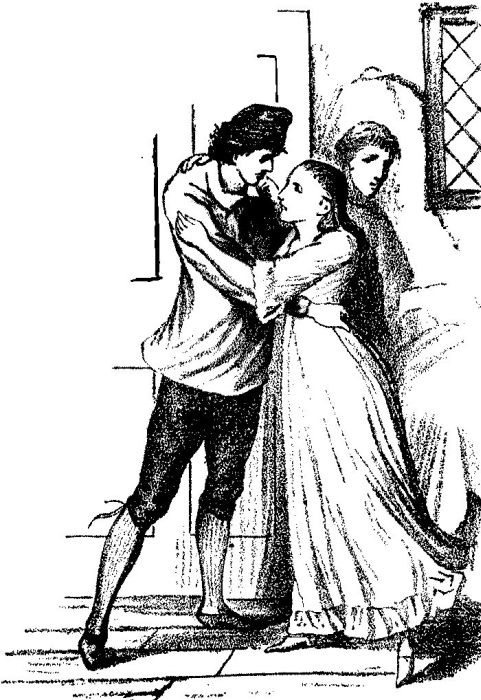
“Pierre had wandered down the whole length of the Rue de Lille before he quite came to himself, and then he started to see how far he had come. He had crossed two or three side streets without noticing their names.
”‘I may have passed the Rue de Poitiers,’ he said to himself, ‘where she said the wine-shop was,’ and he looked about him anxiously. A few steps further brought him out of the quiet Rue de Lille into a wider thoroughfare, the noise of which had already begun to reach him. Here there was life and movement enough—of a kind. Groups stood about talking, noisily laughing; some few passers-by, looking more serious, as if on their way to or from their daily work, were stopped and jeered at, and in some cases seemed to have difficulty in getting away.
”‘Stay five minutes—they are coming this way—hark! you can hear them already,’ Pierre heard said in a group of blouses to one of their fellows, who evidently wanted to get off.
”‘My wife’s ill,’ he said, ‘and the noise frightens her when she hears them pass. Let me go, good friends; I would stay, and gladly, but for that.’
“They let him go with a muttered oath. The man’s face was pale, and belied his words. Indeed, on many faces Pierre learnt to recognise the traces of misery and deadly fear, though these very ones sometimes laughed and shouted the loudest. But his attention was now caught by a strange sound coming nearer and nearer—a distant roar it had seemed at first, but by degrees it grew into the shouting and yelling, hardly to be called singing—though there was some tune and measure in it, and the time was marked by the beating of small drums, the clashing and clanging of tambourine;—of a multitude of human voices.
”‘What is it?’ said Pierre, half-timidly, to a boy a year or two younger than himself, who stood near. ‘Is it a procession?’
“The boy looked at him curiously. But his face was thin and pale; he did not look as if he had come in for many of the good things to be had for the asking.
”‘A procession!’ he repeated, but in a low voice; ‘mind what you say.’ For the word is associated in France with religious observances. ‘It is the Carmagnole—the dance of rejoicing. Stay, you will see for yourself; you must be a new-comer never to have seen it before.’
“Many and many a time in his after-life, as he has often told me, did Pierre Germain wish he had never seen that horrid sight at all. It used to haunt him, strong and practical as he was, like a hideous nightmare. There they came—a band of men and women, or beings that had been such, though looking more like demons. Some were half-naked, with scarfs and ribbons, generally of flaming red, flying from them; some in the most absurd and grotesque costumes that could be imagined: the women with long hair streaming, the men daubed crimson with paint or what looked like worse, some brandishing sticks and clubs, some waving scarlet flags—all leaping and dancing with a sort of monotonous rhythm, sometimes closing in together, sometimes stretching out with joined hands in enormous wheels, all yelling and shouting, with yet a tune or refrain that went in time to their steps, and somehow seemed to make the whole more horrible.
”‘Are they mad?’ said Pierre, leaning back against the wall with unutterable loathing. The pale-faced boy was still beside him, for to proceed on one’s way till the hideous crowd had passed was impossible.
”‘Hush! hush!’ said the boy in a tone of real terror. ‘Mad? Yes, indeed they are—mad with blood! Oh, I would not have risked coming out had I known I would meet them again,’ and he reeled as if he were going to faint. Pierre caught him by the arm; something in the boy’s air and tone seemed at variance with his shabby clothes.
”‘Can I do nothing for you?’ said Pierre. ‘You seem so weak. Will you take my arm?’
“But the boy seemed better again, and as the crowd began to disperse a little he was evidently in an agony to be gone.
”‘No, no,’ he said, ‘I have not far to go. Take care of yourself,’ he added, and in an instant he had slipped away.
“Pierre stood for a moment, feeling almost as sick and faint as the poor boy he had pitied. Then afraid of attracting notice he crossed the street, and went down the first quiet one he came to. Here, after a while, he passed some children playing about, whom he asked to direct him to the Rue de Poitiers. It happened to be very near, and in another moment he found himself again at a corner of the Rue de Lille. Here stood a wine-shop, sure enough. It must be here that Marguerite Ribou was to be heard of.
“But his courage, or presence of mind rather, had begun to fail him a little. He had met with such disappointment, and was confused and shocked by what he had seen and heard, and by the constant warnings to ‘beware’ of he scarcely knew what. It was evident that his countrified air and anxious face made him remarked, and though he had no fear for himself, he felt more than ever that all chance of finding and rescuing Edmée or her mother hung on him alone. He was faint and hungry too—he had had nothing for many hours but his cup of coffee and bread—and he felt as if even the fumes of the wine, for he distinguished several blouses drinking inside, would mount to his head, and make him feel still more confused, and he hung about irresolutely, even while conscious that his doing so might attract attention. Happily for him, before any one inside had noticed him, a servant-maid with a basket on her arm came out of the shop and passed down the street. Pierre followed her quickly.
”‘Pardon,’ said he, lifting his cap—a vague idea had struck him that this perhaps might be the Marguerite he was in search of, but one glance at the girl’s round rosy face told him he was wrong; ‘is there anywhere near here I can get anything to eat at?’
”‘Follow me,’ said the girl, who seemed a matter-of-fact person, ‘there is an eating-house round the corner.’
”‘Do you live there?’ said Pierre, glancing back to the wine-shop.
”‘To be sure. I am the servant.’
”‘Do you know any one called Marguerite, who comes there sometimes?’
“The girl shook her head.
”‘She comes no more,’ she said. ‘She and the mistress, the Citizeness Victorine, had words one day, and since then she comes no more.’
”‘Do you know where she is now?’
“Again the stolid young person shook her head.
”‘It is somewhere over by the church of Notre Dame—a good way from here. But I cannot tell you where,’ said the girl. ‘It is possible that the Citizeness Victorine may know, and would tell you if she were in a good temper.’
“But Pierre, feeling sure that the Victorine she spoke of was none other than his old enemy of the same name, was unutterably thankful to have avoided coming across her, so in his turn he shook his head.