Chapter IX · MARRIAGE
Reading edition
The Behrs visit Yásnaya. Proposal by thought-reading. The Diary. Marriage. Ministers on magazine. The school closed and the magazine stopped. Family happiness. Health. Fet's visit. Sergius born. Children. The Cossacks and Polikoúshka. Bees. Plays. Confession. Saving the hay. Decembrists. Samára. Preparations for War and Peace. Collected edition. Translations. Dislocates arm. Tatiána born. Fears of famine. Sergius (brother) and Tánya Behrs. Nikólsky. Visits Borodinó. Tolstoy at home and with the children. Relations with servants. Masquerade. Moscow. Drawing school. Sculpture. Ilyá born. Pleads at court-martial. Dr. Zahárin. Smoke. Fet's Literary Evening. War and Peace. Schopenhauer. Pénza. Death of V. P. Bótkin. The Countess and the children's education. English nurse. Tolstoy's habits. Visitors. Fet. Tolstoy's ardour. Property. Untidiness. Respect for sleep. Newspapers. Characteristics. Studies the drama.
To one who admires Tolstoy's educational work, it is somewhat disconcerting to see how scornfully he spoke of it sixteen years later in his Confession. But that is always his way: the old is useless and worthless and bad; only the new, the unachieved, the fresh ideal, is admirable. For it, he decries all that the past has produced—including himself and his former work. He makes his points broadly and powerfully, but to understand, we must discriminate, and allow for an artistic temperament tempting him to exaggerate. Let him however speak for himself, that the reader may judge:
On returning from abroad I settled in the country, and happened to occupy myself with peasant schools. This work was particularly to my taste, because in it I had not to face the falsity which had become obvious to me and stared me in the face when I tried to teach people by literary means. Here, also, I acted in the name of Progress, but I already regarded Progress itself critically. I said to myself: 'In some of its developments Progress has proceeded wrongly; and with primitive peasant children one must deal in a spirit of perfect freedom, letting them choose what path of Progress they please.' In reality I was ever revolving round one and the same insoluble problem, which was: How to teach without knowing what? In the higher spheres of literary activity I had realised that one could not teach without knowing what; for I saw that people all taught differently, and by quarrelling among themselves succeeded only in hiding their ignorance from one another. But here, with peasant children, I thought to evade this difficulty by letting them learn what they liked. It amuses me now, when I remember how I shuffled in trying to fulfil my desire to teach, while in the depth of my soul I knew very well that I could not teach anything needful, for I did not know what was needful.
After spending a year at school work, I went abroad a second time, to discover how to teach others while myself knowing nothing.
And it seemed to me that I had learnt this abroad, and in the year of the peasants' Emancipation I returned to Russia armed with all this wisdom; and having become an Arbiter, I began to teach both the uneducated peasants in schools, and the educated classes through a magazine I published. Things appeared to be going well, but I felt I was not quite sound mentally, and that matters could not long continue in that way. And I should perhaps then have come to the state of despair at which I arrived fifteen years later, had there not been one side of life still unexplored by me, and which promised me happiness: that was marriage.
For a year I busied myself with Arbitration work, the schools, and the magazine; and I became so worn-out—as a result especially of my mental confusion—and so hard was my struggle as Arbiter, so obscure the results of my activity in the schools, so repulsive my shuffling in the magazine (which always amounted to one and the same thing: a desire to teach everybody, and to hide the fact that I did not know what to teach) that I fell ill, mentally rather than physically, and threw up everything, and went away to the Bashkírs in the steppes, to breathe fresh air, drink koumýs, and live an animal life.
1862
Tired of and dissatisfied with his work, and thinking he detected in himself signs of the malady that had carried off two of his brothers, he set off in May 1862 (accompanied by his servant Alexis and two of his pupils) to undergo a koumýs (soured and fermented mares' milk) cure in the Samára steppes east of the Vólga.
He went first to Moscow, and his friend Raévsky has told how Tolstoy came up to him in the Club there, and mentioned with great indignation and vexation that his brother was playing cards and had lost Rs. 7000 in a few hours. 'How can men do such things?' said Tolstoy. Half-an-hour later Raévsky saw Leo Tolstoy himself playing Chinese billiards (a game something like bagatelle, played on a board with wire impediments) and learnt that he had lost Rs. 1000 to the stranger with whom he was playing! This was, I believe, the last occasion on which Tolstoy played any game for stakes he found it difficult to pay. The occurrence led to the premature publication of his novel The Cossacks, which he had had in hand for several years, but to which he still intended to add a second part. Not having Rs. 1000 (then about £150) available, he let Katkóf, the well-known publicist, editor of the Moscow Gazette and of the monthly Russian Messenger, have the story for that sum paid in advance. This 'Tale of the Year 1852,' as the sub-title runs, is based on Tolstoy's Caucasian experiences. The circumstances which led to its premature publication made the work repugnant to him, and he never completed it.
Among those to whom he mentioned the occurrence were the Behrs, of whom Miss Sophie was already so interested in him that she wept at the news. At their home he was always a welcome and intimate guest, and as time went on he saw more and more of that family.
From Moscow he proceeded to Tvér by rail, and thence by steamer down the Vólga to Samára.
At Kazán he stopped to visit his relation V. I. Úshkof: and from Samára he wrote to Aunt Tatiána:
27 May 1862.
To-day I shall start to drive ninety miles from Samára to Karalýk....
I have had a beautiful journey; the country pleases me very much; my health is better, i.e. I cough less. Alexis and the boys are alive and well, as you may tell their relations. Please write me about Sergéy, or let him do so. Greet all my dear comrades [probably the masters in the schools] for me, and request them to write me of what goes on, and of how they are getting on....
In another letter, dated 28th June 1862, he wrote:
It is now a month since I had any news of you or from home; please write me about everybody: first, our family; secondly, the (University) students [who acted as masters in the schools] etc. Alexis and I have grown fatter, he especially, but we still cough a little, and again he especially. We are living in a Tartar tent; the weather is beautiful. I have found my friend Stolýpin—now Atamán in Ourálsk—and have driven over to see him; and have brought back from there a secretary; but I dictate and write little. Idleness overcomes one when drinking koumýs. In two weeks' time I intend to leave here, and I expect to be home by St. Elijah's day [20 July, old style]. I am tormented in this out-of-the-way place by not knowing what is going on, and also by the thought that I am horribly behind-hand with the publication of the magazine. I kiss your hand....
Just when Tolstoy was leaving Karalýk a most unexpected event was occurring at Yásnaya, where his sister Mary was staying with Aunt Tatiána. Owing to the denunciation of a police spy who, among other lies, pretended to have discovered a secret door in Tolstoy's house, the police authorities decided to search his estate; and one morning—to the immense astonishment of the neighbouring peasants—police, watchmen, officials, and gendarmes, under the command of a Colonel, appeared upon the scene! In the school-house a photographic apparatus was found: a thing sufficiently rare in a Russian village in those days to evoke the suspicious inquiries of the gendarme officer, to whom one of the student-teachers chaffingly volunteered the information that it was kept to photograph Herzen (the celebrated exile, then living in London); but nowhere were any secret doors found.
The floors of the stables were broken up with crowbars to see if anything was hidden there. The pond was dragged, but nothing more incriminating than crayfish and carp was found. All the cupboards, drawers, boxes and desks in the house were opened and searched, and the ladies were frightened almost to death. A police-officer from Toúla would not even allow Tolstoy's sister to leave the library till he had finished reading aloud in her presence and in that of two gendarmes, Tolstoy's Diary and letters, which contained the most intimate secrets of his life and which he had kept private since he was sixteen years old.
Finding nothing incriminating at Yásnaya, the representatives of law and order next betook themselves to the other schools working in conjunction with Tolstoy, and there also they turned tables and cupboards upside down, seized exercise-books and primers, arrested the teachers, and spread the wildest suspicions abroad among the peasants, to whom school education was still a novelty held somewhat in suspicion.
On receiving news of this event Tolstoy at once wrote to his aunt, the Countess A. A. Tolstoy, asking her to speak to those who knew him well and had influence, and on whose aid he could rely. Said he:
I cannot and will not let this affair pass. All the activity in which I found solace and happiness, has been spoilt. Aunty is so ill from fright that she will probably not recover. The peasants no longer regard me as an honest man—an opinion I had earned in the course of years—but as a criminal, an incendiary, or a coiner, whose cunning alone has enabled him to escape punishment.
'Eh, man, you've been found out! Don't talk to us any more about honesty and justice—you've hardly escaped handcuffs yourself!'
From the landed proprietors I need not say what a cry of rapture went up. Please write to me as soon as possible, after consulting Peróvsky [Count V. A. P.] and Alexéy Tolstoy [Count A. T., the dramatist and poet] and any one else you like, as to how I am to write to the Emperor and how best to present my letter. It is too late to prevent the injury the thing has done, or to extricate myself, and there is no way out except by receiving satisfaction as public as the insult has been; and this I have firmly resolved on. I shall not join Herzen; he has his way, I have mine. Neither will I hide.... But I will loudly announce that I am selling my estate and mean to leave Russia, where one cannot know from moment to moment what awaits one....
At the end of an eight-page letter he mentions that the Colonel of gendarmes, on leaving, threatened to renew his search till he discovered 'if anything is hidden'; and Tolstoy adds, 'I have loaded pistols in my room, and am waiting to see how this matter will end.'
He also remarked: 'I often say to myself, How exceedingly fortunate it was that I was not at home at the time! Had I been there, I should certainly now be awaiting my trial for murder!'
Soon after this, Alexander II spent some time at Petróvsky Park, near Moscow. There Tolstoy presented a letter claiming reparation, which an aide-de-camp undertook to give to the Emperor; and some weeks later the Governor of Toúla transmitted to Tolstoy the Emperor's expression of regret for what had occurred.
It is easy to imagine the effect such an outrage as this police-search would have on a man of Tolstoy's acute self-esteem, and how it would intensify his hatred of Government.
After his return from Samára, he saw more of the Behrs than ever. Fet, whom he introduced to them, thus records his impressions of the family:
I found the doctor to be an amiable old gentleman of polite manners, and his wife a handsome, majestic brunette who evidently ruled the house. I refrain from describing the three young ladies, of whom the youngest had an admirable contralto voice. They all, notwithstanding the watchful supervision of their mother and their irreproachable modesty, possessed that attractive quality which the French designate by the words du chien [lively, full of go]. The service and the dinner were admirable.
Madame Behrs was on very friendly terms with Tolstoy's sister, the Countess Mary; and before he went abroad Tolstoy had frequently, at the house of the latter, played with the children of both families. In 1862 he often visited the Behrs at Pokróvskoe-Glébovo, where they lived in a dátcha (country house) they occupied every summer. He nearly always walked the eight miles from Moscow, and often took long rambles with the family besides. The girls had been educated at home, but Sophia Andréyevna, the second daughter, had passed a University examination entitling her to the diploma qualifying to teach both in private and in State schools.
We may judge of Tolstoy's state of mind at this time by an entry in his Diary, dated 23rd August: 'I am afraid of myself. What if this be only a desire for love and not real love? I try to notice only her weak points, but yet I love.' And again, 'I rose in good health, with a particularly clear head, and wrote easily, though the matter was feeble. Then I felt more sad than I have done for a long time. I have no friends at all. I am alone. I had friends when I served Mammon, but have none when I serve truth.'
On 26th August he notes that Sónya (Miss Sophia Behrs) gave him a story to read, written by herself, and her description of the hero as a man of 'unusually unattractive appearance, and changeable convictions' hit him hard; but he was relieved to find that it was not meant for him.
On his thirty-fourth birthday, 28th August 1862 (old style) he jotted down in his Diary the words: 'Ugly mug! Do not think of marriage; your calling is of another kind.'
About this time the Behrs paid a two weeks' visit to Madame Behrs' father's estate of Ívitsa, some thirty miles from Yásnaya, and en route they stopped a couple of days at Yásnaya to visit the Countess Mary. The day after their arrival a picnic party was arranged with some neighbours. It was haymaking time, and there was much haystack climbing by the picknickers. The general impression was that Tolstoy was in love with Lisa, the eldest Miss Behrs: this opinion being fostered by the idea, then common in Russia, that an elder daughter should be disposed of before a younger daughter may be courted.
A few days later Tolstoy followed the Behrs to Ívitsa; and here the scene occurred which he has utilised in Anna Karénina when describing Lévin's proposal to Kitty—a scene in which something approaching thought-reading takes place.
Sitting at a card-table with Miss Sophia Behrs, Tolstoy wrote the initial letters of the sentence:
'In your family a false opinion exists about me and your sister Lisa; you and Tánitchka should destroy it.'
Miss Sophia read the letters, understood what words they stood for, and nodded her head.
Tolstoy then wrote the initial letters of another sentence:
'Your youth and need of happiness, to-day remind me too strongly of my age and the impossibility of happiness.'
The nature of the Russian language (with its inflections instead of particles, and the absence of articles) somewhat diminishes the miracle; but the test was a very severe one, and again the girl guessed the words aright. The two understood one another, and their fate was practically sealed.
The Behrs returned to Pokróvskoe-Glébovo in September. Tolstoy accompanied them on the carriage-journey back to Moscow and visited them every day, bringing music for the young ladies, playing the piano for them, and accompanying the youngest—whom he nicknamed 'Madame Viardot' after the famous singer.
On the 17th of that month (the name's day of Sophia) Tolstoy handed his future wife a letter containing a proposal of marriage, which she gladly accepted. Her father, displeased that the second daughter should be preferred to the eldest, at first refused his assent. But Tolstoy was strenuously insistent—I have even heard that he threatened to shoot himself—and the doctor soon yielded to the united persuasion of daughter and suitor.
The bridegroom's sense of honour led him to hand his future wife the Diary, in which, mingled with hopes, prayers, self-castigations and self-denunciations, the sins and excesses of his bachelorhood were recorded. To the girl, who had looked upon him as a personification of the virtues, this revelation came as a great shock; but after a sleepless night passed in weeping bitterly over it, she returned the Diary and forgave the past.
To get married it was necessary first to confess and receive the eucharist. Tolstoy's own experiences in this matter are narrated in Chapter I of Part V of Anna Karénina, where they are attributed to Lévin.
The marriage took place within a week of the proposal, namely on 23rd September 1862, in the Court church of the Krémlin, the bridegroom being thirty-four and the bride eighteen years of age. When the ceremony was over the couple left Moscow in a dormeuse (sleeping carriage), and drove to Yásnaya Polyána, where Tolstoy's brother Sergéy and Aunt Tatiána were awaiting them.
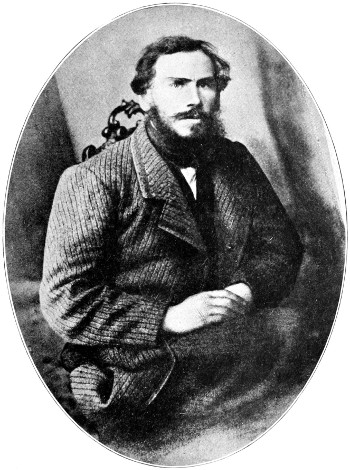
Tolstoy in 1862, the year of his marriage.
Fet records the letter in which Tolstoy informed him of his marriage:
Fétoushka [an endearing diminutive of Fet] Uncle, or simply Dear Friend Afanásy Afanásyevitch!—I have been married two weeks and am happy, and am a new, quite a new man. I want to visit you, but cannot manage it. When shall I see you? Having come to myself, I feel that I value you very, very much. We have so many unforgettable things in common: Nikólenka, and much besides. Do drive over and make my acquaintance. I kiss Márya Petróvna's hand. Farewell, dear friend. I embrace you with all my heart.
In another letter belonging to the same period he writes:
I am writing from the country, and while I write, from upstairs where she is talking to my brother, I hear the voice of my wife, whom I love more than the whole world. I have lived to the age of thirty-four without knowing that it was possible to love, and to be so happy. When I am more tranquil I will write you a long letter. I should not say 'more tranquil,' for I am now more tranquil and clear than I have ever been, but I should say, 'when I am accustomed to it.' At present I have a constant feeling of having stolen an undeserved, illicit, and not-for-me-intended happiness. There ... she is coming! I hear her, and it is so good!... And why do such good people as you, and, most wonderful of all, such a being as my wife, love me?
It did not much disturb his happiness, when, before Tolstoy had been married a fortnight, an event occurred which might easily have led to very disagreeable consequences. On 3rd October the Minister of the Interior called the attention of the Minister of Education to the harmful nature of the Yásnaya Polyána magazine. This is what he wrote:
A careful perusal of the educational magazine, Yásnaya Polyána, edited by Count Tolstoy, leads to the conviction that that magazine ... frequently propagates ideas which apart from their incorrectness are by their very tendency harmful.... I consider it necessary to direct your Excellency's attention to the general tendency and spirit of that magazine, which often infringes the fundamental rules of religion and morality.... I have the honour to inform you, Sir, of this, in the expectation that you may be inclined to consider it desirable to direct the special attention of the Censor to this publication.
Fortunately the decision of the matter did not lie with the Minister of the Interior, but with the Minister of Education, who on receiving this communication had the magazine in question carefully examined, and, on 24th October, replied that he found nothing harmful or contrary to religion in its tendency. It contained extreme opinions on educational matters, no doubt, but these, he said, should be criticised in educational periodicals rather than prohibited by the Censor. 'In general,' added the Minister:
I must say that Count Tolstoy's educational activity deserves full respect, and the Ministry of Education is bound to assist and co-operate with him, though it cannot share all his views, some of which after full consideration he will himself probably reject.
Other things besides the suspicion in which he was held by the Minister of the Interior, tended to discourage Tolstoy. His magazine had few subscribers and attracted but little attention. The year's issue was causing him a loss of something like Rs. 3000 (say about £450)—a larger sum than he could well afford to throw away. So he decided to discontinue it after the twelfth number. The month after his marriage he also closed the school, which was too great a tax on his time and attention.
It has often been said that the obstacles placed in his way by the Government turned him aside from educational work, but in speaking to me about it Tolstoy remarked that really the main factor was his marriage, and his preoccupation with family life.
Both he and his wife were absorbed by their personal happiness, though from time to time small quarrels and misunderstandings arose between them. So impulsive and strenuous a nature as Tolstoy's was sure to have its fluctuations of feeling, but on the whole the ties binding the couple together grew stronger and closer as the months passed into years.
The Countess's parents used to say: 'We could not have wished for greater happiness for our daughter.' The Countess not only loved Tolstoy dearly as a husband, but had the deepest admiration for him as a writer. He on his side often said that he found in family life the completest happiness, and in Sophia Andréyevna not only a loving wife and an excellent mother for his children, but an admirable assistant in his literary work, in which, owing to his careless and unmethodical habits, an intelligent and devoted amanuensis was invaluable. The Countess acquired remarkable skill in deciphering his often extremely illegible handwriting, and was sometimes able to guess in a quite extraordinary way the meaning of his hasty jottings and incomplete sentences.
One drawback to their almost complete happiness lay in the fact that though active and possessed of great physical strength, Tolstoy seldom enjoyed any long periods of uninterrupted good health. In his correspondence we find frequent references to indisposition. In early manhood, he seems to have distended his stomach, and, especially after the hardships he endured during the war of 1854-5, he was subject to digestive troubles for the rest of his days.
Town life did not attract him. He had never felt at ease in what is called high society; nor were his means large enough to enable him to support a wife and family in a good position in town. Still, towards the close of the year of his marriage, he and the Countess spent some weeks in Moscow.
1863
They were however soon back at Yásnaya. In February Fet visited them there, and found them overflowing with life and happiness.
On 15th May, after the Tolstoys and Fet had by some chance just missed meeting at the house of a neighbouring proprietor, Tolstoy wrote to his friend:
We just missed seeing you, and how sorry I am that we did! How much I want to talk over with you. Not a day passes without our mentioning you several times. My wife is not at all 'playing with dolls.' Don't you insult her. She is my serious helpmate, though now bearing a burden from which she hopes to be free early in July. What won't she do afterwards? We are ufanizing[48] little by little. I have made an important discovery, which I hasten to impart to you. Clerks and overseers are only a hindrance to the management of an estate. Try the experiment of dismissing them all; then sleep ten hours a day, and be assured that everything will get along not worse. I have made the experiment and am quite satisfied with its success.
How, oh how, are we to see one another? If you go to Moscow with Márya Petróvna and do not come to visit us, it will be dreadful offensive. (My wife, who was reading this letter, prompted that sentence.) I wanted to write much, but time lacks. I embrace you with all my heart; my wife bows profoundly to you, and I to your wife.
Business: When you are in Orél, buy me 20 poods [720 lbs.] of various kinds of twine, reins, and shaft-traces, if they cost less than Rs. 2.30 per pood including carriage, and send them me by a carter. The money shall be paid at once.
Fet soon availed himself of the invitation, and after driving past the low towers which mark the entrance to the birch alley leading to the house, he came upon Tolstoy eagerly directing the dragging of a lake and taking all possible care that the carp should not escape. The Countess, in a white dress, came running down the alley, with a huge bundle of barn-door keys hanging at her waist. After cordially greeting the visitor, she, notwithstanding her 'exceedingly interesting condition,' leapt over the low railing between the alley and the pond. It will however be better to quote Fet's own account of his visit:
'Sónya, tell Nestérka to fetch a sack from the barn, and let us go back to the house,' said Tolstoy—who had already greeted me warmly, without losing sight of the carp-capturing operations the while.
The Countess immediately detached a huge key from her belt and gave it to a boy, who started at a run to fulfil the order.
'There,' remarked the Count, 'you have an example of our method. We keep the keys ourselves; and all the estate business is carried on by boys.'
At the animated dinner table, the carp we had seen captured made their appearance. We all seemed equally at ease and happy....
That evening was one truly 'filled with hope.' It was a sight to see with what pride and bright hope Tatiána Alexándrovna, the kindest of aunts, regarded the young people she so loved; and how, turning to me, she said frankly, 'You see, with mon cher Léon of course things could not be otherwise.'
As to the Countess, life to one who in her condition leapt over fences, could not but be lit up with the brightest of hopes. The Count himself, who had passed his whole life in an ardent search for novelties, evidently at this period entered a world till then unknown, in the mighty future of which he believed with all the enthusiasm of a young artist. I myself, during that evening, was carried away by the general tone of careless happiness, and did not feel the stone of Sisyphus oppressing me.
Soon after this visit, on 28th June 1863, a son, Sergius, was born. During the first eleven years of marriage, the Countess bore her husband eight children, and another five during the next fifteen years: making in all, thirteen children in twenty-six years.
But we must turn back a few months to mention the stories by Tolstoy which appeared during this year.
In the January number of the Russian Messenger, Katkóf had published The Cossacks, which Tolstoy had kept back to revise, and had only delivered in December.
In the February number of the same magazine appeared Polikoúshka, the story of a serf who, having lost some money belonging to his mistress, hangs himself.
These stories are referred to in the following letter from Tolstoy to Fet, undated, but written in 1863:
Both your letters were equally important, significant, and agreeable to me, dear Afanásy Afanásyevitch. I am living in a world so remote from literature and its critics, that on receiving such a letter as yours, my first feeling is one of astonishment. Whoever was it wrote The Cossacks and Polikoúshka? And what's the use of talking about them? Paper endures anything, and editors pay for and print anything. But that is merely a first impression; afterwards one enters into the meaning of what you say, rummages about in one's head, and finds in some corner of it, among old, forgotten rubbish, something indefinite, labelled Art; and pondering on what you say, agrees that you are right, and even finds it pleasant to rummage about in that old rubbish, amid the smell one once loved. One even feels a desire to write. Of course, you are right. But then there are few readers of your sort. Polikoúshka is the chatter of a man who 'wields a pen,' on the first theme that comes to hand; but The Cossacks has some matter in it, though poor. I am now writing the story of a pied gelding, which I expect to print in autumn. [It did not appear till 1888!] But how can one write now? Invisible efforts—and even visible ones—are now going on; and, moreover, I am again up to my ears in farming. So is Sónya. We have no steward; we have assistants for field-work and building; but she, single-handed, attends to the office and the cash. I have the bees, the sheep, a new orchard, and the distillery. It all progresses, little by little, though of course badly compared with our ideal.
What do you think of the Polish business? [the insurrection of 1863, then breaking out]. It looks bad! Shall we—you and I and Borísof—not have to take our swords down from their rusty nails?...
The bees, which Tolstoy here places first among his out-door duties, occupied much of his time, and he often spent hours studying the habits of these interesting creatures.
Tourgénef, writing to Fet, commented on The Cossacks as follows:
I read The Cossacks and went into ecstasies over it; so did Bótkin. Only the personality of Olénin spoils the generally splendid impression. To contrast civilisation with fresh, primeval Nature, there was no need again to produce that dull, unhealthy fellow always preoccupied with himself. Why does Tolstoy not get rid of that nightmare?
Several months later he wrote:
After you left, I read Tolstoy's Polikoúshka and marvelled at the strength of his huge talent. But he has used up too much material, and it is a pity he drowned the son. It makes it too terrible. But there are pages that are truly wonderful! It made a cold shudder run down even my back, though you know my back has become thick and coarse. He is a master, a master!
Tolstoy was now fairly launched on the life he was destined to lead for sixteen years: a quiet, country life, occupied with family joys and cares. These years followed one another with so little change that the story of a decade and a half can almost be compressed into a sentence. Children came in quick succession, two great novels and an ABC Book were produced, a large orchard was planted with apple-trees, the Yásnaya Polyána property was improved, and new estates were purchased east of the Vólga.
During the year 1863 Tolstoy wrote two plays, which have never been published. One, a farcical comedy called The Nihilist, was privately performed at home with great success. The second, also a comedy, written on a topic of the day, was called The Infected Family. Hoping to have it staged, Tolstoy took it to Moscow early in 1864; but the theatrical season, which in Russia ends at the commencement of Lent, was already too far advanced; and he never subsequently appears to have troubled himself to have it either published or acted.
The Countess Tolstoy's brother, S. A. Behrs (who from 1866 when he was a boy of eleven, till 1878, spent every summer with the Tolstoys) in his book, Recollections of Count Tolstoy, gives much interesting information about the life at Yásnaya. He mentions that it was a proverb about the hard fate of penniless noblemen, that prompted Tolstoy to take all possible care to provide for the future of his children; and the passage in the letter quoted above, about the bees, sheep, new orchard and distillery with which he was occupied, shows how this care was applied.
In his Confession, Tolstoy says of the years now under review:
Returning from abroad I married. The new conditions of happy family life completely diverted me from all search for the general meaning of life. My whole life was centred at that time in my family, wife and children, and in care to increase our means of livelihood. My striving after self-perfection and progress, was now again replaced by the effort simply to secure the best possible conditions for myself and my family.
So another fifteen years passed.
In spite of the fact that I regarded authorship as of no importance, I yet, during those fifteen years, continued to write. I had already tasted the temptation of authorship: the temptation of immense monetary rewards and applause for my insignificant work; and I devoted myself to it as a means of improving my material position, and of stifling in my soul all questions as to the meaning of my own life, or of life in general.
Again, writing in 1903 of this middle period of his life, Tolstoy says:
Then came a third, an eighteen-year period which may be the least interesting of all (from my marriage to my spiritual re-birth) and which from a worldly point of view may be called moral: that is to say, that during those eighteen years I lived a correct, honest, family life, not indulging myself in any vices condemned by public opinion, but with interests wholly limited to selfish cares for my family, for the increase of our property, the acquisition of literary success, and all kinds of pleasure.
(In the one place he speaks of 'fifteen years,' and in the other of 'eighteen years'; but that is his way, and chronological exactitude is not the important matter here.)
After the Emancipation, in many parts of Russia the landlords had more or less serious difficulty with the peasants, among whom stories were rife to the effect that the Tsar intended to give them all the land, but had been deceived by the officials into only giving half; and, for a time, riots were not infrequent. There was no serious trouble of this sort on Tolstoy's estate; but his sister (whom I met at Yásnaya in 1902, long after her husband's death and when she, a nun, had been allowed out of her convent to visit her brother, after his very serious illness) told me that on one occasion the peasants refused to make the hay; and to save it from being lost, Tolstoy, his wife, the members of the family, and the masters from eleven neighbouring schools, all set to work with a will, and by their own strenuous exertions saved the crop before the weather changed.
On settling down to married life, Tolstoy formed the plan of writing a great novel, and the epoch he at first intended to deal with was that of the Constitutional conspiracy which came to a head on the accession of Nicholas I to the throne in December 1825. That quite premature military plot was quickly snuffed out. So little were things ripe for it, that many even of the soldiers who shouted for a 'Constitution' (Konstitútsia) thought they were demanding allegiance to Nicholas's elder brother Constantine, who having married a Polish lady of the Roman Catholic faith had renounced his right to the throne. While considering the plan of his work, Tolstoy found himself carried back to the scenes amid which his characters had grown up: to the time of the Napoleonic wars and the invasion of Russia by the French in 1812. Here was a splendid background for a novel, and putting aside The Decembrists he commenced War and Peace, a work conceived on a gigantic scale, and that resulted in a splendid success.
1864
His attention, as we have already seen, was however not wholly absorbed by literature, but was divided between that and the management of his property. He had during his stay among the Kirghiz in the Province of Samára, noticed how extremely cheap and how fertile was the land in those parts. He therefore wished to purchase an estate there, and visited the district in the autumn of 1864, probably with that end in view. How long he stayed there I do not know, but from a letter he wrote to Fet on 7th October, saying, 'We start for home to-day and do not know how we shall make our way to happy Yásnaya,' we know when he returned. In November he again wrote to Fet, and mentioned the laborious preparations he was at that time making for War and Peace:
I am in the dumps and am writing nothing, but work painfully. You cannot imagine how hard I find the preliminary work of ploughing deep the field in which I must sow. To consider and reconsider all that may happen to all the future characters in the very large work I am preparing, and to weigh millions of possible combinations in order to select from among them a millionth part, is terribly difficult. And that is what I am doing....
Late in that month he wrote again to Fet:
This autumn I have written a good deal of my novel. Ars longa, vita brevis comes to my mind every day. If one could but make time to accomplish a hundredth part of what one understands—but only a thousandth part gets done! Nevertheless the consciousness that I can is what brings happiness to men of our sort. You know that feeling, and I experience it with particular force this year.
The year 1864 saw the publication of the first collected edition of Tolstoy's works, and though they have been already mentioned, it may be as well to give a complete list of those twenty 'trials of the pen' which preceded the appearance of War and Peace, and had already sufficed to place Tolstoy in the front rank of Russian writers. The following are their titles, with the years in which they were first published. They suffice to fill four very substantial volumes.
1852 Childhood.
1853 The Raid: A Volunteer's Story.
1854 Boyhood.
1855 Memoirs of a Billiard-Marker.
1855 *Sevastopol in December.
" *Sevastopol in May.
" *The Wood-Felling.
1856 *Sevastopol in August.
" The Snow Storm.
" *Two Hussars.
" *Meeting a Moscow Acquaintance in the Detachment.
" A Squire's Morning.
1857 Youth.
" Lucerne.
1858 Albert.
1859 Three Deaths.
" Family Happiness.
1862 Educational articles in Yásnaya Polyána.
1863 The Cossacks.
" Polikoúshka.
As I am sometimes asked where satisfactory versions of these stories can be found, I may say that I think the best version of Childhood, Boyhood and Youth[49] is Miss Isabel Hapgood's, and I make no apology for quoting a letter Tolstoy wrote me on 23rd December 1901, concerning the volume, Sevastopol,[50] translated by my wife and myself, and containing the six stories marked * in the above list. I do this with less hesitation, because his letter illustrates the cordial way in which he encourages those who do any work he can approve of, in connection with his own activity:
I think I already wrote you how unusually the volume pleases me. All in it is excellent: the edition and the footnotes, and chiefly the translation, and yet more the conscientiousness with which all this has been done. I happened to open it at Two Hussars and read on to the end just as if it were something new that had been written in English.
One day in October Tolstoy went out for a ride on his favourite horse, an English thoroughbred named Máshka. His borzoi dogs Lúbka and Krylát accompanied him. After he had ridden some way, a hare suddenly started up and the dogs rushed after it. Tolstoy had not come out with the idea of hunting, but on seeing the dogs chasing the hare he could not restrain himself, and galloped after them, uttering the hunting cry, 'Atoú!' The weather was bad, the ground slippery, and the horse stumbled at a narrow ravine and fell, dislocating and breaking its rider's arm. The horse ran away, and Tolstoy, who was quite alone and several miles from home, fainted. When he came to, he managed to drag himself a distance of more than half a mile to the highroad, where he lay in great pain. Some peasant carts passed by, but at first he could not attract any one's attention. When at last he was noticed, in order not to alarm his wife, he asked to be taken to the hut of an old wife, Akoulína, famed as a bone-setter. In spite of all that she and her son Iván could do—soaping, pulling, twisting and bandaging the arm—they could not set it, and Tolstoy continued to suffer the greatest pain.
The Countess, who had meanwhile heard of the accident, reached the hut late at night. She at once arranged to have her husband taken home, and sent to Toúla for a doctor. The latter arrived about 3 A.M., and after administering chloroform, succeeded, with the aid of two labourers who were called in to assist, in setting the arm. On coming to, Tolstoy's profound disbelief in the efficiency of doctors, prompted him to send for another surgeon. After a consultation the two physicians decided that everything had been done properly, and that Tolstoy must lie up for six weeks to allow the arm to recover. When that time was up, Tolstoy asked for his gun and fired it off to test his arm. No sooner had he done so than he again felt great pain. He thereupon wrote to his father-in-law, Dr. Behrs, and on his advice went to Moscow to consult the specialists. These differed among themselves, but after a week's hesitation a fresh operation was decided upon, and was carried out by two competent surgeons. This time it was quite successful, and in due course the patient completely recovered the use of his arm.
Meanwhile the Countess (now nursing her second child, a daughter named Tatiána, who had been born on 4th October) remained at Yásnaya, where her eldest child, Sergius, was taken dangerously ill with smallpox and diarrhœa. This was the first occasion on which Tolstoy and his wife had been separated.
While in Moscow he concluded an arrangement with Katkóf by which he received Rs. 500 (£75) per printed sheet of sixteen pages for the serial rights in War and Peace, which appeared in the Russian Messenger. This was just ten times the amount which, when he wrote his first stories, Nekrásof had mentioned as the highest rate paid to any one for the magazine rights in a story.
1865
On 23rd January 1865, when Tolstoy had got over his accident, he wrote Fet another of those jocular letters which sometimes contain more of the real truth than will bear saying seriously:
Shall I tell you something surprising about myself? When the horse threw me and broke my arm, and when I came to after fainting, I said to myself: 'I am an author.' And I am an author, but a solitary, on-the-quiet kind of author.... In a few days the first part of 'The Year 1805' [so the first part of War and Peace was originally called] will appear. Please write me your opinion of it in detail. I value your opinion and that of a man whom I dislike the more, the more I grow up—Tourgénef. He will understand. All I have printed hitherto I consider but a trial of my pen; what I am now printing, though it pleases me better than my former work, still seems weak—as an Introduction must be. But what follows will be—tremendous!!!... Write what is said about it in the different places you know, and especially how it goes with the general public. No doubt it will pass unnoticed. I expect and wish it to do so; if only they don't abuse me, for abuse upsets one....
I am glad you like my wife; though I love her less than my novel, still, you know, she is my wife. Be sure you come to visit us; for if you and Márya Petróvna do not stay here on your return from Moscow it will really, without a joke, be too stupid!
In May 1865 one sees by a letter of Tolstoy's to Fet that one of the children had been ill and he himself had been in bed for three days and barely escaped a fever. His wife's younger sister, Tánya, she of the contralto voice who (with some admixture of his wife) served Tolstoy as model for Natásha in War and Peace, was spending the summer at Yásnaya, as she had done each year since her sister's marriage. The Countess Mary and her children were also there. The children, he says, were well, and out all day in the open air. He adds:
I continue to write little by little, and am content with my work. The woodcock still attract me, and every evening I shoot at them, that is, generally, past them. My farming goes on well, that is to say, it does not disturb me much—which is all I demand of it....
In reply to a suggestion from Fet, he goes on to say that he will not write more about the Yásno-Polyána school, but hopes some day to express the conclusions to which his three years' ardent passion for that work had brought him. Then comes a reference to the state of agricultural affairs after the Emancipation, and a passing allusion to the question of famine—a subject destined to make great demands on Tolstoy's attention in later years:
Our affairs as agriculturists are now like those of a share-holder whose shares have lost value and are unsaleable on 'Change. The case is a bad one. Personally I only ask that it should not demand of me so much attention and participation as to deprive me of my tranquillity. Latterly I have been content with my private affairs; but the general trend—with the impending misery of famine—torments me more and more every day. It is so strange, and even good and terrible. We have rosy radishes on our table, and yellow butter, and well-baked, soft bread on a clean tablecloth; the garden is green, and our young ladies in muslin dresses are glad it is hot and shady; while there that evil hunger-devil is already at work, covering the fields with goose-weed, chafing the hard heels of the peasants and their wives, and cracking the hoofs of the cattle. Our weather, the corn, and the meadows, are really terrible. How are they with you?
The letter closes with advice to Fet to transfer his chief attention from the land to literature, and a statement that Tolstoy himself has done so, and is finding life less difficult.
When Tolstoy went out hunting hares and foxes with borzoi dogs, Miss Tatiána Behrs (the Tánya alluded to above) used often to accompany him.
Between this lady and Count Sergius Tolstoy (Leo's elder brother) an attachment had grown up which caused great distress to them both, for, besides being twenty-two years older than the lady, Sergius was living with, and had a family by, the gipsy mentioned in a previous chapter, though he was not legally married. His affection for his family prevented his yielding completely to his love for Tánya and asking her to be his wife. The Behrs were quite willing that he should do so, and the young lady would have accepted him, and was much pained by the vacillation that resulted from the battle between his love for her and his affection for his family. Ultimately he resolved to be faithful to the union he had formed, and, in order to legitimise his children, went through the form of marriage with their mother in 1867. Almost at the same time, Tánya, having recovered from her disappointment, married a Mr. Kouzmínsky.
Here again one gets a slight glimpse of the experience of life which has led Tolstoy, contrary to the opinion general among the Russian 'intelligents,' to advocate faithfulness at all costs to the woman with whom one has once formed a union.
A knowledge of Tánya's story adds to the interest with which, in Tolstoy's great novel, one reads of Natásha Róstof's troubles and ultimate happiness.
Towards the end of May, Tolstoy visited the estate of Nikólsky (which after the death of his brother Nicholas had become his), and had the house there repaired. In June the whole family moved to Nikólsky, where they lived very quietly; Tolstoy continuing to write War and Peace. His friend D. A. Dyákof's estate was only ten miles away, and Tolstoy saw much of him at this time, besides having him at other times as a frequent visitor at Yásnaya. Dyákof was his chief adviser in agricultural matters, as well as in his efforts to improve the stock of his cattle, pigs and poultry. Almost the only other visitors at Nikólsky were the Fets; and the poet records meeting there the Countess's 'charming sister,' Tánya, and experiencing violent antipathy for the sour koumýs, about which Tolstoy was enthusiastic, and a large tub of which stood near the front door.
While living at Nikólsky Tolstoy was invited for a fortnight by a neighbouring landlord, Kiréyevsky, to a grand hunt, in which the huntsmen wore special costumes, and luxurious dinners were served in the woods. What interested Tolstoy most in all this was not the hunt, but the opportunity it afforded him of studying types of the old and new aristocracy.
At this period of his life one hears of his playing the guitar and singing passionate love-songs.
During the autumn of 1865 Tolstoy, accompanied by his eleven-year-old brother-in-law, visited the battlefield of Borodinó. They left Moscow in Dr. Behrs' carriage, with post-horses. When the time came for them to have something to eat, they found that the lunch basket had been left behind, and they had only a small basket of grapes. Thereupon Tolstoy remarked to his companion, 'I am sorry, not that we have left the basket of food behind, but because your father will be upset and will be angry with his man.' The journey took only one day, and they stayed at the monastery erected in memory of those who fell in the great fight. For two days Tolstoy investigated the scene of the conflict which he was about to describe in his novel, and he then drew the plan of the fight which appears in that work. Even in 1865 there were but few survivors of the campaign of 1812 to be found in the neighbourhood.
Tolstoy used at this time to spend whole days in the Roumyántsef Museum in Moscow, studying books and manuscripts relating to the times of Alexander I, and especially to the reformatory and Masonic movements which then sprang up in Russia, but were subsequently suppressed on political grounds.
S. A. Behrs tells us that Tolstoy
was always fond of children, and liked to have them about him. He easily won their confidence, and seemed to have found the key to their hearts. He appeared to have no difficulty in suiting himself to a strange child, and with a single question set it completely at ease, so that it began at once to chat away with perfect freedom. Independently of this, he could divine a child's thought with the skill of a trained educationalist. I remember his children sometimes running up to him, and telling him they had a great secret; and when they persisted in refusing to divulge it, he would quietly whisper in their ears what it was. 'Ah, what a papa ours is! How did he find it out?' they would cry, in astonishment.
He also says:
Gifted by nature with rare tact and delicacy, he is extremely gentle in his bearing and conduct to others. I never heard him scold a servant. Yet they all had the greatest respect for him, were fond of him, and seemed even to fear him. Nor, with all his zeal for sport, have I ever seen him whip a dog or beat his horse.
A servant who lived with him more than twenty years has said: 'Living in the Count's house from my childhood, I loved Leo Nikoláyevitch as though he were my father'; and in another place he remarks:
The Count had a stern appearance, but treated the servants excellently, and made things easy for all strangers whom he met. He has a very good heart, and when he was cross with me for anything, I, knowing his character, used at once to leave the room, and when next he called me, it was as though nothing unpleasant had happened.
Speaking of Tolstoy's later years the same servant says:
Leo Nikoláyevitch has now become quite a different man. From 1865 to 1870 he was active in managing the estate, and was fond of cows, bred sheep, looked after the property, and, in a word, attended to everything. At that time he was hot-tempered and impulsive. He would order the trap to be brought when he wanted to go hunting. His man, Alexis, would bring him his hunting-boots, and the Count would shout at him, 'Why have you not dried them? You are not worth your salt!' Alexis, knowing the Count's character, would take the boots away, and bring them back almost directly. 'There! now they're all right,' the Count would say, and would brighten up instantly.
His love of the country and his dislike of towns sprang partly from his keen appreciation of the charm and loveliness of Nature. He saw fresh beauty every day, and often exclaimed: 'What wealth God has! He gives each day something to distinguish it from all the rest.'
Sportsman and agriculturist himself, he maintains that sportsmen and agriculturists alone know Nature. To quote Behrs again:
No bad weather was allowed to interfere with his daily walk. He could put up with loss of appetite, from which he occasionally suffered, but he could never go a day without a sharp walk in the open air. In general, he was fond of active movement, riding, gymnastics, but particularly walking. If his literary work chanced to go badly, or if he wished to throw off the effects of any unpleasantness, a long walk was his sovereign remedy. He could walk the whole day without fatigue; and we have frequently ridden together for ten or twelve hours. In his study he kept a pair of dumb-bells, and sometimes had gymnastic apparatus erected there.
All luxury was distasteful to him; and much that ordinary people regard as common comforts, seemed to him harmful indulgences, bad for the souls and bodies of men. Nothing could well be more simple than the arrangement of his house at Yásnaya, substantial and solidly built as it was, with its double windows, and the Dutch stoves so necessary to warm a Russian house.
He was not at all particular about what he ate, but objected to a soft bed or spring mattress, and at one time he used to sleep on a leather-covered sofa.
He dressed very simply, and when at home never wore starched shirts or tailor-made clothes, but adapted to his own requirements the ordinary Russian blouse, having it made of woollen stuff for winter, and of linen for summer. His out-door winter dress was also an adaptation of the sheepskin shoúba and peasants' caftán, made of the plainest material; and these afforded such good protection from the weather that they were often borrowed by members of the household as well as by visitors.
During the writing of War and Peace Tolstoy generally enjoyed good spirits, and on days when his work had gone well, he would gleefully announce that he had left 'a bit of my life in the inkstand.' One of his chief recreations was to go out hare-hunting with borzoi dogs, and this he often did in company with a neighbouring landed proprietor, Bíbikof.
From October 1865 he ceased to keep his Diary, and did not renew it during the period covered by this volume.
1866
On Twelfth Night a grand masquerade was held at Yásnaya, and the festivities were kept up till past two in the morning, and were followed by a troika drive next day.
That same January the family moved to Moscow, where they hired a six-roomed apartment for Rs. 155 a month (say about £23); and there they remained for six weeks while the second part of War and Peace was being printed for the Russian Messenger.
Among the friends Tolstoy saw most of at this time were Aksákof and Prince Obolénsky. He also attended the Moscow drawing school, and he tried his hand at sculpture—modelling a bust of his wife. It does not appear, however, that he continued this occupation long.
In May 1866 a second son, Ilyá, was born, and an English nurse introduced into the family.
During this summer an infantry regiment was stationed near Yásnaya, in which a young Sub-Lieutenant named Kolokóltsef was serving, whom the Countess Tolstoy had known in Moscow. He visited the Tolstoys, and introduced to them his Colonel Únosha, and his fellow-officer Ensign Stasulévitch (brother of the Liberal editor of the monthly magazine, The Messenger of Europe), who had been degraded to the ranks because, while he was on prison-duty, a prisoner had escaped. Ensign Stasulévitch was middle-aged, but he had only recently regained his rank as officer and joined the regiment commanded by his former comrade, Colonel Únosha.
One day Stasulévitch and Kolokóltsef called on Tolstoy and told him that a soldier, serving as secretary in one of the companies of the regiment, had struck his Company Commander, and was to be tried by court-martial. They asked Tolstoy to undertake the man's defence, and he, having always regarded capital punishment with abhorrence, readily agreed to do so.
The circumstances of the case were these. The soldier, Shiboúnin, was a man of very limited intelligence, whose chief occupation was writing out reports. When he had any money he spent it on solitary drinking. The Captain in command of his company, a Pole, apparently disliked him, and frequently found fault with his reports and made him rewrite them. This treatment Shiboúnin bitterly resented; and one day, when he had been drinking, on being told to rewrite a document he had prepared, he insulted and struck the Captain. By law the penalty for a private who strikes his officer is death. Tolstoy nevertheless hoped to save the man's life, and obtained permission to plead on his behalf. The trial took place on 6th June, and the members of the court-martial were Colonel Únosha, Stasulévitch, and Kolokóltsef; the latter being merely a light-headed youngster.
Tolstoy, when telling me of the incident, remarked that of the four occasions on which he has spoken in public, this was the time that he did so with most assurance and satisfaction to himself. He had written out his speech; the main point of which was that Shiboúnin was not responsible for his actions, being abnormal, and having from the combined effect of intemperance and the monotony of his occupation, become idiotic and obsessed by an idea that his Company Commander did not understand report writing, and unfairly rejected work faultlessly done. The law decrees a mitigation of sentence for crimes committed by those who are not in the full possession of their senses; and as this contradicts the paragraph allotting death as the sole punishment for a soldier who strikes his officer, Tolstoy argued that mercy should be extended to the prisoner.
The Court adjourned to consider its verdict, and (as Tolstoy subsequently learnt) Stasulévitch was in favour of mercy. The Colonel, who was more of a military machine than a human being, demanded the death sentence, and the decision therefore rested with the boyish Sub-Lieutenant, who (submitting to his Colonel) voted for death.
Tolstoy wished to appeal (through his aunt, the Countess A. A. Tolstoy) to Alexander II for a pardon; but with characteristic disregard of details, he omitted to mention the name of the regiment in which the affair had occurred, and this enabled the Minister of War, Milútin, to delay the presentation of the petition until Shiboúnin had been shot; which occurred on 9th August. Tolstoy's appeal never, therefore, reached the Emperor.
In contrast with the action of the Colonel and the Minister, was that of the peasants of the district, who flocked in crowds to see the prisoner; bringing him milk, eggs, home-made linen and all the gifts their poverty could afford. When the day of execution arrived, Shiboúnin went quite impassively to his death; to all appearance incapable of understanding what was happening. The people thronged around the post to which he was to be tied—the women weeping and some of them fainting. They fetched a priest to perform Masses at his grave, and paid for the service to be repeated all day. At night contributions of copper money, linen, and candles such as are burnt in Russian churches, were laid upon his grave. Next day the Masses were recommenced, and were continued until the local police forbade any more religious services, and levelled the grave that the people might not continue to visit it.
The knowledge of such a difference between the spirit of the governors and the governed, helps us once again to understand Tolstoy's ultimate conviction that Government and the administration of law are essentially evil things, always tending to make the world worse and not better. In later life we may be sure he would not have been content to base his plea for mercy on merely legal grounds.
From time to time he continued to be troubled with ill-health; for instance, in July 1866 he writes that he is confined to the house with pains in the stomach which make it impossible for him to turn quickly.
In November—contrary to what he had often said in the past and was to return to in later life—he expresses his sense of the importance of authorship. Fet, criticising something in War and Peace, had quoted the words, irritabilis poetarum gens, and Tolstoy, replying 'Not I,' welcomes the criticism, begs for more, and goes on to say:
What have you been doing? Not on the Zémstvo [County Council] or in farming (all that is compulsory activity such as we do elementally and with as little will of our own as the ants who make an ant-hill; in that sphere there is nothing good or bad), but what are you doing in thought, with the mainspring of your being, which alone has been, and is, and will endure in the world? Is that spring still alive? Does it wish to manifest itself? How does it express its wish? Or has it forgotten how to express itself? That is the chief thing.
By the autumn of this year the railway southwards from Moscow to Koursk had been constructed as far as Toúla, making it easier to get from Yásnaya to Moscow, and to the rest of Europe. Yet Tolstoy comparatively seldom felt tempted to leave his much-loved, tranquil, busy, country life, in which alone he found himself able to work with the maximum of efficiency.
About this time he undertook the planting of a birch wood, which has since grown up and become valuable.
1867
During the summer of 1867 Tolstoy, despite the dislike and distrust of doctors—which he shares with Rousseau, and which he has again and again expressed in his works—was induced by the state of his health and by his wife's persuasion, to consult the most famous Moscow doctor of the time, Professor Zahárin, on whose advice he drank mineral water during several weeks.
Writing to Fet he says:
If I wrote to you, dear friend, every time I think of you, you would receive two letters a day from me. But one cannot get everything said, and sometimes one is lazy and sometimes too busy, as is the case at present. I have recently returned from Moscow and have begun a strict cure under the direction of Zahárin; and most important of all, I am printing my novel at Ris's, and have to prepare and send off MSS. and proofs every day under threat of a fine and of delayed publication. That is both pleasant and also hard, as you know.
He goes on to criticise Tourgénef's novel, Dym (Smoke), which had appeared that year:
About Smoke I meant to write long ago, and, of course, just what you have now written. That is why we love one another—because we think alike with the 'wisdom of the heart' as you call it. (Thank you very much for that letter also: 'the wisdom of the heart' and 'the wisdom of the mind' explain much to me.) About Smoke, I think that the strength of poetry lies in love; and the direction of that strength depends on character. Without strength of love there is no poetry; but strength falsely directed—the result of the poet's having an unpleasant, weak character—creates dislike. In Smoke there is hardly any love of anything, and very little poetry. There is only love of light and playful adultery, and therefore the poetry of that novel is repulsive. That, as you see, is just what you write about it. Only I fear to express this opinion because I cannot look soberly at the author, whose personality I do not like; but I fancy my impression is the general one. One more writer played out!
In November 1867 we find the whole family again established for a while in a lodging in Moscow, where they seem to have remained for a large part of the winter.
Here Fet visited Tolstoy and announced to him that he had decided to arrange a Literary Evening for the benefit of the famine-stricken peasants of Mtsensk, the district in which Fet's estate lay. Tolstoy met the suggestion with irony, maintaining that Fet had invented the famine; and in reply to a request that he would ensure the success of the evening by reading something, flatly refused to do so, declaring that he never had and never could do such a thing as read in public. Still, he lent Fet the chapter of War and Peace containing the wonderful description of the retreat of the Russian army from Smolénsk in fearful drought. This as yet existed only in proof, not having been published. (It forms Chapter V of Part X of Volume II in Mrs. Constance Garnett's version: the best English rendering of that novel.) Read by Prince Kougoúshef, the poet and dramatist, it evoked thunders of applause.
1868
On 12th April 1868 Tourgénef, writing to Fet, said:
I have just finished the fourth volume of War and Peace. There are things in it that are unbearable, and things that are wonderful; and the wonderful things (they predominate) are so magnificently good that we have never had anything better written by anybody; and it is doubtful whether anything as good has been written.
About the same time V. P. Bótkin wrote from Petersburg: 'Tolstoy's novel is having a really remarkable success; every one here is reading it, and they not merely read it but become enthusiastic about it.'
1869
The Epilogue was not completed till late in 1869. On 30th August Tolstoy writes: 'Part VI [i.e. Part II of the Epilogue] which I expected to have finished a month ago, is not ready'; and then in the next sentence, he goes into ecstasies over Schopenhauer:
Do you know what this summer has been for me? An unceasing ecstasy over Schopenhauer, and a series of mental enjoyments such as I never experienced before. I have bought all his works, and have read and am reading them (as well as Kant's). And assuredly no student in his course has learnt so much and discovered so much as I have during this summer. I do not know whether I shall ever change my opinion, but at present I am confident that Schopenhauer is the greatest genius among men. You said he had written something or other on philosophic subjects. What do you mean by 'something or other'? It is the whole world in an extraordinarily vivid and beautiful reflection. I have begun translating him. Won't you take up that work? We would publish it together. After reading him I cannot conceive how his name can remain unknown. The only explanation is the one he so often repeats, that except idiots there is scarcely any one else in the world....
He goes on to say that he was starting next day for the Government of Pénza to look at an estate he meant to buy 'in those out-of-the-way parts.' The servant who accompanied Tolstoy has told how they travelled third class from Moscow to Nízhni, and how Tolstoy chatted with his fellow-travellers, so that many of them took him 'for a common man.' The idea of buying the estate in Pénza was ultimately abandoned.
He had by then completed the last part of War and Peace, which was to appear complete in book form in November. Two volumes had been published in 1866, three more in 1868, and the sixth was not ready till this year, 1869. (In subsequent editions the book was rearranged, first into five and then into four volumes.)
Though he had so completely conquered the laziness of which he accused himself in early manhood as to have become a regular, indefatigable and extremely hard worker, yet after the completion of so gigantic a task he felt the need of recuperation and in summer wrote to Fet: 'It is now my deadest time: I neither write nor think, but feel happily stupid,' and he adds that he goes out shooting woodcock and has killed eight at an outing.
That at this time he already felt something of the strong repugnance he so strenuously expressed in later years for luxury and profuse expenditure, is indicated by his comment on the death of his acquaintance, the author V. P. Bótkin, which took place in 1869. The latter, a member of a wealthy family of tea-merchants, having lived with economy till he knew his death was approaching, then hired a splendid lodging in Petersburg, fitted it up with all possible comfort and luxury, engaged a chef from the kitchen of the Tsarévitch, paid daily attention to the dinner menu, and engaged famous musicians to perform quartets at his lodgings. To the magnificent feasts he gave every day (at which, owing to the state of his health, he himself participated chiefly as a spectator) he gathered a select circle of those friends whose conversation interested him. He told his brother that these arrangements for the close of his life gave him the keenest pleasure, and that 'birds of Paradise are singing in my soul.' On 4th October a quartet and a banquet had been arranged as usual, and many guests were expected—but V. P. Bótkin lay dead in his bed.
Tolstoy, hearing of this, wrote to Fet:
I was terribly shocked by the character of V. P. Bótkin's death. If what is told of it is true, it is terrible. How is it that among his friends not one was found to give to that supreme moment of life the character suitable to it?
Before War and Peace was finished, the Countess had borne four children, the fourth being a boy, born on 20th May 1869, and christened Leo—nursing them all herself, as she did her subsequent children, with two exceptions mentioned later on. Her willingness to do her duty in this respect was exceptional among women of her class, for the employment of wet-nurses was extremely common in Russia.
Up to the age of ten, the children were taught Russian and music by the Countess, and she even found time to make their clothes herself till they reached that age. Besides managing the household, her brother tells us that during the composition of War and Peace she found time to copy it out no less than seven times, a statement not to be taken literally: for greatly as Tolstoy believes in the proverb that 'Gold is got by sifting,' and indefatigably as he revises his work, not all the chapters of War and Peace will have been altered that number of times. With Tolstoy the children learnt arithmetic; and they learnt to read French out of illustrated volumes of Jules Verne.
In all that concerned the education of the children, his wife at this time willingly constituted herself the executant of her husband's decisions, which were based largely on J. J. Rousseau's Émile, and were relaxed only in so far as the Countess was unable to carry them out, and as Tolstoy found himself too much occupied with other affairs to attempt to do so. Later on there was less accord between the parents.
With the first child they tried to do without a nurse, but the attempt was unsuccessful, and subsequently Russian nurses and foreign bonnes were employed.
Toys were not allowed in the nursery, but much liberty was given to the children. No violent or severe punishments were inflicted on them, and none but their parents might award the punishments that were administered. They aimed at gaining their children's confidence by timely petting and kindly treatment.
If one of the children told a falsehood, this was treated as a serious matter, and the punishment usually consisted in the parents treating the child coldly. As soon, however, as it showed that it was really sorry, the punishment ceased; but a child was never persuaded to say it was sorry or to promise not to repeat its fault.
All the grown-up people in the house were expected to remember that children are apt to copy and imitate all that they see and hear; and the children were not kept away from the adults, except at lesson time. Consequently when eight o'clock came and the children went to bed, Tolstoy would often remark: 'Now, we are freer!'
Partly that they might learn English, partly because Tolstoy believed that education was freer in England than elsewhere, young English governesses were engaged to take charge of his children from the age of three to nine. He was extremely fortunate in his first choice, for the young lady remained with the Tolstoys for six years, and after her marriage continued in most friendly relations with the whole family.
He aimed at acquainting the children with Nature, and developing their love of it, of animals, and of insects. He liked to let them realise their impotence and their complete dependence on their elders, but he always did this with kindly consideration.
The children were not allowed to order the servants about, but had to ask them for anything they wanted; and that a good example might be set, every one in the house was expected to do the same. This was the more important, because the peasant servants in Russia, even after the Emancipation, were scarcely regarded as belonging to the same race of human beings as their masters, and a famous Russian author could say without any exaggeration, 'The balcony was rotten. Only servants went there; the family did not go there.' But, to avoid giving a wrong impression, I must here make a reservation. Just because there was no idea of the two classes overlapping, and because so wide a gap existed between them that they dressed quite differently (the peasants having their own costume and style of garments) very cordial and sincere good feeling often grew up between master and man, or between proprietress and servant, and real human interest, such as is shown in Tolstoy's descriptions of the servants in Childhood, and in his other stories. It was, and is, not at all unusual for Russian servants to intervene in the conversation of the family or visitors; and the whole relation between employers and employed was quite different to what it is in England, where on Sundays the maid might be mistaken for her mistress, except that she often looks more attractive than the latter.
The plan adopted in the Yásno-Polyána school, where no child was obliged to learn anything it did not care to learn, had to be abandoned in the family; but some scope was allowed to the children to reject what they had no capacity for, and they were never punished for neglecting to prepare lessons, though they were rewarded when they learnt well.
To illustrate Tolstoy's way of developing the minds of those about him, Behrs tells of his own case when, as a youth, he stayed at Yásnaya:
Regardless of my youth at the time, I remember that Tolstoy discussed quite seriously with me all the scientific and philosophic questions it came into my head to put to him. He always answered simply and clearly, and never hesitated to admit the fact if he himself did not understand this or that matter. Often my talk with him took the form of a dispute, on which I embarked in spite of my consciousness of his immense superiority.
The children were always eager to go for walks with their father, to answer his call to practise Swedish gymnastics, and to be on his side in any game he taught them. In winter they skated a good deal; but clearing the snow off the pond under his leadership was an even greater pleasure than the skating itself.
Before breakfast he would go for a walk with his brother-in-law, or they would ride down to bathe in the river that flows by one side of the estate. At morning coffee the whole family assembled, and it was generally a very merry meal, Tolstoy being up to all sorts of jokes, till he rose with the words, 'One must get to work,' and went off to his study, taking with him a tumbler full of tea. While at work in his room not even his wife was allowed to disturb him; though at one time his second child and eldest daughter, Tatiána, while still quite a little girl, was privileged to break this rule. The rare days (generally in summer) when he relaxed, were very welcome to the children, for their father's presence always brought life and animation with it. Generally after dinner, before resuming work, he would read a book not directly connected with the task he had in hand. It was often an English novel; and we hear of his reading Anthony Trollope with approval, Mrs. Henry Wood, who, he says, made a great impression on him, and Miss Braddon. His dislike of George Sand remained unshaken, and he considered Consuelo to be a mixture of the pretentious and the spurious. Goethe (especially Faust) he admired; while Molière's plays and Hugo's Les Misérables appealed to him very strongly indeed. In the evening he was fond of playing duets with his sister. He used to find it hard to keep up with her in playing long pieces with which he was not quite familiar, and when in difficulties he would say something to make her laugh, and cause her to play slower. If he did not succeed by means of this ruse, he would sometimes stop and solemnly take off one of his boots, as though that must infallibly help him out of the difficulty; and he would then recommence, with the remark, 'Now, it will go all right!'
During the early years of his married life few visitors came to Yásnaya, except the numerous members of the Tolstoy-Behrs families, who stayed there chiefly in summer. The poet A. A. Fet, D. A. Dyákof, whom he had known from boyhood and had described in Youth, N. N. Stráhof, the philosopher and critic, for whose judgment he had great respect and whom he frequently consulted throughout his literary career, and Prince L. D. Ouroúsof, a cousin of the Prince Ouroúsof he had known during the siege of Sevastopol, seem to have been almost the only friends who visited him in the years first following his marriage; and this suited Tolstoy very well, for to entertain many visitors would have seriously interrupted the absorbing work in which he was continually engaged.
Fet has so often been mentioned in this volume that it is time to devote a few lines to describing a man who has come in for much abuse on account of the anti-Emancipationist sympathies expressed in some of his writings. Like Tolstoy, he had grown up with no idea that it is incumbent on men of education and capacity to organise the society of which they are members, or by political action to remedy such abuses as inevitably arise among human beings who do not keep the task of systematic social organisation constantly in view. Of the impression Fet's political opinions made on the Liberals, one may judge by a remark Tourgénef addressed to him in a letter written in 1874: 'Twenty years ago, at the height of Nicholas I's régime, you dumbfounded me by announcing your opinion that the mind of man could devise nothing superior to the position of the Russian aristocracy of that day, nor anything nobler or more admirable.' The Liberals saw in Fet a political reactionary—and so he was; but any one who reads his Recollections may also see how large a measure of personal worth can be combined with political indifferentism—a quality many Russians of his generation were brought up to regard as a virtue. In private life he was a really worthy man, and Tolstoy once very truly remarked to him:
There are some people whose talk is far above their actual morality; but there are also some whose talk is below that level. You are one who is so afraid of his sermon being above his practice, that you intentionally talk far below your actual practice.
While still a young cavalry officer Fet began to write poetry, for which he had real talent; and after leaving the army he continued his literary career as an Art-for-Art's-sake-ist, producing verse translations of Virgil, Horace, Ovid, Juvenal, Catullus, Tibullus, Propertius, and Persius, besides original works of his own in prose and verse, and (after Tolstoy's suggestion, already recorded) translations from the German of Schopenhauer's The World as Will and Idea, and Goethe's Faust.
In his dislike, or perhaps one should say ignorance, of politics, commerce, and that great industrial revolution of the Western world that has been the most conspicuous achievement of the last one hundred and fifty years, as well as in his love of pure art, chiefly literary, he had much in common with Tolstoy. They could talk with profound sympathy of all that related to art, and they were alike in their love of country life and in their relation to agriculture, as well as in the fact that the great problems of life centred for them round their own personality rather than around the community to which they belonged. Patriotic by instinct, it was no part of their philosophy to be so; at least they never dreamed of that newer patriotism which seeks to manage the production and distribution of the national wealth so that every member of the community may have an opportunity to live in decent conditions. They had therefore at this period much in common; and one sees by Tolstoy's letters how greatly they enjoyed each other's society, though a time was coming when their friendship would wane.
Tolstoy had a strong dislike of leaving home even for a few days. When it was absolutely necessary for him to go to Moscow he would grumble at his hard fate, and Behrs, when he accompanied him, noticed how town life depressed Tolstoy, making him fidgety and even irritable. When returning from a journey, or a hunting expedition, he would express his anxiety by exclaiming, 'If only all's well at home!' After he had been away from Yásnaya, Tolstoy never failed to give the home party full and amusing accounts of what he had seen and heard.
A distinguishing feature of Tolstoy, already remarked upon, but so strongly marked that it can hardly be insisted on too much, was the ardent and whole-hearted way in which he threw himself into whatever occupation he took up. On this point Prince D. D. Obolénsky says: 'I have seen Count L. N. Tolstoy in all phases of his creative activity.... Whatever his occupation, he did it with conviction, firmly believing in the value of what he was doing, and always fully absorbed by it. I remember him as a man of the world, and have met him at balls, and I remember a remark he once made, "See what poetry there is in women's ball-dresses, what elegance, how much thought, how much charm even in the flowers pinned to the dresses!" I remember him as an ardent sportsman, as a beekeeper, as a gardener; I remember his enthusiasm for farming, for tree planting, fruit culture, horse breeding, and much else.'
A housekeeper who was with him for nine years, said of him:
The Count himself looked after everything, and demanded extreme cleanliness in the cowhouse and in the pig-styes and in the sheep-cot. In particular he delighted in his pigs, of which he had as many as 300, paired off in separate styes.... There the Count would not allow the least dirt. Every day I and my assistants had to wash them all, and wipe the floor and walls of the styes; then the Count, on passing through the piggery of a morning, would be very pleased, and would remark aloud: 'What management!... What good management!' But God have mercy on us if he noticed the least dirt! That at once made him shout out angrily.... The Count was very hasty, and a doctor who used to come to Yásnaya said to him more than once in my presence: 'You must not get so angry, Count, it is very bad for your health....' 'I can't help it,' he would reply. 'I want to restrain myself, but can't do it. That, it seems, is the way I am made!'... His farming gave the Count a good revenue in those days. Besides the pigs and their litters, he had 80 cows, 500 good sheep, and very many fowls. We used to make excellent butter, which we sold in Moscow at 60 copecks [about 19 pence] a lb.
His management of property was characteristically personal. He never took shares in any joint-stock company, but he bought land, bred cattle and horses of good quality, planted a large apple-orchard, as well as a quantity of other trees, and in general he acquired property he could manage himself, or (for he entrusted the management of his Samára estates to stewards) over which he had full control. He has always been more alive to the dangers and evils of commercial companies and large engineering and industrial undertakings, than to the good they have achieved by irrigating arid lands, uniting distant realms, and lightening man's toil by making iron bear some of his burdens for him.
Tolstoy furnishes an example of the well-known fact that men of artistic temperament are often untidy. Though he acknowledges the advantages of neatness in general, he often remarked that it is a quality most frequently found in shallow natures. He himself simply could not, and therefore did not try to, keep his things in order. When he undressed he let his clothes or boots drop where he stood; and if he happened to be moving from place to place, his garments remained strewn about the room, and sometimes on the floor. Behrs remarks.
I noticed that to pack his things for a journey cost him great effort, and when I accompanied him I used very willingly to do it for him, and thereby pleased him very much. I remember that once, for some reason, I did not at all wish to pack for him. He noticed this, and with characteristic delicacy did not ask me to, but put his things into his portmanteau himself; and I can assert positively that no one else, were they to try, could have got them into such fearful disorder as they were in, in that portmanteau.
It was a peculiarity of Tolstoy's that he not only liked to have his own sleep out without being disturbed, but that he never could or would wake any one from sleep, and in cases of absolute necessity would ask some one else to relieve him of that disagreeable task.
Behrs recounts that when they sat up late, the man-servant sometimes fell asleep in his chair and omitted to serve up the cold supper. Tolstoy would never allow him to be disturbed on these occasions, but would himself go to the pantry to fetch the supper, and would do this stealthily, and with the greatest caution, so that it became a kind of amusing game. He would get quite cross with Behrs if the latter accidentally let the plates clatter or made any other noise.
Many years later, alluding in my presence to this peculiarity of his, Tolstoy remarked, 'While a man is asleep he is at any rate not sinning.'
1870
On 4th February 1870 Tolstoy wrote to Fet:
I received your letter, dear Afanásy Afanásyevitch, on 1st February, but even had I received it somewhat sooner I could not have come. You write, 'I am alone, alone!' And when I read it I thought, What a lucky fellow—alone! I have a wife, three children, and a fourth at the breast, two old aunts, a nurse, and two housemaids. And they are all ill together: fever, high temperature, weakness, headaches, and coughs. In that state your letter found me. They are now beginning to get better, but out of ten people, I and my old aunt alone turn up at the dinner table. And since yesterday I myself am ill with my chest and side. There is much, very much, I want to tell you about. I have been reading a lot of Shakespear, Goethe, Poúshkin, Gógol, and Molière, and about all of them there is much I want to say to you. I do not take in a single magazine or newspaper this year, and I consider it very useful not to.
S. A. Behrs tells us that Tolstoy 'never read newspapers, and considered them useless, and when they contain false news, even harmful. In his humorous way he would some times parody a newspaper style when speaking of domestic affairs.' His attitude towards journalists and critics (except his friend Stráhof) was rather scornful, and he was indignant when any one classed them even with third-rate authors. He considered that it is a misuse of the printing-press to publish so much that is unnecessary, uninteresting, and worst of all, inartistic. He seldom read criticisms of his own work. 'His feeling towards periodicals in general had its source in his intense dislike of the exploitation of works of art. He would smile contemptuously at hearing it suggested that a real artist produces his works for the sake of money.'
Having said this much about his characteristics and peculiarities, let us note the extent to which his life and mode of thought at this time approximated to his later teaching. His humane relations towards the peasants, his condemnation of many of the manifestations of modern civilisation, his simplicity in household matters and dress, his exemplary family life, humane educational ideals, deep love of sincerity and of industry (including physical labour), his ardent search for truth and for self-improvement, his gradually increasing accessibility to and regard for others, his undoubted love of family and his hatred of violence—indicate that the ideals of his later life were not very far from him, even before the commencement of the conversion told of in his Confession.
On 17th February Tolstoy writes to Fet:
I hoped to visit you the night of the 14th, but could not do so. As I wrote you, we were all ill,—I last. I went out yesterday for the first time. What stopped me was pain in the eyes, which is increased by wind and sleeplessness. I now, to my great regret, have to postpone my visit to you till Lent. I must go to Moscow to take my aunt to my sister's, and to see an oculist about my eyes.
It is a pity that one can only get to your place after passing a sleepless, cigarette-smoky, stuffy, railway-carriage, conversational night. You want to read me a story of cavalry life.... And I don't want to read you anything, because I am not writing anything; but I very much want to talk about Shakespear and Goethe and the drama in general. This whole winter I am occupied only with the drama; and it happens to me, as it usually happens to people who till they are forty have not thought of a certain subject or formed any conception of it, and then suddenly with forty-year-old clearness turn their attention to this new untasted subject—it seems to them that they discern in it much that is new. All winter I have enjoyed myself lying down, drowsing, playing bézique, going on snowshoes, skating, and most of all lying in bed (ill) while characters from a drama or comedy have performed for me. And they perform very well. It is about that I want to talk to you. In that, as in everything, you are a classic, and understand the essence of the matter very deeply. I should like also to read Sophocles and Euripides.
There we see Tolstoy, as always, ardently devoting his attention to some great subject—which happens, this time, to be dramatic art. So keen is he, that his mind is full of it whatever else he may be doing; and so vivid is his imagination that the characters of the plays perform for him whether he is standing up or lying down. How real a grip he obtained of the subject with very little theatre-going, was shown seventeen years later, when he wrote one of the most powerful dramas ever produced, and followed it up by an excellent comedy: both pieces being so good that they are constantly revived in Russian theatres, besides having achieved success in other countries.
At the point we have reached there was no break in the manner of Tolstoy's life. He continued to live quietly at Yásnaya, and to concern himself chiefly with literature, and also with the management of his estates and the welfare of his family. Children continued to be born in rapid succession, and with the increasing family his means also increased. But we have come to the middle of that tranquil period of sixteen years which succeeded his marriage, and here, while—as one would say of another man—he was indefatigably studying the drama; or while—as one is inclined to say of him—he was resting and recuperating before undertaking his next great work, it is convenient to close this chapter.