VI. HOW SIR JOHN FALSTAFF WON THE BATTLE OF SHREWSBURY.
Reading edition
EVEN had the Royalist side been deprived of the immense weight of Sir John Falstaff’s counsels and support, the issue of the struggle could not have been doubtful. Fortune seemed to have declared against the rebels from the outset. The Earl of Northumberland was taken ill at Berwick, and unable to join his gallant son in the field. The Welsh under Glendower did not come up in time for the battle. All the efforts of their gallant and patriotic chieftain to bring his troops past the neighbouring cheese districts of the border county of Chester had proved ineffectual.
Nevertheless the rebels determined on giving battle, which was perhaps a superfluous piece of generosity on their part, as the king, the princes, and Sir John Falstaff had come determined to take it. Hotspur—the warmth of whose heels would not seem to have produced in him any remarkable coolness of head—sent, on the eve of the engagement, an epistle to the king, which is strikingly illustrative of the knightly courtesy of the period. In this document he accuses Henry of murder, perjury, illegal taxation, obtaining money under false pretences, kidnapping, and bribery at elections. * The crimes of garrotting and stealing drinking vessels from the railings of private dwellings were not then known, or it is more than probable that these too would have entered into the wholesale list of accusations. Such a document, it will be admitted, was not calculated to dispose the king to leniency or placability. He was a monarch of the bilious temperament, and not at any time remarkable for excessive amiability or good humour. A popular historian has informed us that “he was subject to fits, which bereaved him for a time of reason.” ** The effect of such a communication on a monarch so constituted may be imagined.
* Hall, folio 21—‘22, &c. ** Pinnock on Goldsmith—a work that has not come within the sphere of my observation for many years. The passage quoted, however, and many others from the same, were indelibly impressed on my memory at the time of perusal by a system of mnemonics now unhappily falling into disuse.— Biographer.
Whether it was that the insurgent chieftains had formed a mistaken estimate of the king’s nature, and imagined that he required a great deal of provoking before he could be induced to give them the thrashing they seemed so ardently to desire, it would be difficult to say. At any rate, on the morning of the battle, Sir Thomas Percy, the Earl of Worcester, thought it advisable to look in on the royal camp, as he happened to be passing, with a flag of truce, and favour his Majesty with a viva voce resume of some of the heads of his nephew’s spirited epistle of the preceding night, which might have slipped the royal memory. To Percy’s address—which has been put into excellent blank verse by Shakspeare—the king replied with a proposal that the rebels should lay down their arms and go home quietly, which he knew would not be accepted. Percy departed, and the royal council of war at which he had been heard—and at the deliberations of which the Princes Henry and John, with Sir Walter Blunt and Sir John Falstaff, had assisted—broke up to prepare for action.
The rival armies were drawn up on a large plain near the town of Shrewsbury overlooked by Haughmond Hill. The character of the ground is indicated in the opening lines of the fifth act of the chronicle of “Henry the Fourth” (Part I.):—
“How bloodily the sun begins to peer Above yon bosky hill! The day looks pale At his distemperature.”
Herein we have one of ten thousand proofs of Shakspeare’s fidelity to historic and natural truth on all occasions. Mr. Blakeway says that great author has described the scene as accurately as if he had surveyed it. “It still merits the appellation of a bosky hill.”
“Bosky” must be taken in its ancient and poetical sense, signifying “wood-covered,” and not in its more modern and familiar acceptation, which the presence of Sir John Falstaff, Bardolph, and other warriors of their way of living, might have rendered applicable to the aspect of the country.
The opposing forces were about equal in number, each army consisting in round numbers of twelve thousand men. In point of discipline and training the advantages were also fairly balanced. The light infantry, under Sir John Falstaff, consisted, as we have seen, of raw recruits, indifferently clad and nourished. But, as an offset to this must be taken into consideration the condition of the Scots under Douglas—large numbers of whom, being from the northern highlands, were, according to English notions, of necessity more imperfectly clothed than even the Falstaff troops themselves. For courage on either side there could not have been much to choose; Englishmen and Scotchmen could hit as hard, and were quite as fond of doing it, then as in the present day.
Hume, writing of this decisive engagement, says:—
“We shall scarcely find any battle in those ages where the shock was more “terrible and more constant. Henry exposed his person in the thickest of “the fight: his gallant son, whose military achievements were afterwards so “renowned, and who here performed his novitiate in arms, signalised himself “on his father’s footsteps; and even a wound, which he received in the face “with an arrow, could not oblige him to quit the field. Percy supported that “fame which he had acquired in many a bloody combat; and Douglas, his “ancient enemy, and now his friend, still appeared his rival amongst the “horror and confusion of the day. This nobleman performed feats of valour “which are almost incredible: he seemed determined that the King of England “should that day fall by his arm: he sought him all over the field of battle; “and as Henry, either to elude the attacks of the enemy on his person, or to “encourage his own men by the belief of his presence everywhere, had “accoutred several captains in the royal garb, the sword of Douglas rendered “this honour fatal to many: but while the armies were contending in this “furious manner, the death of Percy, by an unknown hand, decided the victory, “and the royalists prevailed. There are said to have fallen on that day, on “both sides, near two thousand three hundred gentlemen; but the persons “of greatest distinction were on the king’s: the Earl of Stafford, Sir Hugh “Shirley, Sir Nicholas Ganoil, Sir Hugh Mortimer, Sir John Massey, Sir “John Calonly. About six thousand private men perished, of whom two- “thirds were of Percy’s army. The Earls of Worcester and Douglas were “taken prisoners: the former was beheaded at Shrewsbury; the latter was “treated with the courtesy due to his rank and merit.”
The above account is substantially correct. To the list of killed and wounded it is necessary to add the names of Sir Walter Blunt amongst the two thousand three hundred gentlemen, and amongst the six thousand private men, one hundred and forty-seven hapless warriors whose particular fate will be presently mentioned. Sir Walter Blunt was one of the several captains whom the king had “accoutred in the royal garb,” with the view “either to elude the attacks of the enemy on his person, or to encourage his own men by the belief in his presence everywhere.” The reader may accept which theory he pleases. I myself incline to the former, having the greatest confidence in Henry Bolingbroke’s wisdom as a general and sense of his own value as an individual.
Of the violence of the shock between the conflicting armies, one circumstance alone is sufficient corroboration. Sir John Falstaff, emulating his royal chieftain, also “exposed his person in the thickest of the fight”—nay, may very reasonably be asserted to have been “the thickest of the fight himself.” We will not pause to dwell upon the magnitude of risk incurred by Sir John—much greater in proportion to his bulk than that of the slender and dyspeptic monarch—in exposing so vast a target to the arrows of the enemy. Our knight’s heroic achievements are too numerous to need any stress to be laid on one solitary instance. Suffice it, that Sir John, at an early stage of the battle, conducted his troops to a position of the greatest danger, where they perished almost to a man. In his own light-hearted words, uttered amidst the most terrible carnage and peril, “he led his ragamuffins where they were peppered!”
“There’s not three of my hundred and fifty left alive!” said Sir John, wiping his brow, that was clotted with dust and blood, “and they are for the town’s end, to beg during life.”
And with this historic fact staring them in the face, there are not wanting people to pronounce Sir John Falstaff a coward! Well, well! Sir John himself has told us what the world is given to!
The heroism of the Douglas and his gallant Scots has not been exaggerated by their compatriot historian, in whom exaggeration on the subject might well be pardoned. Those intrepid warriors—their movements, for the most part, unencumbered with nether garments—performed prodigies of valour and ubiquity. It was said of the field of Shrewsbury in the fifteenth, as of the four quarters of the globe in the nineteenth century, “You found Scotchmen everywhere!”
Amongst the Royalist gentlemen with whom the gallant Scotch leader had the honour of crossing swords in the course of the day, but to whom the reciprocal honour was not “fatal,” as Hume has told us it had been to so many, we must class Sir John Falstaff. The fact that the hero of these pages was sought out for single combat by the “hot, termagant Scot,” is a proof of the high estimation in which our knight’s valour was held even by his enemies. The Douglas could not have mistaken him for the King, of whom he was in such active pursuit. Sir John’s costume and personal appearance must have placed that out of the question. At any rate, they met and fought. After a brief encounter—in which the training of poor Wat Smith, the Maldyke cudgeller, was doubtless not forgotten—the fortune of war decided against our hero. He fell wounded,—not dangerously, or even severely, but wounded. The Douglas seeing his formidable enemy hors de combat, and—let us assume—espying one of the King’s counterfeits in the distance, retreated without following up his advantage. I might revive national jealousies, which had better be left at rest for ever, were I to hint that the unquestionably brave Caledonian had possibly had enough of it, and had found his stalwart English adversary rather more than he had bargained for. I will content myself with the statement that the Earl of Douglas quitted the scene of action abruptly, leaving Sir John Falstaff alive,—not seriously injured, but for the moment incapable of doing mischief.
And now I approach what I confess to be a most delicate question, and one whereof the solution causes me much perplexity. The question is—“Who killed Hotspur?”
Hume, as we have seen, asserts that the young Northumbrian fell by an unknown hand; Shakspeare, as the world knows, represents him to have been slain by the Prince of Wales, after a brief hand-to-hand combat.
Which is the truth? Is either the truth?
As I have professed to abide by the representations of Shakspeare on all occasions, in preference to those of other historians, consistency bids me to adopt his views on this momentous problem. But I hesitate. After all, even Shakspeare was but a man. May not the wish to glorify a popular favourite have lulled his conscience to sleep just for once, and induced him to crown one hero with another’s laurels? He has been known to falsify history for the gratification of popular feeling—in one instance most glaringly. Has he not loaded the shoulders of Richard the Third with more hump and iniquity than that monarch is historically licensed to carry? And why? Because he happened to be writing in the time of Henry the Seventh’s granddaughter, and the name of the last Plantagenet was still execrated in the land; just as was that of the now respected Cromwell in the fine old English reign of the great and good King Charles the Second.
Let us, however, calmly consider Shakspeare’s view of the case in point, and sum up the probabilities before coming to any definite decision.
According to Shakspeare, at the moment when the Earl of Douglas was running away from Sir John Falstaff—I repeat that I impute no unworthy motives to that possibly intrepid act on the part of the noble Earl—while the Earl of Douglas was running away, and Sir John Falstaff lay panting and bleeding (the Prince of Wales saw him bleed) on the field of battle, the two young Henrys, Percy and Plantagenet, had met, at a short distance from the scene of the last recorded struggle, and were exchanging formal civilities previous to the laudable operation of cutting each other’s throat, after the chivalrous manner of our prize-ring gladiators, derived traditionally from the practice of the Dacian Pet and the Herculaneum Slasher, as chronicled in the writings of Tintinabulus. * The Game Chicken, from the wilds of Northumberland, complimented the Larky Boy—champion of the Westminster Light Weights—with some irony rather implying a regret that the latter bantam should be in a recently hatched and inadequately-fledged condition, and scarcely entitled to the honours of immolation at the hands, or rather the red-hot spurred heels of himself, the Northumberland Chicken, which he declared the Larky One was nevertheless foredoomed to undergo; to which Larky replied by advising his adversary not to crow prematurely, nor too loudly, nor yet to waste arithmetical calculation upon chickens whose incubation was at least problematical. He admitted that he was not an old bird, but at the same time implied that he was not to be caught by the peculiar species of conversational bait of which his opponent was so over liberal. Briefly, they flapped their wings, and, without further cackling, flew to the attack.
* Vita in Roma... De Pugnatoribus. Cap. I.
“The pen of Homer” has been worn by myself and others into a rather stumpy condition for the recital of warlike encounters. Let me borrow the pen of Jones, the latest London successor of the graphic Tintinabulus, to describe the event in question, which Shakspeare represents as having “come off” at Shrewsbury.
ROUND THE FIRST.
The two plucky ones were in admirable condition. At first it might have been feared that the Westminster Boy, who had bolted from his training a short time previously, would not be able to come to the scratch; while it was presumed that the Northern Customer, having been for some weeks out of collar, and at grass, might have accumulated a troublesome superabundance of pork; whereas it proved——
But no! The penholder of Jones is too much for the grasp of my attenuated fingers. I cannot manage it. I may not attempt to particularise the various fibbings, sloggings, grassings, and chancery suits to which the conflicting champions subjected one another. I will confine myself to a statement in plain language,—that the gallant Percy, having more than once drawn claret from the heroic Plantagenet, and the latter mountain of courage having given birth to a ridiculous mouse under the left ogle of his opponent, both champions having repeatedly kissed the old woman *, and risen from that filial process in a piping condition, the future winner of the Agincourt belt had it all his own way, until the terror of the Scottish borders was eventually gone into and finished.
* Mother Earth. Vide “Tintinabulus.” London edition, 1857.
After all, there is nothing like plain, straightforward, intelligible, unadorned English!
Then, says Shakspeare, the Prince of Wales, having wiped his ensanguined sword, and, let us assume, briefly congratulated himself on being well out of a serious difficulty, delivered a funereal oration over the body of his late adversary, which proved his Royal Highness to be gifted with the most eminent qualifications for a popular lecturer. This burst of eloquence being terminated to his own satisfaction, he looked round with the pardonable vanity of a public speaker, to see if anybody had been listening to him. He was disappointed to discover no one but Sir John Falstaff, apparently dead, on the ground.
However, being in the oratorical vein, his Royal Highness was not to be deterred from speaking, by so contemptible a reason as the absence of a living auditory. He accordingly let off the following speech, addressed to what he considered a dead gentleman. A foolish proceeding, if you will, but princes are privileged:—
“What! old acquaintance! could not all this flesh Keep in a little life? Poor Jack, farewell! I could have better spar’d a better man. O! I should have a heavy miss of thee, If I were much in love with vanity. Death hath not struck so fat a deer to-day, Though many dearer, in this bloody fray. Embowell’d will I see thee by and by; Till then, in blood by noble Percy lie.”
Having delivered himself of this laboured composition, the Prince of Wales went away to tell his father what a clever thing he had done.
And then Sir John Falstaff—got up! He had had ample breathing time, and felt, upon the whole, much better. He had sufficiently recovered his faculties to overhear and understand the concluding phrases of the Prince’s soliloquy.
“Embowelled!” said Jack, rising slowly (the expression is Shakspeare’s);
“If thou embowel me to-day, I’ll give you leave to powder me, and eat me “to-morrow. ‘Sblood, ‘twas time to counterfeit, or that hot, termagant Scot “had paid me scot and lot too. Counterfeit! I lie; I am no counterfeit. “To die is to be a counterfeit, for he is but the counterfeit of a man who hath “not the life of a man; but to counterfeit dying, when a man thereby liveth, “is to be no counterfeit, but the true and perfect image of life indeed. The “better part of valour is—discretion; in the which better part I have saved “my life.”
The unapproachable wisdom of these words, which have claimed the discussion of the subtlest modern commentators, it is too late in the day to dwell upon.
And then Sir John Falstaff looked round and saw the dead body of poor Harry Percy. He was frightened, and confessed himself so. But let it be borne in mind he only confessed it to himself. The bravest are subject to fear. The faculty of apprehension implies comprehension. Lord Nelson had a dread of the sea to his dying day, because he knew it would be sure to make him sick for the first few days of a voyage. “You were frightened,” said a bantering subaltern, after the Battle of Inkermann, to a veteran whose cheeks had turned as white as his hair on entering the action. “Quite true,” said the brave old man, who had been nearly cut to pieces; “if you had been half so frightened as I was, you would have run away.”
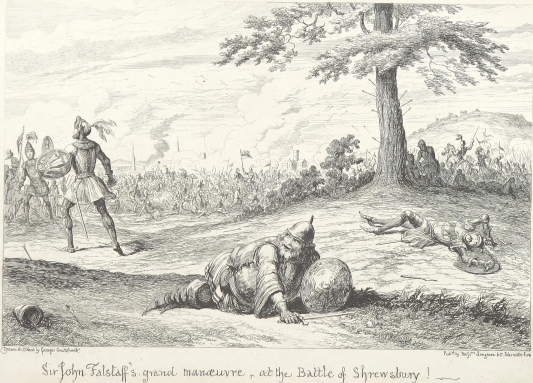
Original Size -- Medium-Size
Let Sir John Falstaff speak for himself on the occasion:—
“Zounds! I am afraid of this gunpowder Percy, though he be dead. How if he should counterfeit too, and rise?”
Quite possible! Sir John knew very little of the defunct Percy’s character. How was he to divine that Hotspur had but been distinguished by the worser part of valour—brute courage? For aught he knew, the young Northumbrian might have been as sensible a man as himself. But let us not interrupt the knight’s soliloquy.
“I am afraid he would prove the better counterfeit. Therefore I’ll make him sure; yea, and swear I killed him. Why may not he rise as well as I? Nothing confutes me but eyes, and nobody sees me.”
(This episode of the civil war may be supposed to have taken place in a sheltered ravine of the plain of Shrewsbury, then intersected by the numerous branches of a stream, the source of which—on the hill of Haughmond—is now dried up.)
“Therefore, sirrah, with a new wound in your thigh, come you along with me.”
Saying these words, Sir John Falstaff inflicted a gash upon the still warm body of Percy, which he proceeded to hoist on his shoulders. Not an easy task, considering our knight’s bulk; but he was born to face and conquer difficulties!
The native impetuosity of the Prince of Wales’s character cannot be better illustrated than by his impatience to procure a witness of some kind or another to his recent achievement. In the absence of a better, he pounced upon his little brother John, Prince of Lancaster, and possibly the most uninteresting character in English history. He dragged that mild prince to the scene of action, which they reached just in time to meet Sir John Falstaff bearing off the mortal remains of the illustrious Percy.
Bewilderment and utter confusion of the distinguished visitors—especially Prince Henry.
“Now then, Hal,” said Prince John (I translate the stilted versification of Shakspeare into familiar prose); “I thought you told me this stout party had gone to that thingamy from which no what-do-you-call-it returns?”
“Ahem! so I did,” replied the elder, stammering and blushing a little.
“I saw the individual in question in a positively door-nail condition, not ten minutes ago; and I can scarcely believe my senses——”
“Mr. Paunch—are you dead?”
No reply.
“Because, if you are, be so kind as to say so—like a man. Seeing is by no means believing in this exceptional case. I should be an ass, indeed, if I were to say I am all ears; but I listen attentively for your own testimony as to whether you are what you appear to be, or not.”
“No, that’s certain,” replied Sir John, throwing down his body (I now quote the chronicler textually). “I am not a double man. There is Percy: if your father will do me any honour, so; if not, let him kill the next Percy himself. I look to be either earl or duke, I can assure you.”
The Prince of Wales scratched his ear, and looked very uncomfortable. The Prince of Lancaster eyed his brother with an unmistakeable expression of opinion that the latter was the greatest humbug in the family—which was saying a good deal.
“Why,—” Prince Henry stammered awkwardly, addressing himself to Sir John Falstaff,—“Percy I killed myself, and saw thee dead.”
Prince John of Lancaster whistled a popular melody in a low key.
Sir John Falstaff lifted up his hands, and exclaimed—
“Didst thou? Lord, Lord, how this world is given to lying! I grant you I was down, and out of breath; and so was he: but we rose both at an instant, and fought a long hour by Shrewsbury clock. If I may be believed, so; if not, let them that should reward valour take the sin upon their own heads. I’ll take it upon my death, I gave him this wound in the thigh: if the man were alive and would deny it, I would make him eat a piece of my sword.”
Prince John of Lancaster continued to whistle, and implied that the story was, to say the least,—singular. It was evident he was inclined to attach more credit to the representations of Sir John Falstaff than to those of his elder brother. You see, they had been, at school together. No man is a hero in the eyes of the valet who takes off his boots when he is not in a condition to remove them himself; or in those of the little brother whom he has fleeced, fagged, and bullied at a public college.
Appearances were certainly against the Prince of Wales, and he was, at any rate, philosopher enough to make the best of the difficulty. For once, the conqueror of Agincourt—Englishman and warrior as he was—knew and confessed himself beaten. He felt that in this particular contest Sir John Falstaff had got decidedly the best of him, and morally yielded his sword with princely grace.
He contented himself with remarking to the Prince of Lancaster, “this is the strangest fellow, brother John.”
And then, addressing Falstaff,
“Come, bring your luggage nobly on your back. For my part, if a lie may do thee grace, I’ll gild it with the happiest terms I have.”
At this juncture a retreat was sounded, proving that the fortune of war had decided in favour of the Royalist faction. The two princes hastened to their father’s tent, Sir John Falstaff following, with the body of Hotspur on his back, soliloquising as follows:
“I’ll follow, as they say, for reward. He that rewards me, Heaven reward him! If I do grow great, I’ll grow less; for I’ll purge, and leave sack, and live cleanly as a nobleman should do.”
The above is the Shakspearian account, and—as I have already stated—in consistency I am bound to adopt it. But what I want to know is this,—why, if the Prince of Wales really killed Hotspur, the paid chroniclers of the period have not reported it? I admit I can come to no definite conclusion upon the subject, and will confine myself to the expression of an opinion that the death of Hotspur is still an open question,—with the supplementary reminder that Sir John Falstaff, being only a private gentleman of limited means, could not hope for the historic recognition of an honour disputed with him by the heir-apparent of England. And—to come to the point at once—I really believe that Sir John Falstaff did kill Hotspur, and that his royal patron bore him a grudge on that account to his dying day. It is the only logical explanation of Henry the Fifth’s notorious ingratitude to his former boon companion, whom it would have been so easy and natural for him to load with honours.
The Earl of Douglas, as we have seen, was punished by being sent back to Scotland. Sir John Falstaff, contrary to his reasonable expectations, was not made either Duke or Earl, in recompense of an achievement for which, whether really performed by him or no, he at least obtained credit in the opinion of many impartial persons. Herein we find not merely an illustration of the proverbial ingratitude of monarchs, but also one, by implication, of the personal jealousy of Prince Henry towards Sir John Falstaff, whom, as the sequel will show, the Prince of Wales treated with the most pointed malignity from the date of the Shrewsbury action to that of the knight’s death.
I will merely remark that Henry Plantagenet—fifth English king of that name—was not a man to do anything without a motive.
What Sir John Falstaff really gained by his glorious victory of Shrewsbury shall be seen in future chapters. It will be found that he was not a loser by the transaction. I will conclude the present chapter by a quotation from our knight’s expressed opinions before entering the field of battle:—
“Honour pricks me on. Yea, but how if honour pricks me off when I “come on? How then? Can honour set to a leg? No. Or an arm? No. “Or take away the grief of a wound? No. Honour hath no skill in surgery “then? No. What is honour? A word. What is that word honour? “Air; a trim reckoning! Who hath it? He that died o’ Wednesday? “Doth he feel it? No. Doth he hear it? No. Is it insensible, then? “Yea, to the dead. But will it not live with the living? No. Why? “Detraction will not suffer it;—therefore, I’ll none of it. Honour is a “mere scutcheon, and so ends my catechism.”
I think the above observations prove that Sir John Falstaff knew rather more about honour than most people of his time, and therefore deserves a prominent position amongst the honourable men of the age he lived in.