Chapter VI
Reading edition
JUDICIAL CAREER
I. HISTORY OF CRIMINAL LAW
The Commission upon the Criminal Code occupied Fitzjames for some time after his appointment to a judgeship. His first appearance in his new capacity was in April 1879 at the Central Criminal Court, where he had held his first brief, and had made his first appearance after returning from India. He had to pass sentence of death upon an atrocious scoundrel convicted of matricide. A few months later he describes what was then a judge's business in chambers. It consists principally, he says, in making a number of small orders, especially in regard to debtors against whom judgment has been given. 'It is rather dismal, and shows one a great deal of the very seamy side of life.... You cannot imagine how small are the matters often dealt with, nor how important they often are to the parties. In this dingy little room, and under the most undignified circumstances, I have continually to make orders which affect all manner of interests, and which it is very hard to set right if I go wrong. It is the very oddest side of one's business. I am not quite sure whether I like it or not. At any rate it is the very antithesis of "pomp and 'umbug."'
Walker & Boutalls Ph. Sc. From a Photograph by Bassano, 1886 London. Published by Smith Elder & Co 15. Waterloo Place.
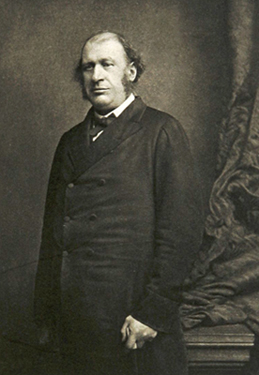
The last phrase alludes to a conversation overheard at the assizes between two workmen. One of them described the judge, the late Lord Chief Justice Cockburn, as a 'cheery swine' who, as he affirmed, had gone to church and preached a sermon an hour and a half long. The sheriff, too, was there in a red coat, and had no doubt got his place by interest. 'Pomp and 'umbug I calls it, and we poor chaps pays for it all.' Fitzjames heartily enjoyed good vernacular embodiments of popular imagination. He admitted that he was not quite insensible to the pleasures of pomp and humbug as represented by javelin men and trumpeters. His work, as my quotation indicates, included some duties that were trivial and some that were repulsive. In spite of all, however, he thoroughly enjoyed his position. He felt that he was discharging an important function, and was conscious of discharging it efficiently. There are few greater pleasures, certainly few were greater to him, than the exercise of a craft which one has so mastered as to have lost all the embarrassment of a beginner. He felt that he was not only up to his duties but had superfluous energy to direct elsewhere. The pleasantest hours of the day were those before and after business hours, when he could devote himself to his literary plans.
In some of his letters to Lord Lytton about the time of his appointment, I find unusual confessions of weariness. He admits that there is a difference between forty and fifty; and thinks he has not quite the old elasticity. I believe, however, that this refers to the worry caused by his work on the Commission, and the daily wrangle over the precise wording of the code, while the judgeship was not yet a certainty. At any rate there is no more mention of such feelings after a time; and in the course of the summer he was once more taking up an important literary scheme which would have tasked the energies of the youngest and strongest. He seems to have contemplated for a time a series of books which should cover almost the whole field of English law and be a modern substitute for Blackstone. The only part of this actually executed—but that part was no trifle—was another book upon the English Criminal Law. It was, in truth, as he ventured to say, 'a remarkable achievement for a busy man to have written at spare moments.' We must, of course, take into account his long previous familiarity with the law. The germ of the book is to be found in the Essay of 1857; and in one way or other, as a writer, a barrister, a codifier, and a judge, he had ever since had the subject in his mind. It involved, however, along with much that was merely recapitulation of familiar topics, a great amount of laborious investigation of new materials. He mentions towards the end of the time that he has been working at it for eight hours a day during his holiday in Ireland. The whole was finished in the autumn of 1882, and it was published in the following spring.
Fitzjames explains in his preface how the book had come to be written. He had, as I have said, laid aside the new edition of the original 'View' in order to compile the 'Digest,' which he had felt to be its necessary complement. I may add that he also wrote with the help of his eldest son—now Sir Herbert Stephen—a 'Digest of the Law of Criminal Procedure,' which was published contemporaneously with the 'History.' The 'Digest' had led to the code and to the Commission. When the Commission was over, he returned to the proposed new edition of the 'View.' But Fitzjames seems to have had an odd incapacity for producing a new edition. We, who call ourselves authors by profession, are sometimes tempted, and we do not always resist the temptation, to describe a book as 'revised and corrected' when, in point of fact, we have added a note or two and struck out half a dozen obvious misprints. When Fitzjames said that his earlier treatise might be described as 'in some sense a first edition' of the later, he meant that he had written an entirely new book upon a different aspect of the old subject. The 'View' is in one volume of about 500 pages, nearly a third of which (153 pages) consists of reports of typical French and English trials. These are reprinted in the 'History.' Of the remainder, over 100 pages are devoted to the Law of Evidence, which is not discussed in the 'History.' Consequently the first 233 pages of the 'View' correspond to the whole of the three volumes of the 'History,' which, omitting the reported trials given in both books, contain 4,440 pages. That is, the book has swelled to six times the original size, and I do not think that a single sentence of the original remains. With what propriety this can be called a 'new edition' I will not try to decide.
The cause of this complete transformation of the book is significant. Fitzjames, in his preface, observes that much has been said of the 'historical method' of late years. It has, he agrees, 'thrown great light upon the laws and institutions of remote antiquity.' Less, however, has been done for modern times; although what is called 'constitutional history' has been 'investigated with admirable skill and profound learning.' As I have noticed, his original adherence to the theories of Bentham and Austin had tended to make him comparatively indifferent to the principles accepted and illustrated by the writings of Maine. He had looked at first with some doubts upon those performances and the brilliant generalisations of 'Ancient Law' and its successors. He quotes somewhere a phrase of his friend Bowen, who had said that he read Maine's works with the profoundest admiration for the genius of the author, but with just a faint suspicion somewhere in the background of his mind that the results might turn out to be all nonsense. Fitzjames had at any rate no prepossessions in favour of the method, and may be said to have been recruited, almost in spite of himself, by the historical school. But it was impossible for anyone to discuss the peculiarities of English Criminal Law without also being plunged into historical investigations. At every point the system is determined by the circumstances of its growth; and you can no more account for its oddities or its merits without considering its history than you can explain the structure of a bat or a seal without going back to previous forms of life. The growth of the criminal law, as Fitzjames remarks, is closely connected with the development of the moral sentiments of the community: with all the great political and social revolutions and with the changes of the ecclesiastical constitution and the religious beliefs of the nation. He was accordingly drawn into writing a history which may be regarded as complementary to the great constitutional histories of Hallam and Dr. Stubbs. He takes for granted many of their results, and frankly acknowledges all his obligations. But he had also to go through many investigations of his own special topics, and produced a history which, if I am not mistaken, is of the highest interest as bringing out certain correlative processes in the legal development of our institutions, which constitutional historians naturally left in the background.
His early work upon the similar book suggested by his father had made him more or less familiar with some of the original sources. He now had to plunge into various legal antiquities, and to study, for example, the six folio volumes called Rotuli Parliamentorum; to delve in year-books and old reports and the crabbed treatises of ancient lawyers, and to consider the precise meaning and effect of perplexed and obsolete statutes. He was not an antiquary by nature, for an antiquary, I take it, is one who loves antiquity for its own sake, and enjoys a minute inquiry almost in proportion to its minuteness. Fitzjames's instinct, on the contrary, was to care for things old or new only so far as they had some distinct bearing upon living problems of importance. I could not venture to pronounce upon the value of his researches; but I am happily able to give the opinion of Professor Maitland, who can speak as one having authority. 'About the excellence of your brother's History of English Criminal Law,' he writes to me, 'there can, I suppose, be but one opinion among those who are competent to speak of such a matter. But I think that he is scarcely likely to get all the credit that is due to him for certain parts of the work which are especially interesting to me, and which I have often read—I mean those parts which deal with the middle ages. They seem to me full of work which is both good and new. I take it that he had no great love for the middle ages, and wrote the chapters of which I am speaking as a disagreeable task. I do not think that he had from nature any great power of transferring himself or his readers into a remote age, or of thinking the thoughts of a time very different from that in which he lived: and yet I am struck every time I take up the book with the thoroughness of his work, and the soundness of his judgments. I would not say the same of some of his predecessors, great lawyers though they were, for in dealing with mediæval affairs they showed a wonderful credulity. To me it seems that he has often gone right when they went wrong, and that his estimate of historical evidence was very much sounder than theirs. The amount of uncongenial, if not repulsive labour that he must have performed when he was studying the old law-books is marvellous. He read many things that had not been used, at all events in an intelligent way, for a very long time past; and—so I think, but it is impertinent in me to say it—he almost always got hold of the true story.'
To write three thick volumes involving such inquiries within three years and a half; and to do the work so well as to deserve this praise from an accomplished legal antiquary, was by itself an achievement which would have contented the ambition of an average author. But when it is remembered that the time devoted to it filled only the interstices of an occupation which satisfies most appetites for work, and in which he laboured with conscientious industry, I think that the performance may deserve Professor Maitland's epithet, 'marvellous.' He was greatly interested in the success of the book, though his experience had not led him to anticipate wide popularity. It was well received by competent judges, but a book upon such a topic, even though not strictly a 'law-book,' can hardly be successful in the circulating-library sense of the word. Fitzjames, indeed, had done his best to make his work intelligible to the educated outsider. He avoided as much as possible all the technicalities which make the ordinary law-book a hopeless bewilderment to the lay reader, and which he regarded on all grounds with natural antipathy. The book can be read, as one outsider at least can testify, with strong and continuous interest; though undoubtedly the reader must be prepared to endure a little strain upon his attention.
There are, indeed, certain drawbacks. In spite of the abundant proofs of industry and knowledge, there are indications that a little more literary polish might have been advantageous. Some of the materials are so crabbed that hardly any skill could have divested them of their natural stiffness. As Professor Maitland's remarks indicate, Fitzjames did not love the old period for its own sake. He liked, as I have noticed, general histories, such as Gibbon's, which give a bird's-eye view of long periods and, in a sense, codify a great mass of knowledge. But he had not the imaginative power of reconstructing ancient states of society with all their picturesque incidents which was first exemplified by Scott. He was always interested in books that reveal human nature, and says in the 'History,' for example, that some of the State Trials are to him 'much more impressive than poetry or fiction.'[176] But the incidents do not present themselves to him, as they did to Scott or to Macaulay, as a series of vivid pictures with all their material surroundings. He shrank, more advisedly, perhaps, from another tendency which has given popularity to a different school. Though he gradually became an admirer of Maine's generalisations, founded upon cautious inquiries and recommended by extraordinary literary skill, his own intellectual aptitudes did not prompt him to become a rival. Briefly, his attitude of mind was in the strictest sense judicial. He asks always for distinct proofs and definite issues. He applies his canons of evidence to every statement that comes up, and, after examining it as carefully as he can, pronounces his conclusions, unequivocally but cautiously. He will not be tempted to a single step beyond the solid ground of verifiable fact. This undoubtedly gives confidence to the tolerably patient reader, who learns to respect the sobriety and impartiality of his guide. But it also fails to convince the hasty reader that he has seen the event precisely as it happened, or that he is in possession of a philosophical key to open all historical problems. I do not wish for a moment to underrate the value of work which has different qualities; but I do think that Fitzjames's merits as a solid inquirer may be overlooked by readers who judge a writer by the brilliance of his pictures and the neatness of his theories.
The book covers a very large field. A brief indication of its general plan will show how many topics are more or less treated. He begins with a short account of the Roman Criminal Law; and then of English law before the Conquest. He next takes up the history of all the criminal courts, including the criminal jurisdiction of the extraordinary courts, such as Parliament and the Privy Council. This is followed by a history of the procedure adopted in the courts, tracing especially the development of trial by jury. The second volume opens a discussion of certain principles applicable to crime in general, such as the theory of responsibility. Next follows a history of the law relating to crime in general. He then takes up the history of the principal classes of crime, considering in separate chapters offences against the state, treason, sedition, and seditious libels; offences against religion, offences against the person (this opens the third volume), especially homicide; offences against property, such as theft and forgery; offences relating to trade and labour and 'miscellaneous offences.' This finishes the history of the law in England, but he adds an account of the extension of the English criminal law to India; and this naturally leads to an exposition of his views upon codification. The exposition is mainly a reproduction of the report of the Commission of 1878-9, which was chiefly his own composition. Finally, the old reports of trials, with a few alterations, are appended by way of pointing the contrast between the English and the French methods, upon which he has already introduced some observations.
Mr. Justice Stephen's book, said Sir F. Pollock in a review of the day, is 'the most extensive and arduous' undertaken by any English lawyer since the days of Blackstone. So large a framework necessarily includes many subjects interesting not only to the lawyer but to the antiquary, the historian, and the moralist; and one effect of bringing them together under a new point of view is to show how different branches of inquiry reciprocally illustrate each other. The historian of the previous generation was content to denounce Scroggs and Jeffreys, or to lament the frequency of capital offences in the eighteenth century, and his moral, especially if he was a Whig, was our superiority to our great-grandfathers. There was plenty of room for virtuous indignation. But less attention was generally paid to the really interesting problems, how our ancestors came to adopt and to be content with these institutions; what precisely the institutions were, and how they were connected with other parts of the social framework. When an advance is made towards the solution of such problems, and when we see how closely they connect themselves with other problems, social, ecclesiastical, and industrial, as well as political, we are making also a step towards an intelligent appreciation of the real meaning of history. It is more than a collection of anecdotes, or even, as Carlyle put it, than the essence of a multitude of biographies; it becomes a study of the growth of an organic structure; and although Fitzjames was reluctant, even to excess, to put forward any claim to be a philosophical historian, a phrase too often applied to a dealer in 'vague generalities,' I think that such work as his was of great service in providing the data for the truly philosophical historian who is always just on the eve of appearing.
I venture to touch upon one or two points with the purpose of suggesting in how many ways the history becomes involved in topics interesting to various classes of readers, from the antiquary to the student of the development of thought. The history of trial by jury had, of course, been already unravelled by previous historians. Fitzjames was able, however, to produce quaint survivals of the old state of things, under which a man's neighbours were assumed to be capable of deciding his guilt or innocence from their own knowledge. There was the Gibbet Law of Halifax, which lasted till the seventeenth century. The jurors might catch a man 'handhabend, backbarend, or confessand,' with stolen goods worth 13½d. in his possession and cut off his head on a primitive guillotine without troubling the judges. Even in 1880 there existed (and I presume there still exists) a certain 'liberty of the Savoy,' under the shadow of the new courts of justice, which can deal with keepers of disorderly houses after the same fashion.[177] From this primitive institution Fitzjames has to grope his way by scanty records to show how, during the middle ages, the jury ceased to be also witnesses and became judges of fact informed by witnesses. Emerging into the period of the Tudors and the early Stuarts, he comes to trials full of historic interest; to the dramatic scenes in which Sir Thomas More, and Throckmorton, and Raleigh played their parts. He has to show how in a period of overpowering excitement, when social organisation was far weaker, and the power of the rulers more dependent upon personal vigour, the Government dealt out sharp and short justice, though juries still had to be cajoled or bullied; how the system was influenced by the growth of the Star Chamber, with a mode of procedure conforming to a different type; and how, when the tyranny of such courts had provoked indignation, they were swept away and left to the jury its still undisputed supremacy. From the time when honest John Lilburne wrangled successfully against Cromwell's judges, it began to assume a special sanctity in popular belief. Then we come to the Popish plots and the brutalities of Scroggs and Jeffreys, when the jury played a leading part, though often perverted by popular or judicial influence, and without any sound theory of evidence. The revolution of 1688 swept away the grosser abuses; the administration of justice became decorous and humane; a spirit of fair play showed itself; the laws of evidence were gradually worked out; and, instead of political tragedies, we have a number of picturesque cases throwing the strangest gleams of light into all manner of odd dark social corners. Within the last century, finally, the mode of investigating crime has become singularly dignified, impartial, and substantially just. A survey of this long history, bringing out at every step picturesque incidents and curious illustrations of social and political constitutions, lights up also the real merits and defects of the existing system. Fitzjames, with much fuller knowledge and longer experience, adheres substantially to his previous opinion. He has not, of course, the old-fashioned worship for the 'palladium of our liberties'; jurors could be 'blind and cruel' under Charles II., and as severe as the severest judge under George III. They are not more likely to do justice than a single judge. But the supreme advantages of placing the judge in his proper position as mediator and adviser, and of taking the public into confidence as to the perfect impartiality of the proceedings, outweigh all objections.
Again we have the curious history of the 'benefit of clergy.' Before 1487, a man who could read and write might commit murder as often as he pleased, subject to an indefinite chance of imprisonment by the 'ordinary.' At a later period, he could still murder at the cost of having M branded on the brawn of his thumb. But women and men who had married two wives or one widow did not enjoy this remarkable privilege. The rule seems as queer and arbitrary as any of the customs which excite our wonder among primitive tribes. The explanation, of course throws a curious light upon the struggle between Church and State in the middle ages; and in the other direction helps to explain the singularities of criminal legislation in the eighteenth century. Our grandfathers seem to have thought that felony and misdemeanour were as much natural classes as mammal and marsupial, and that all that they could do was to remove the benefit of clergy when the corresponding class of crime happened to be specially annoying. They managed to work out the strange system of brutality and laxity and technicality in which the impunity of a good many criminals was set off against excessive severity to others.
The spiritual courts, again, give strange glimpses into the old ecclesiastical system. The records show that from the time of the Conquest to that of the Stuarts a system prevailed which was equivalent to the Spanish Inquisition, except that it did not use torture. It interfered with all manner of moral offences such as that of Eleanor Dalok, a 'communis skandalizatrix,' who 'utinizavit' (supposed to be a perfect of utinam) 'se fuisse in inferno quamdiu Deus erit in cælo, ut potuisset uncis infernalibus vindicare se de quodam Johanne Gybbys mortuo.' The wrath provoked by this and more vexatious interferences makes intelligible the sweeping away of the whole system in 1640. With this is connected the long history of religious persecution, from the time when (1382) the clergy forged an act of Parliament to give the bishops a freer hand with heretics. Strange fragments and shadows of these old systems still remain; and according to Fitzjames it would still in strict law be a penal offence to publish Renan's 'Life of Christ.'[178] The attempt to explain the law as referring to the manner, not the matter, of the attack is, he thinks, sophistical and the law should be simply repealed. A parallel case is that of seditious libels; and there is a very curious history connected with the process by which we have got rid of the simple, old doctrine that all attacks upon our rulers, reasonable or otherwise, were criminal.
These are some of many cases in which Fitzjames has to give a side of history generally left in comparative obscurity. Upon some matters, as, for example, upon the history of impeachments, he thought that he had been able to correct or clear up previous statements. I have only wished to show how many interesting topics come into his plan; and to me, I confess, the most interesting of all is the illustration of the amazing nature of the so-called intellectual process involved. People seem to begin by making the most cumbrous and unreasonable hypotheses possible, and slowly and reluctantly wriggling out of them under actual compulsion. That is not peculiar to lawyers, and may have a meaning even in philosophy.
Fitzjames's comments upon the actual state of the law brings him to many important ethical problems. The discussion of the conditions of legal responsibility is connected with that of moral responsibility. Fitzjames once more insists upon the close connection between morality and law. 'The sentence of the law,' he says, 'is to the moral sentiment of the public what a seal is to hot wax. It converts into a permanent final judgment what might otherwise be a transient sentiment.' The criminal law assumes that 'it is right to hate criminals.' He regards this hatred as a 'healthy natural feeling'; for which he again quotes the authority of Butler and Bentham. The legal mode of expressing resentment directs it to proper applications in the same way as the law of marriage gives the right direction to the passion of love. From his point of view, as I have already indicated, this represents the necessary complement to the purely utilitarian view, which would make deterrence the sole legitimate end of punishment. The other, though generally consistent, end is the gratification of the passion of moral indignation.[179]
Hence arise some difficult questions. Fitzjames insists, in agreement with Bentham, and especially with James Mill, that the criminal law is concerned with 'intentions,' not with 'motives.' All manner of ambiguities result from neglecting this consideration. The question for the lawyer is, did the prisoner mean to kill?—not, what were his motives for killing? The motives may, in a sense, have been good; as, for example, when a persecutor acts from a sincere desire to save souls. But the motive makes no difference to the sufferer. I am burnt equally, whether I am burnt from the best of motives or the worst. A rebel is equally mischievous whether he is at bottom a patriot or an enemy of society. The legislator cannot excuse a man because he was rather misguided than malignant. It is easy to claim good motives for many classes of criminal conduct, and impossible to test the truth of the excuse. We cannot judge motives with certainty. The court can be sure that a man was killed; it can be sure that the killing was not accidental; but it may be impossible to prove that the killer had not really admirable motives.
But if so, what becomes of the morality? The morality of an act is of course affected (if not determined) by the motive.[180] We can secure, no doubt, a general correspondence. Crimes, in nine cases out of ten, are also sins. But crimes clearly imply the most varying degrees of immorality: we may loathe the killer as utterly vile, or be half inclined very much to applaud what he has done. The difficulty is properly met, according to Fitzjames, by leaving a wide discretion in the hands of the judge. The jury says the law has been broken; the judge must consider the more delicate question of the degree of turpitude implied. Yet in some cases, such as that of a patriotic rebel, it is impossible to take this view. It is desirable that a man who attacks the Government should attack it at the risk of his life. Law and morality, therefore, cannot be brought into perfect coincidence, although the moral influence of law is of primary importance, and in the normal state of things no conflict occurs.
There are certain cases in which the difficulty presents itself conspicuously. The most interesting, perhaps, is the case of insanity, which Fitzjames treats in one of the most elaborate chapters of his book. It replaces a comparatively brief and crude discussion in the 'View,' and is conspicuously candid as well as lucid. He read a great many medical treatises upon the subject, and accepts many arguments from an opponent who had denounced English judges and lawyers with irritating bitterness. There is no difficulty when the madman is under an illusion. Our ancestors seem to have called nobody mad so long as he did not suppose himself to be made of glass or to be the Devil. But madness has come to include far more delicate cases. The old lawyers were content to ask whether a prisoner knew what he was doing and whether it was wrong. But we have learnt that a man may be perfectly well aware that he is committing a murder, and know murders to be forbidden in the Ten Commandments, and yet unable to refrain from murder. He has, say the doctors, homicidal monomania, and it is monstrous to call in the hangman when you ought to be sending for the doctor. The lawyer naturally objects to the introduction of this uncertain element, which may be easily turned to account by 'experts' capable of finding symptoms of all kinds of monomania. Fitzjames, however, after an elaborate discussion, decides that the law ought to take account of mental disease which operates by destroying the power of self-control. The jury, he thinks, should be allowed to say either 'guilty,' or 'not guilty on the ground of insanity,' or 'guilty, but his power of self-control was diminished by insanity.'[181] I need not go into further detail, into a question which seems to be curiously irritating to both sides. I am content to observe that in the earlier book Fitzjames had been content with the existing law, and that the change of opinion shows very careful and candid consideration of the question, and, as I think, an advance to more moderate and satisfactory conclusions.
The moral view of the question comes out in other relations. He intimates now and then his dissatisfaction with the modern sentimentalism, his belief in the value of capital and other corporal punishments, and his doubt whether the toleration of which he has traced the growth can represent more than a temporary compromise. But these represent mere obiter dicta which, as he admits, are contrary to popular modes of thought. He is at least equally anxious to secure fair play for the accused. He dwells, for example, upon the hardships inflicted upon prisoners by the English system of abstinence from interrogation. The French plan, indeed, leads to cruelty, and our own has the incidental advantage of stimulating to the search of independent evidence. 'It is much pleasanter,' as an Indian official remarked to him by way of explaining the practice of extorting confessions in India, 'to sit comfortably in the shade rubbing red pepper into a poor devil's eyes than to go about in the sun hunting up evidence.'[182] Fitzjames, however, frequently remarked that poor and ignorant prisoners, unaccustomed to collect their ideas or to understand the bearing of evidence, are placed at a great disadvantage by never having stated their own cases. The proceedings must pass before them 'like a dream which they cannot grasp,' and their counsel, if they have counsel, can only guess at the most obvious line of defence. He gives instances of injustice inflicted in such cases, and suggests that the prisoners should be made competent witnesses before both the magistrates and the judge. This would often enable an innocent man to clear up the case; and would avoid the evils due to the French system.[183]
Without going further into this or other practical suggestions, I will quote his characteristic conclusion. The Criminal Law, he says, may be regarded as an expression of the second table of the Ten Commandments. It follows step by step the exposition of our duty to our neighbours in the Catechism. There was never more urgent necessity for preaching such a sermon than there is at present. There was never so much doubt as to other sanctions. The religious sanction, in particular, has been 'immensely weakened, and people seem to believe that if they do not happen to like morality, there is no reason why they should be moral.' It is, then, 'specially necessary to those who do care for morality to make its one unquestionable indisputable sanction as clear and strong and emphatic as acts and words can make it. A man may disbelieve in God, heaven, and hell; he may care little for mankind, or society, or for the nation to which he belongs—let him at least be plainly told what are the acts which will stamp him with infamy, hold him up to public execration and bring him to the gallows, the gaol, or the lash.'[184] That vigorous summary shows the connection between the 'Liberty, Equality, Fraternity,' the various codifying enterprises, and his writings upon theology and ethics. The remarkable point, if I am not mistaken, is that in spite of the strong feeling indicated by the passage just quoted, the tone of the book is throughout that of sound common sense, impartiality, and love of fair play. It is characteristic that in spite of his prejudice against the commonplaces about progress, he does, in fact, show that the history of criminal law is in many most important respects the history of a steady advance in humanity and justice. Nor, in spite of a reservation or two against 'sentimentalism,' does he fail to show hearty sympathy with the process of improvement.
II. 'NUNCOMAR AND IMPEY'
In the summer (1883) which followed the publication of the 'History,' it began to appear that Fitzjames's health was not quite so vigorous as it had hitherto been. He could not throw off the effects of a trifling accident in June so rapidly as of old; and in the last months of the year his condition caused for a time some anxiety to his wife. Considered by the light of what afterwards happened, these symptoms probably showed that his unremitting labours had inflicted a real though as yet not a severe injury upon his constitution. For the present, however, it was natural to suppose that he was suffering from nothing more than a temporary exhaustion, due, perhaps, to the prolonged wrestle with his great book. Rest, it was believed, would fully restore him. He was, indeed, already at work again upon what turned out to be his last considerable literary undertaking. The old project for a series of law-books probably seemed rather appalling to a man just emerging from his recent labours; and those labours had suggested another point to him. The close connection between our political history and our criminal law had shown that a lawyer's technical knowledge might be useful in historical research. He resolved, therefore, to study some of the great trials 'with a lawyer's eye'; and to give accounts of them which might exhibit the importance of this application of special knowledge.[185] He soon fixed upon the impeachment of Warren Hastings. This not only possessed great legal and historical interest, but was especially connected with his favourite topics. It would enable him to utter some of his thoughts about India, and to discuss some very interesting points as to the application of morality to politics. He found that the materials were voluminous and intricate. Many blue books had been filled by the labours of parliamentary committees upon India; several folio volumes were filled with reports of the impeachment of Hastings, and with official papers connected with the same proceeding. A mass of other materials, including a collection of Sir Elijah Impey's papers in the British Museum, soon presented themselves. Finally, Fitzjames resolved to make an experiment by writing a monograph upon 'Impey's Trial of Nuncomar,' which is an episode in the great Warren Hastings story, compressible within moderate limits. Impey, as Fitzjames remarks incidentally, had certain claims both upon him and upon Macaulay; for he had been a Fellow of Trinity and had made the first attempt at a code in India. If this first book succeeded Fitzjames would take up the larger subject. In the event he never proceeded beyond the preliminary stage. His 'Story of Nuncomar and the Impeachment of Sir Elijah Impey,' published in the spring of 1885, gives the result.
Fitzjames had been familiar from his boyhood with the famous article upon Warren Hastings, in which Macaulay reached the very culminating point of his surpassing literary skill. It is a skill which, whatever else may be said of it, makes his opponents despair. They may disprove his statements; they can hardly hope to displace his versions of fact from their hold upon popular belief. One secret of Macaulay's art is suggested by the account of his delight in 'castle-building.' His vast reading and his portentous memory enabled him to create whole galleries of mental pictures of the past, and his vigorous style embodies his visions with admirable precision and sharpness of outline. But, as those who have followed him in detail became painfully aware, there is more than one deduction to be made from his merits. His imagination undoubtedly worked upon a great mass of knowledge; but the very nature of the imaginative process was to weave all the materials into a picture, and therefore to fill up gaps by conjecture. He often unconsciously makes fancy do the work of logic. 'The real history' (of the famous quarrel between Addison and Steele), says Macaulay, 'we have little doubt, was something like this': and he proceeds to tell a story in minute detail as vividly as if he had been an eye-witness. To him, the clearness of the picture was a sufficient guarantee of its truthfulness. It was only another step to omit the 'doubt' and say simply 'The real history was.' Yet all the time the real history according to the best evidence was entirely different. We can never be certain whether one of Macaulay's brilliant pictures is—as it sometimes certainly is—a fair representation of a vast quantity of evidence or an audacious inference from a few hints and indications. It represents, in either case, the effect upon his mind; but the effect, if lively enough, is taken to prove itself. He will not condescend to the prosaic consideration of evidence, or to inserting the necessary 'ifs' and 'perhapses' which disturb so painfully the impression of a vivid narrative. When his strong party feelings have coloured his beliefs from the first, his beliefs acquire an intensity which enables them not only to dispense with but to override evidence.
I insist upon this because Fitzjames's mental excellencies and defects exactly invert Macaulay's. His imagination did not clothe the evidence with brilliant colours; and, on the other hand, did not convert conjectures into irresistible illusions. The book upon 'Nuncomar and Impey' shows the sound judgment of evidence in regard to a particular fact which Professor Maitland perceives in his treatment of mediæval affairs. It is an exhaustive, passionless, and shrewd inquiry into the facts. He speaks in one of his letters of the pleasure which he has discovered in treating a bit of history 'microscopically'; in getting at the ultimate facts instead of trusting to the superficial summaries of historians. In brief, he is applying to an historical question the methods learnt in the practice of the courts of law. The book is both in form and substance the careful summing up of a judge in a complicated criminal case. The disadvantage, from a literary point of view, is obvious. If we were profoundly interested in a trial for murder, we should also follow with profound interest the summing up of a clear-headed businesslike judge. But, if we did not care two straws whether the man were guilty or innocent, we might find the summing up too long for our patience. That, I fear, may be true in this case. Macaulay's great triumph was to create an interest in matters which, in other hands, were repulsively dry. Fitzjames could not create such an interest; though his account may be deeply interesting to those who are interested antecedently. He observes himself that his 'book will be read by hardly anyone, while Macaulay's paragraph will be read with delighted conviction by several generations.' So long as he is remembered at all, poor Impey will stand in a posthumous pillory as a corrupt judge and a judicial murderer.[186] One reason is, no doubt, that the effect of a pungent paragraph is seldom obliterated by a painstaking exposure of its errors requiring many pages of careful and guarded reasoning. Macaulay's narrative could be superseded in popular esteem only by a writer who should condense a more correct but equally dogmatic statement into language as terse and vivid as his own. Yet Fitzjames's book must be studied by all conscientious historians in future, and will help, it is to be hoped, to spread a knowledge of the fact that Macaulay was not possessed of plenary inspiration.
It will be enough to give one instance of Macaulay's audacity. 'Every schoolboy of fourteen' knows by heart his vivid account of the reign of terror produced by Impey's exercise of the powers of the supreme court, and of the bribe by which Hastings bought him off. A powerful and gloomy picture is drawn in two or three expressive paragraphs. The objection to the story, says Fitzjames, 'is that it is absolutely false from end to end, and in almost every particular.'[187] Fitzjames proceeds not only to assert the absence of evidence, but to show what was the supposed evidence out of which Macaulay's imagination conjured this vision of horror. Fitzjames remarks in a letter that his investigations had given him a very low opinion of the way in which history was written, and certainly, if Macaulay's statement was a fair specimen, the estimate could hardly be too low.
I may admit that, to my mind, the purely judicial method followed by Fitzjames has its disadvantages. It tends to the exclusion of considerations which, though rightly excluded from a criminal inquiry, cannot be neglected by an historian. A jury would be properly directed to acquit Hastings upon the charge of having instigated the prosecution of Nuncomar. Yet, after all, it is very hard to resist the impression that he must have had some share, more or less direct, in producing an event which occurred just at the right moment and had such fortunate results for him. It would be very wrong to hang a man upon such presumptions; but it is impossible to deny that they have a logical bearing upon the facts. However this may be, I think it is undeniable that Fitzjames did good service to history in showing once for all the ruthlessness and extravagance of Macaulay's audacious rhetoric. It is characteristic that while making mincemeat of Macaulay's most famous essay, Fitzjames cannot get rid of his tenderness for the great 'Tom' of his boyish days. Besides praising the literary skill, which indeed, is part of his case, he parts from his opponent with the warm eulogy which I have previously noticed. He regards Macaulay as deluded by James Mill and by the accepted Whig tradition. He condemns Mill, whose dryness and severity have gained him an undeserved reputation for impartiality and accuracy; he speaks—certainly not too strongly—of the malignity of Francis; and he is, I think, a little hard upon Burke, Sheridan, and Elliot, who were misled by really generous feelings (as he fully admits) into the sentimental rhetoric by which he was always irritated. He treats them as he would have put down a barrister trying to introduce totally irrelevant eloquence. Macaulay escapes more easily. Fitzjames felt that the essay when first published was merely intended as a summary of the accepted version, making no pretensions to special research. The morality of this judgment is questionable. Burke, believing sincerely that Hastings was a wicked and corrupt tyrant, inferred logically that he should be punished. Macaulay, accepting Burke's view of the facts, calmly asserts that Hastings was a great criminal, and yet with equal confidence invites his readers to worship the man whose crimes were useful to the British empire. Fitzjames disbelieved in the crimes, and could therefore admire Hastings without reserve as the greatest man of the century. His sympathy with Macaulay's patriotism made him, I think, a little blind to the lax morality with which it was in this case associated. There is yet another point upon which I think that Macaulay deserves a severer sentence. 'It is to be regretted,' says Fitzjames, 'that Macaulay should never have noticed the reply made to the essay by Impey's son.'[188] Unluckily this is not a solitary instance. Macaulay, trusting to his immense popularity, took no notice of replies which were too dull or too complicated to interest the public. Fitzjames would himself have been utterly incapable of behaviour for which it is difficult to discover an appropriate epithet, but which certainly is inconsistent with a sincere and generous love of fair play. If he did not condemn Macaulay more severely, I attribute it to the difficulty which he always felt in believing anything against a friend or one associated with his fondest memories. Had I written the book myself, I should have felt bound to say something unpleasant: but I am hardly sorry that Fitzjames tempered his justice with a little excess of mercy.
The scheme of continuing this book by an account of Warren Hastings was not at once dropped, but its impracticability became obvious before many months had passed. Fitzjames was conducting the Derby assizes in April 1885, when he had a very serious attack of illness. His wife was fortunately with him, and, after consulting a doctor on the spot, he returned to London, where he consulted Sir Andrew Clark. A passage from a letter to Lady Egerton explains his view of what had happened. 'I suppose,' he says (April 29, 1885), 'that Mary has told you the dreadful tale of my getting up in the morning and finding that my right hand had either forgot its cunning or had turned so lazy that I could not write with it, and how I sent for a Derby doctor, and how he ordered me up to London, and how Clark condemned me to three months' idleness and prison diet—I must admit, of a sufficiently liberal kind. Fuller sees the sentence carried out in detail. I have had about three days' experience of it, and I must own that I already feel decidedly better. I think that after the long vacation I shall be thoroughly well again. In the meantime, I feel heartily ashamed of myself. I always did consider any kind of illness or weakness highly immoral, but one must not expect to be either better or stronger than one's neighbours; and I suppose there is some degree of truth in what so many people say on Sundays about their being miserable sinners.' He adds that he is having an exceedingly pleasant time, which would be still more pleasant if he could write with his own hand (the letter is dictated). He has 'whole libraries of books' into which he earnestly desires to look. He feels like a man who has exchanged dusty boots for comfortable slippers; he is reading Spanish 'with enthusiasm'; longing to learn Italian, to improve his German, and even to read up his classics. He compares himself to a traveller in Siberia who, according to one of his favourite anecdotes, loved raspberries and found himself in a desert entirely covered with his favourite fruit.
He took the blow gallantly; perhaps rather too lightly. He was, of course, alarmed at first by the symptoms described. Clark ultimately decided that, while the loss of power showed the presence of certain morbid conditions, a careful system of diet might keep at bay for an indefinite time the danger of the development of a fatal disease. Fitzjames submitted to the medical directions with perhaps a little grumbling. He was not, like his father, an ascetic in matters of food. He had the hearty appetite natural to his vigorous constitution. He was quite as indifferent as his father to what, in the old phrase, used to be called 'the pleasures of the table.' He cared absolutely nothing for the refinements of cookery, and any two vintages were as indistinguishable to him as two tunes—that is, practically identical. He cared only for simple food, and I used, in old days, to argue with him that a contempt for delicacies was as fastidious as a contempt for plain beef and mutton. However that may be, he liked the simplest fare, but he liked plenty of it. To be restricted in that matter was, therefore, a real hardship. He submitted, however, and his health improved decidedly for the time. Perhaps he dismissed too completely the thought of the danger by which he was afterwards threatened. But, in spite of the improvement, he had made a step downwards. He was allowed to go on circuit again in the summer, after his three months' rest, and soon felt himself quite equal to his work. But, from this time, he did not add to his burthens by undertaking any serious labours of supererogation.
III. JUDICIAL CHARACTERISTICS
I will here say what I can of his discharge of the judicial functions which were henceforth almost his sole occupation. In the first place, he enjoyed the work, and felt himself to be in the position most suitable to his powers. Independent observers took, I believe, the same view. I have reported the criticisms made upon his work at the bar, and have tried to show what were the impediments to his success. In many respects these impediments ceased to exist, and even became advantages, when he was raised to the bench. The difficulty which he had felt in adapting himself to other men's views, the contempt for fighting battles by any means except fair arguments upon the substantial merits of the case, were congenial, at least, to high judicial qualities. He despised chicanery of all kinds, and formed independent opinions upon broad grounds instead of being at the mercy of ingenious sophistry. He was free from the foibles of petty vanity upon which a dexterous counsel could play, and had the solid, downright force of mind and character which gives weight to authority of all kinds. I need not labour to prove that masculine common sense is a good judicial quality. Popular opinion, however, is apt to misconstrue broad epithets and to confound vigour with harshness. Fitzjames acquired, among careless observers, a certain reputation for severity. I have not the slightest wish to conceal whatever element of truth there might be in such a statement. But I must begin by remarking a fact which, however obvious, must be explicitly stated. If there was one thing hateful to Fitzjames, and sure to call out his strongest indignation, it was oppression in any form. The bullying from which he suffered at school had left, as I have said, a permanent hatred for bullies. It had not encouraged him, as it encourages the baser natures, to become a bully in his turn, but rather to hate and trample down the evil thing wherever he met it. His theories, as I have said, led him to give a prominent place (too prominent, as I think) to what he called 'coercion.' Coercion in some form was inevitable upon his view; but right coercion meant essentially the suppression of arbitrary violence and the substitution for it of force regulated by justice. Coercion, in the form of law, was identical with the protection of the weak against the strong and the erection of an impregnable barrier against the tyrannous misuse of power. This doctrine exactly expressed his own character, for, as he was strong, he was also one of the most magnanimous of men. He was incapable of being overbearing in social intercourse. He had the fighting instinct to the full. An encounter with a downright enemy was a delight to him. But the joy of battle never deadened his instinct of fair play. He would speak his mind, sometimes even with startling bluntness, but he never tried to silence an opponent by dogmatism or bluster. The keenest argument, therefore, could not betray him into the least discourtesy. He might occasionally frighten a nervous antagonist into reticence and be too apt to confound such reticence with cowardice. But he did not take advantage of his opponent's weakness. He would only give him up as unsuited to play the game in the proper temper. In short, he represented what is surely the normal case of an alliance between manliness and a love of fair play. It is the weaker and more feminine, or effeminate, nature that is generally tempted to resort to an unfair use of weapons.
When, therefore, Fitzjames found himself in a position of authority, he was keenly anxious to use his power fairly. He became decidedly more popular on the bench than he had been at the bar. His desire to be thoroughly fair could not be stronger; but it had a better opportunity of displaying itself. The counsel who practised before him recognised his essential desire to allow them the fullest hearing. He learnt to 'suffer fools' patiently, if not gladly. I apologise, of course, for supposing that any barrister could be properly designated by such a word; but even barristers can occasionally be bores. Some gentlemen, who are certainly neither the one nor the other, have spoken warmly of his behaviour. The late Mr. Montagu Williams, for example, tells with pleasant gratitude how Fitzjames courteously came down from the bench to sit beside him and so enabled him to spare a voice which had been weakened by illness. His comment is that Fitzjames concealed 'the gentleness of a woman' under a stern exterior. So Mr. Henry Dickens tells me of an action for slander in which he was engaged when a young barrister. Both slanderer and slandered were employed in Billingsgate. The counsel for the defence naturally made a joke of sensibility to strong language in that region. Mr. Dickens was in despair when he saw that the judge and jury were being carried away by the humorous view of the case. Knowing the facts, he tried to bring out the serious injury which had been inflicted. Fitzjames followed him closely, became more serious, and summed up in his favour. When a verdict had been returned accordingly, he sent a note to this effect:—'Dear Dickens, I am very grateful to you for preventing me from doing a great act of injustice.' 'He was,' says Mr. Dickens, 'one of the fairest-minded men I ever knew.' His younger son has described to me the kindness with which he encouraged a young barrister—the only one who happened to be present—to undertake the defence of a prisoner, and helped him through a difficult case which ended by an acquittal upon a point of law. 'I only once,' says my nephew, 'heard him interrupt counsel defending a prisoner,' except in correcting statements of fact. The solitary exception was in a case when palpably improper matter was being introduced.
In spite of his patience, he occasionally gave an impression of irritability, for a simple reason. He was thoroughly determined to suppress both unfairness and want of courtesy or disrespect to the court. When a witness or a lawyer, as might sometimes happen, was insolent, he could speak his mind very curtly and sharply. A powerful voice and a countenance which could express stern resentment very forcibly gave a weight to such rebukes, not likely to be forgotten by the offender. He had one quaint fancy, which occasionally strengthened this impression. Witnesses are often exhorted to 'watch his lordship's pen' in order that they may not outrun his speed in taking notes. Now Fitzjames was proud of his power of rapid writing (which, I may remark, did not include a power of writing legibly). He was therefore nervously irritable when a witness received the customary exhortation: 'If you watch my pen,' he said to a witness, 'I will send you to prison': which, as he then had to explain, was not meant seriously. It came to be understood that, in his case, the formula was to be avoided on pain of being considered wantonly offensive.
He rigidly suppressed, at any rate, anything which could lower the dignity of the proceedings. He never indulged in any of those jokes to which reporters append—sometimes rather to the reader's bewilderment—the comment, 'loud laughter.' Nor would he stand any improper exhibitions of feeling in the audience. When a spectator once laughed at a piece of evidence which ought to have caused disgust, he ordered the man to be placed by the side of the prisoner in the dock, and kept him there till the end of the trial. He disliked the promiscuous attendance of ladies at trials, and gave offence on one occasion by speaking of some persons of that sex who were struggling for admission as 'women.' He was, however, a jealous defender of the right of the public to be present under proper conditions; and gave some trouble during a trial of dynamiters, when the court-house had been carefully guarded, by ordering the police to admit people as freely as they could. His sense of humour occasionally made itself evident in spite of his dislike to levity. He liked to perform variations upon the famous sentence, 'God has, in his mercy, given you a strong pair of legs and arms, instead of which you go about the country stealing ducks'; and he would detail absurd or trifling stories with an excess of solemnity which betrayed to the intelligent his perception of their comic side.
Fitzjames thought, and I believe correctly, that he was at his best when trying prisoners, and was also perhaps conscious, with equal reason, I believe, that no one could do it better. His long experience and thorough knowledge of the law of crime and of evidence were great qualifications. His force of character combined with his hatred of mere technicalities, and his broad, vigorous common sense, enabled him to go straight to the point and to keep a firm hand upon the whole management of the case. No rambling or irrelevance was possible under him. His strong physique, and the deep voice which, if not specially harmonious, was audible to the last syllable in every corner of the court, contributed greatly to his impressiveness. He took advantage of his strength to carry out his own ideal of a criminal court as a school of morality. 'It may be truly said,' as he remarks, 'that to hear in their happiest moments the summing up of such judges as Lord Campbell, Lord Chief Justice Erle, or Baron Parke, was like listening not only (to use Hobbes's famous expression) to law living and armed, but to justice itself.'[189] He tried successfully to follow in their steps.
Justice implies fair play to the accused. I have already noticed how strongly he insists upon this in his writings. They show how deeply he had been impressed in his early years at the bar by the piteous spectacle of poor ignorant wretches, bewildered by an unfamiliar scene, unable to collect their thoughts, or understand the nature of the proceedings, and sometimes prevented by the very rules intended for their protection from bringing out what might be a real defence. Many stories have been told me of the extreme care with which he would try to elicit the meaning of some muddled remonstrance from a bewildered prisoner, and sometimes go very near to the verge of what is permitted to a judge by giving hints which virtually amounted to questions, and so helping prisoners to show that they were innocent or had circumstances to allege in mitigation. He always spoke to them in a friendly tone, so as to give them the necessary confidence. A low bully, for example, was accused of combining with two women to rob a man. A conviction seemed certain till the prisoners were asked for their defence; when one of them made a confused and rambling statement. Fitzjames divined the meaning, and after talking to them for twenty minutes, during which he would not directly ask questions, succeeded in making it clear that the prosecutor was lying, and obtained an acquittal. One other incident out of many will be enough. A man accused of stabbing a policeman to avoid arrest, pleaded guilty and was sentenced to seven years' penal servitude. On being removed by the warders he clung to the rail, screaming, 'You can't do it.
You don't know what you are doing!' Fitzjames shouted to the warders to put him back; discovered by patient hearing that the man was meaning to refer to some circumstance in extenuation, and after calling the witnesses found that the statement was confirmed. 'Now, you silly fellow,' he said, 'if you had pleaded "not guilty," as I told you, all this would have come out. It is true that I did not know what I was doing, but it was your own fault.' He then reduced the sentence to nine months, saying, 'Does that satisfy you?' 'Thank you, my Lord,' replied the man, 'that's quite right,' and left the court quite cheerfully. Fitzjames was touched by the man's confidence in a judge, and by his accurate knowledge of the proper legal tariff of punishment. Fitzjames was scrupulously anxious in other ways not to wrest the law, even if unsatisfactory in itself, out of dislike to the immediate offender. One instance is given by the curious case of the Queen v. Ashwell (in 1885). A man had borrowed a shilling from another, who gave him a sovereign by mistake. The borrower discovered the mistake an hour afterwards, and appropriated the sovereign. Morally, no doubt, he was as dishonest as a thief. But the question arose whether he was in strict law guilty of larceny. Fitzjames delivered an elaborate judgment to show that upon the accepted precedents of law, he was not guilty, inasmuch as the original act of taking was innocent.
Another aspect of justice, upon which Fitzjames dwells in his books, was represented in his practice. A judge, according to him, is not simply a logic machine working out intellectual problems, but is the organ of the moral indignation of mankind. When, after a studiously fair inquiry, a man had been proved to be a scoundrel, he became the proper object of wrath and of the punishment by which such wrath is gratified. Fitzjames undeniably hated brutality, and especially mean brutality; he thought that gross cruelty to women and children should be suppressed by the lash, or, if necessary, by the gallows. His sentences, I am told, were not more severe than those of other judges: though mention is made of one case in early days in which he was thought to be too hard upon a ruffian who, on coming out of gaol, had robbed a little child of a sixpence. But his mode of passing sentence showed that his hatred of brutality included hatred of brutes. He did not affect to be reluctant to do his duty. He did not explain that he was acting for the real good of the prisoner, or apologise for being himself an erring mortal. He showed rather the stern satisfaction of a man suppressing a noxious human reptile. Thus, though he carefully avoided anything savouring of the theatrical, the downright simplicity with which he delivered sentence showed the strength of his feeling. He never preached to the convicts, but spoke in plain words of their atrocities. The most impressive sentence I ever heard, says one of his sons, was one upon a wife-murderer at Norwich, when he rigidly confined himself to pointing out the facts and the conclusiveness of the evidence. Another man was convicted at Manchester of an attempt to murder his wife. He had stabbed her several times in the neck, but happened to miss a fatal spot; and he cross-examined her very brutally on the trial. Fitzjames, in delivering sentence, told him that a man who had done the same thing, but with better aim, 'stood at the last assizes where you now stand, before the judge who is now sentencing you. The sentence upon him was that he should be hanged by the neck till he was dead, and he was hanged by the neck till he was dead.' The words emphatically pronounced produced a dead silence, with sobs from the women in court. It was, he proceeded, by a mere accident that the result of the prisoner's crime was different, and that, therefore, the gravest sentence was the only proper sentence; and that is 'that you be kept in penal servitude for the term of your natural life.' This again was spoken with extreme earnestness: and the 'life' sounded like a blow. There was a scream from the women, and the prisoner dropped to the ground as if he had been actually struck. Fitzjames spoke as if he were present at the crime, and uttering the feelings roused by the ferocious treatment of a helpless woman.
Some of his letters record his sense of painful responsibility when the question arose as to reprieving a prisoner. He mentions a case in which he had practically had to decide in favour of carrying out a capital sentence. 'For a week before,' he writes, 'I had the horrible feeling of watching the man sinking, and knowing that I had only to hold out my hand to save his life. I felt as if I could see his face and hear him say, "Let me live; I am only thirty-five; see what a strong, vigorous, active fellow I am, with perhaps fifty years before me: must I die?" and I mentally answered, Yes, you must. I had no real doubts and I feel no remorse; but it was a very horrible feeling—all the worse because when one has a strong theoretical opinion in favour of capital punishment one is naturally afraid of being unduly hard upon a particular wretch to whom it is one's lot to apply the theory.' On another occasion he describes a consultation upon a similar case with Sir W. Harcourt, then Home Secretary. Both of them felt painfully the contrast with their old free conversations, and discussed the matter with the punctilious ceremony corresponding to the painfulness of the occasion. There was something, as they were conscious, incongruous in settling a question of life and death in a talk between two old friends.
I must briefly mention two such cases which happened to excite public attention. On July 27 and 28, 1887, a man named Lipski was tried for a most brutal murder and convicted. His attorney wrote a pamphlet disputing the sufficiency of the evidence.[190] Fitzjames was trying a difficult patent case which took up the next fortnight (August 1 to 13). He saw the attorney on Monday, the 8th, and passed that evening and the next morning in writing his opinion to the Home Secretary (Mr. H. Matthews). On Thursday he had another interview with the attorney and a thorough discussion of the whole matter with Mr. Matthews. Some points had not been properly brought out on the trial; but the inquiry only strengthened the effect of the evidence. Mr. Matthews decided not to interfere, and Fitzjames went to stay with Froude at Salcombe on the Saturday. Meanwhile articles full of gross misstatements had appeared in certain newspapers. Fitzjames himself reflected that his occupation with the patent case had perhaps prevented his giving a full consideration to the case, and that an immediate execution of the sentence would at least have an appearance of undue haste. He therefore telegraphed to suggest a week's respite, though he felt that the action might look like yielding to the bullying of a journalist. Mr. Matthews had independently granted a respite upon a statement that a new piece of evidence could be produced. Fitzjames returned on the Monday, and spent a great part of the week in reading through all the papers, reexamining a witness, and holding consultations with Mr. Matthews. The newspapers were still writing, and 100 members of Parliament signed a request for a commutation of the sentence. After the most careful consideration, however, Fitzjames could entertain no reasonable doubt of the rightness of the verdict, and Mr. Matthews agreed with him. A petition from three jurors was sent in upon Sunday, the 21st, but did not alter the case. Finally, upon the same afternoon, Lipski confessed his guilt and the sentence was executed next day. 'I hope and believe that I have kept the right path,' writes Fitzjames, 'but it has been a most dreadful affair.' 'I hardly ever remember so infamous and horrible a story.' He was proportionally relieved when it was proved that he had acted rightly.
The other case, for obvious reasons, must be mentioned as briefly as possible. On August 7, 1889, Mrs. Maybrick was convicted of the murder of her husband. The sentence was afterwards commuted with Fitzjames's approval, and, I believe, at his suggestion, to penal servitude for life, upon the ground, as publicly stated, that although there was no doubt that she had administered poison, it was possible that her husband had died from other causes. A great deal of feeling was aroused: Fitzjames was bitterly attacked in the press, and received many anonymous letters full of the vilest abuse. Hatred of women generally, and jealousy of the counsel for the defence were among the causes of his infamous conduct suggested by these judicious correspondents. I, of course, have nothing to say upon these points, nor would I say anything which would have any bearing upon the correctness of the verdict. But as attacks were made in public organs upon his behaviour as judge, I think it right to say that they were absolutely without foundation. His letters show that he felt the responsibility deeply; and that he kept his mind open till the last. From other evidence I have not the least doubt that his humanity and impartiality were as conspicuous in this as in other cases, and I believe were not impugned by any competent witnesses, even by those who might doubt the correctness of the verdict.
Fitzjames's powers were such as naturally gave him unsurpassed authority with juries in criminal cases. A distinguished advocate was about to defend a prisoner upon two similar counts before Fitzjames and another eminent judge. The man was really guilty: but, said the counsel, and his prediction was verified, I shall obtain a verdict of 'not guilty' before the other judge, but not before Stephen. In civil cases, I am told that an impartial estimate of his merits would require more qualification. The aversion to technicality and over-subtlety, to which I have so often referred, appears to have limited his powers. He did not enjoy for its own sake the process of finding a clue through a labyrinth of refined distinctions, and would have preferred a short cut to what seemed to him the substantial merits of the case. He might, for example, regard with some impatience the necessity of interpreting the precise meaning of some clause in a legal document which had been signed by the parties concerned as a matter of routine, without their attention being drawn to the ambiguities latent in their agreement. His experience had not made him familiar with the details of commercial business, and he had to acquire the necessary information rather against the grain. To be a really great lawyer in the more technical sense, a man must, I take it, have a mind full of such knowledge, and feel pleasure in exercising the dialectical faculty by which it is applied to new cases. In that direction Fitzjames was probably surpassed by some of his brethren; and he contributed nothing of importance to the elaboration of the more technical parts of the law. I find, however, that his critics are agreed in ascribing to him with remarkable unanimity the virtue of 'open-mindedness.' His trenchant way of laying down his conclusions might give the impression that they corresponded to rooted prejudices. Such prejudices might of course intrude themselves unconsciously into his mind, as they intrude into the minds of most of us. But no one could be more anxious for fair play in argument as in conduct. He would give up a view shown to be erroneous with a readiness which often seemed surprising in so sturdy a combatant. He spared no pains in acquiring whatever was relevant to a case; whether knowledge of unfamiliar facts or of legal niceties and previous judicial decisions. Though his mind was not stored with great masses of cases, he never grudged the labour of a long investigation. He aimed at seeing the case as a whole; and bringing out distinctly the vital issues and their relation to broad principles. He used to put the issues before the jury as distinctly as possible, and was then indifferent to their decision. In a criminal case he would have been inexpressibly shocked by a wrongful conviction, and would have felt that he had failed in his duty if a conviction had not taken place when the evidence was sufficient. In a civil case, he felt that he had done his work when he had secured fair play by a proper presentation of the question to the jury. His mastery of the laws of evidence would give weight to his opinion upon facts; though how far he might be open to the charge of cutting too summarily knots which might have been untied by more dexterity and a loving handling of legal niceties, is a question upon which I cannot venture to speak positively.
I will only venture to refer to two judgments, which may be read with interest even by the unprofessional, as vigorous pieces of argument and lucid summaries of fact. One is the case (1880) of the 'Attorney-General v. the Edison Telephone Company,'[191] in which the question arose whether a telephonic message was a telegram. If so, the Company were infringing the act which gave to the Post Office the monopoly of transmitting telegrams. It was argued that the telephone transmitted the voice itself, not a mere signal. Fitzjames pointed out that it might be possible to hear both the voice transmitted through the air and the sound produced by the vibrations of the wire. Could the two sounds, separated by an interval, be one sound? The legal point becomes almost metaphysical. On this and other grounds Fitzjames decided that a telephone was a kind of telegraph, and the decision has not been disturbed. The other case was that of the Queen v. Price,[192] tried at Cardiff in 1883. William Price, who called himself a Druid, was an old gentleman of singularly picturesque appearance who had burnt the body of his child in conformity, I presume, with what he took to be the rites of the Druids. He was charged with misdemeanour. Fitzjames gave a careful summary of the law relating to burials which includes some curious history. He concluded that there was no positive law against burning bodies, unless the mode of burning produced a nuisance. The general principle, therefore, applied that nothing should be a crime which was not distinctly forbidden by law. The prisoner was acquitted, and the decision has sanctioned the present practice of cremation. Fitzjames, as I gather from letters, was much interested in the quaint old Druid, and was gratified by his escape from the law.
IV. MISCELLANEOUS OCCUPATIONS
I have now described the most important labours which Fitzjames undertook after his appointment to a judgeship. Every minute of the first six years (1879-85) might seem to have been provided with ample occupation. Even during this period, however, he made time for a few short excursions into other matters, and though after 1885 he undertook no heavy task, he was often planning the execution of the old projects, and now and then uttering his opinions through the accustomed channels. He was also carrying on a correspondence, some of which has been kindly shown to me. The correspondence with Lord Lytton continued, though it naturally slackened during Lytton's stay in England, from 1880 to 1887. It revived, though not so full and elaborate as of old, when, in 1887, Lytton became ambassador at Paris. Fitzjames's old friend, Grant Duff, was Governor of Madras from 1881 to 1886, and during that period especially, Fitzjames wrote very fully to Lady Grant Duff, who was also a correspondent both before and afterwards. If I had thought it desirable to publish any number of these or the earlier letters, I might have easily swelled this book to twice or three times its size. That is one good reason for abstaining. Other reasons are suggested by the nature of the letters themselves. They are written with the utmost frankness, generally poured out at full speed in intervals of business or some spare moments of his so-called vacation. They made no pretensions to literary form, and approach much more to discursive conversations than to anything that suggests deliberate composition. Much of them, of course, is concerned with private matters which it would be improper to publish. A large part, again, discusses in an unguarded fashion the same questions of which he had spoken more deliberately in his books. There is no difference in the substance, and I have thought it only fair to him to take his own published version of his opinions, using his letters here and there where they incidentally make his views clearer or qualify sharp phrases used in controversy. I have, however, derived certain impressions from the letters of this period and from the miscellaneous articles of the same time; which I shall endeavour to describe before saying what remains to be said of his own personal history.
One general remark is suggested by a perusal of the letters. Fitzjames says frequently and emphatically that he had had one of the happiest of lives. In the last letter of his which I have seen, written, indeed, when writing had become difficult for him, he says that he is 'as happy as any man can be,' and had nothing to complain of—except, indeed, his illegible handwriting. This is only a repetition of previous statements at every period of his life. When he speaks of the twenty-five years of long struggle, which had enabled him to rise from the bar to the bench, he adds that they were most happy years, and that he only wishes that they could come over again. It is difficult, of course, to compare our lot with that of our neighbours. We can imagine ourselves surrounded by their circumstances, but we cannot so easily adopt their feelings. Fitzjames very possibly made an erroneous estimate of the pains and pleasures which require sensibilities unlike his own; and conversely it must be remembered that he took delight in what would to many men be a weariness of the flesh. The obviously sincere belief, however, in his own happiness proves at least one thing. He was thoroughly contented with his own position. He was never brooding over vexations, or dreaming of what might have been. Could he have been asked by Providence at any time, Where shall I place you? his answer would almost always have been, Here. He gives, indeed, admirable reasons for being satisfied. He had superabundant health and strength, he scarcely knew what it was to be tired, though he seemed always to be courting fatigue, or, if tired, he was only tired enough to enjoy the speedy reaction. His affections had a strength fully proportioned to his vigour of mind and body; his domestic happiness was perfect; and he had a small circle of friends both appreciative and most warmly appreciated. Finally, if the outside world was far from being all that he could wish, it was at least superabundantly full of interest. Though indifferent to many matters which occupy men of different temperament, he had quite enough not only to keep his mind actively engaged, but to suggest indefinite horizons of future inquiry of intense interest. He was in no danger of being bored or suffering from a famine of work. Under such conditions, he could not help being happy.
Yet Fitzjames's most decided convictions would have suited a thorough-going pessimist. Neither Swift nor Carlyle could have gone much beyond him in condemning the actual state of the political or religious condition of the world. Things, on the whole, were in many directions going from bad to worse. The optimist is apt to regard these views as wicked, and I do not know whether it will be considered as an aggravation or an extenuation of his offence that, holding such opinions, Fitzjames could be steadily cheerful. I simply state the fact. His freedom from the constitutional infirmities which embittered both the great men I have mentioned, and his incomparably happier domestic circumstances, partly account for the difference. But, moreover, it was an essential part of his character to despise all whining. There was no variety of person with whom he had less sympathy than the pessimist whose lamentations suggest a disordered liver. He would have fully accepted the doctrine upon which Mr. Herbert Spencer has insisted, that it is a duty to be happy. Moreover, the way to be happy was to work. Work, I might almost say, was his religion. 'Be strong and of a good courage' was the ultimate moral which he drew from doubts and difficulties. Everything round you may be in a hideous mess and jumble. That cannot be helped: take hold of your tools manfully; set to work upon the job that lies next to your hand, and so long as you are working well and vigorously, you will not be troubled with the vapours. Be content with being yourself, and leave the results to fate. Sometimes with his odd facility for turning outwards the ugliest side of his opinions, he would call this selfishness. It is a kind of selfishness which, if everyone practised it, would not be such a bad thing.
I must mention, though briefly, certain writings which represent his views upon religious matters: I have sufficiently indicated his position, which was never materially changed. His thoughts ran in the old grooves, though perhaps with a rather clearer perception of their direction. In June 1884 he published an article upon the 'Unknown and the Unknowable' in the 'Nineteenth Century,' declaring that Mr. Herbert Spencer's 'Unknowable' and Mr. Harrison's 'Humanity' were mere shadowy figments. 'Religion,' he maintains, will not survive theology. To this, however, he adds, with rather surprising calmness, that morality will survive religion. If the Agnostics and Positivists triumph, it will be transformed, not abolished. The Christian admiration for self-sacrifice, indeed, and the Christian mysticism will disappear, and it will turn out that the respectable man of the world and the lukewarm believer were after all in the right. Considering his own dislike to the mystic and the priestly view of things, this might almost seem to imply a reconciliation with the sceptics. He observes, indeed, in a letter that there is really little difference between himself and Mr. Harrison, except in Mr. Harrison's more enthusiastic view of human nature. But he confesses also that the article has given pleasure to his enemies and pain to his friends. Though his opinions, in short, are sceptical, the consequences seem to him so disagreeable that he has no desire to insist upon them. In fact, he wrote little more upon these topics. He was, indeed, afterwards roused to utterance by an ingenious attempt of Mr. Mivart to show a coincidence between full submission to the authority of the Catholic Church and an equal acceptance of the authority of reason. In a couple of articles in the 'Nineteenth Century' (October 1887 and January 1888), he argued with his old vigour that Mr. Mivart was in fact proposing to put a match in a powder barrel and expect half to explode and the other half to remain unaffected. This was his last encounter upon the old question of authority. In the same year (April and May 1888) he wrote two articles upon a book by which he was singularly interested, Professor Max Müller's 'Science of Thought'; he expounds Professor Max Müller's philology in the tone of an ardent disciple, but makes his own application to philosophy. I do not suppose that the teacher would accept all the deductions of his follower. Fitzjames, in fact, found in the 'Science of Thought' a scientific exposition of the nominalism which he had more or less consciously accepted from Hobbes or Horne Tooke. Max Müller, he says, in a letter, has been knocking out the bottom of all speculative theology and philosophy. Thought and language, as he understands his teacher to maintain, are identical. Now language is made up of about 120 roots combined in various ways. The words supposed to express more abstract conceptions, some of them highly important in theology, are mere metaphors founded upon previous metaphors, twisted and changed in meaning from century to century. Nothing remains but an almost absolute scepticism, for on such terms no certainty can be obtained. In a letter he states that the only problems which we can really solve are those of space and number; that even astronomy involves assumptions to which there are 'unanswerable objections'; that what is loosely called science, Darwinism, for example, is 'dubious in the extreme'; that theology and politics are so conjectural as to be practically worthless; and judicial and historical evidence little more than a makeshift. In short, his doctrine is 'scepticism directed more particularly against modern science and philosophy.' I do not take these hasty utterances as expressing a settled state of opinion. I only quote them as vehement expressions of an instinctive tendency. His strong conviction of the fallacies and immoralities of the old theological dogmatism was combined with an equally strong conviction of the necessity of some embodiment of the religious instincts and of the impotence of the scientific dogmatism to supply it. He therefore was led to a peculiar version of the not uncommon device of meeting the sceptic by a more thorough-going scepticism. It is peculiar because he scorned to take the further step of accepting a dogmatic belief on sceptical grounds; but it certainly left him in a position of which silence was, if I may say so, the only obvious expression of his feeling.
One curious illustration of his feelings is given by an utterance at the beginning of this period. Nobody had less tendency to indulge in versification. When a man has anything to say, he observes to Lord Lytton on one occasion, as an excuse for not criticising his friend adequately, 'I am always tempted to ask why he cannot say it in plain prose.' I find now that he once wrote some lines on circuit, putting a judgment into rhyme, and that they were read with applause at a dinner before the judges. They have disappeared; but I can quote part of his only other attempt at poetry. Tennyson's poem called 'Despair' had just appeared in the 'Nineteenth Century' for November 1881. The hero, it will be remembered, maddened by sermons about hell and by 'know-nothing' literature, throws himself into the sea with his wife and is saved by his preacher. The rescuer only receives curses instead of thanks. Fitzjames supplies the preacher's retort.[193] I give a part; omitting a few lines which, I think, verged too much on the personal:—
So you're minded to curse me, are you, for not having let you be, And for taking the trouble to pull you out when your wife was drowned in the sea? I'm inclined to think you are right—there was not much sense in it; But there was no time to think—the thing was done in a minute. You had not gone very far in; you had fainted where you were found, You're the sort of fellow that likes to drown with his toe on the ground. However, you turn upon me and my creed with all sorts of abuse, As if any preaching of mine could possibly be of use To a man who refused to see what sort of a world he had got To live in and make the best of, whether he liked it or not. I am not sure what you mean; you seem to mean to say That believing in hell you were happy, but that one unfortunate day You found out you knew nothing about it, whereby the troubles of life Became at once too heavy to bear for yourself and your wife. That sounds silly; so, perhaps, you may mean that all is wrong all round, My creed and the know-nothing books, and that truth is not to be found— That's sillier still: for, if so, the know-nothing books are right, And you're a mere spiritless cur who can neither run nor fight, Too great a coward to live and too great a coward to die, Fit for nothing at all but just to sit down and cry. . . . . . . . . . Why, man, we're all in one boat, as everyone can see, Bishops, and priests, and deacons, and poor little ranters like me. There's hell in the Church of England and hell in the Church of Rome, And in all other Christian Churches, abroad as well as at home. The part of my creed you dislike may be too stern for you, Many brave men believe it—aye, and enjoy life, too. The know-nothing books may alarm you; but many a better man Knows he knows nothing and says so, and lives the best life he can. If there is a future state, face its hopes and terrors gravely; The best path to it must be to bear life's burthens bravely. And even if there be none, why should you not live like a man, Enjoying whatever you have as much and as long as you can? In the world in which we are living there's plenty to do and to know; And there's always something to hope for till it's time for us to go. 'Despair' is the vilest of words, unfit to be said or thought, Whether there is a God and a future state or not. If you really are such a wretch, that you're quite unfit to live, And ask my advice, I'll give you the best that I have to give: Drown yourself by all means; I was wrong and you were right. I'll not pull you out any more; but be sure you drown yourself quite.
'Despair is the vilest of words.' That expresses Fitzjames's whole belief and character. Faiths may be shaken and dogmas fade into meaningless jumbles of words: science may be unable to supply any firm ground for conduct. Still we can quit ourselves like men. From doubt and darkness he can still draw the practical conclusion, 'Be strong and of a good courage.' And, therefore, Fitzjames could not be a pessimist in the proper sense; for the true pessimist is one who despairs of the universe. Such a man can only preach resignation to inevitable evil, and his best hope is extinction. Sir Alfred Lyall's fine poem describes the Hindoo ascetic sitting by the bank of the sacred stream and watching the legions as they pass while cannon roar and bayonets gleam. To him they are disturbing phantoms, and he longs for the time when they will flicker away like the smoke of the guns on the windswept hill. He meanwhile sits 'musing and fasting and hoping to die.' Fitzjames is the precise antithesis: his heart was with the trampling legions, and for the ascetic he might feel pity, but certainly neither sympathy nor respect. He goes out of his way more than once to declare that he sees nothing sublime in Buddhism. 'Nirvana,' he says in a letter, 'always appeared to me to be at bottom a cowardly ideal. For my part I like far better the Carlyle or Calvinist notion of the world as a mysterious hall of doom, in which one must do one's fated part to the uttermost, acting and hoping for the best and trusting' that somehow or other our admiration of the 'noblest human qualities' will be justified. He had thus an instinctive dislike not only for Buddhism, but for the strain of similar sentiment in ascetic versions of Christianity. He had a great respect for Mohammedanism, and remarks that of all religious ceremonies at which he had been present, those which had most impressed him had been a great Mohammedan feast in India and the service in a simple Scottish kirk. There, as I interpret him, worshippers seem to be in the immediate presence of the awful and invisible Power which rules the universe; and without condescending to blind themselves by delusive symbols and images and incense and priestly magic, stand face to face with the inscrutable mystery. The old Puritanism comes out in a new form. The Calvinist creed, he says in 'Liberty, Equality, Fraternity,' was the 'grain on which the bravest, hardiest, and most vigorous race of men that ever trod the earth were nourished.' That creed, stripped of its scholastic formulas, was sufficient nourishment for him. He sympathises with it wherever he meets it. He is fond of quoting even a rough blackguard, one Azy Smith, who, on being summoned to surrender to a policeman, replied by sentencing 'Give up' to a fate which may be left to the imagination. Fitzjames applied the sentiment to the British Empire in India. He was curiously impressed, too, by some verses which he found in an Australian newspaper and was afterwards given to quoting. They turned out to be written by Adam Lindsay Gordon (the 'Sick Stockrider').
I have had my share of pastime, and I've done my share of toil, And life is short—the longest life a span. I care not now to tarry for the corn or for the oil, Or for the wine that maketh glad the heart of man; For good undone and time misspent and resolutions vain 'Tis somewhat late to trouble—this I know; I would live the same life over if I had to live again And the chances are I go where most men go.
I am perfectly well aware of the comments which that statement may suggest. The orthodox may, if they please, draw a moral for their own tastes; and I could draw a moral which is not quite orthodox. I only say that I have tried to describe his final position in the matter, without reserve; and that, in my opinion, whatever else it shows, it reveals both the sincerity and the manliness of a man who dared to look facts in the face.