Front matter
Reading edition
Every attempt has been made to replicate the original as printed. Some typographical errors have been corrected; a list follows the text. Contents. List of Rossini’s works with the date of their production in public. (etext transcriber's note)
Engraved by J. Brown, from a Sketch taken at Naples, 1820.
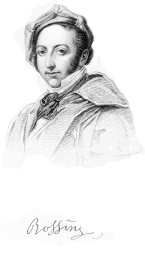
THE LIFE OF ROSSINI.
BY H. SUTHERLAND EDWARDS. IN ONE VOLUME. LONDON: HURST AND BLACKETT, PUBLISHERS, 13, GREAT MARLBOROUGH STREET. 1869. The Right of Translation is Reserved.
LONDON: BRADBURY, EVANS, AND CO., PRINTERS, WHITEFRIARS.
CONTENTS.
INTRODUCTION.
PAGE
Rossini’s Influence, and Success1
PART I. ROSSINI AND HIS EARLY WORKS.
CHAPTER I. ROSSINI’S YOUTH.
Pedigree and Arms—Rossini’s First Work—Rondo Finale—Five Operas in one Year—Rossini and the Conscription—“Un Curioso Accidente”—The Mombelli Family—An Operatic Burlesque9
CHAPTER II. ITALIAN OPERA UNTIL “TANCREDI.”
Rossini’s Innovations—Rossini and an old Habitué—The Opera at Naples—Scarlatti and his School27
CHAPTER III. FOUR HISTORICAL OPERAS.
Pergolese and Gluck—Cimarosa and Paisiello37
CHAPTER IV. MOZART AND ROSSINI.
Mozart in Germany; and Abroad43
CHAPTER V. ROSSINI’S REFORMS IN SERIOUS OPERA.
The Basso Cantante—Overture to “Tancredi”—Rossini’s Crescendo—“Di tanti palpiti”48
CHAPTER VI. ROSSINI’S REFORMS IN COMIC OPERA.
“L’Italiana in Algeri”—Anecdote of a Duet—Liveliness and Laziness57
CHAPTER VII. ROSSINI’S REFORMS IN WRITING FOR THE VOICE.
“Aureliano in Palmira”—The Sopranists—Porpora and Caffarelli—Rossini and Velluti—Vocal Embroidery—Singers and Composers—Change of System—A Royal Singing-master64
CHAPTER VIII. FROM MILAN TO NAPLES.
“Il Turco in Italia”—A Fiasco—The Opera at Rome—The Opera at Turin—Operatic Subventions—The Two-Act Division—Baldness of Rossini’s Managers81
PART II. ROSSINI AT NAPLES.
CHAPTER I. ROSSINI, BARBAJA, AND MDLLE. COLBRAN.
The Illustrious Barbaja—Mademoiselle Colbran—A Patriotic Hymn99
CHAPTER II. “ELISABETTA”: ROSSINI’S DEBUT AT NAPLES.
“Elisabetta”—Accompaniment of Recitative109
CHAPTER III. ROSSINI VISITS ROME—“TORVALDO E DORLISKA.”
Rossini’s Barber114
CHAPTER IV. BEAUMARCHAIS, PAISIELLO, AND ROSSINI.
“Le Barbiere de Seville”—Beaumarchais’ Preface—La Calunnia—Paisiello’s “Barbiere”117
CHAPTER V. “THE BARBER OF SEVILLE.”
Contract for the “Barber”—Rossini and the Music-Publishers—Getting to work—The Composer and the Librettist—Hard work—Preface to the “Barber”127
CHAPTER VI. “THE BARBER OF SEVILLE”—FIRST REPRESENTATION.
The Two Overtures—Madame Giorgi Righetti—Almaviva’s Air—Trio of the Music-Lesson—Transpositions141
CHAPTER VII. “OTELLO”: FURTHER REFORMS IN OPERA SERIA.
Cast of “Otello”—Davide—Progress of Instrumentation—The Clarinet—Brass Instruments—A Solo on the Kettledrum152
CHAPTER VIII. ROSSINI’S REPRODUCTIONS FROM HIMSELF.
Religious and Secular Music—Borrowed Pieces—Parts in “Il Barbiere”—“La Cenerentola” and “Il Barbiere”165
CHAPTER IX. “LA GAZZA LADRA”: THE CONTRALTO VOICE.
The Magpie and the Trowel—Beethoven and Paer—Contralto parts—Overture to “La Gazza Ladra”—A Drum-hater—Operatic prayers174
CHAPTER X. “ARMIDA,” “ADELAIDA,” AND “ADINA.”
“Adina,” an Opera for Lisbon187
CHAPTER XI. “MOSÈ IN EGITTO”: REFORMS IN OPERA SERIA.
Emancipation of the Serious Basso—Musical Fevers—Crossing the Red Sea—The Preghiera190
CHAPTER XII. THREE UNFAMILIAR WORKS.
“Ermione”—Memory of a Neapolitan Merchant—New Music and Old200
CHAPTER XIII. SACRED AND SECULAR SUBJECTS.
An Operatic Mass—Secular and Religious Music206
CHAPTER XIV. “LA DONNA DEL LAGO.”
Operatic Subjects—Classical and Mythological Opera—Victor Hugo on the Libretto—New Combination—“Robert Bruce.”210
CHAPTER XV. END OF ROSSINI’S ITALIAN CAREER.
Departure from Naples—“Matilda di Sabran”—Rossini’s Marriage—Carpani and “Zelmira”—Madame Rossini—“Semiramide”—Farewell to the Italian Stage222
PART III. ROSSINI’S FRENCH CAREER.
CHAPTER I. A VISIT TO LONDON—ROSSINI AND GEORGE IV.
A Successful Manager—Rossini’s English Adapters—His Popularity in London—Rossini and George IV.—Concert at Almack’s—Rossini on his stay in England—Art in London Drawing-rooms239
CHAPTER II. ROSSINI’S OPERA FOR THE KING’S THEATRE.
Operatic Management in England—The Missing Act254
CHAPTER III. ROSSINI IN PARIS.
Musical Feuds in Paris—Rossini in a Vaudeville—Berton and Paer—Boieldieu and the French Rossinists—Auber and Rossini’s Music—“Art is lost”261
CHAPTER IV. ROSSINI AND HIS CRITICS.
“Signor Crescendo”—Paisiello’s “Barbiere”—Curious instance of Antipathy275
CHAPTER V. ROSSINI AT THE ITALIAN OPERA OF PARIS.
Rossini and Paer—“Il Viaggio a Reims”—“Andiamo a Parigi”—Rossini and Bellini282
CHAPTER VI. ROSSINI AT THE ACADEMIE.
Rossini on “Ermione”—Italian Artists at the French Opera—“Le Siège de Corinthe”—Rossini’s Profits as a Composer—“Moïse”—M. Scribe as a Librettist—The Royal Italian Opera291
CHAPTER VII. “GUILLAUME TELL.”
The Libretto—Beauty of the Music—Avoidance of the “Cavatina”—Dramatic Effects peculiar to Operas307
CHAPTER VIII. ROSSINI AFTER “WILLIAM TELL.”
Windmills and Wind—Industry and Idleness—Rossini’s “Faust”—After “Guillaume Tell”—Rossini and M. Guizot319
CHAPTER IX. THE “STABAT MATER.”
Rossini and Mendelssohn—Religious and Secular Styles—Heine on the “Stabat Mater”—Rossini’s Mass—Three Masterpieces332