Volume 2 — CHAPTER XX. (continued 2)
Reading edition
Even now, the intention to go to Tetuan, advisable as the step was, was contingent upon the opportunity offering of reaching a position whence he could move with facility. Nelson did not mean to be back-strapped again within the Mediterranean, with a west wind, and a current setting to leeward, if the enemy turned up in the Atlantic. "If the wind is westerly," he wrote on the early morning of the 22d, "I shall go to Tetuan: if easterly, out of the straits." At half-past nine that day the fleet weighed, and at half-past seven in the evening anchored at Tetuan, whither orders had already gone to prepare bullocks and fresh vegetables for delivery. At noon of the 23d the ships again lifted their anchors, and started. "The fleet is complete," he wrote the First Lord that day, "and the first easterly wind, I shall pass the Straits." Fortune apparently had made up her mind now to balk him no more. Thirty-six hours later, at 3.30 A.M. of July 25th, being then off Tarifa, a little west of Gibraltar, the sloop-of-war "Termagant," one of his own Mediterranean cruisers, came alongside, and brought him a newspaper, received from Lisbon, containing an account of the report carried to England by the "Curieux." "I know it's true," he wrote to the Admiralty, "from my words being repeated, therefore I shall not lose a moment, after I have communicated with Admiral Collingwood, in getting to the northward to either Ferrol, Ireland, or Ushant; as information or circumstances may point out to be proper." In his haste to proceed, and wishing to summon the "Amazon" frigate to rejoin him, he sent the "Termagant" at once to Gibraltar, without understanding that she was just from there and had on board his clothes left for washing; in consequence of which precipitancy she "carried all my things, even to my last shirt, back again." "As I fancied he came from Lisbon," he explained, "I would not allow him to stop." "My dear Parker," he wrote the frigate-captain, "make haste and join me. If all places fail you will find me at Spithead." Parker, who was a favorite of the admiral's, followed out the careful detailed instructions which accompanied this note, but could not overtake the fleet, and from incidents of the service never met Nelson again.
With a fresh easterly gale the squadron pressed again into the Atlantic. As it went on for Cape St. Vincent, Collingwood's division was seen some distance to leeward, but, as not infrequently happens in and near the Mediterranean, the wind with it came from the opposite quarter to that which Nelson had. The latter, therefore, would not stop, nor lose a mile of the ground over which his fair breeze was carrying him. "My dear Collingwood," he wrote, "We are in a fresh Levanter. You have a westerly wind, therefore I must forego the pleasure of taking you by the hand until October next, when, if I am well enough, I shall (if the Admiralty please) resume the command. I am very far from well; but I am anxious that not a moment of the services of this fleet should be lost." Matters therefore were left standing much as they were when he passed in a week before. He had taken upon himself, however, with a discretion he could now assume freely, to change the Admiralty's orders, issued during his absence, withdrawing most of the small cruisers from about Malta, to reinforce Collingwood's division. When he first learned of this step, he said it was a mistake, for double the number he had left there were needed; "but the orders of the Admiralty must be obeyed. I only hope officers will not be blamed for the events which it is not difficult to foresee will happen." With the crowd of enemy's privateers in those waters, Malta, he was assured, would be cut off from all communication. He soon made up his mind that he would use his own discretion and modify the dispositions taken. "Malta cannot more than exist, and our troops would be placed in a position of great distress," he told the Admiralty. "I transmit a statement of the force I think necessary to the eastward of Carthagena for performing the services intrusted to my care, and when I get the lists I shall apportion them as far as their number will allow, and my judgment will admit." "I hope the Board will consider this as not wishing to alter any arrangement of theirs, but as a measure absolutely necessary." Within his own field Nelson was now, by proved professional genius, above the restraint of Boards; and when he reached England the new First Lord had the wisdom to admit it, in this supreme crisis, by giving him full control, within the resources of the country, over the constitution of the fleet with which he fought Trafalgar.
Map of the North Atlantic Full-resolution image
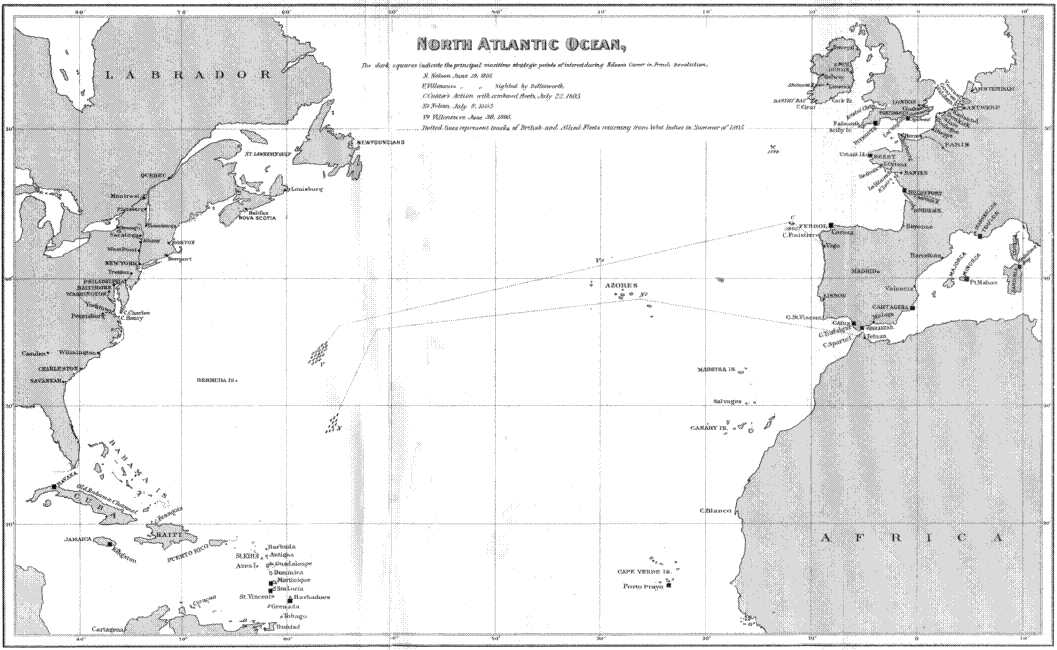
Letters left for Bickerton and Collingwood placed them in possession of his ideas, including the revocation of the Admiralty's order; and, in an official letter, he earnestly recommended the latter officer to adhere to his arrangements. Word was also sent forward to Cornwallis, and to the commander-in-chief at Cork, as well as to the Admiralty, to notify them of his approach. To the northward of Cape St. Vincent he met the northerly winds that prevail on the Portuguese coast. Delayed by these, he was three full weeks making the passage from Gibraltar to the Channel Fleet, which he joined at 3 P.M. of August 15th, twenty-five miles west of Ushant. To this point his movements were finally determined by a frigate, which was spoken on the 12th of August, and informed him that up to three days before no intelligence had been received of the enemy's arrival in the Bay of Biscay, or on the Irish coast. Cornwallis excused him from the customary personal visit, and authorized him to proceed at once to Portsmouth with the "Victory," in pursuance of the Admiralty's leave which he so long had had in his hands. On the morning of August 18th, the long and fruitless chase of the allied fleet was brought to an end by the dropping of the "Victory's" anchor at Spithead. To Davison Nelson summed up his disappointment in the exasperated expression, "—n General Brereton."[109]
From newspapers received off Ushant he first learned of Calder's battle, and the public dissatisfaction with the results. He had undergone too much frustration and anxiety himself not to feel for an officer who had made a mistake, although it may safely be said that Calder's mistake was not only one Nelson could not have made, but was the exact opposite of the course which Nelson by anticipation had said he would adopt. He expressed himself in words of generous sympathy. "I was bewildered by the account of Sir Robert Calder's victory, and the joy of the event; together with the hearing that John Bull was not content, which I am sorry for. Who can, my dear Freemantle, command all the success which our Country may wish? We have fought together, and therefore well know what it is. I have had the best disposed fleet of friends, but who can say what will be the event of a battle? and it most sincerely grieves me, that in any of the papers it should be insinuated, that Lord Nelson could have done better. I should have fought the enemy, so did my friend Calder; but who can say that he will be more successful than another? I only wish to stand upon my own merits, and not by comparison, one way or the other, upon the conduct of a brother officer. You will forgive this dissertation, but I feel upon the occasion." These words, which spoke the whole of his honest heart, were the more generous, because he believed Calder to be one of the few professional enemies that he had.
From the place where Villeneuve was met, Nelson reasoned, again, that the primary intention of the allies, returning from the West Indies, had been to enter the Straits. "By all accounts I am satisfied their original destination was the Mediterranean, but they heard frequently of our track." This persistence in his first view was partly due to the confidence with which he held to his own convictions,—the defect of a strong quality,—partly, doubtless, to the fact that Villeneuve had blundered in his homeward course, and fetched unnecessarily to leeward of his port, with reference to winds perfectly understood by seamen of that day. In fact he had no business to be where he brought up, except on the supposition that he was making for the Straits.
FOOTNOTES:
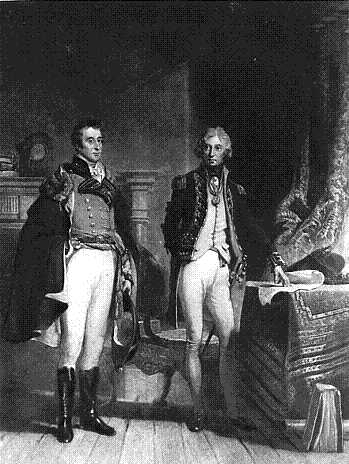
Meeting of Nelson and Wellington