Chapter IV
Reading edition
Napoleon and Alexander at Tilsit.[8]
The Floating Pavilion — Emperor, Czar, and King — The Two Principals — Their Relation to Frederick William — A Diplomatic Novelty — Napoleon's Motives — Great Britain and the World's Commerce — The Orders in Council — Napoleon's Decrees — Russia as an Ally — The Ministers and the Negotiations — Imperial Amusements — The Fate of Turkey — The Two Friends — Work after Play.
The Czar's conscience smote him in regard to his desertion of Prussia, but with no great effort he obtained material concessions for her from his new ally. The same afternoon an armistice was arranged with Frederick William, by the terms of which he temporarily kept his strong places in Silesia and Pomerania; but his propositions for an alliance were incontinently rejected. Next day there was another meeting on the same raft, but this was tripartite, for the King of Prussia was present. Napoleon was blunt and imperious, reproaching Frederick William with the duplicity of his policy, vindictively (the descriptive word he used himself), and with emphasis, demanding Hardenberg's dismissal. At parting he invited Alexander to dinner, but ostentatiously omitted to include Frederick William in the request. It was agreed that to expedite the final negotiations the three monarchs should remain on the ground; one half the town of Tilsit was neutralized and divided into three portions, each of the three parties to take up his residence in one. This closed the preliminaries, and the two emperors returned with mutual satisfaction to the respective sides of the river from which they had come. The sensations of Frederick William, who accompanied Alexander, must have been those of a soldier on the field under a capital operation in surgery. That very afternoon the Czar removed to the quarter of Tilsit appropriated to him. The King of Prussia took lodgings in the house of a miller, but spent only a part of each day in them, preferring the melancholy solitude of the neighboring hamlet of Piktupönen, where he and Hardenberg had last alighted.
Alexander was now thirty years of age, sanguine, ambitious, impressionable, and mature in proportion to his years. His features were well formed on Slavic lines, his look was sympathetic, and his form elegant. The many graces of his mind and person were natural. "My friend," wrote Napoleon to Josephine on the twenty-fifth, "I have just met the Emperor Alexander. I have been much pleased with him; he is a very handsome, good young emperor; he has more intelligence than is generally thought." Napoleon himself was only eight years older, but his mind was more penetrating and adroit by a whole generation. The classic cast in his features, which only a few years before made sculptors mold him like the statue of the young Augustus, had nearly disappeared. A complete transformation had been produced in his bodily appearance by the robust health he had for some time enjoyed. He had become more of a primitive Italian and less of a Roman. His skin was now clear and of a rich, dark tint. His powerful frame was fully developed, and while fat, he was not obese; the great head sat on a neck which was like a pillar in thickness and strength. His expression was slightly sensuous about the mouth and chin, but his eyes were quick and penetrating in their glance. It was rarely that his gaze was intent. The good manners and polished courtesy in which he indulged at this time were an unwonted luxury.
Cobenzl said that the last step but one to universal conquest was to divide the world between two. At that moment there was little doubt as to which of these two would ultimately survive. Alexander was impressionable and eager for friendship. He was flattered by the attentive and considerate manner of the greatest man in Europe. The glittering, intoxicating generalities of Napoleon attracted his aspiring mind, while the fascination of the Emperor's person strongly moved his heart. On the other hand, the influence of the Czar on the Emperor was substantial. Beneath his frank and chivalric manners, behind his enthusiasm and romanticism, lay much persistence and shrewd common sense. The advantages which he gained were granted by Napoleon mainly from motives of self-interest, for Russia, strong, was the best helper in reducing Austria to impotence; nevertheless, they were secured largely through personal influence, and were substantial advantages which might be permanent in case of disaster to a single life. Frederick William was only two years younger than Napoleon. His development had been slow; he was well-meaning but dull, proud but timid. Though destined to see a regeneration of Prussia under his own reign, he had as yet done nothing to further it, and in an access of resentment had declared a war in which she had been virtually annihilated. His former ally insisted that he should occasionally attend the conferences, but his presence was distasteful to Napoleon. Thus he sat, dejection and despair stamped on his homely face; haughty, yet a suppliant; a king, yet only by sufferance. Fortunately his queen, Louisa, the woman of her day, beautiful, virtuous, and wise, came finally to his support. Her hopes were destined to be rudely shattered, and her charm was to be used in vain; but it was her presence alone which gave any dignity to Prussia at Tilsit.
Both from the place and circumstances, from the station and character of the persons negotiating, as well as from the nature of the results, the meeting at Tilsit is the most remarkable in the history of diplomacy. The motives which disposed Napoleon to an armistice were plain enough; those which determined his later conduct can only be divined. Prussia had seemed to the French liberals of the Revolution to belong by nature to their system: they were quite as angry with her persistent neutrality as was either Austria or England, both of whom thought she should adhere to them, if only for self-preservation. Napoleon's repeated but vain attempts to secure a Prussian alliance before Jena, or a separate negotiation afterward, rooted this traditional bitterness in his mind. To secure the prize for which he was fighting he had only two courses open: either to restore Poland as the frontier state between the civilization of his empire and the semi-barbarism and ambitions of Russia, or else to negotiate with Russia herself.
The former course meant an interminable warfare with Russia, Austria, and Prussia, at a distance of fifteen hundred miles from Paris; for Russia would fight to the death rather than lose the only possessions which put her into the heart of Europe, and thus be relegated to the character of an Asiatic power. The Emperor of the French had already seen after Eylau how untrustworthy the grand army was, even in Poland; if dejected and insubordinate there, as he may well have recalled was actually the case, what would it be on the banks of the Dnieper, in the plains of Lithuania? Such considerations probably determined not only the fact of peace, but its character. In order to secure what he had gained in western, southern, and central Europe, England must be brought to terms. Russia must therefore not only be an ally, but a hearty ally: as the price of her subscription to the Berlin Decree, and the consequent closing of her harbors to English shipping, she could gratify any reasonable ambition, and might virtually dictate her own terms. With an engine in his hands as formidable as Russia's adhesion to his commercial policy, he could act at the nick of time,—which, as he declared at this very season to Joseph, was the highest art of which man is capable,—could destroy England's commerce, and in a long peace could consolidate the empire he had already won. His empire thus consolidated, he would be virtual master of half the solid earth in the Eastern hemisphere. If ambition should still beckon him on, he would still be young; he could then consider the next step to universal empire.
When colonies were first recognized as essential to the prosperity of European nations, the rule was universally observed that only the mother country could trade with her own. In 1756 France endeavored to break this rule by permitting neutral ships to engage in traffic between herself and her West Indian possessions. England at once laid down the "rule of 1756," that neutrals should not exercise in time of war privileges of traffic which they were not permitted to enjoy in time of peace; and this principle she was able to maintain more or less completely until 1793, when France declared war on her, and again invited neutral commerce to French colonial harbors. England, having regained her supremacy of the seas, reasserted in 1793 the rule of 1756, but nevertheless so modified it the following year that she permitted neutral traders to break, in their own or in her harbors, their voyages from or to colonial ports. In 1796 France notified all neutrals that she would treat them just as they permitted Great Britain to treat them, and in 1798 shut all her harbors to any vessel which had even touched at a British port. This state of affairs continued until the peace of Amiens. When war was renewed in 1803 between England and France the former again asserted the rule of 1756 as binding, while indirect trade between neutral ports and the ports of an enemy was again allowed, but under the new proviso that the neutral ship did not on her outward voyage furnish the enemy with goods contraband of war. This privilege of indirect trade was invaluable to American ship-owners, and for two years the ocean commerce of all Europe was in their hands. The fortunes they thus accumulated were enormous, while Great Britain saw her own manufactures displaced by those of continental nations, and the colonies of her enemies prospering as never before. In 1805, therefore, she withdrew the privilege of indirect trade, and her flag being, after Trafalgar, the only belligerent one left on the ocean, proceeded both to enforce the new rule and to abuse the proviso concerning neutral vessels carrying contraband of war by ruthlessly exercising the right of search. Under the orders in council of September fifth, 1805, every neutral ship must be examined to see whether its lading was a cargo of neutral goods, or whether it contained anything contraband. This could only mean that every American ship laden with other than American goods was to be seized; and in May of the following year, by the still more notorious order of the sixteenth, Great Britain declared that every European harbor from Brest to the mouth of the Elbe was blockaded. This was a distance of eight hundred miles, and even she had not ships enough to enforce her decree. Trafalgar had turned the heads of English statesmen.
This paper blockade was the challenge which called forth the Berlin Decree from Napoleon. American ships, like those of the French, were for a time seized, searched, and detained by the British on the slightest suspicion that they were either leaving or were destined for a hostile port, while their sailors were pitilessly impressed. The government at Washington authorized reprisals, but American ship-owners found it more profitable to compromise than to resist, and Monroe came to an understanding with the English ministry; the prosperity of American shipping was again revived, and the merchants of the United States continued to prosper by carrying English wares under the American flag into harbors where the union jack was forbidden. By this evasion Great Britain retained her commercial supremacy, and her prosperity was rather increased than diminished. She withheld a similar coöperation from Sweden and Russia until it was too late, her enterprise being chiefly concerned to open new channels for her commerce in Egypt and in South America.
How was this leviathan, which was drawing the wealth of all Europe to its stores, and eluding or repelling all attack on its chosen element—how was this tyrant of the ocean to be slain? Clearly the Americans must be so harassed and annoyed that in the end the public spirit of the United States would be aroused to resent English control, and bid defiance to Great Britain's assumption of maritime supremacy. To this end the rigid enforcement of the Berlin Decree would be well adapted in the long run, but in the interval much could be done: if its principle could be extended to the destruction of all smuggling, to the absolute exclusion of British commerce from the entire Continent—not only from the seaports, but from the markets—the end would be gained. With Russia's coöperation alone was this possible. Napoleon's present plan, therefore, was to secure France and the French Empire, as far as won, by compelling the world to a lasting peace through the immediate establishment of a counterpoise, the French and Russian empires against Great Britain, leaving time to do its perfect work of exasperating the rising naval power of the United States into open hostility against the parent land.
These, it seems, must have been the considerations which controlled the course of affairs at Tilsit. The deliberations were both formal, so called, and informal. At the former were present the three sovereigns with their ministers—Talleyrand for France, Kurakin and Labanoff for Russia, Kalkreuth and Goltz for Prussia; at the latter were sometimes all three of the monarchs, frequently only the two principals, for they found Frederick William a damper on their hilarity. The generals, the staff, and the men of the two great armies which had fought so bravely at Friedland harmonized in mutual respect; but the unwarlike King and his suite, both military and civil, were outsiders. Immediately after the formal and brilliant entry of Alexander into Tilsit, Napoleon began the exchange of prisoners, and despatched messengers commanding his forces in Germany to restore to their sovereign the territories of Mecklenburg, whose reigning house was kin to the Czar. For Frederick William there was scarcely a show of kindness—nothing, in fact, but a cold condemnation of Hardenberg, to whose influence, combined with that of the military party, the conqueror charged Prussia's declaration of war. This minister, banished at Napoleon's instance, was near by. The King pleaded in vain that he might still serve as mentor in the coming negotiation; the Emperor scornfully refused. There were no others available, rejoined the King. Napoleon named several: among them, and probably not by inadvertence, Stein. This great name is welded to the regeneration of Prussia, but its bearer was a liberal in the measures he enforced. Hardenberg, great and adroit as he was, stood for the passing conservatism, and while he was indefatigable to the end, he was after all a worker at twilight, unable to see the coming metamorphosis of old Europe into the new. It was a proposition outlined by him which brought forward the first vital question, the partition of Turkey. His sovereign's stateliest lands had been gained by the partition of Austria and of Poland; he now suggested that Russia and Austria should divide the Danubian principalities between them, that France should take Greece and her isles, and that Poland should be restored and given to the King of Saxony, who in turn should hand over his German domains to Prussia. The Czar accepted the paper, which was communicated to him as approved by the King, but kept silence.
A favorite amusement of the two emperors was playing with the French army. Napoleon delighted in the display of his condescension to the men, and in the exhibition of their enthusiastic affection for him. Their drill, their uniforms, the niceties of military ceremonial, the gorgeous drum-majors twirling their batons or marching in puffy state—every detail fascinated the Czar, whose house, said Czartoryski, was affected with the disease of paradomania.
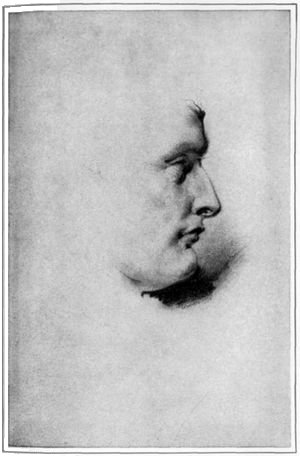
Napoleon Exposition, 1895.
NAPOLEON, by Ingres.
From nature, during a mass at the Tuileries. Belonging to M. Germain Bapst
At an opportune moment on one of these reviewing expeditions, Napoleon, surrounded by all the splendors of his power, was approached by a hurrying courier, who put into his hands despatches announcing the overthrow of the Sultan Selim. "It is a decree of Providence, announcing the end of Ottoman empire!" he cried. Thenceforth he talked incessantly of the Orient. As if inspired by prophetic fire, he sketched a missionary enterprise for the liberation and regeneration of Greece, and for the emancipation and reorganization of the lands and peoples on the Danube and in the Levant by distributing them among enlightened sovereigns. It was language identical with that which Catherine the Great employed to inspire her people and her descendants for Russia's policy. But the millennium must wait; for the present the barbarous Turks must be driven back, not by force, but by a steady, continuous application of the policy thus outlined; the consummation, when reached, would be permanent. For the moment more immediate and pressing matters must be settled; when Alexander should pay his promised visit to Paris they would have more abundant leisure to discuss ulterior plans. These dazzling prospects were a part of the Czar's consideration. He promised in return to conclude a separate peace with Turkey, which, in the absence of French support, he doubted not he could make most favorable. But in case the Porte should prove obdurate, a provisional plan of partition was drawn up to indicate approximately what Russia might expect.
As the days passed, a routine life was gradually established. The two emperors met privately in the morning, and chatted about every conceivable point, pacing the floor or bending with heads touching over the map of Europe to consider its coming divisions. Alexander had said at the outset that his prejudice against Napoleon disappeared at first sight, and later he exclaimed, "Why did we not meet sooner?" He now repudiated any fondness whatever for the "legitimate" politics of Europe; he had visited the Bourbon pretender, the so-called Louis XVIII, at Mittau, and had found him of no account; he even accepted the light suggestion of his new-found friend that the Russian councilor Budberg should have no share in the conferences, as being possibly too closely wedded to old ideas. "You be my secretary," said Napoleon, "and I will be yours." In the afternoon the King of Prussia, with his staff, was generally invited to join their cavalcade for a ride. The Emperor of the French gave in later years a malicious account of these jaunts. Himself a fearless though awkward horseman, he spurred his charger to full speed, and the Czar followed with glee, while the King, as timid in the saddle as in the cabinet, jounced and bounced, often knocking Napoleon's arms with his elbows. The French and Russian officers paired in good-fellowship, while the few Prussians rode together. Constantine gathered Murat, Berthier, and Grouchy about him, and treating them on equal terms, displayed the strongest proofs of his regard. The dinners which followed, though always large and stately, were made short, for the emperors wished to be alone as quickly and as long as possible. The Czar was full of curiosity. How did Napoleon win victories? How did he rule men? What were his family relations? How did he regulate his inner life? The Emperor was full of good humor: he told again and again the tale of his victories, and expounded the principles on which he had won them; he explained with candor and in detail the structure and workings of his administrative machine; he opened his heart, and told how its strings had been wrung by the death of the "Little Napoleon," the eldest son of Queen Hortense.
In such pleasant converse the hours of ease rolled swiftly by, and then the work of negotiation began once more. Where differences appeared, Napoleon evaded close discussion and passed to other matters. Next morning early, the Czar would receive a carefully worded, concise note on the points at issue, together with an argument. Sometimes he replied in writing, more frequently not. When they met again, Napoleon sought, or appeared to seek, a compromise, and never in vain. The council of ministers, in which there was not a single man of force except Talleyrand, received the conclusions from time to time, and elaborated the details.[Back to Contents]