Chapter IV
Reading edition
FRANCE, AND THE MEETING AT GREZ
When they arrived on the other side, the Osbournes went directly to Antwerp, having decided to make a trial of that place first for their art studies. They landed at night in that most picturesque old city and took quarters at the Hotel du Bien-être, a quaint little old bourgeois inn where you walked in through the kitchen—full of copper pots and pans. It was in the days before "improvements"—broad avenues, street-cars, and the like—had robbed the old town of much of its distinctive charm, when at the corners of the narrow, stone-paved streets shrines of the Virgin and Child might still be seen. The passing crowds—peasant women in elaborate lace caps and long cloaks, groups of soldiers, milk carts drawn by dogs—all were intensely interesting to the newcomers from America, for whom this was the first foreign experience. The evening of their arrival they hung fascinated from their windows, listening to the glorious chimes from the cathedral near by, and watching the changing spectacle below. There were little tables in the street where soldiers sat drinking, while maids in huge caps filled their flagons. Isobel remarked: "It is like a scene in an opera; all we need is music." At that moment a band at the corner struck up "La Fille de Madame Angot," and the illusion was complete.
The Hotel du Bien-être was kept by the Gerhardts, a delightful family of father, mother, and eleven children. It was a happy time in Antwerp for the Osbourne children, for this large family of young people provided them with pleasant companionship.
But if the Osbourne children had a happy time in Antwerp, it was far otherwise with their mother, for she was alone with her family in a foreign land and had little money, and the responsibility weighed heavily upon her, her anxiety being further increased by signs of ill-health in her youngest child, Hervey. In this state of mind she was deeply touched by the warm-hearted kindness of the Gerhardts, which they exhibited in a thousand ways. One day the newspapers published an account of the failure of a bank in San Francisco, and, knowing that his guests came from that city, Papa Gerhardt was troubled lest they might suffer some pecuniary distress from the failure. Out of the fulness of his good heart he said to Mrs. Osbourne: "Do not be anxious; it does not matter if you have lost your money; you can stay with Papa Gerhardt." Fortunately, the bank failure did not affect her in any way, but the generosity of these good people in her lonely situation went straight to her heart, and to the end of her days one only had to be a Belgian to call forth her help and sympathy.
Finding it necessary to economize, she took a house, a queer little stone building with a projecting roof, containing four small rooms, one on top of the other. The rooms were so tiny that when the big front door stood ajar it opened up almost all the little apartment dignified by the name of "salon." The entire Gerhardt family took a hand in getting them settled, bringing little gifts—crocheted mats, bouquets of artificial flowers, and two pictures, bright-coloured chromos of "Morning" and "Night," representing two little children, awake and asleep. Mrs. Osbourne loyally kept these pictures for years, hanging them upon her wall in tender and grateful memory of the Gerhardts.
After three months' stay in Antwerp, finding it to be a difficult place for women to study art, and having been told of a good and cheap school in Paris, she decided to go there. When they parted, with many tears, from their dear Belgian friends, Mrs. Osbourne, with a swelling heart, tried to thank Papa Gerhardt for his kindness to her and her children, but he said he had a large family who would some day have to go out into the world, and he had treated the Americans as he hoped his own would be treated.
From Antwerp they went to Paris, and Fanny and her daughter entered the Julien School of Art on the Passage des Panorama, where they spent a very busy time working at their drawings under the instruction of Monsieur Tony Fleury. The older of the two boys, Lloyd, was placed in a French school, and he still remembers that in any quarrel with the boys he was called "Prussian" as a dire insult. He did not know what it meant, but nevertheless resented it promptly.
The family lived very plainly, their meals often consisting of smoked herring and brown bread; yet these straitened circumstances did not prevent Mrs. Osbourne from taking pity on poor and homesick young students, fellow countrymen, whom she met at the school, and, when funds allowed, she invited them to eat Dutch-American dishes prepared by her own hands.
After this sad event the bereaved mother was so listless and broken in health that the doctor advised a change to some quiet country place, where she could get the benefit of outdoor life and better air than in the stuffy little Paris apartment. A casual acquaintance, Mr. Pardessus, an American sculptor whom they had met at the art school, told them about Grez, a little village in Fontainebleau Forest on the River Loing, where there was a ruined castle, a picturesque old inn, and a lovely garden on the river-bank. Above all, it was modest in price and so retired that it was almost unknown to ordinary travellers. This alluring description was not to be resisted, and Mrs. Osbourne, with her little family, now sadly bereaved, left for the place which was to play so momentous a part in her future.
When they reached Grez they found there only one visitor—Mr. Walter Palmer, then a young student, who was painting in the garden. It was a quiet, restful place, and Mrs. Osbourne began to recover the tone of her health and spirits in its peaceful atmosphere.
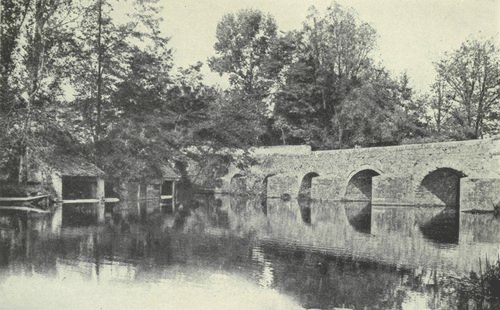
The bridge at Grez.
One evening in the summer of 1876 the little party of guests at the old inn sat at dinner about the long table in the centre of the salle-à-manger with the painted panels—handiwork of artists who had stopped there at various times. It was a soft, sweet evening, and the doors and windows were open; dusk drew near, and the lamps had just been lit. Suddenly a young man approached from the outside. It was Robert Louis Stevenson, who afterwards admitted that he had fallen in love with his wife at first sight when he saw her in the lamplight through the open window.
Again she writes:
"Yesterday I canoed to Nemours in Louis Stevenson's Rob Roy. We generally congregate down in the garden by the big tree after dinner. Mama swings in the hammock, looking as pretty as possible, and we all form a group around her on the grass, Louis and Bob Stevenson babbling about boats, while Simpson, seated near by, fans himself with a large white fan."
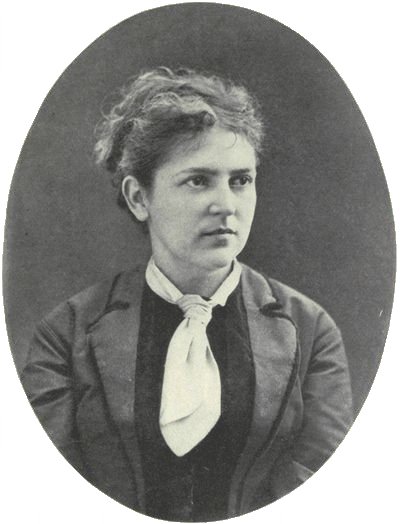
Fanny Osbourne at about the time of her first meeting with Robert Louis Stevenson.
The little party in the old inn, "entirely surrounded by peasants," as Bob Stevenson said, devised all sorts of sports, for which the river afforded many opportunities. There was a huge old boat, a double canoe, lying at the water's edge; this they put on rollers, and after the entire party had climbed into it, persuaded the passing peasants to come and push it off the bank, like a sort of "shoot the chutes." Another game was to divide the canoes into bands, each under a captain, and engage in a contest, each side trying to tip over the enemy canoes. In all this hilarious fun Louis Stevenson was the leader.
In the old hall they had great times, with dances, now and then a performance by strolling players, and once a masquerade given by the guests of the inn themselves, in which they dressed as gods and goddesses in sheets and wreaths. Once when a couple of wandering singers arrived after a disappointing season, the artists contributed a purse and invited them to spend a week and rest. These people told Stevenson the story he made into Providence and the Guitar, and the money which he received for it he sent to them afterwards to help pay for the education of their little girl in Paris.
But of all that went on at Grez the talks are remembered as the best, for, notwithstanding their merry fooling in their idle hours, there were brilliant minds among the company, and the conversation sparkled with rare conceits.
Three summers the Osbournes returned to spend at Grez, lingering on the last time until the snow came. A short visit was made to Barbizon, too, and once when there the whole party had their silhouettes drawn on the walls of the dining-room. This was done by placing a lamp so that it threw a shadow of the face in profile on the wall, then outlining the shadow and filling it in with black. Louis Stevenson wrote verses to them all. The place was repainted the next spring, which was to be regretted, for the walls were completely covered with the most interesting silhouettes and drawings by painters who later became famous, to say nothing of the verses made by Stevenson, which would now have been a priceless memorial of those youthful days.
Among the joyous coterie was the American painter Will H. Low, who writes thus of Fanny Osbourne in his Chronicle of Friendships:
"One evening at Grez we saw two new faces, mother and daughter, though in appearance more like sisters; the elder, slight, with delicately moulded features and vivid eyes gleaming from under a mass of dark hair; the younger of more robust type, in the first precocious bloom of womanhood."
Another of the company, Mr. Birge Harrison, writing in the Century Magazine of December, 1916, expresses his mature judgment of her as he knew her at the little French village:
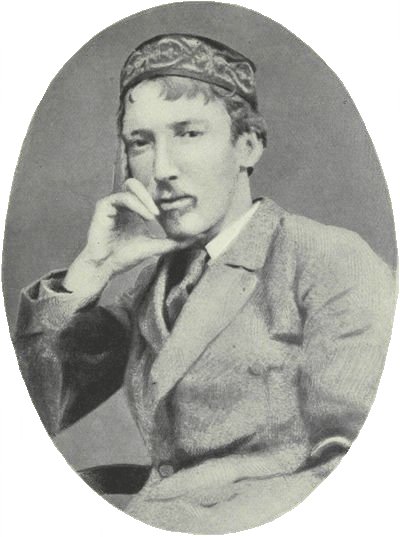
Robert Louis Stevenson in the French days.
"Among a few women who were doing serious work at this place was the lady, 'Trusty, dusky, vivid, and true,' to whom Robert Louis Stevenson inscribed the most beautiful love song of our time. Mrs. Osbourne could not have been at that time more than thirty-five years of age—a grave and remarkable type of womanhood, with eyes of a depth and sombre beauty that I have never seen equalled—eyes, nevertheless, that upon occasion could sparkle with humor and brim over with laughter. Yet upon the whole Mrs. Osbourne impressed me as first of all a woman of profound character and serious judgment, who could, if occasion called, have been the leader in some great movement. But she belonged to the quattrocento rather than to the nineteenth century. Had she been born a Medici, she would have held rank as one of the remarkable women of all time. That she was a woman of intellectual attainments is proved by the fact that she was already a magazine writer of recognized ability, and that at the moment when Stevenson first came into her life she was making a living for herself and her two children with her pen. But this, after all, is a more or less ordinary accomplishment, and Mrs. Osbourne was in no sense ordinary. Indeed, she was gifted with a mysterious sort of over-intelligence, which is almost impossible to describe, but which impressed itself upon every one who came within the radius of her influence. Napoleon had much of this; likewise his arch enemy, the great Duke of Wellington; and among women, Catherine of Russia and perhaps Elizabeth of England. She was therefore both physically and mentally the very antithesis of the gay, hilarious, open-minded and open-hearted Stevenson, and for that very reason perhaps the woman in all the world best fitted to be his life comrade and helpmate. At any rate we may well ask ourselves if anywhere else he would have found the kind of understanding and devotion which she gave him from the day of their first meeting at Grez until the day of his death in far-away Samoa; if anywhere else there was a woman of equal attainments who would willingly, nay gladly, throw aside all of the pleasures and comforts of civilization to live among savages, and the still rougher whites of the South Pacific, in order that her husband might have just a little more oxygen for his failing lungs, a little more chance for a respite and an extension of his shortening years? Probably no one ever better deserved than she the noble tribute of verse which her husband gave her, and from which I have quoted the opening line."
In 1878 the Osbournes returned to America, travelling by way of Queenstown, where, for the sake of stepping on Irish soil, they went ashore for a few hours and took a ride in a real jaunting-car, with a driver who was as Irish as possible, with a thick brogue, a hole in his hat, and a smiling, good-humoured countenance.
A short stop was made in Indiana to visit the old family home in Hendricks County, now saddened by the death of our father, and then Fanny Osbourne once more turned her steps towards the setting sun. At this time she added me, her youngest sister, to her party, and I remained with her until her marriage to Stevenson and their departure for Scotland. She was then in the full flower of her striking and unusual beauty, and so youthful in appearance that she, her daughter, and I passed everywhere as three sisters. To me, reared as I had been in the flat country of central Indiana, where mountains and the sea were wonders known only through books, the journey across the continent—with its glimpses of the mighty snow-capped crags of the Rockies outlined against the fiery sunset skies of that region, the weird castellated rocks of the "Bad Lands," the colonies of funny little prairie-dogs peeping out of their burrows, the blanket-wrapped Indians waiting at the stations, and finally the awesome vision of the stupendous canyons and precipices of the Sierras, was like some strange, impossible dream; and when at last we came out into the warm sun and flowery brightness of California, straight from the gloom and chill of an Indiana November, it was as though the gates of paradise had suddenly opened.
Not long after her return to California, finding a reconciliation with her husband to be quite out of the question, Mrs. Osbourne decided to bring suit for divorce, which was eventually granted without opposition.