TALES, SKETCHES, AND ANECDOTES.
Reading edition
ADAPTED TO THE USE OF SCHOOLS.
WITH ENGRAVINGS.
PHILADELPHIA: DESILVER, THOMAS & CO., No. 253 MARKET STREET.
1836.
Entered, according to Act of Congress, in the year 1832, by Samuel G. Goodrich, in the Clerk's Office of the District Court of Massachusetts.
PREFACE.
The following Preface to the Life of Columbus will explain the plan of the series, of which this is the third volume:—
"There is no kind of reading more attractive than biography, and, if properly treated, there is none more instructive. It appears, therefore, to be peculiarly fitted to the purposes of education; it readily excites the curiosity and awakens the interest of the pupil, and, while it stores his mind with facts, dates and events, displays to his view the workings of the human heart, and makes him better acquainted with himself and mankind.
"In the selection of subjects for a biographical series of works for youth, the editor has been led, by two considerations, to prefer those which belong to our own country. In the first place, it is more particularly necessary that our youth should be made acquainted with the lives of those men who were associated with the history of their native land; and, in the second place, no country can afford happier subjects for biography than this. There are few such lives as those of Columbus, Washington, and Franklin, in the annals of any nation.
"In the preparation of the work, the author has sought to adapt it to youth, by the use of a simple style, and by the introduction of many illustrative tales, sketches, anecdotes and adventures. Questions for examining the pupils are printed in the pages, which may be used, or not, at the choice of the Teacher."
The Life of Columbus and the Life of Washington, on a plan similar to this, have been already published; and other volumes, containing the lives of celebrated Indian Chiefs, celebrated American Statesmen, &c., will appear hereafter, if those already in progress should meet with success.
CONTENTS.
Page
CHAPTER I.
Birth of Franklin. Early Education. Anecdote. Choice of a Trade. He is placed with a Cutler. His Fondness for Reading. Bound Apprentice to his Brother. Makes a Couple of Ballads. His Friend Collins. Reads the Spectator. 11
CHAPTER II.
Franklin gives up eating Meat. His Economy of Time. Studies Arithmetic. James Franklin establishes a Newspaper. Benjamin writes for it. His Brother is imprisoned. Benjamin manages the Paper. Leaves his Brother. Goes to New York. Sails thence for Philadelphia. Anecdote of the Dutchman. 19
CHAPTER III.
His Journey. His Dinner with the old Gingerbread Woman. Arrives in Philadelphia. Anecdote of the Rolls. Attends the Meeting House of the Quakers. Suspected of being a Runaway. Employed by Keimer. Noticed by Governor Keith. Visit to Boston. Return. 27
CHAPTER IV.
Finds his Friend Collins in New York. Visit to the Governor. Promises from Governor Keith. Project of a new religious Sect. Anecdote of Keimer and the roast Pig. His principal Acquaintance. A literary Trick. Prepares to go to London. The Governor's Deception. Arrival in London. 35
CHAPTER V.
Troubled by his Friend Ralph. Obtains Employment. Ralph turns Schoolmaster, and begins an Epic Poem. Franklin teaches some of his Friends to swim. Anecdote of Mr. Denham. Return to Philadelphia. Story of George Webb. Franklin quarrels with Keimer. Returns to work for him. Employed at Burlington. Leaves Keimer. 43
CHAPTER VI.
The Junto. A new Paper started by Keimer. Franklin purchases it. Difficulties in their Business. A Dissolution of the Partnership. Franklin assisted by his Friends. David Harry. Match-making. Marriage with Miss Read. 50
CHAPTER VII.
Library of the Junto. A public Library established. Franklin studies. His Frugality. Anecdote of the Bowl and Spoon. His Scheme of arriving at Moral Perfection. Table of Precepts. Franklin's Remarks upon it. Poor Richard's Almanac. 57
CHAPTER VIII.
Management of his Newspaper. Study of the Languages. Chess-playing. The Preacher Hemphill. Stealing Sermons. Visit to Boston. Visits his Brother James at Newport. Usefulness of the Junto. Formation of new Clubs. Franklin chosen Clerk of the General Assembly. Anecdote. 65
CHAPTER IX.
Reform of the City Watch. Fire Companies. Rev. Mr. Whitefield. Effects of his Preaching. His Project of building an Orphan House in Georgia. Anecdotes. Franklin's Opinion of him. Franklin's Prosperity. Military Defence of the Province. Formation of Companies. 72
CHAPTER X.
Anecdote. William Penn. Education of Youth. Subscription for an Academy. Franklin overloaded with public Offices. Member of the Assembly. Treaty with the Indians at Carlisle. Public Hospital. Anecdote. 82
CHAPTER XI.
Spence's Experiments in Electricity. Franklin repeats them. Makes important Discoveries. Letters to Collinson. Experiment with the Kite. Publication of his Letters. Anecdote of the Abbé Nollet. Fame of Franklin. Elected a Member of the Royal Society. 90
CHAPTER XII.
Appointed Postmaster-General. Journey to New England. Receives Degrees from two Colleges. Story of the Visit to his Mother. 97
CHAPTER XIII.
Congress at Albany. Plan for a Union of the Colonies. Arrival of General Braddock. Franklin sent to him by the Assembly. Want of Wagons. Franklin undertakes to procure them. His Advertisement. Anecdote of Braddock. Battle with the Indians. Retreat. 105
CHAPTER XIV.
Settlement for the Loss of Wagons. Anecdote. Preparations for Defence. Franklin appointed to a military Command. Assembles the Troops at Bethlehem. Farmers killed by Indians. Building Forts. Extracts from Franklin's Journal. Indian Cunning. Anecdotes of the Moravians. 113
CHAPTER XV.
Disputes with the Proprietaries. Franklin sent by the Assembly to London. Appointed general Agent for the Colonies. University Honors. The Armonica. Murder of the friendly Indians. 124
CHAPTER XVI.
Franklin appointed Agent at the Court of Great Britain. Visits Germany and France. Returns to Philadelphia. Appointed Delegate to Congress. Interview with Lord Howe. Sent as Ambassador to France. Asks to be recalled. Chosen President of the Supreme Council of Philadelphia. Death. Character. 130
ESSAYS OF DR. FRANKLIN.
The Whistle. 136
Handsome and Deformed Leg. 138
Advice to a young Tradesman. 142
Necessary Hints to those that would be rich. 145
Paper, a Poem. 146
On the art of Swimming. 149
Preliminary Address to the Pennsylvania Almanac, entitled, "Poor Richard's Almanac, for the year 1758." 153
Observations on War. 167
The Way to make Money plenty in every Man's Pocket. 169
Morals of Chess. 171
Conversation of a Company of Ephemeræ. 177
LIFE OF FRANKLIN.
CHAPTER I.
Birth of Franklin. Early Education. Anecdote. Choice of a Trade. He is placed with a Cutler. His Fondness for Reading. Bound Apprentice to his Brother. Makes a couple of Ballads. His Friend Collins. Reads the Spectator.
1. Benjamin Franklin was born in Boston, New England, on the seventeenth of January, 1706. He was the youngest son in a family of seventeen children. His elder brothers were, at an early age, put apprentices to different trades; for their father was a man of honest industry, but with little or no property, and unable to support the expense of keeping them long at school.
2. Benjamin, however, was intended for the church, and at eight years of age was put to a grammar school. His readiness in learning, and his attention to study, confirmed the first intention of his parents. The plan also met with the approbation of his uncle Benjamin, who promised to give him some volumes of sermons that he had taken down in short hand, from the lips of the most eminent preachers of the day.
3. He continued at the grammar school, however, only about a year, though he had risen to the head of his class, and promised to be a very fine scholar. His father was burthened with a numerous family, and could not carry him through a course of college education. He accordingly changed his first purpose, and sent Benjamin to a school for writing and arithmetic, kept by Mr. George Brownwell.
4. This master was quite skilful in his profession, being mild and kind to his scholars, but very successful in teaching them. Benjamin learned to write a good hand in a short time, but he could not manage arithmetic so easily. At ten years of age he was taken from school to help his father in the business of a tallow-chandler; and was employed in cutting the wick for the candles, going errands, and tending the shop.
5. Benjamin disliked the trade, and had a strong inclination to go to sea; but his father opposed his wishes in this respect, and determined to keep him at home. The house in which he lived happened to be near the water, and Benjamin was always playing with boats, and swimming. When sailing with other boys, he was usually the leader, and he confesses that he sometimes led them into difficulties.
6. There was a salt marsh which bounded part of the mill-pond, on the edge of which the boys used to stand to fish for minnows. They had trampled it so much, however, as to make it a mere quagmire. Franklin proposed to his friends to build a wharf there, for them to stand upon; and showed them a large heap of stones, which were intended for a new house near the marsh, and would answer their purpose exactly.
7. Accordingly, that evening, when the workmen were gone home, he assembled a number of his playfellows, and they worked diligently, like so many emmets, sometimes two or three to a stone, till they had brought them all to make their little wharf. On the next morning, the workmen were surprised on missing the stones. The authors of the removal were detected, complained of, and punished by their parents. Franklin attempted to show the usefulness of their work; but his father took that occasion to convince him, that that which was not truly honest could not be truly useful.
8. Benjamin continued employed in the business of his father about two years, that is, till he was twelve years old. His brother John, who had also been brought up to the trade, had left his father, married, and set up for himself in Rhode Island. There was now every appearance that Benjamin was destined to become a tallow-chandler. As his dislike to the trade continued, his father was afraid that, if he did not put Benjamin to one that was more agreeable, he would run away, and go to sea, as an elder brother of his had done. In consequence of this apprehension, he used to take him to walk, to see joiners, bricklayers, turners and braziers at their work, that he might observe his inclination, and fix it on some trade or profession that would keep him on land.
9. His father at length determined on the cutler's trade, and placed him for some days on trial with his cousin Samuel, who was bred to that trade in London, and had just established himself in Boston. It was then usual to ask a sum of money for receiving an apprentice, and the cutler charged so much for taking Benjamin, that his father was displeased, and put him to his old business again.
10. From his infancy Benjamin had been passionately fond of reading; and all the money that he could get was laid out in purchasing books. He was very fond of voyages and travels. The dangers and adventures of sailors in the different parts of the world, and stories of the strange people and customs they met with, he would always read with delight.
11. The first books that he was able to buy were the works of a famous old English writer, named John Bunyan. These he afterwards sold, in order to purchase some volumes of Historical Collections. His father's library consisted principally of works on divinity, most of which he read at an early age. Beside these, there was a book by De Foe, the author of Robinson Crusoe; and another called An Essay to do Good, by Dr. Mather, an old New England divine.
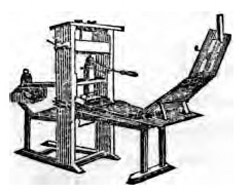
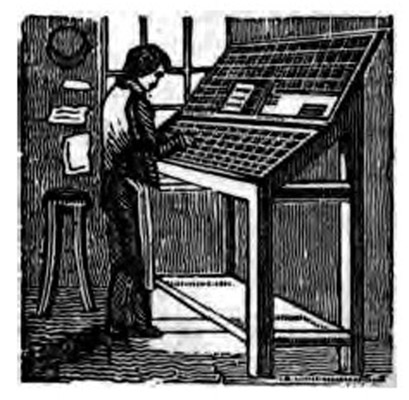
12. This fondness for books at length determined his father to bring him up as a printer, though he had already one son in that employment. In 1717, this son returned from England with a press and letters to set up his business in Boston. Benjamin liked this trade much better than that of his father, but still had a desire to go to sea. To prevent this step, his father was impatient to have him bound apprentice to his brother, and at length persuaded him to consent to it.
13. He was to serve as apprentice till he was twenty-one years of age, and during the last year was to be allowed the wages of a journeyman. In a little time, he made great progress in the business, and became quite useful. He was now able to obtain better books. An acquaintance with the apprentices of the booksellers sometimes enabled him to borrow a small one, which he was careful to return clean and in good season. He often sat up in his chamber the greater part of the night, to read a book that he was obliged to return in the morning.
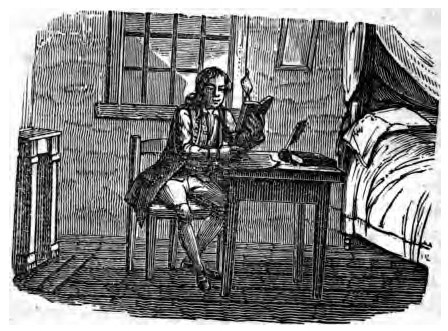
Franklin reading at night.
14. After some time, an ingenious and sensible merchant, Mr. Matthew Adams, who had a pretty collection of books, took notice of Franklin at the printing office, and invited him to see his library. He very kindly offered to lend him any work that he might like to read.
15. He now took a strong inclination for poetry, and wrote some little pieces. His brother supposed that he might use this talent to advantage, and encouraged him to cultivate it. About this time, he produced two ballads. One was called the Light-House Tragedy, and contained an account of the shipwreck of Captain Worthilake, with his two daughters; the other was a sailor's song, on the taking of the famous Blackbeard, the pirate.
16. They were written in the doggerel street-ballad style, and when they were printed, his brother sent Benjamin about the town to sell them. The first sold very rapidly, as the event on which it was founded had recently occurred, and made a great deal of noise. This success flattered his vanity very much, but his father discouraged him by criticising his ballads, and telling him that verse-makers were generally beggars.
17. This prevented him from giving any further attention to poetry, and led him to devote more time and care to prose compositions. He was at this time intimately acquainted with another lad very fond of books, named John Collins. They sometimes discussed different questions together, and had become very apt to indulge in arguments and disputes.
18. A question was once started between them, on the propriety of educating the female sex in learned studies, and their abilities for these studies. As they parted without settling the point, and were not to see one another again for a long time, Franklin sat down to put his arguments in writing. He then made a fair copy of them, and sent it to Collins.
19. Three or four letters passed between them on the subject, when the father of Franklin happened to find the papers, and read them. Without entering into the subject in dispute, he took occasion to talk to him about his manner of writing. He marked the defects in his expressions, and in the arrangement of his sentences, but gave him the credit of spelling and pointing with great correctness. This he had learned in the printing office, but he had never before been taught any thing about manner and style.
20. About this time, he met with an odd volume of the Spectator, a very famous work, published by several English wits in the year 1711. He bought it, read it over and over, and was much delighted with it. This book was now his continual study, and he himself tried to write as much as possible in its very pleasant and popular style. The improvement which he made was encouraging, and led him to hope he might some day become a good English writer; a distinction of which he was very ambitious.
1. Where was Franklin born? When?
2. For what profession did his parents intend to educate him?
3. What induced his father to change his intention?
4. To what trade was Benjamin put, and when?
6. Relate the anecdote about Franklin and his companions.
7. What maxim did his father teach him in consequence of this adventure?
8. What were his father's fears in relation to his new occupation?
9. On what trade did his father finally determine?
10. Describe his early fondness for reading, and the books of which he was most fond.
11. What books did he first buy?
12. What induced his father to bring up Benjamin as a printer? To whom was he bound apprentice?
13. How did he succeed in his new trade?
14. What advantages did it afford him for pursuing his studies?
15. Relate the account of his first attempts in poetry.
16. How did his ballads succeed?
17. How did his father discourage his new taste?
18. What was the subject of his discussion with his friend Collins?
19. What praise and advice did his father give him on this occasion?
20. With what book was Franklin at this time so much pleased? Did he attempt to imitate it?
CHAPTER II.
Franklin gives up eating Meat. His Economy of Time. Studies Arithmetic. James Franklin establishes a Newspaper. Benjamin writes for it. His Brother is imprisoned. Benjamin manages the Paper. Leaves his Brother. Goes to New York. Sails thence for Philadelphia. Anecdote of the Dutchman.
1. When about sixteen years of age, Franklin happened to meet with a book that recommended a vegetable diet. He determined to adopt it. His brother, being unmarried, did not keep house, but boarded himself and his apprentices in another family. By refusing to eat meat, Franklin occasioned a good deal of inconvenience; and he was frequently chid for his singularity. He accordingly learned the manner of boiling potatoes and rice, and of making hasty-pudding, and then proposed to his brother, if he would give him, weekly, half the money he paid for his board, to board himself. His brother instantly agreed to it, and Franklin soon found that he could save half of what he received.
2. This was a new fund for buying books. But this was not the only advantage. When his brother and the apprentices had gone to their meals, he was left in the printing office alone. He immediately despatched his slight repast, which was often no more than a biscuit, or a slice of bread and a handful of raisins, or a tart from the pastry cook's, and a glass of water, and had the rest of the time till their return for study. By being thus economical of his time, he was able to make considerable progress in his books.
3. He now began to feel the want of a knowledge of figures, and was once very much mortified by his ignorance of them. As he had entirely failed of learning them at school, he took Cocker's Arithmetic, and went through the whole of it by himself with the greatest ease. The mortification he had met with induced him to make great exertions; and we can succeed in any thing to which we give our earnest attention.
4. While he was intent on improving his language and style, Franklin met with an English grammar, at the end of which were two little sketches on the arts of rhetoric and logic. The latter of these finished with a dispute in the manner of Socrates, a very famous philosopher of Greece. Franklin was charmed with this modest and artful manner, and cured himself of the tricks of contradiction and too much positiveness. These habits are very disagreeable, and no one should allow himself to fall into them.
5. "In fact, if you wish to instruct others," says Franklin, "a positive and dogmatical manner in advancing your sentiments may occasion opposition, and prevent a candid attention. If you desire improvement from others, you should not at the same time express yourself fixed in your present opinions. Modest and sensible men, who do not love disputation, will leave you undisturbed in the possession of your errors. In adopting such a manner, you can seldom expect to please your hearers, or obtain the concurrence you desire."
6. In the year 1720, or '21, James Franklin began to print a newspaper. It was the second that appeared in America, and was called the New England Courant. The only one before it was the Boston News Letter. Some of his friends endeavored to dissuade him from the undertaking. They thought it would not succeed, as, in their opinion, one newspaper was sufficient for all America. There are now in the United States alone, over eight hundred newspapers.
7. The undertaking, however, went on. Benjamin assisted in setting the types, helped to print off the sheets, and was then employed in carrying the papers to the subscribers. Several men of information and talents wrote little pieces for the paper, which were amusing, and gained considerable credit. These gentlemen often visited the printing office.
8. Hearing their conversations, and their accounts of the praise their pieces received from the public, Benjamin was excited to try his fortune among them. He was afraid, however, as he was still a boy, his brother would object to print any thing of his composition in the paper. It was necessary, therefore, to disguise his hand-writing, and to send his piece to the office in such a way that it should not be known from whom it came.
9. When his friends came in, James showed them the communication from an unknown writer. They read it, praised it, and made several guesses as to the author. In these guesses none were named but men of some character for talents and learning. They never once suspected it was written by the little printer's boy who stood at their elbows, chuckling in silence over the secret.
10. Encouraged by the success of this attempt, he continued to write, and send other pieces in the same way to the press. He kept his secret as long as he saw fit, and then confessed himself the author of the writings they had been so long guessing about. Benjamin now began to be more noticed by his brother's acquaintance, which made him a little vain, and led to some serious difficulties.
11. His brother, notwithstanding the relationship between them, considered himself as master, and Benjamin as his apprentice, and accordingly expected the same services from him that he would from another. In some of these services the young printer felt himself degraded, and thought that he should receive greater indulgence. His brother was passionate, and frequently beat him; and, finding the apprenticeship exceedingly tedious, Benjamin was looking forward for an opportunity to shorten it. This at length happened in a very unexpected manner.
12. One of the pieces in the paper, on some political subject, gave offence to the Assembly, one of the most important branches of the government of Massachusetts. James Franklin was taken up, censured, and imprisoned for a month, because he would not discover the author. Benjamin was also called up and examined before the council; but, considering him as an apprentice, who was bound to keep his master's secret, they dismissed him without punishment.
13. During his brother's confinement, Benjamin had the management of the paper, and indulged in very smart remarks upon the government. This pleased his brother, though it made others look upon him in an unfavorable light, as a youth who had a turn for satire and libeling. The discharge of the imprisoned printer was accompanied with an order that "James Franklin should no longer print the newspaper called the New England Courant."
14. On a consultation held at the printing office, it was proposed, to change the name of the paper, and in this manner elude the order of the council. As there were many difficulties in the way of this project, it was determined to let the paper for the future be printed in the name of Benjamin Franklin.
15. When apprentices are bound out, it is usual to have certain agreements drawn up between them and their masters, sealed and signed according to certain forms required by law. These papers are called indentures. James was afraid that the censure of the Assembly would fall on him, as still printing the paper by his apprentice, and contrived that his old indenture should be returned to Benjamin, with a discharge on the back of it.
16. This was to be shown only in case of necessity; and in order to secure his services for the remainder of the time, it was agreed that Benjamin should sign new indentures. These were to be kept private. This was a very flimsy scheme, but the paper continued to be printed in this manner for several months. At length fresh difficulties arose, and Benjamin determined to take advantage of his discharge; thinking that his brother would be afraid to produce the new indentures. It was unfair to take this advantage, but he was urged to it by very unkind and even cruel treatment.
17. When his brother found out his intentions, he went round to every master printer in town to prevent his getting employment. In consequence of this, he concluded to remove to New York; that being the nearest place where there was another printer. His father opposed his removal, and took side with his brother in the dispute. Benjamin sold his books to furnish the means of paying his passage, went privately on board of a sloop, had a fair wind, and in three days found himself in New York, three hundred miles from home, at the age of seventeen. There was no one in the place whom he knew; he was without any recommendations, and had very little money in his pocket.
18. By this time he had entirely lost all his love for the sea, or he might have been induced to gratify it. Having another profession, and considering himself a good workman, he offered his services to a printer of the place, old Mr. W. Bradford. This man had been the first printer in Pennsylvania, and had removed from there in consequence of a quarrel with the governor, General Keith.
19. He had a sufficient number of workmen, and little to do, and could give Franklin no employment. But he said, "My son, at Philadelphia, has lately lost his principal hand, Aquila Rose, by death, and if you go thither, I believe he may employ you."
20. Philadelphia was one hundred miles farther, but Franklin concluded to go there. In crossing the bay, a squall struck the little vessel he was in, and tore her rotten sails to pieces. She was driven upon Long Island.
21. On the way, a drunken Dutchman, who was a passenger in the boat, tumbled overboard. As he was sinking, Franklin reached out and caught him by a very bushy head of hair, and drew him up again. This sobered him a little, and he went to sleep, having first taken a book out of his pocket, which he desired Franklin to dry for him. It proved to be a Dutch copy of his old favorite book, Bunyan's Pilgrim's Progress, and he carefully complied with the wish of the sleepy owner.
1. What induced Franklin to adopt a vegetable diet? What arrangement did he make with his brother on this account?
2. What advantage resulted from this? Describe Benjamin's economy of time.
3. How did he learn arithmetic?
4. With what treatise was Franklin so much pleased? Of what disagreeable habits did it cure him?
5. What advice does he give on the manner of conversation?
6. Who printed the second newspaper in New England? What was it called?
7. How was Benjamin connected with it?
8. What first induced him to write for it? Describe his first attempt.
9. How was his communication received?
10. What was the consequence of his success?
11. What were the difficulties between the brothers?
12. What happened at this time to James Franklin?
13. How did Benjamin conduct the paper? What was the order of the council?
14. How was it evaded?
15. What is the custom in binding out apprentices? How was Benjamin discharged from his indentures?
16. What unfair advantage did he take of this discharge?
17. What course did his brother pursue on this occasion? His father? Benjamin?
18. To whom did he apply for employment?
19. With what success?
20. Where did he determine to go?
21. What is the anecdote of the Dutchman?
CHAPTER III.
His Journey. His Dinner with the old Gingerbread Woman. Arrives in Philadelphia. Anecdote of the Rolls. Attends the Meeting House of the Quakers. Suspected of being a Runaway. Employed by Keimer. Noticed by Governor Keith. Visit to Boston. Return.
1. On approaching the island, the crew found themselves in a place where there could be no landing, as it was a stony beach, and a violent surf was rolling. They cast anchor, and remained in that situation through the night. As the spray dashed over the boat, they were all, in a very short time, as wet as the unfortunate Dutchman. The wind went down on the next morning, and they were able to reach Amboy before night; having been thirty hours on the water, without victuals, or any drink but a bottle of dirty rum.
2. In the evening, Franklin found himself feverish, and went to bed. As he drank plentifully of cold water, his fever left him, and in the morning he proceeded on his journey. After crossing the ferry, he travelled on foot, notwithstanding a violent rain, till noon. Being now thoroughly soaked and tired, he stopped at a poor inn, where he spent the remainder of the day, and all night.
3. He now began to wish that he had never left home. His prospect of procuring employment, even when he should arrive at Philadelphia, was uncertain. He thought of the distress his sudden disappearance must have occasioned to his parents. Besides all this, he made such a sorry figure that he was suspected of being a runaway servant, and in danger of being taken up on that suspicion.
4. On the next day, however, he continued his journey, and arrived that night at an inn, within eight or ten miles of Burlington. The next morning he reached Burlington, where he expected to find boats to sail immediately for Philadelphia. It was Saturday, and he had the mortification to find that the regular boats had just gone, and that no others were expected to sail before Tuesday.
5. Franklin returned to the shop of an old woman, of whom he had bought some gingerbread to eat on his passage, and asked her where he had better go to find lodgings. She proposed to lodge him in her own house, till a passage, by some other boat, offered itself. He accepted the invitation, and dined with the old woman that day on ox-cheek. All that she would take in return was a pot of ale.
6. Franklin had supposed himself fixed till the next Tuesday, but as he was walking, in the evening, by the side of the river, a boat passed by, with several people, going to Philadelphia. They took him in, and proceeded on their voyage. The weather was very calm, without a breath of wind stirring. They were obliged to row all the way. Reaching Philadelphia about eight or nine o'clock on Sunday morning, they landed at Market street wharf.
7. Our young traveller had sent his best clothes by another conveyance from New York, and he was in his old working dress. His pockets were stuffed out with shirts and stockings, and he knew not where to look for lodgings. He was tired with walking, rowing, and want of sleep, and was, besides, very hungry. His whole stock of cash was a single silver dollar and about a shilling in copper coin. The copper he gave to the boatmen for his passage.
8. As he walked along the street, gazing at the new things he saw, and wondering what would be the end of his trouble, he met a boy with some bread. Inquiring where he had bought it, Franklin went immediately to the place where he was directed, and asked for three-pence worth of bread. He received three large puffy rolls, and, having no room in his pockets, walked off, with a roll under each arm, and eating the third.
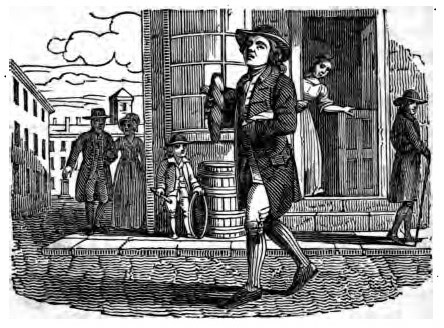
Franklin walking in the streets of Philadelphia.
9. In this manner he walked up Market street, as far as Fourth street, passing by the house of Mr. Read, whose daughter he afterwards married. This young lady was standing at the door as he went by, and probably thought he made rather an awkward appearance. After walking about the streets some time, eating his roll, he found himself again in the neighborhood of the wharf where he had landed. He went on board of the boat, and gave his two remaining rolls to a woman and child that had been his fellow-passengers down the river.
10. He again walked up the street, which was, by that time, filled with a large number of neat, well-dressed people, who were all walking the same way. He joined them, and was led into the great meeting house of the Quakers, near the market. Sitting down among them, he looked round awhile, and, as nothing was said, fell fast asleep from drowsiness. His nap continued till the meeting broke up, when some one was kind enough to awake him.
11. He then walked down towards the river, and meeting a young Quaker, whose countenance pleased him, he asked where a stranger could get lodgings. They were then near a house with the sign of the Three Mariners. "Here," said the Quaker, "is a house where they receive strangers, but it is not a reputable one; if thou wilt walk with me, I'll show thee a better." He conducted Franklin to the Crooked Billet, in Water street.
12. There he dined, and during the dinner several questions were put to him, by persons who supposed him to be a runaway. On the next morning, he dressed himself as neatly as he could, and went to see Andrew Bradford, the printer. Here he found the old gentleman, whom he had met in New York, and who, travelling on horseback, had got to Philadelphia before him.
13. Mr. Bradford received him very kindly, but, as he was not at that time in want of a hand, could only recommend him to a printer, who had lately set up in town, by the name of Keimer. This man had then nothing for him to do, but promised him employment soon. Meanwhile, he was invited to lodge with Mr. Bradford, and to assist when there was any extra work in the printing office.
14. Franklin soon found that neither of the printers knew any thing about their business. Keimer was, before long, able to give him constant employment. He did not like, however, that any one should live with his rival, Bradford, while he worked for him. Lodgings were, therefore, procured for Franklin, with Mr. Read, whose house he had passed on his first arrival, while eating his roll.
15. He had now made some acquaintances about town, and passed his time very pleasantly. By industry and frugality he gained money, and gave up all thoughts of returning to Boston. The governor of the province, Sir William Keith, had accidentally become acquainted with him, and was desirous that he should set up in business for himself, in Philadelphia. He promised to procure for him the public printing of the government, and to assist him, as much as possible, by his influence and patronage.
16. It was concluded that Franklin should return to Boston, with a letter from the governor, to prevail upon his father to assist him in the establishment. Towards the end of April, in 1724, he left Philadelphia for this purpose.
17. He sailed in a little vessel that was bound for Boston, and, in about a fortnight, was safe in his father's house. His sudden appearance surprised the family very much, but they were all delighted to see him, and treated him with great kindness.
18. Soon after his arrival, he paid a visit to his brother, at the printing office. He had on a new suit of clothes, wore a watch, and had about five pounds, in silver, in his pockets. Feeling rather elated by the success he had met with, he made quite a display of all his good fortune before his brother's apprentices and journeymen, and ended by giving them a dollar to drink his health with. This visit offended his brother very much, for he thought it was intended to mortify him.
19. The letter of the governor was without any effect. His father was very glad that Benjamin had been able to gain the confidence of so eminent a man, but would not consent to his request. He wrote a civil letter, thanking Sir William for his promise of patronage, but saying, that his son was altogether too young to be intrusted with the management of so important and expensive an undertaking.
20. Franklin gave so pleasant an account of Philadelphia, that his old friend Collins determined to go on and try his fortune there. Seeing no prospect of restoring harmony between the two brothers, his father consented that Benjamin should return to Philadelphia. He advised him to steady industry and frugality, and promised to assist in setting him up in business, when he should reach the age of twenty-one. With the approbation and blessing of his parents to follow him, he embarked for New York, on the way to his future home.
1. What was the situation of the crew on the water?
2. How did Franklin pursue his journey?
3. What were his fears?
5. Describe the treatment Franklin received from the old woman.
6. How did he get to Philadelphia?
7. Describe his appearance on his first arrival there.
10. Relate his adventure in the meeting house.
11. Where did he first lodge in Philadelphia?
13. Where did he obtain employment?
15. How did Franklin succeed, and how did he pass his time? What was the promise of Sir William Keith?
16. Why did Franklin go to Boston?
18. Describe his visit to his brother.
19. How did his father receive the governor's letter?
20. What were his advice and promise to Benjamin?
CHAPTER IV.
Finds his Friend Collins in New York. Visit to the Governor. Promises from Governor Keith. Project of a new religious Sect. Anecdote of Keimer and the roast Pig. His principal Acquaintance. A literary Trick. Prepares to go to London. The Governor's Deception. Arrival in London.
1. At New York Franklin found his friend Collins, who had arrived there some time before him. They had been intimate from childhood, and he had been sober and industrious. But during Franklin's absence in Philadelphia, Collins had fallen into bad habits, and become a drunkard. He gamed, and lost his money, and borrowed of his friend, to pay his expenses on the road.
2. The governor of New York, hearing from the captain that one of his passengers had a great many books on board, requested that he might be brought to see him. Franklin, accordingly, waited upon him. He was received with great civility. The governor showed him his library, which was a considerable one, and they had a good deal of conversation about books and authors. This attention was very pleasing to Franklin.
3. When they arrived at Philadelphia, Collins continued to drink, and was, consequently, unable to procure any business. He continued to borrow money of Franklin, and finally quarrelled with him, and went to the West Indies. Franklin never heard of him afterwards.
4. Sir William Keith received the young printer, on his return, with a great show of kindness, and large promises. "Since your father will not set you up," he said to him, "I will do it myself. Give me a list of the things necessary to be had from England, and I will send for them. You shall repay me when you are able. I am resolved to have a good printer here, and I am sure you must succeed." This was spoken with an air of perfect sincerity, and Franklin had not the least doubt but that he meant what he said.
5. He accordingly made a list of all the articles that would be wanted for a printing house, the cost of which was about one hundred pounds. The governor liked it, and asked whether it would not be well for him to go to England himself, in order to select the types, and see that every thing was of the best kind. "When there," he added, "you may make acquaintance, and establish correspondence in the bookselling and stationery way."
6. Franklin thought that it might be advantageous. "Then," said he, "get yourself ready to go in the Annis," which was the annual ship, and at that time the only one passing between London and Philadelphia. But, as it would be some months before the Annis sailed, Franklin continued to work with Keimer.
7. They agreed together very well, and lived on quite a familiar footing. Franklin used sometimes to argue with his master, and would most frequently beat him. This gave him so great an idea of Franklin's ability in disputation, that he proposed to him to become his assistant in a new religious sect which he proposed to establish. One was to preach the doctrines, and the other to confound all opponents.
8. When they came to explain with each other upon their doctrines, Keimer was desirous of introducing certain customs, which did not entirely meet the wishes of his colleague. Among other things, he wore his beard at full length; because, somewhere in the Mosaic law, it is said, "Thou shalt not mar the corners of thy beard." He likewise kept the seventh day sabbath, instead of the first; and both of these points he considered essential.
9. Franklin disliked both, but agreed to them on condition of his adopting the doctrine not to use animal food. Keimer was a great eater, and was not much pleased with the idea of being starved; but he consented to try the practice a few weeks, and see how it agreed with his constitution.
10. They held to this plan for three months. Their provisions were purchased, cooked, and brought to them regularly by a woman in the neighborhood, who prepared, at different times, forty dishes, in which there were neither fish, flesh, nor fowl. Franklin went on well enough, but poor Keimer suffered grievously, grew tired of the project, and ordered a roast pig. He invited some friends to dine with him upon the occasion, but the pig being brought too soon upon the table, he could not resist the temptation, but ate the whole before his company came.
11. During this time, Franklin had contracted an affection for Miss Read, and believed that she was not altogether indifferent in her feelings towards him. As he was about to take a long voyage, however, and as they were both very young, her mother thought it most prudent to defer the matter till his return from England.
12. His chief acquaintance, at this period, were Charles Osborne, Joseph Watson, and James Ralph, all lovers of reading. In one of their meetings, it was proposed that at a certain time each of them should produce a piece of his own composition, in order to improve, by mutual observations and corrections. They agreed that this task should be to turn the eighteenth psalm into verse.
13. When the time of the meeting drew nigh, Ralph called upon Franklin, and told him that his piece was ready. "Now," said he, "Osborne never will allow the least merit in any thing of mine, but makes a thousand criticisms, out of mere envy. I wish, therefore, you would take this piece and produce it as yours; we shall then hear what he will say to it."
14. It was agreed. At the meeting, Watson's performance was read first; there were some beauties in it and many defects. Osborne's piece was then read, and was much better. Ralph had nothing to produce. It was now Franklin's turn. He was backward, wished to be excused, but no excuse would be received. The piece he brought with him was read, and repeated. Osborne was delighted with it, and praised it in the highest terms.
15. As he was returning home with Ralph, he expressed himself still more strongly. "Who would have imagined," said he, "that Franklin was capable of such a performance! such painting, such force, such fire! He has even improved on the original. In common conversation he seems to have no choice of words; he hesitates and blunders; and yet how he writes!" When they next met, the trick was discovered, and Osborne was laughed at for praising Ralph, by mistake.
16. The governor sent for Franklin frequently to his house, and always spoke of setting him up in business, as a settled thing. He was to be furnished with letters to the governor's friends in England, and with an order for the money to purchase a press, types, and paper. For these letters he was to call at a certain time, when they would be ready. They were delayed, however, again and again, till the ship was on the point of sailing.
17. When Franklin went to take leave, and receive the letters, the secretary came out and said, that the governor was very busy on business of importance, but that he would send the letters on board, wishing him a good voyage and a speedy return.
18. Understanding that despatches had been brought on board, from the governor, Franklin asked the captain for the letters that were to be under his care. The captain told him that they had all been put into the bag together, and he could not then come at them; but that before they landed in England, he should have an opportunity of picking them out. This satisfied him for the present, and he thought nothing more of it during the voyage.
19. When they arrived in the Channel, the captain kept his word, and permitted him to examine the bag, for the governor's letters. He found some upon which his name was put, and picked out six or seven, which he thought might be the promised letters. One of these was addressed to Basket, the king's printer, and another to some stationer.
20. They reached London on the twenty-fourth of December, 1724. Franklin waited upon the stationer, who came first in his way, and delivered the letter as from Governor Keith. "I don't know such a person," said he; but opening the letter—"O! this is from Riddlesden; I have lately found him to be a complete rascal, and I will have nothing to do with him, nor receive any letters from him." Returning the letter, he turned upon his heel and went to wait upon some customer.
21. It turned out that the governor had sent no letters by Franklin, but had completely deceived him. With no intention of giving him any assistance, he had blinded him with brilliant promises and false hopes. But Franklin was able to assist himself. He determined to procure employment among the printers in London, and acquire a thorough knowledge of his profession before he returned to America.
1. What happened to his friend Collins?
2. What attention did Franklin receive from the governor of New York?
4. What was Sir William Keith's conduct?
5. What was the proposed visit to England?
7. What started the scheme of a new sect?
8. Why did it fail?
10. Relate the anecdote of Keimer and the roast pig.
12. Who were his chief acquaintance at this period? What was the task proposed among them?
14. What was the trick played upon Osborne?
17. What was the conduct of the governor?
18. Did Franklin receive the letters promised by the governor?
20. What was the fate of Franklin's first letter of introduction?
21. What course did Franklin determine to pursue?
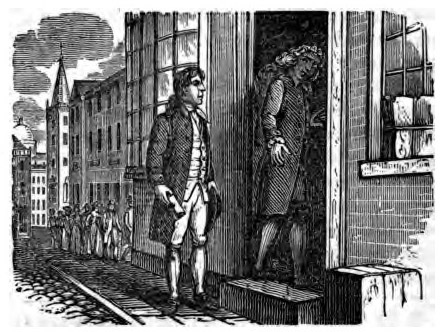
Franklin delivering his letter to the Stationer in London.
CHAPTER V.
Troubled by his Friend Ralph. Obtains Employment. Ralph turns Schoolmaster, and begins an Epic Poem. Franklin teaches some of his Friends to swim. Anecdote of Mr. Denham. Return to Philadelphia. Story of George Webb. Franklin quarrels with Keimer. Returns to work for him. Employed at Burlington. Leaves Keimer.
1. His friend Ralph had accompanied Franklin to London, and they were now inseparable companions. They took lodgings together, at three shillings and sixpence a week. Ralph appears to have been a conceited and helpless character, and made several attempts to get in the way of procuring a livelihood. But all his plans were unsuccessful.
2. Franklin immediately procured employment at an extensive printing house, where he remained nearly a year. He was diligent in work, but his shiftless companion consumed a good share of his earnings. His engagements with Miss Read he was thoughtless and heartless enough to forget, and never wrote to her but once during his absence. This conduct he afterwards considered among the greatest faults of his life.
3. Ralph finally determined to leave London, and take a school in the country. As he was very vain, and confident of rising to literary eminence, he was rather ashamed of what he was silly enough to consider a mean occupation. He accordingly changed his name, and took that of his companion; desiring him to address his letters to "Mr. Franklin, school-master."
4. Ralph continued to write, and, from time to time, troubled his friend with long extracts from an epic poem, which he was then composing, requesting his remarks and corrections. Franklin endeavored to discourage him from this undertaking, but in vain. Sheet after sheet continued to come by every post. Some difficulties at length broke out between the two friends, and Franklin was fortunately relieved of a burdensome dependent.
5. He now began to think of laying up a little money; and, in expectation of better employment, entered a still larger printing house, near Lincoln's Inn Fields. His new employer was named Watts. At this place he became acquainted with a man by the name of Wygate, who had been well educated, read French and Latin, and loved reading.
6. This man and a friend of his were desirous of learning to swim. Franklin had been an expert swimmer from his childhood, and was very fond of displaying his feats of activity in the water. He taught them to swim, after twice going into the river, and they soon became quite skilful. Wygate soon became attached to Franklin, and, at length, proposed that they should travel all over Europe together, supporting themselves on the way by working at their trade. Franklin was inclined to this plan, but was dissuaded from it by his friend, Mr. Denham, who advised him to think of returning to Philadelphia.
7. Mr. Denham was an excellent man, and very kindly disposed towards Franklin. He had formerly been in business in Bristol, a city of England, but failing, and making a settlement with his creditors, he went to America. He had obtained a discharge from all his debts, by giving up all his property. By great industry and economy, he was able to acquire a large fortune, in a few years.
8. He had returned to England, in the same ship with Franklin, and immediately visited his old place of business. While here, he invited all his old creditors to an entertainment. He then thanked them for the easy settlement they had favored him with; and, when they expected nothing but the dinner, every man found, under his plate, an order on the banker, for the full amount of the unpaid remainder, with interest.
9. Mr. Denham was now about to return to Philadelphia, and proposed to take Franklin over as his clerk. He promised him, as soon as he became acquainted with mercantile business, to promote him, and finally establish him in some profitable situation. The plan pleased Franklin, for he had become heartily tired of London, and was anxious to return home. A satisfactory arrangement was made, and Franklin took leave of printing, as he thought, forever.
10. He had thus spent about eighteen months in London, and, during this time, had increased his knowledge, though he had not improved his fortune. They sailed from Gravesend, near the mouth of the river Thames, on the 23d of July, and arrived in Philadelphia early in October. Franklin here found several alterations. Keith was no longer governor, and his place had been supplied by Major Gordon. Miss Read, despairing of his return, had been persuaded by her friends to marry a man by the name of Rogers, a worthless fellow, who left her, and ran away to the West Indies.
11. Mr. Denham took a store, and Franklin attended diligently to the business. Affairs were going on prosperously, when they were both taken violently ill, in the beginning of the year 1727. Mr. Denham died, after a long sickness, and Franklin was again thrown upon the world. He tried for some time to obtain a situation as a merchant's clerk, but, failing in this attempt, he again made an engagement with his old master, Keimer.
12. Keimer was anxious to obtain Franklin's services, as most of his hands were ignorant and needed his instruction. Among these workmen was George Webb, who had been an Oxford scholar, and whose story was an uncommon instance of opportunities neglected and thrown away.
13. He was about eighteen years of age. His birthplace was Gloucester, in England, where he was educated at a grammar school, and had been distinguished when they exhibited plays. From here, he was sent to Oxford, where he continued about a year, but not contentedly; wishing, of all things, to see London, and become a player.
14. At length, receiving his quarterly allowance of fifteen guineas, instead of discharging his debts, he went out of town, hid his gown in a bush, and walked to London. When here, having no friend to advise him, he fell into bad company, soon spent his guineas, found no means of being introduced among the players, grew poor, pawned his clothes, and wanted bread.
15. Walking about the streets, very hungry, and not knowing what to do, a bill was put into his hands, offering immediate entertainment and encouragement to such as would bind themselves to serve in America. He went directly to sign the indentures, was put into the ship, and sailed without writing a line to his friends, to tell them what had become of him. As a companion, he was lively, witty, and good-natured; but idle, thoughtless, and imprudent to the last degree.
16. After continuing a while with Keimer, Franklin found that his services became every day of less importance. At length a trifle snapped their connection. A great noise happening near the printing office, Franklin put his head out of the window to see what was the matter. Keimer, being in the street, looked up, and called out to him, in a loud and angry tone, to mind his business. A number of neighbors, who were standing by, saw the insolent manner in which he was treated, and it vexed him exceedingly. An open quarrel ensued, and Franklin left the printing house.
17. Keimer was very desirous of persuading him to return; and, as it was for the interest of both that harmony should be restored, the quarrel was soon forgotten. A job was now obtained in New Jersey, to print some paper money. Franklin contrived a copperplate press for the purpose, the first that had been seen in the country; he also cut several ornaments and checks for the bills.
18. To execute this job, Franklin and his employer went to Burlington. They performed it to the satisfaction of the government, and received a large compensation. During his short residence here, Franklin made many acquaintance and friends. One of them was Isaac Decon, the surveyor-general, a shrewd, sagacious old man, who began, when young, by wheeling clay for the brick-makers. He learned to write after he was twenty-one years of age, afterwards learned surveying, and had now acquired, by his industry, a considerable property.
19. What had chiefly induced Franklin to return to Keimer, after his quarrel, was the persuasion of a fellow-workman, by the name of Meredith. The father of this young man had promised to advance money to establish him in business, in the ensuing spring, and he was desirous to set Franklin's skill against his own capital, and form a copartnership. The proposal was a fair one, and acceptable upon both sides.
20. A short time after their return from Burlington, the types that Meredith had ordered arrived from London. They settled with Keimer, and left him, by his consent, before he knew any thing about their project.
2. Where did Franklin procure employment?
3. What was the course of his friend Ralph?
5. What new friend did Franklin make?
6. What proposition did he make to Franklin? Why was not the plan carried into execution?
7. Who was Mr. Denham?
8. Describe his honorable conduct towards his old creditors.
9. What proposal did he make to Franklin?
10. How long was Franklin in London? What changes had taken place during his absence?
11. How was Franklin again thrown upon the world? What employment did he obtain?
12. Who was George Webb?
13, 14, 15. What was his story?
16. How did Franklin quarrel with Keimer?
17. Who contrived the first copperplate press ever seen in this country?
18. For what purpose did Franklin visit Burlington?
19. What induced Franklin to return to Keimer, after the separation? What was the proposal of Meredith?
20. When did they leave Keimer?
CHAPTER VI.
The Junto. A new Paper started by Keimer. Franklin purchases it. Difficulties in their Business. A Dissolution of the Partnership. Franklin assisted by his Friends. David Harry. Match-making. Marriage with Miss Read.
1. In the autumn of the preceding year, Franklin had formed, among his acquaintance, a small club for mutual improvement, which they termed the Junto. They met on Friday evenings. The rules required that each member, in his turn, should produce one or more questions on any point of politics, morals or natural philosophy, to be discussed by the company, and once in three months produce and read an essay of his own writing on any subject he pleased.
2. This club answered many good purposes for a great length of time. It introduced better habits of conversation, and drew attention to the most interesting subjects of general inquiry. The members of the club now assisted in bringing business to the young printers. Their industry was unwearied, and soon began to be noticed by their neighbors. This gave them character and credit.
3. George Webb now came to offer them his services, as a journeyman. They were not then able to give him employment, but Franklin let him know, as a secret, that he soon intended to begin a newspaper, and would then probably have work for him. He told him his plan and expectations. His hopes of success were founded on this; that the only newspaper at that time printed there, by Bradford, was a miserable affair, badly managed, not entertaining, and yet profitable.
4. Franklin requested Webb not to mention the project; but he told it to Keimer, who immediately issued proposals for publishing one himself. This vexed Franklin, and, as he was at that time unable to commence his paper, he wrote several amusing pieces for Bradford, under the title of the Busy Body, which were continued by one of his friends for several months. By this means the attention of the public was fixed on that paper, and Keimer's proposals were neglected. He began his paper, however, and carried it on about nine months, with only ninety subscribers. At this time, he offered it, at a very low price, to Franklin, who purchased it, and in a few years made it very profitable.
5. The partnership still continued, though the whole management of the business was confided to Franklin. Meredith knew very little about setting types, or working at the press, and was seldom sober. The connection between them was to be regretted, on many accounts, but Meredith had established the business, and it was now necessary to make the best of it.
6. Their first papers made a better appearance than any that had been before printed in the province. The number of subscribers continually increased, and the leading men found it convenient to oblige and encourage the printers. Bradford still printed the votes, and laws, and public documents; but this business soon fell into the hands of Franklin.
7. A difficulty now occurred, which had been little expected. Mr. Meredith's father, who was to have paid for the printing house, was able to advance only one hundred pounds; and one hundred more were due to the merchant, who became impatient, and sued them all. They gave bail, but unless the money could have been raised in season, they must have sold their press and types, for payment.
8. In this distress, two friends came forward to Franklin, and offered to advance the money, if he would discontinue the partnership with Meredith. Each made the proposition separately, and without the knowledge of the other. These friends were William Coleman and Robert Grace. Franklin told them that he considered himself under obligations to the Merediths, and if they should be able to fulfil their part of the agreement, he could not think of proposing a separation. If they should finally fail in their performance, and the partnership should be dissolved, he would then think himself at liberty to accept the assistance of his friends.
9. Meredith finally proposed a dissolution of the partnership. Franklin consented, and the whole business was left in his hands. He then recurred to his friends, and took half of what he wanted from one, and half from the other. The separation was then publicly advertised, the old debts were paid off, and the business went on in the name of Franklin. This was in or about the year 1729.
10. He now obtained several jobs from the government, and was employed in printing the paper money. A stationer's shop was soon added to his establishment, and he began to pay off gradually the debt he was under for the printing house. In order to secure his character and credit as a trades-man, he was not only industrious and frugal in reality, but avoided any appearance to the contrary. He dressed plainly, and was seen at no places of amusement. To show that he was not above his business, he himself sometimes brought home, on a wheel-barrow, the paper he purchased at the stores.
11. Being thus considered an industrious and thriving young man, the merchants who imported stationery were desirous of his custom. Others proposed supplying him with books, and he went on prosperously. In the mean time, Keimer's business and credit declined daily, and he was at last obliged to sell his printing house, to satisfy his creditors. He went to Barbadoes, and there lived, some years, in great poverty.
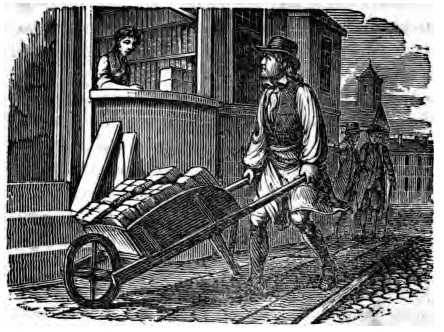
Franklin taking home his paper.
12. An apprentice of Keimer's, David Harry, bought his materials, and set up, in his place, in Philadelphia. His friends were rich, and possessed considerable influence, and Franklin was afraid that he would find Harry a powerful rival. He, therefore, proposed a partnership, which was fortunately rejected. Harry was proud, dressed and lived expensively, neglected his business, and ran in debt. Losing credit, and finding nothing to do, he followed Keimer to Barbadoes, taking his printing materials with him. Here he employed his old master as a journeyman, and was at last obliged to sell his types and return to work in Philadelphia.
13. There now remained no other printer in the place but Bradford. He, however, was rich and easy, and was not anxious about doing much business. His situation as post-master, at that time, was supposed to give him some advantages in obtaining news, and distributing the papers; and he was, on that account, able to procure a great many more advertisements than Franklin. This was of great service to Bradford, and prevented his rival from gaining upon him so rapidly as he otherwise would have done.
14. Franklin had hitherto boarded with Mr. Godfrey, a glazier, who was very much distinguished for his knowledge of mathematics. The wife of Mr. Godfrey was desirous of making a match for the young printer, and fixed upon the daughter of a neighbor, as a suitable person. She contrived, in several ways, to bring them together, and at length Franklin made proposals of marriage.
15. Franklin appears to have been equally prudent and cautious in this affair, as in every thing else. He gave Mrs. Godfrey to understand, and carry to the parents, that he expected one hundred pounds with their daughter. She brought him word that they had no such sum to spare. Franklin sent back, in reply, that they might mortgage their house.
16. The answer to this, after a few days, was, that they did not approve the match; that, on inquiry of Mr. Bradford, they had been informed the printing business was not a profitable one; that Keimer and Harry had failed, and that he would probably soon follow them. The daughter was, accordingly, shut up, and Franklin was forbidden the house.
17. He suspected that this was merely a trick of the parents, to induce him to run away with the young lady, and leave them at liberty to make what terms they pleased. He immediately broke off the connection. The Godfreys were angry, quarrelled with him, and he left the house.
18. He had always continued on friendly terms with the family of the young lady to whom he had been engaged before his visit to London. Her unfortunate marriage made her very dejected and miserable. Franklin saw her, and could not help attributing her unhappiness, in a great measure, to his own misconduct.
19. Their mutual affection was revived, but there were now great objections to the union. Her former husband had not been heard of, and was supposed to be dead. All difficulties were finally surmounted, and he married Miss Read on the first of September, 1730.
1. What was the Junto? What did the rules of this club require?
2. What good purposes did it answer?
3. What project did Franklin communicate to George Webb?
4. What was the consequence of this communication? What course did Franklin pursue?
6. How did the paper succeed under Franklin's management?
7. What difficulty arose at this time?
8. Who offered Franklin their assistance?
9. What did Meredith propose? How was Franklin relieved?
10. Describe the increase of his business, and his character and conduct as a tradesman.
11. What became of Keimer?
12. Who was David Harry? What became of him?
13. Who was now the only rival of Franklin?
14. Describe Mrs. Godfrey's desire of match-making.
15. Did Franklin show his usual prudence?
16. What was the result?
19. Whom did Franklin marry? When?
CHAPTER VII.
Library of the Junto. A public Library established. Franklin studies. His Frugality. Anecdote of the Bowl and Spoon. His Scheme of arriving at Moral Perfection. Table of Precepts. Franklin's Remarks upon it. Poor Richard's Almanac.
1. At the time Franklin first established himself in Pennsylvania, there was not a good bookseller's shop any where to the south of Boston. In New York and Philadelphia, the printers were stationers, but they kept only paper, almanacs, ballads, and a few common school books. Those who loved reading were obliged to send for their books from England.
2. The members of the Junto had, each of them, a few volumes. They had hired a room, in which to hold their meetings, and Franklin proposed that they should all bring their books to that room. In this manner they would not only be ready for them to consult and refer to, but would become a common benefit, by allowing each one to borrow such as he wished to read at home.
3. This was accordingly done, and for a while answered their purpose very well. Finding the advantage and convenience of this little collection, Franklin proposed to render the benefit more general, by commencing a public subscription library. He drew a sketch of the plan and rules that would be necessary, and had them put into the form of articles to be subscribed. By these articles, each subscriber agreed to pay a certain sum for the first purchase of the books, and a yearly contribution for increasing them.
4. The number of readers, at that time, in Philadelphia, was so small, that it was with great difficulty Franklin was able to procure fifty subscribers, willing to pay forty shillings to begin with, and ten shillings a year for a contribution. With this number the library was commenced. The books were imported, and lent out to subscribers. Great advantages were derived from the institution, and it was soon imitated in other places.
5. In this library, Franklin found means of continual improvement. He set apart an hour or two in each day for study, and in this way, in some degree, made up for the loss of a learned education. Reading was his only amusement. His attention to business was as strict as it was necessary. He was in debt for his printing house, and had an increasing family; with two rivals in his business, who had been established before him. Notwithstanding all this, however, he grew more easy in his circumstances every day.
6. His early habits of frugality continued. He often thought of the proverb of Solomon, which his father had impressed on him while a boy—"Seest thou a man diligent in his calling? he shall stand before kings, he shall not stand before mean men." Industry appeared a means of obtaining wealth and distinction, and the thought encouraged him to new exertions. We shall see, by and by, that little as his father expected it, the son really came to stand, with honor, in the presence of monarchs.
7. His wife was, fortunately, as well inclined to industry and frugality as he was himself. She assisted him in his business, folding and stitching pamphlets, tending shop, and purchasing old linen rags for the paper-makers. They kept no idle servants, their table was simply furnished, and their furniture was plain and cheap.
8. "My breakfast," says Franklin, "was for a long time bread and milk (no tea), and I ate it out of a twopenny earthen porringer, with a pewter spoon: but mark how luxury will enter families, and make a progress in spite of principle; being called one morning to breakfast, I found it in a china bowl, with a spoon of silver. They had been bought for me, without my knowledge, by my wife, and had cost her the enormous sum of three and twenty shillings; for which she had no other excuse or apology to make, but that she thought her husband deserved a silver spoon and china bowl as well as any of his neighbors. This was the first appearance of plate and china in our house, which afterwards, in a course of years, as our wealth increased, augmented gradually to several hundred pounds in value."
9. It was about this time that Franklin formed the bold and difficult project of arriving at moral perfection. As he knew, or thought he knew, what was right and wrong, he did not see why he might not always do the one and avoid the other. For this purpose, he made a table of the different virtues, with certain rules and precepts annexed to them. Some of these were as follows:
1. Temperance.—Eat not to dulness: drink not to elevation.
2. Silence.—Speak not but what may benefit others or yourself: avoid trifling conversation.
3. Order.—Let all your things have their places: let each part of your business have its time.
4. Resolution.—Resolve to perform what you ought: perform, without fail, what you resolve.
5. Frugality.—Make no expense but to do good to others or yourself; that is, waste nothing.
6. Industry.—Lose no time: be always employed in something useful: cut off all unnecessary actions.
7. Sincerity.—Use no hurtful deceit: think innocently and justly: and if you speak, speak accordingly.
8. Justice.—Wrong none by doing injuries, or omitting the benefits that are your duty.
9. Moderation.—Avoid extremes: forbear resenting injuries so much as you think they deserve.
10. Cleanliness.—Tolerate no uncleanliness in body, clothes, or habitation.
11. Tranquility.—Be not disturbed at trifles, nor at accidents common or unavoidable.
10. To acquire a habit of practising these virtues, he determined to give a week's strict attention to each of them in succession. Thus, in the first week, he took care to avoid even the slightest offence against temperance, and strictly marked every fault in a little book he kept for that purpose. This book he continued to keep for a great number of years; till, in the pressure of public business, he was obliged to give it up entirely.
11. "It is well," he wrote in his old age, "my posterity should be informed that to this little artifice their ancestor owed the constant felicity of his life, down to his seventy-ninth year, in which this is written. What reverses may attend the remainder is in the hand of Providence: but if they arrive, the reflection on past happiness enjoyed ought to help his bearing them with more resignation."
12. "To Temperance he ascribes his long continued health, and what is still left to him of a good constitution. To Industry and Frugality, the early easiness of his circumstances, and acquisition of his fortune, with all that knowledge that enabled him to be an useful citizen, and obtained for him some degree of reputation among the learned. To Sincerity and Justice, the confidence of his country, and the honorable employs it conferred upon him: and to the joint influence of the whole mass of the virtues, even in the imperfect state he was able to acquire them, all that evenness of temper and that cheerfulness in conversation, which makes his company still sought for, and agreeable even to his young acquaintance: I hope, therefore, that some of my descendants may follow the example, and reap the benefit."
13. In 1732, Franklin first published his almanac, under the name of Richard Saunders. It was continued by him about twenty-five years, and was commonly called Poor Richard's Almanac. He endeavored to make it both entertaining and useful, and it accordingly came to be in great demand. As it was generally read, and as the poor people bought hardly any other books, Franklin thought it would be a good means to circulate instruction among them. He, therefore, filled all the odd spaces with proverbs and wise sayings.
14. These proverbs contained the experience and wisdom of many nations and ages. In 1757, Franklin collected them into a discourse prefixed to the almanac for that year. In this discourse, he represented an old man talking to a number of people who were attending a sale at auction. The hour for the sale not having come, the company were conversing on the badness of the times.
15. One of them called out to a plain, clean old man, with white locks, "Pray, father Abraham, what think ye of the times? Won't these heavy taxes quite ruin the country? How shall we be ever able to pay them? What would you advise us to do?" Father Abraham stood up, and replied, "If you'd have my advice, I'll give it to you in short; 'for a word to the wise is enough; and many words won't fill a bushel,' as Poor Richard says."
16. The old man then went on to advise them to be industrious and economical; and, in the course of his advice, repeated all of the wise sayings of Poor Richard. In this manner they were all collected into a single paper, called The Way to Wealth. This piece was very much approved, copied into all the American newspapers, reprinted in Great Britain, and translated into the French language. Large numbers of it were, in this manner, distributed, and undoubtedly did a good deal of service.
2. What plan did Franklin propose for the formation of a library?
3. How did it succeed? How did Franklin propose to extend its advantages?
4. How many subscribers were obtained?
5. Did Franklin still pursue his studies, and how? Did his early habits continue? What was the proverb so often repeated by his father?
7. What was the conduct of his wife?
8. Describe Franklin's breakfast, and give his humorous account of the first appearance of luxury in his house.
9. What was Franklin's favorite project at this time? Repeat the table of virtues, and the precepts annexed to them.
10. How did he attempt to acquire a habit of these virtues?
12. To what does Franklin ascribe his long continued health? the ease of his circumstances? the confidence and honor he received from his country?
13. When did he first publish his almanac? How long was it continued? How did he endeavor to make it useful?
14. What was prefixed to the almanac for 1757?
16. How was The Way to Wealth approved?
CHAPTER VIII.
Management of his Newspaper. Study of the Languages. Chess-playing. The Preacher Hemphill. Stealing Sermons. Visit to Boston. Visits his Brother James at Newport. Usefulness of the Junto. Formation of new Clubs. Franklin chosen Clerk of the General Assembly. Anecdote.
1. Besides his almanac, Franklin considered his newspaper as a very valuable means of circulating instruction and good advice among the people. For this purpose he frequently reprinted in it extracts from the Spectator, a work written a good many years ago, by several distinguished English authors. It is a collection of pieces on moral and popular subjects, in a very pleasant style, and first published in single numbers of a few pages each.
2. In conducting his paper, Franklin was very careful to avoid all abuse of particular persons. Whenever he was requested to publish any thing of the kind, his answer was, that he would print the piece by itself, and give the author as many copies for his own use as he desired. He very wisely considered that his subscribers expected him to furnish them with useful and entertaining pieces, and not with abuse and violent discussions about things with which they had nothing to do.
3. In 1733, Franklin sent one of his apprentices to Charleston, South Carolina, where a printer was wanted. He furnished him with a press and types, and was to receive one third of the profits of the business. After the death of this man, who was very irregular in settling his affairs with Franklin, the business was continued by his widow. This woman had been born and educated in Holland, where females were taught a knowledge of accounts. She managed the establishment with a great deal of prudence and success, and was in time able to purchase the printing office, and establish her son in it.
4. In 1733, Franklin began the study of foreign languages. He soon obtained such a knowledge of the French, as to read books in that language with perfect ease. After this he undertook the Italian. An acquaintance, who was also learning it, often tempted him to play chess. Finding this took up too much time, Franklin refused to play any more, except upon one condition. This was, that whichever of them should beat, should have a right to impose a task upon the other; either of part of the grammar to be got by heart, or in translations.
5. These tasks they were bound in honor to perform before the next meeting. The two friends played with about equal skill and success, and in this way soon beat each other into a pretty good knowledge of the Italian. Franklin next undertook Spanish, and learned enough to read books in that language with considerable ease.
6. About the year 1734, a young preacher arrived in Philadelphia, by the name of Hemphill. He had a good voice, and delivered very excellent sermons. Large numbers were attracted by his eloquence, of different doctrines and belief. Among the rest, Franklin became a very constant hearer. He was pleased with his sermons, because they impressed the love and the practice of virtue and goodness, without quarrelling about hard questions of doctrinal religion.
7. Some of the congregation, however, disapproved of his preaching, and united with the old ministers to attempt to put him down. Franklin took sides with him very warmly, and did all he could to raise a party in his favor. He wrote two or three pamphlets in his defence.
8. During this contest the unlucky preacher hurt his own cause by a very unpardonable meanness. One of his enemies heard him preach a very eloquent sermon, and thought he had somewhere heard or read parts of it before. On looking into the matter, he found the preacher had stolen several passages from a discourse delivered by a celebrated English divine. This discovery induced many of his friends to desert him, and he was obliged to go in search of a congregation less inquisitive.
9. After ten years' absence from Boston, Franklin determined to make a journey there to visit his relations. He was now doing very good business, and was in quite easy circumstances. He had seen a good many changes in his fortunes, since he first ran away from his native place; and his industry and good sense were to bring about still greater changes.
10. In returning to Philadelphia, he stopped at Newport, to see his brother James, who was, at that time, settled there with his printing office. Their former differences were at once forgotten, and the meeting was very cordial and affectionate. James was at that time in very ill health, and in expectation of a speedy death. He, accordingly, requested Benjamin, when that event should happen, to take home his son, then but ten years of age, and bring him up to the printing business.
11. This he accordingly performed, sending him a few years to school before he took him into the office. When James died, his widow carried on the business till her son was grown up. At that time, Benjamin assisted them with an assortment of new types, and they were, in this manner, enabled to continue the establishment.
Reconciliation of Franklin with his Brother.
12. The club which Franklin had founded proved to be so useful, and afforded so much satisfaction to the members, that they proposed to introduce their friends, and increase their number. They had, from the beginning, determined to keep the Junto a secret, and the secret was kept better than such things usually are. Franklin was of opinion that twelve members formed a club sufficiently large, and that it would be inconvenient to increase it.
13. Instead of adding to their number, he proposed that every member, separately, should endeavor to form another club, with the same rules and on the same plan, without informing them of the existence of the Junto. The project was approved, and every member undertook to form his club; but they did not all succeed. Five or six only were completed, which were called by different names, as the Vine, the Union, the Band. These clubs were useful, and afforded their members a good deal of amusement and information.
14. In 1736, Franklin was chosen clerk of the General Assembly. The choice was made that year without any opposition, but, on the next, a new member of that body made a long speech against him. This, however, did not prevent his second election. The place was one of some credit, and, by giving Franklin an opportunity to make friends among the members, enabled him to secure the business of printing the public laws, votes, and paper money.
15. The new member, who had opposed Franklin, was a man of education and talents, and it was desirable to gain his good opinion. Franklin was too proud to pay any servile respect to him, but was too prudent not to wish for his favor. After some time, with his usual shrewdness and knowledge of human nature, he hit upon the following expedient.
16. Having heard that this gentleman had in his library a very scarce and curious book, he wrote a note, requesting that he would do him the favor of lending it for a few days. The book was immediately sent, and in about a week was returned by the borrower, with a short note, expressive of his sincere thanks for the favor.
17. The next time they met in the house, the gentleman spoke to Franklin with a great deal of civility. He ever after manifested a readiness to serve him, and they became great friends. "This is another instance," observes Franklin, "of the truth of an old maxim I had learned, which says—'He that has done you a kindness will be more ready to do you another, than he whom you yourself have obliged.' And it shows how much more profitable it is prudently to remove than to resent, return, and continue inimical proceedings."
18. In 1737, Colonel Spotswood, at that time postmaster-general, being dissatisfied with his deputy at Philadelphia, took away his commission, and offered it to Franklin. He accepted it with readiness, and found it of great advantage. Though the salary was small, the office gave him the means of increasing the subscribers to his paper, and in this way increased his advertisements. His paper now began to afford him a very considerable income.
1. How did he make his newspaper serviceable in circulating instruction?
2. What was he very careful to avoid?
3. Describe the conduct of the woman whose husband Franklin had established in business.
4. When did Franklin begin the study of foreign languages? What languages did he study? Relate the anecdote about chess-playing.
6. Who was Hemphill?
7. What did Franklin write in his behalf?
8. How did the preacher ruin his own cause?
9. How long had Franklin been absent from Boston when he determined to revisit it?
10. How was the interview between the brothers at Newport? What request did James make respecting his son?
11. How did Franklin comply with this request?
12. How did the Junto flourish?
13. What new clubs were formed? How?
14. To what office was Franklin elected in 1736?
16. How did Franklin conciliate a member who was opposed to him?
17. What is the old maxim quoted by Franklin?
18. To what office was Franklin appointed in 1737?
CHAPTER IX.
Reform of the City Watch. Fire Companies. Rev. Mr. Whitefield. Effects of his Preaching. His Project of building an Orphan House in Georgia. Anecdotes. Franklin's Opinion of him. Franklin's Prosperity. Military Defence of the Province. Formation of Companies.
1. Franklin now began to turn his attention to public affairs. One of his first efforts in this way was to reform the city watch. This was managed in the different wards by the constables, who assembled a certain number of housekeepers to attend them for the night. Those who did not choose to attend paid six shillings a year to be excused. This made the constableship an office of profit: for, instead of spending the money thus received in hiring other watchmen, it was spent in liquors, by which the constables were able to get a parcel of ragamuffins about them, instead of decent and orderly men.
2. These fellows seldom went the rounds of the watch, but spent most of the night in tippling. In the course of a few years, by the exertions of Franklin and his friends, an entire alteration was produced in the laws upon this subject. About the same time that he began to converse at the Junto on the abuses of the watch, he wrote a paper on the different accidents by which houses were set on fire, and means proposed of avoiding them.
3. This gave rise to a project, which soon followed, of forming a company to assist, with readiness, at fires. Thirty persons were immediately found, willing to join in the scheme. Their articles of agreement obliged every member to keep, always in order and fit for use, a certain number of leathern buckets, with strong bags and baskets for packing and carrying goods, which were to be brought at every fire. They also held a monthly meeting, to converse upon the subject of fires, and communicate such ideas as might be useful in their conduct on such occasions.
4. This company proved so useful, that another was soon formed; and thus went on, one new company after another, till they included most of the inhabitants who were men of property. The club first formed was called the Union Fire Company, and, we believe, still exists. These institutions have been exceedingly useful in extinguishing fires and preserving property.
5. In 1739, the Reverend Mr. Whitefield arrived in Philadelphia, from Ireland. This man had made himself very remarkable as a preacher, going about the country and discoursing, sometimes in churches, sometimes in the fields, to crowds of people, with great effect. He was, at first, permitted to preach in some of the churches in Philadelphia, but the clergy soon took a dislike to him, and refused him their pulpits. This obliged him again to discourse in the streets and open fields.
6. Large multitudes collected to hear his sermons. "It was wonderful," says Franklin, "to see the change soon made in the manners of our inhabitants. From being thoughtless or indifferent about religion, it seemed as if all the world were growing religious, so that one could not walk through the town in an evening, without hearing psalms sung in different families of every street. And it being found inconvenient to assemble in the open air, subject to its inclemencies, the building of a house to meet in was no sooner proposed, and persons appointed to receive contributions, but sufficient sums were soon received to procure the ground and erect the building, which was one hundred feet long and seventy broad; and the work was carried on with such spirit, as to be finished in a much shorter time than could be expected."
7. On leaving Philadelphia, Mr. Whitefield went preaching all the way through the colonies to Georgia. The settlement of that province had then been recently commenced, and was made with people entirely unfit for such a service. They were unable to endure hardships, and perished in great numbers, leaving many helpless children, with nothing to feed or shelter them.
8. "The sight of their miserable situation," says Franklin, "inspired the benevolent heart of Mr. Whitefield with the idea of building an orphan house there, in which they might be supported and educated. Returning northward, he preached up this charity, and made large collections; for his eloquence had a wonderful power over the hearts and purses of his hearers, of which I myself was an instance.
9. "I did not disapprove of the design, but as Georgia was then destitute of materials and workmen, and it was proposed to send them from Philadelphia, at a great expense, I thought it would have been better to have built the house at Philadelphia, and brought the children to it. This I advised, but he was resolute in his first project, rejected my counsel, and I, therefore, refused to contribute.
10. "I happened, soon after, to attend one of his sermons, in the course of which, I perceived he intended to finish with a collection, and I silently resolved he should get nothing from me. I had in my pocket a handful of copper money, three or four silver dollars, and five pistoles in gold; as he proceeded, I began to soften, and concluded to give the copper. Another stroke of his oratory made me ashamed of that, and determined me to give the silver; and he finished so admirably, that I emptied my pocket wholly into the collector's dish, gold and all!
11. "At this sermon there was also one of our club, who, being of my sentiments respecting the building in Georgia, and suspecting a collection might be intended, had, by precaution, emptied his pockets before he came from home; towards the conclusion of the discourse, however, he felt a strong inclination to give, and applied to a neighbor who stood near him, to lend him some money for the purpose. The request was fortunately made to perhaps the only man in the company who had the firmness not to be affected by the preacher. His answer was, 'At any other time, friend Hopkinson, I would lend to thee freely; but not now, for thee seems to me to be out of thy right senses.'
12. "Some of Mr. Whitefield's enemies affected to suppose that he would apply these collections to his own private emolument; but I, who was intimately acquainted with him (being employed in printing his sermons, journals, &c.), never had the least suspicion of his integrity, but am to this day decidedly of opinion, that he was, in all his conduct, a perfectly honest man; and methinks my testimony in his favor ought to have the more weight, as we had no religious connection. Ours was a mere civil friendship, sincere on both sides, and lasted to his death.
13. "The last time I saw Mr. Whitefield was in London, when he consulted me about his orphan house concern, and his purpose of appropriating it to the establishment of a college.
14. "He had a loud and clear voice, and articulated his words so perfectly that he might be heard and understood at a great distance; especially as his auditories observed the most perfect silence. He preached one evening from the top of the court house steps, which are in the middle of Market street, and on the west side of Second street, which crosses it at right angles. Both streets were filled with hearers to a considerable distance; being among the hindmost in Market street, I had the curiosity to learn how far he could be heard, by retiring backwards down the street towards the river, and I found his voice distinct till I came near Front street, when some noise in that street obscured it. I computed that he might well be heard by more than thirty thousand. This reconciled me to the newspaper accounts of his having preached to 25,000 people in the fields, and to the history of generals haranguing whole armies, of which I had sometimes doubted."
15. Franklin's business was now constantly increasing, and his newspaper had become very profitable. He began to feel the truth of the old proverb, "that after getting the first hundred pounds, it is more easy to get the second." Those of his workmen who behaved well, he established in printing houses in different colonies, on easy terms. Most of them did well, and were able to repay him what he had advanced, and go on working for themselves.