Chapter VII · LIFE IN AVA AND OUNG-PEN-LA. 1823-1826. (continued 2)
Reading edition
“My first object, the next morning, was to go in search of your brother; and I had the mortification to meet him again in prison, though not the death-prison. I went immediately to my old friend the governor of the city, who now was raised to the rank of a woon-gyee. He informed me that Mr. Judson was to be sent to the Burmese camp, to act as translator and interpreter; and that he was put in confinement for a short time only till his affairs were settled. Early the following morning I went to this officer again, who told me that Mr. Judson had that moment received twenty ticals from Government, with orders to go immediately on board a boat for Maloun, and that he had given him permission to stop a few moments at the house, it being on his way. I hastened back to the house, where Mr. Judson soon arrived, but was allowed to remain only a short time, while I could prepare food and clothing for future use. He was crowded into a little boat, where he had not room sufficient to lie down, and where his exposure to the cold, damp nights threw him into a violent fever which had nearly ended all his sufferings. He arrived at Maloun on the third day, where, ill as he was, he was obliged to enter immediately on the work of translating. He remained at Maloun six weeks, suffering as much as he had at any time in prison, excepting he was not in irons, nor exposed to the insults of those cruel jailers.
“For the first fortnight after his departure, my anxiety was less than it had been at any time previously since the commencement of our difficulties. I knew the Burmese officers at the camp would feel the value of Mr. Judson’s 256services too much to allow their using any measures threatening his life. I thought his situation, also, would be much more comfortable than it really was; hence my anxiety was less. But my health, which had never been restored since that violent attack at Oung-pen-la, now daily declined, till I was seized with the spotted fever, with all its attendant horrors. I knew the nature of the fever from its commencement; and from the shattered state of my constitution, together with the want of medical attendants, I concluded it must be fatal. The day I was taken with the fever, a Burmese nurse came and offered her services for Maria. This circumstance filled me with gratitude and confidence in God; for, though I had so long and so constantly made efforts to obtain a person of this description, I had never been able; when at the very time I most needed one, and without any exertion, a voluntary offer was made. My fever raged violently, and without any intermission. I began to think of settling my worldly affairs, and of committing my dear little Maria to the care of a Portuguese woman, when I lost my reason, and was insensible to all around me. At this dreadful period, Dr. Price was released from prison, and hearing of my illness, obtained permission to come and see me. He has since told me that my situation was the most distressing he had ever witnessed, and that he did not then think I should survive many hours. My hair was shaved, my head and feet covered with blisters, and Dr. Price ordered the Bengalee servant who took care of me to endeavor to persuade me to take a little nourishment, which I had obstinately refused for several days. One of the first things I recollect was seeing this faithful servant standing by me, trying to induce me to take a little wine and water. I was, in fact, so far gone that the Burmese neighbors, who had come in to see me expire, said, ‘She is dead; and if the King of Angels should come in, He could not recover her.’her.’
“The fever, I afterward understood, had run seventeen days when the blisters were applied. I now began to recover slowly, but it was more than a month after this before I had strength to stand. While in this weak, debilitated 257state, the servant who had followed your brother to the Burmese camp came in, and informed me that his master had arrived, and was conducted to the court-house in town. I sent off a Burman to watch the movements of Government, and to ascertain, if possible, in what way Mr. Judson was to be disposed of. He soon returned with the sad intelligence that he saw Mr. Judson go out of the palace-yard accompanied by two or three Burmans, who conducted him to one of the prisons, and that it was reported in town that he was to be sent back to the Oung-pen-la prison. I was too weak to bear ill tidings of any kind; but a shock so dreadful as this almost annihilated me. For some time I could hardly breathe, but at last gained sufficient composure to dispatch Moung Ing to our friend the governor of the north gate, and begged him to make one more effort for the release of Mr. Judson, and prevent his being sent back to the country prison, where I knew he must suffer much, as I could not follow. Moung Ing then went in search of Mr. Judson; and it was nearly dark when he found him, in the interior of an obscure prison. I had sent food early in the afternoon; but being unable to find him, the bearer had returned with it, which added another pang to my distresses, as I feared he was already sent to Oung-pen-la.
“If ever I felt the value and efficacy of prayer, I did at this time. I could not rise from my couch; I could make no efforts to secure my husband; I could only plead with that great and powerful Being who has said, ‘Call upon me in the day of trouble, and I will hear, and thou shalt glorify me,’ and who made me at this time feel so powerfully this promise that I became quite composed, feeling assured that my prayers would be answered.
“When Mr. Judson was sent from Maloun to Ava, it was within five minutes’ notice, and without his knowledge of the cause. On his way up the river, he accidentally saw the communication made to Government respecting him, which was simply this: ‘We have no further use for Yoodthan; we therefore return him to the golden city.’ On arriving at the court-house, there happened to be no one present who was 258acquainted with Mr. Judson. The presiding officer inquired from what place he had been sent to Maloun. He was answered, from Oung-pen-la. ‘Let him, then,’ said the officer, ‘be returned thither’; when he was delivered to a guard and conducted to the place above mentioned, there to remain until he could be conveyed to Oung-pen-la. In the meantime, the governor of the north gate presented a petition to the high court of the empire, offered himself as Mr. Judson’s security, obtained his release, and took him to his house, where he treated him with considerable kindness, and to which I was removed as soon as returning health would allow.
“The advance of the English army toward the capital at this time threw the whole town into the greatest state of alarm, and convinced the Government that some speedy measures must be taken to save the golden city. They had hitherto rejected all the overtures of Sir Archibald Campbell, imagining, until this late period, that they could in some way or other drive the English from the country. Mr. Judson and Dr. Price were daily called to the palace and consulted; in fact, nothing was done without their approbation. Two English officers, also, who had lately been brought to Ava as prisoners, were continually consulted, and their good offices requested in endeavoring to persuade the British general to make peace on easier terms. It was finally concluded that Mr. Judson and one of the officers above mentioned should be sent immediately to the English camp in order to negotiate. The danger attached to a situation so responsible, under a Government so fickle as the Burmese, induced your brother to use every means possible to prevent his being sent. Dr. Price was not only willing, but desirous of going; this circumstance Mr. Judson represented to the members of Government, and begged he might not be compelled to go, as Dr. Price could transact the business equally as well as himself. After some hesitation and deliberation Dr. Price was appointed to accompany Dr. Sandford, one of the English officers, on condition that Mr. Judson would stand security for his return, while the other English officer, then 259in irons, should be security for Dr. Sandford. The king gave them a hundred ticals each to bear their expenses (twenty-five of which Dr. Sandford generously sent to Mr. Gouger, still a prisoner at Oung-pen-la), boats, men, and a Burmese officer to accompany them, though he ventured no farther than the Burman camp. With the most anxious solicitude the court waited the arrival of the messengers, but did not in the least relax in their exertions to fortify the city. Men and beasts were at work night and day, making new stockades and strengthening old ones, and whatever buildings were in their way were immediately torn down. Our house, with all that surrounded it, was levelled to the ground, and our beautiful little compound turned into a road and a place for the erection of cannon. All articles of value were conveyed out of town and safely deposited in some other place.
“At length the boat in which the ambassadors had been sent was seen approaching, a day earlier than was expected. As it advanced toward the city, the banks were lined by thousands, anxiously inquiring their success. But no answer was given; the Government must first hear the news. The palace gates were crowded, the officers at the lut-d’hau were seated, when Dr. Price made the following communication: ‘The general and commissioners will make no alteration in their terms, except the hundred lacks [a lack is a hundred thousand] of rupees may be paid at four different times; the first twenty-five lacks to be paid within twelve days, or the army will continue their march.’ In addition to this, the prisoners were to be given up immediately. The general had commissioned Dr. Price to demand Mr. Judson, and myself, and little Maria. This was communicated to the king, who replied: ‘They are not English; they are my people, and shall not go.’ At this time I had no idea that we should ever be released from Ava. The Government had learned the value of your brother’s services, having employed him the last three months; and we both concluded they would never consent to our departure. The foreigners were again called to a consultation, to see what could be done. Dr. Price and 260Mr. Judson told them plainly that the English would never make peace on any other terms than those offered, and that it was in vain to go down again without the money. It was then proposed that a third part of the first sum demanded should be sent down immediately. Mr. Judson objected, and still said it would be useless. Some of the members of Government then intimated that it was probable the teachers were on the side of the English, and did not try to make them take a smaller sum; and also threatened, if they did not make the English comply, they and their families should suffer.
“In this interval, the fears of the Government were considerably allayed by the offers of a general, by name Layar-thoo-yah, who desired to make one more attempt to conquer the English, and disperse them. He assured the king and Government that he could so fortify the ancient city of Pugan as to make it impregnable, and that he would there defeat and destroy the English. His offers were heard; he marched to Pugan with a very considerable force, and made strong the fortifications. But the English took the city with perfect ease, and dispersed the Burmese army; while the general fled to Ava, and had the presumption to appear in the presence of the king and demand new troops. The king, being enraged that he had ever listened to him for a moment, in consequence of which the negotiation had been delayed, the English general provoked, and the troops daily advancing, ordered the general to be immediately executed. The poor fellow was soon hurled from the palace, and beat all the way to the court-house, when he was stripped of his rich apparel, bound with cords, and made to kneel and bow toward the palace. He was then delivered into the hands of the executioners, who, by their cruel treatment, put an end to his existence before they reached the place of execution.
“The king caused it to be reported that this general was executed in consequence of disobeying his commands ‘not to fight the English.’
“Dr. Price was sent off the same night, with part of the prisoners, and with instructions to persuade the general to 261take six lacks instead of twenty-five. He returned in two or three days, with the appalling intelligence that the English general was very angry, refused to have any communication with him, and was now within a few days’ march of the capital. The queen was greatly alarmed, and said the money should be raised immediately, if the English would only stop their march. The whole palace was in motion; gold and silver vessels were melted up; the king and queen superintended the weighing of a part of it, and were determined, if possible, to save their city. The silver was ready in the boats by the next evening; but they had so little confidence in the English, that, after all their alarm, they concluded to send down six lacks only, with the assurance that, if the English would stop where they then were, the remainder should be forthcoming immediately.
“The Government now did not even ask Mr. Judson the question whether he would go or not; but some of the officers took him by the arm, as he was walking in the street, and told him he must go immediately on board the boat, to accompany two Burmese officers, a woon-gyee and woon-douk, who were going down to make peace. Most of the English prisoners were sent at the same time. The general and commissioners would not receive the six lacks, neither would they stop their march; but promised, if the sum complete reached them before they should arrive at Ava, they would make peace. The general also commissioned Mr. Judson to collect the remaining foreigners, of whatever country, and ask the question, before the Burmese Government, whether they wished to go or stay. Those who expressed a wish to go should be delivered up immediately, or peace would not be made.
“Mr. Judson reached Ava at midnight, had all the foreigners called the next morning, and the question asked. Some of the members of Government said to him, ‘You will not leave us; you shall become a great man if you will remain.’ He then secured himself from the odium of saying that he wished to leave the service of his majesty, by recurring to the order of Sir Archibald, that whoever wished to leave Ava 262should be given up, and that I had expressed a wish to go, so that he of course must follow. The remaining part of the twenty-five lacks was soon collected; the prisoners at Oung-pen-la were all released, and either sent to their houses, or down the river to the English; and in two days from the time of Mr. Judson’s return, we took an affectionate leave of the good-natured officer who had so long entertained us at his house, and who now accompanied us to the waterside, and we then left forever the banks of Ava.
“It was on a cool, moonlight evening, in the month of March, that with hearts filled with gratitude to God, and overflowing with joy at our prospects, we passed down the Irrawaddy, surrounded by six or eight golden boats, and accompanied by all we had on earth. The thought that we had still to pass the Burman camp would sometimes occur to damp our joy, for we feared that some obstacle might there arise to retard our progress. Nor were we mistaken in our conjectures. We reached the camp about midnight, where we were detained two hours; the woon-gyee and high officers insisting that we should wait at the camp, while Dr. Price, who did not return to Ava with your brother, but remained at the camp, should go on with the money, and first ascertain whether peace would be made. The Burmese Government still entertained the idea that, as soon as the English had received the money and prisoners, they would continue their march, and yet destroy the capital. We knew not but that some circumstance might occur to break off the negotiations. Mr. Judson therefore strenuously insisted that he would not remain, but go on immediately. The officers were finally prevailed on to consent, hoping much from Mr. Judson’s assistance in making peace.
“We now, for the first time for more than a year and a half, felt that we were free, and no longer subject to the oppressive yoke of the Burmese. And with what sensations of delight, on the next morning, did I behold the masts of the steamboat, the sure presage of being within the bounds of civilized life! As soon as our boat reached the shore, Brigadier A. and another officer came on board, congratulated us on our 263arrival, and invited us on board the steamboat, where I passed the remainder of the day; while your brother went on to meet the general, who, with a detachment of the army, had encamped at Yandabo, a few miles farther down the river. Mr. Judson returned in the evening, with an invitation from Sir Archibald to come immediately to his quarters, where I was the next morning introduced, and received with the greatest kindness by the general, who had a tent pitched for us near his own, took us to his own table, and treated us with the kindness of a father, rather than as strangers of another country.
“We feel that our obligations to General Campbell can never be cancelled. Our final release from Ava, and our recovering all the property that had there been taken, was owing entirely to his efforts. His subsequent hospitality, and kind attention to the accommodations for our passage to Rangoon, have left an impression on our minds which can never be effaced. We daily received the congratulation of the British officers, whose conduct toward us formed a striking contrast to that of the Burmese. I presume to say that no persons on earth were ever happier than we were during the fortnight we passed at the English camp. For several days this single idea wholly occupied my mind—that we were out of the power of the Burmese Government, and once more under the protection of the English. Our feelings continually dictated expressions like this: What shall we render to the Lord for all His benefits toward us?
“The treaty of peace was soon concluded, signed by both parties, and a termination of hostilities publicly declared. We left Yandabo after a fortnight’s residence, and safely reached the mission-house in Rangoon after an absence of two years and three months.
“A review of our trip to and adventures in Ava often excites the inquiry, Why were we permitted to go? What good has been effected? Why did I not listen to the advice of friends in Bengal, and remain there till the war was concluded? But all that we can say is, It is not in man that walketh to direct his steps. So far as my going round to Rangoon, 264at the time I did, was instrumental in bringing those heavy afflictions upon us, I can only state that, if I ever acted from a sense of duty in my life, it was at that time; for my conscience would not allow me any peace when I thought of sending for your brother to come to Calcutta, in prospect of the approaching war. Our society at home have lost no property in consequence of our difficulties; but two years of precious time have been lost to the mission, unless some future advantage may be gained in consequence of the severe discipline to which we ourselves have been subject. We are sometimes induced to think that the lesson we found so very hard to learn will have a beneficial effect through our lives, and that the mission may, in the end, be advanced rather than retarded.
“We should have had no hesitation about remaining in Ava if no part of the Burmese empire had been ceded to the British. But as it was, we felt it would be an unnecessary exposure, besides the missionary field being much more limited in consequence of intoleration. We now consider our future missionary prospects as bright indeed; and our only anxiety is to be once more in that situation where our time will be exclusively devoted to the instruction of the heathen.
“From the date at the commencement of this long letter you see, my dear brother, that my patience has continued for two months. I have frequently been induced to throw it aside altogether; but feeling assured that you and my other friends are expecting something of this kind, I am induced to send it, with all its imperfections. This letter, dreadful as are the scenes herein described, gives you but a faint idea of the awful reality. The anguish, the agony of mind, resulting from a thousand little circumstances impossible to be delineated on paper, can be known by those only who have been in similar situations. Pray for us, my dear brother and sister, that these heavy afflictions may not be in vain, but may be blessed to our spiritual good and the advancement of Christ’s cause among the heathen.”
Should the reader desire still further to explore the secrets 265of Mr. Judson’s prison-house, he is referred to the book entitled “Personal Narrative of Two Years’ Imprisonment in Burmah,” by Henry Gouger. Mr. G. views the subject, not from the stand-point of a missionary, nor of a minister, nor of an American, but from that of an enterprising English merchant, so that we are indebted to him for a strong cross-light shed upon Mr. Judson’s experiences. The reader’s attention is also directed to a sketch called “The Kathayan Slave,” from the pen of Mrs. E. C. Judson.[32] “I wrote,” says Mrs. J., “under my husband’s eye, and he read and approved it, so that it is perfectly reliable.”
Further information concerning the imprisonment at Ava and Oung-pen-la is afforded by the reminiscences which were gathered by Mrs. E. C. Judson from conversations with Mr. Judson.
“During the first seven months of Mr. Judson’s imprisonment, there was but little change. The white men all wore three pairs of fetters; but they were suffered to walk about the prison-yard, as well as they could with their ankles only a few inches apart, and always followed by keepers. They were from time to time subjected to almost innumerable annoyances, vexations, and extortions; and they were obliged to be the witnesses of wanton cruelties which they could not prevent, and of intense sufferings which they could not alleviate. For the most of the time, through Mrs. Judson’s continual exertions, and by help of occasional presents, they were allowed to spend the day in the open shed in the yard, and Mrs. Judson was even permitted to build a little bamboo shelter for her husband, where he could be, some portion of the time, by himself. Mr. Judson was exceedingly nice in his personal habits, nice even to a fault; and this herding together, even if he had been permitted to choose his associates, would have been exceedingly unpleasant to him. They were not all, belonging as they did to five different nations, educated in his notions of cleanliness, and even he was often, 266from necessity, offensive to himself. Sometimes he was denied the use of water, and sometimes the admission of clothing was forbidden; and the act of dressing, with the ankles made fast by fetters, proved to be no simple art. With all his efforts, and the care taken by his wife of his wardrobe, he was sometimes in a very forlorn state. His food was such as Mrs. Judson could provide. Sometimes it came regularly, and sometimes they went very hungry. Sometimes, for weeks together, they had no food but rice, savored with ngapee—a certain preparation of fish, not always palatable to foreigners. But once, when a term of unusual quiet gave her time for the softer and more homely class of loving thoughts, Mrs. Judson made a great effort to surprise her husband with something that should remind him of home. She planned and labored, until, by the aid of buffalo beef and plantains, she actually concocted a mince pie. Unfortunately, as she thought, she could not go in person to the prison that day; and the dinner was brought by smiling Moung Ing, who seemed aware that some mystery must be wrapped up in that peculiar preparation of meat and fruit, though he had never seen the well-spread boards of Plymouth and Bradford. But the pretty little artifice only added another pang to a heart whose susceptibilities were as quick and deep as, in the sight of the world, they were silent. When his wife had visited him in prison, and borne taunts and insults with and for him, they could be brave together; when she had stood up like an enchantress, winning the hearts of high and low, making savage jailers, and scarcely less savage nobles, weep; or moved, protected by her own dignity and sublimity of purpose, like a queen along the streets, his heart had throbbed with proud admiration; and he was almost able to thank God for the trials which had made a character so intrinsically noble shine forth with such peculiar brightness. But in this simple, homelike act, this little unpretending effusion of a loving heart, there was something so touching, so unlike the part she had just been acting, and yet so illustrative of what she really was, that he bowed his head upon his knees, and the tears flowed 267down to the chains about his ankles. What a happy man he might have been had this heavy woe been spared them! And what was coming next? Finally the scene changed, and there came over him a vision of the past. He saw again the home of his boyhood. His stern, strangely revered father, his gentle mother, his rosy, curly-haired sister, and pale young brother were gathered for the noonday meal, and he was once more among them. And so his fancy revelled there. Finally he lifted his head. O, the misery that surrounded him! He moved his feet, and the rattling of the heavy chains was as a death-knell. He thrust the carefully prepared dinner into the hand of his associate, and as fast as his fetters would permit, hurried to his own little shed.
“Mr. Judson was not naturally of an even temperament. Hopeful and earnest he was, beyond most men, and withal very persevering; but at this period of his life, and up to a much later time, he was subject to a desponding reaction, from which his faith in God, the ruling principle of his later years, was not now sufficiently ripe to set him entirely free. His peculiar mental conformation was eminently active; so that the passive suffering of his prison discipline was more galling than to a mind differently constituted. So long as he could contend with difficulties, he was appalled by nothing; but whatever he might have been in after-life, he was at this time better fitted to do than to endure. For some time previous to the birth of poor little Maria, he had been filled with the gloomiest forebodings; and not without cause. His wife, from the peculiar customs of this land of semi-civilization, was more alone than she would have been among the wild Indian women of an American forest; and he could do nothing for her. When the dreaded crisis was past, and a pale, puny infant of twenty days was brought to his prison, no person not thoroughly conversant with the secret springs of feeling which made his the richest heart that ever beat in human bosom, would be at all able to appreciate the scene. His first child slept beneath the waters of the Bay of Bengal, a victim to Anglo-Indian persecution, a baby-martyr, without the martyr’s conflict; the second, 268his ‘meek, blue-eyed Roger,’ had his bed in the jungle graveyard at Rangoon; and here came the third little wan stranger, to claim the first parental kiss from the midst of felon chains.
“Mrs. Judson had long previous to this adopted the Burmese style of dress. Her rich Spanish complexion could never be mistaken for the tawny hue of the native; and her figure, of full medium height, appeared much taller and more commanding in a costume usually worn by women of inferior size. But her friend, the governor’s wife, who presented her with the dress, had recommended the measure as a concession which would be sure to conciliate the people, and win them to a kindlier treatment of her. Behold her, then—her dark curls carefully straightened, drawn back from her forehead, and a fragrant cocoa-blossom, drooping like a white plume from the knot upon the crown; her saffron vest thrown open to display the folds of crimson beneath; and a rich silken skirt, wrapped closely about her fine figure, parting at the ankle, and sloping back upon the floor. The clothing of the feet was not Burman, for the native sandal could not be worn except upon a bare foot. Behold her standing in the doorway (for she was never permitted to enter the prison), her little blue-eyed blossom wailing, as it almost always did, upon her bosom, and the chained father crawling forth to the meeting!
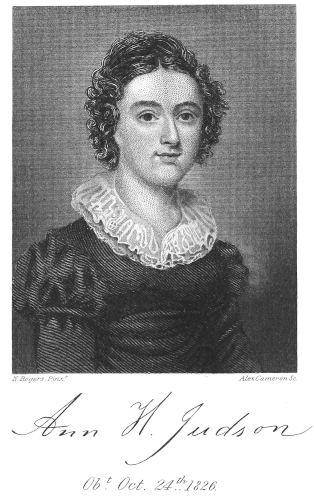
N. Rogers Pinxr Alex Cameron Sc. Ann H Judson Obt Oct. 24th 1826.
“The following verses, of which the writer says, ‘They were composed in my mind at the time, and afterward written down,’ commemorate this meeting:
Lines addressed to an Infant Daughter, twenty days old, in the condemned Prison at Ava.
“‘Sleep, darling infant, sleep,
Hushed on thy mother’s breast;
Let no rude sound of clanking chains
Disturb thy balmy rest.
“‘Sleep, darling infant, sleep;
Blest that thou canst not know
The pangs that rend thy parents’ hearts,
The keenness of their woe.
269“‘Sleep, darling infant, sleep;
May Heaven its blessings shed,
In rich profusion, soft and sweet,
On thine unconscious head!
“‘Why ope thy little eyes?
What would my darling see?
Thy sorrowing mother’s bending form?
Thy father’s agony?
“‘Wouldst view this drear abode,
Where fettered felons lie,
And wonder that thy father here
Should as a felon sigh?
“‘Wouldst mark the dreadful sights,
Which stoutest hearts appal—
The stocks, the cord, the fatal sword,
The torturing iron mall?
“‘No, darling infant, no!
Thou seest them not at all;
Thou only mark’st the rays of light
Which flicker on the wall.
“‘Thine untaught infant eye
Can nothing clearly see;
Sweet scenes of home and prison scenes
Are all alike to thee.
“‘Stretch, then, thy little arms,
And roll thy vacant eye,
Reposing on thy mother’s breast
In soft security.
“‘Why ope thy paly lips?
What would my darling say?
“My dear papa, why leave us thus?
Why thus in prison stay?
“‘“For poor mamma and I
All lonely live at home,
And every day we watch and wait,
And wish papa would come?”
“‘No; all alike to thee
Thy mother’s grief or mirth;
270Nor know’st thou one of all the ills
Which mark thy mournful birth.
“‘Thy lips one art alone,
One loving, simple grace,
By nature’s instinct have been taught;
Seek, then, thy nestling-place!
“‘Spread out thy little hand;
Thy mother’s bosom press,
And thus return, in grateful guise,
Her more sincere caress.
“‘Go, darling infant, go;
Thine hour has passed away;
The jailer’s harsh, discordant voice
Forbids thy longer stay.
“‘God grant that we may meet
In happier times than this,
And with thine angel mother dear
Enjoy domestic bliss.
“‘But should the fearful clouds,
Which Burmah’s sky o’erspread,
Conduct the threatened vengeance down
On thy poor father’s head—
“‘Where couldst thou shelter find?
Oh, whither wouldst thou stray?
What hand would guide my darling’s steps
Along their dangerous way?
“‘There is a God on high,
The glorious King of kings;
’Tis He to whom thy mother prays,
Whose love she sits and sings.
“‘That glorious God, so kind,
Has sent His Son to save
Our ruined race from sin and death,
And raise them from the grave.
“‘And to that gracious God
My darling I commend;
Be Thou the helpless orphan’s stay,
Her Father and her Friend.
271“‘Inspire her infant heart
The Saviour’s love to know,
And guide her through this dreary world,
This wilderness of woe.
“‘Thou sleep’st again, my lamb,
Nor heed’st nor song nor prayer:
Go, sleeping in thy mother’s arms,
Safe in a mother’s care.
“‘And when, in future years,
Thou know’st thy father’s tongue,
These lines will show thee how he felt,
How o’er his babe he sung.
‘To Maria Eliza Butterworth Judson, born at Ava, January 26, 1825.’”
The following versification of the Lord’s Prayer was composed a few weeks later. It illustrates the nature of the subjects which occupied the thoughts of the missionary during this long-protracted agony. It is comprised in fewer words than the original Greek, and contains only two more than the common translation:
“Our Father God, who art in heaven,
All hallowed be Thy name;
Thy kingdom come; Thy will be done
In earth and heaven the same.
“Give us, this day, our daily bread;
And, as we those forgive
Who sin against us, so may we
Forgiving grace receive.
“Into temptation lead us not;
From evil set us free;
The kingdom, power, and glory, Lord,
Ever belong to Thee.
“Prison, Ava, March, 1825.”
“The foreigners had spent about seven months in prison, when suddenly a change came. One day a band of men rushed into the prison-yard, and while some seized the white prisoners, and added two more pairs of fetters to the three they already wore, others began tearing down Mrs. Judson’s 272little bamboo room, snatching up pillows and mattresses, and whatever other articles came within their reach. At last the prisoners, after having half the clothing torn from their persons, were thrust into the common prison, and, with a bamboo between their legs, again stretched upon the bare floor. Here were more than a hundred miserable wretches, shut from every breath of air except such as could find its way between the crevices in the boards, groaning with various tortures, and rattling their chains, as they groped in the gray light, and writhed and twisted themselves, as much as was in their power, from side to side, in the vain endeavor to obtain some ease by change of position. It was the commencement of the hot season, and the heat was not lessened by the fevered breaths of that crowd of sufferers, nor the close air purified by the exhalations which arose from their bodies. Night came, but brought with it no rest. A whisper had passed around the prison, whether through malice or accident, that the foreigners would be led out to execution at three in the morning; and the effect on the little band was not so much in accordance with natural temperament as the transforming principle of faith. Bold men were cowards, and weak men grew strong. At first Mr. Judson felt a pang of regret that he was to go at last without saying farewell to his unsuspecting wife and child. But gradually the feeling changed, and he would not have had it different if he could. She had left him in comparative comfort that day; she would come the next, and find him beyond her care. It would be a terrible shock at first; but she would be spared much anxious suffering, and he could almost fancy that she would soon learn to rejoice that he was safe in glory. As for herself, the Burmans had always treated her with some respect; she seemed to have gained immunity from personal insult, while her intrepidity had won their admiration; and he did not believe that even the rudest of them would dare to do her harm. No; fruitful in resources as she had proved herself, she would get an appointment to carry some message of peace to the English, and so place herself under their protection. It would be a blessing to her and to his child if he was removed 273from them; and he thanked God that his time was so near at hand. He felt thankful, too, that the execution was to take place in the morning. He should pass his own door on the way. There he might breathe his silent farewell, while she was spared the parting agony. He thought of Burmah, too, even then. The English would most likely be conquerors; and then there would be nothing to hinder the propagation of Christianity. He even recollected—so calm and dispassionate were his thoughts—some passages in his translation capable of a better rendering; and then he speculated on the pillow he had lost that day, weighing the probabilities of its ever falling into his wife’s hands, so that the manuscript would be recovered. And then he imagined that she did not find it, and went off into a visionary scene of its being brought to light years afterward, which he smiled at when he gave a sketch of these emotions, and did not fully describe. At length the fatal hour drew nigh. They had no means of ascertaining it precisely, but they knew that it could not be very far distant. They waited with increased solemnity. Then they prayed together, Mr. Judson’s voice for all of them, and then he, and probably each of the others, prayed separately. And still they waited, in awful expectancy. The hour passed by—they felt it must be passed—and there was no unusual movement in the prison. Still they expected and waited, till finally there woke a glimmering of hope, a possibility that they had been deceived. And so, hoping, and doubting, and fearing, they lingered on, till the opening of the door assured them of what they had long suspected. It was morning. Then the jailer came; and, in answer to their questions, chucked them mockingly under the chin, and told then, Oh, no; he could not spare his beloved children yet, just after—kicking the bamboo as he spoke, till all the chains rattled, and the five rows of fetters dashed together, pinching sharply the flesh that they caught between them—just after he had taken so much trouble to procure them fitting ornaments.
“I ought to have stated before that the keeper, to whose share Mr. Judson’s old pillow fell on the day they were so 274unceremoniously thrust into the inner prison, had afterward exchanged it for a better one, wondering, no doubt, at the odd taste of the white man. When he was again robbed of his clothes and bedding, on the day he was driven away to Oung-pen-la, one of the ruffians deliberately untied the mat which was used as a cover to the precious pillow, and threw the apparently worthless roll of hard cotton away. Some hours after, Moung Ing, stumbling upon this one relic of the vanished prisoners, carried it to the house as a token; and, several months from that time, the manuscript which now makes a part of the Burmese Bible was found within, uninjured.
“They remained at Oung-pen-la six months, when Mr. Judson was, for the first time, released from his irons, to be employed as translator and interpreter to the Burmans. From the first, he had been particularly careful not to take any part in political affairs; for, however the war might end, he did not wish the Burmans to receive an impression that he was in the interests of the English. He felt that it would be wrong to endanger his influence as a religious teacher by taking any step which would be likely to render him obnoxious even to a conquered people. But now he had no choice. His own wishes in the matter were not consulted, any more than they had been when he was first thrown into prison. He was probably selected for the office because there was no one who could be better trusted, although it was evident that not the slightest confidence was reposed in him. He was carried to Ava under guard, kept in prison two days, and then, without being permitted to visit his own house but a few moments, was sent to Maloun. Here he remained about six weeks, when, in consequence of the advance of the English from Prome, he was hurriedly sent back to Ava. It was late in the night when he arrived, and he was taken through the streets directly past his own door. A feeble light glimmered within, assuring him that it was not altogether deserted; but yet what might not have occurred in those six weeks! He entreated permission to enter but for five minutes; he threatened, he bribed, he appealed to their 275humanity, for he knew that even they, hard as they seemed, must have humanity somewhere; but all without success. His conductors, with some show of feeling, assured him that they had orders to take him directly to the court-house, and that they dared not disobey. He crouched down in an outbuilding until morning, when, after a slight examination, he was placed under guard in an out-of-the-way shed, which served as a temporary prison. At night of the same day, Moung Ing found him in this obscure place, where he had been all day without food. While conversing with the faithful Burman, Mr. Judson once or twice fancied there was something in his words or manner, or perhaps both, a little puzzling; but the impression was only momentary, and the very sight of this messenger from his wife relieved him of a burden of apprehension. He immediately dispatched Moung Ing to the friendly governor, for aid in his new difficulties, instructing him carefully as to his words and behavior, and, in the joy of his heart, bade him tell the tsayah-ga-dau to keep up courage one day more; it was almost certain he should be with her on the next. As soon as the messenger was gone, Mr. Judson’s thoughts immediately recurred to the singularity of his behavior, scarcely observable at the time, but now assuming much importance. His wife was doubtless well, though Moung Ing had certainly not been very explicit when inquired of; she must be well, for had she not sent several messages, and herself suggested the application to the governor? The child, too, was well; he had said that unhesitatingly. Why had he hesitated in the other case? Could it be, could it really be, that anything serious had befallen her, and they had concealed it from him? But no; those messages! He remembered, however (it all came to him too clearly now), how ostentatiously the good-natured Burman had paraded one of those messages whenever he asked a question; and yet, think as he would, they all resolved themselves into two—she longed to see him, and she recommended an application to the governor. The messenger had certainly behaved strangely, and he had been strangely blinded. These two simple phrases had been repeated 276so often, and in such variety of style, that they had been made to appear a dozen, and to contain a world of meaning; and for the time he was fully satisfied. ‘She must be living,’ he repeated to himself; ‘there is ample proof of that.’ ‘She must have been living,’ answered a withering doubt within, ‘when she gave the directions to Moung Ing.’ After that one thought, he had no disposition to sleep. The tedious night at length dragged itself away; and, though the governor sent for him as early as could reasonably be expected in the morning, a strange, vague apprehension seemed to concentrate whole ages in those few early hours. The kind old man had become his security with the Government, and set him free. With a step more fleet than for the last two years he had practiced, and in spite of the maimed ankles, which sometimes almost refused their office, he hurried along the street to his beloved home. The door stood invitingly open, and, without having been seen by any one, he entered. The first object which met his eye was a fat, half-naked Burman woman, squatting in the ashes beside a pan of coals, and holding on her knees a wan baby, so begrimed with dirt that it did not occur to the father it could be his own. He gave but one hasty look, and hurried to the next room. Across the foot of the bed, as though she had fallen there, lay a human object, that, at the first glance, was scarcely more recognizable than his child. The face was of a ghastly paleness, the features sharp, and the whole form shrunken almost to the last degree of emaciation. The glossy black curls had all been shorn from the finely-shaped head, which was now covered by a close-fitting cotton cap, of the coarsest and—unlike anything usually coming in contact with that head—not the cleanest kind. The whole room presented an appearance of the very extreme of wretchedness, more harrowing to the feelings than can be told. There lay the devoted wife, who had followed him so unweariedly from prison to prison, ever alleviating his distresses, without even common hireling attendance. He knew, by the very arrangement of the room, and by the expression of sheer animality on the face of the woman who held his 277child, that the Bengalee cook had been her only nurse. The wearied sleeper was awakened by a breath that came too near her cheek. Perhaps a falling tear might have been added; for, steady as were those eyes in difficulties, dauntless in dangers, and stern when conscience frowned, they were well used to tender tears.
. . . . . . . . . . . .
“One evening several persons at our house were repeating anecdotes of what different men in different ages had regarded as the highest type of sensuous enjoyment; that is, enjoyment derived from outward circumstances. ‘Pooh!’ said Mr. Judson; ‘these men were not qualified to judge. I know of a much higher pleasure than that. What do you think of floating down the Irrawaddy, on a cool, moonlight evening, with your wife by your side, and your baby in your arms, free—all free? But you can not understand it, either; it needs a twenty-one months’ qualification; and I can never regret my twenty-one months of misery, when I recall that one delicious thrill. I think I have had a better appreciation of what heaven may be ever since.’ And so, I have no doubt, he had.
“The reception of a lady was an incident in the English camp; and Mrs. Judson’s fame had gone before her. No one better than a true-born Englishman can discern precisely the measure of attention grateful to a woman in her situation; and there were innumerable minute touches in General Campbell’s conduct which fixed her gratitude, and more still that of her husband on her account. It was not that his son was sent with the staff officers who came to escort her from the steamer; nor that unexpected honors, in military guise, waited her on the shore, where she was received by Sir Archibald in person; nor that her tent was larger and more commodious than his own, with the very agreeable addition of a veranda; but it was a certain fatherly kindness and genuine heart interest, which made her feel as though she was receiving all these favors from a friend.
“An incident that occurred a few days after the landing of the prisoners is perhaps worthy of notice. General Campbell 278was to give a dinner to the Burmese commissioners, and he chose to make it an affair of some pomp and magnificence. At a given order, almost as by magic, the camp was turned into a scene of festivity, with such a profusion of gold and crimson, and floating banners, as is thought most pleasing to an Oriental eye. When the dinner hour arrived, the company marched in couples, to the music of the band, toward the table, led by the general, who walked alone. As they came opposite the tent with the veranda before it, suddenly the music ceased, the whole procession stood still, and while the wondering Burmans turned their eager eyes in every direction, doubtful as to what would be the next act in the little drama, so curious to them as strangers, the general entered the tent. In a moment he reappeared with a lady on his arm—no stranger to the conscious commissioners—whom he led to the table, and seated at his own right hand. The abashed commissioners slid into their seats shrinkingly, where they sat as though transfixed by a mixture of astonishment and fear. ‘I fancy these gentlemen must be old acquaintances of yours, Mrs. Judson,’ General Campbell remarked, amused by what he began to suspect, though he did not fully understand it; ‘and, judging from their appearance, you must have treated them very ill.’ Mrs. Judson smiled. The Burmans could not understand the remark, but they evidently considered themselves the subject of it, and their faces were blank with consternation.
“‘What is the matter with yonder owner of the pointed beard?’ pursued Sir Archibald; ‘he seems to be seized with an ague fit.’
“‘I do not know,’ answered Mrs. Judson, fixing her eyes on the trembler, with perhaps a mischievous enjoyment of his anxiety, ‘unless his memory may be too busy. He is an old acquaintance of mine, and may probably infer danger to himself from seeing me under your protection.’
“She then proceeded to relate how, when her husband was suffering from fever in the stifled air of the inner prison, with five pairs of fetters about his ankles, she had walked several miles to this man’s house to ask a favor. She had left home 279early in the morning; but was kept waiting so long that it was noonday before she proffered her request, and received a rough refusal. She was turning sorrowfully away, when his attention was attracted by the silk umbrella she carried in her hand, and he instantly seized upon it. It was in vain that she represented the danger of her walking home without it; told him she had brought no money, and could not buy anything to shelter her from the sun; and begged that, if he took that, he would at least furnish her with a paper one, to protect her from the scorching heat. He laughed, and, turning the very suffering that had wasted her into a jest, told her it was only stout people who were in danger of a sunstroke—the sun could not find such as she; and so turned her from the door.
“Expressions of indignation burst from the lips of the listening officers; and, try to restrain them as they would, indignant glances did somewhat detract from that high tone of courtesy which it is an Englishman’s, and especially an English officer’s, pride, to preserve in all matters of hospitality. The poor Burman, conscience-taught, seemed to understand everything that was passing, and his features were distorted with fear; while his face, from which the perspiration oozed painfully, appeared, through his tawny skin, of a deathly paleness. It was not in a woman’s heart to do other than pity him; and Mrs. Judson remarked softly, in Burmese, that he had nothing to fear, and then repeated the remark to Sir Archibald. The conversation immediately became general, and every means was taken to reassure the timorous guests, but with little success. There sat the lady, whom all but one of them had personally treated with indignity, at the right hand of power, and her husband, just released from his chains, close beyond; and they doubtless felt conscious that if they and their lady wives were in such a position they would ask the heads of their enemies, and the request would be granted.
“‘I never thought I was over and above vindictive,’ remarked Mr. Judson, when he told the story; ‘but really it was one of the richest scenes I ever beheld.’
280“A British officer, Major Calder Campbell, describing ‘an adventure in Ava’ in the year 1826, gives a beautiful and affecting description of Mrs. Judson. Major Campbell, then a lieutenant, when descending the Irrawaddy River in a canoe manned by Burmans, was attacked in the night, while asleep, by his faithless boatmen, and severely wounded and robbed. When waiting on the beach with much anxiety and distress for the passage of some friendly bark, a row-boat was seen approaching.
“Signals of distress were made, and a skiff sent to his assistance. The following is the language of the writer:
“‘We were taken on board. My eyes first rested on the thin, attenuated form of a lady—a white lady! the first white woman I had seen for more than a year! She was standing on the little deck of the row-boat, leaning on the arm of a sickly-looking gentleman with an intellectual cast of countenance, in whom I at once recognized the husband or the brother.
“‘His dress and bearing pointed him out as a missionary. I have said that I had not beheld a white female for many months; and now the soothing accents of female words fell upon my ears like a household hymn of my youth.
“‘My wound was tenderly dressed, my head bound up, and I was laid upon a sofa bed. With what a thankful heart did I breathe forth a blessing on these kind Samaritans! With what delight did I drink in the mild, gentle sounds of that sweet woman’s voice, as she pressed me to recruit my strength with some of that beverage “which cheers but not inebriates!” She was seated in a large sort of swinging chair, of American construction, in which her slight, emaciated, but graceful form appeared almost ethereal. Yet, with much of heaven, there were still the breathings of earthly feeling about her, for at her feet rested a babe, a little, wan baby, on which her eyes often turned with all a mother’s love; and gazing frequently upon her delicate features, with a fond yet fearful glance, was that meek missionary, her husband. Her face was pale, very pale, with that expression of deep and serious thought which speaks of the strong and 281vigorous mind within the frail and perishing body; her brown hair was braided over a placid and holy brow; but her hands—those small, lily hands—were quite beautiful; beautiful they were, and very wan; for ah, they told of disease—of death—death in all its transparent grace—when the sickly blood shines through the clear skin, even as the bright poison lights up the Venetian glass which it is about to shatter. That lady was Mrs. Judson, whose long captivity and severe hardships amongst the Burmese have since been detailed in her published journals.
“‘I remained two days with them; two delightful days they were to me. Mrs. Judson’s powers of conversation were of the first order, and the many affecting anecdotes that she gave us of their long and cruel bondage, their struggles in the cause of religion, and their adventures during a long residence at the court of Ava, gained a heightened interest from the beautiful, energetic simplicity of her language, as well as from the certainty I felt that so fragile a flower as she in very truth was, had but a brief season to linger on earth.
“’Why is it that we grieve to think of the approaching death of the young, the virtuous, the ready? Alas! it is the selfishness of human nature that would keep to itself the purest and sweetest gifts of Heaven, to encounter the blasts and the blights of a world where we see them, rather than that they should be transplanted to a happier region, where we see them not.
“‘When I left the kind Judsons, I did so with regret. When I looked my last on her mild, worn countenance, as she issued some instructions to my new set of boatmen, I felt my eyes fill with prophetic tears. They were not perceived. We parted, and we never met again; nor is it likely that the wounded subaltern was ever again thought of by those who had succored him. Mrs. Judson and her child died soon after the cessation of hostilities.’”
282