Chapter XXX · WAR.
Reading edition
The War Fever in 1854—Attacks on Prince Albert—Aberdeen’s Correspondence with the Queen—The Queen’s Opinion of the Country—“Loyal, but a little mad”—Stockmar on the Constitution—Prince Albert’s Position at Court—The Privileges of a Reigning Queen’s Husband—Debates on the Prince’s Position—The Peace and War Parties—Mr. Cobden’s Influence—A new Vienna Note—A Challenge to Russia—The Russian Ambassador leaves London—Recall of Sir H. Seymour from St. Petersburg—Russian Intrigues with the German Powers—The Czar’s Counter-Propositions—His Sarcastic Letter to Napoleon III.—An Austrian Compromise—Lord Clarendon’s Ultimatum to Russia—The Czar’s Reply—Declaration of War—Omar Pasha’s Victories in the Principalities—The Siege of Silistria—Evacuation of the Principalities—The Rising in Greece—The Allies at the Piræus—The Allies occupy Gallipoli—Another English Blunder—Invasion of the Crimea—The Duke of Newcastle and a Sleepy Cabinet—Lord Raglan’s Opinion on the War—The Landing of the Allies at Eupatoria—Battle of the Alma—Death of Marshal St. Arnaud—Russian Fleet Sunk at Sebastopol—At Balaclava—The Siege of Sebastopol—Battles of Balaclava and Inkermann—Mismanagement of the War—Public Indignation against the Government—Mr. Roebuck’s Motion—Fall of the Coalition Ministry.
No writer has described more effectively than Mr. Cobden the sudden change that hurried the country into the military alliance with France against Russia which was made operative in 1854. Suppose, he said, an invalid had been ordered in the spring of 1853 to go to Australia and back for the benefit of his health. When he left home he must have noted that “the Militia was preparing for duty; the coasts and dockyards were being fortified; the Navy, Army, and Artillery were all in course of augmentation; inspectors of artillery and cavalry were reported to be busy on the Southern coast; deputations from railway companies, it was said, had been waiting on the Admiralty and Ordnance to explain how rapidly the commissariat and military stores could be transported from the Tower to Dover or Portsmouth; and the latest paragraph of news from the Continent was that our neighbours on the other side of the Channel were practising the embarkation and disembarkation of troops by night. He left home amidst all these alarms and preparations for a French invasion. But he returns, and, supposing he has not been hearing or giving heed to tidings from Europe, in what condition does he find his country? He steps on shore at Liverpool, and the first newspaper he sees informs him that the English and French fleets are lying side by side in Besika Bay. An impending naval engagement between the two Powers is naturally the idea that first occurs to him; but, glancing at the leading article of the journal, he learns that England and France have entered on an alliance, and that they are on the eve of commencing a sanguinary struggle against Russia.”[135] He would have also found the Tory organs of public opinion vieing with the demagogic Press in denouncing the Queen’s husband as a traitor to his wife and as a servile spy of Russia; from which, if he had been a shrewd man, he would have inferred that the Queen had been again guilty of the atrocious crime of differing from Lord Palmerston, and that Prince Albert had been criticising rather too plainly his bellicose Foreign Policy.
During the first few weeks of 1854 society, indeed, could talk of little else than the “treason” of Prince Albert. The Queen’s vexation found frequent expression in letters to Lord Aberdeen, and that amiable Minister did what he could to comfort her. The Prince, however, treated his slanderers with well-simulated contempt, but, in spite of that, their injustice stung him to the quick, and he suffered much both in health and spirits. Yet nothing could be done in his defence till Parliament met, and the Queen was, therefore, fain to believe that the country, as she says in a letter to Stockmar, was “as loyal as ever, only a little mad.” Long and ponderous essays from Stockmar on the Constitutional prerogatives of the Crown, and the political functions of Prince Albert, as her Majesty’s private secretary, did little to dispel the gloom that settled over the Court. The fact is that Stockmar slightly erred in imagining that the hostility to the Prince was really due to wrong ideas on these interesting points. As Prince Albert bluntly put it, one main element in the agitation against him was the hatred of the old High Tory Party towards him, in the first place, because of his friendship with Peel, and, secondly, because of his success with the Great Exhibition.[136] The grumblers of the military clubs, too, joined in the cry against his Royal Highness because, when Adjutant-General Browne resigned, after quarrelling with Lord Hardinge, the Commander-in-Chief, about the weight of the soldier’s knapsack, the Prince was supposed to have taken Lord Hardinge’s side. The masses, too, had never seriously thought out the question of the position which an able man who was husband of a reigning Queen was certain, through the mere dictates of nature, to take in the counsels of the Sovereign. It struck them like a galvanic shock when they discovered that for fourteen years the Prince had been actively helping to govern them, whilst the omniscient flunkeys of the Press were almost daily smothering him with adulation for his “wise abstinence from politics.” Having stupidly deceived themselves as to the precise influence which the Prince wielded, they were in the right state of mind to be deceived by the Prince’s enemies as to the influence which he did not wield, and which he never sought to wield. These reasons, and not the dubiety of the British Constitution as to the political rights of the husband of an English Queen, gave rise to much of the foolish clamour of the hour.
It need hardly be said that when Parliament met on the 31st of January, the leaders of both parties in both Houses summarily disposed of the falsehoods which had been uttered to the discredit of the Court. The Debates on the Address on this occasion are of high historical and Constitutional importance, because they defined with great precision the position of the consort of a queen regnant in the British Constitution, establishing beyond doubt his right to assist the Sovereign with advice in all matters of State. The address of Lord Campbell may be usefully referred to as giving the legal view of the question; but the speeches which delighted the Queen most were those of Lord John Russell, who, she says, in a letter to Stockmar, “did it admirably,” and “dear, excellent Lord Aberdeen, who has taken it terribly to heart.” It was, however, Lord Campbell’s address which gave most satisfaction to Prince Albert. The common-sense view of the question obviously was, that if the husband of a queen regnant in England embarrassed her Majesty’s responsible Ministers by unconstitutional interference, the fault must be theirs and not his. The Constitution places in their hands the formidable weapon of resignation, and resignation in such circumstances simply means that government is rendered impossible till the unconstitutional interference which is objected to is stopped.
Nobody has stated with greater correctness the political situation of the country at the beginning of 1854 than Sir George Cornewall Lewis. “If,” said he, in a letter to Sir Edmund Head, “war is averted, there will be a Reform Bill, which is likely to lead to an early Dissolution. If war arrives, the Reform Bill and all other similar measures likely to produce party struggles and divisions must be postponed.”[137] The Tories had, therefore, one strong temptation to encourage the War Party. Those Whigs who, like Lord Palmerston, dreaded Reform, were in like case, except Lord John Russell, who, with a Reform Bill on the anvil, was foolish enough to share with Palmerston the leadership of the War Party in the Cabinet. As the war would be one against Russia, the mainstay of despotism in Europe, the Radicals, mindful of how the revolution was stamped out in Hungary, were for once on the side of war. Nobody, in fact, had any genuine desire for peace save the Queen, Prince Albert, and the Peelites, who desired “peace with honour,” and the Cobdenites, who seemed to desire “peace at any price.” The Peace Party was strong in brains and common-sense, but weak in numbers. The strength
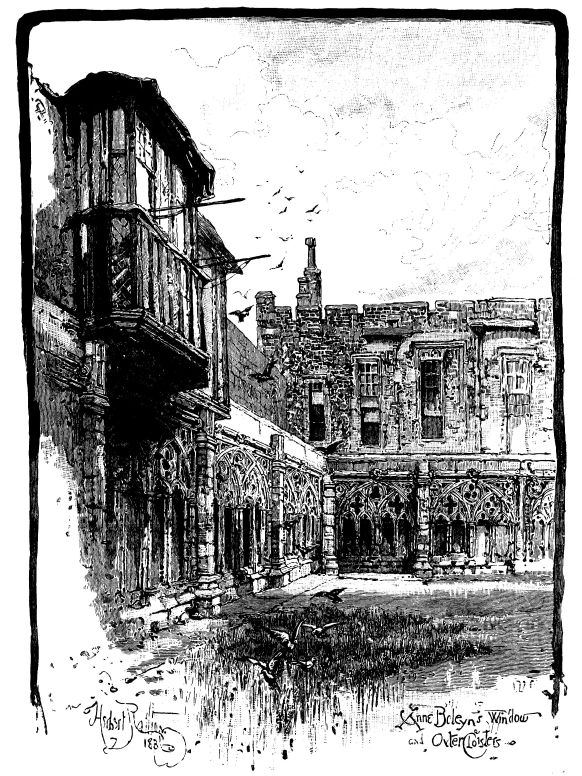
THE OUTER CLOISTERS AND ANNE BOLEYN’S WINDOW, WINDSOR CASTLE.
of the War Party lay in its numbers, and it would be absurd to assert that, with leaders like Derby, Disraeli, Palmerston, and Russell, it lacked intellectual ability. As usual, numbers won the day, and an abnormal alliance of “the classes and masses” rendered the Peace Party—sadly weakened in moral authority by the Moravian fanaticism of the Cobdenites—utterly impotent. Mr. Cobden cherished the illusion that his influence had strengthened the Peace Party. Yet, with the exception of Lord Palmerston, Lord John Russell, Lord Derby, and Lord Lyndhurst, no public men did more to make peace impossible than Mr. Cobden and Mr. Bright, the tone of whose pacific speeches acted on the pugnacious temper of the country as soothingly as a sting on an open and irritable wound.[138]
As might be expected, the Eastern policy of Ministers was fiercely attacked in both Houses of Parliament. But to understand the point of these attacks and the relation of the Queen to them, one must explain what was done after Sinope drove England into a frenzy of anger only comparable with that of the Danes when Nelson destroyed their fleet at Copenhagen.
To rightly appraise the criminal blunder of Russia at Sinope, it is necessary to remember that when that “massacre” occurred, the European Powers had agreed on a new Note embodying what they considered an honourable settlement of the dispute between Russia and Turkey. That was the Note of the 5th of December, and Lord Stratford de Redcliffe, under orders from Lord Clarendon, persuaded the Porte to accept it. This was a great step towards peace, for all that remained was to induce the Czar to be equally reasonable. But on the very day (the 13th of January, 1854) when the Powers, in concert at Vienna, decided to press this settlement on Russia, Sir Hamilton Seymour was instructed by Lord Clarendon to intimate to Count Nesselrode at St. Petersburg that England and France had lifted the gage of battle flung to them at Sinope. Russia was informed that the English and French fleets had sailed for the Black Sea, charged to “require” every Russian ship they met to put back to port. This irritated the Czar, who professed to regard it as “a flagrant act of hostility.”[139] Yet the Czar, or rather Nesselrode—who, like Lord Aberdeen, was braving infinite obloquy on account of his pacific proclivities—was willing to condone the act, if England would only state formally that she would impose on Turkish ships the same restrictions she imposed on those of Russia. Lord Clarendon, in his despatch, dated the 31st of January, did not make this statement, and accordingly, on the 4th of February, the Russian Ambassador in London announced that he and his retinue must return at once to St. Petersburg. On the 7th of February Lord Clarendon ordered the British Ambassador at the Court of the Czar to return to England; the French Government took the same course, and thus the rupture between Russia and the Western Powers became complete. It was in such circumstances hopeless to expect that the Note of the 5th of December, which had been accepted by the Porte, and which the Four Powers agreed to recommend to Russia on the very day that the despatch of the allied fleets to the Euxine was notified to Count Nesselrode (the 13th of January), would be accepted by the Czar. Indeed, but for Nesselrode, it would have been ignored with contempt.[140] Russia, however, temporised. Taking advantage of the false step of England and France in sending their fleets to the Euxine without consulting Austria and Prussia, Russia artfully attempted to detach the German States from the European Concert. Having failed in this, the Russian Government sent two replies to the Protocol of the 13th of January, transmitting the settlement which the Powers had agreed upon, and which the Porte had accepted.
The proposal of the Powers provided, amongst other things, for (1) the evacuation of the Principalities as soon as possible; (2) the renewal of the ancient treaties; (3) a formal guarantee by Turkey to all her non-Mussulman subjects of their spiritual privileges, which should likewise be communicated to all the Powers, including Russia, “accompanied with suitable assurances” to each of them; (4) a pledge from the Porte to reform its system of administration; and (5) the customary promise on the part of the Sultan to uphold the old rights and immunities granted to his Christian subjects by existing treaties. Russia rejected these proposals, and committed the blunder of extending her demands in her first series of counter-propositions.[141] But subsequently she submitted a second series of propositions, in which she withdrew the stipulations as to political refugees, and her ungenerous demand that the Porte should negotiate terms of peace at St. Petersburg, or at the Russian headquarters in Moldavia. The Powers decided that the Russian settlement could not be recommended to Turkey, their main objection being, that while their terms embodied a recognition of the principle that the Turkish concessions and guarantees were given to Europe as well as to Russia, the Russian terms proceeded on the assumption that they were given to Russia alone. The Czar here was in the wrong. In the war on the Danube the Turks had been victorious. He insisted, however, that they should sue for peace, as if they were prostrate in defeat. On the other hand, the Four Powers proposed terms which did not imply that victory or defeat rested with either belligerent. The only defence that can be made for the obstinacy of the Emperor Nicholas in thus refusing to cross the golden bridge of honourable retreat built for him by the Powers is, that the War Party in Russia was as rabid as the War Party in England. “The Emperor,” wrote Sir H. Seymour to Lord Clarendon on the 2nd of January, “is infinitely more moderate than the immense bulk of his subjects,” who denounced Nesselrode “as an alien, a traitor, and a man bought by English gold”—precisely the language which the same kind of people in England applied to Lord Aberdeen. In fact, the Czar himself was rapidly losing his popularity and authority because of the deference he was showing to the Powers, and it is probable that if he had made further concessions he would have been assassinated. But inasmuch as Nicholas himself, in spite of the advice of his three ablest servants,[142] had roused the fanaticism and fury of his subjects by his policy, even this defence, though it explains, does not justify his conduct.
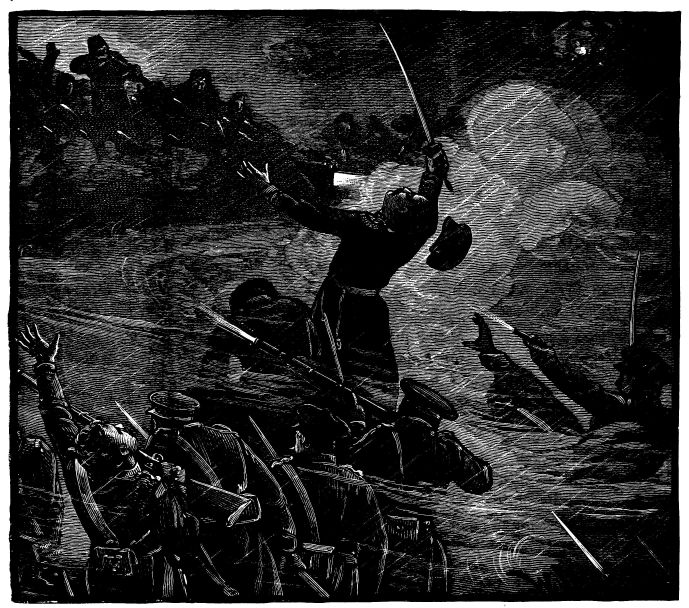
RUSSIAN REPULSE AT SILISTRIA.
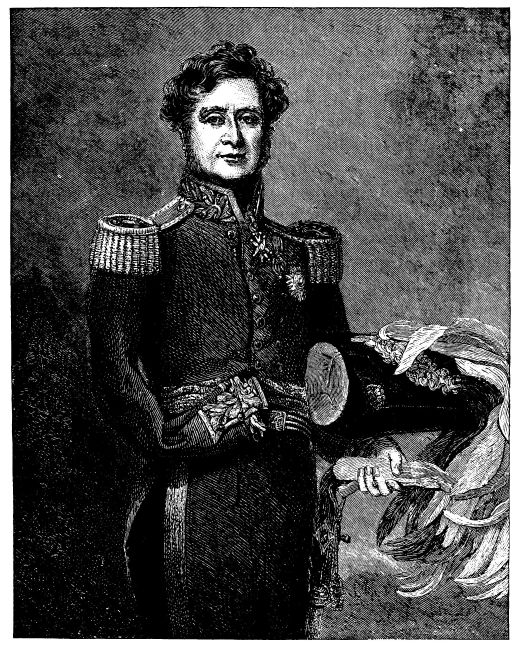
LORD RAGLAN.
Yet, by a strange stroke of fortune, war between Russia and the Western Powers was still avoided. War with Russia was hateful to the French people—almost as hateful as a military alliance with Turkey. But the Emperor Napoleon III., for dynastic reasons, was committed to such a war, and on the 29th of January he accordingly wrote a pacific letter to the Czar couched in language certain to provoke his wrath. Nicholas answered it with infinite hauteur, two contemptuous sentences in his reply stinging the Bonapartists into rage.[143] France now had her War Party rampant, and this did not improve the outlook. Still, one last effort was made in the cause of peace. On the 22nd of February the Austrian Minister, Count Buol, told the French Ambassador at Vienna that if England and France would only fix “a delay”[144] for the evacuation of the Principalities, and agree to keep the peace till that term ran out, Austria would join them in sending Russia a summons to retire across the Pruth. It was tolerably certain that what Austria did, Prussia would do, and here again the European Concert was united in putting irresistible diplomatic pressure on Russia. Lord Clarendon, hearing of this, very naturally asked the German Powers how they would act if the joint summons were ignored by the Czar. Clarendon seems to have taken it for granted that they would in that case join England in going to war, for, without waiting for their reply, he sent to St. Petersburg on the 27th of February an ultimatum to Russia, demanding the evacuation of the Principalities under threat of war. When the replies from the German Powers arrived on the 28th of February, Lord Clarendon found that Austria merely promised to support England in sending the summons, but not to support her in any action she might take in the event of its being ignored; whereas Prussia, though she thought the summons a good thing to send, was not quite sure if she would join the other Powers in sending it. Thus the English Government, by Lord Clarendon’s impetuous indiscretion, again broke up the European Concert; but now under circumstances of supreme peril, for he had positively committed England to enforce alone against Russia, a proposal which not only originated with Austria, but in the enforcement of which the interest of Austria, menaced by a Russian occupation of Moldavia, was obviously greater than that of either England or France. France joined England in this foolish step, and the German States, well pleased to see the Western Powers fighting their battles, and relieved from responsibility by Lord Clarendon’s precipitate action on the 27th of February, astutely kept out of the fray. The Czar instructed Nesselrode to inform Consul Michele at St. Petersburg on the 18th of March that he did not think fit to reply to Lord Clarendon’s ultimatum,[145] and thus, with France as an ally, England went into the war—for the evacuation of the Principalities.
The case of the Tory Opposition in Parliament against the Government was now unanswerable. Their leaders had systematically blamed the Government for not warning Russia at the outset that the invasion of the Principalities would be a casus belli. Had that been done, Russia might have held her hand, whereas it was not done till retreat for Russia meant humiliation.
But, strange as it may seem, the English Government had still one more blunder open to them. The Turks, under Omar Pasha, had not only held the line of the Danube against Russia, but they had won important victories. In May, 1854, the Russians, under Paskiewitch, attacked Silistria; but the Turks, animated by the heroism and admirably served by the skill of some English officers, beat off the enemy, and on the 22nd of June the Russians raised the siege. Two weeks afterwards Gortschakoff was repulsed at Giurgevo, and the Russians were soon driven back across the Pruth.
The evacuation of the Principalities, to bring about which England had gone to war, was thus achieved. The one blunder which was now left for England to commit was to ignore this fact and refrain from taking advantage of it. And this was precisely what England did. Yielding to the popular passion of the hour,[146] the Government found a new object to fight for, namely, the destruction of Russia as an enemy to Mankind. And yet, with this amazing fact on record, there are still people on the Continent who aver that England is a practical nation, which never fights for an idea!
War was declared by England against Russia on the 28th of March, and by France on the 27th, the military alliance between the two Powers being signed on the 12th. Lord Raglan had been appointed to command the British army, whilst Marshal St. Arnaud headed that of France, and the British troops had departed for the seat of war on the 20th of February, amidst scenes of great excitement and popular enthusiasm, which naturally inflamed the bellicose feeling of the metropolis. On the 30th of March the French occupied Gallipoli, in European Turkey, a little above the point where the Dardanelles expand into the Propontis or Sea of Marmora. The English detachments began to arrive on the 5th of April. The allies threw fortified lines across the peninsula, so that if Russia had driven back the Turks from the Danube and, crossing the Balkans to Adrianople, had made a dash for Constantinople, as in 1829, the Turks would have been paralysed by the allied forces on their right flank. But the pride of England as a maritime Power had to be gratified, and, as the ice was breaking in the Baltic, it was decided to order a great fleet to reduce Cronstadt and let the Czar hear the voice of England thundering from her cannon at the very gates of his capital. Sir Charles Napier, the Admiral appointed to command the magnificent Armada at Spithead, was entertained at an absurd Reform Club banquet on the 7th of March. There he, Lord Palmerston, and Sir James Graham, delivered themselves of flippant, vaunting orations, which Mr. Bright, in the House of Commons, denounced as “discreditable to the grave and responsible statesmen of a Christian nation.”[147] Very different was the feeling of the Queen when, on the 11th of March, she reviewed the stately procession of war-ships at Spithead, as they steamed past her yacht, while she waved her handkerchief to the Admiral and crew of the colossal Duke of Wellington, which brought up the rear. Before leaving town she wrote to Lord Aberdeen, “We are just starting to see the fleet, which is to sail at once for its important destination. It will be a solemn moment.[148] Many a heart will be very heavy, and many a prayer, including our own, will be offered up for its safety and glory.”[149] On the 12th of April Napier sailed from Kiöge Bay and completely blockaded the Gulf of Finland. Russia was thus paralysed when she evacuated the Principalities. Omar Pasha kept her at bay on the other side of the Pruth. Napier locked up her fleet and shipping in the Baltic. The allied armies covered Constantinople. The allied fleets swept the Euxine. The “material guarantees” which she had seized for the purpose of forcing her terms on Turkey were wrested from her hands, and as war abrogates all treaties, she had even lost the shadow of a claim to exercise her old rights of protection over the Sultan’s Christian subjects. Russia was now at the mercy of the Western Powers, and had they simply remained passive, she would soon have been compelled to sue for peace on their terms. But the War Party in England, disappointed that this supreme advantage had been gained without gilding British arms with glory, scoffed at the idea of settling the original dispute between Russia and Turkey on these terms. The British Government accordingly resolved, not merely to bring Russia to reason, but to humiliate her and punish her in such a manner that her power in South-Eastern Europe would be utterly broken. As it was this determination which led to the calamitous invasion of the Crimea, it may be well to trace the diplomatic history of such an astounding blunder.
On the 9th of April, after war had been declared, the four Powers—England, France, Austria, and Prussia—signed a Protocol at Vienna which bound them (1) to remain united in maintaining the integrity of Turkey, and in safeguarding, under the guarantee of Europe, the liberties of her Christian inhabitants by every means compatible with the independence of the Sultan; (2) to enter into no arrangement with Russia or any other Power which might be inconsistent with this object without first of all discussing it in concert. On the 20th of April Austria and Prussia concluded an offensive and defensive alliance. In separate Notes they summoned Russia to evacuate the Principalities. On the 29th of July, when Omar Pasha was just about to drive the Russians back to their territory, Count Nesselrode replied to Austria stating that the Czar accepted the principles of the Protocol of the 9th of April. But before evacuating the Principalities, he requested the Cabinet of Vienna to give
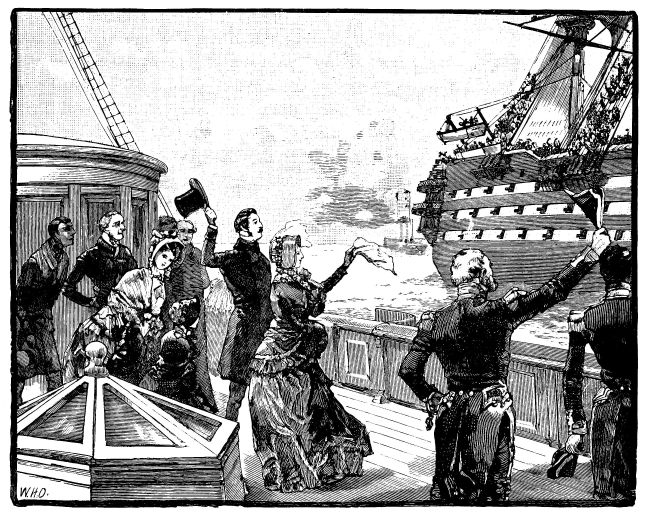
THE QUEEN WAVING FAREWELL TO THE “DUKE OF WELLINGTON” FLAG-SHIP.
him some guarantee that hostilities would cease.[150] Austria was willing to persuade England and France to agree to the condition which the Czar thus made, a condition sine quâ non of evacuation, but Count Buol Schauenstein instructed the Austrian ambassador at St. Petersburg to warn Nesselrode that if the Maritime Powers remained obdurate, Austria must still insist on the withdrawal of Russia from Moldavia and Wallachia. Prussia, however, refused to take part in a Conference which Austria suggested might advantageously be held to consider the Russian terms. King Frederick William and Manteuffel thought that in offering to evacuate the Principalities, Russia had made a sufficient concession to the interests of Germany. But Lord Clarendon was of a different opinion.[151] England, he saw, would no longer be content with the mere evacuation of the Principalities, which was the sole object of the war. Imitating the initial blunder of the Czar, he insisted on getting a “material guarantee” against any future molestation of Turkey. The exclusive right of Russia to protect Moldavia and Wallachia must, he said, be abolished, and instead of it a European Protectorate established. Russia must also cease to control the chief mouth of the Danube. The ill-defined relations of Russia to the Christian subjects of the Porte, embodied in the Treaty of 1841, must be defined in the interests of the balance of power in Europe, and the independence of Turkey. Russia must finally renounce her claim to exercise any individual or official right of protecting Turkish subjects, no matter what their religion might be. The position of Russia as a naval Power in the Black Sea must also be modified.[152] The Czar rejected these terms[153]—indeed, if he had accepted them when as yet he had not suffered any crushing defeat from the Western Powers, his life would not have been worth many days’ purchase. Austria and Turkey concluded a Treaty on the 14th of June, in virtue of which Austria was to occupy the Principalities on behalf of the Sultan. On the 23rd of August the Austrian army entered Wallachia, thus setting the Turks free to co-operate with the Allies for the defence of Constantinople. But at this point the war passed from the defensive to the offensive stage, and it will therefore be convenient to trace the movement of opinion in England which powerfully influenced the change in our plans.
The attacks on Prince Albert created an unusual interest in the opening of Parliament on the 30th of January, 1854. When the Queen passed in her State procession from her palace to the House of Lords, the route was lined by a seething crowd of enthusiasts, who cheered her wildly as she went by. She was evidently more popular than even the Turkish Ambassador, who was the idol of West-End mobs in these mad, foolish, and to us, the rising generation, far-off days. The Speech from the Throne referred somewhat hopefully to the diplomatic negotiations which were then going on between the Powers. But it contained an ominous intimation that her Majesty thought it necessary to increase the strength of the army and navy, “with the view of supporting her representations, and of more effectually contributing to the restoration of peace.” She announced a comprehensive programme of domestic legislation, comprising a Reform Bill, with Bills to remodel Parliamentary Oaths, to reform the methods of selection for the Civil Service, to change the law of removal and settlement, and to renovate the tribunal for trying disputed Parliamentary Elections. If Ministers imagined that they would thus divert attention from the Eastern Question they were mistaken. In both Houses the Opposition attacked the Speech bitterly. They denied that the Government had used its best efforts to preserve peace, because its policy was a tangle of vacillation and inconsistency. They complained that the part played by England had been shrouded in secrecy and mystery, so that the country had to look to foreign sources for such scraps of information as had come to it. Ministers had shown such lack of energy that the Emperor of Russia had been led to regard them as his instruments, or, if that were not the case, as men who had not the courage to vindicate British honour by British arms. Were we at war with either or both of the belligerent Powers—Russia or Turkey—or were we not? If not, why send our fleet to the Black Sea to enforce against Russia a compulsory armistice? If we were, why was war not waged boldly and with vigour? Was it not foolish to dissipate the energies of the country in Reform controversies when it might any day find itself forced to make war in real earnest? The Vienna Note was denounced as a betrayal of Turkey, and the aggressive policy of Russia was unsparingly condemned. The Ministerial defence was weak and spiritless.
After the Russian Ambassador left London the Government was pressed to divulge what it knew of Count Orloff’s suspicious mission to Vienna,[154] as to which it was wondrously secretive; and various debates sprang up, notably one in the House of Commons on the 17th of February, which was raised by Mr. Layard on the official papers that had been published. To remove the impression produced by adverse criticism, Ministers seemed to think that the more bellicose they made their speeches the better.[155] “We mean to fight, so do not weaken the hands of the Government unless you are prepared to take its place”—this was the gist of the Ministerial rhetoric. As to their policy of protracted negotiation, Ministers argued, reasonably enough, that forbearance in the circumstances could not be a crime. Mr. Hume and Mr. Roebuck took this view, and, on the whole, the debates, together with the Blue-books, may be said to have won for the Government a favourable verdict from the country. Mr. Cobden, however, had the audacity to challenge this verdict and to oppose, on what to the present generation seem sensible grounds, the whole policy of the war. His long speeches and pamphlets on this subject can be summed up in three sentences. Either we were going to fight Russia for the sake of Turkey, or for the sake of protecting the liberties of Europe from the encroachment of the Russian autocrat. If we were fighting for the sake of Turkey, we were fighting in a cause that we ought to be ashamed of. If we
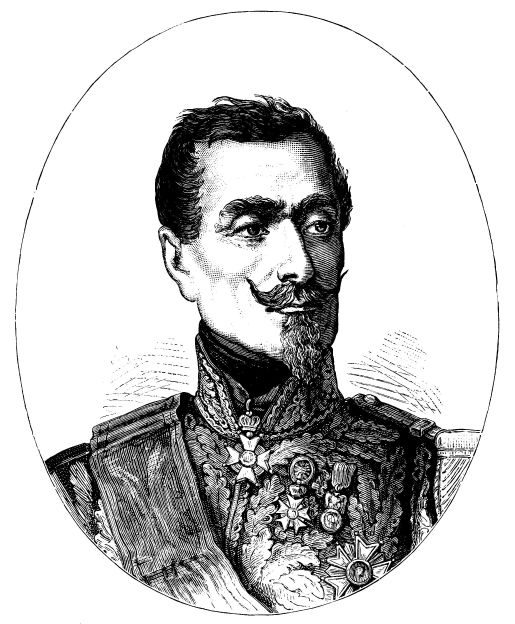
MARSHAL ST. ARNAUD.
were fighting to protect European civilisation from Russia, we ought to let the Powers nearest to the source of danger—Austria and Germany—begin first. This argument was indeed the only one that had the least effect on the House. Members were, however, so completely frightened by the clamour of London Society and the London Press, that even those who agreed with Cobden did not dare to say so.[156] His simple but lucid exposition of the Turkish system of Government which we were asked to maintain, had unexpectedly disturbed the minds, not only of the Nonconformists, but of many good Churchmen
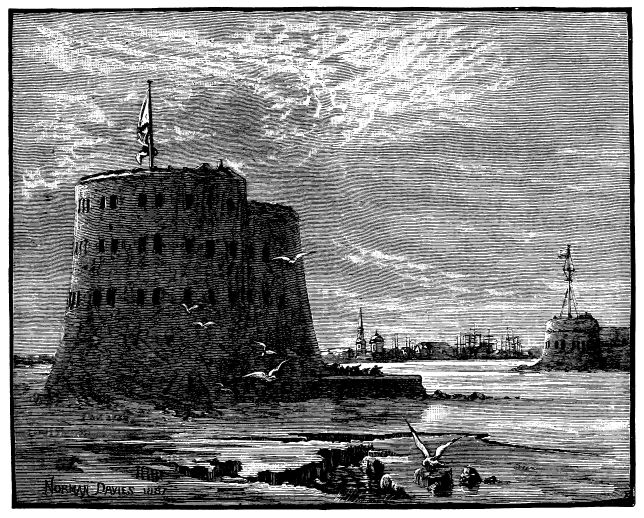
FORTS ALEXANDER AND PETER THE GREAT, CRONSTADT.
also. It was, perhaps, slightly emphasised by the taunt of the Czar in his Manifesto of the 9th of February to the effect that England and France were fighting for Islam against Russia, who was striving to protect Christianity. The War Party feared that there might be a reaction against them, and accordingly they very cleverly induced Lord Shaftesbury, on the 10th of March, to answer this portion of the Manifesto, and not only to prove that the Grand Turk did more than the Czar to advance the progress of Christianity, but also to defend the righteousness of making an alliance with any Power, heathen though it might be, to maintain “the cause of right, justice, and order, against the aggressions even of professing Christians.” Of this speech Lord Shaftesbury says in his Diary that nothing pleased him more than the statement of Lord Clarendon that the debate which he originated “was most opportune.”[157] From a Ministerial point of view it was opportune. Mr. Morley complains that the Nonconformists, who “have so seldom been found fighting on the wrong side,” were now so seriously divided that they did nothing to help Mr. Cobden to resist the warlike policy of the Government.[158] Their neutrality explains why Clarendon was so effusive in his congratulation to the Peer whose influence over this section of the community was supreme.
But the whole question soon passed out of the region of debate. On the 27th of March, the Queen’s message proclaiming war—though oddly enough the word war is not mentioned in it—was read to both Houses of Parliament; and on the 31st a loyal address agreeing to it was duly moved and carried, after a debate which was worthier of such an occasion than many others that had preceded it. The Opposition leaders seem to have been sobered by the solemnity of the moment, and all parties practically supported the Government with the helpless unanimity of despair. In the Upper House, Lord Grey alone uttered a strong protest against the war. In the House of Commons, Mr. Bright and the Marquis of Granby were the only speakers who were for peace. The violent Russophobists found in Mr. Layard an energetic champion. He condemned the Government, first, because it had not coerced Russia immediately after the massacre of Sinope, and secondly, because even now Ministers did not specifically declare that the object of the war was to lock up Russia within well-defined limits, so as to cripple her for ever. The Tory leaders were more cautious. They naturally made capital out of the Secret Correspondence,[159] already referred to (pp. 546-7). They had little difficulty in convicting the Government of misleading the Czar as to their rooted objection to his Turkish policy. Lord John Russell had not rejected the Russian proposals with the sternness of one who had serious hostility to them. He had, indeed, admitted the very claim which he and his colleagues were now about to rebut by war.[160] A “hybrid policy of credulity and connivance,” as Mr. Disraeli once called it, could have no other result than that of tempting the Czar to advance pretensions which he could not withdraw without prejudicing his Imperial position, and it is strange that this aspect of the affair was dealt with somewhat leniently by the critics and enemies of the Ministry. The questions that seemed to be of supreme interest to both Houses were really two—What was the object of the war? Where were our allies? To the one question the answer was vague. To the other the reply was neither frank nor candid. Lord Clarendon said that the object of the war was “to check and repel the unjust aggression of Russia”—which, as things stood, meant to force her out of the Danubian Principalities. But, he added, to ask what was the object of the war was to ask on what terms peace would be made?—a question the answer to which must depend on chances nobody could forecast. As for allies, it was easy to say that France was with us. The difficulty was to say what the German Powers would do. Ministers felt that Cobden had pierced their armour when, in the adjourned debate on Mr. Layard’s motion (20th Feb.), he asked whether it would not be sensible to let those Powers who were nearest Russia—and must therefore suffer first from her aggression—begin the fighting. Parliament must therefore be cajoled into a belief that Austria and Prussia would join us. Both Houses knew that though Austria and Prussia had concurred with England and France in recommending Russia to evacuate the Principalities, they had not pledged themselves to co-operate with us in war. Still, said Lord John Russell, when Austria was asked what she would do in the event of war breaking out, “the answer was at the time satisfactory,” and if Prussia had only fallen in with her views, he would have had a most satisfactory statement to make to the House. Though Prussian views seemed to Lord John “too narrow, taking in German interests alone,” he (Lord John) trusted that a short time would bring Prussia “to the conclusion that the disturbance of the balance of Power and the aggrandisement of Russia were matters of concern to Prussia as well as to other Powers.”
Lord John Russell unscrupulously deceived the House of Commons and the country on both points. The whole course of the negotiations had shown first, that Prussia considered the Czar’s final concessions sufficient, and, secondly, that Austria, though regretting that Russia did not do more to mollify Lord Clarendon, refused to admit that a declaration of war was necessary for that purpose. Lord John Russell’s statement as to Prussia was not only untrue, but the dates of the official despatches prove that he and his colleagues must have known it to be untrue.[161] When it was made in the House of Commons by him, and virtually in the same form in the House of Lords by Lord Clarendon, neither Austria nor Prussia had given any direct answer whatever to the question as to what they would do if war broke out. The Prussian Minister, indeed, said he did not think that Prussia would join the Powers in such a
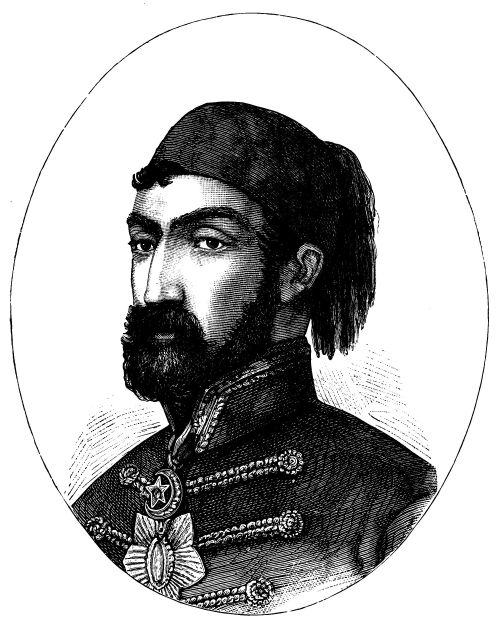
OMAR PASHA.
war.[162] But a still grosser deception was the delusive assurance that Prussia would yet come to our assistance. The Government knew too well that the views of Prussia were such as to absolutely destroy this hope. The King of Prussia looked upon war against Russia on the issue raised as a crime, and he had written an autograph letter to the Queen, a fact which was concealed from Parliament, saying so in the plainest words. He reminded her of what it is to be feared the Queen, like most of her countrymen, did not then sufficiently realise—the agonies of a great war such as that of 1813-15—agonies that he had seen, but which, alas! her Majesty and the new generation had only read about. Yet that was a war worth the horrors of its sacrifices. Was this one now impending worth similar sacrifices?
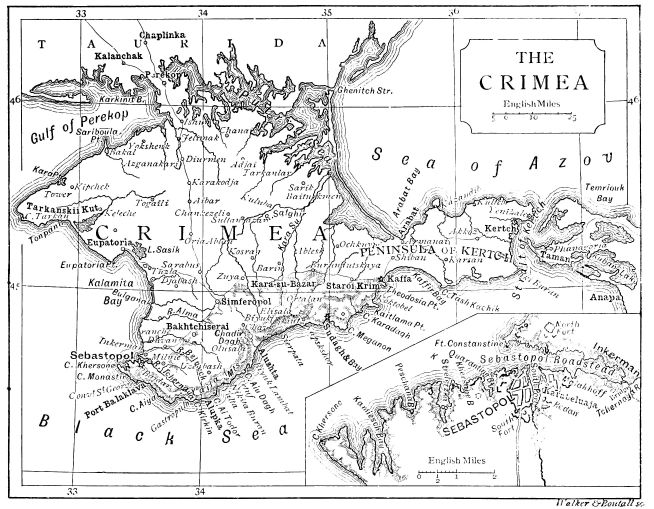
MAP OF THE CRIMEA.
Hardly, argued the King, for even England had at last become ashamed of the cause she had taken up—that of the Turk, and her endeavour now was to persuade herself and the world that it was for another cause—the equilibrium of Europe, menaced by the preponderance of Russia—that she was about to draw the sword. “The preponderance of Russia,” he writes in this letter, “is to be broken down! Well! I, her neighbour, have never felt this preponderance, and have never yielded to it.” It was war for an idea, and, adds the King with intense earnestness, “Suffer me to ask, ‘Does God’s law justify war for an idea?’” He implores the Queen to reconsider the Russian proposals in a friendly spirit, sifting what is really objectionable from them, and pledges himself that if a golden bridge is built to save the Czar’s honour, the Czar will cross it. But one word the King craves leave to speak plainly to the Queen: “For Prussia and myself,” he writes, “I am resolved to maintain a position of complete neutrality; and to this I add, with proud elation, my people and myself are of one mind. They require absolute neutrality from me. They say (and I say), ‘What have we to do with the Turk?’ Whether he stand or fall in no way concerns the industrious Rhinelanders and the husbandmen of the Riesengeberg and Bernstein.” Russia, he admits, might have perhaps pressed hard on the Turk. However, “it was the Turk, not we, who suffered, and the Turk has plenty of good friends, but the Emperor is a noble gentleman, and has done us no harm. Your Majesty will allow that this North German sound practical sense is difficult to gainsay.” Yet it was with such a letter in their possession that the Government led the country to believe, first, that Austria, who could not possibly move without Prussia, would join us in the war; and, second, that Prussia would also draw her sword for a cause which she declared we ourselves were even then ashamed of!
On the 17th of March, 1854, the Queen, nettled by the rough practical “North German sense” in this letter from the King of Prussia, endeavoured to answer it—her draft being submitted to Lord Clarendon and Lord Aberdeen for approval. Her answer, according to Sir Theodore Martin, indicates a “firm hand” and “admirable tact.”[163] To the political student of the present day it indicates neither the one nor the other. There was no tact in scoffing at the King’s “North German sound practical sense” by saying, “Had such language fallen from the King of Hanover or of Saxony, I would have understood it,” and there was more weakness and sentimentality than firmness and statecraft in the hand that added, “But up to the present hour I have regarded Prussia as one of the five great Powers which, since the Peace of 1815, have been the guarantors of treaties, the guardians of civilisation, the champions of right, and ultimate arbitrators of the nations; and I have for my part felt the holy duty to which they were thus divinely called, being at the same time perfectly alive to the obligations, serious as they are, and fraught with danger, which it imposes. Renounce these obligations, my dear brother, and in doing so you renounce for Prussia the status she has hitherto held.”[164] If the example thus set by Prussia—that of making the interests of the Prussian people the supreme object of her policy—should find imitators, the Queen contended, “European civilisation is abandoned as a plaything to the winds; right will no longer find a champion, nor the oppressed an umpire to appeal to.”
Such was the reply which the Queen made to what Sir Theodore Martin calls “the amiable but most mischievous weakness” that pervaded the letter from the King of Prussia. Such was the appeal which she made to what Sir Theodore calls “a sentiment higher than the short-sighted and selfish policy which it announced.” The King’s letter was perhaps amiable—but it was not weak. Its policy was perhaps selfish—a Sovereign who draws or sheathes the sword, save from motives of national selfishness, is guilty of a crime against his people—but it was not shortsighted. As Mr. Lowe, in his biography of Prince Bismarck, says, “Every one is now agreed, in the words of Leopold von Ranke, that his (the King of Prussia’s) neutrality during the Crimean War was the condition precedent of the great achievements which afterwards made Germany one.”[165] Prussia, in fact, was at this moment master of the situation; and it is amazing that the Queen, through her German connections, did not know it. Herr von Bismarck had been sent on a secret mission to the minor German States. His intrigues had rendered it certain that if Austria joined the Western Powers in war, Prussia would step into her place as the dominant power in Germany.[166] In fact, but one excuse is given for the grave error of the English Court in not seizing the opportunity offered by the letter of the King of Prussia for building the “golden bridge” over which his Majesty pledged his word the Czar would even then have gladly retreated. The Queen’s reason in her reply was that the resources of diplomacy—its Protocols, Notes, Conventions, &c., &c.—had been exhausted, and that “the ink that has gone to the penning of them might well be called a second Black Sea.”[167] A sanguine and proud young Princess must not be too harshly judged by History for a light jest, even on such a momentous issue. In a few brief months it was wiped out with her tears and her people’s blood. Moreover, her Majesty, as will be seen later, did not forget the hard stern lesson read to her by this “war for an idea,” when she saved England from a similar calamity in the dispute between Germany and Denmark over the Duchies.
Only one thing now vexed the hearts of the War Party. The Address in answer to the Queen’s Message announcing war was carried. But the debate did not definitely commit the Government to a war for the purpose of breaking the power of Russia.
There was, however, an insurrection in the Greek provinces of Turkey, which gave promise of bloodshed, for early in March Nesselrode had authorised the agents of Russia to support the insurgents. King Otho of Greece gave them unofficial support. The atrocious cruelty of the Turkish Bashi-bazouks, according to one party, had caused the rising, whilst another party held that it was due to Russian intrigue. Doubtless it was due to both causes, more especially as it was the hope of getting rid of the torture of Turkish misrule, that led the Greeks to listen eagerly to the Russian intriguers. The insurrection was easily strangled by the Allies who occupied the Piræus on the 25th of May; but one of its incidents was the expulsion of the Greeks from Constantinople. Now, as the Greeks in those days carried on nearly all the trade of Turkey, dealing with Manchester and Glasgow to the extent of £3,000,000 a year, a strong attack might have been made against the Ministry. They could have been taunted with going to war for British interests in support of the Turks, who were destroying our trading agencies in Turkey. Mr. Cobden saw this point clearly, and though he put it before the House of Commons, he spoilt it by foolishly arguing, on sentimental grounds, that we ought not to support an act as barbarous as the Edict of Nantes. Lord John Russell won an easy victory over him by virtually ignoring the question of English commercial interests, and showing that there was no parallel between the expulsion of Frenchmen from France on account of their religious opinions, and the expulsion from Turkey of the subjects of a foreign Prince who was fomenting rebellion. As for the atrocities of the Turks, the House of Commons was, of course, told that they were the natural results of Russian ambition, “for which there was scarcely one apologist but Mr. Cobden!”
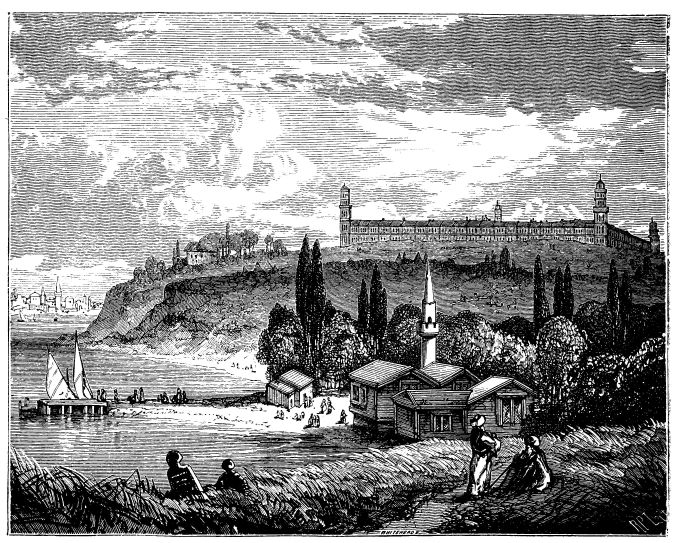
THE BARRACKS HOSPITAL, SCUTARI.
In the meantime the war had to be financed, and the country reconciled to increased taxation. Mr. Gladstone’s ordinary, as distinguished from his War Budget, was introduced on the 6th of March, when his position was this.
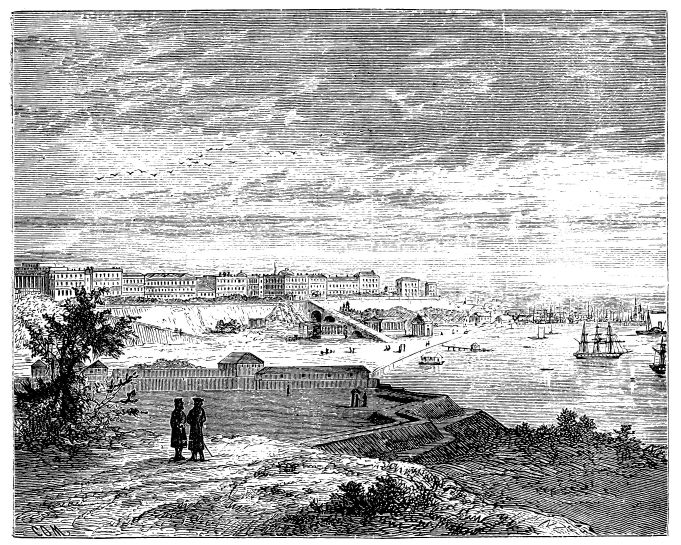
ODESSA.
He had collected £54,025,000 of revenue, or £1,035,000 in excess of what he had counted on. He had spent £51,171,000, which, in spite of military operations, was less by £1,012,000 than he had estimated. His balance in hand from the past year was £2,854,000. For the coming year his estimates must necessarily be increased by additional military outlay,[168] which would bring up his estimated expenditure to £56,189,000. As the revenue he could depend upon from existing taxes was only £53,349,000, he had therefore a deficit of £2,840,000. Had there been no need to increase his estimates,[169] he might have had a surplus of £1,166,000 for the remission of taxation. As things stood, how was the deficit to be met? Not by a loan, answered Mr. Gladstone, because no nation had mortgaged its industry to such a frightful extent as England, whose National Debt of £750,000,000 exceeded that of all countries in the world put together. Without pledging themselves to pay all future war charges out of the revenue of each year, Mr. Gladstone said it was as yet possible for the House of Commons “to put a stout heart upon the matter, and to determine that so long as these burdens are bearable, and so long as the supplies necessary for the service of the year can be raised within the year, so long we will not resort to the system of loans.” The expenses of a war, he observed, “are the moral check which it has pleased the Almighty to impose upon the ambition and the lust of conquest that are inherent in nations.” He therefore proposed to increase the Income Tax by one-half, but to collect the whole of the increase in the first six months of 1854; in other words, he doubled the tax in the first half year. He was assailed on two grounds. The Tories protested against the doctrine of meeting war expenditure out of current revenue, and they taunted him with the failure of his scheme for the conversion of the debt,[170] which, they pretended, had been disastrous. “The next Party conflict,” wrote Prince Albert in a letter to Stockmar on the 18th of April, “will be upon finance. Gladstone wants to pay for the war out of the current revenue, so long as he does not require more than ten millions sterling above the ordinary expenditure, and to increase the taxes for the purpose. The Opposition are for borrowing—that is, increasing the debt—and do not wish to impose in the meantime any further burdens on themselves. The former course is manly, statesmanlike, and honest; the latter is convenient, cowardly, perhaps popular. We shall see.”[171] This is a masterly summary of the great financial controversy that raged throughout the Session of 1854. It leaves nothing more to be said save this, that when Mr. Gladstone explained his second or War Budget (8th of May), after war had been declared, his eloquence carried the country in favour of his policy. He obtained his war expenditure by doubling the Income Tax and increasing the duty on spirits and malt, and he pointed to the rapidly-growing trade of the nation as a proof that it ought not to adopt the course which Pitt found ruinous,[172] and which Prince Albert so justly described as “convenient and cowardly.”
Perhaps the first Budget in February had slightly sobered the country—at all events, the 26th of April was set apart for a day of Fast, Humiliation, and Prayer. Over this a slight controversy had broken out. The Queen was a little offended that Lord Aberdeen had announced, without consulting her, in the House of Lords, on the 31st of March, that such a Fast would be proclaimed. She thought Fasts of Humiliation were resorted to too often, and that it was hypocritical to publicly confess in the stereotyped form that “the great sinfulness of the nation had brought about this war.” Therefore she desired that the Fast should be called a Day of Prayer and Supplication, and urged Lord Aberdeen “to inculcate the Queen’s wishes into the Archbishop’s mind, that there be no Jewish imprecations against our enemies.” Her desire was to adapt the prayer in the Church Service, “To be used before a Fight at Sea,” to the occasion.[173] According to Mr. Greville, bankers in the City pointed out that if the word “Fast” were omitted, Bills would be payable on that day and not on the day before, as Masterman’s Act provides in such cases. The Queen was, therefore, persuaded by Lord Aberdeen to proclaim “a Day of Solemn Fast, Humiliation, and Prayer, to be kept on the 26th.” It was observed solemnly in the United Kingdom, India, and the Colonies, by British subjects of all races and creeds.
When it was found that the object for which the war was undertaken—the evacuation of the Principalities—had been effected by the retreat of the Russians across the Pruth on the 28th of July, there was some fear lest the taxpayers, who were painfully digesting Mr. Gladstone’s War Budget, might consider enough had been done to bring Russia to reason. Russia, it has been shown, was now in such a position that her surrender, under the passive pressure of the Powers, was inevitable, so as a matter-of-fact enough had been done. But the growth of this feeling had to be stopped, for the War Party insisted that Russia must be rendered incapable of again disturbing Europe. It was a curious revival of a policy, the practicability of which Napoleon I. had ruined himself to illustrate. Yet on the 19th of June Lord Lyndhurst invited the House of Lords to preside at its resurrection. The long, virulent, and passionate harangue by which he endeavoured to excite the hatred of England against Russia, his indictment of her as an enemy of the human race, his appeals for her destruction in the sacred interests of liberty and civilisation, drew forth cheer after cheer even from that frigid Assembly of patricians. It produced a prodigious effect on the country, and forthwith Englishmen worked themselves up into a belief that unless a mortal blow were dealt at Russia, Europe would be overrun by Cossacks, and every honest man in England would be buried alive in Siberia. Lord Aberdeen ventured to protest against Lyndhurst’s extravagant and scurrilous abuse of the Czar, and to remind the Peers that in 1829, when Turkey was at his mercy, he had not seized Turkish territory, but had been content with the Treaty of Adrianople. For this Aberdeen was denounced as a tool of Russia, who desired to patch up a hasty and dishonourable peace.
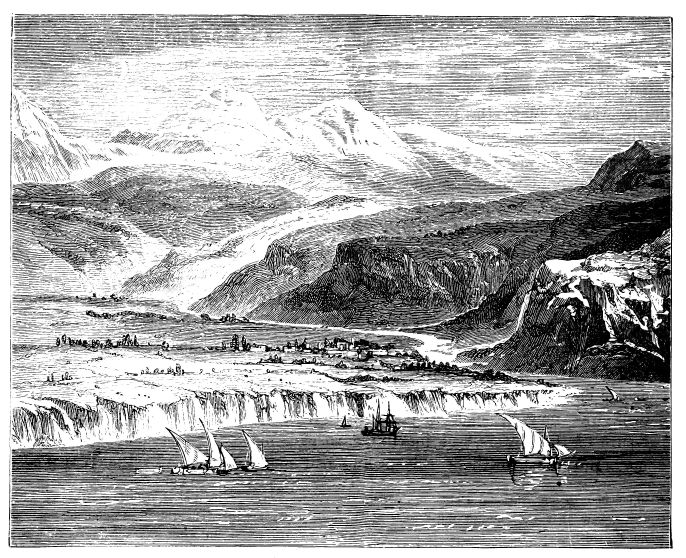
HEIGHTS OF THE ALMA.
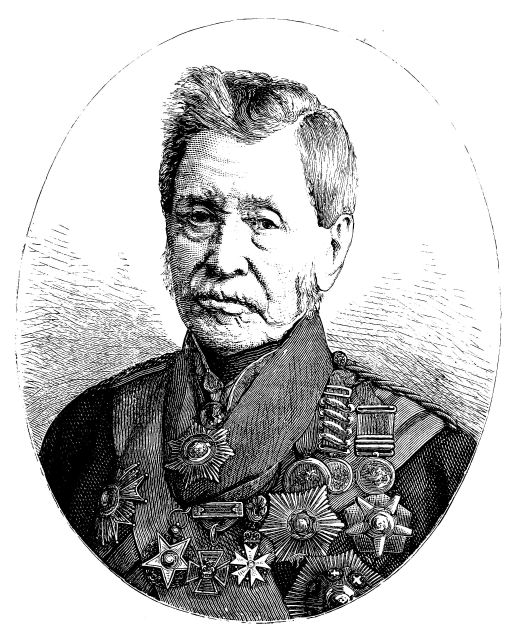
SIR JOHN BURGOYNE.
Mr. Layard, on the 23rd of June, gave notice of motion in the House of Commons, “that, in the opinion of this House, the language held by the First Minister of the Crown was calculated to raise grave doubts in the public mind as to the objects and results of the present war, and to lessen the prospect of a durable peace.” Even the Queen wrote to the aged statesman a letter scolding him because he had annoyed the public by “an impartial examination of the Emperor of Russia’s conduct.” She admired Aberdeen’s courage and honesty, but expressed a hope—in the circumstances her “hope” was a command—that in any explanation of his unlucky speech “he will not undertake the ungrateful and injurious task of vindicating the Emperor of Russia from any of the exaggerated charges brought against him and his policy, at a time when there is enough in that policy to make us fight with all our might against it.”[174] What Aberdeen said was that he objected to Russian aggression on Turkey, but as for Russian aggression on Europe, he did not fear it in the least. There was nothing in that to cause offence, except to those who, suddenly finding that Russian aggression on Turkey had been repelled by Omar Pasha, supported by the hostile demonstrations of the Western Powers, were now at a loss to discover another form of Russian encroachment, real or imaginary, to repel. There must therefore, cried Lyndhurst and the War Party, be no talk of peace till the Russian fleet in the Black Sea was destroyed, and the walls of Sebastopol razed to the ground. “For the future,” exclaimed Lord Derby, “it was impossible to permit the Black Sea to be a Russian lake, or that the Danube should be a Russian ditch, choked with mud and filth.”[175] A great army had been sent to Turkey; but the fighting and the glory had fallen to Omar Pasha on the Danube. As Lord Hardwicke said, in the debate in the House of Lords on a Vote of Credit (24th of July), “if the present campaign closed without some great deed of arms equal to the power and dignity of this country, Her Majesty’s Government would lie under a heavy responsibility.”
Lord John Russell, in defending this Vote of Credit in the House of Commons, said that the Government had now three objects in view besides the evacuation of the Principalities: (1) to place Turkey under the protection of the European Powers, to whom, and not to Russia alone, she should be asked for the future to guarantee the privileges of her Christian subjects; (2) to deprive Russia of her special right of protecting the Principalities under the Treaty of Adrianople; (3) to reduce the power of Russia in the Black Sea, so that she should not be able to menace Turkey. In connection with this third aim, Lord John threw out a sinister allusion to the destruction of Sebastopol, which Mr. Disraeli protested he heard with “consternation,” and which Lord John vainly endeavoured to explain away. The German Powers objected as much to the occupation of Russian territory by England or Turkey, as to the occupation of Turkish territory by Russia. Lord John Russell had, therefore, emulated Lyndhurst in his eagerness to give Austria and Prussia a pretext for refusing England and France their co-operation.
It was in truth easy to whet the fashionable appetite for adventure and glory. The country sulked over the inaction of the British fleet in the Baltic and the army at Varna. Yet the fleet under Napier, though it failed to make good the foolish vaunting of its commander when he started, did some useful work. It found the frowning fortifications of Cronstadt impregnable,[176] but at all events it shut up the Russian navy in their harbours, and swept their commerce from the sea. Captain Hall’s daring reconnoissance of Hango Bay in the month of May, elicited a tribute of admiration from the Grand Duke Constantine himself. Admiral Plumridge destroyed Bomarsund, a fortress built to dominate the Gulf of Bothnia. But in the Pacific the Allies were decidedly less successful in August in their attack on Petropaulovski. The English Admiral, Price, had committed suicide, and was succeeded by Sir F. Nicholson. On the 4th of September an attempt was made to take the place in the rear, but owing to the treachery of two guides, our men were misled and repulsed. They were driven over a precipice 70 feet high which lay between them and the shore, many of them being killed, and still more being wounded in taking a headlong leap for their lives.
In the Black Sea the record was more brilliant. The first shot fired in the war was at Odessa, which was bombarded for ten hours on the 22nd of April, in revenge for an outrage committed by the Russians, who fired on a flag of truce. This was followed by a challenge to the Russian fleet in Sebastopol, which was not accepted. On the 12th of May the Tiger ran aground off Odessa, and had to strike her flag. Her crew were made prisoners, but treated with the utmost kindness and courtesy by the Russians. The captain (Gifford) died of his wounds on the 19th of June, and the lieutenant (Royer) was sent to St. Petersburg by order of the Czar, who at once set him free. Captain Parker, on the 8th of July, destroyed the Russian works at the Sulina mouth of the Danube.
In May there were 20,000 French on the European and 10,000 British troops on the Asiatic side of the Danube. Gallipoli was fortified, and works thrown up in order to check the Russians had they crossed the Danube. Constantinople was also fortified, and then the Allies concentrated at Varna, ready, if need be, to carry war into the enemy’s territory. They were encamped at a spot which was saturated with the germs of malaria, and which was chosen with a reckless disregard of sanitary considerations. During June and July malaria, dysentery, and cholera decimated their ranks. They sat brooding listlessly in the shadow of death all through that fatal summer, chafing, as did their countrymen at home, over their inglorious fortune. Cardigan’s reconnoissance of the country up to Trajan’s Wall on the confines of the Dobrudscha alone broke the monotony of their existence, and on his return they were cheered by his news of the disastrous retreat of the Russians on Bessarabia. On the 26th of August a Council of War was held at Varna, and the rumour that the army was to be led to the invasion of the Crimea flew through the disheartened camp like tidings of great joy. It has been shown by what steps the English Government was lured on to this fatal decision. Yet it is due to Lord Aberdeen’s Cabinet to say, that it was not at first unanimous as to the expediency of widening the area of conflict, and attempting to break the power of Russia, “by razing Sebastopol to the ground.” Mr. Kinglake[177] has stated that this enterprise was sanctioned at a Cabinet meeting held on June 28 in Lord John Russell’s house (Pembroke Lodge). Mr. Kinglake, at a loss to explain to posterity how a number of intelligent men could have approved an act of such stupendous folly, has invented an ingenious theory. The Duke of Newcastle, as Secretary of State for War, subsequently blamed Lord Raglan for mismanaging the campaign. But Mr. Kinglake has constituted himself Lord Raglan’s champion, and he accordingly endeavours to lay as much blame as possible on the Duke. The Duke came to the meeting, says Mr. Kinglake, with a ponderous despatch, which he proposed, with the approval of his colleagues, to send to Lord Raglan ordering him to invade the Crimea. As he went on reading it, one Minister after another fell asleep. When he finished, they awoke, and sanctioned the Duke’s instructions without knowing what they were. It is unfortunately not possible to save the reputation of the Aberdeen Ministry by making drowsiness an excuse for blundering. Sir George Cornewall Lewis, in one of his letters,[178] gives the flattest contradiction to Mr. Kinglake’s amusing fable, and so does Sir Theodore Martin.
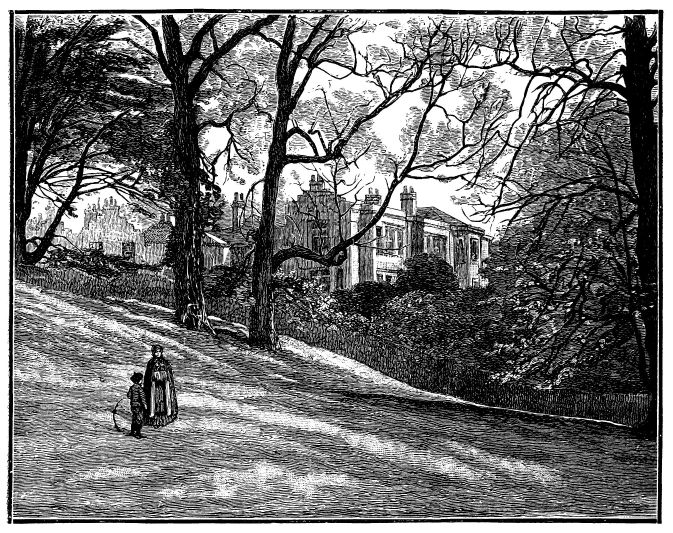
PEMBROKE LODGE, RICHMOND.
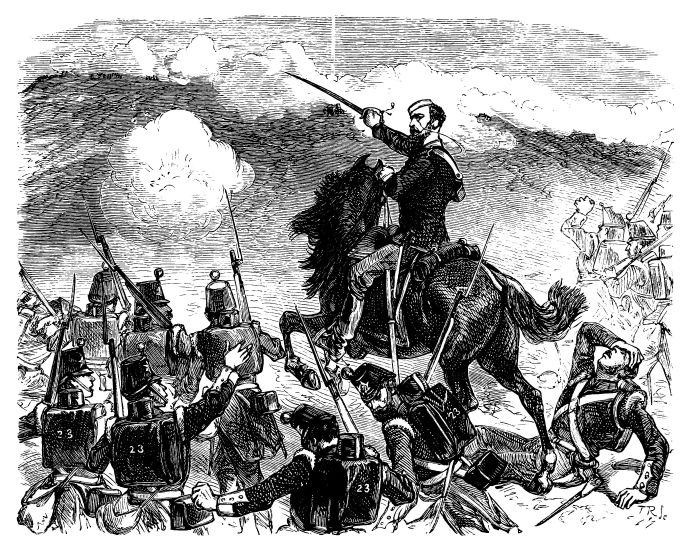
CODRINGTON’S BRIGADE (23RD ROYAL WELSH FUSILIERS) AT THE ALMA.
An eccentric Member of the House of Commons, Mr. H. Drummond, in one of the debates on the War, said that there was a division of labour in the operations, for whilst we found the money, the French Emperor found the brains. The project of wounding Russia in a vital point by invading the Crimea, was originated by the French Emperor, who possibly thought his illustrious uncle’s experiment at Moscow needed no verification. The French Emperor’s plan was submitted to the Queen on the 14th of March as one approved of by Lord Raglan, Lord de Ros, Lord Clarendon, and the Duke of Newcastle. It was dropped because some sensible person suggested that it would be hardly safe to leave Constantinople, then covered by the allied troops, at the mercy of the Russians. But after Constantinople was fortified against attack, the mischievous idea was revived. On the 28th of June it was embodied in the draft despatch containing the instructions to Lord Raglan, which was sanctioned by that fatigued Cabinet, the Members of which, according to Mr. Kinglake, fell asleep. One other fact may be cited against Mr. Kinglake. The plan was opposed by certain Members of the Ministry who, though they thought something should be done to limit Russia’s opportunities of interfering with Turkey in future, felt sure that an invasion of the Crimea must end in failure. They complained that nobody knew what could be done with the Crimea even if it were taken, or how the Russians could be stopped from rebuilding Sebastopol, except by another war, after it was destroyed. But why has there ever been any controversy over the point at all? Simply because the project was such a mad one, that everybody who had anything to do with it, has been anxious to blame somebody else for originating it. The Ministry and their apologists declared that they left the whole affair to the discretion of Lord Raglan. He was only instructed to invade the Crimea if as a soldier he thought an invasion practicable. Lord Raglan and his friends declared that he had no discretion in the matter, and that the instructions of the Cabinet amounted to an order from the Secretary of State for War, which he as the General in command had no option but to obey. Lord Aberdeen’s account of the matter to the Queen was that, “although the expedition to the Crimea was pressed very warmly” on Lord Raglan, “the final decision was left to the judgment and discretion” of Raglan and St. Arnaud, “after they should have communicated with Omar Pasha.” Sir George Cornewall Lewis, in the letter already quoted, says he does not think that the Cabinet could have given Raglan a wider discretion, because they would have probably thought they were throwing too much responsibility on him. But the obvious truth is that, as the Cabinet and the General had approved of the plan in March, they were alike responsible for it, and that if it had not been disastrous to their reputations, they would have each claimed credit for it.[179] Mr. Kinglake says that St. Arnaud was also opposed to the invasion of the Crimea, but it was his Imperial Master’s plan, and he had to adopt it against his better judgment. Possibly, Raglan’s doubts, confided to Sir G. Brown at Varna, sprang from conferences with St. Arnaud.[180]
The order to invade was dated the 28th of June, and two months were spent in preparing for the expedition. At the last moment it was found that there was no means of embarking and disembarking the cavalry and artillery. This difficulty was cleverly overcome by Mr. Roberts, a master in the navy. “Roberts did more for us than anybody,” said Lord Raglan to Admiral Lyons. He set the Turkish caïques in rows, and built great pontoons on them buoyant enough to support the enormous weight of horses and guns.[181] On the 13th of September the expedition sighted the shores of the Crimea. The allied troops skilfully disembarked without loss or confusion at the Old Fort, a spot twenty miles south of Eupatoria. Twenty thousand French and twenty thousand English soldiers, with a powerful artillery, were thus thrown upon a hostile coast in perfect marching order in one single day. On the 19th of September they moved southwards, and got touch of the Russians under Prince Menschikoff. These were 40,000 strong, and they held a fortified position on the heights of the Alma, a little river which flowed between them and the Allies. On the morning of the 20th the battle began. St. Arnaud was to attack, and if possible turn the Russian left. When that had been done, the English were to dash at the right wing of the Russians. St. Arnaud was farther away from his objective point than our men, and before he completed his manœuvre, he seems to have asked Lord Raglan to advance. Abandoning the original plan of the battle, Raglan moved forward on the swarming masses of Russians in front of him, and drove them from their position. In this contest one sees nothing admirable save the rough masculine vigour of the English attack, and the skill with which the battle was planned by St. Arnaud. Lord Raglan’s conduct was likened by the Secretary of State to that of the Duke of Wellington. As a matter of fact, at the outset he seems to have plunged into the river with his Staff, dashed on into the enemy’s lines, till he found himself on the extreme left of the French, without any control over his army. It was really led into action by his Generals of Divisions, who, till after the crisis of the battle was over, seemed scarcely conscious of the existence of their Commander-in-Chief.[182] The French attack was dashing, but somehow it did not succeed quickly.[183] As for the Russians, they were clumsily handled. Menschikoff chose a good position—so good that he staked his field defence of Sebastopol on it. But he manœuvred in massive columns, so that his front did not nearly cover all his ground. He seemed nervously anxious to meet attacks in detail, hurrying regiments from point to point wherever he thought his troops were being hard pressed, to the utter confusion of his formation. His subordinates were so stupid that they did not even think of bringing their strongest arm, the cavalry, into action.
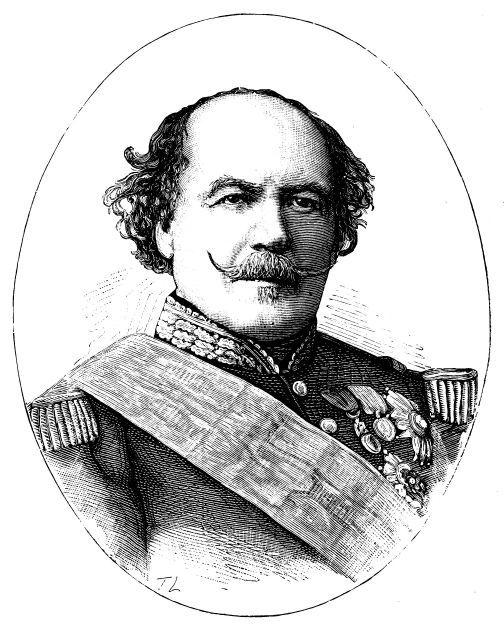
GENERAL CANROBERT.
Curiously enough at this point, the expedition, owing to Menschikoff’s bungling, had success within its grasp. The defence of Sebastopol was staked upon the army of the Alma. The stronghold lay at the mercy of the Allies after that army was routed, and could have been taken next morning by a coup de main. Raglan, to do him justice, was eager to press on, but St. Arnaud held him back. The Allies then spent three days in burying the dead, and by that time the Russians had considerably strengthened their fortifications. Raglan again urged that the city should be attacked, but, as St. Arnaud was unwilling to risk an assault, it was agreed that the invaders should march round to the south of the citadel, and attack it from that aspect. On the 29th St. Arnaud, whose health and brain had been long failing him, died, and Canrobert, an equally sluggish soldier, succeeded to his command. Whilst the Allies were, at Raglan’s instigation, marching round to the south of Sebastopol, they were for a whole day exposed to a flank attack from the enemy, which, had it been delivered, would have simply cut them to pieces. Menschikoff’s incapacity saved them from this disaster, and on the 28th of September the Russians, who had been looking for an attack from the north, to their surprise found their feeble works on the south at the mercy of their enemies. Some of the divisional commanders, like Cathcart and Campbell, were eager for storming the place at once, and, had they done so, they could have captured it with hardly any appreciable loss. Sir John Burgoyne—then supposed to be infallible as a military engineer—and General Canrobert thought the risks too great, and said that the army must wait till the siege-train was brought up. Raglan yielded to Canrobert’s hesitancy and Burgoyne’s ignorance.
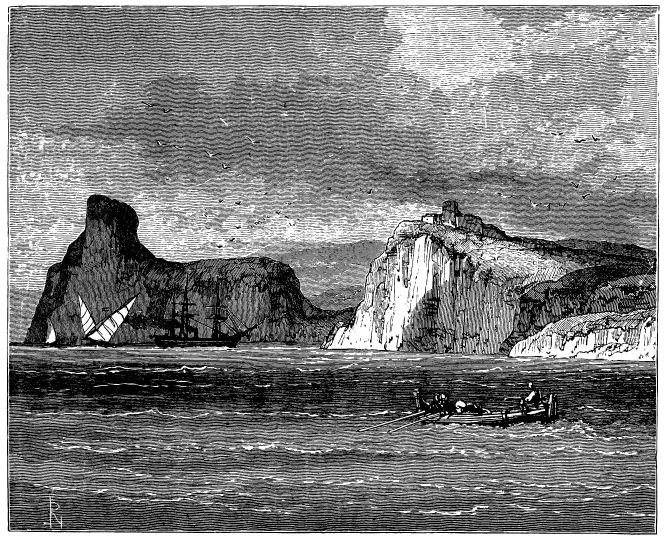
ENTRANCE TO BALACLAVA HARBOUR.
The Russians, who expected every moment to see the enemy swarming over their walls, must have looked on the unintelligible paralysis of the Allies as an intervention of Providence on their behalf. Oddly enough, when Raglan was making his flank march from north to south, Menschikoff, instead of springing on him and destroying his army, was marching with equal stupidity from the south to the north.[184] Here the allied attack was looked for; here all available troops were hurried. Nachimoff, who remained on the south bank of the harbour, had just 3,000 troops to hold indefensible works against an army of 40,000 men. He behaved with high spirit; he sank his ships so as to block the channel. Admiral Korniloff hastened from the north side to his aid and took command, and filled the troops with his own determination to hold out to the last, no matter how heavy were the odds against them. Colonel Todleben—whose master mind was about to revolutionise the art of fortification—accompanied him, and these two perfectly dauntless men, profiting by the blunder of Canrobert and Burgoyne, simply wrecked the expedition of the Allies. The time spent in waiting for the siege-train was precisely what Todleben prayed for.
Inspirited by Korniloff’s enthusiasm, and guided by Todleben’s genius, the Russians toiled like galley-slaves to strengthen their fortifications. Korniloff succeeded in inducing Menschikoff to march 25,000 troops into the town, so that on the 17th of October, when the siege-train of the Allies had arrived, Sebastopol, which had been at their mercy on the 25th of September, was virtually impregnable. On the 17th of October an attempt was made to demolish the earthworks of the enemy by a general bombardment, after which it was the intention of the Allies to dash forward and storm the southern half of the town.[185] The English batteries did not fail, for they seriously damaged the Redan Fort of the enemy. Nachimoff’s sacrifice of the sunken fleet, however, prevented our ships from getting far enough up the harbour to assist our land force, and though the sea batteries were open to attack, shoal water prevented our ships from getting close enough to them to do them much harm.[186] The failure of the bombardment was followed up by a series of attacks on the position of the Allies, the results of which may now be summarised. The great flank march from north to south had left every road from Russia open to the enemy. Reinforcements swarmed into the Crimea, even from the Russian Army of the Danube, which was liberated when the Austrians occupied the Principalities. The English army at the end of October numbered 25,000. The French had 40,000 in the field. But 120,000 combatants had rallied to the standards of Prince Menschikoff. They held not a fortress but a great entrenched camp, defended by impregnable works on which, says Lord Raglan, plaintively, in one of his despatches, “an apparently unlimited number of heavy guns, amply provided with gunners and ammunition, are mounted.” Now, it is a rule of warfare that the besieging force should be five times as strong as the besieged. No general with a grain of prudence will attempt to lay siege to a stronghold unless his force is three times as strong as that of the garrison, and unless he has an army of observation besides to protect him from molestation. Before Sebastopol the besiegers were only half as strong as the besieged, and they had no covering force whatever. Like the Athenians at Syracuse, the besiegers had become the besieged. If Lord Raglan did not complete the parallel by sacrificing his army to an eclipse of the moon, he did his best to emulate that historic achievement by sacrificing it to the flank march from the Belbeck to Balaclava.[187]
In these circumstances the Russians promptly adopted offensive tactics. Menschikoff ordered Liprandi to march round to the rear of the British position and attack Balaclava, from which we drew our supplies, and on the 25th of October the Russians suddenly drove the Turks from the redoubts that formed one of our chief defences. This gave him the northern half of the Balaclava valley. The British cavalry were withdrawn from the southern half westwards behind redoubts, which were still in our hands, and the road to Balaclava, with all our shipping and our stores, was clear. Yet not quite clear. Sir Colin Campbell and the 93rd Highlanders were in the way, and his consummate skill and their stubborn valour saved our base of operations. At a glance Campbell saw that Liprandi meant to annihilate the Scots, by hurling against them overwhelming masses of cavalry covered by artillery. To such an onset a single regiment in square formation could obviously offer no effective resistance whatever. In an instant Campbell conceived the novel and daring project of receiving the Russian cavalry in line.[188] Such a
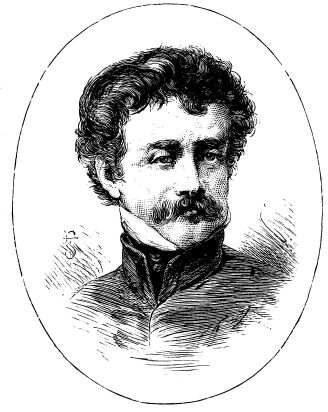
SIR COLIN CAMPBELL.
manœuvre could be possible only where a commander and his troops had implicit confidence in each other, and where officers and men, instinct with barbaric strength and courage, went forth to battle under the iron discipline of civilised warfare. In grim silence the Scots obeyed the stern, curt orders of their leader, and formed the famous “thin red line tipped with steel,” on the solidity of which, for a moment, the fate of the army depended. Their flanks were covered by the Turks who had fled from the redoubts. A hundred sick men, who crawled from the hospital to rally round their chief, were formed under Lieutenant-Colonel Daveney as “supports.” The Russian commander, with great ability, modified his plan of attack and struck swiftly not only at the centre, but strongly at Campbell’s right flank, where the Turks were posted. The dense masses of cavalry first reeled and then broke up when they came within the central zone of fire, but the Turks fled, leaving the “thin red line” uncovered on the right. The Russians, feeling that the game was now in their hands, charged again, confident that they could roll up the line at this unprotected spot. Campbell was, however, equally alert. When the Turks ran away he ordered his grenadier company to wheel to the right. It went swiftly and silently round, with automatic precision, like a door on a hinge, and met the
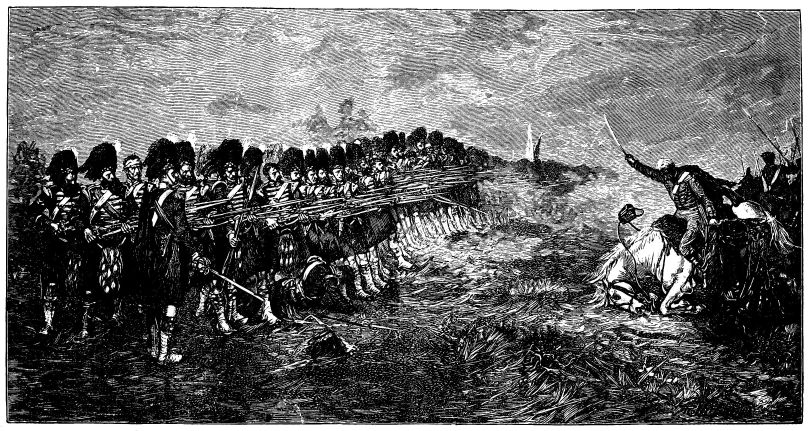
BALACLAVA—“THE THIN RED LINE.”
(After the painting by Robert Gibb, R.S.A., in the possession of Archibald Ramsden, Esq., Leeds.)
Russian squadrons with a scorching storm of fire, that sent them flying in confusion from the field. “During the rest of the day,” said Sir Colin Campbell, with a touch of grim humour in his despatch, “the troops under my command received no further molestation from the Russians.” A still more formidable body of Russian horse, however, had swooped down on our Heavy Cavalry (Brigadier-General Scarlett). The Scots Greys and Enniskilling Dragoons sprang forward to meet them, tore through the first and second lines of the enemy, and, supported by the Dragoon Guards, broke up their heavy masses in utter rout. At this moment Lord Raglan ordered Lord Lucan, who was in command of the cavalry, to advance his Light Brigade and prevent the Russians from carrying away some of the guns which the Turks had abandoned in the redoubts. When the order was carried to Lucan by Captain Nolan, Raglan’s aide-de-camp, the Russians had recovered from their reverses and had completely re-formed on their own ground. Raglan’s order, therefore, had come to mean that Lucan was to hurl his slender Light Cavalry Brigade, utterly devoid of supports, against a great army holding a strong position, flanked and covered on all sides by murderous artillery. For a moment he hesitated, appalled by the hideous madness of the order. A taunt from Nolan stung him to the quick, and he spoke the word that sent Cardigan into the “valley of death” with the far-famed Six Hundred.
“Long shall the tale be told, Yea, when our babes are old”—
how they rode onward—through the smoke and fire that belched forth from the iron throats of the Russian cannon—how they clove their way through the Russian masses and cut down the gunners at their guns—how they cut their way back, “stormed at with shot and shell,” a broken remnant of wounded and dismounted troopers, who had to report that they had failed to do that which even the demigods of ancient legend would not have been reckless enough to attempt. Nolan was killed at the very first onset—whilst riding far in advance cheering on the Brigade.[189] “It was magnificent, but it was not war” was the comment of the French General Bosquet, on this horrible sacrifice—a sacrifice so horrible that, when it was over, even the Russians ceased firing and stood motionless and awe-stricken, gazing at the sickening scene. They claim Balaclava as a victory. Certainly they took more than half the field from us; but on the other hand, thanks to the obstinate tenacity of the 93rd Highlanders, we repelled their attack on our base of operations, which was, of course, their objective point.[190]
After this fight the Russians concentrated an overwhelming force and planned an attack on our position at Inkermann. Its weakest point, in spite of the warnings of Lieutenant-General Sir De Lacy Evans, had been left badly protected, and on the 5th of November the Russians surprised our pickets. Having driven them in they fell on our Second Division, who had barely time to stand to their arms when they found themselves struggling with overwhelming masses of the enemy. Pennefather was in command, for, unfortunately, De Lacy Evans was disabled. Instead of retiring in order and attempting to ward off the attack by artillery, Pennefather hurried up little mobs of troops to his outposts, and there waged a dreadful hand to hand fight against an army ten times as strong as his own. It was “a soldiers’ battle” that raged through the morning on these misty heights—a confused melée, in which officers lost their men, and men lost their officers—in which, when ammunition failed, the English troops fought with bayonets; when these broke or bent, with stones; and when these failed, with clenched fists. Column after column of Russians was hurled at our little force—but without avail. No man could be moved from his position till he was shot or cut down, and the indomitable courage of the Duke of Cambridge and his Guards—for his Royal Highness, though he lacked skill and knowledge, never lacked pluck—held the Russians in check so long, that the French had time to come to the rescue. Then the enemy beat a retreat. We retook the positions we had lost, and once again demonstrated that the English infantry were without a rival in the world. The Russian plans were so laid, that it was a mathematical certainty our army must be driven into the sea. Two sons of the Czar had been invited to witness this catastrophe. And, in spite of the splendid fighting qualities of our men, the catastrophe must have happened, had it not been for two blunders which the Russians committed. In the first place, Menschikoff, who seems to have been even a stupider person than Raglan or Burgoyne, attacked in massive columns. This so reduced his fighting front that our weak detachments formed in line decimated them with their fire, and when our artillery came into action every shot and every shell also told on them with deadly effect. The Russian sortie from Sebastopol, moreover, was mismanaged. The commander lost his way in the mist, and instead of falling on us, he found himself entangled with the French far away on our left, so that he gave no real aid to the main attack.
The Russians lost 12,000 men in this battle, the French lost 1,800, and the British lost 2,600. It was therefore clear that the siege must be raised, or that the Allies must enter on a winter campaign. Up till now the troops had suffered very little hardship; but, alas! when winter set in they were doomed to cruel suffering. A terrific storm on the 14th of November blew
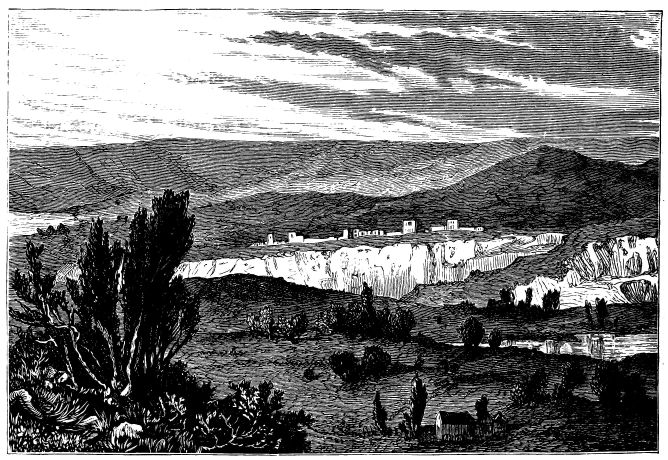
VALLEY OF INKERMANN.
down their tents and destroyed twenty-one vessels in Balaclava Bay laden with supplies. It rendered the valley from Balaclava to the camp—a distance of nine miles—almost impassable. Two-thirds of the transport horses died, and there was hardly any forage obtainable for the remainder. Cholera—the germs of which had been carried to the Crimea from Varna—raged in our lines, and those who escaped it fell victims to scurvy, dysentery, or fever. “Between the beginning of November,” writes Mr. Spencer Walpole, “and the end of February, 8,898 British troops perished in hospital. At the last of these dates 13,608 men were still in hospital.”[191] The state of the hospitals was so bad that men died there more quickly than on the field. Part of the ghastly tale of mismanagement had been told by Mr. W. H. Russell, the special correspondent of the Times, when Parliament met on the 12th of December, and empowered the Queen to raise a foreign legion and utilise the Militia for foreign service—measures forced on the Ministry by Prince Albert. But soon after it separated the cry of distress from the Crimea grew too loud to be stifled. When it rang through England the people turned on the Government in furious anger, and called them to account for their gross mismanagement of the war. The Duke of Newcastle, being Secretary of State for War, was blamed because he was alleged to be incompetent. Aberdeen was blamed because it was said he was at heart a Russian. The scurrilous charges against Prince Albert were revived, and he was accused of impeding the operations of our army by his treacherous interference. As a matter of fact, these charges were all untrue. Prince Albert, Aberdeen, and Newcastle were the three men who alone had courage to face the situation, when they suddenly discovered that the military system of England had failed them, and that the military machine which they inherited from Wellington had broken down. They had toiled long and wearily to mend it when the distinguished persons who afterwards attacked them were away enjoying their holidays. But when Parliament reassembled on the 23rd of January, 1855, the gathering storm broke on the head of the Government. Mr. Roebuck gave notice of a motion for the appointment of a committee to inquire into the mismanagement of the war; Lord John Russell deserted his colleagues and resigned. The Ministry, who resisted Mr. Roebuck’s motion, were beaten, on a division, by 305 votes to 148, and the Coalition Government resigned on the 31st of January, 1855. The army was starving, with abundance of supplies within its reach, through the sheer stupidity of those whose duty it was to feed it. Its camp was a hospital, and its hospitals were pest-houses. The nation was utterly humiliated. As for the War Party, which was really responsible for the invasion of the Crimea, it naturally destroyed the Ministry which had stooped to be the instrument of its braggart passions and its ignorant policy.
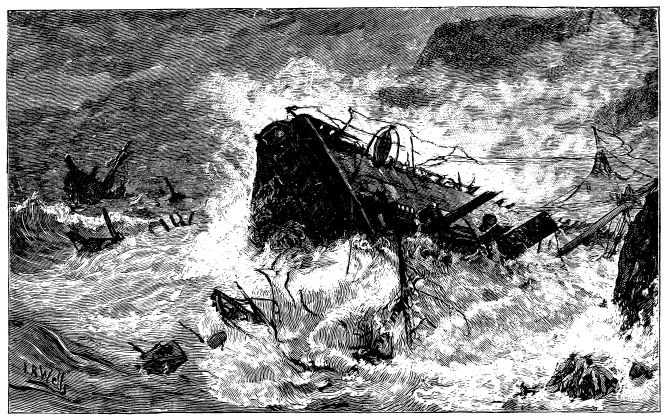
THE STORM OFF BALACLAVA.