Chapter III · 1881-1890 LONDON—GEANIES
Reading edition
CHAPTER III 1881-1890 LONDON—GEANIES
One may now for a short space turn away from the scientific side of Mr. Romanes' life and speak a little of other aspects.
No one was ever a more incessant worker and thinker. If he went away for a short visit, his writing went too; and if in Scotland wet weather interfered with shooting, he would sit down and write something, perhaps a poem, perhaps (as he once said playfully when condoled with on account of heavy rain and absence of books, 'I don't care, I'll write an essay on the freedom of the will') an article for a magazine.
A great deal of reviewing, chiefly in 'Nature,' filled up some of his time, and he also turned his attention more and more to poetry.
In the postscript of a letter written in 1878 to Mr. Darwin he says: 'I am beginning to write poetry!' and poetry interested him more and more as years went on. Of this, more later.
He much enjoyed society; he ceased to mingle exclusively with scientific and philosophical people, and as time went on he became acquainted with many of the notabilities of the day. And, as has been said, it is impossible perhaps to exaggerate the outward pleasantness of those years.
He was able to devote himself to his work; he had an ever-increasing number of devoted friends both of men and women, and he was intensely happy in his home life.
His children were a great and increasing interest to him, and he was an ideal father, tender, sympathetic, especially as infancy grew into childhood. He shared in all his children's interests, and lived with them on terms of absolute friendship, chaffing and being chaffed, enjoying an interchange of pet names and jokes, and yet exacting obedience and gentle manners, and never permitting them as small children to make themselves troublesome to visitors in any way, or to chatter freely at meals when guests were present.
He had very strong feelings about the importance of making children familiar with the Bible. He used to say that as a mere matter of literary education everyone ought to be familiar with the Bible from beginning to end. He himself was exceedingly well versed in Holy Scripture.
He also thought a good classical training very desirable for boys (and girls also), and had no very great belief in science being taught to any great extent during a boy's school career. Memory, he considered, ought to be cultivated in childhood, and he did not think that the reasoning powers ought to be much taxed in early years. He used to say that Euclid could be learnt much more easily if it were begun later in boyhood. He also much wished that foreign languages should be taught very early in life, and with little or no attention to grammar.
Perhaps a few words of reminiscence from one of his children may not be unwelcome.
MEMORIES.—G. J. R.
I remember that when my father was particularly amused at anything, he used a certain gesture, which, according to the 'Life of Darwin,'[37] must have been precisely similar to that of Darwin, and was probably unconsciously copied by my father. He never used the gesture except when very much tickled at hearing some amusing story; when the climax of the story was reached he would burst into a peal of hearty laughter, at the same time bringing his hand heavily but noiselessly down upon his knee or on the table near him.
When we were at Geanies, our greatest delight was 'to go out shooting with father.' We used to tramp for hours together over turnip and grass fields behind my father and the gamekeeper. We used to enjoy the expeditions so much better if our father was the only sportsman, for then we had him all to ourselves. We were very small then; our ages were ten, nine, and six respectively, but we were good walkers and we never became tired. What little sunburnt, healthy, grubby children we were to be sure! When Bango, the setter, pointed at a covey, we all had to stand quite still while our father walked forward towards the dog. Directly the covey rose we all 'ducked' for safety. I shall never forget the joy and pride we felt when a bird fell, and we ran with shouts of triumph to pick it up. Then the delight of eating lunch under a hedge or in a wood! That was a time of jokes and fun, and we talked as freely and unrestrainedly as we liked about all kinds of subjects. Then came some more tramping in the turnips, and we would journey homewards, a weary but very happy little party. The counting of the game would follow, and our pride was very great when the number of brace was high, for we felt that we had been helping our father to slay the partridges. In fact, we thought that Sandy, the gamekeeper, was a very useless personage when we went out, for did we not mark as well as, or better, than he did? And surely we could carry the game bags; they were not very heavy even when they were full to bursting!
There was something very beautiful in the respect and reverence which George Romanes felt for children and for child-life, and a sonnet 'To my Children' expresses these feelings:—
'Of all the little ones whom I have known Ye are so much the fairest in my view— So much the sweetest and the dearest few— That not because ye are my very own Do I behold a wonder that is shown Of loveliness diversified in you: It is because each nature as it grew Surpassed a world of joy already grown. If months bestow such purpose on the years, May not the years work out a greater plan? Vast are the heights which form this 'vale of tears,' And though what lies beyond we may not scan, Thence came my little flock—strayed from their spheres, As lambs of God turned children into man.'
As has been said, for music Mr. Romanes had an absolute passion. A good concert of chamber or of orchestral music was absolute happiness to him, and he heard a great deal in these years. One or two of his friends were excellent musicians. To one of these he once wrote a sonnet, 'To a Member of the Bach Choir,'[38] and sent it to her in the form of a Christmas card, producing much pleasant mystification and laughter when it was discovered from whom the sonnet came.
To Miss Paget.
18 Cornwall Terrace, Regent's Park: December 27, 1887.
Dear Miss Paget,—If my sonnet gave half as much pleasure as your note, I am sure we have both the best reasons to be glad. The letter was as much a surprise to me as the former was to you, because, far from seeing the 'ungraciousness' of yesterday, even then I thought that my reward was much in excess of my deserving. But your further response of to-day has given me a greater happiness than I can tell; let it, therefore, be told in some of the greatest words of the greatest man I ever knew. These you will find in the first nine lines of a letter on page 323, vol. ii., of the 'Life of Darwin,' and in one respect you have conferred an additional benefit, for, unlike him, I did not previously know that my own feelings of friendship were so fully reciprocated. If you think that this amounts to a confession of dulness on my part, my only excuse is that I formed too just an estimate of my own merits as compared with those of a friend. All that the latter were, or in this estimate must ever continue to be, I shall not now venture to say; for, if I did, the peculiar ethics of the Paget family (which you have been good enough to explain) would certainly pound this letter into a pulp. But there are two remarks which I may hazard. The first is, that I make it a point of what may be called æsthetic conscience never to write anything in verse which is not perfectly sincere. The next is, that my dulness is not so bad as to have prevented me from observing the Sebastian attachment.
Last Christmas I lost my greatest and my dearest friend.[39] This Christmas I have found that I had a better friend than I was aware of. For the seasonable kindness, therefore, of your truly Yule-tide consolation, gratias tibi ago.
Ever yours, most sincerely,
G. J. Romanes.
For some years a delightful society existed in London, known as the 'Home Quartet Union,' the members of which met at different houses and listened to perfect music performed by first-rate artists under perfect conditions.
There were few happier evenings in his life than those spent in such a way.
Of all composers, Beethoven represented to him everything that was highest in art or poetry; for Beethoven, Mr. Romanes had much the same reverence and admiration which he felt for Darwin, and perhaps Beethoven, in other and very different ways, taught him and influenced him much.
He was very catholic in his musical tastes, except perhaps that Italian opera never greatly fascinated him. Wagner's operas, on the other hand, became a great delight, particularly after a visit to Baireuth in 1889, where he saw Parsifal and Meistersinger.
Politics interested Mr. Romanes moderately. He was by nature and by family tradition a Conservative, but he cared very little for parties, and admired great men on whichever side of the House they sat.
Perhaps of all living politicians, the one for whom he had the greatest enthusiasm and respect was Mr. Arthur Balfour. For him, both as a politician and as a thinker, Mr. Romanes had an unbounded admiration.
EXTRACTS FROM JOURNAL[40]
Feb. 1881.—Went to Mr. Norman Lockyer. Several people, including William Black, the novelist, were there. After Mr. Lockyer had shown us several experiments in spectrum analysis, a lady asked him 'What is the use of the spectroscope?' Called on Mr. Cotter Morison and saw some beautiful books. He is a wonderfully good talker.
June 1881.—Dinner at the Spottiswoodes'. Mr. Browning was there and talked much about Victor Hugo. He mentioned that when Wordsworth was told that Miss Barrett had married Mr. Browning, he replied, 'It's a good thing these two understand each other, for no one else understands them.'
Garvock, Perthshire: November 5, 1881.
My dearest Charlotte,—I thought you would like the photos, and your letter to-day more than justifies my anticipation. Coming events cast their shadows before, and it will not now be long before you see the former. These are both exceedingly well. I wish you could see little Ethel dancing. It is now her greatest amusement, and she does it with all the state and gravity of an eighteenth century grande dame.
Many thanks for your prompt action about the proofs. You did everything in the best possible way, as I knew you would. It is a great blessing you were in London at the time, as the caretaker would be sure to have made some mistake, and time is pressing.
The duke has answered me in this week's 'Nature,' and likewise has Carpenter. I have written a rejoinder for next week's issue in a tone which I have tried to make at once dignified and blunt.
I send you a riddle which I have just made. See if you can answer it in your next.
'My first is found in Scripture, My second hangs in air, My third a thing to all unknown, Yet maps can tell you where. My whole is neither fact nor thing, A word, yet not a word, And if you stand me on my head, I'm bigger by a third.'[41]
Much love from both to both.
Yours ever the same,
George.
In this Journal constant mention occurs of concerts and of the pleasure given by amateur musical friends. The late Professor Rowe's name often occurs, he succeeded Professor Clifford at University College, and besides his great mathematical attainments he was also a most accomplished musician. He played Schumann especially in the most poetic way.
Journal, Feb. 1882.—Lecture by Professor Tyndall on the action of molecular heat. Triumphant vindication of his own work against Magnus and Tait.
April 2.—Sunday, the 25th, we spent at Oxford, met the Warden of Keble in Mr. F. Paget's rooms, as a year ago we had met Dr. Liddon. Met Mr. Vernon Harcourt at Christ Church.
May.—Met Shorthouse, author of 'John Inglesant,' at the F. Pollocks'. He spoke of Mr. Scott-Holland's review of his book. Sir T. Bramwell lectured the other day at the Royal Institution on the making of the Channel tunnel, and was as amusing as usual.
June.—Interesting talk with Mr. J. R. Green. Both J. R. G. and G. J. R. agreed that Herbert Spencer, Professor Huxley, and Leslie Stephen only represented one side of the question, i.e. that conduct can only be called moral when it is beneficial to the race, and that the ethical quality of an action is determined solely by its effects as beneficial or injurious. This purely mechanical view of morality deprives morality of what both speakers considered the essential elements of morality as such, i.e. the feeling of right and wrong, so that, e.g., ants and bees, according to this canon, have a right to be considered more truly moral than men.
The view taken by J. R. G. and G. J. R. was that the essential element of morality resided in feeling and inclination.
To Miss C. E. Romanes.
18 Cornwall Terrace: June 9.
My dearest Charlotte,—We are all well and lively. Ascot and an 'at home' yesterday; to-day artists' studios, dinner at the Pagets', and Sanderson's lecture; to-morrow, College of Surgeons' reception and dinner party of our own; and next week, one, two, or three engagements for every day. 'Babylon' is in full swing, and I heard yesterday, from the head of the Census department, that for the last ten years it has been growing at the rate of 1,000 per week.
I have only time to write a few lines to thank you and the mother for the very jolly letters received this morning, and to let you know that we are all well.
The reason of my haste now is this extraordinary discovery that has been made in the Botanical Gardens, and which you have probably read about in the 'Times.' Medusæ have been found in swarms in the fresh-water tank of the Victoria Regina Lily. Such a thing as a fresh-water Medusa has never been heard of before, and I want to lose no time in getting to work upon his physiology. You see, when I don't go to the jelly-fish the jelly-fish come to me, and I am bound to have jelly-fish wherever I go.
It would have been very odd if I had been the discoverer, as I should have been had I known that there was a living Victoria Regis, for then I should have gone to see the plant, and would not have failed to see the Medusæ. Only in that case I might have begun to grow superstitious, and to think that in some way my fate was bound up in jelly-fish.
I must get to work soon because all the naturalists are in a high state of excitement, and there has been a regular scramble for priority.
The worst about this jelly-fish is that it will only live in a temperature of 90°, so I shall have to work at it in the Victoria House, which is kept at a temperature of 100°, and makes one 'sweat.' But I shall not work long at a time.
From 1882 to 1890 Mr. Romanes rented Geanies, a beautiful place overlooking the Moray Firth. It belongs to a cousin of the Romanes family, Captain Murray, of the 81st Regiment. Captain Murray's mother and sisters lived not far away, and the Murrays and Romanes formed a little coterie in that not very populous neighbourhood.
He continued to be an ardent sportsman, and probably his happiest days were those he spent tramping over moors or plodding through turnips in those October days of perfect beauty, which seem especially peculiar to Scotland.
The surroundings of Geanies, without being romantically beautiful, have a charm of their own. There is a certain melancholy and loneliness about the inland landscape round Geanies which appealed strongly to him. It is a place abounding in every kind of sea-bird, and it is almost impossible to describe the weird, uncanny effect which the long endless twilight of the summer, the silence broken by hootings of owls, by the scream of a sea-gull, produce on one.
It is an old rambling house with long passages and mysterious staircases, and, as the children found, endless conveniences for playing at hide-and-seek. The library is a most lovely room, lined with bookcases, and leading into an old-fashioned garden, full of sweet-smelling flowers.
It is impossible to imagine a more ideal abode for a poet, a naturalist, a botanist, a sportsman, than this, his summer home; and as Mr. Romanes was, to some extent, all four, Geanies was a place of exceeding happiness to him.
Two of his sonnets are dedicated to his dogs, 'To my Setters,' and 'To Countess,' and the following letter will show him as a sportsman.
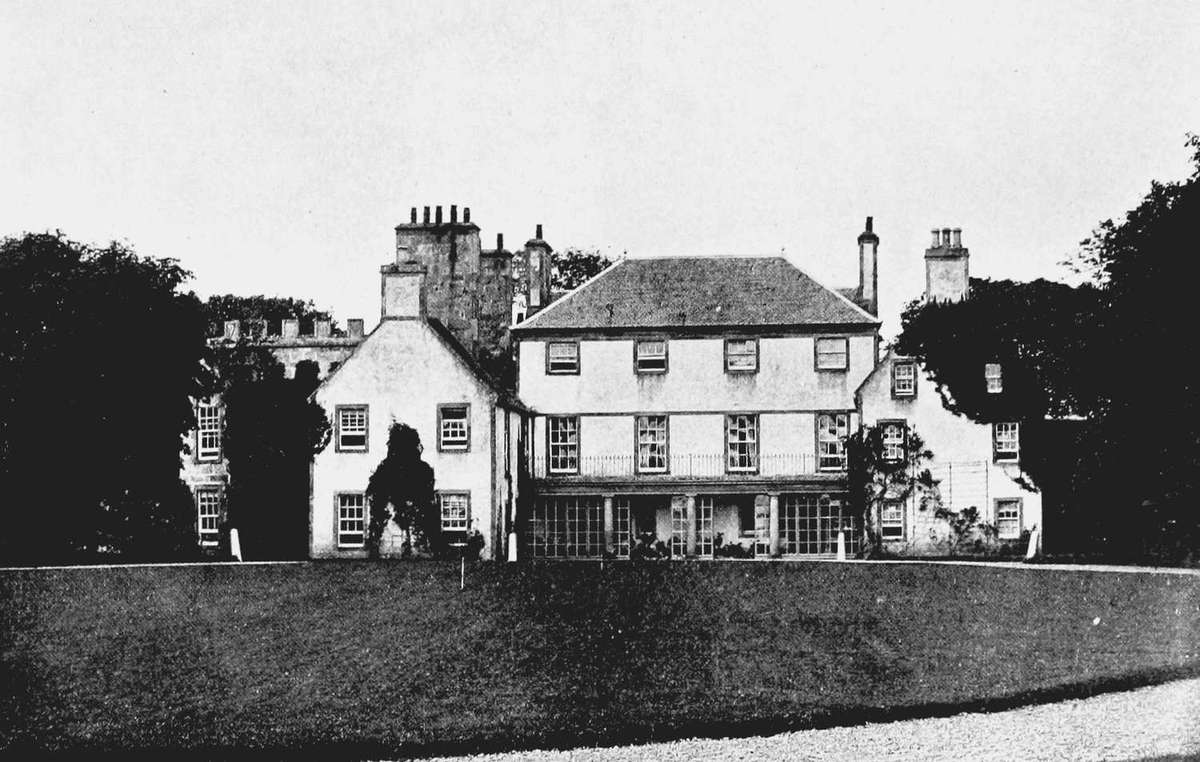
GEANIES, ROSS-SHIRE Reproduced from a photograph by Messrs. W. Smith & Co. Tain
To Mrs. Romanes.
Achalibster,[42] Caithness: August 14, 1883.
To-day turned out not at all bad after all; and although there was a good deal too much rain I had a glorious time. Bag twenty brace of grouse, one brace plover, one hare, one duck; I could easily have got more, only Bango got so tired in the afternoon that we knocked off at five o'clock, moreover I did not begin till eleven, as I did not wake till ten! So the twenty brace was shot in about five hours. The new setter 'Flora' is a beauty. She is extraordinarily like Bango, but with a prettier face. She is a splendid worker.
Even at Geanies he always 'worked' for some part of the day, and sport, tennis, boating, filled up the rest of his time.
Very often there was a house party, and the evenings were particularly bright—merry talk, games, very amateurish theatricals, learned discussions. Nothing came amiss to the master of the house. He was always a little apt to be absent-minded and dreamy, and his pet name, bestowed on him by the dearest and merriest of all the merry 'Geanies brotherhood' was 'Philosopher.' It stuck, and many people only knew him by that name.
No one ever appreciated a good story more than he, and, as a friend has said, 'his laugh was so merry and so often heard.'
His own jokes were invariably free from any unkindness, and he did not in the least appreciate repartee or epigram, the point of which lay chiefly, if not wholly, in unkindness. Many friends enlivened his summer home, and all those who paid a second visit were known as the 'Geanies brotherhood.'
Journal, Geanies, July 26.—Yesterday came the terrible news of Mr. Frank Balfour's sudden death.[43] His loss is irreparable. It is only a month since we met him at Cambridge, looking so well, quite recovered from his recent illness; we were looking forward to his promised visit.
Sept.—Mr. Lockyer, the Bruntons, and the Burdon Sandersons have been here. Memorial Poem to Darwin begun.
Nov. 14, Edinburgh.—Met for the first time Mr. and Mrs. Butcher, who were just taking possession of the Greek Chair; also Professor Blackie, who was himself, and talked much of the insolence of John Bull.
Jan. 1883.—Dr. Sanderson is elected Professor of Physiology at Oxford.
To this election was due the ultimate change in Mr. Romanes' life in 1890, when he followed Dr. Sanderson to Oxford, attracted mainly by the facilities for physiological research.
On Jan. 2 of this year (1883) his mother died.
Mr. Romanes lectured at the Royal Institution in January, and immediately afterwards went abroad on one of the only two Continental tours he took simply for pleasure. He much enjoyed this Italian journey, and the rhyming instinct woke up in him greatly. He wrote a good deal about this time, and one of his sonnets has reference to this journey—'Florence.' He also made acquaintance for the first time with a good many well-known novels, read to him during a temporary illness at Florence—the precursor, alas, of many such times of novel-reading. He shared Mr. Darwin's tastes for simple, pure, love stories, and one of the party at Florence well remembers how 'The Heir of Redclyffe' brought tears to his eyes. For this and 'The Chaplet of Pearls,' read to him some years later, he had a great admiration.
Journal, March 28, 1883.—Mr. F. Paget's wedding in St. Paul's, a special anthem by Stainer. The Warden of Keble and Dr. Liddon married them, and the whole service was very impressive.
June.—Mr. Spottiswoode's death has been a terrible blow. Service at the Abbey. We put off our party on June 27th; it seemed improper to have a party, mainly composed of scientific people, the very day after the death of the President of the Royal Society.
12th.—Dinner at the Pagets'. Met Browning,[44] who is entirely on Carlyle's side à propos of Froude's recent revelations.
15th.—Went to Professor and Mrs. Allman, at Parkston. He is a most fascinating naturalist of the old type, caring for birds, and beasts, and flowers.
Met Mr. E. Clodd the other night, who alluded to 'Physicus'[45] and the tone of depression in the book. ('Candid Examination of Theism.')
This year Mr. Romanes and Professor Ewart set up a small laboratory on the Geanies coast, and the Journal notes:
Professor Ewart could not get the farmhouse he hoped, and this was unfortunate, as he had written to the British Association and invited one or two foreigners to come and work and live in this farmhouse. In vain were the foreigners warned not to come, for one evening in walked a young Dane, who preceded a postcard he had sent announcing his arrival. Very nice, and extremely embarrassed at finding himself in a country house where people dressed for dinner.
However, he got accommodation in the neighbourhood and worked at Ascidians, but the experiment of inviting stray foreign scientists was abandoned.
Sept.—The Allmans, Turners, and Mr. Lockyer have been here, and we have been getting up some private theatricals.
Jan. 1884.—Lecture at the Royal Institution on 'the Darwinian Theory of Instinct.'
To Miss C. E. Romanes.
January 5, 1884.
I am preparing a beautiful surprise for Ethel after she comes down again. The library is to have its end wall papered and panelled, the conservatory is to be painted green, and filled with stands of flowers, and the little room is to have the window filled with stained glass, the walls, ceiling, and doors, beautifully papered and decorated. I expect my book to pay the bills. Is not this a nice idea?
Little Ethel's ideas about writing, by the way, are original. A few days ago she wanted me to play at gee-gee. I said, 'No, Ethel, father is writing.' She asked, 'Writing letters or writing book?' I said, 'Writing book.' Whereupon she made the shrewd remark—'Father not writing to anybody, father can play gee-gee.' So much for her estimate of my popularity as an author.
Journal, April.—Lecture at Manchester; stayed with Professor Boyd Dawkins.
This year Mr. Romanes attended Canon Curteis' 'Boyle Lectures' at Whitehall.
Journal, March 1883.—'G. Lectured at ——. One of the hearers asked whether in the lecturer's opinion man or animals had first appeared on the earth! G. spent a pleasant day at Bromsgrove with the F. Pagets.'
To James Romanes, Esq.
18 Cornwall Terrace, Regent's Park, N.W.: June 1, 1884.
My dearest James,—Little Ethel has just brought me the enclosed letter to send to you. She had written it as far as the up and down lines go, and said it was to tell you how much she loved you, and how sorry she was that she should not see you when she goes to Geanies. She then asked me to tell her how to write kiss. I told her that in letters they write kiss by a cross, and then she made the crosses. She also made me promise to send you the letter at once, without any delay; and as the idea of writing you a letter was entirely her own, I do as I was told. You may take it as a definite expression of the emotions, even though it be not a very intelligible expression of ideas.
She wants to know why you are going away, and whether you will write to her when you are away, and a heap of other questions of the same kind.
We are all well now, and I am just going with the two Ethels to a children's service, which they both enjoy. It is very pretty to hear the little one singing with the other children, which she does perfectly in tune.
They are waiting for me now, so with best love from all,
Yours ever the same,
George.
In 1885 came the first warnings of ill-health. Mr. Romanes had a short but very sharp illness, and after that year he suffered frequently from gout, which necessitated visits to various foreign 'cures.' He was a perfect travelling companion, he liked to have arrangements made for him, and was never discomposed if anything went wrong, never put out by any of the ordinary mischances of travel. Although he always professed indifference to architecture and art, he would grow quite boyishly enthusiastic over some cathedral, as his sonnets to Amiens, and Christ Church, Oxford,[46] testify, and for sculpture he had a real love.
In May 1885 came the first marked public utterance which showed that Mr. Romanes was now in a very different mental attitude to that in which he wrote his 'Candid Examination of Theism.'
He delivered the Rede Lecture at Cambridge, and in it he criticises the materialistic position. (It must be remembered that his anti-Theistic book was published anonymously, and at that time he had no intention of ever referring to it.)
The reaction set in very soon after the 'Candid Examination' was published.
He was severe, as it seemed often to those who knew him best, unduly severe with himself, and often described himself as utterly agnostic when possibly 'bewildered' would have better described him.
Through these years, underneath all the outward happiness, the intense love for scientific work, there was the same longing and craving for the old belief, and before his eyes was always the question, 'Is Christian faith possible or intellectually justifiable in the face of scientific discovery?'
These years between 1879 and 1890 were years of frequent despondency, of almost despair, but also of incessant seeking after truth, and year after year he grew gradually nearer Christian belief.
The letters which follow will be interesting in this place. They arose out of a correspondence in 'Nature.'[47]
To Professor Asa Gray.
May 16, 1883.
Dear Professor Gray,—The receipt of your kind letter of the 1st instant has given me in full measure the sincerest kind of pleasure; for in the light supplied by your second letter communicated to 'Nature' I came deeply to regret my misunderstanding of the spirit in which you wrote the first one, and now you enable me to feel that we have shaken hands over the matter.
For my own part I am always glad when differences in matter of opinion admit of being honestly expressed without enmity, and still more so when, as in the present case, this discussion leads to a basis of friendship. I therefore thank you most heartily for your letter, and remain yours very truly,
G. J. Romanes.
P.S.—If you have not already happened to read a book called 'A Candid Examination of Theism,' I should like to send you a copy. I wrote it six or seven years ago and published it anonymously in 1878. I do not now hold to all the arguments, nor should I express myself so strongly on the argumentative force of the remainder, but I should like you to read the book, in order to show you how gladly I would enter your camp if I could only see that it is on the side of Truth.
December 30, 1883.
Dear Professor Gray,—I sent you my papers as a return for those which you so kindly sent to me, and for which I have written to thank you before. I quite agree with your view, that the doctrine of the human mind having been proximately evolved from lower minds is not incompatible with the doctrine of its having been due to a higher and supreme mind. Indeed, I do not think the theory of evolution, even if fully proved, would seriously affect the previous standing of this more important question.
The sorrow is, that this question is so far removed from the reach of any trustworthy answer. Or, at least, such is the sorrow if that answer when it comes is to prove an affirmative. If it is to be an eternal sleep, no doubt it is better to live as we are than in the certainty of a Godless universe. But although we cannot find any sure answer to this momentous question, I cannot help feeling that it is reasonable (although it may not be orthodox) to cherish this much faith, that if there is a God, whom, when we see, we can truly worship as well as dread, He cannot ex hypothesi be a God who will thwart the strong desire which He has implanted in us to worship Him, merely because we cannot find evidence enough to believe this or that doctrine of dogmatic Theology.
But I do not know why I should thus trouble you with my troubles, unless it is that the kindness of your letters has broken through the bars by which we usually imprison such feelings from the world. Anyhow, I thank you for that kindness, and hope you will forgive this somewhat odd requital.
Very sincerely yours,
G. J. Romanes.
'The desire to worship Him.'
These words are the key-note of the religious history of the pure and noble character which I am trying to describe.
The letters, so touching in the momentary breaking down of reserve, give, as it were, a glimpse of the inner life, give an indication of the struggle, the perplexity, the sorrow which eleven years later ended in 'Eternal Peace.'
Readers of the lately published 'Thoughts on Religion' will see how gradually he grew to perceive the reasonableness of the Christian Faith; he had never doubted the beauty, the moral worth, the attraction of that faith. And with him it was what Dante in his 'Paradiso' puts into S. Bernard's mouth:
'A quella luce cotal si diventa, Che volgersi da lei per altro aspetto È impossibil che mai si consenta.'
And through all these years there was a constant willingness to try to aid other people in their difficulties, to remove stumbling-blocks which hindered others. He was always willing to discuss problems of belief, always perfectly fair and candid, and there were not a few who, since his death, have spoken of the real help which he gave them. He did not drop religious observances; on Sunday in London he usually went to Christ Church, Albany Street, of which the present Bishop of St. Albans was then vicar, and for some years at Geanies he had a short Evening Service for guests and servants who could not drive ten miles to church.
This service, unless a clergyman happened to be staying at Geanies, he conducted himself, and ended it by reading a sermon. He had all his Presbyterian ancestors' love for a good discourse, and serious efforts had to be made to prevent him from reading too long a sermon.
Mozley's 'University Sermons' he liked particularly, and when these were divided, they were tolerated by his audience, who at first considered them much too long. He also read many of Dean Church's sermons.
He first knew the Dean in 1883, and although he only went very occasionally to the Deanery, he was greatly impressed by the striking personality of the great divine and scholar, whom to know was to love. The Dean's beautiful style, his great learning, his intellectual sympathy with perplexities and troubles of heart and mind, and the indefinable air of distinction which a great writer stamps on every bit of work he undertakes, all appealed to Mr. Romanes; and above and beyond all these, the almost austere loftiness of thought, the moral heights implied in Dean Church's writings, seized on the mind of one who, beyond all else, reverenced personal character and personal goodness.
He really enjoyed reading Dean Church's sermons, and they exercised much influence on him. For Newman, on the other hand, he had little liking, and indeed he never did Newman adequate justice. He had promised a friend just before his death to read more of Newman, and discover for himself the great gifts of that wonderful man, but there was not time. Only one bit of Newman's writing was dear to him, 'Lead, kindly Light.'
The following letter rose out of a conversation Mr. Romanes had with Dr. Paget, during one of the Oxford visits:
The Palace, Ely: June 15, 1886.
My dear Romanes,—I have often and anxiously thought over the question which you asked me when you were at Oxford about your boy's education, and the part which you should take in his religious training: and I would venture, with most true and affectionate gratitude for your trust, to write a few lines in partial qualification of what I then said.
I start on the ground of your own wish (for which indeed I am with all my heart thankful) that your boy's character should be fashioned after the Christian type and under the influence of Christ. And I am as anxious as ever that, even if your own estimate of the evidences of Christianity should for a long while remain as it is, your children may never, in their later years, feel that you ever taught them anything which you did not believe: on every ground I long to avoid all danger of such a thought crossing their minds. But at the same time I do long that they may be spared to the very last possible moment the knowledge that in the judgment of the mind which they, I hope, will most reverence and love, the bases of their religious trust and hope are uncertain. It is only far on in life, I think, that a man comes to realise either the vast importance of things which are not held with absolute certainty, or the mysterious and complex nature of the act of faith, and the discipline of obscurity, and the way in which real spiritual progress may be going on where the mind seems only to be holding on, as it were, with fear and trembling.
To a boy of sixteen the mere knowledge of uncertainty in his father's mind may drain all the moral cogency out of the whole conception of religion:—the very suspicion of the uncertainty may unnerve him more than the full realisation of the doubt would change his father's aim and hope in doing his duty.
And so, at the risk of paining you—believe me, I would rather have the pain than give it you—and presuming very thankfully on the wish of which you spoke, I would plead that your children might remain as long as possible in ignorance of your uncertainty and anxiety; that they should only know in a general way that the religious influences, the principles of their Godward life which they receive, are given to them by your wish—that you would have them grow up after that type, with that hope and aspiration; and I would plead that for their sakes you should suffer the pain, great as it may be, of being reticent where you long to be ever communicative, ever unreserved. You may be unspeakably thankful some day that you did so suffer:—and, whatever comes, you will be sure of your children's deepest love and gratitude, if ever they should know that this was one of your acts of self-sacrifice for them.
Please forgive me, dear Romanes, where I have written blunderingly, or given you unnecessary pain. I pray God to guide and teach and gladden both you and yours, and I am
Your affectionate friend,
Francis Paget.
Geanies, Ross-shire, N.B.: June 24, 1886.
My dear Paget,—I should indeed require to be made of unduly sensitive material, if either the extreme kindness of your thought or the most considerate delicacy of your expression could give me pain. Pain I have, but it is of a kind that is beyond the power of friends either to mitigate or to increase.
The advice which you give accords precisely with my own view of the matter, and it is needless to say that in such an agreement I find no small degree of satisfaction. Moreover, the principles which it thus appears to be my duty to adopt are made easy for me.... So that on the whole it does not now appear to me that in its practical aspects the problem is likely to prove difficult of solution; although theoretically, or as a matter of ethics, I do think it is a complex question whether (or how far) parents should teach dogmas as facts, or matters of faith as matters of knowledge. Happily, however, ethics are to morals very much what shadow is to sunshine; and in seeking to follow the right or the good, instinct is often a better guide than syllogism.
And now, in conclusion, let me endeavour—inadequately as it must be—to express my deep sense of gratitude to you for having so earnestly taken my troubles into your consideration. I assure you that your letter has touched me truly, and that on its account I am more than ever happy to subscribe myself
Your affectionate friend,
Geo. J. Romanes.
Journal says:—
April 12, 1885.—Went with the Church family to St. Paul's and heard a fine sermon from Dr. Liddon. He spoke very touchingly of Lady Selborne's death, and also alluded to Max Müller's new book.
Have been to Pfleiderer's Hibbert Lectures.[48] We met Pfleiderer the other day, and he described a Sunday in which he had tried to study English religious life. Spurgeon, Parker, and, I think, Stopford Brooke or Haweis, I forget which, he took as samples! Pfleiderer also went to St. Paul's on the day the Bishop of Lincoln[49] was consecrated, and as he got within earshot he heard Dr. Liddon's silvery voice pronouncing his own name not with approval.
Geanies, August.—Mr. Cotter Morison is here, and is most amusing. Mr. Horsburgh asked two comic riddles: 'Why are men like telescopes and women like telegrams?'
Men are like telescopes, because they are made to be drawn out and shut up; and women are like telegrams because they far exceed the males (mails) in intelligence.
G. fiddled at an amateur concert at Tain.
Mr. F. Galton is here. He told us an amusing child's question: 'How did sausages get along when they were alive?'
To Miss C. E. Romanes.
Geanies, Ross-shire: November 7, 1885.
The two Ethels left this afternoon minus their luggage and luncheon, which arrived at the station with the dog-cart just as the train was leaving. Pathetic it was to see their hungry eyes looking at the neat luncheon basket from the train windows! We are all well here. L—— is here. He has now fired his first hundred cartridges, and has nothing to show but a brace of cats which he took a pot shot at in the trees.
November 12.
I am now playing at the last day in the old house, and doing so in the library all by myself. L—— left this morning, and we all leave to-morrow. Gerald now leads me from one room to another, and after opening the door and looking round each says, 'All gone!'
I have somewhat relieved the monotony of my solitary life by buying a horse. This you will no doubt think is a purchase well timed and thus worthy of a philosopher. For six months at least I shall have to pay for his keep, and never have a chance of a single bit of use for him all that time. Yet, strange to say, I think I have made a good bargain.
Nov., Edinburgh.—Dined at Dalmeny. We met Mr. and Mrs. Gladstone, and also Lieutenant Greely, of Arctic fame.
Nov., London.—Dinner with the F. Galtons, and met the Leckys and other nice people. Mr. Galton says the study of statistics fascinates him just as skating on thin ice does some people—it's so perilous.
Returning for a little while to the scientific work of these years, one may say that they were chiefly devoted to the more philosophical side of his work as a naturalist.
'Animal Intelligence,' 'Mental Evolution in Animals,' appeared respectively in 1881 and 1883, and are works designed to prove that the law of evolution is universal, and applies to the mind of man as well as to his bodily organisation.
Mr. Romanes read widely and observed much, and no one less deserved the charge of writing without observing, or of being a 'paper philosopher.' Both these books abound in stories of animals, and are full of interest for anyone caring at all for 'beasts,' quite apart from the special object of the books.
Lecturing and reviewing were, so to speak, pastimes to him, and gave him little trouble. One lecture given at the Royal Institution on 'The Mental Differences between Men and Women' drew upon the head of the unlucky lecturer a great storm of indignation—why, the writer of this memoir has never been able to discover.
In May 1886, Mr. Romanes read a paper before the Linnean Society on 'Physiological Selection, an additional suggestion on the origin of species.' This paper was the outcome of many years' study of the philosophy of evolution, during which time he had gradually been coming to the conclusion that natural selection cannot be regarded as the sole guiding factor in the production of species, but that there must be some other cause at work in directing the course of evolution.
The theory of natural selection rests on two classes of observable facts: first, that all plants and animals are engaged in a perpetual struggle for existence, there being in every generation of every species a great many more individuals born than can possibly survive; and secondly, that the offsprings, although closely resembling the parent form, do present individual variations. It follows, therefore, that those individuals presenting variation in any way beneficial to them in the struggle for existence will survive as being the fittest to do so, Nature, so to speak, selecting certain individuals of each generation, enabling them not only to live themselves, but also to transmit their favourable qualities to their offspring. If a special line of variation is in some way preserved, there may result a variety so fixed and so distinct from the parent and collateral related forms as to constitute a separate species.
Further, since the environment (i.e. the sum total of the external conditions of life) is continually changing, it follows that natural selection may slowly alter a type in adaptation to the slowly changing environment, and if in any case the alterations effected are sufficient in amount to lead naturalists to name the result a distinct species, then natural selection has transmuted one specific type into another.
Mr. Romanes pointed out that the theory of natural selection only accounts for such organic changes as are of use to the species—by use signifying life-preserving—that it is, in fact, a theory of the origin and cumulative development of adaptations, whether these be distinctive of species, or of genera, families, classes, &c.
The question then arises, do species differ from species solely in points of a useful character, as they undoubtedly should do if natural selection has been the sole factor in their formation? Investigation shows that systematists recognise a species by a collection of characters, the value of a character depending not on its utility, but upon its stability; in fact, a large proportional number of specific characters, such as minute details of structure, form, and colour, are wholly without meaning from a utilitarian point of view. Investigation further shows that the most general of all the 'notes' of a true species is cross-infertility, that is, the infertility of the offspring of two individuals belonging to separate species: this, it was urged, could not be due to the action of natural selection. Lastly, apart from the primary distinction of cross-infertility, and the inutility of so many of the secondary specific distinctions, neither of which can be explained by the action of natural selection, Mr. Romanes was strongly of the opinion that even if a beneficial variation did arise, the swamping effects of free intercrossing would reabsorb it, and so render evolution of species in divergent lines, as distinguished from linear transmutation, impossible. This last difficulty can only be met by assuming that the same beneficial variation arises in a number of individuals simultaneously, for which assumption our present knowledge furnishes no warrant. If natural selection is brought forward as the sole factor in the guidance of organic evolution, then he considered that these difficulties remain insurmountable; if, however, it is regarded as a factor, even the chief factor, then these difficulties vanish, it being consistent, in the latter case, to hold the other factor, or factors, responsible for an explanation of the difficulties in question. It was the object of this paper to suggest another factor in the formation of species, which, although independent of natural selection, was in no way opposed to it, and might be called supplementary to it, and was at the same time capable of explaining the facts, of the inutility of many specific characters, the cross-infertility of allied species, and the non-occurrence of free intercrossing. Very briefly indicated, Mr. Romanes' line of argument is as follows:—Every generation of every species presents an enormous number of variations, of which only the ones that happen to be useful are preserved by natural selection. The useless variations are allowed to die out immediately by intercrossing.
Consequently, if intercrossing be prevented, there is no reason why unuseful variations should not be perpetuated by heredity quite as much as useful ones when under the nursing influence of natural selection. Thus, if from any cause, a section of a species is prevented from intercrossing with the rest of its parent form, it is to be expected that new varieties—for the most part of a trivial and unuseful kind—should arise within that section, and in time pass into new species. This supposition is borne out by the nature of the flora and fauna of oceanic islands, which are particularly rich in peculiar species, and where intercrossing was, of course, prevented with the original parent forms by the action of the geographical boundaries.
However, closely allied species are not always, or even generally, separated by geographical boundaries, and the cross-infertility remains to be explained. The cardinal feature of Mr. Romanes' theory is that the initial step in the origin of species is the arising of this infertility as an independent variation, by which, free intercrossing with the parent form on a common area is prevented, and specific differentiation rendered possible. Innumerable varieties are known to occur which do not pass into distinct species, the reason being that this initial variation, that is, incipient infertility whereby the swamping effects of intercrossing might be obviated, was lacking, and the variations became re-absorbed. That is, given any degree of sterility towards the parental form which does not extend to the varietal form, then a new species must take its origin. Without the bar of sterility, in Mr. Romanes' opinion, free intercrossing must render the formation of species impossible. Mutual sterility is thus the cause, not the result, of specific differentiation. As regards the occurrence of this initial variation, the reproductive system is known to be highly variable, its variability taking the form either of increased fertility, or of sterility in all degrees, and depending on either extrinsic causes (changes of food, climate, &c.), or on an intrinsic cause arising in the system itself.
From the nature of this additional factor at work in the formation of species, Mr. Romanes called his theory 'physiological selection.'
Physiological selection is conceived of as co-operating with natural selection, the former allowing the latter to act by interposing its law of sterility, with the result that the secondary specific characters may be either adaptive or non-adaptive in character.
To Miss C. E. Romanes.
Aix-les-Bains: May 1886.
The Linnean Society paper went off admirably. There was a larger attendance than ever I saw there before. But this may have been partly due to the president (Lubbock) having had a paper down for the same evening. He was considerate enough to withdraw it at the last moment so as to leave all the evening for mine. I spoke for an hour and a half, and the discussion lasted another hour. The paper itself I have brought with me here, and am now putting the last touches upon it.
Probably I shall have to try the rat experiment again, if the young ones show no signs of piebalding. But look at them occasionally to see.
There would be no use in getting the parrot to make a gesture sign at the same time as he makes a verbal one; for, as you say, he would only show that he can establish an association between a phrase and a thing (whether object, quality, or action), and about this there is no question. The question is whether he can use verbal signs, not only as stereotyped in phrases (when they are really equivalent to only one word), but as movable types, which he can transpose for the purpose of expressing different ideas with the same words.
He writes concerning a Junior Scientific Society which had a meeting to discuss his theory:
'The meeting was the best fun imaginable, the paper was merely a statement of my theory by a young man who made it very clear. —— got up and expressed disapproval of the theory, but expressly declined to argue, so I had merely to give him some chaff. The young men highly enjoyed it. Afterwards they were enthusiastic in their applause.
'I have no doubt, if I had not been present, the class would have had a very different impression both of me and my theory.'
To Professor Meldola.
Geanies: September 16, 1886.
Dear Professor Meldola,—Physiological selection seems to have brought a regular nest of hornets about my head. If I had known there was to have been so much talk about it at the British Association I should have gone up to defend the new-born. If you were there, can you let me know the main objections that were urged? It seems to me there is a good deal of misunderstanding abroad, due, no doubt, to the insufficiency with which my theory has been stated. In 'studying' the paper, therefore, please keep steadily in view that the backbone of the whole consists in regarding mutual sterility as the cause (or at least, the chief condition) instead of the result of specific differentiation. This is just the opposite view to that now held by all evolutionists, and, I believe, by Darwin himself. (See 'Origin,' pp. 245-246; 'Variation,' ii. pp. 171-175.) Now, if this view be sound, my theory is obviously not restricted to any one class of causes that may induce mutual sterility. Such cases may be either extrinsic or intrinsic as regards the reproductive system; they may be either direct in their action on that system or indirect (e.g. natural selection, or use and disuse, &c., producing morphological changes elsewhere, which in turn react on that system); therefore these causes may act either on a few or on many individuals. Yet Wallace does not seem to see this, but argues in the 'Fortnightly' that they can only act on an individual here and there.
I sincerely hope you will give your attention to the subject, because the great danger I now fear is prejudice against the theory on account of people not taking the trouble to understand it. How absurd ——, for example, giving that quotation from 'Origin' in 'Nature,' as evidence of Mr. Darwin's having considered the theory. Read with its context, the passage is arguing (much against the writer's desire) that variations in the way of sterility with parent forms cannot be seized upon (or perpetuated as specific distinctions) by natural selection. But physiological selection says that such variations do not require to be seized upon by natural selection. Therefore, so far as the passage in question proves anything, it tends to show that nothing could have been further from the mind of the writer than a theory which would have rendered his whole argument superfluous, and I can scarcely believe that if the theory of physiological selection had ever occurred to him, he would not have mentioned it, if only to state his objections to it, as he has done with regard to so many ideas of a much less feasible character.
I write at length because I value your judgment more than that of almost anybody else upon a subject of this kind, and therefore I should like it to be given with your eyes open. Prejudice at first there must be, but there need not be misunderstanding; and private correspondence shows me that the theory has already struck root in some of the best minds who do understand it. Any explanation, therefore, will be gladly given you by
Yours very truly,
Geo. J. Romanes.
To F. Darwin, Esq.
Geanies: November 5, 1886.
Dear Darwin,—I am much interested by the enclosed, and therefore much obliged to you for letting me see it. But it would have been made a better 'answer' if it had gone on to say something about the relation of such an experiment (supposing it successful) to the question of originating a species. Some weeks ago I was planning with a friend a closely analogous experiment, but designed to produce a 'family' which would be sterile towards the majority of the parent form, or not only towards one other 'family.' And it seemed to me that if this could be done it would amount to the artificial creation of a new species by conscious selection of a physiological kind.
But, as far as I can gather from the enclosed, the idea seems to be that of experimenting on the conditions leading to sterility; not that of regarding sterility, however conditional, as itself the condition of specific divergence. In other words, the passage seems to go upon the supposition that sterility is the result and not the cause of specific divergence. But if so, I do not see that it affects the question whether he ever contemplated the latter possibility.
I have just received Seebohm's British Association paper, which, except when it repeats Wallace's objection about the doctrine of chances, elsewhere curiously contradicts all the points in his criticism.
The editor of the 'Fortnightly' tells me that a further delay has arisen in bringing out my reply, on account of Wallace desiring to answer it. For my own part I think that all this fire of criticism at the present juncture is a mistake. As yet the theory is only a 'suggestion,' and, until tested, there can be no adequate data for forming a definite opinion.
Therefore I regret the published opposition—those who are in favour do not publish only because it may tend to choke off co-operation in carrying out the experiments; and it was for the sake of securing assistance in so laborious a research that I published the suggestion in outline.
I wonder who Catchpole is? His answer in 'Nature' to Wallace won't do.
Yours very truly,
Geo. J. Romanes.
18 Cornwall Terrace, Regent's Park, N.W.: January 7, 1887.
Dear Darwin,—Some time ago you write that I ought to read a book or paper by Jordan about varieties in relation to sterility. I cannot find any book or paper of his at the L.S. library which treats of this subject; could you give me the name of his essay?
I am making arrangements for trying whether there are any degrees of sterility to be found between well-marked and constant varieties of plants. But as I have never done anything in the way of hybridising, perhaps you would be good enough to let me know whether the enclosed plan of experimenting represents the full and proper way of going to work. I know that you do not believe in the object of it, but, even supposing it to be a wild goose chase, there would be no harm in your telling me the best way to run. Then, whether the results prove positive or negative, it will not be open for any one to doubt them on the ground of any fault in the method.
Do any objections occur to you re my answer to critics in the 'Nineteenth Century'? Of course I might have said more about the swamping effects of free intercrossing (which appears to me the only point in which I deviate at all from the 'Origin of Species'), but it is much too large a subject to be dealt with in a review. My greatest difficulty here is to conceive the possibility of differentiation (as distinguished from transmutation in linear series) without the assistance of isolation in some form or another.
Yours very truly,
Geo. J. Romanes.
Dear Darwin,—Criticism of an intelligent kind is what I feel most in need of, and therefore it is no merit on my part to like it when it comes.
The point about the combined action of natural and physiological selection is, after all, a very subordinate one, and, as I said in 'Nature' some weeks ago, is the most highly speculative and least trustworthy part of the theory. Moreover, it is the only part that is directly opposed to an expressed conclusion in the 'Origin,' though, even here, the opposition is not real. If natural selection can do anything at all in the way of bringing about sterility with parent forms, it can only do so by acting on the type or whole community (for I quite agree with the reasoning in the 'Origin,' that it cannot do so by acting on individuals); and whether natural selection could in any case act on a type is a question which your father has told me he could never quite make up his mind about, except in the case of social hymenoptera and moral sense of man.
You will see what I mean by 'secondary variations' by looking at page 366 of my paper. It is merely a short-hand expression for all other specific differences save the sexual difference of sterility. My view is that these secondary differences are always sure to arise sooner or later in some direction or another wherever a portion of a species is separated from the rest, whether by geographical or physiological isolation, which, indeed, as regards the former, is no more than you (following Weismann, &c.) acknowledge. Now, to me it seems obvious that Weismann's 'variations' (i.e. slight changes in the form of shells) cannot possibly be themselves my 'physiological sports,' although they may very well be the consequences of such a sport leading to physiological isolation, and so to independent variation in two or three directions simultaneously, till afterwards blended by intercrossing. And my reason for thinking this is that 'Weismann's variations' always arose in crops at enormously long intervals of time. On the mere doctrine of chances it therefore becomes impossible to suppose that each of these variations was due to a separate physiological sport, although it is easy to see how each crop of them might have been so. For, if not, why should they always have arisen in crops, each member of which was demonstrably fertile with the other members of that crop, while no less demonstrably sterile with the original parent form? Therefore, what I see in these facts is precisely what, upon my theory, I should expect to see, viz. first, a 'primary variation,' or 'physiological sport,' arising at long intervals; secondly, closely following upon this, a crop of 'secondary variations' in the way of slight morphological changes affecting two or three different 'strains' simultaneously; and thirdly, an eventual blending of these strains by intercrossing with one another without being able to intercross with the surrounding and (at first) very much more numerous parent form.
But I can now quite understand why you thought these facts were 'dead against' me; you thought that every single slight change of morphology must (on my theory) have had a separate 'physiological sport' to account for it. This, however, most emphatically is not my theory. Physiological isolation I regard as having morphological consequences precisely analogous to those of geographical isolation; and you would not think of arguing that there must be a separate geographical isolation for every slight change of structure—for example, that a peculiar species of plant growing on a mountain top must have had one isolation to explain its change of form, and another isolation to explain its change of colour.
Lastly, if you will look up Hilgendorf's paper about these snails of Steinheim, I think you will find it impossible to suppose that all these little changes (thus arising at long intervals in crops) can have been useful. Or, if you can still doubt, look up the closely analogous but much larger case of the ammonites investigated by Neumayr and Wurtenberger.
What I meant about the sexual system being specially liable to variation is, that it is specially liable to variation in the way of sterility. In other words, changed conditions of life more readily effect variations in the primary functions of the sexual system than they do in general morphology. But at the same time, I quite agree with your view that in the last resort all changes of structure may be regarded as due to variations of this system. And, as you will see by turning to pp. 371-72 of my paper, important capital is made out of this doctrine.
Now about making too much of the inutility of specific characters; if I do so, it is erring on the side of natural selection; for it clearly follows from this theory that, if there are any useless structures at all, they ought to occur with (greater?) frequency among species, where (as?) yet natural selection has not had time to remove them. But I cannot think I have here unduly favoured natural selection. For although there are not a few instances of apparently useless structures running through even an entire class (as the 'Origin' remarks), these are not only infinitely less numerous than apparently useless structures in species, but are also very much more rarely trivial.
Now the latter fact, coupled with that of the greatly wider range of their occurrence, appears to me intensely to strengthen 'the argument from ignorance,' i.e. to give us much more justification for believing that they are now, or once were, of use. For in the case of species, the 'once were' possibility is virtually excluded.
A propos to this point, I do not believe that anyone yet has half done justice to natural selection in respect of its action subsequent to the formation of species—at least, not expressly. But I must shut up.
I should greatly like to see Jordan's paper. Sir J. Hooker and Professor Oliver have sent me references to literature, but neither of them mention this.
Why my answer to Wallace has not appeared in this month's 'Fortnightly' I am at a loss to understand. The editor bullied me with letters and telegrams to have it ready in time, till I laid everything else aside, and sent him back the proof on the 15th.
This new theory roused the public interest (so far as the scientific public were concerned) and produced much criticism.
There is a scientific orthodoxy as well as a theological orthodoxy 'plus loyal que le roi,' and by the ultra-Darwinians. Mr. Romanes was regarded as being strongly tainted with heresy.
The 'Times' devoted a leader in August 1886 to the theory, and the president of Section D at the British Association at Bath in the same month also criticised it.
A sharp discussion took place in the columns of 'Nature,' and it is characteristic of those who took the chief part in this controversy that their friendly relations remained undisturbed. Mr. Wallace criticised the theory in the 'Fortnightly,' and Mr. Romanes wrote an article in the 'Nineteenth Century' describing his beliefs on the subject. This theory was very close to his heart, and perhaps no part of his work was left unfinished with more keen regret.
He planned a course of experiments on plants in an alpine garden which, through the kindness of M. Correvon, Professor of Botany at Geneva, he was able to begin on a plot of ground near Bourg St. Pierre, on the great St. Bernard.
Other work diverted him a good deal from this, but Mr. Romanes had always large plans of work, looking forward through a course of years.
There were some experiments on the power dogs possess of tracking by scent, in the autumn of 1886.
With this year came the appointment to a Lectureship in the University of Edinburgh on 'The Philosophy of Natural History.'[50] This lectureship Mr. Romanes held for five years, and he enjoyed the fortnight's residence in Edinburgh it involved, and the meetings with Edinburgh people. He gave to his class a course on the History of Biology, and then proceeded to take them through a course of lectures on the Evidences of Organic Evolution, on the theories of Lamarck, of Mr. Darwin himself, and on post-Darwinian theories. These lectures he worked up into the three years' course he gave as Fullerian Professor at the Royal Institution, with many additions and alterations. The substance of them now appears in 'Darwin and after Darwin,' parts i. and ii. A third volume was to have been devoted to Physiological Selection, and enough was prepared in the form of notes to justify publication.
At the end of 1886 there fell on the Romanes family a bitter sorrow. Of the Geanies 'brotherhood,' the brightest and merriest, a remarkably handsome, joyous girl, absolutely unselfish and sweet, most dearly loved and loving, was the first to die. Her death was a terrible sorrow not only to her own immediate circle of relations, but to the friends to whom she had been as a very dear sister. On Mr. Romanes this death, so sudden and so startling, made a deep and lasting impression. From this time more and more he turned in the direction of faith, and his feelings found an outlet in poetry more frequently and more effectually than before.
To Miss C. E. Romanes.
Edinburgh: Christmas Day, 1886.
My dearest Charlotte,—The time has come when it is some relief to write, but how shall I begin to tell the sadness of the saddest tragedy that has ever been put together? First the hours of fluctuating hope, and then the growing darkness of despair. She had previously asked whether Ethel and G. J.[51] had come down from London, and on being told that we were in the house was so glad. We were admitted at night, and only had to watch for three hours the peaceful breathing, slower, slower, slower, until the last. Oh, the unearthly beauty of that face! Nothing I have ever seen in flesh or in marble—nothing I could have ever conceived could approach it. But try to picture it as you knew it in life changed into something so yet more beautiful that it seemed no longer human, but the face of the angel that she was. Then in one room her little child, in another her mother, utterly broken by illness. For my own part I have never had a grief so great as this. Even in our sister's case there were elements of mitigation; but here absolutely none. Oh, it is bitter, bitter; so much of life's happiness emptied out and Edith, our own Edith, no longer here!
In memory of this friend Mr. Romanes wrote a little poem called 'To a Bust,' and from this a few lines are given.
There is one point to which the writer of this memoir would like to call attention.
Mr. Romanes was incapable of exaggeration, of writing for effect, of insincerity. What he wrote he felt, and his very simplicity and sweetness of character, his childlike trust in the sympathy of others, made him unreserved to his friends, to those whom he loved.
'Upon that Christmas Eve We saw thee pass away, We heard the music of thy parting breath; We saw a light of angels in thy face— A beauty so ineffable, that Death Was changed into a minister of Grace: The mountains in their autumn hues, Of mountain reds and mountain blues, With heather and with highland bells, Await thy step on hills and fells; The spongy peat and dewy moss Remember where we used to cross— Remember how they loved thy tread, Make for thy steps their softest bed: The murmuring streams are calling thee, The woodlands sigh in every tree; Yet when I walk upon the shore, The waves are whispering—nevermore! Mournfully, mournfully whispering, they, Whispering, whispering every day, Thy soul in their waters, thy breath in their spray, Thy spirit still speaking in all that they say. They knew thee well, those weedy rocks, And now they rear their rugged blocks When I pass by, To ask me why They never feel thy tender hands; And all the yellow of the sands Is spread to greet Thy tireless feet, Which loved to walk them when the tide was low. Now when I walk alone, To hear the ocean moan, The sea-birds circling round Sweep almost to the ground, And peep and pry above my head to know Why thou dost never come, To watch them flying home, Upon the purple breast, Where daylight sinks to rest.'
The Journal 1887, 1888, and 1889 is full of mention of pleasant dinners and meetings with interesting people. Young as Mr. Romanes was, he attained long before he died 'that which should accompany old age—honour, love, obedience, troops of friends,' and as one turns over the brief records of the Journal one is struck with the brightness of his outward life. He enjoyed constant pleasant intercourse with men and women differing widely in pursuits, in opinions, in social position; he was full of plans for work, work which led him into many different phases of intellectual life, and he had every year an admixture of country life and country pursuits, and the love for music and for poetry, which increased each year, kept him from growing too absorbed in science, from being at all one-sided. He used sometimes to say he had too many interests, but be that as it may, these interests gave him much enjoyment and made him the most delightful of companions.
A dear friend wrote of him after his death that 'In the home few men have been more surrounded by love, or have better deserved it,' and few men have been more loved by those outside his home. He had an unlimited capacity for loyal, true-hearted friendship. As one most truly said, 'Romanes was the most loyal of friends.'
There was something womanly in the tenderness which he felt for anyone in trouble of mind or body, and he was—what perhaps is even more rare—always ready to put aside his own work to help other people. He never grudged time or trouble to write letters or testimonials; he was always ready to go and see people who were sad or lonely; he was never too busy to be kind. He was intensely loved by those who served him, and few have been better served. There were very few changes in his household, and no one was ever more unwilling to give needless trouble, to find fault without cause, than he, or more ready to be really grateful for the ungrudging and loving and devoted service he received. 'You were the nicest master I ever served,' wrote a gamekeeper. 'To think I have lived for fifteen years with him and never heard a cross word,' was said the day he was taken from his home. In money matters he was generous and almost lavish in readiness to give and also to lend.
In Mr. Romanes there was a certain chivalrous temper which could be roused to strong indignation where it was encountered by injustice and oppression, and the following letter to the 'Times' is one of many such:
To the Editor of the 'Times.'
Sir,—On several previous occasions I have been instrumental in obtaining remission of grievous sentences at the police-courts by simply drawing attention in your correspondence columns to the cases as they appear in your police reports. Adopting this course, I think that the following, which appeared in your issue of the 29th ult., requires some explanation:
'At Wandsworth, James Clarke, aged 17, a weakly-looking lad, residing at Byegrove Road, Mitcham, was charged with stealing two turnips, value 3d., growing in a field belonging to Mr. H. Bunce, at Merton. The prosecutor having lost a quantity of produce, Police Constable Whitty was set to watch the property, and saw the prisoner pull the turnips and put them in his pocket. The accused said he had had nothing to eat all day, and being very hungry, he took the turnips! A previous conviction was proved against him for felony, and he was now committed by Mr. Denman for six weeks' hard labour.'
One would like to possess a good large field of turnips, where each turnip can be fairly valued at 1½d. But, taking this as the true value of the particular turnips in question, it appears that a starving man is now serving a week's hard labour for every half-penny's worth of the cheapest possible kind of food that he could steal. It is, of course, very right that he should have received some measure of punishment, if only as a warning to others in the neighbourhood; but the measure of punishment which he did receive seems, in the face of the matter, monstrous. We are not told what was the 'felony' for which this 'weakly-looking lad' was previously convicted; but, at any rate, we do know that on the present occasion his theft was not for any purpose of gain. It must have been, as he said, merely to alleviate the pains of hunger, for otherwise he would have carried some more capacious receptacle than either his pockets or his stomach. On the whole, therefore, I say—and say emphatically—this case demands some explanation.
I am, Sir, yours, &c.,
LL.D.
He was always ready to listen to what younger men (and women) had to say, to talk to them about his own subjects, his own work, to draw out their abilities, to discuss their difficulties. What Mr. Lionel Tollemache has written of Professor Owen is not less applicable to him:
'His innate modesty enabled him, when speaking upon his own subject, so to let himself down to the level of the ordinary listeners that they not only felt quite at their ease with him, but fancied for the moment that they were experts like himself.'
Journal, Jan. 1888.—Met Mr. Burne-Jones at the Humphry Wards', and had much interesting talk anent Rossetti. Burne-Jones said Rossetti was like an emperor; his voice was that of a king who could quell his subjects. Also that he had a wonderful memory for metre, but that Swinburne's is better still, inasmuch as he can remember prose. On one occasion Swinburne recited to Burne-Jones several pages of Milton's prose which he had read once twenty years previously. Burne-Jones went on to say that Rossetti worked a great deal at his poetry, and added, 'That's what you can do with words, worry them as much as you like, but you can't tease a picture.'
March 9.—Mr. Leslie Stephen lectured on Coleridge most admirably.
To Miss C. E. Romanes.
18 Cornwall Terrace: March 1, 1888.
My dearest Charlotte,—I find that neither of us wrote yesterday, so I have two of your letters to answer to-day.
You certainly seem to be having much the best time of it as regards weather. Every week and every day here is worse than the last—the month which has just ended having been the most savage February in the memory of living Londoners. You will have seen that poor Cotter Morison has not survived it. He died last Sunday, just too soon to see his son, who had been telegraphed home from India. He had a great desire to live long enough to have had this meeting, and it seems hard that when he struggled on so long and painfully at the end, that he should just have missed it.
For Mr. Morison Mr. Romanes had a great regard, and his death was a real sorrow.
Journal.—Sir F. Bramwell lectured on the 'Faults of the Decimal System,' calling it a lecture without a point. He was killingly amusing. Dinner at Sir H. Thompson's, met Mr. J. Froude, Hannen, and others.
We met the author of 'The New Antigone' the other night at the Lillys'. He reviewed 'Mental Evolution in Man' in a R.C. paper the other day; according to him it's the Gospel of Dirt! Last Sunday we went to hear Spurgeon; of his personal goodness there is no doubt.
May 14.—Stayed in Christ Church with the Pagets. G. had a most interesting talk with Aubrey Moore. [Mr. Romanes had already, at the Aristotelian Society, met Mr. Aubrey Moore.] Lunched on Sunday with the Max Müllers. He showed us a letter from Mr. Darwin most characteristic in its humility and sweetness.
May 20.—Very fine sermon from Mr. Scott-Holland on the Evidence of the Gospels. Tea at the Deanery, and G. had a little talk with the Dean.
There are frequent mentions now of Mr. Scott-Holland, whom Mr. Romanes often went to hear.
In 1888 appeared 'Mental Evolution in Man.'
To Miss C. E. Romanes.
Cornwall Terrace: May 18, 1888.
My own book is certain to make a 'commotion,' if not among 'the angels' in heaven,[52] at least among 'the saints' upon earth. One of these same saints has been behaving outrageously in print, and everybody is full either of jubilation or indignation at what he has been writing about Darwin and Darwinism. F. Darwin asked me to do the replying, and to-day I am returning proof of an article for the 'Contemporary Review.'
I am ashamed to have been so long in writing, but the truth is that, notwithstanding having put down Finis to my M.S., other things occurred to me to add, which required recasting some of the chapters, and so I have been fighting against time, and am still.
It will not be long now before you have the children.
They are looking forward with great glee to Dunskaith; but you must take care that they do not make it too lively. I never saw such nice children myself, but James may find them over-noisy when they are particularly high-spirited. His godson is the most comical chap that ever was born. He has a passion for what he calls 'loaded matches,' i.e. matches unused, and so ready to 'go off.' Yesterday his fingers were found to be burnt. Asked as to the cause, he said he had lighted some loaded matches and held his fingers in the flames so as to see if he could 'keep back crying.' This he seems to have done to his own satisfaction, and now wants to prove his prowess in public. Little Ethel was found bathed in tears a few days ago in a room by herself, and the grief turned out to have been on account of the death of the Emperor.[53]
You ask how the lectures are 'going on.' They are 'going on' rather too well. Owing to Schäfer having been taken ill with bronchitis, I agreed to relieve him of some engagements he had entered into for giving lectures to a Highgate Institution. Consequently I had to give two lectures on Tuesday (in the afternoon at the Institution, and in the evening at Highgate), and another yesterday, besides attending Council meetings, &c. The Institution lectures give much more satisfaction than I anticipated, as I thought the historical character of this year's course would appeal but to a small number of people. But the audience keeps up to between one hundred and two hundred very steadily (usually one hundred and fifty), and is in part made up of outsiders. But I shall not be sorry when they are over, as it will leave me more time for better work.
I am sorry that there still continue to be so many ups and downs in your daily reports.[54] The case is, indeed, dreadfully tedious. How would you like me to run down to see you after my lectures are over?
I enclose a photo which has just come from a man who is photographing the Royal Society.
We are all well and flying about in all directions. Such a time for dinners and concerts and all manner of things; it is a wonder that we are living at all, as old Jean[55] used to say.
To J. Romanes, Esq.
March 15, 1889.
I am glad you think so well of what I write, for it often seems to me that, amid so many distractions and in so many directions, I work to very little purpose. The 'Guardian' reviewer[56] has written to me a private letter, from which it appears that he is a man I know very well. He is Aubrey Moore, of Oxford, and is considered one of the ablest men there. I enclose his letter, which I failed to send before.
It is indeed a change for you to like being nursed, and perhaps not altogether a bad one from the character point of view. The only 'explanation' I can give is that of the 'adaptation of the organism to changed conditions of life.'
About this time Mr. Romanes drew up a paper, which is given here, as it may interest some readers.
18 Cornwall Terrace, Regent's Park, London, N.W.
Dear Sir or Madam,—While engaged in collecting materials for a work on Human Psychology, I have been surprised to find the greatness of the differences which obtain between different races, and even between different individuals of the same race, concerning sentiments which attach to the thoughts of death. With the view, if possible, of ascertaining the causes of such differences, I am addressing a copy of the appended questions to a large number of representative and average individuals of both sexes, various nationalities, creeds, occupations, &c. It would oblige me if you would be kind enough to further the object of my inquiry by answering some or all of these questions, and adding any remarks that may occur to you as bearing upon the subject.
In order to save unnecessary trouble, I may explain that, in the event of your not caring to answer any of the questions, I shall not expect you to acknowledge this letter; and that, if you should reply, answers to many of the questions may be most briefly furnished by underlining the portion of each, which by its repetition would serve to convey your answer.
It is needless to add that the names of my correspondents will not be published.
I am yours very faithfully,
George J. Romanes.
(1) Do you regard the prospect of your own death (A) with indifference, (B) with dislike, (C) with dread, or (D) with inexpressible horror?
(2) If you entertain any fear of death at all, is the cause of it (A) prospect of bodily suffering only, (B) dread of the unknown, (C) idea of loneliness and separation from friends, or (D) in addition to all or any of these, a peculiar horror of an indescribable kind?
(3) Is the state of your belief with regard to a future life that of (A) virtual conviction that there is a future life, (B) suspended judgment inclining towards such belief, (C) suspended judgment inclining against such belief, or (D) virtual conviction that there is no such life?
(4) Is your religious belief, if any, (A) of a vivid order, or (B) without much practical influence on your life and conduct?
(5) Is your temperament naturally of (A) a courageous or (B) of a timid order as regards the prospect of bodily pain or mental distress?
(6) More generally, do you regard your own disposition as (A) strong, determined, and self-reliant; (B) nervous, shrinking, and despondent; or (C) medium in this respect?
(7) Should you say that in your character the intellectual or the emotional predominates? Does your intellect incline to abstract or concrete ways of thought? Is it theoretical, practical, or both? Are your emotions of the tender or heroic order, or both? Are your tastes in any way artistic, and, if so, in what way, and with what strength?
(8) What is your age or occupation? Can you trace any change in your feelings with regard to death as having taken place during the course of your life?
(9) If ever you have been in danger of death, what were the circumstances, and what your feelings?
(10) Remarks.
(Signature.)[57]
This communication well exemplifies the spirit in which Mr. Romanes approached the problems of animal faculty. He spent, indeed, much time and labour in collecting and classifying the observations and anecdotes which he published in 'Animal Intelligence'; but he lost no opportunities of observing and experimenting for himself. In this, as in other departments of inquiry, his constant effort was to be in direct and immediate touch with facts. His observations on his own dogs, especially those which he published in his article[58] on 'Fetishism in Animals,' wherein he describes the effects on a terrier of the apparent coming to life of a dry bone which the dog had been playing with, and to which a fine thread had been attached, and those which dealt with the power of tracking their master by scent,[59] further exemplify his careful methods and his resort, wherever possible, to experimental conditions. His observations, too, on the 'homing' of bees,[60] by which he showed that the insects find their way back to the hive through their experience of the topography and by knowledge of landmarks, rather than through any mysterious innate faculty or sense of direction, are the work of a scientific observer, and very different from the chance tales of a mere anecdotist.
The whole subject of comparative psychology had a special and peculiar fascination for Mr. Romanes, partly on account of its intimate connection with the theory of evolution, and partly from its bearing on those deeper philosophic problems which were never long absent from his thoughts. His treatment of the phenomena of instinct in 'Mental Evolution in Animals,' and elsewhere, was both comprehensive and exact, and still forms, in the opinion of competent authorities, the best general account of the subject that we have; though, had he lived to review and consolidate his work, some changes would probably have been introduced in view of later discussions on the nature and method of hereditary transmission. His arguments in 'Mental Evolution in Man,' in support of the essential similarity of the reasoning processes in the higher animals and in man, created a stir, at the time of their publication, which was in itself evidence that his critics felt that they had a writer and thinker that must be seriously and sharply met. He hoped by this work to win over the psychologists to the evolution camp; and he himself felt strongly that in some cases, when he failed fully to convince them of the adequacy of his method of treatment and of the arguments he adduced, it was rather in matters of definition than in matters of fact that the source of their differences lay. He was somewhat disappointed that his terms 'recept' and 'receptual' for mental products intermediate between the 'percept' and the 'concept' were not more generally accepted by psychologists, since, in his matured opinion, they and the conception they represent were eminently helpful in bridging the debatable space between the intellectual powers of man and the faculties of the lower animals.
It was Mr. Romanes' intention to continue the mental evolution series and to deal, in further instalments of his work, with the intellectual emotions, volition, morals, and religion. This intention, however, he did not live to fulfil. His further development of mental evolution in the light of his later conclusions in the region of philosophical and religious thought would have been profoundly interesting. But one's regret that this part of his life work remained incomplete is tempered by the recollection that what he did complete was so worthily done. For, in the words of Mr. Lloyd Morgan, which were quoted with approval by Dr. Burdon Sanderson in his Royal Society obituary notice: 'by his patient collection of data; by his careful discussion of these data in the light of principles clearly and definitely formulated; by his wide and forcible advocacy of his views; and, above all, by his own observations and experiments, Mr. Romanes left a mark in this field of investigation and interpretation which is not likely to be effaced.'
In 1889 Mr. Romanes attended the British Association which met that year at Newcastle. Here, he and Professor Poulton had a long discussion on the 'Inheritance of Acquired Characters'; he spoke so much, and was so much en évidence, at this Association that the Newcastle papers described him as a most belligerent person.
He wrote afterwards from Edinburgh:
Things progress as usual. After my lecture I played chess with Mrs. Butcher and dined with the Logans. Margaret, in telling me the pretty things she had heard, drew from her husband the rebuke that she was not judicious. So I told them your estimate of my merits, and Charles[61] was quite satisfied that I was in good keeping.
You have made a 'philosophical' mistake about the dinner party to the R.'s which, of course, I imitated. Butcher has given me a MS. of his to read on the 'Psychology of the Ludicrous.' Seems very good.
To Professor Poulton.
Newcastle: Monday, September 1889.
My dear Poulton,—I am very glad to receive your long and friendly letter; because, although I have the Ishmael-like reputation of finding my hand against every man, and every man's against mine, my blastogenetic endowments are really of the peaceful order. Moreover, in the present instance the 'row' was not one that affected me with any feelings of real opposition, although it seemed expedient to point out that a somewhat hasty inference had not been judiciously stated. Therefore, I take it, we may now cordially, as well as formally, shake hands, and probably be better friends than ever. In token of which I may begin by furnishing the explanation of what was meant by the passage in the 'Contemporary Review' to which you alluded.
I quite agree that Weismann's suggestion about causes of variability is an admirable one. But it has always seemed to me that it is comprised under Darwin's general category of causes internal to the organism (or, in his terminology, causes due to 'the nature of the organism'). But besides this, he recognised the category of causes external to the organism (or the so-called Lamarckian principles of direct action of environment, plus inherited efforts of use and disuse). Now, anyone who accepts this latter category as comprising veræ causæ, obviously has a larger area of causality on which to draw for his theoretical explanations of variability, than has a man who expressly limits the possibility of such causes to the former category. This is all that I had in my mind when writing the line in the 'Contemporary Review' which led you to suppose that I was expounding W. without having read him; and although I freely allow that the meaning was one that required explanation to bring out, you may remember that this meaning had nothing whatever to do with the subject which I was expounding, and therefore it was that I neglected to draw it out. You will observe that, so far as the present matter is concerned, it does not signify what views we severally take touching the validity of Lamarckian hypotheses. The point is, that anyone who sees his way to entertaining them thereby furnishes himself with a larger field of causality for explaining variations than does a man who limits that field to causes internal to organisms—even though, like W., he suggests an extension of the latter.
And now about the 'Athenæum.' I fear you think I have been taking an unfair opportunity of giving you a back-hander. In point of fact, however, I never do such things; and the more reason I have for anything like hitting back (which, however, is entirely absent on the present occasion), the more careful should I be to avoid any appearance of doing so in an unsigned review. I neither wrote, nor have I read the particular review in question.
Regarding articulation, read in my 'Mental Evolution in Man,' Mr. Hales' admirable remarks on children having probably been the constructors of all languages. I believe this theory will prove to be the true solution of the origin of languages, as distinguished from the faculty of language. What you say about the latter being blastogenetic, requires you to unsay what is said by W.
Please let me know whether there is anything that you see in my 'cessation of selection' different from W.'s 'Panmixia.' The debate to-day failed to furnish any opposition.
Yours very sincerely,
G. J. Romanes.
Geanies, Ross-shire, N.B.: October 21. 1889.
My dear Poulton,—Many thanks for your interesting letter. From it I quite understand your views about the relation between reproduction and repair; are they those of Weismann or altogether your own? And have they, as yet, been published anywhere? If not, I suppose it is undesirable to allude to them in public? The theory is ingenious, but seems to sail rather near Pangenesis (as do many of the latter amendments of germ-plasm by W.); and I should have thought that the limbs of salamanders, &c., are too late products, both phylogenetically and ontogenetically, to fall within its terms.
I also see better what you mean about Sphex. But Darwin's letter in 'Mental Evolution in Animals' seems to me to meet (or rather to anticipate) the 'difficulty.' Of course, he did not suppose that the insects' knowledge of 'success' goes further than finding out and observing the best place to sting in order to produce the maximum effect. The analogy of Cymphs is apposite; but is it the fact that there is any species whose localisation is really comparable with that of Sphex? Contrasting Weismann's account with Fabre's, I should say not.
As for neuter insects (which you mentioned at Newcastle), Darwin allows that they constitute one of the most difficult cases to bring under natural selection, seeing that this has here to act at the end of a long lever of the wrong kind, so to speak. Read Perrier's preface to French translation of 'Mental Evolution in Animals,' and observe how good his suggestion is, on the supposition that Lamarckian principles have any applicability at all.