Chapter VI · The Person and Character of Albert J. Tirrell.
Reading edition
Early on the morning of the awful tragedy which filled the whole country with amazement and dread, and before the newspapers blazed with its horrible details, there was great excitement in the horse-stables and the gambling-shops of Boston. The sucker-sharps, who always, in every part of the world, keep up a telegraphic communication with the frail sisterhood, were on this occasion elated with an event which so absorbed their inquisitive cunning, that they forgot, for a few hours, the game of filching green-horns. Spagnoletto, with all the power of his pencil, would fail in a delineation of those groups of human cormorants, as they surfeited their murderous appetites upon the fresh intelligence. They were jolly-serious—upsetting chairs, swallowing brandy, breaking glasses, and uttering fearful oaths. In one place a sucker preached a tirade to the riotous auditory, himself standing on a large Bible. A murder, of unexampled atrocity, had just been committed by one of the most notorious of their gang.
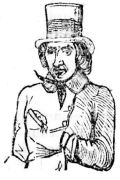
“Plume’s” Daguerreotype of Tirrell.
The name of the murderer was Albert J. Tirrell, a young man whose improvidence had, in less than one year, scattered to the winds a patrimony of more than twenty-seven thousand dollars—the life’s earnings of an indulgent parent, whose grey hairs had but lately gone down in sorrow to the grave. His flushed cheeks, his beak-like, pimpled nose, his gallynipper lips, rendered his demeanor the beau ideal of a sucker-sharp. His tongue could rattle off more lies and oaths in a minute than that of any other sucker in Boston, excepting one. These characteristics, accompanied by the most lavish expenditure of his wealth, won for him the appellation of “good fellow,” all about the horse-stables, at least. Whenever he hired a horse and buggy, he carelessly and suavitously tossed a five dollar gold piece, by way of perquisite, to the ostler. Then would the literature of horse-flies load him with slimy phrases. “Liberal-hearted fine gentleman,”—“noble fellow,”—“there’s nothing mean about him,”—“good fellow,” etc., often reverberated through the horse-stalls, and the same learned and pithy remarks were nightly circulating through the upper rooms of a celebrated gambling-house in Sudbury street, for many years the sucker-sharp head quarters, and the devil’s den in Boston. But, as the enterprising Dickinson once remarked to a clan of rebellious compositors, “There is an end to all things,” so the greatnesses of Tirrell’s life were on that morning hurried into a grand tableau. Tirrell’s Flight. He had slashed open Maria Bickford’s throat with a razor, most valiantly, from ear to ear, and, to slip the noose of the gallows, ran away!
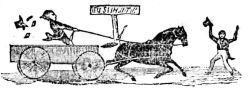
There is no doubt of his INSANITY.
But we cannot dismiss the subject matter of this history until we inform the world of one of Tirrell’s exploits in a business way. No sooner had he tumbled into the possession of his patrimony, than he took up quarters in the city of New York, with the intention of founding a publishing house, on a magnificent scale. After beating about the trade for two or three weeks, without knowing where or how to begin a business of which he was utterly ignorant, and which his rattle-headedness rendered him incapable of comprehending under any circumstances, he made up his mind to commence the publication of a periodical, of some kind or other. Our information runs, that, with this object before his eyes, he called on Mr. Edgar A. Poe, of that city, and tendered him the exclusive editorship and control of the concern, without ceremony or condition. Poe, after a cautious and analytical survey of the gentleman, propounded divers queries which Tirrell had not the capacity to answer. He seemed to be possessed of a belief that if he brought some doubled sheets of printed paper before the people, and the ladies in particular, an illumination as wonderful as the aurora borealis would be the consequence. “The people,” said he, “want knowledge; they thirst for it as the heart panteth for the water brooks.” “Yes, sir, precisely,” said the other, “but engagements compel me to decline your generous offers; I have already promised to do much more than I can possibly accomplish. I think, however, there is a compositor of my acquaintance whose talents are so nearly like your own, that he would prove the very person you are seeking. I will give you his name—it is Silas Estabrook. Explain your plans to that individual, sir, and there will be no lack of projects, I assure you.”
Tirrell was elated with this advice, and forthwith made search for and found the obscure and shrivelled compositor. With the same mountebank bluffness, he made known his wants. “They say you sometimes work in the editing line, sir. Now, sir, I’m about to start a great publishing establishment, like that of the Harpers, and I want to engage you to edit it! If you’ll go into it strong with me, we’ll make Astors of ourselves. I will furnish all the money to begin with.”
Estabrook rubbed his eyes and looked at the man through a spy-glass. “Can it be possible,” thought he, “that good luck has found me at last, and that I am about to realize the Actual from my splendid ideas? This must be the very man whom I have wanted so much to find.” A long and earnest confab took place. Perhaps two persons never before met, whose brains rattled with more incoherence, than did those of Tirrell and Estabrook. If the first was ignorant, impudent and stupid, the other greatly transcended him by a fanatical adherence to his own visionary fooleries. His plans and projects for astonishing the world were as numerous as the phases of a kaleidescope, and his explanations thereof were as voluminous and intelligible as a colloquial parody from that useful bird, the goose.
“I will tell you what it is, Mr. Tirrell,” said he, “we have a fortune within our grasp. I have the mind and you the means. We must get up something which has never been dreamed of before. It’s of no use to think of starting a common newspaper; the very idea of it is vulgar—yet it must be a publication of some kind. Now, I propose that we issue a journal in the shape and style of a Letter; print it in the smallest type—cram a large amount of racy matter into a small space—and then fold it up and seal it. Let the price be six cents a copy, and a figure indicating this sum can be stamped with red ink on the outside, as though it were the postage by mail. Then let us send a copy to every man, woman, and child, in this great city, under a written direction. In this guise and shape every body will jump after it, and the result will be, that we shall sell at least two hundred thousand copies a day. You see they will be so pleased with the contents, that after they receive the first letter they will be still more and more greedy to get the succeeding ones. Now, just reckon up how much 200,000 letters a day, at six cents each, will amount to in a year.”
Tirrell drew from his pocket a ponderous gold pencil and began to cypher. After scratching his head for a half hour he suddenly leaped from his chair in a perfect phrenzy of exultation. The amount was enormous. The golden egg was discovered. Nobody else had found it out. It was the most wonderful idea of the age! He patted Estabrook on the shoulder as fondly as a cat would play with a philosopher’s stone, and immediately invited him to partake of a supper of oysters.
The oysters were devoured. During their mastication, Tirrell was overflowing with so much joy that he was unable to sustain a decent composure. His horse-laughs so annoyed the other patrons of the restorateur, that the host politely ordered him to quit the premises. Tirrell observed the mandate with the most indifferent contempt, and spatting a ten dollar bill on the counter, bawled out for Wine! at the full blast of his lungs.
The preliminaries for publishing the great unexpected were soon arranged. Estabrook manufactured the “copy” with the rapacity and zeal of a starving lunatic. The flow of ideas imparted to his eyes an unnatural stare; his brows were knit; and his teeth chattered as if he were undergoing an attack of the delirium-tremens in a wintry blast. But he heeded not himself nor the movements around him, though Tirrell was constantly peeping over his shoulder and mouthing every sentence as it fell from the pen. In two days the “copy” was completed, and placed in the hands of the printer, who was required by written contract to produce the whole edition in five days. Tirrell launched out his money like water in the purchase of fine letter-sized paper; “the trade” greatly marvelled at what was “in the wind;” and the power of steam was brought into full requisition night and day. At the end of the time specified, the immense job was finished, at a cost of $2,500. Tirrell cashed the bill with readiness and delight. One hundred and twenty-five girls were then hired to double and seal them, and thirty-three clerks were at the same time employed in writing the inscriptions. Every name in Doggett’s octavo directory, of something like 400 closely printed pages, was transcribed to a “letter.” Estabrook, with becoming dignity, reserved to himself the privilege of giving the finishing touch to the whole, by stamping, after the manner of a post mark, the figure “6” on one corner, which was intended as the price of the article. When this was completed, “all hands” were set about arranging them; and let me say to the reader that this feature was no trifling one. It required the machinery of a great post office to assort and arrange that mass of letters, number by number and street by street. The whole being at length completed at an expense of over $700 more, the day at length came when the edition was to be placed into the hands of two hundred efficient carriers, who were to sally forth at the same moment in all parts of the city. Below we give the inner heading of this singular publication, with some extracts, to convey to the reader of these pages a more correct idea of its character and purpose:
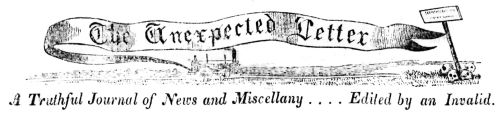
EDITOR’S SALUTATORY—TO THE READER.
We (myself and thee) are twin-links in that grand chain, which hung out from the primeval chaos that was ere the golden sun shone on a virgin world, and hath come down through the juttings of fifty-nine epochs of time, to this hour. Onward to the future goeth its silvery trail, weaving everlasting issues.... But myself and thee move not. Here stand we—links in the grand chain of human destiny—as watchers on a storm beaten rock, whereon also millions are. We hear the sound of voices and of footsteps. Hammers clink and dollars jingle. It is the din of a city. Out in the fields there, the lillies grow and the bee sings. Far away and high in the mountains, where the eaglet’s eyrie is, graze the flocks of the humble shepherd. Let us bow to the harmony of nature and the majesty of God! But—but I am astray already. This is not the strain with which I meant to open up to you.... Life, you know, is tumultuous; at least, I know it. Half-wrecked already. I am an invalid, seeking through the Race-stubble around me—sympathy! Forasmuch as my departure to the Great Homestead draweth near, I am panting for those pure vestments of mortality which shall grace its heaven-wide halls. Thus far, how hard to discover! All my methods are thread-bare and fruitless. But sympathy is a law of the Universe, plentifully abounding, and without its strengthening influences this world were an ungladdened waste. Wherefore I have wrought a new manner to commune with thee—this present.... I had a dream lately. A frame of dilapidated bones stood by the side of a stream. The rains pelted and the winds whistled through it. In the place where, in flesh-time, the breath case had been, was a machine of wonderful handiwork—now not less silent and awful than the frame that held it—which might be sacrilegiously likened unto a spinning-jenny. There were its gearings yet; and I named it Mystery. There were its charmed threads—thousands, millions—issuing in all directions, so that the Race were supplied, each with one. And I was amazed to behold how reluctantly Age yielded them up to the eager grasp of Youth. I cried out for the history and the name of his Boneniness. And they said “Fame! Fame!” And when I heard of the great number who were struggling in their might to rear unto themselves their own frame, with a like appendage—lavishing thereon, with an idol-worship, the genius of the head, of the heart, of the hand—I marvelled much the more.... Cogitate severally, while you contemplate the
REFLECTIONS OF A TAILOR-POET.
Day hath put on his jacket, and around His burning bosom buttoned it with stars. Here will I lay me on the velvet moss, That is like padding to earth’s meagre ribs, And hold communion with the things about me. Ah me! how lovely is the golden braid That binds the skirt of night’s descending robe; The twin-leaves quivering on their silken threads, Do make a music like the rustling satin, As the light breezes smoothe their downy nap. Ha! what is this that rises to my touch, So like a cushion? Can it be a cabbage? It is, it is, the deeply injured flower, Which boys do flout with; but yet I love thee, Thou giant rose, wrapped in a green surtout; Doubtless in Eden thou didst blush as bright As these thy puny brethren; and thy breath Sweetened the fragrance of the spicy air; But now thou seemest like a bankrupt beau Stript of his gaudy hues and essence, And growing portly in his sober clothes. Is that a swan that rides upon the water? Oh no! it is that other gentle bird Which is the patron of our noble calling. I well remember, in my boyhood’s time, When these young hands first closed upon a goose. I have a scar upon my thimble finger Which chronicles the hour of young ambition. My father was a tailor, and his father, And my great grandsire: all of them were tailors. They had an ancient goose; it was an heir-loom From some remoter tailor of our race. I am not certain, but I think ’twas he Who through misfortune was unfortunate. No matter; ’tis a joy to straighten out One’s limb’s, and leap elastic from the counter, Leaving the petty grievances of earth, The breaking thread, the din of clashing shears And all the needles that do wound the spirit.
People on whom the hand of disease permanently mayhap to rest, as in my own case, are not unapt to be cloudy. However this may be as a general thing with others, I am not so. I heartily despise serious confabs. You may reckon it strange, my friend, but the nearer death am I, the more cheerful are my feelings. God is good.... But what have we here?
Set me down as one of small knowledge in things matrimonial. When I happen to stumble over any difficulty in that line, enacting by man and wife, down goes the cap before two crossed-eyes, my heels imitating, at the same instant, a pair of crane’s wings. When very young a picture of “Washing Day,” in the toy book, where the wife laid her good man sprawling by a well-directed blow from a water-ladle, was to me a source of much amusement; but bachelorship and sad health, have contributed to render the reality of that picture painful.
Here allow me to take breath and remark, that if perchance any good individuals, having eyed our peregrinations thus far, should happen to begrudge the expenditure of this purchase, and sigh for the luxury of repossessing it again, let them forthwith repair to my sick-room, at No.—Dey street, and the talismanic sixpence shall be refunded. But, my good friends, and my evil friends, be sure of this much; that however kindly or reprovingly you may view the present visionary intrusion of my little thought-messenger, this is the only time it will trouble you, without your own especial command.... And now, peradventure, if “The Letter” be so fortunate as to meet with one welcoming smile, I pray the sainted lady or gentleman to drop in a line at the Post Office, directed “Editor of the Letter,” commanding its regular visits. And I do also earnestly entreat of such, to enclose me any effusion of their’s which they deem worthy of publication, and if worthy it be, I promise that “The Letter” shall go out to the wavy multitude, freighted and enriched with their own ideas. Lend me your countenance and your mind’s treasures, and I will hold up to human gaze a casket more sparkling than eye hath yet beheld, and it shall gladden and glorify you.... Turn from this to the attractive narration of the Pig-Stealer, commencing the next page.
It is high time that this mind-monotony be tied to a post, and the eddy-whirl of community accidents and interests attacked with a skimmer. Perforce, to chouse government out of letter-postage, we sail in the wake of the common newspapers. And if any avaricious limb of the post-office undertake to extort the postage of a letter for the mail-carriage of “The Unexpected Letter,” pay it not, my friend, but expostulate with him that we are a newspaper, regularly published and miscellaneous not only, but news-mongering in particular. None of his business what our guise may be.
Wanted immediately—Five active, able-bodied jokers. Apply to me. None need come without a bag full. Fat folks preferred.... Large newspapers are on the decline. Old fashioned murders are getting scarce. Letters are merchandise—a quantity for sale at this office—only six cents a-piece! Something makes me spiteful. Trade fluctuates once in a while!... Short farewells are ominous. I can’t be with you all the time, my dear one, but, if we meet no more the fault will be your own! I will write to you periodically, with the patent assistance of types and steam—never forgetting your important aid—sixpence! Very Cheap! isn’t it. If you would say anything to me, write it down, mark “The Unexpected Letter,” on the back, and then cram it into that “hole in the wall” at the post office. Send me a pile of rich jokes, or if you have nothing original in that line, cheese and hoe-cake will not be refused.... All things must have an end—even I! Adieu! Number Two will pass along in about ten days—not voluntarily though—but if you want it send word! Rare dough in the bake. Don’t miss it.
THE INVALID.
By this time the reader may be a little curious to hear the upshot of this magnificent and fair-promising scheme. At a given moment the whole corps of robust carriers was set in motion by command of Tirrell. Then what a ringing of bells and thumping of knockers was there, in that mighty city! How many fond expectations leaped in the bosoms of the fairest, as letters were announced to their pretty names! For about an hour all went off like a charm. Tirrell was in his element—passing hurriedly from street to street—advising, cheering, animating all. And as for Estabrook, he was so overcome with joy that he went up garret and stowed himself away among the old furniture, to reflect upon the question whether human nature was mutable, or not?
But the sport was soon over. Several worthy citizens lodged information with the Police, that a great gang of petty swindlers were taking the city by storm, infringing alike upon the post office laws and the finances of the community. Justice Parker, alarmed by this startling news, promptly issued orders commanding all constables and officers to seize the depredators and bring them before the bar of the Court. A scene now took place which beggars description. In all directions there was pulling and hauling and bawling. The people gaped in amazement from door and window and street-corner. Excitement rose to so high a pitch that some of the “fathers of the city” were really terrified with the idea that every body was about to blow up. Some cried out, “The Vandals are in the city!” The boys shouted “fire!” and the women screamed “murder!” Tirrell, watching the great commotion with intense interest, began to clench his teeth and mutter revenge; but he soon became seized of the conviction that nothing of a joke but Sing Sing would be likely to come out of the “flare up.” Then his heels cut the atmosphere with as much celerity as when he was making his escape from the vicinity of the spot where poor Maria Bickford lay weltering in gore.
Violent hands were laid on Estabrook, while in the very heart of his golden reveries; and when they explained to him the cause of his arrest, he doubted his own senses, and declared the whole to be “a spell.” But it was a wakeful one, for Mr. Justice Parker consigned him to an apartment in the “Egyptian Tombs.”
Immured within the walls of a dungeon, for the only time during his previous and hitherto crimeless life, he threw his lank form upon a flea-infected couch and gave vent to an insupportable grief. When this subsided, he began to review the matter stoically. A thought struck him, that the only relief from the horrors of his present situation lay in a full and frank explanation of all the circumstances connected with the affair, demonstrating most clearly his innocence of any intention to commit a fraud; winding up with an affecting appeal to public sympathy; and publishing the document in the penny papers of the following morning. This he did; and the device was successful. The city folks, after learning the facts, laughed at the singularity of the project, and freely bestowed their sympathy upon the dupe of Tirrell. More than twenty thousand individuals on that morning gathered around the “Tombs” and demanded the liberation of Estabrook. Justice P. trembled in his ermine when he looked upon that mob. In former times he had been a raving politician, and a desciple of the mob spirit; he now thought it prudent to grant the demand of that funny populace, by stipulating a trifling bail for the release of the prisoner. This was instantly given, and Estabrook soon made his appearance amidst thunders of applause. He stood on the massive granite steps of the “Tombs,” and, after gracefully bowing to the multitude, made a thrilling harangue about the magic influence of the pennypress, and on human rights in general. When he concluded the multitude gave him three times three.
These occurrences so wrought upon the curiosity of the people of that city, that they were now even more eager to obtain the Unexpected Letter than had been to suppress it the day previous. It was thrown into the hands of a gallant band of newsboys, who cried it by its name for a week, when the edition became exhausted, and Estabrook had “bettered his fortunes” very materially.
Tirrell returned to Boston about five thousand dollars poorer than he left it a month before. If he ever visited the city of New York after this, it was in disguise.