ROBINSON CRUSOE. (continued 6)
Reading edition
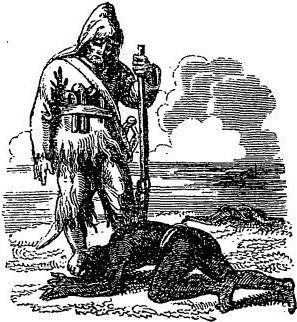
He was a comely handsome fellow, perfectly well made, with straight strong limbs, not too large, tall, and well shaped; and, as I reckon, about twenty-six years of age. He had a very good countenance, not a fierce and surly aspect, but seemed to have something very manly in his face; and yet he had all the sweetness and softness of an European in his countenance too, especially when he smiled. His hair was long and black, not curled like wool; his forehead very high and large; and a great vivacity and sparkling sharpness in his eyes. The colour of his skin was not quite black, but very tawny; and yet not an ugly, yellow, nauseous tawny, as the Brazilians and Virginians, and other natives of America are, but of a bright kind of a dun olive colour, that had in it something very agreeable, though not very easy to describe. His face was round and plump; his nose small, not flat like the Negroes; a very good mouth, thin lips, and his fine teeth well set, and as white as ivory.
After he had slumbered, rather than slept, about half an hour, he awoke again, and came out of the cave to me, for I had been milking my goats, which I had in the enclosure just by: when he espied me, he came running to me, laying himself down again upon the ground, with all the possible signs of an humble thankful disposition, making a great many antic gestures to show it. At last, he lays his head flat upon the ground, close to my foot, and sets my other foot upon his head, as he had done before; and after this, made all the signs to me of subjection, servitude, and submission, imaginable, to let me know how he would serve me so long as he lived. I understood him in many things, and let him know I was very well pleased with him. In a little time I began to speak to him, and teach him to speak to me; and, first, I let him know his name should be FRIDAY, which was the day I saved his life: I called him so for the memory of the time. I likewise taught him to say Master; and then let him know that was to be my name: I likewise taught him to say Yes and No, and to know the meaning of them. I gave him some milk in an earthen pot, and let him see me drink it before him, and sop my bread in it; and gave him a cake of bread to do the like, which he quickly complied with, and made signs that it was very good for him. I kept there with him all that night; but as soon as it was day, I beckoned to him to come with me, and let him know I would give him some clothes; at which he seemed very glad, for he was stark naked. As we went by the place where he had buried the two men, he pointed exactly to the place, and showed me the marks that he had made to find them again, making signs to me that we should dig them up again, and eat them. At this I appeared very angry, expressed my abhorrence of it, made as if I would vomit at the thoughts of it, and beckoned with my hand to him to come away; which he did immediately, with great submission. I then led him up to the top of the hill, to see if his enemies were gone; and pulling out my glass, I looked, and saw plainly the place where they had been, but no appearance of them or their canoes; so that it was plain they were gone, and had left their two comrades behind them, without any search after them.
But I was not content with this discovery; but having now more courage, and consequently more curiosity, I took my man Friday with me, giving him the sword in his hand, with the bow and arrows at his back, which I found he could use very dexterously, making him carry one gun for me, and I two for myself; and away we marched to the place where these creatures had been; for I had a mind now to get some fuller intelligence of them. When I came to the place, my very blood ran chill in my veins, and my heart sunk within me, at the horror of the spectacle; indeed, it was a dreadful sight, at least it was so to me, though Friday made nothing of it. The place was covered with human bones, the ground dyed with their blood, and great pieces of flesh left here and there, half-eaten, mangled, and scorched; and, in short, all the tokens of the triumphant feast they had been making there, after a victory over their enemies. I saw three skulls, five hands, and the bones of three or four legs and feet, and abundance of other parts of the bodies; and Friday, by his signs, made me understand that they brought over four prisoners to feast upon; that three of them were eaten up, and that he, pointing to himself, was the fourth; that there had been a great battle between them and their next king, whose subject, it seems, he had been one of, and that they had taken a great number of prisoners; all which were carried to several places by those who had taken them in the fight, in order to feast upon them, as was done here by these wretches upon those they brought hither.
I caused Friday to gather all the skulls, bones, flesh, and whatever remained, and lay them together in a heap, and make a great fire upon it, and burn them all to ashes. I found Friday had still a hankering stomach after some of the flesh, and was still a cannibal in his nature; but I discovered so much abhorrence at the very thoughts of it, and at the least appearance of it, that he durst not discover it: for I had, by some means, let him know, that I would kill him if he offered it.
When he had done this, we came back to our castle; and there I fell to work for my man Friday: and, first of all, I gave him a pair of linen drawers, which I had out of the poor gunner's chest I mentioned, which I found in the wreck; and which, with a little alteration, fitted him very well: and then I made him a jerkin of goat's-skin, as well as my skill would allow (for I was now grown a tolerable good tailor;) and I gave him a cap, which I made of hare's-skin, very convenient and fashionable enough: and thus he was clothed for the present, tolerably well, and was mighty well pleased to see himself almost as well clothed as his master. It is true, he went awkwardly in these clothes at first; wearing the drawers was very awkward to him; and the sleeves of the waistcoat galled his shoulders, and the inside of his arms; but a little easing them where he complained they hurt him, and using himself to them, he took to them at length very well.
The next day after I came home to my hutch with him, I began to consider where I should lodge him; and that I might do well for him, and yet be perfectly easy myself, I made a little tent for him in the vacant place between my two fortifications, in the inside of the last and in the outside of the first. As there was a door or entrance there into my cave, I made a formal framed door case, and a door to it of boards, and set it up in the passage, a little within the entrance; and causing the door to open in the inside, I barred it up in the night, taking in my ladders too; so that Friday could no way come at me in the inside of my innermost wall, without making so much noise in getting over that it must needs waken me; for my first wall had now a complete roof over it of long poles, covering all my tent, and leaning up to the side of the hill; which was again laid across with smaller sticks, instead of laths, and then thatched over a great thickness with the rice-straw, which was strong, like reeds; and at the hole or place which was left to go in or out by the ladder, I had placed a kind of trap-door, which, if it had been attempted on the outside, would not have opened at all, but would have fallen down, and make a great noise: as to weapons, I took them all into my side every night. But I needed none of all this precaution; for never man had a more faithful, loving, sincere servant, than Friday was to me; without passions, sullenness, or designs, perfectly obliged and engaged; his very affections were tied to me, like those of a child to a father; and I dare say, he would have sacrificed his life for the saving mine, upon any occasion whatsoever: the many testimonies he gave me of this put it out of doubt, and soon convinced me that I needed to use no precautions, as to my safety on his account.
This frequently gave me occasion to observe, and that with wonder, that however it had pleased God, in his providence, and in the government of the works of his hands, to take from so great a part of the world of his creatures the best uses to which their faculties and the powers of their souls are adapted, yet that he has bestowed upon them the same powers, the same reason, the same affections, the same sentiments of kindness and obligation, the same passions and resentments of wrongs, the same sense of gratitude, sincerity, fidelity, and all the capacities of doing good, and receiving good, that he has given to us; and that when he pleases to offer them occasions of exerting these, they are as ready, nay, more ready, to apply them to the right uses for which they were bestowed, than we are. This made me very melancholy sometimes, in reflecting, as the several occasions presented, how mean a use we make of all these, even though we have these powers enlightened by the great lamp of instruction, the Spirit of God, and by the knowledge of his word added to our understanding; and why it has pleased God to hide the like saving knowledge from so many millions of souls, who, if I might judge by this poor savage, would make a much better use of it than we did. From hence, I sometimes was led too far, to invade the sovereignty of Providence, and as it were arraign the justice of so arbitrary a disposition of things, that should hide that light from some, and reveal it to others, and yet expect a like duty from both; but I shut it up, and checked my thoughts with this conclusion: first, That we did not know by what light and law these should be condemned; but that as God was necessarily, and, by the nature of his being, infinitely holy and just, so it could not be, but if these creatures were all sentenced to absence from himself, it was on account of sinning against that light, which, as the Scripture says, was a law to themselves, and by such rules as their consciences would acknowledge to be just, though the foundation was not discovered to us; and, secondly, That still, as we all are the clay in the hand of the potter, no vessel could say to him, "Why hast thou formed me thus?"
But to return to my new companion:—I was greatly delighted with him, and made it my business to teach him every thing that was proper to make him useful, handy, and helpful; but especially to make him speak, and understand me when I spoke: and he was the aptest scholar that ever was; and particularly was so merry, so constantly diligent, and so pleased when he could but understand me, or make me understand him, that it was very pleasant to me to talk to him. Now my life began to be so easy, that I began to say to myself, that could I but have been safe from more savages, I cared not if I was never to remove from the place where I lived.
After I had been two or three days returned to my castle, I thought that, in order to bring Friday off from his horrid way of feeding, and from the relish of a cannibal's stomach, I ought to let him taste other flesh; so I took him out with me one morning to the woods. I went, indeed, intending to kill a kid out of my own flock, and bring it home and dress it; but as I was going, I saw a she-goat lying down in the shade, and two young kids sitting by her. I catched hold of Friday;—Hold, said I; stand still; and made signs to him not to stir: immediately I presented my piece, shot, and killed one of the kids. The poor creature, who had, at a distance, indeed, seen me kill the savage, his enemy, but did not know, nor could imagine, how it was done, was sensibly surprised, trembled and shook, and looked so amazed, that I thought he would have sunk down. He did not see the kid I shot at, or perceive I had killed it, but ripped up his waistcoat, to feel whether he was not wounded; and, as I found presently, thought I was resolved to kill him: for he came and kneeled down to me, and embracing my knees, said a great many things I did not understand; but I could easily see the meaning was, to pray me not to kill him.
I soon found a way to convince him that I would do him no harm; and taking him up by the hand, laughed at him, and pointing to the kid which I had killed, beckoned to him to run and fetch it, which he did: and while he was wondering, and looking to see how the creature was killed, I loaded my gun again. By and by, I saw a great fowl, like a hawk, sitting upon a tree, within shot; so, to let Friday understand a little what I would do, I called him to me again, pointed at the fowl, which was indeed a parrot, though I thought it had been a hawk; I say, pointing to the parrot, and to my gun, and to the ground under the parrot, to let him see I would make it fall, I made him understand that I would shoot and kill that bird; accordingly, I fired, and bade him look, and immediately he saw the parrot fall. He stood like one frightened again, notwithstanding all I had said to him; and I found he was the more amazed, because he did not see me put any thing into the gun, but thought that there must be some wonderful fund of death and destruction in that thing, able to kill man, beast, bird, or any thing near or far off; and the astonishment this created in him was such, as could not wear off for a long time; and I believe, if I would have let him, he would have worshipped me and my gun. As for the gun itself, he would not so much as touch it for several days after; but he would speak to it, and talk to it, as if it had answered him, when he was by himself; which, as I afterwards learned of him, was to desire it not to kill him. Well, after his astonishment was a little over at this, I pointed to him to run and fetch the bird I had shot, which he did, but staid some time; for the parrot, not being quite dead, had fluttered away a good distance from the place where she fell: however, he found her, took her up, and brought her to me; and as I had perceived his ignorance about the gun before, I took this advantage to charge the gun again, and not to let him see me do it, that I might be ready for any other mark that might present; but nothing more offered at that time: so I brought home the kid, and the same evening I took the skin off, and cut it out as well as I could; and having a pot fit for that purpose, I boiled or stewed some of the flesh, and made some very good broth. After I had begun to eat some, I gave some to my man, who seemed very glad of it, and liked it very well; but that which was strangest to him, was to see me eat salt with it. He made a sign to me that the salt was not good to eat; and putting a little into his own mouth, he seemed to nauseate it, and would spit and sputter at it, washing his mouth with fresh water after it: on the other hand, I took some meat into my mouth without salt, and I pretended to spit and sputter for want of salt, as fast as he had done at the salt; but it would not do; he would never care for salt with his meat or in his broth; at least, not for a great while, and then but a very little.
Having thus fed him with boiled meat and broth, I was resolved to feast him the next day with roasting a piece of the kid: this I did, by hanging it before the fire on a string, as I had seen many people do in England, setting two poles up, one on each side of the fire, and one across on the top, and tying the string to the cross stick, letting the meat turn continually. This Friday admired very much; but when he came to taste the flesh, he took so many ways to tell me how well he liked it, that I could not but understand him: and at last he told me, as well as he could, he would never eat man's flesh any more, which I was very glad to hear.
The next day, I set him to work to beating some corn out, and sifting it in the manner I used to do, as I observed before; and he soon understood how to do it as well as I, especially after he had seen what the meaning of it was, and that it was to make bread of; for after that I let him see me make my bread, and bake it too; and in a little time Friday was able to do all the work for me, as well as I could do it myself.
I began now to consider, that having two mouths to feed instead of one, I must provide more ground for my harvest, and plant a larger quantity of corn than I used to do; so I marked out a larger piece of land, and began the fence in the same manner as before, in which Friday worked not only very willingly and very hard, but did it very cheerfully: and I told him what it was for; that it was for corn to make more bread, because he was now with me, and that I might have enough for him and myself too. He appeared very sensible of that part, and let me know that he thought I had much more labour upon me on his account, than I had for myself; and that he would work the harder for me, if I would tell him what to do.
This was the pleasantest year of all the life I led in this place; Friday began to talk pretty well, and understand the names of almost every thing I had occasion to call for, and of every place I had to send him to, and talked a great deal to me; so that, in short, I began now to have some use for my tongue again, which, indeed, I had very little occasion for before, that is to say, about speech. Besides the pleasure of talking to him, I had a singular satisfaction in the fellow himself: his simple unfeigned honesty appeared to me more and more every day, and I began really to love the creature; and, on his side, I believe he loved me more than it was possible for him ever to love any thing before.
I had a mind once to try if he had any hankering inclination to his own country again; and having taught him English so well that he could answer me almost any question, I asked him whether the nation that he belonged to never conquered in battle? At which he smiled, and said, "Yes, yes, we always fight the better:" that is, he meant, always get the better in fight; and so we began the following discourse:
Master. You always fight the better; how came you to be taken prisoner then, Friday?
Friday. My nation beat much for all that.
Master. How beat? If your nation beat them, how came you to be taken?
Friday. They more many than my nation in the place where me was; they take one, two, three, and me: my nation over-beat them in the yonder place, where me no was; there my nation take one, two, great thousand.
Master. But why did not your side recover you from the hands of your enemies then?
Friday. They run one, two, three, and me, and make go in the canoe; my nation have no canoe that time.
Master. Well, Friday, and what does your nation do with the men they take? Do they carry them away and eat them, as these did?
Friday. Yes, my nation eat mans too; eat all up.
Master. Where do they carry them?
Friday. Go to other place, where they think.
Master. Do they come hither?
Friday. Yes, yes, they come hither; come other else place.
Master. Have you been here with them?
Friday. Yes, I have been here (points to the N.W. side of the island, which, it seems, was their side.)
By this I understood that my man Friday had formerly been among the savages who used to come on shore on the farther part of the island, on the same man-eating occasions he was now brought for; and, some time after, when I took the courage to carry him to that side, being the same I formerly mentioned, he presently knew the place, and told me he was there once when they eat up twenty men, two women, and one child: he could not tell twenty in English, but he numbered them, by laying so many stones in a row, and pointing to me to tell them over.
I have told this passage, because it introduces what follows; that after I had this discourse with him, I asked him how far it was from our island to the shore, and whether the canoes were not often lost. He told me there was no danger, no canoes ever lost; but that, after a little way out to sea, there was a current and wind, always one way in the morning, the other in the afternoon. This I understood to be no more than the sets of the tide, as going out or coming in; but I afterwards understood it was occasioned by the great draft and reflux of the mighty river Oroonoko, in the mouth or gulf of which river, as I found afterwards, our island lay; and that this land which I perceived to the W. and N.W. was the great island Trinidad, on the north point of the mouth of the river. I asked Friday a thousand questions about the country, the inhabitants, the sea, the coast, and what nations were near: he told me all he knew, with the greatest openness imaginable. I asked him the names of the several nations of his sort of people, but could get no other name than Caribs: from whence I easily understood, that these were the Caribbees, which our maps place on the part of America which reaches from the mouth of the river Oroonoko to Guiana, and onwards to St. Martha. He told me that up a great way beyond the moon, that was, beyond the setting of the moon, which must be west from their country, there dwelt white bearded men, like me, and pointed to my great whiskers, which I mentioned before; and that they had killed much mans, that was his word: by all which I understood, he meant the Spaniards, whose cruelties in America had been spread over the whole country, and were remembered by all the nations, from father to son.
I inquired if he could tell me how I might go from this island and get among those white men; he told me, Yes, yes, you may go in two canoe. I could not understand what he meant, or make him describe to me what he meant by two canoe; till, at last, with great difficulty, I found he meant it must be in a large boat, as big as two canoes. This part of Friday's discourse began to relish with me very well; and from this time I entertained some hopes that, one time or other, I might find an opportunity to make my escape from this place, and that this poor savage might be a means to help me.
During the long time that Friday had now been with me, and that he began to speak to me, and understand me, I was not wanting to lay a foundation of religious knowledge in his mind: particularly I asked him one time, Who made him? The poor creature did not understand me at all, but thought I had asked him who was his father: but I took it up by another handle, and asked him who made the sea, the ground we walked on, and the hills and woods? He told me, it was one old Benamuckee, that lived beyond all; he could describe nothing of this great person, but that he was very old, much older, he said, than the sea or the land, than the moon or the stars. I asked him then, if this old person had made all things, why did not all things worship him? He looked very grave, and with a perfect look of innocence said, All things say O to him. I asked him if the people who die in his country went away any where? He said, Yes; they all went to Benamuckee: then I asked him whether these they eat up went thither too? He said, Yes.
From these things I began to instruct him in the knowledge of the true God: I told him that the great Maker of all things lived up there, pointing up towards heaven; that he governed the world by the same power and providence by which he made it; that he was omnipotent, and could do every thing for us, give every thing to us, take every thing from us; and thus, by degrees, I opened his eyes. He listened with great attention, and received with pleasure the notion of Jesus Christ being sent to redeem us, and of the manner of making our prayers to God, and his being able to hear us, even in heaven. He told me one day, that if our God could hear us up beyond the sun, he must needs be a greater God than their Benamuckee, who lived but a little way off, and yet could not hear till they went up to the great mountains where he dwelt to speak to him. I asked him if ever he went thither to speak to him? He said, No; they never went that were young men; none went thither but the old men, whom he called their Oowokakee; that is, as I made him explain it to me, their religious, or clergy; and that they went to say O (so he called saying prayers,) and then came back, and told them what Benamuckee said. By this I observed, that there is priestcraft even among the most blinded, ignorant pagans in the world; and the policy of making a secret of religion, in order to preserve the veneration of the people to the clergy, is not only to be found in the Roman, but perhaps among all religions in the world, even among the most brutish and barbarous savages.
I endeavoured to clear up this fraud to my man Friday; and told him, that the pretence of their old men going up to the mountains to say O to their god Benamuckee was a cheat; and their bringing word from thence what he said was much more so; that if they met with any answer, or spake with any one there, it must be with an evil spirit: and then I entered into a long discourse with him about the devil, the original of him, his rebellion against God, his enmity to man, the reason of it, his setting himself up in the dark parts of the world to be worshipped instead of God, and as God, and the many stratagems he made use of to delude mankind to their ruin; how he had a secret access to our passions and to our affections, and to adapt his snares to our inclinations, so as to cause us even to be our own tempters, and run upon our destruction by our own choice.
I found it was not so easy to imprint right notions in his mind about the devil, as it was about the being of a God: nature assisted all my arguments to evidence to him even the necessity of a great First Cause, and over-ruling, governing Power, a secret, directing Providence, and of the equity and justice of paying homage to him that made us, and the like; but there appeared nothing of this kind in the notion of an evil spirit; of his original, his being, his nature, and, above all, of his inclination to do evil, and to draw us in to do so too: and the poor creature puzzled me once in such a manner, by a question merely natural and innocent, that I scarce knew what to say to him. I had been talking a great deal to him of the power of God, his omnipotence, his aversion to sin, his being a consuming fire to the workers of iniquity; how, as he had made us all, he could destroy us and all the world in a moment; and he listened with great seriousness to me all the while. After this, I had been telling him how the devil was God's enemy in the hearts of men, and used all his malice and skill to defeat the good designs of Providence, and to ruin the kingdom of Christ in the world, and the like. "Well," says Friday, "but you say God is so strong, so great; is he not much strong, much might as the devil?"—"Yes, yes," says I, "Friday, God is stronger than the devil: God is above the devil, and therefore we pray to God to tread him down under our feet, and enable us to resist his temptations, and quench his fiery darts."—"But," says he again, "if God much stronger, much might as the devil, why God no kill the devil, so make him no more do wicked?" I was strangely surprised at this question; and, after all, though I was now an old man, yet I was but a young doctor, and ill qualified for a casuist, or a solver of difficulties; and, at first, I could not tell what to say; so I pretended not to hear him, and asked him what he said; but he was too earnest for an answer, to forget his question, so that he repeated it in the very same broken words as above. By this time I had recovered myself a little, and I said, "God will at last punish him severely; he is reserved for the judgment, and is to be cast into the bottomless pit, to dwell with everlasting fire." This did not satisfy Friday; but he returns upon me, repeating my words, "Reserve at last! me no understand: but why not kill the devil now; not kill great ago?"—"You may as well ask me," said I, "why God does not kill you and me, when we do wicked things here that offend him: we are preserved to repent and be pardoned." He mused some time on this: "Well, well," says he, mighty affectionately, "that well: so you, I, devil, all wicked, all preserve, repent, God pardon all." Here I was run down again by him to the last degree; and it was a testimony to me, how the mere notions of nature, though they will guide reasonable creatures to the knowledge of a God, and of a worship or homage due to the supreme being of God, as the consequence of our nature, yet nothing but divine revelation can form the knowledge of Jesus Christ, and of redemption purchased for us, of a Mediator of the new covenant, and of an Intercessor at the footstool of God's throne; I say, nothing but a revelation from Heaven can form these in the soul; and that, therefore, the gospel of our Lord and Saviour Jesus Christ, I mean the Word of God, and the Spirit of God, promised for the guide and sanctifier of his people, are the absolutely necessary instructors of the souls of men in the saving knowledge of God, and the means of salvation.
I therefore diverted the present discourse between me and my man, rising up hastily, as upon some sudden occasion of going out; then sending him for something a good way off, I seriously prayed to God that he would enable me to instruct savingly this poor savage; assisting, by his Spirit, the heart of the poor ignorant creature to receive the light of the knowledge of God in Christ, reconciling him to himself, and would guide me to speak so to him from the word of God, as his conscience might be convinced, his eyes opened, and his soul saved. When he came again to me, I entered into a long discourse with him upon the subject of the redemption of man by the Saviour of the world, and of the doctrine of the gospel preached from heaven, viz. of repentance towards God, and faith in our blessed Lord Jesus. I then explained to him as well as I could; why our blessed Redeemer took not on him the nature of angels, but the seed of Abraham; and how, for that reason, the fallen angels had no share in the redemption; that he came only to the lost sheep of the house of Israel, and the like.
I had, God knows, more sincerity than knowledge in all the methods I took for this poor creature's instruction, and must acknowledge, what I believe all that act upon the same principle will find, that in laying things open to him, I really informed and instructed myself in many things that either I did not know, or had not fully considered before, but which occurred naturally to my mind upon searching into them, for the information of this poor savage; and I had more affection in my inquiry after things upon this occasion than ever I felt before: so that, whether this poor wild wretch was the better for me or no, I had great reason to be thankful that ever he came to me; my grief sat lighter upon me; my habitation grew comfortable to me beyond measure: and when I reflected, that in this solitary life which I had been confined to, I had not only been moved to look up to heaven myself, and to seek to the hand that had brought me here, but was now to be made an instrument, under Providence, to save the life, and, for aught I knew, the soul, of a poor savage, and bring him to the true knowledge of religion, and of the Christian doctrine, that he might know Christ Jesus, in whom is life eternal; I say, when I reflected upon all these things, a secret joy ran through every part of my soul, and I frequently rejoiced that ever I was brought to this place, which I had so often thought the most dreadful of all afflictions that could possibly have befallen me.
I continued in this thankful frame all the remainder of my time; and the conversation which employed the hours between Friday and me was such, as made the three years which we lived there together perfectly and completely happy, if any such thing as complete happiness can he formed in a sublunary state. This savage was now a good Christian, a much better than I; though I have reason to hope, and bless God for it, that we were equally penitent, and comforted, restored penitents. We had here the word of God to read, and no farther off from his Spirit to instruct, than if we had been in England. I always applied myself, in reading the Scriptures, to let him know, as well as I could, the meaning of what I read; and he again, by his serious inquiries and questionings, made me, as I said before, a much better scholar in the Scripture-knowledge than I should ever have been by my own mere private reading. Another thing I cannot refrain from observing here also, from experience in this retired part of my life, viz. how infinite and inexpressible a blessing it is that the knowledge of God; and of the doctrine of salvation by Christ Jesus, is so plainly laid down in the word of God, so easy to be received and understood, that, as the bare reading the Scripture made me capable of understanding enough of my duty to carry me directly on to the great work of sincere repentance for my sins, and laying hold of a Saviour for life and salvation, to a stated reformation in practice, and obedience to all God's commands, and this without any teacher or instructor, I mean human; so the same plain instruction sufficiently served to the enlightening this savage creature, and bringing him to be such a Christian, as I have known few equal to him in my life.
As to all the disputes, wrangling, strife, and contention which have happened in the world about religion, whether niceties in doctrines, or schemes of church-government, they were all perfectly useless to us, and, for aught I can yet see, they have been so to the rest of the world. We had the sure guide to heaven, viz. the word of God; and we had, blessed be God, comfortable views of the Spirit of God teaching and instructing us by his word, leading us into all truth, and making us both willing and obedient to the instruction of his word. And I cannot see the least use that the greatest knowledge of the disputed points of religion, which have made such confusions in the world, would have been to us, if we could have obtained it.—But I must go on with the historical part of things, and take every part in its order.
After Friday and I became more intimately acquainted, and that he could understand almost all I said to him, and speak pretty fluently, though in broken English, to me, I acquainted him with my own history, or at least so much of it as related to my coming to this place; how I had lived here, and how long: I let him into the mystery, for such it was to him, of gunpowder and bullet, and taught him how to shoot. I gave him a knife; which he was wonderfully delighted with; and I made him a belt, with a frog hanging to it, such as in England we wear hangers in; and in the frog, instead of a hanger, I gave him a hatchet, which was not only as good a weapon, in some cases, but much more useful upon other occasions.
I described to him the country of Europe, particularly England, which I came from; how we lived, how we worshipped God, how we behaved to one another, and how we traded in ships to all parts of the world. I gave him an account of the wreck which I had been on board of, and showed him, as near as I could, the place where she lay; but she was all beaten in pieces before, and gone. I showed him the ruins of our boat, which we lost when we escaped, and which I could not stir with my whole strength then; but was now fallen almost all to pieces. Upon seeing this boat, Friday stood musing a great while, and said nothing. I asked him what it was he studied upon? At last, says he, "Me see such boat like come to place at my nation." I did not understand him a good while; but, at last, when I had examined farther into it, I understood by him, that a boat, such as that had been, came on shore upon the country where he lived; that is, as he explained it, was driven thither by stress of weather. I presently imagined that some European ship must have been cast away upon their coast, and the boat might get loose, and drive ashore; but was so dull, that I never once thought of men making their escape from a wreck thither, much less whence they might come: so I only inquired after a description of the boat.
Friday described the boat to me well enough; but brought me better to understand him when he added with some warmth, "We save the white mans from drown." Then I presently asked him, if there were any white mans, as he called them, in the boat? "Yes," he said; "the boat full of white mans." I asked him how many? He told upon his fingers seventeen, I asked him then what became of them? He told me, "They live, they dwell at my nation."
This put new thoughts into my head; for I presently imagined that these might be the men belonging to the ship that was cast away in the sight of my island, as I now called it; and who, after the ship was struck on the rock, and they saw her inevitably lost, had saved themselves in their boat, and were landed upon that wild shore among the savages. Upon this, I inquired of him more critically what was become of them; he assured me they lived still there; that they had been there about four years; that the savages let them alone, and gave them victuals to live on. I asked him how it came to pass they did not kill them, and eat them? He said, "No, they make brother with them;" that is, as I understood him, a truce; and then he added, "They no eat mans but when make the war fight;" that is to say, they never eat any men but such as come to fight with them, and are taken in battle.
It was after this some considerable time, that being upon the top of the hill, at the east side of the island, from whence, as I have said, I had, in a clear day, discovered the main or continent of America, Friday, the weather being very serene, looks very earnestly towards the main land, and, in a kind of surprise, fells a jumping and dancing, and calls out to me, for I was at some distance from him. I asked him what was the matter? "O joy!" says he; "O glad! there see my country, there my nation!" I observed an extraordinary sense of pleasure appeared in his face, and his eyes sparkled, and his countenance discovered a strange eagerness, as if he had a mind to be in his own country again. This observation of mine put a great many thoughts into me, which made me at first not so easy about my new man Friday as I was before; and I made no doubt but that if Friday could get back to his own nation again, he would not only forget all his religion, but all his obligation to me, and would be forward enough to give his countrymen an account of me, and come back perhaps with a hundred or two of them, and make a feast upon me, at which he might be as merry as he used to be with those of his enemies, when they were taken in war. But I wronged the poor honest creature very much, for which I was very sorry afterwards. However, as my jealousy increased, and held me some weeks, I was a little more circumspect, and not so familiar and kind to him as before: in which I was certainly in the wrong too; the honest, grateful creature, having no thought about it, but what consisted with the best principles, both as a religious Christian, and as a grateful friend; as appeared afterwards, to my full satisfaction.
While my jealousy of him lasted, you may be sure I was every day pumping him, to see if he would discover any of the new thoughts which I suspected were in him: but I found every thing he said was so honest and so innocent, that I could find nothing to nourish my suspicion; and, in spite of all my uneasiness, he made me at last entirely his own again; nor did he, in the least, perceive that I was uneasy, and therefore I could not suspect him of deceit.
One day, walking up the same hill, but the weather being hazy at sea, so that we could not see the continent, I called to him, and said, "Friday, do not you wish yourself in your own country, your own nation?"—"Yes," he said, "I be much O glad to be at my own nation." "What would you do there?" said I: "would you turn wild again, eat men's flesh again, and be a savage as you were before?" He looked full of concern, and shaking his head, said, "No, no, Friday tell them to live good; tell them to pray God; tell them to eat corn-bread, cattle-flesh, milk; no eat man again."—" Why then," said I to him, "they will kill you." He looked grave at that, and then said, "No, no; they no kill me, they willing love learn." He meant by this, they would be willing to learn. He added, they learned much of the bearded mans that came in the boat. Then I asked him if he would go back to them. He smiled at that, and told me that he could not swim so far. I told him, I would make a canoe for him. He told me he would go, if I would go with him. "I go!" says I, "why, they will eat me if I come there."—"No, no," says he, "me make they no eat you; me make they much love you," He meant, he would tell them how I had killed his enemies, and saved his life, and so he would make them love me. Then he told me, as well as he could, how kind they were to seventeen white men, or bearded men, as he called them, who came on shore there in distress.
From this time, I confess I had a mind to venture over, and see if I could possibly join with those bearded men, who, I made no doubt, were Spaniards and Portuguese: not doubting but if I could, we might find some method to escape from thence, being upon the continent, and a good company together, better than I could from an island forty miles off the shore, and alone, without help. So, after some days, I took Friday to work again, by way of discourse; and told him I would give him a boat to go back to his own nation; and accordingly I carried him to my frigate, which lay on the other side of the island, and having cleared it of water (for I always kept it sunk in water,) I brought it out, showed it him, and we both went into it. I found he was a most dexterous fellow at managing it, and would make it go almost as swift again as I could. So when he was in, I said to him, "Well, now, Friday, shall we go to your nation?" He looked very dull at my saying so; which, it seems, was because he thought the boat too small to go so far: I then told him I had a bigger; so the next day I went to the place where the first boat lay which I had made, but which I could not get into the water. He said that was big enough: but then, as I had taken no care of it, and it had lain two or three and twenty years there, the sun had split and dried it, that, it was in a manner rotten. Friday told me such a boat would do very well, and would carry "much enough vittle, drink, bread;" that was his way of talking.
Upon the whole, I was by this time so fixed upon my design of going over with him to the continent, that I told him we would go and make one as big as that, and he should go home in it. He answered not one word, but looked very grave and sad. I asked him what was the matter with him? He asked me again, "Why you angry mad with Friday? what me done?" I asked him what he meant: I told him I was not angry with him at all. "No angry!" says he, repeating the words several times, "why send Friday home away to my nation?"—"Why," says I, "Friday, did not you say you wished you were there?"—"Yes, yes," says he, "wish be both there; no wish Friday there, no master there." In a word, he would not think of going there without me. "I go there, Friday!" says I, "what shall I do there?" He returned very quick upon me at this: "You do great deal much good," says he; "you teach wild mans be good, sober, tame mans; you tell them know God, pray God, and live new life."—"Alas! Friday," says I, "thou knowest not what thou sayest; I am but an ignorant man myself."—"Yes, yes," says he, "you teachee me good, you teachee them good."—"No, no, Friday," says I, "you shall go without me; leave me here to live by myself, as I did before." He looked confused again at that word; and running to one of the hatchets which he used to wear, he takes it up hastily, and gives it to me. "What must I do with this?" says I to him. "You take kill Friday," says he. "What must I kill you for?" said I again. He returns very quick, "What you send Friday away for? Take kill Friday, no send Friday away." This he spoke so earnestly, that I saw tears stand in his eyes: in a word, I so plainly discovered the utmost affection in him to me, and a firm resolution in him, that I told him then, and often after, that I would never send him away from me, if he was willing to stay with me.
Upon the whole, as I found, by all his discourse, a settled affection to me, and that nothing should part him from me, so I found all the foundation of his desire to go to his own country was laid in his ardent affection to the people, and his hopes of my doing them good; a thing, which, as I had no notion of myself, so I had not the least thought, or intention, or desire of undertaking it. But still I found a strong inclination to my attempting an escape, as above, founded on the supposition gathered from the discourse, viz. that there were seventeen bearded men there: and, therefore, without any more delay, I went to work with Friday, to find out a great tree proper to fell, and make a large periagua, or canoe, to undertake the voyage. There were trees enough in the island to have built a little fleet, not of periaguas, or canoes, but even of good large vessels: but the main thing I looked at was, to get one so near the water that we might launch it when it was made, to avoid the mistake I committed at first. At last, Friday pitched upon a tree; for I found he knew much better than I what kind of wood was fittest for it; nor can I tell, to this day, what wood to call the tree we cut down, except that it was very like the tree we call fustic, or between that and the Nicaragua wood, for it was much of the same colour and smell. Friday was for burning the hollow or cavity of this tree out, to make it for a boat, but I showed him how to cut it with tools; which" after I had showed him how to use, he did very handily: and in about a month's hard labour we finished it, and made it very handsome; especially when, with our axes, which I showed him how to handle, we cut and hewed the outside into the true shape of a boat. After this, however, it cost us near a fortnight's time to get her along, as it were inch by inch, upon great rollers into the water; but when she was in, she would have carried twenty men with great ease.
When she was in the water, and though she was so big, it amazed me to see with what dexterity, and how swift my man Friday would manage her, turn her, and paddle her along. So I asked him if he would, and if we might venture over in her. "Yes," he said, "we venture over in her very well, though great blow wind." However, I had a farther design that he knew nothing of, and that was to make a mast and a sail, and to fit her with an anchor and cable. As to a mast, that was easy enough to get; so I pitched upon a straight young cedar tree, which I found near the place, and which there were great plenty of in the island: and I set Friday to work to cut it down, and gave him directions how to shape and order it. But as to the sail, that was my particular care. I knew I had old sails, or rather pieces of old sails enough; but as I had had them now six and twenty years by me, and had not been very careful to preserve them, not imagining that I should ever have this kind of use for them, I did not doubt but they were all rotten, and, indeed, most of them were so. However, I found two pieces, which appeared pretty good, and with these I went to work; and with a great deal of pains, and awkward stitching, you may be sure, for want of needles, I, at length, made a three-cornered ugly thing, like what we call in England a shoulder of mutton sail, to go with a boom at bottom, and a little short sprit at the top, such as usually our ships' long-boats sail with, and such as I best knew how to manage, as it was such a one I had to the boat in which I made my escape from Barbary, as related in the first part of my story.
I was near two months performing this last work, viz. rigging and fitting my mast and sails; for I finished them very complete, making a small stay, and a sail, or fore-sail, to it, to assist, if we should turn to windward; and, which was more than all, I fixed a rudder to the stern of her to steer with. I was but a bungling shipwright, yet, as I knew the usefulness, and even necessity of such a thing, I applied myself with so much pains to do it, that at last I brought it to pass; though, considering the many dull contrivances I had for it that failed, I think it cost me almost as much labour as making the boat.
After all this was done, I had my man Friday to teach as to what belonged to the navigation of my boat; for, though he knew very well how to paddle a canoe, he knew nothing what belonged to a sail and a rudder; and was the most amazed when he saw me work the boat to and again in the sea by the rudder, and how the sail gibbed, and filled this way, or that way, as the course we sailed changed; I say, when he saw this, he stood like one astonished and amazed. However, with a little use, I made all these things familiar to him, and he became an expert sailor, except that as to the compass; I could make him understand very little of that. On the other hand, as there was very little cloudy weather, and seldom or never any fogs in those parts, there was the less occasion for a compass, seeing the stars were always to be seen by night, and the shore by day, except in the rainy seasons, and then nobody cared to stir abroad, either by land or sea.
I was now entered on the seven and twentieth year of my captivity in this place; though the three last years that I had this creature with me ought rather to be left out of the account, my habitation being quite of another kind than in all the rest of the time. I kept the anniversary of my landing here with the same thankfulness to God for his mercies as at first; and if I had such cause of acknowledgment at first, I had much more so now, having such additional testimonies of the care of Providence over me, and the great hopes I had of being effectually and speedily delivered; for I had an invincible impression upon my thoughts that my deliverance was at hand, and that I should not be another year in this place. I went on, however, with my husbandry; digging, planting, and fencing, as usual. I gathered and cured my grapes, and did every necessary thing as before.
The rainy season was, in the mean time, upon me, when I kept more within doors than at other times. We had stowed our new vessel as secure as we could, bringing her up into the creek, where, as I said in the beginning, I landed my rafts from the ship; and hauling her up to the shore, at high-water mark, I made my man Friday dig a little dock, just big enough to hold her, and just deep enough to give her water enough to float in; and then, when the tide was out, we made a strong dam across the end of it, to keep the water out; and so she lay dry, as to the tide, from the sea; and to keep the rain off, we laid a great many boughs of trees, so thick, that she was as well thatched as a house; and thus we waited for the months of November and December, in which I designed to make my adventure.
When the settled season began to come in, as the thought of my design returned with the fair weather, I was preparing daily for the voyage: and the first thing I did was to lay by a certain quantity of provisions, being the stores for our voyage: and intended, in a week or a fortnight's time, to open the dock, and launch out our boat. I was busy one morning upon something of this kind, when I called to Friday, and bid him go to the sea-shore, and see if he could find a turtle, or tortoise, a thing which we generally got once a week, for the sake of the eggs as well as the flesh. Friday had not been long gone, when he came running back and flew over my outer-wall, or fence, like one that felt not the ground, or the steps he set his feet on; and before I had time to speak to him, he cries out to me, "O master! O master! O sorrow! O bad!"—"What's the matter, Friday?' says I. "O yonder, there," says he, "one, two, three canoe; one, two, three!" By this way of speaking, I concluded there were six; but, on inquiry, I found it was but three. "Well, Friday," says I, "do not be frightened." So I heartened him up as well as I could: however, I saw the poor fellow was most terribly scared; for nothing ran in his head but that they were come to look for him, and would cut him in pieces, and eat him; and the poor fellow trembled so, that I scarce knew what to do with him. I comforted him as well as I could, and told him I was in as much danger as he, and that they would eat me as well as him. "But," says I, "Friday, we must resolve to fight them. Can you fight, Friday!"—" Me shoot," says he; but there come many great number."—No matter for that," said I, again; "our guns will fright them that we do not kill." So I asked him whether, if I resolved to defend him, he would defend me, and stand by me, and do just as I bid him. He said, "Me die, when you bid die, master." So I went and fetched a good dram of rum and gave him; for I had been so good a husband of my rum, that I had a great deal left. When he drank it, I made him take the two fowling-pieces, which we always carried, and loaded them with large swan-shot, as big as small pistol-bullets; then I took four muskets, and loaded them with two slugs, and five small bullets each; and my two pistols I loaded with a brace of bullets each; I hung my great sword, as usual, naked by my side, and gave Friday his hatchet. When I had thus prepared myself, I took my perspective-glass, and went up to the side of the hill, to see what I could discover; and I found quickly, by my glass, that there were one and twenty savages, three prisoners, and three canoes; and that their whole business seemed to be the triumphant banquet upon these three human bodies; a barbarous feast indeed! but nothing more than, as I had observed, was usual with them. I observed also, that they were landed, not where they had done when Friday made his escape, but nearer to my creek: where the shore was low, and where a thick wood came almost close down to the sea. This, with the abhorrence of the inhuman errand these wretches came about, filled me with such indignation, that I came down again to Friday, and told him I was resolved to go down to them, and kill them all; and asked him if he would stand by me. He had now got over his fright, and his spirits being a little raised with the dram I had given him, he was very cheerful, and told me, as before, he would die when I bid die.
In this fit of fury, I took and divided the arms which I had charged, as before, between us: I gave Friday one pistol to stick in his girdle, and three guns upon his shoulder; and I took one pistol, and the other three guns, myself; and in this posture we marched out. I took a small bottle of rum in my pocket, and gave Friday a large bag with more powder and bullets; and, as to orders, I charged him to keep close behind me, and not to stir, or shoot, or do any thing, till I bid him; and, in the mean time, not to speak a word. In this posture, I fetched a compass to my right hand of near a mile, as well to get over the creek as to get into the wood, so that I might come within shot of them before I should be discovered, which I had seen, by my glass, it was easy to do.
While I was making this march, my former thoughts returning, I began to abate my resolution: I do not mean that I entertained any fear of their number; for, as they were naked, unarmed wretches, it is certain I was superior to them; nay, though I had been alone. But it occurred to my thoughts, what call, what occasion, much less what necessity I was in, to go and dip my hands in blood, to attack people who had neither done or intended me any wrong? Who, as to me, were innocent, and whose barbarous customs were their own disaster; being, in them, a token indeed of God's having left them, with the other nations of that part of the world, to such stupidity, and to such inhuman courses; but did not call me to take upon me to be a judge of their actions, much less an executioner of his justice; that, whenever he thought fit, he would take the cause into his own hands, and, by national vengeance, punish them, as a people, for national crimes; but that, in the mean time, it was none of my business; that, it was true, Friday might justify it, because he was a declared enemy, and in a state of war with those very particular people, and it was lawful for him to attack them; but I could not say the same with respect to myself. These things were so warmly pressed upon my thoughts all the way as I went, that I resolved I would only go and place myself near them, that I might observe their barbarous feast, and that I would act then as God should direct; but that, unless something offered that was more a call to me than yet I knew of, I would not meddle with them.
With this resolution I entered the wood; and, with all possible weariness and silence, Friday following close at my heels, I marched till I came to the skirt of the wood, on the side which was next to them, only that one corner of the wood lay between me and them. Here I called softly to Friday, and showing him a great tree, which was just at the corner of the wood, I bade him go to the tree, and bring me word if he could see there plainly what they were doing. He did so; and came immediately back to me, and told me they might be plainly viewed there; that they were all about their fire, eating the flesh of one of their prisoners, and that another lay bound upon the sand, a little from them, which, he said, they would kill next, and which fired the very soul within me. He told me it was not one of their nation, but one of the bearded men he had told me of, that came to their country in the boat. I was filled with horror at the very naming the white-bearded man; and, going to the tree, I saw plainly, by my glass, a white man, who lay upon the beach of the sea, with his hands and his feet tied with flags, or things like rushes, and that he was an European, and had clothes on.
There was another tree, and a little thicket beyond it, about fifty yards nearer to them than the place where I was, which, by going a little way about, I saw I might come at undiscovered, and that then I should be within half a shot of them: so I withheld my passion, though I was indeed enraged to the highest degree; and going back about twenty paces, I got behind some bushes, which held all the way till I came to the other tree; and then came to a little rising ground, which gave me a full view of them, at the distance of about eighty yards.
I had now not a moment to lose, for nineteen of the dreadful wretches sat upon the ground, all close huddled together, and had just sent the other two to butcher the poor Christian, and bring him, perhaps, limb by limb, to their fire; and they were stooping down to untie the bands at his feet. I turned to Friday—"Now, Friday," said I, "do as I bid thee." Friday said he would. "Then, Friday," says I, "do exactly as you see me do; fail in nothing." So I set down one of the muskets and the fowling-piece upon the ground, and Friday did the like by his; and with the other musket I took my aim at the savages, bidding him to do the like: then asking him if he was ready, he said, "Yes." "Then fire at them," said I; and the same moment I fired also.
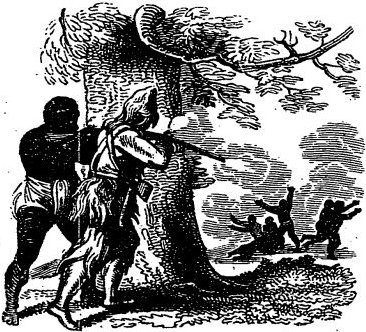
Friday took his aim so much better than I, that on the side that he shot, he killed two of them, and wounded three more; and on my side, I killed one, and wounded two. They were, you may be sure, in a dreadful consternation; and all of them who were not hurt jumped upon their feet, but did not immediately know which way to run, or which way to look, for they knew not from whence their destruction came. Friday kept his eyes close upon me, that, as I had bid him, he might observe what I did; so, as soon as the first shot was made, I threw down the piece, and took up the fowling-piece, and Friday did the like: he saw me cock and present; he did the same again. "Are you ready, Friday?" said I.—"Yes," says he. "Let fly, then," says I, "in the name of God!" and with that, I fired again among the amazed wretches, and so did Friday; and as our pieces were now loaden with what I called swan-shot, or small pistol-bullets, we found only two drop, but so many were wounded, that they ran about yelling and screaming like mad creatures, all bloody, and most of them miserably wounded, whereof three more fell quickly after, though not quite dead.
"Now, Friday," says I, laying down the discharged pieces, and taking up the musket which was yet loaden, "follow me;" which he did with a great deal of courage; upon which I rushed out of the wood, and showed myself, and Friday close at my foot. As soon as I perceived they saw me, I shouted as loud as I could, and bade Friday do so too; and running as fast as I could, which, by the way, was not very fast, being loaded with arms as I was, I made directly towards the poor victim, who was, as I said, lying upon, the beach, or shore, between the place where they sat and the sea. The two butchers, who were just going to work with him, had left him at the surprise of our first fire, and fled in a terrible fright to the sea-side, and had jumped into a canoe, and three more of the rest made the same way. I turned to Friday, and bade him step forwards, and fire at them; he understood me immediately, and running about forty yards, to be nearer them, he shot at them, and I thought he had killed them all, for I saw them all fall of a heap into the boat, though I saw two of them up again quickly: however, he killed two of them, and wounded the third so, that he lay down in the bottom of the boat as if he had been dead.
While my man Friday fired at them, I pulled out my knife and cut the flags that bound the poor victim; and loosing his hands and feet, I lifted him up, and asked him in the Portuguese tongue, what he was. He answered in Latin, Christianus; but was so weak and faint that he could scarce stand or speak. I took my bottle out of my pocket, and gave it him, making signs that he should drink, which he did; and I gave him a piece of bread, which he eat. Then I asked him what countryman he was: and he said, Espagniole; and being a little recovered, let me know, by all the signs he could possibly make, how much he was in my debt for his deliverance. "Seignior," said I, with as much Spanish as I could make up, "we will talk afterwards, but we must fight now: if you have any strength left, take this pistol and sword, and lay about you." He took them very thankfully; and no sooner had he the arms in his hands, but, as if they had put new vigour into him, he flew upon his murderers like a fury, and had cut two of them in pieces in an instant; for the truth is, as the whole was a surprise to them, so the poor creatures were so much frightened with the noise of our pieces, that they fell down for mere amazement and fear, and had no more power to attempt their own escape, than their flesh had to resist our shot: and that was the case of those five that Friday shot at in the boat; for as three of them fell with the hurt they received, so the other two fell with the fright.
I kept my piece in my hand still without firing, being willing to keep my charge ready, because I had given the Spaniard my pistol and sword: so I called to Friday, and bade-him run up to the tree from whence we first fired, and fetch the arms which lay there that had been discharged, which he did with great swiftness; and then giving him my musket, I sat down myself to load all the rest again, and bade them come to me when they wanted. While I was loading these pieces, there happened a fierce engagement between the Spaniard and one of the savages, who made at him with one of their great wooden swords, the same-like weapon that was to have killed him before, if I had not prevented it. The Spaniard, who was as bold and brave as could be imagined, though weak, had fought this Indian a good while, and had cut him two great wounds on his head; but the savage being a stout, lusty fellow, closing in with him, had thrown him down, being faint, and was wringing my sword out of his hand; when the Spaniard, though undermost, wisely quitting the sword, drew the pistol from his girdle, shot the savage through the body, and killed him upon the spot, before I, who was running to help him, could come near him.
Friday being now left to his liberty, pursued the flying wretches, with no weapon in his hand but his hatchet; and with that he dispatched those three, who, as I said before, were wounded at first, and fallen, and all the rest he could come up with: and the Spaniard coming to me for a gun, I gave him one of the fowling-pieces, with which he pursued two of the savages, and wounded them both; but, as he was not able to run, they both got from him into the wood, where Friday pursued them, and killed one of them, but the other was too nimble for him; and though he was wounded, yet had plunged himself into the sea, and swam, with all his might, off to those two who were left in the canoe, which three in the canoe, with one wounded, that we knew not whether he died or no, were all that escaped our hands of one and twenty; the account of the whole is as follows: three killed at our first shot from the tree; two killed at the next shot; two killed by Friday in the boat; two killed by Friday of those at first wounded; one killed by Friday in the wood; three killed by the Spaniard; four killed, being found dropped here and there, of their wounds, or killed by Friday in his chase of them; four escaped in the boat, whereof one wounded, if not dead.—Twenty-one in all.
Those that were in the canoe worked hard to get out of gun-shot, and though Friday made two or three shots at them, I did not find that he hit any of them. Friday would fain have had me take one of their canoes, and pursue them; and, indeed, I was very anxious about their escape, lest carrying the news home to their people, they should come back perhaps with two or three hundred of the canoes, and devour us by mere multitude; so I consented to pursue them by sea, and running to one of their canoes, I jumped in, and bade Friday follow me; but when I was in the canoe, I was surprised to find another poor creature lie there, bound hand and foot, as the Spaniard was, for the slaughter, and almost dead with fear, not knowing what was the matter; for he had not been able to look up over the side of the boat, he was tied so hard neck and heels, and had been tied so long, that he had really but little life in him.
I immediately cut the twisted flags or rushes, which they had bound him with, and would have helped him up; but he could not stand or speak, but groaned most piteously, believing, it seems, still, that he was only unbound in order to be killed. When Friday came to him, I bade him speak to him, and tell him of his deliverance; and, pulling out my bottle, made him give the poor wretch a dram; which, with the news of his being delivered, revived him, and he sat up in the boat. But when Friday came to hear him speak, and look in his face, it would have moved any one to tears to have seen how Friday kissed him, embraced him, hugged him, cried, laughed, hallooed, jumped about, danced, sung; then cried again, wrung his hands, beat his own face and head; and then sung and jumped about again, like a distracted creature. It was a good while before I could make him speak to me, or tell me what was the matter; but when he came a little to himself, he told me that it was his father.
It is not easy for me to express how it moved me to see what ecstasy and filial affection had worked in this poor savage at the sight of his father, and of his being delivered from death; nor, indeed, can I describe half the extravagances of his affection after this; for he went into the boat, and out of the boat, a great many times: when he went in to him, he would sit down by him, open his breast, and hold his father's head close to his bosom for many minutes together, to nourish it; then he took his arms and ancles, which were numbed and stiff with the binding, and chafed and rubbed them with his hands; and I, perceiving what the case was, gave him some rum out of my bottle to rub them with, which did them a great deal of good.
This affair put an end to our pursuit of the canoe with the other savages, who were now got almost out of sight; and it was happy for us that we did not, for it blew so hard within two hours after, and before they could be got a quarter of their way, and continued blowing so hard all night, and that from the north-west, which was against them, that I could not suppose their boat could live, or that they ever reached their own coast.
But, to return to Friday; he was so busy about his father, that I could not find in my heart to take him off for some time: but after I thought he could leave him a little, I called him to me, and he came jumping and laughing, and pleased to the highest extreme; then I asked him if he had given his father any bread. He shook his head, and said, "None; ugly dog eat all up self," I then gave him a cake of bread, out of a little pouch I carried on purpose; I also gave him a dram for himself, but he would not taste it, but carried it to his father. I had in my pocket two or three bunches of raisins, so I gave him a handful of them for his father. He had no sooner given his father these raisins, but I saw him come out of the boat, and run away, as if he had been bewitched, he ran at such a rate; for he was the swiftest fellow on his feet that ever I saw: I say, he ran at such a rate, that he was out of sight, as it were, in an instant; and though I called, and hallooed out too, after him, it was all one, away he went; and in a quarter of an hour I saw him come back again, though not so fast as he went; and as he came nearer, I found his pace slacker, because he had something in his hand. When he came up to me, I found he had been quite home for an earthen jug, or pot, to bring his father some fresh water, and that he had two more cakes or loaves of bread; the bread he gave me, but the water he carried to his father; however, as I was very thirsty too, I took, a little sup of it. The water revived his father more than all the rum or spirits I had given him, for he was just fainting with thirst.
When his father had drank, I called to him to know, if there was any water left: he said, "Yes;" and I bade him give it to the poor Spaniard, who was in as much want of it as his father; and I sent one of the cakes, that Friday brought, to the Spaniard too, who was indeed very weak, and was reposing himself upon a green place under the shade of a tree; and whose limbs were also very stiff and very much swelled with the rude bandage he had been tied with. When I saw that, upon Friday's coming to him with the water, he sat up and drank, and took the bread, and began to eat, I went to him and gave him a handful of raisins: he looked up in my face with all the tokens of gratitude and thankfulness that could appear in any countenance; but was so weak, notwithstanding he had so exerted himself in the fight, that he could not stand up upon his feet; he tried to do it two or three times, but was really not able, his ancles were so swelled and so painful to him; so I bade him sit still, and caused Friday to rub his ancles, and bathe them with rum, as he had done his father's.
I observed the poor affectionate creature, every two minutes, or perhaps less, all the while he was here, turn his head about, to see if his father was in the same place and posture as he left him sitting; and at last he found he was not to be seen; at which he started up, and, without speaking a word, flew with that swiftness to him, that one could scarce perceive his feet to touch the ground as he went: but when he came, he only found he had laid himself down to ease his limbs, so Friday came back to me presently; and then I spoke to the Spaniard to let Friday help him up, if he could, and lead him to the boat, and then he should carry him to our dwelling, where I would take care of him: but Friday, a lusty strong fellow, took the Spaniard quite up upon his back, and carried him away to the boat, and set him down softly upon the side or gunnel of the canoe, with his feet in the inside of it; and then lifting him quite in, he set him close to his father; and presently stepping out again, launched the boat off, and paddled it along the shore faster than I could walk, though the wind blew pretty hard too: so he brought them both safe into our creek, and leaving them in the boat, ran away to fetch the other canoe. As he passed me, I spoke to him, and asked him whither he went. He told me, "Go fetch more boat:" so away he went like the wind, for sure never man or horse ran like him; and he had the other canoe in the creek almost as soon as I got to it by land; so he wafted me over, and then went to help our new guests out of the boat, which he did; but they were neither of them able to walk, so that poor Friday knew not what to do.
To remedy this, I went to work in my thought, and calling to Friday to bid them sit down on the bank while he came to me, I soon made a kind of a hand-barrow to lay them on, and Friday and I carried them both up together upon it, between us.
But when we got them to the outside of our wall, or fortification, we were at a worse loss than before, for it was impossible to get them over, and I was resolved not to break it down: so I set to work again; and Friday and I, in about two hours' time, made a very handsome tent, covered with old sails, and above that with boughs of trees, being in the space without our outward fence, and between, that and the grove of young wood which I had planted: and here we made them two beds of such things as I had, viz. of good rice-straw, with blankets laid upon it, to lie on, and another to cover them, on each bed.
My island was now peopled, and I thought myself very rich in subjects; and it was a merry reflection, which I frequently made, how like a king I looked. First of all, the whole country was my own mere property, so that I had an undoubted right of dominion. Secondly, my people were perfectly subjected; I was absolutely lord and lawgiver; they all owed their lives to me, and were ready to lay down their lives, if there had been occasion for it, for me. It was remarkable, too, I had but three subjects, and they were of three different religions: my man Friday was a Protestant, his father was a Pagan and a cannibal, and the Spaniard was a Papist: however, I allowed liberty of conscience throughout my dominions:—But this is by the way.
As soon as I had secured my two weak rescued prisoners, and given them shelter, and a place to rest them upon, I began to think of making some provision for them; and the first thing I did, I ordered Friday to take a yearling goat, betwixt a kid and a goat, out of my particular flock, to be killed; when I cut off the hinder-quarter, and chopping it into small pieces, I set Friday to work to boiling and stewing, and made them a very good dish, I assure you, of flesh and broth, having put some barley and rice also into the broth: and as I cooked it without doors, for I made no fire within my inner wall, so I carried it all into the new tent, and having set a table there for them, I sat down, and eat my dinner also with them, and, as well as I could, cheered them, and encouraged them. Friday was my interpreter, especially to his father, and, indeed, to the Spaniard too; for the Spaniard spoke the language of the savages pretty well.
After we had dined, or rather supped, I ordered Friday to take one of the canoes, and go and fetch our muskets and other fire-arms, which, for want of time, we had left upon the place of battle: and, the next day, I ordered him to go and bury the dead bodies of the savages, which lay open to the sun, and would presently be offensive. I also ordered him to bury the horrid remains of their barbarous feast, which I knew were pretty much, and which I could not think of doing myself; nay, I could not bear to see them, if I went that way; all which he punctually performed, and effaced the very appearance of the savages being there; so that when I went again, I could scarce know where it was, otherwise than by the corner of the wood pointing to the place.
I then began to enter into a little conversation with my two new subjects: and, first, I set Friday to inquire of his father what he thought of the escape of the savages in that canoe, and whether we might expect a return of them, with a power too great for us to resist. His first opinion was, that the savages in the boat never could live out the storm which blew that night they went off, but must, of necessity, be drowned, or driven south to those other shores, where they were as sure to be devoured as they were to be drowned, if they were cast away: but, as to what they would do, if they came safe on shore, he said he knew not; but it was his opinion, that they were so dreadfully frightened with the manner of their being attacked, the noise, and the fire, that he believed they would tell the people they were all killed by thunder and lightning, not by the hand of man; and that the two which appeared, viz. Friday and I, were two heavenly spirits, or furies, come down to destroy them, and not men with weapons. This, he said, he knew; because he heard them all cry out so, in their language, one to another; for it was impossible for them to conceive that a man could dart fire, and speak thunder, and kill at a distance, without lifting up the hand, as was done now: and this old savage was in the right; for, as I understood since, by other hands, the savages never attempted to go over to the island afterwards, they were so terrified with the accounts given by those four men (for, it seems, they did escape the sea,) that they believed whoever went to that enchanted island would be destroyed with fire from the gods. This, however, I knew not; and therefore was under continual apprehensions for a good while, and kept always upon my guard, with all my army: for, as there were now four of us, I would have ventured upon a hundred of them, fairly in the open field, at any time.
In a little time, however, no more canoes appearing, the fear of their coming wore off; and I began to take my former thoughts of a voyage to the main into consideration; being likewise assured, by Friday's father, that I might depend upon good usage from their nation, on his account, if I would go. But my thoughts were a little suspended when I had a serious discourse with the Spaniard, and when I understood that there were sixteen more of his countrymen and Portuguese, who, having been cast away, and made their escape to that side, lived there at peace, indeed, with the savages, but were very sore put to it for necessaries, and indeed for life. I asked him all the particulars of their voyage, and found they were a Spanish ship, bound from the Rio de la Plata to the Havanna, being directed to leave their loading there, which was chiefly hides and silver, and to bring back what European goods they could meet with there; that they had five Portuguese seamen on board, whom they took out of another wreck; that five of their own men were drowned, when first the ship was lost, and that these escaped, through infinite dangers and hazards, and arrived, almost starved, on the cannibal coast, where they expected to have been devoured every moment. He told me they had some arms with them, but they were perfectly useless, for that they had neither powder nor ball, the washing of the sea having spoiled all their powder, but a little, which they used, at their first landing, to provide themselves some food.
I asked him what he thought would become of them there, and if they had formed any design of making their escape. He said they had many consultations about it; but that having neither vessel, nor tools to build one, nor provisions of any kind, their councils always ended in tears and despair. I asked him how he thought they would receive a proposal from me, which might tend towards an escape; and whether, if they were all here, it might not be done. I told him with freedom, I feared mostly their treachery and ill usage of me, if I put my life in their hands; for that gratitude was no inherent virtue in the nature of man, nor did men always square their dealings by the obligations they had received, so much as they did by the advantages they expected. I told him it would be very hard that I should be the instrument of their deliverance, and that they should afterwards make me their prisoner in New Spain, where an Englishman was certain to be made a sacrifice, what necessity, or what accident soever brought him thither; and that I had rather be delivered up to the savages, and be devoured alive, than fall into the merciless claws of the priests, and be carried into the Inquisition. I added, that otherwise I was persuaded, if they were all here, we might, with so many hands, build a bark large enough to carry us all away, either to the Brazils, southward, or to the islands, or Spanish coast, northward; but that if, in requital, they should, when I had put weapons into their hands, carry me by force among their own people, I might be ill used for my kindness to them, and make my case worse than it was before.