II HARVESTING NATURE'S CROPS (continued 2)
Reading edition
All the spruces yield gum, but the best quality is said to come from the white spruce. The first thing to do then is to learn to recognize this tree on sight. It will take you and a tree book together about five minutes to distinguish between the three short-leaved evergreens which look so much alike to a novice, the firs, the hemlocks, and the spruces. When once you know the spruces by the looks or the feel, you will begin to know the white from the red and black spruce by the colour. Everything about the white spruce is paler than the others. The foliage is light, almost pea-green, and the bark is not ruddy but grayish-brown. There are thousands of acres of spruce woods in our northern Central and New England states. Boys and girls on camping trips can sometimes collect spruce gum enough to pay expenses and have fun doing it. The only equipment necessary is a heavy pocket knife, a gum spud, a canvas sack, a strong hand, and a pair of sharp eyes. The eyes will get sharper as the knife gets dull and the tree you found nothing on in the morning of your first day may yield a good harvest on the return trip. You will not be able to buy a gum spud, but a tinsmith can make one for you at small cost, according to these directions: Solder a piece of galvanized iron into a funnel six inches deep, three inches across the top, and one inch in diameter at the bottom. A ferrule two or three inches deep and an inch in diameter is fitted into the bottom of the funnel and soldered in tight. Fit a long handle into this affair and your spud is ready. You may count on a good majority of the gum you find being out of reach of the knife but the spud gets it down very successfully.
The best place to find spruce gum is undoubtedly in woods where no one has been "gummin'" before, at least not for five years or so. The most plentiful supply is said to be on slopes where the trees have a southern exposure, and the smaller trees yield more gum than the big ones. Your work is not done with collecting, for in order to get the best price you must present a fancy grade to the market. If your gum is all thrown in together, good, bad, and indifferent, your average price is pretty sure to be less than for a carefully cleaned and sorted lot.
Spruce gum can be collected in summer or winter. Which time is better for you depends on circumstances. There is a peculiar charm about gum hunting on snow-shoes. A young man suffering from too little fresh air and attendant ills might find his health among the spruce trees while the gum paid the bills.
MUSHROOMS
"Are you sure these are good mushrooms?" I asked my seven-year-old daughter.
"Yes. I'm sure. Don't you know Aunt J—— says that all the Coprinæ are edible?"
This is a true story and it only goes to show that even a small child can learn that there are a small number of unmistakable mushrooms, which are edible and there is never any danger of being wrong about them. The puff-balls, for example, are all good to eat. When we found the neighbour's children kicking great white spongy puff-balls in the pasture we begged them to let us have them instead. "Pap says they're p'ison" was their reply, but we heeded them not for their "pap" was no oracle of ours. We were quite willing the children should go on thinking puff-balls were poison, if only they would not use them for foot-balls. Nobody in his senses would try to eat puff-balls after they have begun to turn black or brown. But when they are white and tender they are very good. Skin the ball, slice thin, add water and a little salt, and stew for twenty minutes or so. Drain and dress with cream sauce. No doubt puff-ball slices broiled over a camp fire with bacon would be good. I wish I had tried it, but I never have. We will agree that no puff-ball can compare with the pink-gilled meadow mushroom, but we make no such claims for it.
The best place to look for puff-balls is in old pastures in late summer and early fall. The giants are sometimes as big as a milk pail. The pear-shaped ones grow on tree stumps and are as big as your fist or smaller. There is an endless variety of tiny ones of all sorts which are either too tough or too small to bother with. But no puff-ball is "p'ison," not one.
Boys and girls who like to harvest nature's crops are missing a lot of fun besides many pecks of delicious food by neglecting the common edible mushrooms. If you know a few good ones you are perfectly safe. When you have seen them a few times and gathered them a few times and compared them with photographs you are ready to eat them. I should advise always to go mushroom hunting first with some experienced person. Personally I take no risks. For instance if my book tells me that "dangerous fungi resembling this species and sometimes found in company with it—etc.," that's enough. Say no more. I let that one alone. I do not like the company it keeps, and it may be a sheep in wolf's clothing. In my list of edible fungi, common in New York and New Jersey, there are less than a dozen kinds. No one of these looks enough like any other fungus to be mistaken for it. A few good looks at them will fix them in the memory. These are morels, meadow mushrooms, shaggy-manes, inky-caps, oyster mushroom, puff-balls, coral fungi, and chanterelles. The open season for morels is in early spring, when arbutus is blossoming, and later. Coral fungi and chanterelles are at their finest in midsummer, puff-balls in September, inky-caps and shaggy-manes in October, and we ate oyster mushrooms on January first one year, though they appear earlier. The meadow mushroom with white flesh and pink gills is grown indoors and is seen in the market from fall till spring, but nature's crop must be harvested in fall before frost.
Morels.—Morels look like nothing else. When full sized they are six inches high. The hollow stalk is as large as your finger and about half the length of the whole. The top or cap is brownish and so covered with ridges and wrinkles that it would never be mistaken for anything else in the world. You ought to see a picture of it because it is difficult to describe so irregular an object. Look it up in some mushroom book or bulletin in your library.
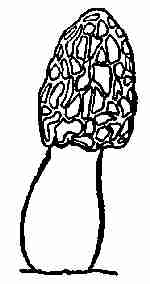
You never know just where morels may appear. We found them in our garden once. They come up right among the weeds or dead leaves. I have often found them along forest by-paths, especially in wet weather in spring. They are delectable. Perhaps you have eaten delicately broiled slices of tenderloin of young pig. Morels do not taste like this—they look a little like it—they taste very much better. You taste them.
Coral Fungi.—The coral fungi that I eat look like chunks of pinkish or cream white organ pipe coral. They are fleshy, soft, yet firm enough to keep their shape, and the whole mass is made up of tiny thread-or rod-like parts of many branches. There is a fine one which looks like a cauliflower though more yellow. I have found the pink and creamy ones on fallen and decayed tree trunks in deep, cool woods in midsummer. Others equally good grow in thin woods or open places. They vary in size from chunks as big as a walnut to those as big or bigger than your fist. They need careful cleansing under a faucet. Some cooks soak them first in cold water into which they put a little vinegar or lemon juice. They then fry in butter. Another way is to stew till tender in water with lemon juice in it. Then drain and dress with cream sauce.
Puff-balls.—What country child has not puffed the "smoke" from the hole in the top of the tough-skinned little brown balls they find in the fields in autumn? Children generally believe them to be deadly poison and call them "devil's snuff-boxes." Their life history is very like that of other fungi. The most of the year these flowerless and leafless plants spend underground. They spread in a tangle of fine threads all through the soil wherever they find decaying vegetable matter upon which to feed. When their time comes, little white balls push out and up from the threads. These come to the surface and we know them by their shapes and sizes as our different kinds of puff-balls, mushrooms, or other fungi.
The puff-balls are white and look like fine cream cheese when they first appear. Their business is to ripen their spores, scatter them, and disappear. The brown smoke or dust of the ripe puff-ball is blown about by the wind and finds its way into the earth in time; each tiny spore or grain of dust can start a new mat of threads down underground. When you puff the devil's snuff-box you are doing the plant just the kindness it was waiting for. When a cow steps on a ripe giant puff-ball a great smoke goes up, and the breeze catches the dust. Some of the spores may be carried on the wind or on the cow's foot to far distant pastures, there to settle down and start a new puff-ball colony. It is just so with all the fungi.
All the puff-balls are edible but one of the most eatable is the giant, which is found in August or September in pastures or other grassy places. When right to eat it is grayish on the outside and pure white clear through. In size this giant varies from six or eight inches through to two feet. Specimens of ten pounds' weight are not rare, and there is record of some twice that size. When yellow or brown inside, the giant is past eating.
The pear-shaped puff-ball is the commonest one. This is a sort of dirty brown colour outside, pure white inside. It is found on old wood or on the ground as early as July and as late as October. In size the balls vary from thimble size to that of a big pear. They grow in companies, sometimes scores together.
The brain puff-ball is larger than the pear-shaped. The top is wrinkled or corrugated, and grayish or reddish in colour.
Chanterelles.—Chanterelles are found in late summer in the woods amongst moss where it is damp and cool. They are red or yellow and look as if you had put your thumb in the middle of the top and pushed it down so that the network of gills appear on the outside. The name means a little goblet, and the perfect ones are goblet-shaped. If you go camping in the woods in summer you are almost sure to find chanterelles.
Meadow Mushrooms.—The wild meadow mushroom usually appears in large numbers after the autumn rains have renewed the pastures. They frequently come up alongside of an old dried patch of cow manure. To make myself familiar with this pink-gilled variety I visited a large market where they had them for sale in all stages, from the little round buttons to the big flat broilers which are turning brown. They are just right when the cap has spread so as to burst the delicate white veil which covers the gills. The flesh is white and the gills a delicate pink. The skin peels off easily like that of a ripe peach. Look them over with great care when preparing for the table. The early worm which is on hand to get a first bite of everything sometimes honeycombs the whole plant. The stems of young ones are tender at the top.
Inky Caps.—You never expect to gather your dinner from an ash heap? Neither did I; but in the edge of the woods nearest us the public used to be allowed to dump ashes. It is now overgrown with golden-rod, iron weed and various other coarse plants. A path leads through it. Last fall we discovered that the place was fairly swarming with Coprinus comatus, the shaggy mane mushroom. This does not look like anything else on land or sea and is delicious. Its relative, the inky cap is just as good to eat, but not so handsome. Both melt away into black ink as they grow old. They should be cooked as soon as possible after gathering. We kept some over night once. Such a sight! They looked like black corn smut.
The Coprinæ push up in such tight clumps sometimes that their heads are all out of shape. They rise literally over night. Sometimes one comes up singly and grows tall and perfect, a truly lovely object, pure white, six inches tall, its shaggy head held high, its silver-white gills delicate as tissue paper. A few hours later you will see a ragged bit of pulp rapidly dissolving in a pool of black ink.
Oyster Mushrooms.—The oyster mushroom comes out like the shelf fungi on decaying tree stumps or logs. They are ashy colour or dull white, solid and rather tough, and vary in breadth from two to five inches. As to why they are called oyster mushrooms, opinions differ. The flavour is not oyster-like, though the flesh is about as tough as a boiled oyster. The shape does suggest an oyster shell; perhaps that is the best reason for the name. One edible relative of the oyster mushroom grows usually on decaying elm stumps as late in the year as November.
The first thing to do if you get interested in mushrooms is to get some good illustrated book on them. The chances are that your State Experiment Station has issued a bulletin on the subject. If not you can get those published by the United States Department of Agriculture or perhaps those issued by some neighbouring state. What you want is information on wild fungi, especially the edible ones, not directions about growing the market varieties. When you write for bulletins state just what you are looking for. Pictures, especially photographs, are of the greatest use in identifying specimens. Compare the descriptions and pictures with your mushrooms and do not use them if there is any question in your mind as to what they are. The books mentioned in the appendix of this book have been of help to me.
CONSERVING NATURE'S CROPS
The harvesting of nature's crops is a most fascinating occupation. As boys and girls we do not ask why; we only know what fun it is. If the time ever comes when you wish to forget that you are grown up, nothing will help you like going into the woods, the fields, or the hedge-rows to help the birds and the little fur-coated animals harvest the crops of nuts or berries or other fruit that grow in nature's orchards. With your sack of nuts or plums on your arm, or your pail full of berries, you can easily forget that you live in a flat or work in an office or a factory.
Some people think when they see how much over-ripe fruit is falling to the ground, and how much more there is than can ever be gathered by human hands, that nature is wasteful. Perhaps this is why these same people and others who did not think at all, have been so very wasteful of our country's natural resources, and brought about such a really alarming state of things in our forests. Those who do stop to think will see that although she is lavish, nature is never wasteful. The berries must decay in order that the seeds may germinate, and in moulding they nourish the fungi which are just as important in nature's eyes, so to speak, as the berries are. Nothing is wasted in nature. On the contrary, everything is saved and is made over into some other form. Nothing stands still; transformation goes on continuously. What was soil yesterday is fruit to-day and is built into our muscles and nerves and brains to-morrow.
Every boy or girl that helps to harvest nature's crops can do a little to assist in our great national work of preserving the country's natural resources. Would you ruin a fine young tree just beginning a life of usefulness? By mutilating it past recognition, you may add a few nuts to your this year's store. But what an injustice you are doing to the next generation of boys and girls. You are robbing them. I have heard men say: "When I was a boy we used to bring home arbutus by the wagon load from Coy Glen. But it's hard to find any there now. It must have winter-killed or blighted." My tongue burned to tell them that they themselves were the blight that winter-killed the arbutus and robbed me of my right to gather a few sprays. They had torn it up by the roots in their greed to fill their wagons, and then they cut out all the trees, and the sunlight destroyed all the shade-loving things.
Boys and girls of a more enlightened generation know better ways and will not leave behind them a record of selfishness.
THE STORY OF THE CREATION OF A NEW INDUSTRY
I am glad to tell the methods by which I have developed a good business in collecting and growing California bulbs, as I believe my success can be duplicated in other parts of the country—in fact, one man already makes a good living by exploiting the wild flowers of the Rocky Mountains, several people are exporting the cacti of our desert, and there are several nurseries in the southern Appalachians for the interesting plants of North Carolina.
In 1870, when I was nine years old, my family moved to Ukiah Valley in north-western California, and there I have lived ever since. My early home was a farm, and my first work to raise hops and a mortgage. My education was such as the district school and an abundance of good reading could give me. At eighteen I began to teach school. I was always a lover of nature and fond of wandering about the hills. In Mendocino County in 1870 the country was just emerging from the cowboy era, and little attention was paid to vegetable gardening, while flower gardens were all but unknown.
HOW THE LIFE WORK WAS DETERMINED
There was one notable exception to the indifference to flowers. Alexander MacNab, a Scotchman who had been forced by declining health to leave Glasgow, had found new vigour in California's mountains. The property which he had purchased for a stock range is one of the most picturesque in northern California, and there he built a modest but ideal home. He sent everywhere for flowers, and I know of no place in these later days where more flowers are well grown. He gave to his flowers not only money, but love and himself, and few gardeners were more successful. I often visited there in my boyhood days and the inspiration that I received from this place and from another source determined my life work.
I had a sister a few years older than myself who had been in the East for some years and whose failing health forced her to return to California. She was a flower-lover and soon called upon me to begin a garden on the bare hill where our very plain home stood. It was a work of love, for all of the new soil was carried in buckets, and the water which our hot climate made necessary was carried from a well, but it was a great success. My Scotch friend was most liberal with both plants and instruction, and between the two my bent was well fixed.
THE BEGINNING OF THE INDUSTRY
It was through Mr. MacNab that I got started in the collection of native plants. Woolson and Company, then of Passaic, N. J., were the first American firm to take up the culture of our native American plants as a specialty. They wrote to Mr. MacNab, asking him to secure the native plants and offering to pay for them in eastern grown plants. My love for flowers had interested me in botany, and it was quite natural that the letter should be turned over to me. In my first letter to Woolson I sent a pressed flower of Colochortus pulchellus and received in return an order for one hundred bulbs, which they said they would pay for in cash. This order was filled and it was the beginning of my bulb business.
My first idea was to earn money to buy plants with, but before long I saw that a small business might be built up.
My progress as a collector went hand in hand with my education in botany. My method was this: First to find something of sufficient beauty to make it probable that it would be wanted; next, to find its name, and then to offer it to some one of the very few firms then interested in such things.
Such was the first stage in the development of a new industry, but the latter was no less important, for it involved knowing the plant at every stage of its growth, finding when it could best be handled, and how best packed for shipment. Almost from the beginning I tried to grow the native plants, and botanical study, collection, and cultivation have gone hand in hand since.
METHODS OF COLLECTING
Every year I took longer trips. I went alone, with the lightest of camping outfits, slept on the ground, and penetrated the wildest regions, learning where the desirable flowers grew, and collecting those in demand, at the same time studying the general flora. When I had learned the flora of a region, I tried to train some resident as a permanent collector, for not all of these long trips could be made every year. My horizon fast widened, and through friends, by letters to others, and often by the migration of men whom I had trained, new fields were opened, and later I had men who had been trained under me to send to distant points.
Before I began to collect, others had been in the field, but they were principally wandering botanists who seldom collected over the same ground for two years in sequence. Their collections were of stuff of all grades, often made at the wrong season, and there was no demand except from a few special lists. At first I shared their faults, but after a few years I saw the necessity of making a reputation for reliability, for thoroughly learning the art of packing, and for such grading as would insure uniform quality.
ESTABLISHING A NURSERY BUSINESS
As time went on, collection became less important and culture the central feature of my work.
My first garden was at the farm home; later I spent much time and money in experiments in a reclaimed lake bed near Ukiah, still later at my Ukiah home, and since 1897 in the mountains about eight miles east of Ukiah. Each experiment had its value. No one had grown Californian bulbs in California, and everything had to be learned experimentally. I now have two nurseries. One of them is at Lyons Valley, a lovely spot in the highest part of that branch of the Coast Range which I found six years ago was specially adapted to lily culture. About three quarters of a mile away, at "The Terraces," nature has provided endless variations of soil, climate, moisture, sun, and shade. Here I grow a great variety of bulbs.
In 1886 I sold about seven thousand plants of all sorts; in 1888, two hundred and fifty thousand, and the difference was on business principles.
Carl Purdy