V 1867-1868 (continued 2)
Reading edition
I have been feeling for a month past that I ought to come here, but an effeminate shrinking from loneliness and so forth, and the inhuman blackness of the weather kept me from it. Now that I am here, I am only sorry I deferred it so long. I found the Fürstenbad open, and with four other "cure-guests" in it. All its varletry, male and female, fat as wood-chucks from their winter's repose; a theatre (!) going in town three times a week; the head waiter of the restaurant where in the summer I used, for the price of a glass of milk, to read the "Times" and the "Independence Belge," no longer wearing the pallid look of stern and desperate business with which he used to scud around among the crowded tables, and which used to make me stand in mortal fear of him, but appearing as a comfortable and red-cheeked human being with even greater conversational gifts than usual; every one moreover glad to see me, etc., etc. The veil of winter has been lifted for a week and the buried spring [has] peeped out and taken a-breathing before her time. Today everything is a-dripping, the earth has a moving smell, and the sky is full of spots of melting blue. If such weather but lasts, the time will pass here very quickly. I have brought a lot of good books, and if their interest wanes have the whole circulating library to fall back on. So much for Teplitz.
Sunday before last Mrs. Bancroft told me that the most beautiful woman in Berlin had asked after me with affection and expressed a desire to see me. After making me guess in vain she told me that it was Mrs. Lieutenant Pertz, née Emma Wilkinson.[43] I went to see her and found her looking hardly a day older or different, and certainly very good-looking, though probably Mrs. B.'s description was exaggerated. She had the sweetest and simplest of manners and asked all about the family, to whom she sends her love. She told me nothing particular about her own family which we did not know, except that Jamie had an aquiline nose. She has three fine children, much more of the British than the German type, and it was right pleasant to see her. She has very handsome brown eyes. Nice manners are a very charming thing, and some of the ladies here might set a good example to some other young ladies I might mention (who do not live 100 miles from Quincy Street); Fräulein Borneman, for example. Let Alice cultivate a manner clinging yet self-sustained, reserved yet confidential; let her face beam with serious beauty, and glow with quiet delight at having you speak to her; let her exhibit short glimpses of a soul with wings, as it were (but very short ones); let her voice be musical and the tones of her voice full of caressing, and every movement of her full of grace, and you have no idea how lovely she will become.... I am sorry Wilky has had a relapse of his fever. He and Bob are still the working ones of the family (Harry too, though!), but I hope my day will yet come. Give him and Bob a great deal of love for me. Life in Teplitz is favorable to letter-writing and I will write to Bob next week. Love to every one else, from yours ever,
WM. JAMES.
To Henry James.
Fürstenbad, Teplitz, Mar. 4, 1868.
...I have been admitted to the intimacy of a family here named G——, who keep a hotel and restaurant. Immense, bulky, garrulous, kind-hearted woman, father with thick red face, little eyes and snow-white hair, two daughters of about twenty. The whole conversation and tea-taking there reminded me so exactly of Erckmann-Chatrian's stories that I wanted to get a stenographer and a photographer to take them down. The great, thick remarks, all about housekeeping and domestic economy of some sort or other; the jokes; the masses of eatables, from the awful swine soup (tasting of nothing I could think of but the perspiration of the animal and which the terrible mother forced me to gulp down by accusing me, whenever I grew pale and faltered, of not relishing their food), through the sausages (liver sausages, blood sausages, and more), to the beer and wine; then the masses of odoriferous cheese, which I refused in spite of all attacks, entreaties and accusations, and then heard, oh, horrors! with somewhat the feeling I suppose with which a criminal hears the judge pass sentence of death upon him,—then heard an order given for some more sausages to be brought in to me instead; the air of religious earnestness with which the eating of the father was talked about, how the mother told the daughter not to give him so much wine, because he never enjoyed his beer so much after it, while he with his silver spectacles and pointing with his pudgy forefinger to the lines, read out of the newspaper half aloud to himself; the immense long room with walls of dark wood, the big old-fashioned china stove at each end of it, etc., etc.,—all brought up the Taverne du Jambon de Mayence into my mind....
[W. J.]
The water-cure at Teplitz worked no cure; but James repaired to Heidelberg in the spring, to hear Helmholtz lecture and with the hope of following the medical courses during the summer semester. Once more he had to stop work, and for a while he returned to Berlin. From there he traveled by way of Geneva, stopping characteristically for only the very briefest of glances at the familiar scenes of his school-days, and hurrying on to spend the latter part of the summer at another watering-place, Divonne in Savoy. The following brief letter seems to have been written there, and is interesting as a first reference to Charles Renouvier, a French philosopher who later exercised an important influence on James's thinking.
To his Father.
[Divonne?], Oct. 5, 1868.
DEAR FATHER,—...I have not been doing much studying lately, nor indeed for some time past, though I manage to keep something dribbling all the while. I began the other day Kant's "Kritik," which is written crabbedly enough, but which strikes me so far as almost the sturdiest and honestest piece of work I ever saw. Whether right or wrong (and it is pretty clearly wrong in a great many details of its Analytik part, however the rest may be), there it stands like a great snag or mark to which everything metaphysical or psychological must be referred. I wish I had read it earlier. It is very slow reading and I shall only give it a couple of hours daily.
I got a little book by a number of authors, "L'Année 1867 Philosophique," which may interest you if you have not got it already. The introduction, a review of the state of philosophy in France for some years back, is by one Charles Renouvier, of whom I never heard before but who, for vigor of style and compression, going to the core of half a dozen things in a single sentence, so different from the namby-pamby diffusiveness of most Frenchmen, is unequaled by anyone. He takes his stand on Kant. I have not read the rest of the book.
Here I stop and take my douche. I will be as economical as I can this winter in details, and next summer will see us together. I wish I had the inclination to write, or anything to write about, as Harry has. I feel ashamed of fattening on the common purse when all the other boys are working, but writing seems for me next to impossible. Lots of love to all. Yours,
W. J.
The "cure" at Divonne was as profitless as had been the similar experiments at Teplitz. So instead of staying abroad for the winter, James turned his face homeward almost immediately. After a fortnight's companionship with H. P. Bowditch in Paris, he embarked on November 7 for America, disappointed in the chief hopes with which he had landed in Europe eighteen months before, but much matured in character and thought, and resolved to seek his health and his career at home.
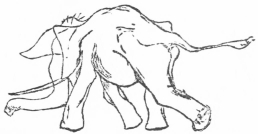
Pencil Sketch from a Pocket Note-Book.