to W. H. Low
Reading edition
[Skerryvore, Bournemouth, March 1886.]
MY DEAR LOW,—This is the most enchanting picture. Now understand my state: I am really an invalid, but of a mysterious order. I might be a malade imaginaire, but for one too tangible symptom, my tendency to bleed from the lungs. If we could go, (1st) We must have money enough to travel with leisure and comfort—especially the first. (2nd) You must be prepared for a comrade who would go to bed some part of every day and often stay silent (3rd) You would have to play the part of a thoughtful courier, sparing me fatigue, looking out that my bed was warmed, etc. (4th) If you are very nervous, you must recollect a bad hæmorrhage is always on the cards, with its concomitants of anxiety and horror for those who are beside me.
Do you blench? If so, let us say no more about it.
If you are still unafraid, and the money were forthcoming, I believe the trip might do me good, and I feel sure that, working together, we might produce a fine book. The Rhone is the river of Angels. I adore it: have adored it since I was twelve, and first saw it from the train.
Lastly, it would depend on how I keep from now on. I have stood the winter hitherto with some credit, but the dreadful weather still continues, and I cannot holloa till I am through the wood.
Subject to these numerous and gloomy provisos, I embrace the prospect with glorious feelings.
I write this from bed, snow pouring without, and no circumstance of pleasure except your letter. That, however, counts for much. I am glad you liked the doggerel: I have already had a liberal cheque, over which I licked my fingers with a sound conscience. I had not meant to make money by these stumbling feet, but if it comes, it is only too welcome in my handsome but impecunious house.
Let me know soon what is to be expected—as far as it does not hang by that inconstant quantity, my want of health. Remember me to Madam with the best thanks and wishes; and believe me your friend,
Robert Louis Stevenson.
to Mrs. Fleeming Jenkin
[Skerryvore, Bournemouth, April 1886.]
MY DEAR MRS. JENKIN,—I try to tell myself it is good nature, but I know it is vanity that makes me write.
I have drafted the first part of Chapter VI., Fleeming and his friends, his influence on me, his views on religion and literature, his part at the Savile; it should boil down to about ten pages, and I really do think it admirably good. It has so much evoked Fleeming for myself that I found my conscience stirred just as it used to be after a serious talk with him: surely that means it is good? I had to write and tell you, being alone.
I have excellent news of Fanny, who is much better for the change. My father is still very yellow, and very old, and very weak, but yesterday he seemed happier, and smiled, and followed what was said; even laughed, I think. When he came away, he said to me, ‘Take care of yourself, my dearie,’ which had a strange sound of childish days, and will not leave my mind.
You must get Litolf’s Gavottes Célèbres: I have made another trover there: a musette of Lully’s. The second part of it I have not yet got the hang of; but the first—only a few bars! The gavotte is beautiful and pretty hard, I think, and very much of the period; and at the end of it, this musette enters with the most really thrilling effect of simple beauty. O—it’s first-rate. I am quite mad over it. If you find other books containing Lully, Rameau, Martini, please let me know; also you might tell me, you who know Bach, where the easiest is to be found. I write all morning, come down, and never leave the piano till about five; write letters, dine, get down again about eight, and never leave the piano till I go to bed. This is a fine life.—Yours most sincerely,
R. L. S.
If you get the musette (Lully’s), please tell me if I am right, and it was probably written for strings. Anyway, it is as neat as—as neat as Bach—on the piano; or seems so to my ignorance.
I play much of the Rigadoon but it is strange, it don’t come off quite so well with me!
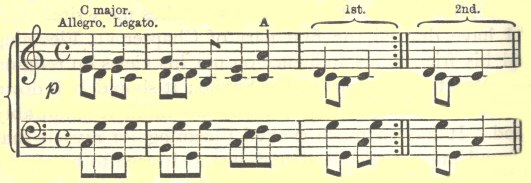
There is the first part of the musette copied (from memory, so I hope there’s nothing wrong). Is it not angelic? But it ought, of course, to have the gavotte before. The gavotte is in G, and ends on the keynote thus (if I remember):—
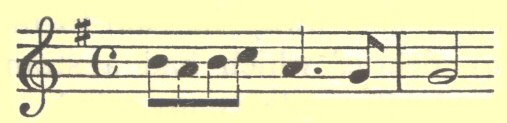
staccato, I think. Then you sail into the musette.
N.B.—Where I have put an ‘A,’ is that a dominant eleventh, or what? or just a seventh on the D? and if the latter, is that allowed? It sounds very funny. Never mind all my questions; if I begin about music (which is my leading ignorance and curiosity), I have always to babble questions: all my friends know me now, and take no notice whatever. The whole piece is marked allegro; but surely could easily be played too fast? The dignity must not be lost; the periwig feeling.
to Thomas Stevenson
[Skerryvore, Bournemouth, March 1886.]
MY DEAR FATHER,—The David problem has to-day been decided. I am to leave the door open for a sequel if the public take to it, and this will save me from butchering a lot of good material to no purpose. Your letter from Carlisle was pretty like yourself, sir, as I was pleased to see; the hand of Jekyll, not the hand of Hyde. I am for action quite unfit, and even a letter is beyond me; so pray take these scraps at a vast deal more than their intrinsic worth. I am in great spirits about David, Colvin agreeing with Henley, Fanny, and myself in thinking it far the most human of my labours hitherto. As to whether the long-eared British public may take to it, all think it more than doubtful; I wish they would, for I could do a second volume with ease and pleasure, and Colvin thinks it sin and folly to throw away David and Alan Breck upon so small a field as this one.—Ever your affectionate son,
R. L. S.
to Mrs. Fleeming Jenkin
[Skerryvore, Bournemouth], April 15 or 16 (the hour not being known), 1886.
MY DEAR MRS. JENKIN,—It is I know not what hour of the night; but I cannot sleep, have lit the gas, and here goes.
First, all your packet arrived: I have dipped into the Schumann already with great pleasure. Surely, in what concerns us there is a sweet little chirrup; the Good Words arrived in the morning just when I needed it, and the famous notes that I had lost were recovered also in the nick of time.
And now I am going to bother you with my affairs: premising, first, that this is private; second, that whatever I do the Life shall be done first, and I am getting on with it well; and third, that I do not quite know why I consult you, but something tells me you will hear with fairness.
Here is my problem. The Curtin women are still miserable prisoners; no one dare buy their farm of them, all the manhood of England and the world stands aghast before a threat of murder. (1) Now, my work can be done anywhere; hence I can take up without loss a back-going Irish farm, and live on, though not (as I had originally written) in it: First Reason. (2) If I should be killed, there are a good many who would feel it: writers are so much in the public eye, that a writer being murdered would attract attention, throw a bull’s-eye light upon this cowardly business: Second Reason. (3) I am not unknown in the States, from which the funds come that pay for these brutalities: to some faint extent, my death (if I should be killed) would tell there: Third Reason. (4) Nobody else is taking up this obvious and crying duly: Fourth Reason. (5) I have a crazy health and may die at any moment, my life is of no purchase in an insurance office, it is the less account to husband it, and the business of husbanding a life is dreary and demoralising: Fifth Reason.
I state these in no order, but as they occur to me. And I shall do the like with the objections.
First Objection: It will do no good; you have seen Gordon die and nobody minded; nobody will mind if you die. This is plainly of the devil. Second Objection: You will not even be murdered, the climate will miserably kill you, you will strangle out in a rotten damp heat, in congestion, etc. Well, what then? It changes nothing: the purpose is to brave crime; let me brave it, for such time and to such an extent as God allows. Third Objection: The Curtin women are probably highly uninteresting females. I haven’t a doubt of it. But the Government cannot, men will not, protect them. If I am the only one to see this public duty, it is to the public and the Right I should perform it—not to Mesdames Curtin. Fourth Objection: I am married. ‘I have married a wife!’ I seem to have heard it before. It smells ancient! what was the context? Fifth Objection: My wife has had a mean life (1), loves me (2), could not bear to lose me (3). (1) I admit: I am sorry. (2) But what does she love me for? and (3) she must lose me soon or late. And after all, because we run this risk, it does not follow we should fail. Sixth Objection: My wife wouldn’t like it. No, she wouldn’t. Who would? But the Curtins don’t like it. And all those who are to suffer if this goes on, won’t like it. And if there is a great wrong, somebody must suffer. Seventh Objection: I won’t like it. No, I will not; I have thought it through, and I will not. But what of that? And both she and I may like it more than we suppose. We shall lose friends, all comforts, all society: so has everybody who has ever done anything; but we shall have some excitement, and that’s a fine thing; and we shall be trying to do the right, and that’s not to be despised. Eighth Objection: I am an author with my work before me. See Second Reason. Ninth Objection: But am I not taken with the hope of excitement? I was at first. I am not much now. I see what a dreary, friendless, miserable, God-forgotten business it will be. And anyway, is not excitement the proper reward of doing anything both right and a little dangerous? Tenth Objection: But am I not taken with a notion of glory? I dare say I am. Yet I see quite clearly how all points to nothing coming, to a quite inglorious death by disease and from the lack of attendance; or even if I should be knocked on the head, as these poor Irish promise, how little any one will care. It will be a smile at a thousand breakfast-tables. I am nearly forty now; I have not many illusions. And if I had? I do not love this health-tending, housekeeping life of mine. I have a taste for danger, which is human, like the fear of it. Here is a fair cause; a just cause; no knight ever set lance in rest for a juster. Yet it needs not the strength I have not, only the passive courage that I hope I could muster, and the watchfulness that I am sure I could learn.
Here is a long midnight dissertation; with myself; with you. Please let me hear. But I charge you this: if you see in this idea of mine the finger of duty, do not dissuade me. I am nearing forty, I begin to love my ease and my home and my habits, I never knew how much till this arose; do not falsely counsel me to put my head under the bed-clothes. And I will say this to you: my wife, who hates the idea, does not refuse. ‘It is nonsense,’ says she, ‘but if you go, I will go.’ Poor girl, and her home and her garden that she was so proud of! I feel her garden most of all, because it is a pleasure (I suppose) that I do not feel myself to share.
1. Here is a great wrong.
2. ,, growing wrong.
3. ,, wrong founded on crime.
4. ,, crime that the Government cannot prevent.
5. ,, crime that it occurs to no man to defy.
6. But it has occurred to me.
7. Being a known person, some will notice my defiance.
8. Being a writer, I can make people notice it.
9. And, I think, make people imitate me.
10. Which would destroy in time this whole scaffolding of oppression.
11. And if I fail, however ignominiously, that is not my concern. It is, with an odd mixture of reverence and humorous remembrances of Dickens, be it said—it is A-nother’s.
And here, at I cannot think what hour of the morning, I shall dry up, and remain,—Yours, really in want of a little help,
R. L S.
Sleepless at midnight’s dewy hour.
,, ,, witching ,,
,, ,, maudlin ,,
,, ,, etc.
Next morning.—Eleventh Objection: I have a father and mother. And who has not? Macduff’s was a rare case; if we must wait for a Macduff. Besides, my father will not perhaps be long here. Twelfth Objection: The cause of England in Ireland is not worth supporting. À qui le dites-vous? And I am not supporting that. Home Rule, if you like. Cause of decency, the idea that populations should not be taught to gain public ends by private crime, the idea that for all men to bow before a threat of crime is to loosen and degrade beyond redemption the whole fabric of man’s decency.
to Mrs. Fleeming Jenkin
[Skerryvore, Bournemouth, April 1886.]
MY DEAR MRS. JENKIN,—The Book—It is all drafted: I hope soon to send you for comments Chapters III., IV., and V. Chapter VII. is roughly but satisfactorily drafted: a very little work should put that to rights. But Chapter VI. is no joke; it is a mare magnum: I swim and drown and come up again; and it is all broken ends and mystification: moreover, I perceive I am in want of more matter. I must have, first of all, a little letter from Mr. Ewing about the phonograph work: If you think he would understand it is quite a matter of chance whether I use a word or a fact out of it. If you think he would not: I will go without. Also, could I have a look at Ewing’s précis? And lastly, I perceive I must interview you again about a few points; they are very few, and might come to little; and I propose to go on getting things as well together as I can in the meanwhile, and rather have a final time when all is ready and only to be criticised. I do still think it will be good. I wonder if Trélat would let me cut? But no, I think I wouldn’t after all; ’tis so quaint and pretty and clever and simple and French, and gives such a good sight of Fleeming: the plum of the book, I think.
You misunderstood me in one point: I always hoped to found such a society; that was the outside of my dream, and would mean entire success. But—I cannot play Peter the Hermit. In these days of the Fleet Street journalist, I cannot send out better men than myself, with wives or mothers just as good as mine, and sisters (I may at least say) better, to a danger and a long-drawn dreariness that I do not share. My wife says it’s cowardice; what brave men are the leader-writers! Call it cowardice; it is mine. Mind you, I may end by trying to do it by the pen only: I shall not love myself if I do; and is it ever a good thing to do a thing for which you despise yourself?—even in the doing? And if the thing you do is to call upon others to do the thing you neglect? I have never dared to say what I feel about men’s lives, because my own was in the wrong: shall I dare to send them to death? The physician must heal himself; he must honestly try the path he recommends: if he does not even try, should he not be silent?
I thank you very heartily for your letter, and for the seriousness you brought to it. You know, I think when a serious thing is your own, you keep a saner man by laughing at it and yourself as you go. So I do not write possibly with all the really somewhat sickened gravity I feel. And indeed, what with the book, and this business to which I referred, and Ireland, I am scarcely in an enviable state. Well, I ought to be glad, after ten years of the worst training on earth—valetudinarianism—that I can still be troubled by a duty. You shall hear more in time; so far, I am at least decided: I will go and see Balfour when I get to London.
We have all had a great pleasure: a Mrs. Rawlinson came and brought with her a nineteen-year-old daughter, simple, human, as beautiful as—herself; I never admired a girl before, you know it was my weakness: we are all three dead in love with her. How nice to be able to do so much good to harassed people by—yourself! Ever yours,
R. L. S.
to Miss Rawlinson
[Skerryvore, Bournemouth, April 1886.]
Of the many flowers you brought me, Only some were meant to stay, And the flower I thought the sweetest Was the flower that went away.
Of the many flowers you brought me, All were fair and fresh and gay, But the flower I thought the sweetest Was the blossom of the May.
Robert Louis Stevenson.
to Miss Monroe
Skerryvore, Bournemouth, May 25th, 1886.
DEAR MISS MONROE,—(I hope I have this rightly) I must lose no time in thanking you for a letter singularly pleasant to receive. It may interest you to know that I read to the signature without suspecting my correspondent was a woman; though in one point (a reference to the Countess) I might have found a hint of the truth. You are not pleased with Otto; since I judge you do not like weakness; and no more do I. And yet I have more than tolerance for Otto, whose faults are the faults of weakness, but never of ignoble weakness, and who seeks before all to be both kind and just. Seeks, not succeeds. But what is man? So much of cynicism to recognise that nobody does right is the best equipment for those who do not wish to be cynics in good earnest. Think better of Otto, if my plea can influence you; and this I mean for your own sake—not his, poor fellow, as he will never learn your opinion; but for yours, because, as men go in this world (and women too), you will not go far wrong if you light upon so fine a fellow; and to light upon one and not perceive his merits is a calamity. In the flesh, of course, I mean; in the book the fault, of course, is with my stumbling pen. Seraphina made a mistake about her Otto; it begins to swim before me dimly that you may have some traits of Seraphina?
With true ingratitude you see me pitch upon your exception; but it is easier to defend oneself gracefully than to acknowledge praise. I am truly glad that you should like my books; for I think I see from what you write that you are a reader worth convincing. Your name, if I have properly deciphered it, suggests that you may be also something of my countrywoman; for it is hard to see where Monroe came from, if not from Scotland. I seem to have here a double claim on your good nature: being myself pure Scotch and having appreciated your letter, make up two undeniable merits which, perhaps, if it should be quite without trouble, you might reward with your photograph.—Yours truly,
Robert Louis Stevenson.
to Miss Monroe
[Skerryvore, Bournemouth, June 1886.]
MY DEAR MISS MONROE,—I am ill in bed and stupid, incoherently stupid; yet I have to answer your letter, and if the answer is incomprehensible you must forgive me. You say my letter caused you pleasure; I am sure, as it fell out, not near so much as yours has brought to me. The interest taken in an author is fragile: his next book, or your next year of culture, might see the interest frosted or outgrown; and himself, in spite of all, you might probably find the most distasteful person upon earth. My case is different. I have bad health, am often condemned to silence for days together—was so once for six weeks, so that my voice was awful to hear when I first used it, like the whisper of a shadow—have outlived all my chief pleasures, which were active and adventurous, and ran in the open air: and being a person who prefers life to art, and who knows it is a far finer thing to be in love, or to risk a danger, than to paint the finest picture or write the noblest book, I begin to regard what remains to me of my life as very shadowy. From a variety of reasons, I am ashamed to confess I was much in this humour when your letter came. I had a good many troubles; was regretting a high average of sins; had been recently reminded that I had outlived some friends, and wondering if I had not outlived some friendships; and had just, while boasting of better health, been struck down again by my haunting enemy, an enemy who was exciting at first, but has now, by the iteration of his strokes, become merely annoying and inexpressibly irksome. Can you fancy that to a person drawing towards the elderly this sort of conjunction of circumstances brings a rather aching sense of the past and the future? Well, it was just then that your letter and your photograph were brought to me in bed; and there came to me at once the most agreeable sense of triumph. My books were still young; my words had their good health and could go about the world and make themselves welcome; and even (in a shadowy and distant sense) make something in the nature of friends for the sheer hulk that stays at home and bites his pen over the manuscripts. It amused me very much to remember that I had been in Chicago, not so many years ago, in my proper person; where I had failed to awaken much remark, except from the ticket collector; and to think how much more gallant and persuasive were the fellows that I now send instead of me, and how these are welcome in that quarter to the sitter of Herr Platz, while their author was not very welcome even in the villainous restaurant where he tried to eat a meal and rather failed.
And this leads me directly to a confession. The photograph which shall accompany this is not chosen as the most like, but the best-looking. Put yourself in my place, and you will call this pardonable. Even as it is, even putting forth a flattered presentment, I am a little pained; and very glad it is a photograph and not myself that has to go; for in this case, if it please you, you can tell yourself it is my image—and if it displeased you, you can lay the blame on the photographer; but in that, there were no help, and the poor author might belie his labours.
Kidnapped should soon appear; I am afraid you may not like it, as it is very unlike Prince Otto in every way; but I am myself a great admirer of the two chief characters, Alan and David. Virginibus Puerisque has never been issued in the States. I do not think it is a book that has much charm for publishers in any land; but I am to bring out a new edition in England shortly, a copy of which I must try to remember to send you. I say try to remember, because I have some superficial acquaintance with myself: and I have determined, after a galling discipline, to promise nothing more until the day of my death: at least, in this way, I shall no more break my word, and I must now try being churlish instead of being false.
I do not believe you to be the least like Seraphina. Your photograph has no trace of her, which somewhat relieves me, as I am a good deal afraid of Seraphinas—they do not always go into the woods and see the sunrise, and some are so well-mailed that even that experience would leave them unaffected and unsoftened. The ‘hair and eyes of several complexions’ was a trait taken from myself; and I do not bind myself to the opinions of Sir John. In this case, perhaps—but no, if the peculiarity is shared by two such pleasant persons as you and I (as you and me—the grammatical nut is hard), it must be a very good thing indeed, and Sir John must be an ass.
The Book Reader notice was a strange jumble of fact and fancy. I wish you could have seen my father’s old assistant and present partner when he heard my father described as an ‘inspector of lighthouses,’ for we are all very proud of the family achievements, and the name of my house here in Bournemouth is stolen from one of the sea-towers of the Hebrides which are our pyramids and monuments. I was never at Cambridge, again; but neglected a considerable succession of classes at Edinburgh. But to correct that friendly blunderer were to write an autobiography.—And so now, with many thanks, believe me yours sincerely,
Robert Louis Stevenson.
to R. A. M. Stevenson
Skerryvore, Bournemouth, July 1886.
SIR,—Your foolish letter was unduly received. There may be hidden fifths, and if there are, it shows how dam spontaneous the thing was. I could tinker and tic-tac-toe on a piece of paper, but scorned the act with a Threnody, which was poured forth like blood and water on the groaning organ. If your heart (which was what I addressed) remained unmoved, let us refer to the affair no more: crystallised emotion, the statement and the reconciliation of the sorrows of the race and the individual, is obviously no more to you than supping sawdust. Well, well. If ever I write another Threnody! My next op. will probably be a Passepied and fugue in G (or D).
The mind is in my case shrunk to the size and sp. gr. of an aged Spanish filbert. O, I am so jolly silly. I now pickle with some freedom (1) the refrain of Martini’s Moutons; (2) Sul margine d’un rio, arranged for the infant school by the Aged Statesman; (3) the first phrase of Bach’s musette (Sweet Englishwoman, No. 3), [37] the rest of the musette being one prolonged cropper, which I take daily for the benefit of my health. All my other works (of which there are many) are either arranged (by R. L. Stevenson) for the manly and melodious forefinger, or else prolonged and melancholy croppers. . . . I find one can get a notion of music very nicely. I have been pickling deeply in the Magic Flute; and have arranged La dove prende, almost to the end, for two melodious forefingers. I am next going to score the really nobler Colomba o tortorella for the same instruments.
This day is published The works of Ludwig van Beethoven arranged and wiederdurchgearbeiteted for two melodious forefingers by, Sir,—Your obedient servant,
Pimperly Stipple.
That’s a good idea? There’s a person called Lenz who actually does it—beware his den; I lost eighteenpennies on him, and found the bleeding corpses of pieces of music divorced from their keys, despoiled of their graces, and even changed in time; I do not wish to regard music (nor to be regarded) through that bony Lenz. You say you are ‘a spumfed idiot’; but how about Lenz? And how about me, sir, me?
I yesterday sent Lloyd by parcel post, at great expense, an empty matchbox and empty cigarette-paper book, a bell from a cat’s collar, an iron kitchen spoon, and a piece of coal more than half the superficies of this sheet of paper. They are now (appropriately enough) speeding towards the Silly Isles; I hope he will find them useful. By that, and my telegram with prepaid answer to yourself, you may judge of my spiritual state. The finances have much brightened; and if Kidnapped keeps on as it has begun, I may be solvent.—Yours,
Threnodiæ Avctor (The authour of ane Threnodie).
Op. 2: Scherzo (in G Major) expressive of the Sense of favours to come.
to R. A. M. Stevenson
Skerryvore [Bournemouth, July 1886].
DEAR BOB,—Herewith another shy; more melancholy than before, but I think not so abjectly idiotic. The musical terms seem to be as good as in Beethoven, and that, after all, is the great affair. Bar the dam bareness of the base, it looks like a piece of real music from a distance. I am proud to say it was not made one hand at a time; the base was of synchronous birth with the treble; they are of the same age, sir, and may God have mercy on their souls!—Yours,
The Maestro.
to Mr. and Mrs. Thomas Stevenson
Skerryvore, Bournemouth, July 7th, 1886.
MY DEAR PEOPLE,—It is probably my fault, and not yours, that I did not understand. I think it would be well worth trying the winter in Bournemouth; but I would only take the house by the month—this after mature discussion. My leakage still pursues its course; if I were only well, I have a notion to go north and get in (if I could) at the inn at Kirkmichael, which has always smiled upon me much. If I did well there, we might then meet and do what should most smile at the time.
Meanwhile, of course, I must not move, and am in a rancid box here, feeling the heat a great deal, and pretty tired of things. Alexander did a good thing of me at last; it looks like a mixture of an aztec idol, a lion, an Indian Rajah, and a woman; and certainly represents a mighty comic figure. F. and Lloyd both think it is the best thing that has been done of me up to now.
You should hear Lloyd on the penny whistle, and me on the piano! Dear powers, what a concerto! I now live entirely for the piano, he for the whistle; the neighbours, in a radius of a furlong and a half, are packing up in quest of brighter climes.—Ever yours,
R. L. S.
P.S.—Please say if you can afford to let us have money for this trip, and if so, how much. I can see the year through without help, I believe, and supposing my health to keep up; but can scarce make this change on my own metal.
R. L. S.
to Charles Baxter
[Skerryvore, Bournemouth, July 1886].
DEAR CHARLES,—Doubtless, if all goes well, towards the 1st of August we shall be begging at your door. Thanks for a sight of the papers, which I return (you see) at once, fearing further responsibility.
Glad you like Dauvit; but eh, man, yon’s terrible strange conduc’ o’ thon man Rankeillor. Ca’ him a legal adviser! It would make a bonny law-shuit, the Shaws case; and yon paper they signed, I’m thinking, wouldnae be muckle thought o’ by Puggy Deas.—Yours ever,
R. L. S.
to Thomas Stevenson
[Skerryvore, Bournemouth], July 28, 1886.
MY DEAR FATHER,—We have decided not to come to Scotland, but just to do as Dobell wished, and take an outing. I believe this is wiser in all ways; but I own it is a disappointment. I am weary of England; like Alan, ‘I weary for the heather,’ if not for the deer. Lloyd has gone to Scilly with Katharine and C., where and with whom he should have a good time. David seems really to be going to succeed, which is a pleasant prospect on all sides. I am, I believe, floated financially; a book that sells will be a pleasant novelty. I enclose another review; mighty complimentary, and calculated to sell the book too.
Coolin’s tombstone has been got out, honest man! and it is to be polished, for it has got scratched, and have a touch of gilding in the letters, and be sunk in the front of the house. Worthy man, he, too, will maybe weary for the heather, and the bents of Gullane, where (as I dare say you remember) he gaed clean gyte, and jumped on to his crown from a gig, in hot and hopeless chase of many thousand rabbits. I can still hear the little cries of the honest fellow as he disappeared; and my mother will correct me, but I believe it was two days before he turned up again at North Berwick: to judge by his belly, he had caught not one out of these thousands, but he had had some exercise.
I keep well.—Ever your affectionate son,
R. L. S.
to Mrs. Thomas Stevenson
British Museum [August 10th, 1886].
MY DEAR MOTHER,—We are having a capital holiday, and I am much better, and enjoying myself to the nines. Richmond is painting my portrait. To-day I lunch with him, and meet Burne-Jones; to-night Browning dines with us. That sounds rather lofty work, does it not? His path was paved with celebrities. To-morrow we leave for Paris, and next week, I suppose, or the week after, come home. Address here, as we may not reach Paris. I am really very well.—Ever your affectionate son,
R. L. S.
to T. Watts-Dunton
Skerryvore, Bournemouth [September 1886].
DEAR MR. WATTS, The sight of the last Athenæum reminds me of you, and of my debt, now too long due. I wish to thank you for your notice of Kidnapped; and that not because it was kind, though for that also I valued it, but in the same sense as I have thanked you before now for a hundred articles on a hundred different writers. A critic like you is one who fights the good fight, contending with stupidity, and I would fain hope not all in vain; in my own case, for instance, surely not in vain.
What you say of the two parts in Kidnapped was felt by no one more painfully than by myself. I began it partly as a lark, partly as a pot-boiler; and suddenly it moved, David and Alan stepped out from the canvas, and I found I was in another world. But there was the cursed beginning, and a cursed end must be appended; and our old friend Byles the butcher was plainly audible tapping at the back door. So it had to go into the world, one part (as it does seem to me) alive, one part merely galvanised: no work, only an essay. For a man of tentative method, and weak health, and a scarcity of private means, and not too much of that frugality which is the artist’s proper virtue, the days of sinecures and patrons look very golden: the days of professional literature very hard. Yet I do not so far deceive myself as to think I should change my character by changing my epoch; the sum of virtue in our books is in a relation of equality to the sum of virtues in ourselves; and my Kidnapped was doomed, while still in the womb and while I was yet in the cradle, to be the thing it is.
And now to the more genial business of defence. You attack my fight on board the Covenant: I think it literal. David and Alan had every advantage on their side—position, arms, training, a good conscience; a handful of merchant sailors, not well led in the first attack, not led at all in the second, could only by an accident have taken the round-house by attack; and since the defenders had firearms and food, it is even doubtful if they could have been starved out. The only doubtful point with me is whether the seamen would have ever ventured on the second onslaught; I half believe they would not; still the illusion of numbers and the authority of Hoseason would perhaps stretch far enough to justify the extremity.—I am, dear Mr. Watts, your very sincere admirer,
Robert Louis Stevenson.
to Frederick Locker-Lampson
Skerryvore, September 4, 1886.
Not roses to the rose, I trow, The thistle sends, nor to the bee Do wasps bring honey. Wherefore now Should Locker ask a verse from me?
Martial, perchance,—but he is dead, And Herrick now must rhyme no more; Still burning with the muse, they tread (And arm in arm) the shadowy shore.
They, if they lived, with dainty hand, To music as of mountain brooks, Might bring you worthy words to stand Unshamed, dear Locker, in your books.
But tho’ these fathers of your race Be gone before, yourself a sire, To-day you see before your face Your stalwart youngsters touch the lyre—
On these—on Lang, or Dobson—call, Long leaders of the songful feast. They lend a verse your laughing fall— A verse they owe you at the least.
to Frederick Locker-Lampson
[Skerryvore], Bournemouth, September 1886.
DEAR LOCKER,—You take my verses too kindly, but you will admit, for such a bluebottle of a versifier to enter the house of Gertrude, where her necklace hangs, was not a little brave. Your kind invitation, I fear, must remain unaccented; and yet—if I am very well—perhaps next spring—(for I mean to be very well)—my wife might. . . . But all that is in the clouds with my better health. And now look here: you are a rich man and know many people, therefore perhaps some of the Governors of Christ’s Hospital. If you do, I know a most deserving case, in which I would (if I could) do anything. To approach you, in this way, is not decent; and you may therefore judge by my doing it, how near this matter lies to my heart. I enclose you a list of the Governors, which I beg you to return, whether or not you shall be able to do anything to help me.
The boy’s name is —; he and his mother are very poor. It may interest you in her cause if I tell you this: that when I was dangerously ill at Hyères, this brave lady, who had then a sick husband of her own (since dead) and a house to keep and a family of four to cook for, all with her own hands, for they could afford no servant, yet took watch-about with my wife, and contributed not only to my comfort, but to my recovery in a degree that I am not able to limit. You can conceive how much I suffer from my impotence to help her, and indeed I have already shown myself a thankless friend. Let not my cry go up before you in vain!—Yours in hope,
Robert Louis Stevenson.
to Frederick Locker-Lampson
Skerryvore, Bournemouth, September 1886.
MY DEAR LOCKER,—That I should call myself a man of letters, and land myself in such unfathomable ambiguities! No, my dear Locker, I did not want a cheque; and in my ignorance of business, which is greater even than my ignorance of literature, I have taken the liberty of drawing a pen through the document and returning it; should this be against the laws of God or man, forgive me. All that I meant by my excessively disgusting reference to your material well-being was the vague notion that a man who is well off was sure to know a Governor of Christ’s Hospital; though how I quite arrived at this conclusion I do not see. A man with a cold in the head does not necessarily know a ratcatcher; and the connection is equally close—as it now appears to my awakened and somewhat humbled spirit. For all that, let me thank you in the warmest manner for your friendly readiness to contribute. You say you have hopes of becoming a miser: I wish I had; but indeed I believe you deceive yourself, and are as far from it as ever. I wish I had any excuse to keep your cheque, for it is much more elegant to receive than to return; but I have my way of making it up to you, and I do sincerely beg you to write to the two Governors. This extraordinary outpouring of correspondence would (if you knew my habits) convince you of my great eagerness in this matter. I would promise gratitude; but I have made a promise to myself to make no more promises to anybody else, having broken such a host already, and come near breaking my heart in consequence; and as for gratitude, I am by nature a thankless dog, and was spoiled from a child up. But if you can help this lady in the matter of the Hospital, you will have helped the worthy. Let me continue to hope that I shall make out my visit in the spring, and believe me, yours very truly,
Robert Louis Stevenson.
It may amuse you to know that a very long while ago, I broke my heart to try to imitate your verses, and failed hopelessly. I saw some of the evidences the other day among my papers, and blushed to the heels.
R. L. S.
I give up finding out your name in the meantime, and keep to that by which you will be known—Frederick Locker.
To Frederick Locker-Lampson
[Skerryvore, Bournemouth], 24th September 1886.
MY DEAR LOCKER,—You are simply an angel of light, and your two letters have gone to the post; I trust they will reach the hearts of the recipients—at least, that could not be more handsomely expressed. About the cheque: well now, I am going to keep it; but I assure you Mrs. — has never asked me for money, and I would not dare to offer any till she did. For all that I shall stick to the cheque now, and act to that amount as your almoner. In this way I reward myself for the ambiguity of my epistolary style.
I suppose, if you please, you may say your verses are thin (would you so describe an arrow, by the way, and one that struck the gold? It scarce strikes me as exhaustively descriptive), and, thin or not, they are (and I have found them) inimitably elegant. I thank you again very sincerely for the generous trouble you have taken in this matter which was so near my heart, and you may be very certain it will be the fault of my health and not my inclination, if I do not see you before very long; for all that has past has made me in more than the official sense sincerely yours,
Robert Louis Stevenson.
To Sidney Colvin
Skerryvore, Dec. 14, 1886.
MY DEAR COLVIN,—This is first-rate of you, the Lord love you for it! I am truly much obliged. He—my father—is very changeable; at times, he seems only a slow quiet edition of himself; again, he will be very heavy and blank; but never so violent as last spring; and therefore, to my mind, better on the whole.
Fanny is pretty peepy; I am splendid. I have been writing much verse—quite the bard, in fact; and also a dam tale to order, which will be what it will be: I don’t love it, but some of it is passable in its mouldy way, The Misadventures of John Nicholson. All my bardly exercises are in Scotch; I have struck my somewhat ponderous guitar in that tongue to no small extent: with what success, I know not, but I think it’s better than my English verse; more marrow and fatness, and more ruggedness.
How goes Keats? Pray remark, if he (Keats) hung back from Shelley, it was not to be wondered at, when so many of his friends were Shelley’s pensioners. I forget if you have made this point; it has been borne in upon me reading Dowden and the Shelley Papers; and it will do no harm if you have made it. I finished a poem to-day, and writ 3000 words of a story, tant bien que mal; and have a right to be sleepy, and (what is far nobler and rarer) am so.—My dear Colvin, ever yours,
The Real Mackay.
To Frederick Locker-Lampson
Skerryvore, Bournemouth, February 5th, 1887.
MY DEAR LOCKER,—Here I am in my bed as usual, and it is indeed a long while since I went out to dinner. You do not know what a crazy fellow this is. My winter has not so far been luckily passed, and all hope of paying visits at Easter has vanished for twelve calendar months. But because I am a beastly and indurated invalid, I am not dead to human feelings; and I neither have forgotten you nor will forget you. Some day the wind may round to the right quarter and we may meet; till then I am still truly yours,
Robert Louis Stevenson.
to Henry James
[Skerryvore, Bournemouth, February 1887.]
MY DEAR JAMES,—My health has played me it in once more in the absurdest fashion, and the creature who now addresses you is but a stringy and white-faced bouilli out of the pot of fever, with the devil to pay in every corner of his economy. I suppose (to judge by your letter) I need not send you these sheets, which came during my collapse by the rush. I am on the start with three volumes, that one of tales, [48a] a second one of essays, [48b] and one of—ahem—verse. [48c] This is a great order, is it not? After that I shall have empty lockers. All new work stands still; I was getting on well with Jenkin when this blessed malady unhorsed me, and sent me back to the dung-collecting trade of the republisher. I shall re-issue Virg. Puer. as Vol. I. of Essays, and the new vol. as Vol. II. of ditto; to be sold, however, separately. This is but a dry maundering; however, I am quite unfit—‘I am for action quite unfit Either of exercise or wit.’ My father is in a variable state; many sorrows and perplexities environ the house of Stevenson; my mother shoots north at this hour on business of a distinctly rancid character; my father (under my wife’s tutorage) proceeds to-morrow to Salisbury; I remain here in my bed and whistle; in no quarter of heaven is anything encouraging apparent, except that the good Colvin comes to the hotel here on a visit. This dreary view of life is somewhat blackened by the fact that my head aches, which I always regard as a liberty on the part of the powers that be. This is also my first letter since my recovery. God speed your laudatory pen!
My wife joins in all warm messages.—Yours,
R. L. S.
to W. H. Low
(April 1887.)
MY DEAR LOW,—The fares to London may be found in any continental Bradshaw or sich; from London to Bournemouth impoverished parties who can stoop to the third class get their ticket for the matter of 10s., or, as my wife loves to phrase it, ‘a half a pound.’ You will also be involved in a 3s. fare to get to Skerryvore; but this, I dare say, friends could help you in on your arrival; so that you may reserve your energies for the two tickets—costing the matter of a pound—and the usual gratuities to porters. This does not seem to me much: considering the intellectual pleasures that await you here, I call it dirt cheap. I believe the third class from Paris to London (viâ Dover) is about forty francs, but I cannot swear. Suppose it to be fifty.
50 × 2=100 100
The expense of spirit or spontaneous lapse of coin on the journey, at 5 frcs. a head, 5 × 2=10 10
Victuals on ditto, at 5 frcs. a head, 5 × 2 = 10 10
Gratuity to stewardess, in case of severe prostration, at 3 francs 3
One night in London, on a modest footing, say 20 20
Two tickets to Bournemouth at 12.50, 12.50 × 2=25 25
Porters and general devilment, say 5 5
Cabs in London, say 2 shillings, and in Bournemouth, 3 shillings=5 shillings, 6 frcs. 25 6.25
frcs. 179.25
Or, the same in pounds, £7, 3s. 6½d.
Or, the same in dollars, $35.45
if there be any arithmetical virtue in me. I have left out dinner in London in case you want to blow out, which would come extry, and with the aid of vangs fangs might easily double the whole amount—above all if you have a few friends to meet you.
In making this valuable project, or budget, I discovered for the first time a reason (frequently overlooked) for the singular costliness of travelling with your wife. Anybody would count the tickets double; but how few would have remembered—or indeed has any one ever remembered?—to count the spontaneous lapse of coin double also? Yet there are two of you, each must do his daily leakage, and it must be done out of your travelling fund. You will tell me, perhaps, that you carry the coin yourself: my dear sir, do you think you can fool your Maker? Your wife has to lose her quota; and by God she will—if you kept the coin in a belt. One thing I have omitted: you will lose a certain amount on the exchange, but this even I cannot foresee, as it is one of the few things that vary with the way a man has.—I am, dear sir, yours financially,
Samuel Budgett.
to Alison Cunningham
Skerryvore, April 16th, 1887.
MY DEAREST CUMMY,—As usual, I have been a dreary bad fellow and not written for ages; but you must just try to forgive me, to believe (what is the truth) that the number of my letters is no measure of the number of times I think of you, and to remember how much writing I have to do. The weather is bright, but still cold; and my father, I’m afraid, feels it sharply. He has had—still has, rather—a most obstinate jaundice, which has reduced him cruelly in strength, and really upset him altogether. I hope, or think, he is perhaps a little better; but he suffers much, cannot sleep at night, and gives John and my mother a severe life of it to wait upon him. My wife is, I think, a little better, but no great shakes. I keep mightily respectable myself.
Coolin’s Tombstone is now built into the front wall of Skerryvore, and poor Bogie’s (with a Latin inscription also) is set just above it. Poor, unhappy wee man, he died, as you must have heard, in fight, which was what he would have chosen; for military glory was more in his line than the domestic virtues. I believe this is about all my news, except that, as I write, there is a blackbird singing in our garden trees, as it were at Swanston. I would like fine to go up the burnside a bit, and sit by the pool and be young again—or no, be what I am still, only there instead of here, for just a little. Did you see that I had written about John Todd? In this month’s Longman it was; if you have not seen it, I will try and send it you. Some day climb as high as Halkerside for me (I am never likely to do it for myself), and sprinkle some of the well water on the turf. I am afraid it is a pagan rite, but quite harmless, and ye can sain it wi’ a bit prayer. Tell the Peewies that I mind their forbears well. My heart is sometimes heavy, and sometimes glad to mind it all. But for what we have received, the Lord make us truly thankful. Don’t forget to sprinkle the water, and do it in my name; I feel a childish eagerness in this.
Remember me most kindly to James, and with all sorts of love to yourself, believe me, your laddie,
Robert Louis Stevenson.
P.S.—I suppose Mrs. Todd ought to see the paper about her man; judge of that, and if you think she would not dislike it, buy her one from me, and let me know. The article is called ‘Pastoral,’ in Longman’s Magazine for April. I will send you the money; I would to-day, but it’s the Sabbie day, and I cannae.
R. L. S.
Remembrances from all here.
to Sidney Colvin
[Edinburgh, June 1887.]
MY DEAR S. C.,—At last I can write a word to you. Your little note in the P. M. G. was charming. I have written four pages in the Contemporary, which Bunting found room for: they are not very good, but I shall do more for his memory in time.
About the death, I have long hesitated, I was long before I could tell my mind; and now I know it, and can but say that I am glad. If we could have had my father, that would have been a different thing. But to keep that changeling—suffering changeling—any longer, could better none and nothing. Now he rests; it is more significant, it is more like himself. He will begin to return to us in the course of time, as he was and as we loved him.
My favourite words in literature, my favourite scene—‘O let him pass,’ Kent and Lear—was played for me here in the first moment of my return. I believe Shakespeare saw it with his own father. I had no words; but it was shocking to see. He died on his feet, you know; was on his feet the last day, knowing nobody—still he would be up. This was his constant wish; also that he might smoke a pipe on his last day. The funeral would have pleased him; it was the largest private funeral in man’s memory here.
We have no plans, and it is possible we may go home without going through town. I do not know; I have no views yet whatever; nor can have any at this stage of my cold and my business.—Ever yours,
R. L. S.