VI Rye (continued) (1904-1909) (continued 2)
Reading edition
Your fond old Uncle.
To Mrs. Dew-Smith.
This refers to the revision of Roderick Hudson, which was to head the "New York" edition of his novels, now definitely announced.
Lamb House, Rye. November 12th, 1906.
Dear Mrs. Dew-Smith,
Very kind your note about the apples and about poor R.H.! Burgess Noakes is to climb the hill in a day or two, basket on arm, and bring me back the rosy crop, which I am finding quite the staff of life.
As for the tidied-up book, I am greatly touched by your generous interest in the question of the tidying-up, and yet really think your view of that process erratic and—quite of course—my own view well inspired! But we are really both right, for to attempt to retouch the substance of the thing would be as foolish as it would be (in a done and impenetrable structure) impracticable. What I have tried for is a mere revision of surface and expression, as the thing is positively in many places quite vilely written! The essence of the matter is wholly unaltered—save for seeming in places, I think, a little better brought out. At any rate the deed is already perpetrated—and I do continue to wish perversely and sorely that you had waited—to re-peruse—for this prettier and cleaner form. However, I ought only to be devoutly grateful—as in fact I am—for your power to re-peruse at all, and will come and thank you afresh as soon as you return to the fold; as to which I beg you to make an early signal to yours most truly,
HENRY JAMES.
To Mrs. Wharton.
The desired visit to George Sand's Nohant was brought off in the following year, when H. J. motored there with Mrs. Wharton. "Rue Barbet de Jouy" is the address in Paris of M. Paul Bourget.
Reform Club, Pall Mall, S.W. November 17th, 1906.
Dear Mrs. Wharton,
I had from you a shortish time since a very beautiful and interesting letter—into the ink to thank you for which my pen has been perpetually about to dip, and now comes the further thrill of your "quaint" little picture card with its news of the Paris winter and the romantic rue de Varenne; on which the pen straightway plunges into the fluid. This is really charming and uplifting news, and I applaud the free sweep of your "line of life" with all my heart. We shall be almost neighbours, and I will most assuredly hie me as promptly as possible across the scant interspace of the Channel, the Pas-de-Calais &c: where the very first question on which I shall beset you will be your adventure and impression of Nohant—as to which I burn and yearn for fond particulars. Perhaps if you have the proper Vehicle of Passion—as I make no doubt—you will be going there once more—in which case do take me! And such a suave and convenient crossing as I meanwhile wish you—and such a provision of philosophy laid up, in advance, for use in, and about, rue Barbet de Jouy! You will have finished your new fiction, I "presume"—if it isn't presumptuous—before embarking? and I do so for the right of the desire to congratulate, in that case, and envy and sympathise—being in all sorts of embarras now, myself, over the finish of many things. I pant for the start of that work and languish to take it up. I think I have had no chance to tell you how much I admired your single story in the Aug. Scribner—beautifully done, I thought, and full of felicities and achieved values and pictures. All the same, with the rue de Varenne &c., don't go in too much for the French or the "Franco-American" subject—the real field of your extension is here—it has far more fusability with our native and primary material; between which and French elements there is, I hold, a disparity as complete as between a life led in trees, say, and a life led in—sea-depths, or in other words between that of climbers and swimmers—or (crudely) that of monkeys and fish. Is the Play Thing meanwhile climbing or swimming?—I take much interest in its fate. But you will tell me of these things—in February! It will be then I shall scramble over. I go home an hour or two hence (to stay as still as possible) after a night—only—spent in town. The perpetual summonses and solicitations of London (some of which have to be met) are at times a maddening worry—or almost. I am wondering if you are not feeling just now perhaps a good deal, at Lenox, in the apparently delightful old 1840 way—a good snowstorm ending, and the Westinghouse colouring, as I suppose, a good deal blurred. But how I want to have it all—the gossip of the countryside—from you! Some of it has come to me as rather dreadful ... and that is what some of the lone houses in the deep valleys we motored through used to make me think of!...
I am meanwhile yours very constantly, HENRY JAMES.
To W. E. Norris
16 Lewes Crescent, Brighton. December 23rd, 1906.
My dear Norris,
I think it was from here I wrote you last Christmas; by which I devoutly hope I don't give you a handle for saying: "And not from anywhere since then." But I am but too aware that it has been at the best a hideous record of silence and apparent gloom, and also fully feel that after such base laideurs of behaviour explanations, attenuations, protestations, are as the mere rustle of the wind and had really better be left unuttered. That only adds to the dark burden of one's consciousness when one does write; one crawls into the dear outraged presence with all one's imperfections on one's head. So I'll indulge, at any rate, in no specific plea—but only in that general one of the fact that the letter-writing faculty within me has become extinct through increasing age, infirmity, embarrassment (the spelling faculty, even, you see, almost extinct,) and general demoralization and desolation. Twenty reproachful spectres rise up before me—out of whom your fine sad face is only the most awful. All I can say for myself (and you) is that among these feeble reparations that I am trying to make in the way of "hardy annuals"—hardy in the sense, I fear, of a sort of shameful brazenness—this "Christmas letter" to you takes absolute precedence. I wrote indeed to Rhoda Broughton a couple of days since, from town, but that was a melancholy matter on the occasion of my having gone up to poor dear Hamilton Aïdé's memorial service (where I didn't see her, though she may have been present, and of which I thought she would care for some little account. It was a very beautiful and touching musical service. But I haven't seen her for a long time, alas!—amid these years of more and more interspaced—and finished—occasions.) Of course I am hoping that this will lie on your table on Xmas morning—in all sorts of charming company, and not before and not after. But it's difficult to time communications at this upheaved season, especially from another (non-London) province, and I trust to the happy hazard, though still a little ruffled by a sense of the break-down of things (the "public services") that compelled me yesterday, coming down here from Victoria, to be shoved into (as the only place in the train) the small connecting-space between two Pullmans, where I stuck, all the way, in a tight bunch of five or six other men and three portmanteaux and boxes: quite the sort of treatment (one's nose half in the w.c. included) that the English traveller writes from Italy infuriated letters to the Times about. I figure you at all events exempt from any indignity of movement (and the conditions of movement nowadays almost all include indignity) and still sitting up on your Torquay slope as on a mild Olympus and with this strife of circulating humans far below you. But when I reflect that I don't know, for certain, any of your actualities I reflect with a crimson countenance on the months that have elapsed. I have before me as I write a beautiful letter from you, of the date of which nothing would induce me to remind you—but that is not quite your contemporary history.... Putting your own news at its quietest, however, my own runs it close—for save for this small episode (a stay with some old and intensely tranquil American friends established here for the ending of their days,) and putting aside a few days at a time in London, which I find periodically inevitable, and even quite like, I haven't stirred for ages from my own house, the suitability of which to my modest scheme of existence grows fortunately more and more marked. I spent last summer there—the most beautiful of one's life I think—without the briefest of breaks—and that gregarious time is the one at which I like least to circulate. The little place, alas, becomes itself—like all places save Torquay, I judge—more and more gregarious: and there were a good many days when even my own small premises bristled too much with the invader. But there is a great virtue in sitting tight—you sit out many things; even bores are, comparatively speaking, loose; and I had a blest sort of garden (by which I'm far from meaning gardening) summer. What it must have been beside your sapphire sea! I return, at any rate, in a few days, to sit tight again, till early in February, when there are reasons for my probably going for five or six weeks to Paris; and even possibly—or impossibly—to Rome; one of the principal of these being that the prospect fills me with a blackness of horror that I find really alarming as a sign of moral paralysis and abjection; so that I ought to try to fly in the face of it. But I shall fly at the best, I fear, very low!...
I needn't tell you how much I hope and pray that this may find you, as they say, in health. There's an icy blast here to-day—yet I take for granted that if it weren't Sunday you would be doing something very prodigious and muscular in the teeth of it. The prize (of long activity and sweet survival) is with those whose hardness is greater than other hardnesses. And yours is greater than that of the sea-wave and all the rest of opposing nature—though I make this imputation only on behalf of your sporting resources. I appeal to the softest corner of the softest part of the rest of you to make before too long some magnanimous sign to yours very constantly,
HENRY JAMES.
To Thomas Sergeant Perry.
Mr. Perry, whose recollections of H. J. and his brothers at Newport have been read on an early page of these volumes, was at this time living in Paris.
Brighton. Boxing Day, 1906.
My dear Thomas,
I have remained silent—in the matter of your last good letter—under a great stress of correspondence de fin d'année; which you on your side must be having also to reckon with. The end is not yet, but I want to greet you without a more indecent delay and to impress you with a sense of my cordial and seasonable sentiments; such as you will communicate, please, unreservedly to les vôtres around the Xmastide hearth. I am spending the so equivocal period with some very quiet old friends at this place, and I write this in presence of a shining silvery shimmery sea, on one of the prettiest possible south-coast mornings. It's like the old Brighton that you may read about (Miss Honeyman's) in the early chapters of the "Newcomes." But you are of course bathed, in Paris, in a much more sumptuous splendour. But what a triste Nouvel An for the poor foolish, or misguided church (not) of France! A little more and "we Protestants"—you and I—will have to subscribe for it. Your "Censeur" was very welcome, and the portrait of Mme Barboux of the last heart-breaking expertness. But somehow these things are all pen, as if all life had run to it—and one wonders what becomes of the rest (of consciousness—save the literary). Yet the literary breaks down with them too on occasion—as in the apparent failure to discover that the value of Shakespeare is that of the most splendid poetry, as expression, that ever was on earth, and that they are reckoning for him apparently as by the langue of Sardou. How funnily solemn, or solemnly funny, the little Goncourt Academy!—yet when they have made up their mind I shall like to hear on whom and what, and you must tell me, and I will get the book.
Bill, I am afraid meanwhile, will have been absent from your Yuletide revels: if he has gone to Geneva (of the bise) as he hinted to me that he might and as I don't quite envy him. But à cet âge—!... I think I really shall see you dans le courant de février. I presently go home to work toward that end, ferme. I send again a thousand friendships to Mrs. Thomas and the Miss Thomases and am always yours and theirs,
HENRY JAMES.
To Gaillard T. Lapsley.
Mr. Lapsley, now settled in England, had become the neighbour (at Cambridge) of Mr. A. C. Benson and the present editor—the "Islander" and the "Librarian" of the following letter.
16 Lewes Crescent, Brighton. December 27th, 1906.
My dear, dear Gaillard,
I am touched almost to anguish by your beautiful and generous letter, and lose not an instant in thanking you for it with the last effusion. It is no vain figure of speech, but a solemn, an all-solemn verity, that even were I not thus blessedly hearing from you at this felicitous time, I should have been, within the next two or three days, writing to you, and I had formed and registered the sacred purpose and vow, to tell you that really these long lapses of sight and sound of you don't do for me at all and that I groan over the strange fatality of this last so persistent failure—during long months, years!—of my power to become in any way possessed of you. (My own fault, oh yes—a thousand times; for which I bow my forehead in the dust.) My intense respect for your so noble occupations and your so distinguished "personality" have had a good deal to say to the matter, moreover; there is a vulgar untimeliness of approach to the highly-devoted and the deeply-cloistered, of which I have always hated to appear capable! It is just what I may, however, even now be guilty of if I put you the crude question of whether there isn't perhaps any moment of this January when you could come to me for a couple of deeply amicable days?... I don't quite know what your holidays are, nor what heroic immersions in scholastic abysses you may not cultivate the depressing ideal of carrying on even while they last, but I seem to reflect that you never will be able to come to me free and easy (there's a sweet prophecy for you!) and that my only course therefore is to tug at you, blindfold, through, and in spite of, your tangle of silver coils. I know, no one better, that it's hateful to pay visits, and especially winter ones, from (far) and to (far) 'tother side of town; but to brood on such invidious truths is simply to plot for your escaping me altogether; and I reflect further that you are, with your great train-services, decently suburban to London, and that the dear old 4.28 from Charing Cross to Rye brings you down in exactly two not discomfortable hours. Also my poor little house is now really warm—even hot; I put in very effective hot-water pipes only this autumn. Ponder these things, my dear Gaillard—and the further fact that I intensely yearn for you!—struggle with them, master them, subjugate them; then pick out your pair of days (two full and clear ones with me, I mean, exclusive of journeys) and let me know that you arrive. I hate to worry you about it, and shall understand anything and everything; but come if you humanly can.
When I think of the charm of possibly taking up with you by the Lamb House fire the various interesting impressions, allusions, American references and memories etc., with which your letter is so richly bedight, I kind of feel that you must come, to tell me more of everything.... So, just yet, I shall reserve these thrills; for I feel that I shall and must, by hook or by crook, see you. I expect to go abroad about Feb. 5th for a few weeks—but that won't prevent. I rejoice to hear your news, however sketchy, of the Islander of Ely and the Librarian of Magdalene. Commend me as handsomely as possible to the lone Islander—how gladly would I at the very perfect right moment be his man Friday, or Saturday, or, even better, Sunday!—and tell Percy Lubbock, with my love, that I missed him acutely the other week at Windsor (which he will understand and perhaps even believe.) What disconcerted me in your letter was your mention of your having, while in America, been definitely ill—a proceeding of which I wholly disapprove. I desire to talk to you about that, too, even though I meanwhile discharge upon you, my dear Gaillard, the abounding sympathy of yours always and ever,
HENRY JAMES
To Bruce Porter.
Mr. Bruce Porter had written from San Francisco, describing the earthquake of the preceding spring.
Lamb House, Rye. February 19th, 1907.
My dear Bruce Porter,
I have had from you a very noble and beautiful letter, which has given me exceeding great joy, and which I have only not sooner thanked you for—well, by reason of many interruptions and preoccupations—mainly those resulting from my being in London (the hourly importunate) when it came to me; at which seasons, and during which sojourns, I always put off as much correspondence as possible till I get back to this comparative peace. (I returned here, but three days since.) How shall I tell you, at any rate, today, how your letter touches and even, as it were, relieves me? I had felt like such a Backward Brute in writing mine, but now in communication with your treasures of indulgence and generosity, I feel only your admirable virtue and the high price I set upon your friendship. So I thank you, all tenderly, and assure you that you have poured balm on much of my anxiety, not to say on my shame. Your account of those unimaginable weeks of your great crisis are of a thrilling and uplifting interest—and yet everything remains unimaginable to me—as to the sense of your whole actual situation; and the lurid newspapers, on all this, do nothing but darken and distract my vision. I hope you are living in less of a pandemonium than they, basest afflictions of our afflicted age, give you out to be—but verily the bridge of comprehension is strained and shaky and impassable between this little old-world russet shore and your vertiginous cosmic coast. Let me cling therefore to you, dear Bruce Porter, personally, as to the friend of those three or four all but fabulous antediluvian days, and keep my hands on you tight, till, by gentle insistent pressure, I have made you yield to that delightful possibility of your perhaps at some nearish day presenting yourself here. You speak of it as a discussable thing—it's the cream of your letter. Let me just say once for all you shall have the very eagerest and intensest welcome. Heaven therefore speed the day. I go to the continent for a few weeks—eight or ten, probably at most—a fortnight hence; but return after that to be here in the most continuous fashion for months and months to come—all summer and autumn. You are vividly interesting too on the subject of Fanny Stevenson and her situation—and your picture is filled out a little by my hearing of her as in a rather obscure and inaccessible town "somewhere on the Riviera"; communicating with a friend or two in London in an elusive and deprecative fashion—withholding her address so as not to be overtaken or met with (apparently.) Poor lady, poor barbarous and merely instinctive lady—ah, what a tangled web we weave! I probably shall fail of seeing her, and yet, with a sneaking kindness for her that I have, shall be sorry wholly to lose her. She won't, I surmise, come to England. But if I see you here I shall repine at nothing. Do manage to be sustained for the gallant pilgrimage—and do let it count a little, for that, that I am here, my dear Bruce Porter, ever so clingingly and constantly yours,
HENRY JAMES.
To Miss Grace Norton.
Lamb House, Rye. March 5th, 1907.
Dearest Grace,
Hideous as is really the time that has elapsed since I last held any communication with you (on that torrid July 3d, p.m., in Kirkland St.—I won't name the year!) it has seemed to me extraordinarily brief and has in fact passed like a flash! Measured by the calendar it's incredible—measured by my sense of the way the months whizz by (more and more like the telegraph-posts at the window of the train,) it has been a simple good "run" from the eve of my leaving America to the present moment. I came straight back here—to a great monotony and regularity and tranquillity of life (on the whole,) and haven't had really (and shouldn't have, didn't I begin to count!) any of the conscious desolation of having drifted away from you. However, beginning to count makes it another and rather horrible matter—or would make it so if you and I ever counted (in the dreary way of "times" of writing,) or ever had, or ever will. At the same time I yearn to hear from you, and it may increase my chance of that boon if I tell you with all urgency how much I do. On that side, though you, through your habitual magnanimity, won't "mind" my long silence unduly, I mind it myself, with this very first word of my breaking it. Because I'm talking with you now again, and that brings back so many, too many things; and to do so seems the pleasantest and dearest and most natural thing in the world. I leave this place tomorrow for Paris—that is sleep at Dover—but an hour and a half hence—and go farther the next day; which is the first time I've stirred (except for an occasional week in London) since I last stirred out of sight of you. I've been for a long time under the promise of going over to see William's Bill, who is working tooth and nail, to every appearance, at Julian's studio— ...If I can I shall dash down to Italy—to Florence and Venice—for a short spell before restoration—to this domicile—the last time, I daresay, that I shall ever brave the distinctly enfeebled spell (as I last felt it to be—seven years ago) of those places; so utterly the prey of the Barbarian now that if you still ever yearn for them take an easy comfort and thank your stars that you knew them in the less blighted and dishonoured time. It is very singular to me, living here (in this comparatively old-world corner which has nothing else but its own little immemorial blots and vulgarisms—besides all its great merits) to find myself plunged into the strain of the rankest and most promiscuous actuality as soon as, crossing to the Continent, I direct myself to the shrines of a superior antiquity. One is so out of the stream here that one almost wholly forgets it—and then it is incongruously the most sacred pilgrimages that most vociferously remind one—because (to put it as gracefully as possible) most cosmopolitanly. "Left to myself" I really think I should scarce ever budge from here again—unless to go back to the U.S., which, honestly, I should like almost as much as I should (in some connections—the "travelling" above all) dread it. But the dread wouldn't be the same dread of the American-Anglican and German Italy. These will strike you as cheerful sentiments for the eve of a pleasure-trip abroad, and I shall feel better when I've started; but even so the travel-impulse (which I've had almost no opportunity in my life really to gratify) is extinct as from inanition (and personal antiquity!) and above all, more and more, the only way I care to travel is by reading. To stay at home and read is more and more my ideal—and it's one that you have beautifully realized. I think it was the sense of all that it has so admirably done for you that confirmed me while I was with you in my high estimation of it. Great, every way, dear Grace, and all-exemplary, I thought the dignity and coherency and benignity of your life—long after beholding it as it has taken me (by the tiresome calendar again!) to make you this declaration. I at any rate have the greatest satisfaction in the thought—the fireside vision—of your still and always nobly leading it. I don't know, and how should I? much about you in detail—but I think I have a kind of instinct of how the side-brush of the things that I do get in a general way a reverberation of touches and affects you, and as in one way or another there seems to have been plenty of the stress and strain and pain of life on the circumference (and even some of it at the centre, as it were) of your circle, I've not been without feeling (and responding to,) I boldly say, some of your vibrations. I hope at least the most acute of them have proceeded from causes presenting for you—well, what shall I say?—an interest!! Even the most worrying businesses often have one—but there are sides of them that we could discover in talk over the fire but that I don't appeal to you lucidly to portray to me. Besides, I can imagine them exquisitely—as well as where they fail of that beguilement, and believe me, therefore, I am living with you, as I write, quite as much as if I made out—as I used to—by your pharos-looking lamplight through your ample and lucid window-pane, that you were sitting "in," as they say here, and were thereupon planning an immediate invasion. I have given intense ear to every breath of indication about Charles and his condition, and in particular to the appearance that, so far as I understand, he has been presiding and dignifying, as he alone remains to have done, the Longfellow centenary—a symptom, as it has seemed to me, of very handsome vitality....
I have been very busy all these last months in raising my Productions for a (severely-sifted) Collective and Definitive Edition—of which I even spoke to you, I think, when I saw you last, as it was then more or less definitely planned. Then hitches and halts supervened—the whole matter being complicated by the variety and the conflict of my scattered publishers, till at last the thing is on the right basis (in the two countries—for it has all had to be brought about by quite separate arts here and in America,) and a "handsome"—I hope really handsome and not too cheap—in fact sufficiently dear—array will be the result—owing much to close amendment (and even "rewriting") of the four earliest novels and to illuminatory classification, collocation, juxtaposition and separation through the whole series. The work on the earlier novels has involved much labour—to the best effect for the vile things, I'm convinced; but the real tussle is in writing the Prefaces (to each vol. or book,) which are to be long—very long!—and loquacious—and competent perhaps to pousser à la vente. The Edition is to be of 23 vols. and there are to be some 15 Prefaces (as some of the books are in two,) and twenty-three lovely frontispieces—all of which I have this winter very ingeniously called into being; so that they at least only await "process" reproduction. The prefaces, as I say, are difficult to do—but I have found them of a jolly interest; and though I am not going to let you read one of the fictions themselves over I shall expect you to read all the said Introductions. Thus, my dear Grace, do I—not at all artlessly—prattle to you; artfully, on the contrary, toward casting some spell of chatter on yourself.... Meanwhile the Irving Street echoes that have come to me have been of the din of voices and the affluence of strangers and the conflict of nationalities and the rush of everything. I don't quite distinguish you in the thick of it, but I suppose Shady Hill has had its share. Will you give my tender love there when you next go? Will you kindly keep a little in the dark for the present my fond chatter about my poor Edition? Above all, dearest Grace, will you believe me, through thick and thin, your ever devoted old friend,
HENRY JAMES.
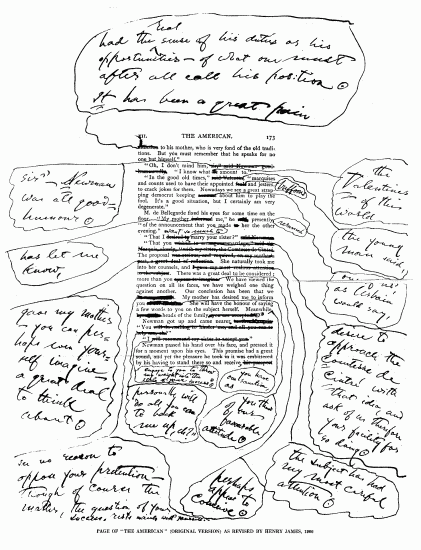
PAGE OF "THE AMERICAN" (ORIGINAL VERSION) AS REVISED BY HENRY JAMES, 1906
To William James, junior.
Grand Hotel, Pau. March 26, 1907.
Dearest Bill,
This is just a word to tell you that your poor old far-flying Uncle is safe and sound and greatly enjoying [himself], so far, after étapes consisting of Bois, Poictiers, and Bordeaux, with wonderful minor stops, déjeuners and other impressions in between. We got here last night—into the balmiest, tepidest, dustiest south, and stay three days or so, for excursions, going probably after today's luncheon to Lourdes and back. This large, smooth old France is wonderful (wisely seen, as we are seeing it,) and I know it already much more infinitely well. The motor is a magical marvel—discreetly and honourably used, as we are using it—and my hosts are full of amenity, sympathy, appreciation, etc. (as well as of wondrous other servanted and avant-courier'd arts of travel,) so that we are an excellent combination and most happy family—including our most admirable American chauffeur from Lee, Mass., whose native Yankee saneness and intelligence (projected into these unprecedented conditions) makes me as proud of him as he is of his Panhard car. On Thursday or Friday (at furthest) we turn "her" head to Paris—but of course with other stops and impressions—though none, I think, of more than one night. Don't dream of troubling to write—I will write again as we draw nearer. I hope these efflorescent days (if you have them) don't turn your stomach too much against the thick taste of the Julian broth. I already long to see you again.
Ever your affectionate HENRY JAMES.
To Howard Sturgis.
The plan of approaching Italy through South Germany and Austria was not carried out. He presently went straight from Paris to Rome.
58 Rue de Varenne, Paris. April 13th, 1907.
Dearest Howard,
I find your beautiful tragic wail on my return from a wondrous, miraculous motor tour of three weeks and a day with these admirable friends of ours, who so serve one up all the luxuries of the season and all the ripe fruits of time that one's overloaded plate will hold. We got back from—from everywhere, literally—last night; and in presence of a table groaning under arrears and calendars and other stationery I can but, as it were, fold you in my arms. You talk of sad and fearful things ... and I don't know what to say to you (at least in this poor inky, scratchy way.) What I should like to be able to say is that I will come down to Rome and see you even now; but this alas is not in my power without my altering all sorts of other pressing arrangements and combinations already made. I do hope to go to Rome for a little—a very little—stay later; but not before the middle or 20th of May; a time—a generally emptier, quieter time—I greatly prefer there to any other. It is of extreme importance to me to be (to remain) in Paris till May 1st—I haven't been here for years and shall probably never once again be here (or "come abroad" once again, like you) for the rest of my natural life. Ergo I am taking what there is of it for me—I can't afford, as it were, not to. And I have made my plans (if they hold) for approaching Italy by South Germany, Vienna, Trieste, Venice &c.—all of which will bring me to Rome by the 20th of May about, when, I fear, you will well nigh—or certainly—have cleared out altogether. From Rome and Florence ... I shall return straight home—where at least, then, I must infallibly see you. Or shall you pass through this place—homeward—before May 1st? The gentlest of lionesses bids me tell you what a tenderest welcome you would have from them. Hold up your heart, meanwhile, and remember, for God's sake, that there is a point beyond which the follies and infirmities of our friends and our proches have no right to ravage and wreck our own independence of soul. That quantity is too precious a contribution to the saving human sum of good, of lucidity, and we are responsible for the entretien of it. So keep yours, shake yours, up—well up—my dearest friend, and to this end believe in your admirable human use. To be "crushed" is to be of no use; and I for one insist that you shall be of some, and the most delightful, to me. Feel everything, tant que vous voudrez—but then soar superior and don't leave tatters of your precious person on every bush that happens to bristle with all the avidities and egotisms. We shall judge it all sanely and taste it all wisely and talk of it all (even) thrillingly—and profitably—yet; and I depend on your keeping that appointment with me. This is all, dearest Howard, now. I almost blush to break through your obsessions to the point of saying that my three weeks of really seeing this large incomparable France in our friend's chariot of fire has been almost the time of my life. It's the old travelling-carriage way glorified and raised to the 100th power. Will you very kindly say to Maud Story for me, with my love, that I am coming to Rome very nearly all to see her. I bless your companions and am your tout dévoué
HENRY JAMES.
To Howard Sturgis.
From Rome H. J. went to Cernitoio, Mr. Edward Boit's villa near Vallombrosa.
Hôtel de Russie, Rome. May 29th, 1907.
Dearest Howard,
I've been disgustingly silent in spite of your so good prompt, blessed letter—but the waters of Rome have been closing over my head, for I have, each day, a good part of each, something urgent and imperative to do, "for myself," as it were—and everything the hours and the "people" bring forth has to be crowded into too scant a margin; with a consequent sensation of breathlessness that ill consorts alike with my figure, my years and my inclinations. I am "sitting for my bust," into the bargain—to Hendrik Andersen (it will be, I think, better than some other such work of his,) and that makes practically a great hole of two hours and a half in the day—without which, in truth (the promise to hold out to the end of the ordeal,) I should already have broken away from this now very highly-developed heat and dust and glare. My days "abroad" are violently shrinking—I am long since due at home; and my yearning for a damp grey temperate clime hourly develops. However, I didn't mean to pour forth this plaintive flood—but rather to take a fine healthy jolly tone over the fact of your own so happily achieved (I trust) liberation from the Roman yoke and your probable inhalation at this moment of the fresh air of the summits and of the tonic influence of admirable friends. Need I say that I number poor dear deafened Rhoda's Florentine contact as among the stimulating?—since it surely must take more than deafness, must take utter and cataclysmal dumbness—and I'm not sure even that would get the better of her practical acuity—to make her fall from the tonic. But I'm very sorry—I mean for her I trust temporary trouble—and if I but knew where she is—which you don't mention—and when departing, or how long staying, would reach her if I might. I cherish the thought of getting off Tuesday at very latest—if I return intact from a long motor-day that awaits me at the hands of the Filippo Filippis on Saturday—as I believe. I drove with Mrs. Mason out yesterday afternoon to the Abbotts' villa—that is a very charming late afternoon tea-garden, and they told me you are soon to have them at Cernitoio. Expansive (not to say expensive) and illimitable you! All this time I don't tell you—tell Mildred Seymour—a tenth of the comfort I am deriving amid continued tension from the sense that her (and your bow is for the time unstrung and hung up for the Vallombrosa pines to let the mountain-breeze loosely play with it.... I expect to be here till Tuesday a.m.—but I see I've said so. You shall then, and so shall Edward Boit (to whom and his girls I send tanti saluti, as well as to brave and beneficent Mr. William) have further news of yours, my dear Howard, ever affectionately,
HENRY JAMES.
To Madame Wagnière.
The name of this correspondent recalls a meeting at Florence, described in an early letter (vol. i, p. 28). Madame Wagnière (born Huntington) was now living in Switzerland.
Palazzo Barbaro, Venice. June 23rd, 1907.
Dear Laura Wagnière,
I have waited since getting your good note to have the right moment and right light for casting the right sort of longing lingering look on the little house with the "Giardinetto" on the Canal Grande, to the right of Guggenheim as you face Guggenheim. I hung about it yesterday afternoon in the gondola with Mrs. Curtis, and we both thought it very charming and desirable, only that she has (perhaps a little vaguely) heard it spoken of as "damp" which I confess it looks to me just a trifle. However, this may be the vainest of calumnies. It does look expensive and also a trifle contracted, and is at present clearly occupied and with no outward trace of being to let about it at all. For myself, in this paradise of great household spaces (I mean Venice generally), I kind of feel that even the bribe of the Canal Grande and a giardinetto together wouldn't quite reconcile me to the purgatory of a very small, really (and not merely relatively) small house.... Mrs. Curtis is eloquent on the sacrifices one must make (to a high rent here) if one must have, for "smartness," the "Canal Grande" at any price. She makes me feel afresh what I've always felt, that what I should probably do with my own available ninepence would be to put up with some large marble halls in some comparatively modest or remote locality, especially della parte di fondamenta nuova, etc.; that is, so I got there air and breeze and light and pulizia and a dozen other conveniences! In fine, the place you covet is no doubt a dear little "fancy" place; but as to the question of "coming to Venice" if one can, I have but a single passionate emotion, a thousand times Yes! It would be for me, I feel, in certain circumstances (were I free, with a hundred other facts of my life different,) the solution of all my questions, and the consolation of my declining years. Never has the whole place seemed to me sweeter, dearer, diviner. It leaves everything else out in the cold. I wish I could dream of coming to me mettre dans mes meubles (except that my meubles would look so awful here!) beside you. I presume to enter into it with a yearning sympathy. Happy you to be able even to discuss it....
This place and this large cool upper floor of the Barbaro, with all the space practically to myself, and draughts and scirocco airs playing over me indecently undressed, is more than ever delicious and unique.... The breath of the lagoon still plays up, but I mingle too much of another fluid with my ink, and I have no more clothes to take off.... I greet affectionately, yes affectionately, kind Henry, and the exquisite gold-haired maiden, and I am, dear Laura Wagnière, your very faithful old friend,
HENRY JAMES.
To Mrs. Wharton.
The Vicomte Robert d'Humières, poet and essayist, fell in action in France, April 26, 1915.
Lamb House, Rye. August 11th, 1907.
My dear Edith and my dear Edward,
The d'Humières have just been lunching with me, and that has so reknotted the silver cord that stretched so tense from the first days of last March to the first of those of May—wasn't it?—that I feel it a folly in addition to a shame not yet to have written to you (as I have been daily and hourly yearning to do) ever since my return from Italy about a month ago. You flung me the handkerchief, Edith, just at that time—literally cast it at my feet: it met me, exactly, bounding—rebounding—from my hall-table as I recrossed my threshold after my long absence; which fact makes this tardy response, I am well aware, all the more graceless. And then came the charming little picture-card of the poor Lamb House hack grinding out his patient prose under your light lash and dear Walter B.'s—which should have accelerated my production to the point of its breaking in waves at your feet: and yet it's only to-night that my overburdened spirit—pushing its way, ever since my return, through the accumulations and arrears, in every sort, of absence—puts pen to paper for your especial benefit—if benefit it be. The charming d'Humières both, as I say, touring—training—in England, through horrid wind and weather, with a bonne grace and a wit and a Parisianism worthy of a better cause, amiably lunched with me a couple of days since on their way from town to Folkestone, and so back to Plassac (don't you like "Plassac," down in our dear old Gascony?) the seat of M. de Dampierre—to whom, à ce qu'il paraît, that day at luncheon we were all exquisitely sympathetic! Well, it threw back the bridge across the gulfs and the months, even to the very spot where the great nobly-clanging glass door used to open to the arrested, the engulfing and disgorging car—for we sat in my little garden here and talked about you galore and kind of made plans (wild vain dreams, though I didn't let them see it!) for our all somehow being together again.... But oh, I should like to remount the stream of time much further back than their passage here—if it weren't (as it somehow always is when I get at urgent letters) ever so much past midnight. It was only with my final return hither that my deep draught of riotous living came to an end, and as the cup had originally been held to my lips all by your hands I somehow felt in presence of your interest and sympathy up to the very last, and as if you absolutely should have been avertie from day to day—I did the matter that justice at least. Too much of the story has by this time dropped out; but there are bits I wish I could save for you.... But I must break off—it's 1.15 a.m.!
Aug. 12th. I wrote you last from Rome, I think—didn't I? but it was after that that I heard of your having had at the last awful delays and complications, awful strike-botherations, over your sailing. I knew nothing of them at the time.... I can only hope that the horrid memory of it has been brushed and blown away for you by the wind of your American kilometres. I remained in Rome—for myself—a goodish while after last writing you, and there were charming moments, faint reverberations of the old-time refrains—with a happy tendency of the superfluous, the incongruous crew to take its departure as the summer came on; yet I feel that I shouldn't care if I never saw the perverted place again, were it not for the memory of four or five adorable occasions—charming chances—enjoyed by the bounty of the Filippis.... My point is that they carried me in their wondrous car (he drove it himself all the way from Paris via Macerata, and with four or five more picked-up inmates!) first to two or three adorable Roman excursions—to Fiumicino, e.g., where we crossed the Tiber on a medieval raft and then had tea—out of a Piccadilly tea-basket—on the cool sea-sand, and for a divine day to Subiaco, the unutterable, where I had never been; and then, second down to Naples (where we spent two days) and back; going by the mountains (the valleys really) and Monte Cassino, and returning by the sea—i.e. by Gaeta, Terracina, the Pontine Marshes and the Castelli—quite an ineffable experience. This brought home to me with an intimacy and a penetration unprecedented how incomparably the old coquine of an Italy is the most beautiful country in the world—of a beauty (and an interest and complexity of beauty) so far beyond any other that none other is worth talking about. The day we came down from Posilipo in the early June morning (getting out of Naples and round about by that end—the road from Capua on, coming, is archi-damnable) is a memory of splendour and style and heroic elegance I never shall lose—and never shall renew! No—you will come in for it and Cook will picture it up, bless him, repeatedly—but I have drunk and turned the glass upside down—or rather I have placed it under my heel and smashed it—and the Gipsy life with it!—for ever. (Apropos of smashes, two or three days after we had crossed the level crossing of Caianello, near Caserta, seven Neapolitan "smarts" were all killed dead—and this by no coming of the train, but simply by furious reckless driving and a deviation, a slip, that dashed them against a rock and made an instant end. The Italian driving is crapulous, and the roads mostly not good enough.) But I mustn't expatiate. I wish I were younger. But for that matter the "State Line" would do me well enough this evening—for it's again the stroke of midnight. If it weren't I would tell you more. Yes, I wish I were to be seated with you to-morrow—catching the breeze-borne "burr" from under Cook's fine nose! How is Gross, dear woman, and how are Mitou and Nicette—whom I missed so at Monte Cassino? I spent four days—out from Florence—at Ned Boit's wondrous—really quite divine "eyrie" of Cernitoio, over against Vallombrosa, a dream of Tuscan loveliness and a really admirable séjour.... I spent at the last two divine weeks in Venice—at the Barbaro. I don't care, frankly, if I never see the vulgarized Rome or Florence again, but Venice never seemed to me more loveable—though the vaporetto rages. They keep their cars at Mestre! and I am devotedly yours both,
HENRY JAMES.
To Miss Gwenllian Palgrave.
Lamb House, Rye. Aug. 27, 1907.
My dear Gwenllian Palgrave,
It is quite horrid for me to have to tell you (and after a little delay caused by a glut of correspondence, at once, and a pressure of other occupations) that your gentle appeal, on your friend's behalf, in the matter of the "favourite quotation," finds me utterly helpless and embarrassed. The perverse collectress proposes, I fear, to collect the impossible! I haven't a favourite quotation—absolutely not: any more than I have a favourite day in the year, a favourite letter in the alphabet or a favourite wave in the sea! And the collectress, in general, has ever found me dark and dumb and odious, and I am too aged and obstinate and brutal to change! Such is the sorry tale I have to ask you all patiently to hear. I wish you were, or had been, coming over to see me from Canterbury—instead of labouring in that barren vineyard of other friendship. Do come without fail the next time you are there; and believe me your—and your sister's—very faithful even if very flowerless and leafless well-wisher from long ago,
HENRY JAMES.
To William James.
Lamb House, Rye. October 17th, 1907.
Dearest William,
...I seem to have followed your summer rather well and intimately and rejoicingly, thanks to Bill's impartings up to the time he left me, and to the beautiful direct and copious news aforesaid from yourself and from Alice, and I make out that I may deem things well with you when I see you so mobile and mobilizable (so emancipated and unchained for being so,) as well as so fecund and so still overflowing. Your annual go at Keene Valley (which I'm never to have so much as beheld) and the nature of your references to it—as this one to-night—fill me with pangs and yearnings—I mean the bitterness, almost, of envy: there is so little of the Keene Valley side of things in my life. But I went up to Scotland a month ago, for five days at John Cadwalader's (of N.Y.) vast "shooting" in Forfarshire (let to him out of Lord Dalhousie's real principality,) and there, in absolutely exquisite weather, had a brief but deep draught of the glory of moor and mountain, as that air, and ten-mile trudges through the heather and by the brae-side (to lunch with the shooters) delightfully give it. It was an exquisite experience. But those things are over, and I am "settled in" here, D.V., for a good quiet time of urgent work (during the season here that on the whole I love best, for it makes for concentration—and il n'y a que ça—for me!) which will float me, I trust, till the end of February; when I shall simply go up to London till the mid-May. No more "abroad" for me within any calculable time, heaven grant! Why the devil I didn't write to you after reading your Pragmatism—how I kept from it—I can't now explain save by the very fact of the spell itself (of interest and enthralment) that the book cast upon me; I simply sank down, under it, into such depths of submission and assimilation that any reaction, very nearly, even that of acknowledgment, would have had almost the taint of dissent or escape. Then I was lost in the wonder of the extent to which all my life I have (like M. Jourdain) unconsciously pragmatised. You are immensely and universally right, and I have been absorbing a number more of your followings-up of the matter in the American (Journal of Psychology?) which your devouring devotee Manton Marble ... plied, and always on invitation does ply, me with. I feel the reading of the book, at all events to have been really the event of my summer. In which connection (that of "books"), I am infinitely touched by your speaking of having read parts of my American Scene (of which I hope Bill has safely delivered you the copy of the English edition) to Mrs. Bryce—paying them the tribute of that test of their value. Indeed the tribute of your calling the whole thing "köstlich stuff" and saying it will remain to be read so and really gauged, gives me more pleasure than I can say, and quickens my regret and pain at the way the fates have been all against (all finally and definitely now) my having been able to carry out my plan and do a second instalment, embodying more and complementary impressions. Of course I had a plan—and the second vol. would have attacked the subject (and my general mass of impression) at various other angles, thrown off various other pictures, in short contributed much more. But the thing was not to be....
But I am writing on far into the dead unhappy night, while the rain is on the roof—and the wind in the chimneys. Oh your windless (gateless) Cambridge! Choyez-le! Tell Alice that all this is "for her too," but she shall also soon hear further from yours and hers all and always,
HENRY.
To W. E. Norris.
Lamb House, Rye. December 23rd, 1907.
My dear Norris,
I want you to find this, as by ancient and inviolate custom, or at least intention, on your table on Christmas a.m.; but am convinced that, whenever I post it, it will reach you either before or after, and not with true dramatic effect. It will take you in any case, however, the assurance of my affectionate fidelity—little as anything else for the past year, or I fear a longer time, may have contributed to your perception of that remembrance. The years and the months go, and somehow make our meetings ingeniously rarer and our intervals and silences more monstrous. It is the effect, alas, of our being as it were antipodal Provincials—for even if one of us were a Capitalist the problem (of occasional common days in London) would be by so much simplified. I am in London less, on the whole (than during my first years in this place;) and as you appear now to be there never, I flap my wings and crane my neck in the void. Last spring, I confess, I committed an act of comprehensive disloyalty; I went abroad at the winter's end and remained till the first days of July (the first half of the time in Paris, roughly speaking—and on a long and very interesting, extraordinarily interesting, motor-tour in France; the second in Rome and Venice, as to take leave of them forever.) This took London almost utterly out of my year, and I think I heard from Gosse, who happily for him misses you so much less than I do, (I mean enjoys you so much more—but no, that isn't right either!) that you had in May or June shone in the eye of London. I am not this year, however, I thank my stars, to repeat the weird exploit of a "long continental absence"—such things have quite ceased to be in my real mœurs—and I shall therefore plan a campaign in town (for May and June) that will have for its leading feature to encounter you somewhere and somehow. Till then—that is to a later date than usual—I expect to bide quietly here, where a continuity of occupation—strange to say—causes the days and the months to melt in my grasp, and where, in spite of rather an appalling invasion of outsiders and idlers (a spreading colony and a looming menace,) the conditions of life declare themselves as emphatically my rustic "fit" as I ten years ago made them out to be. I have lived into my little house and garden so thoroughly that they have become a kind of domiciliary skin, that can't be peeled off without pain—and in fact to go away at all is to have, rather, the sense of being flayed. Nevertheless I was glad, last spring, to have been tricked, rather, into a violent change of manners and practices—violent partly because my ten weeks in Paris were, for me, on a basis most unprecedented: I paid a visit of that monstrous length to friends (I had never done so in my life before,) and in a beautiful old house in the heart of the Rive Gauche, amid old private hotels and hidden gardens (Rue de Varenne), tasted socially and associatively, so to speak, of a new Paris altogether and got a bellyful of fresh and nutritive impressions. Yet I have just declined a repetition of it inexorably, and it's more and more vivid to me that I have as much as I can tackle to lead my own life—I can't ever again attempt, for more than the fleeting hour, to lead other people's. (I have indeed, I should add, suffered infiltration of the poison of the motor—contemplatively and touringly used: that, truly, is a huge extension of life, of experience and consciousness. But I thank my stars that I'm too poor to have one.) I'm afraid I've no other adventure to regale you with. I am engaged, none the less, in a perpetual adventure, the most thrilling and in every way the greatest of my life, and which consists of having more than four years entered into a state of health so altogether better than I had ever known that my whole consciousness is transformed by the intense alleviation of it, and I lose much time in pinching myself to see if this be not, really, "none of I." That fact, however, is much more interesting to myself than to other people—partly because no one but myself was ever aware of the unhappy nature of the physical consciousness from which I have been redeemed. It may give a glimmering sense of the degree of the redemption, however, that I should, in the first place, be willing to fly in the face of the jealous gods by so blatant a proclamation of it, and in the second, find the value of it still outweigh the formidable, the heaped-up and pressed together burden of my years.
But enough of my own otherwise meagre annals.... I must catch my post. I haven't sounded you for the least news of your own—it being needless to tell you that I hold out my cap for it even as an organ-grinder who makes eyes for pence to a gentleman on a balcony: especially when the balcony overhangs your luxuriant happy valley and your turquoise sea. I go on taking immense comfort in the "Second Home," as I beg your pardon for calling it, that your sister and her husband must make for you, and am almost as presumptuously pleased with it as if I had invented it. I am myself literally eating a baked apple and a biscuit on Xmas evening all alone: I have no one in the house, I never dine out here under any colour (there are to be found people who do!) and I have been deaf to the syren voice of Paris, and to other gregarious pressure. But I wish you a brave feast and a blameless year and am yours, my dear Norris, all faithfully and fondly,
HENRY JAMES.
To W. E. Norris.
H.J. had inadvertently addressed the preceding letter to 'E. W. Norris Esq.'
Lamb House, Rye. December 26: 1907.
My dear Norris,
It came over me in the oddest way, weirdly and dimly, as I lay soaking in my hot bath an hour ago, that my jaded and inadvertent hand (I have written so many letters in so few days, and you see the effect on everyone doubtless but your own impeccably fingered self) superscribed my Xmas envelope with the monstrous collocation "E.W."! The effect has been probably to make you think the letter a circular and chuck it into the fire—or, if you have opened it, to convince you that my handsome picture of my "health" is true—if true at all—of my digestion and other vulgar parts, at the expense of my brain. Clearly you must believe me in distinct cerebral decline. Yet I'm not, I am only—or was—in a state of purely and momentarily manual muddle. But the curious and interesting thing is: Why, suddenly, as I lay this cold morning agreeably steaming, did the vision of the hind-part-before order come straight at me out of the vapours, after three or four days, when I didn't know I was thinking of you?
Well, it only shows how much you are, my dear Norris, in the thoughts of yours remorsefully,
HENRY JAMES.
P.S. I hope, now, I did do it after all!
To Dr. and Mrs. J. William White.
H.J. had enjoyed the hospitality of these friends at Philadelphia, during his last visit to America.
Dictated.
Lamb House, Rye. Jan. 1, 1908.
Dear William and Letitia!
It would be monstrous of me to say that what I most valued in William's last brave letter was Letitia's gentle "drag" upon it; and I hasten to insist that when I dwell on the pleasure so produced by Letitia's presence in it (to the extent of her gently "dragging") I feel that she at least will know perfectly what I mean! Explain this to William, my dear Letitia: I leave all the burden to you—so used as you are to burdens! It was delightful, I can honestly say, to hear from you no long time since—and whether by controlled or uncontrolled inspiration; and I tick a small space clear this morning—clear in an air fairly black with the correspondence "of the season"—just to focus you fondly in it and make, for the friendly sound of my Remington, a penetrable medium and a straight course. I am shut up, as mostly, you see, in the little stronghold your assault of which has never lost you honour, at least—I mean the honour of the brave besieger—however little else it may have brought you; and I waggle this small white flag at you, from my safe distance, over the battlements, as for a cheerful truce or amicable New Year's parley. I think I must figure to you a good deal as a "banked-in" Esquimau with his head alone extruding through the sole orifice of his hut, or perhaps as a Digger Indian, bursting through his mound, by the same perforation, even as a chicken through its shell: by reason of the abject immobility practised by me while you and Letitia hurl yourselves from one ecstasy of movement, one form of exercise, one style of saddled or harnessed or milked or prodded or perhaps merely "fattened," quadruped, to another. Your letter—this last—is a noble picture of a free quadrupedal life—which gives me the sense, all delightful, of seeing you both alone erect and nimble and graceful in the midst of the browsing herd of your subjects. Well, it all sounds delightfully pastoral to one whose "stable" consists but of the go-cart in which the gardener brings up the luggage of those of my visitors (from the station) who advance successfully to the stage of that question of transport; and my outhouses of the shed under which my solitary henchman (but sufficient to a drawbridge that plays so easily up!) "attends to the boots" of those confronted with the inevitable subsequent phase of early matutinal departure! All of which means, dear both of you, that I do seem to read into your rich record the happiest evidences of health as well as of wealth. You take my breath away—as, for that matter, you can but too easily figure with your ever-natural image of me gaping through a crevice of my door!—the only other at all equal loss of it proceeding but from my mild daily revolution up and down our little local eminence here. No, you won't believe it—that these have been my only revolutions since I last risked, at a loophole, seeing you thunder past. I shall risk it again when you thunder back—and really, though it spoils the consistency of my builded metaphor, watch fondly for the charming flash that will precede, and prepare! I haven't been even as far as to see the good Abbeys at Fairford—was capable of not even sparing that encouragement when she kindly wrote to me for a visit toward the autumn's end. I haven't so much as pilgrimised to the other shrine in Tite St.—and, having so little to tell you, really mustn't prolong this record of my vacancy. I am quite spending the winter here—"bracing" for what the spring and summer may bring. But I do get, as the very breath of the Spice-islands, the balmy sidewind of your general luxuriance, and it makes me glad and grateful for you, and keeps me just as much as ever your faithful, vigilant, steady, sturdy friend,
HENRY JAMES.
To Mrs. Wharton.
The work just finished was the revision of The High Bid, shortly to be produced by Mr. and Mrs. Forbes Robertson.
Lamb House, Rye. January 2nd, 1908.
My dear Edith,
G. T. Lapsley has gone to bed—he has been seeing the New Year in with me (generously giving a couple of days to it)—and I snatch this hour from out the blizzard of Xmas and Year's End and New Year's Beginning missives, to tell you too belatedly how touched I have been with your charming little Xmas memento—an exquisite and interesting piece for which I have found a very effective position on the little old oak-wainscotted wall of my very own room. There it will hang as a fond reminder of tout ce que je vous dois. (I am trying to make use of an accursed "fountain" pen—but it's a vain struggle; it beats me, and I recur to this familiar and well-worn old unimproved utensil.) I have passed here a very solitary and casanier Christmastide (of wondrous still and frosty days, and nights of huge silver stars,) and yesterday finished a job of the last urgency for which this intense concentration had been all vitally indispensable. I got the conditions, here at home thus, in perfection—I put my job through, and now—or in time—it may have, on my scant fortunes, a far-reaching effect. If it does have, you'll be the first all generously to congratulate me, and to understand why, under the stress of it, I couldn't indeed break my little started spell of application by a frolic absence from my field of action. If it, on the contrary, fails of that influence I offer my breast to the acutest of your silver arrows; though the beautiful charity with which you have drawn from your critical quiver nothing more fatally-feathered than that dear little framed and glazed, squared and gilded étrenne serves for me as a kind of omen of my going unscathed to the end.... I admit that it's horrible that we can't—nous autres—talk more face to face of the other phenomena; but life is terrible, tragic, perverse and abysmal—besides, patientons. I can't pretend to speak of the phenomena that are now renewing themselves round you; for there is the eternal penalty of my having shared your cup last year—that I must taste the liquor or go without—there can be no question of my otherwise handling the cup. Ah I'm conscious enough, I assure you, of going without, and of all the rich arrears that will never—for me—be made up—! But I hope for yourselves a thoroughly good and full experience—about the possibilities of which, as I see them, there is, alas, all too much to say. Let me therefore but wonder and wish!... But it's long past midnight, and I am yours and Teddy's ever so affectionate
HENRY JAMES.
To Gaillard T. Lapsley.
Reform Club, Pall Mall, S.W. March 17th, 1908.
My dear, dear Gaillard!
I can't tell you with what tender sympathy your rather disconcerting little news inspires me nor how my heart goes out to you. Alack, alack, how we do have to pay for things—and for our virtues and grandeurs and beauties (even as you are now doing, overworked hero and model of distinguished valour,) as well as for our follies and mistakes. However, you have on your record exactly that mistake of too generous a sacrifice. Fortunately you have been pulled up before you have quite chucked away your all. It must be deuced dreary—yet if you ask me whether I think of you more willingly and endurably thus, or as your image of pale overstrain haunted me after you had left me at the New Year, I shall have no difficulty in replying. In fact, dearest Gaillard, and at the risk of aggravating you, I like to keep you a little before me in the passive, the recumbent, the luxurious and ministered-to posture, and my imagination rings all the possible changes on the forms of your noble surrender. Lie as flat as you can, and live and think and feel and talk (and keep silent!) as idly—and you will thereby be laying up the most precious treasure. It's a heaven-appointed interlude, and cela ne tient qu'à vous (I mean to the wave of your white hand) to let it become a thing of beauty like the masque of Comus. Cultivate, horizontally the waving of that hand—and you will brush away, for the time, all responsibilities and superstitions, and the peace of the Lord will descend upon you, and you will become as one of the most promising little good boys that ever was. Après quoi the whole process and experience will grow interesting, amusing, tissue-making (history-making,) to you, and you will, after you get well, feel it to have been the time of your life which you'd have been most sorry to miss. Some five years ago—or more—a very interesting young friend of mine, Paul Harvey (then in the War Office as Private Sec. to Lord Lansdowne), was taken exactly as you are, and stopped off just as you are and consigned exactly to your place, I think—or rather no, to a pseudo-Nordrach in the Mendips. I remember how I sat on just such a morning as this at this very table and in this very seat and wrote him on this very paper in the very sense in which I am no less confidently writing to you—urging him to let himself utterly go and cultivate the day-to-day and the hand-to-mouth and the questions-be-damned, even as an exquisite fine art. Well, it absolutely and directly and beautifully worked: he recula—to the very limit—pour mieux sauter, and has since sauté'd so well that his career has caught him up again.... Your case will have gone practically quite on all fours with this. I am drenching you with my fond eloquence—but what will you have when you have touched me so by writing me so charmingly out of your quiet—though ever so shining, I feel—little chamber in the great Temple of Simplification? I shall return to the charge—if it be allowed me—and perhaps some small sign from you I shall have after a while again. I came up from L.H. yesterday only—and shall be in town after this a good deal, D.V., through the rest of this month and April and May. At some stage of your mouvement ascensionnel I shall see you—for I hope they won't be sending you up quite to Alpine Heights. Take it from me, dear, dear G., that your cure will have a social iridescence, for your acute and ironic and genial observation, of the most beguiling kind. But you don't need to "take" that or any other wisdom that your beautiful intelligence now plays with from any other source but that intelligence; therefore be beholden to me almost only for the fresh reassurance that I am more affectionately than ever yours,
HENRY JAMES.
To Mrs. Wharton.
The first performance of The High Bid took place in Edinburgh three days after the date of the following.
Roxburghe Hotel, Edinburgh. March 23rd, 1908.
My dear Edith!
This is just a tremulous little line to say to you that the daily services of intercession and propitiation (to the infernal gods, those of jealousy and guignon) that I feel sure you have instituted for me will continue to be deeply appreciated. They have already borne fruit in the shape of a desperate (comparative) calm—in my racked breast—after much agitation—and even to-day (Sunday) of a feverish gaiety during the journey from Manchester, to this place, achieved an hour ago by special train for my whole troupe and its impedimenta—I travelling with the animals like the lion-tamer or the serpent-charmer in person and quite enjoying the caravan-quality, the bariolé Bohemian or picaresque note of the affair. Here we are for the last desperate throes—but the omens are good, the little play pretty and pleasing and amusing and orthodox and mercenary and safe (absit omen!)—cravenly, ignobly canny: also clearly to be very decently acted indeed: little Gertrude Elliott, on whom it so infinitely hangs, showing above all a gallantry, capacity and vaillance, on which I had not ventured to build. She is a scrap (personally, physically) where she should be a presence, and handicapped by a face too small in size to be a field for the play of expression; but allowing for this she illustrates the fact that intelligence and instinct are capables de tout—so that I still hope. And each time they worry through the little "piggery" it seems to me more firm and more intrinsically without holes and weak spots—in itself I mean; and not other in short, than "consummately" artful. I even quite awfully wish you and Teddy were to be here—even so far as that do I go! But wire me a word—here—on Thursday a.m.—and I shall be almost as much heartened up. I will send you as plain and unvarnished a one after the event as the case will lend itself to. Even an Edinburgh public isn't (I mean as we go here all by the London) determinant, of course—however, à la guerre comme à la guerre, and don't intermit the burnt-offerings. More, more, very soon—and you too will have news for yours and Edward's right recklessly even though ruefully,
HENRY JAMES.
To Henry James, junior.
105 Pall Mall, S.W. April 3rd, 1908.
Dearest Harry,
...The Nightmare of the Edition (of my Works!) is the real mot de l'Enigme of all my long gaps and delinquencies these many months past—my terror of not keeping sufficiently ahead in doing my part of it (all the revising, rewriting, retouching, Preface-making and proof-correcting) has so paralysed me—as a panic fear—that I have let other decencies go to the wall. The printers and publishers tread on my heels, and I feel their hot breath behind me—whereby I keep at it in order not to be overtaken. Fortunately I have kept at it so that I am almost out of the wood, and the next very few weeks or so will completely lay the spectre. The case has been complicated badly, moreover, the last month—and even before—by my having, of all things in the world, let myself be drawn into a theatrical adventure—which fortunately appears to have turned out as well as I could have possibly expected or desired. Forbes Robertson and his wife produced on the 26th last in Edinburgh—being on "tour," and the provincial production to begin with, as more experimental, having good reason in its favour—a three-act comedy of mine ("The High Bid")—which is just only the little one-act play presented as a "tale" at the end of the volume of the "Two Magics"; the one-act play proving really a perfect three-act one, dividing itself (by two short entractes, without fiddles) perfectly at the right little places as climaxes—with the artful beauty of unity of time and place preserved, etc.... It had a great and charming success before a big house at Edinburgh—a real and unmistakable victory—but what was most brought home thereby is that it should have been discharged straight in the face of London. That will be its real and best function. This I am hoping for during May and June. It has still to be done at Newcastle, Liverpool, etc. (was done this past week three times at Glasgow. Of course on tour three times in a week is the most they can give a play in a minor city.) But my great point is that preparations, rehearsals, lavishments of anxious time over it (after completely re-writing it and improving it to begin with) have represented a sacrifice of days and weeks to them that have direfully devoured my scant margin—thus making my intense nervousness (about them) doubly nervous. I left home on the 17th last and rehearsed hard (every blessed day) at Manchester, and at Edinburgh till the production—having already, three weeks before that in London, given up a whole week to the same. I came back to town a week ago to-night (saw a second night in Edinburgh, which confirmed the impression of the first,) and return to L.H. to-morrow, after a very decent huitaine de jours here during which I have had quiet mornings, and even evenings, of work. I go to Paris about the 20th to stay 10 days, at the most, with Mrs Wharton, and shall be back by May 1st. I yearn to know positively that your Dad and Mother arrive definitely on the Oxford job then. I have had to be horribly inhuman to them in respect to the fond or repeated expression of that yearning—but they will more than understand why, "druv" as I've been, and also understand how the prospect of having them with me, and being with them, for a while, has been all these last months as the immediate jewel of my spur. Read them this letter and let it convey to them, all tenderly, that I live in the hope of their operative advent, and shall bleed half to death if there be any hitch.
...But I embrace you all in spirit and am ever your fond old Uncle,
HENRY JAMES.
To W. D. Howells.
The "lucubrations" are of course the prefaces written for the collected edition. The number of volumes was eventually raised to twenty-four, but The Bostonians was not included. The "one thing" referred to, towards the end of this letter, as likely to involve another visit to America would seem to be the possible production there of one of his plays; while the further reason for wishing to return was doubtless connected with his project of writing a novel of which the scene was to be laid in America—the novel that finally became The Ivory Tower.
Dictated.
Lamb House, Rye. 17th August, 1908.
My dear Howells,
A great pleasure to me is your good and generous letter just received—with its luxurious implied licence for me of seeking this aid to prompt response; at a time when a pressure of complications (this is the complicated time of the year even in my small green garden) defeats too much and too often the genial impulse. But so far as compunction started and guided your pen, I really rub my eyes for vision of where it may—save as most misguidedly—have come in. You were so far from having distilled any indigestible drop for me on that pleasant ultimissimo Sunday, that I parted from you with a taste, in my mouth, absolutely saccharine—sated with sweetness, or with sweet reasonableness, so to speak; and aching, or wincing, in no single fibre. Extravagant and licentious, almost, your delicacy of fear of the contrary; so much so, in fact, that I didn't remember we had even spoken of the heavy lucubrations in question, or that you had had any time or opportunity, since their "inception," to look at one. However your fond mistake is all to the good, since it has brought me your charming letter and so appreciative remarks you therein make. My actual attitude about the Lucubrations is almost only, and quite inevitably, that they make, to me, for weariness; by reason of their number and extent—I've now but a couple more to write. This staleness of sensibility, in connection with them, blocks out for the hour every aspect but that of their being all done, and of their perhaps helping the Edition to sell two or three copies more! They will have represented much labour to this latter end—though in that they will have differed indeed from no other of their fellow-manifestations (in general) whatever; and the resemblance will be even increased if the two or three copies don't, in the form of an extra figure or two, mingle with my withered laurels. They are, in general, a sort of plea for Criticism, for Discrimination, for Appreciation on other than infantile lines—as against the so almost universal Anglo-Saxon absence of these things; which tends so, in our general trade, it seems to me, to break the heart. However, I am afraid I'm too sick of the mere doing of them, and of the general strain of the effort to avoid the deadly danger of repetition, to say much to the purpose about them. They ought, collected together, none the less, to form a sort of comprehensive manual or vade-mecum for aspirants in our arduous profession. Still, it will be long before I shall want to collect them together for that purpose and furnish them with a final Preface. I've done with prefaces for ever. As for the Edition itself, it has racked me a little that I've had to leave out so many things that would have helped to make for rather a more vivid completeness. I don't at all regret the things, pretty numerous, that I've omitted from deep-seated preference and design; but I do a little those that are crowded out by want of space and by the rigour of the 23 vols., and 23 only, which were the condition of my being able to arrange the matter with the Scribners at all. Twenty-three do seem a fairly blatant array—and yet I rather surmise that there may have to be a couple of supplementary volumes for certain too marked omissions; such being, on the whole, detrimental to an all professedly comprehensive presentation of one's stuff. Only these, I pray God, without Prefaces! And I have even, in addition, a dim vague view of re-introducing, with a good deal of titivation and cancellation, the too-diffuse but, I somehow feel, tolerably full and good "Bostonians" of nearly a quarter of a century ago; that production never having, even to my much-disciplined patience, received any sort of justice. But it will take, doubtless, a great deal of artful re-doing—and I haven't, now, had the courage or time for anything so formidable as touching and re-touching it. I feel at the same time how the series suffers commercially from its having been dropped so completely out. Basta pure—basta!
I am charmed to hear of your Roman book and beg you very kindly to send it me directly it bounds into the ring. I rejoice, moreover, with much envy, and also a certain yearning and impotent non-intelligence, at your being moved to-day to Roman utterance—I mean in presence of the so bedrenched and vulgarised (I mean more particularly commonised) and transformed City (as well as, alas, more or less, Suburbs) of our current time. There was nothing, I felt, to myself, I could less do than write again, in the whole presence—when I was there some fifteen months agone. The idea of doing so (even had any periodical wanted my stuff, much less bid for it) would have affected me as a sort of give-away of my ancient and other reactions in presence of all the unutterable old Rome I originally found and adored. It would have come over me that if those ancient emotions of my own meant anything, no others on the new basis could mean much; or if any on the new basis should pretend to sense, it would be at the cost of all imputable coherency and sincerity on the part of my prime infatuation. In spite, all the same, of which doubtless too pedantic view—it only means, I fear, that I am, to my great disadvantage, utterly bereft of any convenient journalistic ease—I am just beginning to re-do ... certain little old Italian papers, with titivations and expansions, in form to match with a volume of "English Hours" re-fabricated three or four years ago on the same system. In this little job I shall meet again my not much more than scant, yet still appreciable, old Roman stuff in my path—and shall have to commit myself about it, or about its general subject, somehow or other. I shall trick it out again to my best ability, at any rate—and to the cost, I fear, of your thinking I have retitivation on the brain. I haven't—I only have it on (to the end that I may then have it a little consequently in) the flat pocket-book. The system has succeeded a little with "English Hours"; which have sold quite vulgarly—for wares of mine; whereas the previous and original untitivated had long since dropped almost to nothing. In spite of which I could really shed salt tears of impatience and yearning to get back, after so prolonged a blocking of traffic, to too dreadfully postponed and neglected "creative" work; an accumulated store of ideas and reachings-out for which even now clogs my brain.
We are having here so bland and beautiful a summer that when I receive the waft of your furnace-mouth, blown upon my breakfast-table every few days through the cornucopia, or improvised resounding trumpet, of the Times, I groan across at my brother William (now happily domesticated with me:) "Ah why did they, poor infatuated dears? why did they?"—and he always knows I mean Why did you three hie you home from one of the most beautiful seasons of splendid cool summer, or splendid summery cool, that ever was, just to swoon in the arms of your Kittery genius loci (genius of perspiration!)—to whose terrific embrace you saw me four years ago, or whatever terrible time it was, almost utterly succumb. In my small green garden here the elements have been, ever since you left, quite enchantingly mixed; and I have been quite happy and proud to show my brother and his wife and two of his children, who have been more or less collectively and individually with me, what a decent English season can be....
Let me thank you again for your allusion to the slightly glamour-tinged, but more completely and consistently forbidding and forbidden, lecture possibility. I refer to it in these terms because in the first place I shouldn't have waited till now for it, but should have waked up to it eleven years ago; and because in the second there are other, and really stouter things too, definite ones, I want to do, with which it would formidably interfere, and which are better worth my resolutely attempting. I never have had such a sense of almost bursting, late in the day though it be, with violent and lately too much repressed creative (again!) intention. I may burst before this intention fairly or completely flowers, of course; but in that case, even, I shall probably explode to a less distressing effect than I should do, under stress of a fatal puncture, on the too personally and physically arduous, and above all too gregariously-assaulted (which is what makes it most arduous) lecture-platform. There is one thing which may conceivably (if it comes within a couple of years) take me again to the contorni of Kittery; and on the spot, once more, one doesn't know what might happen. Then I should take grateful counsel of you with all the appreciation in the world. And I want very much to go back for a certain thoroughly practical and special "artistic" reason; which would depend, however, on my being able to pass my time in an ideal combination of freedom and quiet, rather than in a luridly real one of involved and exasperated exposure and motion. But I may still have to talk to you of this more categorically; and won't worry you with it till then. You wring my heart with your report of your collective Dental pilgrimage to Boston in Mrs Howells' distressful interest. I read of it from your page, somehow, as I read of Siberian or Armenian or Macedonian monstrosities, through a merciful attenuating veil of Distance and Difference, in a column of the Times. The distance is half the globe—and the difference (for me, from the dear lady's active afflictedness) that of having when in America undergone, myself, so prolonged and elaborate a torture, in the Chair of Anguish, that I am now on t'other side of Jordan altogether, with every ghost, even, of a wincing nerve extinct and a horrible inhuman acheless void installed as a substitute. Void or not, however, I hope Mrs Howells, and you all, are now acheless at least, and am yours, my dear Howells, ever so faithfully,
HENRY JAMES.
P.S. With all of which I catch myself up on not having told you, decently and gratefully, of the always sympathetic attention with which I have read the "Fennel and Rue" you so gracefully dropped into my lap at that last hour, and which I had afterwards to toy with a little distractedly before getting the right peaceful moments and right retrospective mood (this in order to remount the stream of time to the very Fontaine de Jouvence of your subject-matter) down here. For what comes out of it to me more than anything else is the charming freshness of it, and the general miracle of your being capable of this under the supposedly more or less heavy bloom of a rich maturity. There are places in it in which you recover, absolutely, your first fine rapture. You confound and dazzle me; so go on recovering—it will make each of your next things a new document on immortal freshness! I can't remount—but can only drift on with the thicker and darker tide: wherefore pray for me, as who knows what may be at the end?
To Mrs. Wharton.
Lamb House, Rye. October 13th, 1908.
My very dear Friend,
I cabled you an hour ago my earnest hope that you may see your way to sailing ... on the 20th—and if you do manage that, this won't catch you before you start. Nevertheless I can't not write to you—however briefly (I mean on the chance of my letter being useless)—after receiving your two last, of rapprochées dates, which have come within a very few days of each other—that of Oct. 5th only to-day. I am deeply distressed at the situation you describe and as to which my power to suggest or enlighten now quite miserably fails me. I move in darkness; I rack my brain; I gnash my teeth; I don't pretend to understand or to imagine.... Only sit tight yourself and go through the movements of life. That keeps up our connection with life—I mean of the immediate and apparent life; behind which, all the while, the deeper and darker and unapparent, in which things really happen to us, learns, under that hygiene, to stay in its place. Let it get out of its place and it swamps the scene; besides which its place, God knows, is enough for it! Live it all through, every inch of it—out of it something valuable will come—but live it ever so quietly; and—je maintiens mon dire—waitingly!... What I am really hoping is that you'll be on your voyage when this reaches the Mount. If you're not, you'll be so very soon afterwards, won't you?—and you'll come down and see me here and we'll talk à perte de vue, and there will be something in that for both of us.... Believe meanwhile and always in the aboundingly tender friendship—the understanding, the participation, the princely (though I say it who shouldn't) hospitality of spirit and soul of yours more than ever,
HENRY JAMES.
To J.B. Pinker.
By this time the monthly issue of the volumes of the "New York" edition was well under way—with the discouraging results to be inferred from the following letter.
Lamb House, Rye. October 23rd, 1908.
My dear Pinker,
All thanks for your letter this a.m. received. I have picked myself up considerably since Tuesday a.m., the hour of the shock, but I think it would ease off my nerves not a little to see you, and should be glad if you could come down on Monday next, 26th, say—by the 4.25, and dine and spend the night. If Monday isn't convenient to you, I must wait to indicate some other near subsequent day till I have heard from a person who is to come down on one of those dates and whom I wish to be free of. I am afraid my anticlimax has come from the fact that since the publication of the Series began no dimmest light or "lead" as to its actualities or possibilities of profit has reached me—whereby, in the absence of special warning, I found myself concluding in the sense of some probable fair return—beguiled thereto also by the measure, known only to myself, of the treasures of ingenuity and labour I have lavished on the ameliorations of every page of the thing, and as to which I felt that they couldn't not somehow "tell." I warned myself indeed, and kept down my hopes—said to myself that any present payments would be moderate and fragmentary—very; but this didn't prevent my rather building on something that at the end of a very frequented and invaded and hospitable summer might make such a difference as would outweigh—a little—my so disconcerting failure to get anything from ——. The non-response of both sources has left me rather high and dry—though not so much so as when I first read Scribner's letter. I have recovered the perspective and proportion of things—I have committed, thank God, no anticipatory follies (the worst is having made out my income-tax return at a distinctly higher than at all warranted figure!—whereby I shall have early in 1909 to pay—as I even did last year—on parts of an income I have never received!)—and, above all, am aching in every bone to get back to out-and-out "creative" work, the long interruption of which has fairly sickened and poisoned me. (That is the real hitch!) I am afraid that moreover in my stupidity before those unexplained—though so grim-looking!—figure-lists of Scribner's I even seemed to make out that a certain $211 (a phrase in his letter seeming also to point to that interpretation) is, all the same, owing me. But as you say nothing about this I see that I am probably again deluded and that the mystic screed meant it is still owing them! Which is all that is wanted, verily, to my sad rectification! However, I am now, as it were, prepared for the worst, and as soon as I can get my desk absolutely clear (for, like the convolutions of a vast smothering boa-constrictor, such voluminosities of Proof—of the Edition—to be carefully read—still keep rolling in,) that mere fact will by itself considerably relieve me. And I have such visions and arrears of inspiration—! But of these we will speak—and, as I say, I shall be very glad if you can come Monday. Believe me, yours ever,
HENRY JAMES.
To Miss Ellen Emmet.
H. J.'s interest in the work of this "paintress-cousin" (afterwards Mrs. Blanchard Rand) has already appeared in a letter to her mother, Mrs. George Hunter (vol. i, p. 258).
Lamb House, Rye. November 2d, 1908.
...I have taken moments, beloved Bay, to weep, yes to bedew my pillow with tears, over the foul wrong I was doing you and the generous and delightful letter I so long ago had from you—and in respect to whose noble bounty your present letter, received only this evening and already moving me to this feverish response, is a heaping, on my unworthy head, of coals of fire. It is delightful at any rate, dearest Bay, to be in relation with you again, and to hear your sweet voice, as it were, and to smell your glorious paint and turpentine—to inhale, in a word, both your goodness and your glory; and I shall never again consent to be deprived of the luxury of you (long enough to notice it) on any terms whatever....