Volume 2 — CHAPTER IX 1855-1859 (continued 2)
Reading edition
Ah yes. You appreciate Robert; you know what is in his poetry. Certainly there is no pretension in me towards that profound suggestiveness, and I thank you for knowing it and saying it.
There is a real poem being lived between Mr. Kirkup and the 'spirits,' so called.[53] If I were to write it in a poem, I should beat 'Aurora' over and over. And such a tragic face the old man has, with his bleak white beard. Even Robert is touched.
Best love from him and your
Ever attached
Ba.
To Mrs. Martin
Florence: February [1857].
My dearest Mrs. Martin,—I needn't say how much, how very much, pleasure your letter gave me. That the poem should really have touched you, reached you, with whatever drawbacks, is a joy. And then that Mr. Martin should have read it with any sort of interest! It was more than I counted on, as you know. Thank you, dearest Mrs. Martin—thank both of you for so much sympathy.
In respect to certain objections, I am quite sure you do me the justice to believe that I do not willingly give cause for offence. Without going as far as Robert, who holds that I 'couldn't be coarse if I tried,' (only that!) you will grant that I don't habitually dabble in the dirt; it's not the way of my mind or life. If, therefore, I move certain subjects in this work, it is because my conscience was first moved in me not to ignore them. What has given most offence in the book, more than the story of Marian—far more!—has been the reference to the condition of women in our cities, which a woman oughtn't to refer to, by any manner of means, says the conventional tradition. Now I have thought deeply otherwise. If a woman ignores these wrongs, then may women as a sex continue to suffer them; there is no help for any of us—let us be dumb and die. I have spoken therefore, and in speaking have used plain words—words which look like blots, and which you yourself would put away—words which, if blurred or softened, would imperil perhaps the force and righteousness of the moral influence. Still, I certainly will, when the time comes, go over the poem carefully, and see where an offence can be got rid of without loss otherwise. The second edition was issued so early that Robert would not let me alter even a comma, would not let me look between the pages in order to the least alteration. He said (the truth) that my head was dizzy-blind with the book, and that, if I changed anything, it would be probably for the worse; like arranging a room in the dark. Oh no. Indeed he is not vexed that you should say what you do. On the contrary, he was pleased because of the much more that you said. As to your friend with the susceptible 'morals'—well, I could not help smiling indeed. I am assured too, by a friend of my own, that the 'mamas of England' in a body refuse to let their daughters read it. Still, the daughters emancipate themselves and do, that is certain; for the number of young women, not merely 'the strong-minded' as a sect, but pretty, affluent, happy women, surrounded by all the temptations of English respectability, that cover it with the most extravagant praises is surprising to me, who was not prepared for that particular kind of welcome. It's true that there's a quantity of hate to balance the love, only I think it chiefly seems to come from the less advanced part of society. (See how modest that sounds! But you will know what I mean.) I mean, from persons whose opinions are not in a state of growth, and who do not like to be disturbed from a settled position. Oh, that there are faults in the book, no human being knows so well as I; defects, weaknesses, great gaps of intelligence. Don't let me stop to recount them.
The review in 'Blackwood' proves to be by Mr. Aytoun; and coming from the camp of the enemy (artistically and socially) cannot be considered other than generous. It is not quite so by the 'North British,' where another poet (Patmore), who knows more, is somewhat depreciatory, I can't help feeling.
Now will you be sick of my literature; but you liked to hear, you said. If you would see, besides, I would show you what George sent me the other day, a number of the 'National Magazine,' with the most hideous engraving, from a medallion, you could imagine—the head of a 'strong-minded' giantess on the neck of a bull, and my name underneath! Penini said, 'It's not a bit like; it's too old, and not half so pretty'—which was comforting under the trying circumstance, if anything could comfort one in despair....
Your ever most affectionate
Ba.
To Miss Browning
[Florence: February 1857.]
My dearest Sarianna,—I am delighted, and so is Robert, that you should have found what pleases you in the clock. Here is Penini's letter, which takes up so much room that I must be sparing of mine—and, by the way, if you consider him improved in his writing, give the praise to Robert, who has been taking most patient pains with him indeed. You will see how the little curly head is turned with carnival doings. So gay a carnival never was in our experience—for until last year (when we were absent) all masks had been prohibited, and now everybody has eaten of the tree of good and evil till not an apple was left. Peni persecuted me to let him have a domino, with tears and embraces; he 'almost never in all his life had had a domino,' and he would like it so. Not a black domino—no; he hated black—but a blue domino, trimmed with pink! that was his taste. The pink trimming I coaxed him out of; but for the rest I let him have his way, darling child; and certainly it answered, as far as the overflow of joy in his little heart went. Never was such delight. Morning and evening there he was in the streets, running Wilson out of breath, and lost sight of every ten minutes. 'Now, Lily, I do pray you not to call out "Penini! Penini!"' Not to be known was his immense ambition. Oh, of course he thought of nothing else. As to lessons, there was an absolute absence of wits. All Florence being turned out into the streets in one gigantic pantomime, one couldn't expect people to be wiser indoors than out. For my part, the universal madness reached me sitting by the fire (whence I had not stirred for three months); and you will open your eyes when I tell you that I went (in domino and masked) to the great opera ball. Yes, I did really. Robert, who had been invited two or three times to other people's boxes, had proposed to return this kindness by taking a box himself at the opera this night and entertaining two or three friends with gallantina and champagne. Just as he and I were lamenting the impossibility of my going, on that very morning the wind changed, the air grew soft and mild, and he maintained that I might and should go. There was no time to get a domino of my own (Robert himself had a beautiful one made, and I am having it metamorphosed into a black silk gown for myself!), so I sent out and hired one, buying the mask. And very much amused I was. I like to see these characteristic things. (I shall never rest, Sarianna, till I risk my reputation at the Bal de l'Opéra at Paris.) Do you think I was satisfied with staying in the box? No, indeed. Down I went, and Robert and I elbowed our way through the crowd to the remotest corner of the ball below. Somebody smote me on the shoulder and cried 'Bella mascherina!' and I answered as imprudently as one feels under a mask. At two o'clock in the morning, however, I had to give up and come away (being overcome by the heavy air), and ingloriously left Robert and our friends to follow at half-past four. Think of the refinement and gentleness—yes, I must call it superiority—of this people, when no excess, no quarrelling, no rudeness nor coarseness can be observed in the course of such wild masked liberty. Not a touch of license anywhere. And perfect social equality! Ferdinando side by side in the same ballroom with the Grand Duke, and no class's delicacy offended against! For the Grand Duke went down into the ballroom for a short time. The boxes, however, were dear. We were on a third tier, yet paid 2l. 5s. English, besides entrance money. I think that, generally speaking, theatrical amusements are cheaper in Paris, in spite of apparent cheapnesses here. The pit here and stalls are cheap. But 'women in society' can't go there, it is said; and you must take a whole box, if you want two seats in a box—which seems to me monstrous. People combine generally....
Ever affectionate
Ba.
I meant to write only a word—and see! May it not be overweight!
To Mrs. Jameson
Florence: April 9 [1857].
Dearest Madonna,—I must not wait, lest I miss you in your transit to Naples; thank you for your dear letter, then. The weather has burst suddenly into summer (though it rains a little this morning), and I have been let out of prison to drive in the Cascine and to Bellosguardo. Beautiful, beautiful Florence. How beautiful at this time of year! The trees stand in their 'green mist' as if in a trance of joy. Oh, I do hope nothing will drive us out of our Paradise this summer, for I seem to hate the North more 'unnaturally' than ever.
Mrs. Stowe has just arrived, and called here yesterday and this morning, when Robert took her to see the Salvators at the end of our street. I like her better than I thought I should—that is, I find more refinement in her voice and manner—no rampant Americanisms. Very simple and gentle, with a sweet voice; undesirous of shining or poser-ing, so it seems to me. Never did lioness roar more softly (that is quite certain); and the temptations of a sudden enormous popularity should be estimated, in doing her full justice. She is nice-looking, too; and there's something strong and copious and characteristic in her dusky wavy hair. For the rest, the brow has not very large capacity; and the mouth wants something both in frankness and sensitiveness, I should say. But what can one see in a morning visit? I must wait for another opportunity. She spends to-morrow evening with us, and talks of remaining in Florence till the end of next week—so I shall see and hear more. Her books are not so much to me, I confess, as the fact is, that she above all women (yes, and men of the age) has moved the world—and for good.
I hear that Mrs. Gaskell is coming, whom I am sure to like and love. I know that by her letters, though I was stupid or idle enough to let our correspondence go by; and by her books, which I earnestly admire. How anxious I am to see the life of Charlotte Brontë! But we shall have to wait for it here.
Dearest friend, you don't mention Madme de Goethe, but I do hope you will have her with you before long. The good to you will be immense, and after friendship (and reason) the sun and moon and earth of Italy will work for you in their places. May God grant to us all that you may be soon strong enough to throw every burden behind you! The griefs that are incurable are those which have our own sins festering in them....
On April 6 we had tea out of doors, on the terrace of our friend Miss Blagden in her villa up [at] Bellosguardo (not exactly Aurora Leigh's,[54] mind). You seemed to be lifted up above the world in a divine ecstasy. Oh, what a vision!
Have you read Victor Hugo's 'Contemplations'? We are doing so at last. As for me, my eyes and my heart melted over them—some of the personal poems are overcoming in their pathos; and nothing more exquisite in poetry can express deeper pain....
Robert comes back. He says that Mrs. Stowe was very simple and pleasant. He likes her. So shall I, I think. She has the grace, too, to admire our Florence.
Your ever affectionate
Ba.
I dare say the illustrations will be beautiful. But you are at work on a new book, are you not?
The mention of the 'Contemplations' of Victor Hugo in the preceding letter supplies a clue to the date of the following draft of an appeal to the Emperor Napoleon on behalf of the poet, which has been found among Mrs. Browning's papers. An endorsement on the letter says that it was not sent, but it is none the less worthy of being printed.
To the Emperor Napoleon
[April 1857.]
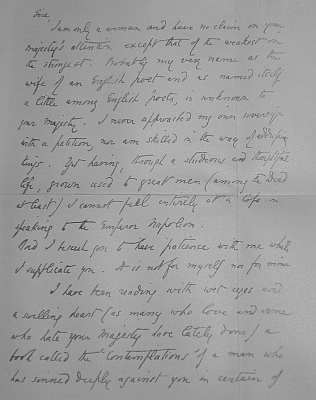
Sire,—I am only a woman, and have no claim on your Majesty's attention except that of the weakest on the strongest. Probably my very name as the wife of an English poet, and as named itself a little among English poets, is unknown to your Majesty. I never approached my own sovereign with a petition, nor am skilled in the way of addressing kings. Yet having, through a studious and thoughtful life, grown used to great men (among the dead, at least), I cannot feel entirely at a loss in speaking to the Emperor Napoleon.
And I beseech you to have patience with me while I supplicate you. It is not for myself nor for mine.
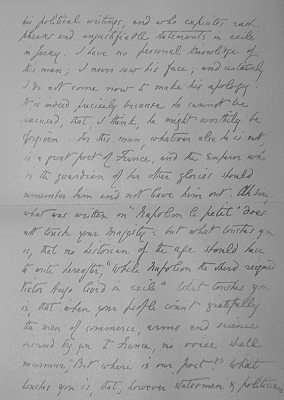
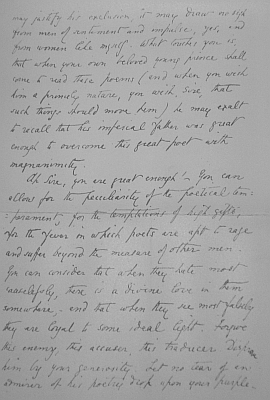
I have been reading with wet eyes and a swelling heart (as many who love and some who hate your Majesty have lately done) a book called the 'Contemplations' of a man who has sinned deeply against you in certain of his political writings, and who expiates rash phrases and unjustifiable statements in exile in Jersey. I have no personal knowledge of this man; I never saw his face; and certainly I do not come now to make his apology. It is, indeed, precisely because he cannot be excused that, I think, he might worthily be forgiven. For this man, whatever else he is not, is a great poet of France, and the Emperor, who is the guardian of her other glories, should remember him and not leave him out. Ah, sire, what was written on 'Napoleon le Petit' does not touch your Majesty; but what touches you is, that no historian of the age should have to write hereafter, 'While Napoleon III. reigned, Victor Hugo lived in exile.' What touches you is, that when your people count gratefully the men of commerce, arms, and science secured by you to France, no voice shall murmur, 'But where is our poet?' What touches you is, that, however statesmen and politicians may justify his exclusion, it may draw no sigh from men of sentiment and impulse, yes, and from women like myself. What touches you is, that when your own beloved young prince shall come to read these poems (and when you wish him a princely nature, you wish, sire, that such things should move him), he may exult to recall that his imperial father was great enough to overcome this great poet with magnanimity.
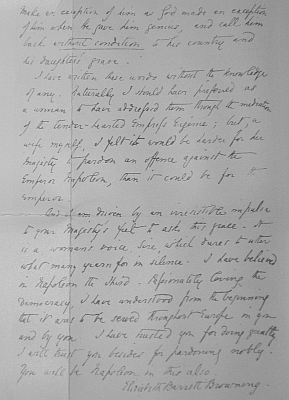
Ah, sire, you are great enough! You can allow for the peculiarity of the poetical temperament, for the temptations of high gifts, for the fever in which poets are apt to rage and suffer beyond the measure of other men. You can consider that when they hate most causelessly there is a divine love in them somewhere; and that when they see most falsely they are loyal to some ideal light. Forgive this enemy, this accuser, this traducer. Disprove him by your generosity. Let no tear of an admirer of his poetry drop upon your purple. Make an exception of him, as God made an exception of him when He gave him genius, and call him back without condition to his country and his daughter's grave.
I have written these words without the knowledge of any. Naturally I should have preferred, as a woman, to have addressed them through the mediation of the tender-hearted Empress Eugénie; but, a wife myself, I felt it would be harder for her Majesty to pardon an offence against the Emperor Napoleon, than it could be for the Emperor.
And I am driven by an irresistible impulse to your Majesty's feet to ask this grace. It is a woman's voice, sire, which dares to utter what many yearn for in silence. I have believed in Napoleon III. Passionately loving the democracy, I have understood from the beginning that it was to be served throughout Europe in you and by you. I have trusted you for doing greatly. I will trust you, besides, for pardoning nobly. You will be Napoleon in this also.
Elizabeth Barrett Browning.
Shortly after this date, on April 17, Mrs. Browning's father died. In the course of the previous summer an attempt made by a relative to bring about a reconciliation between him and his daughters was met with the answer that they had 'disgraced his family;' and, although he professed to have 'forgiven' them, he refused all intercourse, removed his family out of town when the Brownings came thither, and declined to give his daughter Henrietta's address to Mr. Kenyon's executor, who was instructed to pay her a small legacy. A further attempt at reconciliation was made by Mrs. Martin only a few months before his death, but had no better success. His pride stood in the way of his forgiveness to the end.
On receiving the news of his death, the following letter was written by Robert Browning to Mrs. Martin; but it was not until two months later that Mrs. Browning was able to bring herself to write to anyone outside her own family.
Robert Browning to Mrs. Martin
Florence: May 3, 1857.
My dear Mrs. Martin,—Truest thanks for your letter. We had the intelligence from George last Thursday week, having been only prepared for the illness by a note received from Arabel the day before. Ba was sadly affected at first; miserable to see and hear. After a few days tears came to her relief. She is now very weak and prostrated, but improving in strength of body and mind: I have no fear for the result. I suppose you know, at least, the very little that we know; and how unaware poor Mr. Barrett was of his imminent death: 'he bade them,' says Arabel, 'make him comfortable for the night, but a moment before the last.' And he had dismissed her and her aunt about an hour before, with a cheerful or careless word about 'wishing them good night.' So it is all over now, all hope of better things, or a kind answer to entreaties such as I have seen Ba write in the bitterness of her heart. There must have been something in the organisation, or education, at least, that would account for and extenuate all this; but it has caused grief enough, I know; and now here is a new grief not likely to subside very soon. Not that Ba is other than reasonable and just to herself in the matter: she does not reproach herself at all; it is all mere grief, as I say, that this should have been so; and I sympathise with her there.
George wrote very affectionately to tell me; and dear, admirable Arabel sent a note the very next day to prove to Ba that there was nothing to fear on her account. Since then we have heard nothing. The funeral was to take place in Herefordshire. We had just made up our minds to go on no account to England this year. Ba felt the restraint on her too horrible to bear. I will, or she will, no doubt, write and tell you of herself; and you must write, dear Mrs. Martin, will you not?
Kindest regard to Mr. Martin and all.
Yours faithfully ever,
Robert Browning.
E.B. Browning to Mrs. Martin
Florence: July 1, [1857].
Thank you, thank you from my heart, my dearest friend—this poor heart, which has been so torn and mangled,—for your dear, tender sympathy, whether expressed in silence or in words. Of the past I cannot speak. You understand, yes, you understand. And when I say that you understand (and feel that you do), it is an expression of belief in the largeness of your power of understanding, seeing that few can understand—few can. There has been great bitterness—great bitterness, which is natural; and some recoil against myself, more, perhaps, than is quite rational. Now I am much better, calm, and not despondingly calm (as, off and on, I have been), able to read and talk, and keep from vexing my poor husband, who has been a good deal tried in all these things. Through these three months you and what you told me touched me with a thought of comfort—came the nearest to me of all. May God bless you and return it to you a hundredfold, dear dear friend!
I believe hope had died in me long ago of reconciliation in this world. Strange, that what I called 'unkindness' for so many years, in departing should have left to me such a sudden desolation! And yet, it is not strange, perhaps.
No, I cannot write any more. You will understand....
We shall be in Paris next summer. This year we remain quietly where we are. Presently we may creep to the seaside or into the mountains to avoid the great heats, but no further. My temptation is to lie on the sofa, and never stir nor speak, only I don't give up, be certain. I drive out for two or three hours on most days, and I hear Peni's lessons, and am good and obedient. If I could get into hard regular work of some kind, it would be excellent for me, I know; but the 'flesh is weak.' Oh, no, to have gone to England this summer would have helped nobody, and would have been very overcoming to me. I was not fit for it, indeed, and Robert was averse on his own account....
May God bless you both, dearest friends. My little Penini is bright and well. I have begun to teach him German. I do hope you won't fatigue yourselves too much at Colwall. Enjoy the summer and the roses, and be well, be well. We shall meet next year....
Once more, goodbye.
Your ever affectionate and grateful
Ba.
Robert's love as ever.
This is the first letter I have written to anyone out of my own family. I hate writing, and can't help being stupid.
To Miss E.F. Haworth
Florence: [about July 1857].
I write soon, you see, dearest Fanny. I thank you for all, but I do beseech you, dear, not to say a word more to me of what is said of me. The truth is, I am made of paper, and it tears me. Do not, dear. Make no reference to things personal to myself. As far as I could read and understand, it was absurd, perfectly ungenuine. I shall say nothing to anybody. I have torn that sheet. Do not refer to the subject to Isa Blagden. And there—I have done.
No—I thank you; and I know it was your kindness entirely. Will you, if you love me, not touch on the subject (I mean on the personal thing to myself) in your next letters, not even by saying that you were sorry you did once touch on them. I know how foolish and morbid I must seem to you. So I am made, and I can't help my idiosyncrasies.
Now don't mistake me. Tell me all about the spirits, only not about what they say of me. I am very interested. The drawback is, that without any sort of doubt they personate falsely.
We are seething in the heat. The last three days have been a composition of Gehenna and Paradise. It is a perpetual steam bath. Yet Robert and I have not finished our plans for escaping. Mrs. Jameson is here still, recovering her health and spirits. The Villa hospitality goes on as usual, and the evening before last we had tea on the terrace by a divine sunset, with a favoring breath or two. Only even there we wished for Lazarus's finger.
Certainly Florence will not be bearable many days longer. Write to me though, at Florence as usual....
It is said that Hume, who is back again in Paris and under the shadow of the Emperor's wing, has been the means of an extraordinary manifestation, two spiritual figures, male and female, who were recognised by their friends. Five or six persons (including the medium) fainted away at this apparition. It happened in Paris, lately.
Yes, I mistrust the mediums less than I do the spirits who write. Tell me....
Write and tell me everything with exceptions such as I have set down. And forgive my poor brittle body, which shakes and breaks. May God love you, dear.
Yours in true affection,
Ba.
At the end of July, Florence had become unbearable, and the Brownings removed, for the third time, to the Bagni di Lucca, whither they were followed by some of their friends, notably Miss Blagden and Mr. Robert Lytton. Unfortunately, their holiday was marred by the dangerous illness of Lytton, which not only kept them in great anxiety for a considerable time, but also entailed much labour in nursing on Mr. Browning and Miss Blagden. Besides Mrs. Browning's letters, a letter from her husband to his sister is given below, containing an account of the earlier stages of the illness.
Robert Browning to Miss Browning
Bagni di Lucca: August 18, [1857].
Dearest,—We arrived here on the 30th last, and two or three days after were followed by Miss Blagden, Miss Bracken, and Lytton—all for our sake: they not otherwise wanting to come this way. Lytton arrived unwell, got worse soon, and last Friday week was laid up with a sort of nervous fever, caused by exposure to the sun, or something, acting on his nervous frame: since then he has been very ill in bed—doctor, anxiety &c. as you may suppose: they are exactly opposite us, at twelve or fifteen feet distance only. Through sentimentality and economy combined, Isa would have no nurse (an imbecile arrangement), and all has been done by her, with me to help: I have sate up four nights out of the last five, and sometimes been there nearly all day beside....[55] He is much better to-day, taken broth, and will, I hope, have no relapse, poor fellow: imagine what a pleasant holiday we all have! Otherwise the place is very beautiful, and cool exceedingly. We have done nothing notable yet, but all are very well, Peni particularly so: as for me, I bathe in the river, a rapid little mountain stream, every morning at 6-1/2, and find such good from the practice that I shall continue it, and whatever I can get as like it as possible, to the end of my days, I hope: the strength of all sorts therefrom accruing is wonderful: I thought the shower baths perfection, but this is far above it.... I was so rejoiced to hear from you, and think you so wise in staying another month. I sent the 'Ath.' to 151 R. de G. Kindest love to papa: we can't get news from England, but the Americans have paid up the rest of the money for 'Aurora:' by the by, in this new book of Ruskin's, the drawing book,[56] he says '"Aurora Leigh" is the finest poem written in any language this century.' There is a review of it, which I have not yet got, in the 'Rivista di Firenze' of this month. God bless you. I will write very soon again. Do you write at once. Ba will add a word. How fortunate about the books! How is Milsand? Pray always remember my best love to him.
E.B. Browning to Miss Browning
[Same date.]
My dearest Sarianna,—Robert will have told you, I dare say, what a heavy time we have had here with poor Lytton. It was imprudent of him to come to Florence at the hottest of the year, and to expose himself perfectly unacclimated; and the chance by which he was removed here just in time to be nursed was happy for him and all of us. We have had great heat in the days even here, of course—no blotting out, even by mountains, of the Italian sun; but the cool nights extenuate very much—refresh and heal. Now I do hope the corner is turned of the illness. Isa Blagden has been devoted, sitting up night after night, and Robert has sate up four nights that she might not really die at her post. There is nothing infectious in the fever, so don't be afraid. Robert is quite well, with good appetite and good spirits, and Peni is like a rose possessed by a fairy. They both bathe in the river, and profit (as I am so glad you do). Not that it's a real river, though it has a name, the Lima. A mere mountain stream, which curls itself up into holes in the rocks to admit of bathing. Then, as far as they have been able on account of Lytton, they have had riding on donkeys and mountain ponies, Peni as bold as a lion.
[The last words of the letter, with the signature, have been cut off]
To Mrs. Jameson
La Villa, Bagni di Lucca: August 22, [1857].
As you bid me write, my dear friend, about Lytton, I write, but I grieve to say we are still very uneasy about him. For sixteen days he has been prostrate with this gastric fever, and the disease is not baffled, though the pulse is not high nor the head at all affected. Dr. Trotman, however, is uncheerful about him—is what medical men call 'cautious' in giving an opinion, observing that, though at present he is not in danger, the delicacy of his constitution gives room for great apprehension in the case of the least turning towards relapse. Robert had been up with him during eight nights, and Isa Blagden eight nights. Nothing can exceed her devotion to him by night or day. We have persuaded her, however, at last to call in a nurse for the nights. I am afraid for Robert, and in fact a trained nurse can do certain things better than the most zealous and tender friend can pretend to do. You may suppose how saddened we all are. Dear Lytton! At intervals he talks and can hear reading, but this morning he is lower again. In fact, from the first he has been very apprehensive about himself—inclined to talk of divine things, of the state of his soul and God's love, and to hold this life but slackly.
I feel I am writing a horrible account to you. You will conclude the worst from it, and that is what I don't want you to do. The pulse has never been high, and is now much lower, and if he can be kept from a relapse he will live. I pray God he may live. He is not altered in the face, and Dr. Trotman reiterated this morning, 'There is no danger at present.'
You are better. I thank God for it. Oh, yes, it is very beautiful, that cathedral. The weather here is cool and enjoyable by day even. At nights it is really cold, and I have thought of a blanket once or twice as of a thing tolerable. I will write again when there is a change. The course of the fever may extend to six days more.
Your ever most affectionate
Ba.
To Mrs. Jameson
Thursday, [end of August 1857].
Dearest Friend,—I think it better to inclose to you this letter which has come to your address. Thank you for your kind words about Lytton, which will be very soothing to him. He continues better, and is preparing to take his first drive to-day, for half an hour, with his nurse and Robert. See how weak he must be, and the hollow cheeks and temples remain as signs of the past. Still, he is convalescent, and begins to think of poems and apple puddings in a manner other than celestial. I do thank God that our anxieties have ended so.
Robert bathes in the river every morning, which does him great good; besides the rides at mornings and evenings on mountain ponies with Annette Bracken and a Crimean hero (as Mrs. Stisted has it), who has turned up at the hotel, with one leg and so many agreeable and amiable qualities that everybody is charmed with him.
Robert had a letter from Chapman yesterday. Not much news. He speaks of two penny papers, sold lately, after making the fortune of their proprietors, for twenty-five and thirty-five thousand pounds. If Robert 'could but write bad enough,' says the learned publisher, he should recommend one of them. But even Charles Reade was found too good, and the sale fell ten thousand in a few weeks on account of a serial tale of his, so he had to make place to his worses. Chapman hears of a 'comprehensive review' being about to appear in the 'Westminster' on 'Aurora,' whether for or against he cannot tell. The third edition sells well.
So happy I am to hear that Mr. Procter's son is safe. We saw his name in the 'Galignani,' and were alarmed. Lytton has heard from Forster, but I had no English news from the letter. I get letters from my sisters which make me feel 'froissée' all over, except that they seem pretty well. My eldest brother has returned from Jamaica, and has taken a place with a Welsh name on the Welsh borders for three years—what I knew he would do. He wrote me some tender words, dear fellow....
May God bless you!
Yours in much love,
Ba.
To Miss E.F. Haworth
La Villa, Bagni di Lucca: September 14, 1857 [postmark].
My dearest Fanny,—A letter from me will have crossed yours and told you of all our misadventures. It has been a summer to me full of blots, vexations, anxieties; and if, in spite of everything, I am physically stronger for the fresh air and smell of green leaves, that's a proof that soul and body are two.
Our friends of the hotel went away last Saturday, and I have a letter from Isa Blagden with a good account of Lytton. He goes back to Villa Bricchieri, where they are to house together, unless Sir Edward comes down (which he may do) to catch up his son and change the plan. Isa has not quite killed herself with nursing him, a little of her being still left to express what has been.
Now, dear Fanny, I am going to try to tell you of our plans. No, 'plans' is not the word; our thoughts are in the purely elemental state so far. But we think of going to Rome (or Naples) at the far end of November, and of staying here as many days deep into October meanwhile as the cold mountain air will let us. On leaving this place we go to Florence and wait. Unless, indeed (which is possible too), we go to Egypt and the Holy Land, in which case we shall not remain where we are beyond the end of September....
I never could consent to receive my theology or any other species of guidance, in fact—from the 'spirits,' so called. I have no more confidence, apart from my own conscience and discretionary selection, in spirits out of the body than in those embodied. The submission of the whole mind and judgment carries you in either case to the pope—or to the devil. So I think. Don't let them bind you hand and foot. Resist. Be yourself. Also where (as in the medium-writing) you have the human mixture to evolve the spiritual sentiment from, the insecurity becomes doubly insecure....
Your ever affectionate
Ba.
The end of the time at the Bagni di Lucca was clouded by another anxiety, caused by the illness of Penini. It was not, however, a long one, and early in October the whole party was able to return to Florence, where they remained throughout the winter and the following spring. Letters of this period are, however, scarce, and there is nothing particular to record concerning it. Since the publication of 'Aurora Leigh,' Mrs. Browning had been taking a holiday from poetical composition; indeed she never resumed it on a large scale, and published no other volume save the 'Poems before Congress,' which were the fruit of a later period of special excitement. She had put her whole self into 'Aurora Leigh,' and seemed to have no further message to give to mankind. It is evident, too, that her strength was already beginning to decline and the various family and public anxieties which followed 1856 made demands on what remained of it too great to allow of much application to poetry.
To Miss E.F. Haworth
[Bagni di Lucca:] Monday, September 28, [1857].
You will understand too well why I have waited some days before answering your letter, dearest Fanny, though you bade me write at once, when I tell you that my own precious Penini has been ill with gastric fever and is even now confined to his bed. Eleven days ago, when he was looking like a live rose and in an exaggeration of spirits, he proposed to go with me, to run by my portantina in which I went to pay a visit some mile and a half away. The portantini men walked too fast for him, and he was tired and heated. Then, while I paid my visit, he played by the river with a child of the house, and returned with me in the dusk. He complained of being tired during the return, and I took him up into my portantina for ten minutes. He was over-tired, however, over-heated, over-chilled, and the next day had fever and complained of his head. We did not think much of it; and the morning after he seemed so recovered that we took him with us to dine in the mountains with some American friends (the Eckleys—did you hear of them in Rome?)—twenty miles in the carriage, and ten miles on donkey-back. He was in high spirits, and came home at night singing at the top of his voice—probably to keep off the creeping sense of illness, for he has confessed since that he felt unwell even then. The next day the fever set in. The medical man doubted whether it was measles, scarlatina, or what; but soon the symptoms took the decisive aspect. He has been in bed, strictly confined to bed, since last Sunday-week night—strictly confined, except for one four hours, after which exertion he had a relapse. It is the same fever as Mr. Lytton's, only not as severe, I thank God; the attacks coming on at nights chiefly, and terrifying us, as you may suppose. The child's sweetness and goodness, too, his patience and gentleness, have been very trying. He said to me, 'You pet! don't be unhappy for me. Think it's a poor little boy in the street, and be just only a little sorry, and not unhappy at all.' Well, we may thank God that the bad time seems passed. He is still in bed, but it is a matter of precaution chiefly. The fever is quite in abeyance—has been for two days, and we have all to be grateful for two most tranquil nights. He amuses himself in putting maps together, and cutting out paper, and packing up his desk to go to Florence, which is the idée fixe just now. In fact when he can be moved we shall not wait here a day, for the rains have set in, and the dry elastic air of Florence will be excellent for him. The medical man (an Italian) promises us almost that we may be able to go in a week from this time; but we won't hurry, we will run no risks. For some days he has been allowed no other sort of nourishment but ten dessert-spoonfuls of thin broth twice a day—literally nothing; not a morsel of bread, not a drop of tea, nothing. Even now the only change is, a few more spoonfuls of the same broth. It is hard, for his appetite cries out aloud; and he has agonising visions of beefsteak pies and buttered toast seen in mirage. Still his spirits don't fail on the whole and now that the fever is all but gone, they rise, till we have to beg him to be quiet and not to talk so much. He had the flower-girl in by his bedside yesterday, and it was quite impossible to help laughing, so many Florentine airs did he show off. 'Per Bacco, ho una fame terribile, e non voglio aver più pazienza con questo Dottore.' The doctor, however, seems skilful....
But you may think how worn out I have been in body and soul, and how under these circumstances we think little of Jerusalem or of any other place but our home at Florence. Still, we shall probably pass the winter either at Rome or Naples, but I know no more than a swaddled baby which. Also we shan't know, probably, till the end of November, when we take out our passports. Doubt is our element....
I must go to my Peni. I am almost happy about him now. And yet—oh, his lovely rosy cheeks, his round fat little shoulders, his strength and spring of a month ago!—at the best, we must lose our joy and pride in these for a time. May God bless you! I know you will feel for me, and that makes me so egotistical.
Your ever affectionate
Ba.
To Miss Browning
[Florence: February 1858.]
My dearest Sarianna,—Robert is going to write to dear M. Milsand, whose goodness is 'passing that of men,' of all common friends certainly. Robert's thanks are worth more than mine, and so I shall leave it to Robert to thank him.
The 'grippe' has gripped us here most universally, and no wonder, considering our most exceptional weather; and better the grippe than the fever which preceded it. Such cold has not been known here for years, and it has extended throughout the south, it seems, to Rome and Naples, where people are snowed and frozen up. So strange. The Arno, for the first time since '47, has had a slice or two of ice on it. Robert has suffered from the prevailing malady, which did not however, through the precautions we took, touch his throat or chest, amounting only to a bad cold in the head. Peni was afflicted in the same way but in a much slighter degree, and both are now quite well. As for me I have caught no cold—only losing my breath and my soul in the usual way, the cough not being much. So that we have no claim, any of us, on your compassion, you see....
I think, I think Miss Blackwell has succeeded in frightening you a little. In the case of chaos, she will fly to England, I suppose; and even there she may fall on a refugee plot; for I have seen a letter of Mazzini's in which it was written that people stood on ruins in England, and that at any moment there might be a crash! Certainly, confusion in Paris would be followed by confusion in Italy and everywhere on the Continent at least, so I should never think of running away, let what might happen. In '52 and '53, when we were in Paris, there was more danger than could arise now, under a successful plot even; for, even if the Emperor fell, the people and the army seem prepared to stand by the dynasty. Also, public order has attained to some of the force of an habitual thing.
As to the crime,[57] it has no more sympathy here than in France—be sure of that. That unscrupulous bad party is repudiated by this majority—by this people as a mass. I hear nothing but lamentations that Italians should be dishonored so by their own hands. Father Prout says that the Emperor's speech is 'the most heroic document of this century,' and in my mind the praise is merited. So indignant I feel with Mazzini and all who name his name and walk in his steps, that I couldn't find it in my heart to write (as I was going to do) to that poor bewitched Jessie on her marriage. Really, when I looked at the pen, I couldn't move it....
Best love from
Ba.
To Mrs. Martin
Florence: March 27 [1858]
This moment I take up my pen to write to you, my dearest Mrs. Martin. Did you not receive a long letter I wrote to you in Paris? No? Answer me categorically....
And you are not very strong, even now? That grieves me. But here is the sun to make us all strong. For my part, my chest has not been particularly wrong this winter, nor my cough too troublesome. But the weight of the whole year heavy with various kinds of trouble, added to a trying winter, seems to have stamped out of me the vital fluid, and I am physically low, to a degree which makes me glad of renewed opportunities of getting the air; and I mean to do little but drive out for some time. It does not answer to be mastered so. For months I have done nothing but dream and read French and German romances; and the result (of learning a good deal of German) isn't the most useful thing in the world one can attain to. Then, of course, I teach Peni for an hour or so. He reads German, French, and, of course, Italian, and plays on the piano remarkably well, for which Robert deserves the chief credit. A very gentle, sweet child he is; sweet to look at and listen to; affectionate and good to live with, a real 'treasure' so far. His passion is music; and as we are afraid of wearing his brain, we let him give most of his study-time to the piano.
So you want me, you expect me, I suppose, to approve of the miserable, undignified, unconscientious doings in England on the conspiracy question?[58] No, indeed. I would rather we had lost ten battles than stultified ourselves in the House of Commons with Brummagem brag and Derby intrigues before the eyes of Europe and America. It seems to me utterly pitiful. I hold that the most susceptible of nations should not reasonably have been irritated by the Walewski despatch, which was absolutely true in its statement of facts. Ah, dearest friend, how true I know better than you do; for I know of knowledge how this doctrine of assassination is held by chief refugees and communicated to their disciples in England—yes, to noble hearts, and to English hands still innocent—my very soul has bled over these things. With my own ears I have heard them justified. For nights I have been disturbed in my sleep with the thoughts of them. In the name of liberty, which I love, and of the Democracy, which I honour, I protest against them. And if such things can be put down, I hold they should be put down; and that the Conspiracy Bill is the smallest and lightest step that can be taken towards the putting down. For the rest, the great Derby intrigue, as shown in its acts, and as resulting in its State papers, nothing in history, it seems to me, was ever so small and mean.
What I think of him? Why, I think he is the only great man of his age, speaking of public men. I think 'Napoleon III devant le peuple anglais' a magnificent State paper. I confess to you it drew the tears to my eyes as I read it. So grand, so calm, so simply true!
And now with regard to Switzerland. You must remember that there is such a thing as an international law, and that only last year the Swiss appealed in virtue of it to France about the Neufchâtel refugees, and that France received and acted on that appeal. The very translation of the French despatch adds to the injustice done to it in England; because 'insister' does not mean to 'insist upon a thing being done,' but to 'urge it upon one's attention.'
'The Times,' 'The Times.' Why, 'The Times' has intellect, but no conscience. 'The Times' is the most immoral of journals, as well as the most able. 'The Times,' on this very question of the Conspiracy Bill, has swerved, and veered, and dodged, till its readers may well be dizzy if they read every paragraph every day.
See how I fall into a fury. 'Oh, Liberty! I would cry, like the woman who did not love liberty more than I do—'Oh, Liberty, what deeds are done in thy name!' and (looking round Italy) what sorrows are suffered!
For I do fear that Mazzini is at the root of the evil; that man of unscrupulous theory!
Now you will be enough disgusted with me. Tell me that you and dear Mr. Martin forgive me. I never saw Orsini, but have heard and known much of him. Unfortunate man. He died better than he lived—it is all one can say. Surely you admit that the permission to read that letter on the trial was large-hearted. And it has vexed Austria to the last degree, I am happy to say. It was not allowed to be read here, by the Italian public, I mean.
Our plans are perfectly undefined, but we do hope to escape England.... Robert talks of Egypt for the winter. I don't know what may happen; and in the meantime would rather not be pulled and pulled by kind people in England, who want me or fancy they do. You know everybody is as free as I am now, and freer; and if they do want me, and it isn't fancy—never mind! We may see you perhaps, in Paris, after all, this summer....
Now let me tell you. Hume, my protégé prophet, is in Italy. Think of that. He was in Pisa and in Florence for a day, saw friends of his and acquaintances of ours with whom he stayed four months on the last occasion, and who implicitly believe in him. An Englishwoman, who from infidel opinions was converted by his instrumentality to a belief in the life after death, has died in Paris, and left him an annuity of £240, English. On coming here, he paid all his wandering debts, I am glad to hear, and is even said to have returned certain gifts which had been rendered unacceptable to him from the bad opinion of the givers. I hear, too, that his manners, as well as morals, are wonderfully improved. He is gone to Rome, and will return here to pay a visit to his friends in Florence after a time. The object of his coming was health. While he passed through Tuscany, the power seemed to be leaving him, but he has recovered it tenfold, says my informant, so I hope we shall hear of more wonders. Did you read the article in the 'Westminster'? The subject se prête au ridicule, but ridicule is not disproof. The Empress Eugénie protects his little sister, and has her educated in Paris.
Surely I have made up for silence. Dearest friends, both of you, may God bless you!
Your affectionate
Ba.
Robert's love and Peni's.
In the summer of 1858 an expedition was made to France, in order to visit Mr. Browning's father and sister; but no attempt was made to extend the journey into England. In fact, the circle of their flights from Florence was becoming smaller; and as 1856 saw Mrs. Browning's last visit to England, so 1858 saw her last visit to France, or, indeed, beyond the borders of Italy at all. It was only a short visit, too,—not longer than the usual expeditions into the mountains to escape the summer heat of Florence. In the beginning of July they reached Paris, where they stayed at the Hôtel Hyacinthe, rue St. Honoré, for about a fortnight, before going on to Havre in company with old Mr. Browning and Miss Browning. There they remained until September, when they returned to Paris for about a month, and thence, early in October, set out for Italy.
To Miss E.F. Haworth
Hôtel Hyacinthe, St. Honoré: Wednesday and Thursday, July 8, 1858 [postmark].
My dearest Fanny,—The scene changes. No more cypresses, no more fireflies, no more dreaming repose on burning hot evenings. Push out the churches, push in the boulevards. Here I am, sitting alone at this moment, in an hotel near the Tuileries, where we have taken an apartment for a week, a pretty salon, with the complement of velvet sofas, and arm-chairs, and looking-glasses, and bedrooms to correspond, with clocks at distances of three yards, as if the time was in desperate danger of forgetting itself—which it is, of course. Paris looks more splendid than ever, and we were not too much out of breath with fatigue, on our arrival last night, to admit of various cries of admiration from all of us. It is a wonderfully beautiful city; and wonderfully cold considering the climate we came from. Think of our finding ourselves forced into winter suits, and looking wistfully at the grate. I did so this morning. But now there is sunshine.
We had a prosperous journey, except the sea voyage which prostrated all of us—Annunziata, to 'the lowest deep' of misery. At Marseilles we slept, and again at Lyons and Dijon, taking express trains the whole way, so that there was as little fatigue as possible; and what with the reviving change of air and these precautions, I felt less tired throughout the journey than I have sometimes felt at Florence after a long drive and much talking. We had scarcely any companions in the carriages, and were able to stretch to the full longitude of us—a comfort always; and I had 'Madame Ancelot,' and 'Doit et Avoir,' which dropped into my bag from Isa's kind fingers on the last evening, and we gathered 'Galignanis' and 'Illustrations' day by day. Travelling has really become a luxury. I feel the repose of it chiefly. Yes, no possibility of unpleasant visitors! no fear of horrible letters! quite lifted above the plane of bad news, or of the expectation of bad news, which is nearly the same thing. There you are, shut in, in a carriage! Quite out of reach of the telegraph even, which you mock at as you run alongside the wires.
Yes, but some visitors, some faces, and voices are missed. And altogether I was very sad at leaving my Italy, oh, very sad!...
Tell me how you like 'up in the villa' life, and how long you shall bear it.
Paris! I have not been out of the house, except when I came into it. But to-day, Thursday, I mean to drive out a little with Robert. You know I have a weakness for Paris, and a passion for Italy; which would operate thus, perhaps, that I could easily stay here when once here, if there was but a sun to stay with me. We are in admiration, all of us, at everything, from cutlets to costumes. On the latter point I shall give myself great airs over you barbarians presently—no offence to Zerlinda—and, to begin, pray draw your bonnets more over your faces.
I would rather send this bit than wait, as I did not write to you from Marseilles.
May God bless you! If you knew how happy I think you for being in Italy—if you knew.
I shiver with the cold. I tie up three loves to send you from
Your truly affectionate
Ba.
To Miss I. Blagden
Hôtel Hyacinthe, St. Honoré, Paris: Thursday [July 8, 1858].
My dearest dear Isa,—We are here, having lost nothing—neither a carpet bag nor a bit of our true love for you. We arrived the evening before last, and this letter should have been written yesterday if I hadn't been interrupted. Such a pleasant journey we had, after the curse of the sea! ('Where there shall be no more sea' beautifies the thought of heaven to me. But Frederick Tennyson's prophets shall compound for as many railroads as they please.)
In fact, we did admirably by land. We were of unbridled extravagance, and slept both at Lyons and Dijon, and travelled by express trains besides, so that we were almost alone the whole way, and able to lie at full length and talk and read, and 'Doit et Avoir' did duty by me, I assure you—to say nothing of 'Galignanis' and French newspapers. I was nearly sorry to arrive, and Robert suggested the facility of 'travelling on for ever so.' He (by help of nux) was in a heavenly state of mind, and never was the French people—public manners, private customs, general bearing, hostelry, and cooking, more perfectly appreciated than by him and all of us. Judge of the courtesy and liberality. One box had its lid opened, and when Robert disclaimed smuggling, 'Je vous crois, monsieur' dismissed the others. Then the passport was never looked at after a glance at Marseilles. I am thinking of writing to the 'Times,' or should be if I could keep my temper.
So you see, dear Isa, I am really very well for me to be so pert. Yes, indeed, I am very well. The journey did not overtire me, and change of air had its usual reviving effect. Also, Robert keeps boasting of his influx of energies, and his appetite is renewed. We have resolved nothing about our sea plans, but have long lists of places, and find it difficult to choose among so many enchanting paradises, with drawbacks of 'dearness,' &c. &c. Meanwhile we are settled comfortably in an hotel close to the Tuileries, in a pretty salon and pleasant bedrooms, for which we don't pay exorbitantly, taken for a week, and we shall probably outstay the week. Robert has the deep comfort of finding his father, on whose birthday we arrived, looking ten years younger—really, I may say so—and radiant with joy at seeing him and Peni. Dear Mr. Browning and Sarianna will go with us wherever we go, of course.
Paris looks more beautiful than ever, and we were not too dead to see this as we drove through the streets on Wednesday evening. The development of architectural splendour everywhere is really a sight worth coming to see, even from Italy. Observe, I always feel the charm. And yet I yearn back to my Florence—the dearer the farther.
We slept at Dijon, where Robert, in a passion of friendship, went out twice to stand before Maison Milsand (one of the shows of the town), and muse and bless the threshold. Little did he dream that Milsand was there at that moment, having been called suddenly from Paris by the dangerous illness of his mother. So we miss our friend; but we shall not, I think, altogether, for he talked of following us to the sea, Sarianna says, and even if he is restrained from doing this, we shall pass some little time in Paris on our return, and so see him....
Mrs. Jameson is here, but goes on Saturday to England.
[Incomplete]
To Miss E.F. Haworth
2 Rue de Perry, Le Havre, Maison Versigny: July 23, 1858 [postmark].
My dearest Fanny,— ... I gave you an account of our journey to Paris, which I won't write over again, especially as you may have read some things like it. In Paris we remained a fortnight except a day, and I liked it as I always like Paris, for which I have a decided fancy. And yet I did nothing, except in one shop, and in a fiacre driving round and round, and sometimes at a restaurant, dining round and round. But Paris is so full of life—murmurs so of the fountain of intellectual youth for ever and ever—that rolling up the rue de Rivoli (much more the Boulevards) suggests a quicker beat of the fancy's heart; and I like it—I like it. The architectural beauty is wonderful. Give me Venice on water, Paris on land—each in its way is a dream city. If one had but the sun there—such a sun as one has in Italy! Or if one had no lungs here—such lungs as are in me. But no. Under actual circumstances something different from Paris must satisfy me. Also, when all's said and sighed. I love Italy—I love my Florence. I love that 'hole of a place,' as Father Prout called it lately—with all its dust, its cobwebs, its spiders even, I love it, and with somewhat of the kind of blind, stupid, respectable, obstinate love which people feel when they talk of 'beloved native lands.' I feel this for Italy, by mistake for England. Florence is my chimney-corner, where I can sulk and be happy. But you haven't come to that yet. In spite of which, you will like the Baths of Lucca, just as you like Florence, for certain advantages—for the exquisite beauty, and the sense of abstraction from the vulgarities and vexations of the age, which is the secret of the strange charm of the south, perhaps—who knows? And yet there are vulgarities and vexations even in Tuscany, if one digs for them—or doesn't dig, sometimes....
In Paris we saw Father Prout, who was in great force and kindness, and Charles Sumner, passing through the burning torture under the hands of French surgeons, which is approved of by the brains of English surgeons. Do you remember the Jesuit's agony, in the 'Juif Errant'? Precisely that. Exposed to the living coal for seven minutes, and the burns taking six weeks to heal. Mr. Sumner refused chloroform—from some foolish heroic principle, I imagine, and suffered intensely. Of course he is not able to stir for some time after the operation, and can't read or sleep from the pain. Now, he is just 'healed,' and is allowed to travel for two months, after which he is to return and be burned again. Isn't it a true martyrdom? I ask. What is apprehended is paralysis, or at best nervous infirmity for life, from the effect of the blows (on the spine) of that savage.
Then, just as we arrived in Paris, dear Lady Elgin had another 'stroke,' and was all but gone. She rallied, however, with her wonderful vitality, and we left her sitting in her garden, fixed to the chair, of course, and not able to speak a word, nor even to gesticulate distinctly, but with the eloquent soul full and radiant, alive to both worlds. Robert and I sate there, talking politics and on other subjects, and there she sate and let no word drop unanswered by her bright eyes and smile. It was a beautiful sight. Robert fed her with a spoon from her soup-plate, and she signed, as well as she could, that he should kiss her forehead before he went away. She was always so fond of Robert, as women are apt to be, you know—even I, a little....
Forster wrote the other day, melancholy with the misfortunes of his friends, though he doesn't name Dickens. Landor had just fled to his (Forster's) house in London for protection from an action for libel.
See what a letter I have written. Write to me, dearest Fanny, and love me. Oh, how glad I shall be to be back among you again in my Florence!
Your ever affectionate
Ba.
To Mrs. Jameson
Maison Versigny, 2 Rue de Perry, Le Havre: July 24, 1858 [postmark].
Dearest Mona Nina,—Have you rather wondered at not hearing? We have been a-wandering, a-wandering over the world—have been to Étretat and failed, and now are ignominiously settled at Havre—yes, at Havre, the name of which we should have scorned a week ago as a mere roaring commercial city. But after all, as sometimes I say with originality, 'civilisation is a good thing.' The country about Étretat is very pretty, and the coast picturesque with fantastic rocks, but the accommodation dear in proportion to its badness; which I do believe is the case everywhere with places, now and then even with persons—dear in proportion to their badness. We could get three bedrooms, a salon, and kitchen, one opening into another and no other access, and the kitchen presenting the first door, all furnished exactly alike, except that where the bedroom had a bed the kitchen had a stove; wooden chairs en suite, not an inch of carpet, and just an inch of looking-glass in the best bedroom. View, a potato-patch, and price two hundred francs a month. Robert took it in a 'fine phrenzy,' on which I rebelled, and made him give it up on a sacrifice of ten francs, which was the only cheap thing in the place, as far as I observed anything. Also, the bay is so restricted that whoever takes a step is 'commanded' by all the windows of the primitive hotel and the few villas, and as people have nothing whatever to do but to look at you, you may imagine the perfection of the analysis. I should have been a fly in a microscope, feeling my legs and arms counted on all sides, and receiving no comfort from the scientific results. So, you see, we 'gave it up' and came here in a sort of despair, meaning to take the railroad to Dieppe; when lo! our examining forces find that the place here is very tenable, and we take a house close to the sea (though the view is interrupted) in a green garden, and quite away from a suggestion of streets and commerce. The bathing is good, we have a post-office and reading-rooms at our elbow, and nothing distracting of any kind. The house is large and airy, and our two families are lodged in separate apartments, though we meet at dinner in our dining-room. Certainly the country immediately around Havre is not pretty, but we came for the sea after all, and the sea is open and satisfactory. Robert has found a hole I can creep through to the very shore, without walking many yards, and there I can sit on a bench and get strength, if so it pleases God.
Have I not sent you a full account of us? Now if you would return me a cent. per cent.—soll und haben. I want so much to know all about you—how you feel, dearest friend, and how you are. Do write and tell me of yourself. May God bless you ever and ever!
Your affectionate and grateful
Ba.
To Madame Braun
2 Rue do Perry, Le Havre, Maison Versigny: August 10 [1858].
My dearest Madame Braun,—If you have not heard from me before, it has not been that I have not thought of you anxiously and tenderly, but I had the idea that so many must be thinking of you, and saying to you with sad faces 'they were sorry,' that I kept away, not to be the one too many. It seems so vain when we sympathise with a suffering friend. And yet it is something—oh yes, I have felt that! But you knew I must feel for you, if I teased you with words or not; and I, for my part, hearing of you from others, felt shy, as I say, till I heard you were better, of writing to you myself. And you are feeling better, Mrs. Jameson tells me, and are somewhat more cheerful about your state. I thank God for this good news....
One of the few reasons for which I regret our absence from England this summer is that I miss seeing you with my own eyes, and I should like much to see you and talk to you of things of interest to both of us. If illness suppresses in us a few sources of pleasure, it leaves the real ich open to influences and keen-sighted to facts which are as surely natural as the fly's wing, though we are apt to consider them vaguely as 'supernatural.'
'More and more life is what we want' Tennyson wrote long ago, and that is the right want. Indifference to life is disease, and therefore not strength. But the life here is only half the apple—a cut out of the apple, I should say, merely meant to suggest the perfect round of fruit—and there is in the world now, I can testify to you, scientific proof that what we call death is a mere change of circumstances, a change of dress, a mere breaking of the outside shell and husk. This subject is so much the most interesting to me of all, that I can't help writing of it to you. Among all the ways of progress along which the minds of men are moving, this draws me most. There is much folly and fanaticism, unfortunately, because foolish men and women do not cease to be foolish when they hit upon a truth. There was a man who hung bracelets upon plane trees. But it was a tree—it is a truth—notwithstanding; yes, and so much a truth that in twenty years the probability is you will have no more doubters of the immortality of souls, and no more need of Platos to prove it.
We have come here to dip me in warm sea-water, in order to an improvement in strength, for I have been very weak and unwell of late, as perhaps Mrs. Jameson has told you. But the sea and the change have brought me up again, as I hope they may yourself, and now I am looking forward to getting back to Italy for the winter, and perhaps to Rome.
Did you know Lady Elgin in Paris? She has been hopelessly, in the opinion of her physicians, affected by paralysis, but is now better, her daughter writes to me. A most remarkable person Lady Elgin is. We left her sitting in her garden, not able to speak—to articulate one word—but with one of the most radiant happy faces I ever saw in man or woman. I think I remember that you knew her. Her salon was one of the most agreeable in Paris, and she herself, with her mixture of learning and simplicity, one of the most interesting persons in it....
Dearest Madame Braun, I won't think of the possibility even of your writing to me, so little do I expect to hear. Indeed, I would not write if I considered it would entail writing upon you. Only believe that I tenderly regard and think of you, and always shall. May God bless you, my dear friend! Your attached
Elizabeth B. Browning.
The following letter was written at Paris during the stay there which intervened between leaving Havre and the return to Florence:
To Miss I. Blagden
6 Rue de Castiglione, Place Vendôme, Paris: October 2 [1858].
My dearest Isa,—I am saddened, saddened by your letter. We both are. Indeed, this last news from India must have struck—I know it did. Still, to your generous nature, long regret for your dear Louisa will be impossible; and you, so given to forget yourself, will come to forget a grief which is only your own. For she was in the world as not of it, in a painful sense; she was cut off from the cheerful, natural development of ordinary human beings; and if, as was probable, the conviction of this dreary fact had fastened on her mind, the result would have been perhaps demoralising, certainly depressing, more and more. Rather praise God for her therefore, dearest Isa, that she is gone above the cloud, gone where she can exercise active virtues and charities, instead of being the mild patient object of the charities and virtues of her friends. Perhaps she ministers to you now instead of being ministered to by you, while the remembrance of her life on earth is tenderly united to you ever, a proof before men and angels that your life (whatever you may please to say of yourself) has not been useless, nor barren of good and tender deeds....
In this letter and the last (such depressed letters!) you compare your own fate with that of some others with an injustice which God measures, and which I too have knowledge of. Isa, you speak you know not what. Be sure of one thing, however, that God has not been niggardly towards you, and that He never made a creature for which He did not make the work suited to its hand. He never made a creature necessarily useless, nor gave a life which it was not sin on the creature's part to hold unthankfully and throw back as a poor gift. Your excellent understanding will work clear your spirits presently. Some of those whom you think enviable, if they showed you their secret griefs, unsuspected by you, would leave tears in your eyes for them, not you. Every heart knows its own bitterness, and God knows when the bitterest drop is necessary for the heart's health. May He bless you, love you, teach you, strengthen you, make you serene and bright in Him, dear, dear Isa. I have spoken as to a sister; I have spoken as to my own soul in an hour of faintness. Let us take courage, Isa.
Dear, I had just folded up your parcel for Miss Alexander that my brother George should take it to-morrow. It has been my first opportunity for England—at least, for London. But now I will carry it back to you....
Arabel stays with me till we go, which will be in a fortnight perhaps from now. We have an apartment in an exquisite situation, two paces from the Tuileries Gardens, first floor, three best bedrooms and two servants' rooms, a closet of a dining-room, a salon—all small, but exquisitely comfortable and Parisian, looking into a court though, and we are not tempted to stay the winter. No; we return to Florence faithfully. Write again, and be happy, Isa; it is as if I said be good. Tell me, can it be true that Lytton is in Florence with his mother, as Father Prout assures us on the authority of Lady Walpole?...
Write to your ever, in word and deed, loving
Ba.
In October the travellers were back in Florence, but this time only for a short stay of some six weeks, since it was decided that Rome would be more suitable to Mrs. Browning's failing health during the winter. On November 24 they reached Rome, and for the next six months were quartered, as in the winter of 1853-4, at No. 43 Via Bocca di Leone. Here it was that they heard the first mutterings of the storm which was to burst during the following year and to result in the making of Italy.
To Miss E.F. Haworth
Casa Guidi: Saturday [about October 1858].
You do not come, dearest Fanny, though I am here waiting, and I begin to be uneasy about you. Do at least write, do. We have been here since Tuesday, and here is Saturday, and every morning there has been an anxious looking forward for you....
Miss —— wrote to me in Paris to propose travelling with us, which Robert lacked chivalry to accede to; and, in fact, our ways of journeying are too uncertain to admit of arrangements with anyone beyond our circle. For instance, we took nine days to get here from Paris, spending only one day at Chambéry, for the sake of Les Charmettes and Rousseau. Robert played the 'Dream' on the old harpsichord, the keys of which rattled in a ghastly way, as if it were the bones of him who once so 'dreamed.' Then there was the old watch hung up, without a tick in it. At St. Jean de Maurienne we got into difficulties with diligences, and submitted to being thrown out for the night at Lanslebourg, I more dead than alive, and indeed I suffered much in passing the mountain next morning. Then again, on the sea, we had a burrasca, and the captain had half a mind when half-way to Leghorn to turn back to Genoa. Passengers much frightened, including me, a little. A wretched Neapolitan boat, with a machine 'inclined to go to the devil every time the wind went anywhere,' as I heard a French gentleman on board say afterwards. Altogether we were so done up after eighteen hours of it, that we stayed at Leghorn instead of going on straight to Florence. Still, now I seem to have got over fatigue and the rest—and we keep our faces turned undeviatingly to Rome. Mdme. du Quaire having carefully apprised M. Mignaty that we left Paris on the thirteenth, our friends here seem to have made up their minds that we had perished by land or water, and Annunziata's poor sister had passed three days in tears, for instance.
Now, dearest Fanny, let me confess to you. I have not brought the bonnet. A bonnet is a personal matter, and I would not let anyone choose one for me. Still, as you had more faith in man (or woman), I would have risked even displeasing you, only Robert would not let me. He said it was absurd—I 'did not know your size;' I 'could not know your taste;' in fact, he would not let me. Perhaps after all it is better. You shall see mine, which is the last novelty, and I will tell you the results of having investigated the bonnet question generally. I was told at a fashionable shop that hats might be worn out of one's teens; but in Paris, let me hasten to add, you don't see hats walking about except on the heads of small girls. In Rome it may be otherwise, as at the seaside it was. Bonnets are a great deal larger, but you shall see.
Oh, so glad I am to be back—so glad, so glad!
And so happy I shall be to see you, dearest Fanny, whom, till now, I have not thanked for the pretty, pretty sketch. I recognised the persons at a glance, you threw into them so much character....
Your ever most affectionate
E.B.B.
To Miss Browning
[Florence: about November 1858.]
Robert's uncertainty about Rome, my dearest Sarianna, has led him into delay of writing. We dropped here upon summer, and a few days afterwards, just as suddenly, the winter dropped upon us. Such wonderful weather, such cold, such snow—enough to strangle one. The rain has come, however, to-day, and though everything feels wretched enough, and I am languid about schemes of travelling, we talk of going next week, should nothing hinder.
'If it be possible After much grief and pain.'
Peni would rather stay, I believe. His Florence is in his heart still.
Robert will have told you about his bust,[59] which is exquisite in the clay, and will be exhibited in London in the marble next May. The likeness, the poetry, the ideal grace and infantile reality are all there. I am so happy to have it. I set about teasing Robert till he gave it to me, and, as he really loses nothing thereby, I accepted at once, as you may suppose. I would rather have given up Rome and had the bust; but the artist was generous, and would only accept what would cover the expenses, twenty-five guineas. He said he 'would not otherwise do it for us, as he asked in the first place to be allowed to make the sketch in clay, and would not appear to have laid a trap for an order.' So we are all three very happy and grateful to one another—which is pleasant. I feel the most obliged perhaps of the three—obliged to the other two—and ought to be, after the napoleons dropt in Paris, Sarianna!
Oh no; the sea was necessary from Genoa. The expense of the journey would have been very much increased if we had taken the whole way by land, and it was a great thing to escape that rough Gulf of Lyons. The journey to Rome will be rendered easy to Robert's pocket by the extraordinary chance of Mr. Eckley's empty carriage, otherwise the repeated pulls might have pulled us down too low.
Peni will write to you. He loves his nonno and you very much—tell nonno; and my love goes with my message.
May God bless both of you! Love to M. Milsand.
Your affectionate
Ba.
Robert Browning to Miss Browning
Rome, 43 Bocca di Leone: Friday, November 26, 1858 [postmark].
Dearest Sis,—You received a letter written last thing on Wednesday, 18th. We started next day with perfectly fine mild weather and every sort of comfort, and got to our first night's stage, Poggio Bagnoli, with great ease; with the same advantages next day, we passed Arezzo and reached Camuscia, and on Saturday slept at Perugia, having found the journey delightful. Sunday was rainy, but just as mild, so Ba did not suffer at all; we slept at Spoleto. Rain again on Monday. We reached Terni early in the day in order to go to the Falls, but the thing was impossible for Ba. Eckley, his mother-in-law, and I went, however, getting drenched, but they were fine, the rain and melted snow having increased the waters extraordinarily. On Tuesday we had fine weather again to Cività Castellana; there we found that on the previous day, while we were staying at Terni, a carriage was stopped and robbed in the road we otherwise should have pursued. They said such a thing had not happened for years. On Wednesday afternoon, four o'clock, we reached Rome, with beautiful weather; so it had been for some four out of our seven days. Ba bore the journey irregularly well; of course she has thus had a week of open air, beside the change, which always benefits her. We always had the windows of the carriage open. We passed Wednesday night at an hotel in order to profit by any information friends might be able to furnish, but we ended by returning to the rooms here we occupied before, of which we knew the virtues—a blaze of sun on the front rooms—and absolute healthiness. Rents are enormous; we pay only ten dollars a month more than before, in consideration of the desire the old landlady had to get us again. To anybody else the price would have been 20 more—60 in all—for which we are to pay 40. The Eckleys took good rooms and pay 1,000 (£210 or 15) for six months! One can't do that. The best is that they have thoroughly cleaned and painted the place, and everything is very satisfactorily arranged. We take the apartment for four months, meaning to be at liberty to go to Naples if we like. We have no fire this morning while I write, but it is before breakfast and Ba may like the sight of one, tho' I rather think she will not. Rome looks very well, and I hope we shall have a happier time of it than before. Many friends are here and everybody is very kind. The Eckleys were extravagantly good to us, something beyond conception almost. We have seen Miss Cushman, Hatty,[60] Leighton, Cartwright, the Storys, Page and his new (third) wife, Gibson, beside the Brackens and Mrs. Mackenzie; and there are others I shall see to-day. Ferdinando was sent on by sea with the luggage, and met us at the gate. It has been an expensive business altogether, but I think we shall not regret it. I daresay you have mild weather at Paris also. These premature beginnings of cold break down and leave the rest of the year the warmer, if not the better for them. Dearest Sis, write and tell me all the news of your two selves. Do you hear anything about Reuben's leaving London? Anything of Lady Elgin? How is Madame Milsand? I will send you the last 'Ath.' I have received, but break off here rather abruptly, in order to let Ba write. Good-bye. God bless you both. Kindest love to Milsand.
Yours ever affectionately
R.B.
E.B. Browning to Miss Browning
My dearest Sarianna,—I don't know whether this letter from Rome will surprise you, but we have done it at last. Our journey was most prosperous, the wonderful inrush of winter which buried all Italy in snow, and for some days rendered the possibility of any change of quarters so more than doubtful (I myself gave it up for days), having given way to an inrush of summer as wonderful. The change was so pleasant that I bore with perfect equanimity the lamentations of certain English acquaintances of ours in Florence, who declared it was the most frightful and dangerous climate that could be, that now one was frozen to death and the next day burnt and melted, and that people couldn't be healthy under such transitions. But all countries of the south are subject to the same of course wherever there is a southern sun, and mountains to retain snow. Even in Paris you complain of something a little like it, because of the sun. We left Florence in a blaze of sunshine accordingly, and there and everywhere found the country transfigured back into summer, except for two days of April rain. Of the kindness of our dear friends Mr. and Mrs. Eckley I am moved when I try to speak. They humiliate me by their devotion. Such generosity and delicacy, combined with so much passionate sentiment (there is no other word), are difficult to represent. The Americans are great in some respects, not that Americans generally are like these, but that these could scarcely be English—for instance, that mixture of enthusiasm and simplicity we have not. Our journey was delightful and not without some incidents, which might have been accidents. We were as nearly as possible thrown once into a ditch and once down a mountain precipice, the spirited horses plunging on one side, but at last Mr. Eckley lent us his courier, who sate on the box by the coachman and helped him to manage better. Then there was a fight between our oxen-drivers, one of them attempting to stab the other with a knife, and Robert rushing in between till Peni and I were nearly frantic with fright. No harm happened, however, except that Robert had his trousers torn. And we escaped afterwards certain banditti, who stopped a carriage only the day before on the very road we travelled, and robbed it of sixty-two scudi.
Here at Rome we are still fortunate, for with enormous prices rankling around us we get into our old quarters at eleven pounds a month. The rooms are smaller than our ambition would fain climb to (one climbs, also, a little too high on the stairs), but on the whole the quiet healthfulness and sunshine are excellent things, particularly in Rome, and we are perfectly contented....
Rome is so full that I am proceeding to lock up my doors throughout the day. I can't live without some use of life. Here must come the break. May God bless you both! Pen's love with mine to the dear nonno and yourself.
Ba.
To Mr. Ruskin
Rome, 43 Bocca di Leone: January 1, 1859.
My dear Mr. Ruskin,—There is an impulse upon me to write to you, and as it ought to have come long ago, I yield to it, and am glad that it comes on this first day of a new year to inaugurate the time. It may be a good omen for me. Who knows?
We received your letter at Florence and very much did it touch me—us, I should say—and then I would have written if you hadn't bade us wait for another letter, which has not come to this day. Shall I say one thing? The sadness of that letter struck me like the languor after victory, for you who have fought many good fights and never for a moment seemed to despond before, write this word and this. After treading the world down in various senses, you are tired. It is natural perhaps, but this evil will pass like other evils, and I wish you from my heart a good clear noble year, with plenty of work, and God consciously over all to give you satisfaction. What would this life be, dear Mr. Ruskin, if it had not eternal relations? For my part, if I did not believe so, I should lay my head down and die. Nothing would be worth doing, certainly. But I am what many people call a 'mystic,' and what I myself call a 'realist,' because I consider that every step of the foot or stroke of the pen here has some real connection with and result in the hereafter.
'This life's a dream, a fleeting show!' no indeed. That isn't my 'doxy.' I don't think that nothing is worth doing, but that everything is worth doing—everything good, of course—and that everything which does good for a moment does good for ever, in art as well as in morals. Not that I look for arbitrary punishment or reward (the last least, certainly. I would no more impute merit to the human than your Spurgeon would), but that I believe in a perpetual sequence, according to God's will, and in what has been called a 'correspondence' between the natural world and the spiritual.
Here I stop myself with a strong rein. It is fatal, dear Mr. Ruskin, to write letters on New Year's day. One can't help moralising; one falls on the metaphysical vein unaware.
Forgive me.
We are in Rome you see. We have been very happy and found rooms swimming all day in sunshine, when there is any sun, and yet not ruinously dear. I was able to go out on Christmas morning (a wonderful event for me) and hear the silver trumpets in St. Peter's. Well, it was very fine. I never once thought of the Scarlet Lady, nor of the Mortara case, nor anything to spoil the pleasure. Yes, and I enjoyed it both æsthetically and devotionally, putting my own words to the music. Was it wise, or wrong?
But we have had and are having some cold, some tramontana, and I have kept house ever since. Only in Rome there's always hope of a good warm scirocco. We talk of seeing Naples before we turn home to our Florence, to keep feast for Dante.
It is delightful to hear of all you are permitted to do for England meanwhile in matters of art, and one of these days we shall go north to take a few happy hours of personal advantage out of it all. Not this year, however, I think. We have done duty to the north too lately. Now it seems to me we have the right (of virtue, in spite of what I said on another page, or rather, because I said it in good human inconsistency), the right to have and hold our Italy in undisturbed possession. I never feel at home anywhere else, or to live rightly anywhere else at all. It's a horrible want of patriotism, of course, only, if I were upon trial, I might say in a low voice a few things to soften the judgment against me on account of that sin. Ah! we missed you at Havre! If you had come it would have been something pleasant to remember that detestable place by, besides the salt-water which profited one's health a little. We were in Paris too some six weeks in all (besides eight weeks at Havre!) and Paris has a certain charm for me always. If we had seen you in Paris! But no, you must have floated past us, close, close, yet we missed you.
A good happy new year we wish to Mr. and Mrs. Ruskin, as to yourself, and, dear Mr. Ruskin, to your mother I shall say that my child is developing in a way to make me very contented and thankful. Yes, I thank God for him more and more, and she can understand that, I know. His musical faculty is a decided thing, and he plays on the piano quite remarkably for his age (through his father's instruction) while I am writing this. He is reading aloud to me an Italian translation of 'Monte Cristo,' and with a dramatic intelligence which would strike you, as it does perhaps, that I should select such a book for a child of nine years old to read at all. It's rather young to be acclimated to French novels, is it not? But the difficulty of getting Italian books is great, and there's a good deal in the early part of 'Monte Cristo,' the prison part, very attractive. His voice was full of sobs when poor Dantes was consigned to the Château d'If. "Do you mean to say, mama, that that boy is to stay there all his life?" He made me tell him 'to make him happy,' as he said.
For the rest he reads French and German, and we shall have to begin Latin in another year I suppose. Do you advise that, you, Mr. Ruskin? He has not given up the drawing neither. Ah! but there is a weight beyond the post, whatever your goodness may bear, and I must leave a little space for Robert.
May God bless you, my dear friend! Dare I say it? it came.
Affectionately yours always,
Elizabeth Barrett Browning.
Robert Browning to Mr. Ruskin
I am to say something, dear Ruskin; it shall be only the best of wishes for this and all other years; go on again like the noble and dear man you are to us all, and especially to us two out of them all. Whenever I chance on an extract, a report, it lights up the dull newspaper stuff wrapt round it and makes me glad at heart and clearer in head. We, for our part, have just sent off a corrected 'Aurora Leigh,' which is the better for a deal of pains, we hope, and my wife deserves. There will be a portrait from a photograph done at Havre without retouching—good, I think. Truest love to you and yours—your father and mother. Do help us by a word every now and then.
Affectionately yours,
R.B.
To Miss I. Blagden
[Rome]: 43 Bocca di Leone: January 7 [1859].
My dearest Isa,—Your letter seemed long in coming, as this will seem to you, I fear. I ought to have answered mine at once, and put off doing so from reason to reason, and from day to day. Very busy I have been, sending off seven of the nine books of 'Aurora,'[61] having dizzied myself with the 'ifs' and 'ands,' and done some little good I hope at much cost....