Part 2 — CHAPTER III THE ART OF MAKING A WHEEL OF PERPETUAL MOTION
Brother Arnold translation
In this chapter I will make known to you the construction of a wheel which in a remarkable manner moves continuously. I have seen many persons vainly busy themselves and even becoming exhausted with much labor in their endeavors to invent such a wheel. But these invariably failed to notice that by means of the virtue or power of the lodestone all difficulty can be overcome. For the construction of such a wheel, take a silver capsule like that of a concave mirror, and worked on the outside with fine carving and perforations, not only for the sake of beauty, but also for the purpose of diminishing its weight. You should manage also that the eye of the unskilled may not perceive what is cunningly placed inside. Within let there be 32 iron nails or teeth of equal weight fastened to the periphery of the wheel in a slanting direction, close to one another so that their distance apart may not be more than the thickness of a bean or a pea; the wheel itself must be of uniform weight throughout. Fasten the middle of the axis about which the wheel revolves so that the said axis may always remain immovable. Add thereto a silver bar, and at its extremity affix a lodestone placed between two capsules and prepared in the following way: When it has been rounded and its poles marked as said before, let it be shaped like an egg; leaving the poles untouched, file down the intervening parts so that thus flattened and occupying less space, it may not touch the sides of the capsules when the wheel revolves. Thus prepared, let it be attached to the silver rod just as a precious stone is placed in a ring; let the north pole be then turned towards the teeth or cogs of the wheel somewhat slantingly so that the virtue of the stone may not flow diametrically into the iron teeth, but at a certain angle; consequently when one of the 33 teeth comes near the north pole and owing to the impetus of the wheel passes it, it then approaches the south pole from which it is rather driven away than attracted, as is evident from the law given in a preceding chapter. Therefore such a tooth would be constantly attracted and constantly repelled.
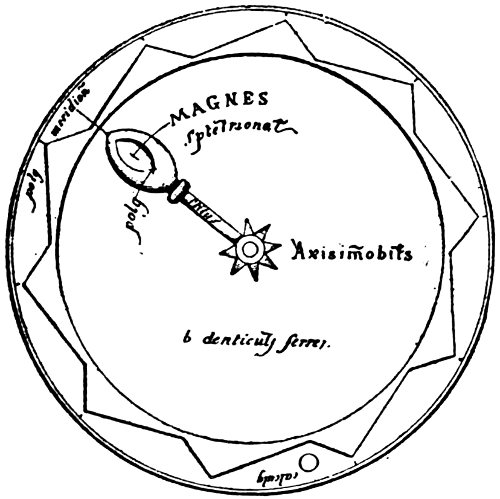
FIG. 4.—PERPETUAL MOTION WHEEL
In order that the wheel may do its work more speedily, place within the box a small rounded weight made of brass or silver of such a size that it may be caught between each pair of teeth; consequently as the movement of 34 the wheel is continuous in one direction, so the fall of the weight will be continuous in the other. Being caught between the teeth of a wheel which is continuously revolving, it seeks the centre of the earth in virtue of its own weight, thereby aiding the motion of the teeth and preventing them from coming to rest in a direct line with the lodestone. Let the places between the teeth be suitably hollowed out so that they may easily catch the body in its fall, as shown in the diagram above. (Fig. 4.)
Farewell: finished in camp at the siege of Lucera on the eighth day of August, Anno Domini MCCLXIX.
35