PART I. GENERAL PRINCIPLES. (continued 2)
Reading edition
With regard to the American system, when opening your strong suit with a low card, those who have already adopted the penultimate lead from suits of five cards, will have no difficulty in again discovering the germ of a principle of play. The fourth-best card of your suit is led from suits of four cards, and from suits of five cards.
You have only to apply the same rule to suits of more than five cards, and to lead your fourth-best card. You then pursue a uniform practice, and at the same time convey valuable information. (See Appendix A).
As an illustration, take this suit—queen, ten, nine, eight. You lead the eight. Now suppose your suit to be queen, ten, nine, eight, three. You still lead the eight. Now add one more card. Your suit is queen, ten, nine, eight, three, two. You should still lead the eight. No doubt, a careful player would lead the eight, as a card of protection, even if American leads had never been thought of. With lower cards, such as queen, nine, eight, seven, three, two, it is possible a careful player might lead the seven; and with still lower cards, where is he to stop? The knot is cut by the very simple and uniform rule of leading the fourth-best, without reference to the possibility of its being a card of protection.
With regard to the lead of a high card followed by a low card, when the American system is followed, the low card selected should be the original fourth-best. (See Appendix A).
The more the American system is examined, the more thorough and perfect it will be found. Care, however, must be taken, with leads late in a hand, not to confuse a fourth-best lead with a forced lead of the highest card of a weak suit. The American rule only applies, in its integrity to the original lead,—or after one or more tricks have been played, to the original lead of the player's own choice, (See Appendix A). Also, it may be, that the leader, with very strong cards in all plain suits, starts by leading a strengthening trump. The uncertainty of the real character of the lead, in this case, is no doubt unfavourable; but, the advantage of frequently being able to give information of great numerical strength far outweighs this occasional danger.
Information as to the number of trumps you hold can be similarly communicated when you have more than four trumps, by trumping with the fourth-best and then leading the fourth-best of those remaining. This rule, however, is subject to rather a large exception. When your fourth-best trump is a medium card, such as an eight, trumping with the eight may imperil a trick later on. For instance: with such cards as king, knave, nine, eight, three, a careful player would rightly trump with the three and lead the eight. For the time, you do not inform your partner as to number, because the eight is too valuable a card to get rid of, and the information might be purchased too dearly. Also, when about to lead high trumps after a force, there is no occasion to run any risk by trumping with any but the lowest, as the high cards led will of themselves indicate how many trumps you now hold (not how many you held originally). If you take a force with any trump but the lowest, and do not lead a trump, when your lowest is afterwards played it only signifies that you had at least five trumps originally, and your play does not constitute a call for trumps. (See p. 125.)
TRUMPS.
THE MANAGEMENT OF TRUMPS.
The Management of Trumps is, perhaps, the most difficult of the problems presented to the Whist-player. Before discussing the special uses of trumps, it may be observed that in some few hands trumps are led like plain suits, because they are your strongest suit, and you prefer leading them to opening a weak suit. The principles already discussed, which guide us to the most favourable chances for making tricks in a suit, apply to trumps equally with other suits. The privilege, however, enjoyed by the trump suit of winning every other, causes some modifications of detail (noticed at pp. 64-71, and at pp. 85-88); for, since the winning trumps must make tricks, you play a more backward game in the trump suit. Thus, with ace, king, and small trumps, you lead a small one, by which you obtain an increased chance of making tricks in the suit, and you keep the command of it, and must have the lead after the third round, the advantage of which will be presently explained. Even if your partner is so weak in trumps that the opponent wins the first trick very cheaply, but little (if any) harm accrues; for the opponent then has to open a suit up to you or your partner.
In the great majority of hands, trumps are applied to their special uses, viz.: 1. To disarm the opponents, and to prevent their trumping your winning-cards; and 2. To trump the winning cards of the adversaries. In order to comprehend when trumps may be most profitably applied to the first, and when to the second, of these uses, we must first clearly perceive the objects aimed at throughout the hand, viz.: to establish a suit, to exhaust the adversaries' trumps, and to retain the long trump, or a certain winning card with which to get the lead again, for the purpose of bringing in the suit; also to endeavour to obstruct similar designs of the opponents. It follows that you should
13. LEAD TRUMPS WHEN VERY STRONG IN THEM.
It cannot be too strongly impressed that the primary use of strength in trumps is to draw the adversaries' trumps for the bringing in of your own or your partner's long suit. With great strength in trumps (five or more), you may proceed at once to disarm the opponents, and lead trumps without waiting to establish a suit. For, with five trumps or more, the chance of your succeeding in drawing the other trumps, and of being left with the long trumps is so considerable, that you may then almost always lead trumps, whatever your other cards. The exceptional hands are principally those which contain five trumps without an honour, and five small cards of a plain suit; or five trumps without an honour, and four middling cards of one plain suit together with four bad cards of another plain suit. But if the adversaries are at the score of three, you should lead a trump with these hands, as your partner must have two honours, or very good cards out of trumps, for you to save the game.
If you are at the score of three, the adversaries being love, one, or two, you should not lead a trump merely because you have five trumps with two honours, if they are unaccompanied by a very strong suit, or by good cards in each suit. For here, if your partner has an honour, you probably win the game in any case; and if he has no honour you open the trump suit to a disadvantage. Some good players, however, do not allow this to be an exceptional case. The turn-up card may sometimes cause you to refrain from leading trumps from five. Thus: you have king, ten, nine, six, and four of spades (trumps); ace, queen, and three small diamonds; and three small hearts. You are four, and the ace of spades is turned up. In the opinion of most players, the ace of diamonds is the best original lead; but, if an ace were not turned up, you should lead a trump.
It is often said, even by pretty good players, "Strength in trumps is no reason for leading them, unless you have a good suit as well." If both you and your partner are devoid of good cards you cannot make tricks; but should your partner hold one good suit out of the three, you will very likely bring it in for him by leading from strength in trumps. For, even if you have a poor hand out of trumps, you will discover in the course of play (i.e., by the suits led or discarded by the other players), what your partner's suit is, and will be able to lead it to him each time you get the lead with your long trumps. Besides, if your hand is weak out of trumps, you are placed in the disadvantageous position of leading from a weak suit unless you lead trumps.
You should not be deterred from leading trumps because an honour is turned up to your right, nor necessarily lead them because the same happens to your left; either is proper if the circumstances of the hand require it, but neither otherwise. To illustrate this proposition, take this hand: ace, queen, and three small spades (trumps), three small hearts, three small clubs, and two small diamonds. The king of spades is turned up fourth hand. The best lead is disputed; but the author has no hesitation in advising the lead of a small trump, notwithstanding that there is a certain finesse over the king. A little consideration will render this apparent. By leading the trump suit originally, you obtain the advantages just enumerated, and make the dealer open a suit up to your partner. Your partner, as soon as he gets the lead, will return the trump, and you thus obtain the command of trumps whether the king was forced out in the first round or not.
Bearing in mind the severe consequences of leaving the adversary with the long trump, you must be cautious in leading trumps from less than five; four trumps and a moderate hand not justifying an original trump lead. You should, instead, lead your strong plain suit, and if you establish it, and the adversaries do not meantime show any great strength, as by leading or calling for trumps (pp. 125-127), you may then, with four trumps, mostly venture a trump lead. With strength in trumps you may generally finesse more freely in the second and third rounds of trumps than you would in plain suits. In plain suits an unsuccessful finesse may result in the best card being afterwards trumped, which cannot happen in trumps. Moreover, by finessing, you keep the winning trump, and so obtain the lead after the third round. This is especially important when you have a suit established and but four trumps. Here you should, generally, not merely finesse in the second round, but hold up the winning trump, and sometimes at this juncture refuse to part with it even if the trump lead comes from the adversary.
An example will render this more clear. The leader (A) has ace, and three small trumps, a strong suit, headed by ace, king, queen, and a probable trick, say king and another, in a third suit. A should, in the writer's judgment, lead a trump. If B (A's partner) wins the first trick in trumps, and returns a strengthening trump, A, as a rule, should not part with his ace. When A or B obtain the lead again they play a third round of trumps, which, being won by the ace, enables A, by leading his tierce major, to get a force (i.e., to compel one of his adversaries to trump in order to win the trick), in which case nothing short of five trumps in one hand against him can prevent A's bringing in his suit. You must be prepared for similar tactics on the part of the adversaries, and not conclude that they have not the best trump because they suffer you to win the first or second round.
With a well protected hand containing four trumps, two being honours, a trump may be led originally. For here the chance of gaining by the trump lead may be taken as greater than the chance of losing. Thus with queen, knave, and two small trumps, a four suit with an honour, say for example, knave, ten, nine, and a small one, king guarded in the third suit, and queen guarded in the fourth, a small trump if it finds partner with an honour is by no means unlikely to win the game. If partner turns out very weak in trumps the leader must alter his plan, and, instead of continuing the trump lead, play to make three, five or seven tricks according to the fall of the cards in plain suits.
Trump leads, without strength in trumps, can only be right in consequence of some special circumstance in the state of the game, or of the score. For instance, great commanding strength in all the plain suits may call for a trump lead; or it may be necessitated to stop a cross-ruff (i.e., the alternate trumping by partners of different suits, each leading the suit in which the other renounces), in which case it is generally advisable to take out two rounds if possible; so with the winning trump you play it out, whatever your others are. Again, if you have a wretched hand and you are love to three or four, you assume that the game is lost, unless your partner is very strong; and if he is very strong, the trump is the best lead for him. This doctrine is frequently carried to excess, as, by concealing your weakness, you often stand a better chance of saving a point, if not the game, than by at once exposing it. If, therefore, you have one four suit, headed by an honour, you would generally do better to choose that.
The trump lead is so much more important than any other that you should almost always return your partner's lead of trumps immediately, except he has led from weakness, when you are not bound to return it unless it suits your hand.
If you find one of the adversaries without a trump, you should mostly proceed to establish your long suit, and abstain from drawing two trumps for one; to say nothing of the probability that the adversary who has not renounced is unusually strong in trumps. Besides, when he has the lead, he will very likely lead trumps in order to draw two for one; and it is more advantageous to you that the lead should come from him. On the other hand, if your partner has no trump, it is often right to endeavour to weaken the adversaries by continuing even their trump lead.
It is a common artifice, if you wish a trump to be led, to drop a high card to the adversary's lead, to induce him to believe that you will trump it next round, whereupon the leader will very likely change the suit, and perhaps lead trumps. Thus, if he leads king (from ace, king, and others), and you hold queen and one other, it is evident that you cannot make the queen. If you throw the queen to his king, he may lead a trump to prevent your trumping his ace; but if he goes on with the suit, and you drop your small card, it may fairly be inferred that you have been endeavouring to get him to lead a trump. Your partner should now take the hint, and, if he gets the lead, lead trumps; for if you want them led, it is of little consequence from whom the lead comes. By a conventional extension of this system to lower cards it is understood that, whenever you throw away an unnecessarily high card, it is a sign (after the smaller card drops) that you want trumps led. This is called asking for trumps or calling for trumps.
When you ask for trumps, you command your partner to abandon his own game, and to lead a trump; and you promise him, in return, if he has reasonably good cards, either to win the game or to make a considerable score. It has been laid down, that the minimum strength in trumps which justifies you in issuing such an order to your partner is four trumps, two being honours, or five trumps, one being an honour, accompanied by such cards in your own or your partner's suits that you are reasonably secure of not having a suit brought in against you. This rule, however, only applies to an original ask. If you have had the lead, and have not led a trump, or if you have had an opportunity of asking and have not asked, and you then ask for trumps at a later period of the hand, the ask is not a command, like an original one, nor does it necessarily imply the possession of the minimum strength above stated. It merely means that, from the fall of the cards, you consider a trump lead would be very advantageous. For example: you hold ace and a small spade; king, ten, and two small hearts (trumps); queen and two small clubs; and knave, ten and two other diamonds. You lead a small diamond; your partner plays the queen; the fourth hand plays the ace. A small club is now led through you. You should ask for trumps.
When your partner asks for trumps, and you have four or more at the time you obtain the lead, lead the smallest, unless you have the ace, or three honours, or queen, knave, ten; if you have only two or three trumps when you obtain the lead, lead from the highest downwards, whatever they are.
Before answering the ask, be sure that the higher card, previously dropped, is unnecessarily high. For instance a higher card is often played before a lower, to show that you command the suit, or that you hold the intermediate cards, or to get out of your partner's way. It is very important to distinguish between covering second hand and discarding an unnecessarily high card. For example: with knave, ten, and one other (say the three), it is usual to play the ten second hand on a small card. When your three comes down in the next round, it is not an ask for trumps, unless your partner can infer that you do not hold the knave. Moderate players, who know of the ask, never consider this; so with them the choice of the least evil is generally not to cover, for you otherwise run the terrible risk of having a strengthening trump led to you with a weak hand. To ask for trumps, second hand, with knave, ten, and one other, you must play the knave.
When your partner leads a trump, or asks for trumps, if you have numerical strength in trumps, you should ask at the first opportunity. This is called the echo of the call, though it is made use of also in response to a lead.
The advantages of the echo are manifold. Your partner being strong in trumps may hesitate to take a force, but your echo enables him to do so without fear, and to persevere with the trump lead. Or, your partner may be in doubt after the second round of trumps as to the policy of playing a third. But if he can count two more trumps in your hand he will be directed. Thus: eight are out, your partner has three more; you have echoed. He will know that the other two are in your hand, and will not draw two for none, as without the echo, he might do.
The negative advantage of the echo should not be overlooked. Thus: to take the same case of eight trumps being out, and the leader with three more trumps. You (his partner) have had the chance of sounding an echo, but have not done so. The leader knows that you have not both the remaining trumps, and he will regulate his game accordingly.
To your partner's trump lead you echo in the trump suit; the same if partner calls, and you are forced. Thus: you have eight, seven, five, two of trumps; your left-hand adversary leads king, ace of a suit of which you only hold one. Your partner calls. You echo, by trumping with the five, and you then lead the eight. On the second round of trumps, when your deuce falls, the echo is completed. Your partner knows that you have one more trump, either the six or the seven. If you had not echoed, he might not be able to tell for certain whether you hold another trump or not. (See Hands XXXIV., XXXV.)
If you have four trumps and are forced, and your partner then leads or asks for trumps, you should echo, notwithstanding that you no longer have numerical strength. This case can best be illustrated by an example. (See Hand XXXVI.)
The use of strength in trumps being to disarm the opponents, it follows that you should as much as possible husband your strength for that purpose. Therefore when second player,
14. DO NOT TRUMP A DOUBTFUL CARD IF STRONG IN TRUMPS.
By a doubtful card is meant a card of a suit of which your partner may have the best.
Whether you should trump or refuse to trump a doubtful card depends almost entirely on your strength in trumps. It has already been mentioned that it is an advantage to trump when you are weak, for you thus make a little trump, which is not available for the other uses of trumps, and which, if not used for trumping, will presently be drawn by the strong hand. It is conversely a disadvantage to trump a doubtful card when you are strong in trumps, for by trumping you weaken your numerical power, and diminish the probability of your bringing in a suit. If, instead of trumping, you throw away a losing card, you inform your partner that you have strength in trumps, and also, by your discard, what your strong suit is; and if your partner has any strength in the suit led, you leave him in a favourable position.
If you refuse to overtrump, or to trump a certain winning card, your partner should conclude either that you have no trump, or more probably four trumps and a powerful hand besides. If he concludes that you are reserving your trumps to bring in a suit, he should assist you by leading trumps as soon as he can. A refusal to be thus forced is seldom requisite if you have more than four trumps; with six you are mostly strong enough to trump and to lead trumps; with five you may do the same, if your suit is established; but if not, it is generally best to take the force, and to lead your suit.
The situations in which it is most necessary to refuse to overtrump your right-hand adversary, or to refuse to trump a winning card, occur when you have four trumps and a very strong suit, or a suit established early in a hand. For then, by trumping, you prejudice your chance of bringing in the suit in order to secure one trick. By refusing to part with a trump in these cases, you obtain the advantages just enumerated, at the time when they are most likely to become of service; and, where you refuse to overtrump, your adversary is left with one trump less, by which your hand is strengthened.
Many players run into the extreme of always refusing to be forced by a winning card when they are strong in trumps. The situations, however, just indicated, are almost the only ones in which it answers to hold up; and these even are liable to several exceptions. For instance:—1. You should not persist in refusing to be forced if you find that the adversary has the entire command of his suit. 2. You should not refuse if your partner evidently intends to force you; and, 3. You should not refuse to overtrump if you have reason to believe that your left-hand adversary is strong in trumps.
With an untaught partner it is useless to refuse to trump; he will not understand it, but will continue to force you. With such, the best course is rather to make tricks when you can than to play for a great game.
From what has just been said, it is evidently an advantage to
15. FORCE A STRONG TRUMP HAND OF THE ADVERSARY.
For you thereby take the best chance of preventing his making use of his trumps for bringing in a suit. If he refuses to take a force, keep on giving it to him.
For instance, if he passes your king (led from king, queen, &c.), and the king wins, continue the suit, and so on. Some players can never be brought to understand this; they do not like to see their winning cards trumped, and therefore frequently change their suit or even lead trumps when an adversary refuses to be forced.
It now hardly requires to be stated that it is bad play intentionally to force a weak adversary, and still worse to lead a suit to which both adversaries renounce, as the weak will trump and the strong get rid of a losing card.
If you have numerical strength in trumps, you are justified in forcing your partner, relying on your own strength to disarm the opponents. But
16. DO NOT FORCE YOUR PARTNER IF YOU ARE WEAK IN TRUMPS.
For you thus weaken him, and leave it in the power of the antagonists to draw all the trumps, and bring in their suit. If, then, a good partner refrains from forcing you, you may be sure he is weak; on the other hand, if he evidently intends to force you (as by leading a losing card of a suit he knows you must trump), you may assume that he is strong in trumps, and you should take the force willingly, even though you do not want to be forced, depending on his strength to exhaust the adversaries' trumps.
You may, however, though weak, force your partner under these circumstances. 1. When he has already shown a desire to be forced, or weakness in trumps, as by trumping a doubtful card, or by refraining from forcing you. 2. When you have a cross-ruff, which secures several tricks at once, and is therefore often more advantageous than trying to establish a suit. 3. Sometimes when you are playing a close game, as for the odd trick, and often when one trick saves or wins the game or a point. And 4. Sometimes when great strength in trumps has been declared against you.
If your partner leads a thirteenth card, or a card of a suit in which he knows that both you and the fourth player renounce, your play must depend on your partner's strength in trumps. If he is strong, he wants you to put on your best trump, either to make the trumps separately, or to force out one or two high ones, to leave himself with the command. If he is weak in trumps, he wants you to pass the card, that the fourth player may obtain the lead, and lead up to your hand. No general rule can be given as to the course to be pursued with regard to thirteenth cards. You must judge of the leader's intention by the score and the previous fall of the cards.
PLAYING TO THE BOARD.
17. PLAY TO THE SCORE; AND 18. WATCH THE FALL OF THE CARDS, AND DRAW YOUR INFERENCES AT THE TIME.
These two all-important principles have already been mentioned as causing differences in the play. The commonest form in which the former is presented to us is this: at the score of Love-all five tricks save the game against two by honours. It is often right, therefore, when two by honours have been declared against you, to go for the fifth trick by leading off a winning card, or by putting one on second or third hand.
To explain further what is meant by playing to the score, put yourself in this situation. Four trumps remain in, the adversaries have two winning trumps, it being uncertain whether they are in one hand or divided; you have the two losing trumps, two forcing cards, and the lead; you can only play correctly by referring to the score. Thus, if the adversary is at four, and you have won five, or even six tricks, your game would be to secure two tricks by forcing; for if you play a trump and the two against you are in the same hand, you lose the game. But suppose you are at the point of two, and the adversaries are not at four, and you have won six tricks, your game would be to risk the trump; for if you bring down the other trumps you win the game; but by playing to force you make certain of scoring only four. By applying this mode of reasoning you will often be directed as to a finesse late in a hand. (Further illustrations of playing to the score occur in the hands.)
For simple examples of drawing inferences at the time of the fall of the cards take the following:—1. You lead a small card from ace, knave, &c.; your partner wins with the queen; you should immediately (i.e., before another card is led) infer that the king cannot be with your right-hand adversary. Hence, on the return of the suit, you would not finesse the knave. 2. You are second player, and a suit is led in which you have king, ten, and one small one. You play the small one. The third hand plays the queen, which is won with the ace. You should at once infer that the third hand cannot have the knave, and that you may safely finesse the ten next round.
You will greatly assist your memory by systematically recording inferences in the above manner. In addition to this you should apply your knowledge of the principles to noting important points, not attempting too much at first. Begin by counting the trumps as they fall, and notice, at all events, the honours, and remember the turn-up card. By degrees you will find yourself able to recollect the ten and nine, and then the smaller trumps. Next attend to the suit led originally by each player, and watch in the second round whether the lead was from strength or weakness. Try also to remember the fall of the cards in your own strong suit, that you may know when it is established. Beyond this, experience will enable you to judge what to retain and what to reject in each hand; so that, with practice, you will acquire what may be termed whist memory which will enable you, without any great effort, to recollect the principal features of every hand.
The fall of the cards may, one time or another, modify nearly every rule of play. A player who simply follows rule, and fails to grasp the situations in which rule should be departed from, is a mere machine without intelligence. General principles only apply to the general case; to apply them to particular cases, observation, inference, and judgment are essential. Thus, in the Analysis of Leads, it appears that the card which should be led in trumps often differs from the card which should be led in plain suits. The reason is given at p. 119. But it will be clear to any one who reads between the lines, that plain suits should be led like trumps, if all the remaining trumps are in the leader's or his partner's hands; or, if all the trumps are out, and the leader or his partner has certain cards of re-entry in other suits.
As another example, take the case of returned leads. A leads a small card; the second hand plays a small card; B (third hand) puts on the eight; the fourth hand wins with the queen. When B gets the lead he returns the knave. It is evident that B must have the ten and the nine. Here two principles appear to conflict. One rule is, with four originally return the smallest; the other rule is convey information to your partner. When a player has thus to choose between two rules, he must use his intelligence, in order to decide under which rule his greater advantage lies. In the example given, the return of the knave cannot deceive partner as to the number of cards held in the suit; if he takes the trouble to think, he will at once perceive that the rule as to returned leads has been departed from, in order to convey information.
The three following Examples further illustrate cases where playing to the board is involved.
CASE I.
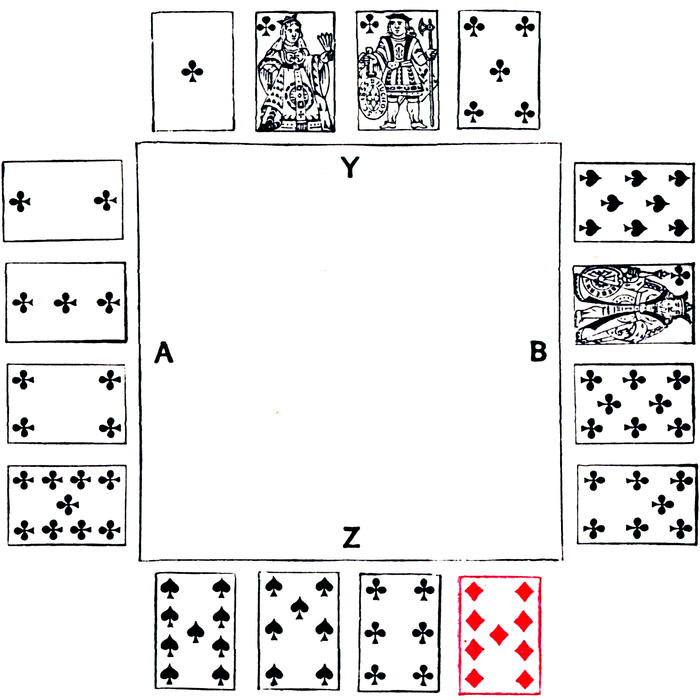
A 9♣, 4♣, 3♣, 2♣
Y A♣, Qn♣, Knv♣, 5♣
B 8♠, Kg♣, 8♣, 7♣
Z 9♠, 7♠, 6♣, 9♦
Score: AB, three; YZ, four. Spades trumps.
AB have six tricks and have played two by honours. It is known from the fall of the cards that A has no trump; also that Z has the long diamond. A to lead.
The Play and Remarks.—A leads a small club. Y puts on the ace second hand. In order to save (and win) the game, Y and his partner must win every trick (see statement of score and of fall of the cards). Y sees that to do this Z must have two of the three remaining trumps. This being so, Z can have but one club, and Y therefore puts on the ace of clubs second hand.
For other illustrations see Hands VIII and XV.
CASE II.
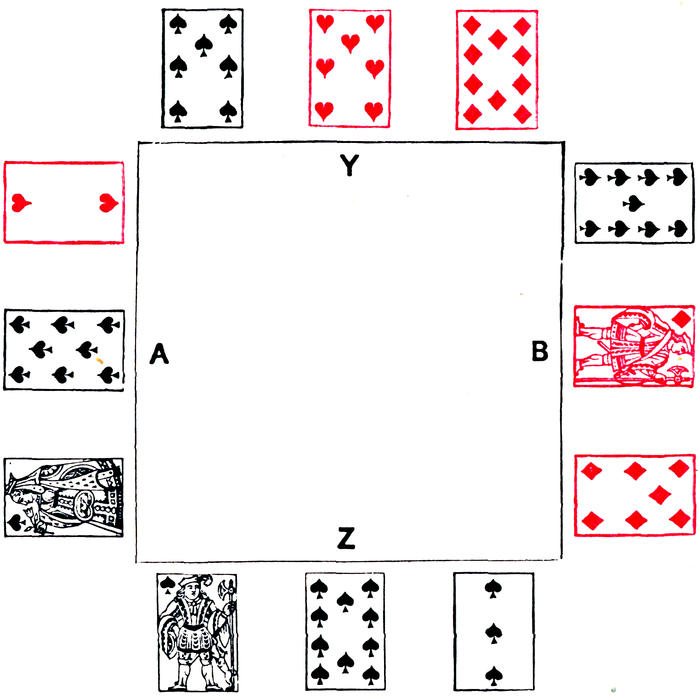
A Qn♠, 8♠, 2♥
Y 7♠, 7♥, 10♦
B 9♠, Knv♦, 7♦
Z Knv♠, 10♠, 3♠
Score: AB want two tricks to save the game. Hearts trumps. A to lead.
A knows Y to have the best heart; also B to have the best diamond and weak spades.
The Play and Remarks.—A leads the queen of spades, and then the losing trump. A takes the only chance of winning two tricks. To accomplish this Y must hold one spade and one diamond, as will appear by placing the unknown cards in any other way. A therefore plays on the assumption that Y holds a spade and a diamond in addition to the trump which is declared in his hand.
For another illustration of leading a losing trump to place the lead see Hand XXXV.
CASE III.
It is the duty of a player to make the game as easy to his partner as he can. The play often depends on the sort of partner. For example:—you lead the ten from king, queen, knave, ten, only, or from king, knave, ten, &c. Suppose the lead to be from the former combination, and that your ten forces the ace from the fourth hand. You obtain the lead again. The proper lead now is the queen. (See Analysis of Leads, p. 67). But, with an indifferent partner, the better lead is the king, as he may not have drawn the correct inference from the first lead, and knowing the queen is not the best, he may trump it.
However good your partner may be, you should not put him into unnecessary difficulties. For example:—
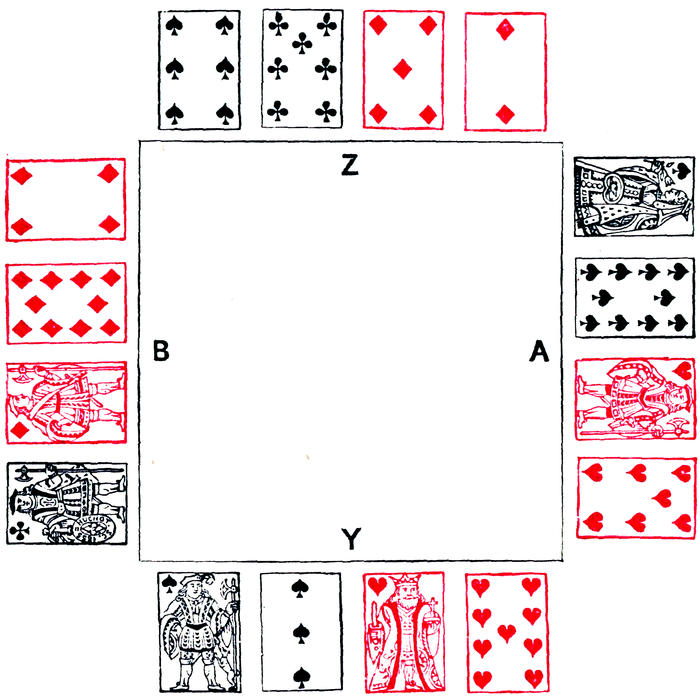
B Knv♣, Knv♦, 10♦, 4♦
Z 6♠, 7♣, 5♦, 2♦
A Qn♠, 10♠, Knv♥, 7♥
Y Knv♠, 3♠, Kg♥, 9♥
Spades trumps. Y can count two hearts, and queen, ten of spades in A's hand, and a small spade in Z's hand. A to lead.
The Play and Remarks.—A leads the seven of hearts. Y should put on the king, though certain of being able to win with the nine. For, if Y wins with the nine, he compels Z to play a coup, viz., to trump the best heart, in order to get the lead through the queen, ten of spades; but, if Y wins with the king and leads the losing heart, it requires no ingenuity on Z's part to trump it.
COUPS.
There is no Whist principle which should not be occasionally violated, owing to the knowledge of the hands derived from inference during the play. Some of the more frequent of the cases, where a general rule can be given for departing from rule, may advantageously close this Section.
LEADING FROM WEAKEST SUIT.
It is advisable in most cases where the game is desperate, and where it is clear that your partner must be strong in your weak suit to save the game, to lead your weakest suit, notwithstanding Principle 1 (p. 56). Your partner should finesse deeply in the suit you lead him, and should not return it, but, actuated by motives similar to yours, should lead his weakest suit, in which you should finesse deeply, and continue your weak suit, and so on.
For example: AB (partners) lead trumps. They win the first three tricks, and show four by honours, and three more trumps remain in A's hand. Consequently, if AB win another trick, they win the game. Y or Z now has the lead for the first time. His lead should be from his weakest suit, on this principle: if his partner has not the command of it, or a successful finesse in it, the game is lost. Say Y leads, and Z wins the trick. Z should not return Y's lead, but should similarly lead his weakest suit.
For an illustration of this coup, see Hand XXVII.
TREATING LONG SUITS LIKE SHORT ONES, AND VICE VERSÂ.
It often happens towards the end of a hand, that an unplayed suit, of which the leader holds (say) four cards, can only go round twice, e.g., there may be two trumps left in in one of the opponents' hands. In such a case, if your suit is headed by queen or knave, you should treat it as a suit of two cards only, and lead your highest, as this gives the best chance of making two tricks in the suit.
In the reverse case, where a suit can only go round once, it is obvious that a small card should be led, so as not to tempt partner to finesse. Thus, holding queen and one small card of an unplayed suit, which you are about to lead, all the opponents' cards but one being winning cards, the proper lead is the small card.
For an illustration see Hand XXII.
There is another case, known as Deschapelles' coup, where the proper card to lead is not determined by the leader's numerical power in the suit. It is this: all the adversaries' and partner's trumps are exhausted, and the leader's partner remains with an established suit. If the leader (not having any of his partner's suit left) is obliged to open a fresh suit headed by king, queen, or knave, he should lead the highest card, irrespective of the number of cards he holds in the suit, that being the best chance of subsequently procuring the lead for his partner in case his only card of entry in that suit should be an honour, not the ace.
For an illustration of this coup, see Hand XXVIII.
Deschapelles' coup often succeeds in practice, but it may generally be defeated by an attentive player. When the above-described position of the cards occurs, the adversary, if he has the ace of the fresh suit led, should not put it on first round. The suit will, in all probability, be continued with a low card, when the third player will most likely be compelled to play his highest, which will be taken by the ace; and, having lost the card of re-entry, he never brings in his suit, unless he gets the lead in some other way.
REFUSING TO WIN THE SECOND ROUND OF A SUIT.
This is a case of by no means infrequent occurrence. For example: one of the adversaries has a long suit declared in his favour, which is led a second time. Only one trump remains in, which is in the hand of the second or fourth player. As a rule, the second round of the suit should not be trumped. The third round will probably exhaust the adverse hand, which is numerically weak in the suit. If it so happens that the player who is numerically strong in it has no card of re-entry in any other suit, he will then never bring in his long suit, as his partner, whose hand is exhausted, cannot lead it again, should he get the lead after the third round. If there is a card of re-entry in the hand of the player who has numerical strength, he must bring in the suit, whether the second round is trumped or not.
See Hand XXIX for an illustration of this position.
A similar rule applies, but less frequently, when one adversary has the long trumps, and his partner a long suit nearly established.
For an illustration of this position, see Hand XXX.
DECLINING TO DRAW THE LOSING TRUMP.
When all the trumps are out but two, and the leader remains with the best trump, the losing trump being in the hand of his adversary, the natural and obvious play is to draw the last trump.
But there is a class of cases in which the trump should not be drawn as a matter of course, viz., if one adversary has a long suit established, and his partner has a card of that suit to lead.
The case usually happens in this way: YZ (partners) lead a suit, and after two rounds establish it. They then lead trumps from a suit of four trumps (see p. 123). Eleven trumps come out, and A (YZ's adversary) has the lead and the best trump, one of the opponents having the losing trump. The question then arises, Should A draw the trump?
A should draw the trump if he has also an established suit; or, if B (A's partner) has an established suit, and A can put the lead into B's hand. For, in these two cases, A or B cannot do better than bring in their suit. Again, A should draw the trump, if the adversary who has a suit established (say Z) has also the losing trump, for then, if either Y or Z has a card of re-entry in either of the other two suits, Z cannot be prevented from bringing in his established suit. Lastly, A should draw the trump if Y (Z's partner) has the losing trump, and Z has, declared in his hand, two cards of re-entry. The last case may be dismissed as of but little practical use, as, at the time when A has to decide whether he will draw the trump, he will seldom know enough about the remaining cards to be positive that Z has two cards of re-entry.
In the above cases, A, by not drawing the trump, makes his adversaries a present of a trick.
On the other hand, A should not draw the trump if one opponent (Z) has an established suit, which Y (Z's partner) can lead, the losing trump being in Y's hand. And, it is especially incumbent on A not to draw the trump, if either he or his partner has a suit which will probably be established by leading it, and if A can infer from the fall of the cards that Y has only one card of his partner's established suit in his hand, subject, of course, to the qualifications already noted.
The point aimed at in not drawing the trump, is, first to get the commanding card of A's or B's long suit out of the adverse hand. Y or Z thus obtains the lead, and continues the established suit, which A trumps with the winning trump. If, now, Z has no card of re-entry in the fourth—or unopened—suit, he never brings in his established suit, Y not having another card of it to lead.
The case is difficult to carry when stated thus generally; for an illustration, see Hand XXXI.
REFUSING TO OVERTRUMP.
Cases often happen where it is not advisable to overtrump. Most of these depend on the fall of the cards and on inferences from the play (see Hands XXIII, XXIV), and cannot be generalised. But there is one case in which it is never right to overtrump, viz., when three cards remain in each hand, and one player holds the second and third best trumps, with one of which he trumps the card led. If the player to his left has the best and fourth best trumps, he can never gain anything by overtrumping, and may lose a trick, as the following example shows:—
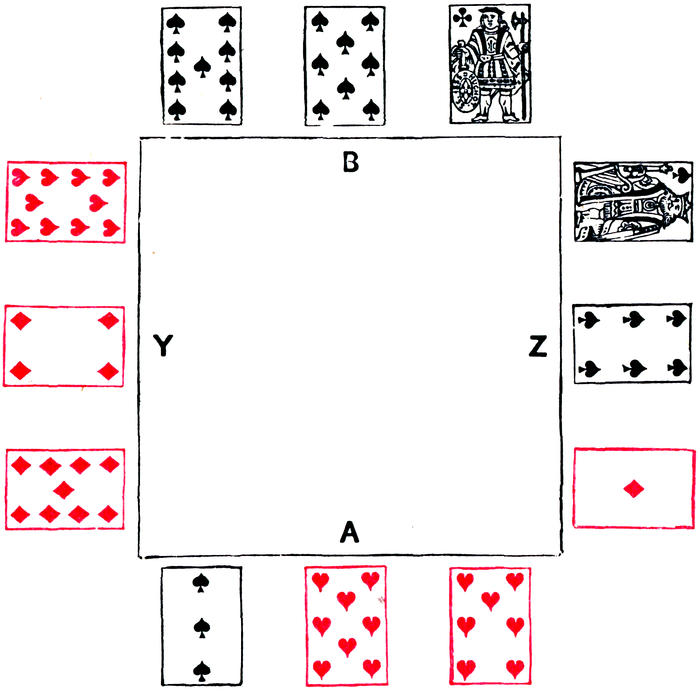
Y 9♦, 4♦, 10♥
B 9♠, 8♠, Knv♣
Z Kg♠, 6♠, A♦
A 3♠, 8♥, 7♥
The position of the trumps (spades) is known. A leads a heart, B trumps it. If Z overtrumps he loses the other two tricks, but if he throws the ace of diamonds he wins the other two tricks.
This rule for not overtrumping cannot be laid down absolutely when there are more than three cards in hand; but when only four trumps remain in, second and third best against best and fourth, it is so frequently advisable not to overtrump, that the player should consider well the position of the remaining cards before overtrumping.
For an illustration of this case, see Hand XXV.
Since it is so often right not to overtrump under these circumstances, it follows that when the case arises the player who holds second and third best should, as a rule, attempt to defeat the coup by playing a false card—i.e., he should trump with the higher card in hopes of deceiving his left hand opponent as to the position of the third best trump.
THROWING HIGH CARDS TO PLACE THE LEAD.
This coup presents itself in a variety of forms; the following are selected as likely to be of use.
Whenever you are left at the end of a hand with the tenace in trumps (either best and third best, or second best guarded) over the player to your right, and two other cards, both being cards of the suit led by him, you, second hand, should always throw the highest card of his lead to that trick. You can never lose by so doing, and may win. For example: you have nine and five of the suit led. Throw the nine. For, in the second round of the suit, it may so happen that you get the lead with the nine. If the cards lie thus, for instance:—
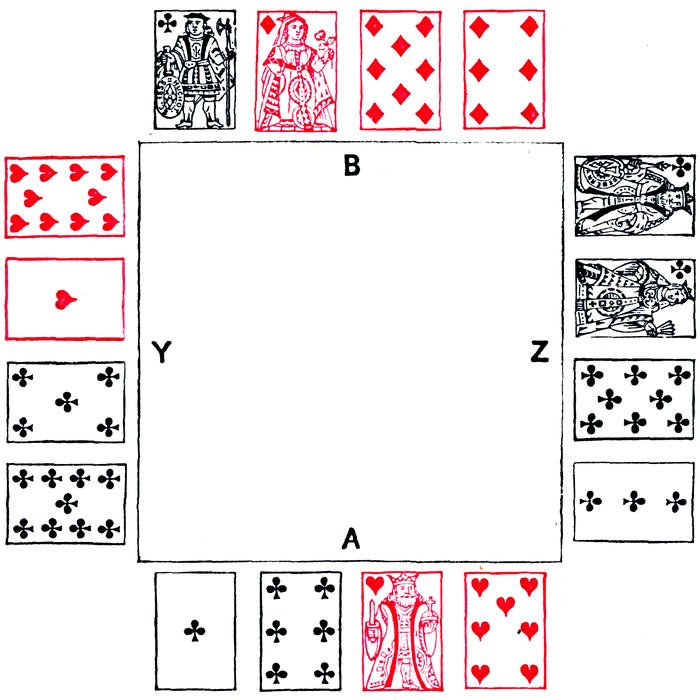
Y 9♣, 5♣, A♥, 10♥
B Knv♣, Qn♦, 8♦, 6♦
Z Kg♣, Qn♣, 8♣, 3♣
A A♣, 6♣, Kg♥, 7♥
Y has the tenace in hearts (trumps) over A. A leads ace of clubs. If Y does not throw the nine, and Z plays carelessly and fails to win Y's nine in the next round, YZ lose a trick. Of course, Z ought to win the second round, but it is Y's duty to render it impossible for Z not to do so (see Remarks on making it easy to Partner, p. 139).
The typical example of this coup is the case where the leader plays the ace, and the second player has king guarded, as in the following example:—
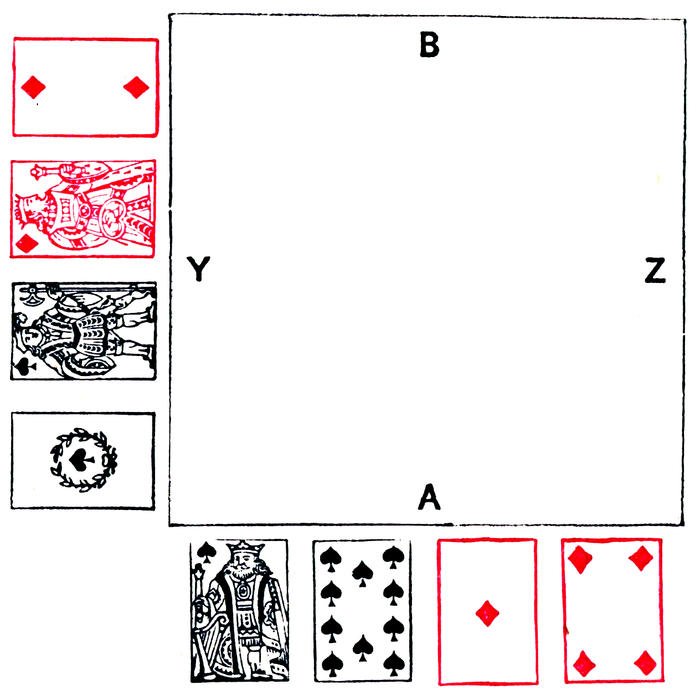
Y A♠, Knv♠, Kg♦, 2♦
B
Z
A Kg♠, 10♠, A♦, 4♦
Spades trumps. There are only four spades in, and Y knows that A has the king, ten. B's and Z's cards are immaterial.
A leads the ace of diamonds. If Y plays the two of diamonds he can only make two tricks; but, if he throws the king to the ace, he still makes two tricks, and, if his partner has the queen of diamonds, he makes three tricks.
This coup may be similarly played in plain suits. For an illustration see Hand XXXII.
The following fine coup (which occurred in actual play) exemplifies a similar, but more complicated, case:—
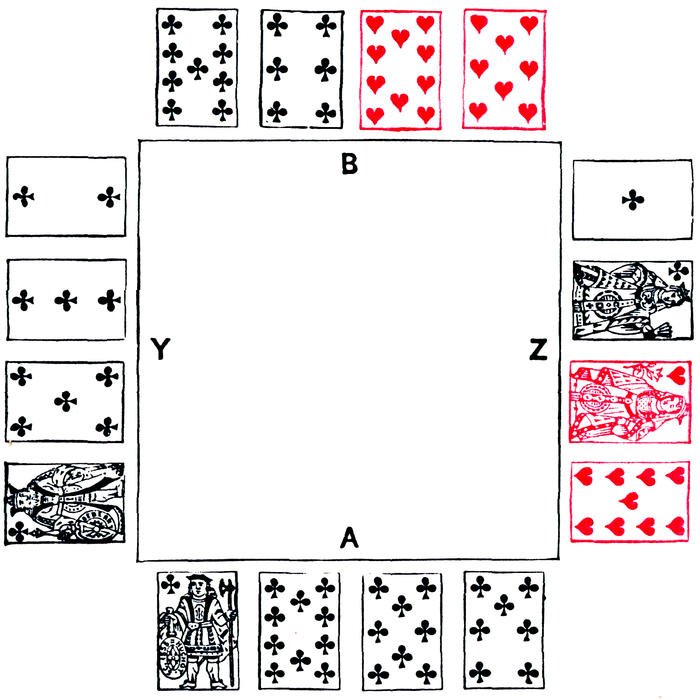
Y Kg♣, 5♣, 3♣, 2♣
B 9♣, 6♣, 10♥, 8♥
Z A♣, Qn♣, Qn♥, 9♥
A Knv♣, 10♣, 8♣, 7♣
Score: YZ require every trick. Hearts trumps. It is known that the trumps lie between B and Z.
A leads a club; Y and B play small clubs. Z, knowing that B holds the second best trump guarded, takes the only chance of saving the game, by winning the first trick in clubs with the ace, and returning the queen. Y, seeing his partner's anxiety to get rid of the lead, rightly conjectures him to hold the major tenace in trumps. He, therefore, wins his partner's queen of clubs with the king, and saves the game.
It being known that the remaining trumps lie between B and Z, Y would be right to win the second round of clubs under all circumstances of the score.
For another illustration of this coup, see Hand XXXIII.
On a similar principle, the leader not infrequently leads a losing plain card, or a losing trump, at the end of a hand, in order to place the lead. For illustrations, see Case II, p. 138, and Hands XVI, XVII, and XXXV.
THE GRAND COUP.
The Grand Coup consists in throwing away a superfluous trump. At the first glance it appears impossible to have a superabundance of trumps; but cases sometimes happen where a player has a trump too many. To get rid of this trump—as by undertrumping a trick already trumped by your partner, or by trumping a trick which he has won, or which you know he may win—is to play the grand coup.
The opportunity for playing the grand coup generally happens in this way. Two rounds of trumps come out, leaving five trumps in, two in the hand of (say) B, and three in the hand of Z (the player to his left). If B has the best and third best trumps, or the second best guarded, and trumps are not led again, nor used for trumping, it is clear that at the eleventh trick Z must obtain the lead, and must lead up to the tenace in trumps. If, before the eleventh trick, Z trumps a trick of his partner's (or, in the case of only seven trumps coming out in two rounds, undertrumps a trick already trumped by his partner), and the lead at the eleventh trick can thus be kept in—or put into—Z's partner's hand, the grand coup comes off, as in the following example:—
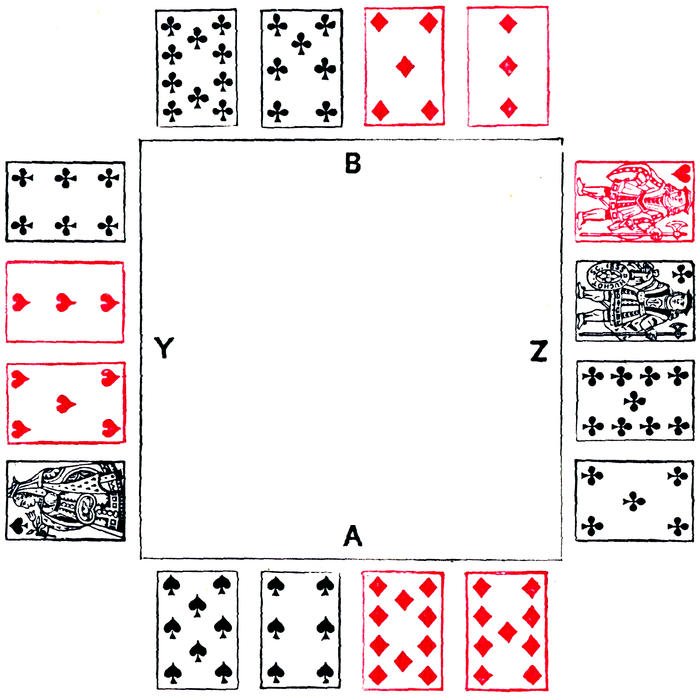
Y Qn♠, 5♥, 3♥, 6♣
B 10♣, 7♣, 5♦, 3♦
Z Knv♥, Knv♣, 9♣, 5♣
A 8♠, 6♠, 10♦, 9♦
Clubs trumps. Z knows that B has ten and another trump. A leads the ten of diamonds; Y trumps with the six of clubs; Z undertrumps with the five. If he retains his three trumps, and B refuses to trump the queen of spades next led by Y, Z loses a trick in clubs.
The opportunity for playing the grand coup is often missed. A player should always be on the look-out for it when he has five trumps, especially if a trump is led to his right. It should be added also, that if the player who attempts it retains a high card in his hand, he may be just as badly off as though he remained with three trumps. Thus, holding three trumps against two, and ace and another card of another suit, it is not sufficient that he disposes of one of his trumps; he should also get rid of his ace (see Remarks on Throwing High Cards to place the Lead, pp. 147-151). The following example will render this more clear:—
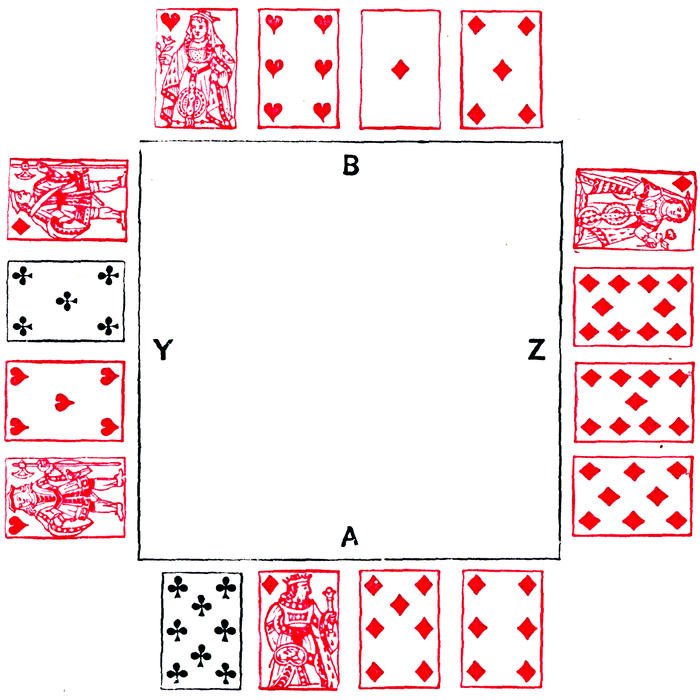
Y Knv♥, 5♥, 5♣, Knv♦
B Qn♥, 6♥, A♦, 5♦
Z Qn♦, 10♦, 9♦, 8♦
A 8♣, Kg♦, 7♦, 6♦
Hearts trumps. B has already got rid of his superfluous trump. A leads the eight of clubs. B should throw the ace of diamonds to it. For, if B has the lead after the next trick, he might just as well have kept his third trump. If A has the king of diamonds, B wins a trick by discarding the ace; and, if A has not the king, B loses nothing by throwing the ace.
An exception to this rule is when A has winning cards to go on with. Thus, if A had another club, B need not discard the ace of diamonds. This is too obvious to require working out.
The following is another aspect under which the grand coup may present itself:—
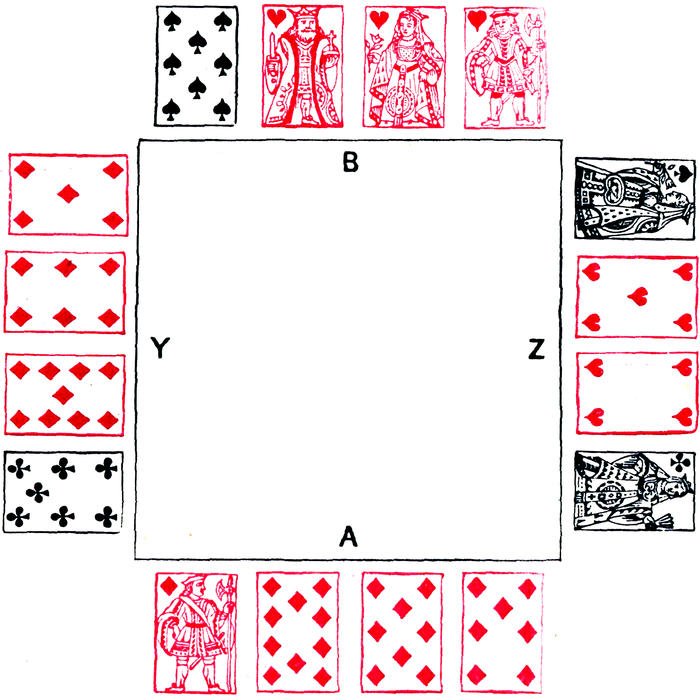
Y 7♣, 9♦, 6♦, 5♦
B 8♠, Kg♥, Qn♥, Knv♥
Z Qn♠, 5♥, 4♥, Qn♣
A Knv♦, 10♦, 8♦, 7♦
Hearts trumps. It is known that B has king, queen, knave of trumps, and a losing spade or club—but uncertain which.
A leads the knave of diamonds. B trumps it.
Z should throw away a small trump, undertrumping B in order to keep two winning queens. If he discards a queen, he must do so at random, and perhaps throw away the suit of which B has the small one. By discarding his useless trump (which B would proceed to draw) he defers parting with either queen till after the next round, when the fall of the cards may assist him. B now leads a trump, and Y discards the losing club. B then leads another trump, and Z now knows that he ought to keep the spade. This case actually occurred in the presence of the writer, but Z, instead of undertrumping, discarded the wrong queen at random, and eventually lost the rubber in consequence.
For further illustrations of the Grand Coup, see Hands XXXVIII and XXXIX.
If the foregoing principles are reflectively perused, it will be seen that they mould the Theory of Whist into a harmonious whole. The Theory of Whist tells you how to play your own hand to the greatest advantage, how to assist your partner, and how to weaken and to obstruct your opponents; in short, it teaches how to take the best chance of making the greatest number of tricks. This knowledge constitutes a sound player. If to theoretical perfection you add the power of accurate observation, and of acute perception, together with a thorough comprehension of the whist capacities of partners and of opponents, you have all the elements necessary to form a Master of the Science.