Front matter
Reading edition

By KATHARINE ELIZABETH DOPP, Ph. D. The Extension Division of The University of Chicago. Author of “The Place of Industries in Elementary Education.”
———————————
Book I. THE TREE-DWELLERS. THE AGE OF FEAR. Illustrated with a map, 14 full-page and 46 text drawings in half-tone by Howard V. Brown. Cloth. Square 12mo. 158 pages. For the primary grades.
Book II. THE EARLY CAVE-MEN. THE AGE OF COMBAT. Illustrated with a map, 16 full-page and 71 text drawings in half-tone by Howard V. Brown. Cloth. Square 12mo. 183 pages. For the primary grades.
Book III. THE LATER CAVE-MEN. THE AGE OF THE CHASE. Illustrated with 27 full-page and 87 text drawings in half-tone by Howard V. Brown. Cloth. Square 12mo. 197 pages. For the primary grades.
Book IV. THE EARLY SEA PEOPLE. FIRST STEPS IN THE CONQUEST OF THE WATERS. Illustrated with 21 full-page and 117 text drawings in half-tone by Howard V. Brown and Kyohei Inukai. Cloth. Square 12mo. 224 pages. For the intermediate grades.
Other volumes, dealing with the early development of pastoral and agricultural life, the age of metals, travel, trade, and transportation, will follow.
TO

I DEDICATE THIS BOOK
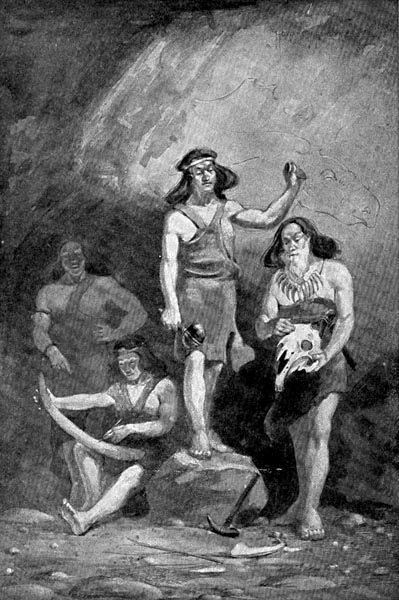
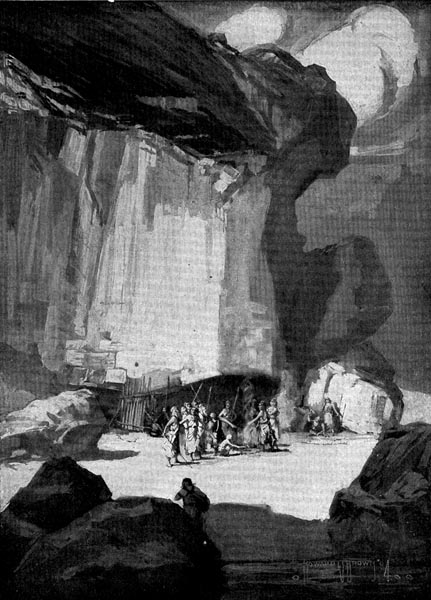
“A feeling of awe came over them while they worked.”—Page 172.
Copyright, 1906 By Katharine Elizabeth Dopp Entered at Stationers’ Hall Edition of 1928

Made in U. S. A.
The series, of which this is the third volume, is an attempt to meet a need that has been felt for several years by parents and physicians, as well as by teachers, supervisors, and others who are actively interested in educational and social progress. The need of practical activity, which for long ages constituted the entire education of mankind, is at last recognized by the elementary school. It has been introduced in many places and already results have been attained which demonstrate that it is possible to introduce practical activity in such a way as to afford the child a sound development—physically, intellectually, and morally—and at the same time equip him for efficient social service. The question that is perplexing educators at the present time is, therefore, not one regarding the value of practical activity, but rather one of ways and means by which practical activity can be harnessed to the educational work.
The discovery of the fact that steam is a force that can do work had to await the invention of machinery by means of which to apply the new force to industrial processes. The use of practical activity will likewise necessitate many changes in the educational machinery before its richest results are realized. Yet the conditions that attend the introduction of practical activity as a motive power in education are very different from those that attended the introduction of the use of steam. In the case of steam the problem was that of applying a new force to an old work. In the case of practical activity it is a question of restoring a factor which, from the earliest times until within the last two or three decades, has operated as a permanent educational force.
The situation that has recently deprived the child of the opportunity to participate in industrial processes is due, as is well known, to the rapid development of our industrial system. Since the removal of industrial processes from the home the public has awakened to the fact that the child is being deprived of one of the most potent educational influences, and efforts have already been made to restore the educational factor that was in danger of being lost. This is the significance of the educational movement at the present time.
As long as a simple organization of society prevailed, the school was not called upon to take up the practical work; but now society has become so complex that the use of practical activity is absolutely essential. Society to-day makes a greater demand than ever before upon each and all of its members for special skill and knowledge, as well as for breadth of view. These demands can be met only by such an improvement in educational facilities as corresponds to the increase in the social demand. Evidently the school must lay hold of all of the educational forces within its reach.
In the transitional movement it is not strange that new factors are being introduced without relation to the educational process as a whole. The isolation of manual training, sewing, and cooking from the physical, natural, and social sciences is justifiable only on the ground that the means of establishing more organic relations are not yet available. To continue such isolated activities after a way is found of harnessing them to the educational work is as foolish as to allow steam to expend itself in moving a locomotive up and down the tracks without regard to the destiny of the detached train.
This series is an attempt to facilitate the transitional movement in education which is now taking place by presenting educative materials in a form sufficiently flexible to be readily adapted to the needs of the school that has not yet been equipped for manual training, as well as to the needs of the one that has long recognized practical activity as an essential factor in its work. Since the experience of the race in industrial and social processes embodies, better than any other experiences of mankind, those things which at the same time appeal to the whole nature of the child and furnish him the means of interpreting the complex processes about him, this experience has been made the groundwork of the present series.
In order to gain cumulative results of value in explaining our own institutions, the materials used have been selected from the life of Aryan peoples. That we are not yet in possession of all the facts regarding the life of the early Aryans is not considered a sufficient reason for withholding from the child those facts that we have when they can be adapted to his use. Information regarding the early stages of Aryan life is meager. Enough has been established, however, to enable us to mark out the main lines of progress through the hunting, the fishing, the pastoral, and the agricultural stages, as well as to present the chief problems that confronted man in taking the first steps in the use of metals, and in the establishment of trade. Upon these lines, marked out by the geologist, the paleontologist, the archæologist, and the anthropologist, the first numbers of this series are based.
A generalized view of the main steps in the early progress of the race, which it is thus possible to present, is all that is required for educational ends. Were it possible to present the subject in detail, it would be tedious and unprofitable to all save the specialist. To select from the monotony of the ages that which is most vital, to so present it as to enable the child to participate in the process by which the race has advanced, is a work more in keeping with the spirit of the age. To this end the presentation of the subject is made: First, by means of questions, which serve to develop the habit of making use of experience in new situations; second, by narrative, which is employed merely as a literary device for rendering the subject more available to the child; and third, by suggestions for practical activities that may be carried out in hours of work or play, in such a way as to direct into useful channels energy which when left undirected is apt to express itself in trivial if not in anti-social forms. No part of a book is more significant to the child than the illustrations. In preparing the illustrations for this series as great pains have been taken to furnish the child with ideas that will guide him in his practical activities as to illustrate the text itself.
Mr. Howard V. Brown, the artist who executed the drawings, has been aided in his search for authentic originals by the late J. W. Powell, director of the United States Bureau of Ethnology, Washington, D. C.; by Frederick J. V. Skiff, director of the Field Columbian Museum, Chicago, and by the author. Ethnological collections and the best illustrative works on ethnological subjects scattered throughout the country have been carefully searched for material. Many of the text illustrations of this volume are reproductions of originals found in the caves and rock shelters of France. K. E. D. October, 1906.
page
Dedication 7
Preface 8
Contents 12
Illustrations 13
THE LATER CAVE-MEN the age of the chase
page
The Reindeer Start for their Summer Home 15
Chew-chew 20
Fleetfoot’s Lessons 23
After the Chase 27
Why the Cave-men Made Changes in their Weapons 32
How the Cave-men Made Delicate Spear Points 36
The Return of the Bison 41
The First Bison Hunt of the Season 46
What Happened when the Children Played with Hot Stones 50
Why the Children Began to Eat Boiled Meat 54
The Nutting Season 56
Why Mothers Taught their Children the Boundary Lines 62
What Happened to Fleetfoot 65
How the Strangers Camped for the Night 69
Fleetfoot is Adopted by the Bison Clan 72
How the Cave-men Protected Themselves from the Cold 77
How the Children Played in Winter 81
Overtaken by a Storm 84
How Antler Happened to Invent Snowshoes 88
How Antler Made Snares 92
How Spears Were Changed into Harpoons 97
How the Cave-men Hunted with Harpoons 101
How the Cave-men Tested Fleetfoot and Flaker 105
Fleetfoot and Flaker See a Combat 109
What Happened when Fleetfoot and Flaker Hunted the Bison 111
What the Cave-men did for Flaker 115
How Flaker Learned to Make Weapons of Bone 118
How Flaker Invented the Saw 121
The Reindeer Dance 124
Fleetfoot Prepares for his Final Test 128
Fleetfoot Fasts and Prays 132
The Meeting of the Clans 139
What Happened when the Clans Found Fleetfoot 143
Fleetfoot’s Return 147
Willow-grouse 150
How Fleetfoot and Willow-grouse Spent the Winter 153
How Willow-grouse Learned to Make Needles 157
How Flaker Became a Priest and a Medicine Man 161
How the Cave-men Learned to Boil and to Dry Foods 165
The New Home 168
How the Clans United to Hunt the Bison 173
How Things Were Made to Do the Work of Men 178
How the Cave-men Rewarded and Punished the Clansmen 182
Suggestions to Teachers 185
FULL PAGE
page
“A feeling of awe came over them while they worked” Frontispiece
“Pigeon boiled meat and gave it to the men, and they all sounded her praises” 14
“The reindeer swam through the deep water and waded out to the opposite bank” 17
Chew-chew telling stories to Fleetfoot 21
“Then Scarface threw, and all the horses took fright” 25
“Chew-chew took her basket and started up the dry ravine” 29
“She took a flint point and scratched the men’s arms until she made big scars” 31
“Straightshaft saw the herd at sunrise and made a sign to the men” 42
“At the close of the day there was not a little valley in the surrounding country that did not have a herd of two or three hundred bison” 45
“With a quick snort he turned and charged” 47
“Chew-chew tried to teach the children how to know the hissing sound” 53
“All the women and children went nutting” 57
The wild hogs were having a feast 59
“Mothers taught their children what the boundaries were” 63
“A big man caught him, and put him upon his shoulder” 67
“The tent was an old oak, which reached out long and low-spreading branches” 70
“Greybeard asked Fleetfoot to drop the hot stones in the water again” 76
“When the men saw the new garment they wondered how it was made” 79
“But many could find no protection, so they turned about and faced the storm” 87
“And so the Cave-men tested the boys in many different ways” 104
“Then their antlers crashed in a swift charge” 108
“They looked so much like wolves that they got very close before the bison threatened” 113
“What the Cave-men did for Flaker” 116
“People began to wander away from their old homes” 129
“It was the melting of this glacier which fed the little stream” 136
“Greybeard, now old and feeble, walked all the way to the spot” 171
After the bison hunt 181
TEXT
A reindeer 16
A stone ax 24
A stone knife 32
A laurel leaf 32
Laurel leaf-shaped spear point 32
A stone scraper 34
A shaft-straightener 35
A delicate spearhead 36
“When the Cave-men held the flint in the hand, the hand yielded to the light blow” 37
“While Scarface placed the punch he sang in low tones” 37
Straightshaft using a flaker 38
A flaker 39
An ibex 43
A bear’s tooth awl 51
A scraper 73
A skin stretched on a frame 73
A hammer of reindeer horn 74
A cave-man’s glove 80
A stone maul 89
Fur gloves 90
A snowshoe 91
“Then she set snares on the ground and fastened them to strong branches” 94
“Antler learned to protect the cord by running it through a hollow bone” 94
“So it ran along and nibbled the bait until its sharp teeth cut the cord” 95
A chisel-scraper 98
A barbed point 99
A harpoon 100
Chipper using a spear-noose 102
A Cave-man’s carving of a “hamstrung” animal 114
A wedge or tent pin 119
The head of a javelin 120
A small antler 121
A knife with two blades, a saw, and a file, all in one 122
A Cave-man’s dagger 123
A Cave-man’s mortar stone 125
A drum 126
The engraving of a cave-bear 131
A stone borer 134
A necklace of fossil shells 139
A throwing-stick 145
An Irish deer 146
A fragment of a Cave-man’s baton, engraved 147
A Cave-man’s nose ornament 149
A Cave-man’s baton, engraved 149
An Eskimo drawing of reindeer caught in snares 151
“A piece of sandstone for flattening seams” 152
A reindeer snare 152
Three views of a Cave-man’s spearhead 154
“It was during this time that the Bison clan learned to use the throwing-stick” 155
Harpoons with several barbs 156
A bone awl 157
A bone pin 157
A large bone needle 157
A bone from which the Cave-men have sawed out slender rods for needles 158
A piece of sandstone used by the Cave-men in making needles 158
A flint comb used in rounding and polishing needles 158
A flint saw used in making needles of bone 158
A short needle of bone 159
A flint comb used in shredding fibers 159
A long fine needle of bone 159
Two views of a curved bone tool 160
A Cave-man’s engraving of two herds of wild horses 162
A Cave-man’s carving of horses’ heads 163
A Cave-man’s engraving of a reindeer 163
Harpoons of reindeer antler 166
A flint harpoon with one barb 167
A spoon-shaped stone 167
A baby’s hood 169
“In summer he played in the basket cradle” 169
First step in coiled basketry 170
Second step in coiled basketry 170
Three rows of coiled work 170
A water basket 172
A Cave-man’s engraving of a tent showing the interior structure 175
A Cave-man’s engraving of a tent showing the exterior 175
A Cave-man’s engraving of a tent with covering pulled one side so as to show the ends of the poles which support the roof 175
Framework showing the best kind of a tent made by the Cave-men 176
A tent pin 176
Handle of a Cave-man’s hunting-knife with engraving 182
A hunter’s tally 183
Fragment of Cave-man’s baton 183
Engraving of a seal upon a bear’s tooth 184
A Cave-man’s hairpin, engraved 184
“Pigeon boiled meat and gave it to the men, and they all sounded her praises.”—Page 166.
THE LATER CAVE-MEN
THE AGE OF THE CHASE